Je suis headbutt guyFootnote 1
A scrawny peripatetic youth who spins records, makes coffee, and paints graffiti stands in Lutruwita/Tasmania, before the world as an individual, a character on a remote island, and becomes galvanized in the global popular imaginary.
Astro Labe wears a black T-shirt featuring a Vodou Gede inscribed with “Too Weird to Live Too Rare to Die,” explaining to 7News why he took the opportunity to headbutt Tony Abbott (Qldaah 2017). (Screenshot by Nancy Mauro-Flude)

ACT I
“Coup de Théâtre” commences on 21 September 2017, 16:35 AEST, location coordinates: latitude 42.8746°S, longitude 147.3175°E.
Astro Labe drinks with friends at The Whaler, a pub on the waterfront in Hobart’s Salamanca district. He spots former Australian Prime Minister (PM) Tony Abbott walking nearby and approaches him gesturing for a handshake. As Abbott reaches his hand, Astro Labe grasps it, lunges forward. His brow grazes Abbott’s lips. A nonchalant Liverpool Kiss. Making haste, Astro Labe swiftly departs, muttering, incantating a raison d’être.Footnote 2
ACT II
“I, Astro Labe” resumes on 22 September 2017, 13:36 AEST, location coordinates: 42.8746°S, 147.3175°E, on the internet and in the streets of numerous capital cities.
On the evening of Astro Labe’s improvised coup de théâtre, a swarm of media envoys descend upon the bar in search of the local antihero. Pulled from a close-knit gathering mourning the unexpected loss of a close friend, he is thrust into the spotlight to field a tempest of questions from journalists representing The Guardian, The Australian Broadcasting Corporation (ABC), SBS News, Seven News, Sky News, and Fairfax Media, among others. Astro Labe reasons:
I am a lone anarchist that felt the need to headbutt Tony Abbott because I didn’t think it was an opportunity I’d get again. (in Burgess Reference Burgess2017)
I picked up pace and went “Tony, Tony, can I shake your hand?” […] Apparently he got a fat lip but he didn’t have one this morning. (in SBS News Reference News2017b)
I believe in human rights, and that’s largely why I hate Tony Abbott. He doesn’t believe in any human rights. (in SteveP 2017)
[It] was just a lifelong ambition to headbutt a fascist because I’m a skinhead that likes ska music and hates fascism. He’s an evil c---, I’m an anarchist. (in Koziol and Maloney Reference Koziol and Maloney2017)
He’s one of the sickest examples of why Australian society is so archaic in 2017. There is no connection to the Bible in his actions […] He’s a gentrified rich kid. He personifies everything I hate politically, and he’s not even good at it. If I see an opportunity to improve my life and those around me by nutting Tony Abbott, I’m a pretty pragmatic guy. […] It’s just about Tony Abbott—the fucking worm that he is […] All it was is I saw Tony Abbott and I’d had half a skinful and I wanted to nut the cunt. (in Morton Reference Morton2017; emphasis added)
As if waiting in the wings to enter an ambush of interviews, he demolishes in a brilliant fusillade everything about Abbott he doesn’t like. Notable is the sartorial sagacity of Astro Labe, clad in a black T-shirt, inscribed with “Too Weird to Live, Too Rare to Die” starring the white-painted skull-like face of Guédé Baron Samedi, a Vodou custodian of the Loa spirits, mischievous ruler of the crossroads between death and the living, smoking a cigar and playing the accordion, delivering safe passage to the underworld (fig. 1). This intermediary dandy for the moribund offers no mercy to those who take themselves too seriously. Invoked in healing rituals, Baron Samedi manifests in the human medium through obscene conduct, queer code switching, coupling a formal top hat with high-heeled shoes, sissy walk, death drop, a formidable drinking appetite, and ragtag licentious debauchery.
“Last Week Tonight with John Oliver Talks Tony Abbott Getting Headbutted by Tasmanian Anarchist Astro Labe, aka DJ Funknukl” (Twisted Flow Fan 2017). (Screenshot by Nancy Mauro-Flude)

Astro Labe careens through the live broadcast media storm, offering candid testimonies for his faux pas, consistently complicating public assumptions about his intent. In moments it was as if his pragmatic speculations, cathartic alarums, and digressions surfaced from abyssal currents. The outrageous sentiments gifted journalists and commentators with a torrent of offbeat headlines and status updates: “GAY-MARRIAGE CRUSADERS MAKE ASTRO THEIR HEADBUTTING HERO” (Bolt Reference Bolt2017); “Hobart DJ Astro ‘Funknukl’ Labe Charged over Alleged Headbutt Assault of Former PM” (Burgess Reference Burgess2017); “Australia’s Former Prime Minister Gets a Glasgow Kiss, This DJ drunkenly headbutted Australia’s former Prime Minister and honestly? He’d do it again” (The Jim Jefferies Show 2017); “‘Nothing to Do with Same-Sex Marriage’: Anarchist DJ Who Headbutted Tony Abbott” (Koziol and Maloney Reference Koziol and Maloney2017); “DJ ‘Six-out-of-10’ Drunk When He Headbutted Tony Abbott” (James Reference James2018); “DJ Astro Labe Admits Headbutting Tony Abbott after Hobart Drinking Session” (Shine Reference Shine2018); and so on.
Astro Labe, a “degenerate” star, went nova, garnering attention from arbiters, art critics, and general public audiences worldwide. Transfixed on-air TV personalities eagerly wove their own analyses of Astro Labe’s eccentric standpoint theories into the coverage, including segments on The Jim Jefferies Show (featuring Brad Pitt’s Weatherman Cameos) and Last Week Tonight with John Oliver:
Here’s the important thing: I am in no way condoning Tony Abbott being attacked. What I will say is: thinking to yourself, “There’s Tony Abbott. I’m going to head-butt him,” is entirely natural. It’s an automatic human response. It’s like, “There’s a puppy. I’m going to pet it.” Or, “There’s Sean Penn. I’m not going to see that movie.” (Twisted Flow Fan 2017)
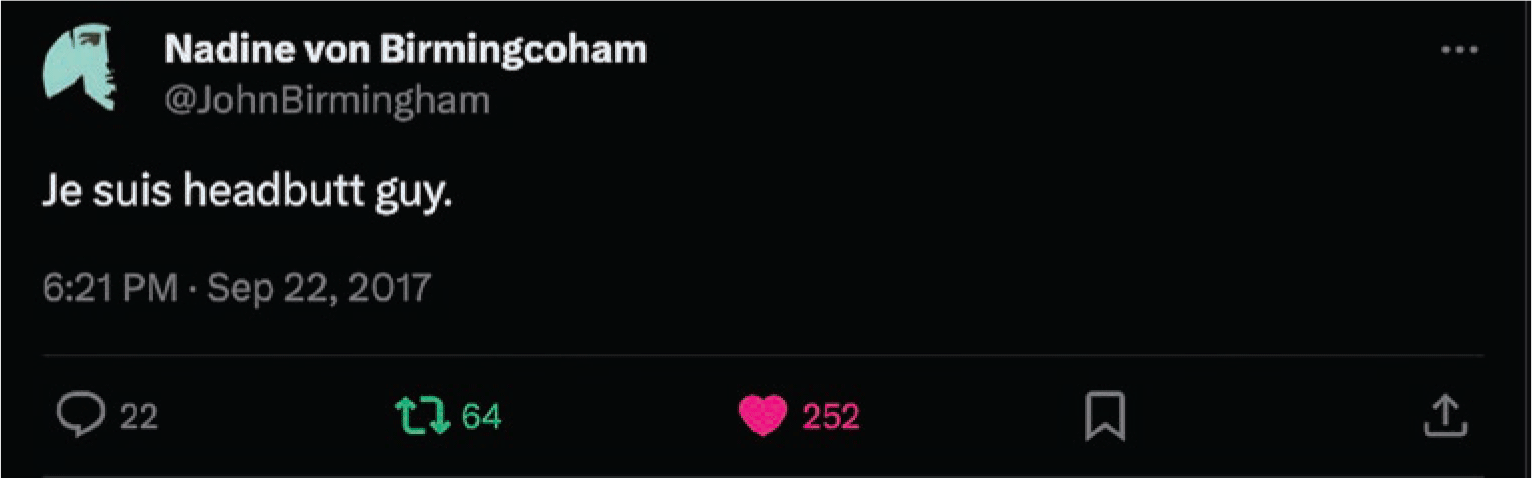
Astro Labe’s “Spartacus moment” partially realized in John Birmingham’s 2017 “Je suis headbutt guy” tweet, which co-opts the resistance rhetoric from “Je suis Charlie,” the French solidarity refrain. (Screenshot by Nancy Mauro-Flude)

Across the social media firmament, posts, replies, and feeds of solidarity and outrage rolled and raged like colliding stellar clusters, dawning new constellations of attention. John Birmingham, a writer famed for his irreverent take on subculture,Footnote 3 posted “Je suis headbutt guy” to his 86.8K followers on the pre-Muskovian Twitter (fig. 3). His sentiment sparked 68 retweets, 298 likes, and a slew of replies: #KudosAstroLabe; Je suis #NutTheCunt; He should’ve shirt fronted him. That Abbott could never have played the upper hand… #justsayin; moi aussi; Nous sommes tous headbutt guy; and Ich bin ein headbutter. There was a cascade of theatrical declarations and solidarity phrases crossing languages and registers, echoing Stanley Kubrick’s “I am Spartacus” (Spartacus, 1960) and John F. Kennedy’s 1963 “Ich bin ein Berliner” speech at the Berlin Wall, a phrase erroneously criticized for referring to a popular jelly doughnut.
The chorus of satirical lexical accords evokes the axioms of guerrilla theatre, a concept formulated by R.G. Davis in 1964 (Davis [Reference Davis1964] 1970), who traces the concept in part to Che Guevara’s handbook on Guerrilla Warfare (1961). Guerrilla Theatre refers both to the broader genre of socially and politically engaged, in-situ/site-responsive performance and, more specifically, to the methodology of contemporary political protest performance.
Richard Schechner advises:
You must know the differences among friendly, neutral, unfriendly, and hostile places/audiences. And you must be prepared to cope with what you expect—that is, be ready to split quickly after an action in an unfriendly place; or, on the other hand, be ready to stick around and rap for a long time in a friendly place. (1970:166)
The perceptual awareness of a performing artist fortifies their craft. As he orbited into prominence from obscurity, Astro Labe deftly wielded these dramatic spatial techniques in spades.
The Story in the Space
Being in Tasmania is being-with-the-archive (Shipway Reference Shipway2017). To veritably live in this remote isle means to reckon with the motley crew of contested, affectively charged artifacts, nomenclatures, schemes, rumors, and proto-linguistic utterances of local inhabitants on a daily basis. A guest may bear witness to the myriad fishtail skids and spherical “donuts” etched onto road surfaces. Each tire burn in the bitumen is a testament of its maker. This vernacular rite-of-passage is a cultural tradition yet is branded as criminal hooliganism. The makers’ rips and slews bedevil the living fabric of the ostensibly tranquil environs. The very countenance of these opaque insignias is how the islander archive is most suitably assembled. The tense past/present of erasures and dormancies, of intergenerational maintenance practices of Indigenous knowledge intertwined with and/or resting alongside settler histories shaped by forced migration, servitude, and convict labor in Lutruwita/Tasmania, lie waiting to be deciphered. Dormant knowledge reemerges through potent reactivation rituals and truthtelling.
Lutruwita/Tasmania sits at a paradoxical frontier: a place celebrated for its pristine qualities, the “world’s cleanest air” (CSIRO 2026), a verdant World Heritage environment, and more than a decade of below–Net Zero climate performance. Yet it is marked by a literacy rate of around 60%, the worst in the nation (Thomas et al. Reference Thomas, McCosker, Parkinson, Hegarty, Featherstone, Kennedy, Lyndon Ormond-Parker, Rea and Ganley2025), and by significant asymmetric disparities in access and affordability that limit socioeconomic participation. These conditions coexist alongside the world’s oldest continuing oral cultures (Hamacher et al. Reference Hamacher, Nunn, Gantevoort, Taylor, Lehman, Law and Miles2023). Together, these realities reveal structural inequities that mirror broader socioeconomic divides, discernible by “The fact that such a paradox can exist in the heart of a single people and place is not easy to grasp. But without at least attempting to grapple with Tasmania’s contradictions, the island remains impossible to explain” (Croome Reference Croome2013:36). Many locals remain reliant on tacit knowledge, what is felt and lived, but rarely formally recognized.
Accordingly, I return to The Whaler, a watering hole with a rugged history dating back to the British Empire whaling industry boom, where Astro Labe’s guerrilla theatre took root. A meeting spot where “more police information could be located than leaves falling from trees in autumn” (Dennison Reference Dennison2008). Astro Labe’s farce echoes in this charged demesne as a compelling performative rupture imbued with the weight of the island’s equivocal tensions and “strange narrative density” (Mead Reference Mead2001:15). Predominant, unsettling accounts of forced migration, carceral violence, and convict tales rehearsed ad infinitum tend to shroud or annihilate the catastrophic reverberations of colonial incursion that efface the enduring survival and resistance of islanders and local First Nations peoples, carried forward through their descendants, the Palawa custodians.Footnote 4 To gain a better vantage point of the dense understory is indispensable in this contemporary context.
The imbroglios of exchange, protocols, and relations are examined by the two Australian feminist economic geographers who write under the shared name J.K. Gibson-Graham. Notably, the deliberate adoption of a single shared name is a sassy political gesture that refuses the mythology of the singular Author-God. Their naming performs the symbiotic argument that knowledge is not proprietary property but something cocreated and embedded in relational communities of practice: a dense thicket of “trust, care, sharing, reciprocity, cooperation, coercion, bondage, thrift, guilt, love, equity, self-exploitation, solidarity, distributive justice, stewardship, spiritual connection, environmental and social justice” (Gibson-Graham Reference Gibson-Graham2014:1). The synergy of Gibson-Graham becomes a material demonstration of the networked feminist commons they theorize and advocate for. A key anchor point for their diverse economies theory (2006a, 2006b, 2008, 2014) is the Diverse Economies Iceberg model (fig. 4) that makes salient the vast reservoir of radical economic alterities and anomalous manifestations of subsistence, social reciprocity, and informal trade and exchanges occurring beneath the economic “waterline.” In the context of Lutruwita/Tasmania, these include practices such as: peers gifting each other artworks, seed saving and swapping, backyard food economies, home fermentation, intergenerational caregiving, neighbor-to-neighbor tool lending, foraging, grassroots music networks, cooperative land regeneration, and collective responses to bushfire resilience.
Diverse Economies Iceberg by Community Economies Collective (2015). (Licensed under a Creative Commons Attribution-ShareAlike 4.0 International License)

Above the watermark sit the regulated and formalized transactions of capitalist wealth: inherited land and property, entrenched social stratification (including elite educational pathways that reproduce political leadership), gatekeeping and cronyism, proprietary systems of ownership that restrict access and participation, corporate-controlled platforms and infrastructures, wage labor and servitude, and markets governed by economic rationalist logics of commodification. These structures shape access to housing, employment, infrastructure, cultural resources, and political power, reproducing inequities even as the state is publicly positioned as environmentally progressive. As Ursula K. Le Guin reminds us, “The individual cannot bargain with the State. The State recognizes no coinage but power: and it issues the coins itself” ([1974] 2015:272). By turning toward other capricious forms of exchange, often informal, volatile, and unrecognized, we begin to better understand the systemic struggles, intergenerational inequalities, and lived realities of entrenched illegitimacy and illiteracy in remote and nonmetro regions that emerge in unorthodox and off-beat forms of trade. It is posited that local eclectic customs often enable social cohesion through deeper comprehension and meaningful reception of systemic struggles. These forms of exchange have affinities with what Schechner describes as “guerrilla theatre,” which “is, in many ways like wall posters or pamphlets. To people who distrust reading and who are accustomed to less linear means of communicating, guerrilla theatre is a succinct language” (1970:166). Tactical media practices like these turn away from grand acts toward modes of activity that are negotiated. In this sense, sites like the bar at the waterfront, or spaces opened by skids on the street emerge as more than backdrops or sceneries for social imbibing; they become tangible stages where culture is embodied.
The tide lines of velocity unfold in the traces of these practices, revealing a vulnerable yet flourishing realm where knowledge is shared through counterpublic resistance, mutual aid, off-the-record relations, and spirited, tacit insignias of effervescent interchange. The radical legacies and invocations of Dada, the Situationists, and DIY punk movements demonstrate how ceremony, artifact, and action can propel social engagement through diverse and eccentric communicative forms and means that extend beyond the confines of state-sanctioned theatre institutions. The methods of capricious dramaturgies can tune us to off-kilter frequencies—to the dances that resonate beyond capitalist veneers. Critically, the prescient timing of the “so-called Liverpool kiss” (Abbott in Stanley Reference Stanley2017) coincided with the national referendum on same-sex marriage, a cause Abbott staunchly opposed; his very presence on the island was to rally support from the dwindling no voters. An unwelcome figure to many residents, Abbott sought leverage from this confrontation: “[C]learly this bloke wanted to make his contribution to the current debate” (in Morton Reference Morton2017), pointing to the yes sticker on Astro Labe’s jacket as framing evidence. Abbott’s erroneous assumption was met with fervent denials by Astro Labe: “Someone had just stuck a campaign sticker on me. I’m not an activist, but of course, I believe in human rights and equality” (in Morton Reference Morton2017)Footnote 5 —adeptly managing the public speculation. The then attorney general, George Brandis, confirmed, “This man had absolutely nothing to do with those who advocate for a yes vote in the same-sex marriage postal survey, absolutely nothing” (in Burgess Reference Burgess2017)—tossing a wrench into Abbott’s apparatus driven by the apparent threat that “We will all lose, in the brave new world of same-sex marriage” (Abbott Reference Abbott2017). The episode shows how deceptive visual signifiers can be mobilized as political evidence, collapsing nuance and enabling narrative distortion.
Strict gender codes in Australia, bound to colonial systems of control, servitude, identity, domination, and uneven power persisted through protracted debates over same-sex marriage.Footnote 6 The enduring influence of these prescribed gender codes is starkly reflected in prominent gay rights activist Rodney Croome’s account of how the United Nations Human Rights Committee’s 1994 “condemnation of the Tasmanian laws sparked a national debate” (Croome Reference Croome2013:31).
The UN Committee’s intervention led to the decriminalization of homosexuality in 1997, which, Croome posits, set off “the worst anti-gay bigotry seen in modern Australian history” (2013:35). The debate continued to reverberate through the national referendum and legislative change in 2017, on the eve of the moment when Astro Labe’s gesture became a conduit for unresolved cultural and political tensions. Through its circulation, the act was rapidly taken up as satire within the networked commons, entering the broader spectrum of contemporary geopolitical theatre. In doing so, it tapped into the social imaginary of the island, at a time when the nation was grappling with the polarizing legacy of Abbott’s blatant misogyny and his public positions on gender and sexuality, which had already fuelled and intensified national controversy. Abbott, whose rap sheet includes, as PM: efforts to restore imperial honorifics, most notoriously his announcement of a knighthood for Prince Philip, an act that offended many citizens, including Queen Elizabeth II; his infamous biting of a raw onion on a visit to Charlton Farm Produce in northern Tasmania in 2016, which ostensibly projected macho bravado and reinforced entrenched stereotypes—typified by his patronizing St. Patrick’s Day speech earlier that week (Wahlquist Reference Wahlquist2015). As shadow leader of the opposition he enacted political duplicity, appointing himself minister for women and Indigenous affairs while simultaneously endorsing sexist chants and placards with “Ditch the Witch” at climate rallies targeting Australia’s first woman PM and lobbying against a carbon tax;Footnote 7 and proposing to fast track and ratify visas for South African farmers over a long wait list of asylum seekers, profoundly offending migrant communities, outraging many First Nations elders, and offending the broader Australian public. Abbott’s colossally visionless declaration of the National Broadband Network (NBN) rollout as a “white elephant on a massive scale,” coupled with hostile threats to “demolish” the expanded implementation of the internet, transformed a vital communication infrastructure into a spectacle of negligence (Rodgers Reference Rodgers2010).
Astro Labe’s satirical cognitive simulation of a Liverpool Kiss, a pointed critique at Abbott’s privileged folly, audaciously compelled the public not only to react, but to consider the merits of rebelling against the systemic violence of insidious hypocrisy ingrained in the aristocracy of convention.
The flamboyant panache of Astro Labe’s guerrilla theatre stirred VICE Magazine to report: “Funknukl […] joked with friends about headbutting ol’ mate onion eater earlier in the day. Which, uh… was he the only guy in Australia doing that? Unlikely. Does Australia stand with DJ Funknukl?” (Gillespie Reference Gillespie2018).
Acutely aware of his clear wrongdoing Astro Labe deftly navigated the jagged public terrain of scrutiny. “I’m a little punk street kid. I’ve grown up here headbutting my friends all my life […;] that said it wasn’t a particularly good headbutt […] I don’t condone or believe in violence against humans […] if it were a human that had been perpetrated against” (in SteveP 2017). Conviction and condemnation aside, defiantly Astro Labe spawned both ovation and censure for his “delinquent actions” (Croome in Burgess Reference Burgess2017) and “cowardly deception” (Magistrate Daly in Coulter Reference Coulter2018); and was called a “stupid clown” (Koziol and Maloney Reference Koziol and Maloney2017). However, many offered reverential praise: “Put Astro on the front of the $5 Note!!” (@sully1394 in Qldaah 2017); “a hero here!” (@m.t.6812 in SteveP 2017); and “After watching the extended interview I can confidently say that Astro is completely insane. But he is an absolute character!” (@khyog in Spears Reference Spears2022), and so on.
Prankish gestures of nonconsensual physical contact equivocally serve as a lever for examining broader systemic inequities of social injustices. Astro Labe’s diabolic satire enables him to sidestep into the role of medium and become a conduit for speaking back to insidious modes of dehumanization and shoddy conservative control codes epitomized in Tony Abbott’s perceived lack of humanity. Playing the tough guy, Abbott’s response to the “so-called Liverpool Kiss” incident with Astro Labe was dismissive: he described himself as “Entirely unscathed” and referred to “a little bit of politically-motivated violence or attempted violence” (in Koziol and Maloney Reference Koziol and Maloney2017), adding that “it wasn’t a very effective head–butt, obviously, but it certainly was a head–butt. I pushed him away” (in SBS News Reference News2017a), and later remarked that “the only damage was a very, very slightly swollen lip” (in Cheer Reference Cheer2017).
Focusing on the technical flaws of execution lays bare the implicit significance of “touch’s meaning in disciplinary, gendered, and social terms,” a subject examined in depth by Miriam Felton-Dansky (Reference Felton-Dansky2023:44). Dormant frictions of domination are thrown into high relief when recalling Abbott’s infamous attempt to intimidate President Vladimir Putin at the G20 summit: “I am going to shirtfront Mr. Putin—you bet I am” (in Chan and Alcorn Reference Chan and Alcorn2014). It was the epitome of boxing ring braggadocio. The delicious irony wasn’t lost on the general public (fig. 8).
In stark contrast to thinly veiled threats, Astro Labe distinctively places his body on the line. The state was equally keen to criminalize it (Coulter Reference Coulter2018). Nowhere is this truer than in the case of the Red Army Faction (RAF) asserting that “urban guerilla means not being demoralized by the violence of the system” (Colvin Reference Colvin2009:42). The fissions of indignation and pungent contempt are captured by Schechner in a pertinent observation: “You are quite literally thought of as ‘the enemy.’ In these places guerrilla theatre is most like guerrilla warfare. Your goal here is not to convince or change minds—but simply to let people know that you have penetrated a highly defended headquarters” (1970:166). An abundance of threads can be teased out from the contexts that set the stage for Astro Labe’s reckless intervention that were met mostly with widespread applause from differing facets of society. The protagonist and self-proclaimed “anarchist and a pacifist” (in Morton Reference Morton2017) ignited the social imaginary, which Dilip Parameshwar Gaonkar describes as “an enabling but not fully explicable symbolic matrix within which a people imagine and act as world-making collective agents” (2002:1). These endeavors reek of the precursor to Dadaesque performance art: the unorthodox, anarchical, poet-boxer and charlatan Arthur Cravan (1887–c. 1918). It isn’t a stretch to presume the enfant terrible who claimed “I, who dream myself even amid catastrophes, I say that man is only so unfortunate because a thousand souls inhabit a single body” (in Conover Reference Conover1995:51), may have recognized something of his own provocation in Astro Labe’s interventions. Cravan, founder of the provocative arts journal Maintenant (1912–1915), suggests he was as moved by the beauty of a fight as by a work of antiart (Cravan Reference Cravan1912). I suspect Cravan himself may have been stirred by Astro Labe’s disruptive interpolations and radically acerbic forays in social criticism.
It takes a certain commitment to trespass established parameters and trouble the wardens of convention, who remain tethered to fiscal constraints. Yet to neglect the lived histories, tacit practices, and relational knowledges of a space perfidiously erodes the horizons of possibilities. Just as it is “the knowledge of the terrain that the guerrilla dances the movements of life; imaginatively creating new combinations of dispersion, concentration, and the constant change of position. The guerrilla dances to the cadence of organic life’s interaction with its environment” (Culp Reference Culp2022:40). In an epoch where the somatic value of kinaesthetic imagination is frequented more by outsider artists, at best, and at worst relegated to neocolonial wellness schematics for neofeminist self-aggrandizement, its radical capacities are increasingly erased.
Against this insidious backdrop, Heiner Müller cautions, “It should be no surprise to us that a Sphinx watches us when we look freedom in the face” (1990:109); under capitalism, only capital can be free. The dramatic crafts of indeterminate encounters are more suitably underscored by the absurdism of Samuel Beckett’s enigmatic “fable of one fabling with you in the dark” ([1979] 1996:4).
While the controversy, varied interpretations, and ethical debates surrounding the merit of the impromptu acts of Astro Labe have subsided, the atmosphere that produced these tensions warrants a closer examination. In particular the forensic spatial dynamics of trespass and touch offer valuable heuristics for performance research, illuminating how embodied encounters can shape resilience of cocreation and the commons of theatre studies practice.
ACT III
“The Black Swan of Trespass,” transmission continues 17 November 2018 19:00 AEST, Museum of Old and New Art, 42.4846°S, 147.1540°E, and asynchronously across various location coordinates.
The term “black swan of trespass” is deployed here to characterize Astro Labe’s guerrilla theatre intervention as an improbable, disruptive act that exposes the underlying fragility of social spatial and political boundaries, the currents of which reached far beyond the far-flung water borders of Lutruwita/Tasmania, flipping the script, chiming in with Nassim Nicholas Taleb’s advice, “Black Swans being unpredictable, we need to adjust to their existence” (2007:xx).
Appraisals of the act ricocheted across the channels of mass media, gathering force across networks, galvanizing a broad coalition of allies in solidarity through the fora of internet platforms, before spilling back into the streets, cascading and permeating through civic discourse and public conversation. Assemblies of comradeship across varied strata, including curators in the global art world, grassroots allies, key players in the hip hop scene from the underground to figures on the global mainstream, converged around the event. Greeley, Australia’s most active top-tier battle MC, was compelled to throw down a new track, “Free Astro,” sharing it on his YouTube channel @GreeleyTHC with 36.8K subscribers on 24 April 2018, reaching 66,334 audience views to date. The adages of this “Black Swan–dependent activity” (Taleb Reference Taleb2007:94) rippled through various graffiti mediums; memes blossomed across the realms of internet folklore, and online video remixes proliferated the plethora of street art derivatives (see Radical Graffiti Reference Graffiti2018). Guerrila theatre tributes to Astro Labe further manifested in audiovisual collages of recompiled slogans percolating through the fibers of the internet, iterations in protest flags, banners and posters at live music gigs, displays on telegraph poles, and “Free Astro” embossed flags and banners hanging from footbridges and overpasses along major highways (figs. 7, 9, 10, and 11). This “100% C*nt” graffiti is emblematic of the solidarity protests for Astro Labe that continue throughout various Australian cities.Footnote 8 As we shall hear about next.
The Currencies of Network Commons
A Black Swan event is an “outlier” that “carries an extreme impact” (Taleb Reference Taleb2007:xvii). The counterintuitive, uncanny functionalist tensions, the fissures of the appellation “Nut the C*NT,” arise from public broadcasts of the ambush interviews with Astro Labe. This catchphrase then disperses across YouTube channels, Reddit threads, social media permalinks, hashtags, and into global hip hop. A derivative of Astro Labe’s catchphrase—the adage “100% C*NT”—pulsates through the local freestyle underground (fig. 5). And while it is of no use to validate the verity of whether Jay-Z wore the “Nut the C*NT” motto on his T-shirt (fig. 6) or if it is a meme riffing on the rapper wearing an image of Che Guevara that caused an uproar in 2010, compelling Jay-Z to justify his lofty penchant for contrived consumerist garish appropriations:
Like a lot of people who stumble across the image with no context, I was still struck by its power and charisma […] For any image or symbol or creative act to mean something, it has to touch something deeper, connect to something true. Che’s failures were bloody and his contradictions frustrating. But to have contradictions—especially when you’re fighting for your life—is human, and to wear the Che shirt and the platinum diamonds together is honest. In the end I wore it because I meant it. (2010:27)Footnote 9
Despite his raison d’être it’s still outlandish to assume Jay-Z takes a critical view on virtue-signalling as he continues to devour and herald upward mobility. The reach of supremacism can be witnessed in dreary figurations of blithely spray-painted murals. As hallmarks of purportedly benevolent arms of state arts funding, these benign artworks often inadvertently choke diversity, smother nascent sociality, subjugate urban habitats, and estrange city-dwellers from speaking inconvenient truths or enacting troubling veracities in contemporary ways that might otherwise ripple through in daily life. As VICE Magazine, the quintessential hubristic click-bait influencer, touts:
“100% C*NT.” A portrait of Abbott inscribed with “100% C*NT” on the forehead, street art located on the wall of the Apple Computer Design store in Hobart’s Central Business District, 2017. Police observed the interventionist graffiti and subsequently took action to erase the temporary public artwork. The double-00s may imply a use of steganography. (Photo by Nancy Mauro-Flude)

An image of Jay-Z wearing a T-shirt with the slogan “Nut the C*NT” circulating on social media. Photo anonymous, source: Facebook meme, 2017. (Screengrab by Nancy Mauro-Flude)

Free Astro 2018 portrait of Astro Labe, aka DJ Funknukl, floating in a cosmic abyss, with the notable footer “abbot deserved it (A).” (Photo by Nancy Mauro-Flude)

Funknukl [is] a self-styled “lone anarchist,” musician, and barista […] A GoFundMe to support his legal costs was set up last year, but then deleted. Which is unfortunate, because publicity stunts don’t come cheap: the DJ now faces up to two years of jail time accompanied by a $25,000 fine. Tagged: #Anarchists #Australia #Today #DJ Funknukl #headbutt #Hobart #marriage equality #News #Tasmania #Tony Abbott. (Gillespie Reference Gillespie2018)
In reality Astro Labe cocreates rather than caters to specific audiences. He was neither concerned nor blinkered by capitalist forms of self-aggrandizement, neocolonial wealth-building #trends and self-styled monetizing acts driven by online reviews where it is chic, admired, and profitable to be part of the sphere of grifters. The slew of germane declarations by Astro Labe substantiates his devastation at entrenched power asymmetries and his reticence to comply with, or be complicit in ignoble regimes of authority and control.
In the domain of insidious clickbait, none of these digital artifacts cancels out the others; instead, they coexist, each contributing to a larger, fractured narrative of cultural production and consumption, confined within capitalist distribution and marketing procedures, where sociocultural values, along with culturally coded notions of quality, excellence, and success are assimilated and packaged to be sold. The incommensurable vectors, disparate trajectories of meaning, affect, and audience engagement, are “imbued with aesthetic theatres of individuation and the mediated forms of culture, politics, and new human-technical platforms, ultimately, pointing at the new kinds and manners of aesthetics” (Goriunova Reference Goriunova2016:72).
By overlaying one meme with another, new spaces of contiguity emerge. In an epoch when “history has adjourned the tribunal in the streets […] the Molotov cocktail is the final bourgeois learning experience. What remains: forsaken texts, waiting for history. And the moth-eaten memory, the crumbling wisdom of the masses, always threatened by forgetfulness” (Müller Reference Müller1978:85; in Robinson Reference Robinson and Friedman2007:108).
An apotheosis of guerrilla theatre is an “exercise in revolt” (Barba Reference Barba2000:56); it exemplifies the equivalence between “comedy and revolution,” as Che Guevara once noted, wherein “anger and love combine in a movement toward freedom” (Davis [Reference Davis1967] 1970:88). Like good satire, love, sex, theatre, literature, music, or the marvel of giving birth, these acts release us in their propensity to induce exultation.
Drawing on Aristotle’s Poetics, Allan Gilbert describes cathartic episodes as having:
the very greatest effect on the mind when they occur unexpectedly and at the same time in consequence of one another; there is more of the marvelous in them than if they happened by themselves or by mere chance. Even matters of chance seem most marvelous if there is an appearance of design as it were in them. (1926:311–12)
This interplay of chance, impromptu act, and intention offers a countermeasure for understanding corporeal conflict as a potentially restorative process. Aboriginal scholar, author, and artist Tyson Yunkaporta, alongside criminologist and Palawa (Tasmania) Aboriginal descendant Michael Bryden, extend this notion to ritualized forms of physical confrontation and violence, noting that the curative potential of violence when ritualized and regulated can offer a constructive and cathartic means of cohesion in complex contexts. Referring to Australian Indigenous retribution practices, they note that
violence is something that has been highly ritualized and regulated as a way of administering punishment, settling disputes, and expelling toxic emotions. In our Law, it is not the unique domain of an exclusive group to administer […] If you transgress, you must be held to account. (2023:17–18)
When used to address a transgression—far from perpetuating longitudinal suffering—violence is instead a mechanism for reinstating community social cohesion.
This practice of ritualized, regulated corporeal conflict is in no way tantamount to endorsing everyday interpersonal violence; however, in some far-flung sense, this community led protocol for accountability can be read as fortifying Aristotelian theories of catharsis, namely, a highly structured rite. As Gilbert explains, “Our pity and terror are indeed purged; we go away knowing, however tangled the net may be in which we feel ourselves caught, there is liberation beyond and an ultimate peace” (1926:313–14). These rites of intensification—rituals of embodied confrontation and transformation—create pathways for communal reparation and customs for dismantling divisive colonial norms, forging spaces of relation. Societal bonds are best roused not through submission to Law or the State, nor through gratuitous obedience, but through cooperatively determined protocols, forged by a shared awareness of collective needs and aspirations, and negotiated through ongoing relational practices of conversation, care, and conflict resolution.
Extending the scope of community maintenance to art and infrastructure, the mutual aid procedures of tactical media practices and aesthetic dispositions inspire the enabling potential of open horizons to be explored. These practices and dispositions create a “Network Commons,” a term conceived by the late Armin Medosch “in long conversations with his London neighbour and colleague Adam Burns together with Consume cofounder Julian Priest,” which, as Burns explains in the introduction to Medosch’s posthumously published book, specifically refers to when “the exciting world of wireless community network projects such as Freifunk, Berlin, gets interspersed with philosophical reflections on the relationship between technology, art, politics, and history” (in Medosch Reference Medosch2025:5, 8). These communal practices of ritual and dialogic forms tune in to the tone of the moment in a community, facilitating the trading of viewpoints, opinions, and grievances; the articulation of counternarratives to dominant stories; the surfacing and renegotiation of biases; and the accumulation of spontaneous mêlées, public utterances, and visible acts in shared fora.
The irony of Abbott’s “head-butter” getting a jail term, despite @TonyAbbottMHR’s long and sordid history with violence and sexual assault. (Screenshot shared by the Twitter account @Frida_P_Rabbit)

Figure 8 Long description
The image contains one screenshot. The screenshot shows a tweet by Kiera Gordon dated April 9, 2018. The tweet discusses the irony of a person receiving a jail term for head-butting Tony Abbott, despite Abbott's history of violence and sexual assault. The tweet includes a news article headline and image. The news article headline reads 'Man who headbutted Tony Abbott in Hobart jailed for at least two months.' The image in the tweet shows a man wearing sunglasses and a grey shirt. The tweet also includes a list of Tony Abbott's violent history, detailing various incidents and charges.
The 100% value-currencies of the C*nt mantle amplified an attenuated counterculture of beneficiaries drawn from the understory. C*nt is a cipher, a discursive construction—concurrently the consequence of, and itself a sequence of, performance acts of text, imagery, and robust forces. The audiences of these networked commons pivot among antifascist, anticapitalist, anti-imperialist points of view, both elliptical and direct, the traces and vestiges that traverse through the urban cosmos. This culture of the C*nt mantle and its nomadic audiences echoes Schechner’s depiction of Waiting for Godot, where the characters, as vagabonds, and the desolate stage is an abyss for brilliant, playful, woeful, losers. But they are also entertainers. Leftovers from vaudeville,from some extinct comedic form drained of its humor, desiccated […,] worn out by their circumstance […] Detritus of northern European Civilization cast out on the move. The where? To an appointed place, there […] So the production will have to be “in progress,” a “rehearsal,” a secret thing […] again, at the edge of the park, “down there” somewhere—where my parents do not want me to venture. The best spot, finally, for art. (2017:250)
Astro Labe delivers an audacious counterperformance—reverse-engineering counterinscriptions that subsist within a womb of anarchy, a spectral reservoir of the exiled. Even the exiled, after all, inhabit a zone.
The Map of Tassie as a Dramaturgical Method
The motif of spatial sublimation builds to a credo, a cri de coeur
“Way out in the never-nevers” (West [Reference West1984] 1987:46), you might hear the sassy euphemism “Show us your map of Tassie” bellowed in passing from the window of a car. This eschatological edict is typically issued forth to a credulous pedestrian. A double entendre, it is a play on the triangular shape of the southern island, which can be construed to resemble the pubis region. At the edge of a communicative field, the provenance of “map of Tassie” as dramaturgical method intimates the distinctive rogue charm that generates a social space for informal exchange and astounding relations, encompassing visual art, zine and record fairs, feminist radio performance art and pop music, nocturnal DJ raves, and Internet folklore.Footnote 10 A phonetic word play, both linguistically jarring and provocative, resides within a panorama of revealing-concealing substrates reminiscent of the mantra “Nut the C*NT.” The corporeal life-giving root of the word c*nt demands serious attention for its radical embrace of counterculture, feminism, and the global art world. Tasmanian writer and gender studies scholar Yvette Blackwood underscores how “many feminists, from Germaine Greer to third wavers, reclaim and embrace the word ‘c**t’” (2008). An array of energies radiates from possibilities generated by activist performances that can pollinate broader movements (for example SlutWalk and Pussy Riot). The simultaneous differences and affinities among contemporary feminist activists along with the potential for cohesion that emerges through reverse-engineering taboo and obscene vilification, together signal new modes of alliance and resistance through the networked commons.
Free Astro 2018 / Patriots can’t paint. Aesthetic commentary and an example of the plethora of memes, street posters, and related subcultural paraphernalia featuring the #Free Astro motif. (Photo by Nancy Mauro-Flude)

In 2015 the world-renowned Australian feminist Germaine Greer was invited to the island to speak at the Museum of Old and New Art (MONA). A young curator teemed with glee as she asked Greer for her opinion of Greg Taylor’s Cunts…and Other Conversations (2001–2011), a notorious series of 152 life-size vulva portrait sculptures commissioned by David Walsh, founder of MONA, who colloquially dubbed it the “vagina wall” (in Adams Reference Adams2015). Greer wryly addressed the audience, “But where are the clitorises?” in a backfire concluding that the artwork amounts to “a cloud of altered depilated pudenda floating above the earth” (Greer Reference Greer2015). Greer’s pertinent attack precisely located the object of critique as disembodied and disempowered.Footnote 11 The same “map of Tassie” that arbiters use as a rhetorical shield to plead their case for their own indulgent art lyfe, affordable only to those for whom access is all they have ever known, also functions as a marker of exclusion, masking how tightly cultural and economic privilege are controlled. The necessity for dramaturgical matrices to address the blindspots of neglect is underscored by the satiating hymn “the clitoris is a direct line to the matrix” by VNS Matrix (Reference Matrix1991), which invokes the consequences of their absence from the artwork. The rebellious cyberfeminism performance art collective introduced their arrival to the artworld through the stage of a regional Australian billboard. A Borgesian quandary, guerilla feminist Ulrike Meinhof, cofounder of the RAF, regularly deployed the avant la lettre mantra “c*nt chauvinism/Votzenchauvismus” (1976) as an explicit provocation for mobilizing. In protest manifestos they issued it as a scathing insult to mediocre second-wave feminist advocates, whose bourgeois counter-elite struggles for abortion rights, legislation, and equality didn’t come close to untangling the systemic roots of class, racial, and sexual domination.
Free Astro Abbott Deserved it, protest graffiti appearing on Melbourne CBD laneway. (Photo by Nancy Mauro-Flude)

Significantly, in 1971 Meinhof cowrote “The Urban Guerilla Concept” with the RAF to counter the tyranny of the German state. This abolitionist offering was built on the Minimanual of the Urban Guerilla by Brazilian revolutionary Carlos Marighella who noted his guide was “not only for people to read […] here and now, but to spread its content far and wide” (1969). The autarkist Black Panther Party fortified cooperative self-determination through survival programs (food and clothing banks, transportation, healthcare, etc.) that ventured to address social tensions of the here and now while concurrently imagining their world otherwise. These radical fronts were often criminalized in unfair circumstances, which cannot be fully navigated here (see Davis Reference Davis1971). The Panthers’ mission of international liberation is conjured in Les guérillères by Monique Wittig, an experimental novel at the vanguard of militant feminism about polyandrous female warriors who staged a violent revolution: “Moved by a common impulse, we all stood to seek gropingly the even flow, the exultant unity of the Internationale” ([1969] 1971:144). Amongst the arsenal of the guérillères is the potent ordinance of “ferocious” laughter that stampedes over sexual fixation and litanies. They are a visceral sisterhood relishing outdoor life, soaking up rays of sun with their vulvas to “retain its brilliance” (28). Acts of corporeal vaunting are a font for literary innovation; the naming of parts “mons pubis the clitoris the labia minora the body and bulbs of the vagina” (1971:31) is recorded in the book’s “feminary,” a communal archive of almanacs for the guérillères daily routines and maintenance acts that nourish and sustain their uninhibited state, free of convention.
The resplendence of local currencies rests in abstruse, interlaced subcultural texts of mutual aid, where a person’s yield, accumulations, promiscuousness, and autonomy are propelled by cross-pollinating assertions in the community-maintained infrastructure of the networked commons. It is for these reasons, grounded in the volatile interdependence of knowledge sharing, desire, and reciprocity, that we approach language viscerally, where eventually everything destructs and reconstructs, as Kathy Acker invokes:
[…L}anguage is the accumulation of connections where there were no such connections. And so, to [Samuel R.] Delany, names such as “science-fiction” form a web:
“All the uses of the words ‘web,’ ‘weave,’ ‘net,’ ‘matrix,’ and more, by this circular ‘etymology,’ become entrance points into a textus which is ordered from all language functions and upon which the text itself is embedded” [quoting Delaney (1976:340)].
It is this web, a web now named Triton, to which I want to introduce you. If you are Dante, I am Virgil: I am taking you down to the underworld. Into the world under, the worlds of language, words, the world in which there is a secret.
There must be a secret hidden in this book or else you would not bother to read it.
Remember: it all comes down. One must go down to see. Down into language. (1997:62)
Kleist predicted that the main gate to “Paradise is bolted” by greedy land bankers and real estate developers: “we must journey around the world and determine if perhaps at the end somewhere there is an opening to be discovered again” (1810:24). I venture to surmise that the ingress left asunder is depicted by Croome in his account of Tasmania as
a fractured and polarized society with a weak middle ground. It moves forward by the grinding of fault lines against each other. Unfortunately, this sometimes produces great heat and instability, but it offers far more to the world as a result. (2013:36)
Freedom for Astro Labe 2018, banner on overpass. (Photo by Nancy Mauro-Flude)

It is along these fault lines that other kinds of guides emerge. Anomalous black swans, nocturnal “Tassie” devils, and other wildlife that have been hitherto subjected to “cute accelerationism” (Ireland and Kronic Reference Ireland and Kronic2024). These creatures are frequently classed as bizarre, bereft, and rearwards. Instead of directing our sympathies toward orthodox systems of validation, those institutional regimes that continually raise the bar to certify what counts as legitimate culture (art, flora, fauna, initiation stories, and so on), we must uncover remote and obscure entrances into different choreographies of relation, in which ephemerality, among other things, evades domination. These entrances are found by drifting with the black swans of trespass, the imperiled, the undaunted, the outsiders. The ability to comprehend the cultural value of those citizens whose intergenerational forced labor once formed the basis of Tasmania’s carceral infrastructure is an inheritance systematically erased by impatient newcomers. Too often, newcomers to the island either mock, objectify, or become infuriated at the chary drip-drip-drip of vernacular information, all the while undermining and underestimating local acumen, assuming their own footprint remains undetected.Footnote 12
Yet in this cosmology, the “map of Tassie” returns as a sumptuous matrix, not unlike a realm where the deceased disappear beyond all visible perspectives and then reappear to shimmy in the firmament as star constellations for planetary inheritance and nocturnal encounters. The imminent plots of celestial vagabonds also emerge in Beckett’s Waiting for Godot:
VLADIMIR: Time has stopped.
POZZO: (Cuddling his watch to his ear) […] Whatever you like, but not that.
ESTRAGON: (To Pozzo) Everything seems black to him today.
POZZO: Except the firmament! (He laughs, pleased with this witticism.) But I see what it is, you are not from these parts, you don’t know what our twilights can do. Shall I tell you? […] What was I saying?
VLADIMIR: Let’s go.
ESTRAGON: But take the weight off your feet, I implore you, you’ll catch your death. […]
POZZO: (Who hasn’t listened) Ah yes! The night. […] (He raises his head) […] (He looks at the sky.) Look […] What is there so extraordinary about it? Qua Sky. It is pale and luminous like any sky at this hour of the day. (Pause.) In these latitudes. […] (Beckett [Reference Beckett1954] 1965:34)
A Cathartic Beer with Dionysus
Scene: In the garage of a ramshackle cottage, beyond the flannelette curtain:Footnote 13
I am catching up with Astro; he pulls out sheets of paper marked with intricately layered gothic typographic swirls and scripts and shares what he has been working on.Footnote 14 Astro is a proficient scribe. Generally, he produces street artwork incognito; due to his chosen presentation space, the resolution is large-scale. Some of his calligraphy experiments appear on his private Instagram account that states “Astro Funknukl: Sentimental nihilist. Conservative anarchist. Defective product of 20th-century Western society yet to be recalled.”Footnote 15
Picking up the threads, Astro and I recalled my 2008 solo exhibition Party at the End of the World, laughing about his striking design of the gallery windows (fig. 12) that was short-lived, the glass accidently smashed by John Herbert, the gallery’s director, by rolling a bowling ball through them in a bizarre celebratory gesture at the end of the opening night. It was also the day before I traveled to perform at the inaugural Ghetto Biennale in Port-au-Prince, Haiti (Braziel Reference Braziel2017). A harbinger, perhaps.
For the first time I asked Astro about the origin of his name, Astro Labe. I’d wrongly thought it was inspired by the anime character Astro Boy, an adept kind-hearted futuristic Japanese android created by Dr. Osamu Tezuka in 1952 that many of my peers and I watched as children. Astro: “The first Arabic name I was given was Nur-Din.” He recounts the taunt of kids calling him “Nerds in Space,” speaking laconically about his hippie parents, mesmerized by Arabic culture, who then renamed him Hameed when he was six years old. The bullying persisted, branding him with yet another label: “Hammerhead Shark.” At age 13—after watching Stealing Heaven (1988), an adaptation of a 12th-century drama about Abelard, an astrology scholar, and Héloïse, a bold feminist student whose union resulted in the birth of Astrolabe, a love child named after the celestial navigation instrument—Astro Labe chose this name.
Astro: “My family and friends called me Astro from then on; I didn’t legally change my name until I was 21.” As he shows me his first driver’s license—a symbol of self-determined identity, he laments: “I just wish it wasn’t remarkable,” referring to the public scrutiny he endures, skirting around the dramatic turn of events that solarizes his life nowadays.
Astro Labe also emphasizes the significance of the maritime devise, the astrolabe: “a tool for taking the position of the stars” (Ptolemy [c.150 CE] 1984:217),Footnote 16 a crucial aid for course-plotting and exploration. The astrolabe was an actant responsible for the subsequent colonization of the local First Peoples, for whom the realms of Country, Sea Country, and Sky Country were and are inseparable. The colonizers were led by the apex of the northern star abetting information for transoceanic voyages for European encounters with the so-called New World. The darkness was cloven and replaced by a plexus of planetary charts and tables of imperial measurement and alien standards.
The mechanisms that presaged electronic Global Positioning Systems (GPS) participated in a form of networked commons, according to Gigante: “the Verona astrolabe stands out as a remarkable example of an object whose history remains legible on its surface, like a palimpsest, attesting to the contacts and exchanges between Arabs, Jews and Europeans in the medieval and early modern periods” (2024:178–79). In my conversations with Astro Labe, he emphasized the astrolabe’s significance in its role in knowledge transmission. Astro: “trading ideas for mutual prosperity while gazing at the stars.” He offers a subtext that acknowledges how reciprocity is encoded, much like an argot, into the process of naming conventions, while returning the axis of examination to the Celestial South where constellations and celestial bodies are anchors in an extensive system that exceeds weather patterns, cartographies, and annals: “[t]he stars serve as a method-of-loci memory point for cultural lessons” (Hamacher et al. Reference Hamacher, Nunn, Gantevoort, Taylor, Lehman, Law and Miles2023:11). The underpinnings of mutual aid, the awareness of something larger than oneself, in the transmission complex heritage information forms an intimate set of relations in a web of flora ecologies and fauna organisms: “The night sky served many important functions and roles within Aboriginal communities, including timekeeping, food economics, navigation, social structure, marriage classes and as a mnemonic device” (Hamacher and Norris Reference Hamacher and Norris2011:112) in a visceral perceptual field. Astro’s deceptively simple aspiration, “Forever I’ve wanted to call an exhibition From Darkness. That’s just what it has to be,” is an antidote to the impact of geocentric models on planetary navigation assimilating la longue durée, deeply troubling cosmologies of Sky Country, especially as “light pollution is damaging human and wildlife connections to the stars […]. The whitewashing of the night sky through colonial policy and practice—without regard to Indigenous people, land, or culture—is an ongoing form of cultural genocide” (Hamacher et al. Reference Hamacher, Napoli and Mott2020:14).
Astro Labe the latent black swan of trespass in 2008, action painting in his unique graphic calligraphy style for “Party at the End of the World” at SOMA, a former Hobart Art Gallery. (Photo by Nancy Mauro-Flude)

These are some examples of how I am struck by Astro’s rare blend of sincerity and bedlam in our informal conversations, fortifying my conviction about his role as a medium, a meaningful provocateur in a politically charged landscape. Oblique pursuits and revelry call to mind Ursula Le Guin’s evocative reflection: “Don’t look straight at the sun. Go into a dark bar for a bit and have a beer with Dionysus” ([1969] 2010:xvii). Francis Yates recounts that it is “a short step from the Orphic nox […] to the Dionysian darkness” ([1964] 2002:141–42). Still, the satyr play that follows the mayhem is another layer of inquiry that won’t be pursued. Except by way of the pronouncement “I, Astro Labe, do not like Tony Abbott” (Nine News Melbourne 2017), a supplication that harks to the inscrutable Dionysian countenance by Nietzsche (1889), “every name in history is I” (in Klossowski [Reference Klossowski1969] 2005:59)—an utterance where the boundary between the actor and chronological time is equivocal. The inherent mysticism in the Dionysian mode of abandonment has produced much exuberance and abundance over time.
Even if inadvertently, Astro Labe’s off-the-cuff performance and unapologetic testimonies breathe air into dormant narratives—this latent Black Swan of Trespass dances with intermediaries in conversation with the present where the future is now (as distinct from the ensnared “Angel of History” portrayed by Walter Benjamin and the “Luckless Angel” of Müller). Astro Labe’s “Liverpool Kiss” act is more akin to the sci-fi art film The Last Angel of History by John Akomfrah (Reference Akomfrah1996), which trails the quest of the Data Thief, traveling through the crossroads and collecting techno-fossils to crack the code of the mothership connection of Afrofuturism.Footnote 17 As a participant in transmissions rather than a distant observer, words spell out portals for the obliterated; gestures can permeate space and open out into a theatrical process of perception that awakens an oeuvre that momentarily infiltrates the imaginary of social consciousness. Potent transmissions can reach distant others in those “shadow places” (Gibson-Graham et al. Reference Gibson-Graham, Cameron and Healy2013:100), like pods that need activation before they can seed. Bonnie Marranca reflects on the mise én abyme of cosmic and mortal interplay: “The landscape is cosmic. I am mortal. The landscape vibrates with life […] a model of indeterminacy” (2017:235). The latent understory that yearns for a lick of fire to erupt the island spirits into radiant stygian life. The sequestered map of Tassie serves as an exceptional node for witnessing galactic activity, offering unparalleled darkness over Sea Country and Sky Country—a place that is, quite literally and enigmatically, the eye of the storm.Footnote 18
Coeur de Lion
Coeur de Lion (2018) is an homage to Astro Labe by Michael Kieran Harvey. The three-minute composition was commissioned by the acclaimed culturally subversive MONA as part of PRTZL, a suite of chamber works. The allegorical title refers to Richard the Lionheart, indicating strength and valor, resistance and defiance—correlating to virtues epitomized by Astro Labe. The signature hauteur is propelled by a set of antinomies: hardness and softness, freedom and responsibility. Building upon vivid layers, a sonata of tensions, balancing lightness with immensity, slowness with urgency, with contrasting punctus contra punctum enlivens the arrangement. The piece teems with grandiosity. It begins and ends with dissonant chords; the radical treatment motions toward the “petty bourgeois struggle for the ‘freedom’ of music” (Adlington Reference Adlington2013:226)—a critique of the highbrow aesthetic practice of cultural hegemony through evoking sardonic friction through classical transgression. The 2018 premiere of Coeur de Lion took place at The Void, a catacomb-style salon bar at MONA, where spectators gather for soirées.
MONA audiences are often oblivious to their role in the labyrinthine mise-en-scéne as a shadow form of entertainment for Walsh, whose home base was designed by modernist architect Roy Grounds originally for the Italian winemaking Alcorso family who founded Moorilla Estate.Footnote 19 The void forms the kernel of MONA, the Escher-ized maze, built into raw sedimentary passages exposing geological formations with artworks nested throughout a network of chambers, vaulted routes, subterranean tunnels, and internal staircases connecting to lifts.
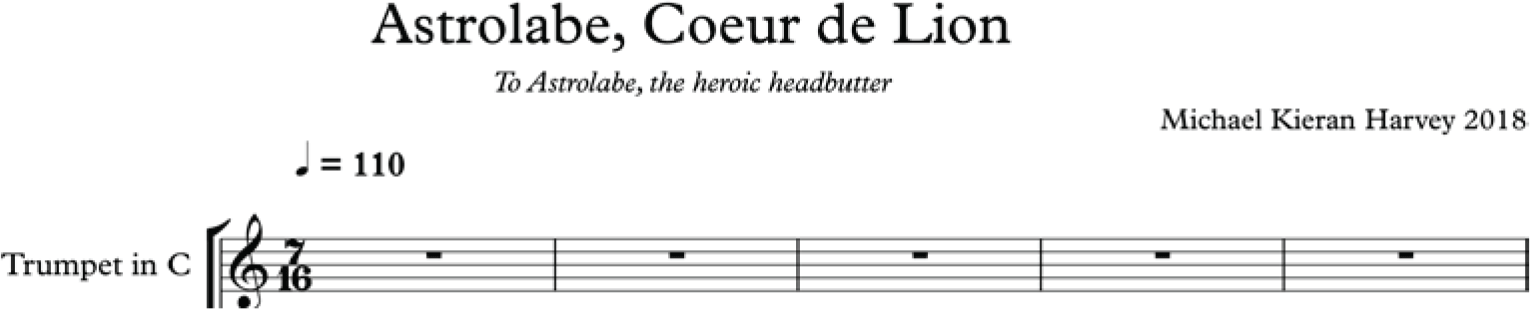
“Astrolabe, Coeur de Lion” (2018). Image detail of the score by Michael Kieran Harvey. (Harvey Reference Harvey2018b).

To attend the live recital of Coeur de Lion was also to witness its travesty of a grand finale: a pantomime sequence culminating in a cartoonish “bird-KO” motif of a boxing ring knockout. The windup was met with chuckles and jeers, echoing the ambivalent responses reserved for court jesters. The audience’s cries of “Hurrah!” at the “bird-KO,” were an obvious allusion and musical nod to Astro’s c*nt theatrics, corroborated by the dedication on the composer’s sheet music: To Astrolabe, the heroic headbutter (fig. 13).
But neither the live interpolations of the audience nor the textual antiphony of Harvey was included in the official premiere recording and accompanying score available online via the Australian Music Centre:
Instrumentation: Electric piano, synthesizer, trumpet in C. Duration: 3 min. Difficulty: Advanced—Virtuosic, some multi tasking required. Dedication note: Dedicated to Astro Labe. Commission note: Commissioned by MONA, Hobart. First performance: by Michael Kieran Harvey, Simon Reade at Dancing to the Tremors of Time (MONA) on 17 Nov 2018. The composer notes the following styles, genres, influences, etc. associated with this work: 1960s cop show soundtracks, Spike Jones, The Mothers of Invention, Captain Beefheart. (Harvey Reference Harvey2018b)
Standing to differ from their original munificent press release of PRTZL, the printed catalog for the concert program and the MONA website (with Astro quotes since deleted from the website) explicitly centered and endorsed Astro Labe with their signature brand of shock value as a figure who “put to shame all the flaccid sycophancy and lack of action by institutions in the face of the unholy alliance of church, state, and corporations that seek to crush minorities in Australia” (MONA 2018).
More from the printed program for Michael Kieran Harvey’s suite of chamber works:
This piece pays homage to Astro Labe while totally ignoring the ludicrous conservative pugilist who ran crying to the press. (MONA 2018)
Yet, MONA’s confederacy with Astro Labe shifts over time, from treating him as a protagonist whose antihero status was valorized and venerated, to minimizing his moniker “DJ F” with a minor mention in the fine print of website promotion materials. While this could be merely due to the passing of time, the occasion is now logged as a footnote on the promo for “repeat Mofo offender” Michael Kieran Harvey. Once a headliner, a selling point to entice spectators to the museum, Astro Labe was now a fickle exploit relegated to “court jester to the oligarchy” (Penny Arcade Reference Arcade2014). Despite the appeal of Coeur de Lion and the initial deference to Astro Labe, DJ Funknukl’s techno turntable moxie mix of futuristic beats previously mentioned on ABC website’s description of their broadcast is now notably absent, struck from official documentation.
Deviating from the fickle arbiters, Harvey’s salient description of his concerto as a tribute to Astro Labe remains on his page on the Australian Music Centre website.
“I’m never going to get the chance to head butt that c*nt again—so I seized the moment.” With these immortal words, Astro Labe aka DJ Funknuckl [sic] recalled spontaneously headbutting someone infamous. The joy engendered by this long-overdue act reverberated around Australia and has now become legendary. This short piece seeks to capture some of the energy, larrikin humour, and courage of Astro Labe, who accomplished what so many had only dreamed of doing. (Harvey Reference Harvey2018a)
MONA’s public digital archive fails to capture the full scope of the performance; erasing these portions abandons the subversive features of the Coeur de Lion composition. Astro Labe’s theatre lingers as a Black Swan moment in the flotsam and jetsam of the indolent currents of MONA’s iconoclastic, sycophantic kitsch and charily curated exhibitions, on the horizon between institutional celebration and erasure, where individuals’ bold acts are cannibalized, consumed, and discarded by the forces the museum proclaims to challenge.
Apart from the Coeur de Lion score, most of the primary and secondary material of the live performance premiere of PRTZL is unavailable or altered. Guided by a search in my archives for what had been excluded or forgotten, I rifled through my hoard of digital objects to find the image file of the performance program I recall capturing. This now-obscure remnant resides on an old hard drive, accessed only by a proprietary USB connector no longer compatible with my current operating system. Together with this TDR article, as homage, Coeur de Lion plays a critical role in supporting Glenn D’Cruz’s observation that “it is often left to artists to care for the legacies of their peers, especially when official records distort or exclude their work and achievements” (2022:148). This dilemma reveals how the archive can function as a key maker, gatekeeper, or oppressor and offers a moment to query: “What is passed on as a dynamic ecological composition in duration—that is, as societal data worth continuing” (Cameron Reference Cameron2021:18)? Perhaps, rather than prudently archiving, we might better release the contents back into the unknown. As Beckett suggests, we “breathe that void” ([1979] 1996:86).
Womb of Anarchy
“the Living, The ende, and beginning of these things, are known unto me: and by suffereance I do dispose then untyll my Violl be run.”Footnote 20
To catch the veracity of the present, as theatremakers and scholars move into the epoch of the 21st century, the subtle generosity and patience of dramaturgical crafts remain critical. To access the poignant stories within the space, subtle shifts of intentionality are required. Without these deceptively simple cadences, what many of us appreciate as subversive guerrilla theatre is destined to become a fleeting novelty monopolized by KPIs, creative producers throttling their peers, choking and flogging them with production pipelines and paralyzing regulations. This is not a pugnacious argument, but it’s an experience that many prominent theatremakers fail to fully grasp. Instead of treating these forces as transactional, when they reinvigorate community relations, replenish the discourse on what constitutes theatre, many overlook how such baffling encounters demand new interpretive tools for new theatrical models of perception, through which greater audience agency can emerge. In pursuit of radical theatre, we must validate unpredictable narratives and errant actors that resist prescriptive convention. While it’s easier said than done, when theatre ceases to be a rite of intensification—an event of wonder or transformation—and is merely an object of consumption measured by profit, a malady sets in. The result is inertia; wasted talent, lost opportunities, and the tight embrace of mediocre theatre persist, along with turf-defending practitioners instituting barriers of what and who is appreciated as suitable for inclusion in the annals. Customs of reviews, auditions, box office metrics, and other professional gatekeeping acts reinforce fiscal control and smother insurgent creativity. To counter these is to commit to generating exchanges of diffusion with energies that singe the façade of prescriptive charters; invoke incantatory practices that interrupt the mundane and puncture the nox of vernacular economic rationalist delirium.
The restorative properties of meaningful dialog, of being both heard and seen, witnessing the unfolding of a moment, and listening to buoyant orations, evokes movement with accented beats—a scenario of “thunder and its rattle to chase dull gloom away./Till seraphims embrace you to free your soul from clay” (Huon Times Reference Times1920).
This is theatre’s task. To drift beyond the drapes of the orthodoxy straining to slake the moat around their progressively feeble status within establishments plagued by an inability to digest profound change. If dismantling imperial logics is appealing, then it is imperative to challenge the standards of compliance that sustain capitalist systems, and asymmetries of collateral that have no traction in the realm of ideas that spur cocreation. It is imperative to ask: In what contemporary contexts can we confidently claim that theatre studies fosters sincerely diverse makers, compelled by the desire to articulate a broader repertoire of encounters, to salute the form as sustenance? What forms of relation give oxygen and resources to nascent forms of performing, those that defy excellence as it’s typically defined? How can we nurture this (again) rather than salvage the vestiges of what remain a century later? Where are the sites for makers to learn to embrace the poetry of drama—its entanglement with history, its polyvocal chorus, its demand for fearless truth-telling and adaptive exchange?
This is a cri de coeur for artists to shimmer brightly—with the fiery relevance of self-determination in eccentric modes of dramatic trespass as theorists and practitioners. To cross-pollinate protocols of territorial markers that many scholars claim to challenge. We must corroborate delicate connections, intimate sites of encounter, activate latent spaces that reshape our understanding of community based on the intrinsic worth of each of us and our supporting actants—and take risks that feel awkward, audacious, and hard to grasp. In the space beyond the shadow of dominion (colonization), the networked commons of artist-led ordinances and community-maintained protocols learned through choreographic scores rest on cooperative feminist webservers, where a living locus of unruly and regenerative energy swirls. From this energy, future performances surge.