The aim of this article is to assess the empirical plausibility of a vastly popular view of the unemployment problem, endorsed by international organizations such as the Organization for Economic Cooperation and Development (OECD) and the International Monetary Fund (IMF), as well as policymakers in several countries. In a nutshell, this view holds that unemployment is caused by labor market institutions and should be addressed through systematic institutional deregulation.1
The policy implications are succinctly summarized in one of the IMF's policy papers: “Countries with high unemployment [are] urged to undertake comprehensive structural reforms to reduce ‘labor market rigidities’ such as generous unemployment insurance schemes; high employment protection, … high firing costs; high minimum wages; noncompetitive wage-setting mechanisms; and severe tax distortions.”2IMF 2003, 125.
To address this question, we conduct a time-series cross-section (TSCS) analysis of eighteen OECD countries between 1960 and 1998. We pay considerable attention to the statistical properties of models, and this leads us to compare several estimators and specifications. Our preferred model, which we arrive at by testing down, estimates the direct effect of institutions with data averaged over five-year periods. It includes only one macroeconomic control (the interest rate), six institutional variables: employment protection, unionization rate, a measure of generosity of unemployment benefits, tax wedge, central bank independence, as well as wage coordination, and no interactions. Such a parsimonious model, which we consider both in levels and first differences, gives changes in labor market institutions a fair chance to explain changes in unemployment. Yet little support for the deregulatory view emerges from the analysis: not just employment protection, but also, and more surprisingly, the generosity of unemployment benefits and the size of the tax wedge do not seem to be associated with higher unemployment. We also test for possible indirect effects of institutions on unemployment, operating by magnifying the size of adverse external shocks,3
Blanchard and Wolfers 2000.
Our analysis also fails to provide empirical support for the opposite view that labor market institutions are good for unemployment. Indeed, our models display a robust (albeit small) positive association between unemployment and the union density rate. We also find that, focusing on the within-country variation, bargaining coordination does not reduce unemployment (despite frequent claims to the contrary), even though it does seem to be associated with lower real wage growth and to increase the responsiveness of real wages to unemployment. In addition, wage coordination does not seem to modify the impact of other institutions in any robust way. Overall, our findings suggest that the impact of labor market institutions on unemployment is, for the most part, indeterminate. Their effect is probably dependent on country-specific institutional configurations. There seems to be no one best way to organize and govern the labor market. Restrictive monetary policies implemented by an independent central bank and other determinants of high real interest rates appear to be more robustly associated with greater unemployment than institutions.
The remainder of the article is organized as follows: the next section reviews the theory and evidence on the relationship between labor market institutions and unemployment. The second section introduces models and data. The third section lays out a set of hypotheses on the impact of labor market institutions, based on the available literature. The fourth section presents the results of an econometric analysis testing the direct impact of institutions on unemployment. The fifth section discusses the findings and their implications for the desirability of labor market deregulation. The sixth section tests for possible nonlinear effects of institutions on the magnitude of adverse shocks, as well as for the impact of institutions on wage growth. The final section concludes with an overall summary of the evidence.
Labor Market Institutions and Unemployment
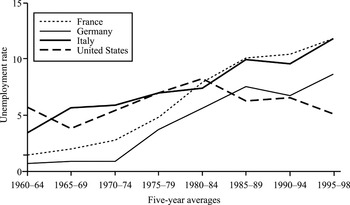
If one looks at the evolution of unemployment in the United States, on the one side, and the major continental European countries, France, Germany, and Italy, on the other, the differences stand out immediately (see Figure 1). In the United States, unemployment starts off at a higher level than in the other countries in the first half of the 1960s (and well above the OECD median). Unemployment falls briefly in the second half of the 1960s and then grows steadily until the early 1980s, when it peaks. From then on, it declines continuously throughout the late 1990s, returning to lower levels than at the beginning of the period. In the continental countries, too, unemployment grows sharply in the 1970s. Rather than peaking and declining, however, it continues to grow well beyond the early 1980s and is at the end of the 1990s not only higher than the U.S. rate, but also higher than the OECD median.4
Baker et al. 2006, fig. 1, 56.

Trajectory of unemployment in France, Germany, Italy, and the United States (1960–98)
Even at first glance, however, there are numerous problems with this diagnosis. First, if it were true that unemployment is determined by labor market rigidities, one would expect the evolution of U.S. labor market institutions to match the path of unemployment in that country.5
We use the term “institution” somewhat imprecisely in this article as a shortcut for nondemand and supply factors impinging on the labor market. However, the label may not be appropriate for some of the factors we consider. For example, benefit replacement rates and tax rates are probably more accurately characterized as the result of policies; and union density rates are the result of social processes.
Second, the evolution of labor market institutions in continental European countries also fails to match the trajectory of unemployment. Indeed, as argued by Solow, “there are good empirical reasons for rejecting this convenient belief that the labor market by itself provides an adequate account of the sad story of European unemployment. At the crudest level, the timing is wrong. One of the two big increases in unemployment took place in the early eighties, although there was no change in labor-market regulation to account for it…. The large continental economies do not seem to have suffered from noticeably more rigid labor markets during the high-unemployment 1980s than they did in the low-unemployment 1970s.”7
Solow 2000, 4–5 (emphasis the author's). According to Solow, alternative explanations are to be sought, having to do with the low rate of job creation (potentially caused by the rigid employment protection, but also by limited product market competition) and with the more demand-friendly U.S. macroeconomic policies.
Third, it would be unwise to generalize from the experience of the largest continental countries to Europe as a whole. Some European countries managed to bring their unemployment rates back down. Yet the labor market in these same countries is overall considerably more regulated than in the United States.8
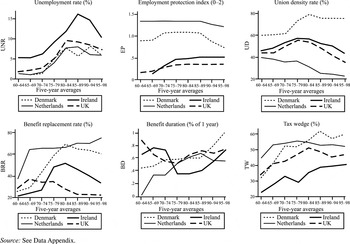
For the labor market rigidity thesis to hold true, the decline in the unemployment rates should be consistently accompanied (or, even better, preceded) by reductions in institutional protections in these countries. This does not seem to be the case. Indeed, if one looks at four of the most successful European countries as far as unemployment reduction is concerned—Ireland, Denmark, the Netherlands, and the United Kingdom—the lack of correspondence is quite clear (see Figure 2).
Trajectory of unemployment and labor market institutions in Denmark, Ireland, the Netherlands, and the United Kingdom
In all these countries, the unemployment rate increased in the 1970s, began declining in the second half of the 1980s (later in Ireland), and continued to decline in the 1990s. Yet the behavior of labor market institutions was far from univocal: employment protection declined in two countries (in Denmark and, slightly, in the Netherlands) but increased in the other two (Ireland and the United Kingdom). Unemployment benefit replacement rates declined in Denmark,9
Apparently, the most relevant aspect of reform of the unemployment insurance system in Denmark had to do with tightening of the eligibility criteria; see Nickell, Nunziata, and Ochel 2005, 4.
The major reform of the unemployment insurance system in the Netherlands involved the tightening of eligibility criteria; Saint-Paul 2004, 52.
An additional reason to mistrust the rigidity thesis is that it is not clear that similar institutional reforms have comparable effects in different countries. For example, a marked increase in collective bargaining coordination, bringing about wage moderation, is often regarded as key for the employment successes of Ireland11
Baccaro and Simoni 2007.
Visser and Hemerijck 1997.
Baccaro 2000. Between the second half of the 1980s and the second half of the 1990s, the index measuring bargaining coordination increased from 2 to 4 in Italy (on a 5-point scale), from 2.3 to 4 in Ireland, and from 3 to 4 in the Netherlands.
Schettkat 2003, 773.
Considering the heterogeneous experience of countries, it is not particularly surprising that the results of econometric tests using TSCS data on OECD countries appear not especially robust. Baker, Glyn, Howell, and Schmitt have been tracking the evolution of the literature in this domain for quite some time.15
A recent article of theirs provides an up-to-date comparison of findings from eleven econometric studies between 1997 and 2005,16Baker et al. 2006, 19–28, and tab. 3, 68.
See particularly Nickell 1997; Elmeskov, Martin, and Scarpetta 1998; IMF 2003; and Nickell, Nunziata, and Ochel 2005. One exception is Baker et al. 2005.
In brief, both case study evidence and econometric testing suggest that the case for the rigidities-cause-unemployment thesis is probably less robust and unambiguous than it should be, particularly considering its wide popularity and its huge influence on policymakers. Yet the current debate among mainstream economists is not whether or not changes in labor market institutions explain movements in unemployment. This is more or less taken for granted.18
Indeed, Saint-Paul 2004, 53, has argued in a recent review of the literature that “evidence supports the traditional view that rigidities that reduce competition in labor markets are typically responsible for high unemployment. Reducing these rigidities across the board seems to work.” Freeman 2005 has recently argued that economists' priors concerning the role of labor market rigidities in unemployment are so strongly held that they are unlikely to be changed simply by the results of TSCS econometric testing, and that different, more micro data and analyses are needed.
See Nickell 1997; Elmeskov, Martin, and Scarpetta 1998; IMF 2003; Belot and Van Ours 2004; and Nickell, Nunziata, and Ochel 2005.
Within the recent literature, the work of Nickell and co-authors carries particular weight, having inspired several other authors. Nickell, Nunziata, and Ochel conduct a TSCS analysis of unemployment patterns in twenty OECD countries between 1961 and 1995 using annual data.21
Nickell, Nunziata, and Ochel 2005.
Nickell, Nunziata, and Ochel find that for all institutional predictors except employment protection the null hypothesis of zero coefficient is rejected, by ample margins in most cases.22
Ibid., tab. 5, 14, col. 1.
Ibid., 21.
Blanchard and Wolfers, 2000.
Nickell, Nunziata, and Ochel 2005, tab. 8, 21, col. 2.
In the next section we examine whether these strong conclusions are robust to small changes in data and specifications. In light of the findings of Nickell, Nunziata, and Ochel,26
Ibid., 2005.
Models and Data
We make no attempt at modeling unemployment in an innovative way. Instead, we rely on existing models, whose empirical testing has been found to provide strong support for the thesis that institutional rigidities cause unemployment. In particular we draw heavily on an IMF 2003 data set that is, in turn, a modification of Nickell and colleagues' 2001 research—itself an early version of Nickell, Nunziata, and Ochel.27
We focus on IMF 2003 because this allows us to use data for three additional years (1996–98). However, in Table 1, columns (7) and (8), using a shorter panel, we also estimate models in which the macroeconomic controls are the same as in Nickell et al. 2001; and Nickell, Nunziata, and Ochel 2005.
In static form, the model we use is the following:

where uit is the unemployment rate in country i at time t; the x's are j institutional variables; the z's are n macroeconomic controls; the h's are p interactions; the δi's are (N-1) fixed effects, capturing country-specific, but time-invariant, unmeasured determinants of unemployment; the αts are (T-1) year dummies, accounting for time-varying annual shocks affecting all countries simultaneously; and εi,t is the stochastic residual. With yearly data we estimate dynamic models, namely by adding the lagged unemployment rate to the predictors:

For reasons explained in the text, the models are sometimes estimated in first differences, with first differencing wiping out the country fixed effects. The vector of institutional variables is the following:

where EP is an employment protection index, BRR is the benefit replacement rate,29
The benefit replacement rate variable should be combined with a benefit duration variable (as well as with other variables capturing which percentage of the workforce is eligible for benefits and how tight the rules of access are—measures that, to our knowledge, are presently unavailable for many countries). However, the benefit duration variable available in our data set is the one elaborated and used by Baker et al. 2003. Following Nickell and Nunziata 2001, they constructed the series proxying the duration of unemployment benefits with the ratio of benefits available after the first year to benefits available in the first year of unemployment. The drawback of this methodology is that the variable assumes the value of 0 whenever there are no benefits available after the first year of unemployment, and hence does not capture the shorter lengths. For this reason, we omit the benefit duration variable and use instead the OECD summary measure of benefit entitlements (benoecd) in some specifications. This averages the gross unemployment benefit replacement rates for two earnings levels, three family situations, and three durations of unemployment. The advantage of this variable is that it considers both the dimension of duration and the dimension of income replacement. Its disadvantage is that it does not distinguish between the two. In a related paper (Baccaro and Rei 2005), we also ran estimates that included benefit duration variables and their interactions with the wage coordination variable, and found that results did not vary much from the ones presented here.

where RIR is the real interest rate, PROD is the (lagged) change in labor productivity,30
As in IMF 2003, we lag the productivity variable due to possible endogeneity with unemployment.

Also, every interactive term is expressed as deviation from the sample average ψ.31
See Nunziata 2002, 8.

While our specifications are similar to others in the literature,32
they also present a few peculiarities. First, unlike previous work,33 we do not include country-specific time trends in the model.34See Baker et al. 2003, 15, for a similar choice.
Second, unlike other research, which contain a rather eclectic array of interactions,35
One exception is Belot and Van Ours 2004, who provide an explicit rationale for their choice of interaction terms.
See Hall and Soskice 2001.
Our main interest is to see whether the η's (the coefficients of the institutional variables) are significantly different from 0 across the eighteen OECD countries included in our analysis and over the entire period (1960–98). We do not explore parameter heterogeneity over time. As far as cross-sectional heterogeneity is concerned, we do not allow for country-specific parameters but do let the effects of institutions to vary systematically across bargaining regimes. As is common practice in this literature, we assume exogeneity of the predictors. As for data, we rely on the TSCS data set assembled by Baker and colleagues,37
Baker et al. 2003.
The countries we consider in this analysis are Australia, Austria, Belgium, Canada, Denmark, Finland, France, Germany, Ireland, Italy, Japan, Netherlands, New Zealand, Norway, Sweden, Switzerland, the United Kingdom, and the United States.
Nickell and Nunziata 2001.
See Kenworthy 2003.
Specific Hypotheses
Research on specific labor market institutions has shown that the channels through which these may affect unemployment are multiple and possibly contradictory. For example, the effects of employment protection (ep) legislation have been found to be theoretically and empirically ambiguous.41
Employment protection simultaneously reduces both flows from unemployment into employment and flows from employment into unemployment.42 A portion of the literature also underscores the possible positive effects of employment protection legislation on worker productivity, by providing for greater job stability and employee morale, such that wage increases possibly caused by employment protection may finance themselves through increased productivity.43See Cazes and Nesporova 2003, 87, relying on the findings of Ichniowski, Shaw, and Prennushi 1997; and Nickell and Layard 1999.
The union density (ud) measure is intended to capture union bargaining power.44
The collective bargaining coverage rate would be preferable as a measure. This series is, however, largely incomplete.
For example, for women, youth, and old workers, see Bertola, Blau, and Kahn 2001.
The benefit replacement rate (brr) variable expresses the percentage of gross earning replaced by unemployed benefits in the first year of unemployment and, in so doing, seeks to capture the degree of generosity of the unemployment insurance system. More generous insurance systems may cause unemployment to rise through multiple channels,48
See Holmlund 1998, for a general review.
Blanchard 1999, 12.
Nickell 1997, 67.
Feldstein and Poterba 1984.
Katz and Meyer 1990.
The tax wedge (tw) variable is the sum of the payroll, income, and consumption tax rates. Clearly, the tax wedge is potentially an additional cost for enterprises. However, the impact of this variable on unemployment depends on who shoulders the burden of these taxes,53
Nickell 1997, 69.
The wage bargaining coordination (bc) variable is generally hypothesized to be associated with lower unemployment, because of the tendency of coordinated bargaining to internalize the externalities of wage bargaining and lead to lower real wage settlements than uncoordinated bargaining.54
See Tarantelli 1986; Soskice 1990; Flanagan 1999, 1157ff; Hall and Franzese 1998; and Franzese 2001, 112–20.
OECD 2004b.
The central bank independence (cbi) index is intended to capture the degree to which the monetary authority is able to resist political pressures to inflate the economy. It is not clear what kind of impact this variable should have on unemployment when considered in isolation. In a rational expectation framework, for example, central bank independence does not directly affect employment or unemployment but reduces inflation.57
Political economists have devoted a great deal of attention to the interaction between central bank independence and bargaining structure. In an economy characterized by coordinated bargaining, the bargaining actors are more likely to heed the monetary policy announcements issuing from an independent central bank and adjust their behavior accordingly than actors in an uncoordinated bargaining system.58 Based on this reasoning, the interaction between central bank independence and wage bargaining coordination should be negatively associated with unemployment, other things being equal.With regard to the macroeconomic controls, we expect the real interest rate to be positively associated with unemployment, mostly because high interest rates reduce capital accumulation (at least until wages adjust downwards, and an increase in the profit rates compensates for the greater cost of capital). According to Blanchard, the effect of interest rates should be limited to the short term and should be small in the long run.59
Blanchard 1999, 3.
Ball 1999.
Nickell et al. 2001, 3.
The change in the inflation rate variable should capture a possible trade-off between inflation and unemployment of the Phillips curve-type, that is, higher values of this variable are expected to be associated with lower unemployment values.62
In line with most macroeconomic theory, we expect this effect to hold in the short but not in the medium or long term.The terms of trade shock variable, defined as first log-difference of the terms of trade multiplied by trade openness (in turn defined as the ratio between imports plus exports to gross domestic product (GDP)), is expected to have a negative sign and is supposed to operate through real wage resistance. If there is a fall in terms of trade and the real wage does not adjust downwardly due to real wage resistance, unemployment should rise.63
Nickell et al. 2001, 5.
The change in labor productivity variable is also expected to have a negative sign due to real wage resistance. If the rate of productivity growth suddenly decelerates, and workers continue to obtain similar rates of growth in real wages as in the past, unemployment should rise. As argued by Bertola, Blau, and Kahn,64
Bertola, Blau, and Kahn 2001, 17.
See also Layard, Nickell, and Jackman 1991.
Our models also include interactions between every institutional/organizational variable (employment protection, union density, benefit replacement, benefit duration, tax wedge, and central bank independence) and the wage bargaining coordination variable.66
Hall and Soskice 2001.
Econometric Analysis67 All analyses were performed with StataSE 8.0., except for the
cointegration tests, for which Eviews 4.1 was used.
All analyses were performed with StataSE 8.0., except for the cointegration tests, for which Eviews 4.1 was used.
Annual Data
We begin the econometric analysis by estimating dynamic fixed effects models using annual data.68
In a dynamic model the lagged dependent variable is included in the regressors. Hence the variable coefficients have to be interpreted as the effects of the regressors on the partial adjustment process of unemployment and are short-term coefficients.
See IMF 2003; Nickell et al. 2001; Nickell, Nunziata, and Ochel 2005; Nunziata 2002; and Elmeskov, Martin, and Scarpetta 1998. Based on Beck and Katz's 2004, and others' advice (see Nunziata 2002, 11; and Judson and Owen 1999), we ignore the possible bias due to the correlation between the (demeaned) lagged dependent variable and the (demeaned) error term in the fixed effect estimator, known as Nickell bias (Nickell 1981; Kiviet 1995; and Baltagi 2001, 130). Monte Carlo evidence reported in Beck and Katz 2004, 33–34, suggests that, with T=39, the fixed-effects estimator should perform as well as others, if not better.
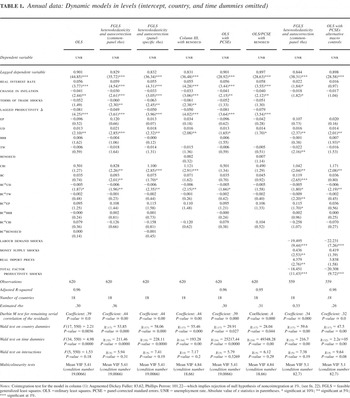
Column (1) in Table 1 reports the results of ordinary least squares (OLS) estimation. Columns (2) and (3) model country-specific heteroskedasticity and residual serial correlation (which persists even in the dynamic specification) by using a panel weighted least squares (PWLS) estimator with a Prais-Winsten transformation of the data. Model (2) uses a common estimated rho (first-order autocorrelation coefficient), as recommended by Beck and Katz;70
Beck and Katz 1995, 640.
See Nickell et al. 2001; and Nickell, Nunziata, and Ochel 2005. It should be noted that, just like other regression coefficients, the estimated rho, too, could be biased in a dynamic model with serial correlation.
The PCSEs correct for country-specific heteroskedasticity and cross-country correlation of the errors—both typical features of TSCS data sets—thus providing more reliable estimates of the standard errors (Beck and Katz 1995 and 1996).
Annual data: Dynamic models in levels (intercept, country, and time dummies omitted)

The coefficients of the lagged dependent variable are all worryingly very high (close to 0.9 in some cases). Test results on stationarity show that the series are for the most part nonstationary.74
See Appendix 2 in Baccaro and Rei 2005.
The test checks for stationarity of the regression residuals. Drawing on Nunziata 2002, 12–13, we used the test for cointegration proposed by Maddala and Wu 1999, which is suitable for an unbalanced panel such as ours. This test combines the results of country-specific tests with p-value pi, in the statistic: −2([sum ]i log pi), which is χ2 distributed with 2N degrees of freedom, under the null of non–co-integration; see Smith and Fuertes 2004, 35–36. To perform the country-specific tests, we adopted the Augmented Dickey Fuller (ADF) and Philips Perron (PP) tests. For the ADF, the appropriate country-specific specifications were determined by trial and error based on the three possible alternatives (with trend and constant, constant only, no constant–no trend), and the optimal number of lags was selected according to the Akaike Information Criterion. For the PP test, the Newey West bandwidth was selected using the Bartlett Kernel. The p-values are Mackinnon approximations. The Maddala and Wu 1999 test assumes that there is no cross-sectional correlation of the errors. Because we control for cross-country correlation through the insertion of time dummies, we assume (somewhat incorrectly) that the test statistics follows the χ2. Concerns about the critical values are likely to arise only in case the margin of acceptance/rejection is thin (which is not our case).
See Gaduh 2002.
Ignoring the possible bias, the results reported in Table 1 suggest that unemployment clearly depends on macroeconomic conditions. All macroeconomic predictors are significantly associated with unemployment, even though the terms of trade variable is statistically insignificant when OLS is used. The effects of institutional variables are, instead, much less clear-cut. Only union density is robustly positive and significant in all models. Central bank independence is positively correlated with unemployment, but often insignificant when OLS is used. Bargaining coordination is found to be positively, not negatively, associated to unemployment, and sometimes significantly so. The only robust interaction seems to be that between unionization and wage coordination, which is negative as expected.77
This conclusion also holds when interaction terms are entered one at a time.
We also estimated a battery of models in first differences (not shown here). This allowed us to deal with the problem of remaining serial correlation in the residuals and associated bias in a dynamic model. In addition, differencing served another important purpose: since our series are integrated of order 1, it allowed us to ignore the question whether or not the variables in levels are cointegrated or not. In this regard, Kittel and Winner 2005, 278, fn. 11, observe, based on Maddala and Wu 1999, that “time series with T ≅ 30 are too short for the estimation of reliable parameters in the cointegration framework.” The results were in line with those from models in levels. Among the institutional variables, only unionization was both positive and significant across models. Its impact seemed to be partially counterbalanced by its interaction with the coordination variable.
Five-Year Data
The next step in the analysis is to estimate models with data averaged over five-year intervals.80
Since institutions vary little over time, an analysis with averaged data should be preferable to one with yearly data. Also, five-year aggregates should be more appropriate than annual data for indicators such as the employment protection index, which is based on interpolation from a few observations.81See Baker et al. 2003, 6 and fn 4, as well as the Data Appendix to this article.
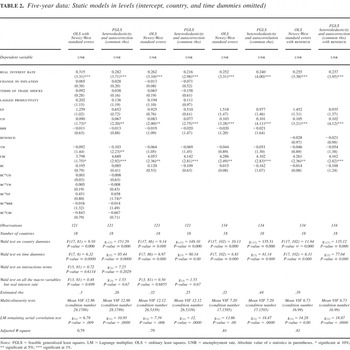
In columns (1) and (2) in Table 2, we estimate a static fixed-effects model, using two alternative methods: one is OLS with the Newey-West robust standard errors, which correct for both first-order autocorrelation and panel heteroskedasticity; the other is PWLS with a Prais-Winsten transformation, modeling both heteroskedasticity and serial correlation in the residuals.82
The Beck and Katz's panel (Beck and Katz 1995) corrected standard errors (PCSEs), used in models with annual data, are not appropriate in this case because this estimator is recommended for panels where T > N. In particular, Beck 2001, 174, recommends against using PCSEs when T < 10 because they depend on asymptotic assumptions about T.
Hsiao 2004, 71–72.
See Judson and Owen 1999, 12.
See Smith and Fuertes 2004, 51.
Binder, Hsiao, and Pesaran 2005.
Five-year data: Static models in levels (intercept, country, and time dummies omitted)

Ignoring these statistical problems, the results are similar across estimators and specifications. Among the macroeconomic variables, only the real interest rate is significant and signed according to prediction (that is, positive). The other macroeconomic predictors are mostly positive rather than negative. All are, however, insignificant. Among the institutional variables, only union density and the central bank independence index are robustly different from zero. The interactions terms are individually and jointly insignificant,87
This conclusion also holds if the interaction terms are entered one by one in the specification.
See tab. 8 in Baccaro and Rei 2005.
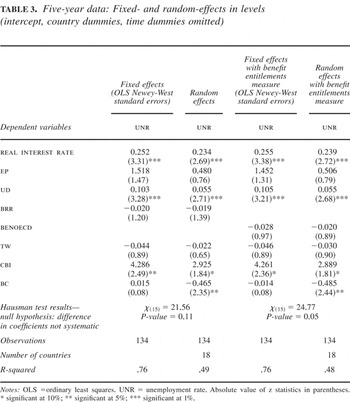
Table 3 compares fixed-effects and random-effects specifications. We chose fixed effects on both theoretical and methodological grounds: the model is better specified when country dummies are inserted. Indeed, country dummies seem to capture a large share of the variation in the unemployment rate. In a random-effects model it is assumed that the countries are random draws from a population, about which inferences are being made—an assumption that does not seem especially realistic in this case. We tested for fixed versus random effects through a Hausman test.89
In a Hausman test, if the null hypothesis cannot be rejected, then random effects are warranted because one can assume no correlation between the covariates and the error term.
See the review in Aidt and Tzannatos 2002.
Five-year data: Fixed- and random-effects in levels (intercept, country dummies, time dummies omitted)

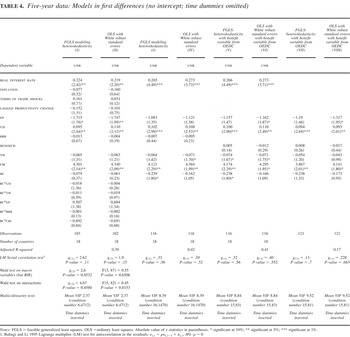
Table 4 moves from models in levels to models in first differences.91
Country fixed effects in a model in first differences can be interpreted as capturing country-specific time trends. The fact that a Wald test on the insertion of country dummies in the first difference estimator (not reported) reveals that they are not jointly significant signals that country-specific time trends are not warranted in our models.
There are approximately four observations for each parameter to be estimated when the model is in levels, and eight observations per parameter in first differences.
See Arellano 2003, 50.
Five-year data: Models in first differences (no intercept; time dummies omitted)

We present two sets of estimates: one is PWLS (heteroskedasticity-consistent), the other is OLS with White-robust standard errors. The coefficients have to be interpreted as the effect of changes in independent variables (averaged over five-year spans) on change in unemployment in the same period, controlling for other determinants, including time-specific shocks. This interpretation does not seem at odds with the basic policy question underlying this and other studies, namely understanding how average unemployment would change compared with the average of the previous five years if institutions were to change over the same period. In Table 4, columns (1) and (2) include the full battery of macroeconomic controls and interactions. Columns (3) and (4) only include the real interest rate among macroeconomic controls and no interactions. Columns (5) and (6) estimate the same models as in the preceding two tables but with the OECD measure of benefit generosity instead of the benefit replacement rate. Columns (7) and (8) estimate an all-institution specification, omitting the real interest rate.
One would expect similar coefficient estimates from models in differences and levels. This is indeed the case with most variables (real interest rate, union density, benefit replacement rate, and tax wedge), but there are a few exceptions, as revealed by comparing Tables 2 and 4. Not surprisingly, variables based on indicators, which change little over time, are the ones for which coefficient estimates vary the most. For example, employment protection is positive (albeit insignificant) when the models are estimated in levels, and negative (at times even significant) when the same models are estimated in differences. This variable is measured through a time-invariant index for Australia, Canada, Japan, New Zealand, Switzerland, and the United States. These are for the most part countries with low protection and higher than average unemployment (except Japan, for which the opposite holds). The fact that they do not participate in the determination of the employment protection coefficient in models with country fixed effects may explain the positive sign.
Similarly, wage coordination is often positive (albeit insignificant) with models in levels, while it is always negative in differences and significant with FGLS when only the interest rate is included as macroeconomic control. The countries in which the wage coordination index is time-unvarying and which do not participate in the determination of the coordination coefficient in levels with country dummies are Austria, Germany, Japan, and Switzerland, all characterized by high coordination and low unemployment on average across the time period. This may tilt the estimate in levels towards a positive sign. Interestingly enough, the other index, that of central bank independence (which is time-invariant for Australia, Austria, Canada Denmark, Germany, Sweden, and the United States), has similar coefficients and standard errors in both levels and differences.
Discussion of Findings
Our strategy in the previous section has been to compare a number of different estimators as well as specifications. None of the models we have considered has been found to be exempt from statistical problems: by comparing them we have sought to ensure that our conclusions were robust across estimators and specifications. Our findings suggest that macroeconomic conditions (captured by real interest rates) and macroeconomic policies (specifically, restrictive monetary policies implemented by an independent central bank) do matter for unemployment. It is much less clear that the same can be said for labor market rigidities in block.
The real interest rate is almost always a positive and significant predictor of unemployment across models, especially with five-year data but often also with annual data. Our findings suggest that the depressing effect of real interest rates on unemployment, which is in all likelihood mediated by reduced capital accumulation, are not just limited to the short run, but also affect the medium-to-long term, and are, in this respect, a confirmation of Ball's argument that “determinants of aggregate demand have … effects on long-run as well as short-run movements in unemployment.”94
Ball 1999, 189.
Unsurprisingly, other macroeconomic variables seem to have a more fleeting impact. For example, changes in consumer price indexes are negatively correlated with unemployment in models with one-year data, signaling the presence of a short-term Phillips-curve trade-off. However, they are insignificant with five-year data. Lagged changes in productivity and terms of trade changes are also negatively associated with unemployment in models with yearly data, possibly indicating the presence of short-run real wage resistance interfering with the adjustment of real wages to shocks. However, with five-year data, changes in terms of trade and changes in productivity appear insignificant.
Among the institutional variables, the sign of the employment protection variable varies considerably across specifications and is generally positive in levels and negative (even weakly significant in some specifications) in first differences. The absence of a robust positive association with unemployment is in line with most theoretical arguments, according to which the impact of employment protection on the unemployment rate is indeterminate as employment protection reduces employment and unemployment flows simultaneously and these effects tend to cancel each other out. We attribute at least a portion of the shift in sign between levels and first differences to the influence of fixed effects when the measure, as is the case for some countries, is time-invariant.
In contrast to theoretical predictions, the benefit replacement rate variable is almost always negative (albeit often insignificant) with both annual and, especially, five-year data. It may be that if benefit replacement is a form of insurance,95
the cost of such insurance is borne by workers through lower real wages. It could also be that the positive impact of benefit replacement on unemployment (for example, by increasing the reservation wage) is counterbalanced by a negative effect linked with a better match between jobs and worker skills when benefit replacement rates are higher.96In a related paper (Baccaro and Rei 2005, tabs. 6, 7, 12), we also estimated specifications that included a benefit duration variable, whose sign appears unstable and dependent on the particular measure used to operationalize the construct.
The tax wedge estimates are also surprising, since they are negative with both annual data and five-year data, and sometimes even significant. If the impact of the tax wedge depends on what portion of it is not paid for by workers through lower real wages and contributes, therefore, to increase the real labor cost faced by employers, then one may conclude that the tax wedge is, on average, entirely paid for by workers, controlling for other variables in the model. The negative sign may depend on the fact that lower take-home pay shifts the labor supply curve rightward, that is, for given wage levels, workers increase their labor supply.
Union density is the one institutional variable that appears to have a robust positive impact on unemployment, independent of specification or estimation method used.97
It bears noting, however, that we are assuming (as is common practice in this literature) exogeneity of the institutional predictors, and that such assumption may be unwarranted in the case of the union density rate, which is considered by the industrial relations literature to depend on unemployment among other things; see Checchi and Lucifora 2002; and Goldfield 1990, 102–3.
The central bank independence variable is positive with annual data, but sometimes not significantly different from 0. With five-year data, its coefficient is much larger and always significant, which suggests that an increase in central bank independence leads to greater unemployment, controlling for other determinants. Our point estimates with five-year data—greater than four—suggest that the transition from a totally independent to a totally politically dependent monetary authority is associated with a decrease in unemployment of more than 4 percentage points on average. Interestingly enough, the effect of central bank independence is net of the effect of the real interest rate in our models. The two measures are weakly correlated (the correlation coefficients are around 0.14). We interpret the results as follows: the central bank independence index captures the more or less restrictive monetary policy stance of the country in the particular year. Its coefficient reflects the effect on unemployment of restrictive monetary policies: these lead to a temporary increase in unemployment, which then becomes permanent probably because some form of hysteresis intervenes, as argued by Ball.98
Ball 1999.
The wage coordination variable is insignificant in most specifications, and often even “wrongly” signed, that is, positively rather than negatively. The effect of coordination is, according to our models, ultimately the result of a modeling choice. If fixed effects are included in the model, either directly or indirectly by taking first differences, then this variable does not seem to have a significant impact on unemployment. If, however, fixed effects are not included (for example, in random-effects models), the coefficient of the coordination variable is negative and significant. It is possible that with better-specified models we could be able to dispose of country dummies (which are nothing more than labels) and be able to appreciate the cross-sectional effect of the wage coordination variable. For the time being, however, a model without fixed effects is likely to suffer from omitted variable bias. We conclude that the effects of wage coordination that seem to matter most for unemployment are the cross-sectional ones, while the within-country variation in wage coordination does not significantly reduce unemployment. Cross-sectional differences probably reflect the rest of the institutional structure (for example, social democracy and associated economic policies) in which wage coordination is often embedded. From a policy perspective, simply increasing the level of bargaining coordination, in the absence of parallel changes in the rest of the institutional and policy structure, would probably not reduce unemployment, according to our results.
Among the interaction variables, it seems that coordination increases, in the short-term, union capacity to internalize externalities.99
However, our findings with yearly data do not support the thesis of Hall and Franzese and others that the employment-depressing effects of restrictive monetary policies enacted by an independent central bank decrease with greater coordination.100Hall and Franzese 1998. Some support for this thesis emerges from models in first differences with yearly data (not shown here).
Hall and Soskice 2001.
Additional Tests of Institutional Effects
Nonlinear Model
Our analysis has failed to uncover a direct impact of labor market institutions on unemployment, except for unionization. However, as suggested by Blanchard,102
Blanchard 1999.
Blanchard and Wolfers 2000.
To test for this eventuality, we estimate essentially the same model as in Blanchard and Wolfers:104
Ibid., tab. 1, C20.

Unemployment in country i at time t is presented as a function of the same j institutional variables considered before (employment protection, union density, benefit replacement rate, tax wedge, central bank independence, and wage coordination), (n-1) country-specific fixed effects (δi), and (t) year dummies (φt). The coefficients of institutions (γj) expresses the linkage between the unobservable time shocks captured by the country-unvarying time dummies (φt) and the set of institutions (Xj). In this specification, the effects of institutions on unemployment are nonlinear and are estimated through nonlinear least squares. In line with our previous analysis (and consistent with Blanchard and Wolfers), we use data grouped in five-year averages.105
This specification makes it impossible to understand exactly which shocks are at play and how they vary by country. However, this is acceptable to us as our focus is on institutions, not shocks. Blanchard and Wolfers makes an attempt at modeling the shocks explicitly by including three macroeconomic variables: the real interest rate, the rate of total factor productivity growth, the change in labor demand; see ibid., tab. 5, C28. They find, however, that country-invariant time dummies provide a better fit than observable measures of shocks.
Our tests differ from Blanchard and Wolfers's in the following respects: (1) the institutional variables we use are not exactly the same, as their list also includes collective bargaining coverage, a measure of active labor market policies, and benefit length, but does not contain central bank independence; (2) the data we use are different, as our institutional measures are time-varying, unlike theirs;106
Blanchard and Wolfers also estimate a model with time-varying institutional measures for benefit replacement rates and employment protection (see ibid., tab. 3, C24) and find that results are generally stronger with time-unvarying institutions.
Ibid., C20.
It has to be considered that with fixed effects (country and time) the data are already transformed in deviations from country and period means, so the choice to express them as deviations implies demeaning the variables even further.
See ibid., C20, fn. 21.
See Rogers 1993.
The standard errors in question are equivalent to the Huber/White heteroskedasticity consistent standard errors, adjusted to account for possible correlation within a cluster. They are consistent in the absence of cross-sectional correlation. This estimator has not been frequently used in small samples because of concerns about its performance. However, recent Monte-Carlo evidence by Kézdi 2003 (tabs. 2.2 and 2.5) shows that in a fixed-effects contest with a serial correlation of about 0.3 (similar to our situation) its absolute performance in terms of efficiency is acceptable and the relative efficiency with respect to the White estimator (which corrects for heteroskedasticity only) depends on the degree of autocorrelation of the variable considered (the more sluggish the variable the better the cluster estimator). Also, Petersen 2005 (Figures 3 to 5) shows (using, however, a sample where N is much bigger than in our case) that even with time and country dummies included, the performance of the Rogers standard errors is much better than the (Panel) Newey West standard errors and the Fama-MacBeth standard errors and that its bias with a small N is little. In brief, the experimental evidence seems to suggest the Rogers standard errors as acceptable. Also, the short-time dimension suggests that modeling heteroskedasticity and serial correlation with a feasible weighted least square estimator would not greatly improve efficiency. The problem of cross-sectional correlation is dealt with in the models, as is common praxis, through the insertion of time dummies, even though we doubt that all spatial correlation is eliminated in this way.
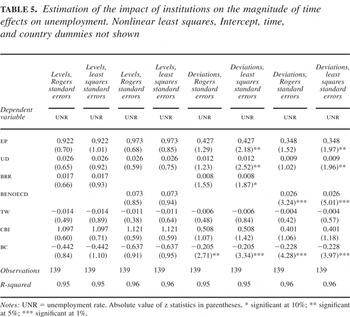
In the first four columns of Table 5, data are expressed as levels; in the latter four as deviations from sample means. The interpretation of coefficients is different. In columns (1) to (4) the coefficients of the time dummies (not shown) represent the impact of “pure” exogenous shocks on unemployment in a hypothetical country in which all institutional variables are set to 0, so that [sum ]j γj Xj,it = 0. In such hypothetical country, there is no employment protection, no unionization, no unemployment benefits, no taxes, the central bank is politically dominated, and bargaining is completely uncoordinated. The coefficients of the institutional variables in columns (1) to (4) represent the additional impact of the time shocks on unemployment when the institution in question grows by one unit. In columns (5) to (8), instead, the coefficients of the time dummies (not shown) are to be interpreted as the impact of time shocks on unemployment in a hypothetical country in which all institutions are equal to the sample mean (so that [sum ]j γj(Xj,it − Xj) = 0); while the coefficients of the institutional variables represent the extra impact of the time shocks on unemployment when the institution in question grows by one unit above the sample mean.112
Each of the time dummies is insignificant in models with data in levels, while several of the time dummies are significant in models with data in deviations. In both cases, the time dummies show a growing trend. The difference could be explained as follows: in a completely deregulated hypothetical country (data in levels), exogenous time shocks do not significantly affect unemployment, but they do in a country with average values of institutions (data in deviations).
Estimation of the impact of institutions on the magnitude of time effects on unemployment. Nonlinear least squares, Intercept, time, and country dummies not shown

As the table clearly shows, substantive conclusions about the impact of institutions vary dramatically depending on the particular way in which the data are expressed (levels or deviations) and the choice of standard errors for hypothesis testing. Overall, we do not find unequivocal evidence of institutional impact. When data are in levels, no institutional effect is significantly different from 0. When data are in deviations only two institutions seem to alter significantly the impact of exogenous shocks on unemployment, using robust standard errors for hypothesis testing—columns (5) and (7): the overall generosity of the unemployment insurance system (as captured by the summary measure beoecd) and the coordination of the wage bargaining system. The former increases the impact; the latter decreases it.
Impact of Institutions on Wage Growth
We now consider the impact of institutions on wage growth. Indeed, if labor institutions have an impact on unemployment, such impact should work its way through wages: in an imperfect market scenario, in which wages are determined as the outcome of bargaining between firms and workers, institutions should raise equilibrium unemployment by increasing the bargaining power of workers and reducing the willingness of the unemployed to bid down the wages of the employed. As a check on previous results, then, we estimate a model in which the dependent variable is a measure of wage growth. The model tested is:

where ΔWEU is the five-year average of the annual percentage change of the wage expressed in efficiency units in country i at time t (roughly, a measure of permissible real wage increases given total factor productivity gains attributable to labor).113
The vector of institutional variables ([sum ]j γj xj,it) includes employment protection, union density, benefit replacement rate or the benefit generosity measure, change in the tax wedge,114See Layard, Nickell, and Jackman 1991, 33, for this modeling choice.
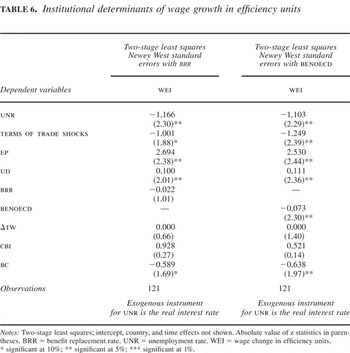
Results from the wage growth model are largely compatible with those from models estimating the direct effects of institutions on unemployment. Wage change in efficiency units responds negatively (as expected) to unemployment and terms of trade shocks. Benefits replacement rate and tax wedge are not significantly associated with higher wage increases, consistent with the unemployment models. Benefit generosity is (surprisingly) even significantly negatively associated with wage growth (in line with previous results). Central bank independence per se does not seem to lead to wage moderation.115
Consistent with the unemployment models, union density is significantly positively associated with wage growth. The main peculiarities of the wage change models concern the employment protection index and the wage coordination index. It appears that employment protection does lead to higher wages in efficiency units even though this does not seem to translate into increases in unemployment. Interestingly enough, employment protection seems to have no significant impact when the dependent variable is change in unit labor costs (model not shown). This may be due to the fact that the higher wages induced by employment protection spur capital-labor substitution processes that, in turn, generate productivity increases that compensate for them, such that unit costs are unaffected.116Another peculiarity of the wage growth model is that bargaining coordination is significantly associated with lower wage growth, even controlling for country fixed effects. Hence coordination seems effective in bringing about wage moderation, but wage moderation does not necessarily translate in lower unemployment, on average, as suggested by the lack of a robust direct effect of bargaining coordination on unemployment in previous models. This finding, combined with the ones above on real interest rates and central bank independence (which does not significantly affect wages, but does seem to lead to higher unemployment), points to the importance, in future research, of understanding how the various predictors affect different components of aggregate demand.
We also test whether institutions reduce the responsiveness of wage growth to unemployment. Indeed, this is a key channel through which institutions may affect the persistence of exogenous shocks over time. The argument is illustrated by Blanchard and Wolfers as follows: “Take an adverse shock which leads to higher unemployment. The normal adjustment mechanism is then for unemployment to put downward pressure on wages until unemployment has returned to normal. To the extent that some labor market institutions reduce the effect of unemployment on wages, they will increase the persistence of unemployment in response to shocks.”117
Blanchard and Wolfers 2000, C17.
Hence we add to the previous model of wage growth in efficiency units a term (instrumented) interacting unemployment with each institution expressed as deviation from the sample mean. The interaction terms are entered in the equation one by one.118
This is to limit the bias associated with the omission of implicit interaction terms (that is, variables that are interacted with the same variable, but not entered explicitly as interaction terms, see Braumoller 2004).
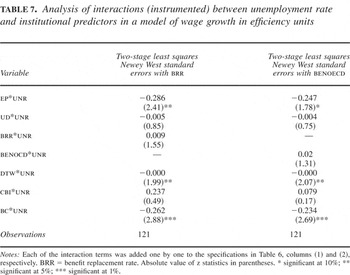
Table 7 shows that most interactions are negative. The interaction between wage coordination and unemployment is not only negative but also significantly different from zero at standard confidence levels. Thus, it seems that wage coordination not only leads to lower real wage growth directly, but also increases the effect of unemployment on wage growth. The interactions between benefit replacement and benefit generosity, respectively, with unemployment are instead positive but insignificant. This result, combined with a negative direct effect of benefits on wage growth (Table 6), suggests that the finding of a significant positive impact of benefit generosity on unemployment-increasing exogenous shocks in models with variables expressed as deviations from the sample mean (see Table 5) may have been a statistical incident.
Institutional determinants of wage growth in efficiency units

Analysis of interactions (instrumented) between unemployment rate and institutional predictors in a model of wage growth in efficiency units

Conclusions
In this article, we have examined whether pooled TSCS data on OECD countries provided empirical support for the thesis that unemployment is caused by labor market rigidities. In conducting our analysis, we have sought to pay attention to a series of statistical problems generally associated with TSCS data, and compare results from multiple estimators and specifications.
While no model we estimate is entirely problem free, our main results seem robust to changes in estimation methods as well as changes in specification. Our preferred model, which we estimate both in levels and differences, tests the direct effects of institutions with data averaged over five-year periods. It is a simple and parsimonious model, leaving ample room for institutional measures to explain changes in unemployment. We find no systematic support for the deregulatory view. Indeed, employment protection, benefit replacement rates, and tax wedge do not seem to have a significant impact on unemployment. At the same time, we find a robust positive association between union density and unemployment. Also, in contrast with most literature that attributes to it a negative impact on unemployment, wage coordination seems an insignificant predictor of unemployment when fixed effects are controlled for (even though it does seem to moderate wages) and does not moderate the impact of other institutions in a significant way in the medium- to long-term.119
We cannot exclude that, since some of the institutional variables (especially employment protection) are probably measured with error, the coefficients of the imperfectly measured variables are not biased downwards. Other coefficients may be biased, too, as a result of measurement error. This, however, is a problem that applies to all analyses using these data.
Our results suggest that, at least as far as pooled data allow one to tell,120
See Freeman 2005 for a discussion of the limitations of this kind of analysis.
See Bertola, Blau, and Kahn 2001.
Data Appendix
We use the TSCS data set made available to us by Baker et al. 2003. This is based on the IMF 2003 data set with some modifications. The IMF data set, in turn, updates the Nickell and Nunziata 2001 (henceforth NN) data set. The latter is mostly based on OECD data.122
Available at 〈http://cep.lse.ac.uk/pubs/number.asp?number=502〉. Accessed 24 November 2006.
For details, see Baker et al. 2003, 27.
The countries included in the sample are Australia, Austria, Belgium, Canada, Denmark, Finland, France, Germany, Ireland, Italy, Japan, Netherlands, New Zealand, Norway, Sweden, Switzerland, United Kingdom, and United States. The years covered are 1960–98. The panel is unbalanced.
Macroeconomic Variables
unemployment rate (unr): All data are from historical OECD databases for standardized unemployment rate.
real interest rates: This is the NN series updated for 1995–99 by the IMF based on OECD Economic Outlook series for long-term interest rates and consumer price deflators. The measure is defined as nominal returns on long-term government bond minus the actual inflation rate over the following year.
change in inflation rate: Yearly changes in Consumer Prices Indexes, based on OECD databases. The formula for country i is CPIt − CPIt−1.
labor productivity growth (lagged): The series is based on OECD data. Productivity growth for country i is defined as: 100 * ((Prodt − Prodt−1)/Prodt−1).
terms of trade shocks: The measure is defined as first log-difference of the terms of trade multiplied by trade openness. The trade openness of the country is defined as the ratio between imports plus exports to GDP (at constant prices). Raw data on export prices, import prices, and trade openness are from OECD databases.
wage change in efficiency units (ΔWEUi,t): corresponds to the five-year average of the change in real wage (RW) minus the change in an index of labor productivity (ILP): ΔWEU = ΔRW − ΔILP. The ILP is constructed, following Blanchard and Wolfers 2000, as the percentage change in total factor productivity (ΔTFP) minus the percentage change in the labor share of current GDP at current market prices (a): ΔILP = ΔTFP − Δa. Both measures (TFP and a) are taken from the AMECO database.
Additional Macroeconomic Controls
These are used in Table 1, columns (7) and (8).
money supply shock: from NN database. Defined as ln(money supply) from the OECD Economic Outlook database.
real import prices: alternative to terms of trade shocks series, from NN database. Defined as the import price deflator normalized by the GDP deflator. Source: OECD, National Accounts and Main Economic Indicators. The real import price shock is the change in the log of real import prices times the share of imports in GDP (from OECD Main Economic Indicators).
total factor productivity shocks: from NN database. Based on the Solow residual for each country.124
See Nickell and Nunziata 2001, for details.
labour demand shocks: from NN database. Residuals from country-specific employment equations, each being a regression of employment on lags of employment and real wages.
Institutional Variables
employment protection legislation (ep): This is a 0–2 index, where 2 is the highest level of employment legislation protection. This measure presents some peculiarities that undermine its strength as an indicator.125
See Baker et al. 2003, 6, and fn. 4.
union density (ud): This is the NN series updated for 1995–98 by Baker et al. 2003 based on Ebbinghaus and Visser 2000, as well as other sources. Data are expressed in percentage points.
benefit replacement rate (brr): This is the NN measure as modified by Baker et al. 2003, namely “benefit entitlement before tax as a percentage of previous earnings before tax. Data are averages over replacement rates at two earnings levels (average and two-thirds of average earnings) and three family types (single, with dependent spouse, with spouse at work). They refer to the first year of unemployment.”126
Nickell et al. 2001, 46.
benefit entitlements (benoecd): This is the OECD summary measure of benefit entitlements. It is defined as the average of the gross unemployment benefit replacement rates for two earnings levels, three family situations and three durations of unemployment. As the measure for the benefit replacement rate, it is available every second year. We interpolated linearly the value for the missing years, considering the first year of our range, 1960, equal to 1961, the first year of data availability.
tax wedge (tw): Baker et al. 2003 update the NN series “based on changes in the sum of individual (income) tax, social security contributions (employer and employee), payroll taxes, VAT, sales taxes, excise taxes and customs duties, all over GDP … from OECD data.”127
Baker et al. 2003, 27.
central bank independence index (cbi): This is a 0–1 continuous Central Bank Independence (CBI) index. The IMF borrowed the series from Franzese (see Hall and Franzese 1998) and updated it based on information on more recent reforms in Daunfeldt and de Luna 2002.
index of wage bargaining coordination (bc): The variable is taken from Kenworthy 2003. The index ranges from 1 to 5 where 1 is the minimum coordination. We introduced minor changes for Ireland between 1988 and 1992 and Italy in the 1990s based on our previous work (Baccaro and Simoni 2007; and Baccaro 2000).