




No CrossRef data available.
Article contents
Cardiac dimensions during extracorporeal membrane oxygenation
Published online by Cambridge University Press: 13 July 2005
Abstract
Our aim was to analyze left ventricular fractional shortening during extracorporeal membrane oxygenation under the influence of changing volume loading conditions induced by a ductal left-to-right shunt. In all patients, the fractional shortening was observed using echocardiography before, during, and after bypass, irrespective of the presence or absence of the ductal left-to-right shunt. During membrane oxygenation, there was a significant decrease in fractional shortening (p less than 0.001), with no difference before and after membrane oxygenation. A greater decrease in fractional shortening was observed in the group with a ductal left-to-right shunt when compared to patients lacking the ductal shunt (p less than 0.006). The diastolic diameter of the left ventricle also increased significantly during the membrane oxygenation in those patients with left-to-right ductal shunting. Moreover, the patients with left-to-right shunting showed a very severe decreased fractional shortening, lower than 10 per cent, with significantly greater frequency (p less than 0.05) during the course of membrane oxygenation. Conclusion: An important decrease in left ventricular fractional shortening is observed during veno-arterial extracorporeal membrane oxygenation. Left-to-right shunting during bypass, as seen in the patients with patency of the arterial duct, increases the loading conditions on the left ventricle, and produces a significant increase in left ventricular diastolic dimensions. Despite the effects of volume loading produced by the ductal shunt during bypass, the decrease in fractional shortening is significantly more pronounced for these patients. Therefore, during membrane oxygenation the volume loading produced by the ductal shunt is unable to prevent a decrease in left ventricular fractional shortening.
Information
- Type
- Original Article
- Information
- Copyright
- © 2005 Cambridge University Press
Cardiac performance is usually determined by preload, afterload, contractility, and heart rate.1 Synchronous contraction of the ventricles has also recently been shown to be of importance.2 During veno-arterial extracorporeal membrane oxygenation, there are important changes in preload.3 Owing to the drainage from the right atrium to the pump, the preload for the right ventricle is decreased. Then, because the pulmonary circulation is bypassed, the preload for the left ventricle will also be decreased. In contrary to the situation in cardiac bypass surgery, the heart during extracorporeal membrane oxygenation is not empty. Most ultrasonic observations during extracorporeal oxygenation show a non-collapsed heart, even at high rates of flow through the pump.4 Rates of flow from 180 to 200 millilitres per kilogram per minute are usually used, these being almost equal to the normal neonatal cardiac output.5 Changes in loading conditions are frequently attributed to alterations in left ventricular dimensions and fractional shortening during bypass.6, 7 After 1 or 2 days on bypass, a significant decrease in fractional shortening is observed. During this period, there is also left-to-right shunting through the patent arterial duct in a significant proportion of neonates undergoing extracorporeal oxygenation.7–9 This ductal shunt will increase the pulmonary perfusion, and thus increase the preload to the left heart. We sought to investigate the changes in intra-cardiac volume induced by such a left-to-right ductal shunting, and its consequences for changes in left ventricular dimensions and fractional shortening. On the one hand, because of the increase produced in loading conditions for the left ventricle, we might anticipate an increase in fractional shortening. Indeed, it has been suggested that the left-to-right ductal shunt could protect the left ventricle against any decrease in fractional shortening.10 On the other hand, the stressed nature of the myocardium during this phase of extracorporeal bypass might be incapable of tolerating the increased loading conditions induced by the ductal shunt shortly after the commencement of membrane oxygenation.
Methods
We studied consecutively 29 patients meeting the standard criterions11 for extracorporeal membrane oxygenation. This is the same group of patients we have studied previously so as to explore other aspects of influences induced by patency of the arterial duct during extracorporeal membrane oxygenation.9 According to our institutional protocol, all patients were treated with veno-arterial extracorporeal membrane oxygenation. Veno-venous membrane oxygenation was not performed in our institution until 2004, and was not used in any of the patients studied in this investigation. There were 10 girls and 19 boys in our cohort. The mean weight at birth was 3,306 grams, with standard deviation of 574 grams. Membrane oxygenation was indicated because of meconium aspiration syndrome in 16 neonates (55 per cent), congenital diaphragmatic hernia in 8 (28 per cent), respiratory distress syndrome in 1 (3 per cent), and neonatal sepsis in 4 (14 per cent). Left-to-right shunting across a patent arterial duct was observed in 56 per cent of the neonates with meconium aspiration syndrome, 75 per cent of those with congenital diaphragmatic hernia, in the only patient with respiratory distress syndrome, and in 2 of the 4 with neonatal sepsis. The mean age at the time of cannulation was 1.8 days, with standard deviation of 1.3 days. All ultrasonic interrogations were performed with a Toshiba SSH 140 machine, using sector- and M-mode echocardiography, and calculating fractional shortening in the parasternal long axis view. This was calculated as the diastolic dimension of the left ventricle minus the systolic dimension of the left ventricle divided by the diastolic dimension of the left ventricle, multiplied by 100, and expressed as a percentage.12 All patients were examined just before cannulation, every 12 hours on bypass during the first 60 hours, and on all following days, with the last investigation made within 24 hours after decannulation. We diagnosed shunting across a patent arterial duct, if present, using colour- and Doppler echocardiography in the supra- and parasternal views. Left- to-right shunting across the duct was defined as continuous flow into the pulmonary arteries from the aortic arch. Those interpreting the echo Doppler variables had no knowledge of the clinical course of the patient.
Management of patients
All patients were nursed in a special intensive care room on an AirShield IICS 90 table. Body temperature was maintained between 36.8 and 37.5 degrees Celsius. Blood pressure was obtained from an umbilical arterial line placed with the tip in the descending aorta, and recorded by a neonatal monitor. Central venous pressure was measured by an umbilical line with the tip in the right atrium, and recorded by the same monitor in addition to the heart rate. Pre- and post-ductal saturations of oxygen were monitored with a Nellcor pulsoximeter. Depending on age, weight gain, and fluid balance, the prescribed fluid intake was at least 50 millilitres per kilogram, with a maximum of 150 millilitres per kilogram. Standard diuretic therapy was administered, using furosemide at 4–8 milligrams per kilogram per day depending on fluid balance and production of urine. Antibiotics were routinely prescribed, giving either amoxicillin at 100 milligrams per kilogram per day, or gentamycin at 5–7 milligrams per kilogram per day. Prior to cardiopulmonary bypass, heart failure or hypotension not due to hypovolaemia were treated with intravenous administration of dopamine or dobutamine at 5–20 micrograms per kilogram per minute. Pulmonary hypertension was treated with vasodilating drugs, including inhalation of nitric oxide. Before starting the extracorporeal oxygenation, ventilatory support ranged from standard mechanical positive pressure ventilation to high frequency oscillation. During bypass, basic mechanical ventilation was maintained using minimal settings of the ventilator. Surgical intervention for correction of congenital diaphragmatic hernia was performed only after adequate oxygenation had been obtained, with flows of bypass weaned to 50 millilitres per minute. All patients were sedated during bypass, using midazolam at doses of 0.1–0.3 milligrams per kilogram per hour, and fentanyl at 2–10 micrograms per kilogram per hour. Pancuronium at a dosage of 0.01–0.02 milligrams per kilogram per hour was used in all patients with diaphragmatic hernia 24 hours after initiation of extracorporeal oxygenation, and also for 24 hours after the surgical correction. Parental consent was obtained for each patient. The study was approved by the local committee on human experimental research. This study was supported financially by the Dutch Heart Foundation through grant 94.023.
Statistical analysis
The diastolic and systolic left ventricular dimensions, and the fractional shortening, were monitored in all patients before, during, and after extracorporeal oxygenation. The observations were made as part of a another study published earlier.8 Observations made specifically to analyse the influence of left-to-right shunting across the duct were taken before the start of bypass, after 24–36 hours on bypass, and within 24 hours after decannulation. Data is presented as mean and range. We chose the period between 24 and 36 hours of bypass because the maximal flow after commencing extracorporeal membrane oxygenation is unchanged at this time.8, 9 We compared findings between those patients with or without left-to-right shunting across a patent duct. We computed the differences in left ventricular diameter and the fractional shortening before, during, and after bypass, assessing them with the Wilcoxon signed rank test for all the patients, and using the Wilcoxon rank sum test to assess differences between groups. p-values of 0.05 or less were considered significant.
Results
Variations in left ventricular dimensions and fractional shortening in all the patients
Left ventricular dimensions, and fractional shortening, before, during, and after bypass are shown in Figures 1 and 2. Flow remained unchanged during the first 48 hours of membrane oxygenation because we made no attempts to wean any of the patients. Therefore, the first part of figures represents findings for all patients in the same phase of extracorporeal oxygenation under full flow. Due to the different clinical course of the patients undergoing extracorporeal membrane oxygenation, the second part of the figures is difficult to analyze, the patients exhibiting many differences among themselves during the process of weaning. After decannulation, nonetheless, all patients are again comparable.

Figure 1. Variations as measured in all our patients in mean diastolic (a) and systolic (b) left ventricular dimensions before, during, and after extracorporeal membrane oxygenation. DdLV: diastolic dimension of the left ventricle; DSLV: systolic dimension of the left ventricle.

Figure 2. Variations as measured in all our patients in mean left ventricular fractional shortening (FS) before, during, and after extracorporeal membrane oxygenation.
When considering effects on the left ventricle, the mean diastolic and systolic left ventricular dimensions before bypass were small, approaching the fifth percentile when compared to the normal values for left ventricular dimensions in children.13, 14 During the first 48 hours of membrane oxygenation, despite the unchanged high rate of bypass flow, we observed a significant increase in diastolic and systolic diameters (p less than 0.02, p less than 0.001, respectively) in all patients. The systolic diameters then showed a decrease during the course of bypass, returning to the values measured before bypass began. After ceasing membrane oxygenation, left ventricular dimensions remained small when compared to normal values.
In terms of fractional shortening, we measured a normal mean fraction of 36 per cent, with standard deviation of 11 per cent, before starting bypass. After beginning extracorporeal oxygenation, mean fractional shortening decreased to 20 per cent, with standard deviation of 11 per cent, this representing a significant decrease, and one observed in all patients during the period of bypass, with p-values less than 0.001. Mean fractional shortening after membrane oxygenation was 40 per cent, with standard deviation of 11 per cent, this showing no significant difference from the values measured before bypass was started.
Results in those with or without ductal shunting
We observed left-to-right ductal shunting in 18 patients after 24–36 hours of membrane oxygenation. Mean values for diastolic and systolic left ventricular dimensions and fractional shortening in these patients, compared to those without ductal shunting are shown in Tables 1 and 2 for the periods before, from 24 to 36 hours on bypass, and after decannulation. Mean diastolic and systolic dimensions increased significantly for those with ductal shunting when compared to findings for total group (p less than 0.05, p less than 0.0005, respectively). No important changes were observed in the diastolic diameter when bypass was stopped, albeit that the systolic diameter decreased to its original level before bypass. Fractional shortening for those with ductal shunting changed from a mean value of 37 per cent, with standard deviation of 12 per cent before bypass, to 16 per cent, with standard deviation of 10 per cent during bypass, and returned to 40 per cent, with standard deviation of 13 per cent after bypass (Fig. 3). A significant decrease in fractional shortening (p less than 0.001) was found for the patients with ductal shunting, these patients having a mean decline of 21 per cent, with standard deviation of 13 per cent.
Table 1. Patients without ductal left-to-right shunt (n = 11).

Table 2. Patients with ductal left-to-right shunt (n = 18).


Figure 3. Variations as measured in the patients with and without left-to-right shunting across a patent arterial duct in mean left ventricular fractional shortening (FS) before bypass, at 24–36 hours of extracorporeal membrane oxygenation, and after discontinuing bypass.
In the 11 patients without ductal shunting, the mean diastolic dimension did not increase significantly during bypass. Systolic dimension increased significantly (p less than 0.009). Fractional shortening in this group was 35 per cent, with standard deviation of 12 per cent before bypass, reducing to 29 per cent, with standard deviation of 7 per cent during bypass, and returned to 40 per cent, with standard deviation of 7 per cent after bypass. The observed decrease of 6 per cent in fractional shortening in these patients was not significant.
Prior to bypass, no differences in fractional shortening had been observed between the groups of patients with or without ductal shunting. On the contrary, during membrane oxygenation, the decrease in fractional shortening was significantly more pronounced in the patients who developed a left-to-right shunt across a patent arterial duct (p less than 0.006). This difference was no longer evident once bypass was terminated. Furthermore, two-thirds of the patients manifesting shunting across the duct showed a very severe decrease in fractional shortening, to levels smaller than 10 per cent, against one-fifth of patients without ductal shunting. The difference between the groups for this very severe decrease in fractional shortening is significant (p less than 0.05).
Discussion
Prior to the commencement of extracorporeal membrane oxygenation, the mean left ventricular diastolic and systolic dimensions in our patients were much lower than the left ventricular dimensions found in the normal population. Others have described dimensions within the same range as we observed, without commenting on the low percentiles.4, 6, 15 It is unclear why the left ventricle should be so small before membrane oxygenation. It is possible that severe pulmonary hypertension, producing a right-to-left ductal shunting, could reduce the preload to the left ventricle in this situation. The pressure overload on the right ventricle prior to bypass could also be of influence by shifting the position of the ventricular septum. Once on bypass, we observed a significant increase of diastolic and systolic diameter for all our patients. We then found the same significant increase, especially in diastole, for those manifesting ductal shunting, a feature not seen in patients without shunting from left-to-right across a patent duct. The observed increase in diastolic dimension seen in those with ductal shunting is the consequence of the volume loading on the left ventricle that occurs once ductal shunting has developed.
Left ventricular fractional shortening was not depressed before the start of extracorporeal oxygenation, perhaps a surprising finding when we consider the critically ill nature of our patients prior to the commencement of bypass. The temporary administration of dopamine and dobutamine, by their positive inotropic effects, could also have influenced this pre-bypass phase. During bypass, we noted a drop in fractional shortening, suggested to be related to factors such as decreased preload, post-hypoxic injury to the myocardium and reperfusion injury, or increased afterload.4, 6, 15, 16 Other authors describing this drop in fractional shortening have postulated that it is due to the decrease in preload.3 Left ventricular performance, of course, is itself measured and monitored with parameters that are more insensible to the preload, such as heart-rate-corrected mean circumferential fibre fractional shortening.17 Our study, however, was designed specifically to analyse the effects of volume loading in the presence of left-to-right ductal shunting. Due to this, we selected fractional shortening as our parameter, this being known to be dependent on preload.4 We then examined whether the presence or absence of the left-to-right ductal shunt had any increasing effect on fractional shortening. If present, the left-to-right shunt creates a better state of preload for the left ventricle. It also influences the saturation of oxygen in the coronary arteries, since the ductal shunt will increase the saturation of oxygen in the blood in the left atrium and the left ventricle. The saturation in the left atrium is usually decreased in this phase of membrane oxygenation because of intrapulmonary right-to-left shunting. Coronary arterial perfusion is determined in particular by the antegrade flow from outflow tract into the ascending aorta, and is less influenced by the retrograde flow from the aortic cannula.18 Despite all these considerations, we failed to observe any preserving effect for fractional shortening from the left-to-right ductal shunt. Nakamura et al.10 described better coronary arterial saturations of oxygen and perfusion when a small left-to-right shunt is present in dogs placed on extracorporeal membrane oxygenation. In contrast, we observed a significant decrease in fractional shortening during bypass in the patients who developed left-to-right ductal shunting. It is possible that the volume loading on the left ventricle is not well tolerated shortly after the start of extracorporeal oxygenation. Furthermore, the ductal shunt prolongs the period of extracorporeal membrane oxygenation, which could also be of influence.9 In those patients maintained on veno-venous membrane oxygenation, there are usually no signs of decreased cardiac performance. Only positive effects on contractility and cardiac performance have been observed.19 Coupled with our observation that the ductal shunting led to prolongation of veno-arterial membrane oxygenation, it is also possible that the shunt could play a role in producing myocardial damage because of reperfusion injury. In this context, an important ductal left-to-right shunt could also decrease coronary perfusion by stealing blood in diastole from the aorta and redirecting it to the pulmonary arteries. In all patients, the fractional shortening returned to normal values, without any specific therapy, once we had discontinued bypass, with the duct closing spontaneously in all the patients who had manifested left-to-right shunting. Holley et al.4 have already pointed out that the decrease in cardiac performance is not influenced by the underlying diagnosis, but is determined mainly by loading conditions. The left-to-right shunt across the duct that becomes manifest during bypass is known to be haemodynamically significant, and has been shown to produce pulmonary hyperperfusion in experimental situations.20 The volume loading produced is regarded to be beneficial. In contradiction to Holley et al.,4 however, we did not observe any protecting effect on fractional shortening produced by the ductal shunt. Perhaps factors other than preload are more important during extracorporeal membrane oxygenation. Possible candidates are afterload, left ventricular wall stress, or coronary arterial resistance. The results concerning these factors, nonetheless, are somewhat conflicting. Kimball et al.6 pointed out that, during bypass, there were no significant changes in contractility or afterload when using determinants of cardiac output independent of volume load. Berdjis et al.17 also measured variable independent of volume load, and found no disturbances in contractility when corrected for afterload. They suggested that there was no depression of myocardial function. Kato et al.,21 in contrast, demonstrated a decrease in coronary arterial perfusion in dogs because of an increased coronary arterial resistance. Comparison of the studies made when extracorporeal oxygenation is achieved using the veno-venous route make it clear that disturbances in cardiac performance are mostly observed when using veno-arterial extracorporeal oxygenation.4 More studies are therefore necessary further to analyze and understand the working mechanisms of the left ventricle under altered conditions of volume and pressure loading during extracorporeal membrane oxygenation.
References
Mason DT. Afterload reduction and cardiac performance. Physiologic basis of systemic vasodilators as a new approach in treatment of congestive heart failure. Am J Med 1978; 65: 106–125.Google Scholar
Rosenqvist M, Isaaz K, Botvinick EH, et al. Relative importance of activation sequence compared to atrioventricular synchrony in left ventricular function. Am J Cardiol 1991; 67: 148–156.Google Scholar
Martin GR, Short BL. Doppler echocardiographic evaulation of cardiac performance in infants on prolonged extracorporeal membrane oxygenation. Am J Cardiol 1988; 62: 929–934.Google Scholar
Holley DG, Short BL, Karr SS, Martin GR. Mechanisms of change in cardiac performance in infants undergoing extra corporeal membrane oxygenation. Crit Care Med 1994; 22: 1865–1870.Google Scholar
Rudolph AM. Distribution and regulation of blood flow in the fetal and neonatal lamb. Circ Res 1985; 57: 811–821.Google Scholar
Kimball TR, Daniels SR, Weiss RG, et al. Changes in cardiac function during extracorporeal membrane oxygenation for persistent pulmonary hypertension in the newborn infant. J Pediatr 1991; 118: 431–436.Google Scholar
Martin GR. Cardiac changes during prolonged extracorporeal membrane oxygenation. In: Krensman RM, Cornish J (eds). Extracorporeal Life Support. Blackwell Scientific Publishers, Boston, 1993, pp 126–137.
Tanke RB, Daniëls O, Van Lier HJ, Van Heyst AF, Festen C. Neonatal pulmonary hypertension during extracorporeal membrane oxygenation. Cardiol Young 2000; 10: 130–139.Google Scholar
Tanke RB, Daniëls O, Van Heijst A, Van Lier H, Festen C. The influence of ductal L–R shunting during extracorporeal membrane oxygenation. J Ped Surg 2002; 37: 1165–1168.Google Scholar
Nakamura T, Takata M, Arai M, Nakagana S, Miyasaka K. The effect of left-to-right shunting on coronary oxygenation during extracorporeal membrane oxygenation. J Pediatr Surg 1999; 34: 981–985.Google Scholar
Rosenberg EM, Seguin JH. Selection criteria for use of ECLS in neonates. In: Zwischenberger JB, Bartlett RH (eds). ECMO, Extracorporeal Cardiopulmonary Support in Critical Care. Extracorporeal Life Support Organisation, Ann Arbor, 1995, pp 261–273.
Feigenbaum H. Echocardiographic evaluation of cardiac chambers. In: Feigenbaum H (ed.). Echocardiography. Lea & Febiger, Philadelphia, 1986, pp 127–187.
Gutgesell HP, Paquet M, Duff DF, McNamara DG. Evaluation of left ventricular size and function by echocardiography. Results in normal children. Circulation 1997; 56: 457–462.Google Scholar
Ghafour AS, Gutgesell HP. Echocardiographic evaluation of left ventricular function in children with congestive cardiomyopathy. Am J Cardiol 1979; 44: 1332–1338.Google Scholar
Martin GR, Chauvin L, Short BL. Effects of hydralazine on cardiac performance in infants receiving extracorporeal membrane oxygenation. J Pediatr 1991; 118: 944–948.Google Scholar
Hirschl RB, Heiss KF, Bartlett RH. Severe myocardial dysfunction during extracorporeal membrane oxygenation. J Pediatr Surg 1992; 27: 48–53.Google Scholar
Berdjis F, Takahshi M, Lewis AB. Left ventricular performance in neonates on extracorporeal membrane oxygenation. Pediatr Cardiol 1992; 13: 141–145.Google Scholar
Kinsella JP, Gerstmann DR, Rosenberg AA. The effect of extracorporeal membrane oxygenation on coronary perfusion and regional blood flow distribution. Pediatr Res 1991; 31: 80–84.Google Scholar
Strieper MJ, Sharma S, Dooley KJ, Cornish JD, Clark RH. Effects of venovenous extracorporeal membrane oxygenation on cardiac performance as determined by echocardiographic measurements. J Pediatr 1993; 122: 950–955.Google Scholar
Tanke RB, Van Heijst AF, Klaessens JHGM, Daniels O, Festen C. Measurement of the ductal L–R shunt during extracorporeal membrane oxygenation in the lamb. J Pediatr Surg 2004; 39: 43–47.Google Scholar
Kato J, Seo T, Ando H, Takagi H, Ito T. Coronary arterial perfusion during venoarterial extracorporeal membrane oxygenation. J Thorac Cardiovasc Surg 1996; 111: 630–636.Google Scholar

Variations as measured in all our patients in mean diastolic (a) and systolic (b) left ventricular dimensions before, during, and after extracorporeal membrane oxygenation. DdLV: diastolic dimension of the left ventricle; DSLV: systolic dimension of the left ventricle.

Variations as measured in all our patients in mean left ventricular fractional shortening (FS) before, during, and after extracorporeal membrane oxygenation.
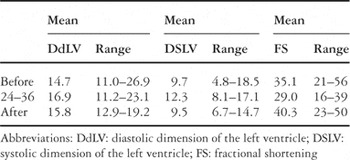
Table 1.
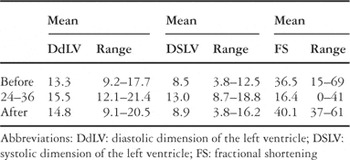
Table 2.

Variations as measured in the patients with and without left-to-right shunting across a patent arterial duct in mean left ventricular fractional shortening (FS) before bypass, at 24–36 hours of extracorporeal membrane oxygenation, and after discontinuing bypass.
 You have
Access
- 5
- Cited by