Introduction
The neurocognitive theory of schizophrenia has demonstrated explanatory reach (Deutsch, Reference Deutsch2011; Kahn & Keefe Reference Kahn and Keefe2013). Cognitive impairment accounts for a range of outcomes including ability to live independently, employment, quality of life and reactive violence in addition to response to antipsychotic medication (Kim et al. Reference Kim, Lee, Hur, Yoon, Lee and Ko2008; Chang et al. Reference Chang, Ming Hui, Yan Wong, Wa Chan, Ming Lee and Hai Chen2013; Kahn & Keefe, Reference Kahn and Keefe2013; O'Reilly et al. Reference O'Reilly, Donohoe, Coyle, O'Sullivan, Rowe, Losty, McDonagh, McGuinness, Ennis, Watts, Brennan, Owens, Davoren, Mullaney, Abidin and Kennedy2015). Although pharmacotherapy is the primary treatment for the symptoms of schizophrenia (Leucht et al. Reference Leucht, Tardy, Komossa, Heres, Kissling and Davis2012) such as delusions and hallucinations, it is less effective for negative symptoms like lack of motivation, nor is it effective for cognitive impairment (Harvey & Bowie, Reference Harvey and Bowie2012; Nielsen et al. Reference Nielsen, Levander, Kjaersdam Telléus, Jensen, Østergaard Christensen and Leucht2015). Only one in seven patients achieve recovery when defined as clinical and social adaptation sustained over time (Jääskeläinen et al. Reference Jääskeläinen, Juola, Hirvonen, McGrath, Saha, Isohanni, Veijola and Miettunen2013). Psychosocial treatments are generally used to address the functional disability that characterizes schizophrenia (Grant et al. Reference Grant, Huh, Perivoliotis, Stolar and Beck2011). Unfortunately cognitive problems may also interfere with the effectiveness of these interventions (Green et al. Reference Green, Kern, Braff and Mintz2000; Kurtz, Reference Kurtz2011; O'Reilly et al. Reference O'Reilly, Donohue, O'Sullivan, Coyle, Mullaney, O'Connell, Maddock, Nulty, O’ Flynn, O'Connell and Kennedy2016).
To facilitate the development of cognitive enhancing agents the US National Institute of Mental Health devised a neuropsychological battery for treatment studies, the MATRICS consensus cognitive battery (MCCB; Nuechterlein et al. Reference Nuechterlein, Green, Kern, Baade, Barch, Cohen, Essock, Fenton, Frese, Gold, Goldberg, Heaton, Keefe, Kraemer, Mesholam-Gately, Seidman, Stover, Weinberger, Young, Zalcman and Marder2008). The US Food and Drug Administration (FDA) requires that cognitive enhancing agents be supported by both evidence of change in cognitive performance and improvements in ‘real world’ functioning (Buchanan et al. Reference Buchanan, Davis, Goff, Green, Keefe, Leon, Nuechterlein, Laughren, Levin, Stover, Fenton and Marder2005). Currently pharmacological attempts to enhance cognition among patients with schizophrenia have been unsuccessful (Harvey & Bowie, Reference Harvey and Bowie2012). The reason for this is unclear. Excessive synaptic pruning may limit the potential for improving cognition via neurotransmitters (Keshavan et al. Reference Keshavan, Anderson and Pettegrew1994; Harvey & Bowie, Reference Harvey and Bowie2012; Sekar et al. Reference Sekar, Bialas, de Rivera, Davis, Hammond, Kamitaki, Tooley, Presumey, Baum, Van Doren, Genovese, Rose, Handsaker, Daly, Carroll, Stevens and McCarroll2016). But the use and dose of concurrent medications may also be important (Harvey & Bowie, Reference Harvey and Bowie2012). One mechanism through which a deleterious effect of concurrent medications might occur is via the cholinergic system (Nebes et al. Reference Nebes, Pollock, Meltzer, Saxton, Houck, Halligan and DeKosky2005; Campbell et al. Reference Campbell, Boustani, Limbil, Ott, Fox, Maidment, Schubert, Munger, Fick, Miller and Gulati2009). The cholinergic system is a series of pathways from the basal forebrain radiating throughout the cerebral cortex and involved in regulating attention and memory (Chudasama et al. Reference Chudasama, Dalley, Nathwani, Bouger and Robbins2004; Sarter et al. Reference Sarter, Hasselmo, Bruno and Givens2005).
Most antipsychotic medications administered to patients with schizophrenia possess anticholinergic properties (Chew et al. Reference Chew, Mulsant, Pollock, Lehman, Greenspan, Mahmoud, Kirshner, Sorisio, Bies and Gharabawi2008). The side-effect profile of antipsychotic medication is also sometimes treated with anticholinergic agents. In recognition of this the FDA-NIMH-MATRICS Guidelines for Clinical Trial Design of Cognitive-Enhancing Drugs require that first-generation antipsychotics can be utilized in clinical trials but only with no additional anticholinergic agents (Buchanan et al. Reference Buchanan, Keefe, Umbricht, Green, Laughren and Marder2011). Over 50% of people with schizophrenia also have other psychiatric or general medical conditions which require treatment (Green et al. Reference Green, Canuso, Brenner and Wojcik2003; Jones et al. Reference Jones, Macias, Barreira, Fisher, Hargreaves and Harding2004). Many medications for treating these non-psychiatric problems have anticholinergic properties. Pharmacological treatments when aggregated may create a considerable anticholinergic burden that impairs cognition, functional capacity and ability to benefit from psychosocial treatments amongst a group of patients who are already cognitively impaired (Vinogradov et al. Reference Vinogradov, Fisher, Warm, Holland, Kirshner and Pollock2009; O'Reilly et al. Reference O'Reilly, Donohoe, Coyle, O'Sullivan, Rowe, Losty, McDonagh, McGuinness, Ennis, Watts, Brennan, Owens, Davoren, Mullaney, Abidin and Kennedy2015).
To our knowledge only one study has investigated whether anticholinergic burden moderates the effectiveness of behavioural treatments (Vinogradov et al. Reference Vinogradov, Fisher, Warm, Holland, Kirshner and Pollock2009). Serum anticholinergic activity uniquely accounted for 20% of the variance in change of global cognition following a programme of cognitive remediation therapy, independent of age, IQ or symptom severity. A limitation of this study was that it consisted of patients who were treatment responsive and who volunteered to participate in 50 hours of intensive therapy. Moreover, the study was limited to cognitive outcome and did not examine the effect of anticholinergic burden on functional status. Because cognitive impairment in schizophrenia is an important goal of treatment and because cognitive deficits are known to affect patients’ ability to benefit from psychosocial programmes it is necessary to examine whether anticholinergic burden affects patients’ ability to benefit from treatments.
-
(1) We hypothesized that the relationship between anticholinergic burden and ability to benefit from psychosocial treatment programmes would be mediated by cognitive ability, when controlling for age, gender, baseline performance on psychosocial treatment programmes, total antipsychotic dose, and symptoms.
-
(2) We hypothesized that the mediation relationship between medication, cognition, and programme completion would be specific to anticholinergic burden and not total antipsychotic dose; and that the mediation would be specific to cognition, not to symptoms or functioning when cognition is controlled for.
Method
This was a naturalistic 3 year prospective observational cohort study of anticholinergic burden, cognitive ability and patient benefit from psychosocial treatment programmes. Data were gathered from 2012 to 2015. Baseline data was gathered in 2012. Follow up data was gathered until the end of 2015. All of the assessments were completed by assessors who were blind to the results of the other assessments
Participants and setting
The National Forensic Mental Health Service (NFMHS) for Ireland provides specialized care for adults who have a mental disorder and are at risk of harming themselves or others. At the time of the study the NFMHS had 94 secure inpatient beds located on a single campus, the Central Mental Hospital (CMH), and 13 supervised community beds for those discharged subject to conditions. The CMH is the only secure forensic psychiatric hospital for the Republic of Ireland.
Inclusion criteria were having a diagnosis of schizophrenia or schizoaffective disorder and being judged to be able to provide informed consent. A total of 123 patients were invited to participate during 2012. Of these eight patients declined to take part and 15 did not have a diagnosis of schizophrenia or schizoaffective disorder as assessed by a consultant psychiatrist using the Structured Clinical Interview for DSM-IV (SCID; First et al. Reference First, Spitzer, Gibbon and Williams2002). Of the 100 remaining, 19 patients were discharged and one patient died before they could complete the programme completion assessment at follow-up, one patient was judged to be feigning during the assessment, and one patient did not complete the cognitive assessment, while eight patients did not complete the Positive and Negative Syndrome Scale (PANSS; Kay et al. Reference Kay, Fiszbein and Opler1987) assessment. Of the 70 patients that remained in the study 59 patients has a SCID diagnosis of schizophrenia and 11 a diagnosis of schizoaffective disorder. There were 66 male (94.3%) and four female (5.7%) patients. The mean age of patients in the study was 39 years (s.d.=11.1).
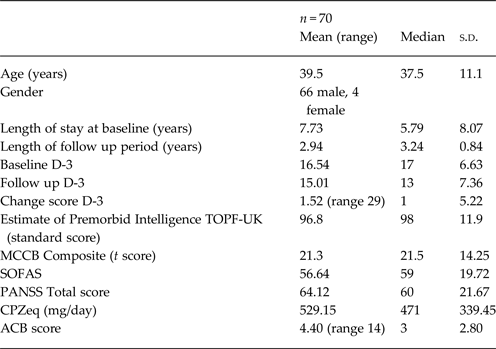
The mean length of stay at baseline for the 70 patients was 7.73 years (s.d.=8.07), median 5.79. Of the 70 patients included in the study 62 (88%) remained in the study until 2015. Seven patients were discharged during the 3-year follow-up and one patient died. As assessments were carried out every 6 months, the last assessment was taken. Demographic details and sample characteristics are presented in Table 1.
Demographics and sample characteristics
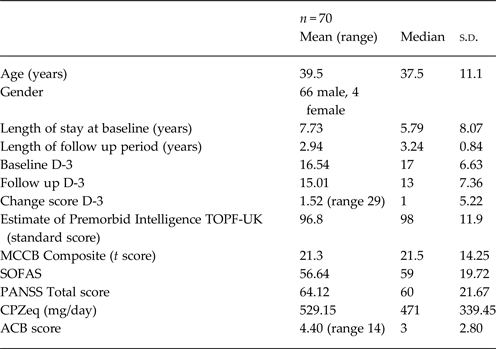
D-3, DUNDRUM-3 Programme Completion Scale; TOPF, Test of Premorbid Functioning; MCCB, Matrics consensus cognitive battery; SOFAS, Social and Occupational Functioning Assessment Scale; PANSS, Positive and Negative Symptom Scale; CPZeq, chlorpromazine equivalent; ACB, Anticholingeric Cognitive Burden scale.
Cognitive assessment
Patients were assessed using the Measurement and Treatment to Improve Cognition in Schizophrenia (MATRICS) Consensus assessment battery of cognitive deficits in schizophrenia (MCCB), and also the Test of Premorbid Functioning (TOPF-UK; Wechsler, Reference Wechsler2011). The mean MCCB composite score was 21.32 (s.d.=14).
Scores for estimated pre-morbid intelligence (TOPF-UK) were not adjusted for education as an estimate of premorbid ability because the symptoms associated with mental disorder can affect educational attainment. A small number of patients (n = 7) could not complete the TOPF-UK because of literacy problems. The mean estimated premorbid IQ was 96.8 (s.d.=12.0).
Functional performance
The Social and Occupational Functioning Assessment Scale (SOFAS) was completed by a member of the multidisciplinary team responsible for the care of the patient, who was blind to the other assessments including the cognitive assessment (Rybarczyk, Reference Rybarczyk, Kreutzer, DeLuca and Caplan2011). The mean score on the SOFAS was 57 (s.d.=20).
Programme completion
The DUNDRUM-3 Programme Completion Scale (D-3) is a structured clinical judgement instrument taken from the DUNDRUM toolkit which assesses whether patients have participated in, engaged and benefited from psychosocial programmes (Kennedy et al. Reference Kennedy, O'Neill, Flynn and Gill2010). An independent review found that the scale met requirements for routine outcome measures examining functioning, recovery, risk and placement pathways within forensic mental health populations (Shinkfield & Ogloff, Reference Shinkfield and Ogloff2014). The D-3 has also been shown to distinguish significantly between groups of patients at different levels of therapeutic security within a forensic setting (Davoren et al. Reference Davoren, O'Dwyer, Abidin, Naughton, Gibbons, Doyle, McDonnell, Monks and Kennedy2012); and it has been shown to predict moves between levels of therapeutic security and to predict conditional discharge from a secure hospital (Davoren et al. Reference Davoren, Abidin, Naughton, Gibbons, Nulty, Wright and Kennedy2013).
The D-3 has seven items measuring outcomes for programmes concerning physical health, mental health, drugs and alcohol, problem behaviours, self-care and activities of daily living, education occupation and creativity, and family and social networks. These items are intended to cover the domains of health defined by the WHO (1986), which holds that health is ‘a resource for everyday life, not the objective of living. Health is a positive concept emphasizing social and personal resources, as well as physical capacities.’ Each item is rated on a 5-point scale with lower scores representing a higher level of participation, sustained engagement and change. Engagement is demonstrated through more than simply having attended all sessions of a programme. This battery of assessments encompasses the range of interventions typically offered for patients with schizophrenia in a modern forensic hospital over a time scale of years rather than months. Annual audits during the period of this study showed that patients achieved a target of 25 h a week of timetabled therapeutic activity and represents ‘treatment as usual’.
The mean D-3 score at baseline was 16.5 (s.d.=6.63) which is the total score for all seven items. The mean D-3 at follow up was 15.0 (s.d.=7.36). D-3 change scores were calculated by subtracting the D-3 score at follow-up from the D-3 at baseline to estimate the strength of the anticholinergic effect. The mean change in D-3 score over the follow-up period was 1.52 (s.d.=5.22).
Symptom assessment
The PANSS was completed on all 70 patients who remained in the study. The PANSS assessments were completed by a psychiatric registrar and an assistant psychologist trained in its use, who were blind to the cognitive assessments. The mean PANSS Total score at baseline was 64 (s.d.=22).
Medication
A recent review indicated that evidence is not sufficiently robust for any one of a number of methods of calculating dose equivalence for different antipsychotic medications to be considered as a gold standard, and justification should be offered for the method chosen in any particular study (Patel et al. Reference Patel, Arista, Taylor and Barnes2013) A chlorpromazine equivalent (CPZeq) was calculated for each participant as a measure of his/her relative daily dose of antipsychotic medications (Taylor et al. Reference Taylor, Paton and Kapur1994; Woods, Reference Woods2003; Haddad et al. Reference Haddad, Lambert and Lauriello2010). CPZeq was selected for calculating antipsychotic dose as it is a widely used and coherent method, appeared to have the best face validity for the purposes of this study and produces similar results to other approaches such as the British National Formula percentage maximum dose and defined daily dose (Sweileh et al. Reference Sweileh, Odeh, Shraim, Zyoud, Sawalha and Al-Jabi2014). The mean CPZeq score at baseline was 529.15 mg/day (s.d.=339.45).
Anticholinergic burden
Anticholinergic burden was assessed using the Anticholinergic Cognitive Burden (ACB) scale (Boustani et al. Reference Boustani, Campbell, Munger, Maidment and Fox2008). The ACB scale was developed by a multidisciplinary expert panel based on a systematic review of medications with known anticholinergic activity likely to have an effect on cognition. The ACB scale contains 88 listed medications. Each listed medication can be rated on a 4-point scale (0–3): 0 = no anticholinergic activity, 1 = mild anticholinergic activity, 2 = moderate anticholinergic activity, and 3 = severe anticholinergic activity. The total anticholinergic burden is then calculated by aggregating the score for each listed medication. The ACB scale has been validated in a range of studies (Salahudeen et al. Reference Salahudeen, Duffull and Nishtala2015).
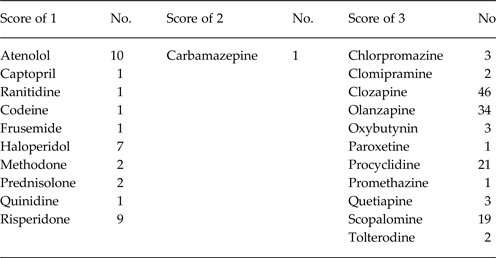
The ACB scale was scored from prescription charts by a consultant psychiatrist (P.O'C.) the week prior to the baseline cognitive assessment. The mean ACB score at baseline was 4.40 (s.d.=2.80), mode 3; 75% of the sample had an ACB score <6. Table 2 shows that many of the medications contributing to ACB score were non-psychiatric. No benzodiazepines were prescribed.
Medications contributing to the anticholinergic cognitive burden (ACB) scale score

Numbers (No.) are the numbers of patients receiving each medication. Note also that no patients were prescribed benzodiazepines.
Statistical analysis
Distributions of all measures were screened for outliers and evaluated for normality. One case was assessed as being an outlier on the ACB scale using an outlier labelling method and visual inspection of plots. This case was winsorized to the value of the next highest case not considered an outlier. Four cases were determined to be outliers for the change score on the D-3. These cases were also winsorized to the next highest or lowest case not considered to be an outlier. Following the removal of outliers both the ACB score and the D-3 change scores were normally distributed. The variables age, baseline 2012 D-3 and CPZeq were not normally distributed and were transformed using log10 and Srt transformation. The PANSS Total score and the MCCB Total score met criteria for a normal distribution and did not require any transformations.
A paired sample t test was used to calculate whether there was a significant difference between patients’ performance on the D-3 at baseline and 3 years follow-up. Morris & DeShon's (Reference Morris and DeShon2002) within-group effect-size formula was used to calculate the magnitude of the effect size over a 3-year period.
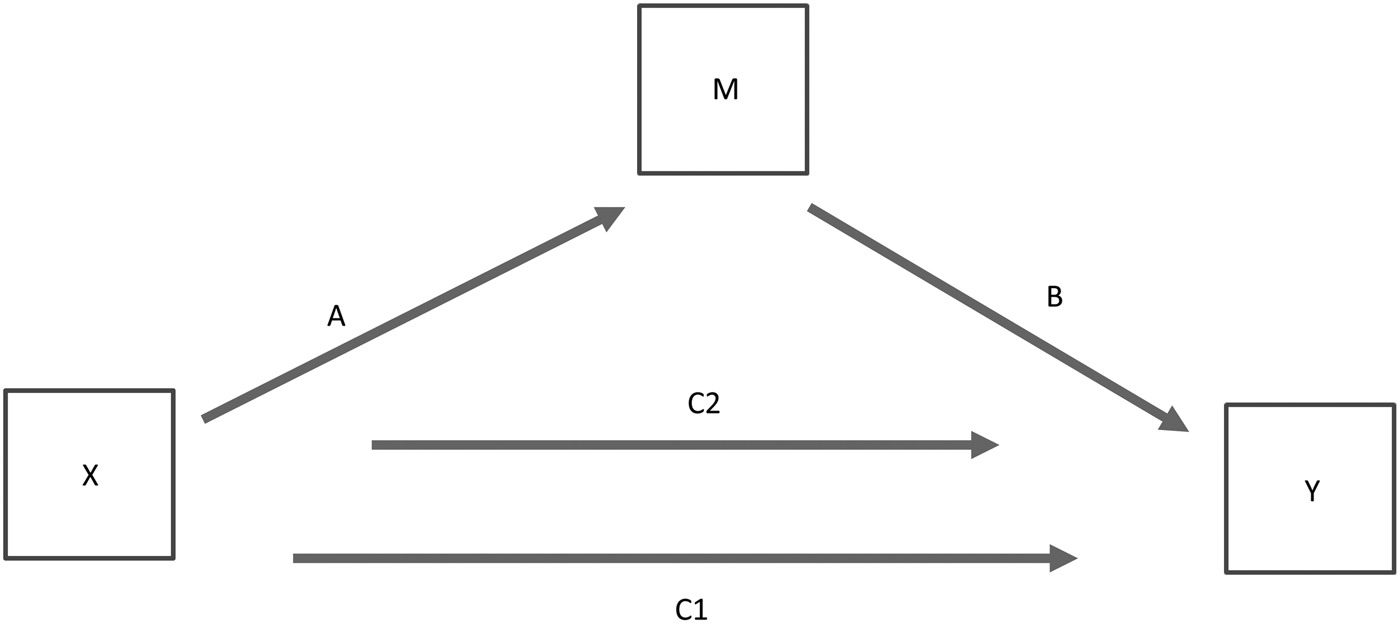
SPSS process macro model 4 (Hayes, Reference Hayes2013) was used to analyse mediation relationships between anticholinergic burden measured by the ACB scale and change of D-3 scores over a 3-year period in scores on the D-3. Unstandardized effect sizes were generated for the mediation models using 10 000 bootstrap samples and 95% bias-corrected confidence intervals were calculated. Age and gender were entered as covariants for all coefficients (Fig. 1).
C1, Direct effect of X on Y, before mediation via M; C2, direct effect of X on Y after mediation via M; A, indirect effect of X on Y mediated via M; B, direct effect of M on Y, adjusted for X.

Six specific mediation analyses were carried out to test the specificity of the relationship between anticholinergic burden, cognition, and patients’ ability to participate in and benefit from treatment programmes (change in D-3 score). First, we examined whether cognitive ability as measured by the MCCB Total score would mediate the relationship between anticholinergic burden and change in D-3 score, when controlling for age, gender, baseline performance on the D-3, psychiatric symptoms as measured by the PANSS Total score, and antipsychotic dose. Second, we examined whether MCCB also mediated an effect of dose (CPZeq) on change in D-3 score as an alternative to a specific effect of ACB. Third, we examined whether psychiatric symptoms as measured by the PANSS Total score would mediate the relationship between anticholinergic burden and change in D-3 score, controlling for age, gender, cognition as measured by the MCCB Total score, antipsychotic dose and baseline performance on the D-3. Fourth, we examined whether baseline functioning as measured by the SOFAS would mediate the relationship between anticholinergic burden and change in D-3 score, when controlling for age, gender, baseline performance on the D-3, cognition as measured by the MCCB Total score, antipsychotic dose, and psychiatric symptoms. Fifth, we examined whether cognition (MCCB Total score) would act as mediator when additionally controlling for baseline functioning (SOFAS), and whether baseline functioning (SOFAS) would act as a mediator when cognition (MCCB) was not controlled.
Ethical standards
This study was approved by the research ethics and effectiveness committee of the NFMHS and complied with the ethical standards of the relevant national and institutional committees on human experimentation and with the Helsinki Declaration of 1975, as revised in 2008. All participants gave written informed consent.
Results
Magnitude of change over a 3-year period within a forensic mental health service
The mean follow-up period (n = 70) was 2.94 years (s.d.=0.840). The mean change in D-3 score was −1.528 units s.d. 5.22. This was a significant change [paired t = 2.448, df = 69, p < 0.017; 95% confidence interval (CI) 2.77–0.28]. The Pearson correlation between baseline programme completion and programme completion at 3-year follow-up was r = 0.726. The magnitude of effect of 3 years of treatment in a forensic mental health service using D-3 was 0.295 (Cohen's d).
Anticholinergic burden and change in programme completion scores over 3 years
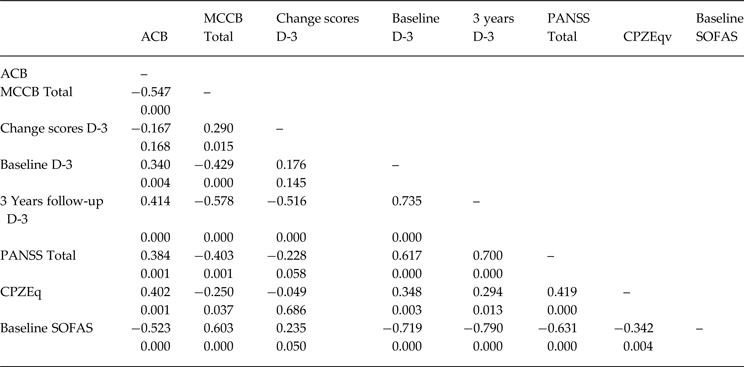
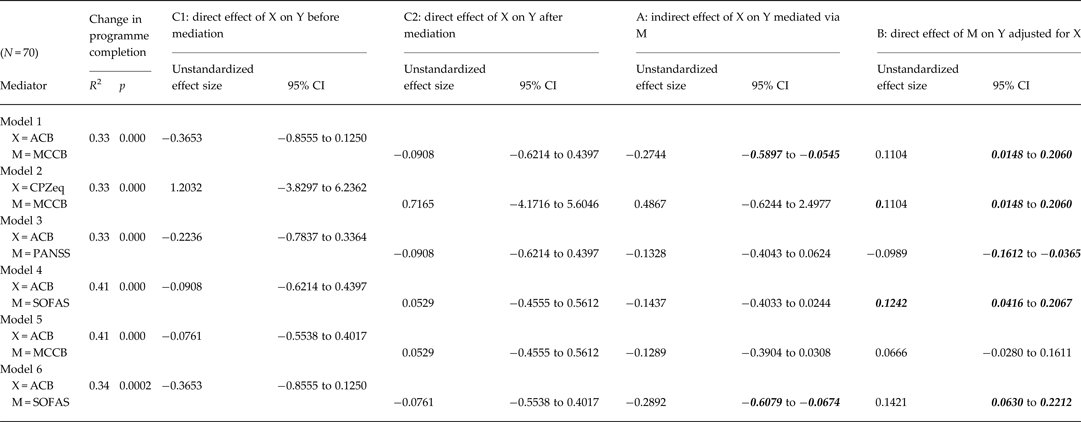
The MCCB Total score completely mediated the relationship between anticholinergic burden (ACB) and the change in D-3 scores, when controlling for age, gender, baseline programme completion, total antipsychotic dose (CPZeq), and total psychopathology (PANSS). The unstandardized indirect effect of anticholinergic burden as measured by the ACB scale through cognition as measured using the MCCB Total score was −0.27 (95% CI −0.58 to −0.0545) (Table 3) which can be read that for every 1-point increase on the ACB scale changes on the D-3 decrease by −0.27 points.
Pearson correlations (n = 70) and significance (p) values
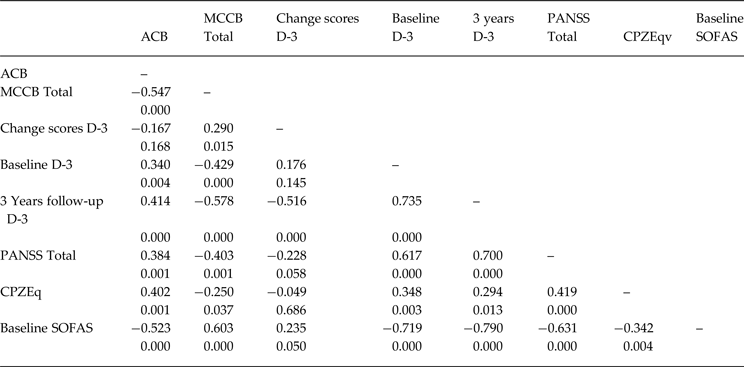
ACB, Anticholingeric Cognitive Burden scale; MCCB, Matrics consensus cognitive battery; Change scores D-3, DUNDRUM-3 Programme Completion Change Scale scores; Baseline D-3, DUNDRUM-3 Programme Completion Scale scores at baseline; 3 years follow-up D-3, DUNDRUM-3 Programme Completion Scale score at follow-up; PANSS, Positive and Negative symptom Scale; CPZEq, chlorpromazine equivalent; SOFAS, Social and Occupational Functioning Assessment Scale.
Cognition as a mediator between CPZeqs and change in programme completion score
To test the hypothesis that anticholinergic burden and not total antipsychotic dose had a specific effect on cognition which in turn influenced the functional outcome of programme completion we constructed a mediation model where CPZeq was the independent variable and controlled for anticholinergic burden, age, gender, psychopathology, and baseline programme completion. There was no evidence of a direct effect or an indirect effect via cognition for CPZeq on programme completion, when controlling for ACB and other variables.
Total psychopathology as a mediator between anticholinergic burden and change scores for 3 years and programme completion
To test the hypothesis that the effects of anticholinergic burden were specific to cognition and not psychopathology in general we constructed a model where PANSS Total score was the proposed mediator controlling for age, gender, baseline programme completion, CPZeq, and the MCCB Total score. There was no evidence of an indirect effect of PANSS Total score on change in D-3 score when controlling for other variables.
SOFAS as a mediator between anticholinergic burden and change in programme completion scores over 3 years
To test the hypothesis that the effect of anticholinergic burden was specific to cognition we constructed a mediation model where the effect of anticholinergic burden on change in D-3 score was mediated by social and occupational functioning (SOFAS) controlling for age, gender, baseline programme completion, MCCB Total Score, CPZeq, and PANSS Total score. Social and occupational functioning as measured by the SOFAS significantly mediated the relationship between ACB and change in programme completion but only when MCCB Total score was removed from the model.
Cognition as a mediator between anticholinergic burden and change in programme completion scores when controlling for social and occupational functioning
When controlling for social and occupational functioning at baseline the MCCB Total score no longer mediated ACB and change in D-3 scores (Table 4).
Regression and mediation coefficients
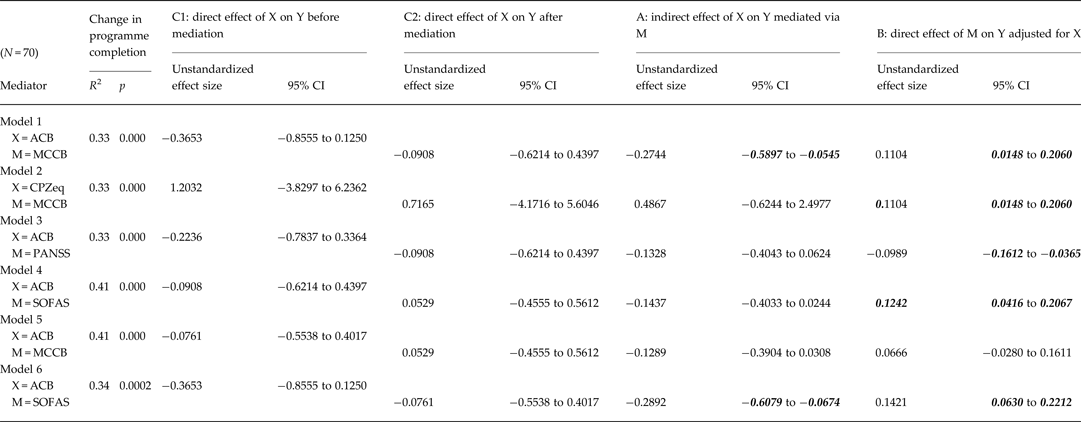
CI, Confidence interval; ACB, Anticholingeric Cognitive Burden scale; MCCB, Matrics consensus cognitive battery; CPZEq, chlorpromazine equivalent; PANSS, Positive and Negative Symptom Scale; SOFAS, Social and Occupational Functioning Assessment Scale.
In all cases, the outcome (Y) is ‘Change in DUNDRUM-3 Programme Completion Scale scores’. X is the hypothesized determinant factor and M is the hypothesized mediating factor. Total sample n = 70.
Models 1, 2, 3 include age, gender, DUNDRUM-3 Programme Completion Scale (D-3) baseline scores; PANSS Total, MCCB Total, and CPZeq. Models 4 and 5 also include SOFAS in addition to age, gender, D-3 Baseline, PANSS Total, MCCB Total and CPZeq. Model 6 does not included or control for MCCB and contains ACB, SOFAS, age, gender, PANSS Total, and CPZeq. In each case the dependent variable (Y) is change scores on the D-3.
Post-hoc analysis
A post-hoc analysis exploring the mediation relationship between ACB, cognition (MCCB Total score) and disability or functioning (SOFAS) was also conducted, controlling for age, gender, psychopathology (PANSS Total) and medication (CPZeq). This analysis again used process and 10 000 bootstrapped samples. In total the model accounted for 59% of the variance of functioning (SOFAS). The direct effect of ACB on functioning (SOFAS) was not significant (−0.7657, 95% CI −2.4759 to 0.9445). However, the mediated effect via cognition (MCCB) was significant (−1.4651, 95% CI −2.5479 to − 0.6905). For every 1-point increase in anticholinergic burden score, functioning (SOFAS) declined by 1.4651 points.
This effect was specific to cognition being fully mediated by MCCB score. Psychopathology (PANSS Total) did not mediate the relationship between ACB and functioning when cognition was controlled for (−0.4508, 95% CI −1.558 to 0.4978). Further, the effect was specific to anticholinergic burden and not total antipsychotic dose. CPZeq did not affect functioning (SOFAS) via cognition, when ACB was controlled for (0028, 95% CI −0.0026 to 0.0089).
Discussion
This is the first study to demonstrate that anticholinergic burden has a negative impact on the outcomes of psychosocial treatment programmes for patients with schizophrenia or schizoaffective disorder. It is noteworthy that many of the medications contributing to the ACB score were non-psychiatric. This adverse effect on psychosocial treatments appears to be mediated specifically through impaired cognitive capacity. The patients within this prospective cohort were cognitively impaired at baseline and had a mean MCCB t score composite of 21.3, which is almost 3 s.d. below the non-clinical mean. A score of this size approximates the cognitive abilities of individuals with a moderate intellectual disability. The cognitive ability of patients within this sample is especially marked given that their estimated premorbid IQ was found to be in the average range. Anticholinergic burden in part appeared to be a determinant of cognitive ability and psychosocial treatment outcomes. Within this study for every 1-unit increase on the ACB scale, patients change in D-3 scores, a scale measuring participation and benefit from psychosocial treatment programmes, decreased by −0.27 points. This decrease needs to be taken in context that the mean change score on the D-3 was 1.52 over the 3-year period (Cohen's d = 0.29). The range of change in D-3 score was, however, very wide (Table 1). Anticholinergic burden impairs cognition, which in turn impairs the ability to benefit from treatment programmes, even when controlling for a range of confounding variables including age, gender, antipsychotic dose and symptom severity.
These findings appear to be specific to anticholinergic burden and cognition. The effect of total antipsychotic dose on change in programme completion score was not mediated by cognition. Since no benzodiazepines were prescribed, these could not have contributed to slowed processing speed. Moreover, total psychopathology (PANSS) did not mediate the effect of anticholinergic burden on change in programme completion scores. Clinicians’ ratings of patients’ psychosocial and occupational functioning (SOFAS) also did not mediate the relationship between anticholinergic burden and change in programme completion when cognition was controlled for. But SOFAS did mediate the relationship between anticholinergic burden and programme completion when cognitive ability was removed from the model, presumably because functioning is in part dependent on cognitive capacity.
Our post-hoc analysis demonstrates that anticholinergic burden may impact on patient disability as measured by the SOFAS. This effect again is specific to cognition as demonstrated by mediation analysis. Mediation analysis also shows that the effect of ACB on SOFAS is specific to anticholinergic burden and not total antipsychotic dose (CPZeq). This may have implications for rehabilitation in schizophrenia.
The findings of this study may go some way to explaining why Wunderink et al. (Reference Wunderink, Nieboer, Wiersma, Sytema and Nienhuis2013) found that dose reduction of antipsychotic medication was linked with superior functional but not symptomatic remission in comparison to maintenance treatment at 7 years follow-up. Reductions in anticholinergic burden may have been the mechanism responsible for this improved psychosocial functioning. It has been suggested that treatments like CBT may not be as helpful for patients with schizophrenia as for some other problems (Jauhar et al. Reference Jauhar, McKenna, Radua, Fung, Salvador and Laws2014). But psychological interventions have a robust evidence base for a range of disorders (Carr, Reference Carr2009). One reason for reduced efficacy in schizophrenia may be that cognitive impairments affect patients’ ability to attend to, process, store, and use the information offered during psychological interventions (Green et al. Reference Green, Kern, Braff and Mintz2000; Kurtz, 2011). This study illuminates a possible iatrogenic effect that pharmacotherapy can have on cognition and functioning, which in turn affects the outcome of psychosocial treatment. Cognitive ability and anticholinergic burden should therefore routinely be considered as moderators in clinical trials of psychological therapy for patients with schizophrenia.
We do not propose that anticholinergic burden is the sole cause of cognitive impairments amongst patients with schizophrenia or even the major cause, because these difficulties have been observed in medication naïve patients (Kahn & Keefe, Reference Kahn and Keefe2013). However our findings do suggest that anticholinergic burden may have adverse effects for patients with schizophrenia. There are studies suggesting that there is a widespread decrease in muscarinic receptors in the brains of people with schizophrenia (Scarr et al. Reference Scarr, Gibbons, Neo, Udawela and Dean2013) including post-mortem studies (Mancama et al. Reference Mancama, Arranz, Landau and Kerwin2003; Zavitsanou et al. Reference Zavitsanou, Katsifis, Mattner and Xu-Feng2004; Newell et al. Reference Newell, Zavitsanou, Jew and Huang2007; Gibbons et al. Reference Gibbons, Scarr, Boer, Money, Jeon, Felder and Dean2013) and a brain-imaging study (Raedler et al. Reference Raedler, Knable, Jones, Urbina, Gorey, Lee, Egan, Coppola and Weinberger2003). Similar to older patients, or those with dementia, people with schizophrenia are likely to have a vulnerable brain with a paucity of cholinergic neurons (Tune, Reference Tune2001; Campbell et al. Reference Campbell, Boustani, Limbil, Ott, Fox, Maidment, Schubert, Munger, Fick, Miller and Gulati2009; van Haren et al. Reference van Haren, Schnack, Cahn, van den Heuvel, Lepage, Collins, Evans, Hulshoff Pol and Kahn2011; Harvey & Bowie, Reference Harvey and Bowie2012; Kahn et al. Reference Kahn, Sommer, Murray, Meyer-Lindenberg, Weinberger, Cannon, O'Donovan, Correl, Kane, van Os and Insel2015; Gray et al. Reference Gray, Anderson, Dublin, Hanlon, Hubbard, Walker, Yu, Crane and Larson2015; Kubota et al. Reference Kubota, van Haren, Haijma, Schnack, Cahn, Hulshoff Pol and Kahn2015). Physicians are therefore required to conduct careful risk benefit decisions and collaborate with patients regarding the medications they prescribe. The ACB scale may be a useful clinical tool for helping physicians and patients make these decisions. Because verbal intelligence in people with schizophrenia is largely intact (Michel et al. Reference Michel, Goldberg, Heinrichs, Miles, Ammari and McDermid Vaz2013), it may be particularly challenging for physicians to identify declines or impairments in other cognitive domains. Also cognitive screening instruments may not be helpful as they do not take account of a patient's premorbid intellectual ability or have enough sensitivity to change (Lezak et al. Reference Lezak, Howieson, Bigler and Tranel2012). Therefore comprehensive neuropsychological assessment using psychometrically robust and functionally relevant instruments may be important in the planning of care and treatment for people with schizophrenia.
This study has a number of methodological strengths as well as limitations. Strengths include a sample made up of most of a national cohort of forensic patients diagnosed with schizophrenia or schizoaffective disorder. This sample was followed up over a 3-year period. The use of the MCCB measure for assessing cognitive problems in schizophrenia and controlling for a range of confounders including psychopathology and antipsychotic dose are also strengths. Furthermore, all measurements were conducted independently of each other.
Limitations in this study include the specialist sample consisting entirely of forensic patients which may raise questions regarding the generalizability of the results to other samples of patients with schizophrenia. Patient participation and benefit from psychosocial treatment programmes was measured using the D-3 which has been specifically developed and recommended for this patient group. This scale takes account of the wide range of psychosocial interventions provided for hospitalized patients over a 3-year period. Because no attempt is made here to distinguish between treatment responses to different treatment programmes, the overall effect measured is a measure of ‘treatment as usual’ with multi-disciplinary delivery of programmes. The sample in this study was cross-sectional rather than an incident series of new admissions. To achieve an incident sample of sufficient size, a very prolonged study over as much as a decade would have been required, or a multi-centre study.
This study supports the validity of the ACB scale given its correlations with the MCCB, SOFAS, and D-3. However it is important to point out that a number of criticisms have been levelled at anticholinergic burden scales. There is no consensus for how to calculate anticholinergic burden. Although a bioassay of serum anticholinergic activity has in the past been considered the gold standard it is only a marker of anticholinergic activity in serum, and not in the brain (Hori et al. Reference Hori, Konishi, Tani, Tomioka, Akita, Kitajima, Aoki, Yokoyama, Azuma, Ikuse, Akashi, Hosoi, Jinbo and Hachisu2014). Also dosage is not considered within clinical scales such as the ACB and medications are unlikely to have a simple 0:1:2:3 ratio in relation to dose or in relation to each other. However, a number of studies have found that unit weighting as used in the ACB scale is quite robust for making predictions (Dawes, Reference Dawes1979). Unit weighting performs particularly well where the criterion (in this case central anticholinergic effect) cannot be quantified and this is precisely the case regarding anticholinergic burden (Dawes, Reference Dawes1979). Unit weighting also performs well when there is not a straightforward relationship between the predictor variables and the criterion (Dawes, Reference Dawes1979), and there is considerable individual variation in absorption, distribution, rate of metabolism, formation, and excretion of pharmacologically active metabolites (Pollock, Reference Pollock, Saddock and Saddock2000). A third criticism of anticholinergic scales is that there is variability in the quantification of anticholinergic burden across different instruments. However, unit weighting is also viable when it is difficult to develop a regression model because of a larger number of predictors. There are more than 600 medications that have anticholinergic activity (Chew et al. Reference Chew, Mulsant, Pollock, Lehman, Greenspan, Mahmoud, Kirshner, Sorisio, Bies and Gharabawi2008). Finally, because medications with anticholinergic properties do not have a straightforward relationship with cognitive decline the correlation between scales may be a better measure of construct validity than the kappa coefficient (Lertxundi et al. Reference Lertxundi, Domingo-Echaburu, Hernandez, Peral and Medrano2013).
Although a number of confounding factors were controlled for there was no attempt to manipulate any variable and therefore the study only approximates a causal design. The value of this study is that it establishes a case for an intervention study using meaningful outcome measures concerning treatment engagement and response, and real world functional outcomes. A number of studies have suggested that discontinuing anticholinergic treatments had a positive effect on cognition among patients with schizophrenia (Baker et al. Reference Baker, Cheng and Amara1983; Mori et al. Reference Mori, Yamashita, Nagao, Horiguchi and Yamawaki2002; Drimer et al. Reference Drimer, Shahal and Barak2004; Ogino et al. Reference Ogino, Miyamoto, Tenjin, Kitajima, Ojima, Miyake, Funamoto, Arai, Tsukahara, Ito, Tadokoro, Anai, Tatsunami, Kubota, Kaneda and Yamaguchi2011; Desmarais et al. Reference Desmarais, Beauclair, Annable, Bélanger, Kolivakis and Margolese2014). But no study has yet examined whether improvements in cognition following reduction in anticholinergic burden have in turn affected real-world functioning.
Conclusion
Anticholinergic burden as measured by the ACB scale had a significant impact on patient ability to participate and benefit from psychosocial treatments within a forensic hospital as measured by change in D-3 score. Anticholinergic burden appears to impair cognitive ability and real-world functioning, which in turn affects patient ability to participate in and benefit from psychosocial programmes. Physicians need to be mindful of the cumulative effect that psychiatric and other medications can have on cognitive ability, functional capacity, and ability to participate and benefit from psychosocial treatments.
Acknowledgements
The authors acknowledge the help and assistance of all those who voluntarily participated in the study. This research received no specific grant from any funding agency, commercial or not-for-profit sectors. The work was carried out as part of the routine quality improvement programmes of the Health Service Executive's National Forensic Mental Health Service.
Declaration of Interest
None.