


Introduction
According to the fourth edition of the Diagnostic and Statistical Manual of Mental Disorders (DSM-IV; American Psychiatric Association, 2000), one of the main characteristics of hypochondriasis is “the person's misinterpretation of bodily symptoms”. With the newly published DSM-5 (American Psychiatric Association, 2013), hypochondriasis can now be divided into two different diagnoses: “somatic symptom disorder” and “illness anxiety disorder”. In contrast to illness anxiety disorder, somatic symptom disorder includes the presence of somatic symptoms as a key diagnostic element. Because the presence of one or more somatic symptoms is not required in hypochondriasis, illness anxiety disorder is more consistent with the DSM-IV diagnosis for hypochondriasis. Increased sensitivity to concerns regarding health also remains a key diagnostic element of illness anxiety disorder. In addition, according to the cognitive-behavioural model that was proposed by Warwick and Salkovskis (Reference Warwick and Salkovskis1990), the misinterpretation of bodily symptoms as signs of a severe illness constitutes a key factor in the exacerbation and maintenance of hypochondriasis. This dysfunctional symptom attribution leads to a vicious circle of fear, increased bodily vigilance, an enhanced perception of bodily sensations and engagement in safety behaviour (Abramowitz, Deacon and Valentiner, Reference Abramowitz, Deacon and Valentiner2007; Marcus, Gurley, Marchi and Bauer, Reference Marcus, Gurley, Marchi and Bauer2007; Warwick and Salkovskis, Reference Warwick and Salkovskis1990).
Empirical evidence for the importance of symptom attributions for hypochondriacal fears is strong (see, for example, Bailer et al., Reference Bailer, Müller, Witthöft, Diener, Mier and Ofer2013; Barsky et al., Reference Barsky, Ahern, Duff Bailey, Saintfort, Liu and Peekna2001; Barsky, Coeytaux, Sarnie and Cleary, Reference Barsky, Coeytaux, Sarnie and Cleary1993; Fergus, Reference Fergus2014; Hadjistavropoulos, Reference Hadjistavropoulos1998; Haenen, Jong, Schmidt, Stevens and Visser, Reference Haenen, Jong, Schmidt, Stevens and Visser2000; Haenen, Schmidt, Schoenmakers and van den Hout, Reference Haenen, Schmidt, Schoenmakers and van den Hout1998; Hitchcock and Mathews, Reference Hitchcock and Mathews1992; MacLeod, Haynes and Sensky, Reference MacLeod, Haynes and Sensky1998; Marcus, Reference Marcus1999; Marcus and Church, Reference Marcus and Church2003; Rief, Hiller and Margraf, Reference Rief, Hiller and Margraf1998; Schmidt, Witthöft, Kornadt, Rist and Bailer, Reference Schmidt, Witthöft, Kornadt, Rist and Bailer2013; Weck and Höfling, Reference Weck and Höfling2015, Weck, Neng, Richtberg and Stangier, Reference Weck, Neng, Richtberg and Stangier2012a, Reference Weck, Neng, Richtberg and Stangier2012b). Assessment of symptom attributions, however, can be conducted by using various approaches. Most commonly, questionnaires with forced-choice, closed-ended answer formats are used. In addition, more experimental approaches, such as card-sorting techniques, or implicit assessment strategies, such as the newly developed IAT-Hypochondriasis (Weck and Höfling, Reference Weck and Höfling2015), can be used. Another important approach to assessing symptom attributions is free associations. Compared with forced-choice answer formats, free associations offer many advantages. Because free associations are not restricted and patients can freely specify every symptom that comes to mind, free associations are closer to the patients’ reality, which increases the validity of the measurement. Especially in the field of hypochondriasis, it is important to detail individual perspectives, because patient attributions may vary over time. This variation may, for example, be strongly influenced by current media coverage of special diseases (e.g. amyotrophic lateral sclerosis, ALS). If these attributions are not assessed, important information concerning a patient's symptoms would be neglected. Another important advantage of free associations is the possibility to differentiate somatic attributions regarding different degrees of illness severity. Thus, free associations allow additional information on symptom attributions to be collected (Neng and Weck, Reference Neng and Weck2015).
In the field of somatoform disorders in general, a few prior studies have attempted to overcome the disadvantage of forced-choice instruments by using free associations. Misattributions, for example, have been assessed in interviews (Groben and Hausteiner, Reference Groben and Hausteiner2011; Hiller et al., Reference Hiller, Cebulla, Korn, Leibbrand, Röers and Nilges2010; Martin et al., Reference Martin, Korn, Cebulla, Saly, Fichter and Hiller2007). With regard to hypochondriasis, however, empirical evidence of dysfunctional symptom attributions assessed through free associations is scarce. One method to freely assess symptom attributions is the Attribution Task (Sensky, Haynes, Rigby and MacLeod, Reference Sensky, Haynes, Rigby and MacLeod1998). In this task, different common bodily sensations are presented (e.g. prolonged headache) to participants, who then have one minute per symptom to spontaneously attribute possible causes. Neng and Weck (Reference Neng and Weck2015) reported one notable study in which the Attribution Task is used to compare symptom attributions among patients with hypochondriasis, patients with anxiety disorders and healthy controls. In this study, two independent blind raters classified the given attributions into different categories: normalizing, somatic (diseases) and psychological. By using this instrument, Neng and Weck (Reference Neng and Weck2015) showed that hypochondriasis is associated with a disorder-specific attribution style that connects somatic symptoms primarily with moderate (e.g. migraine) and severe (e.g. cancer) diseases. Furthermore, patients with hypochondriasis used normalizing attributions (e.g. not enough sleep) less often than patients with diagnosed anxiety disorders and healthy controls. No differences in the frequency of psychological attributions (e.g. anxiety) and somatic attributions concerning mild diseases (e.g. having a cold) were found.
The hypochondriasis-specific attribution style that is reported by Neng and Weck (Reference Neng and Weck2015) raises the question whether cognitive-behavioural therapy (CBT) can change freely associated attributions regarding normalizing, somatic and psychological explanations. In general, CBT has been demonstrated to be highly effective in the treatment of hypochondriasis (Olatunji et al., Reference Olatunji, Kauffman, Meltzer, Davis, Smits and Powers2014). However, until now, the empirical evidence that CBT can change dysfunctional symptom attributions is based on forced-choice instruments only. For instance, Weck, Neng, Schwind and Höfling (Reference Weck, Neng, Schwind and Höfling2015) used the Symptoms Outcome Scale (Marcus, Reference Marcus1999) and the Health Norms Sorting Task (Barsky et al., Reference Barsky, Coeytaux, Sarnie and Cleary1993), a card-sorting technique, to measure changes in symptom attributions in hypochondriasis.Footnote 1 They compared exposure therapy (ET) and cognitive therapy (CT) with assignment to a waitlist (WL), and the active treatment included 12 weekly sessions that occurred over a 3-month period. The results showed that compared with the WL group, both the ET and CT groups significantly changed their dysfunctional symptom evaluations after treatment. No differences between the CT and ET groups were found. Moreover, changes in health-related beliefs mediated the relation between the treatment condition and reductions in health anxiety. This finding underlines the importance of modifying health-related beliefs to facilitate effective treatment.
It is unclear, however, whether the results of Weck, Neng and Schwind et al. (Reference Weck, Neng, Schwind and Höfling2015) are applicable to free associations. Investigating free associations in a longitudinal design therefore constitutes a valuable contribution to the literature. Such an investigation would also allow the severity of somatic attributions to be considered. Such research is necessary to elucidate the influence of CBT on somatic attributions with different degrees of severity. With the present study, we therefore aim to extend the current literature by using the Attribution Task. Accordingly, we re-examined the study by Weck, Neng, Richtberg et al. (Reference Weck, Neng, Richtberg, Jakob and Stangier2015) and analysed the changes in free symptom attributions in patients with hypochondriasis after CBT. We used a longitudinal design and compared CT and ET patients with a WL control group. We hypothesized that compared with WL, both ET and CT would lead to significant reductions in free attributions regarding serious and moderate diseases (Hypothesis 1a) and significant increases in normalizing attributions (Hypothesis 1b). Based on the results of Neng and Weck (Reference Neng and Weck2015), we also expected to find no changes in attributions regarding mild diseases (Hypothesis 2a) or psychological attributions (Hypothesis 2b). Furthermore, in line with the recent findings of Weck, Neng, Schwind et al. (Reference Weck, Neng, Schwind and Höfling2015), we hypothesized that changes in attributions would not differ between the CT and ET groups (Hypothesis 3).
Method
The current study was based on a RCT that compared CT, ET, and assignment to a WL (see Weck, Neng, Richtberg et al., Reference Weck, Neng, Richtberg, Jakob and Stangier2015 for a detailed description). Eighty-four patients with a primary diagnosis of hypochondriasis were randomized to either CT, ET or a WL. After completing the WL condition, the patients were also randomized to either CT or ET. The results showed that compared with the WL, both CT and ET proved effective in both primary (Yale–Brown Obsessive Compulsive Scale for Hypochondriasis; H-YBOCS; Weck, Gropalis, Neng, and Witthöft, Reference Weck, Gropalis, Neng and Witthöft2013) and secondary (several standardized self-report measures that evaluated hypochondriacal characteristics and general psychopathology) outcome measures. No differences were detected for CT and ET. The current study included 73 patients who completed the Attribution task at pre and posttreatment (completer sample).
Participants
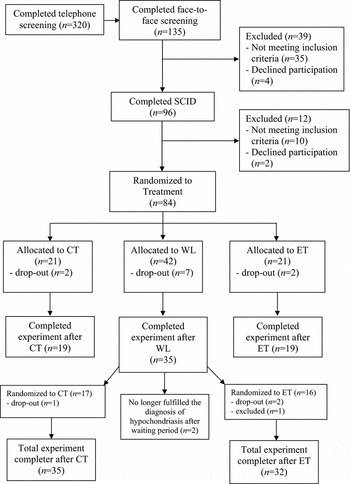
All 73 participants met the DSM-IV criteria of hypochondriasis according to the Structured Clinical Interview for DSM-IV (SCID; First, Spitzer, Gibbon and Williams, Reference First, Spitzer, Gibbon and Williams1997), which was conducted by experienced diagnosticians who were trained in a 2-day SCID workshop. The inclusion criteria were a primary diagnosis of hypochondriasis. The exclusion criteria were age under 18 or over 67 years, deficiencies in the German language, a major medical illness (e.g. cancer), acute suicidality, and a clinical diagnosis of substance addiction, schizophrenia or schizoaffective disorder, or bipolar disorder according to the SCID. Relative to the WL, both ET and CT demonstrated their efficacy in reducing hypochondriacal cognitions and behaviours (primary outcome measures) and several psychopathological characteristics (secondary outcome measures). Furthermore, the completer analysis revealed no differences between CT and ET on the primary and secondary outcome measures. However, safety behaviour was reduced to a greater extent after ET (see Weck, Neng, Richtberg et al., Reference Weck, Neng, Richtberg, Jakob and Stangier2015). Figure 1 provides an overview of the participant recruitment. The 73 patients ranged from 18 to 67 years old, with an average age of 40.07 years (SD = 11.65). Forty-three of the participants were female (58.9%). Fifty patients (68.5%) had the qualifications for university entrance. The majority of the patients (53.4%) had at least one comorbid disorder (comorbid anxiety disorder: 38.4%, comorbid affective disorder: 19.2%). The most feared disease was cancer (69.9%). No significant differences were found between the three groups (ET, CT, and WL) regarding participants’ sociodemographic and psychopathological characteristics, including comorbid diagnoses and most feared diseases (each p > .05).
Participant flow chart

Measures
Attribution task
The Attribution task is based on the work of Sensky et al. (Reference Sensky, Haynes, Rigby and MacLeod1998). We used nine common bodily sensations (prolonged headache, getting dizzy, feeling fatigued, hand trembling, having trouble sleeping, upset stomach, losing appetite, difficulties catching breath, and numbness or tingling in hands or feet) from the SIQ (Robbins and Kirmayer, Reference Robbins and Kirmayer1991). Each symptom was printed on a separate sheet of paper and presented to the participant with the instruction to imagine that the symptom would affect her or him at the moment. Symptoms were always presented in the same sequence. The participants were told to write down any explanations they would have below the presented symptom. They had 1 minute for each symptom, and the experimenter then gave the instruction to turn the page for the next symptom, thus standardizing the procedure and ensuring that the participants spent the same amount of time on each symptom. In doing so, the task should be thoroughly processed, preventing early termination of the task, e.g. from fear-related avoidance.
The provided attributions were classified into three categories: normalizing (e.g. insufficient intake of food or fluids, fatigue or overexertion), somatic (diseases) and psychological (e.g. nervousness or excitement). Based on the work by Weck, Neng, Göller and Müller-Marbach (Reference Weck, Neng, Göller and Müller-Marbach2014), we further segmented illnesses into the categories mild, moderate and severe depending on the severity of the illness. Illnesses without lasting impairment were categorized as mild (e.g. a cold), whereas illnesses associated with moderate impairment were categorized as moderate (e.g. migraine, asthma). Finally, chronic illnesses with massive impairment and potentially life threatening illnesses were categorized as severe (e.g. cancer, HIV, myocardial infection). The interrater reliability of two independent raters for the entire classification was found to be κ = .90, p < .001, 95 % CI (0.89, 0.91), which is almost in perfect agreement with and at the same level as the findings of Neng and Weck (Reference Neng and Weck2015; κ = .90, p < .001, 95 % CI (0.89, 0.91). The raters were blinded with respect to the treatment conditions.
Treatment
For a detailed description of the interventions, see Weck, Neng, Richtberg et al. (Reference Weck, Neng, Richtberg, Jakob and Stangier2015). In both CT and ET, the first session was used for a detailed psychoeducation regarding the clinical picture of hypochondriasis. Depending on the condition, either the role of selective attention (CT) or the avoidance and safety behaviour (ET) was presented. In CT, sessions 2 and 3 were used to demonstrate the importance of selective attention to bodily sensations through behavioural experiments, which were followed by attention-related exercises designed to reduce body-focused attention. Sessions 4 to 11 focused on the reduction of dysfunctional health-related automatic beliefs. These interventions mainly involved searching for alternative, non-threatening explanations for bodily symptoms and the evaluation of these explanations. For this reason, cognitive restructuring, behavioural experiments, and imagery rescripting for the modification of intrusive images were conducted.
ET did not include any explicit cognitive interventions; rather, it focused on exposing the patient to stimuli that are relevant for health anxieties (e.g. documentaries regarding diseases), reducing avoidance behaviour (e.g. cemeteries) and safety behaviour (e.g. reassurance seeking on the internet). Here, sessions 2 and 3 focused on the reduction of patients’ safety behaviour step-by-step. Sessions 5 to 11 focused on the implementation of the treatment rationale for exposure and multiple exercises of exposure (i.e. interoceptive exposure, exposure in vivo, and exposure in sensu). A more detailed description of ET has been provided in previous research (Weck, Ritter and Stangier, Reference Weck, Ritter, Stangier, Neudeck and Wittchen2012). In both conditions, session 12 focused on relapse prevention and the discussion on how the techniques can be established for the time after treatment. The purity index (Luborky, McLellan, Woody, O'Brian and Auerbach, Reference Luborsky, McLellan, Woody, O'Brien and Auerbach1985), which reflects the ratio of the intended interventions to the presence of intended plus unintended interventions, indicated very high therapist adherence in both treatment conditions (CT: 0.94, SD: 0.10; ET: 0.96; SD: 0.07; see Weck, Neng, Richtberg et al., Reference Weck, Neng, Richtberg, Jakob and Stangier2015 for a more detailed description). The waiting period for the WL also lasted 12 weeks and did not include any treatment.
Procedure
After initial contact, the patients were randomly assigned to CT, ET, or the WL, and they completed the Attribution task both before the treatment/waiting period started and after the treatment/waiting period ended. After the waiting period, the participants in the WL were randomized to CT or ET, and they also completed the Attribution task after the treatment ended (see Figure 1).
Statistical analyses
The possible differences between the groups concerning pretreatment sociodemographic characteristics, comorbid diagnoses, and most feared diseases were analysed with χ² tests for the categorical variables or a series of analyses of variance (ANOVAs) for the continuous variables.
Interrater agreement in the Attribution task was determined by using Cohen's κ. The relative frequencies were summed for all symptoms and then analysed as described below. For each attribution category and symptom, we computed the relative frequency of use. We thus divided the number of attributions in each category by the total number of attributions per symptom. In this way, we were able to avoid distortions due to different numbers of freely associated attributions.
A two-stage strategy was used for the data analyses of treatment effects. In the first stage, analyses of covariance (ANCOVAs) using pretreatment (or pre-waiting period) scores as a covariate, group (CT, ET, or WL) as the independent variable, and the posttreatment (or post-waiting period) scores as the dependent variable were conducted. Post-hoc comparisons were used to investigate differences between the three conditions.
In the second stage, the analysis also included participants who were initially randomized to the WL and subsequently assigned to ET or CT, and ANCOVAs using pretreatment scores as a covariate, group (CT or ET) as the independent variable, and the posttreatment scores as the dependent variable were again conducted.
Effect sizes were obtained via Hedges's g. All reported p values were two tailed, and a conventional α significance level of .05 was used.
Results
Comparison between cognitive therapy, exposure therapy, and wait list (first step of the analysis)
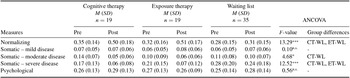
ANCOVAs revealed a significant main effect of treatment group on the frequency of the use of normalizing attributions and attributions regarding moderate and severe diseases (see Table 1). Post-hoc pairwise comparisons of the posttreatment scores of the frequency of the use of normalizing attributions revealed significant differences between CT and WL (p < .001, Hedges's g = 1.17) and between ET and WL (p < .001, Hedges's g = 1.24) but not between CT and ET (p = .36, Hedges's g = 0.05). Post hoc pairwise comparisons of the posttreatment scores of the frequency of the use of attributions regarding moderate diseases revealed significant differences between CT and WL (p < .01, Hedges's g = 0.69) but not between ET and WL (p = .10, Hedges's g = 0.52) or between CT and ET (p = .33, Hedges's g = 0.17). Post hoc pairwise comparisons of the post-treatment frequency of the use of attributions regarding severe diseases revealed significant differences between CT and WL (p< .001, Hedges's g = 1.12) and between ET and WL (p< .001, Hedges's g = 1.03) but not between CT and ET (p = .38, Hedges's g = 0.05). No differences in the frequency of the use of psychological attributions and attributions regarding mild diseases were found (each p > .05).
Mean scores and standard deviations of the relative frequency of use of the categories in the Attribution task for the completer sample

Notes: ANCOVA: analyses of covariance; pre = pretreatment; post = posttreatment; * p < .05; ** p < .01; *** p < .001.
Comparison between cognitive therapy and exposure therapy for the outcomes at posttreatment (second step of the analysis)
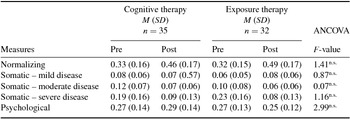
The results of this analysis, as well as the mean scores and standard deviations of the relative frequencies of use of the categories in the Attribution task at pre and posttreatment for all participants in the CT and ET groups who completed the Attribution task, are shown in Table 2. ANCOVAs showed no significant main effect of condition (each p > .05).
Mean scores and standard deviations of the relative frequency of use of the categories in the Attribution task at pre and posttreatment for the cognitive therapy and exposure therapy groups

Notes: ANCOVA: analyses of covariance; pre = pretreatment; post = posttreatment.
Discussion
The present study expands the current literature by examining changes in symptom attributions in patients with hypochondriasis after CT and ET with an open-response format. The results indicate that in comparison with a WL, both CT and ET can significantly reduce the frequency of somatic attributions regarding severe diseases (Hypothesis 1a) and significant increase the frequency of normalizing attributions (Hypothesis 1b). Contrary to our expectations, only CT was able to change the somatic attributions regarding moderate diseases; however, ET showed a trend towards a significant change (Hypothesis 1a). Consistent with our expectations, the frequencies of mild somatic attributions (Hypothesis 2a) and psychological attributions (Hypothesis 2b) did not change after therapy. Consistent with previous analyses of the sample (Weck, Neng, Schwind et al., Reference Weck, Neng, Schwind and Höfling2015), the direct comparison of CT and ET also revealed no differences between the conditions in the open-response format (Hypothesis 3).
Previous research was only able to show that CT and ET can change the prescribed symptom attributions, which were assessed with only forced-choice instruments (Weck, Neng, Schwind et al., Reference Weck, Neng, Schwind and Höfling2015). Our study, however, is the first to show that changes in symptom attributions after CT and ET can also be shown through free associations, which enables the evaluation of more individual perspectives of the patients. The specific pattern of attributional changes that is observed in this study corresponds to the hypochondriasis-specific attribution style that was found by Neng and Weck (Reference Neng and Weck2015), and our results show that these particular patterns can be changed with psychotherapy. Future research should also analyse the combined effects of cognitive and exposure-based interventions on free symptom attributions in hypochondriasis to account for the possible incremental effects of a combination of CT and ET.
By using the Attribution Task, we were able to assess symptom attributions in an open-response format. This format enabled the assessment of idiosyncratic attribution and the investigation of several gradations of symptom severity by using the normalizing, somatic, and psychological symptom categories. Furthermore, we obtained almost perfect interrater reliability, which indicates that the Attribution Task is a suitable instrument for the specific near-patient assessment of free associations and their changes after CBT. Compared with previously used forced-choice instruments, free associations offer a valuable contribution to the literature and previous analyses of the used sample (see Weck, Neng, Schwind et al., Reference Weck, Neng, Schwind and Höfling2015). Therefore, future studies regarding symptom attributions in hypochondriasis may benefit from using the Attribution Task for the assessment of more individual symptom attributions. Moreover, the Attribution Task may provide additional information in clinical practice because it can facilitate a systematic and more exhaustive assessment of dysfunctional symptom attributions than an oral exploration. A better assessment may facilitate, for example, more tailored interventions. The Attribution Task therefore expands the assessment possibilities for therapists.
In our study we found that not only CT but also ET can reduce the frequency of severe somatic attributions and increase the frequency of normalizing attributions, although ET does not include any cognitive interventions (Hypotheses 1a and 1b). Thus, although ET does not focus on explicitly changing misattributions, it is nevertheless effective at changing them. This finding supports the results of previous analyses of the same sample by Weck, Neng, Schwind et al. (Reference Weck, Neng, Schwind and Höfling2015) who used a forced-choice task. In this study, the need for cognitive interventions for hypochondriasis has already been challenged. However, ET seems to be able to disconfirm misattributions by violating expectations without explicitly targeting them with cognitive techniques. Through experiential evidence, ET can thus cause the same cognitive changes as CT, as proposed in the inhibitory learning model (see, for example, Arch and Abramowitz, Reference Arch and Abramowitz2014; Bouton, Reference Bouton1993; Bouton, Woods, Moody, Sunsay and García-Gutiérrez, Reference Bouton, Woods, Moody, Sunsay, García-Gutiérrez, Craske, Hermans and Vansteenwegen2006; Craske et al., Reference Craske, Kircanski, Zelikowsky, Mystkowski, Chowdhury and Baker2008; Craske, Treanor, Conway, Zbozinek and Vervliet, Reference Craske, Treanor, Conway, Zbozinek and Vervliet2014; Vervliet, Craske and Hermans, Reference Vervliet, Craske and Hermans2013). In this process, non-danger based associations between the conditioned and unconditioned stimulus are formed (“Dizziness is not dangerous and may occur”), and fear tolerance (“Fear is tolerable”) is increased; then, the non-danger based associations compete with original danger based associations (“Dizziness is dangerous and a sign of a brain tumour”).
Interestingly, ET does not seem to be equally effective in changing various types of hypochondriasis-specific attributions. We further found that compared with assignment to a WL, only CT can change the attributions regarding moderate diseases; however, we observed a trend towards a significant change in moderate somatic symptoms through ET. Thus, we may have been able to find a significant effect with a larger sample size. Nevertheless, compared with ET, CT appears to have a broader spectrum of efficacy to change the somatic attributions of both moderate and severe diseases. Previous findings have shown that changes in health-related beliefs mediate the relation between treatment condition and health anxiety (Weck, Neng, Schwind et al., Reference Weck, Neng, Schwind and Höfling2015), which emphasizes the importance of CT in the treatment of hypochondriasis. Therefore, future studies should further compare the efficacy of CT and ET on different degrees of severity of symptom attributions.
An explanation for the broader efficacy of CT compared with ET may lie in the treatment rationale itself. CT may simply offer more space to discuss a very broad range of bodily symptoms that focus not only on severe diseases but also on moderate somatic attributions. To facilitate Socratic reasoning regarding the origins of bodily symptoms, patients also receive detailed information in the form of psychoeducation concerning the autonomic nervous system and bodily sensations in general. In contrast, ET explicitly confronts the patient with her or his worst personal fears; thus, ET is more tailored and more often addresses severe somatic attributions. However, one may argue that somatic attributions regarding severe diseases are more relevant to hypochondriasis. This explanation is consistent with the definition of hypochondriasis in the DSM-IV (American Psychiatric Association, 2000), which includes a preoccupation with having or acquiring a serious (not moderate) illness. Furthermore, regarding somatic attributions, Neng and Weck (Reference Neng and Weck2015) showed that patients with hypochondriasis differed the most from patients with anxiety disorders (d = 1.61) and healthy controls (d = 1.91) in severe diseases. However, Neng and Weck also found significant differences concerning moderate diseases, which indicates that patients with hypochondriasis also show specific deviations regarding this degree of severity (d = 0.63 compared with patients with anxiety disorders, d = 1.13 compared with healthy controls).
In the second step of the analysis with all treated patients, however, our results confirmed that the differences between CT and ET are not significant. Considering the clinical implications of our findings, we therefore provide evidence that both CT and ET are appropriate for treating misattributions in patients with hypochondriasis. Therefore, clinicians working primarily with exposure can also adequately address attributional patterns.
Limitations
Some limitations of the current study should be noted. First, our sample comprises patients with hypochondriasis who were willing to receive psychological treatment. Often, however, patients with hypochondriasis remain in purely medical settings; thus, we may have examined a subgroup of patients with hypochondriasis who show particular openness to psychological treatment or who have a less rigid dysfunctional health-belief system. Second, although the Attribution task has many advantages over common questionnaires, the presentation of the symptoms is still prescribed. Patients may thus suffer from completely different symptoms than the presented symptoms. However, in hypochondriasis, we can assume that the disorder-specific, dysfunctional cognitive pattern can also be reflected in the evaluations of other symptoms.
In summary, our results expand current knowledge by showing that both CT and ET are effective for changing freely associated misattributions in patients with hypochondriasis. We recommend a detailed assessment of individual symptom attributions before therapy. Future research should also integrate a more differential perspective. More profound knowledge of patient variables that may moderate the effect of CT and ET on symptom attributions would help to inform the selection of the most promising treatment approach, possibly increasing response rates.
Acknowledgements
This research was supported by grants WE 4654/2-1 and WE 4654/2-3 from the German Research Foundation. We want to thank MSc Margit Kiechle for her help with the data collection.
Ethical standards: The authors assert that all procedures that contribute to this work comply with the ethical standards of the relevant national and institutional committees on human experimentation and with the Helsinki Declaration of 1975 and its most recent revision. The authors also assert that all procedures that contribute to this work comply with the ethical standards of the relevant national and institutional guides on the care and use of laboratory animals.
Conflict of interest: The authors have no conflicts of interest with respect to this publication.



Comments
No Comments have been published for this article.