Introduction
Geriatric day hospitals have been part of the spectrum of health and social care for older people for over half a century. They are out-patient health care facilities for older people living in the community and provide multiprofessional treatment on a full or part basis to those who attend. However, the role of day hospitals has not always been clear either to attendees, their carers, or many health care professionals. The aim of this article is to review the development of day hospitals, look at current practice and then consider the strategic future of this unique resource.
The past
The first purpose-built geriatric day hospital was opened in Oxford in 1958 and the first published review of British geriatric day hospitals was in 1961.Reference Farndale1 Throughout the 1960s, day hospital services expanded rapidly with the aim of complementing in-patient services. In the UK, the number of day hospitals has increased over the decades, rising from 90 in 1969Reference Brocklehurst2 to 322 in 1977Reference Brocklehurst and Tucker3 and around 400 in the early 1990s.4 This expansion of day hospital services has also been mirrored in New Zealand, Australia, Canada, USA and several European cities. Despite this expansion, most general practitioners and the majority of hospital doctors remain unaware of the services and facilities that day hospitals were designed to provide.Reference Macfarlane, Collins, Graham and MacIntosh5
So what is the role of the day hospital?
In 1973 BrocklehurstReference Brocklehurst6 described the day hospital as ‘the shop front for the geriatric service’, as well as ‘the logical extension of the progression from an acute and rehabilitation ward, forming a bridge between the hospital and the community’. This description is as true today as it was in the 1970s. As regards the function of day hospitals, DonaldsonReference Donaldson, Wright, Maynard, Hamil and Sutcliffe7 in 1987 stated that the objective of day hospitals was to facilitate prolonged independent living for elderly people in the community, with a strong emphasis on rehabilitation, reflected in a multidisciplinary staffing structure.
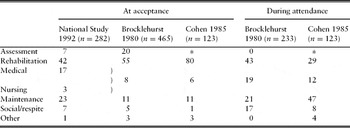
Whilst rehabilitation has been pivotal to the role of day hospitals, they also fulfil a number of different functions in order to satisfy their remit of providing comprehensive geriatric care. In 1992, a National Survey found that at the point of acceptance for day hospital, 42% were referred for rehabilitation, 23% for maintenance, 17% for medical intervention, 7% for social and respite care and 7% for assessment.4 This has also been echoed in other studies, as outlined in Table 1.
Main reason for acceptance and attendance for geriatric day hospital care4; figures are % of patients (copyright © 1994 Royal College of Physicians; reproduced by permission).

*category not recorded.
Despite their varied functions, day hospitals have in the past come under the spotlight for lack of a good evidence base on outcome measures and cost effectiveness. There is certainly patient and carer satisfaction with day hospitals. In 1977, Peach and PathyReference Peach and Pathy8 identified that patients enjoyed attending, whilst Anard and colleaguesReference Anard, Thomas, Osbourne and Osmolski9 in 1982 reported that carers found day hospitals helpful, although a validated tool of carer satisfaction was not used. As regards specific benefits of day hospital services, indirect evidence of effectiveness of day hospital services came from the sudden closure of a day hospital for 16 weeks in 1978 due to industrial action.Reference Berrey10 Comparing affected patients with a matched control population for the years 1974–1980 showed an appreciable increase in acute hospital admissions and deaths of those affected by the stoppage, suggesting benefit from attendance. The number of admissions and deaths during the two months after normal services were resumed did not differ appreciably from those in the control years. No single cause predominated among those reported from acute admissions or deaths during the affected year. In another retrospective review from 1979, Macfarlane reported that day hospital attendance had shortened in-patient treatment in 8% and had delayed or prevented admission in 42% of cases.Reference Macfarlane, Collins, Graham and MacIntosh5
Despite these claimed benefits, a number of reports have indicated that day hospitals are an expensive form of patient care and the National Audit Office in 1994 raised concerns regarding their cost effectiveness.11 They identified that, in most cases, contracts for day hospital care were based upon target levels for attendance, but with no quality indicators specified. The National Audit Office stated that attendance schedules and treatment programmes were too non-specific and unfocused, that time spent in day hospitals varied and that periods of inactivity were often considerable. It has been estimated that more than twice weekly attendance may be more costly than in-patient care.Reference Hildick-Smith12 Only one of the 22 day hospitals visited by the National Audit Office could provide costing information. Additionally, attendance rates at day hospitals were often only in the region of 66% with half of day hospital attendees failing to complete their planned course of treatment.Reference Zeeli and Isaacs13 The reasons for non-attendance were complex, but one major contributory factor was motion sickness, reported in up to 20% of cases.Reference Stokoe and Zuccollo14
In order to try to address these issues and to provide purchasers with a framework for optimizing the role of the day hospital, the Royal College of Physicians in 1994 published two important documents, entitled ‘Geriatric Day Hospitals – their role and guidelines for best practice’4 and ‘Clinical audit scheme for geriatric day hospitals’.15
Geriatric Day Hospitals – their role and guidelines for best practice4
This document recognized that geriatric day hospitals had been established with little formal evaluation. The aim of the publication was to review the purpose of day hospitals, research evidence of effectiveness and provide guidelines for good practice. Additionally, it was envisaged that it would assist in the development of customized local approaches to care that could be incorporated into contracts for geriatric day hospital care.
The document also recognized the multifaceted role of the day hospital, which included:
1 Functional and medical assessment.
2 Rehabilitation.
3 Physical maintenance.
4 Respite and social care.
5 Medical and nursing procedures.
The document reviewed 13 studies of the effectiveness of the geriatric day hospital published over the previous 13 years. The studies included six randomized controlled trials (from Canada, USA, New Zealand and the UK), one case-control study and six observational studies. The controlled trials had contradictory outcomes, depending in part on the nature of treatment received by the control group. In the observational studies, measurements appeared to have been made by the staff caring for the patients, raising the possibility of bias. Few of the studies took into account the views of the patients and their carers. Overall, emerging from all the studies was the implication that treatment provided in geriatric day hospitals was too non-specific and not sufficiently focused, a finding that echoed the previous National Audit Office report.11
Clinical audit scheme for geriatric day hospitals15
To address the themes identified in the report discussed above, the research unit of the Royal College of Physicians produced simultaneously the ‘Clinical audit scheme for geriatric day hospitals’. The aim of this document was to improve the quality of care provided within day hospitals and it was designed for use with the guideline publication.
The audit scheme provides guidance notes, an instruction sheet for staff and forms that can be photocopied as necessary for carrying out the audits and for recording the results. Three types of audit forms were provided: some for use in the day hospital itself, some to be used to audit individual patient care, and summary sheets of the results of the individual patient audits. A patient satisfaction questionnaire was also included.
The geriatric day hospital audit forms looked at several areas:
1. Facilities, including the location and capacity of the day hospital, access, accommodation, equipment available, storage for case records and transport provision.
2. Staff and policy, to include information on management structure and staffing.
3. Methods to identify:
– if activities of the day hospital were clearly defined.
– if individual patient care plans included specific patient objectives and goal setting.
– if protocols were available outlining the roles of multidisciplinary team members and for individual disciplines.
– if there was provision of care for any specific clinical conditions.
– if health education and health promotion programmes were incorporated into the day hospital function.
4. Communication and quality
– to identify if the roles and objectives of the day hospital were available to referrers and users of the service.
– to determine if systems were in place for effective communication to those involved in day hospitals, including referrers and members of the community teams.
– to determine if systems were in place to undertake clinical audit, to collect operational statistics and to undertake service developments.
The patient audit forms similarly covered a wide range of areas:
1. Admissions procedures – referral process, purpose of attendance, initial assessment and care planning, transport arrangements, admission patient problems list and use of standard assessment scales.
2. Current attendees – duration and purpose of attendance, assessments undertaken, care planning and current care programmes, transport provision, patient problem list and use of standardized assessment scales.
3. Discharges were analysed as for current attendees.
4. Patient satisfaction – a questionnaire was included that looked at the patient's social circumstances and whether they found the treatment offered to be beneficial. Information was gathered also on the adequacy of the day hospital facilities and the attitude of the staff.
It was envisaged that geriatric day hospital staff would use the audit scheme to evaluate and improve the health care they provided. It would also assist purchasers who wished to specify that the audit system be used to fulfil the quality assurance aspects of the contracts of care.
Although these two documents were well received, they did not fulfil their ambition, as was identified by the next major review of day hospitals in 1999/2000.
The Cochrane review
In 1999, Forster et al.Reference Forster, Young and Langhorne16, Reference Forster, Young and Langhorne17 published a systematic review of 12 randomized trials (available by January 1997) comparing day hospital care for elderly medical patients with a range of alternative services. Five studies compared day hospital with comprehensive elderly care. The control group in this case had access to a wide spectrum of geriatric medical services (both in-patient and out-patient). Four studies compared day hospital with domiciliary care. Here the control patients received an approximately equivalent rehabilitation input within their own home or social day centre. Three studies compared day hospital with no comprehensive elderly care. Here control patients did not routinely have access to out-patient rehabilitation. In total, the 12 studies involved 22 day hospitals and 2867 patients.
No overall significant difference was found between day hospital care and alternative services for the outcomes of death, death or requiring institutionalized care, and death or deterioration in activities of daily living (ADL). When death or a global ‘poor’ outcome (death, institutionalization or dependency) at follow up was examined, there was a significant difference in favour of day hospital care compared with no comprehensive elderly care. Eleven studies looked at dependency utilizing a variety of functional measures: two described short-term improvement for day hospital care, one reported improved outcome for the comparison group, while in the remainder there was no significant difference. Using the outcome of deterioration in ADL score among survivors, day hospital attendees showed reduced odds of deterioration compared with those receiving no comprehensive elderly care. Finally, when use of resources was examined, the day hospital group showed trends towards reductions in bed use and placement of survivors in institutional care. Nine studies comparing treatment costs indicated that day hospital attendance was a more expensive option, although only two analyses took into account long-term care costs.
The authors concluded that day hospital care for elderly people who need rehabilitation seemed to be more effective than no intervention, but may have no clear advantage over other forms of comprehensive elderly medical services. They went on to add that although day hospitals appear to be an expensive form of care, their benefits may include reduced in-patient bed days and less use of institutionalized care, suggesting the potential for long-term cost effectiveness. However, methodological problems limited these conclusions as the trials included in the review employed a pragmatic design and had attempted to address the broad question of overall day hospital effectiveness. Overall, it was suggested that given the diversity of patients attending day hospitals and the corresponding diversity of day hospital interventions employed, future trials should be large multi-centre trials and should examine more focused questions.
Recent randomized control trial (RCT) evidence
The Cochrane review was updated in 2008Reference Forster, Young, Lambley and Langhorne18 with the addition of 140 patients from a further study comparing day hospital and domiciliary care, but the results and conclusions were similar to those of the original review. Indeed there has been relatively little in the way of further research, despite the growth of interest in intermediate care services. However, Crotty et al.Reference Crotty, Giles, Halbert, Harding and Miller19 reported in 2008 the results of a well-designed randomized controlled trial comparing day hospital-based rehabilitation with a home-based rehabilitation programme. This study looked at 229 patients, who were referred for post-discharge rehabilitation following hospital admission for a variety of conditions. Both treatment programmes were multidisciplinary and intensive (with 3–5 sessions per week) and they appeared to be well resourced. The trial was pragmatic with rehabilitation programmes customized to individual patient needs.
Results showed considerably longer duration of rehabilitation for the day hospital group (day hospital: median 78 days, home-based rehabilitation: 28 days) and consequently considerably more treatment sessions. However, despite the longer period of intervention in the day hospital group, the improvements in functional outcomes from baseline to 3 months were similar for all participants. At discharge, carers of patients in the day hospital group reported higher Carer Strain Index scores in comparison with home-based rehabilitation carers. Additionally, patients in day hospital had double the risk of readmission compared with those in the home-based group. This effect persisted at 6 months and may be explained on the basis of increased access to admitting medical staff in the day hospital cohort. Although this study did not look at cost effectiveness, the longer period of rehabilitation and the greater use of hospital beds for the day hospital group imply greater expense. Overall, the conclusion of the authors from this small, well-designed study was that home-based rehabilitation may be better than day hospital rehabilitation.
An abstract presented at the British Geriatric Society (BGS) meeting in 2008 by Stuart Parker's groupReference Parker, Bond and Jagger20 reported more findings in favour of home-based over day hospital-based rehabilitation. They recruited 84 subjects into a four centre, two–armed randomized controlled trial. The primary outcome measure of change in the Nottingham Extended Activities of Daily Living Scale (NEADL) showed no significant difference between groups at 6 months. Secondary outcome measures of EQ-5D, therapy outcome measures and the General Health Questionnaire (GHQ-30) for carers also showed no significant difference, whilst the Hospital Anxiety and Depression Scale (HADS) suggested a borderline advantage for home-based rehabilitation. The authors acknowledge that the study was underpowered, but again there is a suggestion that home-based rehabilitation may have advantages over geriatric day hospital-led rehabilitation.
The future
Despite the unfavourable findings of RCTs, the provision of an out-patient-based facility providing multiprofessional treatment to frail older people still appears attractive. Additionally, the majority of trial evidence has been based upon the traditional day hospital service model. Thus in 2006, the BGS21 produced a best practice guide for geriatric (medical) day hospitals for older people, which incorporated a much more diverse service model. If this were adapted to local needs, it may secure the geriatric day hospital's future.
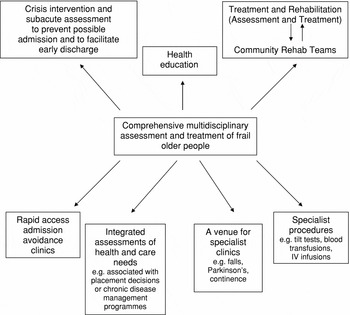
The BGS recommended a wide range of functions for the day hospital, as outlined in Figure 1. This model has at its core the comprehensive multidisciplinary assessment and treatment of frail older people, but it also incorporates admission avoidance and early supported discharge. The latter two functions lend themselves well to meeting the aim of reducing length of hospital stay, which is an important political and economic factor in today's health service. Additional functions would incorporate a role in chronic disease management and the development of specialist clinics (e.g. for Parkinson's disease, falls and osteoporosis). It would also maintain a strong rehabilitation theme, be this within the day hospital itself or as a base for a community outreach team. Also central to the role of the modern geriatric day hospital would be the availability of joint health and social care assessments.
Functions of geriatric day hospital

The BGS also recommended that older people attending the day hospital should have the following:
1 Immediate access to senior medical opinion at all times.
2 Trained nursing staff with a nursing leader present in the day hospital at all times.
3 Immediate access to social services provision.
4 Immediate access to general hospital-type investigations, such as radiology and pathology.
5 Daily support from allied health professional services, in particular physiotherapy and occupational therapy.
6 Access to other professionals such as speech and language therapists, podiatry, surgical appliances, etc.
It was suggested that the geriatric day hospital would most commonly be located in the district general hospital, although in some localities the day hospital may be more appropriately located within a community hospital. Within the day hospital, there needs to be provision for regular multidisciplinary meetings, which should be consultant led. Regular management meetings, an effective transport system and a clinical governance framework were also requirements identified as essential.
It has been highlighted recently that for day hospitals to survive in the modern National Health Service they need to adapt to current UK policy initiatives, such as that of primary and community care being delivered through locality-based polyclinics.Reference Young and Forster22 The increasing development of community-based intermediate care services could be used as an opportunity to expand the evidence-based advantages of comprehensive geriatric assessment undertaken in day hospitals to care of older people in the community. However, in the UK with introduction of ‘payment by results’ and the commissioning of health services with proven cost effectiveness, the geriatric day hospital has to rise to the challenge of offering value for money.
Geriatricians are well versed in the role of the day hospital, but it is well recognized that most GPs and probably most hospital doctors are unaware of the services and facilities they can provide. Thus it is important that the purchasers (and indeed the providers) are aware of the role of day hospitals and that dialogue between purchasers and providers should include clinicians who are intimately involved in day hospital care.
Conclusion
In the 1980s, Donaldson stated that the objective of the day hospital was ‘to facilitate prolonged independent living for the elderly in the community’.Reference Donaldson, Wright, Maynard, Hamil and Sutcliffe7 This should still be seen as their central purpose. They should provide an interface between primary and secondary care, as part of a continuum of specialist services for older people outside the acute hospital setting. The emphasis should be on the term ‘specialist service’. As part of intermediate care provision, comprehensive multidisciplinary assessment and management of frail older people is central to effective future care of the ageing community. The geriatric day hospital can effectively work in partnership with primary care services to enhance the care of this population, with particular reference to chronic disease management.