Anxiety disorders are one of the most common psychiatric disorders in children (Albano, Chorpita, & Barlow, Reference Albano, Chorpita, Barlow, Mash and Barkley2003), and one of the costliest mental health problems (Kessler & Greenberg, Reference Kessler, Greenberg, Davis, Coyle and Nemeroff2002). Although there has been substantial progress in identifying factors that lead to the development and maintenance of another form of internalizing symptoms, childhood depression, much less is known regarding the factors related to childhood anxiety (Albano et al., Reference Albano, Chorpita, Barlow, Mash and Barkley2003). In addition to causing internal distress, anxiety problems in children are associated with difficulties in meeting typical developmental challenges. For example, children who manifest anxiety symptoms in middle childhood show difficulties in their relationships with parents and peers (LaGreca & Harrison, Reference LaGreca and Harrison2005; McLeod, Wood, & Weisz, Reference McLeod, Wood and Weisz2007), deficits in school performance (Albano et al., Reference Albano, Chorpita, Barlow, Mash and Barkley2003), and are more likely to develop depression in adolescence (Zahn-Waxler, Klimes-Dougan, & Slattery, Reference Zahn-Waxler, Klimes-Dougan and Slattery2000). It is therefore important to understand factors related to the development and maintenance of childhood anxiety symptoms.
Etiological models of anxiety have identified several different potential influences on the development of anxiety symptoms (Brumariu & Kerns, Reference Brumariu and Kerns2010; Rapee, Reference Rapee, Vasey and Dadds2001; Vasey & Dadds, Reference Vasey and Dadds2001; Weems & Stickle, Reference Weems and Stickle2005). Most commonly, models focus on parent–child relationships, other aspects of the family context, and child characteristics. Two aspects of parent–child relationships that have been linked to anxiety are the security of children's attachments and the quality of parenting. Studies of attachment are based on Bowlby's (Reference Bowlby1982) theorizing that the absence of a secure base can lead to free floating anxiety. Specifically, children who are able to use a parent as a secure base from which to explore and as a haven of safety in times of distress, and who are confident in the parent's future availability, are expected to experience less anxiety than children who lack a secure base. In empirical studies insecure attachment has been identified as a risk factor for the development of anxiety disorders in preschoolers (Shamir-Essakow, Ungerer, & Rapee, Reference Shamir-Essakow, Ungerer and Rapee2005) and adolescents (Warren, Huston, Egeland, & Sroufe, Reference Warren, Huston, Egeland and Sroufe1997). Insecure attachment is also related to elevated levels of anxiety symptoms (Costa & Weems, Reference Costa and Weems2005; Papini, Roggman, & Anderson, Reference Papini, Roggman and Anderson1991; Roelofs, Meesters, Huurne, Bamelis, & Muris, Reference Roelofs, Meesters, Huurne, Bamelis and Muris2006; van Brakel, Muris, Bogels, & Thomasson, Reference van Brakel, Muris, Bogels and Thomassen2006; but for exceptions, see Bosquet & Egeland, Reference Bosquet and Egeland2006; Feng, Shaw, & Silk, Reference Feng, Shaw and Silk2008). Insecure attachment also has been linked with higher rates of specific anxiety symptoms in children, including school phobia (Bar-Heim, Dan, Eshel, & Sagi-Schwartzl, Reference Bar-Haim, Dan, Eshel and Sagi-Schwartz2007), separation anxiety (Moss, Smolla, Cyr, Dubois-Comtois, Mazzarello, & Berthiaume, Reference Moss, Smolla, Cyr, Dubois-Comtois Mazzarello and Berthiaume2006), and social anxiety (Bar-Heim et al., Reference Bar-Haim, Dan, Eshel and Sagi-Schwartz2007; Bohlin, Hagekull, & Rydell, Reference Bohlin, Hagekull and Rydell2000; Brumariu & Kerns, Reference Brumariu and Kerns2008).
A second research tradition has focused on qualities of parenting, typically examining parental acceptance or parental control. Parental acceptance is thought to mitigate against the development of anxiety because in the context of accepting parenting children may learn to regulate their emotions, including those related to anxiety-provoking situations (Wood, McLeod, Sigman, Hwang, & Chu, Reference Wood, McLeod, Sigman, Hwang and Chu2003). In addition, parental acceptance may communicate to the child that parental assistance is available when needed (Moore, Whaley, & Sigman, Reference Moore, Whaley and Sigman2004). High levels of parental control (e.g., overprotection, lack of autonomy support) are thought to contribute to the development of anxiety by interfering with a child's sense of self-efficacy, with the lack of perceived control leading to feelings of anxiety (Chorpita & Barlow, Reference Chorpita and Barlow1998; Wood et al., Reference Wood, McLeod, Sigman, Hwang and Chu2003). In a recent meta-analysis, McLeod et al. (Reference McLeod, Wood and Weisz2007) reported that both parental acceptance and parental control are related to anxiety. The effects were stronger for control than for acceptance, and highest specifically for one aspect of control, autonomy granting. The associations were also stronger when parenting was rated by observers rather than reported by the parent or the child. That several parenting qualities are related to anxiety suggests that there may be a more general parenting style related to the development of anxiety. The concept of maternal sensitivity captures both acceptance and control, in that a sensitive parent is one who is responsive and accepting as well as cooperative and noninterfering (Belsky & Fearon, Reference Belsky, Fearon, Cassidy and Shaver2008). Thus, children may be less likely to develop anxiety if they experience more sensitive parenting.
It is also well established that other aspects of the family context, such as exposure to an anxious parent or to negative life events, are related to anxiety symptoms in children. Behavioral genetics studies show that anxiety is a genetically influenced trait (Albano et al., Reference Albano, Chorpita, Barlow, Mash and Barkley2003), and therefore the presence of an anxious parent in the home may signal a genetic risk for anxiety. An anxious parent may also model anxious behaviors or differentially respond to anxious behaviors from the child (Barrett, Rapee, Dadds, & Ryan, Reference Barrett, Rapee, Dadds and Ryan1996). There is evidence that maternal anxiety is related to child anxiety (Costa & Weems, Reference Costa and Weems2005; Shamir-Essakow et al., Reference Shamir-Essakow, Ungerer and Rapee2005). The family environment may also be important as families vary in their exposure to negative life events. The more frequent experience of negative life events has been linked to symptoms of childhood psychopathology (Grant, Compas, Thurm, McMahon, & Gipson, Reference Grant, Compas, Thurm, McMahon and Gipson2004), including anxiety (Manassis, Hudson, Webb, & Albano, Reference Manassis, Hudson, Webb and Albano2004; Rapee & Spence, Reference Rapee and Spence2004). The experience of stressful life events is likely to contribute to anxiety by creating a sense that the world is unpredictable and difficult.
A third set of risk factors that may be related to the development of anxiety in children are child characteristics. Most commonly, the focus has been on biologically based child characteristics (e.g., temperament, pubertal development, child sex), which may influence the development of anxiety either directly, or through their interaction with environmental risk factors. Children who have an inhibited temperament are reactive to novel situations and people, and are thought to be at risk for the development of anxiety (Kagan & Snidman, Reference Kagan and Snidman1999). Behavioral inhibition is linked to anxiety disorders (e.g., Shamir-Essakow et al., Reference Shamir-Essakow, Ungerer and Rapee2005), although it may show the strongest associations specifically with social anxiety (Hirshfeld-Becker et al., 2007; Kagan & Snidman, Reference Kagan and Snidman1999). A second child characteristic that may operate as a risk factor for anxiety is the timing of pubertal development. Early entrance to puberty may make children more vulnerable to typical environmental stressors (e.g., acceptance by peers), and thereby increase the risk for the development of internalizing symptoms, including anxiety symptoms (Ge, Brody, Conger, & Simons, Reference Ge, Brody, Conger and Simons2006). It is not clear, however, if the association between early pubertal timing and anxiety symptoms is similar for boys and girls. Ge et al. (Reference Ge, Brody, Conger and Simons2006) found that early pubertal timing was related to higher levels of general anxiety symptoms for both boys and girls, and to higher levels of social anxiety symptoms for boys. By contrast, Papini et al. (Reference Papini, Roggman and Anderson1991) did not find an association between pubertal development and anxiety symptoms, and Deardoff and colleagues (Reference Deardorff, Hayward, Wilson, Bryson, Hammer and Agras2007) reported that early entrance to puberty predicted social anxiety symptoms for girls but not for boys. Although there are not clear sex differences in anxiety symptoms prior to adolescence (Zahn-Waxler et al., Reference Zahn-Waxler, Klimes-Dougan and Slattery2000), the findings for pubertal development suggest it is important to explore whether the risk factors for anxiety are similar for boys and for girls. Thus, child sex is a third child characteristic that may act as a risk factor for anxiety, either individually or in combination with other risk factors.
Despite the substantial progress in identifying risk factors for the development of anxiety, there are important limitations to our understanding. A developmental psychopathology perspective would suggest that anxiety problems are most likely due to several factors. Although there are a few exceptions (e.g., Chorpita, Brown, & Barlow, Reference Chorpita, Brown and Barlow1998; Feng et al., Reference Feng, Shaw and Silk2008), for the most part studies of anxiety symptoms have examined one or two of these risk factors in isolation (Vasey & Dadds, Reference Vasey and Dadds2001). The lack of integrative research has limited our ability to understand the relative influence and possible interactive effects among different risk factors. One possibility is that, consistent with a cumulative risk model (Appleyard, Egeland, van Dulmen, & Sroufe, Reference Appleyard, Egeland, van Dulmen and Sroufe2005; Sameroff, Reference Sameroff2000), risk factors may each independently contribute to increased risk for the development of anxiety. Alternatively, the principle of multifinality (Cicchetti & Sroufe, Reference Cicchetti and Sroufe2000) suggests that the influence of any risk factor may depend on the presence or absence of other risk factors. Thus, it is also possible that some risk factors may interact, such that the presence of one risk factor magnifies the impact of another (Weems & Stickle, Reference Weems and Stickle2005). For example, insecure attachment may operate as a risk factor for the development of anxiety only for children who also have a behaviorally inhibited temperament (Feng et al, Reference Feng, Shaw and Silk2008; Manassis, Reference Manassis, Silverman and Treffers2001).
A developmental psychopathology perspective, with its emphasis on pathways, also underscores the need to study not only which risk factors are related to anxiety, but whether they can predict changes in anxiety symptoms over time. It may be especially important to understand risk factors related to the latter as children who show an increase in anxiety symptoms across childhood are more likely to be later diagnosed with an anxiety disorder (Feng et al., Reference Feng, Shaw and Silk2008). It may be that different risk factors predict the initial occurrence of anxiety and the rise of anxiety symptoms over time. For example, Feng et al. (Reference Feng, Shaw and Silk2008) suggested that behavioral inhibition may predispose children to develop anxiety, but family factors may explain changes in anxiety symptoms over time. Studies of risk factors for anxiety have often used cross-sectional rather than longitudinal designs (Bogels & Brechman-Toussaint, Reference Bogels and Brechman-Toussaint2006; McLeod et al., Reference McLeod, Wood and Weisz2007), which has limited our understanding of risk factors that can explain changes in anxiety symptoms over time (Weems, Reference Weems2008).
In the current study, we extended the literature by examining anxiety symptoms in relation to a broad set of predictors that included mother–child relationships (perceived attachment security, maternal sensitivity), family context (maternal anxiety, negative life events), and biologically related child characteristics (child temperament, child pubertal development, child sex). We used a longitudinal design in which we measured anxiety symptoms at several points during middle childhood. This design allowed us to examine how our set of risk factors were related to early levels of anxiety, as well as how they predicted increases in anxiety from the early school years to preadolescence. We focused on middle childhood for two reasons. First, it is a time of increased challenges for children; in the elementary school years children face a new developmental task, succeeding at school, and peer relationships become more important. In addition, anxiety symptoms are only moderately stable across childhood (Ferdinand, Dieleman, Ormel, & Verhulst, Reference Ferdinand, Dieleman, Ormel and Verhulst2007; Ialonga, Edelson, Werthamer-Larsson, Crockett, & Shephard, Reference Ialongo, Edelsohn, Werthamer-Larsson, Crockett and Sheppard1995; Westenberg, Gullone, Bokhorst, Heyne, & King, Reference Westenberg, Gullone, Bokhorst, Heyne and King2007), suggesting that there may be some change to be explained.
In addition to examining the correlates of earlier and later anxiety, we examined whether parent–child relationships, family environment, and child characteristics predicted changes in anxiety symptoms across middle childhood. Our predictors of change, with the exception of behavioral inhibition, were measured after the initial assessment of anxiety. Consistent with Feng et al. (Reference Feng, Shaw and Silk2008), we hypothesized that mother–child relationships and aspects of the family environment might be most predictive of changes in anxiety across childhood. Specifically, we expected that children who were less securely attached to their mothers, experienced less sensitivity from mothers, had more anxious mothers, and experienced more negative life events would show increases in anxiety over time. Our design allowed us to examine whether each of these factors uniquely added to the prediction of anxiety symptoms. We did not expect gender differences given the age range studied, and given prior inconsistent findings we did not have a hypothesis regarding whether children who entered puberty early would show higher levels of anxiety symptoms.
Further, we explored the possibility that the effects of some of our risk factors might depend on levels of other risk factors (i.e., evidence for multifinality). Given the large number of interactions that could be tested and because prior theorizing has tended to focus on child characteristics as potential moderators, we limited these analyses by testing whether each of the individual child characteristics (temperament, pubertal status, and gender) moderated the influence of the other risk factors. For example, Manassis (Reference Manassis, Silverman and Treffers2001) suggested that behavioral inhibition may moderate associations between attachment and anxiety, such that attachment may be more highly related to anxiety if a child is also high on behavioral inhibition. Despite these speculations, prior studies have not provided strong and consistent evidence for temperament or other moderators that might alter relations between attachment and anxiety (Brumariu & Kerns, Reference Brumariu and Kerns2010). Prior studies of pubertal development and anxiety symptoms differed in whether early pubertal development was a stronger risk factor for anxiety for boys (Ge et al., Reference Ge, Brody, Conger and Simons2006) or for girls (Deardoff et al., Reference Deardorff, Hayward, Wilson, Bryson, Hammer and Agras2007). The lack of evidence for moderation in earlier studies might be due to low power to detect these effects, as large samples are needed to have adequate power for testing interactions. With the present large sample we tested interaction effects involving child characteristics, although we did not have any a priori hypotheses for these exploratory analyses.
Finally, our study also provided an opportunity to examine continuity and change in anxiety symptoms across middle childhood. Although there are age-related changes in specific anxiety disorders in middle childhood (e.g., a decline in the frequency of separation anxiety disorders; see Weems, Reference Weems2008), it is less clear whether there are developmental trends in overall anxiety symptoms. There are relatively few longitudinal studies of anxiety symptoms, and of these, only two have tested for normative changes in levels of anxiety symptoms in middle childhood. Bell-Dolan, Last, and Strauss (Reference Bell-Dolan, Last and Strauss1990) reported few age differences in anxiety symptoms over a 12-month period. Westenberg et al. (Reference Westenberg, Gullone, Bokhorst, Heyne and King2007) reported an increase in social evaluation concerns, but no age changes for general fears. Several studies have examined the stability of anxiety symptoms in middle childhood over a 1- to 6-year period. All of these studies found evidence for continuity in anxiety symptoms (Bosquet & Egeland, Reference Bosquet and Egeland2006; Ferdinand et al., Reference Ferdinand, Dieleman, Ormel and Verhulst2007; Gullone, King, & Ollendick, Reference Gullone, King and Ollendick2001; Ialonga et al, Reference Ialongo, Edelsohn, Werthamer-Larsson, Crockett and Sheppard1995; Verhulst & van der Ende, Reference Verhulst and van der Ende1992; Westenberg et al., Reference Westenberg, Gullone, Bokhorst, Heyne and King2007). In general, effects sizes were medium to large, with correlations around 0.30 when anxiety symptoms were assessed over a 3- to 6-year period, and higher when examined over shorter intervals. A secondary goal of the present study was to examine the stability and change in anxiety symptoms from kindergarten to sixth grade. We expected to find clear evidence of stability, with greater stability over shorter time spans. We did not have any a priori hypotheses regarding whether we would find any age related changes in anxiety symptoms.
Method
Participants and design
Participants in the present study were a part of the NICHD Study of Early Child Care. Children and their families were recruited from 10 different sites across the United States when the target child was an infant and were followed until age 15 in four phases of data collection (for more details on procedure and data collection, see NICHD Early Child Care Research Network, 2001). Families were excluded if the mother was under 18 years old, had difficulties with substance abuse, or did not speak English. Families were also excluded if they intended to move or if the child had a disability or had been hospitalized for more than a week after birth. For this study, data were utilized from phase 2 (54 months through first grade) and phase 3 (second through sixth grades).
At the start of the NICHD study, 1,364 families were recruited (48% of the target children were female). The sample was 80.4% Caucasian, 12.9% African American, and 6.7% another ethnicity. As anxiety in preadolescence was the construct of interest, household status was examined at the sixth grade. At sixth grade, 66% of target children were a part of an intact family, 17% lived in a single-parent household, 13% lived in a stepparent household, and 4% lived in a household with an alternate caregiver. The sample income/needs ratio, scored so that higher scores reflect greater income, at sixth grade was M = 4.54 (SD = 4.15, range = 0.11–39.59).
Procedure
Data for the present study were obtained from different time points in Phases 2 and 3. Security was assessed in fifth grade when the child completed a modified security questionnaire. Maternal sensitivity was assessed at first, third, and fifth grades from an interaction between the mother and child completed in the laboratory. Mothers completed a questionnaire to assess maternal anxiety in the home in third and fifth grades. Stressful life events were assessed when mothers completed the Life Events Questionnaire in the laboratory in third and fifth grades. The child's behavioral inhibition was assessed at 54 months when mothers filled out a questionnaire in the laboratory. Pubertal development was assessed either in the laboratory or in a clinical office using a pubertal development exam in fourth and fifth grades. The child's anxiety was assessed using the Child Behavior Checklist (CBCL; Achenbach, Reference Achenbach1991), which mothers completed six times in middle childhood: kindergarten (home), first grade (laboratory), third grade (home), fourth grade (laboratory), fifth grade (home), and sixth grade (laboratory).
Mother–child relationship measures
Perceptions of attachment security
To assess perceptions of mother–child attachment, data were utilized from the My Family Questionnaire filled out at fifth grade by the target child. The questionnaire requests that participants report how they feel about their mother and the relationship they have (e.g., “I go to my mom when I'm upset.”). The questions included 13 (of 15) items from the Security Scale (Kerns, Aspelmeier, Gentzler, & Grabill, Reference Kerns, Aspelmeier, Gentzler and Grabill2001), which was originally developed to assess a child's perception of security with a specific parent (i.e., mother or father). Three other items from the My Family Questionnaire that were conceptually similar were also included. Items were answered on a 4-point scale ranging from 1 (not at all true) to 4 (very true), where scores of 4 indicated higher levels of security. This newly constructed 16-item scale had adequate internal reliability (α = 0.83). The Security Scale has previously been established to demonstrate good internal validity and reliability (Kerns et al., Reference Kerns, Schlegelmich, Morgan, Abraham, Kerns and Richardson2005). In the current study, this measure had a mean of 3.37 and a standard deviation of 0.46.
Observed maternal sensitivity
At Grades 1, 3, and 5 maternal sensitivity was rated from a 15-min semistructured mother–child interaction session which was videotaped. At the first-grade time point, two tasks were included which required the assistance of mothers and a third task was included that promoted free play. The first activity required the mother to help her child draw a picture with an etch-a-sketch maze; mother and child each controlled one knob, and thus they needed to coordinate their actions. In the second task, the mother and child were given a set of colored shapes and they filled out a geometric design. The task required maternal assistance because it was too difficult for the child to complete alone. In the third task, mother and child played a card game that was intended to elicit expressions of affect. At the third and fifth grade time points, mothers participated in two tasks with their children. The first was a discussion task. In third grade, mothers and their children were given different cards which prompted them to discuss a number of topics involving rules including rules for children (e.g., “kids should be responsible for their own belongings”), rules for mothers (e.g., “parents should decide who their children can be friends with”), and difficult decisions (e.g., “sometimes it's OK to tattle”). The pair chose one card from each category to discuss. In the second task, mothers and children participated in a planning activity in which they were given a list of errands to do and a map of a fictional town. Using this they were to plan out a route together to accomplish their errands. In the fifth grade, mothers and children first discussed a source of conflict within the family. They were given a set of cards containing common conflicts (e.g., “chores, eating habits”), and asked to discuss their top three sources of problems and to come up with possible solutions. In the problem-solving task, the mother and child were asked to create a bungee jump for a raw egg out of provided materials so that the egg could be dropped without breaking.
For all time points, trained coders rated mothers on a number of parent characteristics (supportive presence, respect for child's autonomy, stimulation of cognitive development, quality of assistance, and hostility) using a 7-point scale (where 1 = very low and 7 = very high). A measure of maternal sensitivity was obtained at each time point by combining ratings from supportive presence, respect for autonomy, and the reversed ratings of hostility for each task (the three ratings were related to one another at each time point, with rs among the scales ranging from .47 to .78). The ratings from first, third, and fifth grade were then summed to create an overall composite. Scores for the maternal sensitivity composite had a possible range of 3 to 21 where higher scores indicated more sensitivity. The internal consistency of the raw items used to create the maternal sensitivity composite at each time point was adequate (α = 0.82 at first grade, α = 0.80 at third grade, and α = 0.85 at fifth grade). Interrater reliability for the maternal sensitivity composite was adequate across all time-points (α = 0.83 at first grade, α = 0.72 at third grade, and α = 0.74 at fifth grade). In the current study, the composite had a mean of 16.53 and a standard deviation of 2.26.
Family environment measures
Maternal anxiety
Maternal anxiety was assessed using the State–Trait Anxiety Inventory (Spielberger, Gorusch, Lushene, Vagg, & Jacobs, Reference Spielberger, Gorusch, Lushene, Vagg and Jacobs1983), which was modified for the NICHD study by asking how the individual felt over the past week rather than how the participant was feeling right at the moment. At Grades 3 and 5 mothers rated their anxiety on a 4-point scale, where a score of 1 = not at all, and a score of 4 = very much. An example of an item is “I feel nervous and restless.” Initially, two anxiety scores were created by averaging the items at each time point. To create a measure of maternal history of anxiety, maternal scores on state anxiety from reports at third and fifth grades were averaged. The correlations between reports of anxiety at the two time points was .52. Internal consistency for the final score, based on both time points, was adequate (α = 0.69). In the current study, the composite had a mean of 17.50 and a standard deviation of 4.70.
Family negative life events
In third and fifth grades, mothers filled out the Life Experiences Survey, a 57-item questionnaire on which they indicated which major life events had occurred in their lives in the past year, and then they rated the impact that these events had (Sarason, Johnson, & Siegel, Reference Sarason, Johsnon and Siegel1978). The events ranged from routine events (e.g., child started school) to more major and catastrophic events (e.g., death of close family member). The impact of each endorsed event was rated on a 7-point scale ranging from +3 to −3 where a rating of +3 indicated that the event was very positive, 0 indicated that it was a neutral event, and −3 indicated the event had been very negative. Items that received a negative impact score were included in calculating a score for negative life events. The negative life event ratings were reversed and summed at both third and fifth grade. The totals from Grades 3 and 5 were aggregated into one variable for the current study. Previous research has demonstrated that this measure has adequate psychometric properties (Sarason et al., Reference Sarason, Johsnon and Siegel1978). In the current study, the composite had a mean of 5.61 and a standard deviation of 6.06.
Measures of child characteristics
Behavioral inhibition
Mothers completed the Shyness scale of The Children's Behavior Questionnaire when children were 54 months old (Rothbart, Ahadi, & Hershey, Reference Rothbart, Ahadi and Hershey1994). Because items on the scale assess negative reactions to unfamiliar situations as well as to unfamiliar people, we interpreted scores as a measure of behavioral inhibition rather than shyness. The original scale was modified for the NICHD study so that only 10 of 13 original items were included (example items are: “My 4.5-year-old sometimes prefers to watch rather than join other children playing”; “sometimes seems nervous when talking to adults s/he has just met.”). Each item was rated on a 7-point Likert scale, which ranged from 1 (extremely untrue) to 7 (extremely true). Internal consistency for the behavioral inhibition scale was high (α = 0.90). Previous studies have demonstrated that the CBQ, including the shyness scale, has good psychometric properties in that it has adequate validity and reliability (e.g., Rothbart et al., Reference Rothbart, Ahadi and Hershey1994). In the current study the measure had a mean of 3.52 and a standard deviation of 1.10.
Pubertal development
Beginning at age 9.5, health and physical development assessments were conducted on the children each year. Because we were interested in testing whether early entrance to puberty is a risk factor for anxiety (i.e., the early timing hypothesis), in this study we included the puberty assessments that were collected in Grades 4 and 5. The child's Tanner stage was evaluated by pediatric nurses or pediatric endocrinologists during each of these assessments by assessing the child's physical growth and development (Tanner, Reference Tanner1962). Specifically, the Tanner stage for males assesses the development of genitalia and pubic hair, and the Tanner's stage for girls assesses the development of breasts and pubic hair, using Stages 1 through 5. Stage 1 indicated prepuberty, whereas Stage 5 indicated full development. To obtain an overall measure of pubertal development, we combined data from the boys’ genital and pubic hair Tanner stage ratings, and data from the girls’ breast and pubic hair Tanner stage ratings. We then averaged ratings from the fourth and fifth grades. The internal consistency for the selected items after data were combined across time points was adequate for both boys and girls (α = 0.72 and 0.82, respectively). Previous research has demonstrated that this measure has adequate reliability and validity (Deardoff et al., Reference Deardorff, Hayward, Wilson, Bryson, Hammer and Agras2007). In the current study, the aggregate had a mean of 1.52 and a standard deviation of 0.55. Thus, on average, children were in the beginning stages of pubertal development, and therefore higher scores indicate children who are entering puberty early.
Child anxiety
Data from the CBCL (Achenbach, Reference Achenbach1991) mother version were used to obtain a measure of anxiety. The CBCL is a commonly used measure that assesses problem behaviors as well as social competence in children and adolescents ages 4 to 18. Because we were interested in measuring anxiety, we created a 12-item anxiety scale that has been previously used in research and demonstrated adequate internal consistency (Bosquet & Egeland, Reference Bosquet and Egeland2006; Feng et al., Reference Feng, Shaw and Silk2008). As recommended by Wadsworth, Hudziak, Heath, and Achenbach (Reference Wadsworth, Hudziak, Heath and Achenbach2001), this scale includes 8 items from the Depression/Anxiety Scale (Items 31, 32, 34, 45, 50, 71, 89, and 112) and 4 other items from the CBCL (Items 9, 29, 30, 66). The mean of the selected anxiety items was computed to calculate an anxiety score.
Mothers completed the CBCL at a number of time points using a 3-point scale ranging from 0 (not true of the child) to 2 (very true of the child). For the current study, we used ratings from kindergarten, first grade, third grade, fourth grade, fifth grade, and sixth grade (this measure was not administered in second grade). Internal consistency was adequate at all time points (α = 0.67 at kindergarten, α = 0.69 at first grade, α = 0.74 at third grade, α = 0.74 at fourth grade, α = 0.73 at fifth grade, and α = 0.75 at sixth grade).
Results
We begin by reporting preliminary analyses in which we investigated the associations between demographic variables and child anxiety. We also report zero-order correlations among our predictor variables. Then, we present the results of our main analyses. We used correlation coefficients to evaluate stability of anxiety symptoms. Latent growth curve modeling was used to examine whether there were age related changes in anxiety symptoms. Further, the growth curve analysis was used to identify how our set of seven predictors (perceived attachment security to mother, maternal sensitivity, maternal anxiety, family negative life events, child behavioral inhibition, child pubertal development, child sex) were related to initial levels of anxiety (i.e, intercept for anxiety) and to increases in anxiety symptoms across middle childhood (i.e., slope for anxiety). Finally, we did additional analyses in which we tested whether behavioral inhibition, pubertal development, or gender moderated associations between all predictors and anxiety.
Preliminary analyses
We initially examined how demographic and design variables were related to children's levels of anxiety in preadolescence. We calculated analyses of variance for comparisons by child sex (girls, boys), ethnicity (Caucasian, African American, other), household type (intact, stepfather, single parent, no parent in household), and data collection site (10 sites). None of these comparisons was significant. We also correlated family income/needs ratio (collected at Grade 6) with anxiety in kindergarten and sixth grade, and these results were also not significant. Given these findings, we did not include demographic variables in subsequent analyses for ease of interpretation of the results.
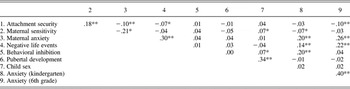
Table 1 presents the zero-order correlations among the predictors and anxiety symptoms at the beginning (kindergarten) and end (sixth grade) of middle childhood. Correlations among the seven predictor variables were generally modest in magnitude. Specifically, 8 of 21 correlations were significant (ps < .05), with significant correlations ranging between .07 and .34. The four largest associations were consistent with prior theory and research: children who reported greater security with their mothers had mothers who were rated as more sensitive, anxious mothers were less sensitive and reported more negative life events, and girls were more advanced than boys in their pubertal development. There were four other significant associations among predictors, all with small effect sizes (rs < .10). Children who reported a more secure attachment to their mothers had mothers who were less anxious and who reported fewer negative life events. In addition, there were two gender differences: girls were rated higher than boys on behavioral inhibition, and mothers were more sensitive to girls than to boys.
Correlations among main study variables

Note: Child sex is coded so that a positive correlation reflects higher scores for girls.
*p < .05.
**p < .01.
As shown in Table 1, several of the predictor variables were individually correlated with anxiety. Children who were more anxious in kindergarten were also higher on behavioral inhibition at 54 months, and during middle childhood they had mothers who were less sensitive, more anxious, and experienced more negative life events. Children who were more anxious in sixth grade were less secure, and had mothers who were more anxious and who reported experiencing more negative life events.
Continuity in anxiety symptoms
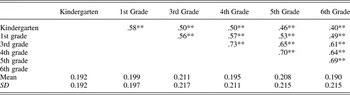
Table 2 displays correlations among the six assessments of anxiety symptoms. There was substantial continuity in anxiety symptoms when assessed over a 1-year interval; stability over 1 year ranged from 0.58 (kindergarten to first grade) to 0.73 (third to fourth grade). It was not surprisingly that the stability was lower over longer time intervals, especially when considering associations between anxiety at the beginning and end of middle childhood. For example, the correlation between anxiety at kindergarten and sixth grade was r = .40, suggesting that anxiety was only moderately stable over longer intervals.
Intercorrelations and means among anxiety time points

**p < .01.
Latent growth curve analyses of changes in anxiety symptoms
We used latent growth curve modeling techniques to explore questions of change in anxiety symptoms. We estimated parameters of intercept and slope for a latent anxiety factor, and examined tests of overall model fit that included our predictors of change as manifest variables. We also tested the slope for the anxiety latent factor to determine if there was a significant linear change in anxiety symptoms over time. We then examined whether our measures of the mother–child relationship, family context, and child characteristics predicted the intercept or slope for anxiety symptoms. Finally, additional analyses tested for significant interactions of the child characteristics with the mother–child relationship and family context variables in predicting changes in anxiety (i.e., slope). The proportion of data available for each of the predictors ranged from 0.68 (puberty) to 1.0 (child sex); for most variables, data were available for 75% to 80% of the original participants. We used the maximum likelihood estimator in MPlus to handle missing data.
Tests of overall model fit
The chi-square test was significant, χ2 (44) = 166.663, p < .0001, although this result could be partly due to the large sample. Other model fit statistics suggested a good fit for the model. Specifically, comparative fit index = 0.96 and the root mean square error of approximation was 0.045 (90% confidence interval = 0.04–0.05). Thus, the tested model appeared to provide a very good fit of the data.
Normative changes in anxiety symptoms across middle childhood
Table 2 also displays the yearly means for anxiety symptoms, which ranged from 0.19 to 0.21. We evaluated age-related changes in anxiety by examining the significance of the slope term. This test of the slope term was not significant, suggesting that anxiety levels did not change with age. There was, however, significant variance in the slope (p < .0001), suggesting substantial individual differences in patterns of change over time.
Predicting change in anxiety symptoms
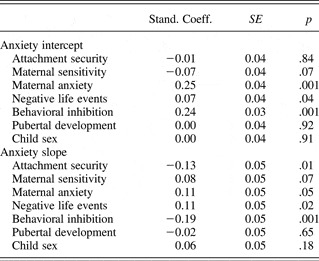
We next evaluated how our measures of the mother–child relationship, family context, and child characteristics predicted the anxiety intercept and slope latent variables. As might be anticipated from Table 1, several variables were related to the intercept. As shown in Table 3, children who had higher levels of anxiety at the beginning of middle childhood were more behaviorally inhibited as preschoolers, and had mothers who were more anxious and who reported more negative life events later in middle childhood (their mothers also tended to subsequently be less sensitive, although this effect was only marginally significant).
Latent growth curve analysis standardized coefficients (and standard errors) for anxiety intercept and slope

In addition, several variables were related to the anxiety slope. Increases in anxiety were associated with less secure attachment to mothers, greater maternal anxiety, the experience of more negative life events, and lower levels of behavioral inhibition at preschool; children who became more anxious also had mothers who were more sensitive, although this effect was only marginally significant. Taken together, the findings for intercept and slope suggest that children who enter middle childhood with higher levels of anxiety subsequently experience a more difficult family context, and these experiences along with insecure attachment tends to further increases their levels of anxiety. By contrast, children who were more behaviorally inhibited as preschoolers were more anxious early in middle childhood, but high behavioral inhibition in early childhood forecasted declines in anxiety over time.Footnote 1
To explore the question of whether these effects were moderated by child characteristics, we conducted a series of additional growth curve analyses in which we included a single interaction term in the model (e.g., the interaction between maternal anxiety and child behavioral inhibition), and examined whether that interaction term was significantly related to the slope for anxiety. We tested all interactions of our three child characteristics with our measures of mother–child relationships and family context. None of the interaction terms were significant, suggesting that child characteristics did not constrain the effects found in the main model.
Discussion
The purpose of the present study was to examine multiple risk factors that might account for anxiety symptoms in middle childhood. Strengths of the study included simultaneous consideration of multiple risk factors, a longitudinal design, and the use of latent growth curve modeling to examine changes in anxiety and predictors of changes in anxiety over time. The risk factors included the mother–child relationship (attachment, parenting), family context (maternal anxiety, negative life events), and child characteristics (behavioral inhibition, pubertal development, and child sex). The study also tested whether the three child characteristics moderated the associations of other risk factors with anxiety. We found that children who were more anxious at the beginning of middle childhood were more behaviorally inhibited as preschoolers, and were more likely in middle childhood to have more anxious mothers and to be in families experiencing more negative life events. Several of the risk factors were related to increases in anxiety symptoms across middle childhood. Children who became more anxious across middle childhood perceived less security with their mothers, had mothers who were more anxious, and were in families experiencing more negative life events. Thus, qualities of the mother–child relationship and aspects of the family context explained changes in anxiety symptoms over time. In addition, there were reciprocal relations between anxiety and family context, in that more anxious children were subsequently exposed to a more anxious and stressful family context, which in turn was associated with increases in anxiety symptoms. Finally, children who were more behaviorally inhibited in early childhood were more anxious at the beginning of middle childhood but were also more likely to show declines in anxiety symptoms across the middle childhood years.
The present findings complement the study of Feng et al. (Reference Feng, Shaw and Silk2008), which examined multiple risk factors in relation to anxiety trajectories in early and middle childhood. In a sample of boys from low income families, Feng et al. found that child temperament (shyness) was associated with high levels of anxiety in early childhood, and with either a high but declining trajectory for anxiety symptoms or a high and increasing pattern. Further, they found that maternal depression and maternal negative control were related to increases in anxiety over time. Attachment in infancy was not predictive of changes in anxiety in their study. Feng et al. speculated that the experience of stressful life events may have partially accounted for their results, although that variable was not assessed in their study. In the present study of girls and boys from somewhat more advantaged families, we similarly found that temperament (behavioral inhibition) was associated with high levels of anxiety in early childhood, and also forecast declines in anxiety symptoms across middle childhood (one of the trajectory patterns noted by Feng et al., Reference Feng, Shaw and Silk2008, to be related to behavioral inhibition). It is possible that early high levels of behavioral inhibition are associated with increases in anxiety symptoms over time only in high-risk samples. Our results also suggest that parent–child relationships, negative life events, and maternal anxiety each independently predict later anxiety. Given that these variables each explain some unique variance in increases in child anxiety, it appears that the experience of negative life events does not explain the associations of other family variables with child anxiety, as suggested by Feng et al. Thus, despite differences in design and sample, our findings are consistent with Feng et al.'s conclusion that temperament may account for early anxiety, whereas familial factors may be important influences on changes in anxiety over time.
Although many findings were similar between the two studies, there were differences as well. Feng et al. (Reference Feng, Shaw and Silk2008) found that maternal negative control, but not infant attachment, predicted increases in anxiety across childhood. By contrast, we found that insecure attachment, assessed in middle childhood, predicted increases in anxiety across middle childhood. The different findings for the two studies may be related to the timing of the attachment assessments. Attachment is moderately stable across childhood (Fraley, Reference Fraley2002), and insecure attachment in infancy would not be expected to predict later anxiety if children became more secure over time. Thus, unless a study is testing the long-term influence of early relationships, understanding the influence of attachment in middle childhood or adolescence requires obtaining more contemporaneous measures of attachment (Kerns, Reference Kerns, Cassidy and Shaver2008). The relationship of maternal sensitivity with anxiety was complex. The zero-order correlations showed that greater maternal sensitivity was associated with lower levels of child anxiety in kindergarten but not in sixth grade. Of interest, although the finding was only marginally significant, greater maternal sensitivity predicted increases in anxiety over time. Because our analysis examined the unique contribution of a variable in predicting increases in anxiety, it appears that only aspects of maternal sensitivity not related to attachment and the other risk factors forecast increased anxiety. One interpretation is that the unique variance in maternal sensitivity that does not overlap with the other variables reflects overinvolvement (i.e., engagement that is not sensitively displayed). This interpretation is consistent with studies showing that maternal overcontrol is related to anxiety (McLeod et al, Reference McLeod, Wood and Weisz2007), including increases in anxiety over time (Feng et al., Reference Feng, Shaw and Silk2008). This interpretation is speculative, and as there is not a direct measure of parental overcontrol in the NICHD study of Early Child Care, this idea needs to be tested more directly in future research.
Prior studies have often examined risk factors for anxiety in isolation, and therefore there has been only limited examination of whether the influence of some risk factors may be enhanced in the presence of certain other risk factors. This is despite interest in the idea that interaction effects may be important to account for the development of anxiety. For example, there has been speculation that insecure attachment may be more strongly related to anxiety in the presence of other risk factors (e.g., Feng et al., Reference Feng, Shaw and Silk2008), although a recent review did not find evidence for this hypothesis (Brumariu & Kerns, Reference Brumariu and Kerns2010). There has also been speculation that behavioral inhibition may interact with other risk factors (e.g., Manassis et al., Reference Manassis, Hudson, Webb and Albano2004; Rapee, Reference Rapee, Vasey and Dadds2001). We did not find support for the idea that behavioral inhibition, pubertal development, or child sex moderated the effects of the other risk factors. Our findings are more consistent with a cumulative risk model (Appleyard et al., Reference Appleyard, Egeland, van Dulmen and Sroufe2005; Sameroff, Reference Sameroff2000) in which multiple risk factors may each independently increment the risk for higher levels of anxiety symptoms. The magnitude of our effects suggests that individual risk factors may each make a small contribution, which underscores the need to examine multiple risk factors to account for the development of anxiety. It is also possible that our set of risk factors capture different developmental pathways to anxiety. For example, some children may develop anxiety in response to a stressful family environment (e.g., the experience of negative life events, living with a parent with psychopathology), whereas for other children a pathway toward anxiety might be initiated due to problems in the parent–child relationship (e.g., insecure attachment) or temperamental characteristics (e.g., behavioral inhibition).
The findings are consistent with earlier models of anxiety in identifying multiple classes of risk factors. For example, DeKlyen and Greenberg (Reference DeKlyen, Greenberg, Cassidy and Shaver2008) proposed that attachment, ineffective parenting, high family adversity, and atypical child characteristics contribute to the development of internalizing and externalizing behavior problems. Weems and Stickle (Reference Weems and Stickle2005) identified biological, cognitive, learning, and interpersonal factors as potential influences on the development of anxiety. Rapee (Reference Rapee, Vasey and Dadds2001) suggested that genetic factors, anxious vulnerability (e.g., temperament), parenting and family socialization, stressful life experiences, and parental anxiety may each contribute to the development of anxiety. Similarly, Vasey and Dadds (Reference Vasey and Dadds2001) identified five broad classes of factors that might explain the development or maintenance of anxiety: excessive use of avoidant coping, low child competence (social emotional, or academic), child cognitive biases or distortions, rejection or criticism by parents and peers, and parental overprotection or rewarding of anxious behaviors. Thus, these models have identified a common set of parent–child, family context, and temperamental precursors of anxiety problems. There has, however, been less speculation regarding potential child characteristics that might mediate or explain links between experiences in the family and the development of anxiety. Thus, models of the development of anxiety could be extended further by elaborating the role of child characteristics. For example, Chorpita and Barlow (Reference Chorpita and Barlow1998) proposed that child perceptions of control may explain associations between controlling parenting and child anxiety, and one study supported their hypothesis (Chorpita et al., Reference Chorpita, Brown and Barlow1998). Brumariu and Kerns (Reference Brumariu and Kerns2010) propose that child cognitions (e.g., attributional biases or future expectations), emotional competencies (e.g, understanding and coping with emotional states), and self-concept (e.g., perceived efficacy or self-worth) may help explain why experiences in the family are related to anxiety symptoms in children. Thus, one direction for future research is investigating how child competencies may play a role in explaining why family experiences are related to the development and maintenance of anxiety.
That the different influences were additive rather than interactive suggests there may be several avenues for intervention with anxious children. Although clinical interventions for anxious children have traditionally included a cognitive–behavioral therapy component to target children's anxiety-related cognitions and behaviors, more recently developed treatments have broadened to also target parent anxiety, parenting, and the quality of the parent–child relationship (e.g., Barrett, Dadds, & Rapee, Reference Barrett, Dadds and Rapee1996; Hirschfeld-Becker et al., Reference Hirschfeld-Becker, Masek, Henin, Blakely, Rettew and Dufton2008; Pincus, Eyeberg, & Choate, Reference Pincus, Eyberg and Choate2005). For example, parents are taught how to manage their own anxiety (Hirschefeld et al., 2008) as well as how to respond effectively to anxious behaviors in their children (Barrett et al., Reference Barrett, Rapee, Dadds and Ryan1996; Hirschfeld-Becker et al., Reference Hirschfeld-Becker, Masek, Henin, Blakely, Rettew and Dufton2008; Pincus et al., Reference Pincus, Eyberg and Choate2005). Other interventions have targeted more general parenting behaviors such as warmth and responsiveness in an effort to enhance the security and overall positive qualities of the parent–child relationship (Pincus et al., Reference Pincus, Eyberg and Choate2005). The present findings provide support for these broader treatment approaches in that mother–child relationship quality, maternal anxiety, and the experience of more negative life events each independently contributed to explaining variance in child anxiety. In addition, our findings suggest that treatments that target the family may work equally well, regardless of child temperament. Thus, our findings suggest that targeting parents as well as children are not redundant approaches but instead are complementary approaches, and therefore involving both will increase the effectiveness of treatments for childhood anxiety.
In this study, we were also able to explore continuity and change in levels of anxiety symptoms from kindergarten through sixth grade. As had been found in other studies (Bosquet & Egeland, Reference Bosquet and Egeland2006; Ferdinand et al., Reference Ferdinand, Dieleman, Ormel and Verhulst2007; Gullone et al., Reference Gullone, King and Ollendick2001; Ialonga et al., Reference Ialongo, Edelsohn, Werthamer-Larsson, Crockett and Sheppard1995; Verhulst & van der Ende, Reference Verhulst and van der Ende1992; Westenberg et al., Reference Westenberg, Gullone, Bokhorst, Heyne and King2007), we found evidence of continuity in anxiety symptoms, with correlations lower over longer time intervals. We did not find any linear changes in anxiety symptoms with age. Although Bell-Dolan et al. (Reference Bell-Dolan, Last and Strauss1990) and Westenberg et al. (Reference Westenberg, Gullone, Bokhorst, Heyne and King2007) also did not find developmental changes in a general measure of anxiety symptoms, Westenberg et al. did find increases in social evaluation fears across middle childhood. The measure of anxiety used in this study provided a general index of anxiety symptoms, and our study is thus consistent with earlier work in suggesting that there are not clear developmental trends on global measures of anxiety symptoms. It may be, however, that anxiety is manifested differently across childhood (Weems, Reference Weems2008), and thus an important extension of this work would be to examine normative changes in specific anxiety symptoms. Weems (Reference Weems2008) has proposed that separation anxiety symptoms may predominate in 6- to 9-year-olds, generalized anxiety symptoms and fear of death or danger may predominate in 10- to 13-year-olds, and social evaluation concerns may predominate in 14- to 17-year-olds. Additional longitudinal studies are needed to test these hypotheses of specificity in changes in childhood anxiety symptoms.
These findings do need to be considered with regard to limitations of the study. One limitation is that anxiety symptoms were assessed only with questionnaires completed by the mothers. Most commonly, anxiety has been assessed with questionnaires or clinical interviews administered to children or parents (Silverman & Ollendick, Reference Silverman and Ollendick2005). Silverman and Ollendick note that parent and child reports often do not covary very highly, and it is not clear whether one source can be treated as the “gold standard” for the assessment of anxiety symptoms. There is, however, recent evidence that child reports of anxiety may correlate more highly with objective measures of anxiety such as physiological responses (Weems, Zakem, Costa, Cannon, & Watts, Reference Weems, Zakem, Costa, Cannon and Watts2005). In addition, parents tend to report lower levels of internalizing symptoms than do children (e.g., van der Ende & Verhulst, Reference van der Ende and Verhulst2005), suggesting that parents may underestimate levels of child distress. Thus, although there may not have been many alternatives for the early assessments in this study, given the ages of the children, the study would have been improved if child questionnaires and/or clinical interviews had been collected to assess anxiety at the later time points. In future studies, it would therefore be beneficial to gather reports from children as well as from parents.
Other aspects of the study to consider in interpreting the findings are the nature of the sample and the assessment of constructs other than anxiety. Our study focused on anxiety symptoms in a community sample, and factors related to anxiety might be different for children with anxiety disorders, who have impairment as well as anxiety symptoms. In addition, as mothers provided information about temperament and family context, as well as anxiety symptoms, it is possible that their reports could be influenced by maternal characteristics (e.g., anxious mothers perceive their children more negatively; see Weems and Stickle, Reference Weems and Stickle2005). There was limited sampling of parenting in the NICHD Study of Early Child Care; aspects of parental control were undersampled, yet this aspect of parenting may be the one most highly related to the development of anxiety (McLeod et al., Reference McLeod, Wood and Weisz2007). Finally, the assessment of attachment was also limited to a single time point, and a single measure (questionnaire completed by the child). A fuller assessment of attachment in middle childhood would include narrative measures such as story stem tasks or autobiographical interviews (Kerns et al., Reference Kerns, Schlegelmich, Morgan, Abraham, Kerns and Richardson2005).
In conclusion, the present study provided evidence that several different risk factors contribute to the development of anxiety in middle childhood. Similar to Feng et al. (Reference Feng, Shaw and Silk2008), the mother–child relationship and aspects of the family context were related to increases in anxiety across middle childhood. Of interest, behavioral inhibition in preschool forecast high levels of anxiety in the early middle childhood years but declines in anxiety over time. As a next step, it will be important to examine other child characteristics (e.g., emotion regulation) which may explain these effects, and which may be important targets for interventions or prevention programs designed to mitigate the development of anxiety.