Introduction
Those with a high public profile are at increased risk of attracting unwanted attention in the form of intrusions, stalking and occasionally attack (Fein & Vossekuil, Reference Fein, Vossekuil and Meloy1998; Scalora et al. Reference Scalora, Baumgartner, Zimmerman, Callaway, Maillette, Covell, Palarea, Krebs and Washington2002a; James et al, Reference James, Mullen, Meloy, Pathé, Farnham, Preston and Darnley2008; Meloy et al. Reference Meloy, Sheridan and Hoffmann2008b; Mullen et al. Reference Mullen, James, Meloy, Pathé, Farnham, Preston, Darnley, Meloy, Sheridan and and Hoffmann2008). Indeed, stalking as a term for unwanted and repeated communications and contacts causing fear was first used to describe the harassment of celebrities (Zona et al. Reference Zona, Sharma and Lane1993; Lowney & Best, Reference Lowney, Best and Best1995). Attempts to approach and force attentions on the famous have long been a problem for public figures, including politicians and royal families. In Sketches in Bedlam (A Constant Observer, 1823; p. 164), the anonymous author noted that there was ‘a class of lunatic visitors who were … assiduous and troublesome in their visits to Buckingham House and in their endeavours to gain admission there’. The intense public interest in Queen Victoria when she first ascended the throne was said to excite ‘the irrational desires of the mad illicitly to force their way into the recesses of royalty’ (Poole, Reference Poole2000; p. 51). Little has changed, and royal and presidential residences remain a magnet for the disordered and distressed.
The problems created by those who send troubling communications or attempt unauthorized approaches to public figures have been amplified in recent years both by the rise of the terrorist threat and by the frequency of injurious and lethal attacks on politicians and celebrities (Meloy et al. Reference Meloy, James, Farnham, Mullen, Pathé, Darnley and Preston2004; James et al. Reference James, Mullen, Meloy, Pathé, Farnham, Preston and Darnley2007; Phillips, Reference Phillips and Pinals2007). Identifying, and if possible rendering harmless, those among the stalkers and harassers of prominent people who present a genuine threat has taken on a new urgency. In the United Kingdom, such concerns extend to members of the Royal Family. In this regard, the potential threat posed by terrorists and organized groups is clearly defined, and the motivation and modus operandi of such groups is well understood. However, the actions of individual harassers and stalkers have not proved readily comprehensible and the potential threat that they pose has remained difficult to assess in terms of standard policing risk assessment models. It is notable that this group has not, until now, been subject to any form of systematic study.
In 2003, the Home Office commissioned the authors to study files held by the Metropolitan Police Service's Royalty Protection unit (SO14), covering unwanted and disturbing communications and attempts at approach to members of the Royal Family. This constitutes one of the largest extant databases on intrusions, threats and attacks on public figures, comparable only to the US Capitol Police and Secret Service files on those who have similarly troubled politicians and presidents of the United States. The primary aim of this research project was to establish the characteristics of those who communicate inappropriately with, or attempt inappropriate approaches to, members of the British Royal Family; to investigate the relationships between motivation and behaviour; and to identify ways in which risk might be assessed or managed. This paper addresses the issue of the role of serious mental illness and its associations with motivation in these problem behaviours.
Method
Selection of the study sample
The source material comprised files created by the Royalty Protection division of the Metropolitan Police Service over a 15-year period between 1988 and 31 July 2003. Such files were held in paper form until May 1997. Thereafter, material was recorded in electronic format as incident and information reports on the Metropolitan Police Service criminal intelligence database. These could not be electronically collated into files. Therefore, all reports in the system (in excess of 20 000) were printed out and collated manually into file form, a process which took two research workers 6 months to complete. The files varied in what was recorded but all contained either the written material sent by the subject, or a detailed description of any incident(s) or both. In addition in some cases there were sometimes the results of enquiries about the subject from other agencies including health providers.
This gave a total of 8001 files. All files were read by the research team. Files were extracted which related to one or more incidents of inappropriate approaches or communications with a member of the Royal Family. Inappropriate approaches included attempts at unauthorized approaches to royalty, breaching security barriers, trespass in the palaces or their grounds, repeated loitering near royal venues in a manner which raised concern, or unauthorized entry into royal events attained by deception. Inappropriate communications covered letters, phone calls, faxes and emails whose content was threatening, amorous or bizarre, or raised concerns about future attempts at inappropriate contact. A proportion of the 8001 files related to incidents, rather than individuals, and to matters irrelevant to the study, for instance, the sighting of suspicious vehicles, illegally trading hot dog vans, the activities of journalists or organized protest groups, and policing issues concerning individual events. These were excluded from the study sample. This resulted in a reduction in the number of files to 5702.
These files were then divided into the following behavioural categories:
(1) Communications (n=3370, 59.1% of files). A high threshold was employed for designating communications inappropriate. The poorly drafted, badly written, excessively enthusiastic, or effusive were not included, nor was the mere repeated nature of communications sufficient. The Queen in particular attracts many regular correspondents keen to express loyalty and share their lives with the Head of State; such correspondents, however assiduous, were considered normal for the purposes of this study.
(2) Simple approaches (n=1349, 23.7%) involved individuals attending royal events or residences, and acting in an inappropriate manner which brought them to the attention of protection officers. This group differentiated themselves from the enthusiastic onlookers by odd behaviours, or by what they were shouting, but above all by what they said when approached by police, for example, stating their intention to claim their throne and dispose of the pretender.
(3) Cases where individuals had engaged in both communications and simple approaches (n=240, 4.2%). An example was a long-term correspondent who mixed advice, personal revelations and occasional recriminations who turned up at the palace gates demanding entrance for the royal tea party she had ordered prepared.
(4) Attempted breaches (n=160, 2.8%) involving forceful, but unsuccessful, attempts to break through security cordons, or scale palace walls.
(5) Successful breaches (n=583, 10.2%) were incidents where the individual had broken through a security barrier or crossed a security perimeter, bringing them into actual or potential close contact with royalty. This included cases where such proximity was obtained through deception.
Assaults, violence against property and other nuisance acts likely to cause embarrassment were not categorized separately, but rather divided amongst the principal behavioural categories above.
Following the initial analysis of all the potentially relevant files a subsample of cases was extracted for more detailed analysis. Those who had attempted or successfully breached security were of particular interest, as they could potentially have launched attacks. A stratified random sample was therefore chosen for detailed analysis which oversampled from these groups. Random allocation into each group was undertaken using a random number generator, until each group reached at least 50 cases.
Incorporated into the random selection process was the exclusion of irrelevant cases from each sample, this being more efficient than re-processing all 5702 cases before randomization. Irrelevant cases were those that could be classified into the behavioural groups, but did not fit the study parameters. These comprised:
(1) The legitimate, who provided police with satisfactory explanations for their behaviour.
(2) The intoxicated, who trespassed or crossed barriers without malicious intent, or often any discernable intent at all.
(3) Pranksters, largely made up of students or drunks (not mutually exclusive categories) who attempted approaches for bets or to show off.
(4) Accidental intruders, who had crossed boundaries unaware of their nature. Examples included individuals (or couples) climbing walls to find a place to sleep or to have sex, unaware that they were entering palace grounds.
This gave a total of 275 cases which formed the study set for the consideration of behaviours and mental state. The total numbers of files in each behavioural group (with % of original sample in parentheses) in the archive comprised: 53 exclusive communicators (1.6%); 58 simple approaches (4.3%); 52 communicators and simple approachers (22.1%); 54 attempted breaches (33.75%) of whom 11 had also communicated previously; 57 successful breaches (9.7%) of whom seven had made prior communications. Evaluations were based entirely on letters sent by the subjects in 53 cases, letters plus incident reports in 70 cases and incidents alone in 152 cases. Fortunately, in 43% of cases, there were multiple incidents and reports.
In 26 of these 275 cases, insufficient information was available reliably to separate into motivational groups. These cases were excluded from analyses involving motivational group, which were therefore performed on a sample of 249 cases.
Data extraction
An enquiry including 125 items was completed from the records of the sample covering demographics, criminal records, the nature and motivations of the behaviour, their state of mind, and the target. Data forms derived from each file were scanned into a computerized spss database (version 11.5; SPSS Inc., Chicago, IL, USA) using an automatic form reader, in order to minimize the occurrence of transcription errors. (The code-book is available on request.) In 53 cases, judgments were made exclusively on written communications, in 70 cases on a combination of incident reports and written material from the subject and in 152 on the incident reports alone. This paper will focus on the motivational and mental health factors.
The motivation of the subjects was determined on the basis of the content of their communications and/or the explanations offered when interviewed by the police. Usually the primary motivation was expressed reasonably clearly, but where a number of different aims were apparent, the most prominent was selected.
In each case, consideration was given as to whether there was sufficient evidence available to establish the presence of serious mental illness. Each file was examined using a screening list of abnormalities. These comprised:
(1) presence of obviously testable delusions;
(2) disordered thought, as illustrated in written material or recorded verbal output;
(3) clear evidence of abnormal perceptions (hearing voices, etc);
(4) evidence of passivity phenomena;
(5) clear documentary evidence of a diagnosis of severe mental illness taken from hospital records.
Statistical analysis
To determine differences between groups on categorical variables, analyses were performed using Pearson's χ2 where the appropriate assumptions were met. Where assumptions were violated, exact tests were used. Independent t tests were used for comparing the ages of groups.
Effect sizes were also calculated for each measure of association, because the group sizes in some of the analyses performed were relatively small and uneven, thus reducing power and increasing the probability of making type II errors (i.e. failing to detect relationships where these exist). The use of effect sizes enabled interpretation of the data beyond, and independently of, the information provided by p values (Cohen, Reference Cohen1992). The measures of effect size used were φ for 2×2 analyses and Cramer's coefficient (C) for larger contingency tables (Siegel & Castellan, Reference Siegel and Castellan1988).
Multiple testing
The research exercise involved the examination of an unexplored topic through analysis of a library of files. The dataset incorporated a series of parameters suggested by the literature and by the preliminary studies. However, the purpose of the exercise was an exploration of possible associations, rather than the testing of hypotheses. As such, multiple testing was used. No corrections to significance values were incorporated in order to compensate for multiple testing. In consequence, conclusions drawn in the account below from p values larger than 0.01 should be treated with caution.
Data quality assurance checks
Formal testing was undertaken of the reliability of case behavioural type and classification of motivation, using Cohen's κ. Three raters completed code-books during the study. Rater 1 completed code-books on 190 (52%) of the 366 cases in the randomly chosen dataset, before irrelevant cases were excluded, rater 2 completed 111 (30%) and rater 3 completed 65 (18%). In order to measure inter-rater reliability, a 21% sample was selected of the cases completed by raters 2 and 3, using a random number generator. The number of cases from each rater was fixed in proportion to the number of cases that each had completed. Rater 1 then blindly re-rated the resulting 37 cases on a pre-chosen item: case type. A κ figure was calculated on whether or not the rating of ‘case type’ in the initial dataset resulted in the case being included in the main study sample. There was 92% concordance, giving a κ of 0.80.
Next, rater 1 blindly re-rated the eight-item typology of motivation for those cases out of the 37 which satisfied criteria for inclusion in the final study groups. Twenty-six cases were re-rated, this comprising an 18% sample of the 141 cases out of 275 (51%) in the final dataset which had been completed by raters 2 and 3. There was 81% concordance, giving a κ of 0.77. The most frequent discordant pairing was between those categorized as ‘chaotic’ (see below) and cases where there was insufficient information to divine a motivation.
Ethical considerations
The project was financed by the Home Office, following competitive tender. The research group was required to operate within the relevant ethical frameworks determined by the Home Office and the Metropolitan Police Service. The project concerned retrospective consideration of police files, with anonymization of data extracted therefrom. It did not involve any direct access to medical files or health service information systems. It did not involve any contact with the subjects, or any form of intervention.
Results
Demographic factors
Of the sample, 70% were men. There was no significant difference in gender distribution between behavioural or motivational types. The mean age of those that engaged in any form of approach was 39.1 (s.d.=12.8) years. Age data for correspondents were not available. There were no significant differences in age between different types of approach or motivational groups.
Mental illness
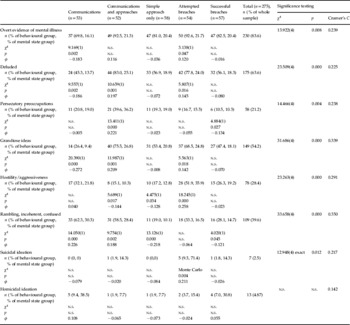
There was evidence for the presence of mental illness in 230 cases (83.6% of the sample). The nature and distribution of the disturbances of mental state and behaviour described in the files on which this conclusion was based is provided in Table 1.
Mental state items for behavioural groupsFootnote a

n.s., Non-significant.
a The abnormalities of mental state ascertained from the files of the 275 subjects are listed together with the level of association to the different types of harassing and intrusive behaviour.
Delusional beliefs were described (often in considerable detail) in 158 (63.6%), grandiose ideas in 54.2%, rambling, incoherent or confused utterances noted in 99 (39.6%), and suicidal intention in six (2.5%). Grandiosity, delusional ideas and incoherence were more frequent than persecutory preoccupations (21.2%). Homicidal ideas were expressed by 12 (4.8%) subjects, usually connected to delusional preoccupations.
Mental state and behavioural category
There were significant differences across behavioural groups in the prevalence of all mental state abnormalities, other than homicidal ideation (Table 1). The most overtly ill groups were those who wrote and approached and those who made unsuccessful attempts to breach; these had significantly higher rates of delusions and of grandiosity. However, they were in other respects very different: those who wrote and approached were significantly more likely than other groups to show persecutory preoccupations. They were significantly more likely to be rambling, incoherent or confused. They were significantly less likely to be overtly hostile or aggressive, whereas the attempted breachers were significantly more likely to be so.
In contrast to those who both wrote and approached, those who wrote, but did not approach, were significantly less likely to be overtly mentally ill, although 69.8% nevertheless were. They were also significantly less likely to show grandiosity or exhibit delusional beliefs.
Those who successfully breached security cordons were less likely to have persecutory preoccupations and less likely to be rambling, incoherent or confused.
Motivation
In 249 subjects (90.5%), there was sufficient information to assign them to one of eight motivational groups, described below.
(1) Delusions of Royal Identity (i.e. pretenders to the throne or to royal kinship). This was the largest group, accounting for 67 cases (26.9%). Seventeen (6.8%) expressed delusional beliefs that they were the true sovereign. This group often wrote lengthy letters accompanied by family trees and multiple annotated documents in support of their claims. Claims of kinship to the sovereign were made by a further 50 (20.1% of the whole sample). There was often evidence in their writings of complex delusional systems.
(2) Amity Seekers were the 41 (16.5%) subjects who offered their friendship and advice, which they expected to be taken, apparently oblivious to the unrealistic nature of their endeavour.
(3) The Intimacy Seekers consisted of 30 (12%) individuals. Fourteen (5.6%) had clearly erotomanic preoccupations, 10 of whom were male. All expressed the conviction that they were loved by or already married to their royal target. Those who were infatuated but not clearly erotomanic (16; 6.4%) usually wished to express their love or offer their hand in marriage to a royal. They understood that the royal personage did not yet love them or even know of their existence, but they still expressed confidence that they would succeed in their suit.
(4) Sanctuary and Help Seekers made up 22 (8.8%) of the sample and were asking for royal assistance with personal adversity or royal protection from supposed persecutors.
(5) The Royally Persecuted were a small group of only eight (3.2%) subjects, who claimed to be victims of organized persecution orchestrated by a member of the Royal Family.
(6) Counsellors who, though similar in some ways to the Amity Seekers, were a group of 28 (11.2%) individuals who saw it as their role to offer advice and opinions to the Royal Family on how they should live their lives and respond to political situations.
(7) Querulants formed a group of 16 (6.4%) people who were pursuing a highly personalized quest for justice and vindication. They were seeking royal assistance with their claims, or complaining of royal indifference to their cause.
(8) The Chaotic comprised a group of 37 cases (14.9%), where no clear motivation could be assigned because their writings and/or their statements to police were so difficult to follow or understand. It was not that there was insufficient information to assign another category. Rather, their thought processes and behaviour were so disturbed as to make a singularity of purpose unlikely.
Interaction between motivational group and behaviour type
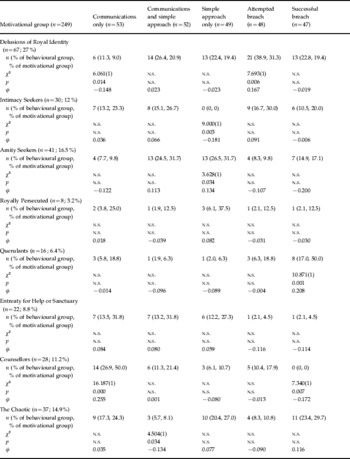
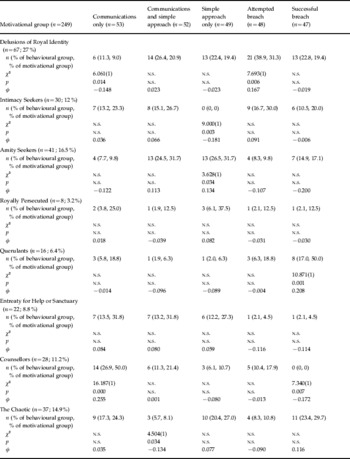
There were significant differences between behavioural groups in terms of motivation (see Table 2).
Comparing the frequency of each particular motivation in each behavioural group with other behavioural groups combinedFootnote a
n.s., Non-significant.
a The association between the motivation of subjects and their harassing and/or intrusive behaviours is illustrated. There were 26 cases where no clear motivation could be ascribed. These cases were omitted.
Some motivations stood out in terms of the proportion of their number who engaged in breach activities. Half the Querulants successfully breached security cordons and a further 18.8% tried unsuccessfully so to do. Those with Delusions of Royal Identity were significantly over-represented amongst the attempted breachers (38.9%). They also accounted for 22.8% of all those that successfully breached. Half the Intimacy Seeker group tried either successfully or unsuccessfully to reach their ‘lovers’. These were the groups with the strongest sense of entitlement and passion, whether for justice, personal destiny, or simply love.
Those with Delusions of Royal Identity were significantly less likely simply to write: they tended to press their claims more directly. Similarly, there were no Intimacy Seeker cases amongst those who simply approached without trying to breach security. Those with Delusions of Royal Identity were significantly more likely to be amongst those unsuccessful in their breach activities, because they tended to walk up to gates and security cordons and demand entry to ‘their’ palace or event. The group with the second largest proportion of attempted breach were the Intimacy Seekers whose sense of entitlement similarly lent itself more towards open demands than subterfuge.
By contrast, those seeking or offering help or advice did not tend to engage in breach activities. Counsellors were significantly over-represented amongst those who communicated only, and none was found in the successful breach group. Of those Seeking Help or Sanctuary, only 9% engaged in any form of breach activity.
The Chaotic were to be found in all behavioural groups, but were significantly under-represented amongst those who both wrote and approached without breaching, this representing a degree of organization over a period of time which may not have been readily compatible with their mental states.
Interaction between mental disorder and motivation
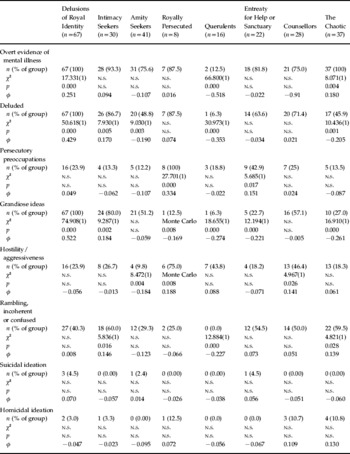
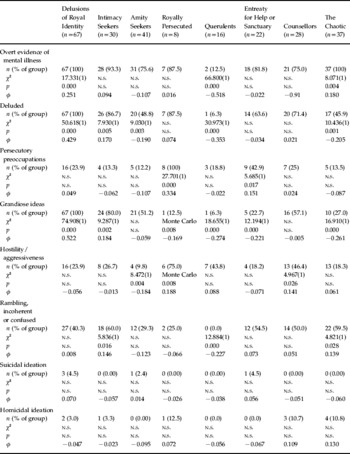
Certain abnormalities of mental state were closely linked with motivational groups (see Table 3). Grandiose ideas and mental illness were coextensive with delusions of royal identity. Likewise, the Intimacy Seekers were significantly more likely to be grandiose and deluded. This may have influenced their tendency towards more direct forms of behaviour. Three-quarters of Counsellors were mentally ill and almost the same proportion deluded, although these figures did not reach statistical significance.
Mental state items for motivational groupsFootnote a
n.s., Non-significant.
a The association between mental state items and motivation is provided for the 249 cases where the data were available.
In contrast, whereas all the Chaotic group were mentally ill, they were significantly less likely to be deluded or grandiose, but significantly more likely to be rambling, incoherent or confused. The Intimacy Seekers were similarly more likely to be rambling, incoherent or confused, 60% evidencing this characteristic, which may have impacted upon their ability effectively to plan.
The Querulants stand out as markedly different from all the other motivations in that only 12.5% appeared mentally ill and only 6.3% deluded or grandiose. None was rated as rambling, incoherent or confused. This was a group of persistent petitioners who were prone to express demands for justice at great length, but with a degree of rationality and face validity which placed them on the borderline between obsessive disproportionate concern and frank delusion. They are likely to have included a proportion with delusional disorder. Not disabled by a range of psychotic symptomatology, their ability to plan effectively is likely to remain relatively intact.
Of the remaining groups, the Amity Seekers were the second least likely to appear deluded, although nearly half did so. The Royally Persecuted were a small group, uniformly preoccupied with what they thought was being done to them and less likely to appear grandiose. Similar characteristics were shared by those Seeking Help or Sanctuary.
In terms of hostility or aggressiveness in words or demeanour, this was most prevalent amongst the Royally Persecuted, presumably reflecting their paranoid state. Counsellors were also significantly more likely to be hostile or aggressive, this reflecting their anger when the recipients of their advice failed to take heed. Significantly fewer Amity Seekers were hostile or aggressive, these being characteristics which do not naturally sit with the pursuit of friendship.
Discussion
The most dramatic finding was the high rate of serious mental illness among those who harassed and stalked royalty (83.6%). The presence of mental illness was ascertained by mental health professionals on the basis of the written material sent by 123 subjects and incident reports covering approaches in 152 cases of which 44% involved multiple incidents. Symptoms such as delusions marked by persecutory and grandiose ideas were often vividly described or obvious from the subjects' letters. Given that, by 2005, royal households were forwarding around 7000 letters per year to the intelligence division of SO14, it is difficult not to conclude that those showing inappropriate attention to the Royal Family constitute a substantial reservoir of psychosis. Attention to this group constitutes a potential new method in the public health armorarium for identifying untreated (or undertreated) mental disorder in the general community.
The only directly comparable findings are those of Scalora et al. (Reference Scalora, Baumgartner, Zimmerman, Callaway, Maillette, Covell, Palarea, Krebs and Washington2002b) in inappropriate communicators and approachers to members of the US Congress. Scalora found 59.6% of those who approached to have serious mental illness compared with our 86.9%, and 39.6% of those making inappropriate communications compared with our 69.8%. The differences are unlikely to be explained by the methodologies of the two studies, which were similar. US Congressmen, however eminent, probably do not occupy quite the same position in the affections, fantasies, and even delusions of the American people as that of the Queen and her family for the British people.
The motivations driving our subjects were in part unique to their relationship to royalty. The 67 pretenders and the claimants to kinship made up over a quarter of the sample and, though some analogous beliefs are found in those who pursue celebrities and politicians, they are a rarity (Mullen et al. Reference Mullen, James, Meloy, Pathé, Farnham, Preston, Darnley, Meloy, Sheridan and and Hoffmann2008; Meloy et al. Reference Meloy, Sheridan and Hoffmann2008b). Conversely, erotomanics and infatuated suitors were relatively uncommon in our sample compared with those who pursue media and film stars (Zona et al. Reference Zona, Sharma and Lane1993; Meloy et al. Reference Meloy, Mohandie, Green, Meloy, Sheridan and and Hoffmann2008a). That the Queen, as head of state and as a sovereign whose role remains connected to the 1689 Bill of Rights, should be regarded by many ordinary people as the ultimate resort for those seeking justice or sanctuary is not surprising, though the relative paucity of such cases in this sample may be so. This is probably explained by nature of the filtering processes which determined which letters were referred on to SO14 for assessment during the period under study, these constituting a fraction of the letters received by the royal households. Those communications which attracted concern in the household correspondence offices were often oddly formatted, contained curious not to say bizarre enclosures, and had an obviously strange or threatening content. Many letters that might have raised the concerns of a mental health professional may have easily passed the scrutiny of the royal staff. For example, many of those complaining of injustice and requesting intercession, however eccentric the complaint, are unlikely to have been regarded as anything other than over-hopeful by palace staff. This probably ensured that those letters forwarded to SO14 had a high chance of being written by someone with a serious mental disorder. Similarly, of the many people whose behaviour attracted the attention of the police guarding the royals and their residences, it is those who respond oddly and inappropriately when challenged who finished up in the SO14 files. That selection bias, however, reflected both the practical experience of those charged with protecting royalty, and the available empirical evidence on who might eventually present a threat.
The individuals studied were responsible for little physical harm to the royal protectees, though in 18 instances there were assaults on other people. Studies of attackers of both royalty and politicians, however, suggest a significant proportion share many characteristics with those who launch attacks (Fein & Vossekuil, Reference Fein, Vossekuil and Meloy1998; James et al. Reference James, Mullen, Meloy, Pathé, Farnham, Preston and Darnley2007, Reference James, Mullen, Meloy, Pathé, Farnham, Preston and Darnley2008; Mullen et al. Reference Mullen, Pathé and Purcell2009). In the relatively recent past there have been incidents, such as the attack on Princess Anne in the Mall and the shooting incident involving the Queen in New Zealand which presented a serious threat to royalty and to those charged with protecting them (James et al. Reference James, Mullen, Meloy, Pathé, Farnham, Preston and Darnley2008).
It is a virtually impossible task from a risk assessment and management perspective individually to identify the tiny minority who will present a genuine threat from among the vast majority who, even if they make threats, will at worst be a nuisance. The alternative strategy is to identify factors associated with stalking and harassing the prominent: managing such factors would reduce the overall risk without the need to identify those peculiarly vulnerable to progressing to assault. This is similar to reducing type 2 diabetes by combating obesity and increasing exercise in a population. This approach does not require the identification of those specific individuals vulnerable to developing the metabolic syndrome. In attacks on public figures, this study illustrates that mental illness is one such factor for intervention. Obtaining treatment for the mentally ill will prevent the few from progressing to constitute a serious risk, without their needing to be individually identified. Further, it can be argued that this fulfils a public health function. Just as losing weight and increasing fitness can improve the quality of life, so treating a mental disorder which is driving fixations on prominent people would also improve the life of the affected individual.
The conclusion reached by the study team and presented to the Home Office was that the assessment and management of risk to the prominent from individuals who stalk, threaten or harass should be managed by a joint police–mental health team, given that health and protection issues so closely overlap in this group. This conclusion was acted upon, leading to the formation of the Fixated Threat Assessment Centre (FTAC) (Hansard, Reference Hansard2007; Rose, Reference Rose2007). However, given the sheer volume of communications and approaches by the mentally ill, it is not within the capability of the FTAC or any similar unit to intervene in the entire population of the disordered presenting through inappropriate communication or approach. It is necessary to select out for attention particular subgroups who are more likely to cause problems to the protectees and those around them. The problems and risks presented by such stalkers and harassers cannot be reduced to the probability of attack. Another risk for public figures who are potential terrorist targets is that these mostly harmless nuisances will dissipate the resources available for protection and inadvertently provide a screen behind which more sinister forces can operate (Biesterfeld & Meloy, Reference Biesterfeld, Meloy, Meloy, Sheridan and and Hoffmann2008). In addition, the public role of royalty is presumably difficult enough without having to cope with the embarrassment and alarm created by these types of intrusion.
As for ways in which those groups most likely to cause problems can be identified, factors which have been shown to contribute to identifying the risks of adverse effects in stalking populations might also contribute to assessing and managing the risks to public figures (Mullen et al. Reference Mullen, MacKenzie, Ogloff, Pathé, McEwan and Purcell2006, Reference Mullen, Pathé and Purcell2009; Phillips, Reference Phillips2006, Reference Phillips and Pinals2007). Motivational factors are central to risk prediction in stalking in the general population and this is likely to be similar with royalty. The motivational categories developed in this paper are useful descriptively, and not too unwieldy for practical application in a risk assessment paradigm. These discreet motivational groupings suffer the problem of simplification which ignores the extent to which motivations can change over time and reflect conflicting desires at any particular moment. The development of an even more parsimonious typology is, however, desirable, incorporating public figures other than royalty, in particular politicians. This will require further research, particularly that employing prospective methodologies.
This study contributes to knowledge of associations between motivation and behaviour, which are of use in terms of risk assessment and management. Specifically, it allows protection personnel greater knowledge of which motivational groups are likely to cause more problems in terms of intrusive behaviour and which groups are unlikely to do so. These findings need now to be supplemented by further work with the current dataset to identify particular associations with individual domains of risk, specifically those of persistence, progression and assault.
Acknowledgements
This study was undertaken as part of the Fixated Persons' Project, which was commissioned and financially supported by a research grant from the British Home Office, which met the costs of the project in terms of employment of authors L.F.P. and B.D as research assistants for 2 years and the costs of travel to project meetings for all authors. None of the authors has any financial involvement or affiliation with any organization whose financial interests might be affected by material in the article, or which might potentially bias it. The views expressed are those of the authors and do not necessarily reflect those of the Home Office.
Declaration of Interest
None.