INTRODUCTION
It is generally the case that the more structurally complex a habitat the greater its biodiversity (Tilman, Reference Tilman1999; Cocito, Reference Cocito2004). In the tropics coral reefs are the archetypal representation of habitat complexity containing rich assemblages of invertebrates (Cornell & Karlson, Reference Cornell and Karlson2000; Cocito, Reference Cocito2004). Corresponding complex structures in temperate seas are typified by biogenic reefs and maerl beds (Holt et al., Reference Holt, Rees, Hawkins and Seed1998; Hall-Spencer & Moore, Reference Hall-Spencer and Moore2000a, Reference Hall-Spencer and Mooreb; Cranfield et al., Reference Cranfield, Rowden, Smith, Gordon and Michael2004). Biogenic reefs have a number of effects on the physical environment, including stabilization of mobile sediment and the provision of suitable substrate for the attachment of sessile organisms. Consequently this leads to a community of biota that is more rich and diverse than the surrounding area (see Holt et al., Reference Holt, Rees, Hawkins and Seed1998). Many mobile animals and their juveniles use upright structures to shelter from currents or predators, e.g. juvenile hake (Auster et al., Reference Auster, Malatesta and Donaldson1997). Tupper & Boutilier (Reference Tupper and Boutilier1995) showed that juvenile cod (Gadus morhua) are more likely to avoid predation in structurally complex habitats leading to better rates of survival.
In UK inshore waters several biogenic reef forming species have been considered to be of special importance, namely the polychaetes Sabellaria alveolata, S. spinulosa and Serpula vermicularis and the bivalves Mytilus edulis and Modiolus modiolus (Holt et al., Reference Holt, Rees, Hawkins and Seed1998; Moore et al., Reference Moore, Saunders and Harries1998; Rees et al., Reference Rees, Sanderson, Mackie and Holt2008). However, as highlighted by Hall-Spencer & Moore (Reference Hall-Spencer and Moore2000b), the homologous bivalve beds of Limaria hians (Gmelin) are currently omitted from the biogenic reef classification and have only recently been included as a priority habitat for conservation action under the UK Biodiversity Action Plan (Biodiversity Reporting and Information Group, 2007). Work on L. hians beds has indicated a diverse assemblage of organisms; however, the sensitivity of L. hians and the susceptibility of their beds to anthropogenic impacts has resulted in dwindling numbers and a drop in their coverage throughout the UK, with only their shells found in areas where several decades ago they were recorded as common (Ansell, Reference Ansell1974; Tebble, Reference Tebble1976; Minchin et al., Reference Minchin, Duggan and King1987; Wood, Reference Wood1988; Seaward, Reference Seaward1990; Minchin, Reference Minchin1995; Trigg & Moore, Reference Trigg and Moore2009).
Limaria hians secretes byssal threads which it then attaches to surrounding material, eventually creating a cocoon-like structure (Merrill & Turner, Reference Merrill and Turner1963; Gilmour, Reference Gilmour1967). Under the right environmental conditions, specifically areas subject to strong tidal currents, large aggregations of L. hians give rise to a layer of continuous nest carpeting the seabed (Ansell, Reference Ansell1974; Minchin et al., Reference Minchin, Duggan and King1987; Minchin, Reference Minchin1995). These beds contain high densities of L. hians with as many as 700 ind. m2 recorded (e.g. Hall-Spencer & Moore, Reference Hall-Spencer and Moore2000b). The provision of a stable substrate overlying the mobile sediment allows colonization by epibionts, thus enabling an array of sessile and sedentary organisms to inhabit regions normally unsuitable for their attachment (Minchin, Reference Minchin1995; Hall-Spencer & Moore, Reference Hall-Spencer and Moore2000b). The bed also acts as a nursery ground for species such as Gadus morhua (Minchin, Reference Minchin1995; Collie et al., Reference Collie, Escanero and Valentine1997; Hall-Spencer & Moore Reference Hall-Spencer and Moore2000b; Bradshaw et al., Reference Bradshaw, Collins and Brand2003). Along with the considerable numbers of species on and inside the byssal bed Hall-Spencer & Moore (Reference Hall-Spencer and Moore2000b) found a high infaunal biomass directly below.
Despite the acknowledged conservation importance of L. hians beds (Biodiversity Reporting and Information Group, 2007) no quantitative data exist on the associated community of L. hians beds. Understanding the contribution of this keystone species towards marine biodiversity in UK waters is a prerequisite for establishing sound conservational guidance, in addition to providing more detailed information on this habitat's ecology. This paper describes an investigation carried out on the macrobenthos of L. hians beds on the west coast of Scotland during the winter and summer periods, in order to characterize the community and to determine the nature of temporal and spatial variation in community composition and diversity.
MATERIALS AND METHODS
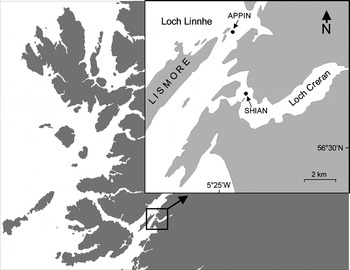
Limaria hians beds were investigated at two sites in Argyll on the west coast of Scotland: Appin in Loch Linnhe (56°33.794′N 5°24.819′W, 9.1 m depth) and Shian in Loch Creran (56°31.745′N 5°23.630′W, 10.0 m depth) (Figure 1). Five replicate 10 cm diameter core samples were taken by diver at each site within areas of 100% nest cover on 17 June 2006. The coring tubes were pushed through the nest material and into the underlying sediment to a total depth of ~15 cm. Nest thickness at each core location was measured by ruler. Core sample location was randomized by the diver swimming for 1–5 kick cycles towards one of the four cardinal points, the number of kick cycles and the cardinal point being determined using a pseuso-random number generator. Core samples were initially preserved in 10% formosaline in 5 l containers before transfer to 70% ethanol for storage. Sampling was repeated at both sites on 13–14 February 2007.
Arrows indicate locations of the study sites at Appin, in Loch Linnhe and at Shian, in Loch Creran.

Prior to examination of the core samples rose Bengal was added to each of the samples and left for a minimum of 24 hours. Freshwater was then added to the buckets and the samples gently stirred to elutriate the lighter organisms. The supernatant was then drained through a 0.5 mm sieve. This process was repeated several times until very few organisms were being collected. The organisms retained in the sieve were washed into a sorting tray and, using forceps, sorted into major taxonomic groupings. The residue left in the sample container, comprising sediment and nest material, was then sieved in small amounts, the material retained being placed in a sorting dish where the nest material was teased apart and the biota sorted into major taxonomic groupings.
Once sorted all the organisms were stored in 70% ethanol solution. These were then identified to the lowest possible taxon and enumerated; however, algae and colonial organisms (i.e. sponges, hydroids, bryozoans and some ascidians) were recorded as present or absent. Due to its extremely small size the polychaete Spirorbis spirorbis was recorded as present or absent. Nomenclature and authorities for all flora and fauna were obtained using the World Register of Marine Species (WoRMS) database (SMEBD, 2010).
Two species abundance data matrices were produced. The minimum species richness matrix excluded taxa that did not necessarily represent additional species (such as unidentified juveniles); taxa recorded as present were given the nominal abundance of 1. In the quantitative-only data matrix such taxa were omitted. For each core replicate, total abundance (N) was taken as the sum of abundances of all quantitatively-recorded taxa. Species richness (S) was taken as the number of taxa included in the minimum species richness data matrix. The Shannon–Wiener index (H′) and Pielou's evenness index (J) were obtained from the quantitative-only data matrix (with the exclusion of possible multispecies taxa such as Nematoda) using Primer 5.1 (Clarke & Warwick, Reference Clarke and Warwick2001).
Temporal and locational differences in mean N, S, H′ and J values were assessed by two-way analysis of variance (ANOVA), following confirmation of homoscedasticity using Levene's test. Temporal and locational differences in community composition were examined using multivariate analysis tools in Primer 5.1 (Clarke & Warwick, Reference Clarke and Warwick2001). Non-metric multidimensional scaling (n-MDS) was carried out on log(x + 1) transformed abundances in the minimum species richness data matrix, employing the Bray–Curtis index. Temporal and locational differences in community composition were tested by two-way analysis of similarities (ANOSIM), and the species contributing mostly to any differences identified using the SIMPER routine.
RESULTS
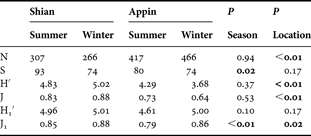
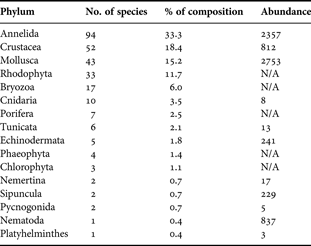
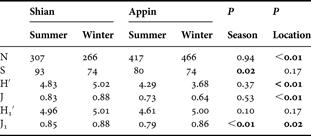
The results of two-way ANOVAs investigating seasonal and locational effects on mean values of the univariate parameters of abundance and diversity are given in Table 1. Abundance was significantly greater at Appin than at Shian; however, no temporal difference was identified. Overall, the abundance was dominated by molluscs, annelids, nematodes and crustaceans, together representing 93% of the total of 7275 enumerated animals (Table 2).
Mean of univariate measures: species number (S), abundance (N), Pielou's evenness (J) and Shannon–Wiener diversity (H′) from Shian and Appin Limaria hians beds during summer 2006 and winter 2007. The measures represent mean values per 0.0079 m2 core. H1′ and J1 are excluding Modiolula phaseolina. Significant differences (P ≤ 0.05) are in bold.
Composition of benthos in all 20 cores. Total abundance of individuals (in ~0.16 m2) found in all samples per phylum. N/A indicates a phylum with species identified in binary.
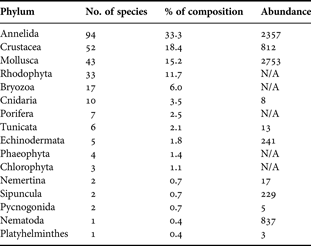
A total of 306 taxa were identified from all 20 cores at both sites (Appendix). However, because the taxa list had more entries than could be confirmed as separate species, the minimum species richness total (S) was 282 (40 algae and 242 faunal taxa). For individual 79 cm2 core samples S ranged between 56 and 108, whilst pooling data for each location produced S values of 227 for Shian and 211 for Appin. The biota collected was represented by 3 algal and 13 faunal phyla with the richest groups being annelids, crustaceans, molluscs and rhodophytes (Table 2). Within each of the 3 richest phyla the dominant groups were errant polychaetes, amphipods and bivalves respectively. Of particular interest is the polychaete Lysilla nivea which was found at Shian. Originally described from Madeira, the presence of this worm is of geographical interest having only been found in UK waters within the southern Irish Sea fairly recently (Mackie et al., Reference Mackie, Oliver and Rees1995).
Mean species richness was found to be significantly greater in summer than in winter, though no locational effect was identified (Table 1). On the other hand, no seasonal change in the mean Shannon–Wiener or Pielou evenness indices was recorded, whilst means of both were significantly greater at Shian (Table 1). As these diversity indices were strongly influenced by the numerically dominant species, Modiolula phaseolina, the ANOVA was repeated omitting this species. This revealed significantly enhanced evenness in winter and at Shian.
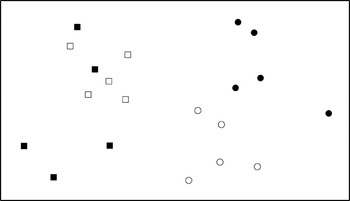
Temporal and locational patterns in species composition are illustrated in the n-MDS plot (Figure 2) which shows distinct separation of the replicate samples from each site and for the samples from different seasons at Shian. Both seasonal and locational differences were confirmed by two-way ANOSIM (P < 0.01 in both cases).
Two-dimensional non-metric multidimensional scaling plot plot of biota, taken from the minimum species richness data set, found within a Limaria hians bed at 2 different sites and times (stress 0.15). The symbols ○ and • represent Shian 2006 and 2007 respectively; □ and ■ represent Appin 2006 and 2007 respectively.

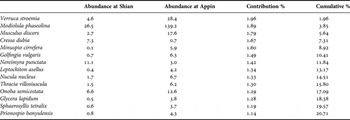
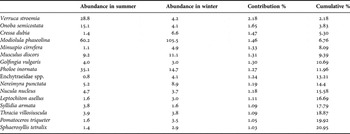
A similarity percentages (SIMPER) analysis on log(x + 1) transformed data identified which species contributed most to the temporal and locational differences. It showed that the top 14 taxa contributed a cumulative percentage of ~21% of the average dissimilarity between sites (49.72%; Table 3). The largest single contributor to the dissimilarity was Verruca stroemia. However, this only has a value of 1.96% and therefore indicates that the differences identified are from broad changes in the assemblage composition rather than from one or a few species. A similar result was found when assessing dissimilarity between times (Table 4). The top 16 taxa contributed a combined percentage of ~21% of the average dissimilarity between times (46.71%). Verruca stroemia has the greatest contribution (2.18%), the low value again indicating that no particular taxon has a large influence on the dissimilarity.
Similarity percentages analysis showing the dissimilarity between the associated community found on a Limaria hians bed at 2 different sites (Shian and Appin).

Similarity percentages analysis showing the dissimilarity between summer and winter seasons of Limaria hians beds.

Ten taxa were found in all the samples including the bivalve Musculus discors and the polychaetes Kefersteinia cirrata and Mediomastus fragilis. Using SIMPER found that 13 and 14 individual taxa, in Shian and Appin respectively, contributed over 50% to the similarity. Three of the 5 most dominant taxa at each site were the same: Nematoda spp., Modiolula phaseolina and Pholoe inornata. Just over 55% (N = 156) of the total number of species were found at both sites.
DISCUSSION
This study represents the first comprehensive quantitative examination of the associated community found in a L. hians bed. A qualitative study in Loch Fyne on the west coast of Scotland recorded more than 280 taxa from 6 L. hians nests (Hall-Spencer & Moore, Reference Hall-Spencer and Moore2000b). Although the total number of species recorded in the present investigation was virtually identical to the Loch Fyne study, a maximum of 227 taxa were found at a single site (Shian) when data from both the summer and winter sampling periods were pooled. The Loch Fyne study used 6 discrete nests of ~25 cm diameter, equating to an estimated area of 0.29 m2, each about 10 cm in height. By comparison, the present study examined an area of ~0.16 m2 in total (0.08 m2 at each location). Therefore, the larger area covered and the greater height of the nests in Loch Fyne could explain why more species were found, even though the sieve mesh size was 1 mm compared to 0.5 mm in this study. Furthermore, the Loch Fyne samples included small kelp plants living on the nests (Hall-Spencer, personal communication). Kelp have their own diverse communities living within the holdfasts and attached to the stipe (e.g. Christie et al., Reference Christie, Jørgensen, Norderhaug and Waage-Nielsen2003), thus quite possibly enhancing the total species richness of a L. hians bed. More than half of the species collected in this study were found at both Appin and Shian. This is probably unsurprising considering their close geographical locations. Interestingly approximately 43% of the species found in the Loch Fyne study (Hall-Spencer & Moore, Reference Hall-Spencer and Moore2000b) were also found on the L. hians beds in this investigation; however, the composition of the benthos was quite different. Molluscs dominated the Loch Fyne samples (N = 74) followed by Crustacea (N = 63) and Polychaeta (N = 52).
Differences in the assemblage composition between sites were clearly illustrated by the n-MDS plot (Figure 2) and confirmed by the two-way ANOSIM. Differences between the Shian and Appin communities were also revealed by Pielou's evenness, the Shannon–Weiner diversity index and faunal abundance, which were all found to have significant site effects when examined by two-way ANOVA. A number of differences in the locations were discernible in situ and are thought to contribute towards the variations observed in the ordinations and univariate measures. For example, the bed at Shian was close to a rocky reef and was fairly homogeneous with a consistent 100% nest cover extending over a large area. In addition the thickness of the bed here was ~5 cm with a density of L. hians of >600 ind. m−2. In contrast the bed at Appin was in the middle of a kelp park, averaged ~4 cm thick, had a L. hians population of approximately 350 ind. m−2 and contained frequent patches within the bed devoid of nest material.
The two sites are only separated by a distance of 4 km and display similar underlying heterogeneous sediments of gravelly sand. Current strengths are unknown but both sites are clearly tideswept, attaining spring rates in excess of 1 knot. There are, however, a number of known environmental differences between the sites that may contribute to the observed community differences. The narrow sill at the entrance to Loch Creran significantly reduces tidal flushing of the loch (see Landless & Edwards, Reference Landless and Edwards1976), which will influence larval supply and recruitment at the Shian site. Adjacent to a Modiolus modiolus bed, the Appin site is pockmarked by holes in the byssal carpet. On several occasions the abundant kelp here was observed to have pulled free sections of the Limaria hians bed; the drag from the currents eventually becoming too strong, resulting in the ‘uprooting’ of kelp holdfasts and subsequent tearing of attached nest material from the surrounding bed. This natural destruction of the beds was also recorded at a L. hians bed in Mulroy Bay, Ireland (Minchin, Reference Minchin1995) and clearly adds an extra dynamic quality to the Appin bed not seen at Shian.
Significant time effects on species richness were found by two-way ANOVA and on species composition by two-way ANOSIM. However, no significant time differences were shown by J or H′. Yet it should be noted that many of the organisms which exhibit seasonal changes were excluded from the univariate calculations, as they were not quantifiable (e.g. hydrozoans, bryozoans and algae) and species richness of algae was found to be significantly greater during the summer. A number of algal species were only recorded in the summer (e.g. Brongniartella byssoides, Colaconema daviesii, Audouinella purpurea and Halurus flosculosus), and when a two-way ANOVA was repeated without the algae the temporal change disappeared. Limaria hians beds have been recorded to depths of 30 m (Connor et al., Reference Connor, Allen, Golding, Howell, Lieberknecht, Northen and Reker2004) so at this depth, where light is severely limited, seasonal differences in their community composition may not be significant.
The recognized biogenic reefs in UK coastal waters are constructed by the mytilids Modiolus modiolus and Mytilus edulis the sabellids Sabellaria alveolata and S. spinosa and the serpulid Serpula vermicularis (Holt et al., Reference Holt, Rees, Hawkins and Seed1998). The richest and most diverse of these are M. modiolus and S. vermicularis reefs (Holt et al., Reference Holt, Rees, Hawkins and Seed1998) and are compared in detail with the present study. Studies on the biodiversity of the sabellid and M. edulis reefs have found considerably fewer taxa. For example, work by Svane & Setyobudiandi (Reference Svane and Setyobudiandi1996) on a M. edulis reef recorded a total of 39 species using a 0.5 mm sieve from an area of 0.029 m2. Although little work has been carried out on the sabellid reefs, in recent years an investigation by Sousa Dias & Paula (Reference Sousa Dias and Paula2001) on a S. alveolata reef in Portugal recorded 107 taxa from an area of 0.32 m2, using a 0.5 mm sieve. Studies undertaken on the M. modiolus reefs around the UK have found this habitat to be extremely diverse. Holt & Shalla (in Holt et al., Reference Holt, Rees, Hawkins and Seed1998) found 270 invertebrate taxa in a M. modiolus reef off the Isle of Man, whilst in Strangford Lough 119 and 90 taxa were recorded on horse mussel clumps by Roberts et al. (Reference Roberts, Davies, Mitchell, Moore, Picton, Portig and Preston2004) and Brown & Seed (Reference Brown, Seed, Keegan, Ceidigh and Boaden1977) respectively. Surveys carried out by Mair et al. (Reference Mair, Moore, Kingston and Harries2000), Moore et al. (Reference Moore, Saunders, Harries, Mair, Bates and Lyndon2006) and Rees et al. (Reference Rees, Sanderson, Mackie and Holt2008) on M. modiolus reefs allow comparisons with the present study as biota was retained on a 0.5 mm sieve and univariate measures calculated. These studies recorded a mean number of taxa of 84, 96 and 108 respectively, compared with a mean of 93 taxa per replicate for the L. hians bed at Shian. Greater areas were sampled per replicate in the M. modiolus studies, 0.03 m2 for the first 2 surveys and 0.06 m2 in the last, compared to a considerably lower 0.0079 m2 for the L. hians bed. A study on a S. vermicularis reef in Loch Creran recorded 71 taxa for a similar area (0.007 m2) and gave estimates of 12756 ind. 0.1 m−2 for total fauna (Chapman, Reference Chapman2004). This compares with 2290 ind. 0.1 m−2 for a Modiolus reef in Pen Llŷn, North Wales (Rees et al., Reference Rees, Sanderson, Mackie and Holt2008) and 3886 ind. 0.1 m−2 and 5894 ind. 0.1 m−2 for the L. hians reefs in Shian and Appin respectively. The L. hians faunal assemblage is dominated by the same groups (Annelida, Crustacea and Mollusca) as in the study by Chapman (Reference Chapman2004), although many more species of Mollusca were found on the serpulid reef than the L. hians bed (N = 70 compared to N = 43). The mean Shannon–Wiener diversity figures of the L. hians bed at Shian (4.83 in the summer and 5.02 in the winter) are similar to those of M. modiolus reefs also found in Loch Creran (4.9 and 5.2 for Mair et al. (Reference Mair, Moore, Kingston and Harries2000) and Moore et al. (Reference Moore, Saunders, Harries, Mair, Bates and Lyndon2006) respectively), and those recorded for the serpulid reefs (~5.0) Chapman (Reference Chapman2004). The similar diversity index values along with the high number of species found in the present study place L. hians beds among, what are considered (Holt et al., Reference Holt, Rees, Hawkins and Seed1998), the most rich and diverse biogenic reefs in UK waters.
Of the 16 phyla found in this investigation almost a third of all species were annelids, and of these all except one species were polychaetes. Within this group the presence of a large number of hesionids (7 species) and syllids (17 species) further highlights the diversity and complexity of the beds. A typical L. hians nest covers a variety of sediments (e.g. shell, gravel and muddy mixed sediments) which can also be bound to the L. hians beds by byssal attachment. In this investigation the rich polychaete assemblage may thus be a reflection of the varying sediments and microhabitats found on these beds. In this study 19 out of 20 cores recorded at least a single Flabelligera affinis worm. Interestingly a concurrent study (Trigg et al., unpublished) found that when cages containing L. hians nest material were brought to the surface, every gallery (>70) contained one or more F. affinis. Hall-Spencer & Moore (Reference Hall-Spencer and Moore2000b) propose that F. affinis could be a commensal inhabitant of L. hians nests and future work should investigate whether a possible relationship exists between these species.
Despite the high numbers of species found at the 2 L. hians beds investigated it is thought that these values are an underestimation of the total species using the habitat. The meiofaunal community were not investigated by this study; although a preliminary examination did not show a particularly well developed community in terms of abundance, and large motile organisms observed at each site (e.g. Necora puber, Gadus morhua and Asterias rubens) were not sampled. Several entries in the taxa list probably contained more than one species (e.g. Nemertina, Enchytraeidae and Nematoda) but could not be identified in the time available. Likewise the preponderance of high numbers of juveniles without clear defining features may have also reduced the total species found.
The natural damage inflicted upon L. hians beds (see above), indicates that although the bed is generally stable, under certain conditions parts of the L. hians nest are subject to a reduction in nest cover. Following these or anthropogenic impacts the disturbed community may be significantly different from the community found on the original bed. The disturbed community possibly consisting of a less diverse assemblage, with opportunistic species taking advantage of the dislodged material and an increase in epifaunal scavengers, such as juvenile Gadus morhua, as food becomes available (Hall, Reference Hall1994; Kaiser & Spencer, Reference Kaiser and Spencer1994; Hall-Spencer & Moore, Reference Hall-Spencer and Moore2000b). Over time it is thought that the community will establish a group of organisms partly typifying the adjacent environment in addition to some characteristic species for the surrounding habitat. Despite the beds being recognized as a relatively long-lived and stable environment if undisturbed (see Minchin, Reference Minchin1995) it has been observed that they are continuously assimilating new material onto the surface and edges of the bed (Trigg, personal observation). Thus it is believed that the beds are in a constant state of flux. Svane & Setyobudiandi (Reference Svane and Setyobudiandi1996) state how species diversity and abundance of the community assemblage on a Mytilus edulis bed could be significantly influenced by its dynamic nature, this is also considered true of L. hians beds. The rapid production of nests and binding of passing and surrounding material by L. hians has been observed in situ (Trigg, personal observation) and in aquaria (Merrill & Turner, Reference Merrill and Turner1963). Moreover, the regular process of the animal secreting and attaching threads will provide new habitats such as the interstitial, allowing animals, for example hesionid and syllid worms, to colonize. This development is thought to constantly add organisms to the community, by provision of a suitable living space.
In summary, the L. hians beds investigated in this study showed comparable levels of species richness and diversity with those found on the most diverse and rich biogenic reefs in UK waters. The results indicate that the associated community of these shallow L. hians beds are subject to temporal and geographical variations, the summer containing a significantly richer community than the winter period. However, before it can be concluded that temporal changes occurring on a particular L. hians bed are a result of regular seasonal patterns, it is advised that future studies be carried out over several years. The complex dynamic nature of the beds means a number of factors should be considered, i.e. the continual assimilation of material and organisms to the bed, the stochastic variability associated with settlement of invertebrates and the damage to beds from natural occurrences. The geographical differences seen in this investigation show that rather than considering all L. hians beds to be a similar entity each bed should be assessed individually. These are important points when determining the habitat's conservational significance and thus how it might be protected by future legislation.
ACKNOWLEDGEMENTS
The authors thank the Esmée Fairbairn Foundation and SPLASH programme for their support. We would also like to thank S. Hamilton for providing taxonomic expertise (Polychaeta) and the referees for their comments.
Appendix
Taxa recorded from two Limaria hians beds on the west coast of Scotland during June 2006 and January 2007. Phyla are depicted in bold lettering and authorities are listed alongside entries. Note that Syllis sp. H is currently without a species name (Hamilton, personal communication).