1 Introduction
We start with a thought experiment. Imagine that there is a morpheme in English – call it M – whose status is unclear. M sometimes appears to express a time notion, but most grammarians are reluctant to label M a tense for three reasons:
A. In other uses M appears to have a modal sense.
B. The only other morpheme with similar morphological properties to M expresses modality or mood, so the consensus is that the two morphemes should be treated together as markers of modality or mood.
C. The time notion that M sometimes expresses is also conveyed by several other forms.
A few grammarians nonetheless claim loudly that M is basically a tense marker, but their arguments have mostly been ignored by mainstream opinion.
Imagine now that M is the bound morpheme which attaches to verbs, and which is realised as -ed for regular verbs. The three reasons for not calling this morpheme a past tense marker would strike most grammarians as weak.Footnote 2 Nonetheless, they clearly apply:
A. The -ed morpheme has non-temporal uses, often labelled with the term ‘modal remoteness’. These include its use in the protasis of unreal conditionals (If he arrived tomorrow, would he be too late?) and after verbs like wish (I wish I had a secure job); and the ‘politeness’ use in I wondered whether I could see you for a few minutes. Some people argue that in indirect reported speech in examples like He said he was happy, the second instance of -ed in was has a distinct meaning from the first instance in said (e.g. Huddleston & Pullum et al. Reference Huddleston and Pullum2002: 151ff.).
B. The only other verbal inflection in English that is distinct from the present tense is the subjunctive, which shows up in the verb be in constructions like I insist that he be here when I arrive and If he were to arrive tomorrow, would he be too late?. Since the subjunctive involves modal notions such as non-factuality, we should treat the past tense as basically modal.
C. We can also refer to the past using the quasi-auxiliary used to, and by means of the so-called ‘historic’ present tense. There is therefore no good reason to single out the -ed morpheme and call it the past tense.
Despite these arguments, the consensus among grammarians is that the -ed morpheme should be treated as a marker of past tense. When it comes to the morpheme will, however, the consensus is quite different. The three arguments which are not thought to disqualify -ed as a tense are (when appropriately reformulated – see below) taken as solid reasons for excluding will as a future tense. This is a strange and unsatisfactory situation, and the purpose of this article is to expose this strangeness and propose a more rational analysis of will. I argue that will should be analysed as a future tense marker with some residual elements of volitional meaning that are activated in the right contexts.
The article is organised as follows. Section 2 reviews the standard arguments against treating will as a future tense and concludes that they are unconvincing. Section 3 presents some arguments in favour of a future tense analysis of will. In section 4, the main arguments in favour of a modal analysis of will are scrutinised and found wanting. Section 5 re-examines the volitional use of will. The conclusion highlights some wider unresolved issues.
2 Arguments for not treating will as a future tense
2.1 The future is uncertain / will is not an inflection
If the three arguments against treating -ed as a tense look weak, why do most grammarians take them seriously when they apply to will? Before looking at these arguments in detail, we should consider the supposed differences between the two cases, which are these:
D. The future, unlike the past, is inherently uncertain and therefore has something in common with modality.
E. The -ed morpheme is an inflection, whereas will is an auxiliary verb; furthermore, will shares the morphosyntactic properties of the English modal auxiliaries.
In his discussion of futurity, Comrie (Reference Comrie, Abraham and Janssen1989: 53) calls argument (D) ‘the conceptual non-argument’, since it may be a fact about the world but that does not make it a fact about language. Comrie points out that if I say It will rain tomorrow and it does not in fact rain the next day, then my statement was simply false; this is not the case for It may rain tomorrow, which is genuinely modal. When will is used for future time reference it simply does not have the properties of modals. We return to this point in section 4.3.4 below.
It is argument (E) which is the reason most commonly given for saying that English only has two tenses, past and present. Jespersen was quite clear on this point:
The English verb has only two tenses proper, the Present and the Preterite.
(Jespersen Reference Jespersen1933: 231)The same position was adopted by all the grammars co-authored by Geoffrey Leech, starting with Quirk et al. (Reference Quirk, Greenbaum, Leech and Svartvik1972) and continuing up to Biber et al. (Reference Biber, Johansson, Leech, Conrad and Finegan1999).
English has two tenses, present tense and past tense . . . There is no obvious future tense in English corresponding to . . . present and past. Instead, there are a number of possibilities for denoting future time.
(Quirk et al. Reference Quirk, Greenbaum, Leech and Svartvik1972: 84–7)Some grammarians have argued for a third, ‘future tense’ . . . but we prefer to follow those grammarians who have treated tense strictly as a category realised by verb inflection.
(Quirk et al. Reference Quirk, Greenbaum, Leech and Svartvik1985: 176)From a structural point of view, English verbs are inflected for only two tenses: present and past.
(Biber et al. Reference Biber, Johansson, Leech, Conrad and Finegan1999: 453)This position rests on a remarkably narrow conception of tense as a purely morphological category: many languages use auxiliaries and particles to express time relations, and studies of tense in a range of languages, such as Comrie (Reference Comrie1985) and Dahl (Reference Dahl1985), do not assume that tense is only inflectional. It is generally agreed that morphological tense is more highly grammaticalised than other means of expressing time, but this does not mean that periphrastic tenses are not grammaticalised at all. Vetters & Skibinska (Reference Vetters, Skibinska, Borillo, Vetters and Vuillaume1998) comment that periphrastic constructions tend to evolve into morphological ones, for example in the development of the future tense in French, so that the distinction is not stable (Reference Vetters, Skibinska, Borillo, Vetters and Vuillaume1998: 250). Similarly, Declerck (Reference Declerck1991: 10) points out that ‘whether or not a tense is morphologically marked is the result of a historical development determined by arbitrary factors that have nothing to do with the essence of the phenomenon of tense itself. I therefore think it is unwarranted to claim that tenses can only be marked by an inflectional morpheme and not by a free morpheme such as an auxiliary.’
In a quantitative study of tense and aspect categories across languages, Bybee & Dahl (Reference Bybee and Dahl1989: 56) note that 73 per cent of the languages in their sample express the past tense using a bound expression, whereas the figure for future tense is 46 per cent (cf. also Dahl & Velupillai Reference Dahl, Velupillai, Haspelmath, Dryer, Gil and Comrie2008). This difference may be significant, but this still leaves 54 per cent of languages using a periphrastic expression for future tense.
In non-literary French, the default way to refer to past time is by using the auxiliary avoir ‘to have’ + past participle, whereas future time is expressed using an inflection:
(1) Nous avons mangé hier dans un restaurant.
‘We ate yesterday in a restaurant.’ (literally ‘We have eaten’)
(2) Nous mangerons demain dans un restaurant.
‘We will eat tomorrow in a restaurant.’
If we only accept inflectional tenses, then French would have a future tense but not a past tense, a conclusion that few would accept.
Comrie dismisses argument (E) as ‘the formal non-argument’ against a future tense (Reference Comrie, Abraham and Janssen1989: 54–5), and Huddleston (Reference Huddleston1995: 414) concedes that this argument ‘has no force’.
It seems fair to conclude that arguments (D) and (E) do not provide a good reason to distinguish between -ed and will. We return now to the first three arguments as they apply to will: we shall see that they are equally unconvincing.
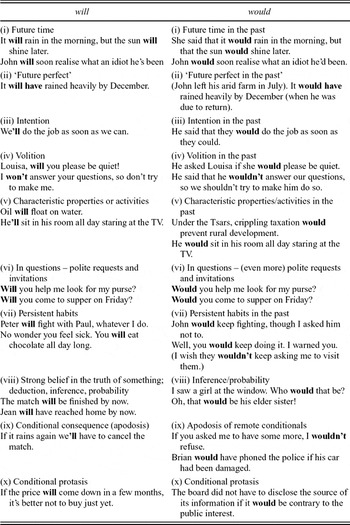
At this point it will be useful to list informally the different uses of will and would (see table 1).
Uses of will and would

We shall mostly ignore constructions with would such as would like (as in We would like to see Mr Brown now, please), wouldn't mind (cf. I wouldn't mind a coffee right now) and would rather (e.g. I would rather go tomorrow).
2.2 Argument (A): will has modal uses
Concentrating for now on the left-hand column of table 1, we can pick out uses (iii–viii) as those where will appears to express something other than simple future time reference. The first argument (A) against treating will as a future tense is the existence of these uses.
Faced with data of this kind, some obvious questions need to be asked. Firstly, what is the nature of these non-temporal uses of will? Are they all of the same kind, and should they be grouped together as ‘modal’? Secondly, are they fundamentally different from future-time will, or are they best analysed as pragmatic inferences from a basic future time meaning, given the right contextual conditions? A comparison with other languages is likely to be revealing here: if we find similar phenomena in languages with an uncontroversial future tense, that would tend to support a pragmatic analysis. Thirdly, how common are they? If they are rare, marginal, or restricted in particular ways, that would make them less convincing as evidence against a tense analysis of will.
In response to the first question, it is surely only use (viii), often called the epistemic use of will, which has a strong claim to be called ‘modal’. The core modal auxiliaries may and must have similar epistemic uses,Footnote 3 and although there are some interesting differences between epistemic will and epistemic must (see Gilbert Reference Gilbert, Dendale and van der Auwera2001: 126–8 and section 4.3.4 below), the two are certainly analogous and can often be substituted one for another with little or no change of meaning: for example, in this exchange from the British National Corpus (BNC):
A: And that's all, there's nothing
B: No there's nothing down that way as far as I know.
A: Okay, it must be one of these then. Okay. [cf. It'll be one of these then.]
B: It's one of these, yes. (BNC KE2)
The other uses are less clearly modal. Intention (iii) and volition (iv) are not expressed by other modals in English. Characteristic properties (v) and persistent habits (vii) are likewise not usually taken as coming under the heading of modality, though there is a parallel with can (Oil can float on water / He can sit in his room all day staring at the TV): we are in the domain of genericity here, not modality. There is a similar parallel with can/could in polite requests (vi): Can/could you help me look for my purse? It is worth pointing out that apart from the epistemic use of will, none of the other uses has parallels with the core modals may and must. Thus apart from the epistemic use, to which we return directly, there is little here to convince us that will is fundamentally modal.
In response to the second question, even some of the strongest advocates of a non-temporal analysis of will concede that several of these uses can be accounted for by the interaction of a basic futurity semantics with elements of the context. Thus Haegeman argues that the volition and intention uses (iii, iv and vi in table 1) are determined by a ‘volitional’ proposition in the right context (typically with first- and second-person subjects), and are not separate from the future use (Haegeman Reference Haegeman1983: 97). There seems to be general agreement that the persistent habit use (vii in table 1) depends on stress on will, and is not separate from characteristic properties (v). The latter is more interesting: it also arises with the simple present and past tenses in the right context (a non-specific subject, or an expression like always to indicate genericity):
(3) Oil floats on water.
(4) He sits in his room all day staring at the TV.
(5) He sat in his room all day staring at the TV.
However, with the past and present tenses the time reference does not change when the sentence is generic (a past generic like (5) is still past), but a generic with will does not refer to future time. There is perhaps a sense of ‘If you take any instance of oil, it floats on water’, with the idea that any such instance will have to be in the future; but this is different from past and present generics. It also remains to be explained why the French future tense is not always used for characteristic properties in the same way:
(6) Weakened batteries will result in lower volume or poor tonal quality.
(7) Des piles insuffisamment chargées entraînent un volume plus faible ou une qualité sonore médiocre. [from the INTERSECT translation corpus (Salkie Reference Salkie2008)]
It does not seem implausible, however, to derive these generic uses of will from a future time sense: they do not appear to have an intrinsic connection with modality.
Turning now to the third question, the frequency of these ‘modal’ uses of will, the evidence is that they are very rare. The first corpus-based study of this question was Wekker (Reference Wekker1976). Using a corpus of 500,000 words of written English (novels and newspapers), and 100,000 words of spoken (radio and TV programmes), Wekker found 1,547 instances of will. He examined the first-person, second-person and third-person examples in turn, and his main results were as follows.
• I/we will: 209 instances, of which 46 are non-volitional like (8), most of the remainder ‘ambiguous between a volitional and a simple future interpretation’ like (9) (Reference Wekker1976: 41).
(8) Next week we will learn for the first time the nature of the Cabinet minutes.
(9) If he should decide to instruct us further in the matter we will let you know.
• You will: 70 instances, of which 67 ‘express simple futurity and . . . show no trace whatever of either the speaker's or the subject's willingness or intentions’ (Reference Wekker1976: 54), e.g.:
(10) I can assure you, sir, that when you come back to Hue in a year, you'll find a Gideon Bible in your hotel room.
• Third-person subject: 1,268 instances, of which 1,241 (98%) express simple futurity, ‘without saying anything about the wishes or intentions of the subject of the sentence’ (Reference Wekker1976: 60), e.g.:
(11) The new season will run until March 21, and the theatre will be announced shortly.
The next substantial corpus-based study was Larreya (Reference Larreya1984), although a direct comparison with Wekker is not straightforward because Larreya's figures cover will and would. Larreya found a total of 2,241 instances in a corpus of 276,500 words of written English and 28,400 of spoken. The breakdown of this total is:

Larreya makes it clear that the ‘conditional’ category are all instances of would (Reference Larreya1984: 304); if these are left out, the total is 1,746 and the percentages are:
Some of these examples also involve would rather than will. Nonetheless, the non-temporal uses still appear to be fairly marginal, though it would have been useful to know how many of Larreya's 1,571 actually include volition.
Mindt (Reference Mindt1995) used a much larger corpus of 80 million words. No details about the corpus are given, but see Mindt (Reference Mindt2000: 596) for the corpora of 240 million words used during his ten-year project. Mindt's categories are not easy to match with the ones we are concerned with here, but they are nonetheless of interest:
• Certainty/prediction: 71 per cent
(12) I am sure it will be published.
(13) Technique, rather than tactics, will be needed from the jockey.
• Volition/intention: 16 per cent
(14) I will be perfectly frank with you.
(15) One thing I'll ask of you, keep away from the . . . Cadwells.
• Possibility/high probability: 10 per cent
(16) You hope I'll miss you.
(17) Indeed he will probably improve for a season or two.
• Others: 3 per cent
Others include inference/deduction (. . . when steps sounded on the veranda, she said ‘That'll be Vetch's boy’) and habit (you will never be lonely because your family will come along and pay you visits) (Reference Mindt1995: 60).
Mindt adds that 94 per cent of his instances of will have future time orientation.
Two other corpus-based studies suggest that the non-temporal uses of will are less rare. Coates (Reference Coates1983) used the Survey of English Usage corpus, containing 725,000 words. Her figures only relate to 200 instances of will, described as ‘a representative sample’ (Reference Coates1983: 2). Coates gives the following breakdown:
• Willingness: 26 instances
(18) Give them the name of someone who will sign for it and take it in.
• Predictability: 19 instances
(19) A commotion in the hall. ‘That will be Celia,’ said Janet.
• Intention: 46 instances
(20) But I will bring you more today I promise
• Prediction: 96 instances
(21) It will be lovely to see you.
All but one of the ‘intention’ examples have a first-person subject.
Palmer (Reference Palmer1990) also uses the Survey corpus. He gives no specific figures, saying: ‘This is not a textual study, and is not concerned with . . . giving statistical information about the use of modals’ (Reference Palmer1990: 29). He goes on to comment, however: ‘there are very few examples in the Survey of futurity will and shall that can, without any doubt at all, be regarded as simply predicting a future event’ (Reference Palmer1990: 137–8).
It is noticeable that Wekker, who believes that will is a future tense marker, has statistics supporting this view; while the figures given by Coates and the informal remarks of Palmer support their view that will is a modal. Larreya is a strong supporter of the modal position, however, and Mindt is agnostic – and their figures support Wekker. The figures in Leech et al. (Reference Leech, Hunt, Mair and Smith2009) show a small decrease in the frequency of will over the past 50 years, but a far smaller decrease than for the core modals (see note 3 on which modals are core). All in all, the corpus findings seem to support the tense analysis.
We return now to the epistemic use of will (viii in table 1). This use is found in languages which have an uncontroversial future tense, such as French or Italian (Rocci Reference Rocci2002):
(22) Pourquoi donc a-t-on sonné la cloche des morts? Ah! Mon Dieu, ce sera pour Madame Rousseau. (Proust)
‘For whom did they toll the passing-bell just now? Oh dear, of course, it would be for Mme. Rousseau.’ (translation by Scott Moncrieff, 1922)
‘Now who were they ringing the passing-bell for? Oh, dear God, it must have been for Mme. Rousseau.’ (translation by Lydia Davis, 2003)
(23) – A qui est-ce?
– C'est lui qui l'aura oublié ici . . . Il l'avait dans les mains hier au soir . . . (Simenon)
‘Whose is it?’
‘It's he who will have left it here . . . He had it in his hands yesterday evening . . .’
(24) Bella stoffa, bella . . . l'avrà pagata un occhio, immagino, laggiù in città non scherzano. (Buzzati)
‘Nice material . . . you will have paid a lot of money, I imagine; there in the city they do not joke.’
(25) – Non c'è Marco?
– Sarà sarà in ospedale, è diventato papa oggi. (spoken conversation)
‘Marco is not there?’
‘He will be in the hospital, he became a father today.’
This epistemic use of the future tense is restricted and rare in French and Italian, but that is also true of English (cf. Celle Reference Celle2005 for discussion of the restrictions in French and English. In her sample of 1,000 instances of the French future, Celle did not find a single instance of the epistemic use (Reference Celle2005: 208)). This indicates that the use of future tenses to express an inference or a deduction is available, though not necessarily common, across languages; it does not support the view that will is fundamentally modal. A similar conclusion is reached by Bybee, Perkins & Pagliuca (Reference Bybee, Perkins and Pagliuca1994) and Tsangalidis (Reference Tsangalidis1999).
Notice also that be going to can be used to express an inference, as in these examples from the BNC:
(26) It seems unlikely then, that ‘standard procedures’ of recording space and time are going to be relevant to the unique identification of utterance acts. (F9V)
(27) So next year's output is to be a hundred and fifty percent of this year's. Because you add fifty percent to the hundred percent and a hundred plus fifty is a hundred and fifty. So the output is going to be a hundred and fifty percent of what it was last year. . . (KE2)
See Fleischman (Reference Fleischman1982: 91) and Tsangalidis (Reference Tsangalidis1999: 160) for similar remarks. The evidence thus suggests that the ‘modal’ uses of will are rare, and are either not modal or mostly explainable on pragmatic grounds.
2.3 Argument (B): the other modal auxiliaries have modal meanings
We do not need to linger long on this argument. It is true that will has the same grammar as other modals, but that does not necessarily mean that it has the same meaning. Huddleston & Pullum et al. (Reference Huddleston and Pullum2002: 109) list eight morphosyntactic properties shared by be and auxiliary have – but there is no suggestion that they therefore share semantic properties. Huddleston & Pullum et al. concede: ‘This argument is not in itself decisive . . . but it does place the onus of proof on defenders of the future tense analysis to demonstrate why will (and shall) should be differentiated from the others as tense auxiliaries vs. mood auxiliaries’ (Reference Huddleston and Pullum2002: 209). Given the weakness of the arguments against the tense position, the question of where the onus of proof lies is debatable.
2.4 Argument (C): English has many ways of referring to future time
This argument starts with data like these:
(28) I'm going to visit Germany next March.
(29) The train leaves in 2 hours.
(30) Helen is taking her exam tomorrow.
(31) Frank may arrive next week.
(32) Julie will visit Germany next April.
Is there any reason to pick out one of these as ‘the future tense’? In fact, there are several. The other ways of referring to the future are restricted in various ways. For example, The train leaves in 2 hours can only be used for a ‘pre-determined and certain’ situation (Declerck et al. Reference Declerck2006: 182): you can't say, *Leeds Utd win against Everton tomorrow, though you can say Leeds Utd play Everton tomorrow. The present tense is typically used in this way for statements about the calendar, future situations that result from a definite plan or a regular pattern which already exists at the time of speaking (Declerck et al. Reference Declerck2006: 182–3). The will + infinitive construction has no such restrictions. In addition, the will + infinitive construction can express future time by itself. The present tense normally needs a time adverbial for a future time interpretation (Huddleston & Pullum et al. Reference Huddleston and Pullum2002:132). Furthermore, French also has aller + infinitive, the present tense, and modals with future time reference, and this is true of many other languages (see in particular Bybee, Perkins & Pagliuca (Reference Bybee, Perkins and Pagliuca1994) for other examples).
We conclude that the five major arguments against the tense analysis are far from convincing.
3 Arguments for the tense analysis
3.1 Frequency
As we have seen, the future time use of will is overwhelmingly the most frequent in naturally occurring speech and writing. Most corpus studies agree that the proportion of pure future time uses is over 90 per cent. Usually statistics of this kind would convince most linguists that the other uses were marginal; it is unlikely that they would be held up as representing the basic meaning of a word. Whether the different uses of a word correspond to distinct senses, and whether distinct senses can be derived from a more abstract underlying meaning, is a controversial issue, particularly with English modals (cf. Papafragou Reference Papafragou2000): the frequency of different uses is, of course, not the only pertinent factor here, but a very high frequency of one use is surely relevant.
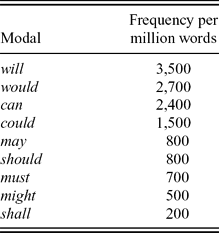
It is also worth noting that will is far more frequent than the core English modals. The figures from the large corpus used in Biber et al. (Reference Biber, Johansson, Leech, Conrad and Finegan1999), presented in table 2, are revealing (compare also similar figures in Coates Reference Coates1983: 23–5).
Frequency of modals in the Longman corpus (Biber et al. Reference Biber, Johansson, Leech, Conrad and Finegan1999: 486)
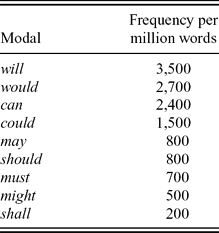
Since over 90 per cent of these occurrences of will probably express future time, this table tells us that there is a large difference in frequency between these occurrences and uses of the core modals – unsurprising if will is basically a tense.
3.2 Comparison with languages which do or do not have a future tense
It is useful to compare English with a language like French, which definitely has a future tense, and Finnish, which definitely does not. Compare these extracts from weather forecasts:
French weather forecast
En plaine les nuages bas seront souvent persistants . . . En montagne, un temps bien ensoleillé se généralisera progressivement . . .
English weather forecast
On low ground there will be low cloud cover . . . Sunny weather will gradually spread across all mountain areas. (Celle Reference Celle1997: 48)
Finnish weather forecast
Sää kylmenee, mutta keskiviikkona tuulee idästä ja pyryttää lunta. Lämpötila kohoaa tilapäisesti nollaan tai jopa vähän suojan puolelle.
Literal translation: ‘The weather becomes cooler, but on Wednesday it blows from the east and there is drifting snow. The temperature rises temporarily to zero or even a little higher.’ (Example from Dahl Reference Dahl and Dahl2000)
The question is whether English looks more like French or Finnish. Leaving aside the fact that the French future is inflectional whereas will is not, it appears that English and French both have a morpheme which is routinely used to refer to the future in weather forecasts, whereas Finnish has no option but to use the present tense. Put this way, it appears that English is more similar to French than to Finnish. It is true that the simple present tense is also found in English weather forecasts, along with other expressions (Tomorrow looks like being cloudy / Thursday is expected to be sunny, etc.), but that does not affect the argument: meteorologists speaking French and English have a choice which is denied to their Finnish counterparts. (A similar comparison of the three languages is made by Dahl & Velupillai Reference Dahl, Velupillai, Haspelmath, Dryer, Gil and Comrie2008.)
3.3 Typological comparison
Dahl (Reference Dahl1985) includes English in his list of languages which have a future tense, ranking English twentieth out of 49 languages in its closeness to the ideal future tense category, higher than French or Spanish which are normally taken to have uncontroversial future tenses. He comments that ‘the traditional view of the Future as a tense can . . . be defended’ (Reference Dahl1985: 107). In more recent work, Dahl (Reference Dahl and Dahl2000) looks at a range of European languages and argues that a number are genuinely ‘futureless’, including ‘at least all Finno-Ugrian and Germanic languages except English’ (Reference Dahl and Dahl2000: 326). With respect to English, Dahl argues that ‘will . . . has (in combination with shall) become what is probably the most highly grammaticalised future marker in the Germanic languages' (Reference Dahl and Dahl2000: 322). However, Dahl & Velupillai (Reference Dahl, Velupillai, Haspelmath, Dryer, Gil and Comrie2008) are more cautious, noting only that ‘one result of the progressive grammaticalization of futures is that the temporal component of their semantics becomes more dominant relative to the modal component’.Footnote 4
3.4 Explanations for non-temporal uses of will
We saw in section 2.2 that it is relatively easy to account for the uses in table 1 under the headings of (iii) intention, (iv) volition, (v) characteristic properties, (vi) polite requests, (vii) persistent habits and (viii) inference and deduction. We return to the volition uses in section 5. That leaves only uses (ix) and (x) which involve conditional sentences: we consider these in our discussion of Huddleston (Reference Huddleston1995) below.
4 Arguments for the modal analysis
We turn now to the positive arguments in favour of the modal analysis, of which the most important are:
F. Would is the past time counterpart of will.
G. Certain generalisations about English grammar treat will as a modal.
H. There are semantic and pragmatic similarities between will and the other modals.
4.1 Argument F: Would is the past time counterpart of will
Like many of the arguments that we shall consider in this section, this one is put forward in Huddleston (Reference Huddleston1995). A third of his paper tries to demonstrate that would is the past tense counterpart of will (compare also Huddleston & Pullum et al. (Reference Huddleston and Pullum2002: 209), where this is described as a ‘major argument’ against the tense analysis). Huddleston claims, accurately, that this relationship between will and would is fatal to any analysis in which will is ‘the marker of a future tense contrasting with preterite and present in a three-term tense system: will is not in paradigmatic contrast with preterite and present tense but contrasts syntagmatically with either’ (Reference Huddleston1995: 415).
Although this argument is correct, it is basically irrelevant, since no serious study of English tense has argued for a three-term system. The actual contenders are:
• Two tenses (the mainstream view)
• Four tenses (Huddleston's position, and that of Huddleston & Pullum et al. Reference Huddleston and Pullum2002)
• Eight tenses (e.g. Declerck Reference Declerck1991)
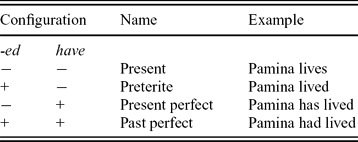
It is arguable that the eight tense analysis is the obvious, default one. Suppose we distinguish between the tense morphemes ‘past’ (represented schematically as -ed), have and will, and the tense configurations which result from using one or more of these morphemes in a clause. The three competing analyses can now be reformulated as claims about tense configurations:
• Two tenses: no configurations are permitted, since only -ed (vs its absence) counts as a tense morpheme.
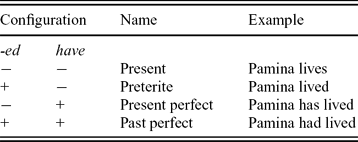
• Four tenses: -ed and have can combine, yielding the four configurations in table 3.
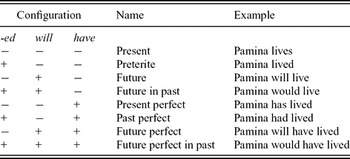
• Eight tenses: -ed, have and will can combine, yielding the eight configurations in table 4.
The four-tense analysis
The eight-tense analysis

These eight tense configurations are perfectly compositional: the first three contain only one morpheme, the next four contain two (as their two-part names suggest), and the last one contains three. They are the only possible configurations owing to the morphology of the three tense morphemes (will only has finite forms, so it cannot follow have, etc). Whether the eight-tense analysis can account for the semantics correctly remains to be seen, but it is fully compatible with the observation that would is the past counterpart of will (i.e. that would can be analysed as will + -ed). Huddleston's claims about will and would are thus irrelevant to choosing between the different analyses.
We should add that in French the future tense inflection can be combined with a past tense inflection to yield the ‘future in the past’ tense configuration (Il mangera [future)] vs Il mangerait [future in the past]):Footnote 5 this is also true of many other languages, as noted by Bybee (1995) and others. Thus there is nothing ad hoc about combining the future and past tense morphemes. Furthermore, the analysis in table 3 is not subject to Huddleston's objection that it treats the meaning of Pamina will live as ‘future in present’, which is implausible (1995: 418). The future tense configuration in table 3 simply lacks the -ed morpheme: that is, it is not specifically marked as past.
4.2 Argument G: Generalisations about English modals
4.2.1 Time reference in the complement of modals
Huddleston (Reference Huddleston1995) argues that the time reference of the infinitival verb in the complement of will is identical to that of other modals, specifically may and should, and ‘lexical modals’ such as bound, certain and likely, and non-auxiliary need (Reference Huddleston1995: 423). This in turn is said to be part of a wider pattern of time interpretation in infinitival complements. Huddleston & Pullum et al. (Reference Huddleston and Pullum2002: 160–2) develop the point with these examples:
(33)

Huddleston & Pullum et al. divide catenative verbs into five groups according to the temporal interpretation they admit for their complement, which in turn depends on the meaning of the catenative:
[‘Anterior’ here means ‘anterior to the time of the matrix clause’.] Will also behaves exactly like may and the other verbs in class 4 when it has have +en heading its non-finite complement:
(34)
In short, the temporal properties of will + verb are covered in the part of the grammar where the temporal properties of modals are covered: if we also treat will as a future tense, we have to repeat the same information there, so the tense analysis is redundant.
There are reasons to doubt the force of this argument. Firstly, unlike most sections of Huddleston & Pullum et al. (Reference Huddleston and Pullum2002), which give substantial lists of items to illustrate grammatical generalisations, this section is suggestive at best. A closer look at some of the verbs in their small sample indicates that things are less clear-cut than they claim. Take want, supposedly in class 5. In these BNC examples, the context suggests simultaneity:
- (35)
(a) Marje now admits that her carefully nurtured image has been torn apart by revelations from a new biography. Why did she agree to have it written? Because, she said, she simply wanted to be honest. [CBC]
(b) You don't understand, Wallace. It isn't that. I'm not frightened or bored or weary. I've had enough. I don't want to be part of this. [FP7]
(c) He got up, galloped to the kitchen for the champagne and Ruth held her head in despair and didn't want to be there! [JY4]
Such examples of want are rare, but the same is equally true of simultaneity with will. It seems, then, that we should move want from class 5 to class 4. Other common catenative verbs of ‘desiring’ listed by Biber et al. (Reference Biber, Johansson, Leech, Conrad and Finegan1999: 702) are like, need, wish and hope. Huddleston & Pullum et al. assign need to class 4, unlike want, and put like in class 3. Consider, however, these examples:
- (36)
(a) I like to write novels.
(b) I'd like to write novels.
In (36b) the relationship is posteriority, so perhaps like should move to class 4. The point is that the time relationship between the catenative and its complement depends on the context of use, not just the meaning of the catenative.
A further problem with this classification of catenatives is that we cannot simply state that all modals belong to class 4. We have to treat must as an exception within class 4, because in its epistemic use it cannot refer to the future (John must come tomorrow can only be deontic, whereas John may come tomorrow can be deontic or epistemic). Again, context of use seems to be relevant.
In many cases the issue of the relationship between the time of the complement and the time of the catenative does not arise, because we cannot separate two situations with distinct times. This is clearest with catenatives like manage:
- (37)
(a) Sadly, they manage to combine all the worst qualities of the bedroom-band with none of the saving graces. [CHB]
(b) But I must tell you how I managed to escape. [GWH]
It is impossible to detach the time of ‘managing’ from the time of ‘combining’ or ‘telling’, any more than we could distinguish the time of the verb and the adverb if these sentences were rephrased as they successfully combine . . . and I successfully escaped. Of the seven most common verbs taking infinitival complements (Biber et al. Reference Biber, Johansson, Leech, Conrad and Finegan1999: 698), five are like manage in this respect: try, seem, begin, tend, attempt (the other two are want and like, both problematic for Huddleston and Pullum et al. as we have seen).
Thus there are reasons to doubt that this is a genuine generalisation about English modals.
4.2.2 Modals in conditional sentences
Huddleston (Reference Huddleston1995) makes three separate points about the use of will in conditional sentences. I shall argue that only the third of these carries any weight, and even in that case its significance is unclear.
Huddleston argues firstly (Reference Huddleston1995: 425–7) that in the example of will in a conditional apodosis [main clause] (use ix in table 1, reproduced here as (38)), the future cancelling of the match is ‘a modal future, dependent on the fulfilment of the condition’:
(38) If it rains again we'll have to cancel the match.
But any tense can be used in the apodosis here:
(39) If it rains again, we were wrong to cancel the match.
(40) If it rains again, we are wasting our time painting the roof.
So it is not clear that this is a separate use of will. Huddleston argues that the will in examples like (38) reinforces the conditional modality, and that this is connected to the obligatory presence of would in remote conditionals (unless some other modal is used – see below):
(41) If they were here, they would be upstairs.
(42) If they came they would sleep upstairs.
He says that ‘in this construction, such reinforcement of the conditionality is grammaticalised into an obligatory requirement’, and that would has the same meaning in (41) and (42). But within the imaginary world created by the if-clause, the times of being here and coming are different (present in (41) vs future in (42)), and the times of the apodosis containing would also differ accordingly. We can therefore treat would in (41) as an instance of epistemic would (like viii in table 1), and would in (42) as future in the past would. Hence they parallel:
(43) If they are here they'll be upstairs. (epistemic will)
(44) If they come they will sleep upstairs (future will)
We can thus claim that will behaves ‘normally’ in the apodosis of conditionals.
We turn now to Huddleston's second point, the use of will in the protasis [if-clause] of conditional sentences (example x in table 1, reproduced here as (45a)). Huddleston argues that will has a modal meaning in these examples, citing the difference between (45a) and the more normal (45b):
- (45)
(a) If the price will come down in a few months, it's better not to buy just yet.
(b) If the price comes down in a few months, it's better not to buy just yet.
The difference here is modal, not temporal, he says: the possible price reduction in (45a) and (b) is at the same time. Huddleston says: ‘if will has a clearly modal meaning in (45a), then it is difficult to deny that it likewise has a modal meaning in the corresponding main clause: The price will come down in a few months’ (Reference Huddleston1995: 427).
This is a weak argument. Firstly, if we applied it to (45b) we would have to say that the meaning of the present tense is the same in The price comes down in a few months, but that is not correct: in a main clause, the present can only have a ‘scheduled future’ sense, which is not the case in (45b).
Secondly, Declerck (Reference Declerck1991: 192–222), and Declerck & Reed (Reference Declerck and Reed2001: 205–15 and 319–67) give a thorough survey of different types of conditional sentence where will can be used in the protasis. They argue that these clauses all depart from canonical conditionals in the same respect: whereas in standard cases of the form ‘if p then q’ the future actualisation of p leads to the actualisation of q (e.g. If you build it, they will come), in examples like (45a) this is not the case. The same is true of other types of conditional sentence where will appears in the protasis, of which two are:
(46) If it'll make you feel any better, we now know that it wasn't your fault.
(47) If it'll make you feel any better I'll take it back.
In (46), p expresses a felicity condition on uttering q. In (47), a paraphrase would be ‘Tell me that my taking it back will make you feel any better, and I will do so’ – the logical structure is ‘if (if q then p), then q’. These types of conditional are termed ‘rhetorical conditionals’ in Declerck & Reed (Reference Declerck and Reed2001). In short, the use of will in conditional protases arises from the grammar of conditional sentences, and does not show that will is modal in such cases.
This leaves one final generalisation which allegedly has to treat will as a modal: it involves verbs in the apodosis of remote conditionals as in the examples in (x) under would in table 1, reproduced here as (48) and (49):
(48) If you asked me to have some more, I wouldn't refuse.
(49) Brian would have phoned the police if it had been his car.
The only forms which can replace would here are other past forms of modal verbs: could, should, might and ought. The generalisation would have to say that only past forms of modal verbs can appear in the apodosis of remote conditionals – but that treats will as a modal verb.
Several comments are in order. In the first place, it is far from clear that this generalisation avoids circularity, since it may be that the term ‘remote conditional in English’ is only definable as ‘one which has a past form of a modal in its apodosis’. Secondly, we need to see evidence that this is a semantic generalisation about modals, as opposed to the morphosyntactic generalisations which we dismissed as irrelevant in section 2.1: perhaps it has been ‘grammaticalised into an obligatory requirement’, to use Huddleston's expression cited above. Thirdly, exceptions, albeit rare, can be found. For some speakers, may can occur in the apodosis of a remote conditional:
(50) The whole thing may never have happened if it hadn't been for a chance meeting. (Example from Denison Reference Denison, Gerritsen and Stein1992, cited in Huddleston Reference Huddleston1995: 408)
Thus there may be more going on here than a simple generalisation about the occurrence of certain words in a certain type of sentence. For the moment, however, this remains an apparent problem for a future tense analysis of will.
4.3 Argument G: semantic and pragmatic similarities between will and the other modals
Before examining Huddleston's arguments under this heading, we need to consider the nature of the issues here. The central claim of the modal analysis is that will fits seamlessly into a framework for representing the meanings of the modal auxiliaries of English. The strength of any proposed modal analysis of will thus depends crucially on whether the overall framework for modality is plausible. Modality is a complex area, and scholars disagree radically about whether it should be broadly or narrowly defined, how to distinguish it from related areas such as mood and evidentiality, where to draw the line between semantic and pragmatic aspects of modality, whether it is in principle desirable to seek a single theoretical framework for English modals, and many other issues.
Huddleston does not propose a theoretical framework for modality, and his discussion adopts the descriptive classification of Palmer (Reference Palmer1990), with one modification – the notion ‘degree of modality’ – to which we shall return. His arguments claim that will can be accommodated within Palmer's system. Arguably, though, almost anything loosely related to modality will have similarities with Palmer's system, since as a descriptive system it does not attempt to be exclusive. The most that we could concede to Huddleston is that he may develop some semantic generalisations about English modals which extend to will. In reality, we do not need to concede even this.
4.3.1 ‘Kinds’ of modality
Palmer distinguishes deontic, epistemic and dynamic as kinds of modality. Huddleston claims that all three kinds apply to will (Reference Huddleston1995: 419):
(51)
Huddleston concedes that deontic modality is less ‘semanticised’ with will than with must, so that You must report back for duty on Friday morning has a deontic meaning whereas the deontic sense of (51b) is a ‘context-dependent implicature’; but he maintains that ‘deontic modality is still relevant to the pragmatic interpretation of will-clauses’ (Reference Huddleston1995: 420).
On examination, this argument collapses completely. As we have seen, the French equivalent of (51a), Il l'aura lu hier, can have the same epistemic interpretation. The future tense in French, in the second person and in the same context as (51b), has the same implicature of issuing an instruction (Vous vous présenterez . . .). The same is true for be going to in the right contexts (e.g. You're not going to mess around with her, buster). As for the dynamic use of will in (51c), several scholars have suggested that dynamic modality may not be a type of modality at all, including Palmer himself, who devised the category (Reference Palmer1990: 37), and Papafragou (Reference Papafragou1998: 2). The notion of dynamic modality is basically used by Palmer to cover uses of can and will which do not otherwise fit into his classification system. The modals may and must do not have dynamic uses.Footnote 6 Hence the fact that will exemplifies ‘dynamic modality’ is actually a difference between this word and the core English modals, not a similarity.
4.3.2 ‘Strength’ of modality
Huddleston uses this term for Palmer's ‘degree’ of modality: it refers to the strength of a speaker's commitment to the truth or actualisation of the propositional content, so that necessity modals are strong while possibility modals are weak. The claim is that will is semantically strong like must, but that pragmatic weakening applies in certain contexts. Thus compare:
- (52)
(a) Ed must have overslept again
(b) Ed is Tom's father and Tom is Bill's father, so Ed must be Bill's grandfather.
- (53)
(a) Ed will have overslept again
(b) Ed is Tom's father and Tom is Bill's father, so Ed will be Bill's grandfather.
[= Huddleston's (47) and (49)]
Both (a) examples have the weaker force of ‘very likely’ rather than the ‘necessarily’ force of the (b) examples – thus the (a) examples are semantically strong but pragmatically weakened. This is true, but the French translations of (52) and (53) differ in exactly the same way, so the argument proves nothing.
Huddleston goes on to claim that even when will has a future time use, ‘a comparable variation in pragmatic strength’ can be found. He contrasts:
- (54)
(a) She will beat him in under an hour.
(b) He will be two tomorrow.
[= Huddleston's (50)]
Huddleston writes:
Assuming that (a) is about some sporting encounter whose outcome has not been fixed in advance, the element of prediction is much more evident than in (b); the difference between (b) and He was two yesterday is hardly more than temporal, whereas that between (a) and She beat him in under an hour is manifestly modal as well as temporal. (Reference Huddleston1995: 421)
This sentence is hard to evaluate. Firstly, Huddleston does not make it clear how he is using the term ‘prediction’. Secondly, it is not clear what ‘hardly more than temporal’ is intended to imply (why not ‘purely temporal’?). Thirdly, what does ‘manifestly modal’ mean? Speakers are likely to be more certain about some future events, for instance birthdays, than others such as winning a sporting event. This is true for speakers of any language, and does not show that will is modal.
4.3.3 ‘Degree’ of modality
This term refers to ‘the amount of independent modal meaning’ in a clause containing a modal auxiliary, and Huddleston applies it to cases where removing the modal from a clause has little or no effect on its meaning. His examples involving can and should are listed in (55) and (56), to which we can add the supposed example of low-degree modality with may in (57) from Huddleston & Pullum et al. (Reference Huddleston and Pullum2002: 179):
(55)
(56)
(57)
In the three (b) examples, leaving out the modal has no effect on the meaning, whereas this is not the case in the (a) examples. Huddleston goes on to argue that the examples in (54) above with will differ in the same way: ‘pragmatically [54b] is no different from He is two tomorrow, whereas we could not similarly replace [54a] by an unmodalised version’ (Reference Huddleston1995: 422).
This argument has two ingredients, both of them dubious. Firstly, Huddleston is claiming that there is a notion ‘degree of modality’ which is central to the analysis of English modals. However, as discussed in detail in Salkie (Reference Salkie, Salkie, Busuttil and van der Auwera2009), all three ‘low degree’ constructions in (55–7) are lexically restricted and unproductive, and the two in (56–7) are stylistically marked as formal and somewhat archaic. We are dealing here with marginal phenomena, not with concepts which lie at the heart of modality in English.
Secondly, Huddleston wants to show that the notion ‘degree of modality’ applies to will, thus establishing a similarity between will and the other modals. It is evident, however, that the pairs with the modals can, should and may are very different from the pair involving will. In the former cases, the modals lose some of their meaning: thus should in (56b) has lost the sense of obligation that it has in (56a), a process sometimes called ‘semantic bleaching’ (cf. Hopper & Traugott Reference Hopper and Traugott1993: 94–8).Footnote 7 In the case of He will be two tomorrow, there is no reason to claim that will has lost some of its future meaning. The fact that He is two tomorrow is available as an alternative comes about because the present tense can be used to refer to schedulable events in the future, of which birthdays are a classic example. As we noted above, a similar phenomenon is found in a language such as French where the future tense is inflectional and uncontroversial. This tells us something about the present tense: it tells us nothing about whether will is a tense or a modal.
Huddleston goes on to claim that ‘in general, will has a lower degree of modality than can, may, must, etc.’ (Reference Huddleston1995: 422). If this simply means that sentences where will is omissible (such as He will be two tomorrow) are more common than sentences where may is omissible (such as Strange as it may seem, I believe you), then as we have seen, there are independent reasons for this. If it means that will lacks a modal element of meaning which the other modals possess, then Huddleston needs to tell us what that element of meaning might be. This would not be easy, because the idea that one modal generally carries less modality than others has no counterpart elsewhere in the set of English modals. The notion ‘degree of modality’ simply lacks the weight to support the use that Huddleston makes of it to analyse will. It is an incoherent and spurious notion: given the problems with it, we could regard Huddleston's claim that will has a low degree of modality as an admission that will has little modality as part of its meaning, and in fact is more like . . . a tense.
4.3.4 Will as a marker of potential world-type
This section scrutinises Berbeira Gardón (Reference Berbeira Gardón1998, Reference Berbeira Gardón, Carretero, Downing, Lavid, Martínez, Neff, Pérez de Ayala and Sánchez-Pardo2006), one of the most important attempts to analyse will within a substantial theoretical framework for modal verbs. I will argue that this analysis has serious problems. Space precludes a similar scrutiny of modal analyses of will in Celle (Reference Celle1994, Reference Celle1997, Reference Celle2005, Reference Celle2006), Nicolle (Reference Nicolle1998), Gilbert (Reference Gilbert, Dendale and van der Auwera2001), and Copley (Reference Copley2009), so I will simply assert that these all incorporate a version of the modal semantics proposed by Enç (Reference Enç and Lappin1996) – see below – and are subject to the same criticisms.
Berbeira Gardón (Reference Berbeira Gardón1998, Reference Berbeira Gardón, Carretero, Downing, Lavid, Martínez, Neff, Pérez de Ayala and Sánchez-Pardo2006) proposes a framework for modality within Relevance Theory, and analyses the semantics of may and will as follows:
May: There is at least some set of propositions such that p is compatible with it, and the world type is potential.
Will: p is true and the world type is potential.
Here p is the proposition expressed by the sentence minus the modal. Potential worlds are ‘worlds compatible with the individual's assumptions about the actual world which can be, or become, actual themselves’ (Sperber & Wilson Reference Sperber and Wilson1986: 85). For Berbeira Gardón, the notion of potential worlds is what all modals, including will, have in common. He concedes, however, that will is also very different:
will is a doxastic modal, as opposed to the rest of the modals . . . which encode a compatibility or entailment relation between the proposition expressed and a set of assumptions and hence can be explained in a very systematic and unified way. When uttering a sentence containing will, however, the speaker communicates that the proposition expressed is potentially true without making any explicit mention of the evidence available to her. (Reference Berbeira Gardón, Carretero, Downing, Lavid, Martínez, Neff, Pérez de Ayala and Sánchez-Pardo2006: 455)
A positive feature of this analysis is that it accounts for differences between epistemic will and epistemic must pointed out by Palmer:
The difference between [epistemic] will and must is that will indicates what is a reasonable conclusion, while must indicates the only possible conclusion on the basis of the evidence available. Compare
John must be in his office
John will be in his office
The first of these would be the more appropriate in response to an observation that the lights were on: the conclusion is that John is in his office. Will would be used to give a reasonable explanation (from previous knowledge) as to why the lights were on, rather than to draw a conclusion from this observation. (Palmer Reference Palmer1990: 57–8)
This corresponds exactly to the distinction made by Berbeira Gardón between will, which does not invoke a set of assumptions in the context, and the other modals, which do. On the other hand the tense analysis of will, in which the epistemic use is an inference from the futurity sense, can also handle Palmer's data: a statement about the future, in a context where the issue is why John's lights are on now, is likely to be about future verification rather than a future fact. There is no essential process of relating p to a set of assumptions, because will is not a modal.
Berbeira Gardón explicitly concedes that will is different from the other modals, but it is important to be clear how big this difference is in his system. The difference between ‘p bears a relationship to a set of assumptions’ for may and the other modals and ‘p is true’ for will is massive: arguably, they fall squarely on either side of the line which divides modality from straightforward non-modal assertions. Much depends, of course, on whether the notion of ‘potential worlds’ can do the theoretical work which Berbeira Gardón wants it to do. There is a striking similarity between Sperber & Wilson's conception of potential worlds and the model-theoretic analysis of will in Enç (Reference Enç and Lappin1996: 354), cited by Kissine (Reference Kissine2008: 131):
[will (p)] is true at utterance time UT in the real world w iff in every world w1 accessible to w there is an interval i1 such that UT < i1 and p is true in w1 at i1. (My notation)
Kissine devotes much of his paper to demonstrating that this kind of analysis of will is incorrect because it includes the notion of necessity (‘in every world’), and that weakening this to possibility also fails. This supports our position, of course, but the key criticism here is that Enç's analysis incorporates the statement ‘there is an interval i1 such that UT < i1’. This clearly just expresses the notion ‘future time’. There is a sense in which the notion ‘possible world’ has to incorporate future time, assuming that a possible world is not just a state of affairs but can change over time. Using that fact to capture futurity, however, incorporates the tense analysis of will: whether we also need the surrounding modal machinery of accessibility and quantification over worlds is a secondary issue (Kissine argues strongly that we do not). Returning to the notion of ‘potential worlds’, the same point can be made: Sperber & Wilson's definition incorporates the tense analysis.
A further problem with the system of Berbeira Gardón is that it makes future time reference fundamentally different in English and French. If we use Enç's (modified) notation to express simple futurity in (58) and modal futurity in (59), we get:
(58) French: [FUT (p)] is true at utterance time UT iff there is an interval i1 such that UT < i1 and p is true at i1.
(59) English: [will (p)] is true at utterance time UT in the real world w iff in every world w1 accessible to w there is an interval i1 such that UT < i1 and p is true in w1 at i1.
This would suggest that in the weather forecast examples in section 3.2, the English version invokes other possible worlds whereas the French version does not. There is no evidence for this difference: recall Comrie's observation, cited in section 2.1, that ‘if I say It will rain tomorrow and it does not in fact rain the next day, then my statement was simply false’ (1989: 53).
We conclude that the system proposed by Berbeira Gardón in effect concedes that will is not a modal, incorporates the tense analysis, is subject to Kissine's criticisms, and fails cross-linguistically.
5 Volition revisited
I suggested in section 3.2 that the willingness use of will is triggered by what Haegeman (Reference Haegeman1983) calls ‘volitional propositions’ in the right context. While this is essentially correct, it cannot be the whole story, because future tenses in French and German do not normally acquire a volitional interpretation,Footnote 8 and this is also true of other languages (including Greek, as noted by Tsangalidis Reference Tsangalidis1999). I searched in the INTERSECT translation corpus for instances of will you and their equivalents in French and German. As Celle (Reference Celle1994: 89–90) points out, when there is a clear volitional sense in the English, the translation does not use the future tense in French:
- (60)
(a) And they called Rebekah, and said to her, Will you go with this man?
(b) Ils appelèrent donc Rebecca, et lui dirent: Veux-tu aller avec cet homme?
[Bible]
- (61)
(a) Will you get me some matches?
(b) Voulez-vous me donner des allumettes?
[English fiction]
The same is true of German:
- (62)
(a) Will you let me in, Fred?
(b) Willst du mich hereinlassen, Fred?
[Dickens]
- (63)
(a) Will you not take a seat, Gentlemen?
(b) Meine Herren wollen Sie nicht Platz nehmen?
[German fiction]
It is instructive to compare instances from the same text – in this case Reed's Ten Days that Shook the World – which are translated differently:
- (64)
(a) ‘Will you please go to your Consul and make arrangements?’
(b) ‘Wollen Sie das bitte bei ihrem Konsul in die Wege leiten?’
- (65)
(a) ‘What will you do if we go forward?’
(b) ‘Was werden sie tun, wenn wir doch gehen?’
In (64), which has a volitional interpretation, the translation uses wollen ‘to want’, whereas the translation of (65), a straightforward request for information about the future, uses the future tense marker werden.
This indicates that the volitional interpretation of will cannot just be a pragmatic inference from a future time semantics, but is also part of the meaning of will. The obvious explanation is that will has retained this element from an earlier time when Old English willan meant ‘to want’, a proposal made inter alia by Harder(Reference Harder1996).
This ‘semantic retention’ hypothesis is considered and rejected by Nicolle (Reference Nicolle1998) and Carretero (Reference Carretero, Facchinetti and Palmer2004) (both of them, ironically, advocates of a modal analysis of will), and we need to look at their reasons. Haegeman (Reference Haegeman1983: 79–87) had noted that volitional uses of will keep a reference to future actualisation which cannot be cancelled, unlike the situation with want:
(66) ? I'll cut the grass but unfortunately I won't be able to.
(67) I want to cut the grass but unfortunately I won't be able to.
Nicolle argues that the willingness is cancellable, suggesting that it is inferred rather than encoded. He gives this example (Reference Nicolle1998: 237, ex. 43):
(68) Will you chair this afternoon's session, or don't you know yet?
I would argue that this example is not volitional: the only coherent interpretation is simple futurity. Questions with volitional will you typically have the force ‘Do you agree’, but the second clause of (68) cannot have the sense ‘Don't you know whether you agree?’ but rather ‘Don't you know if you have been chosen?’
Carretero argues that volition is an implicature, rather than part of the semantics of will, because an example like (69) (her 7) is vague rather than ambiguous with respect to volition (Reference Carretero, Facchinetti and Palmer2004: 209):
(69) My sister will marry that idiot after all.
It is not clear, however, that this test applies here. We are not considering whether will has two distinct senses – a future sense and a volitional sense – but whether the volitional interpretation is an extra element of meaning that is activated in the right context and added on to the future sense. The other two tests that Carretero uses – co-ordination, and substitution with so/too – are similarly unsuited to this question.
The semantic retention explanation of volitional uses of will therefore seems plausible. It may be that these uses are relatively frequent in the early stages of language acquisition: exchanges involving ‘Will you?’ and ‘I won't’ are probably far from rare around young children (for further discussion see Bergs (this issue) and the references cited there). That would go some way towards explaining the retention of this element of meaning.
6 Conclusion
I have argued that the analysis of will as a future tense has strong arguments in its favour. The arguments against the tense analysis are weak, and the arguments in favour of a modal analysis mostly do not stand up to scrutiny. What remains problematic for the tense analysis are these points:
(a) The characteristic properties use of will does not always correspond to a future tense in French (section 2.2).
(b) Most of the published statistics make the future time use of will vastly more common than its other uses – but some are less conclusive (section 2.2).
(c) The generalisation about past forms of modal verbs in the apodosis of remote conditionals may be genuine (section 4.2.2).
These do not seem to add up to a strong case for the modal analysis.
To account for volitional uses of will, I proposed that willingness is a semantic relic from an earlier meaning of this word. There is no need to treat will as a modality marker to account for its other non-temporal uses: all of them can be derived from its basic future time sense.
This article has tried to focus on the central debate about will. To further underpin the tense analysis, more discussion would be needed about (a) the differences between will and be going to; (b) the historical development of will; (c) the debate about werden in German; and (d) contrasts in future time reference between English and other languages. Meanwhile, however, there seem to be few reasons other than habit and a fixation on morphological tense to continue to treat will as a modality marker.