The five papers in this issue cover a range of perspectives on the acquisition and use of the Spanish copulas ser and estar in a variety of contexts, including language contact, bilingual language acquisition, and classroom second language learning. The fact that these papers cite work in this area as far back as the early part of the 20th century with each subsequent decade being represented suggests the continual importance and complexity of the distinction between the two copular forms and shows how this complexity is played out in acquisition and bilingual use. Over the past century different perspectives have been taken on this multifaceted issue with linguistic explanations and the role of the native language being primary. In this epilogue, we focus on some of these same issues, but expand our commentary to include the new dimensions represented in this collection of papers: (i) context of learning (input), (ii) prior knowledge as represented by other language(s) known, (iii) item-learning and lexical development, and (iv) innovations in methodology.
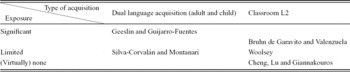
Two aspects of language learning that are uncontroversial are: (i) the need for input and (ii) the impact of language contact on bilingual acquisition and use. The papers in this volume reflect a range of contact situations and, hence, a range of input possibilities. Table 1 illustrates the degree of exposure represented in these papers.
Exposure and acquisition environment.

Particularly interesting with regard to input is the paper by Cheng, Lu and Giannakouros in that that they investigated a population with very little exposure to Spanish outside of the classroom. Yet, even with little exposure, greater proficiency entails a greater reliance on pragmatic and semantic factors. Clearly, we do not know precisely what was presented in the classrooms of these Chinese-speaking learners of Spanish, but, in general, pragmatics is not frequently dealt with in textbooks, and, consequently, pragmatic norms may often go unnoticed by classroom learners (Bardovi-Harlig, Reference Bardovi-Harlig2001; Kasper, Reference Kasper2001). Nonetheless, despite the relative lack of exposure, the learners in this study were able to incorporate pragmatic information in their developing system of copula use (e.g., learners' use of estar was influenced by the ‘prior experience’ factor). To the contrary, the paper by Bruhn de Garavito and Valenzuela shows how the classroom context may, in fact, limit acquisition in the case of eventive passives with ser; the authors suggest that the L2 learners may be rejecting such sentences because explicit instruction favors the impersonal passive (i.e., constructed with se). And, the paper by Silva-Corvalán and Montanari shows that even limited exposure (in their estimate, only 1/3 of the exposure of the child under investigation was Spanish) is sufficient to allow the development of the copular system. This is striking particularly given that the rest of the child's exposure was to English, a language in which the relevant distinctions are neutralized. Thus, while we are further ahead in understanding the role of input, we are still left with the perplexing notion of the quantity and quality of input that is needed.
Another salient theme of this volume is the prior knowledge that learners bring to the learning task. Given the variety of learning contexts represented, the possibilities range from no prior knowledge (Silva-Corvalán and Montanari's research with an L1 learner), underlying knowledge of grammatical representations (Bruhn de Garavito and Valenzuela's work on eventive and stative passives), and knowledge of a second language in addition to the L1 (Cheng et al.). In particular, the profile of the Chinese-speaking participants in Cheng et al.'s research raises an interesting question regarding the cumulative nature of language transfer, that is, whether or not a second language facilitates the acquisition of copula choice in the L3. The authors, citing Hammarberg (Reference Hammarberg, Cenoz, Hufesein and Jessner2001), consider the possibility that the L2 has a greater influence on the L3 given the typological similarity between English and Spanish. However, the results of the study indicate that the developmental path of the Chinese-speaking learners of Spanish is similar to that of other L1 groups (i.e., simplification of ser over estar in early stages, followed by increased usage of estar). This finding lends further support to previous work by Geeslin and Guijarro-Fuentes (Reference Geeslin, Guijarro-Fuentes and Eddington2005, Reference Geeslin and Guijarro-Fuentes2006), who found that L1 speakers of different language backgrounds (English, Portuguese) performed similarly when selecting copulas in pre-adjectival contexts.
A close examination of the research by Cheng et al. suggests that the Chinese speakers face a dual challenge in learning the Spanish verbs ser and estar: (i) acquiring a new syntactic constructionFootnote 1 and (ii) becoming sensitive to the semantic/pragmatic features of each copula. It seems to us that these are two separate problems that pose distinct learning challenges. From the results presented by the authors, we have no indication that the Chinese L1 speakers are omitting the copula in obligatory contexts (e.g., *Ella cansada “She is tired”). Thus, it may be that inserting a form where the L1 has zero is learned quickly, but that the second problem – selecting the appropriate copula depending on one's intended meaning – is as much of a hurdle for the Chinese speakers as it is for other L1 groups. This is similar to the argument made by Gass (Reference Gass1997) and, more recently, Gass and Selinker (Reference Gass and Selinker2008, p. 384) “one needs to learn what needs to be learned before being able to sort out the specific facts of what is to be learned”.
An important theoretical issue related to the selection of ser/estar in pre-adjectival contexts is whether L2 learners' knowledge is best characterized as the result of item-learning or system-learning (Ellis, Reference Ellis1999). We would like to bring this issue to the forefront by citing a few relevant examples. It is clear that most adjectives in Spanish can appear with either copula, and that native speakers are sensitive to a variety of features when choosing the copula to fit a particular context. For example, Geeslin and Guijarro-Fuentes' article shows that native speakers' choices are guided by linguistic variables such as predicate type and adjective class. In this way, the adult native speakers' implicit knowledge of copular verbs can be described as a complex system, allowing speakers to combine a single adjective (e.g., grande “big”) with either ser or estar depending on their intended meaning and the situational context. However, several studies in this volume suggest that the acquisition of ser and estar proceeds on the basis of learning specific constructions and lexical items, which is a defining feature of item-learning.Footnote 2 Silva-Corvalán and Montanari's article underscores this point; the child's data reveal that most adjectives are initially used with either ser or estar, but not both. This “lexical selection bias”, as described by the authors, provides a basis for later abstraction of semantic and pragmatic rules. Cheng et al. also note that “learners at the beginner level tend to use estar + adjective in formulaic phrases with which they are familiar” (p. 312), citing several frequently used adjectives (e.g., infectado “infected”, situado “located”). The key observation to be made here is that the acquisition of ser and estar cannot be studied independently of the learners' lexical development, particularly that of adjectives. This is especially important in open-ended tasks, such as the picture-description task used by Woolsey, which does not target specific adjectives but rather elicits a particular pragmatic context. In our view, studies of copula choice in the L2 context would benefit from a careful assessment of learners' vocabulary at different levels of proficiency in order to determine how their increasing repertoire of adjectives influences their selection of ser, estar, or both.
As we consider possible directions for future research, we note that methodology in terms of elicitation and analysis has evolved significantly since early studies investigating Spanish copula choice. New and creative methodologies are apparent in this volume, suggesting even greater possibilities in future investigations. In other words, new methodologies allow researchers to investigate old questions from different angles. In these papers, we see a range of data elicitation types, which vary depending on the questions being asked. These include corpus data from written production (Cheng et al.), naturally occurring speech (Silva-Corvalán and Montanari) and elicited data from paper-and-pencil tasks (Geeslin and Guijarro-Fuentes; Bruhn de Garavito and Valenzuela; and Woolsey). What unites the latter three studies is that they have all moved from sentence-level data to contextualized data. Bruhn de Garavito and Valenzuela approach the L2 acquisition question within a generative framework and although they adopt the methodologies typically used in UG-oriented research, they supplement the standard grammaticality judgment test with a sentence-selection task that focuses on sentence interpretation. Using multiple methods for data collection is becoming increasingly important in second language research and enriches our understanding of a variety of linguistic structures.
Related to interpretation is Woolsey's goal of understanding learner intent so that one can better understand the pragmatics of L2 use of estar. Borrowing from earlier research by Geeslin, he demonstrates the importance of including unambiguous pragmatic contexts as a way of understanding the use of the Spanish copulas. Geeslin and Guijarro-Fuentes also emphasize the importance of contextualization by embedding their target sentences in paragraph-length contexts. Their paper is critical to a discussion of innovation given their mode of creating contexts that are a bundle of different categories and combinations of categories (sentence- and discourse-level). Finally, comparing frequency of use across different bilingual contexts provides important indicators towards understanding the language contact situation.
The methodologies in this issue are as diverse as the research questions being asked and demonstrate the importance of methodology in answering complex and nuanced questions. As mentioned earlier, methodologies evolve. We anticipate that in the near future, psycholinguistic techniques (and possibly even neurolinguistic methods) might come to the forefront as researchers continue to investigate how the developing lexicon, greater understanding of pragmatic contexts, and so forth impact copula choice in Spanish. Areas such as memory constraints are likely to be important as one is trying to balance multiple sources of information.
Finally, these papers further support basic L2 findings, such as the duration of stages, as pointed out by Silva-Corvalán and Montanari; the role of task type, as was seen in the paper by Woolsey; and text type and text length as seen in the paper by Cheng et al. The papers emphasize the non-linear nature of acquisition and represent an acknowledgement of the multiple variables at play in the acquisition and use of the Spanish copulas, particularly when a form involves an understanding of lexical, semantic, and pragmatic development, all of which require an investigation of how bilingual speakers and L2 learners deal with multiple influences. We anticipate that future research will take us out of the realm of copular production and more into the realm of processing and interpretation, as is hinted at by Bruhn de Garavito and Valenzuela when they propose the interpretation of generics versus non-generics is a result of processing at the interface between semantics and syntax.