The relationship of the Cehpech and Sotuta pottery complexes has been a hotly debated topic in Yucatan since the 1970s. In this paper, I argue that the chronology of the most prolific Sotuta and Cehpech types should be considered independent of their association with either complex. Dzitas Slate, as part of the Sotuta complex, has been used to argue for the presence of Terminal Classic (a.d. 800–1100) elite Itza control in the contexts in which it is found. Muna Slate,Footnote 1 the most common type of the Cehpech complex, is either associated with the Late Classic period (a.d. 600–800) or non-Itza areas of the Terminal Classic period. Scholars have attempted to answer questions regarding the elite political history of the region by studying these utilitarian types, the production and trade of which were not controlled by elites. New evidence from central Yucatan suggests that Dzitas Slate may have been developed out of the local Muna Slate tradition independent of the arrival of outsiders at Chichen Itza in the a.d. 800s. This hypothesis is not new, as it was noted by Brainerd (Reference Brainerd1958), Smith (Reference Smith1971), and numerous modern scholars as discussed throughout this paper.
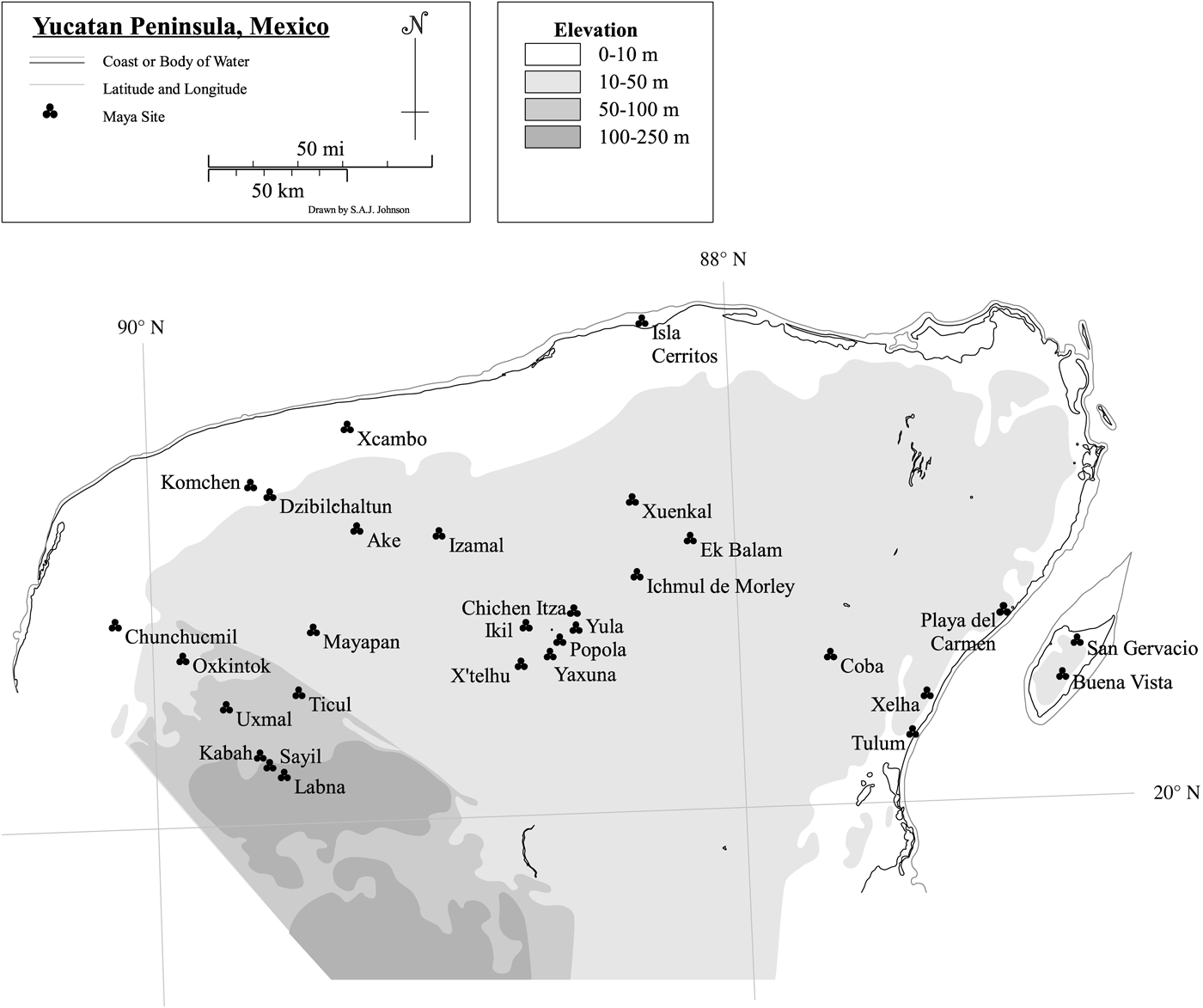
Popola, Yucatan, is a small site located 13 km south-southwest of Chichen Itza and 5 km north-northeast of Yaxuna (see Figure 1). Pottery from this site, as well as data from Ichmul de Morley, Chichen Itza, Yaxuna, Ek Balam, and Coba, has been examined for this study. When separated out from questions of political history, Dzitas Slate can be demonstrated to be the regional slate ware of central Yucatan, which gradually developed out of an earlier Muna Slate tradition. In the past, models describing the overlap (or lack thereof) of Muna and Dzitas Slate have been used to explain both the relationship of these types and regional sociopolitical history. In this paper, I argue that none of these models are necessary to explain the gradual transition from Muna to Dzitas Slate in this central area, although they are still applicable for discussing regional overlap. Apparent “overlap” is shown to be the co-occurrence of regional slate types instead of a mixing of chronological periods in most cases.
Map of major (and some minor) sites across the northern Yucatan Peninsula (after Google Satellite image from 2009 and National Geographic 1997).

THE CEHPECH-SOTUTA TRANSITION DEBATE
The Original Definition and Division of Sotuta and Cehpech Pottery
Robert E. Smith (Reference Smith1971) created a chronology for northern Yucatan with 10 phases, each of which was characterized by a pottery complex. In Smith's (Reference Smith1971:7) terms, complexes are “all-inclusive analytical units in that each descriptively encompasses all the material of a certain kind that is known from a given phase.” Pottery types and groups did not span more than one complex as originally organized and defined by Smith (Reference Smith1971:7). This clear-cut division of types between chronological periods is the root cause of the debate and confusion about the transition from Cehpech to Sotuta complexes in Yucatan. More recently, researchers (for example, Bey et al. Reference Bey, Bond, Ringle, Hanson, Houck and Peraza López1998; Johnstone Reference Johnstone2001; Robles Castellanos Reference Robles Castellanos1990) have defined complexes that share types across periods. This paper uses the term “complex” in Smith's original sense.
The debate surrounding the transition of the Cehpech to the Sotuta complex began with the original definition by Smith, who was working with pottery excavated in the monumental cores of Mayapan, Uxmal, Chichen Itza, and Kabah (in descending order of sample size) (Smith Reference Smith1971:9, Table 1a, Table 1b). Smith (Reference Smith1971:134) dated the Cehpech complex to a.d. 800–1000. This complex consisted of five wares (Puuc Unslipped, Puuc Slate, Thin Slate, Puuc Red, Fine Orange, and Cauich Coarse-cream) and was dominated by the Muna Slate, Yokat Striated, Ticul Thin, and Teabo Red types (in descending order by count) (Smith Reference Smith1971:134, 145, 149, 154, 156). Smith (Reference Smith1971:167, 196) argued that Cehpech pottery originated in the Puuc region and that it became “the most widespread and proliferous of any [complex] within the confines of the northern half of the Yucatan Peninsula.” The Sotuta complex followed Cehpech, lasting from a.d. 1000–1200 in Smith's (Reference Smith1971:134–135) dates. He (Smith Reference Smith1971:134–135, 171, 174, 178) specified at least six wares in the Sotuta complex (Chichen Unslipped, Chichen Slate, Chichen Red, Fine Orange, Fine Buff, and Plumbate), dominated by the Dzitas Slate, Piste Striated, and Dzibiac Red types (in descending order by count). The origin of the Sotuta complex was traced to Chichen Itza, and the novel forms tied to the influx of Silho Orange imported by the “Toltecs” at the beginning of this period (Smith Reference Smith1971:191–192). Although Smith presented these complexes and their associated types as mutually exclusive in the temporal sense, he noted in a number of places how “the principal [Sotuta] wares, unslipped, slate and red, changed but little from the Cehpech Phase” (Smith Reference Smith1971:191, also 169, 192). The argument of this paper hinges on this point.
Smith's chronology updated and improved upon the one created by George W. Brainerd. Brainerd (Reference Brainerd1958:3–4) had created a five-stage chronology of Yucatecan pottery, which included a precursor to the Cehpech-Sotuta division outlined above. Brainerd (Reference Brainerd1958:3–4) identified Florescent and Mexican Stages (roughly today's Late and Terminal Classic periods, respectively). The primary types of each phase were later used by Smith to divide the Cehpech and Sotuta complexes. The Florescent was dominated by “Florescent Thin Slateware,” “Florescent Medium Slateware,” and “Florescent Medium Redware” (today's Ticul Thin-slate, Muna Slate, and Teabo Red types, respectively), while “Mexican Medium Slateware” and “Mexican Medium Redware” (today's Dzitas Slate and Dzibiac Red types, respectively) dominated the Mexican period. One important distinction, however, is that Brainerd did not argue that types were exclusive to each phase: “change[s] probably took place gradually during the [Early Mexican] substage rather than at its beginning, and it is quite possible that various of the other innovations…did not arrive simultaneously” (Brainerd Reference Brainerd1958:94).
The Importance of the Cehpech-Sotuta Transition in the Local Sociopolitical History
Scholars have tied the transition between Cehpech and Sotuta complexes to the regional sociopolitical history in the northern Yucatan Peninsula and, therefore, understanding the pottery chronology has taken on a greater importance than that of simply explaining the development of local pottery. Cehpech represents native Yucatecan pottery before the arrival of the Itza and the areas not affiliated with Chichen Itza, whereas Sotuta pottery is correlated with intrusive Itza domination. When Brainerd and Smith devised their culture-historical chronologies, the rise of Chichen Itza was attributed to the conquest of local Maya by invading central Mexicans (Brainerd Reference Brainerd1958:96; Smith Reference Smith1971:253). The presence of new pottery types associated with the Sotuta complex was taken as evidence for the presence of new ethnic groups in Yucatan. Today, the invasion of central Mexicans has been re-evaluated as the immigration of Gulf Coast traders who undertook a campaign to dominate peninsular trade (Andrews Reference Andrews1990; Andrews and Robles Castellanos Reference Andrews, Robles Castellanos, Chase and Rice1985:67; Robles Castellanos and Andrews Reference Robles Castellanos, Andrews, Sabloff and Andrews1986). Modern scholars use pottery, architecture, iconography, and epigraphy to trace the political history of Chichen Itza (Andrews Reference Andrews1990; Andrews and Robles Castellanos Reference Andrews, Robles Castellanos, Chase and Rice1985; Bey et al. Reference Bey, Bond, Ringle, Hanson, Houck and Peraza López1998; Cobos Palma Reference Cobos Palma, Demarest, Rice and Rice2004, Reference Cobos Palma, Kowalski and Kristan-Graham2007; Freidel Reference Freidel, Kowalski and Kristan-Graham2007; Freidel et al. Reference Freidel, Suhler, Cobos Palma and Mock1998; Ringle et al. Reference Ringle, Bey, Bond Freeman, Hanson, Houck, Gregory Smith, Demarest, Rice and Rice2004; Ringle Reference Ringle2004; Ringle and Bey Reference Ringle, Bey, Nichols and Pool2012; Robles Castellanos and Andrews Reference Robles Castellanos, Andrews, Sabloff and Andrews1986; Schele and Freidel Reference Schele and Freidel1990:346–376; Suhler et al. Reference Suhler, Arden, Freidel, Johnstone, Demarest, Rice and Rice2004; Suhler et al. Reference Suhler, Ardren and Johnstone1998; Wren and Schmidt Reference Wren, Schmidt and Culbert1991). In many cases, the presence of Sotuta complex pottery has been taken as evidence of the presence and often the dominance of Chichen Itza's influence at sites throughout the peninsula (Amador Berdugo Reference Amador Berdugo2005:306; Anderson Reference Anderson1998a; Anderson Reference Anderson1998b:262 [citing Andrews and Robles Castellanos Reference Andrews, Robles Castellanos, Chase and Rice1985:68–69]; Andrews and Robles Castellanos Reference Andrews, Robles Castellanos, Chase and Rice1985:68; Chase and Chase Reference Chase and Chase1982:609; Cobos Palma Reference Cobos Palma, Demarest, Rice and Rice2004:540; Kepecs et al. Reference Kepecs, Feinman and Boucher1994:146; Manahan and Ardren Reference Manahan and Ardren2010; Smith Reference Smith2000:51–52; Suhler et al. Reference Suhler, Ardren and Johnstone1998:178; Suhler et al. Reference Suhler, Arden, Freidel, Johnstone, Demarest, Rice and Rice2004:456–457, 477; Toscano Hernández and Ortegon Zapata Reference Toscano Hernández and Zapata2003:441–442). These scholars represent a diversity of opinions, ranging from the blunt “any Sotuta equals Itza domination,” to those who do not differentiate between different types within the Sotuta sphere when discussing social meaning. This paper, following the lead of others (Ball Reference Ball, Sabloff and Henderson1993; Stanton and Bey Reference Stanton and Bey2006; Stanton and Gallareta Negrón Reference Stanton and Negrón2001), questions this correlation.
Hypotheses Used to Explain the Relationship of Cehpech and Sotuta Pottery
Scholars have proposed three primary hypotheses to explain the transition from Cehpech to Sotuta pottery, each describing the amount of overlap between the two complexes: no overlap, partial overlap, and total overlap. Research at sites across the peninsula provided support for each of these hypotheses, but no one has offered a conclusive resolution to this debate. The central argument of this paper is that what these hypotheses hope to elucidate (elite sociopolitical change) is better explained with other correlates. The existing hypotheses, however, must be discussed before moving on to this argument.
The pottery types in Smith's original definition of the Cehpech and Sotuta complexes were mutually exclusive. The change from Cehpech to Sotuta pottery was thought to be so rapid that virtually no local overlap between the two was discernible in the archaeological record. Indeed, in Smith's analysis of pottery from Chichen Itza, Cehpech deposits were found below levels containing Sotuta materials with little to no mixing between them (Smith Reference Smith1971:168). The primary differences between Cehpech and Sotuta pottery are novel forms in local types and the appearance of trade wares from the Gulf (Silho Fine Orange and Tohil Plumbate) (Smith Reference Smith1971:191). These changes were rapid because they were thought to accompany the central Mexicans who quickly conquered Yucatan.
Problems with the No Overlap Hypothesis at both the local and regional level include logistics, sample size, loss of provenience information, and over-extrapolation of local patterns. While the types of imported pottery may change rapidly because of long-distance politics, locally produced utilitarian pottery cannot change as quickly (see also Johnstone Reference Johnstone2001:116). Bey (Reference Bey, Brown and Stanton2003:21) described three options for the rapid and complete replacement of one utilitarian pottery assemblage with another: “1) import all domestic pottery…2) force all local producers to stop producing one complex and start producing another, or 3) replace all local…potters with new producers.” None of these options are logistically feasible, nor are any of them supported by archaeological data. The No Overlap hypothesis does not explain the change of utilitarian pottery. Furthermore, the sample available to Smith was small and confusing (Ball Reference Ball and Mills1979:18). Smith (Reference Smith1971:5) noted that “a considerable portion of the potsherds collected at these sites had to be discarded because the paper identification tags had been destroyed by insects, and the provenience lost, before Brainerd could examine the material.” The basis of the culture history of Late and Terminal Classic Yucatan began with this small, arguably unrepresentative sample, drawn primarily from two sites—Uxmal and Chichen Itza (Ball Reference Ball and Mills1979:19). Although recent work at Ek Balam, Yaxuna, Chichen Itza, Coba, and other sites has increased the sample size and provenience information associated with these complexes (Ambrosino Reference Ambrosino2006; Ardren Reference Ardren1997; Bey et al. Reference Bey, Bond, Ringle, Hanson, Houck and Peraza López1998; Cobos Palma Reference Cobos Palma2003, Reference Cobos Palma, Demarest, Rice and Rice2004; Freidel Reference Freidel, Kowalski and Kristan-Graham2007; Freidel et al. Reference Freidel, Suhler, Cobos Palma and Mock1998; Houck Reference Houck2004; Johnstone Reference Johnstone2001; Pérez de Heredia Puente Reference Pérez de Heredia Puente2010; Ringle et al. Reference Ringle, Bey, Bond Freeman, Hanson, Houck, Gregory Smith, Demarest, Rice and Rice2004; Robles Castellanos Reference Robles Castellanos1980, Reference Robles Castellanos1990; Schmidt Reference Schmidt1994, Reference Schmidt1999, Reference Schmidt2000, Reference Schmidt2005, Reference Schmidt, Kowalski and Kristan-Graham2007; Smith Reference Smith2000, Reference Smith2001; Stanton et al. Reference Stanton, Hutson and Magnoni2008; Stanton and Magnoni Reference Stanton and Magnoni2009, Reference Stanton and Magnoni2010, Reference Stanton and Magnoni2013; Suhler et al. Reference Suhler, Arden, Freidel, Johnstone, Demarest, Rice and Rice2004; Suhler et al. Reference Suhler, Ardren and Johnstone1998; Toscano Hernandez and Ortegon Zapata Reference Toscano Hernández and Zapata2003), the No Overlap Hypothesis does not explain the transition from the Cehpech to Sotuta complex at the regional or local levels because it cannot explain the utilitarian transition, and this last point is critical because utilitarian types make up the majority of Cehpech and Sotuta pottery. This hypothesis, then, should not be used to explain the sociopolitical history of the peninsula. The political history is more closely tied to imports, which make up only a small part of these complexes.
In 1979, two alternative hypotheses were proposed. The Partial Overlap Hypothesis (originally “non-linear, partial overlap reconstruction”) suggested that Cehpech and Sotuta overlapped regionally for as much as 100 years: Cehpech existed as late as a.d. 1050 in the Puuc region, while Sotuta originated in the mid-800 s near Chichen Itza (Ball Reference Ball and Mills1979:33, Figure 17; see also Andrews Reference Andrews and Mills1979:9; Andrews and Andrews Reference Andrews and Andrews1980; Lincoln Reference Lincoln1983; Robles Castellanos Reference Robles Castellanos1980). The second alternative was known as the Total Overlap Hypothesis (originally “non-linear, total overlap reconstruction”) and suggested that Cehpech and Sotuta were contemporaneous, regional variations: Cehpech lasted until well after a.d. 1100, practically until Sotuta disappeared just before a.d. 1200 (Ball Reference Ball and Mills1979:33–34, Figure 17; but see Andrews Reference Andrews and Mills1979:9). Ball (Reference Ball and Mills1979:18–19) stated that these hypotheses were in response to three shortcomings of the No Overlap Hypothesis: unrepresentative sample size, loss of provenience information, and over-exploitation of local patterns (that is, taking pottery sequences and associations from one site and unquestioningly applying them in areas hundreds of kilometres away). It should be noted that then, as well as now, these pottery chronologies suffer a chronic lack of radiocarbon or epigraphic dates and are subject to debate.
The Overlap Hypotheses do not explain the local appearance of imported pottery and should not be applied equally at every site. The introduction of imported pottery at any particular site, especially types with restricted, elite distribution, may be best explained with the No Overlap Hypothesis, as the trade of these types is typically seen as connected with elite political relationships, which can change rapidly (see also Ball Reference Ball1972; Blanton and Feinman Reference Blanton and Feinman1984; Feinman and Nicholas Reference Feinman and Nicholas1991; Flannery Reference Flannery and Benson1968; Helms Reference Helms1993; Schneider Reference Schneider1977; Stanton and Gallareta Negrón Reference Stanton and Negrón2001). Partially overlapping complexes have been noted at sites such as Isla Cerritos, Coba, Dzibilchaltun, Popola, and Ichmul de Morley (Andrews et al. Reference Andrews, Negrón, Castellanos, Palma and Rivero1988; Andrews and Andrews Reference Andrews and Andrews1980; Johnson Reference Johnson2012; Ringle et al. Reference Ringle, Bey, Bond Freeman, Hanson, Houck, Gregory Smith, Demarest, Rice and Rice2004:495; Robles Castellanos Reference Robles Castellanos1990:212–213 [calls it “intrusive,” not mixed]; Smith Reference Smith2001:33). Fewer sites demonstrate a total overlap of Cehpech and Sotuta types. The most complete overlap may be at Yula, just 5 km south of Chichen Itza (Anderson Reference Anderson1998a, Reference Anderson1998b). Chichen Itza is the largest site to arguably demonstrate the No Overlap Hypothesis (Pérez de Heredia Puente Reference Pérez de Heredia Puente2010; Smith Reference Smith1971). Ball (Reference Ball and Mills1979:19) points out that the pottery chronology at one site does not dictate the sequence at another, and it is possible (although improbable) that scholars have correctly characterized the pottery sequence at their sites through these contrasting hypotheses.
Recently, Pérez de Heredia Puente (Reference Pérez de Heredia Puente2010) completed his dissertation examining the pottery from Schmidt's recent excavations at Chichen Itza. He dated Muna Slate's production (Cehpech) from a.d. 830/850 to 930/950 and Dzitas Slate's production (Sotuta) from a.d. 920/950 to 1100/1150 (Pérez de Heredia Puente Reference Pérez de Heredia Puente2010:178, 269). In each pair of dates, Pérez de Heredia Puente refers to the dates of production and deposit respectively. For example, he argues that Muna Slate was produced from a.d. 830 to 930 and was deposited in the archaeological record from a.d. 850 to 950. I think the distinction is worth considering, but would argue that pottery types will be deposited as soon as they are produced since a percentage of vessels always break in the firing process and would be discarded. Furthermore, his date for the transition from Muna to Dzitas is based on the stratigraphy of the Osario's stairway, which he dates to a.d. 950 because “it must be earlier than the construction of the pyramid, which has a hieroglyphic inscription dated a.d. 998” (Pérez de Heredia Puente Reference Pérez de Heredia Puente2010:189). The date on this inscription does not necessarily date the building, as it may refer to a past event or have been installed at a later time. The lack of carbon dates continues to plague the pottery chronologies of the northern lowlands.
This reconstruction allowed no local overlap in production between the Cehpech and Sotuta slate wares (he argues that complexes are finite and mutually exclusive). He (Pérez de Heredia Puente Reference Pérez de Heredia Puente2010:399) concluded that “the evidence for a sequential arrangement of the historical periods that span from the Classic to the Postclassic at Chichen Itza is overwhelming.” (Pérez de Heredia Puente Reference Pérez de Heredia Puente2010:399). Rejecting the Total and Partial Overlap Hypotheses and their explanatory power at Chichen Itza, he instead argued that his data support the No Overlap Hypothesis (Pérez de Heredia Puente Reference Pérez de Heredia Puente2010:394, 399). Many of his contexts did show evidence of mixing between the complexes, however, a fact he attributed to the continued use of Cehpech pottery even after its production was discontinued (use overlap, not production overlap or later mixing) (Pérez de Heredia Puente Reference Pérez de Heredia Puente2010:408). Pérez de Heredia Puente (Reference Pérez de Heredia Puente2010:399) did concede that “on a regional level, there are indications that point to a partial overlap between Cehpech and Sotuta complexes.” Robles Castellanos worked with the pottery of Coba, Isla Cerritos, and many other sites across the peninsula. He has argued for regional variation and the partial overlap of Cehpech and Sotuta types (Andrews et al. Reference Andrews, Negrón, Castellanos, Palma and Rivero1986, Reference Andrews, Negrón, Castellanos, Palma and Rivero1988; Robles Castellanos Reference Robles Castellanos1980, Reference Robles Castellanos1990, Reference Robles Castellanos, Crespo and Cook2000; Robles Castellanos and Andrews Reference Robles Castellanos and Andrews2001, Reference Robles Castellanos and Andrews2002). By the Late Classic period, Robles Castellanos (Reference Robles Castellanos, Crespo and Cook2000) suggests that Cehpech slate wares, primarily Muna Slate, had divided into two regional groups with three subgroups each. As early as a.d. 750 these two regional groups were divided by the advent of the Sotuta complex and its primary slate ware, Dzitas (Robles Castellanos Reference Robles Castellanos, Crespo and Cook2000:328). Muna Slate persisted through a.d. 900, while Dzitas lasted until a.d. 1100 (Robles Castellanos Reference Robles Castellanos, Crespo and Cook2000:333, 335). Between a.d. 750 and 900, then, Cehpech and Sotuta slate wares existed simultaneously, supporting the partial overlap model on a regional scale. It is irrefutable that Cehpech and Sotuta overlapped on the peninsular scale, as, even with conservative dates, the Muna Slate (Cehpech) was produced as late as a.d. 1100 in Quintana Roo, and Dzitas Slate (Sotuta) is certainly present by a.d. 900 in central Yucatan (Robles Castellanos Reference Robles Castellanos, Crespo and Cook2000; Robles Castellanos and Andrews Reference Robles Castellanos, Andrews, Sabloff and Andrews1986:67), but scholars have debated the amount of overlap at individual sites.
Anderson (Reference Anderson1998a, Reference Anderson1998b) identified contexts representing the total overlap of Cehpech and Sotuta types at the site of Yula, located 5 km south of Chichen Itza. In sealed and unsealed stratigraphic sequences at the site, she demonstrated a statistical correlation of Cehpech and Sotuta types, and in one fully and one partially sealed unit, Sotuta and Cehpech pottery were deposited together in all layers except the bottom two, which contained Sotuta pottery (Anderson Reference Anderson1998a:158–159, Table 2, Reference Anderson1998b:121). Anderson argued that Sotuta completely overlaps Cehpech and that “[t]he results … clearly do not support Smith's model of linear succession, in which Cehpech ceramics are replaced by Sotuta ceramics” and that at Yula “Cehpech and Sotuta were essentially contemporaneous” (Anderson Reference Anderson1998a:162). Anderson did not divide the Halach Winik pottery phase at Yula, which contained both Cehpech and Sotuta complexes and dates from a.d. 600/700–1000 (Anderson Reference Anderson1998a:Table 1).
THE INDEPENDENT EVOLUTION OF DZITAS SLATE
The Division of Utilitarian and Imported Pottery
The Cehpech and Sotuta complexes consisted of various pottery types, some of which were produced regionally, while others were imported from the Gulf Coast or southern lowlands. Together these types created the complexes from which sociopolitical history has been extrapolated. Unfortunately, the complexes defined by Smith encompassed types of pottery that had vastly different social implications. For example, the presence of Sotuta pottery has been used as evidence of Itza domination at sites in Yucatan (Amador Berdugo Reference Amador Berdugo2005:306; Anderson Reference Anderson1998b:262 [citing Andrews and Robles Castellanos Reference Andrews, Robles Castellanos, Chase and Rice1985:68–69]; Andrews and Robles Castellanos Reference Andrews, Robles Castellanos, Chase and Rice1985:68; Chase and Chase Reference Chase and Chase1982:609; Cobos Palma Reference Cobos Palma, Demarest, Rice and Rice2004:540; Kepecs et al. Reference Kepecs, Feinman and Boucher1994:146; Smith Reference Smith2000:51–52; Suhler et al. Reference Suhler, Arden, Freidel, Johnstone, Demarest, Rice and Rice2004:456–457, 477; Suhler et al. Reference Suhler, Ardren and Johnstone1998:178; Toscano Hernández and Ortegon Zapata Reference Toscano Hernández and Zapata2003:441–442). Sotuta pottery, however, includes both utilitarian and imported types. Utilitarian types, such as Dzitas Slate, Piste Striated, and Dzibiac Red, were produced and traded locally by commoners independent of elite influence (Ball Reference Ball, Sabloff and Henderson1993; Fry Reference Fry and Fry1989:10; Hassig Reference Hassig1985:120–121; Rands Reference Rands, Riley and Taylor1967:141; Ringle et al. Reference Ringle, Bey, Bond Freeman, Hanson, Houck, Gregory Smith, Demarest, Rice and Rice2004:491; Roys Reference Roys1947:69; Stanton and Gallareta Negrón Reference Stanton and Negrón2001:232). The presence of these types should not be used to infer elite-level social interaction. Other Sotuta types, such as Tohil Plumbate and Silho Fine Orange, were distributed through elite-controlled trade networks and the presence of these types is an appropriate marker of interaction (although tertiary gifting, market acquisition, or smuggling may also account for the presence of this material) (Stanton and Gallareta Negrón Reference Stanton and Negrón2001:232). Because of this heterogeneity within complexes, the Cehpech and Sotuta labels obscure the material and cultural history, and the utilitarian and imported types must be examined independently.
The fundamental problem is that scholars are looking for a single date for this transition, but the variability of the types (and their production, importation, exchange, etc.) precludes this. Viewing utilitarian and imported wares independently clarifies the otherwise contradictory and confusing sequence of pottery complexes tied to the regional political history. First, the differences in regional utilitarian pottery are actually the gradual change over time of slate, unslipped, and slipped pottery types. Second, imported pottery, when combined with architectural, iconographic, and epigraphic information, is a better indicator of elite regional history. The remainder of this paper focuses on the development of slate wares, which include the dominant types of the Cehpech and Sotuta complexes.
Dzitas and Muna Slate Compared
Slate wares are common and distinctive technology within the Sotuta and Cehpech complexes. Muna Slate is the predominant type of Puuc Slate Ware and the Cehpech complex. Dzitas Slate is the most common type of Chichen Slate Ware in the Sotuta complex. Muna Slate is found across the entire peninsula during the Late Classic period (and primarily the eastern and western parts during the Terminal Classic period), while Dzitas Slate marks the Terminal Classic and, often, Itza domination. Instead of viewing Muna and Dzitas Slates as independent entities with sociopolitical connotations, they should be understood as regional and temporal variations within a single utilitarian technology (Stanton and Bey Reference Stanton and Bey2006).
Brainerd (Reference Brainerd1958:52–53, 55) and Smith (Reference Smith1971:16, 28) described the attributes of Muna and Dzitas Slate. Both types share a polished, waxy, and hard slip, but Muna Slate's slip is usually opaque and “soapy,” while that of Dzitas Slate is translucent and often less soapy (Brainerd Reference Brainerd1958:52; Smith Reference Smith1971:28). Both types have a medium to fine, hard paste, but Muna Slate's paste color matches the slip, while Dzitas Slate's paste color does not (Brainerd Reference Brainerd1958:53; Smith Reference Smith1971:16, 28). Smith (Reference Smith1971:28, 95–96, 97, 191–192) describes the differences between Muna and Dzitas Slate as: (1) 98.6% of Dzitas Slate vessels contain volcanic ash temper, whereas half of Muna Slate vessels are tempered with ash and the other half with calcite, (2) Dzitas Slate has red paste “almost exclusively,” while Muna Slate's paste is usually “gray, brown, beige, and less frequently red,” (3) Dzitas Slate slip has a pinkish hue because the red paste can be seen through the thin, grayish-white to gray slip, which is “a rare phenomenon” with Muna Slate's usually opaque gray, brown, buff, or cream slip, (4) Muna Slate typically has rounded bolstered rims while Dzitas Slate has ovoid bolstered rims that are often everted, and (5) Dzitas has novel forms adopted from imported styles in addition to the common Muna Slate forms.
When presented in the most typical terms, these types appear different and easily distinguishable, but both Brainerd (Reference Brainerd1958:94) and Smith (Reference Smith1971:191–192) note a smooth, gradual transition from Muna to Dzitas Slate (see also Ringle et al. Reference Ringle, Bey, Bond Freeman, Hanson, Houck, Gregory Smith, Demarest, Rice and Rice2004:492; Robles Castellanos and Andrews Reference Robles Castellanos, Andrews, Sabloff and Andrews1986:87; Suhler et al. Reference Suhler, Arden, Freidel, Johnstone, Demarest, Rice and Rice2004:454). Brainerd (Reference Brainerd1958:94) noted a gradual transition in slips:
“…there is a technical change in the slateware [sic] pottery from the waxy, translucent slip of Florescent times to an opaque white slip. This change probably took place gradually during the substage rather than at its beginning, and it is quite possible that various of the other innovations described above did not arrive simultaneously since no certain chronological sequencing has been determined within the substage.”
Smith (Reference Smith1971:191–192) also noted the gradual transition from Muna to Dzitas Slate and their overall similarity:
“Chichen Slate Ware [Dzitas] is much like Puuc Slate Ware [Muna] save in form, decorative techniques and style of design. In other words, the paste composition in some instances is much the same, the surface finish in both cases is smoothed, polished and has a waxy feel…. Here we have a type that seems to have evolved out of an earlier type with the natural changes expected for a new era.”
This paper argues that it is only when Dzitas Slate is compared to much earlier Muna Slate from the same region, or contemporary Muna Slate from other regions, does there appear to be a stark contrast. If this hypothesis is correct, then there should be a discernable period of transition from “typical” Muna to Dzitas attributes in the central region. Recent work at the site of Popola, Yucatan, and other sites in central Yucatan have identified this transition. Four of the five differences from Smith (Reference Smith1971; listed above) between Muna and Dzitas Slates can be shown to change gradually over time (the fifth point, temper material, was not tested). Scholars have attributed deep sociopolitical ramifications to the change from Cehpech to Sotuta at many sites. If, however, it can be demonstrated that the “typical” Muna Slate developed gradually into the “typical” Dzitas Slate, then these types should not be used to mark a hard-and-fast transition point for elite political history.
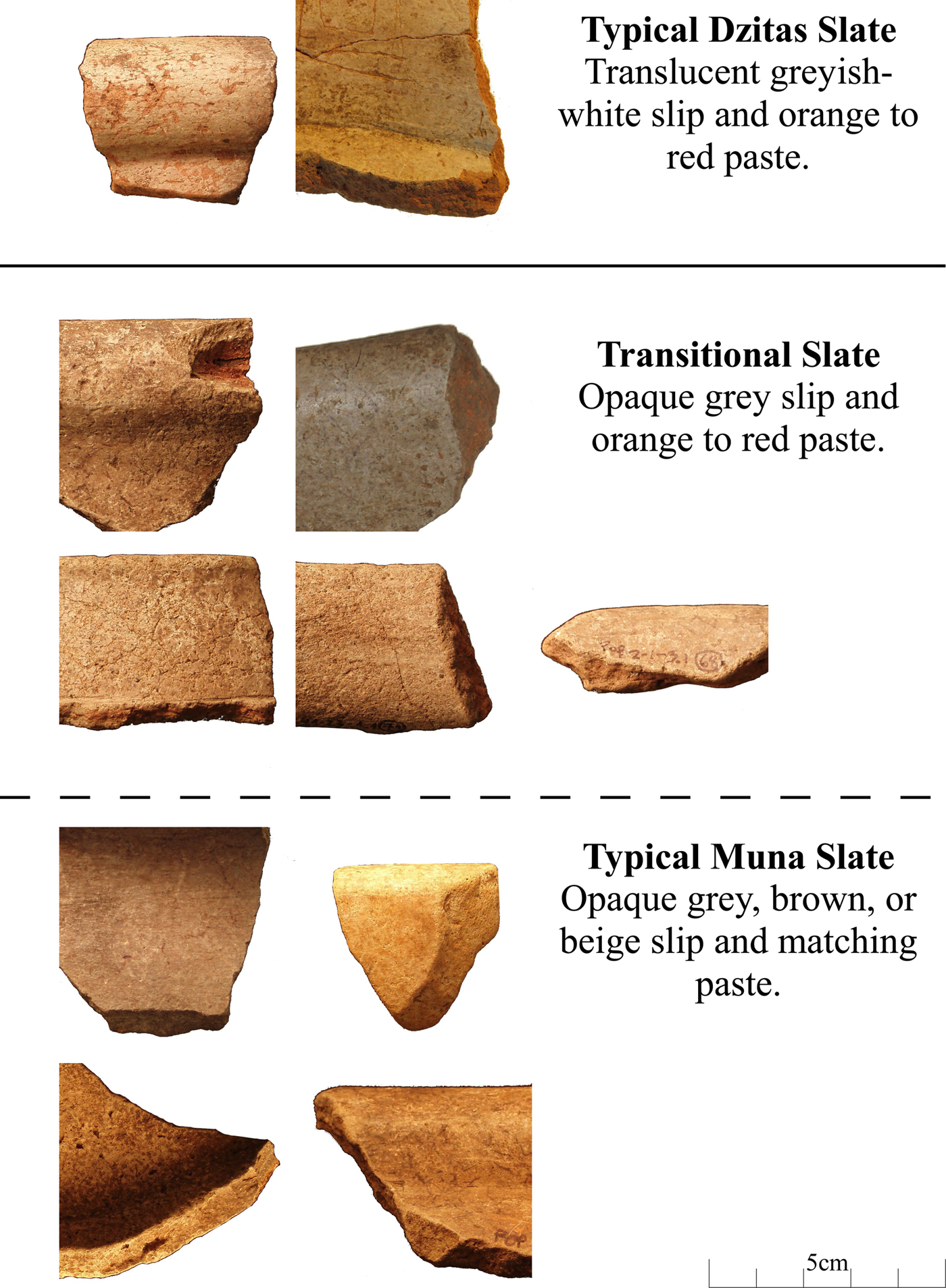
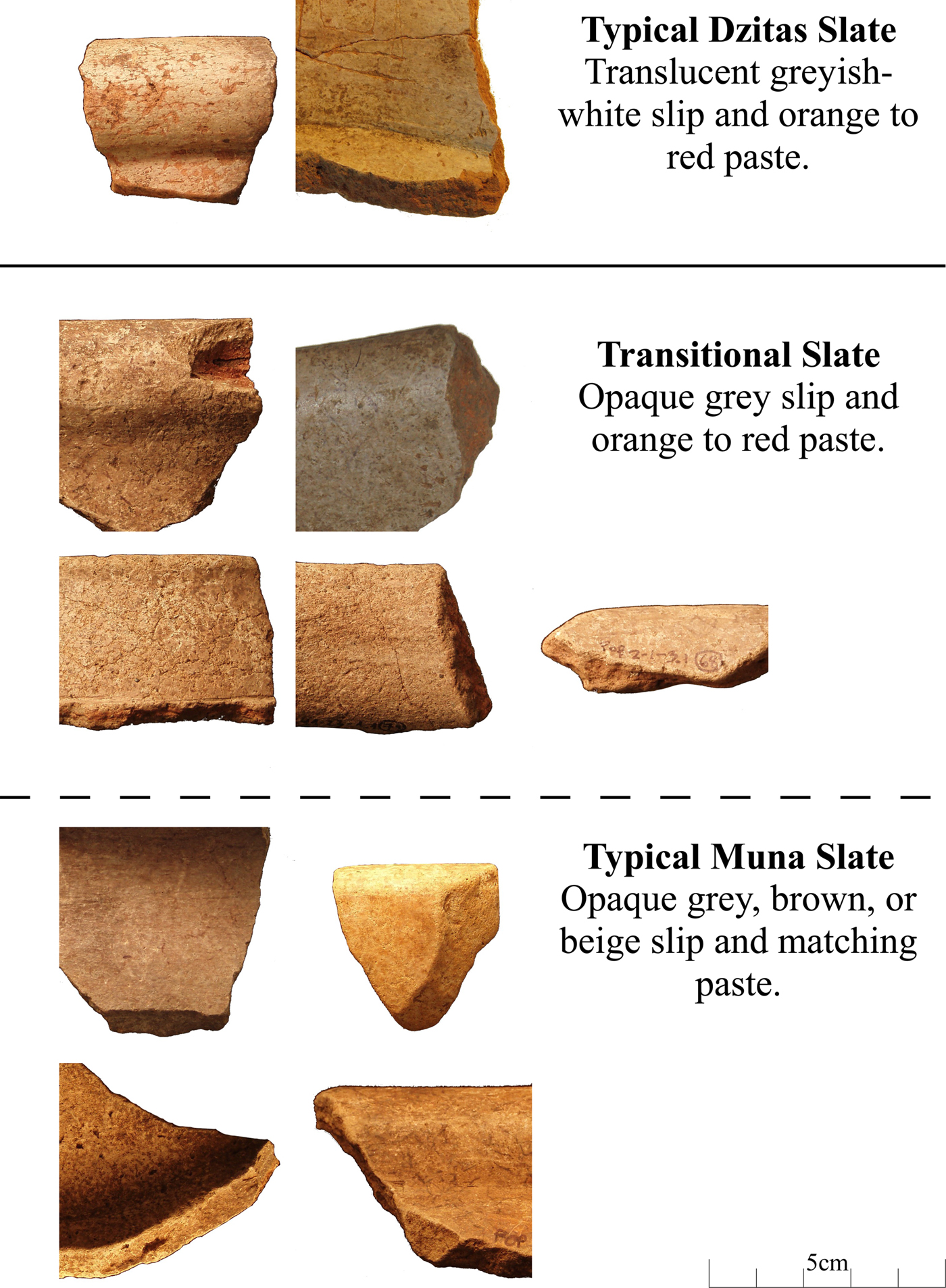
The paste and slip combinations of Muna and Dzitas Slates should differentiate them if Smith's characterizations are accurate. As described above, Muna Slate typically has gray, brown, or beige paste covered by an opaque slip of roughly the same color and Dzitas Slate is readily identifiable by its strong red or orange paste under a semi-translucent grayish-white slip. Examples of both of these types can be seen in Figure 2. The paste and slip colors and slip transparency are mutually exclusive. Therefore, pottery that mixes attributes with both types should not exist if these types are separate. The most common pottery at Popola, however, was a slate ware with a strong red-to-orange paste covered by an opaque gray slip, also shown in Figure 2. While it is not new to suggest that Dzitas Slate derived out of the earlier Muna Slate tradition, this is, to my knowledge, the first substantial report of an intermediate variety. I have argued for this to be considered a new variety of the Muna Slate type, called “Popola” (Johnson Reference Johnson2012:285). The slip was indistinguishable from Muna Slate and the paste was identical to typical Dzitas Slate. Furthermore, the appearance of the slip varied continuously from opaque to translucent. Muna Slate samples at the Instituto Nacional de Antropología e Historia (INAH) Ceramoteca in Mérida, Yucatan, from the sites of Yaxuna and Chichen Itza also exhibited this paste-slip combination, which was also noted by Pérez de Heredia Puente at Chichen Itza (Reference Pérez de Heredia Puente2010:134–135, 178) and Patricia Anderson (personal communication 2011) at Yula. Muna Slate samples from Ek Balam and Coba had almost no red paste.
Examples of the paste and slip of Muna Slate and Dzitas Slate, as well as the intermediate type identified at the site of Popola, Yucatan. Photos by the author.
The deep red paste may be an artifact of chronology, accident, technology, and/or chemical composition. Red paste is produced when ferrous-rich clay is fired in an oxidizing environment. Clay must have at least 3% fully oxidized iron in order to produce a red paste color (Rice Reference Rice1987:335). The greater the oxidation during firing, the greater the value and chroma on the Munsell scale, which translates to brighter colors (having less organic matter within the clay will further increase this) (Rice Reference Rice1987:343). The bright red paste of Dzitas Slate is due to the compounds in the clay and firing technique. Although Maya pottery with red paste had been well known for over a millennium, slate wares appear to have begun with non-red paste and changed over time. In past studies, the red paste-opaque gray slip combination has been counted as Muna Slate at Yaxuna and Chichen Itza, causing difficulty in making intersite comparisons. Almost no red paste was observed in the samples from Ek Balam and Coba, which were producing Muna Slate into the a.d. 1000s, and this suggests that the change in paste color was not a purely chronological distinction. The red paste may have been accidental at first; the unintentional side effect of an oxidizing firing technique in an area that had the right chemical composition in its clay sources. The red paste may not have been purposefully produced by Late and Terminal Classic Yucatecan potters, but it may have been a side effect of traditional firing techniques. The paste, of course, was not meant to be seen by consumers as it was covered by an opaque slip that became thinner and more transparent with time.
My hypothesis is that this red paste was an inadvertent by-product of local clay sources and firing techniques to begin with, and a controlled variable later on. The opaque slip typical of Muna Slate would have made tight control of the paste color unnecessary. The bright red color may have become common (if unintended) in central Yucatan through the use of iron-rich clays and an oxidizing firing technique. Over time, potters near Chichen Itza may have begun to use a thinner and more translucent slip, causing the underlying paste to become increasingly visible. The processes that produced the red paste must have then been purposefully employed to create the pinkish appearance typical of Dzitas Slate. It is difficult to demonstrate intentionality in the archaeological record, and this scenario is one way in which this phenomenon could be explained, but not the only one.
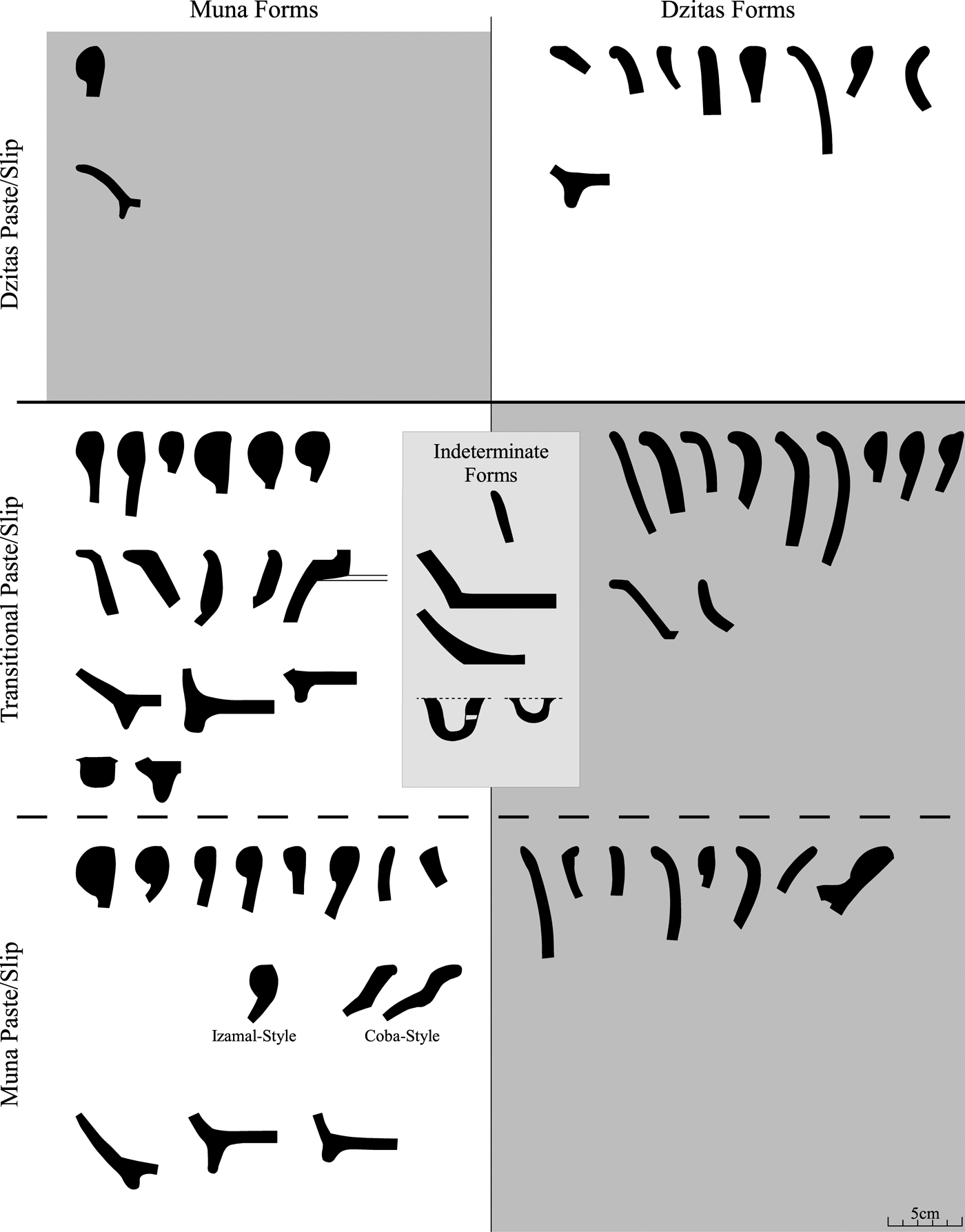
Evidence also demonstrates a clear transition from Muna to Dzitas Slate forms. Although typically differentiated by rim shape and novel forms, Muna and Dzitas Slates from Popola and Ichmul de Morley, Yucatan, demonstrate local overlap and gradual transition. The typical Muna Slate bolstered rim should be found only with sherds of Muna Slate paste and slip combinations, and the ovoid, often everted rims of Dzitas Slate should be found only with typical Dzitas Slate paste and slip combinations. At Popola, Muna Slate forms were found with Dzitas Slate paste and slip combinations and vice versa. Figure 3 illustrates this phenomenon: the top row represents the typical Dzitas Slate paste (deep red) and slip (translucent grayish white) combination, the bottom row contains the typical Muna Slate paste (brown, gray, beige) and slip (opaque slip, matching the paste colour) sherds with their associated forms, which have been separated as typical Muna or Dzitas forms. The middle row represents those sherds with transitional paste (deep red) and slip (opaque gray) combination. Note that the transitional paste-slip combination is equally split between Dzitas and Muna forms, exactly what would be expected of a transitional variety. Furthermore, novel forms, such as the molcajete (grater bowl), thought to be diagnostic of Dzitas Slate, were found on sherds with both Muna and transitional paste-slip combinations. This apparent anomaly was also noted at the site of Ichmul de Morley, half way between Chichen Itza and Ek Balam: “Several examples of Cehpech type with Sotuta forms and modes were noted, including a number of molcajete fragments made with Muna Slate ware paste and slip” (Bey Reference Bey, Brown and Stanton2003:28–29; Ringle et al. Reference Ringle, Bey, Bond Freeman, Hanson, Houck, Gregory Smith, Demarest, Rice and Rice2004:495). I would note that the pottery data from Popola is drawn from heavily mixed stratigraphic contexts. The gradual transition discussed here is in terms of morphology and appearance. The chronological reconstruction outlined below is a hypothetical scenario grounded in data drawn from across the region.
Muna Slate and Dzitas Slate forms sorted by paste and slip combinations from the site of Popola, Yucatan. Gray sectors indicate forms that do not match paste and slip combinations.

The Gradual and Continuous Transition from Muna to Dzitas Slate in Central Yucatan
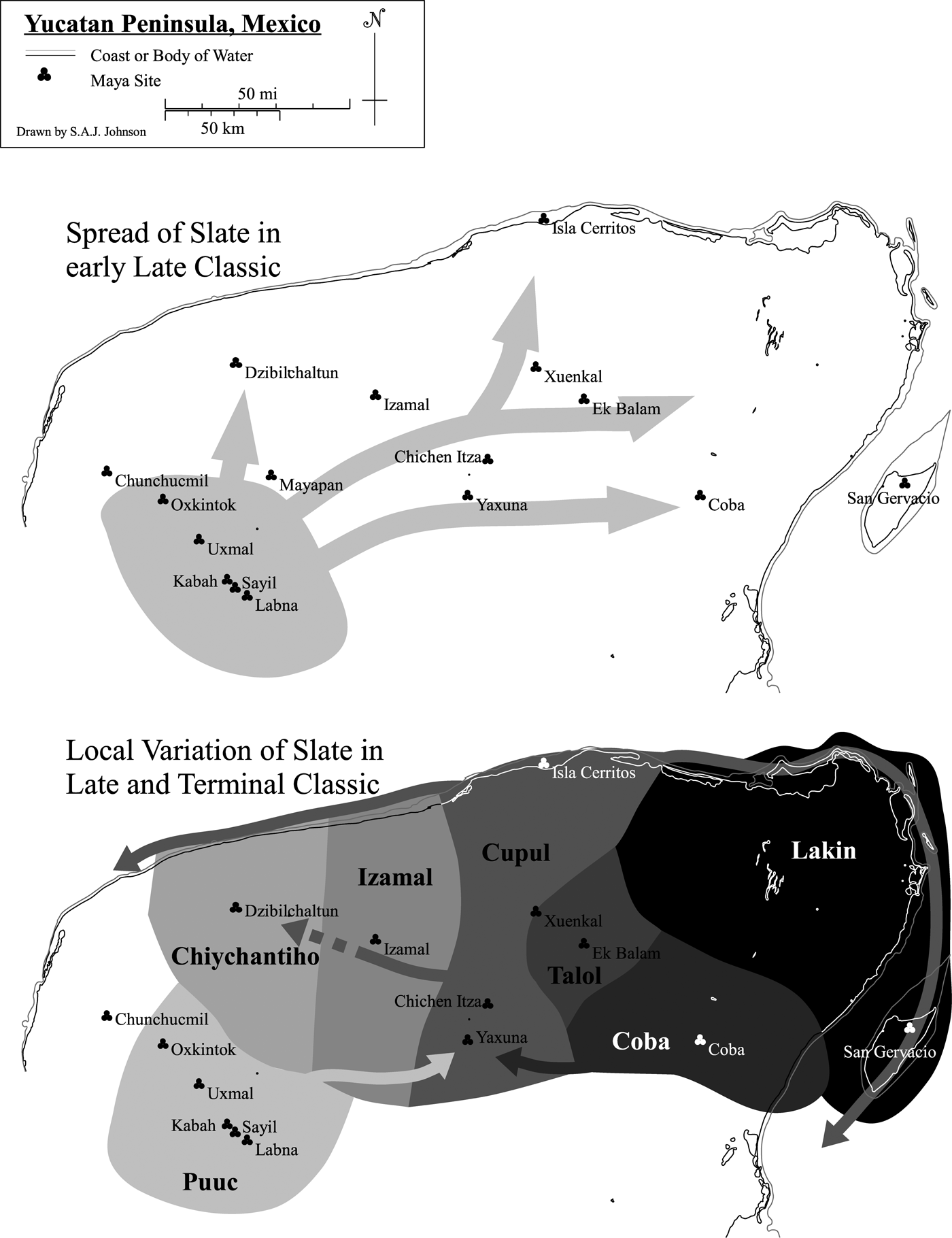
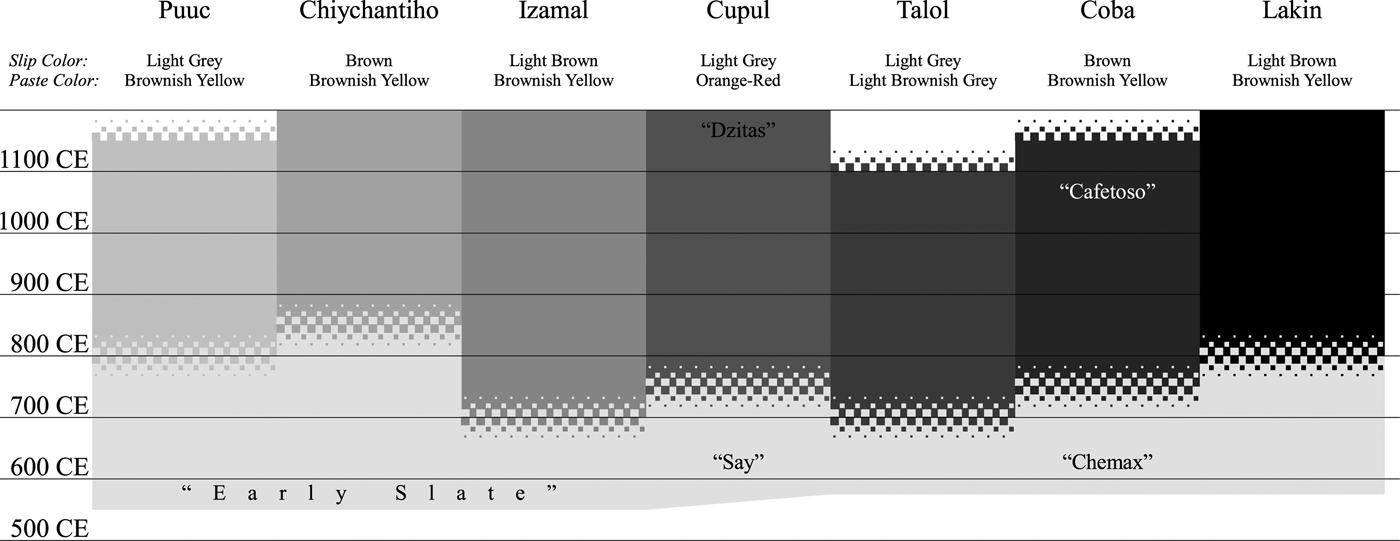
The transition from Muna to Dzitas Slate does not require any of the above-described hypotheses. Muna Slate changed gradually over time in seven regions of Yucatan from a.d. 700 to 900, including the central region, where it developed into what has been labeled Dzitas Slate. Dzitas Slate is a chronological type only in that it succeeds traditional Muna Slate in the central region, but when compared to other slate wares of the Terminal Classic period, Dzitas Slate existed as a coeval regional type with other Muna Slate derivatives. Robles Castellanos (Reference Robles Castellanos, Crespo and Cook2000) described six regional subgroups of Muna Slate, divided by a central zone of nascent Dzitas Slate. If the slate wares are studied independently of the Cehpech and Sotuta labels, however, Dzitas Slate should instead be considered a seventh regional subgroup of Muna Slate (or, as argued by Stanton and Bey [Reference Stanton and Bey2006], a regional complex), which may be called Cupul, stretching from Yaxuna to Isla Cerritos. The seven regional subgroups of Muna Slate in the Late and Terminal Classic periods, from east to west, would then become Lakin, Coba, Talol, Cupul, Izamal, Chiychantiho, and Puuc (see bottom of Figure 4). Robles Castellanos (Reference Robles Castellanos, Crespo and Cook2000) fully describes each of these subgroups, and therefore only a brief summary of the original six is offered here. The Eastern Group includes the Lakin (northern Quintana Roo), Coba (Coba-Yaxuna corridor), and Talol (Ek Balam area) subgroups; the first two share a light to dark brown slip color, while the last has a lighter gray slip (Robles Castellanos Reference Robles Castellanos, Crespo and Cook2000:299–313). The Western Group has the Izamal, Chiychantiho (Mérida-Dzibilchaltun area), and Puuc regional subgroups; the first two are characterized by their brownish-yellow slips, and the last has a distinct gray slip (Robles Castellanos Reference Robles Castellanos, Crespo and Cook2000:313–327). The Cupul regional subgroup, proposed here, covers the area from Yaxuna through Chichen Itza and extends north to Isla Cerritos. The slate ware of this area is distinctive with a light gray or cream slip, whose translucence increases over time to the point where the red paste can be seen through it.
Upper map shows the spread of slate pottery in the Late Classic period, and the lower map identifies the seven regional slate variations in the Late and Terminal Classic periods (adapted from Robles Castellanos Reference Robles Castellanos, Crespo and Cook2000:Figure 17).

The following tentative chronology is based on dates reported by scholars across Yucatan, which are derived from architecture and stratigraphy, not radiocarbon dates, a continuing problem in this area. The seven Muna Slate subgroups may have been developed out of an early slate that originated in the Puuc and spread across the peninsula in the beginning of the Late Classic period (see top of Figure 4). Early slate pottery, called “Early Slate,” “Chemax,” or “Say” (Brainerd Reference Brainerd1958; Boucher Reference Boucher1990; Johnstone Reference Johnstone2001; Robles Castellanos Reference Robles Castellanos1990; Pérez de Heredia Puente Reference Pérez de Heredia Puente2010, Reference Pérez de Heredia Puente2012), was characterized by a gritty, medium paste with smoothed gray, yellowish-brown, or dull orange slip (Johnstone Reference Johnstone2001:67; Pérez de Heredia Puente Reference Pérez de Heredia Puente2010:91–93, Reference Pérez de Heredia Puente2012:383). It began showing up in the Cupul area around a.d. 600 and lasted until a.d. 750/830 (Johnstone Reference Johnstone2001:63, 73–74; Pérez de Heredia Puente Reference Pérez de Heredia Puente2010:124, Reference Pérez de Heredia Puente2012:Figure 27). By the end of the Late Classic period, Early Slate in each of the seven regions had developed into the distinctive subgroup for that area (Figure 5). In all cases the paste had become harder and the slips more even. In the Cupul region, from a.d. 750/800–900/950, a distinct orangish-red paste emerged, covered by a slip that ranged from yellow-brown to light gray in color and became increasingly translucent over time (Anderson Reference Anderson1998b:88; Johnstone Reference Johnstone2001:79; Pérez de Heredia Puente Reference Pérez de Heredia Puente2010:134–135, 178; Patricia Anderson, personal communication 2011). By the beginning of the Terminal Classic period (a.d. 900/950–1100/1150), slate ware in the Cupul region had developed a strong red paste and a translucent light gray slip (Anderson Reference Anderson1998b:100–101; Johnstone Reference Johnstone2001:90; Pérez de Heredia Puente Reference Pérez de Heredia Puente2010:184–186, 269). Although local forms that had been used throughout the Late Classic period continued to dominate the slate ware assemblage, novel forms, mainly derived from imported vessels, were also introduced. This final iteration of local slate ware is labeled Dzitas Slate. The emergence of Dzitas Slate is not the result of the rise of Chichen Itza, but rather the gradual evolution of the slate ware in this central region independent of elite political events.
The parallel evolution of seven regional slate subgroups (after Robles Castellanos Reference Robles Castellanos, Crespo and Cook2000; Suhler et al. Reference Suhler, Ardren and Johnstone1998:Figure 4). The light gray represents early slate and its spread across the peninsula. The darker gray areas represent the regional pottery types, which were gradually developed in seven regions of Yucatan.

RAMIFICATIONS OF THESE FINDINGS
Previously Proposed Hypotheses of Overlap are Unnecessary to Explain Local Transitions of Slate Wares
None of the overlap hypotheses are needed to explain the local development of Dzitas out of Muna Slate (they are necessary, however, to characterize the intrusive appearance of fully developed Dzitas Slate in regional contexts). The idea that artifact types change gradually over time is found in every introductory textbook. This fundamental proposition explains the transition from Muna Slate to Dzitas Slate if the political ramifications are ignored (for the moment). Gradual stylistic change can explain the data presented by Pérez de Heredia Puente (Reference Pérez de Heredia Puente2010), Anderson (Reference Anderson1998a, Reference Anderson1998b), and Robles Castellanos (Reference Robles Castellanos, Crespo and Cook2000) as the progression of regional slate ware variation. In the Cupul region, Muna and Dzitas Slate are strongly related. Recall that fully developed Dzitas Slate is characterized by a white, semi-translucent slip over a deep red or orange paste. At Popola, Chichen Itza, and Yula, most Muna Slate type pottery has a red or orange paste with light gray or white slip (Patricia Anderson, personal communication 2011; Pérez de Heredia Puente Reference Pérez de Heredia Puente2010:134–135).
If judging from paste and slip alone, it may be difficult to pinpoint the division between Muna and Dzitas Slates in this area. Because these closely related types were placed in the Cehpech and Sotuta complexes, a hard-and-fast division between them has nonetheless been sought. Furthermore, the political implications associated with the Cehpech and Sotuta complexes has inflated the importance of this division. Here I suggest that Muna and Dzitas Slate should not be used to mark the division between Cehpech and Sotuta complexes in this area. Types that have a more restricted temporal distribution and that are more easily distinguished from other types are more appropriate to identify contexts associated with each complex. The smooth transition from Muna Slate to Dzitas Slate precludes a clear temporal division in the Cupul slate subgroup. When the late slate ware from the Chichen Itza region is compared to slate wares in nearby areas, the difference is apparent and may be explained by overlap models on a regional scale. Instead of recognizing Dzitas Slate as a contemporaneous regional variation of the Cupul slate subgroup, it is still seen by some as a chronological difference because of the later association of Dzitas Slate with Chichen Itza (while others [for example, Andrews and Sabloff Reference Andrews, Sabloff, Sabloff and Andrews1986; Lincoln Reference Lincoln, Sabloff and Andrews1986] have noted the error in this for some time). Scholars recognize the regional variation of eastern and western Cehpech because contemporaneity is not in question. Dzitas Slate is the most distinctive and recognizable variety of slate ware in the Cupul subgroup, but its characteristic paste, slip, and non-foreign forms were present in the local Muna Slate pottery before the rise of Chichen Itza. Identifications of temporal overlap in the literature may in fact be showing the co-occurrence of contemporaneous regional slate subgroups (Robles Castellanos Reference Robles Castellanos, Crespo and Cook2000:328).
Three overlap hypotheses, presented above, have been used to explain the transition from Cehpech to Sotuta complexes, but I have argued here that the pottery within these complexes cannot be treated as internally homogeneous units because the types are produced and controlled by different social groups. One must instead discuss the slow and gradual transition from Muna to Dzitas Slate (and by extension other local types) as separate from the immediate appearance of imported Silho Orange and Tohil Plumbate. The imported types can be used to mark the Sotuta complex because they indicate what Sotuta is supposed to: association with Chichen Itza and the Terminal Classic period. The appearance of Silho and Tohil pottery may mark the entrance of Itza influence at a site (although other mechanisms, such as tertiary gifting, market acquisition, or smuggling cannot be excluded as possible sources). The distribution of these types was restricted. Once the foreign forms were incorporated into the utilitarian slate wares, however, these forms are no longer restricted and cannot be used to argue for the dominance of Chichen Itza because commoners produced these types without elite control (although the imported types demonstrably controlled by the Itza continue to suggest this relationship).
The No Overlap Hypothesis only explains the immediate appearance of Silho Orange and Tohil Plumbate, which are found between a.d. 900/950 and 1150/1200 (Andrews et al. Reference Andrews, Negrón, Castellanos, Palma and Rivero1988; Pérez de Heredia Puente Reference Pérez de Heredia Puente2010:395) in places where they had not occurred before. This elite-level change may have been rapid when it occurred, and therefore little overlap would have been required. The No Overlap Hypothesis does not hold regionally, however, because the elites at each site appear to have adopted these types at slightly different times, creating a regional overlap. It may work on a site-by-site basis with restricted imports, but not for any region as a whole.
The Total Overlap Hypothesis describes the co-occurrence of contemporaneous regional slate wares, not two separate social groups. The Partial Overlap Hypothesis does not describe the local transition from Muna Slate to Dzitas Slate because the transition is gradual. All of these hypotheses are based upon the supposition that Cehpech and Sotuta come as discrete assemblages. It is clear that some types (Silho Orange and Plumbate) may be sometimes described this way, but the majority of types, which are produced locally by commoners without elite oversight, vary organically and change gradually over time. We cannot place an artificial division between Muna and Dzitas Slate in the Cupul region because it is a gradual transition. When comparing early Muna Slate and late Dzitas Slate one can see a definitive difference, but we cannot continue to view these types in isolation.
Evidence for Itza Elite Interaction Does Not Include Dzitas Slate
The presence or absence of particular types of imported pottery can be used to mark a new pottery complex and associated political changes. It is a sound practice to build pottery chronologies based on the occurrence of types with restricted temporal distribution. It does not seem prudent to rely on gradually transitioning slate wares for chronology at this level of precision, let alone to trace sociopolitical changes on a regional level, and particularly without strong stratigraphy, radiocarbon dates, and a clear description of specific attribute or modal changes over time. If Dzitas Slate is differentiated from Muna Slate by the addition of a few imported forms to a local repertoire, the presence of the imported pottery should be used to mark the period instead of locally produced utilitarian versions (even this is problematic, as imported pottery often had restricted distribution and many contexts may not contain these markers even if they were present at the site). The adoption of imported forms into the local slate tradition may have lagged after the introduction of the imported pottery, further obscuring the analysis. Utilitarian pottery that changes gradually over time is not an appropriate marker of elite sociopolitical changes, as the production and distribution of utilitarian pottery is not controlled by Maya elites in most cases.
The presence of Sotuta-sphere pottery has been seen as a common marker for Chichen Itza dominion (Amador Berdugo Reference Amador Berdugo2005:306; Anderson Reference Anderson1998b:262 [citing Andrews and Robles Castellanos Reference Andrews, Robles Castellanos, Chase and Rice1985:68–69]; Andrews and Robles Castellanos Reference Andrews, Robles Castellanos, Chase and Rice1985:68; Chase and Chase Reference Chase and Chase1982:609; Cobos Palma Reference Cobos Palma, Demarest, Rice and Rice2004:540; Kepecs et al. Reference Kepecs, Feinman and Boucher1994:146; Smith Reference Smith2000:51–52; Suhler et al. Reference Suhler, Arden, Freidel, Johnstone, Demarest, Rice and Rice2004:456–457, 477; Suhler et al. Reference Suhler, Ardren and Johnstone1998:178; Toscano Hernandez and Ortegon Zapata Reference Toscano Hernández and Zapata2003:441–442), but the presence of Dzitas Slate is not the same as the presence of Silho Fine Orange and Tohil Plumbate, even though they are all Sotuta-sphere pottery. Ball (Reference Ball, Sabloff and Henderson1993:257, emphasis added), among others, specifically warned against equating ceramic spheres with polities by stating that “[c]eramic spheres do not correspond to single social communities, economic networks, or polities, although their limits may sometimes be coincident with these…. Thus, ceramic spheres should not be used casually to map the political geography of the Late Classic Maya lowlands.”
The difficulty is that elite trade centers are often associated with population centers and elite and utilitarian goods from the same location occur so often together that they are frequently given the same meaning in interpretation. In cases where Chichen Itza control is argued, Dzitas Slate (as well as Silho Fine Orange and Tohil Plumbate) is present (for example, at Isla Cerritos, Cozumel, and Chichen Itza), and this makes logical sense. Although Dzitas Slate is found in some areas that were probably controlled by Chichen Itza, not all areas with Dzitas Slate were controlled by Chichen Itza. Other, more direct lines of evidence can and should be used to argue for control of an area by Chichen Itza. Stanton and Gallareta Negrón (Reference Stanton and Negrón2001:211) point out that Mamom and Chicanel pottery predominate the Preclassic assemblage, but this does not suggest expansive Mamom or Chicanel polities. They argue that the lack of knowledge about the production and distribution mechanisms of Sotuta types is part of this misunderstanding. Indeed, Ball (Reference Ball, Sabloff and Henderson1993:256) posits that “…major centers appear not to have exercised any real control in the more mundane day-to-day economic affairs of their political territories,” such as the production and trade of domestic pottery. Stanton and Gallareta Negrón (Reference Stanton and Negrón2001:230; see also Bey Reference Bey, Brown and Stanton2003; Stanton and Bey Reference Stanton and Bey2006) make a similar argument, suggesting that the assumption equating Itza control to the presence of Sotuta pottery is faulty, because “[c]onquest, control, and the imposition of ceramic styles are not the only possibilities to explain the distribution of Sotuta vessels” and that “these ‘ceramic style equals political influence’ models of sociopolitical interaction make assumptions concerning how ceramic production and distribution systems articulate with political influence.” The presence of Dzitas Slate is not enough evidence to attribute hegemonic control and each site should be taken on a case-by-case basis.
Late Classic and Early Terminal Classic Political Landscape in Yucatan, a.d. 600–900
Elite interaction of this period has been discussed extensively, although the interactions of elites are often described as if characterizing the entire population. While the elites of the Puuc, Coba, Ek Balam, and other centers imported and traded goods and ideas from the southern lowlands, and possibly central Mexico, during this period, the nonelite populations trended toward pan-Yucatecan goods and ideas.
In the Late Classic period, Puuc-style architecture was seen across the peninsula except at Coba (Andrews Reference Andrews1942, Reference Andrews and Willey1965; Andrews and Andrews Reference Andrews and Andrews1980; Andrews Reference Andrews and Mills1979; Andrews Reference Andrews1995:225; Bey et al. Reference Bey, Bond, Ringle, Hanson, Houck and Peraza López1998; Brainerd Reference Brainerd1958; Thompson Reference Thompson1945:6–8; Thompson et al. Reference Thompson, Pollock and Jean Charlot1932:20). This set of elite ideas, translated into monumental architecture at many sites, including Yaxuna, Dzibilchaltun, Chichen Itza, Ek Balam, and Culuba, suggests a close relationship between their rulers. By this time, Muna Slate had divided into seven regional variants and was completely dominant among the nonelite. Muna Slate was also used by the elite, but they had access to trade wares and local high-quality wares, as well.
Chichen Itza was a medium-sized Late Classic site, with Puuc-style architecture, again attesting to elite relationships across the central and western Peninsula. In the Cupul area, Muna Slate was slowly evolving into a local variant with deep red paste and a light gray slip. Sometime in the a.d. 800s architectural motifs and forms, trade goods, and iconography in the elite contexts at Chichen Itza changed rapidly (although others [for example, Braswell Reference Braswell2012; Ringle and Bey Reference Ringle, Bey, Fash and Luján2009; and Ringle Reference Ringle2004, Reference Ringle2009] suggest that the change may have been more gradual than commonly thought). It has been argued that this was caused by the arrival of foreign elite ideas and people at Chichen Itza (Andrews Reference Andrews1990; Andrews and Robles Castellanos Reference Andrews, Robles Castellanos, Chase and Rice1985; Robles Castellanos and Andrews Reference Robles Castellanos, Andrews, Sabloff and Andrews1986). While utilitarian pottery and architecture did change, it developed out of local slate and household construction technology.
It appears that the Itza elite were violently and/or coercively subjugating much of the peninsula in the early Terminal Classic period, and elite trade goods associated with the Itza, including Silho Fine Orange, Tohil Plumbate, and Pachuca Obsidian, can be found in elite contexts across the peninsula at this time (Andrews and Robles Castellanos Reference Andrews, Robles Castellanos, Chase and Rice1985; Robles Castellanos and Andrews Reference Robles Castellanos, Andrews, Sabloff and Andrews1986; Stanton and Gallareta Negrón Reference Stanton and Negrón2001:238–239). The Itza also spread architectural and iconographic motifs at new subsidiary centers. Nonelite goods and technology, however, were clear continuations of native Yucatecan practices. Dzitas Slate was technologically related to other peninsular slate wares, for example, although novel pottery forms possibly signalled the addition of new food preparations (molcajetes, for example). Many forms, however, were local. For the elites, architecture, iconography, elite pottery, and religious and ritual practices all change more precipitously than for the nonelites. Ball (Reference Ball1977:173–174) noted a similar drastic change in the elite assemblage at Becan, while commoners largely carried on with their own pottery traditions.
CONCLUSION
This paper has two primary conclusions. First, the appearance of Dzitas Slate is less complicated than it has previously been presented. The culprit behind this difficulty is Dzitas Slate's unfortunate association with the Itza and one of the most contentious sociopolitical events of pre-Columbian Yucatan. Scholars have rightly striven to understand the mechanism and effects of the Itza's entrance onto the Yucatecan political stage in the a.d. 800s. The elite political landscape was greatly altered by their appearance. The production of utilitarian pottery types was not revolutionized by the coming of the Itza, however. It is true that novel forms based on new imported types appear in the local slate ware repertoire, but we should instead emphasize the overall similarity of local Muna and Dzitas types: surface treatment, slip texture and color, paste texture and color, forms, and overall technology. These utilitarian types are perfectly capable of evolving and changing over time on their own without any major input from local or foreign elites. Broadly speaking, Dzitas Slate is the Terminal Classic slate type from the Cupul (central Yucatan) region. It gradually developed out of the local Muna Slate variety. In the Cupul region, it may be considered to be a chronological marker of the Terminal Classic period. Across the peninsula during the Terminal Classic, it may be viewed as a regional type, and not necessarily an intrusive tradition imposed by the Itza elite.
Second, the Yucatecan elite experienced great upheaval with the arrival and rise of the Itza, and this history should be traced with the most appropriate correlates. Imported pottery, elite architecture, and prestige goods are all excellent markers of elite activity and political alignment, but utilitarian pottery is not. Dzitas Slate does occur at Chichen Itza during its apogee and has therefore been correlated with that polity. Correlation does not equal causation, however, and not all locations with Dzitas Slate demonstrate other markers of Itza domination. The casual use of any Sotuta or Cehpech wares to mark the presence or absence of Itza domination is too simplistic, and the types and their historical implications must be examined on a case-by-case basis.
RESUMEN
El complejo cerámico Sotuta ha sido utilizado en la arqueología maya de las tierras bajas del norte para identificar el periodo clásico terminal y su asociación cultural con Chichen Itza. La definición original del complejo ha creado una división artificial entre la cerámica Sotuta y tipos del complejo Cehpech, llegados antes. Sin embargo, nuevos datos del centro de Yucatan sugieren que algunos tipos de cerámica Cehpech evolucionaron gradualmente en los tipos del complejo Sotuta y por lo tanto la división entre ambos complejos es en gran medida una construcción artificial.
Los investigadores dependen de la presencia de la cerámica del complejo Sotuta para identificar el alcance del poder político de Chichen Itza. El complejo Sotuta, sin embargo, está formado por muchos tipos de cerámica, y la mayoría son marcadores inadecuados de historia sociopolítica de élite. Aquí se argumenta que en el complejo Sotuta las cerámicas pizarra evolucionaron a partir de las cerámicas pizarra locales, independientemente de los cambios sociopolíticos de la élite que ocurrieron con la llegada de los Itzaes. Las mercancías producidas y distribuidas por los comuneros eran independientes al de las élites y han sido artificialmente encadenados a preguntas de la expansión política de la élite de los que son correlatos inapropiados. Se presenta una nueva interpretación de la secuencia cerámica pizarra regional, mostrando el desarrollo local del tipo primario Sotuta fuera del complejo Cehpech. Algunos tipos del complejo Sotuta son marcadores apropiados de la expansión élite Itza, pero los investigadores deben considerar cuidadosamente qué tipos están presentes antes de crear su relato histórico cultural.
ACKNOWLEDGMENTS
Thank you to the individuals and institutions that supported the fieldwork and analysis of the data collected at Popola. The state and federal offices of the Instituto Nacional de Antropología e Historia provided permits and access to the Centro de INAH Yucatán ceramoteca in Mérida. Thank you especially to the Consejo de Arqueología in Mexico City and to Sylviane Boucher in Mérida. I am grateful to the various funding agencies who financed the work at Popola, including the National Science Foundation (Archaeology, Dissertation Improvement Grant No. 1103533, 2011), American Philosophical Society's Lewis and Clark Fund (2010), Tulane University's Dean of the School of Liberal Arts (2009, 2010) and Stone Center for Latin American Studies (2008, 2009), the Fundación Pedro y Elena Hernández, and the Selz Foundation (2008–2011). Many individuals have helped in the collection, analysis, and interpretation of these data but, of course, any mistakes are my own. Thanks especially to Will Andrews, Aline Magnoni, Travis Stanton, William Ringle, Sara Dzul, and Eduardo Peréz de Heredia Puente, as well as my good friends in the village of Popola and the graduate students who helped me gather field data (especially Cristina Vázquez Piña, who also assisted with the Spanish summary).