Introduction
Person-centred philosophies in long-term care (LTC) provide the foundation for programmes aimed at improving resident outcomes and lessening behavioural symptoms (Koren Reference Koren2010; Rahman and Schnelle Reference Rahman and Schnelle2008). In person-centred care (PCC), residents are understood in terms of their unique needs, preferences, abilities and life experiences (Chenoweth et al. Reference Chenoweth, King, Jeon, Brodaty, Stein-Parbury, Norman, Haas and Luscombe2009; Koren Reference Koren2010; Leutz, Bishop and Dodson Reference Leutz, Bishop and Dodson2010; Rosemond et al. Reference Rosemond, Hanson, Ennett, Schenck and Weiner2012). This can be contrasted to LTC practices prior to the mid-1990s, in which hierarchical management strategies and structured routines stifled personal expression and individualised care (Brune Reference Brune2011). In the 1987 US Nursing Home Reform Act of the Omnibus Reconciliation Act (OBRA), however, a ‘culture shift’ began wherein residents' emotional, social and spiritual needs were considered alongside their biomedical needs (Brune Reference Brune2011; Koren Reference Koren2010). An early 1991 programme, the Eden Alternative, sought to overcome demoralising effects of routine-based, institutionalised care by focusing on lessening the loneliness, helplessness and boredom of those residing in LTC (Brune Reference Brune2011).
Recognising that subjective wellbeing of older persons has complex determinants (e.g. Stones et al. Reference Stones, Hadjistavropoulos, Tuuko and Kozma1995), programmes based in PCC principles focus on knowing the person, quality care (including implementation of best practice guidelines), nurturing relationships, and providing a supportive physical and organisational environment in order to improve care and ameliorate behavioural symptoms (Crandall et al. Reference Crandall, Wite, Schuldheis and Talerico2007; Rosemond et al. Reference Rosemond, Hanson, Ennett, Schenck and Weiner2012). Although PCC programmes target many LTC issues, most focus on improving quality of life and on direct or indirect mitigation of behavioural (i.e. disruptive to the resident and/or those around) and other common symptoms. Such common symptoms include mood deflation, agitation, aggression, pain and sleep disturbances (e.g. Hadjistavropoulos et al. Reference Hadjistavropoulos, Marchildon, Fine, Herr, Palley, Kaasalainen and Beland2009; Koopmans et al. Reference Koopmans, Zuidema, Leontjevas and Gerritsen2010). Many PCC programmes are multifaceted, utilising a comprehensive system of care, spanning disciplines and involving the larger institutional environment (Brownie and Nancarrow Reference Brownie and Nancarrow2013). They may involve educational sessions, follow-up consultations, supervision and mentoring, and follow-up monitoring (Finnema et al. Reference Finnema, Dröes, Ettema, Ooms, Adèr, Ribbe and Tilburg2005; McCallion et al. Reference McCallion, Toseland, Lacey and Banks1999; Narevic et al. Reference Narevic, Giles, Rajadhyax, Managuelod, Monis and Diamond2011; Schrijnemaekers et al. Reference Schrijnemaekers, van Rossum, Candel, Frederiks, Derix, Sielhorst and van den Brandt2002; Teri et al. Reference Teri, Huda, Gibbons, Young and Van Leynseele2005). A key function of these programmes is to facilitate and improve the complex clinical decisions (e.g. Kaasalainen et al. Reference Kaasalainen, Coker, Dolovich, Papaioannou, Hadjistavropoulos, Emili and Ploeg2007).
Programmes involving PCC range in length and breadth. Some approaches involve transforming the physical environment to include smaller, home-like living units that include pets, meal choices and visits with children (Koren Reference Koren2010; Verbeek et al. Reference Verbeek, van Rossum, Zwakhalen, Kempen and Hamers2009). Other approaches emphasise PCC in short educational sessions: a Canadian programme, P.I.E.C.E.S.™ (Hamilton et al. Reference Hamilton, Harris, Le Clair and Collins2008), employs a holistic approach to working with residents through regulated care-provider education (typically 40 hours of initial training). The programme provides a subset of staff with tools for comprehensive assessment and problem solving. The trained staff share their knowledge with others, thereby initiating culture change throughout the facility. This programme emphasises the physical, intellectual, emotional, capabilities, environmental and social (i.e. the acronym P.I.E.C.E.S.) aspects of the resident (Hamilton et al. Reference Hamilton, Harris, Le Clair and Collins2008).
Internationally, PCC has gained popularity over the past 30 years (Verbeek et al. Reference Verbeek, van Rossum, Zwakhalen, Kempen and Hamers2009), although some have noted the United States of America (USA) to be a leader in the movement (Brownie and Nancarrow Reference Brownie and Nancarrow2013; Brune Reference Brune2011). In developed countries, PCC reflects the same values: placing the resident at the centre of health care and considering his or her needs and wishes (e.g. Dow et al. Reference Dow, Fearn, Haralambous, Tinney, Hill and Gibson2013; Landers and McCarthy Reference Landers and McCarthy2007; Law, Baptiste and Mills Reference Law, Baptiste and Mills1995; Verbeek et al. Reference Verbeek, van Rossum, Zwakhalen, Kempen and Hamers2009). Verbeek et al. (Reference Verbeek, van Rossum, Zwakhalen, Kempen and Hamers2009) found similarities in LTC homes designed to provide small, domestic-style living units, an aspect of PCC. They included literature from 11 countries (i.e. Canada, USA, Australia, United Kingdom, and European and Asian countries). Of note were the cross-cultural similarities in core social care philosophy emphasising quality of life and meaningful activities. The countries were heterogeneous with regards to resident characteristics, number of residents and settings of the living units. Canada has adopted some of the same programming as the USA, such as the Eden Alternative as well as its own models and framework based on similar values (Alzheimer Society of Canada 2011; Eden Alternative 2009; Speziale et al. Reference Speziale, Black, Coatsworth-Puspoky, Ross and O'Regan2009).
Finding empirically supported programmes and solutions is critical, as behavioural and related symptoms have been estimated to occur in approximately 80 per cent of residents. These symptoms decrease residents' quality of life and increase care-giver burden as well as health-care costs (Desai and Grossberg Reference Desai and Grossberg2001; Jones et al. Reference Jones, Hadjistavropoulos, Janzen and Hadjistavropoulos2011; Koopmans et al. Reference Koopmans, Zuidema, Leontjevas and Gerritsen2010; O'Neil and Freeman Reference O'Neil and Freeman2011). Although PCC has become extremely popular over the past 20 years (Koren Reference Koren2010; Rahman and Schnelle Reference Rahman and Schnelle2008), the research base is lacking, especially when the effect on the resident is considered. Very few empirical studies specifically examining resident outcomes have been conducted and even fewer with methodological rigour (Brownie and Nancarrow Reference Brownie and Nancarrow2013). For instance, Brownie and Nancarrow (Reference Brownie and Nancarrow2013) systematically reviewed all studies based on PCC approaches and found only seven that met their methodological criteria for inclusion and only one that used a randomised control design (Chenoweth et al. Reference Chenoweth, King, Jeon, Brodaty, Stein-Parbury, Norman, Haas and Luscombe2009). The other six were deemed to have weak methodological designs limiting generalisability (Brownie and Nancarrow Reference Brownie and Nancarrow2013). Moreover, Brownie and Nancarrow (Reference Brownie and Nancarrow2013) report conflicting findings about the benefits of person-centred approaches for residents. Most troubling, they noted that there is some evidence that PCC is associated with increased falls (Chenoweth et al. Reference Chenoweth, King, Jeon, Brodaty, Stein-Parbury, Norman, Haas and Luscombe2009; Coleman et al. Reference Coleman, Looney, O'Brien, Ziegler, Pastorino and Turner2002). Chenoweth et al. (Reference Chenoweth, King, Jeon, Brodaty, Stein-Parbury, Norman, Haas and Luscombe2009), in their randomised controlled trial of PCC, dementia care mapping and care as usual found decreased agitation in both the PCC and the behavioural mapping conditions and increased falls in the PCC condition. Moreover, there are many similar programmes being implemented in LTC facilities that have little if any research associated with them. For example, there are companies that offer LTC facilities training in PCC without offering peer-reviewed research to support the efficacy of their programme.
We were interested in evaluating the results of the implementation of a widely used Canadian programme, P.I.E.C.E.S.™ P.I.E.C.E.S.™ has been implemented on a wide-scale basis in several Canadian jurisdictions, but to our knowledge, no empirical investigations have been published specifically evaluating the impact of its implementation on resident outcomes. Rather, two peer-reviewed published investigations (McAiney et al. Reference McAiney, Stolee, Hillier, Harris, Hamilton, Kessler, Madsen and Le Clair2007; Stolee et al. Reference Stolee, Mcainey, Hillier, Harris, Hamilton, Kessler, Madsen and Le Clair2009) and several unpublished programme evaluations presented on the programme's website (Aestima Research 2003; McAiney Reference McAiney2004a, Reference McAiney2004b; McAiney and Stolee Reference McAiney and Stolee2003) focused on staff outcomes, concluding that staff learners have positive perceptions of the programme overall, and perceived ability to recognise and understand behavioural symptoms and use the assessment tools (Aestima Research 2003; McAiney et al. Reference McAiney, Stolee, Hillier, Harris, Hamilton, Kessler, Madsen and Le Clair2007). There is evidence that the programme impacts positively on staff, although results are limited. McAiney et al. (Reference McAiney, Stolee, Hillier, Harris, Hamilton, Kessler, Madsen and Le Clair2007) reported that after training, professional staff reported increased confidence recognising, understanding and assessing behavioural symptoms using standardised tools. However, these increases were demonstrated directly following training, and sustainability over time is unclear. Stolee et al. (Reference Stolee, Mcainey, Hillier, Harris, Hamilton, Kessler, Madsen and Le Clair2009) reported that staff benefits included increased knowledge and improvements in assessment and diagnosis, although these conclusions were based on a small number of staff (20) representing 11 facilities, rendering the generalisability of these conclusions questionable. However, successful implementation and maintenance of the programme is dependent upon the institutional environment, support of management, and nurses' ability to take on a leadership role to maintain P.I.E.C.E.S.™ and transfer knowledge to other members of the care team (McAiney et al. Reference McAiney, Stolee, Hillier, Harris, Hamilton, Kessler, Madsen and Le Clair2007; Stolee et al. Reference Stolee, Mcainey, Hillier, Harris, Hamilton, Kessler, Madsen and Le Clair2009). Stolee et al. (Reference Stolee, Mcainey, Hillier, Harris, Hamilton, Kessler, Madsen and Le Clair2009) found variation in care facilities' ability to maintain the programme based on these factors. This is not surprising given that successful implementation is contingent upon many factors including organisational stability, financial resources and management support/communication; it is unclear whether multi-dimensional PCC programmes are able to respond to these factors (Crandall et al. Reference Crandall, Wite, Schuldheis and Talerico2007; Hamilton et al. Reference Hamilton, Harris, Le Clair and Collins2008; Lopez Reference Lopez2006; Rahman and Schnelle Reference Rahman and Schnelle2008; Rosemond et al. Reference Rosemond, Hanson, Ennett, Schenck and Weiner2012; Stolee et al. Reference Stolee, Mcainey, Hillier, Harris, Hamilton, Kessler, Madsen and Le Clair2009).
Purpose
Given the dearth of knowledge regarding resident outcomes with PCC programmes generally and those focused on behavioural management specifically, our primary goal was to examine whether LTC facilities which implemented the Canadian programme P.I.E.C.E.S.™ (Hamilton et al. Reference Hamilton, Harris, Le Clair and Collins2008) had demonstrated improved resident outcomes in the nine months following training compared to before training and also compared to facilities in which staff members had not been trained. We further queried whether staff from the Intervention Facilities demonstrated systematic differences in their descriptions of care provision compared to staff from Comparison Facilities three years following initial implementation. Finally, we aimed to review the general maintenance procedures and functioning of the PCC programme at present. We explored whether residents from the Intervention Facilities had more favourable outcomes following the training than those residents from Comparison Facilities, after taking into consideration baseline differences in resident characteristics. We further explored whether nurses and care aides described an approach to care that was more consistent with the PCC philosophy three years following initial implementation. In accordance with the results of previous implementation literature (e.g. Gagnon, Hadjistavropoulos and Williams in press; Stolee et al. Reference Stolee, Mcainey, Hillier, Harris, Hamilton, Kessler, Madsen and Le Clair2009), we questioned whether the degree of managerial support would contribute to maintenance of the programme three years following initial implementation.
Method
Using a mixed-methods research design (e.g. Greene Reference Greene2008; Johnson and Onwuegbuzie Reference Johnson and Onwuegbuzie2004), we conducted a quantitative controlled, retrospective evaluation of resident outcomes before and after the implementation of a PCC programme (see below for description) as well as during a follow-up period, utilising the Resident Assessment Instrument Minimum Data Set version 2.0 (RAI-MDS 2.0). The qualitative component of this study involved evaluation of staff experiences with the programme and the facilities' maintenance procedures three years following initial implementation. Concerning the qualitative component, a descriptive qualitative design and thematic analysis were utilised (Patton Reference Patton2002; Sandelowski Reference Sandelowski2000), including data from both focus group interviews and individual interviews. All necessary ethics approvals were obtained.
PCC programme
A PCC programme, P.I.E.C.E.S.™ (Hamilton et al. Reference Hamilton, Harris, Le Clair and Collins2008), was implemented in three LTC facilities. This programme focuses on a holistic approach to working with behavioural symptoms and mental health difficulties through nurse and other regulated care-provider education. The programme involves training a portion of the professional staff members (e.g. nurses, social workers) who then facilitate culture change in their own facilities through knowledge transfer strategies that are incorporated within the training. There are also training options for managers to be able to support the initiative in their facilities. Primarily, the programme provides the care provider with the tools for comprehensive assessment and problem-solving approaches. It emphasises a model of care in which nursing staff are encouraged to consider the ‘physical, intellectual, emotional, capabilities, environmental and social’ aspects of the resident to determine possible causes and promising treatments for the difficulty (Hamilton et al. Reference Hamilton, Harris, Le Clair and Collins2008). The programme provides instruction in the use of tools for assessing the resident, such as a behavioural tracking tool (P.I.E.C.E.S. Canada 2013a) or the Cohen-Mansfield Agitation Inventory (Cohen-Mansfield Reference Cohen-Mansfield1986). The core curriculum further focuses on a three-question approach to assessment and intervention planning, information on the brain and behaviour, psychotropic medications, dementia and mental health disorders, laboratory tests and values, and methods to assist in transferring knowledge to the workplace. The approach encourages communication among the care team and promotes all clinical staff including care aides (i.e. unregulated care providers) to be involved in the management of the resident (Hamilton et al. Reference Hamilton, Harris, Le Clair and Collins2008).
To determine training efficacy, health region personnel utilised satisfaction surveys and facility feedback (J. Nelson, personal communication, 5 and 6 January 2012). According to their evaluation, care aides reported satisfaction in several areas, such as autonomy and confidence. Moreover, staff reported increased functioning in areas such as observation of residents, reporting of behavioural symptoms and resident improvement in behavioural symptoms. There were also challenges in each facility, particularly related to inconsistency in staffing and time limitations. There were attempts to mitigate these challenges through strategies related to resources, time and people.
Quantitative evaluation of resident outcomes
Facilities
LTC facilities were chosen from the same Canadian health region (Canada has 88 health regions). Three of the facilities chosen for this study (Intervention Facilities A, B and C) trained a portion of their staff in the PCC programme from the period of 15 May to 15 June 2009. These were the only facilities in the health region that had implemented this training. Facility A trained: 18 Registered Nurses (RNs), one recreational therapist, one social worker, one occupational therapist and four care managers who were RNs. Facility B trained three RNs, three Licensed Practical Nurses (LPNs) and two recreational therapists. Facility C trained three LPNs and one Resident Care Coordinator who was a RN. Facilities A and B were comparable in their trained staff to resident ratio (i.e. approximately six staff trained per 100 residents) whereas Facility C trained proportionately more staff (i.e. 14 staff per 100 residents). The initial training was 40 hours. The staff were paid their regular salary during their training for a total of approximately 1,520 hours of professional staff time. The health region also provided additional resources to support the programme, including a portion of a managerial position, an ‘enabler committee’ who meet periodically and organise an annual PCC programme day for staff, a monthly training session at each Intervention Facility and a PCC programme orientation session for new nurses.
Three additional facilities (Comparison Facilities A, B and C) had not implemented any PCC or similar philosophical programming before or during the study period. We utilised data from these facilities for comparison purposes. These were the only facilities in the health region that had not implemented any PCC training at the time of this evaluation. Although we were unable to match facilities in terms of size, Intervention Facility A and Comparison Facility A were large (390 and 228 beds, respectively), Intervention Facility B and Comparison Facility B were medium (147 and 152 beds, respectively) and Intervention Facility C and Comparison Facility C were small (28 and 62 beds, respectively). All six facilities provided the same level of care. On the Cognitive Performance Scale of the RAI-MDS, residents from the facilities had an average score of 3.00 (standard deviation (SD)=1.86) at the first measurement time-point, 2.92 (SD=1.87) at the second time-point and 3.09 (SD=1.88) at the third time-point. Facilities ranged from a low of 2.39 (SD=2.14) to a high of 3.61 (SD=1.83). A score of 3 on the Cognitive Performance Scale indicates moderate impairment. Although a formal diagnosis is often not recorded on the residents' charts (M. Watkin-Pawelko, personal communication, 13 June 2013), it is our experience that the majority of patients (approximately two-thirds) in these facilities suffer from dementia. Those who do not suffer from dementia present with considerable physical frailty.
Participants
Participants were included if they: (1) resided in one of the participating Intervention or Comparison Facilities and (2) had a RAI-MDS entry into the health region's central database during at least one study time period: Baseline was defined as the three months prior to the PCC programme implementation (15 February to 15 May 2009); Post-intervention was defined as the three months immediately following PCC training (15 June to 15 September 2009); and Follow-up was defined as six to nine months following the PCC programme (15 December 2009 to 15 March 2010). Our total sample who had data at any of these time-points consisted of 682 residents in the Intervention Group (441 women, 241 men) and 512 residents in the Comparison Group (371 women, 141 men). The proportion of men and women differed between the conditions, with the Intervention Group having proportionately more men than the Comparison condition (χ 2(1, N=1,194)=8.17, p<0.01). Regarding mean age, the Comparison participants (mean=86.38 years, SD=10.51) were significantly older than the Intervention participants (mean=82.92 years, SD=12.20) (t(1192)=−5.14, p<0.01). The groups did not differ in terms of education level (χ 2(8, N=1,194)=15.34, p>0.05). Given the significant differences between the groups on mean age and sex proportion, we considered these variables as potential covariates in all analyses, as well as other relevant variables (see Analyses section).
Measures
The RAI-MDS 2.0 (Morris et al. Reference Morris, Hawes, Fries, Phillips, Mor, Katz, Drugovich and Friedlob1990) is a standardised measure designed for LTC which provides comprehensive assessment of a resident's strengths, needs, concerns and potential risks (Hutchinson et al. Reference Hutchinson, Milke, Maisey, Johnson, Squires, Teare and Estabrooks2010). It is in use in several countries in different languages, and has been deemed to have excellent clinical utility and demonstrated validity and reliability (Hawes et al. Reference Hawes, Morris, Phillips, Mor, Fries and Nonemaker1995, Reference Hawes, Morris, Phillips, Fries, Murphy and Mor1997; Morris et al. Reference Morris, Nonemaker, Murphy, Hawes, Fries, Mor and Phillips1997). We deemed this outcome measure particularly relevant to evaluation of P.I.E.C.E.S.™, as this measure has been indicated by the developers of P.I.E.C.E.S.™ to be conceptually consistent with the approach and some versions of the PCC programme have been mapped on to the RAI-MDS (P.I.E.C.E.S. Canada 2013b).
The primary measurements we used within the RAI-MDS included ten of the 11 outcome scales and 29 of the 35 quality indicators (QIs; the remaining six QIs were not sufficiently documented in our database for analysis purposes). The outcome scales in the RAI-MDS are as follows: (1) Depression Rating Scale (DRS); (2) Changes in Health, End-stage Disease and Signs and Symptoms (CHESS); (3) Pain Scale; (4) Activities of Daily Living (ADL) Self Performance Hierarchy Scale; (5) ADL Short Form; (6) ADL Long Form; (7) Index of Social Engagement (ISE); (8) Aggressive Behaviour Scale (ABS); (9) Pressure Ulcer Risk Scale (interRAI PURS); (10) Cognitive Performance Scale (CPS); and (11) Personal Severity Index (PSI). For the analysis of the outcome scales specifically, we utilised all scales in our analyses except for the ADL Short Form as each of these items was included also on the ADL Long Form.
The QIs were originally developed in the early 1990s in order to improve care, monitor care and aid in public reporting (RTI International 2012). In 2008, additional research by the developers expanded these indicators to include many outcome-based measures (to determine changes in resident status) along with prevalence measures. There are currently 35 QIs covering 15 domains, which are generally expressed as percentages (e.g. percentage of residents who have depressive symptoms) (RTI International 2012). These domains include: ADL; behaviour; continence; cognitive function; communication; delirium; medications; falls; infections; mobility; mood; nutrition/weight; pain; pressure ulcers; and restraints. Participant demographic information was also collected through the RAI-MDS.
Procedure
All data were collected via retrospective examination of the RAI-MDS. Residents were assigned a random participant number in the database and all identifying information was excluded. Descriptive and inferential analyses were conducted using PASW (SPSS) version 19 and SAS version 9.2.
Analyses
The first set of analyses focused on the RAI-MDS outcome scales wherein we conducted a series of ten mixed-factorial Analyses of Covariance (ANCOVA). The independent variables were time (Baseline, Post-intervention and Follow-up) and condition (Intervention versus Comparison Facilities).
For the second set of analyses focused on the RAI-MDS QIs, we conducted univariate analyses using a logistic random-effects model to investigate the binary quality indicators (i.e. resident's clinical condition was or was not indicative of the QI) (Hedeker and Gibbons Reference Hedeker and Gibbons2006; Larsen et al. Reference Larsen, Petersen, Budtz-Jørgensen and Endahl2000). A random-effects model computes the odds ratios (OR) for the ‘typical’ resident (as opposed to a generalised estimation equation model wherein the average across participants is utilised) and allows the correlation between the clustered measurements to be incorporated into the estimates of parameters, standard errors, interval estimates and tests of hypotheses, rendering it to have greater clinical utility and applicability in its interpretation. We aimed to investigate all 35 QIs of the RAI-MDS, but did not have sufficient data for six of these (i.e. residents who have developed a respiratory condition or have not gotten better, residents whose ability to walk and move about improved, residents who fell in the last 30 days, residents who had unexplained weight loss, residents with pain and residents whose stages 2–4 pressure ulcer worsened). For each of the 29 QIs examined, a model was tested wherein we considered a number of covariates (i.e. age, gender, education, facility, and scores on the CPS and PSI) as well as the variables of interest for hypothesis testing (i.e. group type, time period and their interaction). In order to determine model fit for the data and to interpret the results, we examined fit statistics (i.e. the Pseudo-Akaike's information criterion and the generalised chi square/degrees of freedom) and significance for the effects of covariates and variables of interest. Of primary interest was testing the interaction between group type and time period wherein significance in the expected direction (i.e. favouring the Intervention Facilities) would have supported our hypothesis.
Qualitative evaluation of staff perspectives of care provision and PCC programme maintenance
Participants
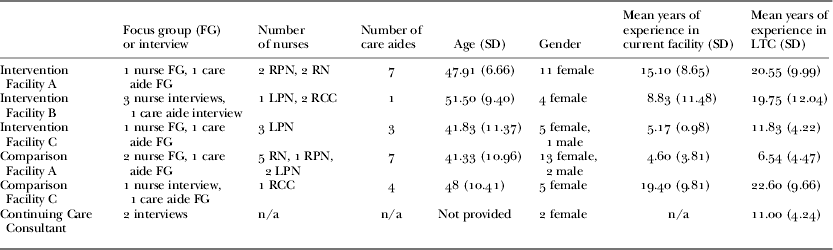
We elicited qualitative responses from nurses and care aides from each of the three Intervention Facilities and two of the Comparison Facilities as well as two district managers, the past and present Senior Continuing Care Consultant (CCC) whose duties include support for the PCC initiative. Comparison Facility B was not included in the qualitative evaluation, as staff had received other PCC training following March 2010. Specifically, they trained two nurses in a one-day session on PCC approaches to dementia care. This training began in 2011 and was concluded in 2012. Because it was subsequent to the time period used in our quantitative evaluation, it likely did not impact our quantitative results. In total, 19 nurses (seven RNs, three Registered Psychiatric Nurses, six LPNs and three Resident Care Coordinators who are also nurses; 17% of this total workforce), 21 care aides (4% of this total workforce) and two inter-facility managers (CCCs; 100% of this total workforce) participated. Almost all participants were women (40 women, three men). Their mean age was 45.19 years (SD=10.02) and they had 9.72 (SD=8.72) years of experience in their current facility and 14.35 (SD=9.84) years in LTC. The breakdown of participant information by facility is presented in Table 1. Participants from the Intervention Facilities did not differ from participants from the Comparison Facilities on age (t(39)=1.24, p>0.05) or years of experience in current facility (t(39)=1.01, p>0.05). Although participants from the Intervention Facilities had more years of experience in LTC (t(39)=2.38, p<0.05), both groups were highly experienced with those from the Intervention Facilities having on average 17.91 years (SD=9.58) and those from the Comparison Facilities having on average 10.76 years (SD=9.38). Only one participant (an LPN) in the Comparison Facilities reported receiving specific and formal PCC training. No care aides reported any training in PCC.
Descriptive information for focus group and interview participants

Notes: SD: standard deviation. LTC: Long-term care. LPN: Licensed Practical Nurse. RCC: Resident Care Coordinator. RN: Registered Nurse. RPN: Registered Psychiatric Nurse. n/a: not applicable.
Procedure
Participants were recruited using a purposive sampling approach (Marshall Reference Marshall1996), which is commonly used in qualitative research. Working with the Directors of Care from each facility, we included a sample of participants who, if working in the Intervention Facilities, would be knowledgeable about the PCC programme. We further sought to include primarily staff members who had been employed prior to the implementation of the programme in 2009. For the Comparison Facilities, we recruited participants who tended to be active in facility programming and knowledgeable about the facility's culture of care. We aimed for longer-term experience, preferably prior to 2009. Inter-facility managers (CCCs) were recruited via health region managerial contacts known to the researchers. Directors of Care or health region managerial contacts initially contacted potential participants, explaining the nature of the research. With verbal consent from the potential participants, their first name and contact information was provided to the researchers, who elaborated on study purpose, obtained consent in principle and arranged the focus group interview or interview session. Formal written consent along with demographic information was obtained immediately prior to the session.
Focus group interview sessions and individual interviews were held at the participants' places of employment. In total, eight focus group interviews and seven individual interviews were conducted across all facilities. Focus group interviews ranged from three to seven participants and separate focus group interviews were conducted for nurses and care aides and also for separate facilities to ensure homogeneity of participants (Krueger and Casey Reference Krueger and Casey2009). A question guide was used with all participants, querying general issues related to the culture of the care environment and philosophy of care. Additional information about the functioning of the PCC programme was gathered from participants in the Intervention Facilities. Only information on the PCC programme was elicited from inter-facility managers. Interviews and focus group interviews were recorded and transcribed.
Analyses
In order to understand better differences in care provision between Intervention and Comparison Facilities and also maintenance procedures for the PCC programme, our overall approach involved thematic analysis (Boyatzis Reference Boyatzis1998; Dixon-Woods et al. Reference Dixon-Woods, Agarwal, Jones, Young and Sutton2005; Graneheim and Lundman 2003). We derived broad, initial categories in response to our specific aims, the previous literature, discussion among the research team and a preliminary reading of the transcripts. These categories related to general facility functioning (e.g. relationships, challenges, support, philosophy of care) and PCC programme maintenance procedures (queried only in the Intervention Facilities). For the PCC programme maintenance analysis, we used a deductive framework (i.e. derived from the literature and our own knowledge) which comprised components of implementation/maintenance including personnel roles, training mechanisms, staff perceptions and interpersonal relationships (Berta et al. Reference Berta, Teare, Gilbart, Ginsburg, Lemieux-Charles, Davis and Rappolt2005). One member of the research team acted as the primary analyst while collaborating with a second researcher. Both researchers coded the total dataset using meaning units (i.e. the smallest unit of text that can convey meaning relevant to the research queries), discussing decision rules throughout and consulting with other members of the research team as indicated. Each focus group interview and interview was coded and kept separately in order to facilitate comparisons among the different facilities and also among the nurses, care aides and managers. The coded responses were examined for heterogeneity or homogeneity of content, parsed when appropriate into sub-categories, described and labelled. This process occurred several times by both researchers with ongoing discussion to ensure that the final coding framework was appropriate and that all of the relevant text was accounted for. Broad themes were identified at the facility level collapsing across nurses and care aides, which facilitated comparisons between Intervention and Comparison Facilities and also among the three different Intervention Facilities. The themes derived from the manager transcripts were similarly collapsed in order to compare with the Intervention Facilities regarding PCC programme functioning. Detailed notes were kept in order to record observations, potential themes, to note similarities and differences among the transcripts, and to aid communication among the two researchers analysing the data. Coding was facilitated using the software NVivo.
Following analysis, member checking or recycled interpretation (Crabtree and Miller Reference Crabtree and Miller1999; Creswell and Miller Reference Creswell and Miller2000) occurred with a random 15 per cent of participants with representation from each facility. In doing so, we presented summative statements of the themes that emerged from their focus group interview or interview, asking them to rate the accuracy of the statements using a seven-point Likert scale. Overall the mean rating of agreement with the statements was 6.36 (SD=0.78).
Results
Quantitative evaluation of resident outcomes
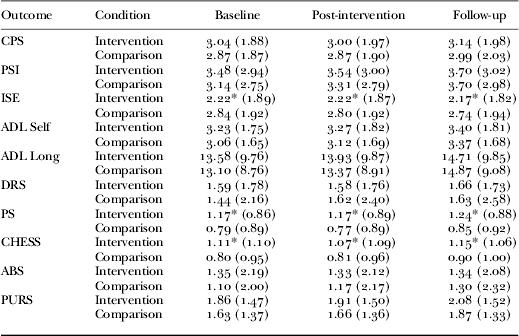
Outcome scales. The number of participants in this analysis (i.e. who had data available at each time-point) included 206 participants in the Intervention Facilities and 182 in the Comparison Facilities. In this sub-sample, the groups did not differ in the proportion of males to females (χ 2(1, N=388)=3.68, p>0.05), but participants from the Comparison Facilities were significantly older (t(386)=3.13, p<0.01). Therefore, we included age as a covariate for each analysis.Footnote 1 Mean scores at each measurement occasion are presented in Table 2.
Mean (standard deviation) for Resident Assessment Instrument Minimum Data Set outcomes
Notes: CPS: Cognitive Performance Scale. PSI: Personal Severity Index. ISE: Index of Engagement Scale. ADL Self: Activities of Daily Living Self Performance Hierarchy Scale. ADL Long: ADL Long Scale. DRS: Depression Rating Scale. PS: Pain Scale. CHESS: Changes in Health End-stage Disease and Symptoms and Signs. ABS: Aggressive Behaviour Scale. PURS: Pressure Ulcer Risk Scale.
Significance level: * p<0.05.
Overall, support of our hypothesis (i.e. that the PCC programme had a beneficial effect on resident outcomes) would have been indicated by the presence of a condition by time interaction. This interaction was not statistically significant for any of the outcome scales. Concerning the ABS, the ADL Self Performance Hierarchy Scale, the ADL Long Form, the CPS, the DRS and the PSI, no significant main or interaction effects were detected.
For the ISE Scale, there was a main effect of facility type (F(1, 385)=12.60, p<0.01). Tukey's HSD tests were conducted between the groups at Baseline, Post-intervention and Follow-up. The Comparison Group scored significantly higher at each time-point, indicating more social engagement (Baseline HSD=2.77, q (0.05, 385, 2)=3.85; Post-intervention HSD=2.77, q (0.05, 385, 2)=3.60; Follow-up HSD=2.77, q (0.05, 385, 2)=3.54). Also for the CHESS Scale, there was a main effect of facility type (F(1, 385)=11.26, p<0.01). Tukey's HSD tests were conducted between the groups at Baseline, Post-intervention and Follow-up. The Intervention Group scored significantly higher at each time-point, indicating higher medical instability (Baseline HSD=2.77, q (0.05, 385, 2)=3.74; Post-intervention HSD=2.77, q (0.05, 385, 2)=3.14; Follow-up HSD=2.77, q (0.05, 385, 2)=3.02). Similarly, for the PURS Scale, there was a main effect of facility type (F(1, 385)=4.27, p<0.05). Tukey's HSD tests were conducted between the groups at Baseline, Post-intervention and Follow-up, but these were found to be non-significant.
Regarding the Pain Scale, there was a main effect of time (F(1.65, 334.91)=3.74, p<0.05) and facility type (F(1, 385)=21.92, p<0.01). Follow-up comparisons indicated that the Intervention Facilities increased significantly (indicating an increase in pain) from Baseline to Follow-up and from Post-intervention to Follow-up (both HSD=2.77, q (0.05, 385, 2)=3.37). Similarly, the Comparison Facility's scores increased significantly from Baseline to Follow-up (HSD=2.77, q (0.05, 385, 2)=2.89) and from Post-Intervention to Follow-up (HSD=2.77, q (0.05, 385, 2)=3.86). At each time-point, the Intervention Facility scored higher (worse pain) than the Comparison Facility (Baseline HSD=2.77, q (0.05, 385, 2)=18.32; Post-intervention HSD=2.77, q (0.05, 385, 2)=19.28; Follow-up HSD=2.77, q (0.05, 385, 2)=18.80).
Quality indicators
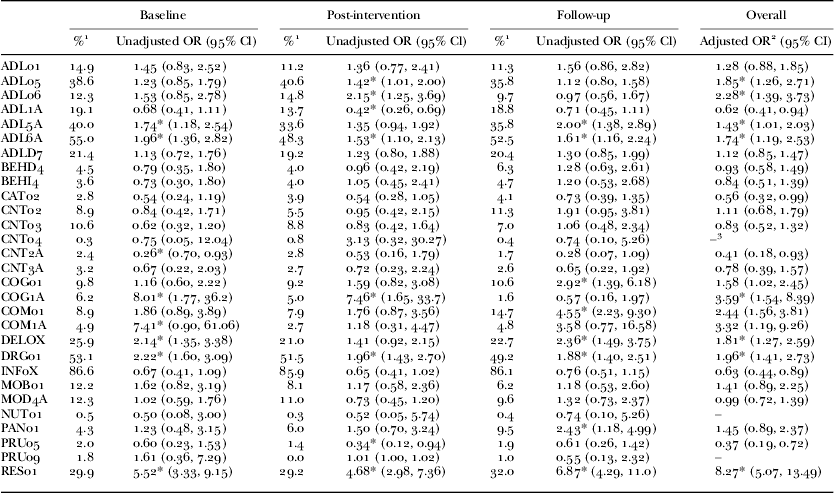
Percentages, unadjusted ORs and adjusted ORs (i.e. adjusted for age, sex, education, facility, CPS scores, PSI scores) are reported in Table 3. The adjusted ORs for the Intervention Facilities relative to the Comparison Facilities were significantly higher for three of the ADL QIs, indicating that the Intervention Facilities had more residents who improved or remained independent on late-loss ADL functioning (OR=1.85, 95% CI=1.26, 2.71) and early-loss ADL functioning (OR=2.28, 95% CI=1.39, 3.73), but the Intervention Facilities also had more residents whose early-loss ADL functioning worsened or who remained dependent (OR=1.74, 95% CI=1.19, 2.53). Further, the adjusted ORs were significant for: a cognitive QI, indicating that the Intervention Facility had more residents whose cognitive function changed across the three time-points (OR=3.59, 95% CI=1.54, 8.39); a delirium QI, indicating more residents from the Intervention Facility had delirium (OR=1.81, 95% CI=1.27, 2.59); an anti-psychotic QI, indicating the Intervention Facility had more residents on anti-psychotics without a diagnosis of psychosis (OR=1.96, 95% CI=1.41, 2.73); and a physical restraint QI, indicating that the Intervention Facility had significantly more residents in daily physical restraints (OR=8.27, 95% CI=5.07, 13.49).
Descriptive statistics and odds ratios (ORs) for Resident Assessment Instrument Minimum Data Set Quality Indicators in the intervention condition
Notes: 1. Percentage of intervention patients rated affirmative for the quality indicator. 2. Adjusted for age, sex, education, Cognitive Performance Scale score and Personal Severity Index score. 3. OR could not be estimated because of low prevalence of quality indicator. CI: confidence interval. ADL01: late-loss Activities of Daily Living (ADL) functioning (bed mobility, transfer, eating and toilet) worsened. ADL05: mid-loss ADL functioning (transfer and locomotion) improve or who remained completely independent in mid-loss ADLs. ADL06: early-loss ADL functioning (dressing and personal hygiene) improved or who remained completely independent in early-loss ADLs. ADL1A: late-loss ADL functioning (bed mobility, transfer, eating and toilet) improved. ADL5A: mid-loss ADL functioning (transfer and locomotion) worsened or who remained completely dependent in mid-loss ADLs. ADL6A: early-loss ADL functioning (dressing and personal hygiene) worsened or who remained completely dependent in early-loss ADLs. ADLD7: ADL self-performance worsened. BEHD4: behavioural symptoms worsened. BEHI4: behavioural symptoms improved. CAT02: indwelling catheters. CNT02: bowel continence worsened. CNT03: bladder continence worsened. CNT04: urinary tract infection. CNT2A: bowel continence improved. CNT3A: bladder continence improved. COG01: cognitive ability worsened. COG1A: cognitive ability improved. COM01: ability to communicate worsened. COM1A: ability to communicate improved. DELOX: symptoms of delirium. DRG01: anti-psychotics without a diagnosis of psychosis. INF0X: one or more infections. MOB01: ability to locomote worsened. MOD4A: mood from symptoms of depression worsened. NUT01: feeding tube. PAN01: pain worsened. PRU05: stages 2–4 pressure ulcer. PRU09: newly occurring stages 2–4 pressure ulcer. RES01: daily physical restraints.
Significance level: * p<0.05.
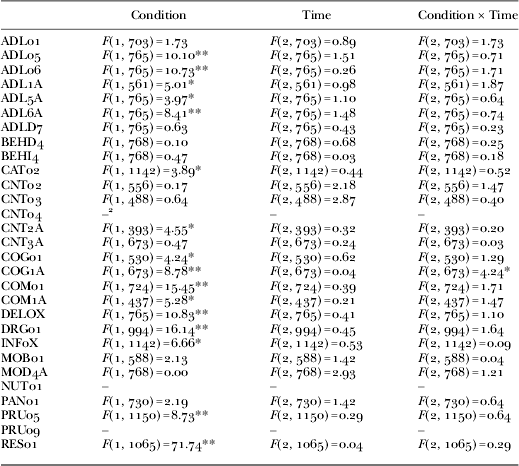
Pertinent results of the statistical models are presented in Table 4. A significant interaction between condition and time (in the expected direction) would indicate that the QI for the Intervention Facilities improved at a greater rate than the QI for the Comparison Facilities. Consistent with the unadjusted and adjusted ORs (Table 3), many of the QIs included a main effect of condition; however, the time by condition interaction was only significant for one QI: COG1A (Residents whose cognitive ability improved) and in this instance the effect was in the opposite direction of the hypothesis (see Table 3). That is, examination of the ORs and the percentage rated affirmative on the QI indicated that significantly more residents from the Intervention Facility improved on cognitive function at Baseline and immediately following the intervention (although the OR decreased from Baseline to Post-intervention) and, at Follow-up more residents from the Comparison Facilities improved. Support of our hypothesis would have occurred if the ORs had increased from Baseline to Post-intervention to Follow-up, whereas in our instance these decreased across the three time-points.
Tests of condition, time and interaction fixed effects for random-effects models of Activities of Daily Living (ADL) Quality Indicators1
Notes: 1. The table contains hypothesis tests for the significance of the fixed effects. 2. The model could not be fit to the data because of low prevalence of the Quality Indicator. All models included the covariates of age, sex, education, Cognitive Performance Scale score and Personal Severity Index score. ADL01: late-loss ADL functioning (bed mobility, transfer, eating and toilet) worsened. ADL05: mid-loss ADL functioning (transfer and locomotion) improve or who remained completely independent in mid-loss ADLs. ADL06: early-loss ADL functioning (dressing and personal hygiene) improved or who remained completely independent in early-loss ADLs. ADL1A: late-loss ADL functioning (bed mobility, transfer, eating and toilet) improved. ADL5A: mid-loss ADL functioning (transfer and locomotion) worsened or who remained completely dependent in mid-loss ADLs. ADL6A: early-loss ADL functioning (dressing and personal hygiene) worsened or who remained completely dependent in early-loss ADLs. ADLD7: ADL self-performance worsened. BEHD4: behavioural symptoms worsened. BEHI4: behavioural symptoms improved. CAT02: indwelling catheters. CNT02: bowel continence worsened. CNT03: bladder continence worsened. CNT04: urinary tract infection. CNT2A: bowel continence improved. CNT3A: bladder continence improved. COG01: cognitive ability worsened. COG1A: cognitive ability improved. COM01: ability to communicate worsened. COM1A: ability to communicate improved. DELOX: symptoms of delirium. DRG01: anti-psychotics without a diagnosis of psychosis. INF0X: one or more infections. MOB01: ability to locomote worsened. MOD4A: mood from symptoms of depression worsened. NUT01: feeding tube. PAN01: pain worsened. PRU05: stages 2–4 pressure ulcer. PRU09: newly occurring stages 2–4 pressure ulcer. RES01: daily physical restraints.
Significance levels: * p<0.1, ** p<0.01.
Qualitative evaluation of PCC programme maintenance procedures and staff knowledge
Staff perspectives on care provision
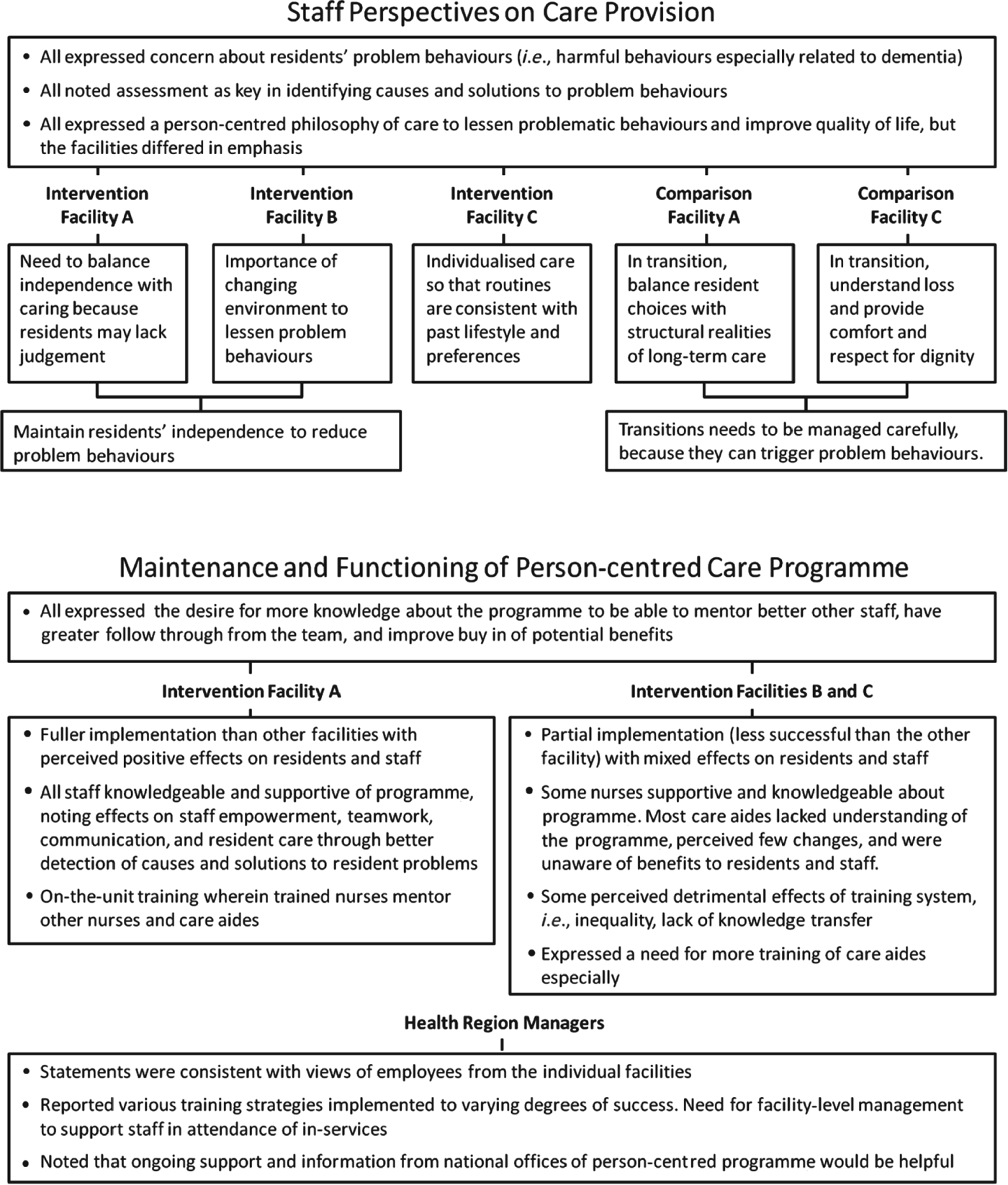
We focused on whether staff from each facility differed in their overall approach to care for residents' physical and psychological difficulties, social supports and wellbeing. A summary of the key findings is presented in Figure 1. Overall, our results did not indicate systematic differences between the Intervention and Comparison Facilities in this regard. All staff underscored concerns related to problematic resident behaviours especially associated with dementia, and described the importance of assessment in determining causes and identifying potential solutions for these difficulties. Staff described an approach to care that was generally consistent with the PCC approach, but each facility emphasised different aspects of the philosophy. Most participants from the Intervention Facilities did not link the approach to care to the intervention unless specifically asked.
Figure 1.
Intervention Facilities A and B both noted that proper assessment of behavioural concerns could help maintain the residents' independence, which they deemed imperative for quality of life. However, Intervention Facility A stressed an ethical struggle wherein they had to balance actions that supported resident independence (e.g. removing restraints) with consequences that could limit independence (e.g. falls, injury). Intervention Facility B, on the other hand, noted that modification of the LTC environment and promotion of privacy may foster independence, thereby ameliorating behavioural symptoms. For example, they described having to problem solve around residents wandering into others' rooms, and ensuring that aggressive residents are given space in group situations such as meal times. Staff from Intervention Facility C emphasised the importance of adapting care on an individual basis. The staff expressed that quality of life could be supported through an assessment of the residents' histories and providing care that was congruent with past lifestyles and habits. A care aide at Intervention Facility C captured these sentiments by stating:
…if one of our patients [sic] doesn't get up until noon that is something that we can accommodate … so we kind of try sometimes to accommodate and others if they become aggressive you are supposed to walk away and come back and try again later, so you kind of are flexible in that way or try to be.
Both Comparison Facilities (A and C) described proper behavioural assessment as key for managing residents' transition into LTC. These staff also focused on changes that they observed in residents transitioning who are contending with lack of privacy and forced social interactions. Staff from Comparison Facility A, however, described difficulties in balancing resident choices and preferences with their own hectic work shifts and residents' medical conditions. As noted by a care aide from Comparison Facility A:
I guess I would think it is about knowing the resident's history prior to admission to long-term care, things like Mrs. J. parts her hair on the left-hand side. That's something you're aware of. You don't just comb her hair you part it on the left-hand side … [however] as much as we want to pay attention to what side they part their hair, truly, some days you are lucky you got your hair combed.
Unlike Comparison Facility A, staff members from Comparison Facility C described the importance of understanding loss, providing comfort, and maintaining the residents' dignity and autonomy during transitions to LTC. This was captured by a nurse who stated:
Depression I think, is a big issue in all LTC facilities. I always tell people, you know, they need to consider the fact that when somebody moves into a LTC facility, they lose everything … some of them have lost bigger things than just their house or their lifestyle.
And a care aide from Comparison Facility C:
These people, once upon a time they have life. They grew up with their children. They look after their children. They have their privacy and, all of sudden, things changed. They have to come here. It's a different place, different life to them. So, they come here – some of them really upset coming here – so, you find a way to make them feel comfortable … And then respect them as a human being, even though, and sometimes, being old, is not a crime … But you need to respect them and know that once upon a time they have life.
Maintenance and programme functioning
This analysis focused on understanding the implementation/maintenance profile for each Intervention Facility. Analysis of the interviews with managers allowed for an overall picture of strategies at the health region level. Data were analysed into a basic deductive framework comprising key components of implementation such as personnel roles, training mechanisms, and staff perceptions and interpersonal relationships (Berta et al. Reference Berta, Teare, Gilbart, Ginsburg, Lemieux-Charles, Davis and Rappolt2005). The results are summarised in Figure 1.
Overall, our results indicated that participants from two of the Intervention Facilities (B and C) described a state of partial programme maintenance with some detrimental effects, whereas participants from Intervention Facility A described more of a full integration of the programme into clinical practice with positive effects on staff and client relationships. From all facility participants, perceived helpfulness of health regional training opportunities was somewhat underwhelming and participants were fairly unanimous in their desire for more knowledge about the programme. However, regional managers described extensive efforts to provide this training and many initiatives dedicated to the maintenance of the programme. Regional managers noted that they would also like more knowledge about the programme to be able to mentor better the facilities.
Staff from Intervention Facilities B and C provided responses consistent with each other in their description of the state of the programme. In these facilities, staff varied in their experience with the programme with some nurses describing adequate PCC programme knowledge and support, and other nurses as well as most care aides having minimal knowledge of the programme and not perceiving changes or benefits to the residents or staff relationships. In some instances, participants appeared to be bothered by the training system (i.e. nurses receiving more training, not having equal opportunity to attend all training sessions). This is evident in the following statement by a care aide from Intervention Facility C:
You know what? I think we all should have been educated in that P.I.E.C.E.S. instead of three or four people that were educated and they never passed it on. They aren't here anymore and they never passed it on to anybody else … they kept the knowledge to themselves and they never had an opportunity to pass it on and we don't have a clue.
In Intervention Facilities B and C, nurses were described to be primarily responsible for initiating assessments, administering tests, interpretation and care planning. Care aides' role was described as minimal and participants noted more training was needed for care aides especially, as indicated by a nurse from Intervention Facility B:
A lot of the frontline people, which is the SCAs [care aides] …, they should have had more of an in-depth training method and more practice. Like, they do have some training, but, um, I guess there wasn't, you know, the funding to sort of, you know. I think if they had more practice and were given a few more tools, um, they might see more value in it.
On the other hand, staff from Intervention Facility A described a different situation indicative of greater success in programme maintenance. Their overall theme involved knowledge and support by all staff members who described the positive impact of the PCC programme on staff empowerment, teamwork and communication. Nurses and care aides were able to confidently articulate the purpose of the programme, including when and why it is used, how it is used, specific aspects and tools, and the role of other team members. Both groups were exclusively positive about the programme, with neither group identifying negative aspects even when directly asked. They noted its effects on resident care, most prominently the programme's ability to systematise the problem-solving process in order to more effectively identify the causes of behavioural symptoms, facilitating better care. The following comprises the description given by two nurses from Intervention Facility A:
Nurse A: It is kind of an all-encompassing assessment of an individual. Everything. Environment, social … All aspects of that person, what could be affecting them, causing their behaviour or whatever they are going through.
Nurse B: Especially if there's a sudden change in their behaviour. You know, then you're starting to look at okay is this a delirium, what has caused this problem, those kinds of things. I think it gets you more on top of something quicker … Like you feel like, okay maybe we should perform a urine on him like right now, those kinds of things, just a little more early, quicker, I think.
Nurse A: …Or if there is a sudden change. What is the sudden change? Then you go through all the aspects, like what are the risks, what could be causing it, medical, social, emotional? And then you try to figure out how to fix it or what can improve the situation.
All staff identified the key role that care aides had in maintaining the PCC programme in Intervention Facility A. In this facility, care aides were mentored by nurses, and worked under their supervision to initiate a PCC assessment for a resident, administer the assessment tools, aid in the interpretation of tests and participate in care planning. Both nurses and care aides valued the positive role of the PCC programme in their working relationships. In this facility, the primary mechanism of training was a process of in-house consultation wherein those who had more training acted as consultants for other nurses who did not have the training and also care aides. To this end, the following are quotations from care aides from Intervention Facility A:
Person 1: You work as a team with the nurse and your partner and you make suggestions, like you do the urine and the blood tests and then you have all your tools to use and then you combine them all and look at the whole picture and a lot of times that will tell you what is going on.
Person 2: And you have input into directing, suggestions on what would be more appropriate for.
Person 3: Oh yeah. And we will sit down and have a meeting to have a plan for this particular resident as a group and the nurse gets involved and whatever. Because you do have your input and that helps us later down the road.
Health region managers were supportive of the approach and philosophy of the PCC programme. They corroborated the responses of the facility participants, noting that Intervention Facility A had more success in implementation than did Intervention Facilities B and C, although one manager noted that it took some time for Intervention Facility A to reach its current stage of implementation. Importantly, they reported that referrals from Facility A for continuing care consultation services had dramatically dropped over the time since initial programme implementation, indicating that staff from this facility were more successful in internally problem solving. In terms of maintenance training (following initial training in 2009), they described several initiatives including monthly in-services for each facility, a quarterly (four times per year) enabler meeting that aimed to bring together managers from each of the facilities, and a once-yearly ‘P.I.E.C.E.S. day’ in which staff could showcase success stories and discuss better implementation procedures. However, each of these initiatives had varying degrees of success and they described several training barriers, including most notably the need for increased facility managers' support to mitigate sporadic attendance at staff in-services and inability to have both nurses and care aides present. As noted by a manager, these barriers limit learning, the amount of new material presented and session progression.
It has to come from management down to say, there's a buy in. There has to be a commitment from the facility to attend the education … I can target what their needs are and what they're asking for but you're never sure that day who is going to be on … I've tried building on knowledge … Well, if you didn't attend the first one then the second one doesn't really mean as much … but you need the nurses there, as well. So if you target it, a case study with, including medications, um, you know, and you can't expect the care aides to move forward if the nurses aren't there … if you're going to have a really robust programme that really works, management have to say, ‘Okay. We are going to have in-services and we're going to, um, try and fit them maybe with the roster and the scheduling so that, you know, you guys are on all these same shifts.’
Both managers received training initially through the organisation P.I.E.C.E.S.™, but noted limited communication with the trainers thereafter. They stated that the organisation was available if contact was initiated (via telephone or e-mail) and their interactions were positive. However, they also had several suggestions to improve support and facilitation of their professional development following the initial training sessions. These suggestions included more frequent updates of the website to facilitate translation of best practices, notifications of updates, a newsletter describing changes in the PCC programme and success stories, and structured check-ins with the organisation or other managers to promote dialogue about the programme.
Discussion
Over the past decade, health-care organisations and LTC facilities have invested considerable resources into the implementation of PCC programmes aimed at improving behavioural symptoms and quality of life among LTC residents. However, the evidence in the LTC literature for multi-component, behavioural management programmes including those relying on a philosophy of PCC is mixed (Brownie and Nancarrow Reference Brownie and Nancarrow2013). Moreover, controlled, empirical investigations demonstrating substantial changes in resident outcomes are lacking (Logsdon, McCurry and Teri Reference Logsdon, McCurry and Teri2007). Our findings confirm this postulation. Specifically, we studied the programme P.I.E.C.E.S.™ (Hamilton et al. Reference Hamilton, Harris, Le Clair and Collins2008) as implemented within facilities of a mid-sized Canadian city, and conducted a retrospective evaluation comparing facilities in which the programme was implemented to those that had not implemented any PCC training. To the best of our knowledge this is the first major attempt to evaluate the impact of implementation of this system, which is widely used in Canada, in relation to resident outcomes. We utilised the RAI-MDS outcome scales and QIs to determine possible group differences, but did not find significance supporting the effectiveness of the PCC programme on any of the 11 outcome scales or 29 QIs examined. We also utilised narrative data to determine whether the Intervention and Comparison Facilities differed in their approaches to care; we found no systematic differences between the two types of facilities but rather, we found that staff from all facilities adhered to various aspects of the PCC philosophy. In the Comparison Facilities, staff members were concerned with difficulties regarding lack of privacy (i.e. something that could improve with PCC) and forced social interactions (e.g. facility-imposed dining companions). They believed, like staff of Intervention Facilities, that it was important to respect resident choices and to maintain dignity and autonomy. An examination of the maintenance procedures for the PCC programme in the three Intervention Facilities revealed that one facility more successfully implemented and maintained the programme, while the other two facilities struggled to utilise the tools of the programme and its general approach. Success related to the prominent role that care aides assumed within the maintenance of the programming and the climate of team work and communication present within the context of the programme.
It was evident from our discussions with nursing staff, care aides and health region managers that initial implementation of the programme was challenging and maintenance continues to be a challenge. This is consistent with the findings of Stolee et al. (Reference Stolee, Mcainey, Hillier, Harris, Hamilton, Kessler, Madsen and Le Clair2009), who also found that the implementation uptake of this PCC programme was not consistent across facilities. The lack of quantitative support for our hypothesis utilising RAI-MDS data may be reflective of these initial implementation challenges. However, this is discouraging given the substantial investments and efforts on the part of the health region to implement the programme, make training and knowledge about the programme available to all staff, and provide ongoing attempts at continuing education. The extent to which investment in the programme produces significant enough fiscal or other benefits to warrant its expansion into additional facilities is unknown. These findings substantiate questions raised by Logsdon, McCurry and Teri (Reference Logsdon, McCurry and Teri2007) regarding the necessity of multi-component, PCC programmes for behavioural management, as less complex programmes have demonstrated significant changes in resident outcomes and, due to fewer resource demands, are easier to implement. It is evident from this research and prior investigations (Gagnon, Hadjistavropoulos and Williams in press; Kaasalainen et al. Reference Kaasalainen, Williams, Hadjistavropoulos, Thorpe, Whiting, Neville and Tremeer2010; Stolee et al. Reference Stolee, Mcainey, Hillier, Harris, Hamilton, Kessler, Madsen and Le Clair2009) that for implementation to be successful, substantial investment of resources is needed; strong management support within the LTC facility is necessary to facilitate staff members' changes in practice. Prior to wide-scale investment into such programmes, it would be useful for future research to examine programmes on a much smaller scale but with a greater degree of intensity and monitoring to first determine success in that context. A cost–benefit analysis could be undertaken, for example, focusing on absenteeism due to stress and burnout; positive staff evaluations may be indicative of potential savings in this area which has yet to be empirically evaluated.
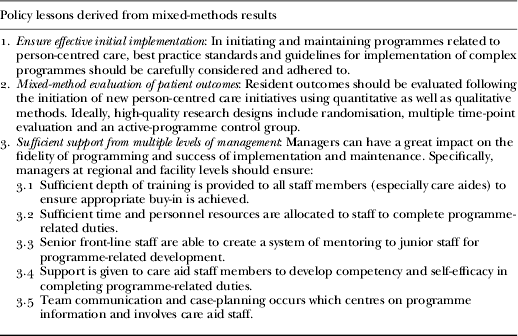
There is little question from the pre-existing literature and also supported by the findings of this study that PCC programmes are generally well-liked and received by nurses and certainly intentioned to make a difference in residents' lives (e.g. Bellchambers and Penning Reference Bellchambers and Penning2007; Brune Reference Brune2011; Koren Reference Koren2010). We found mixed support from participants regarding their subjective impressions of the impact of this PCC programme on resident care. However, in the facility that was most successful in maintaining the programme, the support was unanimously positive. These staff members found that the PCC approach was helpful in problem solving, finding causes for behavioural symptoms, fostering teamwork and empowering staff. One of the differences between the facilities that only partially maintained the programme and the one facility that more fully integrated the approach was the key role of care aides, and the ability of trained staff to mentor others that was evident in the latter facility. It was stressed that for these programmes to be successful, facility-level management must be supportive so that training can occur seamlessly, staff transitions can be maintained, and mentoring can be formalised and assisted when necessary. Further support, in general, is necessary down the chain of staff from those responsible for initial training to regional managers, facility-level managers, managing nurses, and frontline nurses and care aides. The optimistic proposition that implementation of programming can be sustained with minimal resources may be unrealistic; ongoing training needs, updates of best practice information, informal and formal mentoring, and team meetings are resource intensive and require substantial time, energy and leadership. Given these demands, health regions and LTC facilities must be diligent in insisting on high-quality, controlled trials of PCC or other behavioural management/care programmes that demonstrate concrete, improved resident outcomes prior to monetary investment in these programmes. Table 5 summarises policy lessons regarding PCC programme implementation derived from this research.
Person-centred care programme implementation: implications for policy
This study had some limitations that warrant mention. First, our study was retrospective and initial implementation of the PCC programme was conducted by the LTC facilities without researcher involvement. Although implementation was centrally co-ordinated, there might have been differences in the implementation procedures among the facilities. Although these conditions provide us with evaluation of ‘real-world’ implementation conditions, controlled, smaller-scale studies are still needed to determine the efficacy of such programmes under ideal implementation circumstances. Our quantitative evaluation of resident outcomes was limited to RAI-MDS data. Although such evaluation is appropriate given reliability and validity of the RAI-MDS, the international usage of the RAI-MDS and also the PCC programme's endorsement of this outcome measure, it is possible that there are measures more sensitive to the potential changes facilitated through the programme. Measures of care-giver process, interactions with residents and staff teamwork may have been helpful additions to the RAI-MDS.
Further, one of the Comparison Facilities implemented a PCC programme following our quantitative evaluation; staff members from this facility were not included in the qualitative portion of this research. Nevertheless, it is possible that programming we are unaware of (despite checks that were employed) could have contributed to the Comparison Facilities' endorsement of PCC strategies. This is somewhat unlikely, however, as only one nurse from the Comparison Facilities (and no care aides) reported receiving specialised PCC training. It is more likely that, given the popularity of PCC approaches and language, such attitudes are prevalent in LTC irrespective of implementation of specialised training programmes.
It would be important to also note that our results may not generalise to all LTC facilities as LTC facilities vary given differences in resident populations. In other words, resident heterogeneity across facilities/countries/health regions may limit generalisability. For instance, in a recent investigation, age and functional status impacted on the conclusions made about older adults' wellbeing (Bockerman Johansson and Saarni Reference Bockerman, Johansson and Saarni2012). Nonetheless, based on the internationally recognised definitions of PCC and similarities in programme ideologies across developed nations, and the international usage of the RAI-MDS, we cautiously contend that our results are applicable to other developed countries. Nonetheless, there is a need for replication elsewhere. Moreover, the findings of this study in conjunction with the previous literature clearly necessitate further research into such programmes prior to large-scale implementation.
Acknowledgements
This evaluation was funded, in part, through a team grant from the Saskatchewan Health Research Foundation. This project was approved by the Research Ethics Board of our institution as well as of the local health region. The authors declare that they do not have any conflict of interest pertaining to this paper.