On the surface, Hurricane Katrina was a natural disaster. Yet the failure of a succession of American governments to properly maintain the levees that would prevent the flooding of economically dilapidated sections of the city after a hurricane hit made it a catastrophe that was also caused by the state.Footnote 1 The initial media coverage of Katrina revealed what had previously been a hidden population in the neoliberal order, a predominantly African American community living in abject poverty on the outskirts of New Orleans.Footnote 2 The disposability of this population within the American national framework was brutally revealed by the federal government's inadequate and delayed response in its efforts to rescue the inhabitants of New Orleans, which left thousands stranded with scarce supplies inside the Louisiana Superdome.Footnote 3 While the state in contemporary democratic societies is often portrayed as a force of protection, the aftermath of Hurricane Katrina demonstrates that the power of the modern state rests on a process of exclusion that can leave bodies to be rendered dispensable at any time.Footnote 4
In their respective artistic responses to the events following Katrina, Kara Walker and Jesmyn Ward chose to represent African American subjects – like those left in the Superdome – that have been positioned outside the boundaries of state protection. After the Deluge is a visual essay that combines Walker's own provocative silhouettes of life in the antebellum American South with American artworks from the nineteenth century lifted from collections in the Metropolitan Museum of Art, where she curated a show with the same content in 2006.Footnote 5 In keeping with her broader body of work, Walker's silhouettes of racial stereotypes explore the deep-rooted visual vocabulary that continues to shape contemporary race relations in the USA. In the epigraph to After the Deluge, Walker resists the codification of Katrina into easily manageable sound bites such as “security failures” or “the question of race and poverty,” a codification which elides the horror of witnessing the radical precariousness of a “frightened and helpless populace” neglected by their government.Footnote 6 While this collection was planned long before Katrina occurred, Walker's combination of contemporary and historical images representing African American life exemplifies her desire to explore the “subconscious narratives at work when we talk about such an event.”Footnote 7 Jesmyn Ward similarly links the creation of her 2011 novel Salvage the Bones to a broader questioning of the ways in which the aftermath of Hurricane Katrina has been represented. Ward's novel is told from the perspective of Esch Batiste, a pregnant African American teenager who lives out in the “black heart of Bois Sauvage” in rural Louisiana.Footnote 8 The community that Esch inhabits, all male save for her brother Skeetah's prize pit bull terrier China, is a space radically disconnected from the protections associated with the American nation as a central power in the Western world. Having experienced the impact of the storm herself, Ward claims that the novel was driven by a dissatisfaction with the way “it had receded from public consciousness,” a withdrawal which has been seen to stand in direct opposition to the proliferation of 9/11 novels with their emphasis on the domestic dramas of traumatized wealthy white Manhattanites.Footnote 9
Globally resonant events such as Katrina, which bring into lurid detail the sheer power that contemporary states have in determining which of its citizens should live or die, have sustained the popularity of Giorgio Agamben's engagement with biopolitics. Agamben's oeuvre can be seen as part of a wider “political turn” within the humanities, the flourishing of an academic discourse which seeks to engage with the enduring significance of our corporeality to global political situations in spite of our increasing reliance on technologies that dematerialize our experience of the world around us.Footnote 10 A number of scholars have embraced his ongoing examination of the liminal spaces between meaningful and superfluous life in their exploration of the political circumstances that led to the state's abandonment of African American communities in the aftermath of Katrina.Footnote 11 Yet Agamben's concept of “bare life,” a lucid outlining of the philosophical mechanisms by which bodies are stripped of their political significance, has been overlooked in examinations of the cultural responses to Hurricane Katrina. Using Agamben's concept of “bare life” as a theoretical framework, this essay aims to explore the intricate means by which the post-Katrina works of Kara Walker and Jesmyn Ward consider the continuing relevance of the relationship between representation and biopolitical disposability, the way in which narratives fundamentally influence, mediate and express the material conditions of our existence.Footnote 12 Salvage the Bones and After the Deluge explore this affiliation through an engagement with a longer genealogy of representation of the black body from slavery onwards, imploring us to trace the heterogeneous trails that led to the abdication of governmental responsibility during Katrina.
Ward's and Walker's depictions of racialized bodies in the wake of Hurricane Katrina strongly resonate with specific aspects of Agamben's portrayal of biological forms that have been stripped of the privileges that identification with the category of “the human” entails. First, both artists engage with the way in which the line between man and animal in Western culture has been exploited to mark racialized bodies as nonhuman, a concept discussed in Agamben's notion of the anthropological machine. By projecting animality onto socially subjugated groups, these individuals are framed as neither animal nor human life, but bare life. Second, Agamben, Ward and Walker all engage a genealogical approach to their work which embraces a malleable employment of history. However, this genealogical method prompts reflection about the ethics of representing the relationship between current and historical forms of politically expendable life. While the chronological flexibility of bare life allows it to adhere to the genealogical rendition of African American bodies in After the Deluge and Salvage the Bones in stimulating ways, these texts can be seen to diverge from Agambenian models of thought through their engagement with the material experiences of nonwhite subjects. This discussion therefore participates in a wider discourse regarding the way in which the Eurocentric, psychoanalytic frameworks of trauma and Agambenian biopolitics cannot account for the ways in which enduring legacies of racism operate. Probing the intertextual connections that are created between Toni Morrison's novel Beloved (1987) and the silhouette form, which elucidate the relationship between blackness and nonexceptional modes of violence, we can witness how these artists rupture what can be perceived as an artificial distinction between transgenerational biopolitical vulnerability and the experience of continuous forms of concealed trauma. In prompting their audiences to see Katrina in relation to a protracted narrative of exclusion, these artists can be seen to open up a wider debate about the conceptual structures that we use in order to describe shattering incidents such as Katrina that are nevertheless connected to structural forms of persecution.
AGAMBEN AND THE HUMAN–ANIMAL BINARY
In order to understand Agamben's ideas regarding how subjects are barred from the category of the human within the modern political sphere, it is necessary to trace the development of his conception of bare life. In his 1995 book Homo Sacer: Sovereign Power and Bare Life, Agamben engages in a similar line of critical genealogy to that of Michel Foucault in his desire to trace how modern politics utilizes invisible power as opposed to visible subjugation to control and manipulate populations.Footnote 13 In opposition to Foucault's distinction between antiquity and modernity, Agamben constructs a version of history that identifies a perpetual lack of definition between the categories of zoē (the physiological existence common to all living beings) and bios (the qualified, political form of life proper to an individual or group).Footnote 14 He illustrates this historical continuity through the persistence of the sovereign and the homo sacer as figures that demonstrate the gaps between the categories of bios and zoē. The “inclusive exclusion” of the sovereign within the polis is matched by the ancient figure of the homo sacer, a sacred man who could be condemned to death by law but who could not be sacrificed due to the removal of his political life.Footnote 15 For Agamben, the homo sacer is the originary figure of “bare life,” the object of sovereign violence who is decreed expendable due to his exclusion from the political realm.Footnote 16 The ability of the sovereign to produce a state of exception in which the normal rule of law is suspended and through which bare life is produced represents the hidden foundation on which the entire political system is based.Footnote 17 Using selected historical examples, Agamben traces how modern biopolitical states have utilized the state of exception that causes the production of bare life in order to justify the abandonment and potential destruction of those individuals subject to their control.Footnote 18
In The Open: Man and Animal, Agamben can be seen to further nuance and develop his thought with regard to how bare life is produced. In this book, Agamben outlines the concept of the “anthropological machine” as a collection of symbolic discourses operating within the history of Western thought that aim to construct human and animal in opposition to one another. These discourses declare that the elevation to human status is predicated on “destroying one's own animality.”Footnote 19 Yet Agamben argues that the inability of these discourses to effectively define what is fundamentally unique about the human inevitably leads to the collapse of the distinctions between the human and the nonhuman.Footnote 20 The term Homo sapiens therefore does not represent a clearly defined species or even an identifiable substance, but rather represents an optical machine through which the human viewer sees his or her own image reflected “always already deformed in the features of an ape.”Footnote 21 As such man is only an “anthropomorphous” animal whose humanity cannot be recognized as distinct from the ape, hence man “must recognize himself in a non-man in order to be human.”Footnote 22 The anthropological machine therefore works as a continual rearticulation of the divisions between human and animal; this process can then be employed to mark specific individuals out as being nonhuman by attempting to isolate the animal within them.Footnote 23 Foraying into history, Agamben identifies the slave, the barbarian, the Holocaust victim and the foreigner as examples of members of society who have been seen to retain their animality in human form and are accordingly examples of bare life.Footnote 24 Agamben's notion of bare life therefore engages with a specific branch of posthumanist thought that encourages the blurring between humans and their others (be it material, technological or animal) in order to probe the very category of the human itself.Footnote 25 In his denotation of the figures that have retained animality, Agamben alludes to the way in which the differentiation between human beings and animals is one of the fundamental ways in which biopolitics exerts itself.Footnote 26
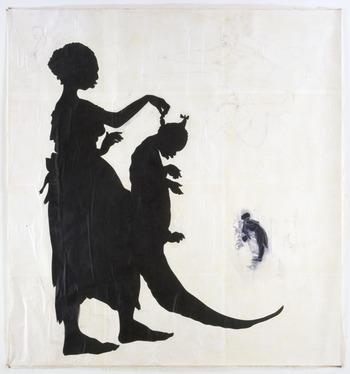
Kara Walker extensively explores the volatility of the line between human and animal in After the Deluge. In an untitled piece from 1996 (Figure 1), one of Walker's silhouettes depicts a woman holding what appears to be a cross between an African American child and a crocodile. As Lisa Saltzman notes in her analysis of Walker's work, the medium of the silhouette renders all figures black, thereby completing “a perverse visual enactment of the ‘one drop rule’” which also “implicates the viewer in the social semiotics of reading and (re)producing racial difference.”Footnote 27 Walker mimics specific visual features of racist stereotypes in order to induce a racialized reading of her images. The exaggerated lips of the female figure, combined with the fact that she holds the child roughly by a lock of curly, braided hair, prompts the viewer to assume that the two female characters are African American due to use of visual markers which contrast to cultural depictions of whiteness. The smaller, male, figure, to whom the female figure is apparently holding up the crocodile child for inspection, is more difficult to read visually. Walker provides more detail to the male figure's clothes: hints of blue shading provide a sartorial elegance that stands in contrast to the ragged edges of the female figure's dress. The difference in economic status that the contrast between the male and female figures denotes, alongside the indelicate manner in which the female figure holds the monstrous child, indicates that the child is being held up in order to be inspected by a fully human form. Walker's image of the gaze of the man upon the blurred human–animal can be seen as a playful depiction of the workings of Agamben's anthropological machine. In depicting a human form staring at a blurred human–animal hybrid, Walker's image indicates how the politics of the distinction between the human and the animal that Agamben describes have historically been utilized and exploited in order to exclude and marginalize racialized subjects.
Kara Walker, untitled, 1996. Cut paper, watercolour and graphite on paper mounted on canvas, 69½″ × 66″ (176·5 cm × 167·6 cm), private collection. Kara Walker, After the Deluge: A Visual Essay (New York: Rizzoli, 2007), 95. Reproduced with permission from Sikkema Jenkins & Co. on behalf of the artist and copyright holder Kara Walker.

While Walker presents us with a visual depiction of the way in which the anthropological machine creates forms of dominated and dehumanized life, Ward's engagement with the elasticity between species, however, can be seen to jar the internal logic of the anthropological machine. Within the hyper-local setting of Salvage the Bones, Esch, her father and her brothers Randall, Skeetah and Junior are figured almost statically around “the Pit” – a hollow trench outside the family's property whose form shifts with the changing seasons.Footnote 28 Esch's family is joined by a small ensemble of characters from the surrounding community, including Manny, the father of Esch's baby. These individuals appear radically isolated and disengaged from broader national or political contexts, and from the communities that surround them. The trappings of the modern world are absent; Ward only provides us with momentary glimpses of the institutional interaction that typically structures North American existence. When the hand of Esch's father is ripped off in a brutal accident as the family prepares for the arrival of Katrina, the scene in the hospital is a fleeting moment of contact with the outside world before we return to the confines of the Pit.Footnote 29 If most novels are structured horizontally, skimming gracefully between the experiences of different sentient human characters, then Ward's novel takes a radically different approach. The Pit is its central character, and Esch's perspective plunges from the insects crawling on the ground to the birds swirling in the air in her lush, swampland setting. Ward's stylistic tendency to include aspects of the natural world normally excluded from the literary picture is best exemplified by the chapter in which Esch and her brothers leave “the black heart of Bois Sauvage” for the “pale arteries” where they steal medicine for China from a white farmer.Footnote 30 In the chase between adolescents and farmer that follows their detection, Ward utilizes a litany of animalistic metaphors to initiate a blurring between the animal and human forms that make up the passage. While an inquisitive egret pecks at Esch's feet, she describes how the urine building up inside her pregnant body is “a tadpole grown to the confines of its egg.”Footnote 31 Big Henry in turn is a “startled bear,” the farmer's dog is “leaping like a doe,” and the farmer himself “waves his hands at the dog as if he is casting out a fishing net.”Footnote 32
This chase scene is certainly indicative of the all-encompassing vision of the natural landscape that Ward creates and sustains throughout the novel, as animal and human forms are fluid and interchangeable. Yet, moving away from a purely metaphorical level, Salvage the Bones also demands that we envision specific animals in noninstrumental terms. When Skeetah asserts at the beginning of the novel, “some people understand that between man and dog is a relationship … Equal,” Ward can be seen to engage with a literary discourse also employed in Marlene van Niekerk's Triomf in which we are called on to resist inscribed hierarchies between canines and humans, and to evaluate human and nonhuman characters alike in the present narration of their novelistic context.Footnote 33 Ward's multilayered pairing of Esch and China resists the social allegory in which comparing a human to a dog inherently reduces the former's status. Agamben's concept of the distorted reflection, the process by which humans determine their unique status, is subverted by Ward in Salvage the Bones. As Esch's pregnancy develops, she demonstrates the desire to witness the changing state of her body as it appears to the outside world. Since the only “big mirror” within the house hangs in the living room, Esch is deprived of seeing her transforming body as she tries to keep the growing baby secret from her family.Footnote 34 Instead of seeing herself in the mirror, Esch recognizes herself in the pregnant China. From the very beginning of her pregnancy, Esch associates her own body with China's, even claiming that “maybe it's China that made me get it” with regard to the initial recognition that she is pregnant.Footnote 35 Ward plays further with the indistinctions between the human and animal forms in her visceral descriptions of China coupled with Esch's memory of her mother giving birth to Junior. In the opening scene of the book Esch recalls her mother, claiming “I can see her, chin to chest, straining to push Junior out” directly before “China tenses … she seems to be turning herself inside out.”Footnote 36 Ward depicts a literary universe in which the antagonistic relationship between humans and animals is subverted through an optical transcendence of the species line.Footnote 37 Unlike Walker's crocodile girl, who is lifted up and dangled powerless in front of the human gaze, the fluidity of the boundary between species in this novel demonstrates the contingency of our present moment by undermining the power of differentiation between human beings and animals. We can perceive, therefore, that Walker and Ward in different ways both expose the processes by which forms of life are positioned as disposable through the manipulation of the human–animal binary, a concept which Agamben is also invested in.
A GENEALOGY OF EXPENDABILITY: SLAVERY AND KATRINA
It is the centrality of one of Agamben's figures who is marked by this human–animal distinction, the slave, to Kara Walker's oeuvre which initiates a consideration of the ethics of representing and engaging with a convoluted, fragmented lineage of African American vulnerability under the mechanisms of state power. Walker's focus on the slave body opens up probing questions about how to portray the relationship between individuals from historically distinct periods who are nevertheless united by their liminal position within the political realm. For Agamben, the body of the slave is an “anthropophorous animal … [an] unresolved remnant that idealism leaves as an inheritance to thought, and the aporias of the philosophy of our time coincide with the aporias of this body that is irreducibly drawn and divided between animality and humanity.”Footnote 38 Inclusion within Agamben's highly selective genealogy places the slave onto the “monstrous continuum” of bare life, connecting the slave body to other temporally and contextually distinct examples of expendable corporealities such as the concentration camp victim and the barbarian.Footnote 39
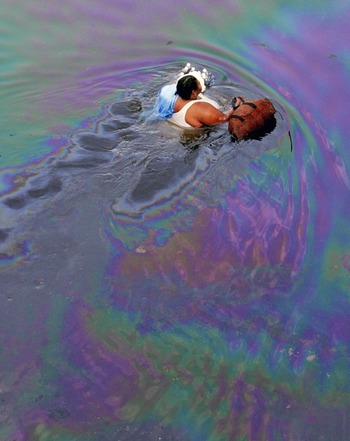
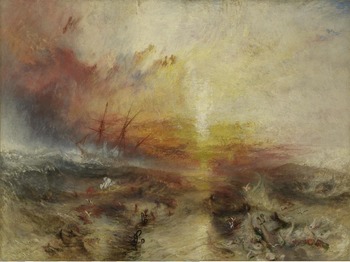
Walker's engagement with slavery takes a similar genealogical approach to Agambenian thought. After the Deluge engages with the slave body not only through Walker's creation of the fantastical silhouettes of antebellum life, but also in her juxtaposition of canonical representations of slavery with the events following Hurricane Katrina. The only image taken directly from Hurricane Katrina accompanies Walker's ruminations in the opening section entitled “Muck.”Footnote 40 The photograph (Figure 2) depicts an African American woman swimming in oil-drenched waters. Unlike Walker's silhouettes, which engulf the viewer's gaze with their scatological and grotesque behavior, the unnamed, swimming individual who faces away from us has a sense of dignity. In the text on the opposite page, Walker outlines a key theme in her artwork: “the idea that a Black subject in the present tense is a container for specific pathologies from the past and is continually growing and feeding off these maladies.”Footnote 41 On turning the page, we are confronted with a double-page spread of what is typically referred to as J. M. W. Turner's Slave Ship (Figure 3), though the painting's official name is Slavers Throwing Overboard the Dead and Dying, Typhoon Coming On.Footnote 42 The sharpness and cool colors and the apparent placidity of the photograph contrast dramatically with the expressionistic, fiery style of Turner's painting, where tens of tiny black hands can be picked out reaching up from the turbulent waters. In both the photograph and the painting, the bodies in the water are rendered disposable, suggesting their expendable position between the Middle Passage and the present day.Footnote 43
PA Images/Bill Haber, in Walker, After the Deluge, 8. Reproduced with permission from PA Photos Limited.

Joseph Mallord Wiliam Turner (1775–1851), Slave Ship (Slavers Throwing Overboard the Dead and Dying, Typhoon Coming On), 1840. Oil on canvas, 35¾″ × 48¼″, Museum of Fine Arts, Boston, in Walker, After the Deluge, 10–11. Reproduced with permission from the Museum of Fine Arts, Boston.

The opening to Henry Giroux's Stormy Weather, in which he uses an Agambenian model of bare life in order to explore the events of Hurricane Katrina, however, illuminates some of the ethical implications of the temporal collapse that Walker's previously discussed pairing of images seems to suggest. Using the bloated, waterlogged body of Emmett Till (an African American teenager killed by white supremacists in 1955) as a counterpoint to the bodies left floating in the wake of the hurricane, Giroux warns against creating a transhistorical image of the African American body excluded from the political sphere. He asserts that though the fate of Emmett Till and the responses to Katrina both revealed to the wider world a “vulnerable and destitute segment of the nation's citizenry,” the lack of help provided to the largely African American population after Katrina was the result of the class and racial bias of the biopolitical agenda of the Bush administration.Footnote 44 In stressing the historical specificity of the government's response, Giroux resists the interpretation of the fate of the victims as unavoidable.Footnote 45
The ethical imperative to represent events within their historical bounds has also been used to critique the very composition of Agamben's bare life. In a cutting analysis, Dominick LaCapra claims that many of Agamben's theoretical assessments are flawed by the way in which he “construes history as a source of illustrations or signs, a repository of incommensurable particularities or singularities.”Footnote 46 LaCapra also critiques Agamben's notion that harmony within a postmetaphysical society can only come about when we stop the functioning of the anthropological machine and stop registering the division between animal and human.Footnote 47 Agamben's peculiar notion of the “emptiness … the suspension of the suspension” that will occur when we render the machine inoperative is, in LaCapra's analysis, an “insufficiently situated version of transhistorical, structural, or existential trauma” which elides the agency that humans possess in committing acts of torture, genocide and other forms of victimization.Footnote 48 The way in which Agamben skips over the specificity of historical circumstance to produce a transhistorical vision of the way in which bare life is produced is seen as deficient “in the attempt to reduce or eliminate the problematic or contestable dimensions of certain human practices.”Footnote 49
Giroux and LaCapra are representative of a model of thinking which stresses the need to engage with the historical specificity of Katrina. However, their focus on the event itself can be seen as obscuring Katrina's place in the context of ongoing social and political exclusion, and as preventing us from seeing what Walker describes as the “subconscious narratives at work” when processing the hurricane. In particular, engaging with LaCapra's critique of Agamben elucidates the way in which canonical models of psychoanalytic trauma, in which a punctual event ruptures a coherent sense of self, is incompatible with describing the experiences of individuals from communities who experience structural forms of oppression.Footnote 50 As Stef Craps has noted, LaCapra's strict distinction between historical and structural trauma is particularly unsuited to deal with the traumatic impact of racism.Footnote 51 LaCapra formulates his model of trauma around loss (the consequence of particular historical events) that can be worked through and absence (structural trauma which is transhistorical in nature) that must be “lived with.”Footnote 52 However, as Craps observes, racism does not fit neatly into either of LaCapra's categories. Both envisioning racism as being tied to a discrete historical event that can be worked through – thereby ignoring the multifarious and insidious ways in which it continues to exist in the present – and viewing it as a transhistorical phenomenon that simply must be lived with seem thoroughly problematic.Footnote 53
The notion of “insidious trauma,” popularized by Laura Brown, is a useful conceptual tool for recognizing the limitations of the event-based model. In her capacity as a psychotherapist, Brown is critical of the way in which the official definition of trauma, which stipulates that a traumatic event must be “outside the range of human experience,” is incapable of registering the realities of everyday life for marginalized groups.Footnote 54 In particular she highlights the enduring structural subjugation of nonwhite and female sections of the population who experience “the traumatogenic effects of oppression that are not necessarily overtly violent or threatening to bodily well-being at the given moment but that do violence to the soul and spirit.”Footnote 55 Pressingly for this enquiry, Pieter Vermeulen uses Brown's concept in order to describe the overlap between questions of biopolitical vulnerability and the traumatic, insisting that “insidious trauma … conjures biopolitics' capillary and invisible mode of operation.”Footnote 56 Thus Vermeulen draws out the parallels between Brown's notion of trauma, which reflects on ongoing, concealed forms of denigration, and a biopolitical situation of legal vulnerability. This discussion gestures to the need for a transhistorical, structural vision when exploring the intersection between pathologies of racism and an exposed position within contemporary sociopolitical relations.
In this light, Hurricane Katrina and slavery can therefore be seen as dramatic revelations of the sustained and ongoing positions of liminality that African American bodies hold within the political realm, in Devon W. Carbado's words “outside and inside the borders of the American body, not quite not American.”Footnote 57 In his temporally flexible formulation of bare life, Agamben can be seen to encourage a perspective of history that registers enduring forms of oppression. The very composition of Walker's visual essay and Ward's novel can also be seen to mirror bare life's elasticity. While Walker gives us a table of contents in After the Deluge, the “Muck” section of the visual essay and the index of artworks are the only sections of the book that are clearly identified for the reader due to the absence of page numbers.Footnote 58 Given the fact that from the table of contents the reader is unable to see which pieces fall into categories such as “Chocolate City” or “Superdome,” Walker's list poses a challenge to a linear account of African American history.
Ward's book, too, engages with this complication of history. Corresponding to Ward's hyper-local setting, the novel is narrated over a compressed period of twelve days, with Hurricane Katrina occurring only on the eleventh. The high-intensity, dramatic action that takes place as the hurricane hits contrasts with the previous leisurely pace of Ward's prose. The reader is treated to stirring, visceral depictions of Esch fighting against the natural elements with puppies in hand: “my head bobs above the water but the hand of the hurricane pushes it down, down again.”Footnote 59 Despite the intense exploits of the eleventh day, the change in tone and feel in the following section, “Alive,” represent a return to Ward's usual form. Aside from the disappearance of China, the death of her puppies and the physical destruction of the characters' homes, Ward renders the human components of Esch's community as intact. It is telling, therefore, that the stylistic change that depicted Ward's portrayal of the hurricane is recovered so quickly. The hurricane is not an aberration, a break or betrayal of sovereign protection, but rather exists for Esch and her family as another episode in a longer history of abandonment, thereby gesturing towards the capillary form of biopolitical power. In both Ward's and Walker's works, therefore, we can see how the depiction of Hurricane Katrina challenges our sense of the hurricane as a discrete, punctual event separate from deeper configurations of subjugation.
BLACKNESS, BELOVED, AND THE SILHOUETTE FORM
Viewing Ward's and Walker's post-Katrina texts through Agamben's conceptual framework demonstrates the need for a generative conception of the past when attempting to engage with events which are connected to a longer history of exclusion rooted in race, a process which cannot be accounted for in models of thought rooted in Eurocentric, psychoanalytic frameworks of trauma. However, the construction of bare life itself can also be seen to dismiss the experiences of racialized bodies through its lack of engagement with the legacies of colonialism. While it has been brought to the forefront of the previous discussion about temporality, the body of the slave is discussed only in passing as part of a collection of secondary figures subordinated to more detailed discussions of the Holocaust. Building upon the foundations of Achille Mbembe's necropolitics, Alexander Weheliye has called for a reorientation to place racial slavery at the centre of our thinking about biopolitics.Footnote 60 Weheliye questions the Eurocentrism of Agamben's thought, asking why he views the concentration camp as the “epitome of modern sovereignty” given the sustained global reality that nonwhite subjects are more likely to occupy the liminal position of inclusive exclusion that bare life engages with.Footnote 61 For Weheliye, the uninterrupted nature of the psychic and physical violence that has been exerted on black subjects renders black suffering in “the domain of the mundane … it refuses the idiom of exception.”Footnote 62 While the politically exploitative uses of determining the human have consistently absorbed Agamben's thought, his Eurocentric focus effectively excludes racialized subjects from a broader conception of humanity by refusing to see their suffering as exceptional. It is this process of the marginalization of black subjects, which can be perceived both in the treatment of African Americans during Hurricane Katrina and more broadly in the lack of attention paid to racialized subjects within biopolitical discourse, that Walker and Ward address.
The nuances of the dual processes of marginalization of African American subjects, both in political terms and in ensuing conceptual frameworks, can be brought out through an examination of the significance of Toni Morrison's novel Beloved to the wider framing of both Ward's and Walker's work. Gwendolyn DuBois Shaw has elucidated some of the connections between Beloved and Walker's silhouettes in their cultural working through of the disremembered events of slavery.Footnote 63 Walker's silhouettes or “icons of death” are resurrected from our collective psyche to haunt the living, a resurrection which mirrors the way in which Morrison's protagonist Sethe is haunted by Beloved, the daughter that she murdered in an attempt to release her from the bonds of slavery.Footnote 64
While Walker's portrayal of African American history has been linked by critics to Beloved, Salvage the Bones explicitly invokes Morrison's text as a cultural marker. Describing her dead mother's peculiar use of language, the creation of her own linguistic world, Esch uses her mother's word “belove” to describe “when Manny was curling pleasure from me with his fingers in mid-swim at the Pit.”Footnote 65 Referencing her deep appreciation for Greek myths, Esch also recalls that before falling in love with Manny, “I was Psyche or Eurydice or Daphne. I was beloved.”Footnote 66 What Ward establishes, therefore, is a link between encounters with Manny's body and the rememory of slavery. The endurance and relevance of the slave past is therefore gestured to in Ward's and Walker's texts, demanding a mode of ethical thinking which acknowledges its relevance even, in Sethe's words, for “you who never was there.”Footnote 67
It seems significant, therefore, that Manny's body, a symbol that is intertwined with Beloved's visceral rendition of the mark that slavery has made upon African American identity, is represented in Salvage the Bones in a way that echoes the silhouette form. In a disturbing scene in which the characters administer medicine to China, Ward depicts how Esch becomes disarmed by Manny's face in the darkness of the Pit:
All I can see is the shadow of him and the white of his smile. It feels wrong to not be able to see his face, seems wrong that he is as dark as me now, that he would be washed dark by the sun behind him like ink set to bleeding over waterlogged paper.Footnote 68
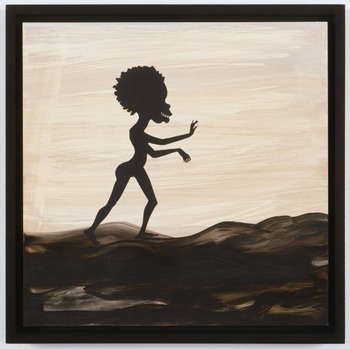
In her 2004 piece Middle Passages, Walker depicts an uncannily similar figure to the one that Ward describes (Figure 4). Perhaps even more grotesque than some of Walker's other silhouettes, this naked figure's gleaming white smile is depicted as more deformed due to his bulbous head.
Kara Walker, Middle Passages, 2004. Gouache, cut paper and collage on board, one from a series of 5·17″ × 17″, collection of Marc and Lisa Mills, in Walker, After the Deluge, 2007, 43. Reproduced with permission from Sikkema Jenkins & Co. on behalf of the artist and copyright holder Kara Walker.

Alan Gibbs's reading of Beloved helps us to elucidate a new perspective on the way in which Ward's and Walker's use of the silhouette form signals the presence of enduring biopolitical structures of exclusion that exist from slavery onwards. Gibbs's interpretation draws out the subtleties of Morrison's narration that disrupt Shaw's Caruthian analysis. Shaw connects Beloved's spectral presence to Cathy Caruth's notion of “unclaimed experience,” claiming that a failure to experience the traumatic event of slavery leads it to belatedly intrude into society's current consciousness in a visual, hallucinatory form which echoes the disturbing imposition of Walker's silhouettes for their viewers.Footnote 69 However, Gibbs contends that due to Morrison's portrayal of Sethe's consciousness of the memory process, Beloved represents the gradual recitation of a consciously repressed memory that previously she had actively refused to recount.Footnote 70 The insistent presence rather than the violent, occasional intrusion of Sethe's past leads Gibbs to reject the punctual, visual model of trauma which Shaw advocates in her reading and to turn again to Brown's concept of insidious trauma. For Gibbs, Sethe's “perpetual consciousness of trauma may be linked to the fact that for [her] it has consisted of an accumulation of incidents of abuse rather than a single, sudden event ‘outside the range of normal experience.’”Footnote 71
Viewing Gibbs's critical intervention through the previous exploration of the way in which biopolitical violence and insidious trauma are related therefore prompts us to reflect upon the way in which the silhouette form is used within Ward's and Walker's work to express a legacy of political expendability. We can perceive a formal replication between the silhouette and the erasure of the human form in Agamben's biopolitical model. In its creation of the void of the human, the silhouette form bears an eerie similitude to bare life due to its portrayal of the semblance of a human who has been detached from the communities and institutions, the proper, political life which allows us to resist the mechanisms of sovereign violence. More crucially, in their construction of these stripped surfaces these artists engage with the material conditions of racism by portraying figures that are defined entirely by their colour. Ward and Walker engage with the way in which, in Weheliye's words, blackness “designates a changing system of unequal power structures that apportion and delimit which humans can lay claim to full human status and which humans cannot” in the American context from slavery onwards.Footnote 72 Furthermore, Carbado has contended that we should conceive of blackness itself as a form of bare life in that it has been included in the juridical order “solely in the form of its exclusion.”Footnote 73 Through the obscured features of Ward's depiction of Manny and the opaque flatness of Walker's silhouettes, we can therefore see portrayals of black figures whose corporealities bear the spiritual and structural violence that characterizes insidious trauma.
Scrutinizing the genealogical uncovering of representations of African American existence, we can perceive how both Ward and Walker position Katrina against ongoing forms of violence and exclusion enacted on this community. In particular, these artistic responses to Katrina gesture to the contemporary political resonance of “blackness” as a determining factor through which bodies are constructed as bare life in the contemporary American context, rupturing what can be seen as the artificial distinction between conditions of biopolitical vulnerability and the experience of trauma. Viewed from this perspective, it is difficult not to see Ward's and Walker's construction of African American history as one shrouded in pathos, the events of Katrina historically determined from some distant point by the inseparable conjoining of a legacy of European colonial slavery and race.Footnote 74 Yet while Ward and Walker engage with the historical event of slavery, they do so in a way that is highly mediated. The post-Katrina texts associate the artificial form of the silhouette with Morrison's fictional Beloved, itself a contemporary reflection about the opaqueness of the past. While these texts, viewed through the contours and complexities of Agambenian biopolitics, implore us to recognize the structural importance of race as a means for political exclusion, they also highlight the fragility, the constructed nature, of our forms of expression.Footnote 75 Through the intertextual and wider critical conjoining of the manufactured silhouette with the stylized literary design of Beloved, we can perceive a refusal to naturalize the nexus between the historical occurrence of slavery and contemporary biopolitical vulnerability. The genealogical approach that Ward and Walker take in their examination of African American life in these post-Katrina texts at once does not ignore the material effects of racism, and demonstrates the way in which we can make these contingencies and legacies thinkable, thereby leaving our political and cultural present open to remaking.Footnote 76