The literature on the descriptive representation of women in parliaments is voluminous, and most studies focus on different levels of women's representation across legislatures (e.g., Krook Reference Krook2010; Matland Reference Matland1998; Paxton Reference Paxton1997; Reynolds Reference Reynolds1999; Siaroff Reference Siaroff2000). The number of women in parliaments is counted across the globe, and explanations as to what facilitates and hinders the election of female politicians are sought. At a macro level, PR systems, high district magnitudes, and, of course, gender quotas are some of the institutional mechanisms that have been identified as advantageous for women's ambitions to conquer seats in legislatures. These aspects of the electoral system have also drawn widespread attention among electoral engineers, since they can be manipulated, far more so than can socioeconomic factors (such as women's educational level or participation in the labor market) or cultural factors (such as dominant religion or the cultural perception of women's societal role), both of which have also been identified as important to women's descriptive representation at the parliamentary level (see, e.g., Christmas-Best and Kjaer Reference Christmas-Best, Kjaer, Cotta and Best2007).
The relationship between women's descriptive and substantive representation—whether and how women's presence affects policy—is debatable. The dominant position is that even though the full understanding of the underlying mechanisms is still sought, the presence of women in legislatures is important for the representation of women's interest (Phillips Reference Phillips1994; Mansbridge Reference Mansbridge1999). Paralleling the renewed focus on the importance of women's parliamentary presence (Phillips Reference Phillips1994), parliamentary research focuses increasingly on committees in legislatures (Shepsle and Weingast Reference Shepsle and Weingast1987; Weingast and Marshall Reference Weingast and Marshall1988; Sprague Reference Sprague2008; Yordanova Reference Yordanova2009). The general sessions are important, and discussions on the floor are crucial to the decision-making process, but a lot of politics also takes place in the committees. These two trends—focus on presence and focus on committees—have also been combined and have led to a few studies of women's presence in committees and the recruitment processes leading to the degree of women's descriptive representation in these committees (Carroll Reference Carroll and Reingold2008; Diaz Reference Diaz2005; Friedman Reference Friedman1996; Frisch and Kelly Reference Frisch and Kelly2003; Gertzog Reference Gertzog1995; Thomas Reference Thomas1994; Wängnerud Reference Wängnerud2009; Yule Reference Yule2000). Underlying most of these more detailed analyses of women's descriptive representation is not only a motive to expand the analysis of women's political presence to new empirical hunting grounds, but also a sincere concern that even though women in recent years have, on average, increased their presence at the parliamentary level, women as a “… new group will not be fully incorporated into the legislative process but will be kept on the sidelines” (Heath, Schwindt-Bayer, and Robinson Reference Heath, Schwindt-Bayer and Robinson2005, 420). Entering parliaments in substantial numbers means that women increasingly have taken “a place at the table” (Frisch and Kelly Reference Frisch and Kelly2003), but it might be that they are not sitting at the tables (i.e., committees) where the most important political decisions are made. We applaud these endeavors to study women's descriptive representation and the concomitant processes of recruitment at the more detailed committee level. But the research on women's committee assignments is still in its infancy, and there is plenty of room for theoretical and methodological improvement. As for the theoretical discussion, previous studies of women's committee assignments have identified and analyzed two interesting and central questions. First, whether differences in women's committee assignments compared to those of their male counterparts are found along vertical or horizontal lines (Raaum Reference Raaum, Karvonen and Selle1995; Yule Reference Yule2000). The distinction is defined as follows: “The vertical division of labour is concerned with the position of men and women in political hierarchies, while the horizontal division of labour focuses on the various policy areas in which men and women work” (Raaum Reference Raaum, Karvonen and Selle1995, 29). Therefore, the horizontal dimension distinguishes between committees that are at the same vertical level of influence but differ in regard to the types of issue they consider. This also means that the two dimensions are not deterministically connected—knowing a committee's position on one dimension does not imply that the same committee's position on the other dimension can be guessed.
In relation to committee assignments, this means that if a vertical division of labor exists, then we should find women relatively less assigned to committees that are formally more influential (for instance, with funding or coordinating power) and/or so-called “prestige committees” (Carroll Reference Carroll and Reingold2008). And if a horizontal division of labor exists, then we should find women relatively more assigned to committees “dealing with issues traditionally seen as more compatible with women's interests” (Carroll Reference Carroll and Reingold2008, 137). As a study conducted in two English local authorities concludes, “Women were … underrepresented on committees associated with men's concerns (planning, information technology, passenger transport and technical services),” whereas “women were overrepresented on committees that dealt with specific service areas and that had a responsibility for issues associated with women's concerns: education, environment, leisure, municipal services, nursery, personnel, and social services” (Yule Reference Yule2000, 36). This is very similar to the division of labor identified by Diaz, who claims that in parliamentary committees “women are working with ‘soft’ issues and men are working with ‘hard’ issues” (2005, 129).
Second, existing research has identified two explanations for a gendered division of labor in committee assignments. Based on the popular supply-demand model used extensively in studies of women's political representation (e.g., Randall Reference Randall1982, 85; Norris and Lovenduski Reference Norris and Lovenduski1995, 144), a distinction is made between “choice” or “self-selection” (Frisch and Kelly Reference Frisch and Kelly2004) and “discrimination” or “stereotyping” (Carroll Reference Carroll and Reingold2008, 136). The difference is who to blame (or credit) for any gender differences in the committee assignments. As Carroll puts it:
Hypothetically, women and men in the aggregate could end up serving in different committees for any of the following reasons: (1) women and men prefer different committees, (2) legislative leaders think women are better (or less) suited to certain committees and assign (or fail to assign) them to these committees despite women's preferences to the contrary, or (3) a combination of (1) and (2) (2008, 135–36).
A number of empirical studies have supported the supply-side explanation by finding that gender patterns are mostly created by choice rather than by discrimination (Carroll Reference Carroll and Reingold2008, 155; Frisch and Kelly Reference Frisch and Kelly2003, 9; Swers Reference Swers2002; Thomas Reference Thomas1994, 67) and that “the overall picture is that functional divisions stem from men's and women's different preferences for committees” (Wängnerud Reference Wängnerud2009, 61).
These two important questions addressed in previous research on women's committee assignments have, however, not been systematically combined. If we distinguish only between vertical and horizontal gendered segregation, then we ignore the source of segregation. Conversely, if we only study whether segregation exists due to self-selection or discrimination, then we ignore that the source of segregation may not be the same vertically and horizontally. Hence, it is important to combine the two dimensions, which leaves us with four potential patterns of gender difference: supply-driven vertical, supply-driven horizontal, demand-driven vertical, and demand-driven horizontal. In any given context, any number (or none) of these four patterns can exist. To us, it is not trivial how many and which gendered differences exist if the ambition is to understand the level of gender equality in a political system. Hence, our empirical study is designed to study the potential presence of all four patterns.
Methodologically, we find it less than optimal that studies comparing committee preferences with actual committee assignments traditionally measure preferences very late in the assignment process. When Carroll (Reference Carroll and Reingold2008) evaluates whether politicians’ preferences for committee assignments have been fulfilled, she asks the politicians after the committee appointment process has been concluded and the legislators know not only to which committees they have been appointed, but also their first experiences with sitting on these committees. The politicians’ preferences measured in retrospect might be affected by their knowledge about the committees to which they actually were assigned, and any tendency to be affected by such knowledge might not be gender-neutral. Frisch and Kelly's thorough study on assignments to the U.S. Congress relies on members’ requests made before the assignment decision was made, but their approach is still problematic. A minor worry is that the data are collected after the election, and, therefore, the politicians know how strong or weak they came out of the election (and how high committee ambitions could be). It is even more troubling that the requests are sent to the party committee on committees (the party leadership, that is) and can, therefore, be affected (and not necessarily in a gender-neutral way) by the representatives’ perception of which signal they send to their party leadership. To avoid suspicion that the committee preferences are in any way contaminated by such response mechanisms, we argue that preferences should be measured in anonymous surveys conducted right before, rather than after, Election Day.
In the remainder of the article, we present the results from a case study in which we combine the two theoretical dimensions and in which we have taken care of the methodological problems outlined above by measuring preelection committee preferences in an anonymous survey. The case study is conducted at the local level in Denmark in 2009. We could claim that the case selection is not that important, since we first and foremost use the case as illustrative in our effort to combine the two dimensions of vertical/horizontal and supply/demand side. But Danish local government also offers advantages in terms of research design. The perception in several studies is that gender differences in committee assignments are fading (Carroll Reference Carroll and Reingold2008). By choosing a Scandinavian country where gender equality is supposed to be most advanced (and traditionally has been, also at the local level [Dahlerup Reference Dahlerup1988]) we have a critical case: This is a setting where gender differences are least likely—if we find a gendered division of labor here, then it is definitely worthwhile to search for it in other contexts, too. Furthermore, there are more politicians to survey in local governments than at the national level, and it is possible to hold a number of institutional factors constant (John Reference John, Baldersheim and Wollmann2006; see also Paxton, Kunovich, and Hughes's [Reference Paxton, Kunovich and Hughes2007] call for such research). Finally, the case offers ideal conditions for identifying committees that men and women stereotypically should request; this is not always easily done (see, for instance, Frisch and Kelly Reference Frisch and Kelly2003, 9).
COMMITTEE ASSIGNMENTS IN DANISH MUNICIPALITIES
Denmark consists of 98 municipalities, each with a city council. The municipalities play a central role in service delivery to the public and are responsible for the provision and distribution of a wide range of important welfare services such as day care, elder care, and public schools, along with services like libraries and local environmental protection. Elections to the city councils are held every four years, and the candidates run for election on lists made by their party. The composition of a new council is determined by proportional representation across election groups (apparentements) using the d'Hondt formula (Elklit Reference Elklit2005, 35).
After the election, the new city council decides on the number of standing committees, the distribution of tasks across committees, the number of seats on each committee, and the chair of each committee (Local Government Statute 2006). The number of committees varies considerably between municipalities (in the election period 2006–2010, the municipalities used between 3 and 15 committees), and city councilors can sit on more than one committee (mean: 1.74 seats per member; see Baekgaard Reference Baekgaard2010). One committee—the finance committee—is compulsory and generally seen as the most influential; it is in charge of coordinating across the jurisdictions of all standing committees and controls the budget decisions of the other standing committees (Serritzlew Reference Serritzlew2003, 332). The standing committees are centrally placed in the municipal legislative system with each standing committee responsible for the daily administration of its own jurisdiction (Serritzlew Reference Serritzlew2003, 329). The allocation of committee seats after an election is important to the councilors, as the committees are the platforms from which they are able to influence policies and attract public attention.
The allocation of committee seats takes place across election groups, across parties within the same election group, and across members of the same party. For every single committee, seats are allocated proportionally across election groups according to their share of seats in the city council (Local Government Statute 2006, §§ 25, 27). The decision about how to distribute seats across parties within an election group is negotiated right after the election by the leaders of the parties represented in the election group. The negotiation is a complex process in which party and individual considerations and preferences may play an important role. The within-party allocation of committee seats is handled entirely by the parties (the party leaders, that is), the only formal requirement being that every elected party member should receive a seat on at least one committee. Committee requests are usually delivered orally from party members to their leaders, and the very informal format of the allocation process entails that party leaders have wide discretion in distributing seats.
GENDER DIFFERENCES IN COMMITTEE ASSIGNMENTS AFTER THE 2009 LOCAL ELECTIONS IN DENMARK
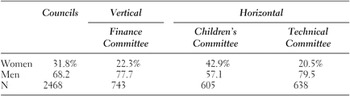
To assess the extent to which men and women councilors end up in the same kind of committees, we coded the committee memberships of all 2,468 councilors elected in the 98 Danish municipalities after the 2009 elections. As for the vertical division, it is easy to make a distinction since, as already described, all 98 municipalities have a finance committee, which in many ways ranks over the policy committees. The finance committee deals with financial and coordinating issues concerning all policy areas, and, therefore, the committee can be placed on the vertical dimension only (and not the horizontal). Furthermore, a vertical division may be revealed if we take a look at the gender of committee chairs. The chairs have better chances than fellow committee members to affect the policy of their committee, as they prepare, convene, and govern the committee meetings (Baekgaard Reference Baekgaard2009). The horizontal divide is more complicated, since the municipalities decide how to organize the committee structure and choose different divisions. Two policy areas, however, are quite easy to place in the committee structure of the 98 municipalities, namely children (child care and social policy aimed at children) and technical questions (roads, renovation, water, sewage, etc.). Since they tend to fall within two groups of traditional women's and men's concerns mentioned above, they can serve as examples. In Table 1, we calculated the gender composition of the finance committee, the children's committee, and the technical committee in the 98 municipalities.
The gender composition of the councils and committees after the Danish 2009 local elections

Note: Based on Municipal Yearbook 2010.
Table 1 demonstrates that there is a gendered difference in the composition of the three committees. A vertical divide is revealed: women make up 31.8% of the councils, but their share of the seats in the powerful finance committees is only 22.3%. Also, a horizontal division of labor can be observed: women hold 42.9% of the seats in the children's committees, but only one-fifth of the seats in the technical committees.
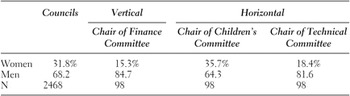
Since each committee has an influential chair, we add this extra level of vertical division of labor to the analysis. In Table 2, the gender composition is calculated for the chairs only. Here, the gender difference is even more pronounced; in all three committees the women are more underrepresented in the chair position than in the committee overall. A gendered difference—vertical as well as horizontal—clearly exists in the committees of Danish local government.
The gender composition of the councils and chairs of committee after the Danish 2009 local elections

Note: Based on Municipal Yearbook 2010.
EXAMINING SUPPLY-SIDE AND DEMAND-SIDE EXPLANATIONS
Does the gender pattern originate from men and women self-selecting to certain committees (a supply-side explanation), or is the decision made by the selectors, the political parties, and their leadership (a demand-side explanation), as is often suggested in the vast literature on committee assignments and committee power (see, for instance, Cox and McCubbins Reference Cox and McCubbins1993, Gilligan and Krehbiel Reference Gilligan and Krehbiel1987; Kiewiet and McCubbins Reference Kiewiet and McCubbins1991)? In order to examine this question, we need to analyze whether men and women's committee seat preferences differ and whether the fulfillment of committee seat preferences depends on sex. That is, we need data on the pre-election committee seat preferences for elected politicians and data on their actual committee seats after the election.
Data on Danish politicians’ committee requests is not available as in the U.S. Congress (Frisch and Kelly Reference Frisch and Kelly2004, 327), since committee requests are delivered orally as a part of post-election negotiations on the allocation of committee seats. Instead, we measured politician committee seat preferences in a survey sent October 20, 2009, to 2,827 of the 9,049 candidates for the November 17, 2009, elections to the Danish city councils (see also Baekgaard Reference Baekgaard2010). In total, 1,657 candidates responded to the survey (corresponding to a response rate of 58.6%). Since we are only interested in candidates elected to the city councils, the dataset was reduced to 678 individuals (those who were actually elected), corresponding to approximately one-third of the candidates elected to Danish city councils in the 2009 elections. The subsample is representative of the population of elected councilors with regard to gender and party affiliation (for instance, the subsample contains 32.9% women and the population of councilors 31.8%). The response rates vary considerably across municipalities, though. In order to check whether the underrepresentation of politicians from some city councils affects our results, we ran our regressions both with and without regression weights. Since these analyses yield similar results, we report just the regressions without regression weights.
The candidates were asked to state their first and second priority among nine committee portfolios. We chose not to ask about actual names on existing committees, since structures can be changed after the election, and since it allows us to compare across municipalities with different committee structures. The advantage of measuring preferences in a survey is that the response is probably a good measure of the politicians’ true preferences about committee seats.
We created a dummy variable for each committee, which takes the value of one if the committee is the city councilor's first or second priority and zero if it is not (analyses where only the first priority takes the value one yields similar results). Again, we focus on the finance committee, the children's committee, and the technical committee since these committees are comparable across municipalities. Furthermore, from a theoretical perspective, these committees are the most interesting to study since they are the ones where gender preferences about assignments are most likely to differ and where discrimination is most likely to take place.
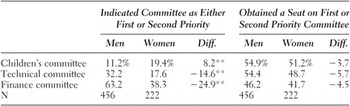
The survey data are supplemented with post-election data on the actual allocation of committee seats, background information on individual politicians’ characteristics, and data on institutional characteristics, such as the size of the city council and the number of standing committees. Table 3 provides a description of gender differences in committee seat preferences and the extent to which committee seat preferences were met.
Committee priorities and assignments, by sex

Note: Included are elected candidates in the 2009 city council elections. Levels of significance: * p < 0.05; ** p < 0.01. Survey documented in Baekgaard (Reference Baekgaard2010).
Table 3 shows considerable differences in men and women's committee seat preferences. As we expected, the children's committee is to a much higher extent preferred by women and the technical committee to a much higher extent by men. It is surprising, however, that the finance committee is preferred more often by male than by female city councilors. Turning to committee seat preference fulfillment, the gender differences are small and statistically insignificant. If we focus only on fulfillment of first priorities (not shown in the table), we find that women's preferences are actually met slightly more often (58.6% of the time) than men's (56.6% of the time).
DO MEN'S AND WOMEN'S COMMITTEE PREFERENCES DIFFER?
The analysis in Table 3 may not tell the full story about men and women's preferences and committee assignments. Preferences as well as committee assignments may depend on other characteristics than gender, and if these characteristics differ substantially by sex, then we risk drawing erroneous conclusions. We, therefore, add a number of controls to our analysis. More specifically, we include a dummy variable denoting whether city councilors were members of a committee with a similar portfolio in the previous election period. It seems probable that politicians would want to sit on the same committee in consecutive periods, as this would give them the opportunity to specialize and, hence, lessen their workload in the city council. Moreover, we include the politicians’ age in the model, since young politicians might have a greater interest in sitting on the children's committee responsible for tasks like day care and public schools. Finally, we include two controls to account for the politicians’ ambitions in city council politics: we expect that (1) experienced politicians and (2) politicians who top the nomination list are more ambitious about their work in the city council and want to sit on the powerful finance committee.
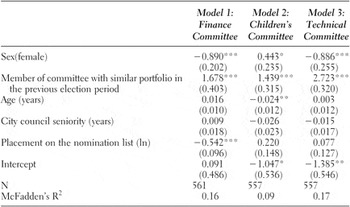
Table 4 presents the logistic regression results with clustered robust standard errors (at the municipal level), in which the dependent variable is a dummy taking the value one if the politician has a preference for sitting on the committee in question (either their first or second priority). The results are not altered substantially in a fixed effects logistic regression in which we include dummies for all but one of the municipalities. The analysis corroborates our findings in Table 3. Men, to a much higher extent than women councilors, want to sit on the finance and the technical committees; and women, to a somewhat greater extent than men, want to sit on the children's committee. The findings are also substantively significant. A calculation of the predicted probabilities based on the coefficients in Table 4 reveals that women are 21.7 percentage points less likely than men to prefer a seat on the finance committee, 14.7 percentage points less likely than men to prefer a seat on the technical committee, and 5.3 percentage points more likely than men to prefer a seat on the children's committee.Footnote 1
Gender and committee seat preferences (logistic regression)

Note: Entries are logistic regression coefficients. Clustered robust standard errors (at the municipal level) in parentheses. Levels of significance: * p < 0.10; ** p < 0.05; *** p < 0.01. Survey documented in Baekgaard (Reference Baekgaard2010).
DOES THE FULFILLMENT OF COMMITTEE SEAT PREFERENCES DEPEND ON GENDER?
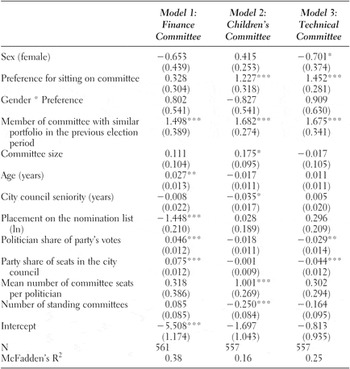
We now examine whether there is a gender difference in the fulfillment of committee seat preferences. If there is, then we may conclude that discrimination explains the gender difference in recruitment to committees. If there is not, then gender differences in preferences are the source of the gendered pattern in recruitment to committees. We use a dependent variable indicating whether councilors became members of the committees in question after the city council elections in 2009. Our main independent variables are the city councilors’ sex, their committee seat preferences, and an interaction term between those two variables, which tests whether there is a cross-gender difference in committee seat preference fulfillment.
We include a number of controls in this analysis as well. According to the information perspective of legislative organization (Krehbiel Reference Krehbiel1992; Pelissero and Krebs Reference Pelissero and Krebs1997; Schaffner Reference Schaffner2007, 478), political parties want their members to specialize in order to get the most reliable information from the committees. Hence, we expect that politicians have a greater probability of getting a seat on a committee if they sat on a committee with a similar portfolio in the previous election period. Furthermore, members with higher status and/or greater experience may have a better chance of becoming members of the powerful finance committee, and we include a number of controls to account for this. Politicians who are older, are placed higher on the nomination list, have received more votes, and have sat on the council for a long time are expected to be more likely to become members of the finance committee and, therefore, less likely to become members of the other committees. For a similar reason, we include a variable describing the party's share of seats in the city council; larger parties are in a more favorable position when committee seats are allocated, so their members have a greater likelihood of becoming members of their preferred committees. We also add two institutional controls: the number and size of committees, both of which vary considerably across municipalities. The larger the committee, the more committee seats per politician, and the fewer committees, the greater the probability that politicians become members of a given committee. The results of the analysis are presented in Tables 5 and 6.
Gender and committee seat preference fulfillment (logistic regression)

Note: “Placement on the nomination list”—the lower the number, the higher the politician is placed on the nomination list. Entries are logistic regression coefficients. Clustered robust standard errors (at the municipal level) in parentheses. Levels of significance: * p < 0.10; ** p < 0.05; *** p < 0.01. Survey documented in Baekgaard (Reference Baekgaard2010). Other variables based on Municipal Yearbook (2010) and Statistics Denmark.
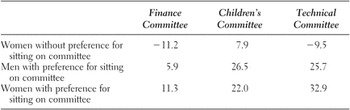
Changes in predicted probabilities for male and female city councilors

Note: Entries are changes in predicted probabilities in percentage points. The baseline (0) is men without a preference for sitting on the committee in question.
Interpreting the two main terms (gender and preference for sitting on the committee) in conjunction with the interaction term, we find that the allocation of committee seats depends on politicians’ committee seat preferences. (Further analysis shows that the preference variable is also statistically significant in the finance committee model if the interaction term is excluded.) Politicians who want a seat on a certain committee have a much higher probability of getting that seat than politicians who do not have a preference for a seat on the committee. For instance, men and women city councilors have a more than 20 percentage point greater likelihood of getting a seat on the children's committee if they prefer a seat on that committee than male city councilors who do not have a preference for sitting on the committee (see Table 6). The interaction terms, however, are insignificant in all models. In other words, we find no evidence of a gender difference in the fulfillment of committee seat preferences. This conclusion holds true for all three types of committees examined and whether preferences are operationalized only as the councilors’ top priority (not shown), or, as in Table 5, as both their first and second priority. It also holds true across party groups. Put another way, preferences matter but they do not matter differently across gender. Men and women have equal chances of having their committee seat preferences fulfilled.Footnote 2 The findings can be considered a rather strong rejection of the demand-side hypothesis. Hence, we conclude that the gender difference in committee assignments is caused by gender differences in preferences. The analysis does reveal, though, that among members who do not have a preference for sitting on the children's and the technical committee, women have a greater probability of being seated in the children's committee, and men have a greater probability of being seated in the technical committee.
CONCLUSION
We applaud the view that research on women's descriptive representation should not only be leveled at legislatures, but also at committees, and we argue that two dimensions are relevant when assessing women's committee assignments: (1) whether women are more systematically assigned to other committees than men along vertical (how powerful?) and horizontal (which policy areas?) lines; and (2) whether differences are caused by and can be ascribed to a supply-side explanation (women self-select) or a demand-side explanation (women are discriminated against). Our case study of Danish local politics reveals that committee assignments are not gender neutral. Women are an even smaller minority in the powerful finance committee than in the council, and there are significantly more women in committees dealing with child care and children's issues than in committees dealing with roads, water, and other technical issues. We also find that these differences can be attributed to a supply-side rather than a demand-side explanation. Women and men sit in different committees primarily because they have different preferences. Thus, we find a supply-driven vertical as well as a supply-driven horizontal gendered division of labor in committee assignments, but no demand-driven vertical or demand-driven horizontal difference.
This conclusion is based on aggregate results across a wide variety of localities. One natural step forward would be to delve deeper into whether there are exceptions to this pattern and whether the conclusion holds in all municipalities. The conclusion also points to another, yet unresolved puzzle, namely what explains these differences in men's and women's preferences for committee assignments? Why are men more inclined to seek the powerful finance committee than women, and why do women prefer children's committees to technical committees? Are these motivations created before people enter local politics, or are gendered preferences created in and by the political institutions and their social norms? Both explanations are plausible, and they might also work in tandem. And, of course, we acknowledge that this type of study, even though more sophisticated than is usually the case, it is still head counting. The follow-up question to this analysis is whether it makes a difference on which committees women and men serve. Does the gender composition of committees affect their work and decisions? While experimental studies give some hints (Kennedy Reference Kennedy2003), empirical evidence is clearly needed.
Limitations notwithstanding, Denmark is a critical case. Like its Scandinavian neighbors, Denmark is considered to be among the countries where politics has moved farthest in the direction of gender equality. Hence, finding gendered differences in committee assignments here indicates that such differences probably also exist in most other settings. While our data demonstrate that women are not outright discriminated against in the Danish case, we do observe large gender differences in committee assignments. Even in a setting where gender equality has come a long way, this study demonstrates that it has not come all the way. Even in the Scandinavian countries, there still seem to be limits to the level of gender equality (Kjaer Reference Kjaer, Beukel, Klausen and Mouritzen1999; Dahlerup Reference Dahlerup and Niskanen2011). We suspect that committee assignments are generally not gender neutral, and we would encourage others to try to produce empirical support for this claim. Such research might also help improve our understanding of how the observed gendered differences can be explained.