Introduction
Guava (Psidium guajava) and araçá plants belong to the Myrtaceae family, comprising about 130 genera and 3000 species of trees and bushes, distributed mainly in the tropical and subtropical regions (Watson and Dallwits, Reference Watson and Dallwits2008). The guava plant, native to the northern part of South America, is widely distributed in the tropical areas of America (Risterucci et al., Reference Risterucci, Duval, Rohde and Billote2005), and it is gaining visibility in the agro-food business due to the attractive characteristics of the fruit, such as flavour, appearance and health properties of nutrients and functional elements. It can be consumed fresh or processed forms, which include candies, jellies, compotes and juices. Araçá is a wild plant occurring throughout Brazil, and its fruits are particularly rich in minerals and functional elements such as vitamins and phenolic compounds (Caldeira et al., Reference Caldeira, Hiane, Ramos and Ramos Filho2004; Wille et al., Reference Wille, Macedo, Masson, Stertz, Neto and Lima2004). As its fruit is well accepted by consumers, it has been proposed as an alternative for commercial planting in specific areas (Franzon, Reference Franzon2009).
The search for plants, which produce edible fruit containing substantial concentrations of functional compounds, has become one of the major priorities of crop breeding programmes (Carvalho et al., Reference Carvalho, Machado, Moretti and Fonseca2006). The aim is to obtain cultivars of native or even newly domesticated plants, adapted to fit the requirements of commerce. Active Germplasm Banks (AGBs) are a potent tool for this purpose, particularly as they serve as a source of novel crop plants (Pereira, Reference Pereira1995). Functional compounds, being considered in breeding programmes aimed at improving human diets are antioxidants such as vitamin C, carotenoids and phenolics (Chorilli et al., Reference Chorilli, Leonardi and Salgado2007). All of these are known to be active as neutralizers of free radicals, and are beneficial to human health (Indap et al., Reference Indap, Radhika, Motiwale and Rao2006). Vitamin C, for instance, helps to prevent DNA damage caused by free radicals, and reduces their harmful effects on plasma lipoproteins (Lehr et al., Reference Lehr, Frei, Olofsson, Carew and Arfors1995). Carotenoids, which are responsible for the yellow/orange pigmentation in the plant (Mattiuz and Durigan, Reference Mattiuz and Durigan2001), are also considered to be excellent antioxidants; in particular, guava fruit contains lycopene, a carotenoid able to prevent prostate cancer and atherosclerosis (Rao and Agarwal, Reference Rao and Agarwal2000). Phenolic compounds combine the trapping of free radicals with being able to chelate heavy metals (Shahidi et al., Reference Shahidi, Janitha and Wanasundara1992). A common class of plant phenolics is represented by flavonoids, which are active as anti-microbial, anti-mutagenesis and anti-carcinogenesis agents (Martinez-Flores et al., Reference Martínez-Flores, González-Gallego, Culebras and Tuñón2002).
The presence of antioxidants in guava has been previously documented (Yan et al., Reference Yan, Teng and Jhi2006; Mendonça et al., Reference Mendonça, Ferreira, De Souza, Marinho and Teixeira2007; Patthamakanokporn et al., Reference Patthamakanokporn, Puwastien, Nitithamyong and Sirichakwal2008). A common theme in this research has been the quantification of free ascorbic acid (AA), phenolic compounds, carotenoids and global antioxidant activity. The aim of the present study was to determine the content, in guava and araçá accessions curated by the Embrapa Semiárido AGB, of free AA, lycopene, β-carotene, total phenolics and total flavonoids, and to quantify their global antioxidant activity. This AGB is responsible for the collection and curation of plant species in the Amazonas (Amazonas and Rondônia), Caatinga (Bahia, Pernambuco, Piauí and Sergipe) and Maranhão provinces. Our goal is to support the breeding programme of Psidium spp., focusing on cultivars producing fruits with a high content of functional compounds.
Materials and methods
Samples acquisition
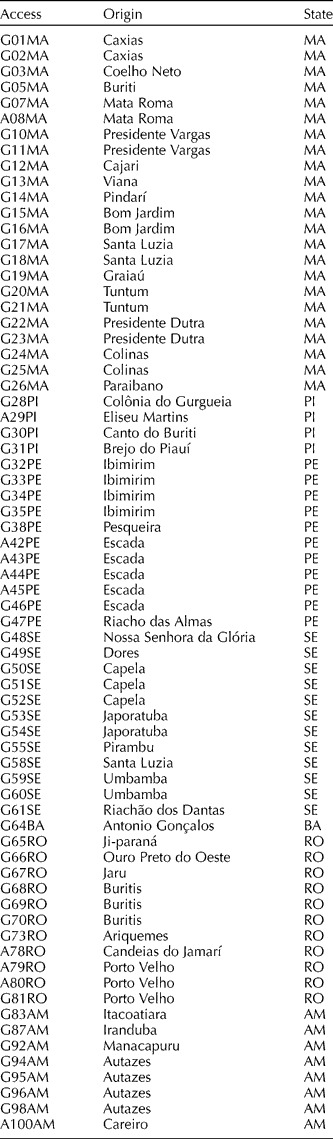
Fruits were collected at physiological maturity from 60 guava and from 10 araçá accessions from the Psidium AGB (Table 1) installed in the Bebedouro experimental station of Embrapa Semiárido (9° 9′ latitude South and 40° 29′ longitude West, altitude 365.5 m) (Amorim Neto, Reference Amorim Neto1989).
Origin of guava (G) and araçá (A) accessions from the AGB of Embrapa Semiárido used for antioxidant activity determination

MA, Maranhão; PI, Piauí; PE, Pernambuco; SE, Sergipe; BA, Bahia; RO, Rondônia; AM, Amazonas.
For each accession, fruits from six plants were used, which were divided into three lots of two plants, accounting for three repetitions. The material was processed, sieved to separate the seeds, frozen in liquid nitrogen and stored in a freezer ( − 80°C) for the analyses, except for free AA determination, which was carried out immediately (Table 1).
Free AA was determined according to Carvalho et al. (Reference Carvalho, Mantovani, Carvalho and Moraes1990). The method is based on the reduction of the 2.6-dichlorophenol-indophenol (DCIP) by AA. The extraction was accomplished on about 500 mg of the processed material with 50 ml 0.5% oxalic acid. The extract was titrated with 0.02% DCIP, previously standardized with a solution of 50 mg/l AA, prepared in 0.5% oxalic acid. Results were expressed in mg of AA/100 g fresh weight (F.W).
Lycopene and β-carotene concentrations were determined according to the method used by Nagata and Yamashita (Reference Nagata and Yamashita1992). Extractions were carried out on the processed material (0.5–2.0 g) with 20 ml hexane–acetone mixture (6:4). After agitation in ice for 15 min with a Turrax homogenizer (Germany) at 12,500 rpm, plant material was centrifuged at 6500 rpm for 10 min at 4°C. The volume was adjusted to 20 ml with the extraction mixture, and the final sample was read by a spectrophotometer at 453, 505, 645 and 663 nm, against a control constituted of the extraction mixture. The following equations were used for calculation:


The results were expressed as mg/100 g F.W.
Total phenolics were extracted according to the method proposed by Alothman et al. (Reference Alothman, Bhat and Karim2009), with minor modifications. Processed material (500 mg) was extracted with 90% ethanol (3 ml), followed by an extraction with 50% acetone (3 ml). The extracted solutions were agitated, in an ice bath, for 30 min in the dark. After the first centrifugation at 6500 rpm for 15 min at 4°C, the supernatant was removed and pooled. The process was repeated twice, and the volume was adjusted to 10 ml.
Total phenolics were determined according to the method proposed by Singleton and Rossi (Reference Singleton and Rossi1965), using the Folin–Ciocalteu reagent. A calibration curve was built using gallic acid (GA) as standard. Spectrophotometric readings were carried out at 700 nm, and results were expressed as mg GA/g F.W.
Total flavonoids were determined according to the method described by Lombard et al. (Reference Lombard, Geoffriau and Peffley2002), with minor modifications. Processed material (500 mg) was extracted three times with a solution (2 ml) containing 95% ethanol and 10% acetic acid (85:15). After agitation for 20 min, samples were centrifuged at 6500 rpm for 15 min. The supernatants were collected, and the final volume was adjusted to 10 ml with the same solution. Total flavonoids were determined on plant extract (500 μl), followed by the addition of 5% AlCl3 (500 μl) and extracting solution (2 ml). After a 30 min rest, sample absorbance was determined by spectrophotometry at 425 nm. A calibration curve was built with rutin, and the results are expressed as mg of rutin/100 g F.W.
Antioxidant activity was determined according to the method proposed by Mensor et al. (Reference Mensor, Menezes, Leitão, Reis, Santos, Coube and Leitão2001), with minor modifications. Samples were treated with the same extraction solution used for total phenolic determination, using ethanol and acetone. A standard solution containing 100 μM diphenylpicryl-hydrazyl (DPPH) was prepared, with which two calibration curves were built as follows:
(1) DPPH reference curve: different amounts of DPPH, in the range 10–300 nmol, coming from the standard DPPH solution, were prepared in six test tubes. Volumes were adjusted to 3 ml with 96% ethanol. After incubation for 40 min in the dark, the absorbance was measured at 517 nm, against a control consisting of 96% ethanol.
(2) AA reference curve: in five test tubes, AA was added in the concentration range 6.25–37.5 μg/ml, from a 250 μg/ml standard solution. Volumes were adjusted to 0.15 ml with 96% ethanol, and then the DPPH standard solution (2.85 ml) was added. After 40 min in the dark, readings were carried out at 517 nm, against a control constituted of 96% ethanol.
Antioxidant activity was determined on plant extracts (0.15 ml), following the addition of the DPPH standard solution (2.85 ml). Results were expressed as μmol of reduced DPPH/g F.W. and AA equivalent (mg AAE/g F.W.).
Statistical analyses
Results were subjected to analysis of variance, and averages were compared by the Scott–Knott test at 5% probability using the SAS package (SAS Institute Inc., 2002). Data were also analyzed by the linear Pearson correlation.
Results
Free AA concentration was determined in guava and araçá samples reported in Table 1.
A variation from 44.66 to 409.77 mg/100 g was observed in guava accessions, and the highest concentration was detected in G03MA, G47PE and G38PE (Supplementary Table S1, available online only at http://journals.cambridge.org). In araçá accessions, the variation was from 20.23 to 67.80 mg/100 g. In these fruits, the highest concentration was found in A100AM, A78RO and A42PE (Supplementary Table S1, available online only at http://journals.cambridge.org).
Lycopene and β-carotene
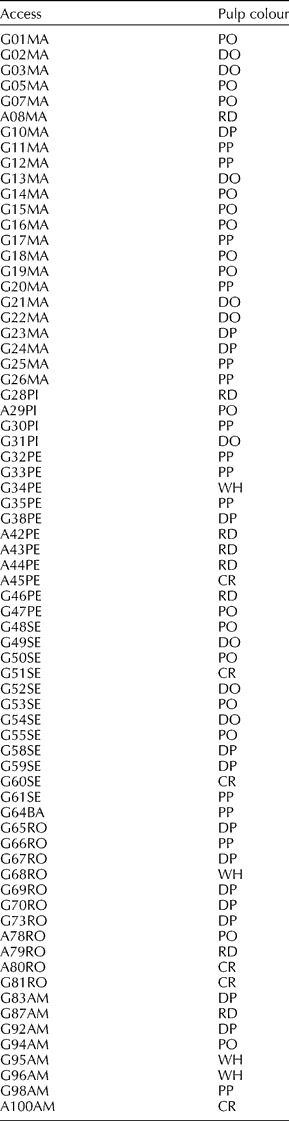
The highest lycopene concentration was found in guava (4.04 mg/100 g) in the accession G73RO, characterized by a dark pink-coloured pulp, followed by G20MA (pale pink) and G32PE (pale pink) accessions. On the other hand, the lowest value (0.04 mg/100 g) was observed in the white-coloured G96AM accession (Table 2 and Supplementary Table S1, available online only at http://journals.cambridge.org). In araçá accessions, in fruits whose pulp colour varied from cream to yellow (Table 2), the variation was from 0.03 to 0.45 mg/100 g in A78RO and A100AM accessions, respectively (Supplementary Table S1, available online only at http://journals.cambridge.org).
Pulp colour of guava (G) and araçá (A) from the AGB of Embrapa Semiárido

PO, pale orange; DO, dark orange; RD, red; PP, pale pink; DP, dark pink; WH, white; CR, cream.
The β-carotene concentration ranged from 0.13 to 2.54 mg/100 g in guava accessions, and fruits presenting a higher concentration had a pulp colour from orange to pink (Table 2 and Supplementary Table S1, available online only at http://journals.cambridge.org). It can be noticed that guava accessions characterized by white- or cream-coloured pulp presented a very low carotenoid concentration. In araçá accessions, the β-carotene concentration varied from 0.18 to 0.73 mg/100 g in A45PE and A08MA accessions, respectively.
Total phenolics
The attention has been focused on another class of antioxidants, and phenolic compounds were considered.
Total phenolics, expressed as equivalent of GA (GAE), varied from 158 to 447 mg GAE/100 g in guava tree accessions, and the concentration was highest in G03MA, G10MA and G01MA (Supplementary Table S1, available online only at http://journals.cambridge.org), characterized by a dark orange, dark pink and pale orange fruit colour, respectively (Table 2).
In araçá accessions, phenolic compound concentration between 231 and 338 mg GAE/100 g was found. The highest concentrations were present in A100AM, A43PE and A80RO accessions.
Total flavonoids
We proceeded with the determination of the most common group of phenolic compounds, that are flavonoids, according to the procedure described in the Method section.
Total flavonoids, expressed as rutin concentration, varied from 10.67 to 46.82 mg/100 g and from 19.64 to 36.33 mg/100 g in guava and araçá accessions, respectively. The highest concentration was found in guava G21MA, which presented a dark orange-coloured pulp, in G24MA (dark pink) and in G55SE (pale orange) (Table 2). In araçá, the highest concentration was found in A43PE, A29PI and A08MA (Supplementary Table S1, available online only at http://journals.cambridge.org).
Antioxidant activity
Antioxidant activity of guava and araçá fruit extracts was determined as reported in Methods.
A variation from 280 to 812 mg/100 g in antioxidant activity, expressed as AAE, among the guava accessions was determined, while in araçá accessions, the variation was from 398 to 575 mg AAE/100 g (Supplementary Table S1, available online only at http://journals.cambridge.org). If antioxidant activity is expressed as μmoles of reduced DPPH/g of sample, it was observed that the values were from 23.87 to 70.42 μmoles/g in guava and from 33.21 to 47.38 μmoles/g in araçá (Supplementary Table S1, available online only at http://journals.cambridge.org).
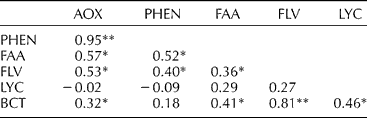
The Pearson correlation study (Table 3) showed a high positive correlation between phenolic compound concentration and antioxidant activity and between β-carotene and flavonoid concentration. The correlation was moderate among other data, except for lycopene, which presented a non-significant correlation with antioxidant activity, phenolic compounds, free AA and flavonoids. The behaviour presented by β-carotene was similar to that shown by phenolic compounds (Table 3).
Pearson correlation indexes of antioxidant activity (AOX), total phenols (PHEN), free AA (FAA), total flavonoids (FLV), lycopene (LYC) and β-carotene (BCT)

*, **Significant at 1 and 5% probability, respectively, according to t test.
Discussion
It was suggested that the daily intake of vitamin C for an adult should be around 60 mg/day (Sauberlich, Reference Sauberlich and Brown1990). However, a revision reporting epidemic studies on antioxidant effects suggested that a daily dose of 150 mg vitamin C, preferably in association with other vitamins, may be related to a lower incidence of cardiovascular diseases and cancer (Diplock et al., Reference Diplock, Charleux, Crozier-Willi, Kok, Rice-Evans, Roberfroid, Stahl and Vina-Ribes1998). Accessions studied could be a good source of vitamin C, and the ingestion of 40 g of fruits coming from, for instance, G03MA accession could supply the daily need for vitamin C. Luximon-Ramma et al. (Reference Luximon-Ramma, Bahorun and Crozier2003) suggested a daily ingestion of about 100 g of white guava, since they found a vitamin C concentration of around 150 mg/100 g. In spite of the lower free AA concentration in comparison with guava, araçá fruits present a sufficient vitamin C content to supply, at least in good part, the human daily need.
Free AA concentration found in some accessions was higher than that showed in similar studies. Yan et al. (Reference Yan, Teng and Jhi2006) found about 144 mg/100 g in the ‘Kampuchea’ guava fruit cultivar, with peel, while Thaipong et al. (Reference Thaipong, Boonprakob, Crosby, Cisneros-Zevallos and Byrne2006) reported a variation from 174 to 397 mg/100 g in four different guava genotypes. On the other hand, Wille et al. (Reference Wille, Macedo, Masson, Stertz, Neto and Lima2004) found about 61 mg/100 g in araça pear–guava (Psidium angulatum), native of Amazonas state, similar to the results showed in the present paper.
Considering lycopene and β-carotene as a set, our results are close to those reported by Setiawan et al. (Reference Setiawan, Sulaeman, Giraud and Driskell2001), who detected a total carotenoid concentration between 0.89 and 4.6 mg/100 g in guava fruits. On the other hand, higher concentrations were found by Mendonça et al. (Reference Mendonça, Ferreira, De Souza, Marinho and Teixeira2007), and lycopene and β-carotene were found to be the most widely distributed carotenoids in guava. Analyzing total carotenoids in the white pulp ‘Cordibel 4’ and in the red pulp ‘Cordibel 1’ cultivars, authors found a variation from 0.28 to 0.75 mg/100 g and from 1.34 to 8.74 mg/100 g, respectively. Thaipong et al. (Reference Thaipong, Boonprakob, Crosby, Cisneros-Zevallos and Byrne2006) did not detect any carotenoid content in a white pulp cultivar, while a variation from 0.78 to 2.93 mg/100 g was observed in three pink pulp guava cultivars. Padula and Rodriguez-Amaya (Reference Padula and Rodriguez-Amaya1986) studied IAC-4 guava, and observed that lycopene was the most abundant carotenoid as well as the most represented in accessions of guava fruits considered in the present study.
Lycopene is reported to be found in tomatoes, water melon, pink guava, pink grapefruit and papaya, with tomatoes and tomato-based foods accounting for more than 85% of all the dietary sources of this carotenoid (Rao and Rao, Reference Rao and Rao2007). According to these authors, a typical raw tomato fruit presents a lycopene concentration from 8.8 to 42.0 μg/g F.W., while in a typical pink guava fruit, it can be found at 54.0 μg/g. The value found in the present study for G73RO was 40.4 μg/g F.W, while Chandrika et al. (Reference Chandrika, Fernando and Ranaweera2009) reported a value of 45.3 ± 8.0 μg/g F.W. in the ‘Horana red’ from Sri Lanka, which is very close to the value found in the G73RO accession of the present study. These results confirmed that guava fruits could be an additional excellent source of lycopene. It is also expected that red araçá cultivars, which are preferred by local consumers, should have higher lycopene concentration.
Studies show that lycopene-supplemented diets may effectively counteract the risk of many chronic diseases, such as cancer and heart diseases (Giovannucci, Reference Giovannucci1999). Lycopene, as well as other carotenoids, can act as a free radical scavenger, and some accessions could be recommended as a source of this substance, which would be a proposal for future studies.
As regards total phenolics, the values showed in the present paper are similar to those found by Thaipong et al. (Reference Thaipong, Boonprakob, Crosby, Cisneros-Zevallos and Byrne2006), who described a variation from 170 to 340 mg/100 g on the same fruits. Patthamakanokporn et al. (Reference Patthamakanokporn, Puwastien, Nitithamyong and Sirichakwal2008) and Alothman et al. (Reference Alothman, Bhat and Karim2009) reported values from 148 to 185 mg/100 g GAE in studies carried out in Thailand and Malaysia, respectively.
It was noticed that the highest values of antioxidant activity were found in fruits with a high phenolic compound concentration (Supplementary Table S1, available online only at http://journals.cambridge.org), confirming the results reported by Luximon-Ramma et al. (Reference Luximon-Ramma, Bahorun and Crozier2003) that fruits characterized by a low phenolic compound concentration expressed a low antioxidant activity. These compounds certainly contribute to the increase of fruit antioxidant potential, bestowing to these substances the good free radical scavenger property, which has already been pointed out by Chen and Yen (Reference Chen and Yen2007), as the main responsible factor for the high antioxidant activity in guavas. Free radicals, or more precisely their excessive production, can promote many human disorders, such as cardiovascular diseases, diabetes and cancer, contributing to the increase of mortality risk in human beings (Luximon-Ramma et al., Reference Luximon-Ramma, Bahorun and Crozier2003). The consumption of foods containing substances capable of removing these radicals (active oxygen species and active nitrogen species) can contribute to the improvement of human health.
Although flavonoids show positive correlation with antioxidant activity, they do not collaborate significantly to the increase in fruit antioxidant activity, due to their low concentration in guava and araçá. Luximon-Ramma et al. (Reference Luximon-Ramma, Bahorun and Crozier2003) reported similar results in some fruits, including white and red guava. Another factor to be considered is that the antioxidant capacity of flavonoids can suffer from the influence of oxygen in the atmosphere, because their easy auto-oxidation, mostly catalyzed by transition metals, produces superoxide radical, which can reduce the total antioxidant capacity of flavonoids (Chen and Yen, Reference Chen and Yen2007). Alothman et al. (Reference Alothman, Bhat and Karim2009) and El Sohafy et al. (Reference El Sohafy, Metwalli, Harraz and Omar2009) reported a flavonoid concentration of 24.05 and 39.5 mg/100 g in guava, expressed as quercetin, similar to values found in the present paper, however, expressed as rutin.
Antioxidant activity of fruits considered in the present work, expressed as AA equivalent, was very high, when compared to that found by Yan et al. (Reference Yan, Teng and Jhi2006), who reported 218 and 310 mg AAE/100 g in green and ripe guava fruits, respectively.
When the antioxidant activity is expressed as trolox equivalent, a variation from 16 to 32 μmoles/g was reported in four guava cultivars (Thaipong et al., Reference Thaipong, Boonprakob, Crosby, Cisneros-Zevallos and Byrne2006), while Luximon-Ramma et al. (Reference Luximon-Ramma, Bahorun and Crozier2003) reported an antioxidant activity of 7 and 17 μmoles/g, always as trolox equivalent, in pink and white pulp guava, respectively, and of 45 μmoles/g in yellow pulp Psidium cattleianum.
The results of Pearson correlation study (Table 3) differ from those reported by Thaipong et al. (Reference Thaipong, Boonprakob, Crosby, Cisneros-Zevallos and Byrne2006), who mentioned a high negative correlation between β-carotene and phenolic compounds, but the correlation was positive between free AA and phenolic compounds. The authors also reported a high positive correlation of antioxidant activity with phenolic compounds and free AA, similar to that reported in the present study. The correlation between free AA and antioxidant activity was moderate, due to the presence, in araçá and in some guavas, of a very low concentration of free AA, when compared to those which presented the highest concentration. This confirmed the results by Luximon-Ramma et al. (Reference Luximon-Ramma, Bahorun and Crozier2003), who reported a low correlation between these two data (0.07), relating the fact to the low concentration of free AA found in their study. On the other hand, the low correlation between antioxidant activity and carotenoids, β-carotene and lycopene content, reported in the present paper, was probably due to the analytical method used, since both solvents used for extraction and DPPH preferably react with hydrophobic compounds. The present paper is one of the widest studies involving antioxidant compounds in guava and araçá accessions carried out in Brazil. In addition to confirm the high concentration of antioxidants in guava, it has been revealed that araçá fruits represent an important source of these substances, especially phenolic compounds. This characteristic, along with their good consumer acceptance, should be taken into account in order to offer a wider visibility to this Brazilian native species.
Regarding guava fruits, the high free AA content found in some accessions, well above that found in most of studies reported in literature, should be mentioned. Furthermore, some of these accessions presented a high phenolic compound concentration, in particular in accessions from Maranhão state, in which five accessions (G01MA, G02MA, G03MA, G10MA, G16MA, G17MA and G22MA) showed the highest concentration of both these two groups of antioxidants, increasing significantly the antioxidant activity of the fruits.
A great variation was found within the analyzed parameters, showing a great potential for breeding, for guava accessions as well as for cultivation options, given the easy adaptation of the genus, good consumer acceptance and market opportunities, which can be allied to the health properties of fruit functional compounds.
A strong positive correlation was found between antioxidant activity and phenolic compounds, both in guava and in araçá, which classified them as important contributors to the antioxidant activity of these fruits. An important contribution to this activity was due to free AA, present in a large part of guava accessions, but in very low concentration among araçá accessions.
The most interesting guava accessions included G03MA, G10MA, G01MA, G16MA and G02MA, which associate a high concentration of various antioxidant compounds with the highest antioxidant activity. Regarding araçá, A100AM, A43PE, A80RO and A78RO accessions were outstanding, due, above all, to their highest phenolic compound concentration.
Acknowledgements
The authors would like to thank the CNPq (National Counsel of Technological and Scientific Development) for the financial support received.