Introduction
Our societies today have a growing proportion of elderly people which requires a particular societal attention, especially since with age comes the risk of different diseases, like dementia (Knapp, Reference Knapp2010). Given the incurable and neurodegenerative aspects of dementia, to which is added the all important average life span once the first symptoms appear, the main question asked is “how to promote and maintain an optimal quality of life (QoL)?” (Ettema et al., Reference Ettema, Droes, de Lange, Ooms, Mellenbergh and Ribbe2005a). To answer it, many researchers have worked for over 20 years in developing methods for evaluating QoL. Two large categories of tools stand out: generic versus specific instruments. In dementia, the specific modality is privileged because it takes the pathology's characteristics into account, lends itself to a more precise evaluation regarding the person's life experience and is more robust psychometrically (Ettema et al., Reference Ettema, Droes, de Lange, Mellenbergh and Ribbe2005b; Perales et al., Reference Perales, Cosco, Stephan, Haro and Brayne2013). Depending on who is doing the evaluation, it is possible to distinguish: (1) self-rated tools (usual procedure in a non-pathological context) which can be used for patients who are in early or moderate stages of dementia (Brod et al., Reference Brod, Stewart, Sands and Walton1999; Smith et al., Reference Smith2007; Trigg et al., Reference Trigg, Jones and Skevington2007a) and even for some patients who have severe dementia (Crespo et al., Reference Crespo, Hornillos and Gomez2013), (2) proxy (formal or informal caregiver)-rated tools, and (3) tools that use both methods. Finally, the literature distinguishes methods of direct observation (primarily useful in an institutional setting) versus questionnaires. If these latest are mainly used, the higher cost in time and energy of methods of direct observation does not prevent them from being valued in dementia research (Sloane et al., Reference Sloane2007) and from providing good psychometric qualities (Fossey et al., Reference Fossey, Lee and Ballard2002).
Within these three large categories (generic/specific; self- and/or proxy-evaluation; direct observation/questionnaire), many tools have been created to evaluate the QoL of people with dementia. The majority of the tools have been documented in papers with varying evaluation objectives: reviewing QoL instruments (e.g. Ready and Ott, Reference Ready and Ott2003; Perales et al., Reference Perales, Cosco, Stephan, Haro and Brayne2013), creating a new instrument (e.g. Smith et al., Reference Smith2005a) or identifying the most appropriate QoL tool for a particular context (e.g. Gräske et al., Reference Gräske, Fischer, Kuhlmey and Wolf-Ostermann2012). But all of them are mainly focused on the formal aspects of the tools (e.g. country of origin, methods of response and correction, number of items and domains) and on their psychometric qualities (acceptability, validity, reliability, and responsiveness) while neglecting the conceptual aspects. Yet, these basic aspects logically determine the tools’ shape, reinforcing the need to take a deeper look at it. In agreement with Davis et al. (Reference Davis2006), we think that the conceptual aspects are satisfactory for any QoL instrument which: (1) is based on a clear, operationalized QoL definition; (2) is based on a QoL theory; (3) includes the important domains of life; and (4) has well-constructed and clearly stated items. With regards to this last point, in agreement with Rabins and Black (Reference Rabins and Black2007), we would add that, in light of the subjective nature of the QoL concept, a tool should ideally allow one to balance the importance of the items with the personal values of each individual (i.e. a tool should not attribute the same score to a relative item, like social relations for example, if they are essential for Mr. X but of little importance to Mr. Y). Out of all the existing literature reviews and theoretical papers on the subject, none include these four essential points for each tool. To be more precise, the QoL definitions and models are very few developed and discussed, even in the first (and the only one at our knowledge) narrative review of dementia-specific measures (Bowling et al., Reference Bowling2015). With regards to the domains and items, they are simply listed (Walker et al., Reference Walker, Salek and Bayer1998; Selai and Trimble, Reference Selai and Trimble1999; Smith et al., Reference Smith2005a; Naglie, Reference Naglie2007; Novella et al., Reference Novella2012; Bowling et al., Reference Bowling2015) or sometimes compared in order to find out the most consensual ones (Ettema et al., Reference Ettema, Droes, de Lange, Ooms, Mellenbergh and Ribbe2005a; Reference Ettema, Droes, de Lange, Mellenbergh and Ribbe2005b; Schölzel-Dorenbos et al., Reference Schölzel-Dorenbos2007; Gräske et al., Reference Gräske, Fischer, Kuhlmey and Wolf-Ostermann2012; Perales et al., Reference Perales, Cosco, Stephan, Haro and Brayne2013). Little information is provided in terms of the items’ formulation (are the items understood in terms of frequency?, intensity?, etc.) and only three reviews (Walker et al., Reference Walker, Salek and Bayer1998; Ready and Ott, Reference Ready and Ott2003; Bowling et al., Reference Bowling2015) present the foundations on which the items and domains were created (literature, caregiver opinions, etc.).
Such a discrepancy between reflections regarding the basics (conceptual aspects, hardly addressed) and the form (methodological aspects, largely addressed) of tools is striking in as much as it is possible that a tool possess good psychometric qualities (which is the case for the majority of dementia-specific instruments; Perales et al., Reference Perales, Cosco, Stephan, Haro and Brayne2013) all the while having a poor conceptual foundation. Furthermore, the QoL definition and model chosen by an author can have significant effects on the type of items (including the manner in which they are questioned) and domains used in an instrument, which will of course affect the results obtained. Based on this information, the aim of this paper is to complete a systematic review of conceptual aspects of QoL tools in dementia. This paper will shed light on QoL definitions, models, domains, and items of existing dementia-specific tools. These conceptual elements will then be discussed to show their evolution over time, as well as their current strong and weak points. In this perspective, recommendations for future instrument refinement and development will be presented and a new QoL definition will be proposed.
Method
In order to inventory all dementia-specific QoL instruments, we first identified literature reviews and theoretical papers about these tools. Our research focused on reviews and papers published in French or in English in the bibliographic databases MEDLINE or PsycINFO between January 1985 and June 2015. It was based on the combination of the following key words: (1) “QoL” or “health-related QoL,” (2) “dementia” or “Alzheimer's disease,” and (3) “review” or “literature.” We then performed a second search based on papers published during the period from January 2012 to June 2015, not covered by existing literature reviews. The same combination of keywords was used except for the words “review” or “literature” which were replaced by “new,” “prototype,” “development,” “validation,” or “psychometric.” All the names and abbreviations of the tools identified were then entered one by one as a keyword in the same bibliographic databases. Only the initial paper and further papers written by one or several authors of this initial paper were selected to focus on all the conceptual information of each instrument. If the initial paper was not included in the databases MEDLINE or PsycINFO, it was obtained from other sources (such as Google Scholar, libraries. . .) based on its bibliographic reference found in our research.
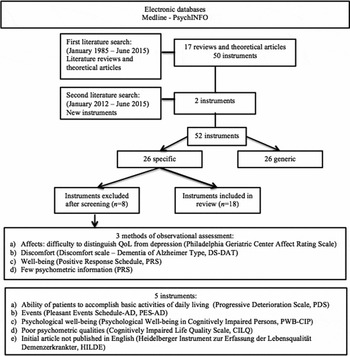
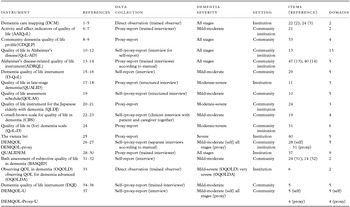
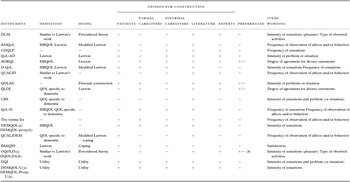
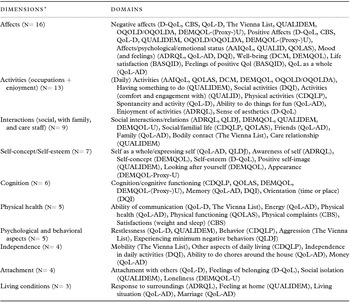
We included all the instruments (see Figure 1) which: (1) are specific to the QoL evaluation of people with dementia or related disease; (2) measure the QoL and not the concepts considered as factors influencing it (e.g. activities of daily living (ADL)) (exclusion criterion a), or dementia specific concepts related to QoL (e.g. discomfort) (exclusion criterion b), or general concepts related to QoL (e.g. well-being) (exclusion criterion c); (3) were not excluded in previous papers or reviews for non-reliability or non-validity reasons (exclusion criterion d); and (4) have their initial paper published in French or in English (exclusion criterion e).We first present the results of this search strategy (see Figure 1) and then list and briefly describe the tools according to their main characteristics (see Table 1). Afterwards, we detail and summarize (see Table 2) QoL definitions, theoretical models, domains, and the different ways of asking items, before discussing them in the last part of the paper. As agreed with all the authors of this paper, all the definitions are divided in the text into categories, defined after reading of all of them. Thereafter, all the models are described on the basis of their main notion. Concerning the domains, all those of the different tools are classified into dimensions, which are broader components (Lam, Reference Lam, Preedy and Watson2010), to bring out the most consensual domains (see Table 3). To make sure that the content of the tools fits well with the most important domains and items, we evaluated the greater or lesser degree of plurality of opinions taken into consideration to construct each instrument (experts, literature, etc.). Further to this, the items were analyzed according to the place allocated to patient's preferences. Finally, items’ formulation of each instrument was described. For all these conceptual aspects (see Table 2) as well as for the formal ones (see Table 1), the tools are listed by respecting the order of their first apparition in the literature in order to further promote the discussion about their evolution through time.
Flow diagram of selection of dementia-specific Qol instruments.

Dementia-specific QoL instruments reviewed with their reference and their main methodological characteristics*

*The classification of tools was established in chronological order based on the first publication of each of them. Only references providing conceptual information were retained.
References. 1: Kitwood and Bredin (Reference Kitwood and Bredin1992); 2: Bredin et al. (Reference Bredin, Kitwood and Wattis1995); 3: Fossey et al. (Reference Fossey, Lee and Ballard2002); 4: Ballard et al. (Reference Ballard2002); 5: Ballard et al. (Reference Ballard2004); 6: Albert et al. (Reference Albert1996); 7: Albert et al. (Reference Albert2001); 8: Salek et al. (Reference Salek, Schwartzberg and Bayer1996); 9: Salek et al. (Reference Salek, Walker and Bayer1999); 10: Logsdon et al. (Reference Logsdon, Gibbons, McCurry and Teri1999); 11: Logsdon et al. (Reference Logsdon, Gibbons, McCurry and Teri2002); 12: Leon-Salas et al. (Reference Leon-Salas, Logsdon, Olazaran and Martinez-Martin2011); 13: Rabins et al. (Reference Rabins, Kasper, Kleinman, Black and Patrick1999); 14: Kasper et al. (Reference Kasper, Black, Shore and Rabins2009); 15: Brod et al. (Reference Brod, Stewart, Sands and Walton1999); 16: Lucas-Carrasco et al. (Reference Lucas-Carrasco, Gomez-Benito, Rejas and Brod2011); 17) Weiner et al. (Reference Weiner, Martin-Cook, Svetlik, Saine, Foster and Fontaine2000); 18: Martin-Cook et al. (Reference Martin-Cook, Hynan, Rice-Koch, Svetlik and Weiner2005); 19: Selai et al. (Reference Selai, Trimble, Rossor and Harvey2001); 20: Yamamoto-Mitani et al. (Reference Yamamoto-Mitani, Abe, Okita, Hayashi, Sugishita and Kamata2002); 21: Yamamoto-Mitani et al. (Reference Yamamoto-Mitani, Abe, Okita, Hayashi, Sugishita and Kamata2004); 22: Ready et al. (Reference Ready, Ott, Grace and Fernandez2002); 23: Lucas-Carrasco et al. (Reference Lucas-Carrasco, Gomez-Benito, Rejas and Ott2013); 24: Terada et al. (Reference Terada2002); 25: Porzsolt et al. (Reference Porzsolt2004); 26: Smith et al. (Reference Smith2005a); 27: Smith et al. (Reference Smith2005b); 28: Ettema et al. (Reference Ettema, Droes, de Lange, Mellenbergh and Ribbe2005b); 29: Ettema et al. (Reference Ettema, Droes, de Lange, Mellenbergh and Ribbe2007a); 30: Ettema et al. (Reference Ettema, Droes, de Lange, Mellenbergh and Ribbe2007b); 31: Trigg et al. (Reference Trigg, Jones and Skevington2007a); 32: Trigg et al. (Reference Trigg, Skevington and Jones2007b); 33: Edelman et al. (Reference Edelman, Fulton, Kuhn, Gallager and Dougherty2007); 34: Scholzel-Dorenbos et al. (Reference Schölzel-Dorenbos, Arons, Wammes, Rikkert and Krabbe2012); 35: Arons et al. (Reference Arons, Krabbe, Schölzel-Dorenbos, van der Wilt and Rikkert2012); 36: Arons et al. (Reference Arons, Krabbe, Schölzel-Dorenbos, van der Wilt and Rikkert2013); 37: Mulhern et al. (Reference Mulhern2012).
Conceptual characteristics of dementia-specific QOL instruments reviewed*

*The classification of instruments was established in chronological order based on the first publication of each of them. Only references providing conceptual information were retained.
AAIQoL: Activity and Affect Indicators of Quality of Life; CDQLP: Community Dementia Quality of Life Profile; QoL-AD: Quality of Life in Alzheimer's Disease; D-QoL: Dementia Quality of Life Instrument; ADRQL: Alzheimer's Disease-Related Quality of Life instrument; QUALID: Quality of Life in Late-Stage Dementia; QOLAS: Quality of Life Assessment schedule; DCM: Dementia Care Mapping; CBS: Cornell-Brown Scale for Quality of Life in Dementia; QoL-D: Quality of Life in (for) Dementia scale; QLDJ: Quality of Life instrument for the Japanese elderly with Dementia; The Vienna List; DEMQOL; BASQID: Bath Assessment of Subjective Quality of Life in Dementia; QUALIDEM; OQOLD(A): Observing QOL in Dementia (for Dementia Advanced); DQI: Dementia Quality of life Instrument; and DEMQOL-(Proxy-)U.
+ = present; +/− = partially present; − = absent.
Domains and dimensions for all dementia-specific QoL instruments reviewed

*n represents the number of tools including each dimension.
AAIQoL: Activity and Affect Indicators of Quality of Life; CDQLP: Community Dementia Quality of Life Profile; QoL-AD: Quality of Life in Alzheimer's Disease; D-QoL: Dementia Quality of Life Instrument; ADRQL: Alzheimer's Disease-Related Quality of Life instrument; QUALID: Quality of Life in Late-Stage Dementia; QOLAS: Quality of Life Assessment schedule; DCM: Dementia Care Mapping; CBS: Cornell-Brown Scale for Quality of Life in Dementia; QoL-D: Quality of Life in (for) Dementia scale; QLDJ: Quality of Life instrument for the Japanese elderly with Dementia; The Vienna List; DEMQOL; BASQID: Bath Assessment of Subjective Quality of Life in Dementia; QUALIDEM; OQOLD(A): Observing QOL in Dementia (for Dementia Advanced); DQI: Dementia Quality of life Instrument; and DEMQOL-(Proxy-)U.
Results
Out of the 140 papers identified from our first literature search, 17 literature reviews and theoretical papers about QoL instruments for people with dementia were selected (see Figure 1). Three of them include both some information about conceptual frameworks and psychometrics qualities of the tools (Ready and Ott, Reference Ready and Ott2003; Perales et al., Reference Perales, Cosco, Stephan, Haro and Brayne2013; Bowling et al., Reference Bowling2015). Ten papers talk about the general properties (formal aspects) and/or psychometric qualities of the tools (Howard and Rockwood, Reference Howard and Rockwood1995; Salek et al., Reference Salek, Walker and Bayer1998; Walker et al., Reference Walker, Salek and Bayer1998; Selai and Trimble, Reference Selai and Trimble1999; Demers et al., Reference Demers, Oremus, Perrault, Champoux and Wolfson2000; Ettema et al., Reference Ettema, Droes, de Lange, Mellenbergh and Ribbe2005b; Naglie, Reference Naglie2007; Novella et al., Reference Novella2012; Shearer et al., Reference Shearer, Green, Ritchie and Zajicek2012; Perales et al., Reference Perales, Cosco, Stephan, Haro and Brayne2013). Two papers are focusing on the creation of a new specific instrument (Ettema et al., Reference Ettema, Droes, de Lange, Ooms, Mellenbergh and Ribbe2005a; Smith, et al., Reference Smith2005a) and two others on the identification of more appropriate tools for the assessment of a clinical intervention (Schölzel-Dorenbos et al., Reference Schölzel-Dorenbos2007), and a use in shared-housing arrangements (Gräske et al., Reference Gräske, Fischer, Kuhlmey and Wolf-Ostermann2012).
Out of all the instruments described in these papers (50 instruments; first literature search) and the two new instruments developed after January 2012 (second literature search), 18 QoL instruments specific to dementia were selected (see Table 1). Eight out of these 18 tools are proxy-rated, two are exclusively self-rated, six have a double version, and two come from the direct observation of behaviors. Concerning the proxy-rated instruments, the CDQLP implies an informal caregiver; QUALID, QLDJ, The Vienna List, and QUALIDEM require a formal caregiver and AAIQoL, ADRQL, and QoL-D can be used by these both kinds of caregivers. The use of some self- (e.g. BASQID) and proxy- (e.g. QUALID) measures implies a data collection with an interviewer. For some tools, the interviewers are trained and instructed to the specific principles and procedures of administration (e.g. QUALIDEM). Some of the tools are applicable to a specific stage of dementia; usually from mild to moderate (e.g. D-QoL) or from moderate to severe (e.g. QUALID) while others are designed for all people with dementia, regardless of disease severity (e.g. QoL-AD). Finally, some are applicable only for a specific setting (e.g. CDQLP at home; The Vienna List in institutional settings) while others may be used in various contexts (e.g. at home or in institutional setting for the QoL-AD).
QoL definitions
Whatever the kind of tools, QoL definitions (or at least the conceptual elements revealing how the authors approach QoL) are provided by most of the authors (see Table 2). Based on their content, these definitions were divided into four categories:
-
1. HRQoL definitions: In reference to Patrick and Erickson (Reference Patrick, Erickson, Patrick and Erickson1993), Rabins et al. (Reference Rabins, Kasper, Kleinman, Black and Patrick1999; ADRQL), consider HRQoL as the “value assigned to the duration of survival as modified by impairments, functional states, perceptions, and social opportunities influenced by disease, injury, treatment, or policy.” Smith et al. (Reference Smith2005a; DEMQOL) take a similar view while opting for a definition as “multidimensional concept that reflects the individual's subjective perception of the impact of a health condition on everyday living (Bullinger et al., Reference Bullinger, Anderson, Cella and Aaronson1993).” It includes aspects of physical, psychological, and social functioning (Smith et al., Reference Smith2005b). These authors distinguish this concept from the broader QoL concept as it includes only the aspects of QoL that are affected by a health condition. In accordance with this definition, Brod et al. (Reference Brod, Stewart, Sands and Walton1999; D-QoL) and later Terada et al. (Reference Terada2002; QoL-D) express that the unique characteristics of dementia lead to differences in the importance and definitions of specific QoL domains and subdomains. For this reason, they rather encourage a definition based on domains that make sense for people with dementia: positive and negative affect, belonging, self-esteem, and sense of aesthetics (D-QoL); positive affect, negative affect and actions, ability of communication, restlessness, attachment with others, and spontaneity/activity (QoL-D). A similar perspective is adopted in AAIQoL (Albert et al., Reference Albert2001): HRQoL is defined in terms of “restriction in activity and narrowing of affective expression (these domains are those more closely linked to aspects of disease progression).”
-
2. QoL definitions based on Lawton's work or similar to this latter: According to Lawton (Reference Lawton, Birren, Lubben, Rowe and Deutchman1991), QoL is “a multidimensional construct that should include not only objective (observable) indices of well-being judged against socio-normative criteria, but also the individual's own subjective perception of his or her position in life.” This definition is mentioned by the authors of the BASQID (Trigg et al., Reference Trigg, Skevington and Jones2007b). Furthermore, a combination of subjective and objective indicators is considered as highly relevant by other authors (Brod et al., Reference Brod, Stewart, Sands and Walton1999 for the D-QoL; Logsdon et al., Reference Logsdon, Gibbons, McCurry and Teri2002 for the QoL-AD). In the AAIQoL (Albert et al., Reference Albert1996), “a high QoL level was defined in terms of high positive affect and high activity,” reflecting the equal weight given to both a subjective indicator (affect) and a more objective indicator (activity). For the QUALID, “a good QoL is favored by an engagement (and the comfort) in a small number of familiar, highly repetitive and very basic activities of life, considered as important by social norms (e.g. eating and engaging and interacting with others)” (Martin-Cook et al., Reference Martin-Cook, Hynan, Rice-Koch, Svetlik and Weiner2005). Finally, the combination of a subjective indicator (well-being) and an objective indicator (activity–behavioral category) in the direct observational tools DCM (Kitwood and Bredin, Reference Kitwood and Bredin1992; Fossey et al., Reference Fossey, Lee and Ballard2002) and OQOLD(A) (Edelman et al., Reference Edelman, Fulton, Kuhn, Gallager and Dougherty2007; tool based on DCM) gives an estimation of the quality of care provided in institution for people with dementia, which constitutes a major component to their QoL (Fossey et al., Reference Fossey, Lee and Ballard2002).
-
3. QoL definitions specific to dementia: In reference to Walker et al. (Reference Walker, Salek and Bayer1998), Terada et al. (Reference Terada2002; QoL-D), consider QoL in dementia as “the integration of cognitive functioning, ADL, social interactions, and psychological well-being.” This definition refines that more general one: “QoL is a multidimensional concept encompassing (at least) social, psychological, and physical domains (both subjective and objective)” (Brod et al., Reference Brod, Stewart, Sands and Walton1999; Terada et al., Reference Terada2002). In CBS (Ready et al., Reference Ready, Ott, Grace and Fernandez2002; Lucas-Carrasco et al., Reference Lucas-Carrasco, Gomez-Benito, Rejas and Ott2013), “high QoL typically is indicated by presence of positive affect, physical and psychological satisfactions, self-esteem, and a relative absence of negative affect and experiences.” For Yamamoto-Mitani et al. (Reference Yamamoto-Mitani, Abe, Okita, Hayashi, Sugishita and Kamata2004; QLDJ), QoL of people with dementia is “a condition in which an elderly person with dementia enjoys his/her daily life with lively interactions with his/her surroundings based upon his/her sense of self that has been cultivated during his/her entire life course.” In their instrument, Yamamoto-Mitani et al. (Reference Yamamoto-Mitani, Abe, Okita, Hayashi, Sugishita and Kamata2002) add the necessity to experience a minimum of aggressive/negative behaviors. Finally, Ettema et al. (Reference Ettema, Droes, de Lange, Mellenbergh and Ribbe2005b; QUALIDEM) define dementia-specific QoL as “the multidimensional evaluation of the person–environment system of the individual, in terms of adaptation to the perceived consequences of the dementia.”
-
4. QoL definitions based on utility theory: The utility instruments quantify multiple domains into a single metric index by applying specific valuation techniques (Arons et al., Reference Arons, Krabbe, Schölzel-Dorenbos, van der Wilt and Rikkert2012). In reference to Krabbe (Reference Krabbe2008), Schölzel-Dorenbos et al. (Reference Schölzel-Dorenbos, Arons, Wammes, Rikkert and Krabbe2012; DQI), consider that index measures quantify the desirability of a certain health state in the context of HRQoL. In contrast, Mulhern et al. (Reference Mulhern2013; DEMQOL-(Proxy-)U) have developed their index in the particular context of the Quality adjusted life year (QALY), which is the unit measure for cost-utility studies in health economics: it is a key outcome used to compare treatments within and between different disease conditions. If the QALY is based on the number of years of life that would be added by the intervention, the utility scores of the DEMQOL-(Proxy-)U can be used as the “Q” quality adjustment weight of the QALY giving information on economic evaluation of the interventions (Mulhern et al., Reference Mulhern2013).
Theoretical QoL model
Twelve of the 18 selected tools have been developed on the basis of a QoL model (see Table 2), frequently the one of Lawton (or modified Lawton). Although no conceptual was noticed in pioneering papers, Lawton's work has been used as reference for the construction of the QoL-AD (Leon-Salas et al., Reference Leon-Salas, Logsdon, Olazaran and Martinez-Martin2011). It has also been employed for the choice and development of the domains of ADRQL, QLDJ (this latter is based on the ADRQL tool), and AAIQoL. From a theoretical point of view, the subjective criterion of Lawton's model includes perceived QoL (self-evaluation of many facets of personal life such as spirituality, satisfaction with health care, etc.) and psychological well-being (overall judgment of “self in environment”). Its objective criterion contains the behavioral competence (behavioral symptoms, agitation, etc.) and the objective environmental quality (architecture, physical safety, etc.) (Ettema et al., Reference Ettema, Droes, de Lange, Ooms, Mellenbergh and Ribbe2005a). According to this, Lawton (Reference Lawton1994) suggests a model based on a hierarchical view built around core concepts (behavioral competence and perceived QoL), a prerequisite or catalyst (objective environment), and an ultimate outcome (psychological well-being).
Based on these theoretical elements, Brod et al. (Reference Brod, Stewart, Sands and Walton1999; D-QoL) propose an operational model in which the ultimate outcome remains the psychological well-being (Chiu et al., Reference Chiu, Chiu, Hsu, Lee, Chen and Kao2010). In this model, the subjective components refer to the subjective domains assessed by the patient himself (if mild to moderate dementia), which constitute the content of the D-QoL: sense of well-being, aesthetics and overall QoL (it is considered as the best one covering subjective domains; Chiu et al., Reference Chiu, Chiu, Hsu, Lee, Chen and Kao2010). The objective components consist of objective domains assessed by proxy using other well-tested measures: physical functioning, daily activities, mobility, discretionary activities, social interaction, interaction capacity, and bodily well-being. All domains and subdomains are strongly linked to each other and do not exist by themselves (Burgener and Twigg, Reference Burgener and Twigg2002).
More recently, Ettema et al. (Reference Ettema, Droes, de Lange, Mellenbergh and Ribbe2005b, Reference Ettema, Droes, de Lange, Mellenbergh and Ribbe2007a, Reference Ettema, Droes, de Lange, Mellenbergh and Ribbe2007b; QUALIDEM) also attempted to adapt the Lawton's model to improve it: they brought the concept of adaptation-coping to the consequences of the disease with reference to the adaptation-coping model of Dröes (Reference Dröes1991). This latter, itself based on the coping theory of Lazarus and Folkman (Reference Lazarus and Folkman1984) and the crisis theory of Moos and Tsu (Reference Moos, Tsu and Moos1977), distinguishes seven adaptive tasks for chronic illnesses: (1) dealing with own invalidity, (2) developing an adequate care relationship with the staff, (3) preserving an emotional balance, (4) preserving a positive self-image, (5) preparing for an uncertain future, (6) developing and maintaining social relationships, and (7) dealing with the nursing home environment. In this perspective, dementia causes changes in the existence of people and the stress that comes with it often leads to a disruption of the existing balance. Depending on the perceived meaning or personal appraisal of changes, the person with dementia tries to cope with them and regain a balance. Successful coping leads to better adaptation (i.e. a state of balance) and therefore to a better QoL (Ettema et al., Reference Ettema, Droes, de Lange, Ooms, Mellenbergh and Ribbe2005a).
This notion of adaptation is also found in the theoretical grounds of the BASQID (Trigg et al., Reference Trigg, Jones and Skevington2007a, Reference Trigg, Skevington and Jones2007b). For their authors, it is necessary to move away from the question of the presence/absence of symptoms (e.g. cognitive impairment) to promote a questioning about satisfactions (Trigg et al., Reference Trigg, Skevington and Jones2007b). Such a perspective highlights the ability of some patients to report higher levels of satisfaction in areas of poor performance, due to a low perceived importance of a QoL domain or the successful use of coping and adaptation (Trigg et al., Reference Trigg, Skevington and Jones2007b). Consequently, such a psychosocial approach questions the medical model of QoL, that is, the more the symptoms present, the poorer the QoL (Bowling et al., Reference Bowling2015). Such perspective is also found, though in different ways, in the theoretical foundations of DCM (Kitwood and Bredin, Reference Kitwood and Bredin1992; Fossey et al., Reference Fossey, Lee and Ballard2002). As mentioned by the authors (Bredin et al., Reference Bredin, Kitwood and Wattis1995; Ballard et al., Reference Ballard2002, Fossey et al., Reference Fossey, Lee and Ballard2002; Ballard et al., Reference Ballard2004), this observational assessment is based on the socio-psychological theory of personhood in dementia (Kitwood, Reference Kitwood1993). This theory asserts that, although the disease processes underlying dementia leads to a degeneration of cognitive functioning, this does not of itself cause individuals to disintegrate from a psychological and emotional point of view. The disintegration occurs largely as a result of the destructive psychosocial environment in which people with dementia find themselves. The disintegration may be hastened by the personality or past coping mechanisms that the patient employs (Brooker et al., Reference Brooker, Foster, Banner, Payne and Jackson1998). Good dementia care, in this context, is that which enables the person to feel supported, valued and socially confident and so regardless type of dementia and no matter the dementia severity. The importance attached to persons themselves and the concept of person-centered care is found in the OQOLD(A) (Edelman et al., Reference Edelman, Fulton, Kuhn, Gallager and Dougherty2007). Indeed, this is largely based on the DCM (tool considered as being attractive given the “richness” of the information it provides, but having the disadvantage of requiring a lot of time to learn it and to use the procedure) but without explicating them or developing the QoL model.
Finally, a last person-centered model, more focused on the personal construction, is the basis of the QOLAS (Selai et al., Reference Selai, Trimble, Rossor and Harvey2001). This instrument derives from a technique called Quality of Life Assessment by Construct Analysis (QoLASCA) which is itself based on Personal Construct Theory (PCT) and the Repertory Grid Technique (RGT) (Kendrick, Reference Kendrick1993). From a theoretical point of view, a person can be viewed as a scientist, who formulates theories or hypotheses relating to themselves and the world they inhabit. These theories are based on their personal construction or interpretation of experienced events and thus form a “personal construct system” (Kelly et al., Reference Kelly, Harvey and Cayton1997). According to this, the method QoLASCA is based on four major concepts (Selai et al., Reference Selai, Trimble, Rossor and Harvey2001): (1) following a comprehensive literature review, five areas important to QoL were chosen: physical functioning, psychological (emotional) status, social and family life, economic/employment status, and cognitive abilities; (2) within these general areas, importance of specific items may vary from individual to individual; (3) QoL is a function of levels of expectation, which means that the discrepancy between the current life situation and expectations is important in determining an individual's QoL; (4) QoL is a comparative phenomenon as, in judging their QoL, individuals compare their current life situation to other times in their life and to other people. After a pilot study, the questions about work/economic functioning were substituted by a domain headed “daily activities” and the expectations are no more taken into account (Selai et al., Reference Selai, Trimble, Rossor and Harvey2001).
Besides these different theories, the latter two instruments created, the DEMQOL- (Proxy-) U and DQI, are based on the utility theory, which assigns values to various health conditions, varying from 0 (worst imaginable health state) to 1 (best imaginable health state). This allows providing a unique index for the realization of economic analyzes. The DQI model (Schölzel-Dorenbos et al., Reference Schölzel-Dorenbos, Arons, Wammes, Rikkert and Krabbe2012) was inspired by the utility model of the European Qol scale (EQ-5D; Brooks, Reference Brooks1996) focused on health. Mulhern et al. (Reference Mulhern2013) adopted a similar perspective, but unlike the DQI, the index calculated by the DEMQOL-U (patient version) and the DEMQOL-Proxy-U (caregiver version) is not only based on health since it is derived from the contents of DEMQOL (Smith et al., Reference Smith2005a).
QoL domains and items
In decreasing order of importance, the main dimensions of QoL instruments are (see Table 3): affects, activities (including enjoyment of activities), interactions (social, with family, and care staff), self-concept/self-esteem, cognition, physical health, psychological and behavioral aspects, degree of independence in ADL and instrumental activities of daily life (IADL), notion of attachment, and living conditions.
The content of the domains and items of each tool was developed according to different methodologies (see Table 2). In decreasing order of importance, the sources are: the literature (16 of 18 tools), the opinion of experts in the field (11/18), of formal caregivers (10/18), of informal caregivers (9/18), and of patients (8/18). Only four instruments (QOLAS, DEMQOL, DQI, and DEMQOL-(Proxy-)U) were developed by taking into account all sources of information. However, no tool really allows us to evaluate the differential importance of each item or domain depending on the individual. Yet, ADRQL and QOLDJ instruments approach such a perspective. According to the opinion of informal caregivers (ADRQL) and experts (QOLDJ), different weights were indeed assigned to each item and this weighting is reflected in the calculation of the QoL scores. Differently, the qualitative part of the QOLAS supports the priorities of patients by allowing each of them to precise what is important for their QoL. On this basis, the interviewers extract for the quantitative part of the test, two consructs for each of the five pre-determined (and pre-listed) domains of the tool. Finally, the OQOLDA is especially based (for the observed activities) on an individualized activity that professional caregivers determine as highly pleasurable for each person with advanced dementia.
A more accurate analysis of the items shows a great diversity with sometimes different wordings within a same tool. So, DEMQOL, DEMQOL-(Proxy-)U, and D-QoL examine the intensity of sensations with items such as “In the last week/recently, have you felt . . .?”, or “. . . how worried have you been about . . .?”. In the case of DCM and OQOLD(A), this is evaluated through the degree of pleasure reported by the observer for the type of (in)activity of the patient during the observation period. Qol-AD, QOLAS, CBS, and DQI evaluate the intensity of sensations and problem/situation by notifying for example the degree of energy (from poor to excellent; QoL-AD); items selected by the patient (from no problem to it could not be worse; QOLAS); the degree of anxiety (from severe or constant to absent) or comfort (from absent to very or constant, CBS); or the degree of independence in daily activities (from no problems to unable to perform; DQI). In a different way, some tools focus on the criterion of frequency sensations (CDQLP, D-QoL, QoL-D) or observation of behavior and/or affects (AAIQoL, QUALID, QoL-D, Vienna List, QUALIDEM). It assess QoL by headings such as “How often have you felt. . .” or “which response best describes Mr. X over the past week for the word ‘smiles’” (with response options ranging from spontaneously once or more each day to rarely, if at all). In terms of behaviors, the authors of DCM and OQOLD(A) opt for the statement of the kind of observed activities during the observation period. For other tools, the respondent is asked to consider how the statement describes the person with dementia (e.g. He/She talks with people: ADRQL, dichotomous response choice “agree”/“disagree”; QLDJ, four-point scale ranging from “not at all applicable” to “very much applicable”). Finally, a last evaluative mode is provided by the authors measuring QoL through a questioning of satisfaction of the type “how satisfied are you with. . .? (from not at all satisfied to extremely satisfied)” and “to what extent are you able/do you feel. . .?” (from not at all to a great deal) (BASQID).
Discussion
Over the last 20 years, many QoL questionnaires have been developed specifically for people with dementia. Many of them were found in several reviews focused primarily on aspects of form (e.g. country of origin, methods of response and correction, number of items and domains) and the psychometrics (acceptability, validity, reliability, and responsiveness) of the tools. This literature review therefore constitutes the first systematic analysis published on the conceptual characteristics that examine in-depth dementia-specific QoL tools. Based on the synthetic table (see Table 2) and on the analysis done, each of these characteristics will be discussed one by one before finishing with a general conclusion.
QoL definitions
The majority of tools are based on a QoL definition that shows a noticeable improvement over time: except for the Vienna List (Porzsolt et al., Reference Porzsolt2004), the authors of the 11 last tools provide a QoL definition. Though this may appear encouraging, a closer reading reveals the vast differences between the four categories of definitions, as well as between the individual definitions themselves.
The various categories expose the differences between the tools for clinical use (categories 1 to 3) and those destined for economic assessments of health (category 4). These categories correspond to the two types of needs that define the QoL in dementia (Brod et al., Reference Brod, Stewart, Sands and Walton1999; Selai and Trimble, Reference Selai and Trimble1999). The different categories also distinguish the terms “QoL” and “HRQoL”: these terms must not be considered synonymous and therefore not used interchangeably (Dupuis et al., Reference Dupuis, Taillefer, Etienne, Fontaine, Boivin, Von Turk, Jobin, Maltais, LeBlanc, Simard and Kinetics2000; Guyatt et al., Reference Guyatt, Feeny and Patrick1993). However, the difference between the two is not always clear. As mentioned by Perales et al. (Reference Perales, Cosco, Stephan, Haro and Brayne2013), Lawton's perspective (general QoL) was integrated into AAIQoL and D-QoL instruments (HRQoL) and contextualized for people suffering from dementia. This observation can be extended to the ADRQL and QLDJ tools. Furthermore, the terms of “QoL specific to dementia” and “HRQoL” are used as synonyms in the context of dementia. When referring to the definition of HRQoL as limited to including aspects affected by a health condition (Smith et al., Reference Smith2005a), the interchangeable use of these two terms seems acceptable.
Going deeper into our analysis of the individual definitions, it appears as though the authors of certain tools (QoL-AD, D-QoL, DCM, and OQOLD(A)) limit themselves to touching on conceptual aspects without integrating them into a clear definition or even referring to an existing definition (i.e. possibly Lawton regarding the first two tools mentioned). The lack of mention of an explicit definition leads to a certain conceptual blur. This is then reinforced by the multiplicity of definitions: the varying definitions confirm the lack of a unique QoL definition for dementia (Ready et al., Reference Ready, Ott, Grace and Fernandez2002; Ettema et al., Reference Ettema, Droes, de Lange, Mellenbergh and Ribbe2005b). This observation, neither recent nor specific to dementia, can be partially explained by the tendency to define (HR)QoL by its domains or dimensions. Though the multi-dimensionality constitutes an accepted property of QoL (e.g. Ettema et al., Reference Ettema, Droes, de Lange, Mellenbergh and Ribbe2005b; Perales et al., Reference Perales, Cosco, Stephan, Haro and Brayne2013), the differences between the authors’ views regarding the constituent domains of the QoL instruments are apparent, whether it be in numbers or content (Yamamoto-Mitani et al., Reference Yamamoto-Mitani, Abe, Okita, Hayashi, Sugishita and Kamata2002) (see Table 3). Also, if the objective is to come to an agreed upon QoL definition, it seems necessary to move away from domains and dimensions. To this effect, some authors (Dupuis et al., Reference Dupuis, Taillefer, Etienne, Fontaine, Boivin, Von Turk, Jobin, Maltais, LeBlanc, Simard and Kinetics2000; Burgener and Twigg, Reference Burgener and Twigg2002) interestingly suggest referring explicitly to the old principle of Gestalt, which states that the whole is bigger than the sum of its parts. With this in mind, Dupuis et al. (Reference Dupuis, Perrault, Lambany, Kennedy and David1989) define “the QoL, at a given time, as a state that corresponds to a level reached by an individual in the ‘continual'pursuit of hierarchically organized goals and objectives.” Different authors support such a perspective when they commit to working with what makes sense for participants with dementia when defining their QoL (Brod et al., Reference Brod, Stewart, Sands and Walton1999; Terada et al., Reference Terada2002), or from the need to take into account their personal values (Rabins and Black, Reference Rabins and Black2007). However, in contrast with these authors, we would rather not include QoL domains or dimensions in the actual definition.
Theoretical QoL models
As for the definitions, a conceptual improvement is noticeable over time: the authors of the last five tools based their instruments on one theoretical model. This improvement goes hand in hand with a recent diversification of models. The explicit role of Lawton's model in the development of “only” six dementia-specific QoL tools (AAIQoL, ADRQL, QoL-D, and QLDJ; D-QoL and QUALIDEM) qualifies its high importance as mentioned by various authors (Ready and Ott, Reference Ready and Ott2003; Perales et al., Reference Perales, Cosco, Stephan, Haro and Brayne2013; Bowling et al., Reference Bowling2015). Beyond this reflection, what is important to underline, as put forward by these same authors, are the differences between the tools in how the Lawton model is applied. Similarly, regarding what we stated about the definitions, the number and diversity of domains included can explain these differences. This diversity confirms the problem of a conceptualization based on the constituent domains or dimensions of the QoL instruments: it allows one to add, subtract, or reorganize domains or dimensions, which in turn modifies the model (Taillefer et al., Reference Taillefer, Dupuis, Roberge and Le May2003), and causes a loss of concept specificity (Dupuis et al., Reference Dupuis, Taillefer, Etienne, Fontaine, Boivin, Von Turk, Jobin, Maltais, LeBlanc, Simard and Kinetics2000). This makes even more sense when one considers the fact that Lawton does not provide any further explanations regarding connections between the different objective and subjective criteria and that there is no empirical proof to support his model (Byrne-Davis et al., Reference Byrne-Davis, Bennett and Wilcock2006). With the aim of enriching Lawton's works, Brod et al. (Reference Brod, Stewart, Sands and Walton1999; D-QoL) provided a hierarchical model of the objective and subjective components in order to optimize positive contributions from the different sources of data (i.e. people with dementia and those close to them) and existing measures (i.e. measure of activities in daily life). However, this model does not describe the hypothetical relationships between health aspects (Jonker et al., Reference Jonker, Gerritsen, Bosboom and Van Der Steen2004; Smith et al., Reference Smith2005a) and it is not associated with an explicit QoL definition (Taillefer et al., Reference Taillefer, Dupuis, Roberge and Le May2003). More recently, Ettema et al. (Reference Ettema, Droes, de Lange, Mellenbergh and Ribbe2005b) recognized the importance of Lawton's works and they added the notion of adaptation, which was found in some subsequent theoretical basis (Trigg et al., Reference Trigg, Jones and Skevington2007a, Reference Trigg, Skevington and Jones2007b). The addition of the adaptation variable, to which we subscribe, fits into the line of research which shows that participants suffering from a form of dementia can interpose a series of processes, often positive (Clare et al., Reference Clare, Goater and Woods2006), between themselves and the illness in order to manage, tolerate, or lessen the impact on their physical and psychological well-being and therefore on their QoL (Clare, Reference Clare2003; de Boer et al., Reference de Boer, Hertogh, Droes, Riphagen, Jonker and Eefsting2007). Maintaining this latter is particularly encouraged by an essential adaptive element, namely that of keeping a sense of identity (Van Dijkhuizen et al., Reference Van Dijkhuizen, Clare and Pearce2006). To this effect, it is important for a person suffering from dementia to always be considered as a whole person (Steeman et al., Reference Steeman, Godderis, Grypdonck, De Bal and Dierckx de Casterle2007). This notion is supported by two interesting theories: Kitwood's socio-psychological theory (DCM and OQOLD(A)) and the person-centered model (QOLAS). The first theory focuses on the psychosocial environment the people suffering from dementia are in. It was developed to recognize and take into account personal experiences of well-being, dignity, and the value of every individual, no matter what their age or state of health (a person suffering from dementia is still a whole person!). So, in this perspective, the sense of personal growth, the sense of agency, the social confidence, and the hope are the four sentient states relevant to QoL in dementia (Bowling et al., Reference Bowling2015). As for the second theory, it is even more focused on the identity of the person with dementia. As such, the QOLAS provides an individualized measure for each participant, which is useful in a clinical practice (Perales et al., Reference Perales, Cosco, Stephan, Haro and Brayne2013). However, it has been argued that this strategy can make any sort of applied research difficult since the scores of the different participants, or even the same participant at different stages of the illness, might not reflect the same HRQoL concept (Perales et al., Reference Perales, Cosco, Stephan, Haro and Brayne2013). We would like to qualify somewhat this second reflection. Indeed, we think that when it is a matter of knowing if the QoL is very good, good, fair, or bad (these levels are used for discussion's sake only), that what matters most is to measure the level of QoL based on the items and domains that make sense for the person: that's the common element between people, and for an individual; what is important to that person may change.
To conclude, in addition to all the theories related to clinical instruments, the utility theory was recently developed in dementia for economic evaluations of QoL. The DQI (Schölzel-Dorenbos et al., Reference Schölzel-Dorenbos, Arons, Wammes, Rikkert and Krabbe2012) and the DEMQOL-(Proxy-) U (Mulhern et al., Reference Mulhern2013) are two tools relevant for studies, which focus on the distribution of public resources and on the determination of costs and consequences of diverse pharmacological and psychosocial intervention strategies. However, it is best to be vigilant regarding the precipitous use of such measures, for example, in encouraging extreme decisions such as euthanasia on persons with dementia whose scores are below a certain threshold (De Lepeleire et al. (Reference De Lepeleire2010) for an interesting reflection on the question of euthanasia in dementia).
QoL domains and items
The dimensions included the most often in dementia-specific QoL instruments, as revealed by the analysis of life items and domains, are: the affects, the activities (including the pleasure taken in them), the interactions, and the concept of self (in terms of self-image and self-esteem). These findings are consistent with past analyses (Ettema et al., Reference Ettema, Droes, de Lange, Mellenbergh and Ribbe2005b; Schölzel-Dorenbos et al., Reference Schölzel-Dorenbos2007; Perales et al., Reference Perales, Cosco, Stephan, Haro and Brayne2013). They are observable regardless of the dementia severity, the categorization of the tools or the age of the tool.
In discussing the principal dimensions, those related to the affects and pleasure taken in activities and interactions seem particularly useful, especially when put into perspective by the theory of socioemotional selectivity (Carstensen, Reference Carstensen1995). Although this theory of “successful aging” was tested in the context of normal aging, it contains elements that should not be ignored in pathological aging. As such, this theory is based on three premises: (1) the increased feeling of finiteness (i.e. the feeling that I have less time ahead of me than behind me) motivates individuals to pursue goals that are more emotionally significant; (2) this motivation leads cognitive resources toward emotional information; and (3) focusing on goals with emotional value is positive for well-being. This focus has, among others, implications on a social level: older people concentrate on people who are emotionally meaningful to them. In this sense, the emotional aspects, those of pleasure, comfort, and interactions appear to constitute key elements in the level of QoL. These aspects are all the more relevant since they are coherent with the adaptive capabilities of those suffering with dementia and they go against stereotypes that typically target them: either the impossibility of having a good QoL or to be able to feel pleasure (Garand et al., Reference Garand, Lingler, Conner and Dew2009). Moreover, given the importance of the notion of identity (the feeling of always being considered as a person, which involves acknowledging personal choices and preferences) in different theoretical models, the inclusion of a domain connected to it seems vital.
In light of these principal dimensions, it appears, however, as though cognition is not generally given much importance regarding dependence and psychological and behavioral aspects. This exclusion is consistent with Lawton's works: these variables constitute factors that influence QoL (Banerjee et al., Reference Banerjee2009) but not QoL domains. Including them would cause an automatic decrease in QoL in the evolution of the dementia (Rabins et al., Reference Rabins, Kasper, Kleinman, Black and Patrick1999; Ettema et al., Reference Ettema, Droes, de Lange, Mellenbergh and Ribbe2005b; Perales et al., Reference Perales, Cosco, Stephan, Haro and Brayne2013). However, in our opinion, the objective measures of these parameters, which, as Perales et al. (Reference Perales, Cosco, Stephan, Haro and Brayne2013) state, must not be confused with measures of perception or satisfaction, should be excluded from the domains of the QoL tools! This takes on its full meaning when one examines the way in which the items are questioned. As we have seen, only the BASQID tool (Trigg et al., Reference Trigg, Jones and Skevington2007a, Reference Trigg, Skevington and Jones2007b) clearly opted for a formulation regarding satisfaction. Such an evaluative approach allows for the inclusion of all items, even those focused on health or the activities of daily life (e.g. of an item from BASQID: “how satisfied are you with your level of independence?”). By questioning all of the items under the umbrella of satisfaction, BASQID attributes somewhat of a transversal role to the global notion of affects through the domains of life instead of considering them as one sole domain. This is supported by the fact that this tool only has two life domains, (life satisfaction and the feeling of positive QoL) and yet it addresses items with very diverse content (health, level of energy, social relations, the freedom to do what one wishes to, etc.). While such a perspective is quite unique, it is also partially found within other tools (i.e. the domain “enjoyment of activities” in the ADRQL) as well as in direct methods of observation (by the measure of pleasure felt, DCM, and OQOLD(A)).
Shifting focus from the formulation of the items to look at their construction, it appears as though certain tools (e.g. ADRQL and QoL-D) base most of their questioning on observable behaviors in line with direct methods of observation. If this procedure implies an ability to observe symptoms and QoL parameters as mentioned by authors of the tools, it is considered to be the best way to approach the experience of the world of people with dementia (Lawton, Reference Lawton1994) and limit the biases that comes with proxy measures. This is backed by a high correspondence between self- and proxy-assessments for observable items compared to more subjective items (Logsdon et al., Reference Logsdon, Gibbons, McCurry and Teri1999; Huang et al., Reference Huang, Chang, Tang, Chiu and Weng2009). As a result, this procedure should be a must for every tool (particularly if it is a proxy assessment). Finally, it appears as though the majority of the tools (13/18) were built based on different sources of information. This supports the data on the validity of the content of the instruments (Perales et al., Reference Perales, Cosco, Stephan, Haro and Brayne2013). In fact, over time, we have noticed that the patients' opinions were being increasingly taken into consideration, even for the tools designed for patients at an advanced stage of dementia. This attests to the growing importance given to patients and therefore recognition of their identities despite their illness. In addition, this consideration falls in line with the consensual property of subjectivity (Lawton, Reference Lawton1994; Rabins et al., Reference Rabins, Kasper, Kleinman, Black and Patrick1999; Leon-Salas et al., Reference Leon-Salas, Logsdon, Olazaran and Martinez-Martin2011; Black et al., Reference Black2012) of the QoL concept. To take this even further, we think that it could be useful to test the prioritization of the items and domains of life by the patients, in line with those made by caregivers (Rabins et al., Reference Rabins, Kasper, Kleinman, Black and Patrick1999; ADRQL) or experts (Yamamoto-Mitani et al., Reference Yamamoto-Mitani, Abe, Okita, Hayashi, Sugishita and Kamata2002; QLDJ) during the building of these both tools. This prioritization could be done with patients at all stages of dementia as long as the method of data collection is adapted: data received directly (interviews with the use of image representations or pictograms or none) or if necessary (in the case of non-communicative patients for example) indirectly (information gathered from caregivers about the patients’ preferences, interests, competencies, and life history). Another alternative worth testing would be enabling a prioritization (direct or indirect) at the time of each individual evaluation, somewhat like the QOLAS questioning. Regardless of the solution that is chosen, these procedures are in agreement with the criterion of knowledge of the person, considered by patients with dementia (as well as their caregivers) as something that promotes continuity between their identity and the concept of normalcy (Edvardsson et al., Reference Edvardsson, Fetherstonhaugh and Nay2010) in the context of person-centered care.
The question of prioritization should be raised even more so as it has been shown that it constitutes a very fundamental process of adaptation despite great biological deficits: people with dementia are capable of steering their resources toward primordial or vital domains of functioning confirming the applicability of the SOC model (selection, optimization, compensation) within dementia (Freund and Baltes, Reference Freund and Baltes2003). In this model of “successful aging,” individuals experiencing declines associated with aging may limit the number of goals to those that are most highly valued, work harder to strive toward achieving those goals, and employ alternative strategies to compensate for formerly used strategies that may no longer be workable (Baltes and Baltes, Reference Baltes, Baltes, Baltes and Baltes1990). In light of the SOC model's principals, we share the QUALID tool's perspective of focusing on a small number of familiar activities. However, based on previously discussed elements, we think it is better to not focus on very basic life activities that are considered important by social norms. In line with the OQOLD(A), we recommend focusing more on those that have meaning for the person (in terms of their interests, preferences, etc.) instead of using a series of predetermined activities. This element encourages a certain content adaptation, one that is adapted specifically to each person.
Conclusion
The detailed conceptual description of the tools showed an improvement over time (though certain older tools such as the QoL-AD, the D-QoL, and the ADRQL already presented interesting conceptual qualities). In reference to analyses conducted and selected criteria, we consider the ADRQL, QLDJ, BASQID, and QUALIDEM tools to be the most robust clinical instruments (each has a clear definition and model) and to fit the most with our theoretical perspectives. Usable for all people with dementia, regardless of disease severity in various settings, the ADRQL and QLDJ proxy tools have an advantage in that they are mainly based on observable behaviors and are composed of items with different values. The same observation is applicable for the QLDJ but this proxy instrument is not used for people with mild dementia. Regarding the BASQID (self-report tool for people with mild to moderate dementia living at home) and QUALIDEM (proxy-report instrument for all institutionalized people with dementia) tools, they took the opinions of patients into account during their construction and included the essential notion of adaptation, which, in the case of BASQID, translates into an interesting way of questioning regarding satisfaction. The DCM and OQOLD(A) direct methods of observation used in care settings are based on a theoretical model, which is interesting in its consideration of the person suffering from dementia simply as a person. The economic tools DQI and DEMQOL-(Proxy-)U both fill all the selected criteria but do not facilitate the weighting of items regarding each individual's personal values. Upon reading this information, it seems evident that the choice of instrument should be made according to psychometric characteristics, as well as on the theoretical basis of each tool. This is all the more important since, as mentioned before, there is no consensus regarding the QoL concept. As such, the comparison of data from different tools should be qualified with regards to the instruments’ conceptual characteristics.
Finally, if we must provide a definition of dementia-specific QoL based on all the information that has been addressed and discussed, we would think it essential to exclude the domains and dimensions and necessary to look to the basis of human functioning, i.e. adaptation (cf. SOC model, theory of socioemotional selectivity, and the model that the QUALIDEM and BASQID are based upon). Also, we feel that dementia-specific QoL could be seen as “the level of success reached by a person in the pursuit of happiness in each domain of their life, these being prioritized according to their preferences.” In this definition, the notion of happiness refers to the Aristotelian conception that presupposes that happiness is what is sought for oneself, and that this pursuit is what drives our behavior as well as its finality (Dupuis et al., Reference Dupuis, Perrault, Lambany, Kennedy and David1989). Also, the operationalization of such a definition would align with the perspective supported by the BASQID tool with a measure of the level reached in the pursuit of happiness (instead of satisfaction). A determined number of life themes or domains could be established based on different sources of information (such as the patients themselves). According to this, the items would be created with a formulation that would allow an individualization of the content within certain domains, like “an activity, whatever it may be, but one that is personalized and meaningful for the person” from the OQOLD(A). The tool would therefore contain a standard number of domains and items that would be evaluated in terms of importance and the level reached in the pursuit of happiness. This would provide the indication of QoL once balanced by the importance of the domains and items. However, especially from a longitudinal perspective, it could be interesting to see to what extent the variation in number of domains and items judged as important by the individual would constitute an additional indication of QoL. Indeed, going from 12 out of 24 items judged as important to just 8 one year later could be interpreted not necessarily as a decrease in QoL but more so as a decrease in the person's fields of interest. This decrease could reveal the person's capacity to adapt (SOC model) if the decrease in fields of interest is coupled with a good QoL within the domains that are still important.
Conflict of interest
None.
Description of author's roles
P. Missotten conducted literature review, the data collection, and wrote the paper. G. Dupuis supervised the development of the paper and assisted with writing the paper, notably for his knowledge of the QoL concept and its measure. S. Adam supervised the development of the paper and assisted with writing the paper, notably for his expertise of the context of dementia.
Acknowledgments
None.