1. Introduction
Just over 40 years ago, on 15 August 1971, President Richard Nixon stunned the world by closing the gold window (ending the ability of foreign central banks to convert their dollar holdings into gold) and slapping a 10% surcharge on imported goods. These policies were designed to prevent a run on US gold reserves and reverse the deterioration in the US balance of payments by getting other countries to revalue their currencies, as well as head off protectionist pressures in Congress. Together with domestic wage and price controls to reduce inflation, these surprise actions became known as the ‘Nixon shock’.
The closing of the gold window ended a defining feature of the Bretton Woods system of fixed exchange rates (Bordo and Eichengreen, Reference Bordo and Eichengreen1993). However, relatively little attention has been paid to the 10% import surcharge, despite the fact that it was a key element of the package. The purpose of the surcharge was to force other countries to revalue their currencies against the dollar, which was widely thought to have been overvalued against other major currencies. Administration officials believed that simply closing the gold window alone would not have induced other countries to agree to a revaluation. As it turned out, four months after the surcharge was imposed, the Smithsonian Agreement was reached, which revalued major currencies and allowed the import surcharge to be lifted.
While short-lived, the import surcharge constituted a unique, unanticipated policy experiment in which the United States imposed an immediate, across-the-board tariff on dutiable imports – the first general tariff increase since the Smoot–Hawley tariff of 1930. This paper reviews the decision-making process behind the surcharge, its impact on US imports, its role in bringing about the revaluation of foreign currencies, and the legal issues raised by its imposition in the hope that it may offer some useful lessons about the interaction between exchange rate adjustments and protectionist pressures.Footnote 1
2. The decision to impose the surcharge
The decision to close the gold window, and thereby end a key feature of the Bretton Woods system, was made over a weekend at Camp David by President Nixon and his advisers in August 1971. However, the deterioration of the US balance of payments position during the 1960s meant that pressure to take such a step had been building for many years. The surprise imposition of the import surcharge was a tactical measure designed to force America's trading partners to revalue their currencies, something that many of them were reluctant to do.
Background
Under the Bretton Woods system of fixed (but adjustable) exchange rates, the dollar was the world's key reserve currency, backed by American gold reserves. The US payments deficits of the 1950s were welcomed as a way of relieving the dollar shortage that existed after World War II. By the 1960s, however, the dollar shortage had given way to a dollar glut. The growing overhang of dollars meant that by the late 1960s foreign holdings of dollars (nearly $50 billion) far outstripped US gold reserves (about $10 billion). There was simply no way the United States could ever meet its obligation to exchange gold for dollars if foreign central banks started demanded gold for all their dollar reserves, a realization of the Triffin dilemma (Bordo and Eichengreen, Reference Bordo and Eichengreen1993; Eichengreen, Reference Eichengreen, Perry and Tobin2000).
The United States had limited policy options to address the deteriorating balance of payments situation. The most straightforward way of addressing the payments imbalance was through a tighter monetary policy and higher interest rates. This would reduce the price of US goods compared to other countries and slow the export of capital from the United States. Yet the Federal Reserve was reluctant to do this for fear of starting a recession (Meltzer, Reference Meltzer2009).Footnote 2 Instead, some half-hearted measures were taken to reduce capital outflows in the 1960s, such as the interest equalization tax on foreign bonds sold in the United States, but these were far from sufficient to address the fundamental problem (Eichengreen, Reference Eichengreen, Perry and Tobin2000).
Another potential solution was an exchange rate adjustment. This was not an option that the United States could exercise on its own. Because the dollar was the world's reserve currency and the anchor of the international monetary system, other countries could revalue or devalue their currencies against the dollar, but the United States could not devalue the dollar against other currencies. Yet other countries did not want to jeopardize the competitive position of their export industries, and therefore most of them were very reluctant to revalue their currencies. The United States could unilaterally devalue the dollar in terms of gold (i.e., raise the dollar price of gold), but American officials were opposed to doing this because of the perceived loss of prestige associated with a ‘devaluation’ of the dollar. In addition, it was thought that other countries would respond by simply devaluing their currencies against gold by the same amount, leaving bilateral exchange rates unchanged.
The US balance of payments difficulties in the late 1960s also led to a rekindling of long dormant protectionist pressures. By this time, European and Japanese manufacturers had also largely recovered from the devastation of World War II and began to pose a serious competitive threat to some major US industries. The intensification of foreign competition led to growing protectionist pressures in the United States. In 1962, the United States limited imports of cotton textiles from Japan through the Long-Term Arrangement on Cotton Textiles. In 1969, the United States negotiated voluntary export restraints with European countries to limit their exports of iron and steel products.
Congress was soon awash with proposals to limit imports even further. In 1970, House Ways and Means Committee chairman Wilbur Mills proposed imposing quotas on imported clothing and footwear from Japan. The measure proved so popular that the Committee amended this proposal to add mandatory quotas on every imported good whose share of the US market exceeded 15%. The House eventually reverted back to the original Mills proposal and passed it, but Congress recessed before the Senate could take up the proposal.
In 1971, an even more controversial piece of legislation was considered, the Burke–Hartke bill, named for its legislative sponsors, Rep. James Burke (D-MA) and Sen. Vance Hartke (D-IL), and strongly supported by organized labor. The key provision of Burke–Hartke was that the quantity of imports in 1972, by product category and by country, was mandated not to exceed the average quantity of imports during 1965 to 1969. This would effectively roll-back the volume of imports by about 32% and be equivalent to increasing the average tariff on dutiable imports from 6.8% to 19.6% (Magee, Reference Magee1972: 692). Once trade had been cut back to 1965–1969 levels, the ratio of imports to domestic production would not have been allowed to exceed the 1965–1969 ratio, effectively freezing import penetration on a product and country basis. Although the bill was never brought to the House or Senate floor, it sparked a tremendous debate and was an unmistakable signal of the building domestic pressures to limit imports.
Thus, when the Nixon administration came into office in 1969, the Bretton Woods exchange rate system and the postwar liberal US trade policy were already under considerable stress. The Nixon administration took a mercantilist stance on trade issues for overtly political reasons. Their goal was to generate domestic political support and stimulate domestic employment growth by expanding exports and restricting imports (Matusow, Reference Matusow1998). For example, as part of the ‘Southern strategy’ in the 1968 presidential election campaign, Nixon promised further limits on imports of textiles from Japan that competed with domestically produced cotton textiles in the South in order to win the political support of South Carolina Senator, Strom Thurmond.
The administration also focused on export promotion. Peter Peterson, an adviser on international economic policy in the White House, focused attention on US competitiveness and the number of jobs created by additional exports. The notion that a lower foreign exchange value of the dollar could create jobs in traded goods industries, to the political benefit of the administration, was widely discussed within the administration.
With this trade policy backdrop, and with US gold reserves at increasing risk due to the growing accumulation of dollars abroad, the Nixon administration began preparing for changes in the international monetary system. Paul Volcker, the Undersecretary of the Treasury for Monetary Affairs, headed an interagency planning group to prepare for the possible closure of the gold window and other actions to persuade foreign countries to adjust their exchange rates. Although it would constitute a big change in policy, closing the gold window was relatively straightforward to implement and would immediately end concerns about the loss of US gold reserves. However, getting other countries to revalue their currencies to address the underlying balance of payments problem and ameliorate the growing trade pressures was expected to be more difficult. Some officials, such as George Shultz, the director of the Office of Management and Budget, even wanted to abandon the Bretton Woods system of fixed exchange rates entirely and move to a floating exchange rate regime.Footnote 3
With regard to exchange rates, the United States did not have a problem with all countries. Some foreign currencies were chronically weak. The dollar was not viewed as being overvalued against the British pound, which had been devalued in November 1967, or the French franc, which had been devalued in August 1969. The United States continued to run trade surpluses with those countries and imports from them did not contribute significantly to protectionist pressures at home. Although the United States had a trade deficit with Canada, the Canadian dollar was already floating against the US dollar, making it difficult to complain that the Canadian currency was undervalued.
Instead, the United States focused on Japan and West Germany as countries whose currencies should be revalued. Not only did the United States have growing trade deficits with both countries, but their exports harmed politically powerful domestic constituencies, textiles and electronics in the case of Japan and iron and steel in the case of Germany. Because they feared importing inflation from the United States, West German officials had shown flexibility with regard to their exchange rate. In October 1969, they revalued the mark against the dollar. In May 1971, to accommodate the growing demand for the mark on foreign exchange markets, Germany allowed the mark to float against the dollar (James, Reference James1996: 214–216). As it began to appreciate, other currencies tied to the mark followed. The Dutch guilder was also allowed to float against the dollar, and the Swiss franc and the Austrian schilling were revalued as well.
However, Japan adamantly opposed any change in its exchange rate, which had been established at 360 yen to the dollar in 1949 and had remained there ever since. Japan was pursuing an export-led growth model and the government was extremely reluctant to do anything that might impede the country's ability to export to the United States. In mid-1971, as exchange rate pressures were coming to a head, the government undertook an extensive campaign to avoid any revaluation of the yen. The measures included liberalizing its import policy, eliminating government support for exports, and removing restrictions on foreign investment, all actions that would depress the yen and increase the chances that the existing parity could be preserved (Angel, Reference Angel1991: 81ff). While these steps were welcome, US officials believed they were an inadequate substitute for a substantial appreciation of the yen. Therefore, from the US perspective, Japan was considered to be the major obstacle to achieving an exchange rate adjustment of the dollar.
Several events in the summer of 1971 led to the US decision to close the gold window and impose the import surcharge. First, the new Treasury Secretary, John Connally, who took office in February 1971, wanted to end the ‘benign neglect’ of the balance of payments situation and take a more proactive approach. Connally sought to avoid the embarrassment of facing a run on US gold reserves or being put in the position of having to deny foreign requests for US gold. Instead, he wanted the United States to seize the initiative to preempt such an event and put the burden of adjustment on other countries. As he famously quipped, ‘foreigners are out to screw us, our job is to screw them first’ (Odell, 1982: 263).Footnote 4
In May 1971, a study completed by staff economists at the Treasury Department concluded that the dollar was overvalued by 10% to 15% and that a foreign exchange crisis was inevitable (Odell, 1982: 252). The Treasury staff argued that the United States should ‘take advantage of the present crisis to achieve (i) a lasting improvement in the balance-of-payments position of the United States, (ii) a more equitable sharing of the responsibilities for world security and economic progress, and (iii) a basic reform of the international monetary system’ (FRUS, 2001, 3: 423). The memo advocated using ‘the following measures as negotiating leverage: (i) suspension of gold convertibility; (ii) imposition of trade restrictions; (iii) diplomatic and financial intervention to frustrate foreign activities which interfere with the attainment of our objectives; and (iv) reduction of the US military presence in Europe and Japan’ (FRUS, 2001, 3: 424–25).
In July 1971, the Williams Commission, which had been appointed by President Nixon the previous year to study the international economic problems facing United States, also issued a report. Among its recommendations, the report suggested that ‘[i]f our balance of payments problem persists, and if other countries find a further accumulation of dollars objectionable, the United States should indicate its readiness to adopt a temporary uniform import tax and export subsidy’ to promote an exchange rate change. This statement resurrected the idea (often attributed to John Maynard Keynes) that a uniform import tariff and export subsidy was equivalent to a currency devaluation. Although a revaluation of foreign currencies was the goal, if that was not feasible then the subsidy and tariff program ‘could improve the US balance of payments with minimum distortion to the United States and the world economy’, according to the report (Committee on International Trade and Investment Policy, 1971: 37).
Also in July, new data were released showing that the United States ran an unexpectedly large merchandise trade deficit in June and was on track to have its first annual trade deficit since the nineteenth century. These data convinced Volcker and other Treasury officials that the existing dollar parities could not be maintained for much longer. In line with Connally's view, they worked to be prepared to close the gold window at a time of their own choosing rather than when they would be forced to do so by foreign official requests for gold.
After being briefed on these developments, Connally instructed Volcker to draw up contingency plans for the closing of the gold window. In addition, he asked him to look into an import surcharge as one possible policy action. Volcker was reluctant to do so and hoped that Connally's request for higher duties on imports would be forgotten, but it was not (Volcker and Gyohten, Reference Volcker and Gyohten1992: 76). Connally appears to have been the key figure who wanted the import surcharge as a way of gaining ‘leverage’ against countries that were reluctant to allow their currencies to appreciate, but the Treasury staff was probably responsible for drawing his attention to it.
On Monday, 2 August, Connally met with President Nixon and agreed on a package of measures to deal with the international situation, reduce inflation, and shore up the economy. The package included closing the gold window, wage and price controls, and tax cuts. Connally proposed coupling the suspension of convertibility with a 10% import surcharge that would remain in effect until new exchange rate parities were negotiated. From the Oval Office taping system, we know that Nixon liked this idea: ‘the import duty delights me’, he said, because it was a way of striking back against other countries and extracting concessions from them (Ohlmacher, Reference Ohlmacher2009: 9). However, no formal decision was made at this meeting about whether to include the surcharge in the final package. They also discussed when the program should be unveiled: Nixon proposed holding off until the end of the year, Connally argued for acting sooner rather than later, and they settled on early September after Congress had returned from its summer recess (Matusow, Reference Matusow1998: 147).
Events conspired to accelerate this timetable. On Friday, 6 August, a report by the Joint Economic Committee's Subcommittee on International Exchange and Payments, chaired by Rep. Henry Reuss (D-WI), reached the ‘inescapable conclusion’ that ‘the dollar is overvalued’. (Ironically, the report was entitled ‘Action Now to Strengthen the US Dollar’.) The Reuss report stated that ‘dollar overvaluation leads to the perpetuation of US [trade] deficits and thus increases the risk of an international monetary crisis that would break the system apart’ (James, Reference James1996: 217–218). However, the report fell short of making specific policy recommendations.Footnote 5 That same day, the Treasury announced that it would sell about $200 million in gold to France and nearly $800 million of foreign exchange to buy back dollars from Belgium and the Netherlands.
The Reuss report, along with the other news, contributed the strong selling pressure on the dollar beginning on Monday, 9 August. Over the course of that week, foreign central banks intervened massively to support the dollar, buying about $3.7 billion to prevent their currencies from appreciating. On Tuesday, 10 August, Volcker and Shultz met and agreed that the United States had to act soon or else foreign central banks might begin demanding gold in exchange for the dollars that they were holding.
On Wednesday, 11 August, Connally was called back to Washington from Texas. Meeting with Nixon that day, Shultz endorsed an import surcharge. He told the president that ‘if he were to close the gold window and took no other action, he might not get the needed change in the exchange rate if others intervened to maintain the value of their currencies'. Therefore he ‘advised that it was better to get the desired change through a devaluation than through an import tax and suggested an immediate closing of the gold window and a temporary import tax, i.e., a devaluation, followed by negotiations’ (FRUS, 2001, 3: 457). On Thursday, President Nixon decided to bring his chief economic advisers to Camp David on Friday afternoon for weekend meetings to decide what to do.
Adding to the growing tension of that week, on Friday morning, Britain requested partial cover for its dollar holdings in the event that the dollar was devalued. The exact request was garbled somewhere along the way and it was reported to administration officials that the British were seeking to exchange $3 billion for American gold. This inaccurate interpretation reinforced fears that there was about to be a run on the US gold stock. However, the British request did not trigger the closing of the gold window; the meeting to formalize that decision had already been set up the day before. As Paul Volcker has noted:
One story circulated later that the British request precipitated our decision to go off gold. That was not true. Demand for gold had been building from other, smaller countries. The momentum toward the decision was by that time, in my judgment, unstoppable. There was, however, a sense in which those last requests for gold and guarantees were helpful; no one could argue that the United States had reached its decision frivolously. (Volcker and Gyohten, Reference Volcker and Gyohten1992: 77)Footnote 6
Camp David
The decision to close the gold window and impose the surcharge was made when President Nixon spirited his key economic advisers away from Washington for a secret meeting at Camp David on Friday, 13 August, and continuing through that weekend. The participants included Treasury Secretary John Connally and Undersecretary Paul Volcker; George Shultz, director of the Office of Management and Budget, and his colleague Kenneth Dam; Federal Reserve chairman Arthur Burns; Council of Economic Advisers chairman Paul McCracken and CEA member Herbert Stein; Peter Peterson, head of the Council on International Economic Policy; speechwriter William Safire, and others, including Caspar Weinberger. Not only were officials from the State Department and the National Security Council not invited to the meeting, they were unaware that it was even taking place.
On Friday afternoon at Camp David, the president and his advisers met to discuss the proposed Treasury package. Federal Reserve chairman Burns strongly opposed closing the gold window, but this position received no support. Volcker recalled that:
the only really active debate about the program was over the import surcharge. As I remember it, the discussion largely was a matter of the economists against the politicians, and the outcome wasn't really close. I think the president had been convinced that it was both an essential negotiating tactic and a way to attract public support. (Volcker and Gyohten, Reference Volcker and Gyohten1992: 78)Footnote 7
Connally was the principal proponent of the import surcharge. He argued that simply closing the gold window would be insufficient to get other countries to revalue their currencies. The surcharge would be temporary, but without an explicit time limit, so that it could achieve its goal of eliciting foreign concessions. He argued that the measure would be politically popular at home and would shock foreign countries into agreeing to America's demands (Safire, Reference Safire1975: 513).
McCracken responded by noting that the import surcharge might strengthen the dollar at a time when they wanted it to fall against other currencies. Connally countered: ‘It's more understandable to the American people to put on a border tax. I know it's inconsistent; you are right. But the tax may make a change in the exchange rate possible’ (Safire, Reference Safire1975: 513). President Nixon was clearly attracted to the idea, saying that ‘the border tax is not too damned aggressive, just aggressive enough’ (Safire, Reference Safire1975: 513). Implying that an effective administration response could also forestall protectionism on the part of Congress, Nixon added that ‘we can screw around with an exchange rate but Mills is coming in with an import surcharge’ (James, Reference James1996, 233). When the president asked if other countries could retaliate against the surcharge, Peter Peterson replied that, under the General Agreement on Tariffs and Trade (GATT), other countries could not retaliate if it was imposed for balance of payments purposes. This seemed to clinch the case for the surcharge.
George Shultz and Kenneth Dam (Reference Shultz and Dam1977: 115), both of whom participated at the meeting, later justified the surcharge on the grounds that ‘we wanted to get their [other countries'] attention, to make them realize how serious we were, and to equip our negotiator, Secretary Connally, with more tools for bargaining’. They said that it was ‘an implicit devaluation on the import side, an attention getter, and a bargaining chip … Although we knew that economists could and would show that the import surcharge had a perverse market effect by reducing US imports and thereby offsetting the tendency for the US dollar to weaken on the exchange markets, we regarded the surcharge as a temporary part of our negotiating strategy.’
President Nixon announced the new policies in a nationally televised speech on the evening of Sunday, 15 August. Most of the address focused on the domestic economic situation, particularly the decision to impose wage and price controls. The decision to close the gold window was not portrayed as a devaluation of the dollar, but as a way of promoting the competitive position of US manufacturing industries in the global market. The surcharge was not the main focus of the speech, but it was discussed in this way:
I am taking one further step to protect the dollar, to improve our balance of payments, and to increase jobs for Americans. As a temporary measure, I am today imposing an additional tax of 10% on goods imported into the United States. This is a better solution for international trade than direct controls on the amount of imports. This import tax is a temporary action. It isn't directed against any other country. It is an action to make certain that American products will not be at a disadvantage because of unfair exchange rates. When the unfair treatment is ended, the import tax will end as well. As a result of these actions, the product of American labor will be more competitive, and the unfair edge that some of our foreign competition has will be removed. This is a major reason why our trade balance has eroded over the past 15 years.Footnote 8
Nixon and Connally were correct in their belief that the import surcharge would be popular. A Harris poll indicated that 71% of Americans surveyed approved of the surcharge, while 14% disapproved and 15% were unsure (Harris Survey, 1975: 184).
Aftermath of the surcharge
Nixon's Sunday night announcement came as a complete surprise; diplomats from America's leading trading partners had not been given advance warning. Having stunned the world with its decision, the Nixon administration now had to come up with its negotiating position on the foreign actions required for the removal of the surcharge. The principal US objective was to bring about a $13 billion improvement in US balance of payments position. To achieve this objective, American officials demanded a substantial appreciation of foreign currencies against the dollar, an end to unfair trade practices, and a liberalization of import policies, and greater burden-sharing in defense expenditures among the Western allies.
After Nixon's announcement, Connally and Volcker were dispatched to foreign capitals to seek these changes in foreign economic policies. Connally's opening demand was for a 24% revaluation of the yen and an 18% revaluation of the mark. Volcker assumed that countries would willingly accommodate US demands:
In my naïveté, I thought we could wrap up an exchange rate realignment and start talking about reform in a month or two … Instead, I got a fast lesson in big-league negotiations … What we found, even after we shut the gold window, was fierce resistance by key countries to their currencies floating upward against the dollar. (Volcker and Gyohten, Reference Volcker and Gyohten1992: 80)
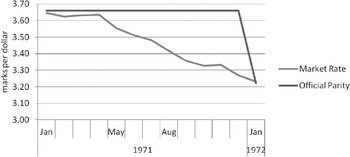
For several months, American officials were unable to get other countries to agree to a formal revaluation of their currencies. This was not a problem with respect to Germany, which allowed the mark to appreciate after having allowed it to float in May (Figure 1). But other European countries objected to Germany's proposal that their currencies also be allowed to float against the dollar. In particular, France insisted that exchange controls, dual exchange rates, and other measures be used to preserve the existing parities.
The dollar–mark exchange rate

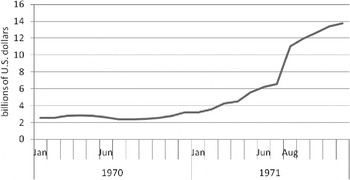
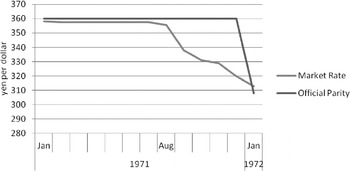
Yet it was clear that the existing parities could not be maintained, particularly with respect to the Japanese yen. More than any other country, Japan resisted the appreciation of its currency. The Nixon shock unleashed enormous speculation against the dollar, forcing Japan's central bank to intervene massively in foreign exchange markets to prevent the yen from appreciating. On Monday and Tuesday, 16–17 August, Japan bought $1.3 billion to support the dollar and keep the yen at the old rate of ¥360 (Angel, Reference Angel1991: 128). Though the Bank of Japan tried to restrict foreign exchange transactions, it failed to stem the flight to the yen. One week after the Nixon shock, Japan's foreign exchange reserves had increased $2.7 billion, an increase of 30% (Angel, Reference Angel1991: 139). After two weeks, it had accumulated an additional $4 billion (Figure 2). Yet this large-scale intervention could not prevent the dollar from depreciating against the yen (Figure 3).
Japan's foreign exchange reserves

The dollar–yen exchange rate

The volume of trading on foreign exchange markets proved stronger than the government's willingness to peg the value of the currency. By the end of August, Japan's Finance Minister announced that the government would allow the yen to float, although it would be a dirty float with continued government intervention to reduce volatility and slow the yen's appreciation.
Although foreign exchange markets were forcing at least some exchange rates to deviate from their official parities, foreign governments were still reluctant to agree to a formal change in parities. By September, there was growing internal dissention within the Nixon administration about the value of continuing the surcharge. The opposition was led by National Security adviser Henry Kissinger. Initially ‘agnostic’ about the 15 August measures, Kissinger (Reference Kissinger1979: 955, 957) recognized that the administration ‘would have to tread a narrow path between maintaining enough pressure to provide an incentive for the adjustments we were seeking, and evoking a trade war as well as jeopardizing political relationships built up over decades’. However, after receiving several memos (from Robert Hormats of the National Security Council staff) arguing that the surcharge was not powerful enough to achieve the exchange rate adjustments, the trade concessions, and the increased burden sharing that Connally desired, Kissinger (Reference Kissinger1979: 955–956) ‘grew concerned about the unsettling impact of a prolonged confrontation on allied relationships’.
Contrary to Connally's view that the impact of the surcharge would increase over time, the NSC believed that the bargaining value of the surcharge would deteriorate the longer it was in place. Not only did it risk leading to foreign countermeasures and reprisals that would harm US exports, but Kissinger was warned that domestic interests might demand that it be kept as a permanent fixture of US trade policy (FRUS, 2001: 512–515). This view was reinforced ‘when Arthur Burns showed me a list of retaliatory measures planned by our major trading partners which would produce an outcome on balance highly disadvantageous to us’ (Kissinger, Reference Kissinger1979: 957). Thus, Kissinger came to the view that the surcharge was contributing to trans-Atlantic diplomatic tensions and should be removed as soon as possible.
On 20 September, Kissinger pressed this foreign policy argument with the president, suggesting that the surcharge be dropped in exchange for no immediate return to dollar convertibility into gold (as if that was even an option). Nixon shot down Kissinger's appeal:
The difficulty is the surcharge, Henry, it so popular domestically, we just can't end it until we get something for it. That's the, hell, the surcharge is supported by 85% of the people. Good God, you just can't give it away. (Ohlmacher, Reference Ohlmacher2009: 23)
The surcharge was certainly becoming a source of international tension. While it had been aimed principally at Japan, the surcharge applied to dutiable imports from all countries, including those running trade deficits with the United States. Latin American countries, many of which had trade deficits, complained that their exports were unfairly subject to the surcharge. Because its currency was already floating against the dollar, Canada demanded an exemption from the surcharge. The European Economic Community filed a complaint in the GATT. Other countries hinted that they might retaliate. In October, Denmark announced that it was imposing a 10% surcharge on imports to address its balance of payments problems. Yet Connally insisted that the surcharge ‘is going to stay on for awhile because it frankly is to our advantage to keep it on for awhile’ (Solomon, Reference Solomon1977: 199–200). Yet he also hinted that countries complying with US demands, such as Germany whose currency had appreciated significantly, would be awarded with an exemption from the surcharge.
To speed the negotiations, Connally reduced the requested amount of revaluation to 20% for the yen and 15% for the mark. Germany was not a problem because the mark had already appreciated significantly against the dollar. The problem was other European countries and the concern about cross-rates: Germany did not want to lose competitiveness vis-à-vis its European trade partners and therefore did not want to agree to a formal revaluation of the mark unless other European currencies were revalued as well. At various international meetings, other European countries continued to resist the US demands. For example, France was willing to allow the dollar to depreciate against the franc, but not allow the franc to appreciate against gold. That is, France insisted that the franc remained fixed in terms of gold and the dollar be devalued in terms of gold.
Connally resisted raising the dollar price of gold because he did not want to be known as the Treasury Secretary who devalued the dollar against gold. Nixon affirmed this position: ‘I'll be damned if we raise the price of gold like Arthur [Burns] wants’ (FRUS, 2001: 522). But without a revaluation of the franc, Germany would not agree to a formal revaluation of the mark because they wanted to ensure that the mark–franc rate did not significantly alter the competitive position of each country's goods. So now France became a key player in the negotiations, a country with which the United States had little leverage – even with the surcharge in place.Footnote 9
By late November, with Kissinger constantly reminding him of the foreign policy difficulties caused by the unresolved exchange rate issue, Nixon began to worry about the political costs of the continued stalemate.Footnote 10 The president signaled to Connally that he should settle the impasse as soon as possible. Shultz and Dam (Reference Shultz and Dam1977: 116) later concluded that ‘without the intervention of Kissinger, the devaluation of the dollar would almost surely have been greater, thereby obviating any need for a further devaluation in February 1973’. The implication is that Kissinger's intervention led to a premature settlement with a smaller exchange rate adjustment.
Yet an agreement still proved elusive. A G-10 meeting in Rome in late November–early December was inconclusive. Japan was still reluctant to change the official parity, despite the fact that the dollar had fallen against the yen on foreign exchange markets. France still refused to revalue its currency against gold and insisted that the United States had to devalue the dollar against gold. And Germany rejected a formal revaluation of the mark against the dollar unless there was a similar change in the franc–dollar rate.
A key meeting between President Nixon and President Georges Pompidou of France in mid-December finally broke the impasse (Kissinger, Reference Kissinger1979: 959–962). France opposed any general move to floating exchange rates, something that had been debated among US officials.Footnote 11 But France agreed to keep its gold parity unchanged if the dollar price of gold was increased. This would allow the dollar to fall against the franc, as long as the revaluation of the franc was less than the mark's revaluation. Nixon agreed to devalue the dollar in terms of gold and lift the surcharge (FRUS, 2001, 3: 597–601).
The agreement with France set the stage for the G-10 meeting at the Smithsonian Institution in Washington, DC on 17–18 December to finalize new exchange rate parities. On the first day of the Smithsonian negotiations, the United States asked for 19.2% revaluation of the yen and 14% for the mark. Germany agreed to a 13.57% revaluation of the mark. The United States agreed to devalue the dollar by raising the dollar price of gold from $35 per ounce to $38 per ounce, an increase of 8.57%. Britain and France did not change their gold parity, so their currencies rose 8.57% against the dollar. Italy and Sweden devalued 1% against gold so that their currencies rose 7.5% against the dollar (James, Reference James1996: 236–238).
All of this put pressure on Japan because German officials insisted that the yen be revalued by at least 4 percentage points more than the mark, or at least 17.57%. The Japanese finance minister insisted that the number had to be less than 17%, telling the story of the finance minister who was assassinated when he revalued the yen by that amount in 1930 after Japan went back on the gold standard (Angel, Reference Angel1991: 257).Footnote 12 Connally agreed and settled for a 16.9% revaluation of the yen. Japan's finance minister later revealed that he had received permission from the prime minister to revalue the yen by as much as 20% (Volcker and Gyohten, Reference Volcker and Gyohten1992: 97).
The Smithsonian agreement was completed on 18 December 1971, and heralded by President Nixon as ‘the most significant monetary agreement in the history of the world’. Two days later he signed an executive order removing the 10% surcharge. The trade-weighted depreciation of the dollar against OECD currencies was slightly less than 8%, or 12% excluding Canada. Volcker later wrote that:
it was well short of what we felt we needed to restore a solid equilibrium in our external payments, even if we had succeeded in opening Japanese and European markets in trade talks. But the stonewalling of the Common Market and Japan had been effective. With the exchange rate realignment settled and the import surcharge removed, we had little negotiating leverage. (Volcker and Gyohten, Reference Volcker and Gyohten1992: 89–90)
Furthermore, the new parities merely formalized what foreign exchange markets had already in large part delivered. As Figures 1 and 3 show, the mark and the yen were already trading at the exchange rates agreed to at the conference. Foreign central banks also adopted wider bands around the parities, so exchange rates could depart from the parities to a much greater extent than before. Still, the Smithsonian agreement only bought a little time before the ultimate demise of the Bretton Woods system with the advent of floating exchange rates in March 1973.
The other US objectives – a reduction of foreign trade barriers and increased burden sharing of defense expenditures – were generally neglected in the aftermath of the Smithsonian agreement.Footnote 13 However, the exchange rate adjustment succeeded in alleviating some of the protectionist pressures that had been building up in Congress. In retrospect, Volcker (Reference Volcker1978–1979: 7) said:
The conclusion reached by some that the United States shrugged off responsibilities for the dollar and for leadership in preserving an open world order does seem to me a misinterpretation of the facts … The devaluation itself was the strongest argument we had to repel protectionism. The operating premise throughout was that a necessary realignment of exchange rates and other measures consistent with more open trade and open capital markets could accomplish the necessary balance-of-payments adjustment.
Indeed, after the devaluation of the dollar, the Burke–Hartke legislation faded away and Congress even began supporting new legislation to reduce trade barriers. There was strong support in 1972–1973 for legislation that eventually became the Trade Act of 1974, which gave formal permission for the United States to participate in the Tokyo Round of GATT negotiations that had begun in 1973.
In terms of academic opinion, while many economists supported the closing of the gold window, the surcharge was more controversial. At Yale University, James Tobin, Robert Triffin, and Richard Cooper were critical of the surcharge, fearing that it would be counterproductive or difficult to remove, while Henry Wallich supported it as a bargaining tool (Hartford Courant, 4 October 1971: 7). Harvard's Francis Bator warned that Connally's tactics were ‘recklessly dangerous’ and were bringing the world to the ‘brink of economic war’ (New York Times, 30 November 1971). While Milton Friedman did not explicitly endorse the surcharge, he argued that it ‘succeeded beyond expectation in shaking exchange rates loose’, adding that ‘once it did that, it should have been abolished promptly’ (Newsweek, 20 December 1971: 83). C. Fred Bergsten (Reference Bergsten1972: 203) was very critical of the administration's failure to attempt to negotiate an exchange rate change with Japan prior to the shock, arguing that ‘the import surcharge, the other trade moves, and the rhetoric accompanying the whole effort actually foster domestic and foreign protectionism’.
3. Did the surcharge reduce US imports and lead to revaluation?
The 10% import surcharge, in effect from 16 August to 20 December 1971, constitutes a unique policy experiment in postwar US trade policy. To determine whether it played a role in bringing about the revaluation of other currencies, it is important to assess how much it affected imports.
The surcharge applied to only about 52% of US imports. There are two reasons for its limited impact. First, the surcharge was only imposed on dutiable imports, which at the time constituted about two thirds of all US imports (US Department of Commerce, 1972: 788). The remaining one-third of imports was duty-free and therefore exempt from the levy. Second, all imports subject to quantitative restrictions (QRs) – about 17% of dutiable imports – were exempt from the surcharge. These included such goods as petroleum, sugar, meat, dairy products, other agricultural imports, and cotton textiles that were covered by the Long-Term Agreement on Textiles.Footnote 14
Furthermore, the 10% surcharge could not be fully applied to the applicable dutiable imports; the weighted average surcharge was 9.3% on dutiable imports, or about 4.8% on total imports (GATT, 1971: 19; Council of Economic Advisers, 1972: 70). The US tariff code consisted of two columns of duties, the column 1 most-favored nation (MFN) rates which were the tariffs that had been reached in executive trade agreements (under the authority of the Reciprocal Trade Agreement act) and the column 2 statutory rates established by Congress in the Tariff Act of 1930. The president only had the legal authority to impose the surcharge on goods whose tariff had been reduced in previous trade agreements, and the surcharge could not increase the applied tariff beyond the statutory rate. If the statutory rate was less than 10%, the surcharge could not be fully applied. For example, the MFN tariff on automobiles was 3.2%, whereas the column 2 statutory rate was 10%. In such cases, the surcharge was simply half the gap between the MFN and the statutory tariff; in the case of automobiles, the surcharge-inclusive tariff was 6.5% (Council of Economic Advisers, 1972: 148). In a limited number of cases, the column 1 and column 2 rates were the same, in which case the surcharge could not be imposed.
Other adjustments were made to the surcharge when it took effect. Shortly after the surcharge was announced, the Treasury decided to exempt goods in transit before 15 August, as well as those held up by dock strikes or being withdrawn from bonded warehouses, so long as they cleared customs by 1 October. As a result, imports for consumption surged in September in part to beat the deadline.Footnote 15
What was the impact of the surcharge on US imports? One way of estimating the impact is to use the Houthakker and Magee (Reference Houthakker and Magee1969) estimate of the price elasticity of US import demand. The existing average tariff on dutiable imports was 9.2% in 1971, and the surcharge was an additional 9.3 percentage points on top of that. This implies that the relative price of dutiable imports would increase by about 8.5%. Using the Houthakker–Magee price elasticity of import demand of −0.54, this translates into a 4.6% reduction in affected imports, or a 2.2% fall in total imports. If the price elasticity was –1, then affected imports would fall by 8.5% and total imports by 4.3%. These figures are roughly comparable to a US estimate at the time. The US representative at the GATT stated that, if the surcharge was in effect for a year, imports would be approximately $1.5–$2.0 billion lower than they otherwise would have been (GATT, 1971: 9). This amounts to about 5.8% to 7.7% of the 1970 value of dutiable imports, which somewhat overstates the percentage reduction because the value of those imports was higher in 1971.Footnote 16
The impact of the surcharge on imports might be revealed by studying the differential movements in dutiable and duty free imports. Figure 4 presents monthly data on dutiable and duty free imports. This gives us a nice comparison between dutiable imports (the treatment group) that were exposed to the surcharge and duty-free imports (the control group) that were unaffected by the surcharge. Although these imports tend to be different types of goods (dutiable imports are largely manufactured goods, whereas duty-free imports are largely raw materials), the month-to-month variation in the two series is very similar. Any major shock to one, due to changes in income or other factors, is usually reflected in the other.
Monthly value of US imports, 1967–1972: dutiable and duty free (millions of US dollars)

This suggests that a simple difference-in-difference specification is one way of identifying the impact of the surcharge on dutiable imports (relative to duty-free imports). Thus, we could consider a regression of the form:
 $${\rm Log\, of\, imports} = \alpha + \beta _{1{\rm}} \cdot{\rm Dutiable} + \beta _2 \cdot {\rm Surcharge} + \delta ({\rm Dutiable} \cdot{\rm Surcharge}) + \varepsilon, $$
where Dutiable is a dummy variable for dutiable imports, Surcharge is a dummy variable for the period that the surcharge was in effect (October–December 1971). The parameter of interest is δ, which is the impact of the surcharge on dutiable imports in comparison to duty-free imports.
Unfortunately, dock strikes are a major confounding factor affecting the behavior of imports at precisely this time. The impact of the dock strikes of January 1969 and October–November 1971 is clearly visible in Figure 4. In both cases, the monthly work-hours of dockworkers dropped to almost zero.Footnote 17 East coast ports were affected by a dock strike from 1 October to 28 November 1971, and West coast ports were affected by dock strikes from 1 July to 8 October 1971 and again from 17 January to 20 February 1972. This creates enormous volatility in imports right around the period of the surcharge. US imports surged in September 1971 in anticipation of the dock strike, dropped off sharply during the strike, and rebounded sharply in December 1971, even though the surcharge remained in effect, because the strike ended. Although the West coast strike does not overlap with the surcharge period, imports were significantly higher than average in October, despite the surcharge, in order to make up for the imports lost over previous months.
Because they coincide almost exactly with the period of the surcharge, these strikes make it extremely difficult to make a clean identification of the impact of the surcharge on imports. Even when additional explanatory variables are included in the difference-in-difference regression, such as dummy variables for time, month, September 1971 to control for the rush to import before the surcharge, and the log of dock hours to control for port activity, the coefficient on the surcharge dummy variable is sometimes the wrong sign (due to the import surge in December 1971) and always statistically insignificant.
The most plausible country estimates are for Canada and Japan. Imports from Canada were largely unaffected by the dock strikes because about 92% of the imports arrived by land or air. The point estimate indicates that imports of dutiable goods were about 2.5% lower than imports of duty-free goods during the period the surcharge was in effect, although the estimate is not statistically significant. Imports from Japan were somewhat less affected by the strikes because the West coast strikes occurred before and after the period the surcharge was in effect. Although it is also not statistically significant, the coefficient suggests that the surcharge reduced Japanese imports by about 2%, a plausible magnitude. This might understate the impact of Japan's trade because it includes higher than normal imports in October due to the lifting of the dock strike.Footnote 18
Unfortunately, therefore, the coincidence of dock strikes at the time the surcharge was in effect confounds any effort to estimate the impact of the surcharge on imports. Just because we cannot obtain a precise estimate of the surcharge's impact on imports, however, does not mean that it did not play a role in persuading other countries to revalue their currencies. The incidence of the surcharge was unequal across countries because countries exported different types of products to the United States that were differentially affected by the surcharge. European countries and Japan were most vulnerable to the surcharge because more than 90% of their exports to the United States were subject to import duties. Canada and most developing countries were the least vulnerable to the surcharge because a larger share of their exports to the United States was duty free.
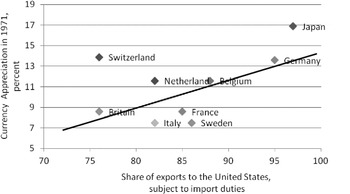
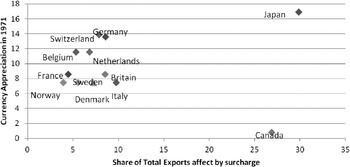
This measure of vulnerability yields an interesting pattern. Figure 5 displays the relationship between the share of a country's exports to the United States subject to duties and the appreciation of its currency in 1971. The positive association suggests that countries that were more vulnerable to the surcharge revalued their currencies more than less vulnerable countries. Yet the relationship in Figure 5 may be spurious: it uses an imperfect measure of a country's vulnerability to the surcharge because countries differed in the importance of their exports to the United States in terms of their overall dependence on foreign trade.
Trade exposure and currency appreciation

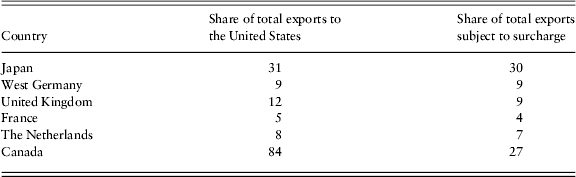
Table 1 presents a better measure of trade exposure to the surcharge: the share of a country's exports destined for the United States and the share of those exports subject to the surcharge. The two countries that stand out in terms of their vulnerability are Japan and Canada. They were vulnerable for different reasons: although a large proportion of Canada's exports to the United States were duty free, the dependence of their exports on the US market still made them vulnerable to American policy, while Japan's export dependence was lower but almost all of its exports were affected by the surcharge. On the other hand, while most of the exports of other European countries to the United States were affected by the surcharge, a much smaller proportion of their exports were destined to the United States. In particular, only about 4% of French exports were affected by the surcharge. Thus, the United States may have had little leverage to influence their policy.
Trade exposure to the United States (1971)
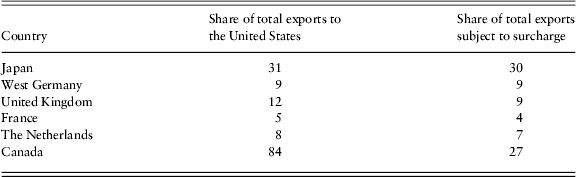
Source: IMF, Direction of Trade Statistics Annual, 1971.
Figure 6 reproduces Figure 5 using the different measure of trade exposure. This plot reveals that there is no relationship between the potential trade impact of the surcharge on a country's exports and the revaluation of its currency. Most European countries are clustered around 5–10% in terms of the share of their exports affected by the US action, with Canada and Japan being the two outliers. Canada was largely an innocent bystander that was adversely affected by the surcharge; its currency was already floating against the dollar, and in fact had appreciated against the dollar in the months before the August 1971 decision.
Trade exposure and currency appreciation

On the other hand, Japan – with whom the United States did want a revaluation – was also quite vulnerable to the surcharge. In fact, there is suggestive evidence that the surcharge was effective in altering views in Japan. Just three days after the Nixon shock, the chairman of Japan's Chamber of Commerce stated that a revaluation of the yen was preferable to the continuation of the 10% surcharge (Angel, Reference Angel1991: 129). As other business interests weighed in with similar views, the Japanese government began to reconsider its adherence to the 1949 parity. Without the pressure from those groups, Japanese officials might have been willing to accumulate more dollar reserves or restrict foreign exchange transactions in an effort to keep the yen at its parity.
Thus, at least in the case of Japan, the import surcharge appears to have played a role in persuading government officials, in the Ministry of Finance and Bank of Japan, to allow the yen to appreciate. They were very reluctant to do so, but were pressured by business groups and export associations who had an interest in removing the surcharge, even though they would also have to contend with a stronger yen.Footnote 19 Even National Security Adviser Henry Kissinger (Reference Kissinger1979: 956), who worked to resolve the exchange rate dispute and remove the surcharge, ‘came to the view that some shock had probably been needed to bring about serious negotiations’.
At the same time, the exact role of the surcharge in bringing about the revaluation is difficult to know. Closing the gold window alone may have triggered enough speculative activity against the dollar to have brought about the exchange rate changes formalized in the Smithsonian Agreement. Yet the surcharge, which had to be applied to all countries on an MFN basis, was a very blunt instrument with which to bring just one country (Japan) to the negotiating table. The MFN requirement of the surcharge harmed the trade of many ‘innocent bystanders’ (countries with whom the United States did not have a problem) and prevented a targeted approach to the ‘problem case’ of Japan.
4. Legal challenges to the import surcharge
The decision to impose the surcharge led to foreign complaints that it violated US commitments under the General Agreement on Tariffs and Trade (GATT) and to domestic complaints that the president lacked the legal authority to impose the surcharge.
The GATT challenge
The GATT permits a country to restrict imports when it is experiencing balance of payments difficulties. According to Article XII, ‘any contracting party, in order to safeguard its external financial position and its balance of payments, may restrict the quantity or value of merchandise permitted to be imported’. This provision suggests that an import quota (quantitative restriction) or a limit on the value of imports is the appropriate policy instrument to support a balance of payments objective, rather than a higher tariff or import surcharge. This preference conflicts with other principles of the GATT, notably the general prohibition of quantitative restrictions in Article XI and the goal of non-discrimination, which is difficult to achieve with non-auctioned quotas.
In practice, parties to the GATT had used both import quotas and import surcharges on balance of payments grounds. While some countries requested and had received a waiver from the GATT for their surcharges on these justifications, many countries had not. As a result, the practice had been established that the GATT would ‘tolerate’ surcharges when there were balance of payments difficulties (Jackson, Reference Jackson1972; Vincke, Reference Vincke1972).
Shortly after the imposition of the surcharge, the GATT established a working party to examine it. Under Article XV, the GATT is required to consult with the International Monetary Fund (IMF) on all matters involving exchange arrangements and to defer to the IMF's view on such matters.Footnote 20 The GATT requested and quickly received a report from the IMF about the surcharge. In its report, the IMF stated that ‘in the absence of other appropriate action and in the present circumstances, the import surcharge can be regarded as being within the bounds of what is necessary to stop a serious deterioration in the United States balance of payments position … The import surcharge can be justified as a means of improving the US balance of payments only until it is possible to supplant it by effective action in the exchange rate field’ (GATT, 1971: 2).
Despite the IMF's finding, the GATT Working Party reached the following conclusion:
The Working Party took note of the findings of the IMF and recognized that the United States had found itself in a serious balance-of-payments situation which required urgent action. While noting the contrary views of the United States, the other members of the Working Party considered that the surcharge, as a trade restrictive measure, was inappropriate given the nature of the United States balance-of-payments situation and the undue burden of adjustment placed upon the import account with consequent serious effects on the trade of other contracting parties. (GATT, 1971: 11)
The GATT Working Party offered no justification for the conclusion that the surcharge was ‘inappropriate’ in light of the IMF's view that it ‘can be regarded as being within the bounds of what is necessary’.
The GATT took no further action and the surcharge was lifted just a few months after this report was issued.
The domestic legal challenge
The surcharge was also challenged in US courts on the grounds that the president did not have the authority under US law to increase import duties (Jackson, Reference Jackson1972).
In February 1972, Yoshida International, a New Jersey based importer of Japanese zippers, filed a legal challenge against the surcharge. The Yoshida suit claimed the president did not have the power to impose the import duties and asked for compensation for the duties paid. Government lawyers argued that the president had such authority on the basis of the Tariff Act of 1930, the Trade Expansion Act of 1962, and section 5(b) of the Trading with the Enemy Act.
The problem for the courts was that there was no precedent for the president's action and the statutes offered no explicit language about the president's authority to impose a surcharge without Congress's consent. The statutory basis for the surcharge in the Tariff Act of 1930 and the Trade Expansion Act of 1962 was weak, while the authority granted to the president in the Trading with the Enemy Act of 1917 was much more general. This act gave the president broad powers, during any period of national emergency, to regulate, prevent, or prohibit the importation of any foreign good. In his official proclamation of the import surcharge, Nixon specifically declared the existence of a ‘national emergency’ so that he could invoke section 5(b) of the Trading with the Enemy Act.
In July 1974, a three judge panel at the US Customs Court unanimously ruled in favor of Yoshida (378 F.Supp. 115). The court issued a summary judgment that nothing in the statutes explicitly allowed the president to impose a surcharge and that therefore the revenue collected should be returned. In November 1975, after the government appealed the decision, the US Court of Customs and Patent Appeals reversed the earlier verdict (526 F.2d 560). The court observed that there was no precedent to rely on because there was nothing in the Trading with the Enemy Act or its history which authorizes or prohibits the imposition of a surcharge. Yet the court concluded that the power to impose a surcharge as a ‘regulation’ of imports was authorized under the act.Footnote 21
Before the outcome of the government's appeal was known, Congress gave the president the explicit authority to impose an import surcharge in the future. Section 122 of the Trade Act of 1974 granted the president broad authority to impose duties (not to exceed 15%) or quantitative restrictions, or a combination of the two, for a period of up to 150 days, after which Congressional authorization would be needed. The surcharge had to be applied on a non-discriminatory basis, although the president was also given the authority to impose it on just one or two large countries with which the United States had large and persistent trade deficits. Although this statute has never been invoked, it presumably would prevent any domestic legal wrangling over a surcharge in the future.
5. Conclusion
President Nixon's 10% import surcharge was a unique event in postwar US international economic policy. The purpose of the surcharge was to get other key countries to revalue their currencies, which eventually occurred as a result of the Smithsonian Agreement. Yet this does not mean that the surcharge was responsible for bringing about the agreement. The closing of the gold window and surcharge set off massive speculation against the dollar which dislodged currencies from their official parities; perhaps that was enough without the surcharge to have brought about the hoped for revaluation. Furthermore, much of the subsequent diplomatic effort aimed at managing the cross exchange rates of European currencies relative to the German mark. France played a key role in these negotiations even though the dollar–franc rate was not much of an issue and the surcharge was not aimed at France, which was in fact not very vulnerable to the surcharge anyway. Therefore, the precise lessons from this period about the value of the surcharge are likely to remain controversial.
Since 1971, proposals for import surcharges have been resurrected in the United States whenever there is controversy over exchange rates and trade imbalances. When the US dollar rose dramatically on foreign exchange markets in the early 1980s, the idea of an import surcharge was dusted off as a way of dealing with the trade deficits and protectionist pressures that the strong dollar contributed to.Footnote 22 This led another Treasury Secretary from Texas, James A. Baker III, to seek exchange rate adjustments as a way of defusing domestic pressures for import restrictions. The result was the Plaza Accord of September 1985 in which foreign countries agreed to undertake measures that would lift the value of their currencies against the dollar, including intervening in foreign exchange markets (Henning and Destler, Reference Henning and Destler1988).Footnote 23 More recently, China's exchange rate policy has sparked controversy in the United States, as well as legislative proposals for trade sanctions against China unless the renminbi is allowed to appreciate more rapidly (Goldstein and Lardy, Reference Goldstein and Lardy2008). Because many countries are affected by the change in cross exchange rates when one bilateral rate is adjusted, one lesson from 1971 and 1985 is that international agreement on exchange rate policy may be required to alleviate frictions caused by different currency policies. The IMF and GATT did not work every effectively together in 1971, but may need to do so in the future to prevent exchange rate conflicts from spilling over and affecting trade policies.