





Intellectual disability (also known as learning disability in the UK) is a neurodevelopmental condition affecting around 2.16% of adults and 2.5% of children in the UK, characterised by impaired intellectual and adaptive functioning. 1
Policy reform for people with Intellectual disability in England over the past decades has largely been driven by responses to systemic failures in care, with a focus on reducing in-patient provision and expanding community-based services. While ethically grounded, these reforms have often assumed the superiority of community care without adequate empirical validation. This editorial examines the growing divergence between health policy and evidence by using seven topical examples specific to England and provides recommendations to help bridge the gap. While focused on England, many of the examples and recommendations are applicable to other countries in the UK, i.e. Scotland, Wales and Northern Ireland.
Reduction of specialist in-patient beds in England: evidence versus assumption
Health policy in England has consistently prioritised reducing in-patient provision, without consummate investment in community health provision, particularly since 2006. Following abuse scandals, particularly Winterbourne, policy shifted heavily toward deinstitutionalisation. The goal has been to close assessment and treatment units (ATUs) and reinvest funds into localised social care and community-based support. In 2015, the Building the Right Support programme was launched for England in an attempt to reduce the number of psychiatric in-patients with intellectual disabilities and/or autism by 35–50%. The National Health Service (NHS) Long Term Plan (2019) established a target to halve the number of autistic people and individuals with an intellectual disability in in-patient units compared with 2015 levels. For 2025–2026, the government committed to reducing numbers by a further 10%.
This approach of reducing in-patient provision reflects a broader and welcomed deinstitutionalisation agenda but is lacking an adequate evidence base, especially given the well documented higher rates of mental disorder in this population. Reference Cooper, Smiley, Morrison, Williamson and Allan2 It could be argued that limiting access to in-patient admissions for people with an intellectual disability when needed purely for ideological reasons is a form of discrimination when those with mental health needs who do not have an intellectual disability can have access. An expectation that general adult in-patient units should admit people with intellectual disability who have a mental disorder becomes challenging when those services themselves are being compromised by a cut in numbers and pressures on usage. The absence of an appropriately skilled workforce compounds this.
Further, there is an absence of a robust analysis underpinning the government targets of bed reduction as this programme is predicated on the assumption that hospital care is inherently undesirable, rather than on comparative outcome data. Reference Shankar, Sawhney, Tromans, Jaydeokar, Oodiyor and Sheehan3 Empirical literature suggests a more complex reality. People with intellectual disability and severe behavioural or psychiatric needs sometimes require specialist mental health care. Studies including systematic reviews indicate that appropriately resourced in-patient services can deliver stabilisation, risk management and treatment optimisation that cannot always be achieved in community settings. Reference Xenitidis, Gratsa, Bouras, Hammond, Ditchfield and Holt4–Reference Melvin, Barnoux, Alexander, Roy, Devapriam and Blair7
The reduction in local generic/mainstream mental health beds and increased reliance on beds far from patient’s homes, is associated with poorer patient experience. Reference Perry, Allen, Pimm, Meek, Lowe and Groves8 This unintended consequence raises questions about whether bed reductions have improved care or simply displaced it away from local communities. In line with the concerns in English in-patient units, a recent study from Canada has found that people with intellectual disability require tailored care in hospital and specific support to facilitate a safe and effective transition to the community. Reference Selick, Campitelli, Huang, Balogh, Kurdyak and Lunsky9 Through an improved range of community services, the priority must be to enhance the quality of in-patient services for people with intellectual disability while reducing undue reliance on them.
Mainstreaming healthcare for people with intellectual disability in England
Policy initiatives have focused on improving access to mainstream healthcare for people with intellectual disability, including the implementation of annual health checks across the UK. While these measures address important healthcare inequalities, they do not adequately reflect the high burden of complex physical health multimorbidity experienced by this population. Meeting these needs requires a more integrated approach across primary, secondary and specialist services.
Persistent systemic barriers continue to limit timely access to specialist assessment and emerging diagnostics, such as genomic testing, as well as to novel and specialist treatments, contributing to ongoing inequities in care.
A salient example is epilepsy in people with intellectual disability, which is a bellwether for multiple harms. With epilepsy affecting around 25% of individuals with intellectual disability (compared with 1% of the general population), it is associated with treatment resistance, polypharmacy and increased mortality, including sudden unexpected death in epilepsy (SUDEP). Reference Watkins, Linehan, Brandt, Snoeijen-Schouwenaars, McGowan and Shankar10 Literature consistently emphasises the need for holistic expertise in managing epilepsy in this population. Population-based studies have demonstrated significant gaps in epilepsy care and highlighted the role of inclusive care improving outcomes. Reference Sun, Watkins, Henley, Laugharne, Angus-Leppan and Sawhney11,Reference Shankar, Henley, Alauddin, Watkins, Tromans and Laugharne12 Despite this, there has been poor focus of policy and reforms on improving access to specialist services or better multi-agency community support. Reference Shillito, Watkins, Ali, Page, Pullen and Mitchell13
This divergence between evidence and policy reflects a broader tension between disease-based clinical pathways and clinical complexity. Without skilled input and agreed operational objectives, inclusive care is diluted rather than enhanced. Furthermore, people with intellectual disability are legally entitled to reasonable adjustments to their care under the Equality Act 2010, a piece of legislation that applies across England, Wales and Scotland. Applying an approach to care that simply mirrors that delivered to the general population will be insufficient in delivering equitable outcomes to this marginalised group.
Specialist psychiatric provision challenges for people with intellectual disability in England
The reduction of in-patient provision for people with intellectual disability in England has been accompanied by insufficient attention to specialist services, particularly in Child and Adolescent Mental Health Services (CAMHS) and forensic services for people with intellectual disability. Reference Taylor, Thompson, Manktelow, Flynn, Gillespie and Bradshaw14,Reference Wild, Alder, Weich, McKinnon and Keown15
Despite a threefold higher prevalence of mental disorders in children and adolescents with intellectual disability compared with children and adolescents who do not have intellectual disability, current CAMHS pathways for children and young people with intellectual disability indicate a significant postcode lottery. The consequences can be significant as children with intellectual disability may experience misdiagnosis, high levels of anxiety and concerning behaviour leading to school exclusion, deteriorating health, inappropriate use of restrictive practices, medication overuse and trauma.
Forensic provision remains predominantly hospital-based, with limited capacity for community-based services. Consequently, early intervention opportunities are missed, and crisis-driven responses persist. Perhaps relatedly, the number of men with intellectual disability in prisons rose, associated with the closure of in-patient intellectual disability beds. Reference Wild, Alder, Weich, McKinnon and Keown15 Furthermore, there is a marked lack of evidence-based commissioning for forensic mental health interventions tailored to people with intellectual disability.
There is reduced provision for rare neurodevelopmental syndromes associated with atypical behavioural regression, treatment-resistant psychosis and complex multimorbidity leaving caregivers and clinicians without access to specialist expertise or treatment pathways. The specialist services challenge is compounded by workforce shortages and inflexible care models. Together, these gaps reflect a system ill-equipped to meet the needs of a highly vulnerable population. There is evidence highlighting the gaps in service provision and inconsistencies even within a specific region. Reference Shillito, Watkins, Ali, Page, Pullen and Mitchell13 The consequences of this and the associated risks are significant for people with intellectual disability, their carers and the wider public. Without specialist provisions for intellectual disability, people may experience delayed and inappropriate care and placements and be disadvantaged within the criminal justice system.
Absence of application of outcome measures in England’s intellectual disability national programmes
A key principle of evidence-based practice is the use of measurable outcomes to evaluate interventions. Yet England’s intellectual disability national programmes have been characterised by a lack of robust outcome metrics. Evaluations have focused primarily on process indicators rather than clinical outcomes. 16 There is limited evidence demonstrating improvements in mental health, quality of life, or mortality. In contrast, biomedical literature suggests the need for outcome measures that include measures of treatment effectiveness, safety and patient experience. Reference Kumar, Sawhney, Chester, Alexander, Mitchell and Shankar17 The absence of such measures in policy limits the ability to assess efficacy and undermines accountability.
Lack of a coordinated research agenda for intellectual disability in England
Despite the scale of system transformation, there has been little investment in research that can empirically underpin intellectual disability policy for care. Reference Bishop, Laugharne, Shaw, Russell, Goodley and Banerjee18 National research strategies allow for clear priorities to be set and better alignment of funding around shared goals. They can create a common framework linking universities, the NHS, industry and third-sector organisations. This is especially valuable in complex areas such as intellectual disabilities, where fragmentation tangibly slows progress.
Reviews of mental health services for people with intellectual disability emphasise the importance of evidence-based interventions and multidisciplinary research. Reference Shankar, Tromans, Laugharne, Courtenay, Sawhney and Roy19 Alongside people with intellectual disability not featuring in the English NHS 10-year plan, Reference Shankar, Sawhney, Tromans, Jaydeokar, Oodiyor and Sheehan3 the absence of a nationally coordinated research strategy for this group stands in stark contrast to the national strategies for dementia, autism and mental health services for adults, children and youth. The absence of specialist clinics or services, especially those for rare conditions associated with intellectual disability, further hampers research and amplifies lack of evidence for treatment as there is lack of critical mass, knowledge and expertise. A national approach can explicitly prioritise this population, highlight regional disparities and lead to fairer distribution of research and innovation benefits across health and social care.
Mental Health Act reform: rights versus evidence
While recent proposals to reform the England and Wales Mental Health Act 1983 aim to reduce the use of detention for individuals with intellectual disability reflect concerns about delayed discharges from psychiatric hospitals, their evidential basis remains limited. Reference Tromans, Bhui, Sawhney, Odiyoor, Courtenay and Roy20,Reference Beazley, Alexander, Taylor, Velani, Dewson and Shankar21 The literature on mental health legislation highlights the need to balance individual rights with clinical necessity. Reference Tromans, Bhui, Sawhney, Odiyoor, Courtenay and Roy20,Reference Beazley, Alexander, Taylor, Velani, Dewson and Shankar21 Without adequate community provision and specialist support, restricting access to in-patient care may increase risk and exacerbate service gaps. When similar changes were implemented in New Zealand, it was to the detriment of people with intellectual disability. Reference Tromans, Bhui, Sawhney, Odiyoor, Courtenay and Roy20,Reference Beazley, Alexander, Taylor, Velani, Dewson and Shankar21
The conflation of autism and intellectual disability: a policy category error
Neurodevelopmental conditions frequently co-occur, but intellectual disability and autism are distinct albeit overlapping conditions with differing needs. Policy development needs to ensure that resources are targeted at those with the highest level of need; however, those with more severe levels of intellectual disability are often not able to advocate for themselves.
England’s policy, however, has consistently grouped intellectual disability and autism within a single commissioning framework (‘intellectual disability and/or autism’). This construct not only excludes other neurodevelopmental disorders but has a weak evidential basis. Reference Beazley, Alexander, Taylor, Velani, Dewson and Shankar21
Autistic people without intellectual disability experience high rates of mental ill health and markedly increased risk of suicide. Reference Cassidy, Bradley, Shaw and Baron-Cohen22 In contrast, those with moderate-to-profound intellectual disability face substantial multimorbidity, polypharmacy and significantly elevated premature mortality. Reference White, Sheehan, Ding, Roberts, Magill and Keagan-Bull23 They are less able to communicate distress or advocate for themselves, increasing their vulnerability to diagnostic overshadowing, and unmet needs.
The continued conflation of autism and intellectual disability risks misaligned service provision and inequitable resource allocation. In the context of rising autism referrals, shared funding structures may inadvertently prioritise higher-functioning populations with prominent advocacy over those less visible population groups with complex and enduring needs. A stratified, evidence-based approach distinguishing autism from intellectual disability in the commissioning of services is therefore essential.
The divergence between policy and literature reflects a broader tension between ideology and evidence in England. Recent policy has often assumed that community care can replace specialist provision and that structural change alone improves outcomes, despite limited empirical support. The literature instead supports an integrated system combining adequately resourced community pathways with specialist services.
The reduction of specialist provision without equivalent community investment risks widening inequalities, limiting access to appropriate care, increasing clinician moral injury (i.e. ‘the psychological, emotional, and ethical distress that clinicians experience when they are unable to provide the care they believe is right because of systemic constraints, rather than because of a lack of knowledge or skill’) and worsening outcomes, particularly for individuals with severe intellectual disability who are unable to advocate for their own needs.
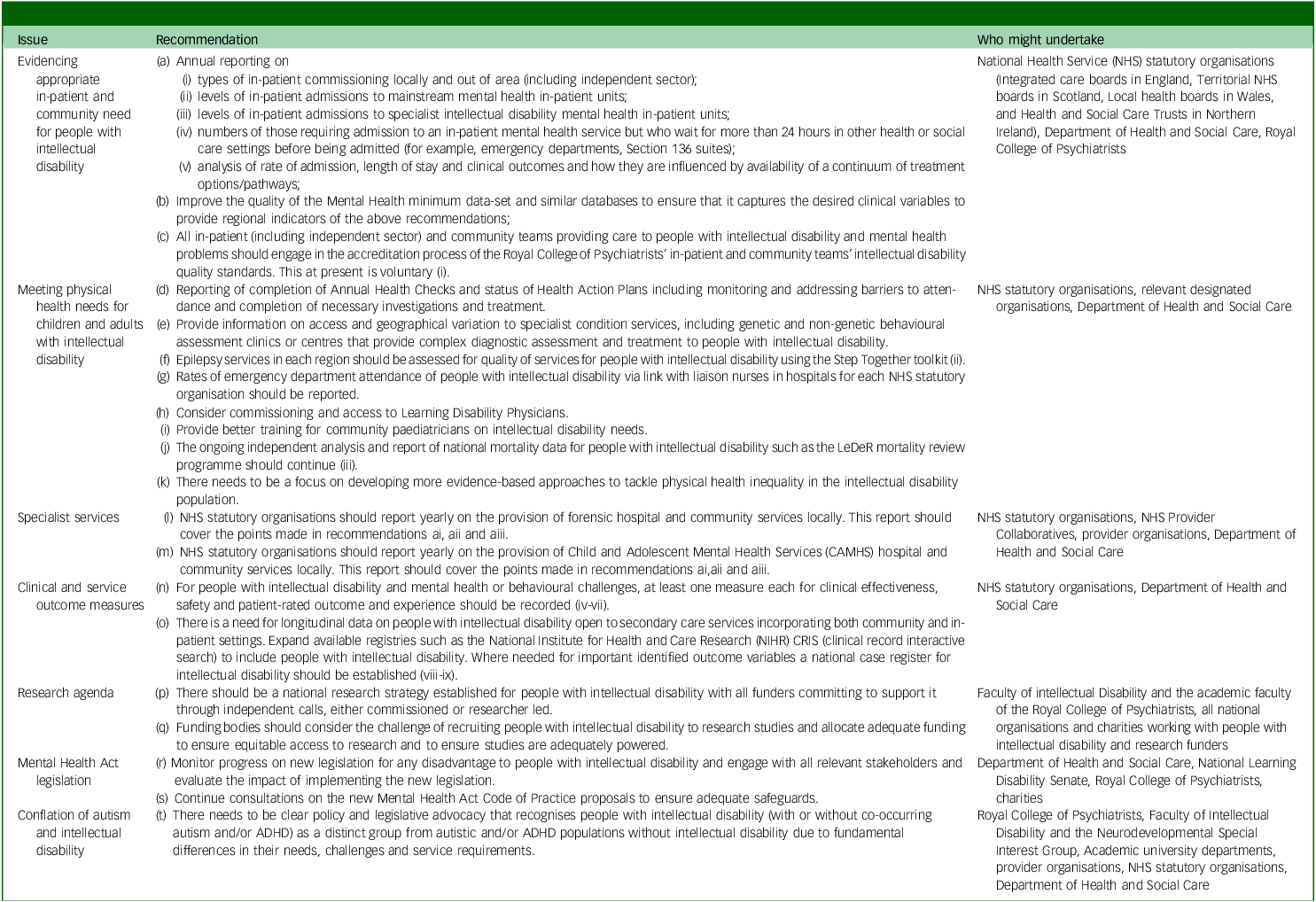
Although policy in England has improved awareness and inclusion, many major reforms are not evidence based. Ideology that supersedes evidence will be to the detriment of one of the most vulnerable populations in healthcare. Future policy must prioritise evidence-based service design, outcome measurement, workforce development and sustained research investment. We provide recommendations in Table 1 to enable this and supportive references for Table 1 items in supplementary information 1.
Proposed recommendations

Table 1 Long description
A table with six columns and multiple rows. The columns are labeled Issue, Recommendation, and Who might undertake. The table lists various issues related to healthcare for people with intellectual disabilities and provides corresponding recommendations and the entities responsible for undertaking these recommendations. The issues include evidencing appropriate in-patient and community need, meeting physical health needs, specialist services, clinical and service outcome measures, research agenda, Mental Health Act legislation, and tackling discrimination. Each row provides specific recommendations and the organizations responsible for implementing them.
Supplementary material
The supplementary material is available online at https://doi.org/10.1192/bjo.2026.12131
Acknowledgements
Artificial Intelligence use: No artificial intelligence tools have been used in the research or writing process for this manuscript.
Author contributions
All authors satisfy the ICMJE guidance by substantially contributing to the design, analysis and interpretation of the work, drafting of the manuscript and final approval of the manuscript and all agree to be accountable for all aspects of the work in ensuring that questions related to the accuracy or integrity of any part of the work is appropriately investigated and resolved. R.S.: conceptualisation, methodology, validation, visualisation, project administration, writing – original draft, writing – review and editing; S.J.T.: writing – review and editing; J.D.V.: writing – review and editing; B.P.: writing – review and editing; R.S.: writing – review and editing; I.S.: writing – review and editing; R.A.S.M.: writing – review and editing; J.M.: writing – review and editing; K.P.: writing – review and editing; S.K.G.: writing: review and editing; A.R.: writing – review and editing; K.R.K.: writing – review and editing; A.S.: writing – review and editing; R.T.A.: writing – review and editing; R.A.L.: conceptualisation, project administration, writing – original draft, writing – review and editing; A.H.: validation, visualisation, writing – review and editing.
Funding
This research received no specific grant from any funding agency in the public, commercial or not-for-profit sectors.
Declaration of interest
All authors are Fellows of the Royal College of Psychiatrists (RCPsych). They are also part of the RCPsych Faculty of Psychiatry of Intellectual Disability. I.S. and R.S. are current office bearers in the RCPsych Faculty of Psychiatry of Intellectual Disability. S.T., J.D.V., R.A.S.M., A.R. and A.S. are currently on the executive committee of the RCPsych Faculty of Psychiatry of Intellectual Disability. K.P. is the RCPsych College Centre for Quality Improvement (CCQI) lead for intellectual disability. R.S. is the RCPsych associate Dean for academic training. The authors assert that this feature in no manner reflects the views of the RCPsych as an organisation. Further, K.R.K. is the Editor in Chief and R.S., S.T., A.H. and R.T.A. are members of the British Journal of Psychiatry Open editorial board. They did not take part in the review or decision-making process of this paper. S.T., R.S., R.S.H., S.K.G., A.S., R.T.A., R.A.L. and A.H. hold institutional grants from various national and charity organisations outside the submitted work. No other author has disclosed any conflicts.
Professor Rohit Shankar, MBE, FRCPsych (pictured), is a professor of neuropsychiatry at Plymouth Medical School, UK; director of the Cornwall Intellectual Disability Equitable Research (CIDER) group, Truro, UK; and a consultant psychiatrist at Cornwall Partnership NHS Foundation Trust, Bodmin, UK.
Dr Samuel Tromans, MRCPsych, is an associate professor at the University of Leicester, UK, and a consultant psychiatrist at Leicestershire Partnership NHS Trust, Leicester, UK.
Dr Jana DeVilliers, FRCPsych, is a consultant psychiatrist at The State Hospital, Carstairs, UK.
Dr Bhathika Perera, FRCPsych, is an associate professor at University College London, UK.
Dr Rory Sheehan, FRCPsych, is a senior lecturer at Kings College London, UK.
Dr Inder Sawhney, FRCPsych, is a consultant psychiatrist at Hertfordshire Partnership NHS Foundation Trust, Hatfield, UK.
Professor Raja Anindya Sekhar Mukherjee, FRCPsych, is a consultant psychiatrist at Surrey and Borders Partnership NHS Foundation Trust, Redhill, UK.
Dr Jane McCarthy, FRCPsych, Is a consultant psychiatrist at Sussex Partnership NHS Foundation Trust, Worthing, UK.
Dr Kiran Purandare, FRCPsych, is a consultant psychiatrist at Central and Northwest London NHS Foundation Trust, London, UK.
Professor (Hon.) Satheesh Gangadharan, FRCPsych, is a consultant psychiatrist at Leicestershire Partnership NHS Trust, Leicester, UK.
Professor (Hon.) Ashok Roy, FRCPsych, is a consultant psychiatrist at Coventry and Warwickshire Partnership NHS Trust, Coventry, UK.
Professor Kenneth R Kaufman, FRCPsych, is a professor at Rutgers Robert Wood Johnson Medical School, New Jersey, USA.
Professor Andre Strydom, FRCPsych, is a professor at King’s College London, UK.
Professor (Hon.) Regi T. Alexander, FRCPsych, is a consultant psychiatrist at Hertfordshire Partnership NHS Foundation Trust, Hatfield, UK, and visiting professor at the School of Life & Medical Sciences, University of Hertfordshire, UK.
Dr Richard A. Laugharne, FRCPsych, is an emeritus consultant psychiatrist at Cornwall Partnership NHS Foundation Trust, Bodmin, UK.
Professor Angela Hassiotis, FRCPsych, is a professor at University College London, UK.


 Open access


eLetters
No eLetters have been published for this article.