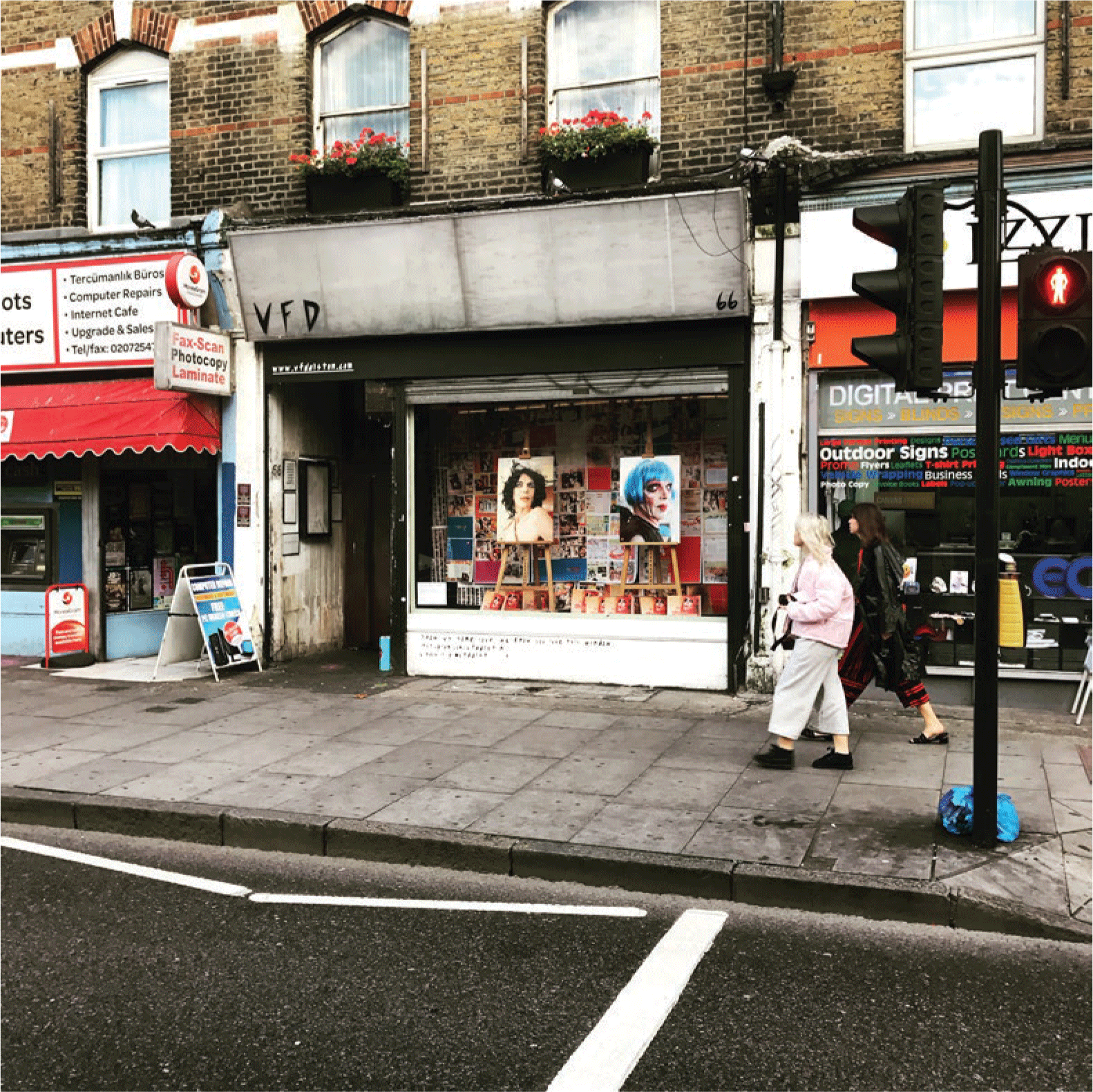
VFD (external view) featuring exhibition of David Hoyle images by Holly Revell, October 2017. (Photo by Phoebe Patey-Ferguson)

Figure 1 Long description
One photo. The photo shows a street view featuring a storefront with an exhibition of images in the window. The storefront is labeled VFD and is located at 66. The window displays several images, including a prominent portrait of a person with blue hair. Two people are walking past the storefront on the sidewalk. The storefront is situated between other businesses, one with a red awning and another with a sign for digital services. A traffic light is visible on the right side of the photo, showing a red pedestrian signal.
Phoebe (VFD, Dalston, London)
I arrive at the club (VFD) at 10am, clutching a Greggs omelette breakfast roll and a black coffee. I unlock the door and sit at my desk. I answer emails, make phone calls, count cash, make orders, schedule social media posts, take meetings, have a lunch break, make some repairs to the space, show some people around, deal with some complaints, talk to the local council, fill in a temporary event license, update the staff rota, chat to colleagues, update the website listings, update the chalkboard, and all the other endless admin. Tempo shifts as evening falls. Stock up the bar, prepare cash floats, update card machine software, watch tech runs, check sound levels, buy bin bags, buy toilet rolls, welcome the cloakroom person, find the raffle ticket book, welcome the bar staff, get myself a drink. Watch people start to arrive on the CCTV. Get myself another drink. Do a bit of DJing, bar work, door work, and a little more dancing to get things going. Buy some more toilet roll. The place is filling up. Buy some more ice. Refill the float. Lose an hour gossiping in the smoking area. Help eject someone. Dance on the bar. Kisses. Give away free shots. Move people from the smoking area into the basement. Watch a show. Move people onto the dancefloor. Move people down the corridor. Move people off the stairs. Record a video of the beauty to post on social media. Deal with the speaker blowing. Deal with the toilet blocking. Deal with the till breaking. Deal with an argument in the smoking area. Deal with tears in the bathroom. Have a snog. Collect empty cans blocking walkways. Mop up some sick. Take a breath to feel my heart full of love. Tell the DJ there is one more song. Dance to the last song. Turn on the lights. Deal with the disappointment. Move people off the dancefloor. Move people up the stairs. Ask everyone to leave quietly. Count cash. Distribute cash. Help pick up all the detritus. Sweep up. Have another drink. Have a little dance and mop up. Clean the toilets. Check my emails. Turn it all off and lock everything up. It’s 4 or 5am and I leave. I get to see the sunrise.
Joe (Her Upstairs, Camden, London)
I’m either early or late. I was maybe here earlier doing something, but most likely I was elsewhere, teaching or being taught. So, when I arrive, I usually feel guilty that I haven’t done anything or haven’t done enough, even though from the start I was always supposed to be the silent partner. The guilt is mine, not put onto me, but I feel it anyway. So I dive in: talk to people, pour a glass of wine, go and wash some glasses, see if we need more ice, try and offer to help behind the bar, have a glass of wine, go and see the performers, have a glass of wine, go and see Vicky on security, see if I need to answer any emails, try and find somewhere quiet to stand during the show and have a glass of wine, check the toilets and do a quick wipe or top up the loo roll, have a glass of wine. If I’m there, I might be roped in. I’m wearing dungarees and pouring oat milk over a performer whilst they twerk in a paddling pool, I’m helping a performer do a quick change, I’m holding a sign, I’m checking that they’re okay, I’m going to get them a drink, I’m having another glass of wine, I’m trying to not think about how much wine I’ve had or the fact I’ve got to teach in the morning or have a meeting. I’m trying not to feel guilty. I’m taking a tenner from the till to get some food on the way home. I’m trying to remember that we are also paying people to do some of the jobs I feel guilty for avoiding this time. I’m trying to remember if all of these things happened on the same night or if they all happened on different nights or if they all happened on every night or if none of them happened. I’m trying to not make it sound romanticized, but I’m worried I’ve instead made it sound awful. So I’m pivoting to make it clear, reaching for the best memory I can find, that sticks with me whenever I think back to those heady times of too much wine: I’m sitting with the love of my life in a storage yard that is an extended backstage area, surrounded by the best people in the world, eating chicken that may or may not have fallen on the floor.
Plugging In and Switching On
In queer venues, you need the plumbing to flow as freely as the drinks, the power to stay on for the mirrorball to glimmer and the music to pump, and for there to be enough human and material resources to make the party happen. If queer nightlife is there to build community, it needs someone to have acquired bricks and mortar. If it’s going to spark romance, we need to plug something in. If it’s going to circulate desire, we need working wiring. If it’s going to empower, we need a power source. If it’s going to flow, we need to unblock. If queer nightlife is about people and bodies and ideas in all their complexity and glory, a few leaks are going to spring, but we can’t let anyone drown. We need to create spaces of use that facilitate misuse and coordinate behavior that allows for misbehavior. And people will always need to piss.
Ideas of circulation, exchange, connection, building, and power are prevalent in the study of queer nightlife and its uses. We want to pay attention not just to how queer clubs are utilized and experienced but how they are enabled to be used by the labor that sustains them. Drawing on our experience managing and working in queer nightlife venues, we attend to how use and misuse function as a working practice to understand how queer subjectivities and communities materialize in these spaces. We follow a thread of Sara Ahmed’s work across several publications that centers around notions of use, utility, labor, queerness, and resistance. Ahmed’s repeated returns to investigating these themes have enabled us to address more expansively the uses and misuses of queer nightlife spaces in dialog with our experience as workers and academics in this area. Where queer nightlife is often (beautifully) articulated as a transformative escape from practical concerns, we instead approach nightlife from routine or pragmatic perspectives that sustain these spaces but are rarely the focus of discussion. Particular forms of leisure intersect with particular kinds of work, revealing the entanglements of responsibility with pleasure, administration with decadence (see Alston Reference Alston2023). As we think about how these spaces function effectively for queer communities, we trace the ways in which people enable and disenable the use and misuse of these spaces.
When we started to think about how we knew queer nightlife, we reflected that between 2016 and 2018 we were both doing some of the shit work that makes shit happen, our hands connected by the labyrinthine sewer system of London as we unblocked (shitty) toilets in two separate queer venues before we knew one another. This is a playful metaphor and a material reality, and in this article we return to things that feel simultaneously metaphorical and material, where one does not interrupt or subsume the other. We think about the various modes of unblocking and flow management that seem central to queer venues as informal practices that are part of what we understand as our DIY queer nightlife methodology.
In publications on queer nightlife there are often discussions of the tensions between academic authority on queer nightlife, the presence (or accusations of absence) of academics in queer nightlife, and the possible disconnects between these areas (see for example Ghaziani Reference Ghaziani2024:14). Less visible are the queer academics involved directly in running nightlife or those who are pushed by their involvement in nightlife to move into academia. For both of us, what was going on in our research and teaching informed our contributions to these venues. What was happening in the venue shaped our teaching and research—sparking insights that jumped between theory and practice and illuminated unexpected connections. Research concepts often materialized in club programming; performers introduced new frictions that produced epistemological shocks disrupting assumed boundaries between academic and nightlife knowledge production. Like the electrical currents running through our venues’ DIY wiring, these knowledge sparks and circuits of knowing were unpredictable and sometimes excitingly hazardous.
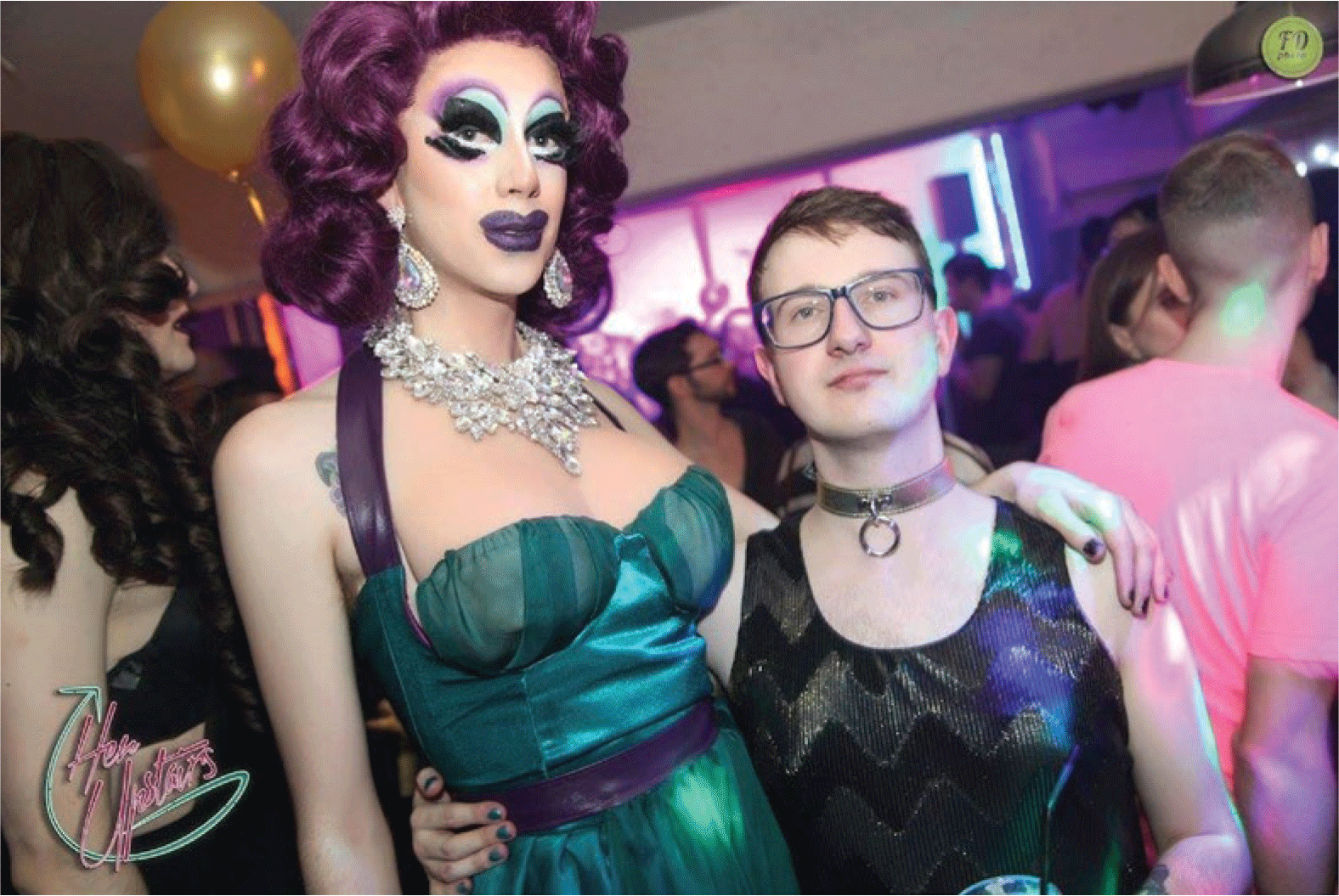
Me the Drag Queen and Joe Parslow at the Opening Night of Her Upstairs in 2016. (Photo by FD Photo)

As people who have been involved in running queer nightlife venues, we come at this from a position of love. We might understand love as a form of critique here; if you love something, you want to make it better. Love is not uncritical, but deeply critically engaged. We might think about critical love as deeply connected to a reparative impulse from Eve Sedgwick (Reference Sedgwick2002) and those she enables (such as Heather Love Reference Love2010), as well as drawn from our own thinking around drag performance (Parslow Reference Parslow2024) and live art practice (Holton and Patey-Ferguson Reference Holton and Patey-Ferguson2024), where we have separately accounted for how closeness to our objects of study allows for particular ideas and insights to emerge.
We move between “we” and “I” here. The shared and individual get mucky and messy—we leak and flow into one another. We tell individual stories about VFD (Phoebe) and Her Upstairs (Joe) and use “I” in these moments, but we also account for our shared speaking and thinking through “we.” Indeed, we haven’t necessarily each written sections and brought them together, although this has happened sometimes. We have each started bits the other has finished, and at times we even write in one another’s voices to fill gaps in paragraphs the other hadn’t got to. We have enjoyed this pleasurable and disorienting process of be-coming (together) on the page.
It is important to be clear that we both had nebulous roles at Her Upstairs and VFD that shifted and responded to circumstances, indicative of the informal and expansive modes of labor in small queer venues. At VFD, Phoebe was employed as the bookings manager (often referred to as booking mistress), which became more of a general “lead producer” role, as well as a performer, bar person, doorperson, cleaner, DJ, promoter, and all kinds of general admin. Joe was a cofounder of Her Upstairs, intended as a silent partner alongside George Anthony as the manager and Meth (now Me), Joe’s husband, as the events coordinator. Joe was never really silent (you can’t shut her up at the best of times!), getting involved in both planning and various day-to-day running, which usually meant whatever needed to happen to make the venue run, and probably at times trying to be helpful but making it harder. In both spaces, we worked alongside a huge cast of people who made shit happen, long-term or just for a night. Working in nightlife is many things, but it’s never solitary, and we do not want to understate how our roles were enmeshed with the labor of so many others. This intense sociality generates workplace friction and conflict, but also some of the most electrifying cooperation we have experienced. Running a venue feels like a marathon, but it’s not a story of any one person winning a race. It’s more helpful to imagine a pack of (fabulous) stray dogs running through the streets, howling, barking, colliding, trying to figure out how to survive together, and often chasing their own tails.
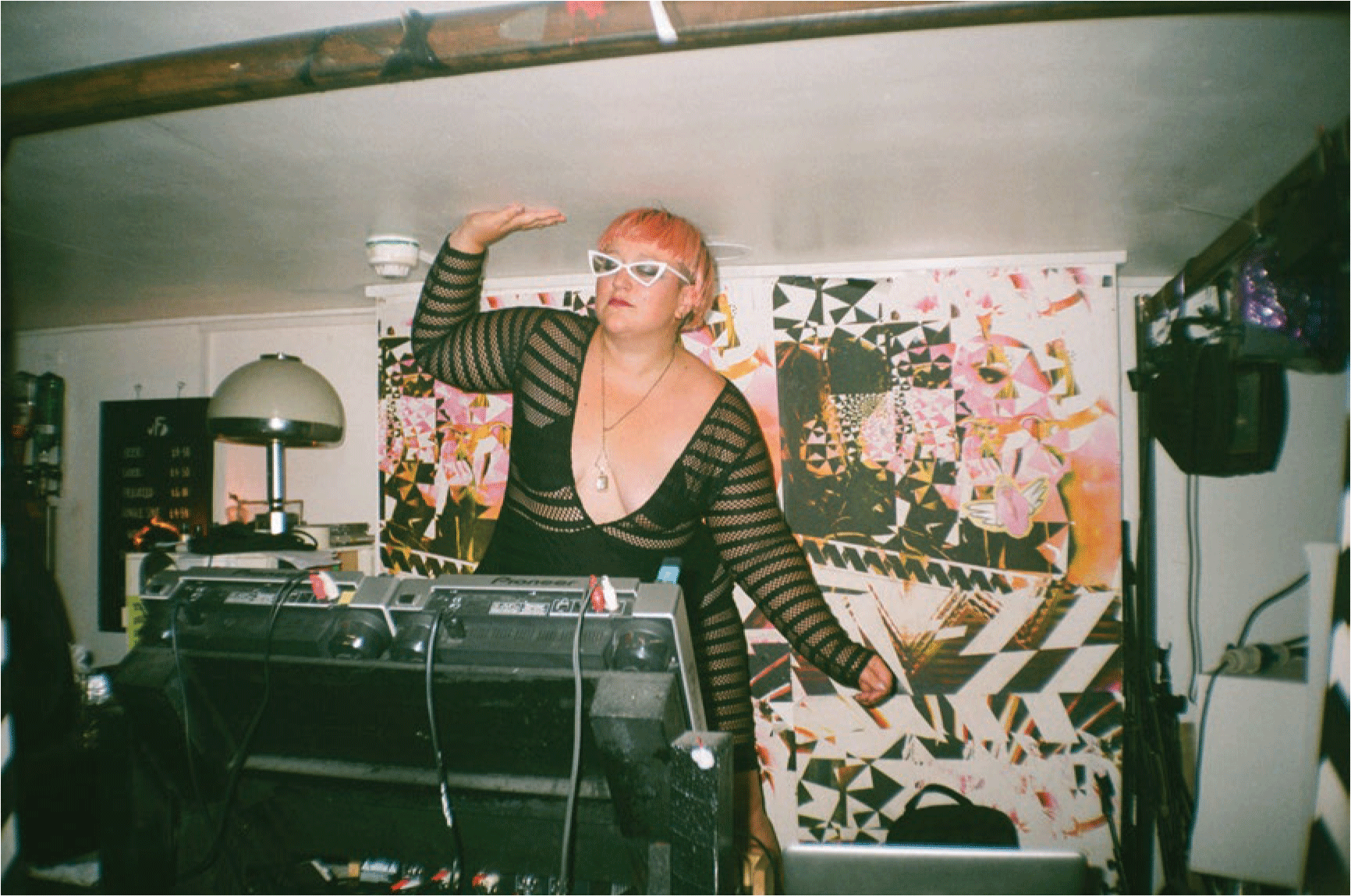
Phoebe at Femmetopia at VFD in 2018. (Photo by Nicol Parkinson)

Uses and Misuses of Method
The call for contributions for this TDR Consortium issue asked us to consider how we know queer nightlife, and it has been simultaneously pleasurable and disorienting. The research has often involved sharing stories, gossip, and fragments of half-remembered or rumored events. We embrace this, following Gavin Butt’s encouragement to add gossip as a “category of evidence,” which can “displace so-called veritable truths from their more positivistic frames of reference and to render them instead […] as projections of interpretative desire and curiosity” (2005:7). It has involved, for both of us, returning to uncomfortable memories and memories where our very beings and identities were forged in different ways as queer people, researchers, and friends. The question of how we know queer nightlife is also a question of how we know ourselves and, perhaps more disconcertingly, how we know what we know.
We understand this DIY queer nightlife methodology as significantly shaped by queer and feminist DIY methods, connected to wider forms of DIY queer organizing in live art, cabaret, and theatre (see for example Holton [Reference Holton2023] for a discussion of DIY artist and collective producing practices under austerity in the UK; Phoebe’s work on DIY pedagogies [Patey-Ferguson Reference Patey-Ferguson and Kartsaki2024]; and Joe’s description of producing as “professional worrying” [Parslow Reference Parslow2024]). In our experience, independent DIY queer nightlife distinguishes itself from commercially oriented nightlife venues, festivals, and events (LGBTQ+ or otherwise) that are more likely to have hierarchical employment structures, delineated roles and responsibilities, fully legitimate business practices, be run for profit, and increasingly have large corporate investment.Footnote 1 In comparison, DIY queer nightlife practices are creatively resistant to these formalized processes with a focus on unregulated agency and “do away with bureaucracy and other professional practices and structures […] which are seen as […] embodying an establishment attitude and hierarchical nature which is antithetical to DIY’s roots in punk, and its frequent anarchist, left-wing, or radically democratic politics” (Holton Reference Holton2023:109). These methodologies emerge from precarious circumstances (often in response to unstable financial circumstances or conditions of austerity), are relatively cheap to produce, may be itinerant or relatively short-lived, and rely on collective efforts enabled through multiple relations and labors. Workers may act as artist, promoter, and producer, do the marketing and set up the ticket links, organize the venue and tidy up afterwards, and more.Footnote 2 This methodology is often less a purposeful choice than the only option given what resources queer communities have available (though necessity and resistance have always been murky entanglements). It is therefore tied to disparate messy and quotidian practices of cocreation and management that are carried out with a wide range of motivations. We connect this to activist organizing and other types of DIY practices including DIY music subcultures (see Fife Reference Fife2025) and Ian Rafael Ramirez’s work on resistive and joyful practices of cocreation in the Philippines and the solidarity of cis heterosexual women and LGBTQ+ individuals through brown commons (2024). DIY nightlife methodologies are fundamentally participatory and respond to the immediate desires of people gathered in a time and place through producing space for connection and artistic expression (such as particular forms of performance or music) to realize counter-hegemonic identities and practices.
So, given the complexity and contingency of these methodologies, what does it mean for us to know queer nightlife? These knowings (or know-hows, following Conquergood [Reference Conquergood2002:146]) are drawn from our practice, our connection to queer nightlife as people who have worked in these scenes in London during a particular austerity-ridden, post–Brexit referendum, prepandemic era in the UK (c. 2010–2020). This period is characterized by a rise in homophobia and a particularly drastic rise in transphobia, as well as the closure of large numbers of queer venues (and nightlife venues) in which the very conditions of our work felt under threat in multiple ways (see Parslow Reference Parslow2024). This know-how, however, is leaky; our ideas are not watertight. This is both because of the intervening years since we actively worked in these locations and because even when we were working, it was only ever a partial view; one obscured by the specific localities and focus of our venues, our positions within them, the amount of alcohol we drank (or didn’t!), and more. Some of the know-how is blocked, then, and this notion of blocks and leaks returns as we work through our knowings in this article—these leaks and blocks are not objects in the way of knowing, they are precisely how we know.
In theatre and performance studies, practice research (or practice as research or PaR) has been remarked by Robin Nelson as founded on tacit knowledge described as “liquid knowing” (2013:60). Alyson Campbell and Stephen Farrier extend this in their articulation of “mess” as a method for queer practice research (and a fabulous one!), understanding queer researchers as bags of liquid, where, following feminist thinkers such as Anne Carson (Reference Carson and James1999), liquid “is hard to contain—it finds cracks and holes to permeate and flow through” (Campbell and Farrier Reference Campbell and Farrier2015:84). For us, attending to this liquid mess (or messy liquid) is tricky, as we can valorize the purposefully disruptive nature of liquid permeating and even eroding disciplinary boundaries while simultaneously—urgently—needing to clear it up. Spillages and mess in the nightclub are an issue, creating risks of slippage and harm that we often had to resolve, navigating a busy dancefloor with a mop and bucket. Here, as we indicated above, the material and the metaphor rub up against one another in erotic and frustrating ways, where we can understand erotics as a knowing in and through the body, following Elizabeth Freeman’s (Reference Freeman2010) notion of an erotohistoriography, where the body becomes method. Through this, we might know in and through our bodies, but these bodies (these bags of liquid) are different now than they were then, and in the intervening years memories of events, colored by alcohol, stress, and more, are unreliable, whilst documentation was sparse or inconsistent. The stories we tell are evidence and they are leaky, full of inconsistencies, or perhaps more pertinently holes, and these stories and their holes tell us about how queer forms of knowing might be done and undone.
We are, of course, not alone in this, and we deliberately displace a positivist methodology. We have nothing to prove. We follow Martin F. Manalansan IV who—in resistance to the “clinical and hygienic social measurements” that permeated gay and queer sociological studies (primarily for Manalansan in the work of Richard Florida and Amin Ghaziani)—proposes a mess and tainted wildness as vital resistance to an oppressive civility and timing produced by numbers and normative modes of measurement (2018:492). Contained in our thinking here is a commitment to extend queer critiques beyond gay, cis, male subcultures, holding our research alongside work that centers queer immigrants, global majority subjects, disabled communities, working-class cultures, and more. Coalitional commitments to solidarity are deeply important to queer nightlife and our work as academics and makers, and frame our thinking. Importantly, Manalansan also connects these coalitional practices to mess and, taking up the underused understanding of mess as “plenitude—as abundance and as opportunity,” proposes that “[m]ess opens up other stories that do not yield to the calls for temperance, cleanliness, and measured behavior. Mess, then, is not an impediment to living but a way of being in the world” (2018:496).
We are interested in what key terms that have emerged as we’ve tried to write this article about queer utilities in nightlife—sparks, blocks, leaks—tell us about the process of doing queer research. We have, for example, encountered blocks; got stuck on certain ideas that we can’t get past; leaked stories and gossip as opposed to writing; found moments where one or the other seems to find a flow or has an idea speak where the other can’t pass. We ask, then, what does knowing—and doing—queer nightlife tell us about how we know—and do—queer studies? This question connects to ephemera and queer forms of evidence present in José Esteban Muñoz’s influential works (1996; 2009). Muñoz’s interest in the “traces, glimmers, residues, and specks of things” (1996:10) speaks to our practice and research in queer nightlife. Muñoz’s articulation here resonates with the “sequin method” proposed by Mark Edward and Stephen Farrier, which invites queer performance researchers to attend to what “glinty fragments catch our eye” (2020:110). We have joked that in our thinking through utilities, use, and labor, we are as interested in the grimy matte fragments that are left once the glamour of the performance is over (or is still being set up), but recognize that no matter what you do, glitter sticks on your clothes, your body, in the mop and bucket—glitter remains.
We want to pay attention to the metaphors and materialities of queer nightlife through the words that kept coming up and from which we couldn’t come unstuck: shocks, blocks, and leaks. We trace stories and theories that allow us to think through these ideas, understanding them as useful placeholders for leaky containers and jumping-off points to think about what and how we know about queer nightlife.
Shocks
The first sign that something was awry was the shock on people’s faces. From my position behind the DJ booth at VFD, I couldn’t see what had gone wrong, but there was a palpable sense of alarm. Other staff sprang into action. As I reached the scene, I saw an island of mushy toilet paper float out of the terracotta-tiled toilet area towards the boots of the closest queers. I squelched through to witness the sink smashed on the floor. The toilet cracked. A water feature created through the rampant sapphic lust of the cubicle’s previous inhabitants. The (queer) misuse of the toilet had led to dysfunction, a threatening outpouring of uncontrollable material. It had got out of hand, and it was out of our hands. The risk had turned to hazard, and we had to call it a night.
Shocks—electrical, political, metaphorical—are integral to queer nightlife’s formation. As venues, VFD and Her Upstairs emerged through moments of disruption, benefiting from impulsive behaviors and destructive forces. Incidents like the above “sex sink night” persist as legendary anecdotes and serve to increase the notoriety of queer nightlife. People often came to these venues to be shocked, and we generally tried to create shock through the performances we curated. Shocks have to be managed (the unexpected turn in a show, broken plumbing, licensing issues, venue closures), but they are also moments that generate knowledge and togetherness. Through examining emotional jolts and infrastructural breakdowns, we consider how queer nightlife operates through a continual negotiation between precarity and possibility. Improvisational, adaptive approaches are required to respond to these shocks, producing unique forms of queer knowledge that resist normative expectations about space, community, and utility. Maintaining these spaces means fostering a heterotopia focused on excitement and pleasure while existing in (but not entirely of) capitalist frameworks of profit and sustainability.
The nightclub’s shocks—a broken toilet, a DIY electrical fix, the electricity between bodies on a dancefloor—are some of the glittering fragments and glints that catch our eyes without clear organizing principles, without anyone in charge (or charging). These shocks function as epistemological sparks, illuminating brief, contingent moments of insight that resist systematic knowledge production. We see—as Foucault writes in The Order of Things—“the disorder in which fragments of a large number of possible orders glitter separately” ([1970] 1994:xvii). The queer nightclub is always heterotopic, full of disparate glitterball refractions. When there is a material failure (the lights go out, the sound cuts off, the circuits fail), it’s a conceptual revelation. Shocks “undermine”; they “shatter or tangle” (xvii) and disrupt any expected flows, forcing improvisational responses that generate new forms of knowing. The spark, shock, or sequin catches light momentarily, draws our attention, then shifts as we move. Our queer nightlife venues embody this heteroclite (abnormal, irregular) quality, spaces where fragments of different social orders (labor, politics, queer performance, economic exchange, community care) glitter separately yet simultaneously, resisting coherent narrative but producing intensely generative disruptions. Our heterotopic knowledge production emerges from the unsettling caused by shocks.
I still find it difficult to talk about Her Upstairs. It opened in 2016 amidst a shocking spate of venue closures in London. The venue started as a drunk idea between my husband (at the time a drag queen called Meth who now goes by Me), myself, and George Anthony—who was then a manager at Bloc Bar but had been the assistant manager of The Black Cap, a legendary LGBTQ+ bar in Camden a few hundred meters from Bloc Bar, which had closed the previous year. We schemed that if we could cover the renovation of an upstairs space at Bloc Bar (including putting floors at the two edges to make it a complete space), then we could open that space separately. I had lost both my parents between 2010 and 2015 and received some money from a life insurance policy my dad had taken out many years previously, which we used to cover some refurbishment. Her Upstairs was open for two years. In that time, we programmed countless drag and cabaret shows, and became best known for hosting nights for specific communities, including the first events of The Cocoa Butter Club, a now-legendary Black and Global Majority cabaret collective, and LADS, a night for female-identified performers.
After a year in the venue, we took over the space downstairs, calling it Them Downstairs (we thought we were so clever). That space hosted pantomimes, private hires, and had regular weekly club nights such as Queer Bash (again, we thought we were so clever). It was a vibrant, heady, and, for me, substance-filled time. We closed its doors in 2018, two years after it opened, amid complex and messy circumstances that are still difficult to process and discuss. As much care as we could put into the venue, it could not stand up to the rolling wheel of capitalism.
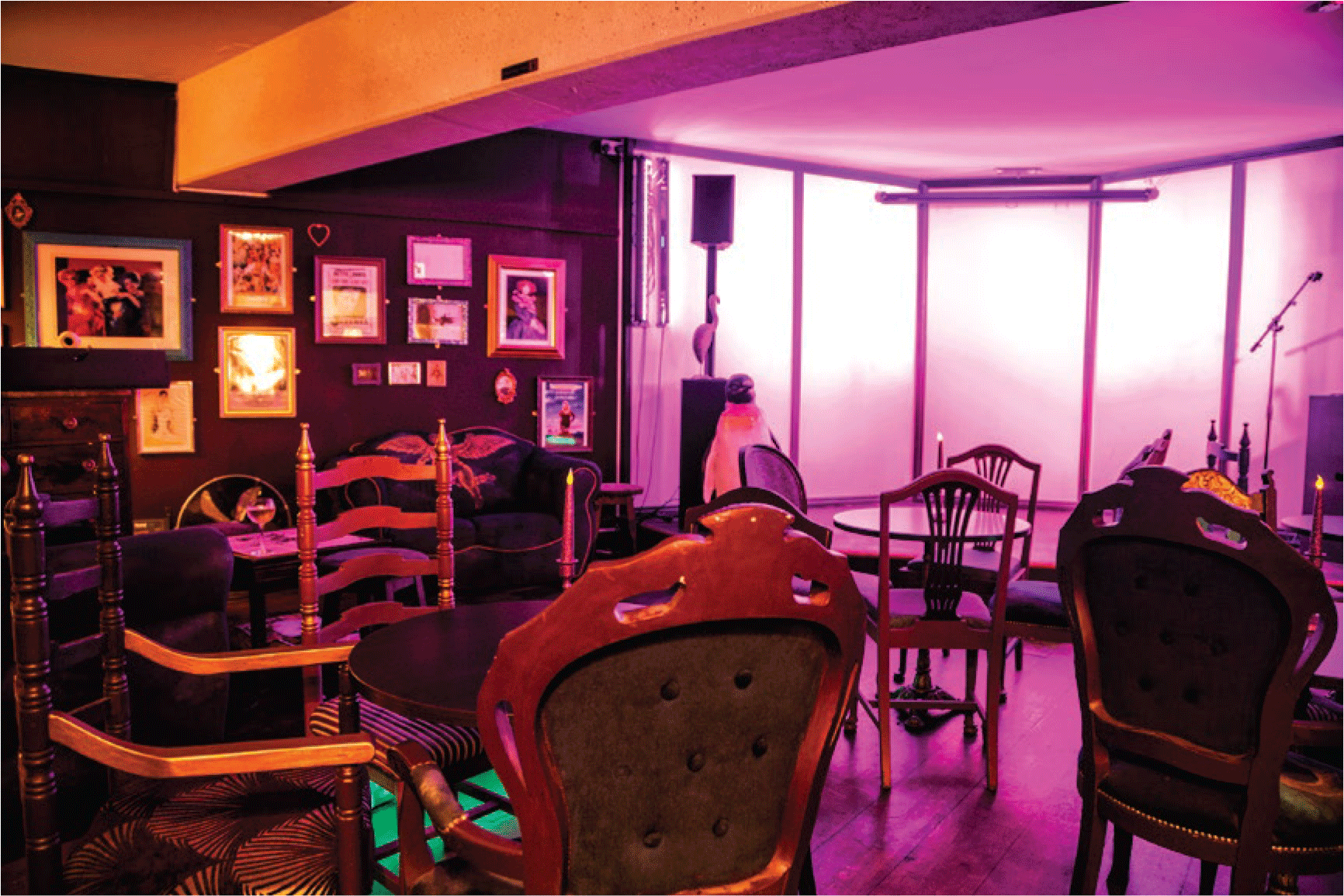
Her Upstairs, September 2016. (Photo by FD Photo)

Figure 4 Long description
A dimly lit room with various seating arrangements, including chairs and sofas, and a stage area with a microphone stand. The walls are adorned with framed pictures and posters. The room has a cozy and intimate atmosphere, with a mix of wooden and upholstered furniture. The stage area is set up with a microphone stand and speakers, suggesting it is used for performances or events. The lighting is soft and warm, creating a welcoming environment.
I ended up working at VFD in 2017 (previously Vogue Fabrics, now sort of Vogue Fabrics Dalston) because I needed a job. My PhD funding had run out, and the number of hourly paid lecturing jobs I could get wasn’t enough. I was swept up in VFD’s signature “magic making” by Lyall Hakaraia, its founder, proprietor, and director. I knew I was entering a legacy; hallowed queer ground trodden by queer academics before me, as well as artists, icons, and all kinds of troublemakers. In the early 1990s, Hakaraia moved into the Georgian terrace building at 66 Stoke Newington Road. Reflecting on this time, Hakaraia described it as “an absolute wreck” with “no working toilets” (Hakaraia Reference Hakaraia2021). After years of it being “the party house” where Hakaraia would wake up to “a house filled with an assortment of snoring drag queens and strangers, a fridge full of broken high heels, wigs in the butter and false eyelashes in the jam,” they decided to reroute the chaos to be (more) contained in a basement (Hakaraia n.d.). Armed with sledgehammers, a skip, and some handy queer friends, Hakaraia transformed the basement into a shebeen, “with curtains instead of doors on the toilets,” a bar that “was a table in the corner with a shoebox for the cash box,” and where “in the winter the rain flooded the back smoking room and toilets and created a pond,” which was dubbed “The Dalston Lido” (Hakaraia n.d.). Legend states the name “Vogue Fabrics” came from an old shop sign found on the street, although several years after the venue became semi-legitimate through official licensing (around 2011), it had to be abbreviated to VFD to (allegedly) circumnavigate a cease-and-desist order from Condé Nast.
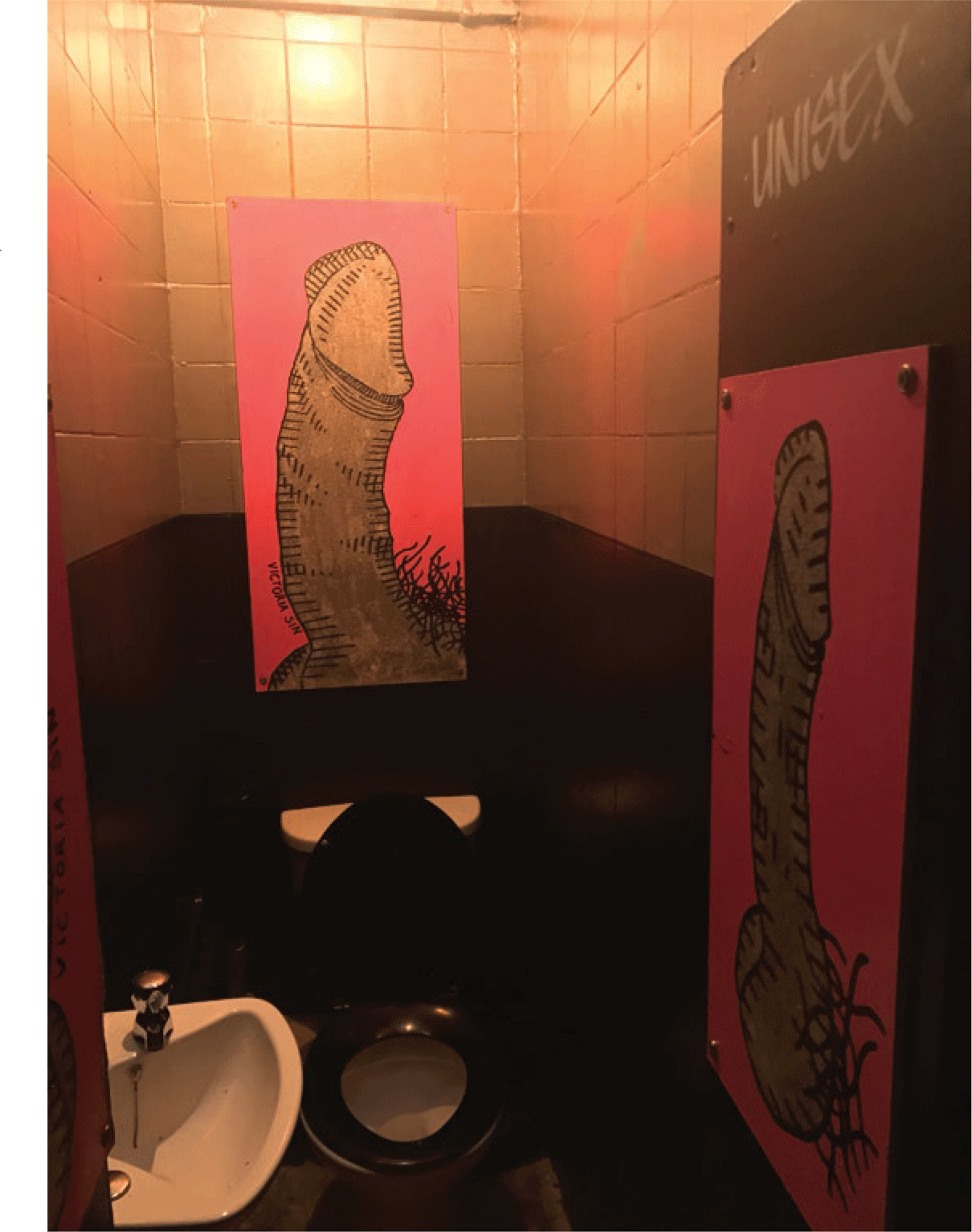
VFD had always relied on and embraced a DIY approach—both in terms of segments of the community coming together to try out a DIY nightlife methodology, but also in a “borrowing a drill and putting up your own shelves” kind of way. While I was working there, I did a lot of painting and repainting, continuing the tradition. My painting was more functional, but the walls and toilets were adorned with murals. Before my arrival, the saloon-style toilet doors and cubicles had been decked out with giant silver dicks surrounded by hot pink, painted by the (now Turner Prize Award–nominated) artist Sin Wai Kin (formerly Victoria Sin). I don’t remember ever using a professional service for anything that broke or needed updating—it was always someone from the community. This meant each layer of paint was a trace of love for the space and each cupboard door that didn’t quite close properly was a demonstration of commitment to its life. VFD was clunky but endlessly resilient. I left in 2019 because completing a PhD was impossible on the dancefloor. Still, the venue has endured with Hakaraia at the helm, surviving even the shock of the pandemic and remaining a vital incubating hub for queer artists.
Both venues were created through sparks—queer spaces functioning as technologies for transforming disruption into creation amid moments of despair, loss, overwhelm, and lack driven by socioeconomic circumstances of austerity, financial desperation, and gentrification. Naomi Klein (Reference Klein2007) argues that economic and political elites exploit crises to implement neoliberal policies while communities are disoriented and vulnerable. Where the powerful weaponize shock to consolidate control, queer venues demonstrate how shock’s disruptive potential might be reclaimed. We propose that when Hakaraia transformed a flooding basement into a disco, or when Her Upstairs emerged from the shock of venue closures, a reverse shock doctrine unfolded—communities harnessed disorientation not to extract value but to create new spaces of belonging as an antidote.
VFD toilet, October 2017. (Photo by Phoebe Patey-Ferguson)

However, there is a troubling parallel to the neoliberal mechanisms we purport to resist. What appears as a creative adaptation might represent the internalization of precarity as inevitable, the normalization of crisis as a permanent condition, or the romanticization of desperation. A DIY ethos is also often unpaid labor. In the face of structural abandonment, have we turned to individual responsibility? Shock has the capacity to suspend normal operations and create openings for transformation. However, who benefits and what values guide the response are important. We tried (and in trying often failed) to respond to these shocks by building communal resilience. As Klein asserts, shock creates disorientation that renders communities vulnerable. Yet as Ahmed (Reference Ahmed2006) demonstrates, disorientation is precisely the condition queerness makes generative. We are at home in the glittering disorder. Institutionalizing a form of productive disorientation means we are not just responding to external shocks but creating our own alternative “desire lines” through the mess (2006:19–20). These paths diverge from established routes, in turn shocking others out of conventional orientations towards new forms of connection.
Blocks
At Her Upstairs, there was a period on a Friday or Saturday night, around 7pm, where someone without fail would drop a pint glass down a toilet, facing up, so that when flushed, water would spill out into the cubicle. Most weeks when this happened, a member of the team or I would wrap a plastic bag around their arm and extract the glass. This was a single cubicle that you would reach before walking into the main bar space; technically it could have been accessed by anyone coming in from the street, although usually there was security on the door. We never found out who did it, if it was the same person every time or multiple people, or why they were doing it. We locked the toilet for a while. Eventually I think it stopped happening when we reopened the toilet. Or maybe that toilet never reopened and we nailed the door shut.
Blockages come in many forms. Sometimes they are financial: blocks caused by stock not arriving or being used up more quickly than expected; sometimes they are blocks caused by people. These blocks need to be resolved, either in the immediate or long term. However, sometimes these blocks are indicative of a venue working—a busy bar, a dancefloor you can barely get through, and even a queue for the toilet might all be signs that the venue is thriving; whereas an empty or quiet space is concerning and can put people off at the door.Footnote 3 We have to be attentive to the complexities of block(age)s, understanding that maintaining flow might not be the most effective way for queer nightlife venues to run. Sometimes the venue functions successfully when you get stuck on the dancefloor because the right song came on at the right time (for Joe its The Weather Girls’ “It’s Raining Men” [1982]; for Phoebe its “Mind Your Own Business” by Delta 5 [1979]; for both of us it’s any Meatloaf song or “Common People” by Pulp [1995], although these change regularly) and therefore you wait a bit before getting your next drink or using the toilet.
This tension between productive and restrictive blockages reflects broader institutional dynamics of flow and obstruction. While Ahmed rightly argues that diversity workers should break down structures and blockages that perpetuate inequities, we consider the role of the “institutional plumber” (in Ahmed’s terms) carefully in the context of queer venues.Footnote 4 For Ahmed, a blockage in an institutional system might be exactly how it works, by stopping certain people, policies, or insights from getting through. Therefore, there are times when
to transform a system we have to stop the system from working. When you stop the machine from working, you have damaged the machine. The plumber might need to be a vandal, or we might have to pass as a plumber (fixing the leak) to become a vandal (making leaks bigger). We might have to throw a wrench in the works or become, to use Sarah Franklin’s (Reference Franklin2015) terms, “wenches in the works,” to throw our bodies into the system, to try to stop the same old bodies, doing the same old things. (Ahmed Reference Ahmed2019:212)
We are attentive to this work, to how our queer bodies connect or disrupt systems. Blocks are about how queer venues are used, how they become used (up), and how they might be useful—as in both fulfilling their function and full of use, overuse. Use is connected to Ahmed’s articulation of queer use, or “how things can be used in ways other than for which they were intended or by those other than for whom they were intended” (2019:44). Her Upstairs was often described as an attic in a concrete box in a supermarket car park, which was depressingly accurate. VFD is a 180-year-old basement that has lived through being a Turkish dance studio, immigration office, and flophouse. Both spaces were converted and their upkeep similarly ad hoc. Inscribed within these spaces, then, is a queer use, but this use isn’t possible without the labor(s) that make this use, overuse, and misuse possible.
In general, queer nightlife venues fundamentally require continuous upkeep, labor, use, and misuse to exist. Ahmed connects ideas of use and misuse, and usefulness, to notions of “use value” from Marxist critique and the relation of use to labor. The toilet (once installed) might seem to be utility without labor, but its constant use (and [in]glorious misuse) requires repeated laborious attention to continue being useful (and useful for misuse). This maintenance has no surplus value and, at least for us, our queer venues did not generate any kind of surplus value, just “metamorphozed” value in Marxist terms (see Blackwall-Pal et al. [2021] for further discussion of labor, value, and performance). The maintenance of these venues is unproductive, even resistant to social reproduction, as people are less productive workers the more they have partied. In this way, can we boldly claim our maintenance of these venues is anticapitalist? The labor that creates use value in queer venues doesn’t produce a coherent, disciplined order but rather maintains an incoherent, undisciplined, unproductive disorder that enables queer possibility.
The use-full-ness of queer venues, how they are overused and full of use, can be seen in these blockages and how they are carefully curated by the labor of those who work in these spaces, whether consciously or not. These immaterial blockages are as important as the material ones, where the flow of bodies in and through the space are both indications of its use-full-ness, its vital-ness or vitality (which may or may not be the same thing), and evidence of how it is or is not working (or where more or less labor is needed). Maintaining flow, then, isn’t only about ensuring the liquids keep flowing (in or out of the body) but also about encouraging blocks, clumps, and congregations. We might mop up sticky floors or wet patches to ensure people can move safely, so they can get stuck safely, on the dancefloor, in the smoking area, in the toilet, or at the bar. The labor maintaining these spaces doesn’t simply reproduce capitalist relations of utility but creates alternative circuits of value and meaning that emerge precisely through deliberate misuse and creative reappropriation.
Dealing with blockages is therefore a process of curation, a particular kind of intuitive labor, a feeling out of what needs to flow and what needs to remain blocked (as well as reaching into the U-bend to feel out the literal blockage). We need to feel out what pressure should be released and where it should be contained. This was a vital part of our roles and getting it wrong could ruin a night for everyone. We had to develop an embodied knowledge of the body of the venue and all the bodies it contained (or was trying to attract); a knowledge that operated beneath conscious articulation. These affective attunements required a range of interventions: Knowing when to play a song to pull people away from a packed smoking area or a long toilet queue. Knowing whether the right song on that night is Madonna’s “Like a Prayer” (1989), or Beyoncé’s “Formation” (2016), or Gloria Gaynor’s “I Will Survive” (1978), or Kelis’s “Milkshake” (2003). Knowing when a vibe is dipping and if a go-go-ing striptease or quick “turn” would reintroduce chaos. Knowing when to deploy a free drink at the bar, or hand out lollipops, or start handing out bottles of water. There are no guides or rules or procedures for this, and what worked at VFD wouldn’t have worked at Her Upstairs; what works on a Tuesday at 10pm doesn’t work at midnight on a Saturday. But we could learn to feel what intervention might sustain the delicate ecosystem of the venue. We understand this as part of these DIY queer nightlife methodologies; a series of care-ful intuitions about where and when to block and unblock that we connect to other aspects of our queer work and commitments, including pedagogy and research.
We developed affective relationships to affective infrastructures. The labor is to sense the potential, both repairing what might be evidently broken but feeling toward what could be—anticipating all the possibilities latent in the seemingly mundane operations of the venue. The skills we develop allow us to feel how affects circulate through the space; to sense when irritation is building, when excitement is peaking, and when fatigue is settling in. Ahmed’s concept of “affective economies” resonates with these moments when emotions circulate and stick to certain bodies and objects (2004). VFD and Her Upstairs required us to respond to visible and affective blockages—allowing permeation, channeling intensities, avoiding stagnation. This intuitive knowledge wasn’t individual but collectively held and transmitted among us through glances, gestures, bitchy comments that comprised an affective infrastructure. Our bodies became tuned instruments registering subtle shifts in the venue’s affective atmosphere, developing a queer intuition for the difference between productive blockage and harmful obstruction. This bodily knowledge operates outside conventional taxonomies of professional expertise but constitutes a crucial form of queer knowing—one that understands intuitively how communities form, thrive, and transform through the careful management of what flows and what remains deliciously, deliriously blocked.
These utopian blocks, these joyful clumps, are not the only sorts of blocks, and in our attentiveness to the metaphor not overriding the material, we want to return to the location where blocks interrupt the use (and misuse) of queer venues: the toilet (yes, we’re back in the bog again). Toilets stand in for how institutions such as queer venues are maintained and sustained as well as how they break down and stop working. They can tell us about how these venues uphold gendered and sexualized norms, and about how these venues work to resist where these norms are built into, literally, the spaces queer venues occupy. As noted, they are rarely, if ever, built as queer venues from the ground up. When the toilet gets blocked, it leaks.
The toilet is the most necessary of utilities due to the realities of all bodies. Maintaining the toilet is often the most vital and most awful part of club work. We endure the toilet as punters and workers. No one goes to clubs because of the toilet; they go despite the toilets.Footnote 5 For us, the knowledge that we have repeatedly plunged our arms into the U-bend—casting it with fisting-esque erotic power with all the bodily materiality of shit and piss—is a kind of “blue-collar” badge of honor we both are drawn to showing off when our working-class guilt bubbles up because we are now “white-collar” academics in an institution that pays other people to clean up after us. It grounds us and bonds us. In our thinking, the toilet is a toilet. A real, functional toilet. Or sometimes a dysfunctional toilet—blocked, leaking, and out of order. The toilet is a locus of labor, of shared community responsibility, a site of irresponsibility and illicitness. It’s deeply ideologically imbued. The last unsurveilled space. A site of trauma, violence, paranoia, shame, hiding, and embarrassment, as well as pleasure, sex, and connection.
Political discussions of queerness have frequently gotten stuck in the toilet. We both grew up in an era where cottaging (UK slang for anonymous sex in toilets) made headlines, particularly after George Michael’s arrest in a public toilet in Los Angeles in 1998, which led to his public outing (and then the brilliant song “Outside,” where Michael dances in an LAPD uniform as urinals spin into mirrorballs, transforming trauma into disco). Toilets with glory holes, numbers scrawled on walls, and intricate cruising etiquettes formed backdrops and fabrics of our queer upbringings. In recent years, the toilet has become the exemplary site in which the politics of queer and trans inclusion is played out. As queer researchers have observed, the “complex, abstract and nebulous concepts of gender and sex are solidified and made visible and communicable through the toilet’s infrastructure” (Jones and Slater Reference Jones and Slater2020:834). The toilet becomes a site of conflict and paranoia, of trans hostility and exclusion, and a focal point for horrific transmisogyny. Like many trans and genderqueer people, we are fucking sick of talking about toilets. But there’s also no better place (pragmatically) to be sick, and so, we find ourselves returning to toilets repeatedly. We make choices about which toilet to use (or not), and we think about them as people who care about how the venues where we make our work are accessible for the communities they are by, for, and about.Footnote 6 We are stuck in the toilet, so we may as well loiter in this familiar architecture to see what we can learn through what leaks out beyond the cubicle door.
Leaks
One of the first signs of what lies beneath at VFD is the delicious odor that hits you on entering. The sharp stench of piss in the doorway, the hallway hinting of the fermentation of spilled booze, walls soaked in sweat. It smells like a body; a body accreting the stench of a thousand nights out. Descending the staircase is like sinking your nose into the chest, armpits, cracks of a hook-up, smelling on them their promiscuity from a long night of flirting, skin-to-skin contact, saliva exchanges, leaking bodies touching leaking bodies, substances, and haphazard pissing.
Leaking speaks to the queer methods of knowing queer nightlife, the spewing but incomplete stream of knowledge and memories, the bodies in which we existed then in the club and which now are secreting and dribbling, spilling tea in the gossip networks that ooze through every corner of queer spaces, and the very real drip drip drip of leaking pipes, toilets, ceilings, and gutters of shoddily built queer spaces. Leaking is desirable; we want to encourage transgression and permeability; we ask you to sweat; we encourage your desires that lead to spit and cum; we stage tearjerkers. All this leaking then needs to be managed, by cleaning up spills, by pouring vodka lime soda on the floor to prevent accidental falls, or the emotional work of cleaning up after the tea is too scalding. Leaking is unavoidable; someone always has to break the seal; bodies, emotions, and urges are never controllable.
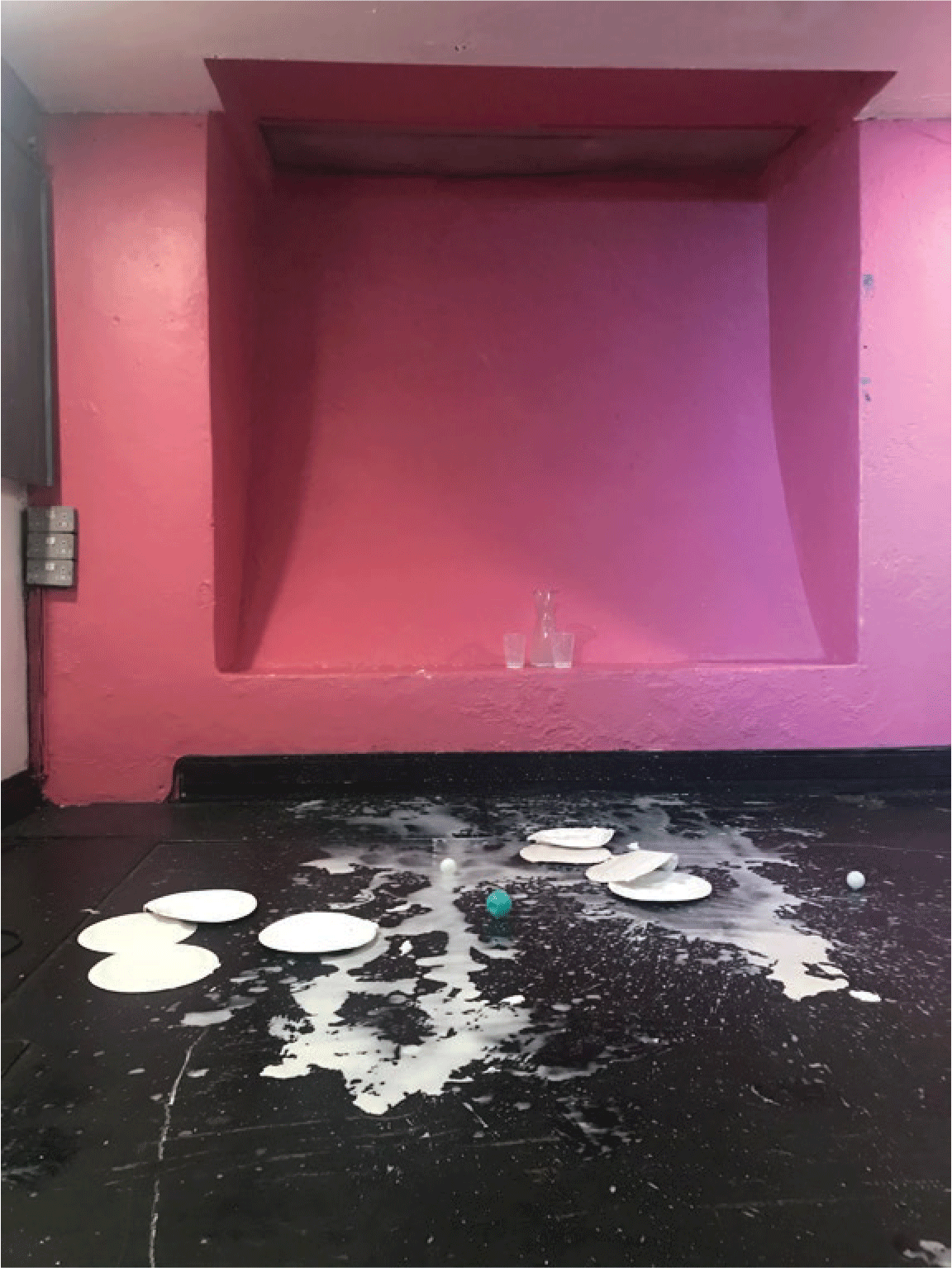
A leaky spill at VFD, November 2018. (Photo by Phoebe Patey-Ferguson)

These leaks connect directly to Ahmed’s conceptualization of queer use—they represent moments where spaces and bodies exceed their designated functions, where queer utility generates forms of flow that resist containment: “We know about closures from trying to open things” (2019:212). The leaking toilet, sweat-soaked walls, permeating smells represent forms of opening, exceeding the normative boundaries of what spaces should be and do.
Just as everyone’s body leaks, the club is a collective body that leaks the physical traces of everyone who passes through. Action always leaves traces on the body—human or otherwise. Some of these we try to remove—we wash, flush, and scrub. But there is so much that gets absorbed. These spaces are saturated with a constant decay and renewal of scent: sudation, booze, urine, cigarette smoke, perfumes. All of these collect, brew, fester, ferment, are renewed, effervesce, and recontaminate. Normative politics and licensing laws require bodies and clubs to have discrete boundaries, but these are always highly permeable. Like skin, the real and imagined boundaries of a licensed space are highly regulated in policy, paperwork, and construction, but this is a false sense of containment. The intensity of exchange creates constant breaches. These breaches and their excessiveness are often desired and invited as pleasurable and necessary in creating connection and building community, but they are also vulnerabilities requiring constant maintenance and ensuring precarity (whether material, social, or legal). If too much leaks out or over—bodies, liquids, sounds, more—then the very material conditions of these venues can be under threat from police, from licensing, or from those who don’t want us to exist.
The permeable boundary of the queer venue exists in constant tension with regulatory frameworks that seek to contain and control. Yet there is hope in this permeability, in this refusal of containment, following Ahmed:
[T]here is hope here; they cannot mop up all of our mess. One spillage can lead to more coming out: can lead, does lead. Just loosen the screw a little bit […] and you might cause an explosion. We need more explosions. Queer use might describe this potential for an explosion, how small deviations, a loosening of a requirement, the creation of an exit point, opening a door to allow something to escape, can lead to more and more coming out. (2019:214–15)
The leakiness of queer nightlife is not merely a metaphor but an epistemological condition—one that resists the containment of knowledge within formal structures and instead allows it to flow, sometimes unpredictably, between bodies, spaces, and communities. The utility of the leak is in its capacity to generate new possibilities, connections, and forms of knowing that exceed the designated functions of the spaces they inhabit.
We understand this as our embodied knowledge as authors, knowledge of our own bodies, and as embodied knowledge of the queer club and how we have touched, smelled, cleaned, and maintained these bodies. Knowledge as sensation and interaction. We’re not the first people to have run venues or events to exclaim in exhaustion, “I’VE PUT MY BLOOD, SWEAT, AND TEARS INTO THIS PLACE!!!” Our labor (physical, intellectual, psychic, emotional) is characterized as us leaking our life fluids into the physical space. Sometimes, the club would feed us in return; we fed off its energy, suckled at the teats of the optics, staved off dehydration from the taps, and bathed in the flashing lights. The collective labor of the staff and money spent by the punters sustained us financially (sometimes). It flowed through the space of the club, and leaked out in free shots, free entry, stolen cans, or sticky fingers in the tills. The health of the body of the club becomes inextricably linked to those who care for it. The more energy you have to invest, the greater the returns (or at least a reduced risk of obsolescence). These DIY queer nightlife methodologies are not neutral or benign but complexly bound up in processes of survival that can be as extractive as they are enabling, and here as above we resist deifying the precarity of these practices whilst also glorying in the leaky memories of these resistive and messy modes of being and doing.
The ill health of the club—when maintenance becomes unsustainable and systems break down—creates stresses that impact our health, and when our health falters, the club suffers too. A few months before Phoebe had to step back from managing VFD, their hair began falling out, creating perfectly smooth bald patches. The balance had gone awry; the relationship became parasitic, with essential nutrients being sucked away. This is not entirely the fault of the club; there was also an impending PhD deadline, but the only diagnosis a doctor could give was that it was acute stress, and the intensity of all this labor was manifesting outwardly, physically. Her Upstairs for Joe was a space indelibly marked by addiction, a casual ability to drink without anyone checking, and a dangerous inability to say no. It was marked by alcohol as the only way to be present at times, and the only way to stay present, and with complex feelings that only in hindsight can be articulated as depression and suicidal ideation. Like Phoebe, this wasn’t the only factor—a similarly looming PhD deadline and complex grief was also part of the ride, but the booze was always there. For both of us, there were a lot of tears.Footnote 7
We are sharing this not to indicate the inevitability of these declines, nor to suggest that these venues facilitated this neglect, but to think through everything we can know about queer nightlife through our work in these settings. Much like the spaces, we are prone to shocks, blocks, and leaks, and understanding queer nightlife venues through bodies and as bodies offers ways of returning to the material to see how and what we know. These leakages connect to economic circuits that sustain and threaten these venues. The flow of money, resources, and labor in queer venues is rarely contained within formal economic structures—shots get bought for friends, drinks get spilled, resources get diverted, boundaries between professional and personal blur. This economic leakiness both enables the venue’s functioning as a queer utility (facilitating connections, building community) and threatens it (draining resources, creating unpredictability). Managing these flows requires a constant negotiation between maintaining necessary boundaries and allowing productive transgressions. We are leaking, oversharing perhaps (overusing the metaphor, maybe), but find pleasure and significance in understanding how our leaky bodies and the porosity between body and venue can reveal the gorgeous and destructive messes that queer nightlife can enact. Like turning on the lights at the end of the night, we find ourselves being revealed to each other and, more disturbingly, to ourselves, and having to account for what we’ve done.
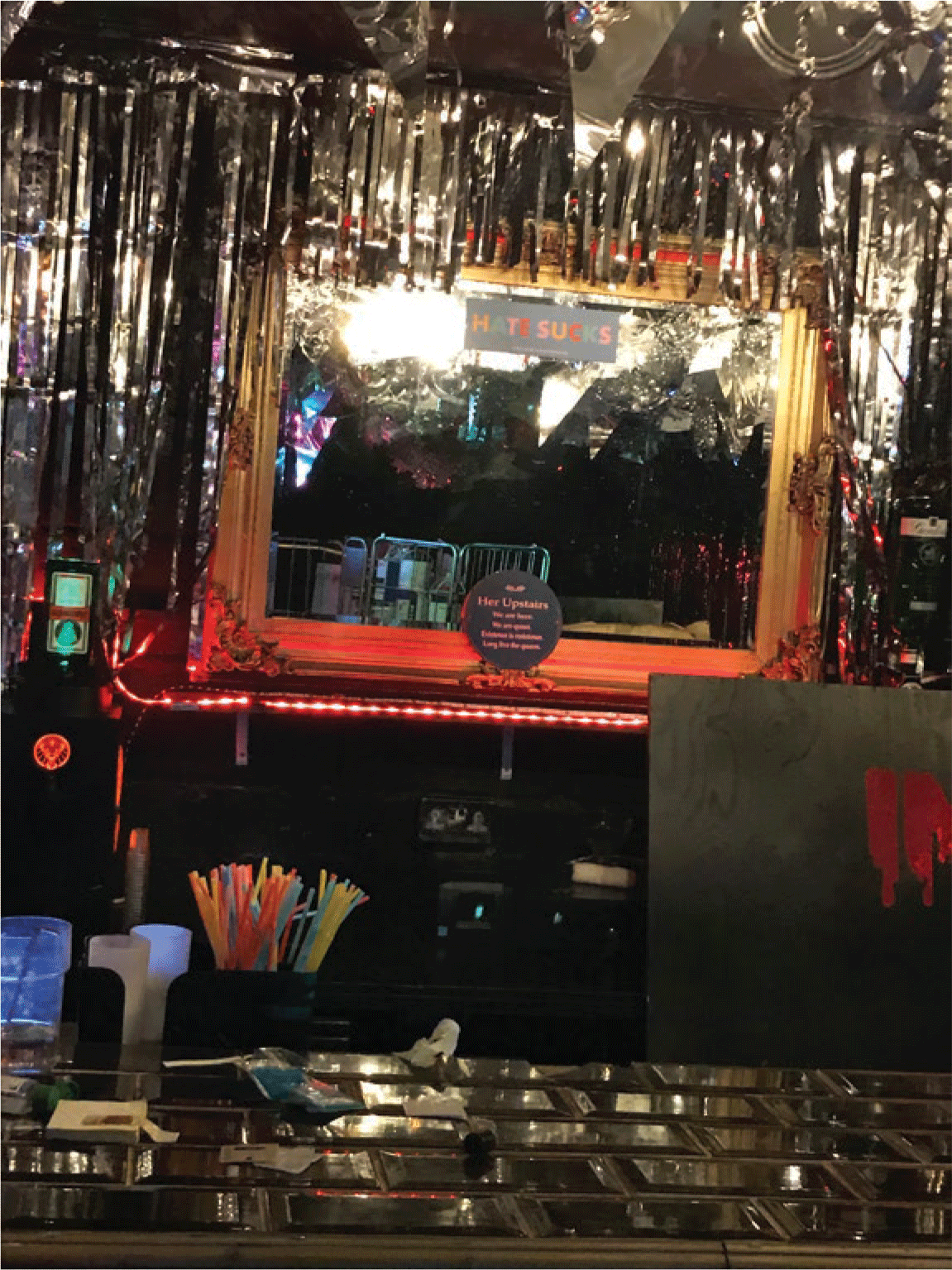
Her Upstairs photo taken on the night it was unexpectedly closed down, August 2018. (Photo by Joe Parslow)

Shit Happens
We have both commented, a little saltily, that queer nightlife scholarship often starts with anticipation outside the club and the afterglow that remains once you leave, yet rarely with the conditions (and people) that facilitate that anticipation and afterglow. This might be a chip on our shoulders, but we are interested in who is in the club before it opens and once it has closed not to highlight hitherto unrecognized queer laborers (particularly when talking about ourselves) but to think about how the use and misuse of queer venues opens up or reveals key ideas about how queer lives, communities, and politics are maintained and sustained through disparate experiences of nighttime landscapes and economies.
Her Upstairs and VFD functioned for us as heterotopias where “fragments of a large number of possible orders glitter separately,” resisting convention and generating their own epistemic framework—one that privileges embodied knowledge, improvisation, and the productive potential of disorder. The messes we’ve documented through shocks, blocks, and leaks aren’t just operational difficulties but constitute an alternative knowledge system that values adaptation over standardization and is part of an unsteady and unpredictable flow of various modes of transmission: touch, sound, smell, and collective emotional attunement.
This queer epistemology disrupts conventional knowledge systems; in these spaces, managers are also patrons, performers are also workers, and knowledge circulates through gossip, memory (or lack thereof), and embodied practices rather than official documentation or fixed capture. The fabric of these venues—their smells, surfaces, infrastructures—tells stories about the bodies that pass through them and the affective economies they sustain. Against theoretical approaches that abstract queerness from its material conditions, we insist on the importance of the sticky, smelly, leaky materiality of queer venues and the bodies that inhabit them. The temporal discontinuities of these venues—their appearances and disappearances, their constant adaptations—are ruptures, suggesting that queer nightlife generates not just community but an alternative framework for understanding how knowledge is produced, maintained, and transformed through the deliberate embrace of the dysfunctional and irregular.
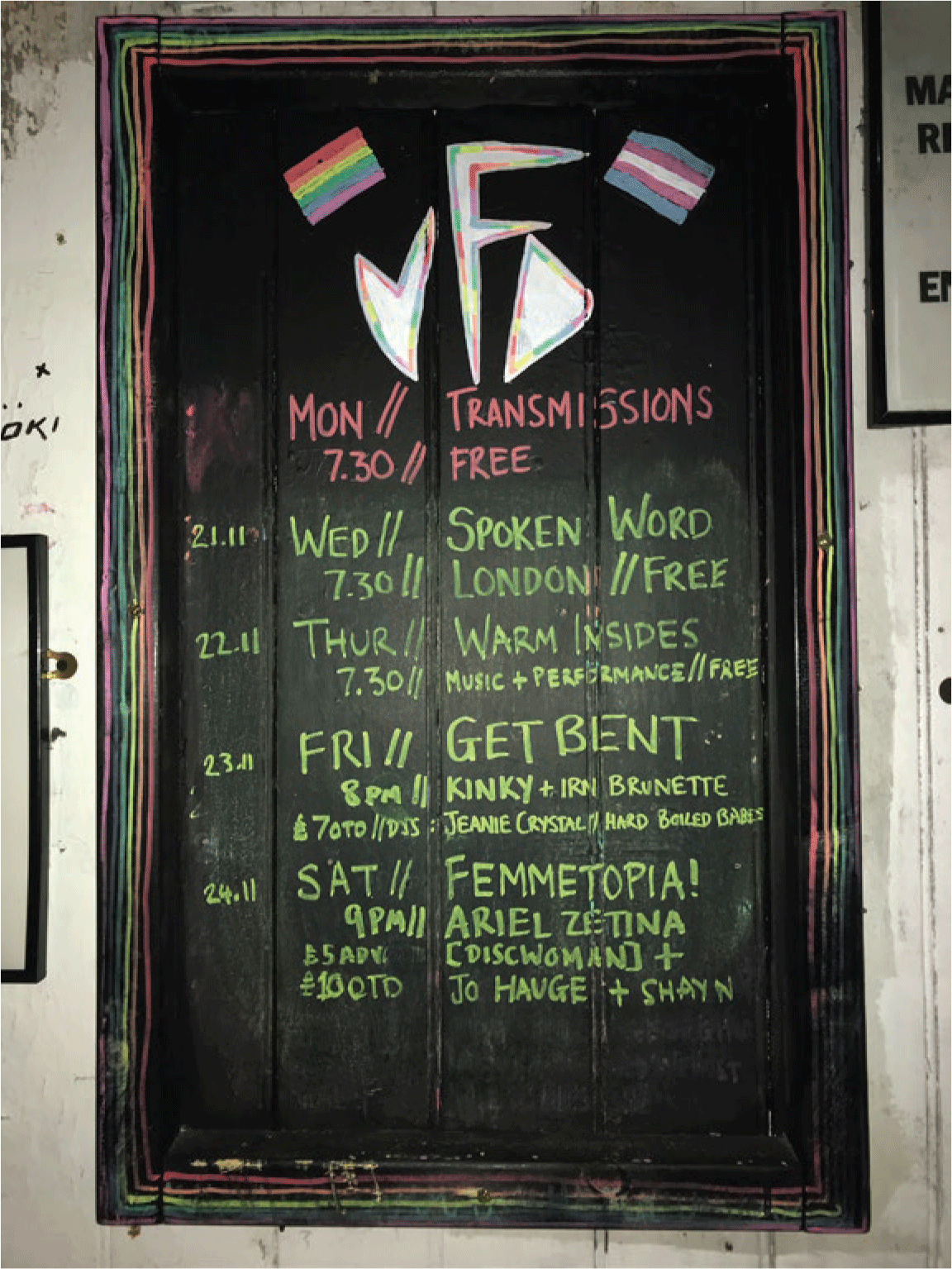
VFD schedule, November 2018. (Photo by Phoebe Patey-Ferguson)

We were, and remain, committed to making shit happen. But like the other colloquial phrase shit happens, the shit (positive or negative, real or metaphorical) keeps on coming. We are constantly navigating intentional creation and unpredictable happenstance and trying to learn how to queerly turn whatever shit or glitter we find on our hands into something meaningful. The flow of shit never stops; we can only learn how to channel it and sometimes how to just get used to the smell, to batten down the hatches against shocks, or encourage jolts to spark something, to dive in to remove a blockage or clog up the system, to monitor the leaks and bathe in the ooze. The utilities of queer nightlife require constant queer attention, not necessarily because they are failing, but because they are alive. Embodied systems that secrete, breathe, and transform. In embracing this unresolved, ongoing process, in continuing to make shit while the shit happens, we find not just knowledge about the practical realities of laboring in queer nightlife, but also that queerness is an unstoppable flow and queer world-building is about all the filthy hands that shape that flow.