INTRODUCTION
The Argentine shortfin squid Illex argentinus is one of the most important cephalopod resources of the world sustaining, in recent years annual catches oscillating between 260,000 and 950,000 tons (FAO, 2010). The species is included among the neritic–oceanic forms of the family Ommastrephidae, occurring in association with the continental shelf and slope areas of the eastern margin of the South American continent, from Rio de Janeiro (23°S) to southern Argentina (54°S). Economically important concentrations have been described in both temperate and subtropical/tropical areas of the species distribution but the former has historically sustained the main directed fishing activities and the bulk of the catches, particularly on the Patagonian Shelf and around the Falkland/ Malvinas Islands (Haimovici et al., Reference Haimovici, Brunetti, Rodhouse, Csirke, Leta, Rodhouse, Dawe and O'Dor1998). Off Brazil, subtropical/tropical concentrations were not subject to commercial exploitation until 2001, when it became one of the targets of the emerging slope mixed trawl fishery (Perez et al., Reference Perez, Silva, Schroeder, Schwarz and Martins2009a, Reference Perez, Pezzuto, Wahrlich and Soaresb).
Distribution patterns and biological attributes of squid concentrations in Brazilian waters have long been described through samples collected during scientific surveys (Haimovici & Perez, Reference Haimovici and Perez1990; Santos & Haimovici, Reference Santos and Haimovici1997) and commercial fishing (Perez et al., Reference Perez, Silva, Schroeder, Schwarz and Martins2009a). These studies revealed that I. argentinus occurs over the shelf break and slope off the south-eastern and southern sectors of the Brazilian coast down to 700 m. Individuals of a wide range of sizes in both early and advanced maturity conditions (including spawning) are caught by bottom trawls throughout the year, but distinct spawning groups can be identified from size-at-maturity patterns. In 2002, catches of small-sized males and females at all maturity stages predominate on the shelf-break and upper slope regions (<250 m) generating moderate landings (~20 tons/month) throughout the year. However, from August to October of that year, the foreign trawl fleet operating in southern Brazilian waters produced significant catches (250 tons/month) of a distinctive group of large spawners which concentrated on the slope (250–700 m). This group became economically attractive to the national trawl fishery thereafter (Perez et al., Reference Perez, Silva, Schroeder, Schwarz and Martins2009a, Reference Perez, Pezzuto, Wahrlich and Soaresb). It has been suggested, mostly from size-at-maturity of the squids present in the catches (but also by indirect evidence derived from trophic relations, presence of parasites and statolith proportions), that those specimens could in fact belong to a northern Patagonian population that migrate in early winter from their feeding grounds off northern Argentina to their spawning grounds off southern Brazil (Santos & Haimovici, Reference Santos and Haimovici1997, Reference Santos and Haimovici2000; Schwarz & Perez, Reference Schwarz and Perez2007). Passive transport of Illex paralarvae occurring on the southern Brazilian Shelf by the southward-flowing Brazil Current in spring–summer could supply recruits across the Subtropical Confluence to the northern Patagonian Shelf feeding grounds (Haimovici et al., Reference Haimovici, Vidal and Perez1995, Reference Haimovici, Brunetti, Rodhouse, Csirke, Leta, Rodhouse, Dawe and O'Dor1998; Waluda et al., Reference Waluda, Rodhouse, Podestá, Trathan and Pierce2001; Bazzino et al., Reference Bazzino, Quiñones and Norbis2005). As a result, both ‘local’ and ‘migrating’ spawning groups would seasonally share slope waters off Brazil characterizing the observed patterns of abundance and size variability in both scientific and commercial catches (Santos & Haimovici, Reference Santos and Haimovici1997; Perez et al., Reference Perez, Silva, Schroeder, Schwarz and Martins2009a).
Consistent with a robust set of empirical evidence, these generalizations are regarded as hypothetical partly because they are grounded on assumptions made about the duration of life cycle events, growth rates and migration patterns common to Illex and most ommastrephids (see Rodhouse et al., Reference Rodhouse, Dawe and O'Dor1998, for review) but not properly demonstrated in Brazilian waters by high resolution methods (e.g. size-at-age, genetic structure and tagging experiments). These are critical for resolving the complex population structure and intra-specific variability of life cycle patterns as generally described for Illex species and associated with their short lifespan (~1 year), protracted spawning seasons, long latitudinal migrations and paralarval transport in association with major geostrophic current systems (Hatanaka et al., Reference Hatanaka, Kawahara and Uozomi1985; O'Dor & Coelho, Reference O'Dor, Coelho, Okutani, O'Dor and Kubodera1993).
In this context, validation of daily-deposited growth increments on statolith and gladius microstructures (Sakai et al., Reference Sakai, Brunetti, Ivanovic, Elena and Nakamura2004; Schroeder & Perez, Reference Schroeder and Perez2010) has opened new opportunities to address aspects of I. argentinus population ecology and life cycles off Brazil and assess the extant population models. Schroeder & Perez (Reference Schroeder and Perez2010), for example, have shown that seasonal patterns of gladius growth variability implied that individuals reaching maturity at different times of the year experience different environmentally-determined growth conditions. In addition Schwarz & Perez (Reference Schwarz and Perez2010) fitted general asymptotic growth models to size-at-age data of squid present in the commercial catches off southern Brazil. The authors also reported squid as old as 320 days but showed that most males and females can spawn and die after six months of life. In the present study the statolith reading techniques were explored to estimate hatching dates and the duration of the life cycle events of I. argentinus caught throughout the year at a wide geographical range off Brazil. Combined, these new elements will be used to review previous generalizations about stock structure and life cycle patterns of I. argentinus in the northern periphery of the species range (e.g. Perez et al., Reference Perez, Silva, Schroeder, Schwarz and Martins2009a).
MATERIALS AND METHODS
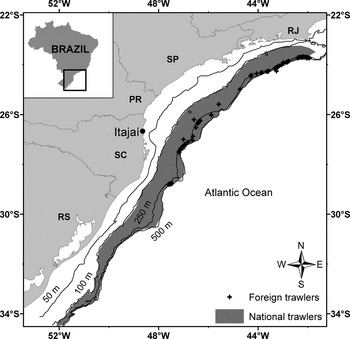
Analysed squid were obtained from the commercial catches of foreign and national bottom trawlers operating over the outer shelf and slope waters off south-eastern and southern Brazil in 2001 and 2002. Trawls were concentrated between 90 and 750 m depths, latitudes 23°–33°S and longitudes 41°–50°W (Figure 1). During fishing trips conducted by foreign trawlers squid were sampled by observers on a tow-by-tow basis (Perez et al., Reference Perez, Silva, Schroeder, Schwarz and Martins2009a). After each tow a sample was removed from the catch, labelled with the tow information (capture date, latitude–longitude and depth) and frozen for posterior analysis in the laboratory. Samples from the national trawl fleet were collected at landing sites in the fishing harbours of Santa Catarina State as part of the industrial fishery sampling programme (Perez et al., Reference Perez, Lucato, Andrade, Pezzuto and Rodrigues-Ribeiro1998). Interviews with the skippers at the time of the landings provided information about effort, catch dates and fishing areas. Because samples were obtained from the total landed catch without tow distinction, the ‘capture date’ assigned to each sample was assumed as the one in the middle of the whole trip duration (~20 days long).
Spatial distribution of Illex argentinus samples. Crosses, trawls from chartered fleet (2001–2002); grey area indicates operation sites of national trawlers.

In the laboratory, each squid was weighed (total weight (TW)) to 0.01 g, measured (dorsal mantle length (ML)) in mm and reproductive features were determined including sex and maturity stage. The latter followed the macroscopic maturity scale proposed by Brunetti (Reference Brunetti1990) for I. argentinus that defines the stages: immature (stages 1 and 2); in maturation (stage 3); early maturity (stage 4); advanced maturity (stage 5); spawning (stage 6 for males and 6 + 7 for females); and spent (stage 7 for males and 8 for females). The pair of statoliths was extracted with forceps, stored and labelled in acrylic tubes (10 ml) containing ethanol 70% (~5 ml) and covered with a pressure lid (Schwarz & Perez, Reference Schwarz and Perez2010).
Statolith preparation procedures and reading accuracy analysis were described in Schwarz & Perez (Reference Schwarz and Perez2010). Statolith growth increments were assumed as daily-deposited based on indirect validation experiments made by Uozumi & Shiba (Reference Uozumi, Shiba, Okutani, O'Dor and Kubodera1993), the direct validation made for paralarvae by Sakai et al. (Reference Sakai, Brunetti, Ivanovic, Elena and Nakamura2004) and for the congeneric species I. illecebrosus by Dawe et al. (Reference Dawe, O'Dor, Odense and Hurley1985). Interpretation and counting was conducted under 1000 × microscope magnification (Nikon® model: Eclipse 200) following Arkhipkin (Reference Arkhipkin2005). The total age was given in days.
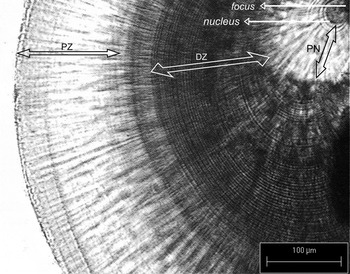
‘Statolith growth zones’ were initially differentiated in the statolith preparations as indicators of individual squid ontogeny stages and life style transitions (Arkhipkin & Perez, Reference Arkhipkin, Perez, Rodhouse, Dawe and O'Dor1998; Arkhipkin, Reference Arkhipkin2005). These zones were defined as: focus (F); nucleus (N); postnuclear zone (PN); dark zone (DZ); and peripheral zone (PZ). A prominent growth mark (check) in the outer boundary of nucleus was referred to as the ‘natal ring’ defining the hatching event (day zero) (Balch et al., Reference Balch, Sirois and Hurley1988). Total age in days was the number of growth increments counted from this check until the last recognizable increment in the peripheral zone (PZ) (Figure 2). Hatching dates were determined by back calculating the number of days-of-life (total age). Capture and hatching dates were grouped and analysed by austral seasons-of-the-year here defined as: summer (23 December–22 March); autumn (23 March–22 June); winter (23 June–22 September); and spring (23 September–22 December). The dates were based on the mean dates officially used in Brazil for the delimitation of seasons (defined by annual solstices and equinoxes dates).
Growth increments in an Illex argentinus statolith after grinding and polishing under 100 × magnification. focus; nucleus; PN, postnuclear zone; DZ, dark zone; PZ, peripheral zone.

Population differentiation among squid samples used in this study was explored through a multivariate principal component analysis (PCA) applied for mature males and females separately. The variables used in this analysis involved the size and reproductive attributes previously used by Perez et al. Reference Perez, Silva, Schroeder, Schwarz and Martins(2009a) such as body weight (BW), gonado-somatic index (GSI), Hayashi index (HI) (Hayashi, Reference Hayashi1970) and testis–nidamental gland index (TI/NGI). Also the day of the year for catch and hatch for squid (DYRcatch–DYRhatch), average decimal latitude of the haul (LAT), depth (DEPTH) and estimated age (AGE) were used in the analysis. All the variables were standardized prior to the calculation of the correlation matrix. The standardization was made using:
 $$Z=\displaystyle{{\lpar x - \mu \rpar } \over \sigma }$$
where Z is the standard score, x is a raw score to be standardized, µ is the mean of the population and σ is the standard deviation of the population. The factors generated by the linear combinations of the variables were used to interpret the potential existence of biologically similar groups of squids and their occurrence in time and space.
RESULTS
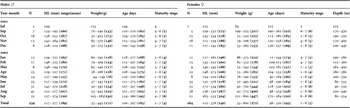
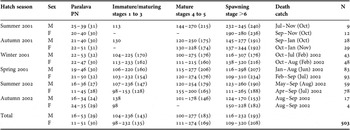
Ageing analysis was conducted on 239 males and 264 females I. argentinus ranging from 112 to 376 mm ML and 33 to 800 g BW (Table 1). Samples originated from 80–524 m deep tows distributed over all months between September 2001 and September 2002 and included squid in all maturity conditions described by Brunetti (Reference Brunetti1990) (Table 1).
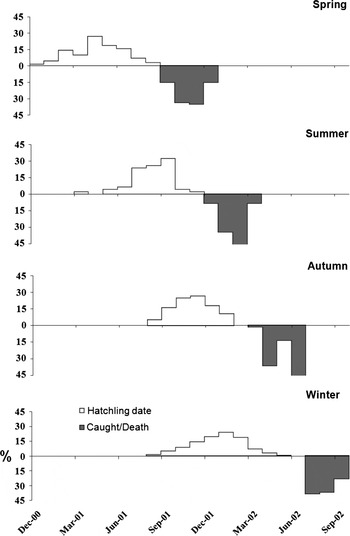
Frequency distributions of estimated hatching dates for mature Illex argentinus (stage ≥ V; N= 361) caught at different seasons from 2000 to 2002 in south-east and south Brazil. N, numbers.

Samples of Illex argentinus caught in southern Brazil between July 2001 and September 2002. Samples were obtained from national trawl fleet and chartered trawl. N, sample size in numbers; ML, mantle length in millimetres; for all values range is presented with mean values in parentheses.

Age structure and hatching dates
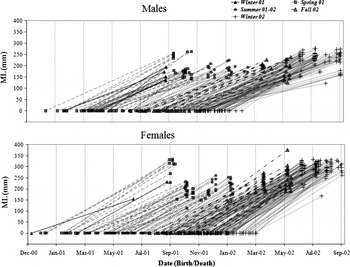
Hatching dates, as estimated by statolith ageing analysis, indicated that I. argentinus caught by the slope trawl fishery off Brazil hatched throughout the year. Spawning/spent squid caught during 2001 spring months had their hatching period estimated between late December 2000 and early August 2001 (Figure 3; Table 2). The oldest individuals were a 270 days-old male (258 mm ML) and 280 days-old female (315 mm ML). Both were spent squid caught between 4 October and 7 October 2001. During summer (2001/2002) catches were mostly composed of spawning/spent squid with hatching dates estimated between March and November 2001 (Figure 3). Mean age of these squids was 160 days with the bulk of hatchings occurring in August. The oldest specimen, a spawning male (stage 6) was collected on 1 January 2002, with hatching date estimated in March. This squid was 277 days-old and 160 mm ML. Hatching dates of spawning/spent squid caught in autumn 2002 ranged from August 2001 to February 2002 peaking between late October and early December (Figure 3). These squids (125 to 240 mm ML) ages ranged from 140 to 274 days with a mean age of approximately six months. The majority of individuals analysed in this study was obtained in the winter/spring of 2002 during an intense directed fishing activity developed by foreign and national trawlers. Hatching of spawning/spent squid occurred from August 2001 to May 2002, with the majority between late December and January (Figure 3). The oldest squid was a mated female 320 days-old and 315 mm ML.
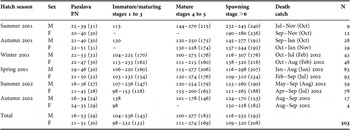
Range of statolith growth increments observed in statoliths on different maturity stages of Illex argentinus hatched at different seasons between 2001 and 2002. M, male; F, Female; PN, postnuclear zone; N is the number of statoliths observed.
There was a considerable variability in size of the spawning/spent squid caught by the slope trawl fishery. Nevertheless when this variable was related to the capture and hatching dates, it was possible to note that squid hatched early in the year attained within six months the largest sizes at maturation, being caught mostly during the winter off southern Brazil (Figure 4). In contrast, squid hatching during autumn and winter produced smaller spawners that predominated in the catches taken during spring and summer.
Hatchling dates of the squid Illex argentinus off southern Brazil as back-calculated statolith-derived age determinations. Lines connect death dates to hatchling dates (on the horizontal axis) of individual squid caught in different seasons between 2001 and 2002 (see legend). ML, mantle length in mm.

Ageing life cycle events
In the examined statoliths of I. agentinus, the postnuclear zone (PN) was identified as a light-coloured band encircling the natal check (Figure 2). Another prominent stress mark or check demarcated the external boundary of PN and the transition to the dark zone (DZ). Previous studies have indicated that PN includes a series of growth increments deposited during the early ‘paralarval’ stage, which in ommastrephid squids, ends when a ‘proboscis’ present in the arm crown splits into a pair of tentacles (Laptikhovsky et al., Reference Laptikhovsky, Arkhipkin and Golub1993; Vidal, Reference Vidal1994). Considering the number of growth increments contained within the statoliths PN of I. argentinus caught off southern Brazil, it is suggested that the mean paralarval phase duration is ~30 days ranging from 16 to 53 days. This duration was stable in squid hatched during different times of the year (see below) but slightly shorter during summer and autumn months (Table 2).
Males and females (immature stages <4) were, on average, 143 and 135 days-old respectively (Table 2). The oldest immature male was 236 days-old and female 232 days-old. Sexual maturation (stages 4 and 5) was reached by males and females at mean ages of 183 and 169 days, respectively. Youngest and oldest mature squid were between 100–111 and 274–277 days-old. Squid that hatched in autumn, winter and summer tended to be younger at maturity than those hatched in spring. Spawning males and females were, on average, 198 and 208 days-old. The oldest spawning male was 232 days-old and female 320 days-old. Again squid hatched in spring months tended to spawn at older ages than those hatched in autumn and winter months.
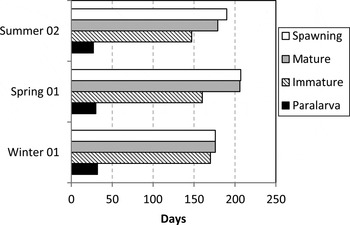
A life-span between four and eleven months is suggested for I. argentinus off Brazil. Most squid, however, spawned after 6–7 months of life, remaining immature for about 60–70% of this period. No analysed specimen completed 1 year of life. Squid hatched in winter months seem to have a shorter life cycle, maturing late in life at a small size. Individuals hatched in spring–summer mature younger and live longer, spawning in winter after 7 months at larger sizes (Figure 5). Contrasting with this general pattern, however, largest and oldest squids were present in the winter/spring catches (e.g. the 320 days-old female) indicating the occurrence of older individuals hatched about 10–11 months before capture.
Statolith-determined mean age of life cycle events of Illex argentinus hatched in summer (2002), spring and winter (2001) months off Brazil.

Stock differentiation
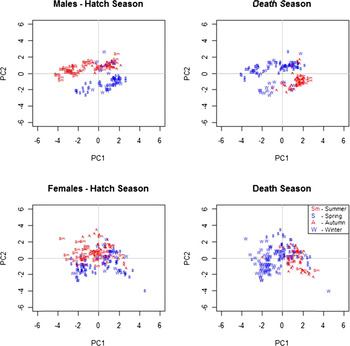
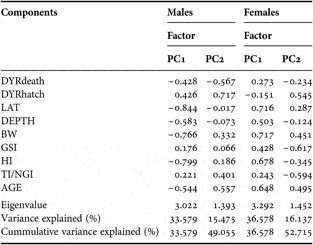
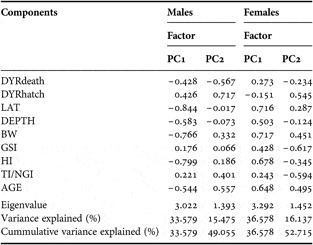
Association among squid analysed in this study was evaluated from the scores produced by the first two PCA extracted factors that explained together 49% and 52% of the total variance in males and females respectively (Table 3). In males, factor 1 was defined mainly by geographical variables (LAT), squid size (BW) and maturity condition (HI) with higher negative weights. In the graphic representation (Figure 6) only the first two factors or components (PC1 and PC2) were used because they had the majority of explanatory variables. In Figure 6, each analysis is represented twice, with individual squid labelled according to their capture and hatching season. Large mature males in advanced maturity stages caught in the southern region were plotted in the left hemiplane, whereas small mature squid caught north-easterly appear in the right hemiplane. The day of the year of hatch, day of the year of the catch and age were important variables in factor 2 (PC2) (Table 3); this indicates that squid hatching early in the year and caught in late winter and spring with advanced ages were plotted in the upper hemiplane, while those with hatching periods in later seasons of the year in the lower hemiplane. For females a similar spatial scenario was obtained in PC1, but PC2 was mostly influenced by the day of the year of hatch and reproductive variables, such as GSI and NGI. Squid in advanced maturity stages appeared in the lower hemiplane (Table 3).
Spatial representation of males (above) and females of the Argentine shortfin squid Illex argentinus caught by commercial trawlers off Brazil between 2001 and 2002 scored by the first two factors extracted from the principal component analysis. Abbreviations indicate the season of year of hatch and catch for each squid.

Principal component analysis (PCA) used to differentiate Argentine shortfin squid Illex argentinus stocks within the catches obtained by commercial trawlers off Brazil between 2001 and 2002. Variables in the analysis were: death and hatchling day of the year (DYRdeath–DYRhatch), average latitude of the haul (LAT), depth (DEPTH), body weight (BW), gonado-somatic index (GSI), Hayashi index (HI), testis–nidamental gland index (TI/NGI) from males and females. The linear coefficients of the variables (case scores) in the first three factors rotated by the PCA are indicated for males and females. The eigenvalues and the variance explained by each factor are also indicated.
In both males and females the distribution of individuals in the space defined by PC1 and PC2, show that squid abundantly caught in winter/spring months off southern Brazil are divided into two groups (Figure 6), one composed of those hatched in the summer and therefore spawning at ~6 months of age (first quadrant), a second composed of those hatched in spring–winter of the previous year, spawning at ~10–11 months of age (fourth quadrant).
DISCUSSION
Life cycle studies in the class Cephalopoda, historically centred in the most common, near shore forms of squid, octopod and cuttlefish, have consistently revealed a short lifespan pattern, rarely exceeding 1–2 years (Boyle & Rodhouse, Reference Boyle and Rodhouse2005). Among the mostly oceanic oegopsid squids, Arkhipkin (Reference Arkhipkin2004) reported that lifespan would tend to increase with latitude and adult size, varying from 3–5 months in small-sized tropical forms to 1–3 years in large species that live in temperate and subpolar–polar latitudes. In that sense, most temperate ommastrephids, including I. argentinus in the Patagonian Shelf and around the Falkland/Malvinas Islands, seem to complete the entire life cycle in one year (see Jackson & O'Dor, Reference Jackson and O'Dor2001 for review). Half-year lifespans, however, occur among small-sized tropical Ommastrephidae such as Nototodarus hawaiiensis and, more importantly, within species of wide latitudinal distribution range such as Illex coindetii (Arkhipkin et al., Reference Arkhipkin, Jereb and Ragonese2000). In this species a 1-year lifespan estimated for temperate North Atlantic concentrations contrasts to subtropical Mediterranean and tropical equatorial Atlantic squid that tend to live no more than six months (Arkhipkin et al., Reference Arkhipkin, Jereb and Ragonese2000; Arkhipkin, Reference Arkhipkin2004). The present study demonstrated that a lifespan under one-year for I. argentinus, formerly reported in Schwarz & Perez (Reference Schwarz and Perez2010), tends to predominate throughout the year off Brazilian waters. It also implies that the species in the south-west Atlantic could make a parallel with I. coindetii in the North Atlantic, displaying both 1-year and 0.5-year lifespans in the tropical/subtropical (north of 35°S) and temperate (south of 35°S) concentrations respectively.
As a general rule I. argentinus off Brazil spend approximately 14% of their lifespan as paralarva (~30 days), 70% as juvenile/immature (~130 days), leaving maturity and spawning condition to the terminal 10–20% (~30–60 days). In addition, considering estimates of size-at-maturity and general growth models fit to size-at-age data, maturation starts at about 130 days (160 mm ML) for males and 140 days of life (180 mm ML) for females, nearly 3.5 months after paralarval/juvenile transition (Perez et al., Reference Perez, Silva, Schroeder, Schwarz and Martins2009a; Schwarz & Perez, Reference Schwarz and Perez2010).
The mean number of growth increments in the PN suggests that the paralarval phase is about ten days shorter in squid caught off Brazil than in those caught in areas south of 42°S, reported between 38 and 40 days (Arkhipkin, Reference Arkhipkin1990, Reference Arkhipkin1993). Living essentially in the epipelagic zone, paralarvae on the continental shelf and slope off Brazil will be strongly influenced by the Brazil Current waters and the subtropical confluence formed by the Brazil/Falkland (Malvinas) Current systems (Castro et al., Reference Castro, Lorenzetti, Silveira, Miranda, Rossi-Wongtschowski and Madureira2006). Reported concentrations were always associated with surface temperatures above 12°C, but paralavae caught off Brazil were generally experiencing an environment ~10°C warmer (18°–24°C) than those caught further south off the La Plata River (12°–16°C) (Haimovici et al., Reference Haimovici, Brunetti, Rodhouse, Csirke, Leta, Rodhouse, Dawe and O'Dor1998). As demonstrated by laboratory experiments, such thermal difference reduces the age at yolk full absorption and accelerates growth (Sakai et al., Reference Sakai, Brunetti, Ivanovic, Elena and Nakamura2004), probably abbreviating also paralarval life towards the northern extremes of the species distribution. Interestingly, squid hatched during winter off Brazil exhibited the widest range of growth increments in the PN (22–53), which may reflect the important thermal gradient established in this area by the northerly displaced subtropical confluence (Castro et al., Reference Castro, Lorenzetti, Silveira, Miranda, Rossi-Wongtschowski and Madureira2006).
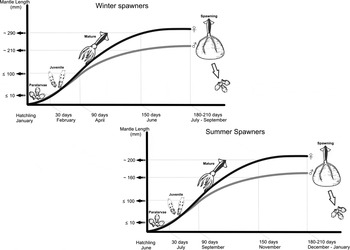
Hatching was found to occur continuously throughout the year and some degree of variability in this general life cycle schedule was observed possibly determined by seasonal environmental conditions. Combining the statolith-determined age and hatching dates presented in this study with data on size-at-maturity and gladius growth variability (Perez et al., Reference Perez, Silva, Schroeder, Schwarz and Martins2009a; Schroeder & Perez, Reference Schroeder and Perez2010), an attempt is made to model seasonal life cycles of I. argentinus off Brazil (Figure 7). Squid hatched in spring months reach maturation later in life (~6–8 months) at small sizes. These are mostly the autumn spawners that undergo poor growth conditions over most juvenile life, as demonstrated by gladius growth variability. In contrast, those hatched in winter generally tend to grow fast over the spring months maturing early (~6 months) and becoming also small-sized summer spawners. More interestingly, summer hatched squid will also mature fast (~6 months) reaching spawning condition at large sizes during the winter months. Schroeder & Perez (Reference Schroeder and Perez2010) noted from the gladius increment analysis that these squid undergo the most favourable growth conditions during the autumn months (March–June).
Schematic representation of the lifespan of Illex argentinus spawning in winter and summer months at south-east–south off Brazil. Mantle length values are based on Perez et al. Reference Perez, Silva, Schroeder, Schwarz and Martins(2009a). ♂, males; ♀, females.

It is important to note, however, that among winter spawners not all squid hatched in the summer. A distinctive group of older and larger spawners was present, particularly in the southernmost latitudes. These squid were previously reported in former studies and hypothesized to belong to northern Patagonian stocks that would reach their winter spawning grounds off southern Brazil (Santos & Haimovici, Reference Santos and Haimovici1997; Perez et al., Reference Perez, Silva, Schroeder, Schwarz and Martins2009a). They represented the bulk of Brazilian catches in 2001–2002 (Perez et al., Reference Perez, Silva, Schroeder, Schwarz and Martins2009a), but were under- represented in the examined samples as their statoliths were frequently damaged or unreadable due to storage problems (Schwarz, unpublished data).
Taking these elements into consideration, it becomes evident that I. argentinus stock structure off Brazil is complex and determined by the overlapping of half-year generations that may experience variable growth and survival conditions during the long juvenile life, as seasonally established by the oceanographic process of the tropical/subtropical south-west Atlantic (Figure 7). In essence these results may contradict the formerly proposed hypothesis of stock connections between Brazilian, Uruguayan and Patagonian Shelf areas, in which winter spawners would belong to northern Patagonian stocks. Migrant winter spawners would necessarily require about 10–12 months for completing a life cycle that could link recruitment and maturation off the northern Patagonian Shelf and spawning in winter off southern Brazil. This hypothesis cannot be fully refuted by the present results because of the distinct concentrations of 10–11 months-old spawners caught in winter. These squid hatched in winter–spring months the year before and could belong to such migratory components (Figures 4 & 7). An ageing and growth study fully focused on winter spawners off Brazil, including large sample sizes, seems mandatory to draw any final conclusions about I. argentinus stock structure in the tropical/subtropical areas of its distribution range, as well as other high-resolution methods such as genetic differentiation and tagging experiments.