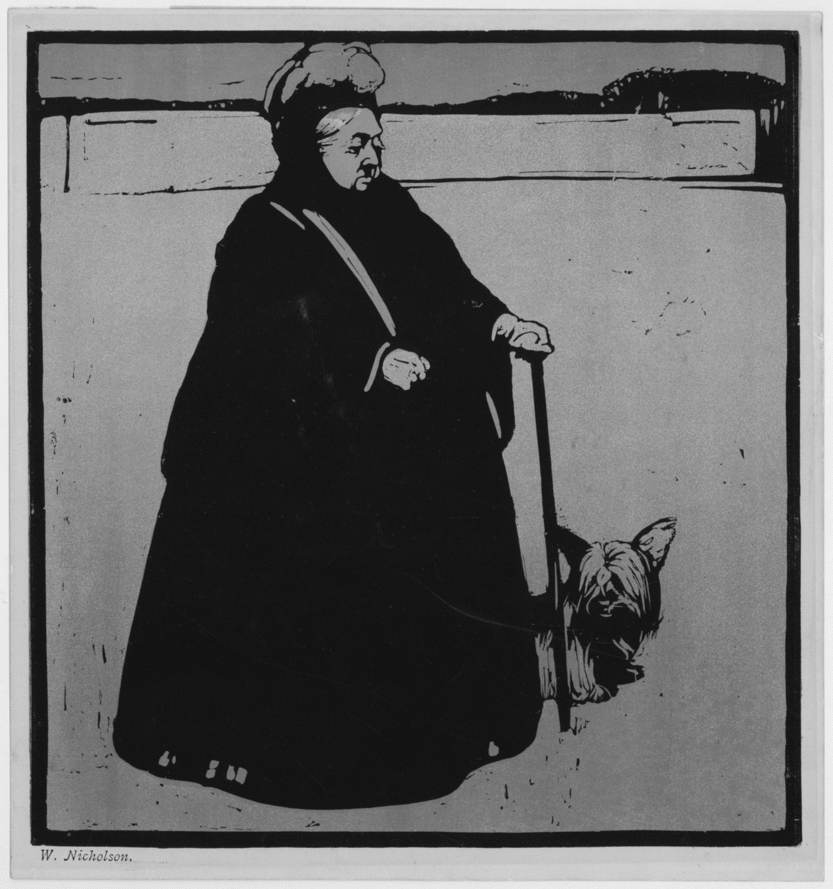
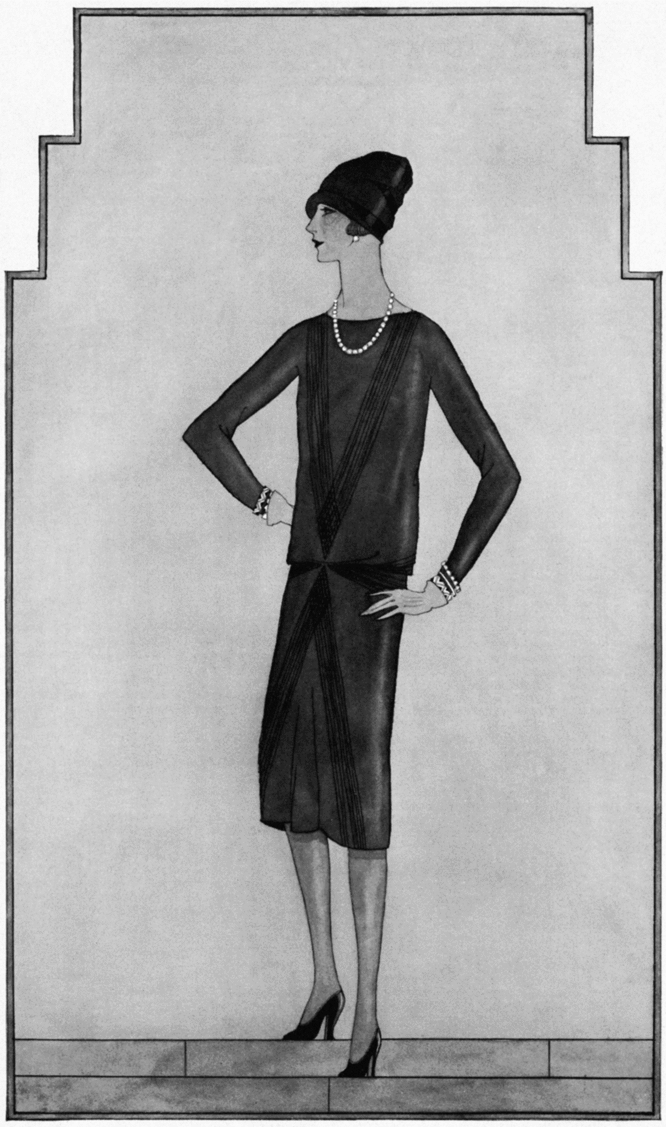
On the occasion of her Golden Jubilee, Queen Victoria was depicted in a woodcut by William Nicholson that was to become extremely popular (Figure 1). So stout that her proportions approach those of a cube, the Queen is dressed from top to toe in her usual black mourning attire, the white of her gloved hands punctuating the otherwise nearly solid black rectangle of her body. Less than thirty years later, another simple image of a woman in black would prove to be equally iconic: the lithe, narrow column of Chanel's black dress (Figure 2). Comparing the dresses depicted in the two images – the first a visual reminder of the desexualized stolidity of Victorian fidelity, the second image an example of women's burgeoning social and sexual liberation – might lead one to conclude that the only thing they have in common is the color black. And yet, twentieth- and twenty-first-century fashion historians suggest that Victorian mourning is the direct antecedent of the sexier fashions that followed. Jill Fields writes, for example, that “the move to vamp black became possible because the growing presence of black outerwear for women in the nineteenth century due to extensive mourning rituals merged with the growing sensibility that dressing in black was fashionable” (144). Valerie Mendes is more direct: “Traditional mourning attire blazed a trail for the march of fashionable black and the little black dress” (9). These are provocative claims given that most scholarly accounts of Victorian mourning attire – whether from the perspective of literary analysis, fashion history or theory, or social history or theory – offer no indication that such progressive possibilities were inherent in widows’ weeds. Instead, those accounts focus almost exclusively on chasteness and piety, qualities required of the sorrowful widow, as the only message communicated by her attire: “Widows’ mourning clothes announced the ongoing bonds of fidelity, dependence, and grieving that were expected to tie women to their dead husbands for at least a year” (Bradbury 289). The disparity in the two accounts raises the question: how could staid, cumbersome black Victorian mourning attire lead to dresses understood to embrace sexuality and mobility?
William Nicholson, “H. M. THE QUEEN (QUEEN VICTORIA),” 1899. Lithograph after wood-cut. © National Portrait Gallery, London (D33653). Used with permission.

Black dress by Coco Chanel as illustrated in American Vogue (1 Oct. 1926): 69. © Condé Nast. Used with permission.
Most writing on mourning attire limits its focus to what Roland Barthes, in his early writing on fashion, describes as the “institutional, fundamentally social” system of meaning circumscribed by clothing, which he terms “dress,” as opposed to the process by which the “individual actualized on their body the general inscription of dress,” which he terms “dressing” (“History” 8–9). Reasons for the scholarly interest in mourning “dress” as opposed to “dressing” might be explained in light of the power of the conventional, reductive versions of Victorian womanhood: overtly pious and sexually repressive, restrictive in a morbidly curious way. Understood as a series of social strictures, the rules governing mourning attire, especially those rules applicable only to the widow, conform closely to this conventional portrait. A mourning regime framed in terms of its oppressive or repressive nature reinforces readings of Victorian women as uniformly devoted “Angels in the House,” thus aligning the signifier (mourning attire) with the signified (heteronormative social customs and gender expectations).
Further complicating matters is the nature of evidence for non-normative mourning dressing; those strictures that determined the appropriate sartorial and behavioral comportment of widows also limited first-person narratives directly attesting to a recent widow's feelings of pleasure, desire, control, or any other emotion that ran counter to expectation. Modes of analysis that privilege first-person accounts might reject the myriad representations in fiction, satire, or advertisements of the widow enjoying her weeds as evidence insufficient to challenge the prevailing conventional wisdom.Footnote 1 As an exception state in fashion, mourning dress also resists broader analyses of Victorian attire. Valerie Steele's influential 1985 work Fashion and Eroticism sought to redress existent readings of Victorian dress by demonstrating the significance of the erotic as a motivating factor in women's fashion. While Steele does not address mourning dress, her approach is nonetheless relevant. Noting the division “between those theorists who interpret fashion . . . primarily in terms of sexual psychology and those who interpret it in terms of the social and economic development of society,” Steele insists that “it is a false dichotomy to argue that fashion is either a product of social forces or of sexual and psychological motivations” (Fashion 20). Victorian fashion, like all fashion, involves both, and the particularities of the Victorian widow's position amplify her engagement with “social forces” and “sexual and psychological motivations.” Indeed, the Victorian widow's relationship to her weeds sits at a most fruitful intersection of socio-cultural, gender, sartorial, historical, material, consumerist, and literary interests. Yet the critical literature of these modes of inquiry has not yet established what appears obvious in retrospect: that the provocative and progressive meanings accessible through mourning dress led to the little black dress.
This article takes up two methodological points of departure – Barthes's long acknowledged but underused semiological framework constructed in and prior to The Fashion System (1967) and Steele's psychoanalytically inflected sociological approach – to explore the iterations of mourning dressing that counter the normative historical definitions of mourning dress. The analysis embraces Barthes's claim that while analyses of clothing systems do have historical value, “it is the degree of participation in the system (be it total submission, deviations, or aberrations) that is meaningful” (“History” 13). I examine a number of sources, from the 1840s through the turn of the twentieth century, to suggest that women with the means and the desire used mourning dress in surprising ways, appropriating its ambivalence, controlling the emotional messages it communicated, and actively negotiating the marketplace for mourning goods to assert erotic, social, and economic agency.Footnote 2 Widows’ fashion could be read as a symbol of bereavement, but it could also signal a woman's new availability or sexual experience. It could be a financial burden tolerated only because of the intensity of the social stigma attached to eschewing mourning attire, but, encouraged by the Victorian marketplace, it could also function as a site of pleasure, fashion, and conspicuous consumption. These multivalent functions of mourning attire are evident in the rupture between the modes of mourning prescribed in social manuals and detailed in historical accounts, and the iterations of mourning depicted in fiction and suggested in advertisements – texts and images that have been underexplored or altogether overlooked in the historical treatment of mourning dress. By exploring these versions of mourning dress, I aim to expand an overly reductive understanding of the Victorian widow's experience and attire, an understanding constricted by the force of social expectations. This expanded account addresses the lacuna created by the claim that widows’ weeds provided a nascent pattern for twentieth-century black fashion.
Mourning Attire in Context
It appeared that the punishment for losing a husband was worse than the crime.
—C. Willett Cunnington
Mourning customs are as old as death itself, which is to say that no society has ever been without them.Footnote 3 By the eighteenth century, wearing black for mourning was de rigueur in England; widows were, by that time, expected to bear the heaviest mourning burden. Histories tend to contextualize the requirements of the seventeenth and eighteenth centuries relative to the past, noting that even rigid mourning expectations were a significant improvement over the days when widows might be expected to sacrifice their very lives to join their husbands in the afterlife (Puckle 90). In this time of the expanding Empire, the Hindu practice of suttee became a common point of comparison (Puckle 37; Morley 68). Spared from having to give up her life, the English widow had merely to give up sartorial freedom, and even a year or more in weeds was a sacrifice that seemed minor in comparison.
That historically sanctioned narratives of pre-Victorian widowhood represent a limited version of widows’ stories is clear from the schism between the narratives of widows’ lives told by historians and those told in fiction and on the stage. In Restoration comedies, for example, the wealthy, available, often conniving widow was a stock character, and women were depicted as being keenly aware of the financial exigency of early widowhood after marriage to a wealthy man (Canfield 46–52). In James Howard's 1663 play The English Monsieur, the Crafty sisters articulate this very awareness, praying for their partners’ “health now, till we are married, and have our Joyntures settled; And then let the Bell tole for them both as soon as time pleases” (IV.iii; cited in Canfield 46). Women like the Crafty sisters must indeed have existed, but a typical widow was far more likely to be impoverished than financially enriched by her husband's death. Such plays thus demonstrate the fear that the widow might have too much power, and – as Karen Gevirtz argues – Restoration comedies and fiction alike ensure that widows who defied the social order “receive their proper punishment of insult, assault, and worse” (15). Gevirtz suggests that in these texts, a threatening aspect of the (wealthy) widow's power is her ability to engage in commercial activity (22) – a power that Victorian mourning dictates would further encourage – but the alluring widow's ability to entrap men is also central to these plots.
By the Victorian era, mourning expectations were condensed into a series of social and sartorial rules, both highly detailed and impossibly confusing, as is evident from the number of advice columns devoted to the explanation of mourning etiquette in nineteenth-century periodicals.Footnote 4 The widow's clothing and demeanor were expected to mirror the role of dutiful wife she had played before the death of her husband, and increasing codification of mourning requirements reflects increasingly rigid marital roles. Just as the idealized Angel in the House was paramount to Victorian domesticity, text upon text insists that the widow's role was the most important in the Victorian mourning ritual (Cunnington and Lucas 261; Taylor 56–59; Jones 64; Flanders 381). Underlying all aspects of the prescribed mourning behaviors is the unchallenged assumption that the widow's husband and marriage were worthy of mourning. In addition to the “duty of wearing depressing, and often in their eyes, ugly clothes for many years of their lives” (Taylor 134), widows faced up to a year of social isolation, turning widowhood into “a final destiny, an involuntary commitment to a form of social exile” (Jalland 231). Their finances were likely to be precarious at best.Footnote 5 Even with such tribulations, so remarkable was the devotion of the Victorian wife and widow, Pat Jalland notes, that women's first-person narratives of death and mourning demonstrate all of the standard stages of grief except for one: anger (237). Despite the “alarm or panic” (236) that they felt upon their changed social and emotional positions, widows “almost never expressed anger” (237), a condition that Jalland accounts for by noting that Christian faith, devotion to their children, and treasured memories of their husbands kept Victorian widows afloat and consoled. Indeed, many Victorian widows’ diaries and letters include iterations of faith and devotion. Jalland cites sources that support this claim, and mentions only briefly that some women actually took to the new demands that widowhood thrust upon them, responding “remarkably well to their new roles” (244). Those widows’ stories are rarely, if ever, told.
In some cases, however, scholarly inability to fix a single version of the widow's experience indicates a conflict between prescribed behavior and actuality. Lou Taylor, in her meticulously researched work on mourning dress, arrives at seemingly contradictory conclusions regarding Victorian widows’ mourning. On the one hand, Taylor writes, they were “under the tightest discipline for two and a half years after [their husbands’] death,” wearing only “dull black silk and crape” (57) which they likely found “ugly” and “depressing” (137). On the other hand, “as the nineteenth century opened the passion for fashionable mourning dress flourished undimmed,” (120) a point which Taylor writes “cannot be emphasised enough” (149). Taylor notes that a woman's “sex life ended with her husband's death” and that, following Victoria, widows “were expected to remain sexually chaste for the rest of their lives,” an expectation which “applied particularly to the wealthy upper and middle classes” (59). But she also notes that “not a few widows” did “undertake second marriages,” and further that “for young and independently wealthy widows, their widowed state allowed them a freedom of choice over their second husband which . . . they had not enjoyed over their first” (61). Taylor's description creates a space for both versions of mourning: the reverently bereaved widow and the newly-freed, independent widow; the impoverished widow beholden to siblings or children for financial support and the wealthy widow with new control over her finances. The former was more common than the latter, but the existence of the independent and/or wealthy widow demands critical attention. Generally, scholars conclude that the limited independence a woman might have gained through the loss of her husband and the cover of mourning must only be understood in light of the relative freedom enjoyed by men throughout their lives (Holland 73).
As an essential component of the “elaborate catechism” (Kucich 59) of Victorian mourning, mourning attire in the Victorian era served more than ever as a signifier of moral fortitude, and the stronger the link between visible, readable mourning and propriety or morality, the larger the risk of defying social mores. Addressing those expectations frequently required shopping, and the incongruity of the two acts was a cause of anxiety for some and relief for others, as the serious work of sorrow might be mitigated by the distraction, if not the pleasure, of acquisition. In Mary Elizabeth Braddon's Taken at the Flood (1874), the newly widowed Lady Silvia Perriam immediately moves into new rooms in her house, furnishing and redecorating to her own tastes. “The acquirement of these things,” Braddon writes, “had been the first use which Sylvia made of her liberty. A childish employment, perhaps, for the solemn days between her husband's death and burial; but the distraction served to keep dark thoughts at bay” (268). Such distraction was anathema to Sarah Stickney Ellis, who years before railed against such behavior. She bemoaned in The Women of England (1843) that, as consequence of the need to “mourn genteelly,” houses where earnest grieving ought to take precedence instead become scenes of “bustling preparation,” leading to an “appearance of activity, and interest, almost amounting to amusement” (194). Ellis saves her most vehement criticism for fashionable mourning attire: “So extremely becoming and lady-like is the fashionable style of mourning, that, under the plea of paying greater respect to the memory of the dead, it has become an object of ambition to wear it in its greatest excellence; and equally an object of dread, and source of humiliation, to be compelled to wear it in an inferior style” (194). While acknowledging the emotive power of mourning attire, which has the potential to communicate respect as well as humiliation, Ellis is suspicious of the encroachment of fashion into mourning and frames her critique in terms of normative propriety.
Ellis's prescriptions suggest that the social strictures that encourage the adoption of mourning attire might present concomitant tyrannies: materialism and, perhaps even worse, vanity. These cautions against the pleasure afforded by fashionable weeds call up the association of the love of finery with the descent of women into prostitution, a connotation most contrary to mourning a loving husband (Valverde 169–70). That sentiment is echoed in an 1844 piece from Godey's Lady's Book: written as a preface to Thomas Hood's farce “The House of Mourning,” the editorial insists that mourning dress “serves, or should serve, as a corrective of the follies and extravagances of fashionable dress; and it is only when this salutary effect is counteracted by vanity and selfishness, and the weeds of mourning are disgraced by the heartless levity of the wearer, that they become a fit mark for ridicule and satire” (“Editor's Table” 244).Footnote 6 For all of their inherent conservatism, such comments illuminate features of women's experience of mourning – the “amusement” noted by Ellis or the “levity” noted by Godey's – that counter the impression of purely pious, religious, and miserable mourning described by the preponderance of mourning accounts. That is, these admonitions against the enjoyment of mourning attire were based on the impression that some people did, in fact, enjoy the very rituals of mourning.Footnote 7 These are subtle undercurrents; the normative imprint of the emotional code of mourning dress is so strong that it is easy to miss the pleasures afforded by selecting or wearing fashionable weeds. Talia Schaffer writes that while mourning attire “embodies emotions,” working as “a kind of poetics of clothing,” the range of emotions it represents is ostensibly limited and, at least to the common viewer (or wearer), “devoid of enjoyment” (116).Footnote 8
Though possible, Victorian women's enjoyment of mourning dress is, on first glance, difficult to substantiate. Women's access to and control over their clothing imbues it with particular power; as Christine Kortsch writes, “women's dominion over matters of sewing and dress” gave them a sanctioned way to “promote social causes” and to “write their own stories through the clothing they chose to wear” (14), but the ephemeral nature of clothing means that documenting those stories is not always easy. The (unhappy, unlucky) connotations of mourning clothing, along with the instability of early black dyes, mean that the garments were particularly unlikely to be preserved. And given the risk of offending the expectations of loved ones or one's society at large, it makes sense that little first-person evidence exists of women enjoying their mourning in some way. Even diaries and journals did not necessarily allow for complete confession.Footnote 9 Nor was the veneer of fiction always thick enough to make palatable the possibility that a woman might feel relief after her husband's death. Such was the case with American writer Kate Chopin's 1894 “The Story of an Hour,” which tells the tale of a woman who experiences the revelation of freedom after being told her husband has been killed, only to die herself when she discovers that he is still alive. The primary narrative was that of Chopin's mother, whose controlling husband died in a train accident, leaving her happily free to control her money and property and to make decisions about her children's upbringing (Toth 9–10). But that reality could not be told, as Chopin was forced to modify real-life events into a version acceptable for publication by killing off the woman who did not mourn appropriately (Toth 10). Chopin's work was not frequently featured in British periodicals, but “The Story of an Hour,” originally published in American Vogue, was almost immediately reprinted in England, appearing in a spring 1895 issue of Bow Bells. The journal, self-described as “a magazine of general literature and art for family reading,” retitled the story “The Dream of an Hour,” further distancing the protagonist's experience from reality and thereby, one might argue, rendering it all the more fit “for family reading.”
It is not surprising, then, that openly giddy, overjoyed widows are relatively rare in Victorian fiction; in any case, ambivalence as opposed to unalloyed happiness or utter misery was likely closer to reality. But the work of dress descriptions in fiction should not be underestimatedFootnote 10: the desires underpinning mourning for the widow and the onlooker alike arise in fictional descriptions of young widows, who are at once tantalizing and untouchable. Such desires are evident in the disconnect between the suggestions in advice columns of ladies’ magazines and the images of fashion plates and advertisements. Taken together, the instances of mourning detailed in this article work against the grain of normative constructions of widowhood, communicating ambivalence and desire through the sartorial grammar of grief.
Enhancing One's Pallor
She looks handsomer than ever in her mourning.
—Mrs. Cadwallader, describing Dorothea Brooke, Middlemarch
In George Eliot's Middlemarch (1871–1872), heroine Dorothea Brooke has a beauty that is enhanced by the austere cuts and colors she favors in dress. But it is her black mourning clothes that, according to the rector's wife, truly set off her beauty. Dorothea's first marriage was, unlike Queen Victoria's, a failure. And to the extent that her mourning dress marked the loss of her husband, it also signaled the possibility for future happiness with another, more appealing man. Perhaps Dorothea did not wish to provoke Mrs. Cadwallader's response, but in being deemed lovelier as a consequence of mourning clothes, she was not alone. The charming young widow, made more appealing in spite of herself by external signs of mourning, is a common and pervasive trope in Victorian fiction and popular press. This widow, especially the young widow who expressly tries not to look good, contrasts with the merry widow of the eighteenth century, who must be contained, and with the impoverished or devoted Victorian widow sociologists and historians describe. There is a fantastic element to these young, beautiful, and often newly-rich women, in that they challenge (or whitewash) the reality of the invisible plight of the typical, older Victorian widow. They also function as fantasy in another, more telling way: the beautiful widow embodies two qualities that would otherwise be contradictory in a Victorian woman, maintaining her dignity and status as angelic, devoted wife at the same time that her clothed body can be read as sexually experienced, desiring, and desirable. These figures thus maintain the sanctity of the idealized Victorian wife while acknowledging the ambivalence of the widow's status and experience. In most of the examples detailed below, and in myriad similar examples throughout Victorian fiction, the widow is described from the outside; her beauty in mourning is not presented as something over which she has control or deploys to her conscious advantage. Rather, it is an effect outside of her will or intention. Unlike Chopin's “A Story of an Hour,” which briefly explores a widow's interiority, in these texts, characters other than the widow herself articulate her beauty, sense of relief, or freedom.
An 1844 story in Blackwood's offers an early iteration:
She was so young, so pale, so beautiful, so sad, and withal so exceeding gentle in her demeanour, that an artist who wished to portray Our Lady in her virgin purity and celestial beauty, would have been ravished with the model. . . She was dressed in mourning, and this enhanced the palor of her countenance; ill-health and sorrow were also evidently portrayed upon her features; but there was so much of lustre in the complexion, and so much of light and intelligence in the eye, that the sense of beauty predominated over all. You could not have wished her more cheerful than she was. (“The Diligence” 693)
The subject of this rapturous description had been taken from a convent to marry a handsome, generous husband who descended into insanity and died soon thereafter. The passage captures effectively the combination of chastity (“Our Lady in her virgin purity”) and allure that defines the widow, along with the heightening effects of her mourning attire. She appears virginal though she is not a virgin. One might not “have wished her more cheerful than she was” because to have wished away her mourning would have wished away her availability and returned her to the arms of her husband. This young widow's type of beauty in mourning is echoed in “A Passage in the Life of a Maître-d'Armes” (1842–1843), wherein the narrator describes a woman as being “dressed in deep mourning, and without a single ornament; but her pale, melancholy style of beauty, was rather improved than impaired by the simplicity and sombre colour of her attire” (738). The ubiquity of the trope denotes the acceptability of the beautiful young widow, emphasizing through her unwittingly heightened beauty and charm that she was not dead yet.
Displacement of intention grounds many of the fictional depictions of widows who are young, attractive, or not miserable. Such displacement is also evident in Victorian paintings of widows. Art historian Susan Casteras notes that the “young, attractive, and vulnerable” widow was a common theme in Victorian painting as it is “a potent formula to excite pathos” (35). Anne Hollander also describes the motif, citing Richard Redgrave's The Governess (1844) as a prime example, but noting that “all sorts of paintings with the Young Widow or Orphan as theme or title” engage the “pronounced erotic undertones” of mourning attire. “The blacker and heavier the mourning,” she concludes, “the sexier the effect” (377). Casteras and Hollander's comments attest to but do not explain the reason for the heightened pathos or sexy effect. On a purely visual level, the black of mourning dress would contrast sharply with the pale or even sickly complexion of a woman stricken with grief and withdrawn from society, a contrast noted in the fictional accounts detailed above. In addition to the young widow's presence suggesting an intriguing combination of sexual knowledge and purity, the contrast also suggests the presence of death itself. As Jill Fields and Elizabeth Bronfen have shown, that claim comprises ambivalent desires: “Pleasure at the beauty of Woman resides in the uncanny simultaneity of recognizing and misrecognizing it as a veil for death” (Bronfen 63). Following Bronfen, the death of the woman provides the artist with a means of self-reflexivity that the merely mourning woman does not. But if the dead woman's body can be a means of representing death itself, or if the “spectacle of another's death may impart knowledge about one's own death, or about the hereafter” (Bronfen 72), the spectacle of the lovely, grieving widow provides a different kind of knowledge. As a representation of life continuing after one's death, the widow embodies the reassurance that one will be missed, one will be remembered, and that one's memory will be reified through objects like mourning attire and physical signs of sadness. If grieving is a performance of love, the more grief-stricken the widow, the greater the assurance that her husband was adored and is missed. So the very same signs function as indicators of (past) wifely devotion and (because, as Hollander put it, the “heavier the mourning . . . the sexier the effect”) of present desirability. The fictional widow is the ultimate catch – chaste and faithful yet sexually knowledgeable and available. As long as she actively encourages only the first reading, she poses no threat to the men around her, though her appeal may inspire consternation among those competing for male attention. Interest in or admiration of the beautiful widow is thus often articulated by men, the elderly, or the disembodied narratorial voice, while disgust or criticism of the beautiful widow is displaced onto her female friends.
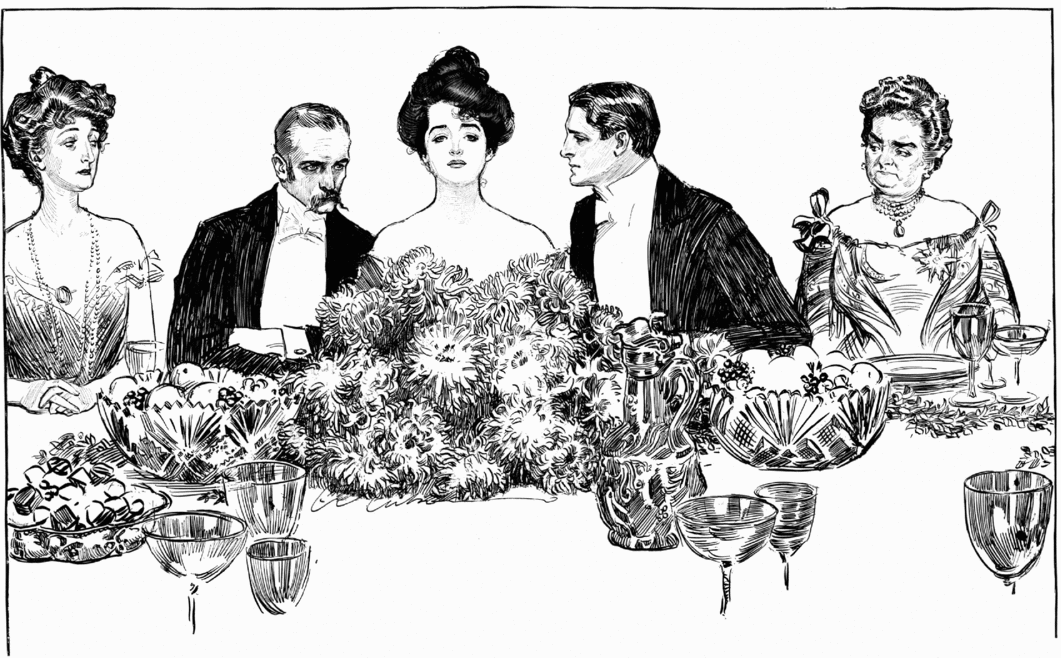
A story from the early twentieth century, Charles Dana Gibson's 1901 A Widow and Her Friends, attests to the power of a widow who deploys her charms to conscious effect. The illustrated story recounts the trials of a young widow unable to escape the admiring gaze of the men or the scorn of the women around her. The images and captions suggest that jealousy of the widow's attractiveness and her mobility motivates this female derision: though the married women are pushed to the boundaries of the frames, the widow is often central, among the men. The widow's beauty, though, is not simply a spectacle for male onlookers. While still in relative seclusion, she “finds some consolation in her mirror,” seeking respite from grief through her solitary contemplation of her beauty. Her first forays into society feature her in a striking black gown with extreme décolleté neckline; the gown is cut so low, in fact, that in one frame the floral centerpiece on a dining table covers any trace of her dress, giving the impression that she is nude (Figure 3). The image's caption, and the expressions of the men and women in the scene, captures the dissonance between the responses the widow receives: “Some think that she has remained in retirement too long. Others are surprised that she is about so soon.” A subsequent frame, captioned “She is the subject of more hostile criticism,” similarly features men gathered approvingly around the widow and women looking on in judgment. The visual effect is heightened because of the contrast between the widow's pale, bare neck and the stark black of her dress, an effect that calls up the Victorian fascination with the dead or dying woman as an erotic figure (see Fields 150–51).
C. D. Gibson, “Some think that she has remained in retirement too long. Others are surprised that she is about so soon.” A Widow and Her Friends (London: Jay Lane, 1901).
But the widow has advantages: she's alive, she's sexually experienced, she looks good in black, and her status as widow links her (visually and in terms of desire) with men and places her in opposition to other women. The suggestion of her power is particularly evident in Gibson's images, in which the widow's black attire and position (surrounded as she usually is by males) locate her visually with the assembled men, whether they are in black evening jackets, suits, or clerical robes. Moreover, the men are clearly in thrall to her, granting this early twentieth-century widow a power that (unlike Eliot's Dorothea Brooke) she and the other women in the image recognize.
Widow Shopping
I drove her to “Jay's” in the carriage on my way home, where I left her in the seventh heaven of shopping, enveloped in neutral tints of the most becoming shades.
—The Vandeleurs of Red Tor
The vision of Gibson's widow, wearing a sumptuously cut black mourning gown and surrounded by admiring men, brings to the forefront the power of the widow in black as well as the liminality of her status. She recognizes her own desire and functions as the object of desire for others. And while the ambiguousness of her position anticipates the later roles of women and the fashion they would wear, it is discordant with the version of isolated and ascetic widowhood prescribed in conduct manuals and described in histories of mourning or widowhood. One historical narrative ascribes the change to the vulgarization of commercial interests rather than to the agency of the widows themselves (Punch called it “trickery to trade” in 1855 [“Etiquette for Mourners” 51]). Advertisements and the wares they touted are often credited with the commodification of mourning, by encouraging middle-class emulation of the mourning habits of the upper classes and tethering mourning attire to current fashions trends rather than to emotional sobriety. In her study of middle-class British widows in the nineteenth century, Cynthia Curran writes that “the expenses involved” in acquiring mourning attire “pointed to manipulation by the marketers of mourning wear and by the funeral firms who flourished in providing traditional ceremonies” (ii). The consumer is frequently cast as “a feminized victim of masculine (economic) aggression,” (Rappaport 13) and because consumers of mourning goods were primarily women, and often recently widowed women at that, the notion of passive victimhood is even more entrenched when applied to these shoppers.
Recent cultural studies have provided a vocabulary to challenge these monolithic views by acknowledging that through the act of consuming, the individual, particularly the woman, may shape the process and may even “disrupt the limits placed on women by gendered norms” and “reformulate the ideologies of gender that were manufactured by the machinery of capitalism” (Lysack 10). Regarded by advertisers as a “careful critics” and “agents of material acquisition” (Loeb 9), female consumers were not merely passive pawns of the advertiser or shop owner, but existed in relation to the commercial complex, defining its offerings as much as being defined by them.Footnote 11
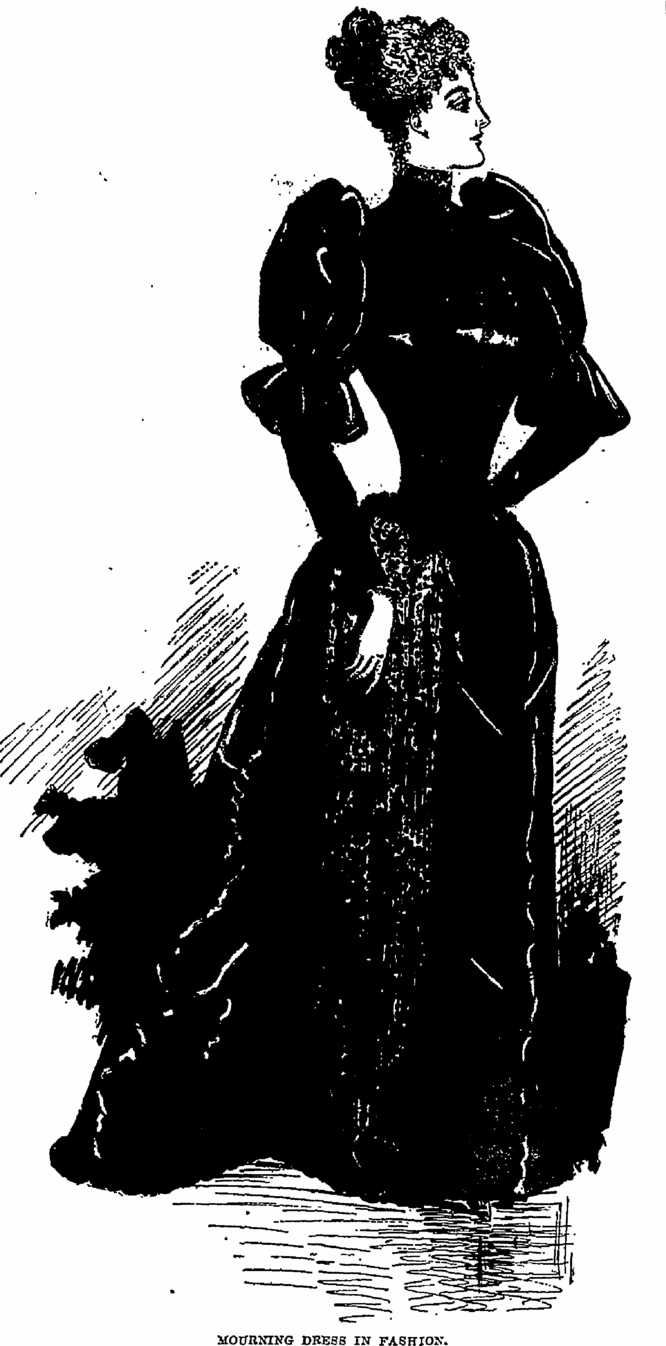
Because mourning attire and the shops which sold it allowed women access to a socially-sanctioned display of emotion and interior life, it provided women with a means to negotiate their desires as women, wives, and consumers simultaneously, or at least to recognize the ambivalence of those multiple states. To be sure, wearing weeds was not the only way a widow could deploy her power in the marketplace or display emotional ambivalence after her husband's death, and mourning practices could not free widows from the inherent patriarchal structure that undergirds the capitalist marketplace. But the particular circumstances of the mourning widow – especially, though not exclusively, the wealthy widow – combined with the extensively codified rules of mourning wear, created a site where ambiguous meanings could be deployed in ways that transgress or subvert that structure. By finding pleasure in mourning and shopping for mourning attire, the widow could usurp the patriarchal underpinnings of mourning requirements even if she was responding to gender-coded advertising messages in doing so. The popular press, with its combination of news, fashion plates, and advertisements, tolerated (if not actively encouraged) such contradictory impulses. Much of the January 30, 1892 issue of the Penny Illustrated, for example, was devoted to somber coverage of the Duke of Clarence's unexpected death. The issue also contains the assurance that “smartness in attire is not incompatible with mourning” (“The World of Women” 69) and an illustration of a strikingly fashionable mourning dress worn by a young and attractive woman (Figure 4). Once in public, the inability of the onlooker to know definitively whether a woman was shopping for mourning because she was a devoted mourner intent on fulfilling her duty or because she wished to indulge her vanity by purchasing the latest fashions is essential: the task of shopping for mourning was especially charged in its ability to simultaneously satisfy desire and duty, and a shopper need not reconcile the ambiguities of her motivation.Footnote 12 The widow, it must be noted, held a special position even among mourners. While anyone shopping for mourning attire could engage these ambiguous or ambivalent motivations, the widow was expected to mourn longer and in more restricted ways than those who had lost a parent, child, brother, or sister (longer too than the widower). By dint of her widowhood, she also moved into a new social status, with increased legal and (potentially) financial power, a shift that other mourners would not necessarily have experienced.Footnote 13 Curiously, though histories of mourning and mourning dress describe advertisements and the advent of the mourning emporium, the widow's or mourner's experience while shopping – her agency as a consumer – is left unexplored.Footnote 14 John Morley refers to mourning shopping as a “chore” (73).
“Mourning in Fashion” from “The World of Women.” The Penny Illustrated Paper (30 Jan. 1892): 74. © British Library Board.
In fact, the English magasin de deuil provided a consolidated site for negotiations of desire and economic power. Though nearly every draper would have had a section devoted to mourning fabrics (Adburgham 58, 180), stores like Jay's Mourning Emporium of London, located in the fashionable shopping destination of Regent Street, flourished by offering a full range of mourning goods in one place. As nineteenth-century mourning required an immediate change in clothes with little notice, such stores specialized in being able to provide mourning accoutrements with minimal delay.Footnote 15 Alison Adburgham notes that Jay's was among the very first to develop new patterns and dress construction methods to facilitate that speed: “Jay's had completely ready-made dresses in 1866. . .. They had devised an ingenious method of overcoming deviations from the female norm without having to stock dresses in many different measurements” (125). Such innovations in clothing design and construction put Jay's on the cutting edge of ready-to-wear, a position that ultimately allowed the company to jettison its identity as mourning emporium and transition to an upscale dress shop.Footnote 16 To accommodate the practical and emotional needs of mourning women, stores like Jay's cultivated soothing, luxurious environments and exceptionally attentive service. These qualities made such shops destinations for non-mourning shoppers as well. That direction is clear in an 1892 travel guide to London, which describes Jay's as the authority for finding “beautiful gowns” for “deep-mourning, half-mourning, quarter-mourning,” or, amusingly, “one-eighth-of-an-inch-mourning” (Pascoe 382). Mourning retailers walked a fine line, needing to project the availability and novelty of their goods and to retain a sense of propriety so as not to appear to be taking advantage of distressed customers in a time of grief. The need to project legitimacy was perhaps a driving force in Jay's self-publication of A History of Mourning by Richard Davey, in which the author extols the virtues of the British incarnation of the magasin de deuil: “The fame of a great house of business like [Jay's] rests more upon its integrity and the expedition with which commands are executed than anything else” (95). By emphasizing integrity and the execution of (customer) commands, Davey makes consumer desires central, while obfuscating the motivation of those desires.
In addition to legitimizing the offerings of the mourning emporiums, strict sartorial rules also legitimized a widow's purchases. Though the financial requirements of purchasing weeds was an enormous burden for the poor widow (Curl 9), those women with money had no such trouble, and they could leverage mourning requirements as a pretense for indulgence.Footnote 17 From the point of view of consumer power, the middle- and upper-class widow was in a particularly advantageous situation. In “The Philosophy of Shopping,” an 1875 essay for the Saturday Review, James Sully does not critique, but rather tries to explain, the pleasure women derive from shopping.Footnote 18 While Sully addresses all women shoppers and not only widows, it is clear from his analysis why the widow might have been in a privileged position to exploit those pleasures. In Sully's telling, paramount to a woman's enjoyment of shopping is her sense of control and power, a feeling often missing from other parts of her life. Tempering a pure sense of power or indulgence is a nagging sense of guilt; should a shopper feel such a twinge, Sully suggests that she may “soothe herself with the belief that this particular thing is quite indispensable” (“Philosophy” 488). Mourning requirements could legitimize a widow's purchase and help to assuage that guilt: weeds were indispensable. A husband's death, then, could provide a justifiable reason for shopping. It also eliminated a major impediment to unfettered spending, as another obstacle was the husband himself, whose “suggestion of extravagance” and complaints of “heavy drains on the marital purse” intrude into the pleasures of shopping (“Philosophy” 488). While shopping for the home was typically the purview of a wife, a husband's control over the household finances often determined how much she might spend. This is clear from advice manuals instructing women to reject extravagance and imploring men to assert control over wifely indulgence, especially in dress.Footnote 19 Many manuals urge young men to avoid such women altogether: “Young men, if you look for homes when you marry, do not marry dressy girls!” implored one (Collyns 123). William Cobbett warned young men that a woman who admires “the trappings of the rich . . . will not spare his purse, when once she gets her hand into it,” and so “if he can bid adieu to her charms, the sooner he does it the better” (120). Others directed warnings to the wife: “Be prepared to submit to your husband in the matter of family expenses” counseled one manual (Kirton 138). With no husband to submit to, the new widow could more freely control “the matter of family expenses.”
Widows could use social rules of mourning to justify the pleasurable indulgence of shopping, and they could regard the mourning emporiums as asylums where such indulgence was not simply tolerated, but accommodated. But did they? Consider Jay vs. Sala, an 1898 lawsuit in which Jay's sued a woman for non-payment of a bill. Mrs. Sala, a recent widow, amassed a debt at Jay's of £121 16s 9d, a staggering sum when a dress length of fine black silk could be had for two guineas. The case further suggests that physically visiting a mourning store was not a prerequisite to extravagant spending on mourning attire, as Mrs. Sala placed the order (on her sister-in-law's credit, no less) through the in-home service provided by Jay's for those who could not or did not want to visit the store in Regent Street (Times Law Reports 461). From court records, one can only infer the reasons for a widow's extravagance. But what can only be intimated in court records is given voice in fiction. In Trollope's Can you Forgive Her? (1864–65), Arabella Greenow revels in the wealth she inherited as a relatively young woman – and, as Trollope takes pains to note, still a very attractive woman – as well as the power that her new wealth affords. She is unabashedly delighted by her mourning attire: “She turned over all her wardrobe of mourning, showing the richness of each article, the stiffness of the crape, the fineness of the cambric, the breadth of the frills, – telling the price of each to a shilling, while she explained how the whole had been amassed without any consideration of expense. This she did with all the pride of a young bride when she shows the glories of her trousseau to the friend of her bosom” (52). The Widow Greenow, described as “almost gorgeous in her weeds,” coquettishly woos two men at once while weeping over the loss of her late husband: “she had scorned to make any compromise between the world of pleasure and the world of woe” (312, 60). “The charm of the woman,” Trollope insists, “was in this, – that she was not in the least ashamed of anything that she did” (52).
The Widow Greenow's frankness is an exception. More frequently, characters other than the widow herself give voice to the pleasantries of shopping for mourning, as in the epigraph of this section, from Monro's The Vandeleurs of Red Tor. And in George Whyte-Melville's General Bounce (1855), the maid is “occupied and excited about [her mistress’] mourning, and her own ‘breadths’ of black and ‘depths’ of crape usurped the place of unavailing regrets in a mind not calculated to contain many ideas at a time. Besides the pleasure of ‘shopping,’ inexplicable as it may appear to a man's perverted taste, is one which ravishes the female mind with an intense delight” (93). Mrs. Frere, in Annie French Hector's novel The Freres (1882) exclaims after purchasing mourning attire, “It's quite a treat to do shopping here . . . they have such lovely things at Jay's” (521).
In these fictional examples, the precise location of mourning's pleasures is unclear – alternately in the mourning dresses themselves, in the act of shopping, or in the physical space of the mourning emporium. All three sites are redolent with possibilities of change through the expression of power, control, or desire. So too is the mourning period itself ripe with possibilities for the expression of myriad, possibly contradictory pleasures and miseries. It is no wonder that the chrysalis is a common metaphor in fiction for the period of mourning, a widow's weeds, or the widow herself: “It was as if some chrysalis of his acquaintance had suddenly developed into a butterfly” (Braddon 268); “she is a widow just breaking the chrysalis of her mourning” (Melville 60); “this summer Mrs. Sylvanus emerged from her chrysalis of crape, a magnificent butterfly” (Kirk 417); a widow had “worn the weeds and acted the disconsolate widow to perfection for the exact space of one year, and then, like a butterfly coming out of its chrysalis, she had exchanged the cap for a becoming head-dress, and the black dresses for greys and lilacs” (Allet 44–45). The chrysalis of mourning is figured not as a space for hibernation, but as a stage for change and development, from which a woman emerges newly independent; here, mourning engages the “transformational myth which seems attached to all mythic reflection on clothing,” amplifying through the connotations of widowhood the possibility of dressing to facilitate “the multiplication of persons in a single being” (Barthes, Fashion System 256).
The “chrysalis” of mourning also appears in Ménie Muriel Dowie's Crook of the Bough, an 1898 New Woman novel suggestive of broader shifts in the role of mourning dress in women's lives. The Crook of the Bough invokes the circumstances of mourning and the space of the mourning emporium to convey a woman's movement into awareness and agency that does not depend on the death of one's husband. Heroine Islay Netherdale is introduced to the reader in the midst of rejecting a proposal of marriage; later, she uses Jay's dressing room as a sort of transportive space. While walking in Oxford Street, she “passed Jay's windows” where “Something – a dark purple gown – caught her eye” (239). Though Islay is not a widow and is not grieving per se, the choice of Jay's is significant, as she would have passed many other shop windows in Oxford Street. The description of her experience is resonant with connotations of mourning and of movement into a new life. She describes the clerks as “funeral ship[s]” who transport her to fresh self-awareness. Once inside, she is struck by the commanding mien and beauty of the women in the store modeling gowns. She names them Clara Vere de Vere, the Queen of Sheba, and Helen of Troy, attributing power and control to their stateliness and beauty (what's more, all three names signify women who have complicated relationships with men). Islay describes “Sheba's” dress as “a marvellous white satin, evening gown” before noting that “the black alpaca sleeves and front that emerged from the low bodice could not detract” from the woman's carriage; the white evening gown trimmed with black suggests half mourning, the stage between initial grief and a full return into society. “Dazzled” by the sight, Islay “had forgotten her mission; life was rapidly developing in front of her, and she gazed, in spirit, down a vista where everything wore new colors” (239, 240). Those colors – the dark purple of the gown, the “soft heliotrope” of the corset, and the “chaste secretive tone of violet” of the petticoat, all of which she tries on – are notably colors suited to half mourning (241, 242). In this new garb, Islay imagines herself as a “chrysalis,” emerging from her “lustreless brown casing” before returning to it (243). That moment in Jay's store allows Islay the freedom to reimagine herself, and while that image moves her distinctly away from the hard working, anti-fashion New Woman sensibility she holds earlier in the novel, it must not be regarded as regression. Lawrence Rainey argues that at the novel's end, Islay is “a distinctively modern figure” who “embodies the promise of modern freedom: an autonomous subject whose appetites for pleasure and sensuous fulfillment are legitimated by modernity itself” (321). Those appetites were fulfilled, even if only momentarily, by the deep purple gown and funereal clerks of the mourning emporium, a place where countless widows equip themselves to transition into a more independent life, a life – at least for some time – without a husband.
The example of Islay Netherdale using Jay's to try on a new identify suggests that mourning attire was being appropriated for the connotations of change it engendered. Mourning reflected other parallel social changes as well; the availability of inexpensive and readily available mourning attire across social classes ultimately led (often to the consternation of the aristocracy) to a kind of democratization of fashion through the uniform of black dress. Even outside the realm of mourning attire, class distinctions that had been readily visible through clothing were increasingly contested during the nineteenth century. Whereas employers could demonstrate rank through their servants’ prescribed dress, “the increasing ease with which women left domestic service for factory work or other more independent occupations” (Valverde 182), combined with the increasing ease with which one could purchase relatively inexpensive, ready-made garments, meant that middle- and lower-class women had greater access to fashion. Such access was disconcerting to employers, a contention “backed up by the evidence of middle-class unease at the fashionability of servants in magazine correspondence and satirical Punch cartoons” (Breward 73). The strict bounds of mourning fashion, with its single color, made its leveling potential all the greater. In fact, some histories of mourning detail employer's dismay in seeing their servants spending their limited means on mourning dress (Puckle 97). Mourning reformers seized upon such anxieties, arguing in an 1876 editorial that “so long as the habit of going into mourning is the fashion with those who can afford it, it will be adopted by those who can not”; it was therefore up to those “who can afford the expense of it” to stop the practice (“Going into Mourning” 283). The goal of this editorial was to offer relief to the poor, who “suffer under this now oppressive yoke” of mourning expenditure, but by appealing to the ego of the wealthy, it implicitly underscores the importance of class divisions.
Retailers could, and did, appeal to class anxiety from both sides. For those interested in demonstrating their wealth through ostentatious displays of mourning, fancy mourning accessories and fashions of the very latest mode were available, along with complementary jewelry and other baubles of bereavement. At the same time, retailers amplified the leveling power of mourning by appealing to the socially aspirant. With competitive pricing, Jay's could accommodate the needs of the lower classes, and through the 1860s their advertisements emphasized those low prices and quick turnaround. But by the end of the century, they touted their specialty as “ladies’ high-class mourning goods,” and the store vocally counted among its patrons “Her Majesty the Queen, the Princess of Wales, and many members of Continental Royal and Imperial families, as well as . . . the nobility and the élite of society,” thereby conferring the status of élite upon the rest of their customer base (“Illustrated London” 70). Jay's advertisements seem to be directed towards women who wanted to have their cake and eat it too – that is, to mourn faithfully and fashionably, lavishly but on a budget. Jay's silk offerings were especially strong, and advertisements for Jay's Black Silk pepper nineteenth-century publications, flaunting their fabrics’ variety and trendiness in the same breath as their durability and cheapness.
The mourning shop provided a space, and mourning attire offered a screen onto which a wide variety of consumer and social behaviors could be projected; it offered, through its uniformity of color and its function as a universal requirement of all classes, a means to express the emotional spectrum from sorrow to coquettish seduction, and the financial spectrum from humble prudence to utter extravagance. For those who were desirous, mourning practices provided genteel cover for explicit materialist desires. In fact, because it was an allowed – if not required – site of spending, mourning trappings were suited to function as a symbiotic construction of consumerism par excellence, one that could be appropriated to project a wide array of sensibilities.
Marking the End of the Mourning Period
. . . hard, indeed, is the lot of those who are not qualified to wear black.
—“Charivaria,” Punch, 1904
Not all Victorians were enamored of the expensive and often ostentatious rituals demanded of mourners, and calls for mourning reform were sounded regularly in the last half of the nineteenth century. And mourning did change, though not only for reasons that the mourning reformers would suggest; the masses did not simply reject formal mourning expectations as mere absurdities. Instead, mingling with calls for mourning reform was an acknowledgement of the ambiguity and multiplicity of meanings attributed to mourning attire by those wearing it. The shifting meanings of mourning dress were of a piece with broader ongoing debates about dress reform, including Rational and Aesthetic Dress, movements that overtly linked fashion with interiority, social progress, and women's liberation.Footnote 20 And to the extent that mourning expectations were indications of marital expectations, the easing of mourning requirements suggest the changing nature of marriage itself. Increased access to divorce, for example, lightened the yoke of the permanence once attached to marriage and, by extension, to widowhood. Two entries in Punch's “Charivaria” from April 1904, though rather biting in their satire, show this divestment of grief and pious sorrow:
Some charming new fashions in mourning apparel for ladies have again made their appearance and we agree with the fair writer who declares that grief must be peculiarly deep which cannot be assuaged by a chic black canvas gown adorned with black taffetas in the form of hands and a broad corselet belt, and finished with a cascade of lace down the backs of the sleeves.
There is little doubt, in fact, that quite the prettiest fancies are now to be found in robes de deuil, and hard, indeed, is the lot of those who are not qualified to wear black. The smiling face of the lady who has recently suffered a bereavement, as it peeps forth from under a smart mourning hat, meets with many an envious glance from those who are less fortunate. (“Charivaria” 235).
In these pieces, mourning serves as a felicitous excuse for indulgence; not having a reason to mourn is lamentable. Here, emotive messages are decoupled from fashion, which now serves less as a readable indicator of one's interiority than as an indicator of one's consumerist appetite or vanity, at least from Punch's perspective. Even though desire was always an implicit part of mourning fashion, with changing social and gender norms that desire need no longer be bound to normative marriage values.
Given the constantly moving and intersecting currents of fashion, mourning etiquette, marital expectations, gender norms, and the other values which contribute to the meaning communicated by clothing, it is impossible to identify a single point which marked the definitive end of the Victorian incarnation of mourning dress. Black evening dress had been gaining in popularity since the 1860s, although, as is clear from Tolstoy's Anna Karenina, Wharton's Madame Olenska, and Sargent's Madame X, black still communicated sexuality and provocativeness.Footnote 21 The erosion of the distinction between mourning and fashionable black was perhaps complete by the time of the famous “Black Ascot” of 1910, which took place only weeks after the death of Edward VII, though Jennifer Craik suggests the event “seemed to mark the start of a new attitude towards mourning dress” (52, my emphasis).
Existing narratives have explained the decline of Victorian mourning by focusing on external factors: the oppressive and suggestive rise of retail, social secularization, and most importantly, the advent of the First World War (Summers 240; Jalland 371; Wilson 188). While these social shifts doubtless played a role in the changing face of mourning, such narratives tend to elide women's agency, erotic or otherwise. According to most fashion historians, the event that ultimately halted mourning trends was not an untenable ratcheting up of mourning expectations or the trend's vocal opponents, but rather the overwhelming numbers of casualties during the First World War (Holland 74; Mendes 9; Vanderbilt 183). In order to “avoid spreading gloom,” as Doris Langley Moore writes, existing modes of mourning were abandoned (80). Nancy MacDonell Smith concurs; “faced with so much death” after the war, she argues, “many felt that it was best to move on” (13). “Family mourning and its conventions were an insufficient comment,” John Morley concludes – “the stage had become too wide for propriety” (79). When everyone had call to wear mourning clothes, weeds marked a woman not as separate and apart from society, but as a member of society, experiencing the same pain and sorrow felt almost universally. Sonia Bedikian offers a variation on this theme when she suggests that WWI impressed so many women into service that “with an increase in the number of casualties, it became impractical for them to interrupt their work in order to observe the seclusion called for by formal mourning etiquette,” resulting in the further undermining of mourning rituals (35). Mourning dress was challenged not only, then, by the sheer number of war casualties, but by the changing gender roles catalyzed by the war effort.
Another foundational narrative of fashion history arises around the same time, one which tends toward hagiography, with Chanel in the starring role. While his description of the birth of the little black dress acknowledges the role of the First World War, Didier Ludot joins countless fashion writers and biographers when he suggests that Chanel singlehandedly “brought the color black out of mourning, away from the clergy, away from the world below the stairs, turning it into the very essence of Parisian chic” (Ludot 7; see also Rubenstein 79; Madsen 117; Sherrow 73; and Edelman). Despite its ubiquity, this tidy narrative – that “black was almost exclusively worn as mourning dress until the 1920s when Coco Chanel supposedly ‘invented’ the little black dress” – is, as Valerie Steele argues, “greatly oversimplified” (The Black Dress 14). Chanel might have been uniquely suited to capitalize on the many intersecting trends of the period, but by the 1920s, women had long been negotiating the many meanings of the black dress.
The movement into the post-WWI incarnation of fashionable black was a rejection of only one set of meanings ascribed to mourning dress: that of obedient wifehood and sorrowful widowhood. The other set of meanings – sexual awareness, availability, economic control, and social leveling – were sustained and amplified through the revolution in style staged through the 1920s. The little black dress, in other words, appropriated the ambivalence inherent in mourning attire. Aligned with the liberation of fashion marked by the rejection of the corset, the ascension of hemlines, the pared-down simplicity of dress silhouettes, and the greater exposure of the limbs than had previously been acceptable, the little black dress came to represent woman's ability to construct meaning out of fashion on her own terms. Stripped of the veil of sorrow and imbued with active markers of freedom and movement, the black dress was understood as “the ultimate blank canvas” (Garcia 18) that could be modified for any occasion or level of formality. That blank-canvas aspect was foundational to the expansion of mourning attire and the concomitant expansion of the mourning emporium, just as many mourning emporiums dropped mourning altogether and became dress shops or department stores. So too did the mourning gown eventually lose its specific emotional power. Once the suggestion of grief was decoupled from the black dress, the sex appeal which was understated or assumed in Victorian mourning dress moved to the semiotic forefront.
As I noted in the opening of this article, recent analyses of twentieth-century fashion often regard the prescience of mourning attire as a given. In An Intimate Affair: Women, Lingerie, and Sexuality, Jill Fields plainly accepts the role of Victorian mourning as a forerunner to the erotic symbolism of the black dress. She argues that black lingerie, first introduced to complement one's mourning wardrobe, also took on the erotic aspect underlying mourning, and, through the course of the mid-twentieth century, became the standard for projecting sexual availability (Fields 138–39). But while Fields offers the most thorough exploration of the ambiguities of mourning fashion to date, and while she notes the “dubious position and transgressive nature of widows” (143), she does not emphasize widows’ agency in the trajectory of black fashion. MacDonell Smith, in her popular history of the little black dress, unabashedly affirms the sexual charge of mourning attire while retaining the perspective of the male onlooker: “Mourning, too,” she writes, “had its sexy side . . . unlike that other group of unavailable women, unmarried girls, widows weren't virgins. They were forbidden fruit, but ripe” (10). This sentiment perpetuates the passivity of the widow, even if it acknowledges on some level the complexity of the widow's social and personal position. These are not merely anachronistic applications of twentieth-century notions of sex appeal onto now-fetishized Victorian fashion. Erotic undertones were always accessible in mourning attire.
Those erotic undertones signify something much larger than sexual desire, and – as this article has sought to establish – mourning attire and its development in the marketplace also function as sites for negotiation of pleasure and power. In purchasing mourning attire, a woman could simultaneously appease normative gender and social expectations and assert her power as a consumer, independent of her husband. Just as Jay's Mourning Emporium could claim to serve both the Queen and (ostensibly) the housemaid, the little black dress could serve as an article of clothing appropriate for every woman of every age and every class. Of course, with such interpretive leeway, one risks being misunderstood. Valerie Mendes captures this anxiety when recalling Chanel's reaction to criticism of her simple black designs: “She was incensed when [they] were dubbed ‘poverty de luxe’, ‘soup kitchen style’ and ‘poor girl fashion’, retorting that these impeccably made clothes in the finest materials (especially when combined with her costume jewelry) allowed women ‘to walk around like millionaires’” (11). Chanel might have been incensed that her chic designs could be mistaken as the uniform of a soup kitchen worker. Queen Victoria might have been appalled by the suggestion that widow's weeds could be used to heighten feminine desirability, but Trollope's Widow Greenow rejoiced in the fact. The traits that define the little black dress – the possibility to communicate multiple and conflicting meanings, the potential to embody complex and ambivalent desires, and the feminine site of control afforded by fashion – also define mourning attire. Other kinds of fashion may be deployed to similar ends, but the development of twentieth-century black fashion depended on the set of cultural connotations, social restrictions, gender roles, and the developing retail landscape particular to the late nineteenth century. And it depended on the color black, “a uniquely powerful, mysterious, and seductive color” that “can be both pious and perverse” (Steele, The Black Dress 5), and one whose boundless meanings were explored through the Victorian appetite for mourning.