I. INTRODUCTION
Al–Mg2Si in situ composites are considered to be attractive structure material candidates for automobiles, aerospace, and thermoelectric applications owing to their outstanding physical and mechanical properties.Reference Chen, Wang, Liu, Wang, Luo and Jiang1 Mg2Si, which serves as a reinforced phase in the Al–Mg2Si in situ composites, exhibits low density (1.99 × 10³ kg/m3), high melting temperature (1085 °C), high hardness (4.5 × 10⁹ N/m2), high elastic modulus (120 GPa), and low thermal expansion coefficient (7.5 × 10⁻⁶ K−1).Reference Wang and Qin2 The intermetallic compound Mg2Si possesses an fcc (antifluorite type) structure with high symmetry.Reference Takeuchi, Hashimoto and Suzuki3 During the conventional solidification process, this phase follows a typical faceted growth pattern because of its high fusion entropy and large Jackson’s factor.Reference He, Zhang, Li and Wang4,Reference Qin and Zhao5
Morphology control is an important means in the synthesis of advanced structural materials.Reference Zhang, Deng, Zhang, Gao and Xu6,Reference Huang, Lyu, Yang and Huang7 Under equilibrium growth conditions, the crystal morphology is determined by the intrinsic crystal structure. However, the crystal morphology may transform if the external conditions change.Reference Wang, Zhu, Li, Li, Zha, Wang, Yang and Jiang8 Much effort has been devoted to modifying the Mg2Si morphology so as to improve the qualities of the novel Al–Mg2Si in situ composites. Among the various growth shapes, truncated octahedron Mg2Si crystals are usually desirable due to their excellent photocatalytic and mechanical properties.Reference Chen, Wang, Luo, Zhang, Liu and Jiang9,Reference Chen, Wang, Li, Zha and Jiang10
It has been widely shown that the modification treatment is an effective method to control the morphologies of the primary and eutectic Mg2Si.Reference Nordin, Farahany, Ourdjini, Bakar and Hamzah11–Reference Moussa, Waly and El-Sheikh13 Kim et al. have reported that the eutectic Mg2Si transformed from Chinese-script into a fine polygonal type when 0.2 wt% Ca was added to a Mg–5Al–1Zn–0.7Si alloy.Reference Kim, Kim, Shin and Kim14 Moreover, changing cooling rate is another effective method to control the morphology of Mg2Si particles.Reference Ourfali, Todd and Jones15–Reference Shimosaka, Kumai, Casarotto and Watanabe18 Wang et al. have found that the primary Mg2Si transformed from a mixture of equiaxed-dendrite and octahedron to cube shape with the decrease of the mold temperature.Reference Wang, Yu, Li, Zha, Wang and Jiang16 In addition, some new fabrication technologies, such as spark plasma sintering and ultrasonic treatment, can also modify the morphology of the Mg2Si phase in Mg2Si-containing alloys.Reference Reinfried, Schmidt, Kieback and Grin19,Reference Zhang, Zhao, Xu and Liu20
In the previous work, a series of geometric morphologies of the primary Mg2Si, such as octahedron, truncated octahedron, cube and enormous dendrite, have been clearly observed.Reference Li, Wu, Li and Liu21,Reference Yu, Wang, Chen, Liu, Wang and Jiang22 The growth mechanisms of octahedral and truncated octahedral Mg2Si have also been discussed.Reference Li, Wu, Li and Liu21 However, the early growth stages (i.e., before the hollows form in the {111} faces of the octahedral Mg2Si) have not been investigated. Moreover, the growth mechanism of octahedral Mg2Si at these stages has also not been clarified clearly. In this paper, the early morphology transition of the octahedral Mg2Si was observed, and the growth mechanism of the octahedral Mg2Si at different growth stages was proposed. Furthermore, the effects of cooling rates on the morphology transformation of the primary Mg2Si were investigated, and the corresponding mechanisms were also discussed. This study provides an important reference for controlling the morphologies of the Mg2Si intermetallic compounds.
II. EXPERIMENTAL
A wedge-shaped copper mold with cooling water was used to investigate the effect of the cooling rate on the morphology of the primary Mg2Si. Insulating papers were used to guarantee that the melt was mainly cooled by the wedge wall. K-type thermocouples were inserted into the mold to record the cooling curves at different positions during solidification. These positions are 30 (A), 60 (B), and 90 mm (C) away from the mold tip, respectively. The schematics of the wedge mold and the positions of thermocouples are shown in Figs. 1(a) and 1(b).
(a) Schematic diagram of wedge copper mold. (b) Measured positions of the Al–Mg2Si melt.

Commercial pure Al, pure Mg, and Al–50 wt% Si master alloy were used to prepare the Al–x wt% Mg2Si composites (x = 16, 25) in a 100 kW intermediate frequency furnace. When the pure Al and Al–50 wt% Si were melted in the graphite crucible, Mg was added to the melt at 650–670 °C. Then the melt was heated up to 800 °C and held at this temperature for 10 min. Subsequently, degassing was performed on the melt with hexachloroethane dry tablets (0.5 wt% of the molten alloy) at 780 °C for 3 min, followed by a slag-removing. Finally, the melt was poured into the wedge-shaped copper mold (mold temperature: 25 °C) to produce an ingot. Simultaneously, the cooling curves were measured by the K-type thermocouples connected to data acquisition equipment (HIOKI-LR8401-21, Hioki, Kyushu, Japan) at a recording time interval of 0.1 s.
Specimens were cut from the A, B, and C positions of the solidified ingot for microstructural observation. A 20% NaOH water solution was used to partly or fully extract the primary Mg2Si from the Al–Mg2Si composites. The three-dimensional morphologies of the primary Mg2Si crystal were observed on a Zeiss ULTRA PLUS FE-SEM (field emission scanning electron microscope; Carl Zeiss AG, Oberkochen, Germany). Phase identifications in the composites were examined by X-ray diffraction (XRD) analysis with Cu Kα1 radiation on a PW3040/60× diffractometer (PANalytical BV, Almelo, the Netherlands).
III. RESULTS AND DISCUSSION
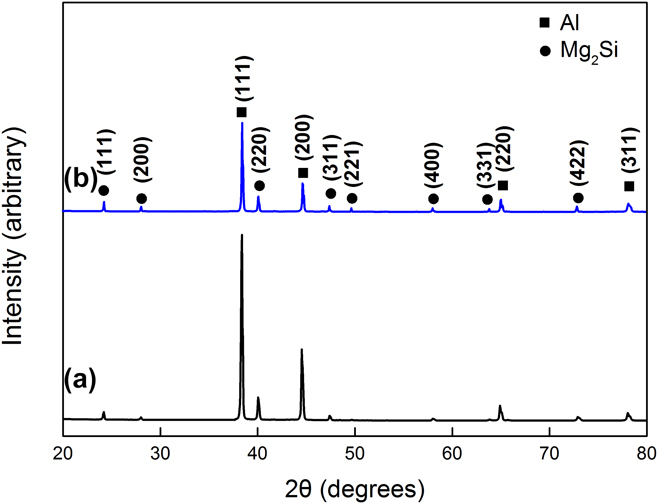
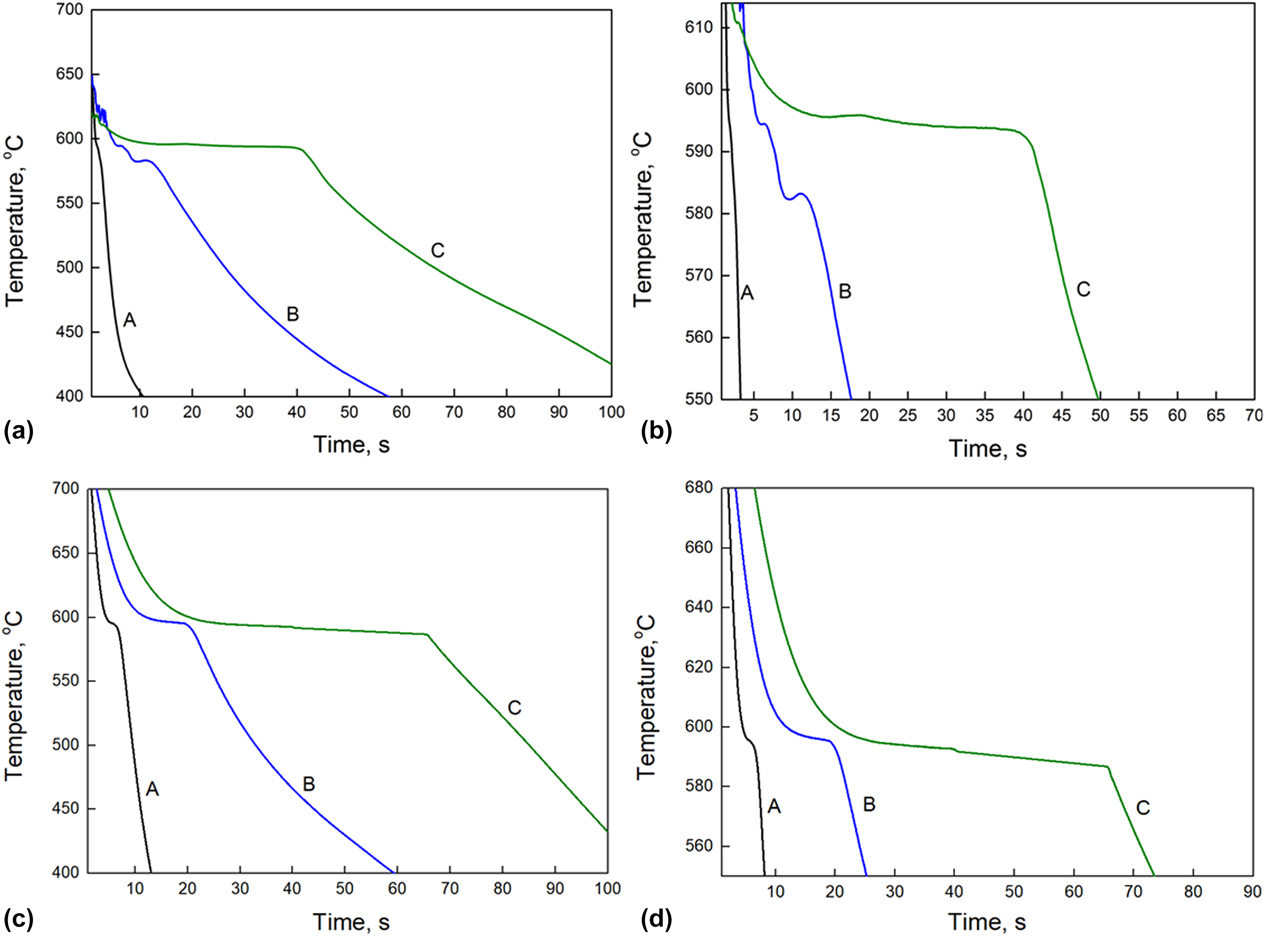
Figure 2 shows the XRD results of the Al–x% Mg2Si (x = 16, 25) composites, indicating that both composites consist of Al and Mg2Si phases. Figures 3(a) and 3(b) show the cooling curves of the Al–16% Mg2Si melt at different positions. As can be found, position A has a faster cooling rate than position B, and position C exhibits the slowest cooling rate and near equilibrium solidification. Average cooling rates can be estimated byReference Li, Gill and Varin23,Reference Xu, Wang, Qiu, Yang and Jiang24
 $${V_{{\rm{average}}}} = {{\left( {{T_{\rm{a}}} - {T_{\rm{b}}}} \right)} / {\Delta t}}\quad ,$$
where V average is the average cooling rate of the Al–Mg2Si melt, T a is the initial temperature of the melt, T b is the final temperature of the melt, and Δt is the time that the temperature decreases from T a to T b. Based on the cooling curves, T b is selected as 550 °C. The average cooling rates of the melt are 32.1, 12.4, and 1.1 °C/s at the positions of A, B, and C, respectively. Figure 4 shows the morphology evolution of the primary Mg2Si from octahedral to truncated octahedral shapes in the Al–16% Mg2Si composite. With a slow cooling rate of 1.1 °C/s, the solidification process of position C is near equilibrium solidification. In this case, the {100} faces with the fastest growth rate will disappear while the {111} faces with the slowest growth rate be retained as the Mg2Si crystal surfaces. Therefore, octahedral Mg2Si is obtained in the final microstructure [Figs. 4(c) and 4(f)].
XRD patterns of (a) Al–16% Mg2Si and (b) Al–25% Mg2Si.

(a) Cooling curves of the Al–16% Mg2Si melt with different positions, (b) local enlarged image of (a); (c) cooling curves of the Al–25% Mg2Si melt with different positions, (d) local enlarged image of (c).

Morphology evolution from octahedral to truncated octahedral Mg2Si in Al–16% Mg2Si composite with various cooling rates (a) position A; (b) position B; (c) position C; evolution schemes from octahedral to truncated octahedral Mg2Si (d) position A; (e) position B; (f) position C.

With an intermediate cooling rate of 12.4 °C/s, the solidification process of position B deviates from the equilibrium solidification. The Mg2Si crystal exhibits truncated octahedron morphology [Figs. 4(b) and 4(e)]. The increase of the cooling rate restricts the growth rates of the 〈100〉 directions and results in morphology evolution of the primary Mg2Si. With a fast cooling rate of 32.1 °C/s, the solidification process of position A further deviates from the equilibrium solidification. The growth of the 〈100〉 directions is further restricted. Therefore, the primary Mg2Si shows the truncated octahedron with the extended {100} faces [Figs. 4(a) and 4(d)].
When the coarsening time is relatively long at position C, the solidification process of the Al–Mg2Si composite is near equilibrium solidification. In the Al–16% Mg2Si composite, the primary Mg2Si follows a typical faceted growth pattern, which forms an octahedral shape due to the high growth rate of 〈100〉 directions and the low growth rate of 〈111〉 directions. With the reduction of the coarsening time, the growth rate of 〈100〉 directions is restricted and the {100} faces are retained finally. As a result, the primary Mg2Si transforms from octahedron to truncated octahedron shape.
Figures 4(d)–4(f) schematically show the morphology evolution of the primary Mg2Si from octahedron to truncated octahedron shape. The {100} faces of the Mg2Si crystal appear and extend with the increasing cooling rate. The morphology of the primary Mg2Si is determined by the ratio of growth rates along the 〈100〉 and 〈111〉 directions, i.e., R = V 〈100〉/V 〈111〉. If  $R \ge \sqrt 3$, a dendrite and an octahedron can be obtained; whereas if 1 < R ≤
 $\sqrt 3$, a truncated octahedron can be achieved; if
 ${{\sqrt 3 } / 3}$ < R ≤ 1, a truncated cube can be prepared, and if R =
 ${{\sqrt 3 } / 3}$, a cube can be formed.Reference Wang, Lu and Hogan25 With increasing cooling rate, the primary Mg2Si transforms from octahedron to truncated octahedron crystal and the ratio of growth rate (R) decreases. Therefore, the growth of the 〈100〉 directions is restrained effectively and the {100} faces are retained finally.
In the Al–Mg2Si composite, octahedral Mg2Si is often observed. In some other work, the formation of hollows has been investigated in the {111} faces of octahedral Mg2Si,Reference Li, Wu, Li and Liu21,Reference Qin and Li26 but the growth before the formation of hollows is not clear.
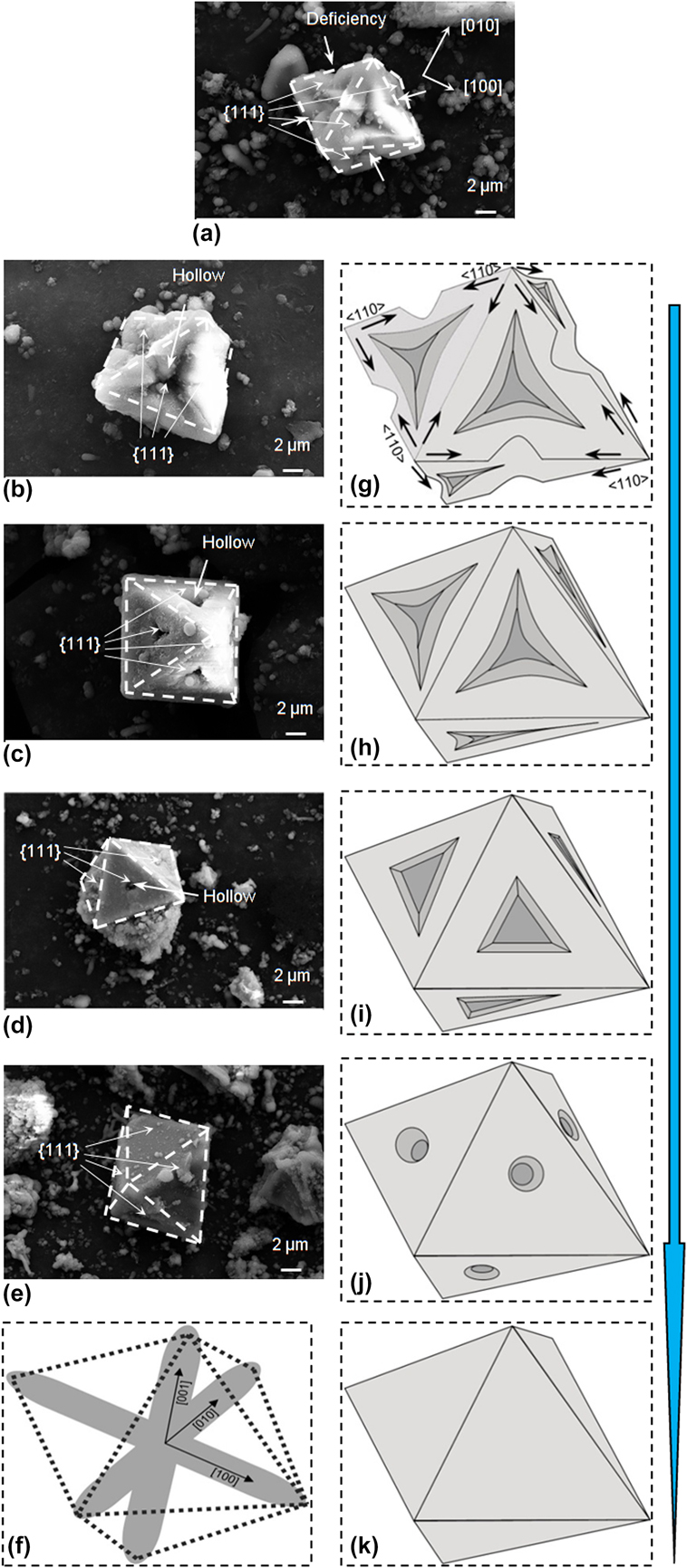
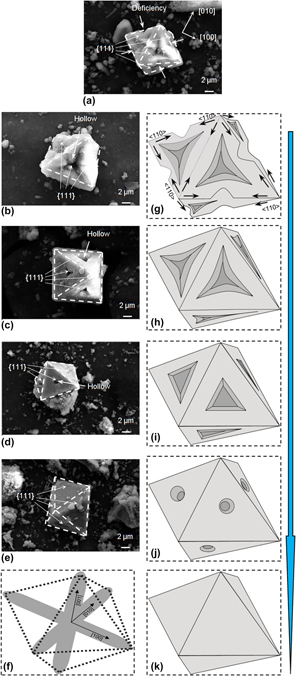
Figures 5(a)–5(e) show the morphologies of the octahedral Mg2Si at different growth stages. Figure 5(a) reveals the early transition morphology of the octahedral Mg2Si before the hollows form in the {111} faces. There are deficiencies on the edge center of the octahedral skeleton due to relatively low concentration of Mg and Si atoms, and no complete hollow forms in the center of the {111} faces. As it grows, the Mg and Si atoms gradually fill the deficiencies on the edge centers of the octahedral skeleton. The edges of the octahedral skeleton have the priority to grow and then the {111} faces start to form in Fig. 5(b). Meanwhile, the hollows start to form but have irregular edges in the centers of the {111} faces. Then, the complete hollows form and show regular edges [Fig. 5(c)]. With the successive growth of the octahedral Mg2Si, the hollow transforms to round shape with lower interface energy [Fig. 5(d)]. Finally, complete octahedral Mg2Si forms in Fig. 5(e).
(a)–(e) Transition morphologies of octahedral Mg2Si at different growth stages; (f)–(k) schematic illustration of the different growth stages of octahedral Mg2Si.

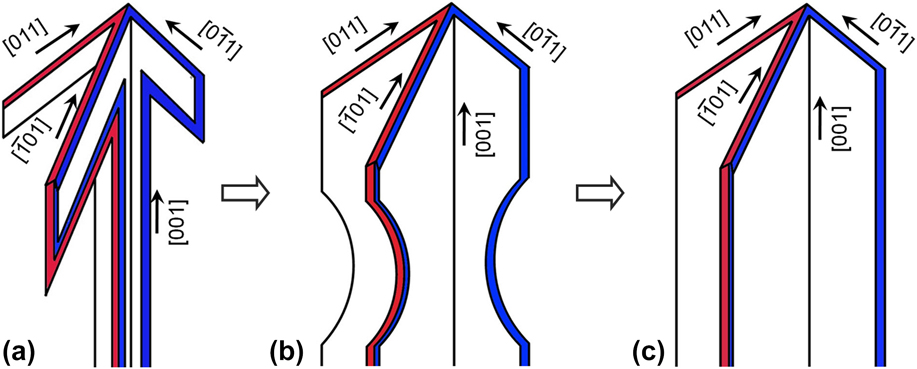
Figures 5(f)–5(k) show the schematic illustrations of the different growth stages of the octahedral Mg2Si. At the starting growth stage, the composition segregation and the various undercoolings result in that the primary Mg2Si grows preferentially in the positions with higher undercooling degree or larger concentrations of Mg and Si atoms in the Al–Mg2Si melt. Analogously, the microsegregation of Si atoms in the melt results in easier nucleation of primary silicon.Reference Wang, Bian, Qin and Syliusarenko27 Figure 5(f) shows that some bulges rapidly grow on the crystal surface and form the first branches along the preferential 〈100〉 direction. Owing to the concentration gradient around the advancing tips of the first branches, the secondary branches are produced along the 〈110〉 directions in Fig. 5(g). However, there are sunken deficiencies on the edge centers of the octahedral skeleton (the 〈110〉 directions). Figures 6(a)–6(c) show the deficiency evolution on the edge center of the octahedral skeleton. First, the secondary branches preferentially grow on the advancing tips of the first branches [Fig. 6(a)]. Then, the deficiencies form on the edge centers of the octahedral skeleton [Fig. 6(b)]. Subsequently, the growth of the 〈110〉 directions finishes and these adjacent secondary branches connect each other and form the octahedral skeletons [Fig. 6(c)]. After the growth of the 〈110〉 directions finishes and the deficiencies disappear, the hollows form in the {111} faces and show incomplete and irregular edges in Fig. 5(h). With the successive growth of the {111} faces, the hollows shrink gradually and exhibit regular edges in Fig. 5(i). As a result of the decrease of interface energy, the hollows transform to round shape in the {111} faces of octahedral Mg2Si [Fig. 5(j)] and disappear finally, which leads to the formation of the complete {111} faces and the perfect octahedron Mg2Si [Fig. 5(k)].
(a)–(c) Deficiency evolution on the edge center of octahedral skeleton.

In the early growth stage of the Mg2Si crystal, the aluminum atoms easily diffuse into a large body of melt on the corners and edges of the octahedron Mg2Si. However, the aluminum atoms are relatively difficult to diffuse in the center of the surfaces, which results in that Mg and Si atoms concentrate in front of the corners and edges. This factor restricts the growth of the {111} faces and induces the formation of hollows in the {111} faces. Moreover, Xu et al. have suggested that the increase of impurity concentrations in the center of {111} faces terminated the growth of the {111} faces of primary silicon,Reference Xu, Wang, Liu and Jiang28 which is another factor to restrict the growth of the {111} faces of octahedral Mg2Si.
Figures 3(c) and 3(d) show the cooling curves of the Al–25% Mg2Si melt at different positions. According to Eq. (1), the average cooling rates of the melt are 25.8, 9.8, and 0.6 °C/s at the positions of A, B, and C, respectively. In the Al–25% Mg2Si composite, the Mg2Si dendrites were observed at a low cooling rate [Figs. 7(a) and 7(b)]. Based on the discussion above, it is known that the growth rate of the Mg2Si crystal is greater for 〈100〉 than for 〈111〉 and its growth rate is encouraged by the supersaturation of Mg and Si. First, the first branch (primary dendrite) forms along the preferential 〈100〉 growth directions. Many growth units grow and stretch themselves to the bugles on the primary Mg2Si dendrite, as shown in Fig. 7(a). Then, the bugles grow into the secondary dendrites in the 〈100〉 directions perpendicular to the primary dendrite, as shown in Fig. 7(b). These growth units of the secondary dendrites produce quickly. In this case, the following growth of the secondary dendrites is strongly limited by the simultaneous growth of its neighbors, and many secondary dendrites overlap or connect to reveal the inconspicuous crystallographic features.
Three-dimensional shapes of the extracted primary Mg2Si in the Al–25% Mg2Si alloy at low cooling rate: (a) primary dendrite; (b) primary and secondary dendrites; (c) truncated octahedron connecting; (d)–(h) growth process schematics of connected Mg2Si phases.

In addition, with the low cooling rate, the truncated octahedron Mg2Si crystals mutually connect to form the complicated crystal structure, as shown in Fig. 7(c). Figures 7(d)–7(h) show the growth process of the connected Mg2Si phases. The initial Mg2Si nuclei are likely to be rounded or spherical, as shown in Fig. 7(d). They are inclined to connect and form fluted structure because of the low undercooling and high concentrations of Mg and Si atoms [Fig. 7(e)]. With the subsequent growth and the undercooling variation, the growth manner of the Mg2Si crystal transforms to faceted and the skeleton of the truncated octahedron Mg2Si starts to form [Figs. 7(f) and 7(g)]. Finally, the hollows in the {111} faces vanish gradually and the Mg2Si phases exhibit connected shape in Fig. 7(h).
Figures 8(a) and 8(b) show the morphology of the primary Mg2Si with the high cooling rate (25.8 °C/s at position A). The primary Mg2Si exhibits truncated octahedron morphologies in the Al–25% Mg2Si composite. The primary Mg2Si dendrite and the complete octahedron Mg2Si cannot be observed in the composite. Moreover, the truncated octahedron with the round hollow is observed in Fig. 8(b). It suggests that the 〈111〉 directions still have relatively low growth rates compared with those of the 〈100〉 directions.
Different three-dimensional shapes of the extracted primary Mg2Si in the Al–25% Mg2Si alloy at high cooling rate: (a) truncated octahedron; (b) truncated octahedron with hollow; (c)–(f) growth process schematics of truncated octahedron Mg2Si phases with and without hollows.

Figures 8(c)–8(f) show the growth process of the truncated octahedron Mg2Si. With the increase of the cooling rate, the initial Mg2Si nuclei are difficult to connect each other and separately grow in the melt [Figs. 8(c) and 8(d)]. The subsequent growth process of the Mg2Si crystal is similar to that of the octahedron Mg2Si as shown in Fig. 5. Owing to higher concentrations of Mg and Si atoms in the Al–25% Mg2Si composite, Mg and Si atoms are easier to concentrate in the {111} faces of the Mg2Si crystal. It increases the growth rate of the 〈111〉 direction and decreases the ratio of growth rates along the 〈100〉 and the 〈111〉 directions, i.e., R = V 〈100〉/V 〈111〉. When 1 < R ≤  $\sqrt 3$, the truncated octahedron can be achieved. Figures 8(e) and 8(f) show the separate growth processes of the truncated octahedron Mg2Si with and without the hollow. The high cooling rate restrains the cluster and aggregation of the initial Mg2Si nuclei, which effectively affect the morphology of the primary Mg2Si in the final microstructure.
In the Al–25% Mg2Si composite, the higher concentrations of Mg and Si and wider solidification range effectively promote the growth of the primary Mg2Si at different directions. The primary Mg2Si exhibits coarse and dendritic morphologies with the long coarsening time (position C). The reduction of the coarsening time restrains the cluster and aggregation of the initial Mg2Si nuclei so that they are difficult to connect. Therefore, the primary Mg2Si transforms from complicated dendrite to truncated octahedron morphology.
IV. CONCLUSIONS
In this work, the transformation and growth mechanism of the primary Mg2Si with various cooling rates were studied. The results indicate the following:
(1) The primary Mg2Si transforms from octahedron to truncated octahedron morphology with increasing cooling rate. The morphology transition shows the different growth stages of the octahedral Mg2Si. In the early growth stage, the deficiencies on the edge centers of the octahedral skeleton indicate that the secondary branches preferentially grow on the advancing tips of the first branches.
(2) With the increase of Mg2Si content, the primary Mg2Si dendrite and the connected Mg2Si phases were observed at low cooling rate. The high cooling rate restrains cluster and aggregation of the initial Mg2Si nuclei, which results in that the morphology of the primary Mg2Si transforms to the truncated octahedron. Moreover, their growth processes have also been discussed.
ACKNOWLEDGMENTS
The authors gratefully acknowledge the support of the Science and Technology Program of Guangzhou, China (Grant No. 2015B090926013) and the Doctoral Foundation of China Ministry of Education (Grant No. 20130042130001).