


Migration is an increasingly important facet of the global political economy. Like flows of commodities and capital, flows of labor have increased dramatically in recent years. The United Nations’ (UN's) Population Division put the share of the world's population residing outside their nation of birth at almost 200 million people—or approximately 3% of the world's population—in 2007. That number continues to grow: the Organisation for Economic Co-operation and Development (OECD; 2006) estimates that the number of legal immigrants entering OECD countries stands at about 3 million annually. Just as with flows of commodities and capital, scholars have devoted enormous energies to the exploration of the consequences of immigration. We know that migration is associated with a rise in support for extreme right wing parties and that it has mixed effects on social spending and on wages in the destination country (e.g., Borjas Reference Borjas1999; Borjas, Freeman, and Katz Reference Borjas, Freeman and Katz1996; Knigge Reference Knigge1998).
Less is known, however, about the consequences of migration for the migrant's country of origin. Some scholars argue that migration results in a “brain drain,” whereby educated and skilled members of a country leave in search of better wages. Others argue that this brain drain is offset because the prospect of leaving provides an incentive for those left behind to invest in their own human capital (e.g., Stark, Helmenstein, and Prskawetz Reference Stark, Helmenstein and Prskawetz1998). There is growing evidence that émigrés do benefit their homeland: return migration constitutes a flow of knowledge of skills, and remittances provide enormous flows of capital.
In this article, we add another layer to the literature on global migration by arguing that diaspora networks—cultural and/or familial linkages between migrant communities in the investing country and the migrant's country of origin—play a pivotal role in the global allocation of capital. We provide some of the first quantitative evidence that diaspora networks act as a conduit for both portfolio and foreign direct investment (FDI) across country pairs. A focus on diasporas—an explicitly cross-border phenomena—also provides a fresh perspective on the factors influencing international investment. The existing literature on investment is primarily monadic, emphasizing the importance of credible commitments and institutional quality in the countries that seek global capital (e.g., Alfaro, Kelemli-Ozcan, and Volosovych Reference Alfaro, Kelemli-Ozcan and Volosovych2006; Büthe and Milner Reference Büthe and Milner2008; Jensen Reference Jensen2003).
We do not question the importance of credible commitments. However, focusing on institutional design only gets us part of the way toward understanding patterns of international investment. Because diasporas provide connections between home and host countries, these networks facilitate cross-border investment in numerous ways. Broadly speaking, migrant networks foster a greater degree of familiarity between home and host countries than may occur in their absence. Just as migrants may have a taste for commodities produced in their home country, they may also have a preference for home country investments—leading them to invest money in their country of origin. Diaspora networks can also help decrease asymmetries of information that, from the perspective of the theory of portfolio investment, can result in a less than optimal portfolio. The reduction in information asymmetries works through two channels. First, migrant communities in destination countries can provide investors with information about their homeland—information regarding the tastes of consumers in their country of origin—that can influence the decision of investors to invest there. Second, diaspora networks can have an indirect effect on investment because they may have knowledge about investment opportunities, information about regulations and procedures, or familiarity with language and customs that can decrease the transaction costs associated with cross-border investment.
We test our argument using a dyadic data set composed of both portfolio and FDI from as many as 56 source countries into up to 154 destination countries for the year 2002. The use of portfolio and FDI allows us to be more general about the implications of our findings as these investment types are fundamentally different. While portfolio investors purchase stocks and bonds in open markets, foreign direct investors purchase fixed shares in plants or in machinery. More important, within a country, portfolio investment opportunities are constrained by the shares issued by corporate or government entities, whereas FDI possibilities are unbounded in both their content and their ownership stake.
Giving pride of place to migrant networks in explaining the cross-national allocation of capital allows us to speak to a number of seemingly disparate literatures. Broadly speaking, the emphasis on diaspora networks as a conduit for capital flows is a natural extension of Keohane and Nye's (Reference Keohane and Nye1974) work on transnational—or nongovernmental—relations between states. Although other scholarship from international relations fits within the category of transnationalism, it tends to focus on nongovernmental or intergovernmental organizations (e.g., Keck and Sikkink Reference Keck and Sikkink1998; Slaughter Reference Slaughter2004). Emphasizing the role of migrant networks in cross-national investment provides another mechanism—this one noninstitutional—by which we can understand the growing degree of interdependence that exists within the international system. From the perspective of international relations theory, our emphasis on migrant communities influencing their homelands allows us to speak to the growing interest in diaspora politics (e.g., Shain and Barth Reference Shain and Barth2003; Sheffer Reference Sheffer2003). By privileging human networks, we highlight the importance of mechanisms other than formal institutions for channeling economic activity (e.g., Greif Reference Greif1989, Reference Greif1993).
Our arguments and evidence are developed in this article. The first section contains our theoretical discussion and embeds our argument within the context of international asset pricing theory. The next section lays out the empirical model and details the statistical methodology we use. In the following section, we present our central statistical results and document the robustness of those findings. The last section concludes and offers suggestions for future research.
DIASPORA NETWORKS AND INVESTMENT
Modeling Bilateral Investment
Our argument is that migrant networks are a mechanism helping direct portfolio and FDI from the migrant's host country to their country of origin. We situate our argument within the international finance literature and ground it in the international capital asset pricing model.Footnote 1 The standard international capital asset pricing model (ICAPM) predicts that in the absence of information asymmetries and transactions costs, investors should hold domestic assets in their portfolio in proportion to their country's share of global capital market capitalization.Footnote 2 However convincing in theory, overwhelming empirical evidence demonstrates that investor behavior deviates considerably from this benchmark model. The empirical finding that investors forgo substantial gains by investing at home rather than abroad has spawned a huge literature trying to explain this “home bias,” a systemic preference for assets that are available in their home market (e.g., Lewis Reference Lewis1999).
What does the literature say about the lack of international diversification? In early work on the “home bias,” French and Poterba (Reference French and Poterba1991) argue that investors purchase domestic assets as a consequence of what they call “familiarity” effects. Tesar and Werner (Reference Tesar and Werner1995) are a bit more specific when they attribute the taste for home rather than foreign assets to factors such as “language [and] institutional and regulator difference” (p. 479). In addition to taste, Coval and Moskowitz (Reference Coval and Moskowitz2001) attribute the home bias to asymmetries of information and argue that investors have better information about assets sold in geographically closer markets.Footnote 3
In a cross-national context, it is difficult to separate familiarity and cultural preferences for home products from informational asymmetries. To minimize problems of model misspecification associated with omitted variable bias, empirical studies of cross-border investment tend to exploit gravity-type models of international transactions. Drawn from gravity models of international trade, which in turn are (loosely) derived from Newton's Law of Gravity, these models hold that bilateral transactions are a positive function of the size of the two economies (their mass) and a negative function of the distance between them. In dealing with the empirical fact that investors exhibit a home bias, scholars “augment” these gravity models with a variety of variables. Eichengreen and Luengnaruemitchai (Reference Eichengreen and Luengnaruemitchai2006), Lane and Milesi-Ferretti (Reference Lane and Milesi-Ferretti2004), and Rose and Spiegel (Reference Rose and Spiegel2008), for example, include variables that measure whether the country pair shares a common language, a common border, or a common colonial heritage. These measures of commonality are then interpreted in the context of greater familiarity, better information, lower barriers to entry, and smaller transactions costs.
Scholars also interpret negative coefficients on the (log of) distance in gravity models of international investment as a proxy for information asymmetries. The greater the distance from a market, so the argument goes, the greater the information cost and the lower the level of investment. Arguing that distance proxies for information costs, however, is theoretically unsatisfying, and, in a series of articles, Portes and Rey (Reference Portes and Rey2005; Portes, Rey, and Oh Reference Portes, Rey and Oh2001) employ a more direct measure of information asymmetries and transactions costs by including a measure of bilateral telephone traffic. They find that telephone traffic is associated with higher levels of bilateral portfolio investment.Footnote 4
These approaches remain incomplete. Even models that include measures of communication flows and communication costs find that investors retain a home bias (e.g., Loungani, Mody, and Razin Reference Loungani, Mody and Razin2002). Taking this as their point of departure, a growing literature argues that investment across country may be driven not by familiarity, but rather by “cultural affinity,” whereby individuals have more trust in individuals and institutions from countries that share common cultural characteristics (e.g., Guiso, Sapienza, and Zingales Reference Guiso, Sapienza and Zingales2005; Siegel, Licht, and Schwartz Reference Siegel, Licht and Schwartz2008). Cultural similarity, viewed within the context of ICAPMs, would constitute a more direct measure of (the lack of) information costs and should be correlated with lower transactions costs and a greater ease of doing business across border.
This is where we join the literature on cross-border investment. Rather than developing empirical proxies for cultural affinity, economic familiarity, and information asymmetries, we argue that diaspora networks help link sources of investment to specific destinations.
Migrant Networks and Cross-border Capital
How do migrant networks fit into an explanation for cross-national investment? A network can be understood as a group of actors that either know about or can learn about each other's characteristics (Granovetter Reference Granovetter1973). Scholars have long recognized the importance of social networks for fostering economic exchange when formal institutions are absent or incomplete (e.g., Greif Reference Greif1989; North Reference North2005).Footnote 5 From this perspective, we can identify numerous ways in which migrant networks facilitate cross-border investment, ways that are consistent with prior research documenting departures from the ICAPM of international investment. Within this context, migrant networks influence investment by facilitating the familiarity effect and by decreasing constraints imposed by information asymmetries and transactions costs.Footnote 6
Before discussing the role of familiarity and information asymmetries, we note that migrant networks can have a direct and observable impact on cross-border investment when they, themselves, are the actors. In his study of the Korean diaspora, for example, Choi (Reference Choi, Bergsten and Choi2003) documents how FDI into Korea—a form of investment that came late to that country—was originally spurred by ethnic Koreans residing in Japan.Footnote 7 Migrant-based investment also comes from nonwealthy expatriates. Schüttler (Reference Schüttler2007) and Schulte (Reference Schulte2008) study, respectively, the investment behavior of Moroccan and Turkish migrants living in Germany. Using ethnographic and survey research, both scholars conclude that diaspora investors are well-situated investment in their homeland because of cultural and linguistic familiarity.Footnote 8 There are larger literatures that make similar points about the ways in which migrant entrepreneurs have used home country connections to channel human, physical, and investment capital.Footnote 9
Cross-national models of home country investment are difficult to test in the aggregate because even if we surveyed investors it would be surprising if they would admit to making bad investments or to being privy to private information. Because our interest is in understanding broad patterns of global investment, we embed variables capturing migrant networks in well-established empirical models; our inferences are then conditional on the set of conditioning variables, and our conclusions are thus statements about average behavior across a set of observations.
At the aggregate level, then, how do migrants channel investment? We identify two channels: one resulting from increased familiarity, and another associated with a decrease in informational asymmetries. These are discussed in turn.
The familiarity effect takes hold when investors in a source country become familiar with characteristics of the migrant's homeland through their connections to, and observation of, migrant communities that exist in their country. This “familiarity effect” occurs as migrants provide a signal to investors that allows investors to make inferences about the quality of labor, the work ethic, and/or the business culture that exists in a particular destination. A migrant community from India residing in the United States, for example, can provide U.S. investors with a signal of the work ethic, labor quality, and business culture that exists in India. These signals enhance the quality of information that U.S. investors have about India allowing them to make forecasts about their ability to invest in potentially profitable assets offered on the Indian market. Kapur (Reference Kapur2001), in his study of the Indian community residing in the United States, explains how the mere presence of that community enhances investment opportunities in India: “Companies like Yahoo, Hewlett Packard and General Electric have opened R&D centers in India largely because of the confidence engendered by the presence of many Indians working in their US operations. This points to the cognitive effects arising from the projection of a coherent, appealing, and progressive identity on the part of the diaspora which signals an image of prosperity and progress to potential investors and consumers.”Footnote 10
Along with the provision of an image of their home country, migrant networks can provide business opportunities by decreasing asymmetries of information and by reducing transaction costs through formal (e.g., business) or information (e.g., familial) contacts in their home country. Again, the case of ethnic Turks residing in Germany is illustrative. Turkish migrants living in Germany, Schulte (Reference Schulte2008) notes, are more likely to invest in their homeland rather than in, say China, because language and cultural knowledge more than compensate for what may be marginally lower returns. This informational advantage does not privilege only individual investors, rather it can work through the larger network of coethnics. In The Bamboo Network, Weidenbaum and Hughes (Reference Weidenbaum and Hughes1996) detail the comparative advantage overseas Chinese have when it comes to investing in China and argue that it goes well beyond commonality of language, knowledge of cultural and legal barriers, and preexisting familial connections. Wang's study shows how ethnic Chinese residing abroad provide a “linkage between China and the rest of the world [in that they] facilitate the understanding of and access to guanxi networks by other foreign investors. Without the agency of ethnic Chinese, it would have been much more difficult for foreign companies to use informal personal networks to complement and compensate for the weak formal legal institutions in China”Footnote 11 (Wang Reference Wang2000, p. 161).
Migrant networks provide investors with an informational advantage because they are in a position to have information regarding investment opportunities in their home country. Bandelj (Reference Bandelj2002) provides some evidence concerning the investment behavior of Western European and North American investors after the opening of markets in Eastern Europe. Investment in Eastern European countries, she writes, was “often based on ethnic ties between sizable and relatively affluent expatriate communities and their home countries” (p. 421). There was an informational advantage as “firms amassed information about investment opportunities through their business or personal ties” (p. 412). This informational advantage can translate into higher than average expected returns if the migrant him- or herself has a higher level of human capital. In his assessment of the Armenian diaspora, Freinkman (Reference Freinkman2002) notes that “when compared to the average economic agent, diaspora businessmen and professionals face a lower risk of becoming the first movers. They benefit from a specific informational advantage: common cultural background and established social links between diaspora and local entrepreneurs help them to reduce transaction costs of new entry and building new partnerships” (p. 4).
Connections between migrant communities across countries may enhance cross-national investment, even when these connections do not provide specific information about investment opportunities. In reference to the Maghribi traders of the eleventh century, Greif (Reference Greif1989, Reference Greif1993) argues that this trading network was effective because it was able to credibly threaten collective punishment by all merchants if even one of them defected. He shows that this coethnic network was able to share information regarding the past actions of actors (they could communicate a reputation), something that was essential for the efficient functioning of markets in the absence of formal legal rules. Weidenbaum and Hughes (Reference Weidenbaum and Hughes1996) reach a similar conclusion about the effectiveness of The Bamboo Network, remarking that “If a business owner violates an agreement, he is blacklisted. This is far worse than being sued, because the entire Chinese networks will refrain from doing business with the guilty party” (p. 51).
These informational effects are important because they help investors overcome general barriers associated with transactions costs. Migrant communities can help facilitate cross-national portfolio investment by reducing barriers to entry—through knowledge of language, institutional rules, and/or regulatory hurdles—that may otherwise prevent a foreign investor from purchasing equities or bonds. Knowledge of on-the-ground conditions is costly (and not necessarily private) and provides investors with the ability to “match” investments with investment opportunities that may exist. This “matching” function of migrant networks has been observed in studies of international trade, where Rauch and Trindade (Reference Rauch and Trindade2002) find that migrant generated information helps match buyers with sellers, a function that becomes more important as goods become increasingly heterogeneous.Footnote 12
It is important to note that the homeland governments are aware of key role that migrants play in facilitating investment and in further integrating their countries into the global economy. Gamlen (Reference Gamlen2008) notes that even developed states such as New Zealand, Ireland, and Israel have well-developed diaspora engagement strategies designed to encourage active economic behavior on the part of their external citizens. In a response to a question from a member of their parliament about how Scotland intends to engage their diaspora residing in Canada, Scottish Executive Minister for Parliament declared, “The Scottish Executive intends to engage with and mobilize the Scottish diaspora to further Scotland's interests for the long-term benefit of our economy and society. We aim to encourage the diaspora's active participation and engagement in promoting Scotland as a great country to visit, live, learn, work, do business and invest.”Footnote 13
Because they increase familiarity and decrease information asymmetries, we hypothesize that larger migrant networks, all other things being equal, will exert a positive influence on cross-border investment. The effect of migrant networks should increase when the migrants themselves are the entrepreneurs, but this increase may also be due to their ability to provide information about opportunities to the investment community. Following Rauch and Trindade (Reference Rauch and Trindade2002), we also hypothesize that migrant networks will be more important for investment in heterogeneous (as compared with homogeneous) assets. This is because information costs—both asymmetries and transactions costs—associated with heterogeneous assets are substantially larger than those associated with homogeneous assets. When it comes to cross-border investment, we argue that FDI is far more heterogeneous than portfolio investment. Whereas portfolio investors choose debt or equity stakes that are offered by an issuing agency on an organized market, foreign direct investors can take innumerable different ownership stakes across a countless number of commodity classes. We hypothesize, therefore, that migrant networks will have a larger substantive effect on FDI than on portfolio investment.
It may be the case that migrant networks do not matter at all and that they just proxy for greater cultural or informational similarities among countries—the sorts of variables identified in empirical studies of ICAPMs. To decrease the risk of incorrect inferences, we go to great lengths to control for a variety of ways that countries are connected with one another.
EMPIRICS
Model and Variables
In addition to migrant networks, there are scores of factors that conceivably effect investment between two countries. In the source country, capital outflows can be influenced by high tax rates, the lack of protection for private property, high savings rates, etc. A similar list can be made for recipient countries: countries that receive capital tend to have better institutions, more stable economic policies, and better governance.Footnote 14
All empirical models are vulnerable to problems of omitted variable bias. We choose a very conservative strategy and estimate a cross-sectional model of bilateral investment that contains fixed effects for both the source and destination countries. Although this estimation strategy sacrifices some richness in that we cannot explore variation in host and homeland domestic institutions and policies, it allows us to concentrate on bilateral characteristics that influence dyadic investment. Concretely, we write our model as

where ysd is the level of either portfolio or FDI from a source country (s) into a destination country (d).Footnote 15 Because we are working with a cross-section of country dyads, we control for unmeasured source and destination country characteristics through the inclusion of two sets of dummy variables: δs and δd. Our variable of interest is the log of the migrant stock (Ids)—the population of migrants—from the destination country residing in the source country.
The vector (Xsd) includes variables other than migrant stock that potentially influence cross-border investment. Drawing on gravity-type models of FDI and portfolio investment,Footnote 16 we control for the dyad's market size, the bilateral distance between countries, the existence of a common border, and a shared common language.Footnote 17 Market size is measured as the log of the product of the two country's gross domestic products (GDPs). Given that distance is an imperfect measure of information costs, following Portes and Rey (Reference Portes and Rey2005), we include the log of bilateral telephone traffic.
Trade-in financial assets may also be influenced by shared policy variables. As in Lane and Milesi-Ferretti (Reference Lane and Milesi-Ferretti2004), we include variables capturing whether the two countries share a common exchange rate peg, have a dual taxation treaty, or are members of a preferential trade agreement. Given the importance of portfolio diversification in ICAPMs, we proxy for common economic shocks by including the (lagged) correlation of the two country's growth rates.
As discussed previously, it is difficult to differentiate between investment due to cultural affinity, market familiarity, or information asymmetry. Our approach is to control—as completely as possible—for other measures of culture and familiarity. To that end, we include a number of measures that capture cultural similarities between the source and destination countries. The first—a measure of common legal origin—is more institutional than cultural, but it captures the ability of investors from country s to invest in country d with minimal transaction costs because they will already be familiar with the rules and regulations. We expect that country pairs with common legal origins will experience higher levels of cross-border investment than those pairs with dissimilar legal origins.
Our second control for cultural similarity is a measure of cultural proximity that is created through the creation of a dummy variable measuring whether the two countries have a common dominant religion. Common religion proxies for similar beliefs, values, and expectations regarding the existence of social norms and the internally imposed constraints that are important for a business partnership across borders.
The third cultural control is grounded in cultural economics and operationalized as a measure of genetic distance between countries. Based on the work of Cavalli-Sforza, Menozzi, and Piazza (Reference Cavalli-Sforza, Menozzi and Piazza1994), scholars have developed measures of genetic distances between indigenous populations based on genetic or DNA polymorphism.Footnote 18 This measure of genetic distance has been used to proxy for culture in studies of international trade and FDI (Giuliano, Spilimbergo, and Tonon Reference Giuliano, Spilimbergo and Tonon2006; Guiso, Sapienza, and Zingales Reference Guiso, Sapienza and Zingales2005), economic development (Spolaore and Wacziarg Reference Spolaore and Wacziarg2008), and state formation in Europe (Desmet et al. Reference Desmet, Le Breton, Ortin and Weber2007). Desmet et al. provide evidence that European countries that are genetically alike have populations that provide similar answers to World Values Survey questions about cultural, religious, and moral issues.
Finally, we include a more direct measure of cultural similarity. Studies in international business find that greater cultural distance between countries is associated with larger transactions costs, higher uncertainty about business practices, and overall greater unease regarding the prospects for doing business (e.g., Habib and Zurawicki Reference Habib and Zurawicki2002; Kogut and Singh Reference Kogut and Singh1988; Siegel, Licht, and Schwartz Reference Siegel, Licht and Schwartz2008). Some recent studies of international trade find that culturally similar countries engage in larger levels of transactions (e.g., Guiso, Sapienza, and Zingales Reference Guiso, Sapienza and Zingales2005; Siegel, Licht, and Schwartz Reference Siegel, Licht and Schwartz2008; White and Tadesse Reference White and Tadesse2008). Following this lead, we use a measure of cultural difference or distance based on questions from the World Values Survey. Unfortunately, these surveys are only given in 95 countries, so their use limits the size of our sample; consequently, we include these measures as a robustness check.
Sample and Methods
To examine the link between migrant networks and bilateral portfolio investment, we use data from the International Monetary Fund's (IMF's) Coordinated Portfolio Investment Survey (CPIS). The CPIS collects information on the stock of cross-border investments in equities and in short- and long-term bonds broken down by issuer's country of residence.Footnote 19 Due to data constraints, we are able to use data on the investment portfolio of 56 source (reporting) countries and 154 destination countries.Footnote 20 The list of source and destination countries is contained in Appendix C.
Our data on FDI come from the OECD's International Direct Investment. This source is limited in that it only provides data for outflows from OECD countries. Therefore, when we look at bilateral FDI, our sample is restricted to one of 28 source countries and 158 destination countries.
Our key independent variable—that of migrant networks—measures the stock (or total number) of migrants from country d residing in country s. These data come from a World Bank project on South–South migration and remittances. They are based on data from national statistical bureaus (censuses and population registers) and secondary sources (the OECD, the International Labour Organization, and the UN). A 162 × 162 matrix of the migrant stock in country s from country d classified according the migrant's country of birth is constructed from these national sources (Ratha and Shaw Reference Ratha and Shaw2007). Although some of the underlying data are from the late 1990s, the majority correspond to migrant stock for 2000 or 2001. Consequently, we are restricted to working with cross-sectional and not time-series data.
We estimate Equation (1) using ordinary least squares (OLS) and control for source- and destination country–specific variables through the use of a double set of fixed effects. Inferences based on OLS standard errors may, however, be underestimated. This bias may be attributable to two related causes. First, investment by source countries may cluster geographically; consequently, we may need standard errors that are clustered by s. Second, some destination countries, for a multitude of reasons, receive more investment than other countries; a phenomena that would call for clustering on d.
We deal with this potential bias by estimating standard errors that are robust to multiway clustering as developed by Cameron, Gelbach, and Miller (Reference Cameron, Gelbach and Miller2006). Their approach allows for arbitrary correlations between errors that belong to “the same group (along either dimension)” (p. 7). As they point out, this estimator is applicable in situations when the errors exhibit spatial correlation. Consequently, we report standard errors that are clustered by both source and destination countries.Footnote 21 It should be noted that Cameron, Gelbach, and Miller mention that multiway clustering increases—by an order of magnitude—the size of standard errors. In the results reported here, the standard errors are between 60% and 100% larger than traditional robust standard errors. Hence, our results are very conservative.
EMPIRICAL FINDINGS
Central Results
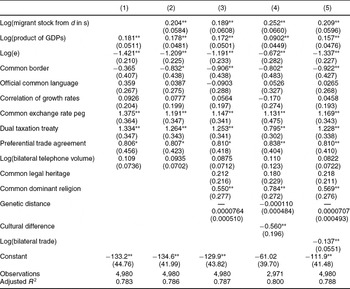
Table 1 reports models of dyadic portfolio investment. The specification in column 1 is our benchmark model, where we just control for the variables used in prior studies of portfolio investment. Consistent with a standard gravity model, portfolio investment is a positive function of country size (as measured by the product of GDPs) and a negative function of distance. Surprisingly, common language and common border are statistically insignificant, as is the proxy for diversification (correlation of growth rates). Shared policies—a common exchange rate peg, a shared dual taxation treaty, and membership in a preferential trade agreement—have a positive and statistically significant effect on portfolio investment. We fail to find evidence that bilateral telephone traffic—a measure of information costs in previous studies (Portes and Rey Reference Portes and Rey2005)—influences cross-border portfolio investment.
Determinants of Cross-border Portfolio Investment

GDP, gross domestic product.
Robust standard errors in parentheses.
Dependent variable: log(portfolio investment from origin to destination).
Robust standard errors clustered by both origin and destination country.
All models include both origin and destination dummy variables.
*p < .10; **p < .05.
In column 2, we add our measure of diaspora networks—the size of the migrant stock from the destination residing in the source country. Consistent with our hypotheses, we find that migrant networks have a positive and statistically significant effect on portfolio investment. Because both the portfolio investment and migrant stock have been transformed into logs, we can interpret the coefficient as an elasticity. This means that increasing the migrant stock from a destination in a source country by 1% results in 0.2% increase in portfolio investment. Evaluated at their means, this translates to a contribution of $450 per migrant to his or her home country.
The migrant stock, of course, could simply be capturing cultural affinity or institutional familiarity. In column 3, we include additional variables to control for this possibility. These results are surprising because portfolio investment is positively influenced by religious similarity, but not by a common legal heritage or by genetic distance. Both latter variables are statistically insignificant. Column 4 includes a more direct indicator of cultural similarity by including the World Values Survey–based measure of cultural difference. As expected, increasing cultural difference decreases cross-border portfolio investment. Adding these measures of cultural affinity or institutional familiarity do not, however, significantly affect the parameter estimate for migrant stock.
It is also possible that patterns of bilateral investment reflect other economic relationships between countries. Rauch and Trindade (Reference Rauch and Trindade2002) were the first to report a positive relationship between diaspora networks and bilateral trade. If investment follows trade and not migration, then inclusion of this variable should render migrant stock statistically insignificant—or at least decrease its substantive impact. Consequently, in column 5, we include a measure of bilateral trade. Trade has a negative effect on bilateral investment, indicating that these flows are substitutes rather than complements, and its inclusion does not decrease the statistical or substantive importance of migrant networks.
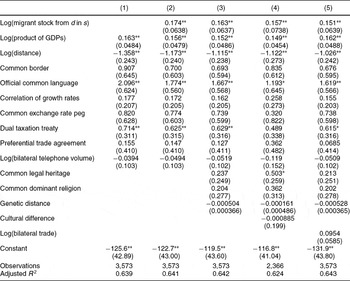
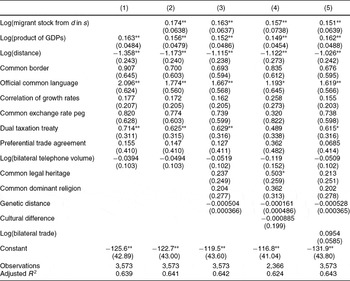
Table 2 repeats this exercise, substituting FDI as the dependent variable. Note that due to data limitations, the FDI models refer to a much smaller number of source countries. For the sake of space, we summarize rather than walk through the findings from Table 2. We find that the gravity specification is a reasonable benchmark because economic size and distance are statistically significant and consistently signed. The log of migrant stock has a positive and statistically significant effect on bilateral FDI that does not go away once we use other variables to measure cultural and institutional familiarity.
Determinants of Cross-border Foreign Direct Investment
GDP, gross domestic product.
Robust standard errors in parentheses.
Dependent variable: log(FDI from origin to destination).
Robust standard errors clustered by both origin and destination country.
All models include both origin and destination dummy variables.
* p < .10; ** p < .05.
Migrant Networks and Heterogeneous Investments
The findings thus far support the argument that migrant networks serve as a conduit for capital flows, and they point to the importance of migrant networks in the provision of information. In this section, we test the informational hypothesis more directly. Following Rauch and Trindade (Reference Rauch and Trindade2002), we argue that the informational role of migrant networks should be more important for trade in heterogeneous commodities, where private information has greater value. We view FDI opportunities as more heterogeneous than portfolio investment opportunities. Not only are there an infinite number of FDI opportunities—ranging from joint ownership to greenfield investments—they also differ in that their risk of expropriation is greater. Portfolio investment, in contrast, can only be made in assets that are publicly issued by either governmental or corporate interests, entities that provide relatively more information to markets. Because portfolio investment is more liquid, it can more easily be moved from market to market and from asset to asset, something that requires relatively less information than FDI. We therefore expect that migrant networks should be substantively more important for FDI than for portfolio investment.
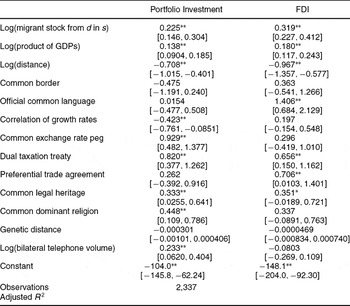
We examine this hypothesis in Table 3, where we estimate a seemingly unrelated regression of the determinants of both portfolio investment and bilateral trade in commodities. This approach allows for testing cross-equation restrictions—the null being that the effect of migrant stock on portfolio investment is equal to its effect on FDI. Rather than reporting standard errors, we provide 95% confidence intervals.Footnote 22
Comparing Portfolio and Foreign Direct Investment

FDI, foreign direct investment; GDP, gross domestic product.
Seemingly unrelated regression estimated via maximum likelihood estimate (MLE); confidence intervals based on robust covariance matrix.
95% robust confidence intervals in brackets.
Column 1 dependent variable: log(portfolio investment from origin to destination).
Column 2 dependent variable: log(FDI).
All models include both origin and destination dummy variables.
* p < .10; ** p < .05.
Table 3 contains the results of this analysis. It is important to point out that we require complete observations for both portfolio and FDI. The overlapping sample results in investment from 24 source countries (all OECD) into 152 destination countries. We find that larger migrant networks increase both portfolio investment and FDI, but that the effect on FDI is substantively larger, and statistically different at the 95% confidence level, than the effect on portfolio investment. This is consistent with our expectations: as portfolio investment represents a more homogenous opportunity set, private information provided by migrant networks becomes increasingly valuable for investors evaluating more heterogeneous options.Footnote 23
Educated Migrants
The results thus far support the hypothesis that migrant networks encourage cross-border investment because they provide investors with information about investment opportunities across particular destinations. We expect that this effect will be more pronounced when the migrant themselves are involved in the investment process. Unfortunately, we cannot directly measure migrant-based investment, so we proxy for it using the percentage of migrants from country d living in country s that have higher (tertiary) education and, more directly, those employed in the Finance, Insurance, or Real Estate (FIRE) sectors.Footnote 24 We also include the log of the total number of migrants so that the former variable is not capturing the effect of the entire migrant stock.
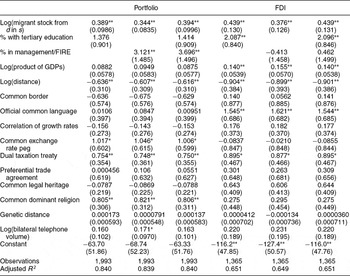
The results in column 1 of Table 4 report results for portfolio investment using the share of migrants with higher education, column 2 replaces the higher education variable with the share of migrants employed in FIRE, and column 3 includes both measures. The results indicate that higher education per se does not have a statistically significant influence on portfolio investment, whereas the opposite is true for employment in the FIRE sector. In columns 4, 5, and 6, we repeat this exercise using FDI as the dependent variable and reach the opposite conclusion because the tertiary education variable is statistically insignificant, whereas employment in the FIRE sector is not. Although not statistically consistent across all models, these results do point to the importance of specific information when it comes to portfolio investment—something associated with training in the FIRE sectors. The findings also support our inclination regarding different information requirements of heterogeneous versus homogenous investments: heterogeneous investment opportunities across a large number of sectors—like those associated with FDI—do not necessarily privilege those with specific knowledge of banking or financial assets.
Educated Migrants

FDI, foreign direct investment; GDP, gross domestic product.
Robust standard errors in parentheses.
Dependent variable: log(portfolio investment) in columns 1–3; log(FDI) in columns 4–6.
Robust standard errors clustered by both origin and destination country.
All models include both origin and destination dummy variables.
* p < .10; ** p < .05.
Robustness of the Central Results
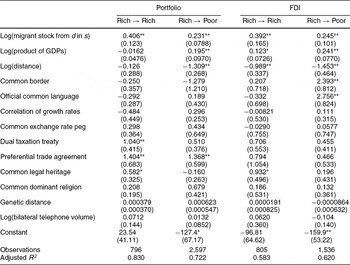
We check the robustness of our results by estimating the effect of the migrant stock on investment across different subsamples.Footnote 25 This is especially important as pointed out by Blonigen and Wang (Reference Blonigen, Wang, Moran, Graham and Blomström2005), who experience problems when pooling FDI data across developed and developing countries.Footnote 26 Table 5 breaks up the sample and examines flows of portfolio investment and FDI from rich countries into rich countries and from rich countries into poor countries.Footnote 27 In all four specifications, we find that migrant networks have a positive and statistically significant effect on bilateral investment.
Different Samples

FDI, foreign direct investment; GDP, gross domestic product.
Robust standard errors in parentheses.
Dependent variable: log(portfolio investment) in columns 1 and 2; log(FDI) in columns 3 and 4.
Robust standard errors clustered by both origin and destination country.
All models include both origin and destination dummy variables.
* p < .10; ** p < .05.
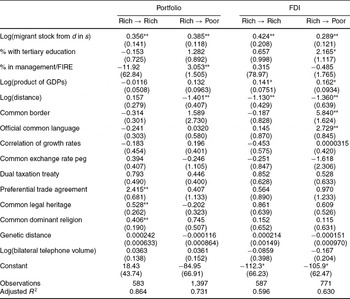
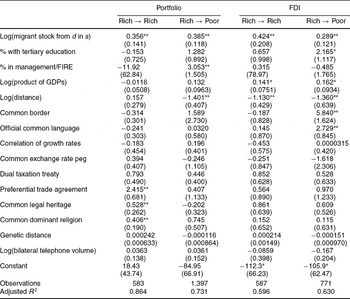
Table 6 repeats the subsampling and includes the measures of educated migrants. These results are suggestive of our existing patterns: even controlling for education level and employment in the FIRE sectors, the size of the migrant network has a positive and statistically significant influence on both portfolio and FDI. Neither education level nor sector of employment is significantly different from zero in the rich–rich country pairs. These variables are significant and positive—in a pattern consistent with Table 4—for rich–poor country pairs. On its face, this seems plausible: investment firms likely have multiple offices across a wide array of rich countries (consider the number of cross-border offices of a firm like AIG or JP Morgan). It is also likely that rich countries have more transparent business practices and government regulations than poorer countries, resulting in a lower need for private information. However, this result also points to the important role that all migrant groups play in funneling portfolio investment from rich countries into poor countries, countries that are likely to have greater transactions costs, higher barriers to entry, and larger information asymmetries.
Different Samples, Educated Migrants
FDI, foreign direct investment; GDP, gross domestic product.
Robust standard errors in parentheses.
Dependent variable: log(portfolio investment) in columns 1 and 2; log(FDI) in columns 3 and 4.
Robust standard errors clustered by both origin and destination country.
All models include both origin and destination dummy variables.
* p < .10; ** p < .05.
CONCLUSION AND DIRECTIONS FOR FUTURE RESEARCH
Access to international capital markets is a perennial problem confronted by all countries. Students of international political economy have invested considerable time in trying to understand the theoretical and empirical connections across countries and markets. One general conclusion from these efforts is that information asymmetries represent a large cost to cross-border economic transactions. We have demonstrated that migrant networks—connections between coethnics across countries—play an important role in decreasing asymmetries and, consequently, promote both portfolio and FDI.
How do these findings square with the extant literature on immigration and on capital flows? Recent studies have already documented that migrant laborers remit a substantial amount of capital (Leuth and Ruiz-Arranz Reference Leuth and Ruiz-Arranz2006; Ratha and Shaw Reference Ratha and Shaw2007). Our findings suggest that migrant-driven investment is yet another way in which diaspora communities influence developments in their home countries. That these two flows of capital likely have different effects on inequality and poverty provides an interesting avenue for future work connecting diasporas to development.
There is still quite a bit we do not know. Is migrant-led investment countercyclical? When a destination experiences a shock—a natural disaster or a financial crisis—is migrant-led investment more stable than traditional investment channels?Footnote 28 What about the effects of migrant networks on other channels of investment such as FDI and cross-border mergers and acquisitions behavior? Connecting these processes will help us better understand institutional and noninstitutional determinants of global investment.
More broadly, it is hoped that this article contributes to broader interdisciplinary discussions about the role that migrant networks play in the process of globalization and development. Although the bulk of scholarship on globalization focuses on the movement (or lack thereof) of commodities, it gives the movement of people—whether they are laborers or entrepreneurs—short shrift. There are scores of studies on the causes and consequences of trade and capital flows, yet we lack similar studies of labor flows. Numerous works investigate the causes of trade restrictions and capital controls, but, again, we lack comparable understanding of the barriers to the international mobility of labor.
To be fair, there is a body of literature that focuses on policies that restrict labor mobility, but this literature focuses on the country of immigration. Howard (Reference Howard2009), for example, details how and why governments of Western Europe restrict the political rights of immigrants, and Leblang (Reference Leblang2009a, Reference Leblang2009b) examines the effect of countries of origin extending voting rights and dual citizenship rights to their diaspora. However, these studies only skim the surface. We still know little about the benefits accorded to immigrants and the property ownership rights accorded to émigrés, and even less about the role that international organizations from the European Union to the World Trade Organization (and the General Agreement on Tariffs and Trade) play in the process of labor migration. As governments and social scientists learn more about the multiple ways that disapora communities connect societies, communities, and economies around the world, both our understanding and government policies may change.
Filling these gaps will pay real dividends for our understanding of migration, investment, and political economy more generally.
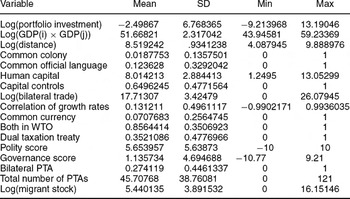
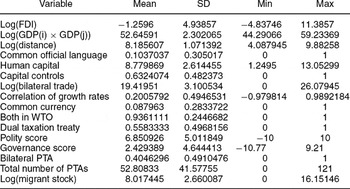
APPENDIX A: DESCRIPTIVE STATISTICS
Portfolio Investment Sample (N = 4,980)
GDP, gross domestic product; Preferential Trade Agreement; WTO, World Trade Organization.
Foreign Direct Investment Sample (N = 3,573)
GDP, gross domestic product; Preferential Trade Agreement; WTO, World Trade Organization.
APPENDIX B: DATA SOURCES
1. Portfolio Investment: International Monetary Fund's Coordinated Portfolio Investment Survey (CPIS) (www.imf.org/external/np/sta/pi/cpis.htm)
2. Bilateral Foreign Direct Investment: OECD's International Investment Statistics accessed via SourceOECD
3. Bilateral Migrant Stock: World Bank's project on South–South Migration and Remittances (http://go.worldbank.org/TGZNEJBXD0)
4. Gross Domestic Product (GDP): Penn World Tables, Mark 6.1, and the World Bank's World Development Report
5. Bilateral Distance, Shared Border, and Common Official Language: Centre D'études Prospectives et D'informations Internationales (CEPII)'s Distances Database (www.cepii.fr/anglaisgraph/bdd/distances.htm)
6. Correlation of Growth Rates: Growth calculated using gross domestic product (GDP) data; correlation based on a 5-year moving average and is lagged 5 years
7. Common Exchange Rate Peg: Klein–Shambaugh Nature of Exchange Rate Regimes Data (www.dartmouth.edu/~jshambau/ShambaughAnnualData.xls)
8. Bilateral Trade and Preferential Trade Agreements: From Goldstein, Rivers, and Tomz (Reference Goldstein, Rivers and Tomz2007), courtesy of Moonhawk Kim
9. Dual Taxation Treaties: United Nations Conference on Trade and Development (UNCTAD) (www.unctad.org/Templates/WebFlyer.asp?intItemID=3150&lang=1)
10. Common Legal Heritage: Based on legal origin data from Rafael La Porta (http://mba.tuck.dartmouth.edu/pages/faculty/rafael.laporta/publications.html/EconomicCon_data.xls)
11. Common Religion: Based on size of the largest religious group from Rafael La Porta (http://mba.tuck.dartmouth.edu/pages/faculty/rafael.laporta/publications.html/EconomicCon_data.xls)
12. Genetic Distance: http://www.anderson.ucla.edu/faculty_pages/romain.wacziarg/downloads/genetic_distance.zip
13. Cultural Distance: Calculated using data from the World Values Survey (www.worldvaluessurvey.org)
14. Telephone Volume: Bilateral telephone traffic obtained from telegeography.com; missing data are interpolated based on the source and destination's per capita gross domestic products (GDPs) and populations
15. Educated Migrants and Migrants Employed in FIRE: Organisation for Economic Co-operation and Development's (OECD's) Database on Immigrants in OECD Countries (DOIC) (www.oecd.org/document/51/0,3343,en_2649_37415_40644339_1_1_1_37415,00.html)
APPENDIX C: COUNTRIES IN SAMPLE
Portfolio Investment Sample:
Origin: Argentina, Australia, Austria, Bahamas, Belgium, Bermuda, Brazil, Bulgaria, Canada, Chile, Colombia, Costa Rica, Cyprus, Czech Republic, Denmark, Estonia, Finland, France, Germany, Greece, Hong Kong, Hungary, Iceland, Ireland, Israel, Italy, Japan, Kazakhstan, Korea (Republic of), Luxembourg, Macao, Malaysia, Malta, Mauritius, Netherlands, Netherlands Antilles, New Zealand, Norway, Panama, Philippines, Poland, Portugal, Romania, Russian Federation, Singapore, Slovak Republic, South Africa, Spain, Sweden, Switzerland, Thailand, Turkey, Ukraine, United Kingdom, United States, Uruguay, Vanuatu, Venezuela.
Destination: Albania, Algeria, Argentina, Armenia, Australia, Austria, Azerbaijan, Bangladesh, Belarus, Belgium, Benin, Bolivia, Brazil, Bulgaria, Burkina Faso, Burundi, Cameroon, Canada, Central African Republic, Chad, Chile, China, Colombia, Costa Rica, Cyprus, Czech Republic, Denmark, Dominican Republic, Ecuador, Egypt (Arab Republic of), El Salvador, Estonia, Fiji, Finland, France, Gabon, Georgia, Germany, Ghana, Greece, Guatemala, Guinea-Bissau, Honduras, Hungary, India, Indonesia, Iraq, Ireland, Israel, Italy, Jamaica, Japan, Jordan, Kazakhstan, Kenya, Kuwait, Kyrgyz Republic, Latvia, Liberia, Lithuania, Madagascar, Malawi, Malaysia, Mali, Mauritius, Mexico, Moldova, Morocco, Mozambique, Nepal, Netherlands, New Zealand, Nicaragua, Niger, Nigeria, Norway, Oman, Pakistan, Panama, Papua New Guinea, Paraguay, Peru, Philippines, Poland, Portugal, Romania, Russian Federation, Rwanda, Saudi Arabia, Senegal, Sierra Leone, Singapore, Slovak Republic, South Africa, Spain, Sri Lanka, Sudan, Sweden, Switzerland, Syrian Arab Republic, Tanzania, Thailand, Togo, Trinidad and Tobago, Tunisia, Turkey, Uganda, Ukraine, United Kingdom, United States, Uruguay, Venezuela, Zambia, Zimbabwe.
Foreign Direct Investment Sample:
Origin: Australia, Austria, Canada, Czech Republic, Denmark, Finland, France, Germany, Greece, Hungary, Iceland, Ireland, Italy, Japan, Luxembourg, Netherlands, New Zealand, Norway, Poland, Portugal, Slovak Republic, Spain, Sweden, Switzerland, Turkey, United Kingdom, United States.
Destination: Albania, Algeria, Argentina, Armenia, Australia, Austria, Azerbaijan, Bangladesh, Belarus, Belgium, Benin, Bolivia, Brazil, Bulgaria, Burkina Faso, Burundi, Cameroon, Canada, Central African Republic, Chad, Chile, China, Colombia, Costa Rica, Cyprus, Czech Republic, Denmark, Dominican Republic, Ecuador, Egypt (Arab Republic of), El Salvador, Estonia, Fiji, Finland, France, Gabon, Georgia, Germany, Ghana, Greece, Guatemala, Guinea-Bissau, Honduras, Hungary, India, Indonesia, Iraq, Ireland, Israel, Italy, Jamaica, Japan, Jordan, Kazakhstan, Kenya, Korea (Republic of), Kuwait, Kyrgyz Republic, Lao People's Democratic Republic, Latvia, Liberia, Lithuania, Madagascar, Malawi, Malaysia, Mali, Mauritius, Mexico, Moldova, Morocco, Mozambique, Nepal, Netherlands, New Zealand, Nicaragua, Niger, Nigeria, Norway, Oman, Pakistan, Panama, Papua New Guinea, Paraguay, Peru, Philippines, Poland, Portugal, Romania, Russian Federation, Rwanda, Saudi Arabia, Senegal, Sierra Leone, Singapore, Slovak Republic, South Africa, Spain, Sri Lanka, Sudan, Sweden, Switzerland, Syrian Arab Republic, Tanzania, Thailand, Togo, Trinidad and Tobago, Tunisia, Turkey, Uganda, Ukraine, United Kingdom, United States, Uruguay, Venezuela, Zambia, Zimbabwe.




Comments
No Comments have been published for this article.