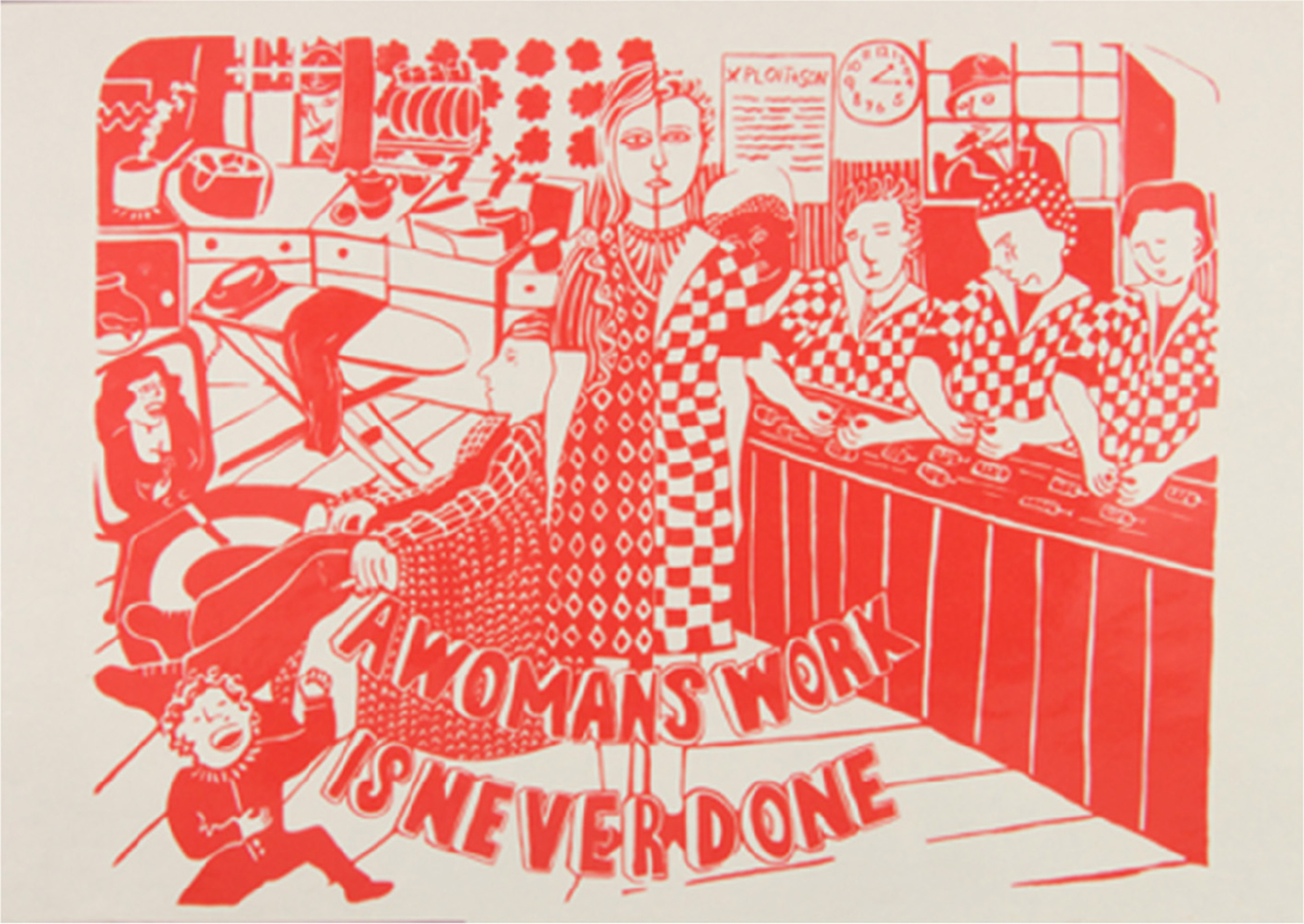
A woman's work is never done: in this 1970s poster from the See Red Women workshop (Figure 1), a female worker moves from the production line to the multitasking of the second shift.Footnote 1 In setting the experience of industrial work alongside that of the woman in a nuclear family, the poster seeks to draw attention to similarities between paid and unpaid work. The woman's factory overall is barely distinguishable from her housewife's tabard. The time discipline of the assembly line is paralleled by the equally pressing demands of a boiling pot and a crying child. In both workplaces, a cigar-chomping capitalist looks gloatingly through the window, mentally calculating the value that will accrue to him through her labour. The woman stands, arms to her side like a soldier, her blank stare suggesting the mental cost of this culture of exploitation.
‘A Woman's Work Is Never Done’, See Red Women's Workshop. Reproduced under a Creative Commons Attribution-NonCommercial-ShareAlike 3.0 Unported License.

See Red's brilliantly polemical poster provides an apt starting point for this forum on women, work and value in post-war Europe. The research presented here is concerned with the female experience of work after 1945. Although this period saw rising levels of paid female employment, women were still expected to take on a large share of the care work that underpins contemporary European economies. These articles emerged from the international research network on Women, Work and Value in Europe, 1945–2015, funded by the Arts and Humanities Research Council. It brought together over forty researchers from fifteen countries, from a range of disciplines including literature, film and cultural studies, sociology, anthropology, economics, history, geography, ethnography, social work and feminist and women's studies. The network focused on ‘value’ as a way of thinking about the different ways in which women's work was experienced, viewed, discussed and represented by men and women, workers, employers and politicians. So while some network members sought to capture how the economic value of women's work was quantified, others were concerned with literary or artistic representations of women in the workplace. The network also sought to question the dichotomy between paid and unpaid labour, with an expansive definition of women's work which included care work, body work, creative labour and political activism. The articles in this forum thus set paid and unpaid work alongside each other, and enquire into the value of both. Inevitably, this forum, which brings together articles on the United Kingdom, Italy and socialist/post-socialist Poland and Czechoslovakia/Czech Republic, cannot represent the full richness of the network's activities, but it does capture the main strands of discussion and debate.
The activities of the network were driven by a desire to understand and historicise recent changes in the workplace, the structure of the labour market, conditions of work, the status and image of the worker, how work is rewarded and what values are attached to it. The fact that these changes are sometimes referred to as ‘feminisation’ is a sign that all is not well. ‘Feminisation of labour’ can be used to refer to the rapid and substantial increase in the proportion of women in paid work over the last two decades. However, it is also used to conceptualise three important characteristics of work in the postindustrial world: the care crisis, the proliferation of temporary and part-time work and underemployment and the culture of constant work. These changes have been most intensely felt by women workers, but are increasingly of concern to men as well.
Our attempt to historicise these changes speaks to an important historiographical opportunity. The historians amongst us were driven by a pressing disciplinary need to return to questions of women and work. While other disciplines have thrown themselves into the study of women's labour with enthusiasm, and while scholars of earlier periods have retained a focus on women's work, the historical research on the post-war period is now several decades out of date.Footnote 2 The end of the Cold War, the advent of the ‘cultural turn’ (in history as in other disciplines) and the shift away from ‘women's history’ to ‘gender history’ all meant that questions about women's particular experiences of work have fallen into relative neglect. Historians of post-war Europe have shifted their energies towards other aspects of women's lives, and histories of women as consumers, as mothers, as housewives or as feminist activists have taken precedence.Footnote 3 Women as paid workers have received little attention since the early 1990s, and historians have to some degree lost sight of the feminist vision of women's unpaid labour as ‘work’. In recent years, however, women as workers during the second half of the twentieth century have gained renewed attention, with some of the most significant work focusing on migrant women on the one hand, and on Central and Eastern (rather than Western) Europe on the other. Much of this research has applied insights from cultural and gender history to focus on the subjective experiences of and attachment to work.Footnote 4
This forum seeks to put women's work back in the picture, using ‘value’ as an analytical lens. Second wave feminists used the quantification of the economic value of women's work as a powerful campaigning tool, from ‘Wages for/against Housework’ to If Women Counted and Who Pays For the Kids.Footnote 5 But as James, Federici, Waring and Folbre knew very well, work has a whole range of subjective values beyond the economic. It can confer status and social capital. It can create networks of friendship, support and influence. It can be a demonstration of political or ideological values, or an expression of love and affection. Unpaid labour (in care work, in the voluntary sector and beyond) has an enormous economic value, and equally paid labour often has a profound non-economic value.
These different facets of value – economic, social, cultural – are not discrete. They interact on both a societal and an individual level. Nor do we wish to suggest an easy dichotomy between the economic and the subjective. Economic quantification is not without an emotional dimension, as the research on implicit bias and remuneration shows. The ‘value’ given to certain sorts of work, like the value given to different currencies, is a political decision, made by the wealthy with major implications for the many.Footnote 6 The slippage between different conceptions of value breaks down traditional scholarly distinctions between paid and unpaid work and between economic quantification and lived experience.
Not all values are created equal. One of the key findings of this collection is the hierarchies of value that are in play for individuals, households and at national and global level. It is striking that even in relatively poor households, economic value does not always override other sorts of value. These (always gendered) hierarchies of value form the framework in which people make decisions about work, and place powerful material and non-material constraints on their choices. These frameworks come in different forms: economic (rates of pay), infrastructural (childcare and education), ideological (maternalism in all its forms), legal (migration regimes), cultural and social (expectations about what sorts of work women will do). But all reflect and create value.
Our focus on value also makes visible the work that goes into negotiating and contesting such hierarchies. In Laura King's article, couples create a shared language to describe and explain decisions made within the family. Nor should we forget the cultural work involved in representing women's labour, and the important symbolic value this confers, as we see in Rosie Read's discussion of maternalist attitudes in Czech film. Attention paid to women's work in advertising and propaganda, literature and film, is a key vehicle for the articulation and transmission of different understandings of value by individual workers, households, activists, governments and employers. Finally, the definition of value is often contested from below, as the workers’ voices in Natalia Jarska's and Maud Bracke's work demonstrate.
Laura King's article ‘How Men Value Women's Work: Labour In and Outside the Home in Post-War Britain’ begins this forum, and digs into the concept of ‘value’ by exploring how men – husbands, partners, fathers – valued (and consistently undervalued) women's paid and unpaid labour throughout the Cold War period in the United Kingdom. King demonstrates that men's valuing and undervaluing of women's labour deeply shaped women's own choices about work, and played a pivotal role in determining how labour was shared between couples and within families. Using the methodology of oral history, King argues that although women's participation in the labour market increased dramatically during this period, the way that male partners and relatives viewed women's labour did not. Men continued to see their own paid work as fundamentally more important than women's paid or unpaid labour, entrenching a system of social value in which women's paid work was imagined as ‘extra’, while men's domestic labour was envisaged as ‘help’. However, the analysis reveals that negotiating processes within families are multi-layered, and demonstrates that neither a simple view on ‘choice’, nor a straightforward understanding of patriarchal structures and cultures, however heavily these may weigh, sufficiently explain the ways in which both men and women construct meaning and discourse when engaging in difficult negotiating processes around the family economy, care and work.
Natalia Jarska, in her article ‘Male and Female Breadwinners in State Socialism: The Value of Women's Work for Wages in Post-War Poland’, continues this theme of exploring the historical value placed on women's paid labour via the concept of the male ‘breadwinner’. As King does, Jarska argues that while the number of women working in post-Stalinist Poland increased, and while women's labour was supported by a state ideology that suggested that work would liberate women, social attitudes failed to keep pace with these changes. Using letters from women workers, opinions expressed in party and parliamentary documents and historical sociological research, Jarska argues that while state socialist ideology guaranteed a woman's ‘right’ to work, this came second to her ‘right’ to her family and household duties – a discourse that ensured, as King found for the British context, that in socialist Poland women's work continued to be valued primarily via the context of the family, and undervalued relative to the ‘breadwinning’ work of male comrades, and relative to their own unpaid caring role.
Maud Bracke's article takes 1970s working-class women's activism as its focus, examining Italian trade union feminism in the forum of the Turin-based women-only trade union Intercategoriale donne (ICD). In 1978 ICD successfully campaigned for gender equality in hiring at the Fiat plants in Turin, setting a national precedent, and leading to a significant increase in the number of women workers, as well as a sudden influx of female activists into the trade union movement. Bracke shows that this had a real impact on a traditionally male-dominated workplace which had been primed for change by the anti-authoritarianism of the Italian Hot Autumn. Sections of the male trade union movement brought an open mind to female-initiated campaigns on health and social reproduction. However, deindustrialisation soon brought this potential feminisation of the labour movement to a premature end, as successive waves of redundancies led to the re-prioritisation of the male worker.
Moving our focus to the socialist and post-socialist period in the Czech context, Rosie Read's exploration of nursing, institutional care and volunteering turns us towards the concept of emotional labour. Contrasting an earlier socialist understanding of nursing as underpinned by modern, scientific knowledge and expertise with a later socialist and post-socialist articulation of nursing as a caring profession, Read identifies the gradual extension and promotion of maternalist ideologies beyond the home and into the wider society. She argues that the emergence of hospital volunteering as a relatively new initiative in the Czech context reproduces older patterns of unpaid work and gender inequality, and reveals the surprising extent to which the transformation of women's work after 1989 was influenced not only by external processes of globalisation but by longer-term internal debates about the value of women's paid employment originating in the socialist period.
Our examination of women's work points to significant shared experiences across national boundaries and between East and West Europe. Four common themes in particular emerge from these articles. Firstly, we see women's articulation of their own interests and the multiple values of their work. Whether through trade union activism, individual petitioning of the authorities or negotiation within the family, women sought out opportunities to express the value of their work and to critique the frameworks within which it took place. Secondly, despite these attempts by women to change the narrative about work, women's paid work – and women workers – have been consistently devalued as temporary and unskilled. In part this was a result of what Bracke describes as ‘the centrality of male experiences in defining work, productivity and militancy’. Men's paid labour was consistently valued above women's, particularly at times when jobs were under threat, as in mid-1950s Poland and early 1980s Italy. Linked to this was a third commonality: the sense that unpaid work was women's true vocation. This belief that women were innately suited to caring and domestic work emerges strongly from all four case studies, from the sympathy felt for female Polish mine workers to the gendered values around Czech hospital volunteering. As Read points out, it is striking that this narrative of maternalism has proved stronger than many of the social rights and economic entitlements for mothers that were provided by pre-1989 welfare states.
This leads us to our fourth and final theme: that changes in attitudes towards women's work, paid and unpaid, often lagged behind changes in the structures of the economy and society, and of women's participation in the labour market. This should not surprise us. The status quo, which gave women responsibility for the vast majority of unpaid caring work, has deep cultural, social and economic roots. Nor have men, as the historic beneficiaries of this distribution of unpaid work, had much of a vested interest in disrupting it. Yet the post-industrial ‘feminisation of labour’ referred to at the start of this introduction has sharpened the need to grasp this nettle. Increasingly, the problems of women workers are the problems of all workers: how to care for children, the disabled and the elderly in a time of shrinking welfare states; the increasingly temporary, fragmented and precarious nature of work; and a culture of constant work, with a consequent ‘implosion of home and work’Footnote 7. If once ‘a woman's work was never done’, then now perhaps it is more accurate to say that ‘work is never done’. In a world where work (paid and unpaid) is so dominant in everyday life, we must understand what renders work meaningful to people, how it shapes their negotiations and roles within and beyond their families and workplaces and the extent to which they are able to determine the value of their work. We hope that the contributions to this issue demonstrate the continuing importance of both a feminist and a historical analysis of this topic.