INTRODUCTION
The Falkland Islands are an archipelago comprised of two main islands, East and West Falkland, and 778 smaller ones. The Falkland Islands and the wider Patagonian Shelf are framed by the Falklands/Malvinas Current Front also known as the Argentine shelf-break front (Acha et al., Reference Acha, Mianzan, Guerrero, Favero and Bava2004), Patagonian shelf break front (SBF, Franco et al., Reference Franco, Piola, Rivas, Baldoni and Pisoni2008) and Shelf-break Frontal System (SBFS, Martos & Piccolo, Reference Martos and Piccolo1988). The main feature of this front is the Falklands Current which originates as the Antarctic Circumpolar Current in the Drake Passage (Peterson and Whitworth III, Reference Peterson and Whitworth1989). The Falkland Current reaches the shelf south of the Falkland Islands and splits into two main northward-flowing branches: to the west of the islands a weaker western branch; and to the east the stronger eastern branch (Bianchi et al., Reference Bianchi, Massonneau and Olevera1982). The north-western waters are dominated by the Argentine Drift which is cold temperate, warmer and less saline than the waters of the Falkland Current (Zyrianov & Severov, 1979). These current systems split the marine environment in the Falklands into two different ecological regions with the north-western areas dominated by temperate waters and the south-eastern areas dominated by colder sub-Antarctic waters (Arkhipkin et al., Reference Arkhipkin, Brickle and Laptikhovsky2013). All of the southern Falkland Islands are under the influence of the Southern Front (SF) (Arkhipkin et al., Reference Arkhipkin, Brickle and Laptikhovsky2013). The Southern Front is situated in an area that has a very steep shelf slope (from 120–250 m) that rises up from the Falkland Trough to the shelf adjacent to Beauchêne Island. The SF is occupied mainly by waters of the Transient Zone situated between Falkland shelf waters and Eastern Falkland Current. This area is highly productive as indicated by chlorophyll a concentrations in surface and near-bottom layers (Arkhipkin et al., Reference Arkhipkin, Brickle and Laptikhovsky2013).
The sponges of the shallow waters of the Falkland Islands are poorly known. Until recently only three expeditions had studied the sponge fauna, namely the Scotia Expedition (1903–1904) (Topsent, Reference Topsent1915), the Swedish Antarctic expedition (1901–1903) (Burton, Reference Burton1934) and the Discovery expeditions (1925–1929) (Burton, Reference Burton1932). The 60 stations at which sponges were obtained by these expeditions ranged from 0–313 m in depth, however only 30% were from shallow infralittoral and circalittoral coastal sites (up to 50 m) with the majority being deeper offshore sites. Sampling was carried out by a variety of remote methods including dredging, otter trawling, beam trawling and tow nets.
Recent work has revealed the potential for studying sponge biodiversity through diving surveys (Boury-Esnault, Reference Boury-Esnault1971; Wiedenmayer, Reference Wiedenmayer1977; Pansini, Reference Pansini, Vacelet and Boury-Esnault1987; Picton & Goodwin, Reference Picton and Goodwin2007; Goodwin & Picton, Reference Goodwin and Picton2009; Willenz et al., Reference Willenz, Hajdu, Desqueyroux-Faúndez, Lôbo-Hajdu, de Souza Carvalho, Häussermann and Försterra2009; Goodwin et al., Reference Goodwin, Jones, Neely and Brickle2011), particularly in areas where many species are small and in habitats which are difficult to sample by other means (Vacelet & Perez, Reference Vacelet and Perez1998). Sampling by scuba diving enables the study of bedrock habitats and encrusting species which are likely to be under-sampled by remote methods and consequently has the potential to significantly increase the number of species recorded (Picton & Goodwin, Reference Picton and Goodwin2007; Goodwin & Picton, Reference Goodwin and Picton2009). Additionally scuba diving surveys enables the in situ appearance of species to be recorded, providing information of great use to field surveyors.
The sponge fauna of the Jason Islands (north-west of the Falkland Islands) and Stanley (north-east of the archipelago) was recently sampled using scuba diving by Goodwin et al. (Reference Goodwin, Jones, Neely and Brickle2011), who described 12 new sponge species. By using the same sampling methodology to sample a contrasting ecological region we hoped to improve current knowledge of the biodiversity of shallow water Falkland Island sponges, particularly the distribution of these newly described species, and how the contrasting oceanographic influences in the two areas affect the sponge communities.
MATERIALS AND METHODS
Specimens were collected by scuba diving. Sponges were selected by eye; the divers attempted to sample species that looked different from those previously sampled during the dive. The aim was to sample as many different species as possible, rather than gaining any quantitative information. Once selected, three photographs of each specimen were taken in situ using housed digital SLR cameras (Nikon D70 and Nikon D300 in Subal housings with Ikelite DS125 substrobe and SB800 flash units both with 60 mm macro lenses). A small piece (approx 1 cm2) of tissue was then removed. After collection the samples were transferred to 95% ethanol for storage.
Tissue slides were prepared by sectioning a very thin portion of tissue at a 90° angle through the sample. This was then dehydrated in absolute ethanol for 4 min and placed in clove oil for a further 4 min, to clarify the tissue, before being mounted on a microscope slide in Canada balsam. A coverslip was then placed on the slide and and it was then kept at 50°C for at least 48 h to allow the mountant to dry. Spicule preparations were prepared by dissolving the tissue in a drop of concentrated nitric acid directly on a microscope slide. The slide was heated over a spirit burner to aid the reaction. Once the acid had burnt off, the remaining spicules were rinsed in water and ethanol and then mounted in Canada balsam as above.
The tissue slide was used primarily for identification to genus level. Spicule measurements were taken from the spicule preparations; at least 20 spicules of each type were measured using ProgRes® CapturePro 2.7 Software (JENOPTIK Optical Systems, Jena, Germany). Type material is in the zoology collections of the Ulster Museum, National Museums Northern Ireland. Material in these is indicated by BELUM (Belfast Ulster Museum) Mc (Porifera collections).
Information on extant species was obtained from the World Porifera Database (Van Soest et al., Reference Van Soest, Boury-Esnault, Hooper, Rützler, de Voogd, Alvarez de Glasby, Hajdu, Pisera, Manconi, Schoenberg, Janussen, Tabachnick, Klautau, Picton, Kelly, Vacelet, Dohrmann and Cristina Díaz2013). Type specimens were examined from several collections; those examined are listed in the text, institutional abbreviations used are as follows: BMNH – Natural History Museum, London; NMSZ – Zoology collections of the National Museums of Scotland; BELUM – Ulster Museum, National Museums Northern Ireland.
THE STUDY SITES
Dive site names correspond to those from the Shallow Marine Surveys Group Southern Island Cruise (SMSG, 2009); sponge samples were not collected on all survey dives. The survey was part of the Stanley-based Shallow Marine Surveys Group's exploration of the inshore marine environment of the Falkland Islands.
Beauchêne Island lies 80 km south of the southernmost point (Porpoise Point) of the mainland of East Falkland Island and 51 km south of the Sea Lion Islands. Beauchêne and Sea Lion are National Nature Reserves. The smaller islands adjacent to Sea Lion – Whisky, Brandy and Sea Lion Easterly – are privately owned reserves. Further north is the Lively Island Group with Lively Island being the largest with the smaller North East and Philimore Islands off its north coast. The Lively Island group is an Important Bird Area (FK010) (BirdLife International, 2014). Motley Island, Green Island and Triste Island lie to the south of the Lively Group (see Figure 1 for more detail).
Location of the Falkland Islands (inset) and the sampling stations.

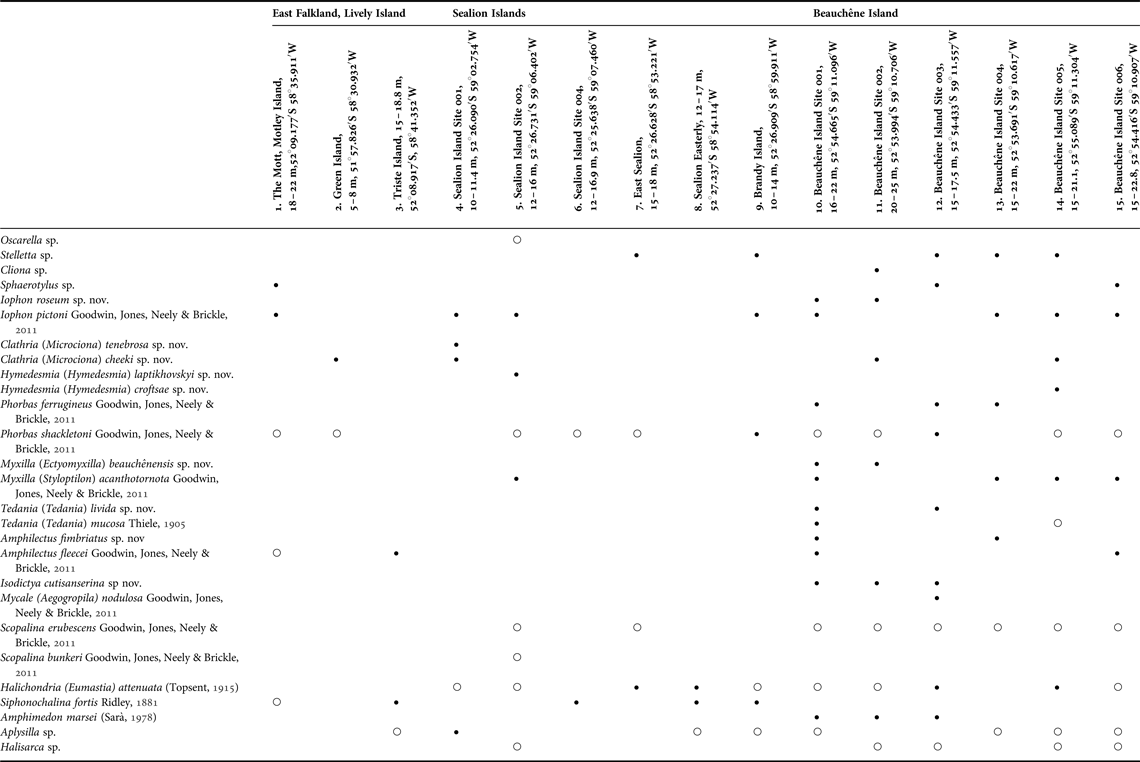
Sponge samples were taken from six sites around Sea Lion Island (Sea Lion, Christmas and Brandy Islands), three other sites south-east of east Falkland in the Lively Island Group, Motley Island, Green Island and Triste Island and six sites around Beauchêne Island (Figure 1, Table 1). For safety, dive depths were limited to 20 m because of the lack of a recompression chamber.
Species recorded at each dive sampling site. Filled circles are records with samples, unfilled circles are photographic records only.
RESULTS
In total 189 specimens were collected from the 15 survey sites. Twenty-seven distinct sponge entities were recorded from 19 different genera. It was possible to identify 21 of these entities to species level and of these nine were species new to science (Table 1). Sponge diversity was highest at Beauchêne Island with 15 sponge entities being recorded from one site (Beauchêne Island site 001, Table 1).
SYSTEMATICS
This section gives descriptions of the species new to science and notes on species of interest recorded. Species are listed in taxonomic order (as currently defined by the World Porifera Database (Van Soest et al., Reference Van Soest, Boury-Esnault, Hooper, Rützler, de Voogd, Alvarez de Glasby, Hajdu, Pisera, Manconi, Schoenberg, Janussen, Tabachnick, Klautau, Picton, Kelly, Vacelet, Dohrmann and Cristina Díaz2013)).
Order POECILOSCLERIDA Topsent, 1928
Suborder MICROCIONINA Hajdu, Van Soest & Hooper, 1994
Family ACARNIDAE Dendy, 1922
Genus Iophon Gray, 1867
Iophon roseum sp. nov.
TYPE MATERIAL
Holotype: Sample in 95% ethanol, tissue section and spicule preparation on slides. [BELUM.Mc6306] Shallow Marine Surveys Group Beauchêne and Sea Lion Islands Cruise, Beauchêne Island Site 001, Falkland Islands (52°54.665′S 59°11.096′W; water depth sampled: 16–22 m), Collected by C. Goodwin and J. Jones, 20 December 2009 and 22 December 2009.
Paratypes: Samples in 95% ethanol, tissue section and spicule preparation on slides. [BELUM.Mc6316] Shallow Marine Surveys Group Beauchêne and Sea Lion Islands Cruise, Beauchêne Island Site 002, Falkland Islands (52°53.994′S 59°10.706′W; water depth sampled: 20–25 m), Collected by C. Goodwin and J. Jones, 20 December 2009. [BELUM.Mc6325] Shallow Marine Surveys Group Beauchêne and Sea Lion Islands Cruise, Beauchêne Island Site 002, Falkland Islands (52°53.994′S 59°10.706′W; water depth sampled: 20–25 m), Collected by C. Goodwin and J. Jones, 20 December 2009.
Etymology
From the latin meaning rosy. Named for its characteristic pink or pale red colour.
External morphology ( Figure 2A)
In situ: Massive pink to pale red sponge. Massively encrusting sponge formed of large mounds, often up to 4 cm in height, each bearing a terminal oscule. The surface of sponge covered in smaller lumps. Preserved in alcohol: light brown, compressible, with large spaces present in choanosome. Ectosome slightly darker brown, smooth, shiny distinct layer, but not readily detachable.
Iophon roseum sp. nov. (A) In situ appearance Paratype [BELUM.Mc6325], Spicules Holotype [BELUM.Mc7606], (B) style, (C) ectosomal tylote, (D) ectosomal tylote ends, (E) style head, (F) anisochelae. All scale bars 10 µm.
Skeleton ( Figure 12A)
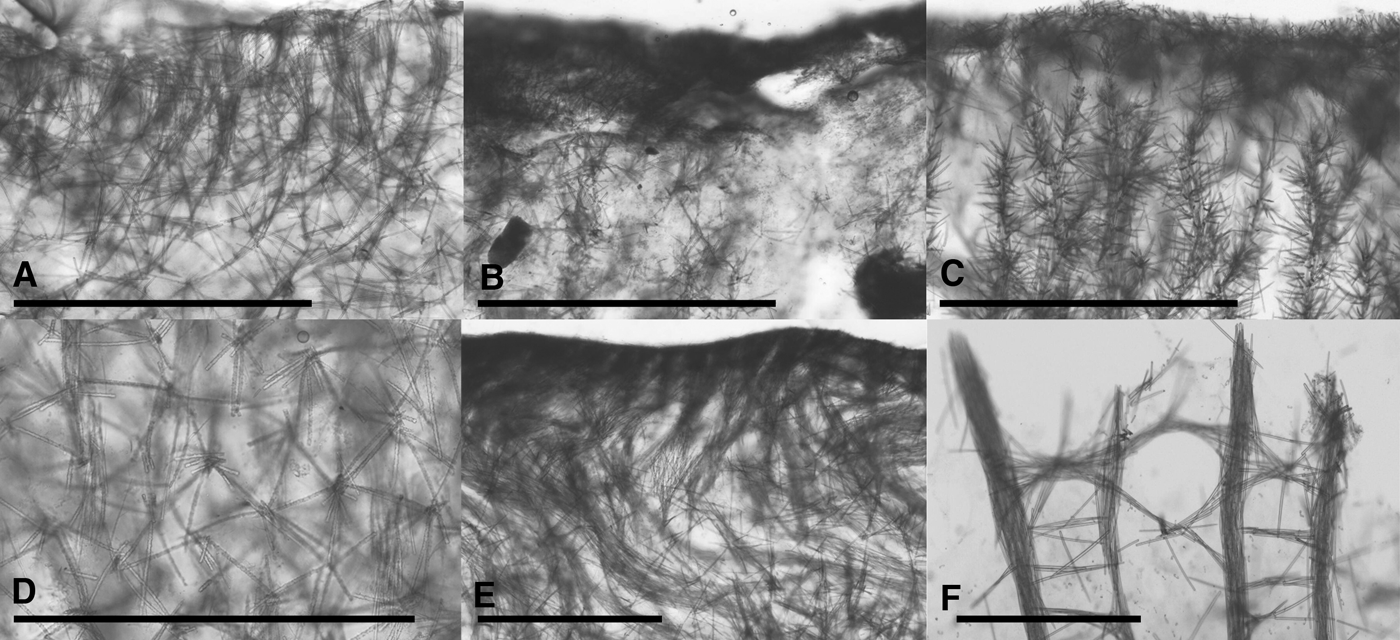
Choanosome: Reticulation of styles in bundles 2–4 spicules thick. Chelae abundant throughout the choanosome. Ectosome: Regularly spaced bundles of tylotes fanning out to form continuous surface layer with some spicules lying parallel to the surface.
Spicules
(1) Fusiform, often slightly curved, styles with abrupt points. The majority of the styles are smooth but some have a slight roughening at their head (Figure 2B, E). [BELUM.Mc6325]: 243(264)285 by 6.9 (8.8)11.6 µm; [BELUM.Mc6306]: 244(268)285 by 4.4(7.8)9.8 µm; [BELUM.Mc6316] 245(267)292 by 5.7(7.7)9.3 µm.
(2) Ectosomal tylotes with spherical, spined ends (Figure 2C, D). [BELUM.Mc6325]: 203(236)262 by 5.4(7.4)10.8 µm on widest part of shaft [BELUM.Mc6306]: 215(239)256 by 5.0(6.3)9.5 µm; [BELUM.Mc6316] 192(230)256 by 3.8(6.0)8.2 µm.
(3) Small spurred anisochelae (Figure 2F). Length [BELUM.Mc6325] 14.7(15.9)17.4 µm; [BELUM.Mc6306] 13.2(15.4)18.4 µm; [BELUM.Mc6316] 11.6(14.3)17.0 µm.
Diagnosis
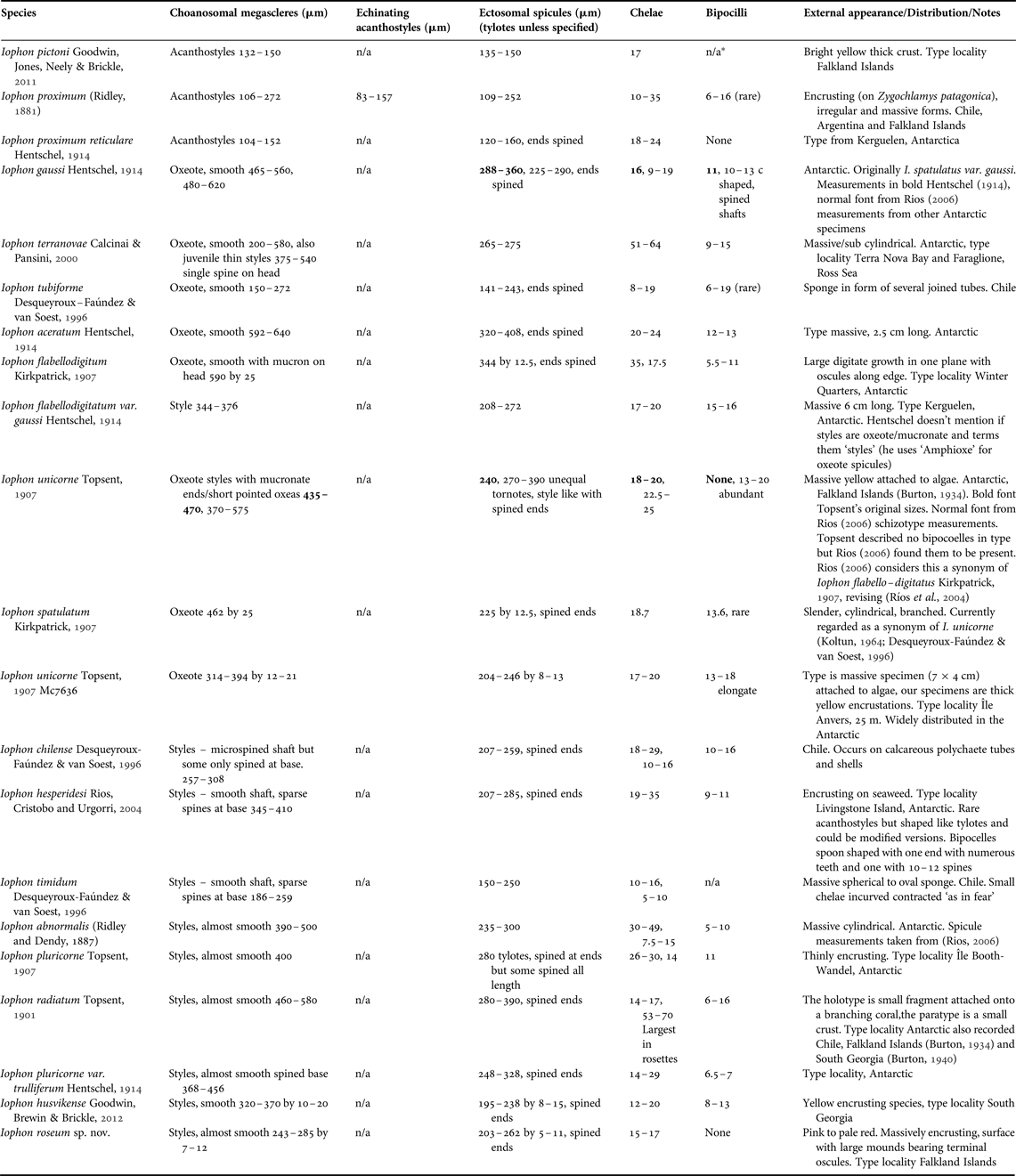
There are several species of South Atlantic and Antarctic Iophon species which possess only smooth styles as choanosomal spicules (Table 2). However only one of these, Iophon timidum Desqueyroux-Faúndez & Van Soest (Reference Desqueyroux–Faúndez and van Soest1996), lacks bipocilli. Iophon timidum possesses similar sized styles (186–259 µm) and ectosomal tylotes (150–250 µm), but has two categories of chelae (10–16 and 5–10 µm), and the smaller of these are ‘contracted as in fear’, the origin of its name. Iophon timidum also differs in appearance, being described as a massive spherical to oval sponge which is beige to dark brown when living.
Iophon species from the southern Atlantic and Antarctic.
*Although not present in the type or paratype very rare bipocoelles (7.5–9.5 µm) were present in specimens BELUM Mc6256, Mc6282, Mc6358 and Mc6394 and these have been tentatively assigned to this species
Iophon pictoni Goodwin, Jones, Neely & Brickle, Reference Goodwin, Jones, Neely and Brickle2011
SPECIMENS
Samples in 95% ethanol, tissue section and spicule preparation on slides. [BELUM.Mc6265] and [BELUM.Mc6269] Sea Lion Island Site 001; [BELUM.Mc6275] and [BELUM.Mc6358] Beauchêne Island Site 001; [BELUM.Mc6370] Beauchêne Island Site 005; [BELUM.Mc6377] Beauchêne Island Site 006; [BELUM.Mc6392], [BELUM.Mc6402] and [BELUM.Mc6403] Brandy Island; [BELUM.Mc6431] The Mott, Motley Island.
Iophon cf. pictoni
[BELUM.Mc6256] Sea Lion Island Site 001; [BELUM.Mc6282] Sea Lion Island Site 002; [BELUM.Mc6385] Sea Lion Island Site 004; [BELUM.Mc6394] Brandy Island.
Comparative material examined
Iophon pictoni Holotype BELUM.Mc4819; Paratype BELUM.Mc4822.
Remarks
The spiculation of the majority of these specimens is a good match for the type specimen (Table 2; Goodwin et al., Reference Goodwin, Jones, Neely and Brickle2011). The holotype and paratype from the Jason Islands (NW Falkland) were both bright custard yellow encrusting sponges. Our specimens are all encrusting and yellow but vary from bright custard yellow to a paler lemon yellow.
Very rare bipocilli (7.5–9.5 µm) were present in specimens Mc6256, Mc6282, Mc6358 and Mc6394. We did not find these on re-examining the type or in the other specimens. In view of the similarity of the other spicules and the external appearance we have identified these as Iophon cf. pictoni, which could be revised as further specimens are collected and the variation of Iophon species in this region is more completely understood. Bipocilli do seem to be very rare or absent in specimens of some species (e.g. see discussion on I. proximum in Desqueyroux-Faúndez & Van Soest, Reference Desqueyroux–Faúndez and van Soest1996).
Family MICROCIONIDAE Carter, 1875
Subfamily MICROCIONINAE Carter, 1875
Genus Clathria Schmidt, 1862
Subgenus Clathria (Microciona) Bowerbank, 1862
Clathria (Microciona) tenebrosa sp. nov.
TYPE MATERIAL
Holotype: Sample in 95% ethanol, tissue section and spicule preparation on slides. [BELUM.Mc6259] Shallow Marine Surveys Group Beauchêne and Sea Lion Islands Cruise, Sea Lion Island Site 001, Falkland Islands (52°26.090′S 59°02.754′W; water depth sampled: 10–11.4 m), Collected by C. Goodwin and J. Jones, 19 December 2009.
Paratypes: Samples in 95% ethanol, tissue section and spicule preparation on slides. [BELUM.Mc6260] and [BELUM.Mc6255] Shallow Marine Surveys Group Beauchêne and Sea Lion Islands Cruise, Sea Lion Island Site 001, Falkland Islands (52°26.090′S 59°02.754′W; water depth sampled: 10–11.4 m), Collected by C. Goodwin and J. Jones, 19 December 2009.
Other specimens: [BELUM.Mc6261], Sea Lion Island Site 001.
Etymology
From the latin tenebrosum dark or gloomy. Named for its dark chocolate brown to black colour.
External morphology ( Figure 3A)
In situ: Chocolate brown to black encrusting species forming patches up to 20 cm in diameter and 5 mm thick on bedrock. Prominent large oscules scattered over patch surfaces, surface in-between with visible ostia. Preserved in alcohol: firm fawn choanosome with smooth, clearly distinct but not easily detachable, dark grey, ectosome.
Clathria (Microciona) tenebrosa sp. nov. (A) In situ appearance Holotype [BELUM.Mc6259], scale bar 10 cm, Spicules Holotype [BELUM.Mc6259], (B) primary acanthostyle, (C) echinating acanthostyle, (D) ectosomal style, (E) chelae, (F) toxa. All scale bars 10 µm, apart from chelae 5 µm.
Skeleton ( Figure 12B)
Choanosome: Columns of between two and 10 primary styles heavily echinated by both the spined echinating acanthostyles and additional primary styles. Toxa and chelae are liberally dispersed throughout the tissue. Ectosome: Palisade of styles. The ectosomal tissue is heavily pigmented and appears dark chocolate brown on our Canada balsam mounted slides.
Spicules
(1) Primary styles: fat, slightly curved, smooth, styles which come to an abrupt point. Some of them have very slightly tylote heads (Figure 3B). [BELUM.Mc6259] 129(176)204 by 4.2(7.2)10.0 µm; [BELUM.Mc6255] 170(205)262 by 5.4(7.6)9.0 µm; [BELUM.Mc6260] 158(188)225 by 5.9(7.5)8.8 µm.
(2) Echinating acanthostyles: abruptly pointed, heads not tylote, entirely spined with large spines; those on the shaft have their tips curved down towards the shaft but the ones on the head are largely straight or curved upwards (Figure 3C). [BELUM.Mc6259] 64(89)107 by 5.9(9.9)15.3 µm; [BELUM.Mc6255] 75(85)98 by 6.2(7.8)10.9 µm; [BELUM.Mc6260] 77(86)94 by 6.0(8.4)10.2 µm.
(3) Ectosomal styles: abruptly pointed smooth styles with microspined heads. (Figure 3D) [BELUM.Mc6259] 103(130)160 by 3.2(4.4) 6.2 µm; [BELUM.Mc6255] 122(158)184 by 3.6(4.8)6.3 µm; [BELUM.Mc6260] 151(177)204 by 2.8(4.5)6.2 µm.
(4) Chelae: typical microcionid palmate isochelae (Figure 3E). [BELUM.Mc6259] 7.5(10.0)13.3 µm; [BELUM.Mc6255] 7.4(8.6)10.1 µm; [BELUM.MC6260] 7.5(10.0)12.2 µm.
(5) Toxa: gently curved, coathanger-shaped toxas, with heavily spined ends (Figure 3F). [BELUM.Mc6259] 64(91)119 µm; [BELUM.Mc6255] 46.0(60.7)76.3; [BELUM.Mc6260] 43(67)100 by 0.9(1.8)2.4 µm.
Diagnosis
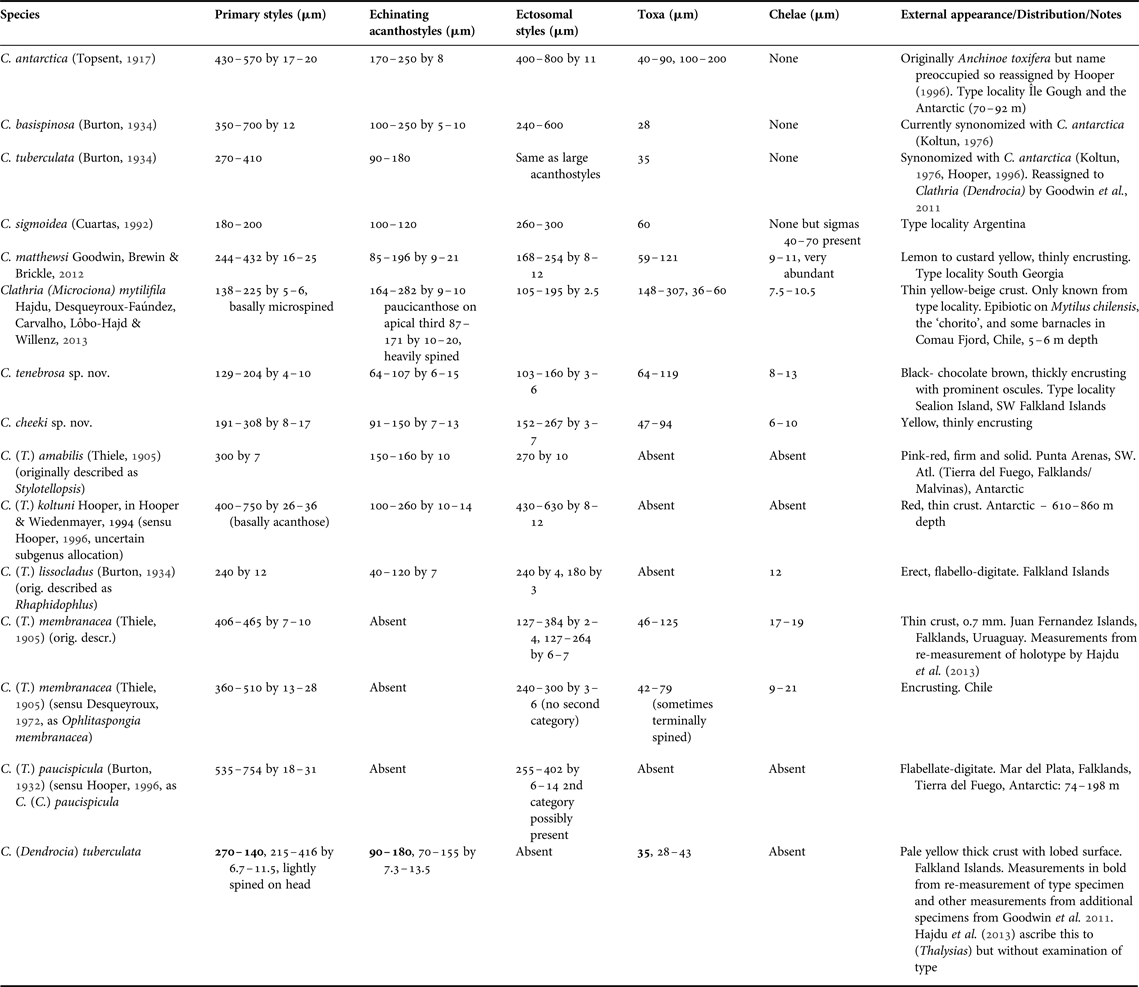
We have assigned these specimens to the subgenus Clathria (Microciona) on the basis of their encrusting growth form and plumose skeletal architecture (Hooper, Reference Hooper, Hooper and Van Soest2002). Very few Clathria (Microciona) species have been recorded from the Antarctic and South Atlantic region, probably because of a lack of sampling of encrusting species. There are several species of Clathria (Thalysias) Duchassaing & Michelotti, 1864 and one species of Clathria (Dendrocia) Hallman, 1920 present in the region (Table 3). Clathria (Thalysias) can be distinguished by the presence of two categories of ectosomal styles and Clathria (Dendrocia) by the lack of a specialized class of ectosomal styles. However, given the paucity of the original descriptions and the fluidity of taxonomy these have been considered. All existing species apart from C. matthewsi Goodwin, Brewin & Brickle, Reference Goodwin, Brewin and Brickle2012, C. mytilifila Hajdu, Desqueyroux-Faúndez, Carvalho, Lôbo-Hajdu & Willenz, Reference Hajdu, Desqueyroux-Faúndez, de Souza Carvalho, Lôbo-Hajdu and Willenz2013, C. cheeki sp. nov., C. (T.) lissocladus (Burton, Reference Burton1934), and C. (T.) membranacea (Thiele, Reference Thiele1905) lack chelae (Table 3). Clathria mytilifila possesses a second category of large toxa, C. matthewsi and C. cheeki sp. nov. have much larger acanthostyles and ectosomal styles, and both species of Clathria (Thalysias) have two categories of ectosomal styles.
Clathria (Microciona) and Clathria (Thalysias) species from the southern Atlantic and Antarctic. Information on Clathria (Thalysias) largely from Hajdu et al. (Reference Hajdu, Desqueyroux-Faúndez, de Souza Carvalho, Lôbo-Hajdu and Willenz2013).
Clathria (Microciona) cheeki sp. nov.
TYPE MATERIAL
Holotype: Sample in 95% ethanol, tissue section and spicule preparation on slides. [BELUM.Mc6262] Shallow Marine Surveys Group Beauchêne and Sea Lion Islands Cruise, Sea Lion Island Site 001, Falkland Islands (52°26.090′S 59°02.754′W; water depth sampled: 10–11.4 m), Collected by C. Goodwin and J. Jones, 19 December 2009.
Paratypes: Samples in 95% ethanol, tissue section and spicule preparation on slides. [BELUM.Mc6257] Shallow Marine Surveys Group Beauchêne and Sea Lion Islands Cruise, Sea Lion Island Site 001, Falkland Islands (52°26.090′S 59°02.754′W; water depth sampled: 10–11.4 m), Collected by C. Goodwin and J. Jones, 19 December 2009.
[BELUM.Mc6440] Shallow Marine Surveys Group Beauchêne and Sea Lion Islands Cruise, Green Island, Falkland Islands (51°57.826′S 58°30.932′W; water depth sampled: 5–8 m), Collected by C. Goodwin and J. Jones, 28 December 2009.
Other specimens:[BELUM.Mc6267] Sea Lion Island Site 001; [BELUM.Mc6312] Beauchêne Island Site 002; [BELUM.Mc6351] Beauchêne Island Site 004; [BELUM.Mc6374] Beauchêne Island Site 005; [BELUM.Mc6441] Green Island.
Comparative material examined
[BELUM.Mc7606] Holotype Clathria (Microciona) matthewsi
Etymology
Named after Falkland politician and businessman the late John Cheek (1939–1996), whose memorial trust supported this work.
External morphology ( Figure 4A)
In situ: Thinly encrusting (up to 3 mm thick) pale to lemon yellow species forming patches up to 15 cm in diameter on bedrock. Most specimens have prominent oscules surrounded by stellate grooves. Preserved in alcohol: firm, cream choanosome with smooth, shiny, but not readily detachable ectosomal layer.
Clathria (Microciona) cheeki sp. nov. (A) In situ appearance specimen Holotype [BELUM.Mc6262], Spicules Holotype [BELUM.Mc6262], (B) primary acanthostyle, (C) echinating acanthostyle, (D) ectosomal style, (E) ectosomal spicule end, (F) chela, (G) large toxa, (H) small toxa. All scale bars 10 µm, apart from small toxa and chelae 5 µm.
Skeleton ( Figure 12C)
Choanosomal columns of three to four primary acanthostyles heavily echinated by echinating acanthostyles. The ectosomal styles fan out in bushes from the ends of these and form a dense ectosomal layer. Toxa and chelae are very abundant throughout the tissue.
Spicules
(1) Primary acanthostyles: head not tylote and shaft often slightly curved. Head spined sparsely and spination becomes progressively more sparse up the shaft. Several spicules appear at first to be smooth for part of their length but on closer examination do have small spines (Figure 4B). [BELUM.Mc6262] 191(228)308 by 8.2(10.6)17.2 µm; [BELUM.Mc6257] 160(243)327 by 10.2(10.8)14.4 µm; [BELUM.Mc6440] 218(294)370 by 6.6(9.3)11.0 µm.
(2) Echinating acanthostyles: entirely and densely spined with small spines, the majority of which are curved down towards the head. Slightly curved. Head not tylote (Figure 4C). [BELUM.Mc6262] 91(107)150 by 6.7(8.4)13.0 µm; [BELUM.6257 84(123)157 by 5.8(8.3)9.8 µm; [BELUM.6440] 79(107)148 by 5.4(9.4)13.8 µm.
(3) Ectosomal styles: thin styles with very small spines on their heads. (Figure 4D, E). [BELUM.Mc6262] 152(194)267 by 2.8(4.5)6.9 µm; [BELUM.6257] 157(213)321 by 3.2(5.4)7.6 µm; [BELUM.6440] 152(225)262 by 3.2(4.7)6.2 µm.
(4) Chelae: small palmate isochelae (Figure 4F). [BELUM.Mc6262] 6.1(8.3)10.3 µm; [BELUM.6257] 7.3(9.1)10.2 µm; [BELUM.6440] 6.5(7.7)9.5 µm. (5) Toxa: coathanger shaped with microspined ends (Figure 4G, H). [BELUM.Mc6262] 47(64)94 by 0.6(1.9)3.6 µm; [BELUM.6257] 46(75)100 by 0.6(1.3)1.9 µm; [BELUM.Mc6440] 29(47)69 by 0.6(1.2)1.7 µm.
Diagnosis
We have assigned these specimens to the subgenus Clathria (Microciona) on the basis of their encrusting growth form and plumose skeletal architecture (Hooper, Reference Hooper, Hooper and Van Soest2002). The majority of species from this region do not possess chelae (Table 3). Clathria tenebrosa sp. nov. can be distinguished by its dark colour, more thickly encrusting form and smaller spicules.
The external appearance of this species is similar to C. matthewsi Goodwin, Brewin & Brickle, Reference Goodwin, Brewin and Brickle2012, which was recently described from South Georgia. However, C. matthewsi has larger and significantly thicker primary and echinating acanthostyles and the spines on the echinating acanthostyles are large and fairly sparse, compared with the dense small spines found in this species.
Family HYMEDESMIIDAE Topsent, 1928
Genus Hymedesmia Bowerbank, 1864
Sub-genus Hymedesmia (Hymedesmia) Bowerbank, 1864
Hymedesmia (Hymedesmia) laptikhovskyi sp. nov.
TYPE MATERIAL
Holotype: Sample in 95% ethanol, tissue section and spicule preparation on slides. [BELUM.Mc6277] Shallow Marine Surveys Group Beauchêne and Sea Lion Islands Cruise, Sea Lion Island Site 002, Falkland Islands (52°26.731′S 59°06.402′W; water depth sampled: 12–16 m), Collected by C. Goodwin and J. Jones, 19 December 2009.
Etymology
Named after Dr Vladimir Laptikhovsky, fisheries scientist for the Falkland Islands Government and member of the Shallow Marine Surveys Group ‘Southern Islands’ expedition team.
External morphology ( Figure 5A)
In situ: Bright yellow encrusting species forming thin (<3 mm thick) patch on bedrock 15 cm in diameter. Pore sieves have very elevated rims giving them a funnel-like appearance. Preserved in alcohol: white, thin crust with small fragments of choanosomal tissue attached to smooth, shiny, ectosomal layer; on the ectosomal layer the pore sieves are visible as raised tags.
Hymedesmia (Hymedesmia) laptikhovskyi sp. nov. (A) In situ appearance Holotype [BELUM.Mc6277], Spicules Holotype [BELUM.Mc6277], (B) large acanthostyle, (C) small acanthostyle, (D) ectosomal strongyle, (E) ectosomal strongyle ends, (F) chela. All scale bars 10 µm.
Skeleton
Basal layer of primary and secondary acanthostyles and thick ascending columns of anisostrongyles (up to 15 spicules and 120 µm wide). Chelae extremely numerous throughout tissue.
Spicules
(1) Primary acanthostyles (Figure 5B). 175(212)250 by 5.0(7.7)10.0 µm (from measurements of five spicules). Long acanthostyles with a slightly tylote head. Entirely spined with small spines. Very rare.
(2) Secondary acanthostyles (Figure 5C). 92(102)109 by 8.5(10.6)13.3 µm. Fusiform acanthostyles without a tylote head. Their tips come to an abrupt point. Entirely spined with conical spines which are larger on the head.
(3) Ectosomal fusiform anisostrongyles (Figure 5D, E). 256(280)310 by 3.4(5.9)9.0 µm.
(4) Chelae (Figure 5F): 20(24)28 µm. Have broad shaft and comparatively small alae.
Diagnosis
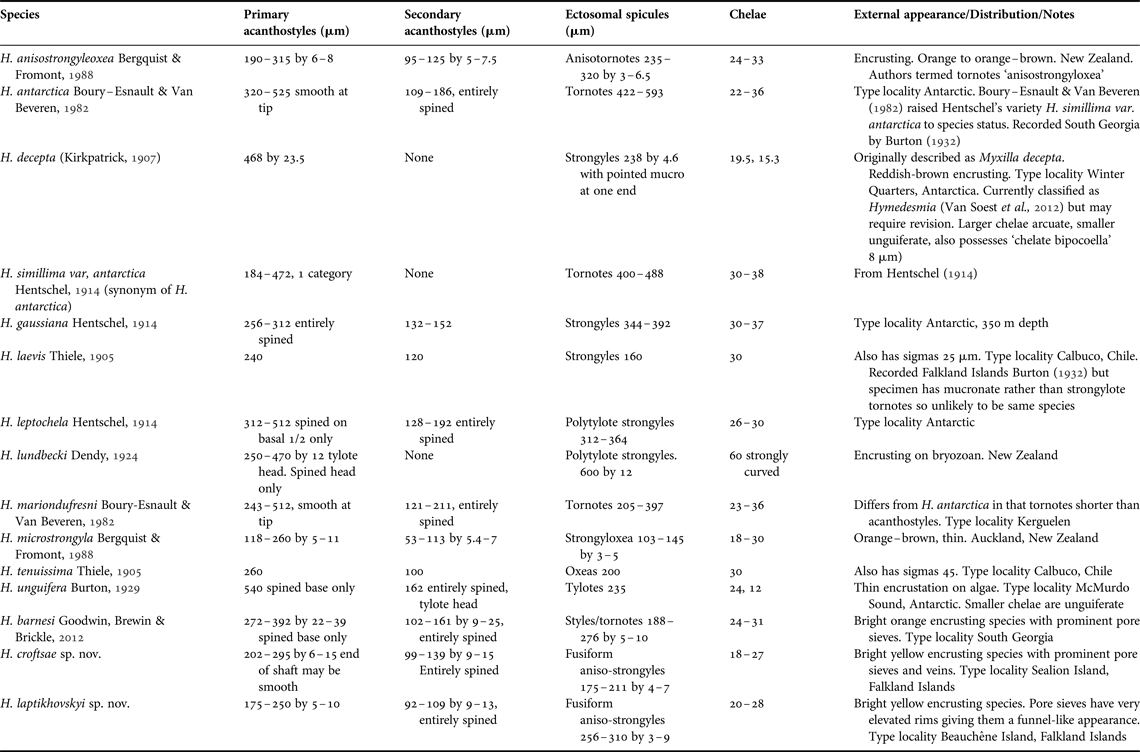
Of the Antarctic and South Atlantic Hymedesmia species which possess strongyle ectosomal spicules this species can be distinguished from H. leptochela Hentschel, Reference Hentschel1914 and H. lundbecki Dendy, Reference Dendy1924 by their much larger acanthostyles, and from H. decepta (Kirkpatrick, Reference Kirkpatrick1907) and H. laevis Thiele, Reference Thiele1905 as they possess other microsclere categories (Table 4). Hymedesmia gaussiana Hentschel, Reference Hentschel1914 has larger acanthostyles (256–312 µm) and strongyles (344–392 µm) and substantially larger chelae (30–37 µm). Hymedesmia laptikhovskyi can be distinguished from H. croftsae sp. nov. as it has curved rather than straight primary and secondary acanthostyles, obviously thinner and shorter anisostrongyles and chelae with a more curved shaft.
Hymedesmia (Hymedesmia) species from the southern Atlantic and Antarctic.
Hymedesmia (Hymedesmia) croftsae sp. nov.
TYPE MATERIAL
Holotype: Sample in 95% ethanol, tissue section and spicule preparation on slides. [BELUM.Mc6369] Shallow Marine Surveys Group Beauchêne and Sea Lion Islands Cruise, Beauchêne Island Site 005, Falkland Islands (52°55.089′S 59°11.304′W; water depth sampled: 15–21.1 m), Collected by C. Goodwin and J. Jones, 23 December 2009.
Etymology
Named after Sarah Crofts, researcher at Falklands Conservation and member of the Shallow Marine Surveys Group ‘Southern Islands’ expedition team.
External morphology ( Figure 6A)
In situ: Bright yellow sponge forming thinly encrusting (<2 mm thick) patches on bedrock. Prominent pore sieves and veins. Specimen measured roughly 20 cm maximum diameter. Preserved in alcohol: thin, pale peach crust with pore sieves visible on ectosome as small dots.
Hymedesmia (Hymedesmia) croftsae sp. nov. (A) In situ appearance Holotype [BELUM.Mc6277], Spicules Holotype [BELUM.Mc6277], (B) large acanthostyle, (C) small acanthostyle, (D) ectosomal strongyle, (E) chelae. All scale bars 10 µm.
Skeleton
Basal layer of acanthostyles and ascending columns of aniso-strongyles up to 15 spicules (100 µm) thick. Chelae scattered throughout tissue and forming a continuous layer at the surface of the ectosome.
Spicules
(1) Primary acanthostyles: 202(251)295 by 6.3(10.2)14.7 µm (Figure 6B), strongly curved with a slightly tylote head. The majority are entirely spined with small spines, but in some specimens the apical quarter to eighth is sparsely spined or lacks spines entirely.
(2) Secondary acanthostyles: 99(113)139 by 8.5(10.1)14.8 µm (Figure 6C). The spicules are often slightly curved. They do not have a tylote head but it is usually more robustly spined than the rest of the shaft. The whole spicule is entirely spined with large spines which are mainly curved back towards the shaft.
(3) Ectosomal fusiform aniso-strongyles: 175(197)211 by 3.8(5.0)6.9 µm (Figure 6D).
(4) Chelae: 18(21)27 µm (Figure 6E). Shaft almost semi-circular in most, however, some specimens have a less pronounced curvature. Alae comparatively small.
Diagnosis
Very similar in spicule size and form to H. laptikhovskyi sp. nov. and can be separated from other Hymedesmia species using the same characteristics (see above, Table 4). Can be distinguished from H. laptikhovskyi sp. nov. as it has straight, fusiform rather than curved primary and secondary acanthostyles, obviously longer and thicker anisostrongyles and chelae without such broadly curved shafts.
Genus Phorbas Duchassaing & Michelotti, 1864
Phorbas ferrugineus Goodwin, Jones, Neely & Brickle, Reference Goodwin, Jones, Neely and Brickle2011
SPECIMENS
Samples in 95% ethanol, tissue section and spicule preparation on slides. [BELUM.Mc6302] Beauchêne Island Site 001; [BELUM.Mc6328], [Mc6331] and [Mc6343] Beauchêne Island Site 003; [BELUM.Mc6352] Beauchêne Island Site 004.
Comparative material examined: Phorbas ferrugineus Goodwin, Jones, Neely & Brickle, Reference Goodwin, Jones, Neely and Brickle2011 slide of Holotype [BELUM.Mc4794].
Remarks
Phorbas ferrugineus is a thinly encrusting rust coloured sponge with dense, high rimmed, pore sieves. It possesses large, partially spined, acanthostyles (225(266)293 by 9.6(12.0)17 µm in the type specimen), entirely spined echinating acanthostyles ((121(141)158 by 5.5(8.2)12.3 µm in type), ectosomal tornotes ((245(289)316 by 3.7(6.0)8.4 µm in type) and chelae with a palmate appearance (20(22)24 µm in type). Our specimens were a good match for the holotype in terms of spicules and external appearance. The type locality is from Steeple Jason in the Jason Islands, NW of the main Falkland Islands. These records demonstrate its presence in the extreme south-east of the Falkland Islands and indicate it is likely to occur throughout the Falkland Islands.
Phorbas shackletoni Goodwin, Jones, Neely & Brickle, Reference Goodwin, Jones, Neely and Brickle2011
SPECIMENS
Samples in 95% ethanol, tissue section and spicule preparation on slides. [BELUM.Mc6348] Beauchêne Island Site 003; [BELUM.Mc6400] Brandy Island.
Comparative material examined: Phorbas shackletoni Goodwin, Jones, Neely & Brickle, Reference Goodwin, Jones, Neely and Brickle2011 slide of Holotype [BELUM.Mc4794].
Remarks
This is a distinctive encrusting sponge which has a characteristic peach colour with closely spaced, irregular pore sieves. It has primary acanthostyles which are spined only on their head (284(322)353 by 7.0(8.9)12.1 µm in the holotype), echinating acanthostyles which are entirely spined with large spines (147(163)182 by 7.7(11.8)15.3 µm in the holotype) and fusiform anisostrongyles (240(290)388 by 4.8(6.0)7.3 µm in the holotype). It does not possess microscleres.
The specimens from this survey were a good match for the holotype in terms of spicules and external appearance. The type locality is Gypsy Cove near Stanley on East Falkland, and Goodwin et al. (Reference Goodwin, Jones, Neely and Brickle2011) found it to be common in this area and in the Jason Islands to the north-west of the Falkland Islands. We found it to be present at the majority of our sampling sites (Table 1), indicating that it is common throughout the Falkland Islands.
Family MYXILLIDAE Dendy, 1922
Genus Myxilla Schmidt, 1862
Subgenus Myxilla (Ectyomyxilla) Hentschel, Reference Hentschel1914
Myxilla (Ectyomyxilla) beauchênensis sp. nov.
TYPE MATERIAL
Holotype: Sample in 95% ethanol, tissue section and spicule preparation on slides. [BELUM.Mc6319] Shallow Marine Surveys Group Beauchêne and Sea Lion Islands Cruise, Beauchêne Island Site 002, Falkland Islands (52°53.994′S 59°10.706′W; water depth sampled: 20–25 m), Collected by C. Goodwin and J. Jones, 20 December 2009.
Paratype: Sample in 95% ethanol, tissue section and spicule preparation on slides. [BELUM.Mc6307] Shallow Marine Surveys Group Beauchêne and Sea Lion Islands Cruise, Beauchêne Island Site 001, Falkland Islands (52°54.665′S 59°11.096′W; water depth sampled: 16–22 m), Collected by C. Goodwin and J. Jones, 20 December 2009.
Etymology
Meaning from Beauchêne Island, the type locality. The island is named after Jacques Gouin de Beauchêne (1652–1730), the French explorer who discovered the island in 1701.
External morphology ( Figure 7A)
In situ: The holotype is a massive bright yellow, lobed sponge with sparse large oscules forming a patch up to 15 cm in diameter which was growing over a kelp holdfast. The paratype is a thickly encrusting yellow sponge with prominent oscules – again encrusting over bedrock around a kelp holdfast. Preserved in alcohol: firm, cream, massive sponge with many spaces visible in the choanosome. The ectosome is shiny and slightly bumpy on the outer surface but not visible as a distinct layer.
Myxilla (Ectomyxilla) beauchênensis sp. nov. (A) In situ appearance Holotype [BELUM.Mc6319], Spicules Holotype [BELUM.Mc6319], (B) choanosomal acanthostyle, (C) ectosomal acanthostyle, (D) tornote, (E) chelae, (F) sigma. All scale bars 10 µm.
Skeleton ( Figure 12D)
Choanosome: An isodictyal reticulation of bundles of up to three acanthostyles. Ectosome: Bundles of ectosomal tornotes fanning out; the ends of these bundles are covered in a tangential layer of acanthostyles. Microscleres scattered throughout choanosome and ectosome.
Spicules
(1) Choanosomal acanthostyles: straight or slightly curved acanthostyles which come to an abrupt smooth point. The rest of the spicule is spined with dense, robust spines (Figure 7B). [BELUM.Mc6319] 184 (201)228 by 8.8(10.6)14.0 µm; [BELUM. Mc6307] 171(190)211 by 8.5(9.6)11.2 µm.
(2) Ectosomal acanthostyles: same in form as the choanosomal acanthostyles, only distinguished by size (Figure 7C). [BELUM.Mc6319] 137(146)161 by 5.8(7.7)8.8 µm; [BELUM.Mc6307] 115(133)148 by 6.3(7.4)8.5 µm.
(3) Tornotes: slightly sinuous. Sometimes one end is rounded and slightly tylote, sometimes both ends sharply pointed (Figure 7D). [BELUM.Mc6319] 195(205)222 by 5.8(7.3)9.5 µm; [BELUM.Mc6307] 171(187)208 by 3.7(5.6)8.2 µm.
(4) Chelae: typical Myxillid tridentate anchorate chelae. (Figure 7E). [BELUM.Mc6319] 11(15)17 µm; [BELUM.Mc6307] 12.8(15.4)18.2 µm.
(5) Sigmas: slightly twisted so the hooked ends are not in the same plane (Figure 7F). [BELUM.Mc6319] 39(45)53 µm; [BELUM.6307] 34.0(42.3)48.0 µm.
Diagnosis
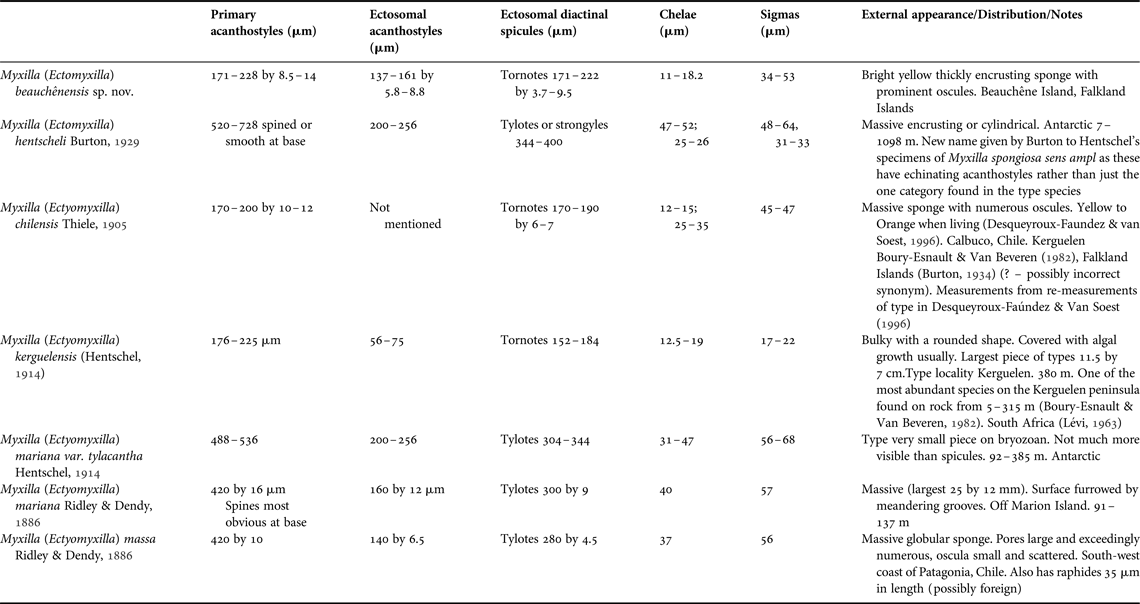
The sub-genus Myxilla (Ectyomyxilla) Hentschel, Reference Hentschel1914 is defined as a Myxilla species with a second category of acanthostyles which may form a surface pallisade as found in this species (Van Soest, Reference Van Soest, Hooper and Van Soest2002a). Of the six species found in the Antarctic and South Atlantic (Table 5) the majority have much larger primary acanthostyles. There are two species with similar size acanthostyles, M. kerguelensis (Hentschel, Reference Hentschel1914) and M. chilensis Thiele, Reference Thiele1905. Myxilla kerguelensis (Hentschel, Reference Hentschel1914) can be distinguished by its smaller sigmas and ectosomal acanthostyles. Myxilla chilensis has similar sized spicules and is described as a massive yellow sponge with numerous oscules (Desqueyroux-Faúndez & Van Soest, Reference Desqueyroux–Faúndez and van Soest1996); it has been described from the Falklands previously by Burton (Reference Burton1932, Reference Burton1934). Burton (Reference Burton1934) and Koltun (Reference Koltun, Pavlovskii, Andriyashev and Ushakov1964) considered M. chilensis as a synonym of M. kerguelensis, but this is not currently regarded as valid (Van Soest et al., Reference Van Soest, Boury-Esnault, Hooper, Rützler, de Voogd, Alvarez de Glasby, Hajdu, Pisera, Manconi, Schoenberg, Janussen, Tabachnick, Klautau, Picton, Kelly, Vacelet, Dohrmann and Cristina Díaz2013). Myxilla chilensis has similar sized acanthostyles and tornotes (Table 5). However, it possesses two distinct categories of chelae (12–15 and 20–35 µm) rather than the one present in our species. Additionally the larger chelae are much bigger than those found in our specimens. The comparatively small size of the chelae and sigmas also distinguish M. beauchênensis from Myxilla (Myxilla) species found in the region.
Myxilla (Ectyomyxilla) species from the south Atlantic and Antarctic.
Subgenus Myxilla (Styloptilon) Cabioch, 1968
Myxilla (Styloptilon) acanthotornota Goodwin, Jones, Neely & Brickle, Reference Goodwin, Jones, Neely and Brickle2011
SPECIMENS
Samples in 95% ethanol, tissue section and spicule preparation on slides. [BELUM.Mc6279] Sea Lion Island Site 002; [BELUM.Mc6292] and [BELUM.Mc6303] Beauchêne Island Site 001; [BELUM.Mc6355] Beauchêne Island Site 004; [BELUM.Mc6366], [BELUM.Mc6368] and [BELUM.Mc6373] Beauchêne Island Site 005; [BELUM.Mc6375] Beauchêne Island Site 006.
Comparative material examined: Myxilla (Styloptilon) acanthotornota Goodwin, Jones, Neely & Brickle, Reference Goodwin, Jones, Neely and Brickle2011, slide of Holotype [BELUM.Mc4778].
Remarks
This species is a thinly encrusting pale yellow sponge which characteristically produces a lot of slime when collected. Its spicule complement includes entirely spined large (217(254)287 by 11.1(13.2)16.0 µm in the holotype) and small (107(125)147 by 7.4(10.2)14.1 µm in the holotype) acanthostyles, very distinctive spined tornotes (176(199)221 by 5.8(7.3)9.0 µm in the holotype), anchorate cheale of two sizes (14(17)21 and 24(29)33 µm in the holotype) and sigmas (33(46)59 µm in the holotype).
Our specimens were a good match for the holotype in terms of spicules and external appearance. The type locality is the Jason Islands to the north-west of the main Falkland Islands. We recorded this species from Sea Lion Island and Beauchêne Island indicating that it may be present throughout the Falklands archipelago. Only three other species are currently assigned to this sub-genus (Van Soest et al., Reference Van Soest, Boury-Esnault, Hooper, Rützler, de Voogd, Alvarez de Glasby, Hajdu, Pisera, Manconi, Schoenberg, Janussen, Tabachnick, Klautau, Picton, Kelly, Vacelet, Dohrmann and Cristina Díaz2013): Myxilla (Styloptilon) ancoratum (Cabioch, 1968), Myxilla (Styloptilon) anchoratum (Bergquist & Fromont, Reference Bergquist and Fromont1988) and Myxilla (Styloptilon) canepai Schejter, Bertolino, Calcinai, Cerrano & Bremec, Reference Schejter, Bertolino, Calcinai, Cerrano and Bremec2011 recently described from the Argentine Sea. However, Hymenancora laevis (Thiele, Reference Thiele1905) and Hymenancora tenuissima (Thiele, Reference Thiele1905) should probably also be included (see Goodwin et al., Reference Goodwin, Jones, Neely and Brickle2011 for discussion). This species can be distinguished from others in the sub-genus by its spined tornotes.
Family TEDANIIDAE Ridley & Dendy, Reference Ridley and Dendy1886
Genus Tedania Gray, 1867
Subgenus Tedania (Tedania) Gray, 1867
Tedania (Tedania) livida sp. nov.
TYPE MATERIAL
Holotype: Sample in 95% ethanol, tissue section and spicule preparation on slides. [BELUM.Mc6294] Shallow Marine Surveys Group Beauchêne and Sea Lion Islands Cruise, Beauchêne Island Site 001, Falkland Islands (52°54.665′S 59°11.096′W; water depth sampled: 16–22 m), Collected by C. Goodwin and J. Jones, 20 December 2009 and 22 December 2009.
Paratypes: Sample in 95% ethanol, tissue section and spicule preparation on slides. [BELUM.Mc6308] Shallow Marine Surveys Group Beauchêne and Sea Lion Islands Cruise, Beauchêne Island Site 001, Falkland Islands (52°54.665′S 59°11.096′W; water depth sampled: 16–22 m), Collected by C. Goodwin and J. Jones, 20 December 2009 and 22 December 2009. [BELUM.Mc6336] Shallow Marine Surveys Group Beauchêne and Sea Lion Islands Cruise, Beauchêne Island Site 003, Falkland Islands (52°54.433′S 59°11.557′W; water depth sampled: 15–17.5 m), Collected by C. Goodwin and J. Jones, 21 December 2009.
Comparative material examined
Tedania murdochi Topsent, Reference Topsent1915 [NMS 2.1921.143.1410] tissue section and spicule preparation slides from the type specimen.
Etymology
From the latin lividus, meaning bruised. Named on account of its mottled, purplish colour.
External morphology ( Figure 8A)
In situ: Thickly encrusting (up to 5 cm) purplish black, mottled sponge with mounded surface, forming large patches (up to 20 cm in diameter) on bedrock. Prominent oscules are situated on the tops of individual mounds or in lines along ridges. When cut the interior of the sponge is yellow. Preserved in alcohol: thin crust with white, firm, but compressible choanosome and a clearly distinct black, smooth, shiny ectosome.
Tedania (Tedania) livida sp. nov. (A) In situ appearance specimen Holotype [BELUM.Mc6294], Spicules Holotype [BELUM.Mc6294], (B) style, (C) ectosomal tornote, (D) large onychaete, (E) large onychaete ends, (F) small onychaete. All scale bars 10 µm.
Skeleton ( Figure 12E)
Wide anastomizing columns of styles 10–20 spicules thick joined by thinner, shorter columns of 1–2 spicules. Columns reinforced by onychaetes. Onychaetes are also present scattered in the choanosome. Ectosomal skeleton projecting bundles of tornotes and onychaetes, fanning out from the end of the choanosomal columns. Surface layer visible as dense black pigmented layer on slide.
Spicules
(1) Choanosomal styles: smooth with an abrupt point (Figure 8B). [BELUM.Mc6294] 227(246)276 by 6.2(7.8)9.8 µm; [BELUM.Mc6308] 230(240)257 by 6.2(7.4)9.2 µm; [BELUM. Mc6336] 198(225)258 by 5.4(7.2)8.9 µm.
(2) Ectosomal tornotes: bluntly pointed at both ends (Figure 8C). [BELUM.Mc6294] 189(214)233 by 4.0(5.4)7.4 µm; [BELUM.Mc6308] 194(214)235 by 4.2(5.0)6.3 µm; [BELUM. Mc6336] 183(204)219 by 4.6(5.8)7.0 µm.
(3) Onychaetes: two categories: large (Figure 8D, E) and small (Figure 8F). [BELUM.Mc6294] 131(142)160 and 38(44)54 by 1.1(1.5)2.0 µm; [BELUM.Mc6308] 129(146)170 and 41(49)56 and by 0.6(1.3)2.2 µm; [BELUM.Mc6336] 126(133)140 and 32(42)56 by 0.7(1.6)2.5 µm.
Diagnosis
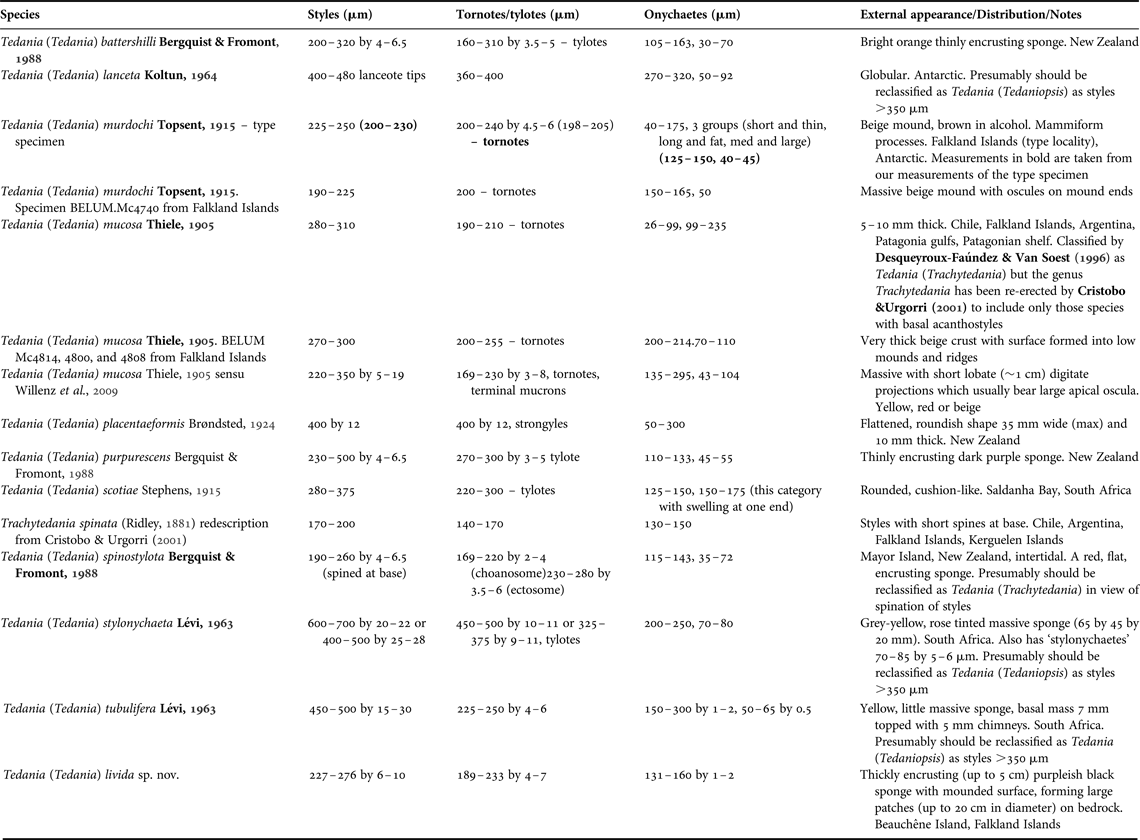
Desqueyroux-Faúndez & Van Soest (Reference Desqueyroux–Faúndez and van Soest1996) reassessed the genera Tedania and Trachytedania and reclassified the species present into three sub-genera: Tedania (Tedaniopsis) with long styles 300–700 µm, Tedania (Tedania) with short styles 150–300 µm and mucronate tornotes, and Tedania (Trachytedania) with smooth or spined short styles 150–300 µm and oxeote or mucronate tornotes (see also Van Soest, Reference Van Soest, Hooper and Van Soest2002b). The redescription of Tedania (Trachytedania) was based on the fact that no basal acanthostyles, the characterizing feature of the genus, could be found in the type species. Trachytedania has since been re-established as a valid genus by Cristobo & Urgorri (Reference Cristobo and Urgorri2001) who re-examined the type and located basal acanthostyles. This species conforms to the current definition of Tedania (Tedania) as it possesses styles shorter than 300 µm (Desqueyroux-Faúndez & Van Soest, Reference Desqueyroux–Faúndez and van Soest1996).
This species can be distinguished from most in the region by its comparatively short styles and tornotes (Table 6). However, its spicules are similar in size to two species which are found in the Falkland Islands: T. mucosa and T. murdochi. Tedania mucosa Thiele, Reference Thiele1905 has similar size tornotes but larger styles and onychaetes, and also differs in external appearance and colour; Falkland Islands specimens of T. mucosa are beige coloured whereas those reported recently from Chile are beige, yellow or red (Willenz et al., Reference Willenz, Hajdu, Desqueyroux-Faúndez, Lôbo-Hajdu, de Souza Carvalho, Häussermann and Försterra2009). Tedania murdochi Topsent, Reference Topsent1915 differs in external appearance, being a massive beige mound. It has thinner and slightly shorter styles, thinner columns of styles in the choanosome, and in the ectosome the pallisade of tornotes is rather confused and unpigmented whereas in T. livida sp. nov. the tornotes fan neatly out in brushes from the end of the columns of styles and the layer is heavily pigmented, clearly visible as a darker layer on the microscope preparation.
Tedania (Tedania) species from the southern Atlantic and Antarctic.
Tedania (Tedania) mucosa Thiele, Reference Thiele1905
SPECIMENS
All samples in 95% ethanol, tissue section and spicule preparation on slides. [BELUM.Mc6293], [BELUM.Mc6304] and [BELUM.Mc6309] Beauchêne Island Site 001.
Remarks
These specimens are a good match in terms of spiculation and external form to those from this area classified as Tedania (Tedania) mucosa Thiele, Reference Thiele1905 by Goodwin et al. (Reference Goodwin, Jones, Neely and Brickle2011). These specimens, recorded from the Jason Islands to the north-west of the Falklands, were thickly encrusting, beige sponges with large oscules on low mounds or ridges. The species is characterized by the possession of comparatively small styles, tornotes and two categories of onychaetes (Table 6).
The type locality of T. mucosa is Calbuco on the west coast of Chile. The species has also been recorded from deep water off the Argentine coast (Burton, Reference Burton1934, Reference Burton1940; Cuartas, Reference Cuartas1986, Reference Cuartas1992; Desqueyroux-Faúndez & Van Soest, Reference Desqueyroux–Faúndez and van Soest1996), the Strait of Magellan (Sarà et al., Reference Sarà, Balduzzi, Barbieri, Bavestrello and Burlando1992), the Chilean coast and the Falkland Islands (Desqueyroux, Reference Desqueyroux1972), and Chilean Patagonia (Willenz et al., Reference Willenz, Hajdu, Desqueyroux-Faúndez, Lôbo-Hajdu, de Souza Carvalho, Häussermann and Försterra2009). Differences in spiculation of Tedania species from this region can be very small (Table 6) and in the future, external appearance may be of use in distinguishing species. Our specimens are pale beige-grey, lobose and encrusting in contrast to the digitate yellow, red or beige forms reported by Willenz et al. (Reference Willenz, Hajdu, Desqueyroux-Faúndez, Lôbo-Hajdu, de Souza Carvalho, Häussermann and Försterra2009). This could indicate that the current definition encompasses a complex of closely related species.
Suborder MYCALINA Hajdu, Van Soest & Hooper, 1994
Family ESPERIOPSIDAE Hentschel, 1923
Genus Amphilectus Vosmaer, 1880
Amphilectus fimbriatus sp. nov.
TYPE MATERIAL
Holotype: Sample in 95% ethanol, tissue section and spicule preparation on slides. [BELUM.Mc6357] Shallow Marine Surveys Group Beauchêne and Sea Lion Islands Cruise, Beauchêne Island Site 004, Falkland Islands (52°53.691′S 59°10.617′W; water depth sampled: 12–15 m), Collected by C. Goodwin and J. Jones, 21 December 2009.
Paratypes: Samples in 95% ethanol, tissue section and spicule preparation on slides. [BELUM.Mc6291] and [BELUM.Mc6305] Shallow Marine Surveys Group Beauchêne and Sea Lion Islands Cruise, Beauchêne Island Site 001, Falkland Islands (52°54.665′S 59°11.096′W; water depth sampled: 16–22 m), Collected by C. Goodwin and J. Jones, 20 December 2009 and 22 December 2009.
Comparative material examined
Amphilectus fleeci Goodwin, Jones, Neely & Brickle, Reference Goodwin, Jones, Neely and Brickle2011 Holotype [BELUM.Mc4715] section and spicule preparation.
Etymology
From the latin fimbriatus meaning fringed.
External morphology ( Figure 9A, B)
In situ: White to pale yellow massively encrusting sponge in the form of circular lobe (Mc6291, Mc6305) or ridge (Mc6357). Encrusting in patches up to 15 cm in maximum diameter on bedrock. The ends of skeletal columns protrude through the surface giving the sponge a delicately hispid appearance (Figure 9B). Large oscules are present at the centre of lobe or ridge.
Amphilectus fimbriatus sp. nov. (A) In situ appearance Holotype [BELUM.Mc6357], (B) close-up of surface hispidation, Spicules Holotype [BELUM.Mc6357], (C) style, (D) chela. All scale bars 10 µm.
Preserved in alcohol: cream coloured, firm but compressible, massive sponge with many spaces in choanosome. No distinct ectosomal layer, but surface is very hispid from projecting columns of spicules that are clearly visible to naked eye.
Skeleton ( Figure 12F)
Anastomizing ascending columns of styles 6–10 spicules thick. The ends of these bundles project through the sponge surface, giving the sponge its hispid appearance. Chelae are scattered throughout tissue.
Spicules
(1) Styles: gently curved styles which come to an abrupt point (Figure 9C). [BELUM.Mc6357] 303(379)436 by 6.3(10.1)13.9 µm; [BELUM.Mc6291] 352(384)419 by 10.4(12.5)16.6 µm; [BELUM.Mc6305] 350(406)461 by 7.8(10.7)14.4 µm.
(2) Palmate isochelae (Figure 9D): [BELUM.Mc6357] 26(33)38 µm; [BELUM.Mc6291] 21.9(28.5)34.1 µm; [BELUM.Mc6305] 25.0(30.0)34.5 µm.
Diagnosis
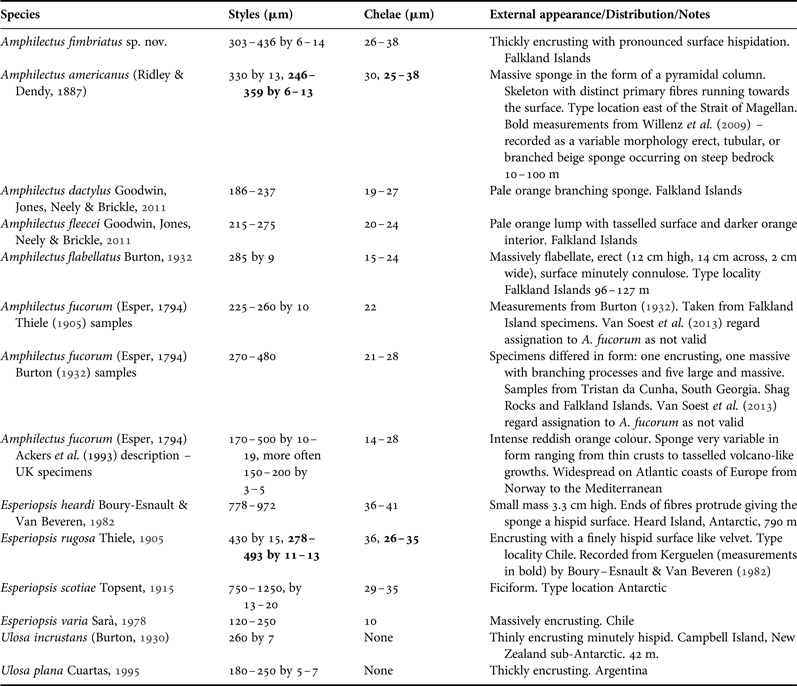
Amphilectus Vosmaer, 1880 is currently defined as an Esperiopsidae with a ladder-like skeleton of ascending and interconnecting spicule tracts. Usually the microscleres are only small palmate microchelae and no sigmas are present, the megascleres being small styles under 400 µm. Esperiopsis is used in the sense of Burton (Reference Burton1929) for species conforming to Esperia villosa; these have an anastomizing plumoreticulate skeleton of thick spicule tracts of large mycalostyles. Microscleres can include up to three categories of palmate isochelae and two categories of sigmas. The genus Amphilectus is considered by many authors to be a synonym of Esperiopsis, and species within these genera require thorough revision (Van Soest & Hajdu, Reference Van Soest, Hajdu, Hooper and Van Soest2002). We have tentatively defined this species as Amphilectus on the basis of its small style size and the presence of only one small category of isochelae.
This species can be distinguished from most other species of Amphilectus or Esperiopsis present in the South Atlantic and Antarctic by its distinctive surface (Table 7). Esperiopsis heardi Boury–Esnault & Van Beveren, Reference Boury-Esnault and Van Beveren1982 does have a similar surface appearance but possesses much larger spicules (styles 778–972 µm).
Amphilectus and Ulosa species from the southern Atlantic and Antarctic.
Ulosa is currently defined as an Esperiopsidae with a skeleton of polyspicular fibres in a rectangular or polygonal reticulation. No specialized external skeleton is present but the surface is hispid due to the projection of spicule tracts. However, the spicules are styles only with no microscleres (Van Soest & Hajdu, Reference Van Soest, Hajdu, Hooper and Van Soest2002), thus distinguishing all Ulosa species from our specimen. Our specimens are very similar in appearance to the well characterized European species Ulosa stuposa (Esper, 1794) which also has a surface with small hispidations or branches. It would seem logical that as in other Esperiopsidae genera chelae microscleres could be present, and revision of this family would be useful. The majority of the 15 valid Ulosa species are from Europe (Van Soest et al., Reference Van Soest, Boury-Esnault, Hooper, Rützler, de Voogd, Alvarez de Glasby, Hajdu, Pisera, Manconi, Schoenberg, Janussen, Tabachnick, Klautau, Picton, Kelly, Vacelet, Dohrmann and Cristina Díaz2013) although two species have been recorded from the Falklands or biogeographically related areas (Table 7); Ulosa incrustans (Burton, Reference Burton1930) (as Axinosia incrustans) from Campbell Island, New Zealand sub-Antarctic and Ulosa plana Cuartas, Reference Cuartas1995 from Argentina. Ulosa incrustans is a thinly encrusting minutely hispid species with styles 260 by 7 µm and U. plana is a thickly encrusting species with styles 180–250 by 5–7 µm.
Amphilectus fleecei Goodwin, Jones, Neely & Brickle, Reference Goodwin, Jones, Neely and Brickle2011
SPECIMENS
All samples in 95% ethanol, tissue section and spicule preparation on slides. [BELUM.Mc6295] and [BELUM.Mc6360] Beauchêne Island Site 001; [BELUM.Mc6379] Beauchêne Island Site 006; [BELUM.Mc6428] Triste Island.
Remarks
This sponge was described from numerous specimens collected around Stanley on East Falkland and the Jason Islands (north-west Falklands). It is described as a thickly encrusting creamy-yellow cushion which bears prominent oscules on the tips of raised projections. It has styles (215(237)275 by 7.9(10.4)13.2 µm in the holotype) and palmate isochelae (20(22)24 µm in the holotype). These specimens are a good match for the type in terms of spicules and external form, however, they were pale peach rather than yellow in colour. Reviewing images of the paratypes of A. fleecei shows that there is some variation in colour with specimens ranging from creamy-yellow to peach in colour. These records extend the known range of this species, which was first recorded from Stanley and the Jason Islands in the Falklands. It appears to be widespread and common in the Falkland Islands.
Suborder MYCALINA Hajdu, Van Soest & Hooper, 1994
Family ISODICTYIDAE Dendy, Reference Dendy1924
Genus Isodictya Bowerbank, 1864
Isodictya cutisanserina sp. nov.
TYPE MATERIAL
Holotype: Sample in 95% ethanol, tissue section and spicule preparation on slides. [BELUM.Mc6298] Shallow Marine Surveys Group Beauchêne and Sea Lion Islands Cruise, Beauchêne Island Site 001, Falkland Islands (52°54.665′S 59°11.096′W; water depth sampled: 16–22 m), Collected by C. Goodwin and J. Jones, 20 December 2009 and 22 December 2009.
Paratypes: Samples in 95% ethanol, tissue section and spicule preparation on slides. [BELUM.Mc6301] Shallow Marine Surveys Group Beauchêne and Sea Lion Islands Cruise, Beauchêne Island Site 001, Falkland Islands (52°54.665′S 59°11.096′W; water depth sampled: 16–22 m), Collected by C. Goodwin and J. Jones, 20 December 2009 and 22 December 2009; [BELUM.Mc6313] Shallow Marine Surveys Group Beauchêne and Sea Lion Islands Cruise, Beauchêne Island Site 002, Falkland Islands (52°53.994′S 59°10.706′W; water depth sampled: 20–25 m), Collected by C. Goodwin and J. Jones, 20 December 2009.
Other specimens: [BELUM.Mc6320] Beauchêne Island Site 002; [BELUM.Mc6334] Beauchêne Island Site 003.
Etymology
From the medical term cutis anserina (literally translated: goose flesh), commonly known as goose bumps. The small papillae on the surface of the sponge resemble this.
Comparative material examined
Alcohol-preserved specimen Isodictya kerguelensis [BMNH 28.2.15.439 RN XXVI XI], Station WS 79. Tissue section on slide.
External morphology ( Figure 10A)
Bright yellow sponge with papillate surface. May take the form of a thick crust or lobes with prominent oscules. In lobed specimens, such as the type specimen, the oscules are placed on the tops of the lobes and may form lines. Preserved in alcohol: pale brown massive sponge, pale brown, compressible choanosome with many spaces and slightly darker brown, shiny, hispid, ectosomal layer. Hair-like columns of spicules which project from the ectosome are visible to naked eye.
Isodictya cutisanserina sp. nov. Holotype [BELUM.Mc6298] (A) In situ appearance, (B) spicules (scale bar 100 µm), (C) chelae (scale bar 10 µm), (D) choanosomal skeleton (scale bar 1000 µm), (E) ectosomal connule formed by protruding end of skeletal fibre (scale bar 1000 µm).
Skeleton
Fat columns of oxea (~20 spicules) in a loose reticulation (Figure 10D). The ends of fibres protrude through the surface (Figure 10E). There are many loose oxea between the fibres: some of these have a much thinner diameter and are shorter in length than the main oxea, and can be curved or flexuous.
Spicules ( Figure 10B, C)
(1) Fat oxeas: often slightly bent with abrupt points: [BELUM.Mc6298] 240(272)292 by 6.8(10.2)12.9 µm; [BELUM.Mc6301] 285(295)301 by 10.8(11.8)13.9 µm; [BELUM.Mc6313] 272(293)319 by 6.4(8.4)10.1 µm.
(2) Thin oxeas: same form as fat oxeas but much narrower. [BELUM.Mc6298] 201(226)255 by 3.2(4.7)6.0 µm; [BELUM.Mc6301] 203(235)261 by 1.9(3.6)6.7 µm; [BELUM.Mc6313] 178(219)292 by 1.3(2.8)5.1 µm.
(3) Chelae: palmate isochelae (Figure 10C): [BELUM.Mc6298] 23(27)31 µm; [BELUM.Mc6301] 20.7(24.1)28.5 µm; [BELUM.Mc6313] 21.9(24.2)26.4 µm.
Diagnosis
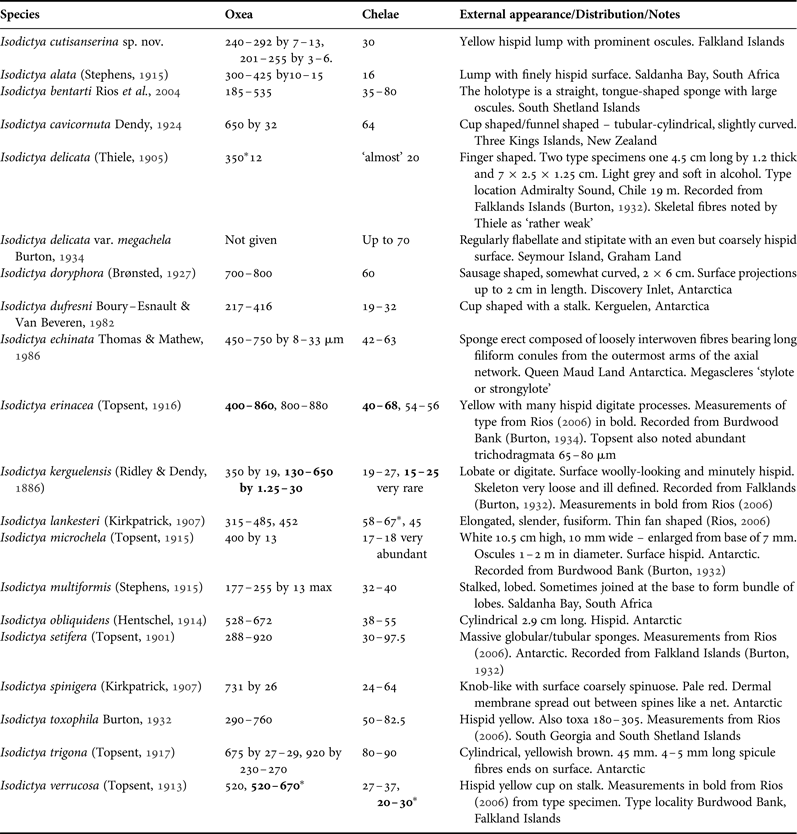
Nineteen valid species of Isodictya are present in the Antarctic and South Atlantic and several have been recorded from the Falkland Islands, although usually in deeper offshore waters (Burton, Reference Burton1932) (Table 8). This species may be distinguished from most by its much smaller spicules. Isodictya delicata (Thiele, Reference Thiele1905) has oxea which are only slightly larger (350 µm). However, this species has smaller chelae (‘almost’ 20 µm) and is small and soft textured with ‘rather weak’ skeletal fibres whereas our specimens are robust with thick skeletal fibres. Isodictya kerguelensis (Ridley & Dendy, Reference Ridley and Dendy1886) has a similar appearance and similar length spicules (styles 350 µm, chelae 19–27 µm noted in the type description). However, comparison with the type revealed that the spicules of I. kerguelensis are significantly longer and more robust.
Isodictya species from the southern Atlantic and Antarctic.
*Larger chelae are an odd elliptical form. Antarctic
Family MYCALIDAE Lundbeck, 1905
Genus Mycale Gray, 1867
Subgenus Mycale (Aegogropila) Gray, 1867
Mycale (Aegogropila) nodulosa Goodwin, Jones, Neely & Brickle, Reference Goodwin, Jones, Neely and Brickle2011
SPECIMENS
Samples in 95% ethanol, tissue section and spicule preparation on slides. [BELUM.Mc6329] [BELUM.Mc6333] [BELUM.Mc6337] and [BELUM.Mc6344] Beauchêne Island Site 003.
Remarks
The type specimen is a massive, pale cream sponge with a mounded surface. The sponge surface bears distinctive, small, lumpy projections. The overall appearance of the sponge is very distinctive and we provisionally identified these specimens from photographs – this was confirmed with microscopic examination. These specimens are a good match for the type specimen in terms of spicules although some of their mycalostyles were faintly polytylote. This sponge was only previously known from the type location: Doctor's Point in Stanley. This extends the known distribution of this species significantly to the south.
Order HALICHONDRIDA Gray, 1867
Family DICTYONELLIDAE Van Soest, Diaz & Pomponi, 1990
Genus Scopalina Schmidt, 1862
Scopalina bunkeri Goodwin, Jones, Neely & Brickle, Reference Goodwin, Jones, Neely and Brickle2011
Remarks
This sponge is a thinly encrusting species with a distinctive rusty red colour and spiky surface. Consequently, it is possible to recognize in situ as no other local species share these characteristics. The type locality of this species is the Jason Islands, north-west of West Falkland. We recorded it from Sea Lion Island (photographic record) indicating that it is widespread but not very common in the Falkland Islands.
Scopalina erubescens Goodwin, Jones, Neely & Brickle, Reference Goodwin, Jones, Neely and Brickle2011
Remarks
This sponge is an encrusting species with a distinctive peach colour and connulose surface, it is possible to recognize in situ as no other local species share these characteristics. The type locality of this species is Stanley, East Falkland and the Jason Islands, north-west of West Falkland. It was recorded at two sites on Sea Lion Island and five out of the six sites at Beauchêne Island (from photographic records). It is a large conspicuous species and can dominate the seabed in some areas. These new records indicate it is widespread and common in the Falkland Islands.
Family HALICHONDRIIDAE Gray, 1867
Genus Halichondria Fleming, 1828
Subgenus Halichondria (Eumastia) Schmidt, 1870
Halichondria (Eumastia) attenuata Topsent, Reference Topsent1915
SPECIMENS
All samples in 95% ethanol, tissue section and spicule preparation on slides. [BELUM.Mc6327] and [BELUM.Mc6346] Beauchêne Island Site 003; [BELUM.Mc6371] Beauchêne Island Site 005; [BELUM.Mc6387] Sealion Easterly; [BELUM.Mc6415] East Sea Lion.
Remarks
Halichondria (Eumastia) attenuata is a large conspicuous sponge easily recognized in situ by its pale lemon colour and well-developed papillae. However, preserved specimens may be more difficult to recognize as the species only possesses oxea spicules. This species seems to be fairly widespread and common in the Falkland Islands with records from the Jason Islands to the north-west of West Falkland (Goodwin et al., Reference Goodwin, Jones, Neely and Brickle2011); Berkeley Sound and Port Louis, from depths of 0–16 m, on East Falkland (Burton (Reference Burton1932, Reference Burton1934) and Beauchêne Island and the Sea Lion Islands (this survey).
There are additional records of this species from South Georgia Island (Burton, Reference Burton1934) and Bransfield Strait, Antarctica (Campos et al., Reference Campos, Mothes and Veitenheimer Mendes2007). However, the Bransfield Strait specimen does not possess the well-developed papillae and specialized ectosomal skeleton characteristic of Halichondria (Eumastia). Additionally, although the spicule size range is similar, the form of the oxeas differs in that they taper smoothly to conical points rather than being abruptly pointed, and they are straight rather than bent. Therefore these specimens are likely to be a different species. Little information is given on the specimens from South Georgia (Burton, Reference Burton1934). However, a recent survey of the shallow water sponge fauna (Goodwin et al., Reference Goodwin, Brewin and Brickle2012) did not find H. attenuata or any other Falkland species, indicating that the islands' faunas are likely to be distinct; therefore it is possible that Burton, having few characters to go on, also misidentified his specimens. If this is the case the known range of H. attenuata is currently restricted to the Falkland Islands.
Order HAPLOSCLERIDA Topsent, 1928
Suborder HAPLOSCLERINA Topsent, 1928
Family CALLYSPONGIIDAE de Laubenfels, 1936
Genus Siphonochalina Schmidt, 1868
Siphonochalina fortis Ridley, Reference Ridley1881
SPECIMENS
All samples in 95% ethanol, tissue section and spicule preparation on slides. [BELUM.Mc6386] Sea Lion Island Site 004; [BELUM.Mc6391] Sealion Easterly; [BELUM.Mc6393] Brandy Island; [BELUM.Mc6425] Triste Island.
Remarks
This species is a white to pale purple branching sponge with branches formed of hollow tubes bearing terminal oscules. The sponge has a distinctive hard, fibrous texture, abundant sponging in fibre meshwork, and small oxea spicules (47–71 by 2–8.1 µm) reported from previous Falkland specimens (Goodwin et al., Reference Goodwin, Jones, Neely and Brickle2011). The species was originally described from Portland Bay, near Madre-de-Dios Island, Chile (Ridley, Reference Ridley1881), and has also been recorded from the coast of Argentina (Burton, Reference Burton1940; Cuartas, Reference Cuartas1991, Reference Cuartas, Boschi and Cousseau2004) and in the Falkland Islands (Port William, Port Albemarle and William Scoresby stations 72 (NE East Falkland), 83 (west of George Island, East Falkland), 84 (west of Sea Lion Island) and 86 (south of Falkland Islands) (Burton, Reference Burton1932, Reference Burton1934)). Recent records are from the Jason Islands and Stanley in the Falkland Islands (Goodwin et al., Reference Goodwin, Jones, Neely and Brickle2011). Depth range of previous Falkland records are from 17–147 m. This species seems to be quite common in the main Falkland Islands group but interestingly was not recorded at Beauchêne Island.
Family NIPHATIDAE Van Soest, 1980
Genus Amphimedon Duchassaing & Michelotti, 1864
Amphimedon maresi (Sarà, Reference Sarà1978)
SPECIMENS
Samples in 95% ethanol, tissue section and spicule preparation on slides. [BELUM.Mc6299] Beauchêne Island Site 001; [BELUM.Mc6311] Beauchêne Island Site 002; [BELUM.Mc6335] Beauchêne Island Site 003.
External morphology ( Figure 11A)
In situ: Pale orange sponge composed of lobes with terminal oscules with a slightly bumpy surface. In the smaller specimens groups of 2–3 lobes join to form flattened branches. In the larger specimen (BELUM.Mc6335) some of these have coalesced to form a more solid mass. Preserved in alcohol: pale cream massive sponge. Choanosome very soft, composed of network of spicule fibres with very little tissue in between. Ectosome slightly shiny, smooth but porous with several large oscules with smooth, slightly raised rims.
Amphimedon maresi (Sarà, Reference Sarà1978). [BELUM.Mc6335]. (A) In situ appearance, (B) skeleton (scale bar 1000 µm), (C) spicules (scale bar 200 µm).
Light microscope images of skeleton of holotypes, ectosome to top (scale bars 1000 µm). (A) Iophon roseum sp. nov., (B) Clathria (Microciona) tenebrosa sp. nov., (C) Clathria (Microciona) cheeki sp. nov., (D) Myxilla (Ectomyxilla) beauchênensis sp. nov. (choanosoame only), (E) Tedania (Tedania) livida sp. nov., (F) Amphilectus fimbriatus sp. nov.
Skeleton ( Figure 11B)
Regular reticulate skeleton with columns of oxeas 7–8 spicules thick. Thinner oxeas are present in the choanosome between the spicule tracts.
Spicules ( Figure 11C)
Oxea: Sharply pointed oxea, often with one or more angular bends along their length. Very variable in width. [BELUM.Mc6299] 162(195)227 by 3.8(7.8)12.4 µm; [BELUM.Mc6311] 163(185)217 by 3.2(5.2)7.8 µm; [BELUM.Mc6335]143(192)216 by 5.4(8.0)9.6 µm.
Remarks
Amphimedon maresi (Sarà, Reference Sarà1978) was first described as Pachychalina maresi from Isla de los Estados, on the tip of Argentina. The type specimen is a massive sponge (9 × 3 × 4 cm) consisting of several fused lobes with oxea 160–200 by 2–6 µm and a reticulate skeleton of primary fibres 40–100 µm in diameter and secondary 10–40 µm. This species has been recorded by Willenz et al. (Reference Willenz, Hajdu, Desqueyroux-Faúndez, Lôbo-Hajdu, de Souza Carvalho, Häussermann and Försterra2009) from the SE Pacific Chilean coasts and the Straits of Magellan from 0–20 m. Willenz et al. (Reference Willenz, Hajdu, Desqueyroux-Faúndez, Lôbo-Hajdu, de Souza Carvalho, Häussermann and Försterra2009) record spicule dimensions as 150–265 by 3–8 µm. They note that the oscules are sometimes formed into large trumpet-like structures, but we did not find these in our specimens. The specimens figured are otherwise similar in form but are a slightly brighter orange in colour. This is the first record for the Falkland Islands.
DISCUSSION
Nine sponge species new to science were identified by this study, and the range of one was notably expanded. Worldwide, Porifera remain a historically understudied group and the potential for discovery of new species is high; although only 8553 valid recent sponge species are currently recognized, at current discovery rates, this is predicted to increase to around 12 000 by the end of the current century (Van Soest et al., Reference Van Soest, Boury-Esnault, Vacelet, Dohrmann, Erpenbeck, De Voogd, Santodomingo, Vanhoorne, Kelly and Hooper2012). Knowledge of the Porifera of the south-west Atlantic is particularly fragmentary, with large areas having never been previously sampled (Lopez & Landoni, Reference Lopez Gappa and Landoni2005). Although the Falkland Islands are comparatively well sampled for this region, sampling has been largely from deep water, and the shallow water sponge fauna remains poorly known. Other studies have indicated that many of the encrusting sponges of shallow bedrock habitats remain undescribed, even in intensively studied areas (Picton & Goodwin, Reference Picton and Goodwin2007; Goodwin & Picton, Reference Goodwin and Picton2009). Many of the species described here were encrusting on bedrock, a habitat unlikely to have been sampled effectively by the previous surveys which sampled by dredging and trawling.
Of the 21 species recorded in this survey, nine are new species, 11 have been found in other regions of the Falklands, and four have been found regionally in the South Atlantic. A comparison between this study and that using identical methodology in South Georgia (Goodwin et al., Reference Goodwin, Brewin and Brickle2012) demonstrated zero overlap in sponge fauna. Confirmation of biogeographic patterns requires further sampling, both around the archipelago and throughout the region.
The degree of affinity of Antarctic and sub-Antarctic marine flora and fauna is a subject of debate. For most groups, the regions are regarded as distinct, with the Antarctic Polar Front, detectable as deep as 1000 m, forming a natural barrier (Griffiths, Reference Griffiths2010; Campos et al., Reference Campos, Bassoi, Nakayama, Valentin, Lavrado, Menot and Sibuet2011). For Porifera, Sarà et al. (Reference Sarà, Barbieri, Bavestrello and Burlando1992) reported a high degree of affinity between regions attributed to the faunal exchanges along the Scotia Arc, whereas Rios (Reference Rios2006) viewed the Magellanic region as a distinct biogeographic entity. Burton (Reference Burton1932, Reference Burton1934) reports many sponge species from both the Antarctic and sub-Antarctic and the Falkland Islands, and analysis by Downey et al. (Reference Downey, Griffiths, Linse and Janussen2012), including Burton's data, also revealed a strong faunistic link between the South American and Antarctic biogeographic regions, with South Georgia and the Shag Rocks (SE of Falkland Islands) representing a region of overlap. However, no Antarctic species were reported from this study, and we suspect that the species found here that have also been recorded below the Polar Frontal Zone (Halichondria (Eumastia) attenuata from South Georgia (Burton, Reference Burton1934) and Bransfield Strait in Antarctica (Campos et al., Reference Campos, Mothes and Veitenheimer Mendes2007), and Haliclona (Soestella) chilensis from the South Shetland Islands (Campos et al., Reference Campos, Mothes and Veitenheimer Mendes2007)), may have been misidentified in those studies.
Whilst it was previously supposed that many southern Atlantic and Antarctic sponges were eurybathic, Downey et al. (Reference Downey, Griffiths, Linse and Janussen2012) demonstrated that only 19% have been shown to have a depth range of over 500 m. Given their restricted larval distribution (Maldonado & Young, Reference Maldonado and Young1996; Maldonado & Bergquist, Reference Maldonado, Bergquist, Young, Sewell and Rice2002), this would probably prevent dispersal of shallow water species across the bathyal depths separating the Falkland Islands from the Antarctic, but allow movement between the Falkland Islands and continental South America across the shallower Argentine shelf. Deeper water or eurybathic species would be able to cross bathyal depths, and therefore the deep-water sponge faunas of the Falklands and South America may be more closely related to that of the Antarctic: studies of a deep water canyon (360 m) off Argentina have found a sponge fauna differing significantly from the shallow water habitats adjacent to it, including Antarctic species not known from the region (Bertolino et al., Reference Bertolino, Schejter, Calcinai, Cerrano, Bremec, Custódio, Lôbo–Hajdu, Hajdu and Muricy2007).
Within the Falklands, some sponge species appear to be widespread while others are more locally endemic. Several recently described species from the north-west of the Falklands (Goodwin et al., Reference Goodwin, Jones, Neely and Brickle2011) were recorded in the southern islands, indicating that many of these are widely distributed in the Falkland Islands. However, the nine new species, some of which were conspicuous and common, had not been recorded from the Jason Islands or Stanley (Goodwin et al., Reference Goodwin, Jones, Neely and Brickle2011), and several species known from the Jason Islands and Stanley (e.g. Halichondria (Eumastia) herinacea Goodwin et al., Reference Goodwin, Jones, Neely and Brickle2011, Lissodendoryx (Ectyodoryx) aurantiaca Goodwin et al., Reference Goodwin, Jones, Neely and Brickle2011, and Lissodendoryx (Ectyodoryx) jasonensis Goodwin et al., Reference Goodwin, Jones, Neely and Brickle2011) were not found. The sub-Antarctic waters which influence the south-eastern Falkland Islands are distinct from the temperate influences on the north-west (Arkhipkin et al., Reference Arkhipkin, Brickle and Laptikhovsky2013). Biogeographic differences between the regions have been demonstrated for fish and squid (Arkhipkin et al., Reference Arkhipkin, Brickle and Laptikhovsky2013) with the south-east being associated with sub-Antarctic species. The sponge faunas could also thus be expected to differ. High levels of regional endemism in sponges have been shown in other areas, with oceanographic circulation and sea surface temperature demonstrated as important factors in shaping zoogeographic affinities (Xavier & van Soest, Reference Xavier and van Soest2012).
The fact that some species with few spicule characters may have been misidentified in previous expeditions complicates our understanding of the true biogeographic ranges of South Atlantic sponge species. Many species are incorrectly regarded as widely distributed as a result of over-conservative systematic traditions (Xavier & van Soest, Reference Xavier and van Soest2012). Use of in situ morphology and molecular tools as needed, along with broader local and regional surveying will aid in correct identification and improve our knowledge of species and regional biogeography.
ACKNOWLEDGEMENTS
We would like to thank Amy Romanes, Fiona Ware and Susan Chambers (National Museums of Scotland); Clare Valentine, Andrew Cabrinovic and Emma Sherlock (Natural History Museum London); and Bernard Picton (Ulster Museum, National Museums Northern Ireland) for providing access to their collections. Spicule comparison was greatly facilitated by the loan of a comparison microscope from Forensic Science Northern Ireland. Several researchers have provided comments on aspects of identification; we would like to particularly thank Eduardo Hajdu, Rob Van Soest and Bernard Picton for their assistance. Special thanks are due to the other members of the Shallow Marine Surveys Group ‘Southern Islands’ expedition team (Celine Blanchard, Jude Brown, Steve Brown, Steve Cartwright, Martin Collins, Sarah Crofts, Wetjens Dimmlich, Vladimir Laptikhovsky, Charlie Maine, Dion Poncet and Alastair Wilson). Four anonymous reviewers greatly contributed to the manuscript.
FUNDING
Support for travel to the Falkland Islands was provided by the Shackleton Scholarship Fund and the John Cheek Trust. Funding for the Shallow Marine Surveys Group Expedition work was provided by the Overseas Territories Environment Programme (Grant FK501) and the Falkland Islands Government. Claire Goodwin was supported by additional funding from the Esmée Fairbairn Foundation/Scottish Natural Heritage and Countryside Council for Wales funded ‘Sponge Biodiversity of the UK’ project.