From household chemical exposures and swimming pool incidents to chemical warfare and industrial accidents, chlorine gas causes thousands of people to seek medical attention annually.Reference Mowry, Spyker, Cantilena, Bailey and Ford 1 Large-scale toxic inhalation injuries caused by pulmonary irritants are uncommon, but they have and will continue to occur.Reference Mowry, Spyker, Cantilena, Bailey and Ford 1 - Reference Jones, Willis and Kang 3 As described in this case report, an industrial accident caused widespread exposure to chlorine, resulting in a local disaster.
Although victims of mild acute exposures typically recover completely,Reference Van Sickle, Wenck and Melflower 4 - Reference Balte, Clark, Mohr, Karmaus, Van Sickle and Svendsen 6 those with more severe exposure may have long-term pulmonary complications, such as reactive airway disease or persistent obstructive disease, if they survive the initial insult.Reference Schwartz, Smith and Lakshminarayan 7 - Reference Duncan, Drociuk and Belflower-Thomas 10 Treatment is symptomatic and supportive, although the efficacy of prevailing treatments has not been validated with blinded, randomized, controlled trials in humans. 11 As it relates to the delivery of medical care, we describe the clinical events from first-hand accounts and review treatment strategies after a large chlorine exposure in a rural town in South Carolina.
Case Report
At 2:39 am on January 6, 2005, a freight train traveling through Graniteville, South Carolina, was accidentally diverted from the main railway and struck a parked train, causing the derailment of both locomotives near a textile mill. Callers notified 911 of a low-lying yellow haze and the odor of a swimming pool immediately following the incident. Textile workers, railroad employees, and initial emergency responders began having respiratory difficulties at the scene, and almost immediately people started arriving at a local hospital with similar complaints. The first patient to arrive at the nearest hospital was critically ill and in respiratory distress. Many ensuing patients presented with eye irritation, cough, dyspnea, chest pain, and pulmonary edema. By 2:57 am, the sole physician covering the emergency department (ED) was inundated with patients seeking treatment for exposure to the unidentified gas. A disaster alert was initiated immediately, and 2 additional physicians quickly arrived.
The train had been carrying 3 carloads of chlorine and 1 carload of sodium hydroxide 12 ; however, the treating physicians did not have this information initially. Based on patient presentation and communications from the poison center, an irritant gas was suspected, and patients were treated accordingly. The triage and management of more than 110 patients arriving at the local ED was based on this identified toxic syndrome. Chlorine, a respiratory irritant, was later confirmed as the sole causative agent.
To efficiently triage and treat the dozens of patients presenting within the first few hours of this mass casualty, the treating physicians relocated all minimally symptomatic patients to a campus across the street from the ED for reassessment and a repeated triage. Any patient that presented with symptoms of hypoxia on room air (with oxygenation saturation less than 90%) was treated immediately. According to 1 of the ED physicians (S.G., personal communication), the most useful and easily attainable diagnostic tests to quickly assess the level of pulmonary insult in presenting patients were pulse oxygenation readings, arterial blood gas measurements, and portable chest roentgenograms.
In a later report about the incident, Van Sickle and colleagues reported that patients who were initially hypoxic on room air were hospitalized 3 times longer than those who were not.Reference Van Sickle, Wenck and Melflower 4 In addition, of those hospitalized, all 71 (100%) presented with respiratory complaints.Reference Van Sickle, Wenck and Melflower 4 The second most common complaint was cardiac-related symptoms (31%), followed by otorhinolaryngeal (15%), gastrointestinal (14%), ocular (13%), and a single dermatological complaint.Reference Van Sickle, Wenck and Melflower 4
Treatment of symptomatic patients involved all of the common therapies for acute irritant gas exposures and reactive airway dysfunction (oxygen, inhaled beta-agonists and ipratropium bromide, inhaled corticosteroids, and oral corticosteroids). Also, 1 treating ED physician (S.G., oral communication) observed that nebulized sodium bicarbonate seemed to improve the pulmonary status of several patients, probably preventing the intubation of 1 patient, and did not appear to worsen the clinical status of any patients.
Van Sickle et al, also found that hypoxia on room air and Po 2/Fi o 2 ratio predicted severity of outcome, as assessed by the duration of hospitalization and the need for intensive care support. Patients who had less than 90% oxygen saturation on room air required hospitalization for a median duration of 6 days. The relationship between the Po 2/Fio 2 ratio and hospital stay duration was clearly inverse. Patients with metabolic derangements likewise required more intensive care and longer hospitalizations.Reference Van Sickle, Wenck and Melflower 4
Overall, this incident resulted in 8 immediate deaths at the scene and 1 death in the hospital. Also, 529 people seeking medical care at multiple EDs were treated and released, an additional 311 were urgently treated by local physicians, and at least another 220 people experienced mild symptoms but did not receive immediate medical attention. 12 According to the South Carolina Department of Health and Environmental Control, 71 people required hospitalization after the chlorine exposure.Reference Van Sickle, Wenck and Melflower 4 Twenty-five people (35%) were admitted to an intensive care unit (ICU), where 1 patient ultimately died.Reference Van Sickle, Wenck and Melflower 4 Of the 24 ICU patients who survived, the average length of stay in the ICU was 3 days.Reference Van Sickle, Wenck and Melflower 4 Seven patients required intubation during their hospitalization, with a median of 6 days of ventilatory support.Reference Van Sickle, Wenck and Melflower 4 The median hospital stay for all 70 admitted patients who survived was 4 days.Reference Van Sickle, Wenck and Melflower 4 Van Sickle et al found that no preexisting condition (eg, age, pulmonary disease, or tobacco use) was significantly associated with a longer hospitalization or the need for intensive supportive treatment.Reference Van Sickle, Wenck and Melflower 4
CHLORINE
Exposure to chlorine gas commonly occurs in association with swimming pool disinfection or the accidental combination of bleach and acid cleaning solutions in homes.Reference Mowry, Spyker, Cantilena, Bailey and Ford 1 , Reference Van Sickle, Wenck and Melflower 4 , Reference Perez and McKay 13 - Reference Douidar 20 Rarely, as in this case, industrial accidents cause large-scale exposures. Chlorine gas was first used as a chemical weapon in World War I, and, given its large-scale transport through urban areas with relatively minimal security, it has persisted as an unconventional weapon used by terrorist groups in recent wars.Reference Jones, Willis and Kang 3
A review of the American Association of Poison Control Centers 2012 annual report revealed 5951 chlorine exposures during the preceding year resulted in no deaths.Reference Mowry, Spyker, Cantilena, Bailey and Ford 1 Of these incidents, 1857 were secondary to household cleaner exposure.Reference Mowry, Spyker, Cantilena, Bailey and Ford 1 This information supports the finding that most exposures result in limited morbidity; however, this and other incidents demonstrate the potential for large-scale disasters to cause greater morbidity and mortality.Reference Cevik and Onay 2 , 11 , Reference Guloglu, Kara and Erten 15
Chlorine is a moderately water-soluble irritant gas. When it comes in contact with water, hydrochloric and hypochlorous acids are generated.Reference Perez and McKay 13 However, chlorine itself is almost 20 times more toxic than hydrochloric acid.Reference Adelson and Kaufman 14 The mechanism of toxicity of chlorine is based not only on the formation of these acids in an aqueous environment (mucous membranes) but also on its strong oxidizing potential.Reference Winder 5 By extracting hydrogen from water, chlorine liberates oxygen-free radicals, which then cause direct cellular injury.Reference Winder 5
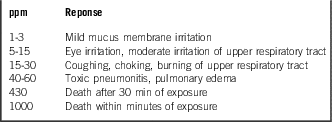
The effects of exposure to chlorine range from mucosal irritation to death, depending on the concentration and duration of the exposure. The odor threshold for chlorine is less than 3 ppm.Reference Perez and McKay 13 According to the Environmental Protection Agency, chlorine concentration of 1 to 3 ppm can cause mild mucous membrane irritation; 5 to 15 ppm can cause moderate irritation of the upper respiratory tract; and 40 to 60 ppm can cause toxic pneumonitis and pulmonary edema.Reference Winder 5 At 1000 ppm, chlorine causes immediate death (Table 1).Reference Winder 5
Dose ResponseReference Winder 5

Signs and symptoms of chlorine exposure reflect the injury to mucous membranes and respiratory tract.Reference Winder 5 , Reference Das and Blanc 9 Symptoms can include lacrimation, rhinorrhea, conjunctival irritation, cough, dyspnea, chest tightness, and hoarseness.Reference Winder 5 In the majority of cases, the mucosal irritation results in sloughing of the bronchial epithelium and infiltration of leukocytes, with sparing of the distal bronchioles and alveoli.Reference Gunnarsson, Walther, Seidal and Lennquist 21 , Reference Jonasson, Koch and Bucht 22 The pro-inflammatory cascade continues and leads to interstitial edema, which, if the exposure is significant or prolonged, can compromise the distal airways as well.Reference Winder 5 , Reference Das and Blanc 9 , Reference Gunnarsson, Walther, Seidal and Lennquist 21 Significant exposures can cause severe hypoxemia, metabolic acidosis, acute respiratory distress syndrome (ARDS), pulmonary edema, thrombosis, and death.Reference Guloglu, Kara and Erten 15 Common physical examination findings in the patients from the Graniteville incident included wheezing, tachypnea, tachycardia, and hypertension; wheezing was the most common finding.Reference Van Sickle, Wenck and Melflower 4 Reports from previous events demonstrated that, with appropriate supportive care, the majority of patients recovered completely from acute exposures.Reference Van Sickle, Wenck and Melflower 4 , Reference Winder 5 , Reference Duncan, Drociuk and Belflower-Thomas 10 In exposures of high concentrations, however, long-term effects have included airway obstruction and reactive airway disease.Reference Schwartz, Smith and Lakshminarayan 7 - Reference Duncan, Drociuk and Belflower-Thomas 10 , Reference Clark, Chanda and Balte 23
MANAGEMENT
Initial management includes attention to airway issues, stabilization, and decontamination. The treatment of acute chlorine exposure targets relief and support of symptoms caused by mucous membrane damage and bronchospasm. Therapeutic modalities for inhalational injuries have included humidified oxygen, bronchodilators, aerosolized sodium bicarbonate, inhaled and intravenous corticosteroids, cough suppressants, and mechanical ventilation, if indicated.Reference Winder 5 To our knowledge, no study to date has validated any of these treatments in randomized, controlled trials in humans, primarily due to the ethical limitation precluding such trials.
Oxygen and inhaled beta-adrenergic receptor agonists are presently the mainstay of treatment in the ED, based on clinical observation.Reference Winder 5 , Reference Guloglu, Kara and Erten 15 , Reference Sexton and Pronchick 16 A case series of 106 patients exposed to chlorine in Turkey showed that oxygen and beta-adrenergic agonists were useful therapies.Reference Guloglu, Kara and Erten 15 Another case series of 13 pediatric patients exposed to chlorine gas at 2 community swimming pools demonstrated improvement of symptoms including chest pain, shortness of breath, and chest tightness after treatment with humidified oxygen and nebulized albuterol.Reference Sexton and Pronchick 16 Five of the 13 patients required admission for persistent hypoxia ranging from 85% to 93%, but all 13 were discharged after 48 hours.Reference Sexton and Pronchick 16
While beta-adrenergic receptor agonists and humidified oxygen are the accepted first-line treatment, the use of nebulized sodium bicarbonate has been discussed as an adjunct in acute exposures.Reference Cevik and Onay 2 , Reference Aslan, Kandis and Akgun 17 - Reference Douidar 20 Theoretically, the bicarbonate neutralizes the hydrochloric acid formed by the interaction between chlorine gas and the water-containing mucous membranes.Reference Aslan, Kandis and Akgun 17 - Reference Douidar 20 Bosse performed a retrospective review of 86 cases of chlorine gas inhalation in which patients were treated with a nebulized solution of 5% sodium bicarbonate. He found that patients reported subjective improvement in respiratory symptoms without appreciating further clinical deterioration.Reference Bosse 18 However, due to variability in the reporting of results, he was unable to draw any conclusions regarding its efficacy.Reference Bosse 18
In a randomized controlled study by Aslan et al, patients exposed to chlorine were initially treated with intravenous corticosteroids and a short-acting beta-2 adrenergic receptor agonist, and then received either nebulized placebo or 4.2% nebulized sodium bicarbonate. The patients who received nebulized sodium bicarbonate showed improved FEV1 values at 120 and 240 minutes, as compared to placebo.Reference Aslan, Kandis and Akgun 17 Several anecdotal case reports detailed improvement in respiratory status after nebulized sodium bicarbonate administration.Reference Cevik and Onay 2 , Reference Vinsel 19 , Reference Douidar 20 , Reference Vajner and Lung 24
DISCUSSION
Chloramine gas is produced when bleach and ammonia are mixed.Reference Pascuzzi and Storrow 25 When combined with moisture, chloramine is thought to break down into hydrochloric acid, resulting in toxicity on the respiratory tract that is similar to that of chlorine gas.Reference Pascuzzi and Storrow 25 Twenty-two soldiers exposed to chloramine gas while cleaning with liquid bleach and ammonia had been treated with nebulized sodium bicarbonate.Reference Pascuzzi and Storrow 25 A case review of the event had reported that the treatment produced no clinically significant difference in outcomes compared to patients who were treated with oxygen alone.Reference Pascuzzi and Storrow 25 A theoretical risk of thermal injury from the neutralization process is thought to occur, but no reports have described significant clinical worsening in patients undergoing sodium bicarbonate nebulization.Reference Aslan, Kandis and Akgun 17 , Reference Vajner and Lung 24
Treatment with nebulized sodium bicarbonate has shown not only to improve objective measurements of pulmonary function but also quality of life scores.Reference Aslan, Kandis and Akgun 17 , Reference Vajner and Lung 24 Optimal dosing is still to be determined, as no study to date has assessed differing concentrations of nebulized sodium bicarbonate.Reference Jones, Willis and Kang 3 , Reference Aslan, Kandis and Akgun 17
Inhaled and intravenously administered corticosteroids have been used for their anti-inflammatory properties, but no randomized controlled trials have been conducted in humans to support this treatment modality.Reference Gunnarsson, Walther, Seidal and Lennquist 21 , Reference Wang, Winskog, Edston and Walther 26 - Reference Jonasson, Wigenstam, Koch and Bucht 29 An animal study done in Sweden found that pigs treated with nebulized steroids (beclomethasone-dipropionate) after exposure to 140 ppm of chlorine gas for 10 minutes had improved oxygen delivery compared to control animals.Reference Gunnarsson, Walther, Seidal and Lennquist 21 Wang et al conducted a randomized controlled trial in pigs to assess the effects of inhaled beta-2 adrenergic agonists and corticosteroids alone and in combination. Pigs exposed to high concentrations of chlorine received terbutaline alone, budesonide alone, terbutaline and budesonide together, or placebo. Recovery of lung function (measured by Pao 2 and lung compliance) was improved with steroids and with beta-2 adrenergic receptor agonists, but it was best in the combined therapy group.Reference Wang, Zhang and Walther 27
In another study, Wang et al compared intravenous and inhaled corticosteroids in pigs exposed to 50 ppm of chlorine gas. Compared to the placebo group, both treatment groups had better arterial oxygen tension (Pao 2) and oxygen delivery; also, recovery of lung-thorax compliance was improved, and histologic injury was lower.Reference Wang, Winskog, Edston and Walther 26 The benefits of intravenous betamethasone and inhaled budesonide were similar. Neither showed superiority in this study. However, given the higher concentrations achieved in the airways and less unwanted systemic effects, the authors favored inhaled corticosteroids.Reference Wang, Winskog, Edston and Walther 26 Chen et al evaluated systemic corticosteroid administration and found a dose-dependent inhibition in neutrophil influx into the lungs as well as a decrease in pulmonary edema acutely after chlorine exposure in mice.Reference Chen, Mo, Schlueter and Hoyle 28
Jonasson and coworkers developed a murine model to evaluate the mechanism by which chlorine exposure can produce long-term pulmonary effects.Reference Jonasson, Koch and Bucht 22 In addition to the previously described acute neutrophilic inflammation in lung tissue and airways, pulmonary edema, and airway hyperresponsiveness, they found persistent hypersensitivity to methacholine up to 28 days post-exposure.Reference Jonasson, Koch and Bucht 22 This finding was consistent with the reactive airways dysfunction syndrome found in humans after exposure to an irritant gas.Reference Winder 5 , Reference Aslan, Kandis and Akgun 17
Jonasson and colleagues then used this information to develop a study in which they investigated whether early corticosteroid administration provided protection against long-term airway dysfunction in mice.Reference Jonasson, Wigenstam, Koch and Bucht 29 They found that high-dose dexamethasone administered intraperitoneally was effective at reducing acute inflammation if given within 6 hours. However, only if it was given within the first hour after exposure did it significantly counteract the formation of pulmonary edema. They did find, however, that both high-dose (100 mg/kg) and low-dose (10 mg/kg) dexamethasone treatment decreased airway hyperresponsiveness 14 days post-exposure.Reference Jonasson, Wigenstam, Koch and Bucht 29 Further studies would be needed to establish a defined role and optimal dosing regimens of these treatments in humans.
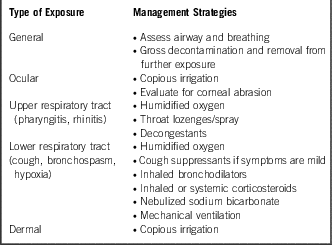
Supportive care and treatment measures can be recommended, depending on the exposure location and symptomatology. Ocular exposures should be treated with copious amounts of irrigation and evaluation for corneal abrasions or other ophthalmologic injuries. Upper airway irritation, including sore throat and rhinitis, can be treated with humidified oxygen, throat lozenges/spray, and decongestants once the acute phase of injury has resolved. Secondary treatments for cough include humidified oxygen in conjunction with antitussive medications. Any dermatological esxposures should be decontaminated and irrigated extensively.
Chemicals with inherent toxicity are readily able to become airborne and are available in large enough quantities to deliver dangerous concentrations to nearby populations; therefore, they have the highest risk for affecting large numbers of people. Chlorine meets these specific characteristics and has been involved in numerous incidents resulting in illness and fatalities. In 4 separate train-related chlorine spills including Youngstown, Florida (1978), Alberton, Montana (1996), San Antonio, Texas (2004), and Graniteville, South Carolina (2005), 21 people died and hundreds more were injured. On a smaller scale, cleaning-related incidents and swimming pool accidents have resulted in chlorine exposures much more frequently.Reference Mowry, Spyker, Cantilena, Bailey and Ford 1 , 11 Although most accidents that occur are small, large-scale releases are possible and can cause substantial morbidity and mortality.
Limitations
The limitations of this case report and its resultant data include the possibility of incomplete record keeping during a mass exposure with primary concern for patient care in a setting of limited resources. In addition, because the experience was documented retrospectively, we relied on the accuracy of recollection. When screening participants in the Graniteville recovery and chlorine epidemiology project, Clark et al found that subjective measures alone were unreliable in predicting pulmonary function.Reference Clark, Chanda and Balte 23 The authors found that of the 259 participants, 50% (n=110) reported persistent new-onset respiratory symptoms; however, almost 67% (n=147) were found to have abnormal spirometric results 8 to 10 months post-exposure.Reference Clark, Chanda and Balte 23 The majority of these individuals had only mild to moderate symptoms initially, with only 22 (8.5%) seeking emergency care on the day of the exposure.Reference Clark, Chanda and Balte 23
As summarized in Table 2, the medical treatment is primarily supportive, and the efficacy of these treatments is difficult to establish.Reference Winder 5 , Reference Guloglu, Kara and Erten 15 - Reference Jonasson, Wigenstam, Koch and Bucht 29 For obvious reasons, it is impossible to attempt randomized, blinded trials involving humans with chlorine-related injury, but published animal studies and clinical observations are supportive of current therapies.
Management Strategies and Recommendations by Exposure Type

CONCLUSION
Chlorine gas is a known pulmonary irritant that can cause a wide range of pathologic conditions, depending on the concentration and length of exposure.Reference Van Sickle, Wenck and Melflower 4 , Reference Winder 5 Although uncommon, large-scale exposures like the one described herein continue to occur. Due to the ethical limitations of such a study, randomized controlled studies on humans exposed to chlorine gas do not exist.Reference Van Sickle, Wenck and Melflower 4 , 11 Based on current animal research and clinical observations, treatment with oxygen, beta-adrenergic receptor agonists, cough suppressants, nebulized sodium bicarbonate, and either systemic or nebulized corticosteroids remain the mainstay of therapy.Reference Winder 5 Further research is needed to delineate dosing recommendations and long-term effects, if any, that these treatments may have on a patient’s clinical course.