Introduction
The extensive use of the sterile insect technique (SIT) against several pest species of the Tephritidae during recent decades has meant that several members of this taxon are model organisms for insect reproduction studies, particularly for analyzing remating behavior of females. SIT relies heavily on the sexual competitiveness of mass-reared sterile males (Hendrichs et al., Reference Hendrichs, Robinson, Cayol and Enkerlin2002) and, as such, any factor that either reduces or improves male performance as part of the whole process of male production, such as strain selection, rearing, sterilization, handling and/or release, has been the subject of intensive research. Given that the final goal of SIT is the induction of sterility in the target population (i.e. females utilizing sterile sperm), understanding the mechanisms by which males modulate female mating receptivity becomes crucial.
There is evidence that unintentional artificial selection occurs during laboratory rearing and that such selection affects male and female sexual behavior. For instance, under mass-rearing conditions, males of the Mediterranean fruit fly, Ceratitis capitata (Wiedemann), modify their courtship behavior compared with wild males (Liimatainen et al., Reference Liimatainen, Hoikkala and Shelly1997; Briceño & Eberhard, Reference Briceño and Eberhard2002), and wild females mated with laboratory males remate faster than those mated with wild males (Vera et al., Reference Vera, Cladera, Calcagno, Vilardi, McInnis, Stolar, Segura, Petit-Marty, Krsticevic, Gómez Cendra, Rodriguero, Barborini, Heer, Allinghi, Bonpland, Hansen and Segade2003). Similarly, it has been shown that mass-rearing affects the sexual behavior of males and females of the Mexican fruit fly, Anastrepha ludens (Loew) (Rull et al., Reference Rull, Brunel and Mendez2005). Laboratory males performed their sexual displays at lower rates during courtship, and laboratory females accepted mates more readily. For the South American fruit fly, Anastrepha fraterculus (Wiedemann), laboratory females mated with laboratory males have shorter intervals between the first and second mating compared with wild females mated with wild males (Abraham et al., Reference Abraham, Goane, Rull, Cladera, Willink and Vera2011a).
SIT requires flies to undergo sterilizing radiation before release. For some species, irradiation affects sterile male sexual performance, decreases the sperm number transferred during copulation and reduces their ability to modulate female remating behavior. Initial studies on C. capitata have shown that sterile males transfer fewer sperm to their mates (Seo et al., Reference Seo, Vargas, Gilmore, Kurashima and Fujimoto1990; Taylor et al., Reference Taylor, Kaspi, Mossinson and Yuval2001) and are less efficient in inhibiting female remating compared with fertile wild males (Bloem et al., Reference Bloem, Bloem, Rizzo, Chambers, Aluja and Liedo1993; Mossinson & Yuval, Reference Mossinson and Yuval2003; Gavriel et al., Reference Gavriel, Gazit and Yuval2009). Similarly, for the Queensland fruit fly, Bactrocera tryoni (Froggatt), Harmer et al. (Reference Harmer, Radhakrishnan and Taylor2006) found that females mated with sterile males stored smaller amounts of sperm in their spermathecae than those mated with wild males.
Improvements to SIT aiming to counter the detrimental effects of laboratory adaptation and irradiation on male competitiveness can be attained through different actions, termed pre-release treatments (Pereira et al., Reference Pereira, Yuval, Liedo, Teal, Shelly, McInnis and Hendrichs2011). These include the addition of protein to the adult diet for some Anastrepha species (Aluja et al., Reference Aluja, Jácome and Macías-Ordóñez2001, Reference Aluja, Pérez-Staples, Sivinski, Sánchez and Piñero2008, Reference Aluja, Rull, Sivinski, Trujillo and Pérez-Staples2009; Pérez-Staples et al., Reference Pérez-Staples, Aluja, Macías-Ordóñez and Sivinski2008a), C. capitata (Taylor & Yuval, Reference Taylor and Yuval1999; Shelly & Kennelly, Reference Shelly and Kennelly2002; Yuval et al., Reference Yuval, Kaspi, Field, Blay and Taylor2002, Reference Yuval, Maor, Levy, Kaspi, Taylor and Shelly2007; Gavriel et al., Reference Gavriel, Gazit and Yuval2009) and B. tryoni (Pérez-Staples et al., Reference Pérez-Staples, Harmer, Collins and Taylor2008b, Reference Pérez-Staples, Weldon, Smallridge and Taylor2009; Prabhu et al., Reference Prabhu, Pérez-Staples and Taylor2008); and the use of juvenile hormone analogs to accelerate males' sexual maturation for some Anastrepha (Teal et al., Reference Teal, Gómez-Simuta and Proveaux2000, Reference Teal, Gómez-Simuta, Dueben, Holler, Olson, Vreysen, Robinson and Hendrichs2007; Pereira et al., Reference Pereira, Sivinski and Teal2009) and Bactrocera (Haq et al., Reference Haq, Cáceres, Hendrichs, Teal, Wornoayporn, Stauffer and Robinson2010) species. Shortening the precopulatory period of males is extremely important in species that need ten or more days before males are sexually mature (Teal et al., Reference Teal, Pereira, Segura, Haq, Gómez-Simuta, Robinson and Hendrichs2011), because sterile males are normally released into the field soon after emergence and could therefore be exposed to predators and adverse environmental conditions that increase mortality before they reach sexual maturity and mate with wild females (Hendrichs et al., Reference Hendrichs, Wornoayporn, Katsoyannos and Hendrichs2007).
Anastrepha fraterculus is a major fruit pest in South America owing to its wide distribution and host range (Norrbom, Reference Norrbom2004). SIT has been proposed as a feasible strategy for area-wide control of this pest (Ortiz, Reference Ortíz1999), and this has triggered recent studies on reproductive biology that expanded our previous knowledge on the insect's mating system (Malavasi et al., Reference Malavasi, Morgante and Prokopy1983; Lima et al., Reference Lima, Howse and Salles1994). Studies on the effect of irradiation on mating success of males revealed that the dose of irradiation required to achieve full sterility does not have a detrimental impact on male competitiveness (Allinghi et al., Reference Allinghi, Gramajo, Willink and Vilardi2007). Moreover, Segura et al. (Reference Segura, Cáceres, Vera, Wornoayporn, Islam, Teal, Cladera, Hendrichs and Robinson2009, Reference Segura, Utges, Liendo, Rodríguez, Devescovi, Vera, Teal and Cladera2010) have shown that sexual maturation of A. fraterculus males can be significantly accelerated by treating males with methoprene (a juvenile hormone mimic), allowing them to attain sexual maturity 3 days earlier than untreated males.
Recent laboratory studies on A. fraterculus have focused on female remating behavior and have found that the products from the accessory glands (AGPs) that the male transfers to the female during mating reduce female sexual receptivity and that effectiveness of the AGPs is increased by protein in the adult diet and decreased by irradiation (Abraham et al., Reference Abraham, Cladera, Goane and Vera2012). However, it was also shown that sperm by itself also has an effect on female receptivity, as females tend to remate when stored sperm is depleted (Abraham et al., Reference Abraham, Goane, Rull, Cladera, Willink and Vera2011a). Additionally, protein content in the adult diet positively affects the amount of sperm transferred (Abraham et al., Reference Abraham, Goane, Cladera and Vera2011b). All of these factors act together to modulate female remating behavior.
In the context of the SIT, it remains to be determined if irradiation, combined or not with protein in the adult diet and methoprene treatments aimed at enhancing male sexual competitiveness, affects the amount of sperm stored and female remating behavior. Additionally, performing these studies under conditions resembling those encountered in nature, where females are able to freely choose their mating partner, would validate findings obtained under more artificial conditions.
Here, we evaluate the effect of different pre-release treatments applied to laboratory sterile males on the amount of sperm stored and female remating behavior in A. fraterculus. We conducted a comprehensive approach that included choice situations in spacious field enclosures. Pre-release treatments combined different protein sources provided as adult food at different doses, as well as different ways to apply methoprene.
Materials and methods
Insects
Laboratory A. fraterculus adult flies were obtained from a colony established at Instituto de Genética ‘E.A. Favret’ (IGEAF), INTA Castelar, Buenos Aires, Argentina. This strain was derived from a strain kept at the Estación Experimental Agroindustrial Obispo Colombres (EEAOC) in Tucumán, Argentina. Rearing methods followed those used at EEAOC (Jaldo, Reference Jaldo2001). Wild flies were recovered from infested guavas collected at Horco Molle, Tucumán, Argentina. Infested fruit were shipped to IGEAF (15 h by ground), where they were placed in trays containing a pupation substrate. Twice a week, pupae were recovered and placed under the same conditions as laboratory pupae until fly emergence.
Irradiation
Sterile laboratory males were obtained from pupae irradiated at Comisión Nacional de Energía Atómica, Ezeiza, Buenos Aires, Argentina (1 h by ground transport from INTA Castelar). After arrival, pupae were kept under a controlled environment until 48 h before emergence. Pupae were irradiated in a Gammacel-220 irradiator (Nordion, Ottawa, Canada) at a dose of 70 Gy in an oxygen atmosphere following conditions and procedures proposed by Allinghi et al. (Reference Allinghi, Gramajo, Willink and Vilardi2007). Pupae were sent back to INTA Castelar also by ground. Upon reception, pupae were placed in cylindrical 1-liter plastic containers until adult emergence.
Treatments
Hormonal treatment was performed by one of two methods: pupae immersion 48 h before emergence or adult topical treatment. In the first case, pupae were immersed in a 1:100 dilution of a 5 μg/μl solution of methoprene (11-methoxy-3,7,11-trimethyl 2E, 4E-dodecadienoate) in acetone for 5 min and then dried out by placing them on tissue paper for 10 min. In the second case, 1 μl of methoprene dissolved in acetone (5 μg/μl) was directly applied on the thorax of newly emerged males (ca. 3–4 h after emergence) using a micropipette (Multipipette Plus Eppendorf, Germany). Dose and application methods followed Teal et al. (Reference Teal, Gómez-Simuta and Proveaux2000) and Segura et al. (Reference Segura, Utges, Liendo, Rodríguez, Devescovi, Vera, Teal and Cladera2010), for topical treatment and pupae immersion, respectively.
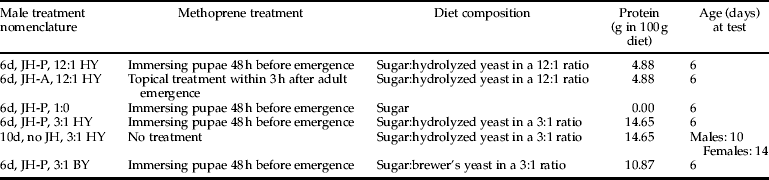
Laboratory males were fed one of several adult diets: sugar only, a mix of sugar and hydrolyzed yeast (MP Biomedicals, Santa Ana, California) in two different proportions (3:1 and 12:1, sugar:hydrolyzed yeast), sugar and brewer's yeast (Calsa, Tucumán, Argentina) (3:1, sugar:brewer's yeast), standard adult diet (sugar, hydrolyzed yeast, hydrolyzed corn) (Gluten Meal, ARCOR, Argentina) and vitamin E (weight/weight) (Jaldo et al., Reference Jaldo, Gramajo and Willink2001). Wild flies were fed the standard adult diet plus a dried peach cut in half, exposing the rind. Combinations of diets and hormonal treatment are shown in table 1. Ages of flies at the time of the field cage test varied according to the treatment (table 1). The ages of flies were chosen following Segura et al. (Reference Segura, Utges, Liendo, Rodríguez, Devescovi, Vera, Teal and Cladera2010).
Treatment applied to sterile laboratory Anastrepha fraterculus flies. Type of methoprene treatment, adult diet and age at the day of the mating competitiveness test.

Experimental procedure
Mating pairs were obtained in a choice experiment under field cage conditions. The field cage tests were carried out at IGEAF, INTA Castelar using cylindrical cages (3 m in diameter and 2 m high) housing one 5-year-old potted Citrus sinensis Osbeck (Rutaceae) (L.) tree (1.7 m high with a canopy of about 1.5 m in diameter). In each cage, 25 laboratory males and 25 laboratory females of one of the six treatments (table 1) and 25 wild males and 25 wild females were released at 07:30 h. Prior to release, flies were marked in order to identify their origin (laboratory or wild). This was achieved by applying a dot of water-based paint (Tempera Alba, ALBA, Buenos Aires, Argentina) on the thorax, a procedure that does not affect the sexual performance of flies (Petit-Marty et al., Reference Petit-Marty, Vera, Calcagno, Cladera, Segura, Allinghi, Rodriguero, Gómez Cendra, Viscarret and Vilardi2004).
After the flies were released, an observer checked the tree and the cage walls every 10 min for a period of 4 h. Mating pairs were carefully coaxed into test tubes (20 ml), which were then capped and numbered. Time of detection and the identity of the male and female were recorded.
Once the pairs separated, they were taken to the laboratory. Pairs involving wild females were retained, whereas those involving laboratory females were discarded. Females were randomly assigned either to evaluate their renewal of sexual receptivity or to be dissected for sperm counts.
To determine the renewal of female receptivity, females were kept singly in 750 ml plastic containers with water and standard adult diet. Two days after the first mating, two sexually mature, fertile virgin males (fed with the standard adult diet) were placed inside each container for a period of 2 h at dawn. For those females that remated, the unsuccessful male was removed from the container. If no copulation occurred after the 2-h period, the males were removed from the container. This procedure was repeated three times a week. Males were used only one time. Females were discarded from the experimental setup once they remated. The trial lasted 35 days with 16 observational periods.
Females assigned to sperm counts were dissected 2–10 h after copulation ended to determine the number of spermatozoids stored in their spermathecae following Abraham et al. (Reference Abraham, Goane, Cladera and Vera2011b). The ventral receptacle was not checked because of the fact that the amount of sperm stored in this organ remains constant during this period (around the 10% of the total sperm stored) (Abraham et al., Reference Abraham, Goane, Cladera and Vera2011b). Females had no access to oviposition substrates. Previous observations have shown that during a 2- to 10-h period the amount of sperm stored remains constant (Abraham, unpublished).
Data analysis
Remating frequencies were compared among females mated with males from the different treatments or with wild males, by means of a chi-square test of homogeneity. Sequential Bonferroni method was applied after the chi-square test. Only remating females and non-remating females that remained alive until the end of the experiments were included in the analysis.
Time in copulation, refractory period and the amount of sperm stored were compared by means of a one-way ANOVA, with male treatment as the independent variable. Differences among means were determined by Tukey tests. Time in copulation was estimated by recording the time the pair engaged and the time they separated. The refractory period was estimated as the time, in days, between the first and the second copulation, and for that reason was only assessed for those females that remated. The total amount of sperm stored was calculated by adding the number of spermatozoa counted in each spermatheca. To determine a possible interaction between male treatment and time in copulation, duration of copulation was grouped to generate categories and we built a general linear model followed by a factorial ANOVA. Because the interaction was not significant (F = 0.863; P = 0.524), we pooled the data to investigate the relationship between time in copulation categories and refractory period. The relationship between time in copulation and refractory period was compared using a nonparametric Kruskal–Wallis test, and multiple comparisons were performed using Dunn's test. The proportion of females with no sperm in their spermathecae was compared among treatments by means of a chi-square test of homogeneity. All statistical analyses were performed with InfoStat (2009).
Results
Neither the different methoprene treatments (topically applied in the thorax of the adult or by immersion of the pupae) nor the different diets provided to males showed differences in any of the response variables evaluated (time in copulation: F 4,144 = 0.86, P = 0.320; remating rate: χ2 = 0.80, df = 4, P = 0.937; refractory period: F 4,101=0.85, P = 0.495; amount of sperm stored: F 2,58 = 2.43, P = 0.100; percentage of spermless females: χ2 = 1.48, df = 2, P = 0.476). For this reason, data of such treatments were pooled and reanalyzed comparing three new categories: (i) methoprene-treated sterile males, (ii) untreated sterile males and (iii) wild males.
Male treatment affected time in copulation (ANOVA: F 2,241 = 5.23, P = 0.006). Those copulations involving wild males were longer than those involving methoprene-treated sterile males, whereas those involving untreated sterile males had intermediate values (table 2).
Copula duration (hh:mm) (mean ± SE), remating rate (%), refractory period (days) (mean ± SE), amount of sperm stored (mean ± SE) and percentage of spermless females of wild Anastrepha fraterculus females mated with different treated males and wild males. Numbers in parentheses represent replicates, except for remating rate, where parentheses show the number of remated females from the total number of females analyzed.

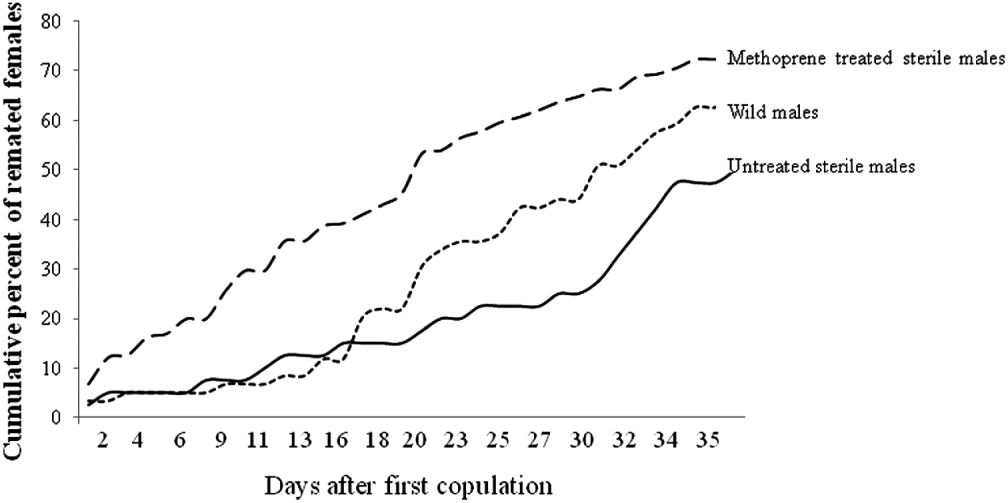
The frequency of females that remated was affected by male treatment (chi-square test of homogeneity: χ2 = 7.73, df = 2, P = 0.021; table 2). Females mated with untreated sterile males had the lowest remating percentage (50%), whereas females mated with methoprene-treated sterile males had the highest values (73.1%; χ2 = 7.70, df = 1, P = 0.016). Cumulative remating percentages are shown in fig. 1.
Cumulative remating curves for wild Anastrepha fraterculus females mated with methoprene sterile males, wild males and sterile males. Remating rates at the end of the experiment were statistically different (chi-square test of homogeneity: χ2, P < 0.05).

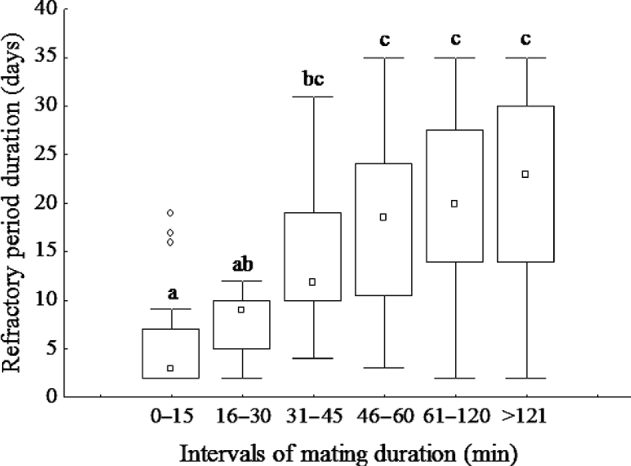
Female refractory period was affected by the treatment category of their first mate (ANOVA: F 2,162 = 11.59, P < 0.001). Females mated with methoprene-treated sterile males displayed the shortest refractory periods (table 2). When mating duration was longer than 45 min, the refractory period of females was significantly longer than when mating duration was 30 min or less (Kruskal–Wallis: H 5 = 45.53, P < 0.001; fig. 2).
Female refractory period at different intervals of mating duration for wild Anastrepha fraterculus females (median with upper (75%) and lower (25%) quartiles +95% CI). Mating durations with the same letter above are not significantly different (Kruskal–Wallis analysis, followed by Dunn's test, P > 0.05). Points above the first box represent data above the 95% upper CI.

The percentage of females that did not store sperm was similar for all treatments (chi-square test of homogeneity: χ2 = 2.89, df = 2, P = 0.236; table 2). Finally, the amount of sperm stored by females was similar among treatments (ANOVA: F 2,98 = 0.06, P = 0.942; table 2).
Discussion
In this work we analyzed the combined effect of methoprene treatment and protein intake on the ability of sterilized A. fraterculus males to inhibit mating receptivity of wild females. Our findings showed that although irradiation has no effect on female remating tendency, females mated with young, methoprene-treated sterile males exhibited less time in copulation, higher remating rates and less time elapsed between the first and the second matings, compared with untreated laboratory sterile males or wild fertile males. Protein intake was not sufficient to overcome the reduced ability of methoprene-treated males to modulate female sexual receptivity. However, amount of sperm stored was not affected by male type. Our results suggest that female sexual receptivity is governed by a series of factors that act in conjunction, and that methoprene treatment does not affect them in the same way.
The sterilization procedure can affect male physiology and development, resulting in males with lower sexual performance. This impact has been reported for some conspicuous traits such as alterations of normal patterns of courtship (Lux et al., Reference Lux, Vilardi, Liedo, Gaggl, Calcagno, Munyiri, Vera and Manso2002) as well as for other, more cryptic characters such as sperm transfer. Taylor et al. (Reference Taylor, Kaspi, Mossinson and Yuval2001) found that the amount of sperm stored by C. capitata females mated with sterile laboratory males was markedly lower than that stored by females mated with fertile wild males and suggested that this could explain why sterile C. capitata males are not as able to inhibit remating as their fertile wild counterparts (Mossinson & Yuval, Reference Mossinson and Yuval2003; Gavriel et al., Reference Gavriel, Gazit and Yuval2009). In this line of evidence, Vera et al. (Reference Vera, Cladera, Calcagno, Vilardi, McInnis, Stolar, Segura, Petit-Marty, Krsticevic, Gómez Cendra, Rodriguero, Barborini, Heer, Allinghi, Bonpland, Hansen and Segade2003) have shown in C. capitata that male irradiation did not affect female remating rate but that females first mated with irradiated laboratory males remated sooner than those first mated with fertile males of the same laboratory strain. In our case, laboratory sterile males showed the same capacity of their wild counterparts to modulate female receptivity, as evidenced by the fact that the number of females that remated, their refractory period and amount of sperm stored were similar regardless of fertility status. This result agrees with those of Allinghi et al. (Reference Allinghi, Gramajo, Willink and Vilardi2007), who found no differences in the proportion of empty spermathecae from females mated with irradiated or fertile males. Abraham et al. (Reference Abraham, Cladera, Goane and Vera2012) found that AGPs of irradiated males are less efficient than those of non-irradiated males in modulating female receptivity. Nonetheless, the present study showed that remating behavior of females mated with both types of males is similar. This suggests that renewal of female receptivity after their first mating is governed by a series of factors, such as stimulation during copulation, the effect of sperm stored and the proteins transferred in the ejaculate, and that these probably act in conjunction. This is supported by the fact that the length of female refractory period increases as time in copulation increases, a fact that has already been observed for A. fraterculus (Abraham et al., Reference Abraham, Goane, Cladera and Vera2011b).
Previous studies have shown that the treatment of pupae or adult males of several tephritid species with juvenile hormone mimics, such as methoprene, accelerates sexual maturation, such that young males are capable of performing sexual displays and mating characteristics of naturally maturing males (Teal et al., Reference Teal, Gómez-Simuta and Proveaux2000; Pereira et al., Reference Pereira, Sivinski and Teal2009; Segura et al., Reference Segura, Cáceres, Vera, Wornoayporn, Islam, Teal, Cladera, Hendrichs and Robinson2009, Reference Segura, Utges, Liendo, Rodríguez, Devescovi, Vera, Teal and Cladera2010; Haq et al., Reference Haq, Cáceres, Hendrichs, Teal, Wornoayporn, Stauffer and Robinson2010). We expected methoprene treatment to affect all organs in a synchronic way, and therefore a synchronized development should have occurred. However, our field cage experiments showed that copulations that involved males treated with methoprene were of shorter duration than those involving wild males. Likewise, the remating rate of females mated with 6-day-old males was higher, and the refractory period was lower than that of females mated with mature (wild or laboratory) males. These results suggest that some organs, such as the accessory glands, could be underdeveloped when compared with other organs, such as testes. In the same line of evidence, Abraham et al. (Reference Abraham, Cladera, Goane and Vera2012) found that the injection of extracts from the AGPs of young methoprene-treated males into the female failed to reduce female receptivity when compared with AGPs extracted from naturally matured males, even when they were sexually active (i.e. perform pheromone calling). Hence, it could be postulated that the accessory glands are among those organs exhibiting slow response (or no response at all) to methoprene treatment. In the fly Cyrtodiopsis dalmanni (Wiedemann) for example, Baker et al. (Reference Baker, Denniff, Futerman, Fowler, Pomiankowski and Chapman2003) noted that the development of the accessory glands was more closely related to the time that males reached sexual maturity than testicular growth, and accessory glands of mature males were larger than those of immature males. Further research on this area should take into account this potential asynchrony in maturation after methoprene treatment, comparing the effect of methoprene on mating behavior as well as on the development of different reproductive organs. This suggests that male mating performance and the ability to inhibit female remating are not necessarily positively correlated. Another possibility is that the correlation exists in nature but can be distorted when we artificially alter juvenile hormone endocrine levels.
Spermathecae of females that mated with young methoprene-treated males had similar numbers of sperm as those found in females that mated with mature (wild or laboratory) males. Our quantitative estimation of transferred sperm provided a result that is in agreement with a previous qualitative assessment carried out for this species by Segura et al. (Reference Segura, Utges, Liendo, Rodríguez, Devescovi, Vera, Teal and Cladera2010). It is important that the effect of mating duration on the length of the refractory period and the reduced capacity of methoprene-treated males to inhibit female receptivity could not be explained by the amount of sperm stored. As mentioned above, this could be the result of asynchrony in maturation of reproductive organs; testes were already mature in 6-day-old methoprene-treated males and hence transferred the same amount of sperm as normally mature laboratory males or wild males but accessory glands were not fully mature and transferred less or no proteins. Interestingly, the number of spermatozoa in females mated with 10-day-old protein-fed laboratory males was lower than found by Abraham et al. (Reference Abraham, Goane, Cladera and Vera2011b), who performed mating tests under more crowded conditions. These differences may reflect male plasticity in sperm transfer, varying with environmental conditions. In our field cage experiments, we released 50 males competing for females in an arena of considerable size (3 m in diameter and 2 m high, ca. 14,000 liters) which housed a citrus plant, whereas the laboratory trials reported by Abraham et al. (Reference Abraham, Goane, Cladera and Vera2011b), consisted of 80 males being released in 12-liter cages along with 40 females. It has been documented in other insects, including C. capitata, flour beetles and crickets, that the males are able to regulate the amount of sperm transferred in response to conspecific male density and the intensity of potential sperm competition (Gage, Reference Gage1991; Gage & Baker, Reference Gage and Baker1991; Gage & Barnard, Reference Gage and Barnard1996; del Barco-Trillo, Reference del Barco-Trillo2011; Kelly & Jennions, Reference Kelly and Jennions2011). Protein intake during the adult stage has been shown to enhance methoprene effect on mating competitiveness of young males for several Tephritidae species, including A. fraterculus (Teal et al., Reference Teal, Gómez-Simuta, Dueben, Holler, Olson, Vreysen, Robinson and Hendrichs2007; Pereira et al., Reference Pereira, Sivinski and Teal2009; Haq et al., Reference Haq, Cáceres, Hendrichs, Teal, Wornoayporn, Stauffer and Robinson2010). Additionally, Liendo et al. (Reference Liendo, Devescovi, Bachmann, Utgés, Abraham, Vera, Lanzavecchia, Bouvet, Gómez-Cendra, Hendrichs, Teal, Cladera and Segura2012) found that methoprene-treated males need to consume protein to obtain similar numbers of matings as wild males. However, our study showed that incorporation of protein in the diet of methoprene-treated males had no effect on the post-mating behavior of the females. Protein intake by males was not sufficient to overcome the inability of treated males to induce a refractory period in females of similar duration to those induced by wild and naturally matured males. Although we expected to find differences on post-mating behavior in females mated with males fed with different diets (Abraham et al., Reference Abraham, Goane, Cladera and Vera2011b, Reference Abraham, Cladera, Goane and Vera2012), protein-fed methoprene-treated males and sugar-fed methoprene-treated males performed in the same way.
Our findings suggest that evaluating sexual competitiveness only through the ability of sterile males to achieve copulation produces a partial characterization of their quality, as other factors, such as the renewal of female receptivity, seem crucial in predicting overall SIT efficacy. The fact that sterile laboratory males performed as well as fertile wild males allowed us to confirm that neither irradiation nor laboratory rearing affects the ability of A. fraterculus males to modulate the receptivity of their partners. Hence, we extend the results of Allinghi et al. (Reference Allinghi, Gramajo, Willink and Vilardi2007), in which it was shown that irradiation doses that effectively sterilize A. fraterculus males do not affect male sexual performance in aspects related to female post-mating decisions. We also found that 6-day-old males treated with methoprene were able to transfer as much sperm as mature wild males. However, the fact that young males were not as efficient as males matured naturally in modulating female sexual receptivity should be further studied. Studying the sexual development of key organs, such as accessory glands, in methoprene-treated males would probably shed light on the asynchrony between mating behavior of young males, a trait linked with sexual maturation, and their ability to inhibit females in seeking a second mating, a trait linked to reproductive maturation. In any case, methoprene-treated males were able, to some degree, to induce a refractory period in females. Therefore, in order for methoprene treatment to contribute to overall efficiency of SIT as a control method for A. fraterculus, a cost–benefit assessment should be carried out, in which releasing 6-day-old methoprene-treated males that induce a shorter refractory period is compared with releasing older (fully mature) males with the disadvantage of having to keep them in the facility for longer periods or expose males to predators in nature. The refractory period of females mated with methoprene-treated males is relatively long, and the benefits of using methoprene in rearing include early male sexual maturation and mating competitiveness. This tends to favor the use of methoprene in production of A. fraterculus for release in SIT programs.
Acknowledgements
The authors thank Guillermo E. Bachmann, M. Eugenia Utgés, Silvia B. Lanzavecchia, Juan P. Bouvet, Paula Gómez-Cendra, Cecilia Giardini, Leonela Carabajal Paladino, María Hoiak, Marianela Juri, Claudia Conte, Alejandra Parreño and Germán Crippa for their collaboration during field cage tests. We want to especially thank Fabián Milla for supplying laboratory flies. We thank Marianela García Alba and the Comisión Nacional de Energía Atómica for helping during irradiation of flies. We thank Compañía Argentina de Levaduras S.A. (Calsa) for providing brewer's yeast and Arcor S.A. for providing corn protein for the diets. Finally, we thank J.A. Rull, two anonymous referees and the Editor for their review and valuable comments that improved the manuscript. This work was supported by FAO/IAEA grant 12852 to JLC, FONCyT - PICT 2006 148 to DFS and FAO/IAEA grant 14111 and FONCyT - PICT 2006 1747 to MTV.