

Introduction
The heat and extreme humidity of a subtropical climate in August made Hong Kong a challenging environment for the 2008 Equestrian Olympic Games. Nations intending to send teams to compete in the equestrian sports expressed concern about the safety of competition in this environment and questioned how horse welfare would be assured.
The Good Luck Beijing CCI2*, held at the Olympic Venues in 2007 on dates corresponding to competition in 2008, provided an opportunity to closely monitor physiological responses of eventing horses to the competition environment. Eight federations that sent horses to the 2007 Olympic Test Three-day Event voluntarily participated in this study and data were pooled for analysis.
Methods
Study population
Seventeen horses (mean age ± SE, 10.5 ± 0.7 years) were shipped by air from North America, Europe and Australia to Hong Kong for this event. Thirteen of the horses were geldings, three were stallions and one was a mare. Breeds represented were: Irish Sport Horse (four), Thoroughbred or Thoroughbred cross (four), Anglo Arab (one) and Warm Blood (five). Three horses were of unknown breeding. All horses received electrolyte supplementation; it was not possible to standardize the supplement selected or the dosages administered.
Nine horses arrived in Hong Kong on 28 July, two horses arrived on 1 August and six arrived on 2 August, so that the total duration of the stay in Hong Kong ranged from 12 to 17 days. Horses were housed in air-conditioned stables at the Sha Tin Racecourse and in an air-conditioned tent at the site of the cross-country course. The barn and tent temperatures were maintained at approximately 25°C. Data are not available on the actual temperature ranges in the stable and tent; however, the stables, where horses spent all but 18–24 hours of their time, were constructed of concrete and stalls were enclosed in the structure. The temperature in all the Olympic stables was monitored and controlled centrally by a sensitive system that allowed us to request that a specific temperature be maintained.
Study design
Participation in the study was voluntary and, although we provided a standardized monitoring protocol, it was not possible to enforce its use. This resulted in lack of uniformity in the data with regard to day and time of day of sample collection, and time before or after exercise that observations were made.
Horses were monitored during their entire stay at the venue. Vital signs were recorded twice daily, and number and duration of exercise periods were recorded daily. Horses were weighed in the morning before and after exercise. A pattern of progressive weight loss was interpreted as evidence of cumulative fluid and electrolyte deficits that were then more closely monitored by measuring packed cell volume (PCV), total protein (TP), urine specific gravity (USG), urine Na concentration (UNa) and urinary clearance of Na (CLNa). Haematological and biochemical variables, UNa and urinary creatinine, were measured by automated systems in the Hong Kong Jockey Club Laboratory, when requested by team veterinarians. USG, determined by a refractometer, was evaluated intermittently at the discretion of the team veterinarian. Team veterinarians and grooms were instructed in the use of the refractometer so that USG could be measured when convenient. CLNa was determined as described previously and results are expressed as a percentageReference Morris, Divers and Whitlock1, Reference McKeever, Scali, Geiser and Kearns2.
Horses were weighed on electronic scales, provided and maintained by the Hong Kong Jockey Club, in the stables. The investigators did not recalibrate the scales. Horses were always weighed on the same scale. Changes in body weight during the day and overnight were calculated for each horse, where data were available. Federation veterinarians, grooms or riders measured daily water intake for each horse.
Weather conditions were continuously monitored during the month of August at the Sha Tin Racecourse and the site of the cross-country course by means of dedicated weather stations that recorded wet-bulb and black-globe temperature, humidity, rainfall and wind speed. The wet-bulb globe temperature (WBGT) was calculated according to the following formulaReference Schroter, Marlin and Jeffcott3:

where T wb is the wet-bulb temperature of ambient air measured in the shade. It is the temperature to which air may be cooled by the evaporation of water into it.
T g is the black-globe temperature that is affected by radiation, convection and wind velocity in addition to ambient temperature in the sun.
The WBGT was used as an index of environmental heat load as described previouslyReference Schroter, Marlin and Jeffcott3, Reference Jeffcott and Leung4.
Statistical analysis
Mean and standard error values were calculated for daily water consumption (l day− 1) and changes in body weight (kg) during the day, overnight and for the entire stay. Mean and standard error values for USG, UNa CLNa, and exercise times were determined for the entire stay. Mean and standard error values were determined by day since arriving at the competition for PCV, WBC, neutrophils, lymphocytes and platelets, TP, total bilirubin, aspartate amino transferase, creatine kinase, γ-glutamyl transferase, creatinine, Na, K and Cl. Changes in haematological and biochemical variables over time were assessed by one-way ANOVA for repeated measures. Differences were identified by the Tukey–Kramer method and significance was set at P < 0.05. Time is expressed as day since arrival at the venue.
Results
Haematological and biochemical data, provided by the Hong Kong Jockey Club at no expense, were collected from all 17 horses, whereas other data were available from a variable sub-population of the horses in the study.
Ambient conditions
The WBGT at the two sites ranged between 24 and 26°C at 06.00 hours, 26 and 27°C at 08.00 hours, and 29 and 30°C at 13.00 hours. The WBGT then declined to 28–29°C by 16.00 hours, and 25–27°C by 20.00 hours.
Completion rate
Fifteen (88%) of the 17 horses completed the competition. One horse had mild exertional rhabdomyolysis during training and was withdrawn before dressage, and a second horse was withdrawn before the cross-country test because of a chronic musculoskeletal injury. Vital signs of all horses remained within reference ranges.
Weight change
The mean body weight change during the entire stay in Hong Kong for 12 horses was − 3.0 ± 2.4 kg (range − 17 to 14 kg). The mean weight change during the day was − 2.9 ± 0.6 kg (range − 20 to 15 kg). Eight per cent of 103 determinations showed no weight change during the day, 25% showed an increase in weight during the day while 67% showed a decrease in weight by evening. The mean weight change overnight was 2.9 ± 0.5 kg (range − 10 to 15 kg). Of the 101 determinations, 8% showed no weight change overnight, 22% showed a decrease in weight overnight and 70% showed an increase in weight overnight.
Water intake
Data for 24 h water intake were available for eight horses. Mean intake, calculated from the results of 62 determinations, was 38 ± 1.5 l daily. The minimum recorded intake was 18 l day− 1 while the maximum was 74 l. This analysis excluded data from three horses whose water intake was recorded on cross-country day (mean 67 l, range 60–70 l).
Exogenous fluid administration was not commonly employed during the study period, except following the cross-country test. One horse received fluids by nasogastric intubation on the day before the competition started. Seven horses received nasogastric (three) or intravenous (four) fluids following the completion of the cross-country course.
Pattern of exercise
Data were available for eight horses. The mean total daily exercise time was 69 ± 3 min (range 20–120 min) based on 55 determinations. The number of exercise sessions daily varied from one (reported 36 times) to three (reported once). In addition to exercise sessions, horses were hand-walked an average of 44 ± 3 min (range 15–80 min) based on 39 reported periods of hand walking.
Haematology
Data for the 15 horses that completed the competition were analysed. Mean values for all haematological variables were within reference ranges. White blood cell counts were lower on days 5 and 6 after arrival than on day 1, and were significantly higher on days 16 and 17 than on all other days. Mean neutrophil concentrations were significantly lower on days 5, 8 and 10 than on day 1 after arrival, with the lowest value occurring on day 10 (3.7 ± 0.4 K ul− 1). Mean lymphocyte concentrations were lowest on day 1 after arrival (1.7 ± 0.09 K ul− 1), and this value was significantly lower than mean values on days 3, 4, 9 and 13. Mean platelet counts on days 7–9 and 11–16 after arrival were significantly lower than the value on day 1, with the lowest value recorded on day 15 (124 ± 15 K ul− 1).
Biochemistry
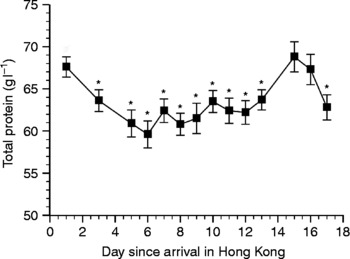
Mean values for biochemical variables from 15 horses that completed the competition were all within reference ranges, with the exception of values for TP that slightly exceeded the reference range on 1 August (67.0 ± 1.9 g l− 1) and 2 August (70.6 ± 1.5 g l− 1); the latter value was significantly higher than values for all other dates except 11 August. The mean value for TP was significantly higher on day 1 of arrival (67.6 ± 1.2 g l− 1) than on all other days, with the exception of days 15 and 16 after arrival (Fig. 1). The total bilirubin concentration was significantly higher on day 1 of arrival than on days 3, 5, 6, 8, 10 and 13.
Mean ± SE of total protein (g l− 1) by day since arrival in Hong Kong. * denotes a significant (P < 0.05) difference from day 1

USG
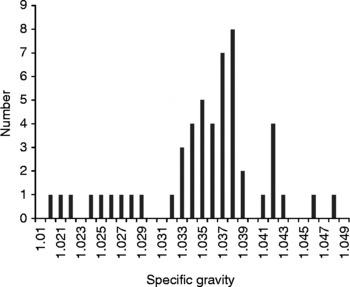
USG was reported on more than two occasions in 10 horses. The mean USG (based on 51 determinations) was 1.035 ± 0.0008, with a range of 1.020–1.048. Twenty-nine (57%) of the 51 determinations were greater than 1.035. USG was greater than 1.040 in a total of eight determinations among four horses (Fig. 2).
Specific gravity determinations in 51 urine samples from 10 horses

UNa and CLNa
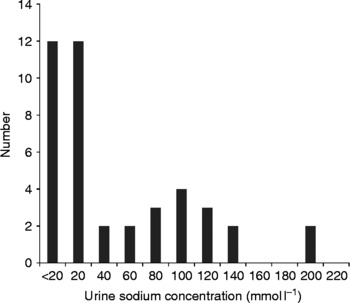
Data were available from 42 determinations of UNa among 10 horses. The mean UNa was 61 ± 8 mmol l− 1, with a range of 10–204 mmol l− 1. Twenty-nine per cent (12/42) of determinations were < 20 mmol l− 1 and 57% (24/42) were ≤ 20 mmol l− 1 (Fig. 3).
Urine Na concentrations (mmol l− 1) in samples from 10 horses

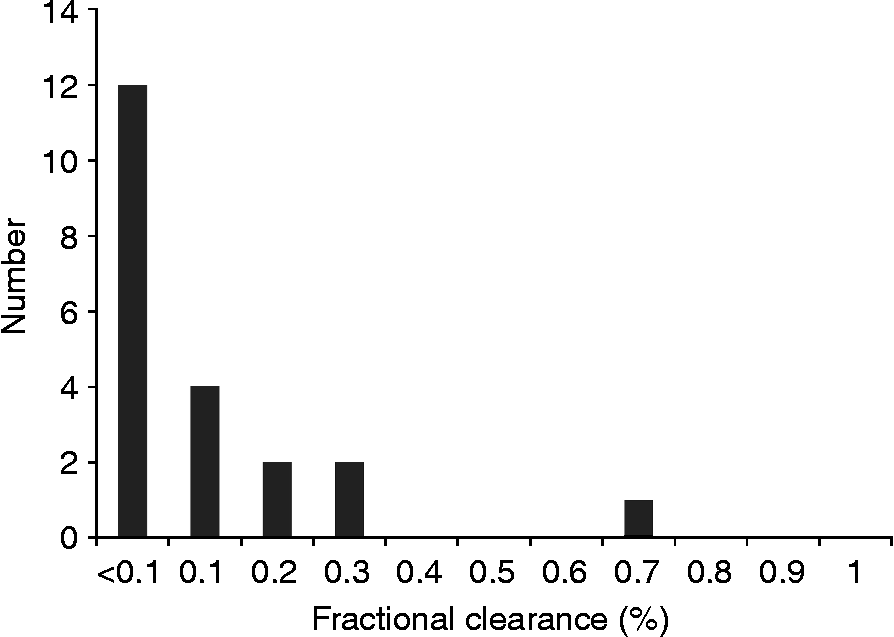
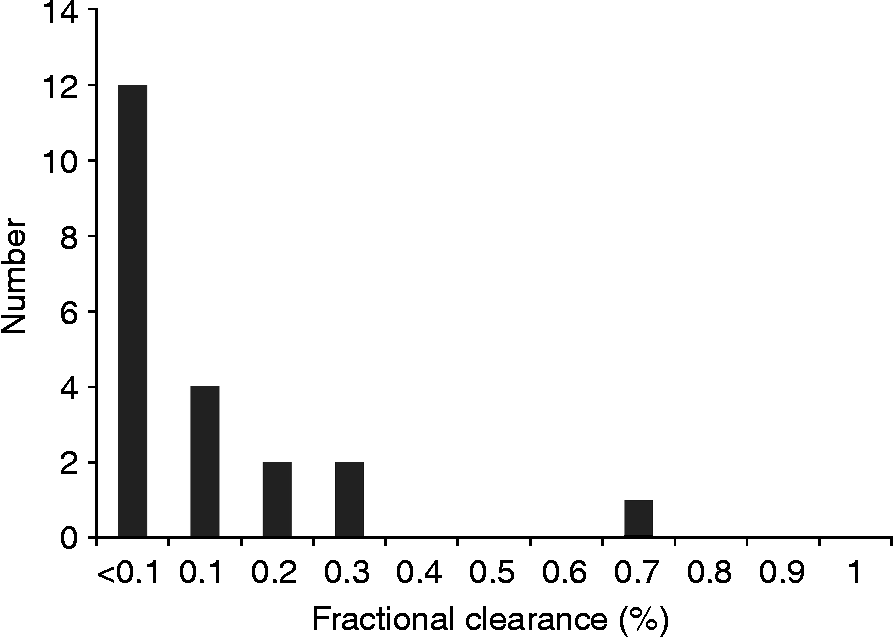
The mean CLNa was 0.14 ± 0.04%, with a range of 0.02–0.78%, on 21 determinations among nine horses. Sixteen (76%) of the 21 determinations were ≤ 0.1% (Fig. 4).
Urinary fractional clearance of Na (mmol l− 1) in nine horses
Discussion
Fifteen (88%) of the 17 horses were trained and completed the August 2007 Olympic Test Event in Hong Kong. This completion rate compares favourably to rates for 12 three-day events of similar or higher level in the USA between 2005 and 2008 (mean 62%, range 42–78%) (Kohn C, unpublished data). All horses that completed the Hong Kong event remained healthy, with rectal temperatures and haematological and biochemical parameters within reference ranges. Horses generally remained well hydrated. Mean weight loss during the study ( − 3.0 ± 2.4 kg) was modest, with a moderate range of changes in weight ( − 17 to 14 kg), including weight gain in some horses.
Although the reasons for this excellent result were not proven by this study, several important factors were identified. The cool ambient conditions in the stables allowed horses to relax and recover from exertion in the hot, humid weather. Air-conditioned stabling is credited with making it possible for race horses to compete safely and to a high standard in Hong Kong (Personal communication Dr. Riggs C, Hong Kong Jockey Club, January 2008). Secondly, coaches and riders from whom data were available embraced a training strategy that combined active and passive acclimatization. Horses spent at most 3.5 h outside each day, and therefore at least 20.5 h daily were spent in the air-conditioned stables. Active acclimatization (exercise in the heat) was usually employed for approximately 1.0–1.5 h daily, while passive acclimatization (heat exposure without exercise) was undertaken for an additional 44 min on average daily. This strategy may have minimized fluid and electrolyte losses incurred during exercise in the heat while providing horses with sufficient exposure to heat to remain acclimatized.
Horses may lose their heat-acclimatized state in as little as 7–10 daysReference Geor and McCutcheon5; however, fit horses remain acclimatized longer than unfit horses. It is important to continue training and exposure to heat to maintain the beneficial physiological adjustments of acclimatization such as expansion of the resting plasma volume, reduced sweating rates during exercise and recovery, and reduction in fluid losses in sweat at a given thermal loadReference Geor and McCutcheon5. In one experiment, heat acclimatization and improved run times in horses performing a standardized exercise test on a treadmill occurred following exercise in and passive exposure to heat for 4 h daily during 21 daysReference Geor, McCutcheon and Ecker6. Horses of the present study were fit when they arrived in Hong Kong, and then spent a maximum of 3.5 h daily in humid heat. This amount of active and passive heat exposure was sufficient to permit horses to compete safely. The optimum duration of daily exposure to heat to maintain acclimatization was not determined by this study.
Sixty-seven per cent of horses lost weight during the day, while 70% gained weight during the evenings. Ninety per cent of an acute reduction in weight is probably due to the loss of body fluidsReference Carlson7, and we surmise that most horses lost fluid during the day while exercising, but regained most or all of these fluids while resting during the evenings. Voluntary water intake during training and competition is essential to maintain adequate hydration. Most horses appeared to voluntarily replace fluid deficits within 24 h, such that the overall mean weight change for 12 horses, during their entire stay in Hong Kong, was modest.
A pattern of continued weight loss was interpreted as evidence of mounting cumulative fluid and electrolyte deficits that were likely to be compounded by continued training, and, if not corrected, might result in suboptimal performance. Our determinations of weight loss and gain may have been somewhat inaccurate due to the fact that the scales were not recalibrated daily; however, we were able to identify trends. Daily weighing allowed identification of horses at risk for fluid deficits, and these horses were then more closely monitored using PCV, TP, serum biochemistries, USG, UNa and CLNa determinations more precisely to assess the need for fluid/electrolyte supplementation.
USG reflects the avidity of renal resorption of water, with higher values indicating reduced losses of free water. Fifty-seven per cent of USG in the present study was greater than 1.035. In contrast, among 1669 Thoroughbred horses in Texas, studied after racing, only approximately 24% had a USG >1.035Reference Cohen, Peck, Smith and Ray8. The horses in the latter study did not receive furosemide before racing. A substantial percentage of horses of the present study probably responded appropriately to the ambient conditions in Hong Kong by increasing USG to >1.035 to conserve waterReference Savage9. USG determinations above 1.035 may also have reflected prerenal dehydrationReference Wilson10, and monitoring changes in USG may provide a practical indicator of hydration status and potential need for rehydration.
UNa is an indicator of the relative need to retain Na. Stimuli for renal Na retention include hypovolaemia, a relative Na deficit in the extracellular fluid and exercise-induced hypervolaemia (requiring an increase in plasma Na content but not concentration)Reference McKeever, Scali, Geiser and Kearns2. UNa ≤ 20 mmol l− 1 in the majority of determinations from salt-supplemented horses in the present study is similar to values of UNa < 20 mmol l− 1 reported for horses on pasture and fed hay only (no electrolyte supplementation)Reference Schott, Dusterdieck, Eberhart, Woody, Refsal and Coenen11 (Personal Communication, Dr. Schott H, Michigan State University, July, 2007) and for eight conditioned Thoroughbred- or Quarter Horse-type mares that had UNa at rest of 12.3 ± 2.9–16.2 ± 9.4 mmol l− 1.Reference Schott, Bayly and Hodgson12 These comparisons suggest that salt supplementation was necessary for our horses to maintain UNa within these ranges.
In another study, five healthy unfit Standardbred horses undertaking repeated bouts of submaximal exercise on a treadmill had baseline (pre-exercise) mean UNa of 10.4 ± 3.3 mmol l− 1.Reference McKeever, Scali, Geiser and Kearns2 Exercise induced a significant reduction in UNa (mean value 1.9 ± 1.5 mmol l− 1 on day 3). Horses of this study were given a controlled amount of salt supplement calculated to replace electrolyte needs under resting conditions. The very low UNa reported after 3 days of exercise may reflect a low Na intake relative to Na losses due to exercise as well as Na retention supporting the hypervolaemic response to exercise. This study underscores the importance of Na supplementation in exercising horses and the potential utility of monitoring UNa in horses that are training or competing.
Equine athletes competing in hot, humid conditions usually require salt supplementation to replace electrolyte losses in sweatReference McCutcheon and Geor13, Reference McCutcheon and Geor14. Just as low UNa may have reflected a need for additional Na intake, high UNa in some horses in our study probably reflected aggressive Na supplementation. Na supplementation in excess of need could have the potentially adverse effect of increased urinary water losses. Monitoring UNa in equine athletes may be a useful guide to adjusting Na intake to avoid both under- and oversupplementation. Further study will be necessary to determine what values for UNa may be associated with insufficient and excessive Na intake.
Values for a limited number of determinations of CLNa in horses competing in Hong Kong were all < 1%. Twenty (95%) of the 21 CLNa determinations were < 0.4%, and 12 (57%) were < 0.1%. These findings are consistent with the low values for UNa in these 21 determinations of fractional clearance. Three days of submaximal exercise on a treadmill resulted in a 59% reduction in CLNa in a previously mentioned studyReference McKeever, Scali, Geiser and Kearns2. Low fractional clearances of Na in horses of our study are consistent with renal Na avidity and perhaps with a need for additional Na supplementation in these horses exercising in hot, humid conditions.
In the present field study, it was not possible to standardize salt intake and all horses received some form of daily electrolyte supplementation. Despite supplementation, USG >1.035, UNa < 20 mmol l− 1 and/or CLNa < 0.1% were documented in a number of horses. These findings suggest that Na intake was probably insufficient in some horses competing and training in Hong Kong.
Additional studies of USG and UNa may demonstrate that these easily monitored parameters may be useful in guiding Na supplementation for exercising horses. Urine collection by free catch is non-invasive, making the procedure acceptable in the competition setting. Urine samples in this study were collected when convenient. The optimum collection time would be in the morning before exercise and before feeding or administration of supplements containing electrolytes. Both the flow of urine and urinary electrolyte excretion are affected by exerciseReference Schott, Bayly and Hodgson12.
The mean TP of horses on day 1 after arrival was significantly higher than on all other days except days 15 and 16, and the day 1 value (67.6 ± 1.2 g l− 1) slightly exceeded the reference range (65 g l− 1). These data are consistent with post-travel dehydration. The mean value for TP concentration declined until day 6 after arrival, and remained significantly lower than day 1 until day 15. These findings are consistent with a sustained improvement in hydration. Changes in hydration during travel may impact health and athletic performance, and our studies indicate that horses may have fluid deficits when they arrive at a competition venue.
The significant decreases in white blood cell, neutrophil, total bilirubin and platelet counts that occurred among horses of this study following arrival in Hong Kong are of unknown clinical significance. The mean platelet count was at the high end of the reference range on day 1, declined significantly by day 7 and remained lower than day 1 until day 16. The relatively high mean platelet count on day 1 may have been associated with air transportReference Bradford15.
This study demonstrated that training and competition in August in Hong Kong could be safe for equine athletes. Air-conditioned stables that protected horses from the ambient conditions most of the time were probably an important factor in assuring horse welfare. A regimen of minimal active acclimatization combined with passive acclimatization may also have contributed to horse welfare by minimizing the effects of the environment on the horses while maintaining physiological adaptations to heat. A majority of values for USG >1.035 suggested that horses compensated for heat by reducing renal loss of free water, and that some horses probably had prerenal dehydration. UNa < 20 mmol l− 1 in 29% of determinations and CLNa < 0.1% in 57% of determinations suggested that some horses may not have had adequate Na intake while in Hong Kong. These observations underscore the need to find practical methods of monitoring fluid and Na deficits, replenishing fluid needs and properly adjusting Na supplementation for equine athletes. Our findings also imply that horses that travel long distances to competition may arrive with fluid deficits that should be identified, monitored and treated, if necessary, during the pre-competition period.
Acknowledgements
The authors wish to thank Dr. Chris Riggs, Chief Veterinarian of the Hong Kong Jockey Club, for his support of this study.