




No CrossRef data available.
Article contents
Synergistic antimalarial activity of ketones with rufigallol and vitamin C
Published online by Cambridge University Press: 28 June 2005
Abstract
Malaria remains a major cause of human morbidity and mortality worldwide. Plasmodium falciparum, the most virulent of the 4 human Plasmodium species causing malaria, is potentially life threatening, is increasing in prevalence and is becoming even more resistant to in-use drugs. In light of the growing problem of multi-drug resistance to malarial parasites, the development of new drugs or the use of a combination therapy is of primary importance. A previous report describes a remarkable synergistic antimalarial interaction between 2 structurally similar compounds, rufigallol, an anthraquinone derivative and exifone, a benzophenone derivative, in vitro. The synergistic antimalarial activity of exifone and vitamin C was also reported. To extend the same analogy to other ketones, we carried out antimalarial testing of 20 benzophenone derivatives, individually, in combination with rufigallol, and also in combination with vitamin C, in mice infected with Plasmodium berghei. Five ketones, out of 20, showed good antimalarial activity, in vivo, when tested individually. Nine ketones, out of 20, showed good antimalarial activity, in vivo, when tested in combination with rufigallol, indicating the synergism between them. However, synergism between ketones and vitamin C was not satisfactory since only 2 ketones showed good antimalarial activity when tested in combination with vitamin C.
Information
- Type
- Research Article
- Information
- Copyright
- © 2005 Cambridge University Press
INTRODUCTION
Malaria remains one of the major health problems worldwide and the situation is worsening day by day. Globally, every 40 seconds a child dies of malaria, resulting in a loss of more than 2000 lives per day (Sachs and Maloney, 2002). Treatment of malaria is becoming more complicated because of the emergence of drug-resistant strains of Plasmodium falciparum, which causes the most deadly form of the disease. While the world awaits the development of a vaccine to control malaria, millions of lives are still dependent on chemotherapeutic agents. As a result, there is an urgent need for new chemotherapeutic agents or a combination therapy, in order to counter drug resistance.
It has been reported that rufigallol, chemically known as 1,2,3,5,6,7-hexahydroxy-9,10-anthraquinone, acts as an active antimalarial compound, in vitro, in P. falciparum (Winter et al. 1995). It was speculated that rufigallol acts as a redox-active iron-chelating agent (Winter et al. 1995). The potent synergistic antimalarial interaction between the structurally similar compounds, rufigallol and exifone (2,3,4,3′,4′,5′-hexahydroxybenzophenone), in vitro, in P. falciparum, is also reported (Winter et al. 1996). To account for this synergism, Winter et al. (1996) proposed that rufigallol, possessing a pro-oxidant activity, transforms exifone, inside the parasitized erythrocytes, into a tricyclic xanthone derivative, 2,3,4,5,6-pentahydroxyxanthone, with potent antimalarial properties. Later, the antimalarial effect of the combination of exifone with ascorbic acid (vitamin C), which is known to exert oxidative stress on plasmodium-infected erythrocytes, was investigated (Winter et al. 1997). From this study, Winter et al. (1997) concluded that, like rufigallol, ascorbic acid also augments antimalarial activity of exifone, in vitro, against a number of strains of P. falciparum via the formation of a tricyclic xanthone derivative, 2,3,4,5,6-pentahydroxyxanthone.
Applying the same analogy of in vitro antimalarial synergism of exifone, a ketone, with rufigallol and with ascorbic acid, to other ketones, it was decided to study the antimalarial activity of few more benzophenone derivatives, individually, in combination with rufigallol, and also in combination with ascorbic acid, in mice infected with P. berghei. The structures of rufigallol, exifone and benzophenone are shown in Fig. 1.

Fig. 1. Structure of (A) rufigallol, (B) exifone and (C) benzophenone.
MATERIALS AND METHODS
Twenty benzophenone derivatives were synthesized on the laboratory scale. Synthesis of the ketones was carried out by Friedel-Crafts reaction, in which acid chlorides were reacted with aromatic hydrocarbons or their derivatives. All the ketones were obtained in good yield. Rufigallol was synthesized by dehydration of gallic acid (Segui, 1934; Grimshaw and Haworth, 1956). Analytical grade vitamin C was procured from s. d. fiNE – CHEM Ltd, Mumbai, India. The purity of all the synthesized compounds was checked by their melting points and thin-layer chromatography using silica gel G-coated plates. The structures of the compounds were confirmed by recording their IR and NMR spectra. All the melting points were determined in open glass capillaries and were uncorrected. IR absorption spectra were recorded using a JASCO FT/IR-5300 spectrometer, with the KBr pellet method. The NMR spectra were recorded on a FT/NMR VARIAN ASM-100 spectrometer, at 300 MHz.
Antimalarial activity
The pure compounds were undertaken for the antimalarial testing by Rane's test (Osdene, Russel and Rane, 1967). The institutional ethics committee of the Haffkine Institute, Mumbai, India, approved the animal experiments.
Albino male mice, 4–5 weeks old, were housed in metal cages with plastic tops and given a standard laboratory diet and water. The mice were infected with an intraperitoneal injection of 0·1 ml of citrated heart blood, containing a minimum of 1×10⁶ parasitized red blood cells, drawn from the donor mice that had been infected 1 week earlier with Plasmodium berghei NK–65, procured from the Central Drug Research Institute, Lucknow, India. To assess the antimalarial activity of the individual compounds, the test compounds were suspended in distilled water by the addition of few drops of Tween-80 and a single dose of 160 mg/kg was administered subcutaneously, 72 h after the infection. Five mice were used for each compound. A group of 5 infected but untreated mice was used as a negative control. A group of five infected mice treated with chloroquine was used as a positive control. The synergistic antimalarial activity of ketones with rufigallol and ketones with vitamin C was also studied by the same procedure. The dose used for this study was 80 mg ketone and 80 mg rufigallol or vitamin C per kg weight of a mouse.
The mice were observed for 40 days. The mean survival time was calculated from the survival time of each mouse. The survival time is the period from the day the mouse was inoculated to the day it was found dead. If the mean survival time for the test compound (MST) is double the mean survival time for the negative control (MSTC), then the compound is considered to possess the antimalarial activity. In the positive control, all the mice should remain alive at the end of 40 days.
Statistical analysis
Data for the antimalarial activity of the compounds were analysed statistically to determine significant increases in the mean survival time of mice after the treatment with these compounds. Statistical analysis was performed using the single-tailed Student's unpaired t-test and also by using the Rank Sum test, i.e., Mann Whitney U-test. The probability of accepting the null hypothesis, obtained from both the tests, the calculated t-values from the single-tailed Student's unpaired t-test and the calculated z-values from the Rank Sum test, are tabulated in Tables 2, 3 and 4 for the ‘Active’ compounds.
RESULTS
Twenty ketones from the benzophenone series were synthesized on the laboratory scale. The melting points and the characteristic IR and NMR spectral data for benzophenone and its derivatives are tabulated in Table 1. These compounds were tested for the antimalarial activity in mice infected with P. berghei NK-65.

Antimalarial activity of individual ketones in mice
The antimalarial activity of all the ketones (1–20), rufigallol (21) and vitamin C (22), in terms of the mean survival time of the mice (MST), at a dose of 160 mg/kg body weight of a mouse, is reported in Table 2. Five ketones (1, 6, 8, 18 and 19) were found to possess antimalarial activity. Individually, rufigallol and vitamin C did not show antimalarial activity in vivo, at a dose of 160 mg/kg weight of a mouse.

Synergistic antimalarial activity of ketones and rufigallol in mice
The antimalarial activity of the combination of rufigallol (80 mg/kg) and ketones (80 mg/kg) is reported in Table 3. In the case of 9 ketones (3, 4, 5, 6, 10, 11, 12, 18 and 20) good synergistic antimalarial activity was observed. In 4, out of these 9 active ketones, survival of 3–4 mice was also observed.

Synergistic antimalarial activity of ketones and vitamin C in mice
The antimalarial activity of the combination of vitamin C with ketones, each at a dose of 80 mg/kg body weight of a mouse, is reported in Table 4. Only 2 ketones (18 and 20) showed good synergistic antimalarial activity in the presence of vitamin C.

DISCUSSION
In the antimalarial testing of the individual compounds, the mean survival time of mice (MST) for benzophenone (1) was little more than double of the mean survival time for the control (MSTC) at 160 mg/kg, whereas for the same compound in combination with rufigallol, MST was found to be marginally less than double the MSTC, but at half the dose, i.e. at 80 mg/kg of a mouse. This can be considered as synergism between benzophenone and rufigallol.
Two ketones (8 and 19), which showed antimalarial activity when tested individually, did not show antimalarial activity in combination with rufigallol. However, 7 ketones (3, 4, 5, 10, 11, 12 and 20), which did not show antimalarial activity when tested individually, were found to be active when tested in combination with rufigallol.
When ketones were tested in combination with vitamin C, all the ketones, except for 1 (18), which showed antimalarial activity when tested individually, did not show the activity. This may be attributed to the lowering of the dose of ketones from 160 mg/kg (when tested individually) to 80 mg/kg (when tested in combination with vitamin C). However, 1 ketone (20), which did not show any activity in the individual testing, was found to possess activity when tested in combination with vitamin C.
Thus, the hypothesis put forth by Winter et al. (1996) for the formation of a potent antimalarial – tricyclic xanthone derivative, by a ketone, exifone, with rufigallol, in vitro, may also be extended to some more ketones from the benzophenone series, in vivo. However, the satisfactory antimalarial synergism was not observed between ketones from the benzophenone series and vitamin C.
Statistical analysis
The data for the antimalarial activity of the compounds, which are labelled ‘Active’ in Tables 2, 3 and 4, were analysed statistically to determine whether there was a significant increase in the mean survival time of mice after the treatment. The null hypothesis that there is no significant difference between the mean survival time of mice before (MSTC) and after (MST) the treatment with the synthesized compounds is rejected for all the compounds that are labelled ‘Active’ in Tables 2, 3 and 4, with different levels of significance. Since the probability of accepting the null hypothesis, obtained from both the tests, is statistically insignificant, the increase in the mean survival time of mice after the treatment with ‘Active’ compounds/combinations is therefore considered to be statistically significant. Hence, these compounds/combinations are probable candidates for the treatment of malaria.
The authors deeply acknowledge the All India Council of Technical Education (AICTE), New Delhi, India, for providing financial assistance for this project.
References
REFERENCES
Grimshaw, J. and
Haworth, R. (
1956).
Flavogallol.
Journal of the Chemical Society,
4225–4232.CrossRefGoogle Scholar
Osdene, T. S.,
Russel, P. B. and
Rane, L. (
1967).
2,4,7-Triamino-6-ortho-substituted arylpteridines.
Journal of Medicinal Chemistry
10,
431–434.CrossRefGoogle Scholar
Sachs, J. and
Maloney, P. (
2002).
The economic and social burden of malaria.
Nature, London
415,
680–685.CrossRefGoogle Scholar
Segui, L. (
1934).
Preparation of some derivatives of anthracene.
Chemical Abstracts
28,
7257.Google Scholar
Winter, R. W.,
Cornell, K. A.,
Johnson, L. L. and
Riscoe, M. K. (
1995).
Hydroxyanthaquinones as antimalarial agents.
Bioorganic and Medicinal Chemistry Letters
5,
1927–1932.CrossRefGoogle Scholar
Winter, R. W.,
Ignatushchenko, M. K.,
Cornell, A.,
Johnson, L. L.,
Hinrichs, D. J. and
Riscoe M. K. (
1996).
Potentiation of the antimalarial agent, rufigallol.
Antimicrobial Agents and Chemotherapy
40,
1408–1411.Google Scholar
Winter, R. W.,
Ignatushchenko, M.,
Olumide, A. T.,
Cornell, K. A.,
Johnson, L. L.,
Hinrichs, D. J. and
Riscoe, M. K. (
1997).
Potentiation of an oxidant drug.
Antimicrobial Agents and Chemotherapy
41,
1449–1454.Google Scholar

Fig. 1. Structure of (A) rufigallol, (B) exifone and (C) benzophenone.
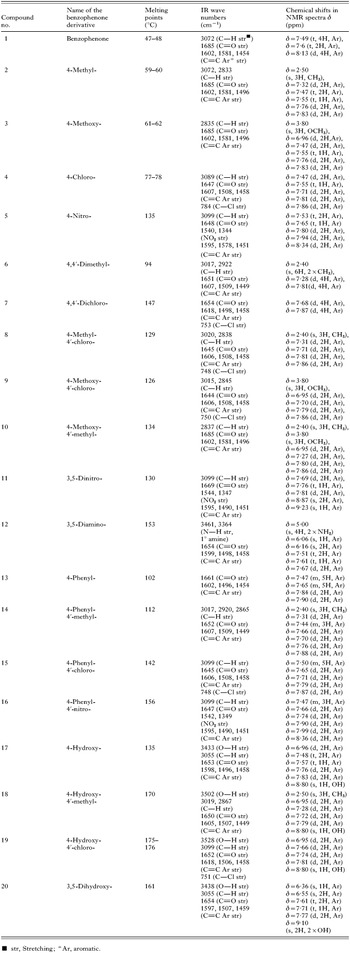
Table 1. The melting points and the characteristic IR and NMR spectral data for benzophenone and its derivatives
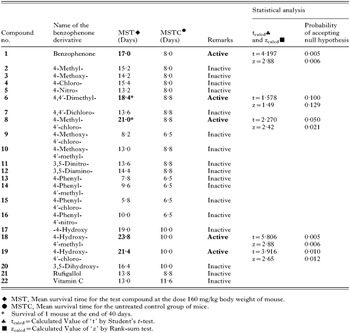
Table 2. The antimalarial activity of individual ketones, rufigallol and vitamin C in mice along with the statistical analysis for the ‘Active’ compounds
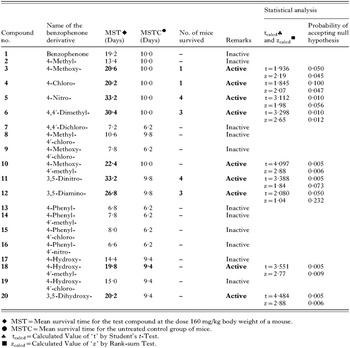
Table 3. The antimalarial activity for the combination of rufigallol and ketones in mice along with the statistical analysis for the ‘Active’ combinations
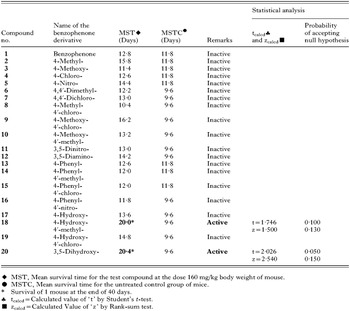
Table 4. The antimalarial activity for the combination of vitamin C and ketones in mice along with the statistical analysis for the ‘Active’ combinations
 You have
Access
- 15
- Cited by