Introduction
Individuals with autism and those with schizophrenia are characterized by marked social deficits, including an impoverished social network, difficulties maintaining employment, and social skills deficits (Green et al. Reference Green, Gilchrist, Burton and Cox2000; Grant et al. Reference Grant, Addington and Addington2001). In addition, deficits in social cognition, such as deficient theory of mind (ToM) or problems detecting emotions in social stimuli, have been identified as likely contributors to social dysfunction in both disorders (e.g. Muris et al. Reference Muris, Steerneman, Meesters, Merckelbach, Horselenberg, van den Hogen and van Dongen1999; Couture et al. Reference Couture, Penn and Roberts2006; Crespi & Badcock, Reference Crespi and Badcock2008).
Clarifying the specificity of social cognitive deficits to schizophrenia or autism is an important step in refining behavioral phenotypes, which provide a simpler link to genes, rather than more complex behaviors and/or broad diagnostic categories (Gottesman & Gould, Reference Gottesman and Gould2003). Detecting differences between two groups sharing social cognitive dysfunction can highlight areas that may be fundamental to each disorder, enabling future studies to hone in on more specific endophenotypic markers that may differentiate the two conditions or point to genes that may be shared by both disorders. For example, a recent study from our group found that those with high-functioning autism (HFA) showed a specific difference in rate of social orienting (i.e. they directed their gaze to the face at a slower rate) when making emotional judgments about social stimuli compared to individuals with schizophrenia, despite showing remarkable similarity on all other eye-tracking parameters (Sasson et al. Reference Sasson, Tsuchiya, Hurley, Couture, Penn, Adolphs and Piven2007). Thus, rate of social orienting may serve as a specific marker for HFA that can be subsequently linked with genes and brain regions.
Individuals with schizophrenia and HFA exhibit pronounced social cognitive deficits. Specifically, individuals with HFA and those with schizophrenia are impaired in basic emotion perception (e.g. Loveland et al. Reference Loveland, Tunali-Kotoski, Chen, Ortegon, Pearson, Brelsford and Gibbs1997; Celani et al. Reference Celani, Battacchi and Arcidiacono1999; Edwards et al. Reference Edwards, Jackson and Pattison2002) and ToM (e.g. Frith & Corcoran, Reference Frith and Corcoran1996; Baron-Cohen et al. Reference Baron-Cohen, Wheelwright, Hill, Raste and Plumb2001; Herold et al. Reference Herold, Tenyi, Lenard and Trixler2002), particularly on higher-order ToM tasks (Baron-Cohen et al. Reference Baron-Cohen, O'Riordan, Stone, Jones and Plaisted1999a; Kaland et al. Reference Kaland, Moller-Neilsen, Callesen, Mortensen, Gottlieb and Smith2002; Rutherford et al. Reference Rutherford, Baron-Cohen and Wheelwright2002; Brune, Reference Brune2005; Sprong et al. Reference Sprong, Schothorst, Vos, Hox and Engeland2007).
Only a few studies have directly compared individuals with schizophrenia and HFA on measures of social cognition. One study found that individuals with HFA were impaired in affect identification relative to those with schizophrenia and to controls, who did not differ from one another (Bölte & Poustka, Reference Bölte and Poustka2003). By contrast, another study found that participants with paranoid delusions and individuals with Asperger's syndrome were impaired on ToM abilities (on the Hinting and Eyes task) relative to controls, but were not significantly different from each other (Craig et al. Reference Craig, Hatton, Craig and Bentall2004).
Two other studies examined social cognitive abilities in childhood-onset schizophrenia versus children with autism. Pilowsky et al. (Reference Pilowsky, Yirmiya, Arbelle and Mozes2000) found that those with childhood-onset schizophrenia performed similarly to children with HFA on a false belief task (with both impaired relative to controls), but that children with schizophrenia performed at normal levels on a deception task. Van Lancker et al. (Reference Van Lancker, Cornelius and Kreiman1989) reported that children with schizophrenia were not impaired on vocal affect recognition, whereas children with autism performed more poorly on the task relative to controls. Taken together, some findings have supported comparable impairments on social cognitive tasks, whereas others have suggested more pronounced deficits in social cognition among those with autism. Clearly, research is limited in this area. In particular, two advances are needed: first, to compare directly schizophrenia and autism on identical tasks, and second, to compare their profile on a battery of several tasks known to tap social cognition.
The aim of the present study was to examine social cognitive abilities in both schizophrenia and HFA on a neurobiologically informed battery of social cognition tasks. Tasks were chosen based on their links to specific brain structures known to be crucial to social cognition (and abnormal in HFA and schizophrenia). Specifically, the Point-Light task has been associated with activation in the right somatosensory cortex (Heberlein et al. Reference Heberlein, Adolphs, Tranel and Damasio2004), the right superior temporal sulcus and the amygdala (Bonda et al. Reference Bonda, Petrides, Ostry and Evans1996). The amygdala is recruited for the Movie Stills task (Adolphs & Tranel, Reference Adolphs and Tranel2003). The Eyes task has been associated with increased activity in the left dorsolateral prefrontal cortex and superior temporal sulcus, the left amygdala, and ventrolateral prefrontal cortex (Baron-Cohen et al. Reference Baron-Cohen, Ring, Wheelwright, Bullmore, Brammer, Simmons and Williams1999b). The Trustworthiness task has been found to activate the amygdala, right insula, superior temporal cortex and fusiform gyrus (Winston et al. Reference Winston, Strange, O'Doherty and Dolan2002). We hypothesized that individuals with HFA would show greater impairments in ToM and emotion perception compared to individuals with schizophrenia and non-clinical controls, even after controlling for general cognitive functioning.
Method
ParticipantsFootnote 1Footnote †
All participants provided informed consent, and all procedures were approved by the local Institutional Review Boards. Individuals with HFA met algorithm criteria of the Autism Diagnostic Interview – Revised (ADI-R; Lord et al. Reference Lord, Rutter and LeCouteur1994) for autism and were recruited through the Subject Registry of the North Carolina Neurodevelopmental Disorders Research Center. The ADI-R was audiotaped to perform random reliability checks.
For the schizophrenia sample, the Structured Clinical Interview for DSM-IV Axis I Diagnosis – Patient Version (SCID-P; First et al. Reference First, Spitzer, Gibbon and Williams1995) was used to confirm diagnosis reported by the participant and documented in medical records, and the Positive and Negative Syndrome Scale (PANSS; Kay et al. Reference Kay, Fiszbein and Opler1987) was administered to assess severity of symptoms. Interviewers were trained by one of the authors (D.L.P.) to high reliability [intra-class coefficient (ICC) >0.80].
The non-clinical controls (NCC) were recruited from the community by mailings, mass emails and postings. Participants in this group could not meet criteria for any current Axis I disorder or have relatives with autism, schizophrenia, Down's syndrome or Fragile X syndrome. All participants needed to obtain a score of ⩾70 on the Wechsler Abbreviated Scale for Intelligence (WASI; Wechsler, Reference Wechsler1999) to be eligible for the study.
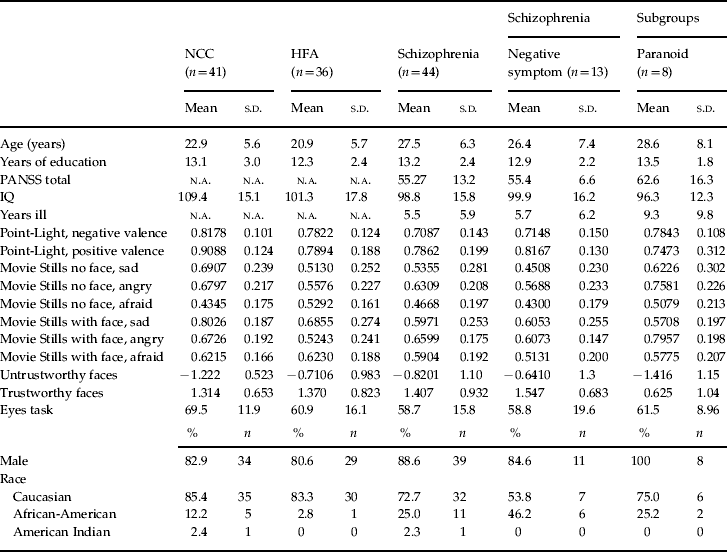
Demographic characteristics for the three groups are presented in Table 1. The groups were significantly different in age and IQ; schizophrenia participants were older than HFA and control participants, and had lower IQ compared to controls. No other comparisons were significant. The number of years ill (time since first diagnosed/hospitalized) and the total score on the PANSS is provided for the schizophrenia sample.
Demographic characteristics, IQ, illness variables and study measures

PANSS, Positive and Negative Syndrome Scale; HFA, high-functioning autism; NCC, non-clinical controls; s.d., standard deviation.
Measures
IQ
The two-subtest version of the WASI, comprising the Vocabulary and Matrix Reasoning subtests, was used to estimate full-scale IQ (FSIQ). The two-subtest version is highly correlated with FSIQ on the full Wechsler intelligence scale (Wechsler, Reference Wechsler1999), and the subtests have high factor loadings on a general intelligence factor (Kaufman, Reference Kaufman1994).
Emotion perception
The Point-Light Motion Displays (Heberlein et al. Reference Heberlein, Adolphs, Tranel and Damasio2004) consist of a series of 22 short films (ranging from 5 to 20 s) of an actor moving in ways that convey emotional information (e.g. dancing joyfully). These clips were filmed in the dark with lights on the major joints of the body and the head, and thus are viewed as a series of dots moving across the screen. Participants were asked to choose one of five emotion words to describe ‘how the dots might be feeling’: happy, sad, afraid, angry or neutral. Performance is converted to accuracy scores on the basis of data from a reference group. For example, if 100% of normal participants thought the answer was ‘happy’ and the participant said the response was ‘happy’, they would earn a score of 1.0, or a zero for all other responses. However, if 50% of normal participants said ‘angry’, 40% said ‘happy’ and 10% said ‘afraid’ in response to the item, one would earn a score of 1.0 for answering ‘angry’, 0.8 for answering ‘happy’ and 0.2 for answering ‘afraid’. Scoring the measure in this manner allows assessment of degrees of impairment relative to a normal population rather than an absolute correct or incorrect score. Accuracy scores were summed and averaged to form two scales: accuracy on positive emotions (happy, five scenes) and accuracy on negative emotions (five scenes for sad, four each for angry and afraid).
The Movie Stills task (Adolphs & Tranel, Reference Adolphs and Tranel2003) consists of 16 photographs of complex scenes from movies with clear emotional content. Participants are first shown the movie stills with the faces blocked out, then are reshown the 16 photographs with the faces present. Comparison of stimuli with and without faces assesses emotion recognition from purely contextual cues versus using both facial expressions and contextual cues to determine emotion. Participants choose one of seven emotion words (happy, sad, afraid, surprised, angry, disgusted, or neutral) that best describe what the actors in the movie still are feeling. Performance is converted to accuracy scores on the basis of data from a reference group as described above for the Point-Light Displays. Given the non-normal distributions for happy and surprised (almost all participants were at ceiling correct performance), only sad (three stimuli), afraid (five stimuli) and angry (four stimuli) were included in the analyses.
Social judgments
In the Abbreviated Trustworthiness task (Adolphs et al. Reference Adolphs, Tranel and Damasio1998; Bellugi et al. Reference Bellugi, Adolphs, Cassady and Chiles1999), participants are shown 42 faces of unfamiliar people and are asked to judge how much they would trust the person by providing a rating on a seven-point scale, ranging from −3 (very untrustworthy) to +3 (very trustworthy). Based on data from a reference group, the most trustworthy (top third/a score >+1) and least trustworthy faces (bottom third/a score <−1) according to normed scores were used to form two scales: the average rating on trustworthy faces and the average rating on untrustworthy faces. Scoring for this task reflects a departure from the accuracy-based scores on the other tasks. There is no ‘correct’ amount of trustworthiness inherent in each stimulus, and given findings from previous studies suggesting that assessing bias in response to the stimuli is important (e.g. Adolphs et al. Reference Adolphs, Tranel and Damasio1998; Pinkham et al. Reference Pinkham, Hopfinger, Pelphrey, Piven and Penn2008), it seemed most appropriate to examine scores in their raw form.
ToM
The Eyes task (Baron-Cohen et al. Reference Baron-Cohen, Wheelwright, Hill, Raste and Plumb2001) was selected to assess ToM for two reasons: (1) it reflects ‘advanced ToM’, which is less prone to ceiling effects in higher functioning populations, and (2) it may rely to a lesser degree on more complex cognitive processes (e.g. working memory and reasoning) than traditional ToM tasks. Research suggests that ToM may be parsed into social perceptual ToM, which relies on using cues that are immediately available to make mental state judgments (such as facial expressions), and social cognitive ToM, which involves reasoning about stories or scenarios to ascertain mental state (Sabbagh, Reference Sabbagh2004; Nettle & Liddle, Reference Nettle and Liddle2008). The Eyes task is hypothesized to assess social perceptual ToM (Nettle & Liddle, Reference Nettle and Liddle2008). Participants were shown only the eye region of faces and asked to choose among four words the one that best describes what the person is thinking or feeling. A glossary was provided for participants to eliminate the influence of a limited vocabularyFootnote 2. The percentage of correct responses was used as a summary score for this measure.
Overview of data analyses
For the two emotion perception tasks (Point-Light and Movie Stills), a mixed-model ANCOVA was conducted, with emotion as the within-group factor (positive versus negative for Point-Light and sad, afraid, angry for Movie Stills) and group membership as the between-group factor (Schizophrenia, HFA or Control). Similarly, a mixed-model ANCOVA was conducted for the Trustworthiness task (within: trustworthy versus untrustworthy faces; between: Schizophrenia, HFA, Control). Finally, a one-way ANCOVA was conducted to examine the Eyes task. All analyses included age and IQ as covariates. For significant group effects in the main analyses, least significant difference (LSD) and Bonferroni post-hoc tests were conducted. For significant interactions, follow-up one-way ANCOVAs (controlling for age and IQ) were conducted with LSD and Bonferroni post-hoc tests if the overall ANCOVA was significant. All tests were two-tailed.
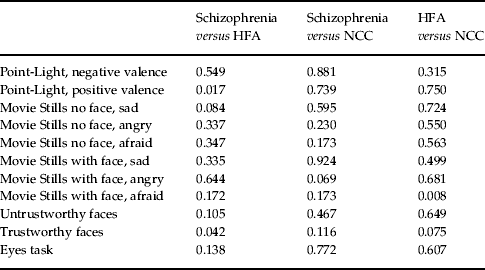
Given the exploratory nature of our study, and the limited statistical power inherent in studies of clinical populations that often show large variability and have modest sample size, we are liberal in our reporting of findings. Thus, we probe some effects that were only marginally significant with the initial ANCOVA, and we report both corrected and uncorrected tests for multiple comparisons. As our aim was to describe the overall patterns of impairments in HFA and schizophrenia, we felt that including all possible findings would be most valuable and provide hypotheses that could be followed up in future studies focused on specific aspects of social cognition. To further this aim, we have also provided Cohen's d effect size estimates for the means on all study measures (Table 2).
Cohen's d effect sizes for three-group comparison

HFA, High-functioning autism; NCC, non-clinical controls.
Results
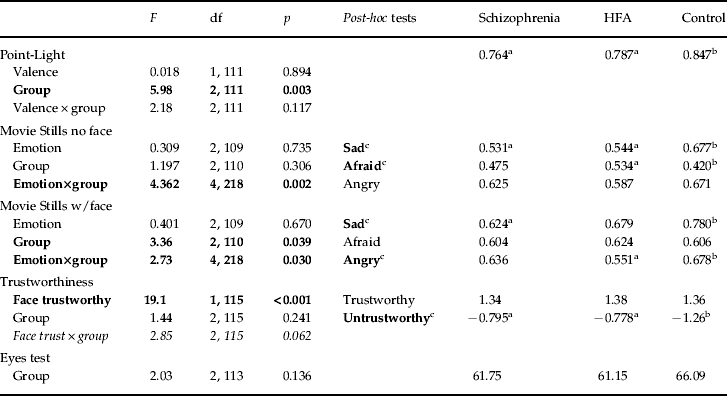
Table 3 displays F statistics and p values for all of the main analyses discussed below, in addition to adjusted group means and results from post-hoc LSD analyses.
Results from repeated-measures ANCOVAs with post-hoc tests for all social cognition tasks

HFA, High-functioning autism; df, degrees of freedom.
For main analyses, significant effects are in bold face, effects approaching significance are italicized.
a Significantly different from b.
c Significant group effect for post-hoc test.
Point-Light Motion Displays
For the Point-Light task, the main effect for emotion valence and the group×emotion valence interaction were not significant, but the main effect for group was statistically significant. Examination of the significant group effect indicated that the schizophrenia and HFA groups performed significantly more poorly than the control group on this task (p=0.001 and 0.021 respectively), but not differently from one another (p=0.403). The HFA-NCC comparison approached statistical significance after applying the Bonferroni correction (p=0.064).
Movie Stills without facesFootnote 3
On the Movie Stills stimuli without faces, the main effect of emotion and the main effect for group were not significant. However, the group×emotion interaction was statistically significant. Probing the interaction revealed that HFA and schizophrenia participants were impaired on ‘sad’ relative to controls (p=0.032 and 0.015 respectively), but did not differ from one another (p=0.843). The HFA-NCC comparison approached statistical significance after the Bonferroni correction (p=0.096). On ‘afraid’, HFA participants performed better than controls (p=0.010), but no other comparisons were statistically significant. There were no group differences on ‘anger’.
Movie Stills with faces
On the Movie Stills stimuli with faces, the main effect of emotion was not significant. However, the main effect of group and the group×emotion interaction were both statistically significant. The group effect indicated the HFA and schizophrenia groups performed more poorly than controls. This main effect was qualified by the significant interaction, which indicated that individuals with schizophrenia performed more poorly than controls on ‘sad’ (p=0.006), but were not significantly different from HFA participants (p=0.384), and that HFA participants performed marginally more poorly than controls (p=0.084). After Bonferroni correction, the HFA-NCC comparison no longer approached statistical significance (p=0.251). On ‘anger’, HFA participants performed more poorly than controls (p=0.009), with the schizophrenia group falling in between but not significantly different from either. There were no group differences on ‘afraid’.
Trustworthiness task
The significant main effect for face trustworthiness indicated that trustworthy faces were rated more positively than untrustworthy faces, as expected. The main effect for group was not significant, but the trustworthy by group interaction approached statistical significance [F(2, 116)=2.759, p=0.068]. Probing this interaction with one-way ANCOVAs, conducted on the trustworthy and untrustworthy faces separately, revealed that the three groups were rating the trustworthy faces similarly (p=0.974), but were different in their ratings on untrustworthy faces (p=0.032). Specifically, HFA and schizophrenia participants rated the untrustworthy faces more positively than controls (p=0.023 and 0.028 respectively), but did not differ from one another (p=0.939). Both results approach statistical significance after the Bonferroni correction (HFA versus NCC, p=0.070; schizophrenia versus NCC, p=0.085).
Eyes task
On the Eyes test, there were no significant group effects after controlling for IQ.
Post-hoc symptom subgroup analyses
Given evidence that individuals with negative symptoms may clinically resemble individuals with autism (Sheitman et al. Reference Sheitman, Kraus, Bodfish and Carmel2003), that social cognition may be similar in individuals with Asperger's syndrome and individuals with paranoid delusions (Craig et al. Reference Craig, Hatton, Craig and Bentall2004), and that individuals with paranoia and those with HFA have similar activation in the fusiform face area and amygdala (Pinkham et al. Reference Pinkham, Hopfinger, Pelphrey, Piven and Penn2008), we repeated the primary analyses after dividing the participants with schizophrenia into negative symptom and paranoid groups. The negative symptom group comprised individuals who scored ⩾4 on at least one of the following PANSS items: blunted affect, emotional withdrawal, passive/apathetic social withdrawal, or lack of spontaneity. Individuals in the paranoid group had a score of ⩾4 on the suspiciousness item. Given the small size of these subgroups (negative symptom group=13, paranoid group=8), these analyses are exploratory and the findings should therefore be interpreted cautiously. Participants who met criteria for both symptom subgroups and those who did not meet criteria for either subgroup (n=23) were excluded from these analyses in order to compare more ‘pure’ symptom subgroups with the HFA and non-clinical samples.
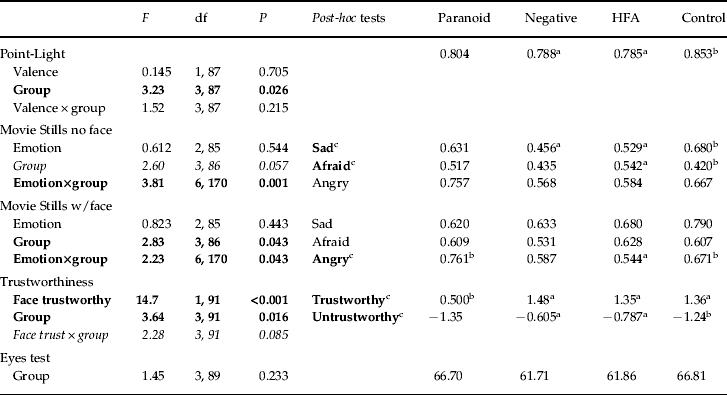
For the Point-Light task, the valence main effect and valence×group interaction were not statistically significant. However, there was a significant main effect for group. Post-hoc analyses revealed that the control group performed significantly better than the HFA group (p=0.005) and the negative symptom group (p=0.045). The negative symptom-NCC comparison no longer reached statistical significance after the Bonferroni correction (p=0.270). There were no other significant differences (see Table 4).
Results from symptom subgroups repeated-measures ANCOVAs and relevant post-hoc tests

For main analyses, significant effects are in bold face, effects approaching significance are italicized.
a Significantly different from b.
c Significant group effect for post-hoc test.
For the Movie Stills task without faces, the main effects for emotion and group were not significant, but the group×valence interaction was statistically significant. Post-hoc analyses revealed that the HFA and negative symptom group performed worse than controls on ‘sad’ (p=0.015 and 0.007 respectively). This effect became marginally statistically significant for the HFA group after applying the Bonferroni correction (p=0.092), but remained statistically significant for the negative symptom subgroup (p=0.043). On ‘afraid’, the HFA group performed better than controls (p=0.004), which remained statistically significant after correction (p=0.025). There were no group differences on ‘angry’, but examination of the means revealed a similar pattern to ‘sad’; HFA and negative symptom groups perform similarly to one another and worse than controls. No other comparisons were significant.
On the Movie Stills stimuli with faces, the main effect for emotion was not significant, but the main effect for group and the group×valence interaction were both statistically significant. Post-hoc analyses revealed that the HFA group performed worse than controls and the paranoid group on ‘angry’ (p=0.013 and 0.012 respectively), with both effects becoming marginally statistically significant after the Bonferroni correction (p=0.075 and 0.071 respectively). No other comparisons were significant, although examination of the means reveals that the negative symptom group performed similarly to the HFA group and worse than the other two. There were no group differences on ‘sad’ or ‘afraid’.
For the Trustworthiness task, the main effect for face trustworthiness and the main effect for group were both statistically significant, with a marginal face trustworthiness×group interaction [F(3, 91)=2.279, p=0.085]. Investigating the interaction with one-way ANCOVAs revealed that the paranoid participants rated the trustworthy faces less positively than the other three groups (HFA p=0.007, negative symptom p=0.005, controls p=0.006), who did not differ from each other. These effects all continued to be statistically significant after applying the Bonferroni correction. By contrast, the HFA and negative symptom group rated the untrustworthy faces more positively than the NCC (p=0.027 and 0.025, respectively); no other differences are significant. These effects were no longer statistically significant after correcting for multiple tests.
On the Eyes test, the one-way ANCOVA was not statistically significant.
Discussion
The aim of this study was to compare social cognitive deficits in schizophrenia and HFA in order to begin refining the social behavioral phenotype in these disorders. It was hypothesized that individuals with HFA and schizophrenia would have greater impairments in emotion perception and social perceptual ToM relative to NCC, with individuals with schizophrenia performing at an intermediate level between these two groups. In general, the hypothesis that individuals with HFA would show greater impairments in social cognition than individuals with schizophrenia was not supported. However, we found that individuals with HFA and those with schizophrenia performed similarly to one another on social cognitive tasks, with both groups tending to differ significantly from controls.
Our results indicate that, even after controlling for age and IQ, both individuals with HFA and schizophrenia were impaired in emotion perception relative to NCC, but were not significantly different from one another. These findings are not consistent with previous studies demonstrating that individuals with autism are more impaired in emotion perception than individuals with schizophrenia (Van Lancker et al. Reference Van Lancker, Cornelius and Kreiman1989; Bölte & Poustka, Reference Bölte and Poustka2003). However, our stimuli were not limited to face and vocal affect recognition, suggesting that we were assessing related, but different, domains than the other studies (Van Lancker et al. Reference Van Lancker, Cornelius and Kreiman1989; Bölte & Poustka, Reference Bölte and Poustka2003). There has been little research directly comparing those with HFA and schizophrenia on social cognition, and each study has used different tasks that tap different abilities; therefore, it is difficult to compare studies at this early stage.
Although the results generally indicate similar impaired performance on emotion perception, examination of the effect sizes for the Point-Light task (Table 2) suggests that emotional valence may impact findings. Specifically, it seems that individuals with schizophrenia performed more poorly on positive emotions, whereas individuals with HFA were worse on negative emotions. Clearly, this interpretation is speculative given that statistical analyses did not provide evidence of a significant interaction. Nevertheless, given the medium to large effect sizes, it may be worthwhile examining further the possibility that these groups may have performance differences based on emotional valence.
We also found evidence for a shared bias in social judgments of trustworthiness in schizophrenia and HFA. Specifically, both groups tended to rate untrustworthy faces as more trustworthy than NCC. Although these group differences did not survive Bonferroni correction (they approached statistical significance), examination of the effect sizes (Table 2) indicate medium–large effects, with ratings from the HFA and schizophrenia samples being similar. Of note, this convergence seems to be true only for a subgroup of individuals with schizophrenia; namely, those with prominent negative symptoms. By contrast, those with paranoia tend to rate untrustworthy faces as negatively as controls while also demonstrating the opposite bias: rating trustworthy faces more negatively than the other three groups. These findings highlight what may be a specific impairment shared by those with HFA and in some individuals with schizophrenia.
There were no group differences in social perceptual ToM after statistically controlling for age and IQ. However, the effect sizes (without regard to age and IQ) suggest large differences between HFA and NCC, and between schizophrenia and NCC, with HFA and schizophrenia performing similarly to one another. Given the putative lower degree of cognitive demand on this task compared to tasks assessing social cognitive ToM (e.g. false belief tasks), it was hoped these results would be independent of IQ. On the contrary, we found evidence for a strong relationship between IQ and Eyes task performance (r=0.65, p<0.001). This high correlation renders the current results difficult to interpret, and suggests that further data are needed to understand the role of cognitive abilities and IQ in social perceptual ToM.
The findings from the current study may be accounted for by several potential explanations, which are not mutually exclusive. First, a shared social cognitive profile may implicate overlapping etiologies, such as genes common to both disorders. For example, it is possible that there are genes that can be linked to the social cognitive deficits prevalent in both disorders. This explanation has some merit, given recent research supporting the role of the Disrupted in Schizophrenia 1 (DISC1) gene (Marx, Reference Marx2007) and choroidal neovascularization (CNV) disruption of the neurexin-1 (NRXN1) gene (Friedman et al. Reference Friedman, Baross, Delaney, Ally, Arbour, Asano, Bailey, Barber, Birch, Brown-John, Cao, Chan, Charest, Farnoud, Fernandes, Flibotte, Go, Gibson, Holt, Jones, Kennedy, Krzywinski, Langlois, Li, McGillivray, Nayar, Pugh, Rajcan-Separovic, Schein, Schnerch, Siddiqui, Van Allen, Wilson, Yong, Zahir, Eydoux and Marra2006; Autism Genome Project Consortium, Reference Szatmari, Paterson, Zwaigenbaum, Roberts, Brian, Lui, Vincent, Skaug, Thompson, Senman, Feuk, Oizn, Bryson, Jones, Marshall, Scherer, Vieland, Bartlett, Mangin, Goedken, Segre, Pericak-Vance, Cuccaro, Gilbert, Wright, Abramson, Betancur, Bourgeron, Gillberg, Leboyer, Buxbaum, David, Hollander, Silverman, Hallmayer, Lotspeich, Sutcliffe, Haines, Folstein, Piven, Wassink, Sheffield, Geschwind, Bucan, Brown, Cantor, Constantino, Gilliam, Herbert, Lejonchere, Ledbetter, Lese-Martin, Miller, Nelson, Samango-Sprouse, Spence, State, Tanzi, Coon, Dawson, Devlin, Estes, Flodman, Klei, McMahon, Minshew, Munson, Korvatska, Rodier, Schellenberg, Smith, Spence, Stodgell, Tepper, Wijsman, Yu, Rogé, Montoulan, Wittemeyer, Poustka, Felder, Klauck, Schuster, Poustka, Bölte, Feineis-Matthews, Herbrecht, Schmötzer, Tsiantis, Papanikolaou, Maestrini, Bacchelli, Blasi, Carone, Toma, Van Engeland, de Jonge, Kemner, Koop, Langemeijer, Hijmans, Staal, Baird, Bolton, Rutter, Weisblatt, Green, Aldred, Wilkinson, Pickles, Le Couteur, Berney, McConachie, Bailey, Francis, Honeyman, Hutchinson, Parr, Wallace, Monaco, Barnby, Kobayashi, Lamb, Sousa, Sykes, Cook, Guter, Leventhal, Salt, Lord, Corsello, Hus, Weeks, Volkmar, Tauber, Fombonne, Shih and Meyer2007) in both schizophrenia and autism. Second, it is also possible that these findings implicate shared underlying neural pathology. This explanation also has validity, given that several of the tasks have strong links with brain regions implicated in theories and research on the ‘social brain’ (Adolphs, Reference Adolphs2002). For instance, the shared bias for rating faces as more trustworthy than healthy controls is suggestive of bilateral dysfunction in the amygdala, given the relationship between bilateral amygdala damage and this bias (Adolphs et al. Reference Adolphs, Tranel and Damasio1998). In addition, the brain regions recruited by study measures have previously been suggested to be dysfunctional in both schizophrenia and autism, which further supports this hypothesis (Abdi & Sharma, Reference Abdi and Sharma2004). Finally, a third explanation is that there may be a similar social cognitive profile, but differing mechanisms contributing to these deficiencies (Pinkham et al. Reference Pinkham, Hopfinger, Pelphrey, Piven and Penn2008). This account is supported by research demonstrating different rates of orienting to social stimuli (Sasson et al. Reference Sasson, Tsuchiya, Hurley, Couture, Penn, Adolphs and Piven2007), which is suggestive of the two groups processing social stimuli in a different manner.
The current study has some limitations. First, the exploratory nature of this study resulted in multiple tests being conducted. To address this concern, we reported the findings with both corrected (Bonferroni) and uncorrected (LSD) tests, and provided means and effect sizes. Thus, it is important to interpret all study findings cautiously. Second, it may have been useful to include a more comprehensive assessment of each participant's developmental history given the neurodevelopmental nature of both disorders. Although the patient samples were evaluated thoroughly to confirm diagnosis, a developmental assessment was outside the scope of the present study (but one that should be pursued in future research). Third, given that we did not control for or assess the effects of general face perception or biological motion perception, it may be that findings are a result of basic perceptual impairments rather than a specific deficit in social cognition. This problem is not new, as many researchers have discussed the notion of a generalized versus specific deficit in social cognition and neurocognition (e.g. Bryson et al. Reference Bryson, Bell and Lysaker1997; Penn et al. Reference Penn, Combs, Ritchie, Francis, Cassisi, Morris and Townsend2000). Although many studies have provided evidence that social cognitive and basic cognitive processes can be reliably dissociated, both behaviorally and through neural substrates (e.g. Brunet et al. Reference Brunet, Sarfati and Hardy-Boyle2003; Phillips et al. Reference Phillips, Drevets, Rauch and Lane2003), it is worthwhile for future studies to consider this question more carefully.
Consideration of possible pathways to similar social cognitive profiles in schizophrenia and HFA (as presented above) highlight important areas for future research to investigate. Future studies could further delineate shared and unique aspects of these disorders, which will probably need to be taken into account in the search for the pathogenesis of HFA and schizophrenia.
Acknowledgments
This study was funded by a grant from Johnson & Johnson Pharmaceutical Research and Development, LLC, USA to D.P. and NIH U54 MH66418 (STAART Center) and NICHD P30 HD003110 (Intellectual and Developmental Disabilities Research Center) to J.P.
Declaration of Interest
None.