How does economic performance affect democratization? Efforts to document whether and how economic performance fuels democratization have been unremitting since Lipset's (1959) work on the requisites of democracy.Footnote 1 Theoretically, the debate wrestles with clarifying the preferences, incentives, capabilities and timing of those actors advocating change.Footnote 2 Empirically, the debate is fanned by the divergence in democratization experience of the high-growth nations of South Korea and Taiwan in East Asia that suggests that economic growth leads to democratization.
This article develops and tests a strategic model of democratization to contribute towards the debate. Specifically, we model democratization as the outcome of strategic interaction or exchange between government and non-government actors. The model builds on one of the few areas of consensus regarding democratization: it usually enhances co-operation with or support for the government, regardless of whether it is demanded by labour, pushed by the middle class or administered top-down by governing elites.Footnote 3 Working from this area of agreement provides two useful theoretical vantages. First, it presents democratization as a strategic outcome, that is, the result of players’ responses to each other's preferences and behaviours, given their own economic, political or social goals and the structure of the game.Footnote 4 Secondly, it offers the use of backward induction as a method to work from this agreement backwards to illuminate the original conditions that trigger democratization.
Briefly, the model shows that when economic performance is weak, the government has the highest incentive to accommodate citizens’ demands for expansion of citizens’ political participation and the government's responsiveness. Similarly, citizens’ threats to use their capabilities to bring about political reforms relevant to democratization are most credible under weak economic conditions. We draw on studies of democratization, especially on East Asia, for the preferences, incentives and capabilities of the government and citizens with regard to democratization. The focus on East Asia considers that these are generally economies with natural resources. The lack of natural resources underlies strategic interaction, i.e. it motivates government and citizens to interact to achieve their political, social or economic goals based on other players’ behaviour or expected reaction. In contrast, countries well endowed with resources may see players circumvent strategic interaction by diverting resources to achieve political, social or economic goals in the short term. From the foundations of the preferences, incentives and capabilities of government and citizens in East Asia, we consider the economic conditions under which these players’ threats or actions are considered credible, that is, when they are expected to use their capabilities to pursue their preferences. This also delineates the conditions under which their promises and threats are not credible. The term citizens’ denotes voters – i.e., those not in the government – who own resources important for economic development, such as labour and production investment. The term includes labour, the middle class, farmers, investors and opposition groups, i.e., those not in government, but it rules out students of voting age. The terms ‘non-government actors’, ‘citizens’ and ‘resource-owners’ are used interchangeably in this article. The strategic interaction treatment provides an alternative to decision-theory perspectives by specifying the preferences, incentives and decision-choices of interrelating participants as the basis of predictions for institutional development or democratization.Footnote 5 In addition, strategic-interaction modelling provides for the backward-induction method of working from the end point of the game to clarify each player's strategies and expectations at the original trigger point.
To test the model's conclusions, we analyse longitudinal data from South Korea and Taiwan between the 1970s and 2004. South Korea and Taiwan are valuable cases for two reasons. First, both nations are generally cited as empirical support that economic growth, rather than downturns, fosters democratization.Footnote 6 Findings to the contrary from systematic analyses of these nations, then, represent significant reversals that contribute to the debate. Secondly, the two Asian economies are now considered successful democracies, even as concerns rise over the progress of democratization in their non-Asian counterparts.Footnote 7 As widely recognized democracies, these nations offer unique opportunities for assessing the relationship between economic performance and successful democratization, as well as the utility of different operationalizations of democratization for theory-building. The analyses of both nations over time are based on recent literature that identifies this methodology as the most rigorous research design for causal tests.Footnote 8
The results from statistical analyses corroborate the model's conclusions for both South Korea and Taiwan. In particular, the analyses across two different operationalizations of democratization – a summary measure and a component indicator – show that weak economic performance, not strong growth, has led to democratization in the two nations. Additional analyses to round up the statistical evidence show that democratization or political liberalization improves the support of non-government actors for the government, i.e. the findings support the model's premise. Indeed, the findings add an interesting nuance on the effects of democratization on citizens’ support: they show that democratization when the economy is growing strongly alienates some support for the government, while democratization in a period of severe economic distress also fails to garner some support.
This article makes four contributions to the literature. First, it provides a model that explains democratization as the outcome of strategic interaction in two nations that have been frequently cited as critical cases in the debate. This extends the strategic treatment of the relationship between economic performance and democratization for theory-building. Secondly, the article evaluates the relationship – weak economic performance leads to political reforms that underlie democratization – with rigorous longitudinal tests from South Korea and Taiwan. In doing so, the article provides important systematic results on critical cases for the debate. Thirdly, the use of different measures of democratization – a summary and a component indicator – ensures that the findings are robust to alternative specifications. In particular, it is based on a growing literature that recommends using component dimensions of democratization to complement theory-building the construction of a theory.Footnote 9 Fourthly, the findings add nuance regarding the effects of democratization on citizens’ support. In particular, the literature has generally struggled to clarify the effects of democratization: even as democratization is expected to elicit support, empirical evidence shows the converse that democratization lowers investment and increases strike activity.Footnote 10 The results here add to the literature by specifying threshold conditions within which democratization improves support and shows how it is not a panacea for eliciting citizens’ co-operation.
In the following, we develop the strategic-interaction model of democratization, describe democratization in Taiwan and South Korea to contextualize the hypotheses and variables used, explain the tests and results, and conclude with a discussion of the implications of the findings.
Strategic-interaction model of democratization
Is it strong or weak economic performance that leads to democratization? To address this question, we treat democratization as the outcome of strategic interaction between the government and citizens against the backdrop of economic performance. Strategic interaction considers democratization as the outcome of an exchange between government and non-government players, subject to the constraints imposed by each other's preferences and behaviour. Extant studies tacitly or explicitly acknowledge that democratization is not unilaterally driven: thus, for instance, some studies explain that labour groups pose substantial challenges to government authority through their protest capacity, once they are mobilized.Footnote 11 In this case, a vital component is who or what instigates labour groups to mobilize. Others identify the middle class as a viable force, when it is willing to join forces with other groups to militate for political and economic reforms.Footnote 12 Still others contend that the state's acceptance or encouragement of political pluralism is key to democratization; however, even where democratization is government-initiated, success relies on non-government actors’ follow-through on that opportunity.Footnote 13 Clearly, in these studies, there is recognition that democratization is not unilaterally driven. Nevertheless, they establish the capacities of government and non-government actors for pursuing democratization. In the following, we draw on these to describe the players’ preferences for outcomes and show the likely outcomes based on the interaction of these preferences.
Setting up the Model
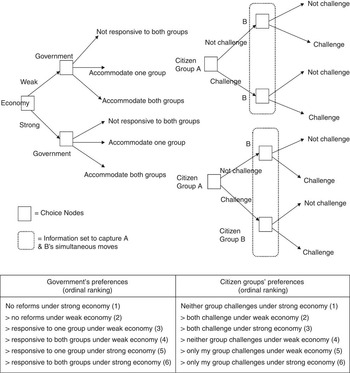
The strategic-interaction model of democratization is developed as a game that incorporates moves by the government and the citizens against the backdrop of strong versus weak economic conditions. Figure 1 displays the sequence of plays. The government moves first in response to economic conditions; this sequence takes into account that the government generally knows how the economy has performed before the rest of the country is informed. It also considers that economic performance is fundamentally uncertain, notwithstanding the government's plans or policies to the contrary. We portray non-government actors as comprising two groups, A and B; this takes into account divisions in the citizenry, but it simplifies the treatment of such divisions so as not to lose tractability in the modelling. The ellipse around the citizen groups denotes that the players move simultaneously in the model. This means that the citizen groups know how the economy has performed and how government has moved but do not know how the other citizen group chooses.Footnote 14 When the economy does well, all the players – that is, the government and groups A and B – gain, although they may not gain equally. When the economy is weak, all the players lose, although they may not lose equally. The players’ preferences and payoffs are known to each other.
The Players’ Ranking of Preferences
What are the players’ preferences over their respective strategies? The tables in Figures 1, 2 and 3 display the ordinal rankings of the players’ preferences. We begin with the explanation of the government's preferences. The government's stay in office depends on the lack of challenge from the citizen groups;Footnote 15 it may achieve this by making political reforms benefiting one or both groups. Clearly, the government's responsiveness and political reforms are achieved at a cost: they compromise the government's policy-reach or latitude and absorb its resources. Thus, the government prefers not to respond and make political reforms, or make the least necessary – that is, the least politically, socially or economically costly – to stay in office. However, the extent of ‘the least necessary’ is contingent on citizen groups’ behaviour, which is, in turn, influenced by economic conditions and their respective evaluation that the other citizen group will challenge in conjunction. Thus, for instance, responding to only one group is less costly than responding to both groups only if it leads to one group's support and the failure of the other group to challenge the government. If one group challenges, then the government's costs rise to include that of responding to the challenge; if the challenge galvanizes or catalyses the other group to challenge, then the strategy of responding to only one group is not less costly. As will be discussed next, studies report that such catalyst action does occur.Footnote 16 Consequently, the government's choices for political survival are constrained by the behaviour of citizens groups, notwithstanding the government's preference rankings. Generally, the government's strategy-choices from most to least preferred are (1) not respond; (2) be responsive and offer political reforms to one group; and (3) respond and offer political reforms to both groups.
Game-form for strategic model of democratization

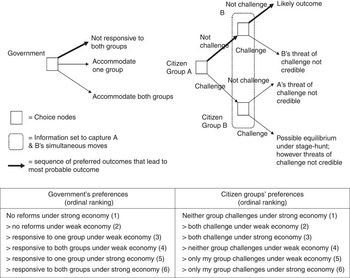
Strategic interaction under strong economic conditions

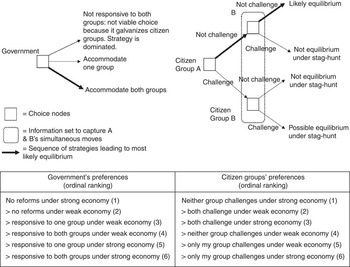
Strategic interaction under weak economic conditions

What are the citizen groups’ preferences? The citizen groups prefer reforms, because these improve their participation and subsequent influence on policies, which affect their payoffs. Citizen groups A and B move simultaneously in this model, and may choose to support or challenge the government depending on the government's offer of reforms and the economy. Citizens’ challenge of the government – which includes efforts such as demonstrating against the government or otherwise withholding support from the government – involves time, effort and resources and is, thus, costly. Nevertheless, the groups prefer to expend that cost and challenge the government if doing so elicits the latter's responsiveness and reforms, or otherwise stultifies the government's policies to improve citizens’ payoffs. In general, when both groups unite, they successfully challenge the government and, hence, improve their payoffs; if only one group challenges, it is unlikely to be successful.Footnote 17 Hence, each citizen group's least preferred outcome is to be the only group challenging the government while the other does not do so.
Importantly, this does not mean that citizen groups have a dominant strategy of not challenging. Instead, the strategic interaction has two equilibria: the ‘risk-dominant equilibrium’ in which both groups refrain from challenging, and the ‘payoff-dominant equilibrium’ in which both groups challenge.Footnote 18 That is, the structure of the groups’ interaction follows that of the stag-hunt game, where the strategy choices capture a conflict between ‘considerations of mutual benefit and … personal risk’.Footnote 19 Under the stag-hunt set-up, each group knows that if it fails to join in the challenge, the other group is unlikely to be successful; given the payoffs of a successful hunt, the main obstacle to a group joining is when to coordinate to achieve the payoff-dominant equilibrium. Empirically, it means that a group may challenge the government even though there is a risk that the other group might not be challenging, because doing so changes the dynamics of interaction, provides assurance to the non-challenging group and potentially leads the non-challenging group to switch strategies to achieve the payoff-dominant equilibrium of both challenging.Footnote 20 This is supported empirically: studies show that citizens mobilize to defend their interests or stultify government policies even if in a minority initially, with such mobilization quickly expanding.Footnote 21 That is, large-N cross-national studies as well as country-specific evidence across authoritarian, transitional and democratic countries such as China, Taiwan, South Korea and, most recently, Thailand, report dissent or mobilization – ranging from politics to religion to environment – that grows quickly and exponentially. Nevertheless, the risk that the other group does not follow suit remains. The task under the stag-hunt set-up, then, is to distinguish between the conditions under which both groups would adopt the strategy of not challenging to reach the risk-dominant equilibrium versus those under which both groups move to challenge, based on the group's calculus of the effect on their payoffs and the assessment that the other group will also challenge or quickly be catalysed into action to reach the payoff-dominant equilibrium.Footnote 22 In general, citizen groups’ preferences over their choices are: challenge and elicit the government's political reforms; not challenge the government; and be the only group challenging the government.
Outcomes under Strong and Weak Economic Conditions
Strong economy
What are the likely outcomes? Figure 2 depicts strategic interaction under strong economic conditions. We evaluate for outcomes through backward induction. Beginning with citizens’ choices under a strong economy, the citizen groups may choose to challenge or not to challenge the government. Challenging the government comes at some costs, which are exacerbated in a strong economy because the challengers lose out on potential returns as a result of the cost of resources directed towards challenging the government. In a strong economy, then, the benefits from challenging the government have to be substantial in order to equal or better expected payoffs. This is likely to be achieved only if both citizen groups challenge the government, that is, if neither defect from collectively challenging the government. How credible is such a united challenge? Unfortunately, it is not credible: each citizen group may achieve strong payoffs from economic returns alone through the strong economy, rather than relying on the constancy of the other group to obtain responses and achieve political reforms from the government. That is, given the large returns from a strong economy, the risk-dominant equilibrium predominates because each group loses substantially if the other group fails to challenge. The government knows this. Given the government's knowledge, the probable outcome when economic conditions are good is: the government does not make any concessions and neither citizen group challenges the government.
Weak economy
Figure 3 portrays strategic interaction under a weak economy. When economic performance is poor, the government and both citizen groups, A and B, stand to lose. Beginning with the citizens’ choices, each set of citizen groups chooses between challenging the government and not challenging. Challenging the government incurs costs, although the costs do not include the loss of potential returns from the economy. Not challenging means that the citizen groups bear the losses from the weak economic performance, possibly without reprieve if the government shuns responsibility for economic performance. If both groups are able to unite in their challenge of the government, their payoffs improve through forcing the government's concessions. The groups prefer not to be the only group challenging the government; fortunately, this is not an equilibrium strategy because each group switches strategies to achieve one of the two equilibria of both challenge or both not challenge.Footnote 23
In general, when both groups unite, they successfully challenge the government and, hence, improve their payoffs.Footnote 24 The question, then, is whether one group will challenge even if there is a risk that the other groups may not, in order to achieve the payoff-dominant equilibrium. Experimental and empirical evidence affirms this: in particular, empirical evidence shows that even in the face of coercive governments, non-collectivized African farmers alter their production, Korean production investors withdraw their investment, and rural Thai peasants agitate for political and economic reforms when they are dissatisfied with economic performance.Footnote 25 That is, empirical evidence shows that weak economic performance amplifies a group's choice to challenge even at the risk that the other groups may not. This is noteworthy because some scholars point out that one outcome – where the government bands with one group at the expense of the remaining citizen group – is stable because it is difficult for one (penalized) group to turn the tables.Footnote 26 Empirical evidence shows otherwise; further, as one group takes steps to avert or minimize losses, it galvanizes or catalyses the other group's choice to challenge to achieve the payoff-dominant equilibrium of both challenging.Footnote 27
The government knows this. The government chooses between three strategies: (1) not respond to either group; (2) offer concessions to one group only; or (3) concede and make reforms that benefit both groups. If it fails to make concessions to any group, the groups will see that; uniting across the groups to challenge the government under these circumstances will be facilitated. As a result, the government's strategy of not responding is dominated when the economy is weak: although the government prefers not to make concessions, that choice is not viable under weak economic conditions because it virtually ensures that the groups will unite to challenge the government. This leaves two viable choices for the government: respond to one group only or make reforms that benefit both groups. The government prefers to undertake the least costly reforms; however, its choice of strategies is constrained by the depth of the economic downturn and citizen groups’ behaviour and preferences. Thus, for instance, if the government responds to only one group and the other group challenges, the strategy is no longer less costly: in addition to making costly reforms to benefit one group, the government has to meet and overcome the challenge of the other group, which entails costs of time, resources and effort.Footnote 28 Under these circumstances, the government prefers to respond and offer reforms to both groups to ensure its political survival. Indeed, the government may do well by trading between depth of reforms (for one group) and breadth of reforms (for two).
These strategy-choices and preferences indicate the following equilibrium under weak economic conditions: the government responds and makes political reforms benefiting both groups and neither group challenges. Democratization occurs only when the government responds and offers political reforms benefiting both groups. The model makes clear that this does not occur under strong economic conditions but, rather, under weak economic conditions.
To summarize, the strategic-interaction model of how economic performance affects democratization reveals stable outcomes under strong economic performance and when the economy is weak. When the economy is strong, the government does not respond or offer political reforms and neither citizen group challenges the government. Under weak conditions, not responding is not a viable option for the government; instead, given the stag-hunt strategic interaction structure, the government prefers to respond and offer political reforms to both groups. Democratization occurs when the government extends reforms to both groups. According to the model, this does not occur under strong economic performance; instead, it occurs when economic conditions are weak. Next, we describe democratization in South Korea and Taiwan.
The democratization tango in south korea and taiwan
Which political actors pursued democratization in South Korea and Taiwan, how, when and why? Existing studies of democratization in both nations generally agree on when democratization occurred but are more divided on who pursued it and how. In the following, we describe extant depictions of democratization in Taiwan and South Korea.
There is general agreement over the ‘when’ question: democratization for South Korea began in 1987 while that for Taiwan took off in earnest in 1991.Footnote 29 Who pursued democratization? Some studies attribute democratization to the efforts of the government: in particular, they contend that reformers in the government cajoled or pushed their conservative counterparts to embrace democratization as a means to broaden political support or as an end in itself.Footnote 30 In South Korea, indications of the government's role in democratization include President Chun Doo-hwan's repeated assurance to the Korean public that he would step down at the end of his presidential term and ensure the peaceful transfer of political power to a civilian government.Footnote 31 When President Chun wavered from this stance in 1987, his hand-picked successor, Roh Tae-woo, disassociated himself from his mentor. In particular, Roh issued an eight-point democratization declaration, which included an accelerated process to revise the constitution and institute direct presidential elections, to show his willingness to pursue democratization.Footnote 32 A national referendum held on 27 October 1987 endorsed a new constitution approved by the National Assembly and paved the way for direct presidential elections in December and legislative elections in April 1988. As military-turned-civilian presidents, why did Presidents Chun and Roh take these steps? Scholars often attribute it to the need to achieve broader political support in order to survive politically.Footnote 33
Similarly, in Taiwan, several studies attribute democratization to the government's efforts. Thus, some studies note President Chiang Ching-kuo's 1986 convening of the task force to develop political reforms to lift martial law and legalize the political opposition as the turning point from Taiwan's authoritarian past; this, in turn, facilitated President Lee Teng-hui's push for institutional changes to Taiwan's political system, including constitutional reform and direct popular elections to the legislature, the national assembly and the presidency.Footnote 34 Some also point out efforts by the ruling Kuomintang (KMT) before the 1980s – including the adoption of competitive elections for supplementary seats to the three national representative bodies and the inclusion of native Taiwanese as vice-presidents in the political system – that constitute the ruling party's spearheading of and ‘commitment’ to democratization.Footnote 35 However, others are less sanguine and consider that these are efforts to co-opt the opposition.Footnote 36 This notwithstanding, there is one area of agreement: the impetus for the KMT or Chiang's efforts lies with broadening support for the party and the KMT regime.
In contradistinction to the state-led democratization argument above, advocates of the opposition-motivated democratization perspective contend that it is non-government opposition groups, comprising or supported by intellectuals and a growing middle class, who tenaciously challenged the government's political restrictions and fought for increased representation and civil liberties.Footnote 37 Thus, in South Korea, supporters of this stance refer to the frequent and massive protests and demonstrations in South Korea, precipitated variously by the political persecution and incarceration of opposition leaders such as Kim Dae-jung and Kim Young-sam. These mass protests led President Chun and, subsequently, President Roh to articulate their willingness to support democratization in the country.Footnote 38 In Taiwan, advocates of this perspective point to the growing middle class and the intellectuals who morphed into the ‘dangwai’ or outside-the-party movement to challenge the government in supplementary elections held since 1969.Footnote 39 Indeed, the dangwai movement provided the genesis of an opposition that would formally constitute the Democratic Progressive Party (DPP) in September 1986, even before the Taiwan government officially lifted the ban on political parties; it is these spirited challenges to the government, advocates say, that drive democratization.
To summarize, extant studies generally consider one of two protagonists – the government or non-government opposition groups – as the motivators of democratization in South Korea and Taiwan. The model builds on these studies to bring into consideration that both government and non-government actors each have incentives and the capacity to pursue democratization.
The question, then, is this: under what economic conditions are the players most credible in their threats or concessions towards democratization? The theoretical model here contends that it is under weak economic conditions that government and non-government actors credibly pursue democratization. We describe the hypotheses and the variables used in the tests next.
Hypotheses and variables for statistical analyses
The model provides the theoretical argument that weak economic performance precedes democratization processes: specifically, during weak economic conditions, the government liberalizes or democratizes the political system to placate and improve support offered by citizen groups to the government. In this section, we set out the hypotheses for the statistical tests and describe the variables that are used. The hypotheses that are tested are:
HYPOTHESIS 1: Weak economic performance precedes democratization.
HYPOTHESIS 2: Democratization elicits citizens’ support.
Hypothesis 2 represents a rounding up of the theoretical model. In particular, it assesses the premise of the model that democratization elicits citizen groups’ support.
In the strategic-interaction model, citizens’ reactions follow the government's actions. While quarterly data may be useful for capturing this sequence, such data are not consistently available even in industrialized democracies.Footnote 40 We follow the conventions of the literature to use annual measures for evaluation.Footnote 41 To ensure that the timing and effect of citizens’ reactions to the government's actions are correctly imputed, information regarding government's actions on democratization in the last quarter of the year t, that is, from October to December, are coded as occurring in the following year t + 1. This allows citizens’ reactions during year t to represent responses to the government actions in the course of year t. Adopting this coding changes only one observation in Taiwan (from 1972 to 1973) and does not affect the results statistically or substantively.Footnote 42 The following describes the variables used.
Dependent Variables
There are two sets of dependent variables: democratization in Hypothesis 1 and citizen support in Hypothesis 2. Democratization is operationalized as two measures: a dichotomous summary measure based on the country experts’ assessment of democratization in South Korea and Taiwan and corroborated by the Polity IV dataset; and a component indicator to capture credible responsiveness, derived from credible commitment studies.Footnote 43 The use of two different measures addresses ongoing debates over whether results may be affected by the operationalization of democratization.Footnote 44 The dichotomous measure of democratization is derived from the accounts of country experts who generally agree that democratization began in South Korea in 1987, while that for Taiwan took off in earnest in 1991.Footnote 45 This is corroborated by the Polity IV democratization–autocracy and regime transition measures. We note that the results were substantively and statistically similar for other dates considered.Footnote 46 The coding of democratization as 1 from transition onwards takes into account that democratization is a process that may continue, stall or reverse, that is, democratic consolidation is not always achieved.Footnote 47 Consider, for instance, South Korea, where democratization occurred in 1987 through the adoption of a new constitution and free, popular elections for the executive and legislature. In 1988, the government abolished the Basic Press Law and the Broadcasting Law, which significantly opened up press freedom, prompting at least one leading scholar to refer to the period as the ‘heyday of “democratic” press freedom’.Footnote 48 However, by early 1990, the ‘unholy alliance’ formed by the merger of three parties into a majority ruling party led to concerns of, at the least, a stalling of democratization, exacerbated by the new party's success in local elections in 1991.Footnote 49 The loss of the new party's majority in the 1992 legislative elections put some of these concerns to rest; nevertheless, some argue that only with the election of opposition leader Kim Dae-jung in December 1997 was it clear the country had passed the most fundamental threshold of democratization.Footnote 50
The credible responsiveness variable draws on studies of credible accountability.Footnote 51 Briefly, credible responsiveness is a component indicator of government responsiveness and the enactment of political reforms favouring non-government actors to elicit their social, economic or political support.Footnote 52 Studies show that where political reforms are credible, democratization generally ensues.Footnote 53 Thus, the utility of credible responsiveness lies in its demarcation of the pathway of credible exchange between the government and non-government actors that precedes and captures the impetus and momentum of political change that underlies democratization. According to the literature, two procedures establish credibility in tandem: monitoring and punishment.Footnote 54 Accordingly, in this article, credible responsiveness comprises monitoring and punishment. Specifically, it consists of political reforms that expand the participation of non-government actors in their role of increased monitoring of the government; and increased government policy responsiveness, which includes policy transparency, review and revision following the expansion of citizen's participation, which, thus, encompasses punishment.Footnote 55 The variable is operationalized as a dichotomous variable: it takes on the value of 1 when the following are reported: broadening of citizen participation, such as through an expansion of suffrage, increased elected representation or increased party competition; and increased government responsiveness through transparency, policy review and revision following the expansion of citizens’ participation; and 0 otherwise.Footnote 56
How is citizen support measured? Our longitudinal data range, both before and during the democratization periods, poses complications for several common measures of citizen support. For instance, while the use of electoral support to capture citizen support is obvious in democracies, the choice is less evident in authoritarian states transitioning to democracies because of the ambiguities in the meaning or effect of the vote in the pre-democratization period. The use of demonstrations is also problematic: in this case, because demonstrations are adaptive and they are as likely to be influenced by preceding events or the extent of martial law as by discontent.Footnote 57
We follow recent literature to consider two different measures of support for the government: (a) resources and resource-investments; and (b) strikes.Footnote 58 The use of the two measures captures a division in citizen groups usually considered to have different preferences that may require disparate government responses.Footnote 59 If the results show that the groups do not balk at challenging the government, this provides additional empirical support for the model. The use of resource and resource-investments follows recent literature that finds that resources buttress a government's tenure; thus, citizens who invest their resources in the economy also enable the government's stay in office.Footnote 60 Earlier works that show that citizens withdraw their resources when they are dissatisfied with the government's performance substantiate the appropriateness of resource-investments as a measure of support for or co-operation with the government.Footnote 61 We use percentage change in private domestic investment as a dependent variable. Studies also consider strike activity, particularly under authoritarian regimes, to carry political import.Footnote 62 We use change in strike activity as a measure.
Independent Variables
The independent variables of interest in Hypothesis 1 are related to domestic economic performance. The extant literature generally uses three economic variables – inflation, unemployment and growth in real per capita gross domestic product (GDP) – to measure domestic economic performance.Footnote 63 However, collinearity between the variables confounds the interpretation of the analyses. For ease of interpretation, we adopt two variables – inflation and growth in the real per capita GDP – that generally move in complementary directions in transitioning economies. We also evaluated several controls, including level of educational attainment and life expectancy at birth. These are not statistically significant and inflate the standard errors. As a result, in the interest of parsimony, only inflation and growth in the real per capita GDP are used in Hypothesis 1.
To evaluate Hypothesis 2, we use two equations: one for domestic private investment and one for strike activity. For private investment, we add two variables to capture world economic conditions in addition to the domestic economic variables. This controls for changes in domestic private investment influenced by world economic conditions. The two variables are: change in real interest rates in the United States and the annual growth in real GDP of the United States. The American rates are used because of American influence on the world economy and also because the United States is one of the largest trading partners of both South Korea and Taiwan. For strike activity, domestic economic conditions – and unemployment in particular – are generally considered to be most relevant. Thus, we use unemployment to control for changes in strike activity caused by unemployment levels, that is, domestic economic conditions alone.
The effects of democratization on private investment or strike activity are likely to vary with the magnitude of the economic downturn in the country. To capture this variability, we use interaction variables. Thus, in Equation 1, we create interaction variables with growth, i.e. (credible responsiveness × real per capita GDP) and (democratization × real per capita GDP). In Equation 2, we interact them with unemployment, i.e. (credible responsiveness × unemployment) and (democratization × unemployment). The variables together – interactive and dichotomous variables – explain how democratization undertaken under varying levels of economic performance affects citizens’ support as measured by investment and strike activity.
In sum, two variables measuring domestic economic conditions are used to test the relationship between economic performance and democratization for Hypothesis 1; in Hypothesis 2, we evaluate the effects of democratization on resource-support as measured by private investment, controlling for domestic and international economic conditions, and strike activity, controlling for domestic economic performance. The methods and results are discussed next.
Methods and findings
To ensure that the analyses of the longitudinal data are robust, we evaluated the data for time series problems, specifically non-stationarity and serial correlation; if left uncorrected, these lead to biased findings and underestimated standard errors. Only unemployment suffers from unit root problems; this is corrected by differencing the unemployment variable, i.e. using change in unemployment as a variable. Serial correlation did not pose a problem for the analyses. We also evaluated the data for structural breaks before and during the democratization periods. If the data are structurally different between the two periods, analysing them as continuous data leads to biased and inconsistent results. The results from Chow tests report no breaks in the data. Accordingly, logistic and longitudinal statistical tests are used to evaluate Hypotheses 1 and 2, which are reformulated to comprise the operationalized variables as follows:
HYPOTHESIS 1: Economic performance, as captured by growth in real per capita GDP and inflation, is negatively related to democratization, as measured by a summary measure and a component indicator.
HYPOTHESIS 2: Citizens’ support or co-operation, as measured by percentage change in private domestic investment or change in strike activity, is positively related to democratization, controlling for domestic or world economic conditions.
Hypothesis 1 tests whether democratization occurs when economic performance is weak. Given that growth generally produces some inflation in growing economies, the evidence supports the strategic-interaction model if inflation and growth are negatively related to the pursuit of democratization.Footnote 64 We note that the expectation that inflation and real per capita growth move in the same direction applies primarily to vigorous economies such as Taiwan and South Korea, where high or hyper-inflation are rare. Hypothesis 2 rounds up the theoretical picture to test whether democratization elicits citizens’ support or co-operation. The evidence supports this argument if it shows that democratization is positively related to citizens’ support as captured by change in private domestic investment and change in strike activity.
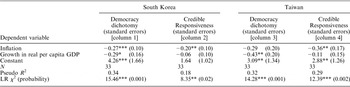
Table 1 reports the results from logistic tests using the two different measures of democratization as dependents. Columns 1 and 2 report the results for the democratization measures in South Korea while columns 3 and 4 report those for Taiwan. In general, the results show that growth or inflation is negatively related to democratization: across both nations, at least one of the economic variables is statistically significant and negative. The effect of the other variable is also in the right direction – negative – although correlation across the economic variables probably inflated the standard errors so that they are not individually statistically significant. This is corroborated by the high chi-square values (probability less than 0.05 across all operationalizations). To evaluate the robustness of the results, we ran generalized linear models extended to binomial dependents with Newey–West standard errors for a heteroscedastic and autocorrelation-consistent variance. The variables remain statistically significant and substantively stable. We are, thus, satisfied that the results are not fragile. In particular, the results show that as growth or inflation increases, the probability that the government pursues democratization, measured as a summary variable or component measure, decreases. This finding holds true across time for South Korea and Taiwan.
Logistic Regressions of Democratization in South Korea and Taiwan

*p < 0.1, **p < 0.05, ***p < 0.01.
Notes: To ensure robustness of the logit regressions, we ran Newey–West corrected standard errors for a heteroscedastic and autocorrelation-consistent variance for one lag (based on generalized linear modelling extended to binomial dependents). The results are stable, with the statistically significant variables remaining significant for both South Korea and Taiwan. Robust logit regressions using the unbiased sandwich estimate of variance yield substantively similar results across both nations.
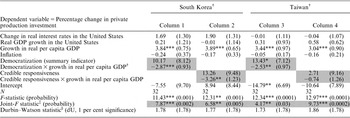
The effects of democratization on private domestic investment are evaluated next. The evidence supports the premise of our model if it shows that democratization is positively related to citizens’ support as captured by change in private domestic investment. Table 2 presents the results from longitudinal analyses of measures of democratization on percentage change in private domestic investment. Columns 1 and 2 report the results of regression analyses for South Korea, while columns 3 and 4 report results for Taiwan.
Regressions of Private Domestic Investment in South Korea and Taiwan

*p < 0.1, **p < 0.05, ***p < 0.01.
†Robust standard errors estimation is used to obtain the Huber–White sandwich estimator of variance to ensure that the results are robust to heterogeneity in the variance.
‡The Joint F-test is a hypothesis test to evaluate whether correlated variables (democratization as a summary variable and its interaction with real per capita GDP in columns 1 & 3; and democratization as credible responsiveness and its interaction with real per capita GDP in columns 2 & 4) add significant statistical explanatory value as a group. The Joint-F statistic reveals that the variables, in conjunction, are highly significant. For column 4, the correlated variables include real per capita GDP.
§The Durbin–Watson statistic is based on original estimation, that is, prior to adjustments for robust estimation or robust standard errors to show that autocorrelation does not pose problems for the analyses. To ensure that the results for column 3 are robust, Prais–Winsten autocorrelation correction was also used. The results before and after correction remained substantively similar. For consistency across the cases, the results without Prais–Winsten correction are presented here.
In general, the results are in the expected direction. In particular, the results for South Korea and Taiwan are consistent in showing that democratization, as measured by the dichotomous summary variable and the component indicator, explains increases in private domestic investment. As before, correlation between the variables inflated their respective standard errors; however, joint-F tests show that they are statistically and substantively important as explanatory variables for private domestic investment. The contrasting signs on the democratization and interactive variables provide an additional layer of information. Specifically, they show that democratization improves support for the government only when economic conditions are weak. Thus, for instance, according to the results of the first column for South Korea, democratization as measured by the dichotomous summary variable improves support for the government when real growth in per capita GDP is low, below 3.5 per cent (10.2 ÷ (−2.9 * 3.5) > 0), holding all else constant. At levels above 3.5 per cent, democratization reduces investment (for example, 10.2 ÷ (−2.9 * 4) < 0). Likewise, according to the results shown in the fourth column for Taiwan, democratization as measured by the credible responsiveness variable improves support for the government when real per capita GDP is below 3.7 per cent (2.7 ÷ (−0.74 * 3.7) > 0), holding all else constant. Thus, the results confirm that the government's actions concerning democratization when economic conditions are poor improve citizens’ support. This finding from the inclusion of the interactive variables is worth noting: the literature has generally struggled to clarify the effects of democratization. In particular, even though democratization is expected to produce support, empirical evidence shows the converse: that democratization lowers investment.Footnote 65 The results here suggest that the interactive variable is an important but omitted factor that bridges theory and empirical findings. Specifically, it clarifies that democratization carried out under weak economic conditions leads to support from citizen groups as measured by investment; under strong economic conditions, further reforms backfire because they may be considered inefficient, responses to populistic-demands or even collusion.Footnote 66
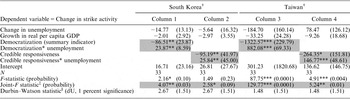
To ensure that the model's predictions address divisions in society, we consider the effects of democratization on strike activity next. The evidence supports the premise of our model if it shows that democratization is positively related to citizens’ support as captured by change in strike activity. Table 3 presents the results from longitudinal analyses of measures of democratization on change in strike activity. The results of regression analyses for South Korea are reported in columns 1 and 2, while columns 3 and 4 report results for Taiwan.
Regressions of Strike Activity in South Korea and Taiwan

*p < 0.1, **p < 0.05, ***p < 0.01.
†Robust regression is used in the analyses to ensure that the results are robust to data that have high leverage.
‡The Joint F-test is a hypothesis test to evaluate whether correlated variables (democratization as a summary variable and its interaction with real per capita GDP in columns 1 & 3; and democratization as credible responsiveness and its interaction with real per capita GDP in columns 2 & 4) add significant statistical explanatory value as a group. The Joint-F statistic reveals that the variables, in conjunction, are highly significant. For column 4, the correlated variables include change in unemployment.
§The Durbin–Watson statistic shows that autocorrelation does not generally pose problems for the analyses here.
Here, again, the results work as expected: democratization is shown to improve citizens’ support – measured by change in strike activity – for the government. The joint-F tests show that the variables measuring democratization and their related interaction variables are statistically and substantively important explanatory variables. As with the results for private domestic investment, the contrasting signs on the democratization and interactive variables show that democratization improves support for the government only under specific conditions. Thus, by the results of the second column for South Korea, democratization as measured by the credible responsiveness variable reduces strike activity when unemployment has not risen above 3.7 per cent. With an average unemployment rate of 3.6 per cent and a 90th percentile rate of 4.5 per cent, the results show that democratization generally increases citizen support as measured by strike activity. They also reveal that at high levels of unemployment, such as during the Asian financial crisis, democratization fails to contain strike activity. Likewise, according to the results in the fourth column for Taiwan, democratization as measured by credible responsiveness improves support for the government when unemployment has not risen above 1.8 per cent. Although the figure is low, it is useful to note that Taiwan's median unemployment rate between 1970 and 2000, that is, prior to its first recession in 2001, was 1.7 per cent. Indeed, the incredibly low unemployment rates in Taiwan have led the press, such as the Free China Journal, to refer to unemployment as an ‘urgent problem’ when it rose from 1.54 to 1.75 per cent in 1996.Footnote 67 Thus, the results for Taiwan also show that democratization generally increases citizen support; further, at higher levels of unemployment, democratization fails to restrain strike activity. As with the findings from private investment, the results on strike activity are notable for the additional information from the interactive variables (democratization and economic conditions) on the results. Specifically, recent studies show that even as democratization is expected to improve support, the empirical evidence finds that democratization increases strike activity.Footnote 68 The findings in this article, then, help to bring empirical findings into line with theoretical expectations that democratization improves government support by specifying threshold conditions within which that occurs, through the inclusion of interactive variables. In particular, the results show that while democratization leads to support from citizen groups generally, it does not generate labour support for the government if pursued under conditions of severe economic weakness.
In sum, the statistical results here support the interpretation of the strategic-interaction model that democratization – measured by two different indicators, a summary variable and a component indicator – occurs when economic conditions are weak. Analysis of citizens’ support to round up the theory shows that support for the government, as measured by private domestic investment and strike activity, is improved when the government pursues political reforms or democratization when economic performance is weak. Importantly, the results are consistent across South Korea and Taiwan and robust to autocorrelation, unit roots and structural breaks.
Conclusion
A debate persists over how economic performance affects democratization. It is fuelled in part by the empirical divergence of the East Asian high-growth cases such as South Korea and Taiwan. We have contributed to the debate by offering a strategic model of how economic performance affects democratization and systematically testing the conclusion using data from South Korea and Taiwan. We build upon one area of theoretical agreement – that democratization improves support for or co-operation with the government – to present democratization as the outcome of strategic interaction between the government and citizens against the backdrop of economic performance. The systematic analyses use two different operationalizations of democratization. We round up the evaluation by examining the effect of democratization on citizens’ support, effectively testing the premise of the theoretical model.
The results support the model's conclusions to show that democratization in both Taiwan and South Korea has occurred under weak economic conditions. Further, the results hold across two different operationalizations of democratization. The findings are evaluated for structural breaks, autocorrelation as well as heteroscedasticity. Through the various tests, the results remain substantively and statistically stable, which adds confidence that they are robust to alternative specifications of democratization.
These results are important in several regards. The multiple methodologies – strategic modelling and systematic tests – provide consistent and complementary findings to explain how weak economic performance foreshadows democratization for two critical cases, South Korea and Taiwan. These findings for two nations that are frequently cited in the debate are important for the larger debate. The modelling of democratization as the outcome of strategic interactions also adds a fresh perspective to the democratization debate. In particular, the strategic model clarifies how players are most credible in their threats or responses to pursue democratization under weak economic conditions. In this treatment, democratization is not unilaterally achieved. It focuses on the players’ incentives and capacity to pursue democratization, in the light of the other players’ actions.
The findings are also notable for the additional nuance from the interactive variables about the effects of democratization on citizens’ support. The literature has generally struggled to clarify the effects of democratization. In particular, even though democratization is expected to elicit support, empirical evidence shows the converse: that democratization lowers investment and increases strike activity.Footnote 69 The results here add nuance to the literature by specifying threshold conditions within which democratization improves support, through the inclusion of interactive variables. Specifically, they show that democratization under strong economic conditions alienates some support for the government (from private investors), while democratization under economic dislocation fails to garner support for the government (from labour). The inclusion of interactive variables suggests an omitted variable that brings empirical findings into line with theoretical expectations that democratization will improve support for the government and, at the same time, reveals how democratization is not a panacea that will bolster support in any circumstance.
One additional consideration: are the political concessions to both groups equivalent to democratization? The focus in this article is on credible actions that underpin strategic interaction towards democratization. Importantly, empirical studies show that democratization generally ensues where political reforms are credible.Footnote 70 Theoretical studies point out that political concessions short of democratization by an authoritarian government are not credible: it has ‘no incentive to deliver’ once the threat of a citizens’ challenge is diffused.Footnote 71 Theoretically and empirically, then, the literature substantiates that if the government offers credible political reforms to both groups, the reforms constitute democratization.
More generally, the findings reveal the potential benefit from applying strategic modelling to East Asia. In particular, the findings are derived from treating governments and citizens in Taiwan and South Korea as politically and economically strategic, so as to uncover the conditions under which the players make best use of their bargaining strength. In doing so, we bring the literature on East Asia into line with the literature on emergent democracies and expanding theoretical and empirical bases.
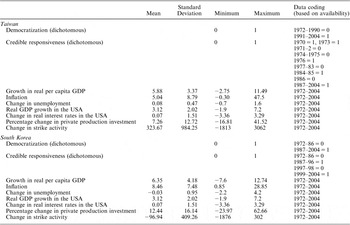
Summary Statistics of Dependent and Independent Variables