In his description of the development of the English state in the 17th century, John Brewer (Reference Brewer1989) refers to revenues as the “sinews of power.” This corporeal metaphor reinforces our traditional conception of the state as an organism/organization that is self-contained, autonomous, and sovereign. Much of the literature on state development has developed in a similar way, though often incorporating external influences such as war and trade. Yet, while our theories of state building expect external influences on state capacity, our modeling of such factors has not caught up. Theoretical models treat war and trade as traits of the individual state under observation, and empirical models follow suit. What if the sinews of power are conceived of as part of larger webs of connections emanating from within and without of the state? In this paper, we attempt to theoretically and empirically refine the dominant approach to state capacity; namely, predatory theory through an application of spatial analytical reasoning and empirical testing.
We argue that while state fiscal capacity may be in large measure shaped by domestic processes, we can also theorize and more accurately observe international influences as well. Theoretically, we argue that four main mechanisms affect state fiscal capacity, including coercion, competition, learning, and emulation. These mechanisms, already highlighted in the diffusion literature, provide channels through which state and non-state actors such as multinational corporations (MNCs) and intergovernmental organizations (IGOs) affect revenue-extraction policies and outcomes throughout the world. In particular, we believe that coercion works primarily through interstate rivalry and territorial contiguity—already a mainstay of the literature, but tested in a novel way in this paper. Competition occurs through trade networks, as governments must compete through tax policy adjustments to secure flows of production and export market share. Learning is thought to occur through membership in IGOs. IGOs provide policy models for their members based on evidence, shared beliefs and norms that changes beliefs and gives greater confidence in a policy in the adopting state. Finally, emulation occurs through regime type, particularly as democracies turn to each other for lessons learned on the legitimacy of bargains struck between the government and the people over taxation and service delivery. These four mechanisms, and their observable channels, are one way to move forward the predatory theory of the state and associated quantitative tests.
We evaluate the four competing causal mechanisms using a multi-parametric spatio-temporal autoregressive model (m-STAR) that captures the spatial effects of interstate rivalry and geographic contiguity, trade, membership in economic IGOs, and regime similarity using spatial lags. In contrast to more traditional modeling approaches, the spatial lags approach allows for a simultaneous modeling of both domestic-level effects, such as GDP per capita or the level of agricultural development, as well as spatial effects, such as the spillover effects from geographical neighbors or trade partners. The spatial effects act as feedback loops through which the dependent variable—state i’s fiscal capacity at time t—is affected by its own fiscal capacity in the previous period t−1, as well as the fiscal capacity in neighboring units at time t. This means that a change in state i’s level of tax extraction does not only affect state i’s own level of tax extraction in the next time period, but also has potential implications for the level of tax extraction of i’s geographical neighbors, interstate rivals, trade partners, IGO partners, and states with similar regimes. Our empirical results provide support for the coercion and learning mechanisms. Namely, we find evidence of a positive relationship between state’s extractive capacity and the average extractive capacity of its geographical neighbors. We also find that a state’s fiscal capacity is positively affected by that of others with whom it shares memberships in economic IGOs. The results show no support for the remaining two mechanisms of competition and emulation.
The Sources of State Fiscal Capacity
States are a product of their revenue-generating abilities, thus a long line of scholarship has devoted attention to the internal and external sources of variation in fiscal capacity. As Levi notes, “the history of state revenue production is the history of the evolution of the state” (Reference Levi1988, 1). Levi, and others, such as North (Reference North1981), Tilly (Reference Tilly1975), Tilly (Reference Tilly1985), and Olson (Reference Olson1993) are variously described as developing predatory theory, fiscal contract theory, or even bellicist theory. The particular label attached to this work usually highlights one aspect of the process of revenue extraction, such as the implied exchange relationship between rulers and the rules in fiscal contract theory, or the central importance of war in stimulating extraction in bellicist theory. In general, all of these approaches share a similar view of rulers as predators attempting to maximize their revenue extraction from a subject population subject to a variety of constraints, such as the ruler’s relative bargaining power, transaction costs, and discount rate. Although much of this predatory literature was developed to explain early modern European states, a number of scholars have attempted to explore the usefulness of its insights in the contemporary world (e.g., Herbst Reference Herbst2000; Centeno Reference Centeno2002; Thies Reference Thies2004).
Drawing upon Levi (Reference Levi1988), Thies (Reference Thies2010) describes the relationship between rulers and the ruled in predatory terms for contemporary states. First, he notes that rulers will have increased bargaining power relative to the subject population the greater their monopolization of coercive, economic, and political resources. Rulers therefore attempt to monopolize the means of violence in the territorial areas under their jurisdiction. Of course, this is one of the issues that many post-colonial states now deal with on a regular basis—how to contain a variety of internal rivals to the government, and often how to prevail in full-fledged civil wars through a monopolization of coercive power. The empirical evidence thus far suggests that civil wars and most types of internal rivalries lead to a reduction in revenue extraction. There has been little systematic evidence gathered on the effect of efforts to monopolize economic resources on extraction. Thies (Reference Thies2010) demonstrated that contrary to the prevailing view in the literature on civil war onset, the state is the main beneficiary of rents and tax revenue from natural resources. Only oil, depending on how it was measured, increased the likelihood of civil war onset (see also Smith Reference Smith2004; Morrison Reference Morrison2009). No one in the predatory literature has focused on restrictions on the economy related to extraction per se, or trade for that matter. Cheibub’s (Reference Cheibub1998) empirical evidence suggests that as levels of trade increase, so do taxation, in part owing to reliance on trade taxes in many developing countries and as a result of a need to develop social protection measures in developed countries. This result is also found in subsequent studies (e.g., Thies Reference Thies2010).
Although the theoretical story is consistent, the empirical findings regarding the monopolization of political resources are mixed. Olson (Reference Olson1993) suggests that autocrats should extract more than their democratic counterparts, given his view that democratic transitions occur when autocratic succession goes awry owing to changes in the balance of power within society. Democracies by nature represent a balancing of political resources, rather than a monopolization of such resources in the ruler. Empirically, some analyses have found the expected negative relationship between democracy and extraction (e.g., Thies Reference Thies2006), whereas others have found a positive relationship (e.g., Cheibub Reference Cheibub1998; Thies Reference Thies2004; Thies Reference Thies2010), others insignificance (Thies Reference Thies2005; Thies Reference Thies2007), and others find an effect contingent on other aspects of state development (Thies Reference Thies2009), though some of this variation is also clearly driven by the sample of states under consideration.
Second, according to Levi, rulers attempt to lower their transaction costs in enforcing compliance with their revenue-extraction policies. There are some standard indicators related to transaction costs found in most empirical studies, such as per capita income, trade openness, inflation, and agriculture as a percentage of GDP. The former two measures are thought to increase state revenues as they reduce transaction costs, whereas the latter two measures should reduce revenues as they increase transaction costs (Cheibub Reference Cheibub1998). However, other factors such as religious and ethnic fractionalization also implicate transaction costs, as extraction from homogeneous societies is presumed to be simpler than heterogeneous ones (Thies Reference Thies2010). In fact, many of the factors discussed as relating to bargaining power (above) and discount rates (see below) also implicate transaction costs. One of the fundamental factors underlying transaction costs is the legitimacy of the ruler, which should generally be higher in democracies than autocracies.
Finally, the discount rates of rulers vary according to the strength of their internal and external rivals. External conflict in the form of war, territorial threat, or interstate rivalry is often argued to loosen the constraints rulers face in raising revenue (e.g., Cohen, Brown and Organski Reference Cohen, Brown and Organski1981; North Reference North1981; Rasler and Thompson Reference Rasler and Thompson1985; Tilly Reference Tilly1985; Campbell Reference Campbell1993; Thies Reference Thies2004; Thies and Sobek Reference Thies and Sobek2010). Empirically, however, most studies find a negative relationship between interstate war and fiscal capacity (Thies Reference Thies2005; Thies Reference Thies2006; Thies Reference Thies2007; Thies and Sobek Reference Thies and Sobek2010). On the other hand, Thies’s modified approach to predatory theory argues that rivalry and ongoing territorial threats should provide the state with the ability to run a version of Tilly’s (Reference Tilly1975) “protection racket,” thus increasing extraction moderately. The evidence from the contemporary developing world seems to confirm this expectation. Internal conflict in the form of civil war or other types of internal rivalry may or may not increase the ruler’s discount rate depending on the strength of the challenge (North Reference North1981, 27; Levi Reference Levi1988, 33), and as previously discussed most of the evidence finds a negative relationship between internal rivalry/civil war and extraction (e.g., Thies Reference Thies2010), though Thies (Reference Thies2004) found that internal rivalries characterized by ethnic challenges were responsible for increased extraction.
There are several avenues to pursue to improve the existing literature. First, it is focused primarily on bargaining pressures within the state, notwithstanding the important role that external conflict plays in some of the more bellicist versions of the theory. We would like to push the literature forward to consider some of the mechanisms of diffusion that operate across boundaries. It is quite likely that state fiscal capacity, while largely a function of internal processes, is also dependent on international context and events in other states. Although some of these factors are often included in statistical models, such as regime type, trade, external threats; others are not, such as involvement in IGOs, and none are probably modeled in a way that demonstrates their full importance to extraction. Second, as Beck, Gleditsch and Beardsley (Reference Beck, Gleditsch and Beardsley2006, 27–8) and Hoff and Ward (Reference Hoff and Ward2004, 161) note more generally about political science research, most statistical analyses assume the independence of individual observations even if our theories are implicitly based on interdependence. As Franzese and Hays put it, “in international relations … the interdependence of states’ actions essentially defines the subject” (2010, 571). However, even work in the bellicist tradition of predatory that focuses on war or interstate rivalry using statistical analyses still holds on to the individual state as the unit of analysis and does not account for potential spatial dependencies in the data.
We already know that within states, subnational units engage in strategic behavior about taxation, as well as welfare provision and imposition of environmental standards (e.g., Case and Rosen Reference Case and Rosen1993; Brueckner Reference Brueckner2003). Geys (Reference Geys2006) is practically a subnational version of predatory theory in that he considers tax competition in the context of the public goods that citizens demand, given the taxation/public goods provision in neighboring locales.
The rather large literature on interstate tax competition has investigated whether competition for mobile factors of production has led to a “race-to-the-bottom.” The argument is that as governments have reduced the restriction on capital mobility, they may be drawn into a Prisoner’s Dilemma in which the dominant strategy of each state is to make its market more profitable than its neighbors. This competition could logically lead to the reduction of taxes on capital. It could also lead to reductions in environmental standards, labor market regulations, and the like, in the pursuit of truly globalized capital. It is often assumed that reductions in marginal tax rates as a result of a race-to-the-bottom dynamic will translate into lower overall government revenues. However, modeling states as if they were predatory rulers—meaning that states prefer higher levels of revenue subject to a variety of constraints—does not rule out the possibility that they may see reducing marginal tax rates as a means to increase overall revenue. Indeed, this is a staple of neoliberal thinking about the relationship between tax rates, economic growth, and revenue generation for the state. What is most important for our purposes is the notion that states will look to see what other states are doing on tax rates when considering decisions about their own in order to prevent businesses or individuals from relocating. Despite the inconsistent evidence on tax competition, it is clear that governments’ choices about tax policy and extraction, more broadly, are interdependent (e.g., Basinger and Hallerberg Reference Basinger and Hallerberg2004; Swank Reference Swank2006; Franzese and Hays Reference Franzese and Hays2007a; Franzese and Hays Reference Franzese and Hays2008).
We also know that a number of “internal” policy decisions affecting revenues and expenditures are influenced by diffusion. The literature on the international diffusion of liberalism is replete with examples (Simmons, Dobbin and Garrett Reference Simmons, Dobbin and Garrett2006). Brooks (Reference Brooks2005) has shown that the privatization of pensions is influenced by decisions made by relevant peer groups. Privatization schemes are adopted by states that are concerned with the balance of revenue generation and future expenditures linked to pension liabilities. Meseguer (Reference Meseguer2004) also shows evidence of rational learning and emulation in privatization more generally in both the OECD and Latin America. Jahn (Reference Jahn2006) analyzed the social expenditures of states as a result of diffusion processes associated with globalization. Lee and Strang (Reference Lee and Strang2006) demonstrate downsizing in public sector employment in the OECD is a production of both learning and emulation. Elkins, Guzman and Simmons (Reference Elkins, Guzman and Simmons2006) have tested a variety of diffusion mechanisms related to the signing of bilateral investment treaties (BITs) designed to increase foreign direct investment. Economic competition seems to have the most significant effect on increasing the likelihood of BITs. Further, Simmons and Elkins (Reference Simmons and Elkins2004) demonstrate diffusion via learning for capital account, current account, and exchange rate policies.
Once again, we suggest that neither the tax competition, nor the diffusion of liberalism literature necessarily implies only a diminution of state fiscal capacity. In fact, liberalism supplies the logic for why reduced tax rates may still produce comparable or even increased revenue for the state. If reduced tax rates (tax competition literature) or reduced regulation/government interference in the economy (diffusion of liberalism literature) free individuals and business to divert their energies to productive uses, then the economy should grow, providing a larger tax base. Even at lower rates, the amount of government revenue may stay the same or even increase. As we know, neoliberal policies were pushed around the world by the International Monetary Fund and World Bank to get governments out of the economy, which they argued would ultimately improve governments’ revenue positions.
We could situate all of this work within Lazer’s (Reference Lazer2005) approach to regulatory capitalism as a kind of informational network. States in such a network are either policy choosers or information producers. The informational spillovers created by some states leads to the kind of diffusion we see in areas like pension privatization, welfare policy, taxation, and the like. Epistemic communities, international organizations, cross-national corporate entities, institutionally mediated networks, and interpersonal networks, all become mechanisms for the transmission of information. This reorientation of what has previously been thought of as separate national decisions into a larger framework of diffusion is a useful wake-up call to the predatory literature, which is still beholden to outdated concepts of immutable state sovereignty. We attempt to draw upon these insights to push the literature forward on state fiscal capacity by considering the mechanisms whereby diffusion of information affects ruler extractive choices and abilities.
Mechanisms of International Influence
Like many previous studies, we seek to incorporate, but also move beyond the traditional geographic realm of space to consider other types of space (Anselin Reference Anselin2003). As Beck, Gleditsch and Beardsley suggest, “… although ‘nearby’ is usually taken to mean geographical closeness, there is no reason why we cannot use any notion of nearness that makes theoretical sense” (Reference Beck, Gleditsch and Beardsley2006). These authors include two measures of connectivity in their attempt to model democracy: geographic distance and trade volumes. We include these measures of connectivity that are already common to the predatory literature, and expand to more carefully consider the contested role of regime type and membership in common international organizations. We suggested that each of these types of space represent an opportunity for diffusion of information via a number of mechanisms.
Like Brinks and Coppedge (Reference Brinks and Coppedge2006, 468), we follow Rogers who defines diffusion as “the process by which [1] an innovation is [2] communicated through certain channels [3] over time among the members of [4] a social system” (Reference Rogers1995). First, the innovation that concerns us is information, models, and practices related to more efficient revenue extraction. Second, the channel of communication will come through a variety of state and non-state (corporations, IGOs) actors as described in more detail below. Although we do not observe this communication directly, we will identify specific mechanisms that serve to channel communication from one state to another. Third, while some innovations will move quickly via the following mechanisms, others may move more slowly. We examine the timing of these changes closely in the empirical analysis. Fourth, the social system in this context is a network of countries. Some of these networks are based on physical proximity, but others related to cultural, economic, and political ties.
The literature on diffusion has already identified a number of mechanisms operating in the international social system of states. For example, Elkins and Simmons (Reference Elkins and Simmons2005, 35) classify diffusion mechanisms “as one of two kinds: those for which another’s adoption alters the value of the practice and those for which another’s adoption imparts information. Each of these two broad classes, adaptation to altered conditions and learning, comprises a set of varied mechanisms (38-39).” The former includes mechanisms like cultural norms, support groups, and competition, whereas the latter involves three methods of learning, namely information cascades, availability, and reference groups. Simmons, Dobbin and Garrett (Reference Simmons, Dobbin and Garrett2006) identify four mechanisms responsible for diffusion of economic and political liberalism: coercion, competition, learning, and emulation. Franzese and Hays (Reference Franzese and Hays2008, 745) reiterate Simmons, Dobbin and Garrett’s four mechanisms and add a fifth mechanism migration.
In our reconceptualization of the external dimension of predatory theory, we focus on these mechanisms that may affect state fiscal capacity: coercion, competition, learning, and emulation.Footnote 1 The primary mechanism that we might identify from bellicist strands of predatory theory is coercion. Rulers compete with other rulers for subject populations and territorially based resources. Whether we view this through the lens of North’s (Reference North1981) property rights framework or through Tilly’s (Reference Tilly1985) war-centered account of the development of the state, it is clear that coercion, and even the possibility of coercion, with neighboring states has been paramount to the revenue-generating abilities and possibilities for states. Thies’s work on interstate rivalry (most of which are territorial in nature and occur between neighbors) has previously demonstrated that it forms a kind of coercive threat that allows for states to increase their tax revenues. We therefore consider interstate rivalry as a form of “direct” coercion that should allow states to increase their revenues. Simmons, Dobbin and Garrett (Reference Simmons, Dobbin and Garrett2006, 790) refer to this type of intentional interaction among states as “direct” coercion because it is active and intentional. We also consider territorial contiguity as a more passive conduit for coercion, or what Simmons, Dobbin and Garrett (Reference Simmons, Dobbin and Garrett2006, 791) refer to as “soft” coercion. Geographic space, a mainstay in the spatial literature, should also have strong positive effects on revenue extraction within states. Gibler’s (Reference Gibler2012) work on territory and state development, and even Shin and Ward’s (Reference Shin and Ward1999) work on the spatial clustering of defense spending point to strong geographic spatial effects for state fiscal capacity. Innovations in revenue generation in neighboring states should diffuse quickly, especially in regions with histories of conflict, as the “policies of powerful governments often constitute focal points” for interdependent domestic policy choices (Simmons, Dobbin and Garrett Reference Simmons, Dobbin and Garrett2006, 791). Thus, the more direct form of coercion is represented by interstate rivalry, whereas the more soft form of coercion is represented by territorial contiguity.
The next mechanism we suggest is important in diffusing information about appropriate extraction is competition, which we believe will be channeled primarily through trade networks. As Simmons, Dobbin and Garrett (Reference Simmons, Dobbin and Garrett2006, 792) note, competition between governments over export market shares, including arguments about diffusion of regulatory environments, and tax competition as described above are mainstays of the literature. Trade taxation meets Simmons, Dobbin and Garrett (Reference Simmons, Dobbin and Garrett2006, 792–3) standards to make an argument about competition, as tax policy affects the “flow of international production and … the attractiveness of a nation’s exports,” changes in taxation will have “consequential effects in the short- to medium-term,” and occur in an “information-rich (in fact, close to perfect) environment.” MNCs engaged in trade assist with the information-rich environment. As Lazer notes, “corporate entities have interests that enter the political calculus in the countries that they exist in (very often pushing for compatible cross-national standards) but, furthermore, also serve as (nonneutral) vessels for policy information” (Reference Lazer2005, 56). MNCs will push for harmonious regulations, including tax policy. Consultants like Accenture, as well as law firms operating international also serve as conduits of information about “lessons from one jurisdiction” at the same time that they are trying to “capture some of the potential gains in other jurisdictions as rents” (Lazer Reference Lazer2005, 56). State officials will be subjected to lobbying activities by MNCs, law firms, consultants, as well as non-governmental organizations who may oppose their rent-seeking, as to what are competitive and appropriate levels of taxation as well as agreements on rents derived from jointly owned or managed natural resources. Further, Simmons, Dobbin and Garrett (Reference Simmons, Dobbin and Garrett2006, 794) argue that diffusion via competition will be much more pronounced among countries located in the same trade network. We therefore operationalize the mechanism of competition with a measure of a state’s bilateral trade to account for the relative importance of trade to each state.Footnote 2
Next, we look at the mechanism of learning that operates through IGOs. According to Simmons, Dobbin and Garrett, learning “refers to a change in beliefs or a change in one’s confidence in existing beliefs, which can result from exposure to new evidence, theories, or behavioral repertoires” (Reference Simmons, Dobbin and Garrett2006, 795). Innovation in tax revenue generation should result from the diffusion of “a shared fund of (often technical) knowledge among elites about what is effective … fostered by … shared norms, beliefs, and notions of evidentiary validity” (Simmons, Dobbin and Garrett Reference Simmons, Dobbin and Garrett2006, 795). Simmons, Dobbin and Garrett specifically suggest that international institutions are a “natural conduit for learning and, especially, for organized pedagogy” (Reference Simmons, Dobbin and Garrett2006, 798). Lazer (Reference Lazer2005, 57) highlights the role that IGOs often play with respect to the dissemination of information about regulatory policy. He used the OECD series of studies about regulatory reform in the 1990s to illustrate how this IGO developed a series of regulatory reform regulations that came to be widely agreed to as being appropriate (see also Breul 1996). The OECD played a critical role in the diffusion process by defining the menu of policy options, providing evaluation of those options by aggregating the experiences of multiple states, and providing exemplars to model appropriate behavior. According to Lazer, the OECD also increased confidence in these beliefs by providing “a cover of legitimacy (normative isomorphism—see DiMaggio and Powell 1983) to policy makers seeking policy options and reduced uncertainty regarding the consequences from any particular option” (Reference Lazer2005). IGOs can thus provide specific policies that ought to be implemented, in part, because membership in their organization ensures that others are also acting similarly based on shared beliefs about which policies produce the best outcomes. A number of IGOs work on issues specifically related to capacity building. For example, the World Bank’s project on Governance and Public Sector Management includes specific policy advice on tax policy and revenue administration. We operationalize the learning mechanism through membership in economic IGOs, as they are the most likely to disseminate information that states may learn from about appropriate tax revenue-generating policies.
Finally, emulation is the last mechanism we examine as a function of political space and more specifically, regime type. Emulation, according to Simmons, Dobbin and Garrett (Reference Simmons, Dobbin and Garrett2006, 799) involves the adoption of a “best practice” in an area of policy based not on evidence nor shared beliefs, but on who had previously adopted a policy. The reference group is key for emulation, as this is what distinguishes it from learning. In the learning mechanism, states change their beliefs or increase confidence in their beliefs based on their participation with each other in an international organization that coordinates the dissemination of information about policy. The emulation mechanism involves a self-comparison to a reference group based on a shared social type, which for the case of tax revenue generation, we suggest is regime type. As the default regime type for states since their earliest formation has been autocracy, it stands to reason that once a transition occurs and a democracy is established that its rulers would look to other democracies as models for their policies. As the legitimacy of the bargain over taxation between rulers and ruled in a democracy is critical for the survival of elected leaders in office as well as the maintenance of democracy itself, rather than simply rely on untested notions of what constitutes a legitimate fiscal contract, it makes sense that other models used by democracies would be adapted (Timmons Reference Timmons2005). Campbell’s (Campbell Reference Campbell1992; Campbell Reference Campbell1993; Campbell Reference Campbell1994) work on taxation policy in the newly democratized Central and Eastern European states showed a great deal of isomorphism as states emulated Western European democracies after the transition. We would expect such emulation to continue as the taxation policies of successful democracies are emulated by followers. We would similarly expect that successful autocracies would emulate each other’s revenue-generating policies. For example, the need for revenue has led many autocrats to cut deals with MNCs to search for natural resource wealth as a way to reduce their need to extract from societal actors and reward those in their selectorate (Bueno de Mesquita et al. Reference Bueno de Mesquita, Smith, Siverson and Morrow2005). Other autocrats have emulated a relaxed attitude toward remittances, as they are a source of foreign currency and revenues.
We therefore expect that interstate rivalry and territorial contiguity operating through the mechanism of coercion, trade operating through the mechanism of competition, IGO membership operating through the mechanism of learning, and regime type operating through the mechanism of emulation will all have significant, positive effects on state fiscal capacity. Although previous research into revenue extraction may have considered some of these factors, it has primarily done so without truly modeling the interconnectedness of each state in the international system. We believe there are strong reasons to suspect that considering geographic, trade, and several forms of political space (regime type and IGO membership) will allow us to uncover the true nature of international effects on domestic revenue extraction.
We assume, consistent with predatory theory, that states prefer to maximize their revenues subject to constraints. Thus the effects on revenue from these various diffusion mechanisms are all presumed to be positive. Predatory theory expects that once increases in revenue generation occur, they tend to be sticky—or subject to a “ratchet effect” or “displacement effect” (Peacock and Wiseman Reference Peacock and Wiseman1961; Rasler and Thompson Reference Rasler and Thompson1985). According to this argument, once an increase in tax revenue is achieved by the ruler, especially as a result of war, it is seldom allowed to return to the pre-war level. In general then, we expect that innovations in extraction will lead to increased revenue extraction.
Data and Methods
We test the competing causal mechanisms using an m-STAR model, which is able to capture the spatial effects of interstate rivalry, geographic contiguity, trade, membership in economic IGOS, and regime similarity using spatial lags (Franzese and Hays Reference Franzese and Hays2008; Hays, Kachi and Franzese Reference Hays, Kachi and Franzese2010). The model accounts for spatial dependence by including a lagged dependent variable on the right-hand side of the equation, taking the form:
 $${\bf y}={\bf Wy}{\plus}\phi {\bf Vy}{\plus}{\bf X}\beta {\plus}{\bivarepsilon},$$
 $${\bf W}=\mathop{\sum}\limits_{r=1}^R {\rho _{r} {\bf W}_{r} ,} $$
where y is a vector of the dependent variable, ρ r the coefficients on spatial lags, Wr the NT×NT matrices whose elements represent the weighted relationship between i and j, φ the coefficient on the first-order temporal lag Vy, V the NT×NT matrix with 1’s on the minor diagonal and 0’s elsewhere, X the NT matrix of k exogenous state-level covariates, β the vector of coefficients, and while ε is a vector representing random error. Spatial autocorrelation is accounted for by the disturbance in the lagged dependent variable weighted by the connectivity matrices (contiguity, rivalry, trade, joint memberships in economic IGOs, and regime similarity), whereas temporal autocorrelation is captured by the lagged dependent variable.
The effect of geographical diffusion on state i’s tax extraction, ρ contig, for instance, is modeled as a parameter on the average tax ratio of state i’s contiguous geographic neighbors, by multiplying the geographical contiguity matrix W contig by a vector of the dependent variable values y. Thus, Tunisia’s tax extraction, for example, is modeled as a function, in part, of the average tax extraction of Tunisia’s geographical neighbors of Libya and Algeria, whereas Libya’s tax extraction, in turn, is a function of the average tax extraction of Tunisia, Algeria, Nigeria, Chad, Sudan, and Egypt. Notably, the model allows for indirect spatial effects: Tunisia’s tax extraction is also indirectly a function of it’s neighbors’ neighbors, that is, Egypt’s tax extraction affects Tunisia through Libya, and vice versa. Finally, Tunisia’s tax extraction is also a function of its own tax extraction, directly through a temporal lag, and indirectly through the feedback loop, in which Tunisia affects its neighbors, who then affect Tunisia back. The effect reverberates through these feedback loops, decreasing with magnitude over time and with distance in the spatial connectivity matrix, until the system reaches equilibrium. The spatial connectivity matrices, in other words, operate as a straightforward way to capture state i’s dependence on the outcomes of other states: that is, how sensitive a state is to interdependence (for a more in-depth discussion of the model, see Anselin Reference Anselin2003; Beck, Gleditsch and Beardsley Reference Beck, Gleditsch and Beardsley2006; Franzese and Hays Reference Franzese and Hays2007b; Franzese and Hays Reference Franzese and Hays2008; Hays, Kachi and Franzese Reference Hays, Kachi and Franzese2010).
We include 137 countries in our analysis from 1960 to 1999, yielding 4098 non-missing observations. The dependent variable represents a state’s fiscal capacity and is consistent with the predatory state theory used here. We measure fiscal capacity as tax ratio, which is a state’s tax revenue as a percent of GDP. This measure reflects the ability of the state to extract resources from its citizens. The tax ratio is obviously a rough proxy for state fiscal capacity. It is the only measure for which data is available for a large number of countries. Data reflecting the composition of the tax ratio is incomplete—especially for developing countries. Ideally, we would assess predatory theory using data on direct taxes, as the theoretical expectation is that individuals bargain with the ruler over their payment for protection. Unfortunately, this data is just not available for most countries. The total tax take represented by the tax ratio is often the only available measure, and has become the standard in the predatory theory literature (Campbell Reference Campbell1993; Cheibub Reference Cheibub1998; Thies Reference Thies2005; Thies Reference Thies2010).
Our primary independent variables represent the causal mechanisms by which external factors influence state’s tax extraction capabilities: coercion, competition, learning, and emulation. These are operationalized as interstate rivalry and territorial contiguity (direct and soft coercion), trade networks (competition), shared economic IGO membership (learning), and political regime similarity (emulation). We treat each of these variables as a spatial lag in order to appropriately test their theorized effects. This means, for example, that each spatial variable is an N×N matrix whose cells represent the number of shared economic IGO memberships between states i and j.
Territorial contiguity is measured as a dichotomous variable where 1 indicates that states share a land border and 0 otherwise. Rivalry is measured using the enduring rivalry variable taken from Klein, Goertz and Diehl (Reference Klein, Goertz and Diehl2006). According to the dichotomous coding of this variable, rivalry is an ongoing, conflictual bilateral relationship that includes at least six militarized disputes over at least a 20-year period. Trade is measured as bilateral trade flows between two countries and is obtained from Barbieri, Keshk and Pollins (Reference Barbieri, Keshk and Pollins2008). Joint membership in an economic IGO is treated as a binary variable, which is coded as 1 if both states are members and 0 otherwise. IGO membership data is obtained from Pevehouse, Nordstrom and Warnke (Reference Pevehouse, Nordstrom and Warnke2004) and IGO type from Boehmer, Gartzke and Nordstrom (Reference Boehmer, Gartzke and Nordstrom2004). Each of these variables is row standardized, giving greater weight to states with which state i interacts more frequently (Plümper and Neumayer Reference Plümper and Neumayer2010). Finally, in order to provide a realistic test of the emulation mechanism, we disaggregate regime similarity into seven categories. Recent work demonstrates substantial variation among regimes that is not captured using blunt coding instruments, such as whether a state is a democracy or not (Lai and Slater Reference Lai and Slater2006; Chyzh Reference Chyzh2014). We use Banks’ (Reference Banks2011) study and Polity (Marshall and Jaggers Reference Marshall and Jaggers2008) to construct two types of democracy—presidential and parliamentary—and four types of autocracy—monarchy, military, single-party and personalist dictatorships, and other.Footnote 3 Political regime similarity is coded as 1 if two states share the same regime type, and as 0 if they do not or are coded as other.
In order to test for interstate diffusion, we must isolate or control for the alternative causes of spatial clustering, such as common exposure—similar unit-level response to the same stimuli—and homophily—self-selection by similar units into similar treatments (Hays, Kachi and Franzese Reference Hays, Kachi and Franzese2010). We account for common exposure by (1) including a number of monadic state-level variables that are typically used to explain a state’s capacity for tax extraction, (2) by estimating a model with country fixed effects, and (3) capturing temporal clustering by including a lagged dependent variable and an annual control for global oil prices.
We include a number of monadic state-level variables that are typically used to explain a state’s capacity for tax extraction, which are gathered from Thies (Reference Thies2010). Each variable is obtained from Fearon and Laitin (Reference Fearon and Laitin2003), unless otherwise noted. Trade openness measures a state’s imports and exports as a percent of GDP. Civil war is coded as 1 if a state is currently engaged in a civil war and 0 otherwise. Debt measures the amount of guaranteed government debt that a state has as a percent of GDP. Inflation is the log of price deflator for GDP. Agriculture is measured as agriculture value added as a percent of GDP. Foreign aid is official development assistance that a state receives as a percent of GDP. Federalism is a dichotomous variable that is 1 when a state’s subnational units have extensive taxing, spending, or regulatory authority (Beck et al. Reference Beck, Clarke, Groff, Keefer and Walsh2001). Income/capita is measured in thousands of 1985 US dollars. Ethnic and religious fractionalization is the probability that two randomly chosen individuals within a state belong to different ethnic–linguistic or religious groups. New state is a dichotomous variable coded as 1 if a state is in its first or second year of independence. Instability is a binary measure, which is coded as 1 if a state experiences a change of 3 or more in its polity score within the last three years. Oil is coded as 1 if a state receives one-third of its export revenues from oil and 0 otherwise. Finally, in contrast to Thies (Reference Thies2010), we include each of the regime types described above, using parliamentary democracy as the reference group. We include these as they are constitutive parts of the regime similarity measure. Moreover, including a more refined measure of regime type may help uncover why previous studies of state capacity and democracy have produced mixed results.
Country fixed effects are a more stringent tool to separate spatial diffusion from domestic-level sources of spatial clustering on the dependent variable. In particular, country dummy variables help capture possible unobservable similarities, such as culture, that may also be highly correlated with geographical proximity or other of our primary independent variables. Despite the strong leverage of controlling for country-level sources for spatial clustering, the obvious disadvantage of using country fixed effects is in the resulting limitations on cross-sectional inference: by “dummying out” individual countries, fixed effects also discard from the analysis any observations with no temporal variation in the domestic-level variables (Beck and Katz Reference Beck and Katz2001). This may be particular problematic for drawing inferences regarding institutional variables, such as regime type and federalism, that tend to exhibit high degrees of stability. Therefore, while our primary empirical models include country fixed effects, we also include a specification without fixed effects.
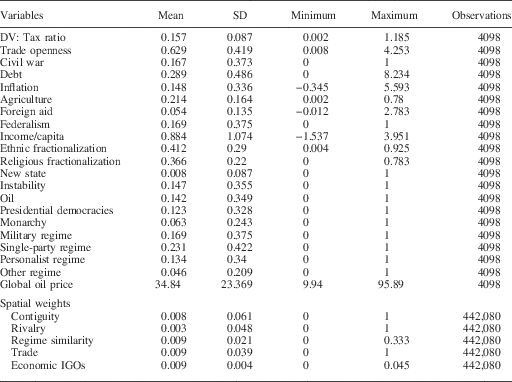
Finally, we account for the temporal dependence in our data in two ways. We model temporal shocks by controlling for global annual oil prices, measured as price per barrel of crude oil, in 2009 USD. In addition, we model temporal clustering, or over-time continuity in the levels of tax extraction, by including a one-year temporal lag of the dependent variable (ChartsBin Statistics Collector Team 2014). Although not a perfect solution, temporal lag also helps account for homophily or the possibility that countries with similar tax-extraction policies tend to join similar economic IGOs, trade with one another, or even build similar domestic regime institutions. Although self-selection presumes policy continuity among already similar units (i.e., states with high tax extraction self-select in the same economic IGOs), controlling for last year’s tax extraction helps model this continuity, ensuring that our resulting inferences capture fluctuations in tax revenues (i.e., states that are self-selected into the same economic IGOs also exhibit similar fluctuations in tax revenues), rather than their continuity.Footnote 4 Summary statistics of all variables are presented in Table 1.
Summary Statistics

IGOs=intergovernmental organizations.
Empirical Analysis
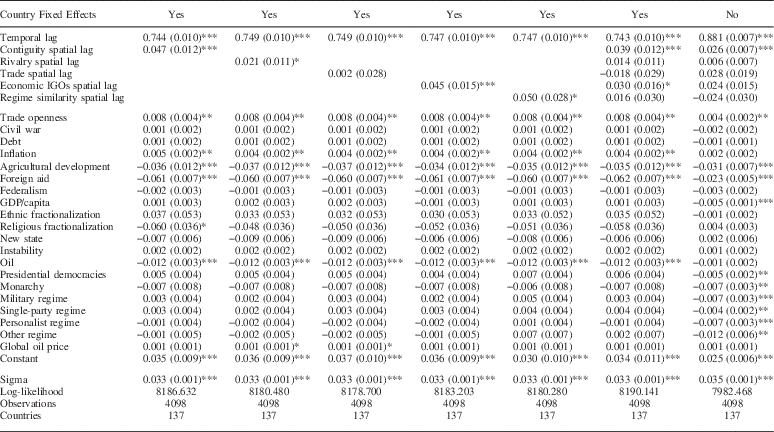
The results of the empirical analysis are presented in Table 2. To get a closer look at the spatial dynamics posited in the theory, we first estimate a series of models (Models 1–5) that include the spatially lagged dependent variables one by one (along with the control variables and country fixed effects).Footnote 5 We then run a combined model including all five spatial lags (Model 6). Finally, we include a full model without country fixed effects (Model 7). It is important to note that the coefficients on spatial lags represent the instantaneous, pre-dynamic effects (i.e., the effects in the absence of spatio-temporal feedback) (Franzese and Hays Reference Franzese and Hays2007b). The dynamic effects created by the “feedback loops” of the spatial and temporal lags are explored using counterfactuals and simulation methods following the discussion of the initial results.Footnote 6
Multi-Parametric Spatio-Temporal Autoregression on Tax Ratio, 1960–1999
Note: coefficients reported with standard error in parentheses. Fixed effects coefficients are suppressed.
IGOs=intergovernmental organizations.
*p<0.1, **p<0.05, ***p<0.01.
In order to evaluate our causal mechanisms, we need to look at the top part of the table that displays the temporal and spatial lags. First, the temporally lagged dependent variable is always positive and statistically significant. This suggests high levels of path dependency within the data, that is, the rates of tax extraction in the previous year are positively correlated with the rates in the current year. This result provides face validity to the empirical analysis, highlighting the expected trend. The result is also important because it means that spatial effects will re-enter the equation through the temporal lag, exercising a continuing effect on the dependent variable even after the initial time period. This effect will become more evident, as we present and discuss the predicted marginal effects graphs.
Second, in the first five models of Table 2, each of the spatial lags, with the exception of trade, is positive and statistically significant. In the combined model with country fixed effects, however, only contiguity and economic IGOs are positive and statistically significant. Finally, in the model without country fixed effects, only contiguity is positive and statistically significant. The differences in statistical significance between the models suggest overlap and a degree of substitutability among the spatial connectivity matrices, even despite the mathematically low correlations among them.Footnote 7 Each spatial lag included in isolation may be picking up the effects of the other omitted spatial lags. Theoretically, this suggests that the five types of international connectivity explored here may act in a complementary manner.
The statistically significant coefficient on contiguity is consistent with the expectations of the soft coercion hypothesis: states converge in their level of fiscal capacity, as a result of the latent competition (military or other) with their geographical neighbors. The statistically significant effect on economic IGOs in Models 4 and 6 also provides some support for the learning mechanism, which postulates that governments both share and acquire important information on tax policy innovations through IGOs, either directly (IGOs serve as teachers of policy innovations) or indirectly, from IGO-facilitated interaction with elites from more fiscally successful states. Neither rivalry, regime similarity, nor trade is statistically significant, once other forms of interdependence are accounted for, that is, there is no support for the competition and emulation mechanisms.
Turning to the monadic variables in the bottom half of the table, it is worth noting that the control variables replicate the existing literature. Trade openness and inflation are positive and statistically significant across all models, whereas agricultural development, foreign aid, and oil are negative and statistically significant across all models. Interestingly, global oil price, the variable capturing common shocks, is statistically insignificant. This result suggests that common shocks exert little additional impact on a state’s extractive capacity (beyond that already captured in the model, as a result of standardizing the dependent variable by GDP).
One important point to discuss here is, however, the disaggregated effect of regime type. Model 7, the model without country fixed effects, shows that the effects of all regimes (including presidential democracies) are negative and significant compared with parliamentary democracies. Moreover, post-estimation Wald χ 2 tests reveal that there is no statistical difference between any of the other groups, including between presidential democracies and any of the autocracies. This is consistent with the comparative literature, which often notes that presidential democracies act similar to autocracies (e.g., Linz Reference Linz1990; O’Donnell Reference O’Donnell1994). This result suggests that parliamentary democracies drive the positive effect associated with democracy in previous work and highlights the importance of using a more refined theoretical and conceptual definition of regime type. Note that the regime effects are no longer statistically significant in Models 1–6, which include country fixed effects. This is easily explained, as the low levels of regime variation within countries makes regime type highly correlated with country effects (Beck and Katz Reference Beck and Katz2001; Plümper and Troeger Reference Plümper and Troeger2007).
An advantage of our estimation approach is that it permits investigation of spatio-temporal feedback dynamics. The spatial variables enter the model as the coefficients on the average effects of state i’s geopolitical neighbors’ values on the dependent variable. This means that the spatial lags operate as feedback loops that channel the effect of the states that state i is connected to, exhibiting non-linear effects on the dependent variable.
In order to assess the overall effect of the spatial lags, we construct two separate counterfactuals. In each of the counterfactuals, we select a suitable country and shock one of its independent variables, while holding all other variables at the values they exhibited in the last year for which the data is available. We then calculate the difference between the predicted value of the dependent variable between the counterfactuals with and without a shock. This allows us to explore the cumulative effects of such shocks on spatial dynamics: (1) the direct effects transmitted via a state’s own connectivities, as well as (2) the indirect effects channeled through the connectivities of the second degree and beyond.
For the first counterfactual, we give a permanent $20 billion (1 SD) decrease to Turkey in agriculture/GDP. Without changing Turkey’s GDP, this reduction represents an increase in economic development, as greater levels of agriculture as a percent of GDP are associated with lower levels of industrialization and economic development (Gollins, Parente and Rogerson Reference Gollins, Parente and Rogerson2002). We selected Turkey as the counterfactual country because it has an abnormally high level of agriculture/GDP compared with neighboring states, which means that a $20 billion change would not be altogether surprising. Moreover, the 1 SD change is panel specific to Turkey, meaning that Turkey has undergone similar variation within the sample.
Using a spatio-temporal approach, we can calculate the predicted cumulative long-run effect of this shock on Turkey, as well as the effects on its neighbors, such as Greece and Syria, via the feedback mechanisms, over a 20-year period (see Figure 1). In Figure 1, greater increases in tax ratio, in response to the shock to Turkey, are represented by darker shades of gray. The 20-year period roughly corresponds to the point in time when the effect from the initial shock returns to its long-run steady state, or long-run equilibrium. Note that one can think of the predicted cumulative long-run effects in terms of the best responses or optimal policy outcome in neighboring states, given the permanent change in Turkey (Franzese and Hays Reference Franzese and Hays2008, 746).
Predicted long-term cumulative changes in tax revenue, resulting from a 1 SD counterfactual shock to economic development (decrease in agriculture) in Turkey
In accordance with the estimates of our model (Model 6), this shock leads to a rather large increase in Turkey’s tax revenue (tax ratio)—a $2.78 billion (1.11 percentage points) increase over the 20-year period. Note, that as a result of the feedback loops described above, the increase for Turkey also includes its own response to the changes it caused in its neighboring states, as the shock reverberates back and forth through a network of states. As shown in Figure 1, the shock also leads to changes in a number of other states connected to Turkey. Greece and Syria, contiguous neighbors of Turkey, increase their tax revenue (tax ratio) by $55 million (0.046 percentage points) and $8.3 million (0.044 percentage points), respectively. Interestingly, even states that are geographically distance are impacted through the other forms of political space. This is evident by Australia, which shares 14 economic IGOs with Turkey, experiencing a $18.8 million (0.005 percentage point) increase in tax revenue (tax ratio).
On the theoretical level, we can think of a negative shock to Turkey’s agricultural production, holding GDP constant, as leading to an improvement in Turkey’s tax extraction (e.g., it is easier for government to tax industries than agricultural areas because of more professional accounting, higher spatial concentration in the cities, etc.). Improvements in Turkey’s tax revenues, in turn, affect its neighbors, who do not want to fall too far behind, owing to the competition induced via (soft) coercion. An improvement in Turkey’s tax extraction similarly affects other states with whom Turkey comes in frequent interaction on the international level (e.g., its economic IGO partners). States, whose elites interact with those of Turkey through international economic IGOs, are more likely to adopt or mimic successful policies from Turkey, because frequent interaction keeps them up to date on Turkey’s economic policies and progress. This effect is larger for states with larger overlaps in economic IGO memberships. Policy changes in Turkey, for example, exert more influence on Australia, who shares 14 of its 1133 joint IGO memberships with Turkey, than on more geographically proximate states, such as Germany (16/1398) and France (18/1558);Footnote 8 that is, Turkey carries more relative weight for policies related to tax extraction for Australia than it does for either Germany or France.
To further illustrate, Figure 2 presents the changing temporal effect of this shock to Turkey on Greece. The y-axis represents the change in Greece’s tax ratio, or its extractive capabilities, from the previous year given the shock to Turkey, whereas the x-axis represents the number of years since the initial shock. As GDP is held constant in this illustration, this increase can be attributed solely to tax extraction.Footnote 9 We can see that the shock produces a relatively large initial effect, which increases in the first three time periods before moderating and gradually decreasing back to 0, or reaching the long-run equilibrium. The cumulative effect of these changes, of course, results in the aforementioned permanent 0.046 percent point increase in Greece’s tax ratio. Although relatively small, it is important to keep in mind that this change is the isolated effect of the spatio-temporal feedback from the shock to just one neighboring country.
Spatio-temporal effects on tax ratio in Greece from a 1 SD counterfactual shock to economic development (decrease in agriculture) in Turkey Note: dashed lines represent 90% confidence interval.
In the second counterfactual, we investigate the effects of a permanent $50 million (13.6 percent) increase in foreign aid to Tunisia, which translates into a 2.427 percentage point increase in the amount of its foreign aid as a percent of GDP. We select Tunisia because it is the state whose democratization initiated the Arab Spring in 2011, triggering an increase in foreign assistance from the United States and other donors. This, as well as the continued instability within the region, makes Tunisia a suitable choice for our counterfactual example.
We again calculate the predicted cumulative long-run effect of this shock on Tunisia, as well as a sample of its neighbors, over a 20-year period (see Figure 3). In Figure 3, darker shades represent states that have undergone the largest decrease in tax revenue (tax ratio) in response to the shock to Tunisia. As was the case in the previous example, the 20 years reflects the approximate amount of time before the effect of the initial shock dissipates, and tax ratio returns to its long-run steady state. Tunisia experiences a $12 million (0.058 percentage point) decrease in tax revenue (tax ratio), whereas its contiguous neighbors, Algeria and Libya, suffer a $3.8 million (0.007 percentage point) and $2.7 million (0.006 percentage point) drop, accordingly. As was the case with Turkey, Tunisia experiences both direct and indirect effects from the initial shock, as it responds to the changes in its neighboring states as the shock feeds back through the network of states with whom it share borders and memberships in economic IGOs. Interestingly, this example highlights that an effect can be negative, as other states can essentially face less pressure in regards to their own extractive practices, given the weakening of a neighboring state.
Predicted long-term cumulative changes in tax revenue, resulting from a 1 SD counterfactual shock (increase) to Tunisia’s foreign aid
Theoretically, a positive shock to Tunisia’s foreign aid also has wide-ranging effects. An increase in foreign aid provides additional disposable funds to the Tunisian government, relaxing pressure to extract revenue from its population. As a result, the government becomes more willing to grant exemptions (or less willing to enforce current tax law) to its constituents. This change in Tunisian tax extraction has implications for other states, especially those with frequent interaction with Tunisia (e.g., through economic IGOs). Investors and traders group these states within the same reference category as Tunisia in terms of development or economic risk. States that fall within the same reference category, such as China and Russia, must compete with the now more lax Tunisian policies. Although not its geographical neighbors, both of these states are in rather frequent interaction with Tunisia, with China sharing with Tunisia nine of its total 1166 joint memberships in economic IGOs, the corresponding number for Russia being 10/1181, and only 12/1566 for the more geographically proximate Italy.
To better investigate the temporal element of the feedback loop, we examine the effect of a shock on Tunisia’s foreign aid on Libya’s extraction capacity in Figure 4. As was the case above, we find that the effect of the shock is relatively strong in the first time period, increases in periods 2 and 3, before gradually dissipating until it reaches the long-run equilibrium and returns to 0.
Spatio-temporal effects on tax ratio in Libya from a $50 million counterfactual shock to foreign aid in Tunisia Note: dashed lines represent 90% confidence interval.
Although the raw values of the substantive effects are rather small, it is important to remember that they represent just the isolated effects of a relatively small shock on only one covariate in a single country. Such isolated cases of a country undergoing economic development are, in reality, quite rare. The literature shows that economic and political shocks tend to cluster in both time and space (e.g., the Asian Tigers, democratic waves), which suggests that the observed cumulative effects of these shocks would likely be much larger.
Conclusion
We build on the predatory theory of state administrative development by positing and exploring several causal mechanisms acting on a state from outside of its borders: coercion, competition, learning, and emulation, that operate to channel information through interstate rivalries, territorial contiguity, trade networks, and the political space associated with regime similarity and IGO membership. We test our predictions using a multi-parametric spatio-temporal autoregressive model with five spatial lags capturing the theoretical mechanisms. We find support for the two of the four mechanisms. First, our empirical results indicate that states respond to the policy outcomes in their contiguous neighbors: a state that finds itself in a neighborhood of states with growing fiscal capacity tends to respond by adopting the policies that increase its own capacity. Such geographical clustering of states with similar levels of extractive capacity suggests support for the soft form of coercion—our first causal mechanism.
Second, we find that states tend to respond to fiscal policy changes of their economic IGO partners: there is a direct relationship between the extractive capacity of states with shared membership in economic IGOs. This provides support for the learning mechanism that views the role of IGOs as the legitimizers of policy models for their members and the source of information regarding the consequences of particular policies.
Our results also have important policy implications, especially in the area of developmental assistance. We show, for example, that exogenous shocks to a state’s development, such as an increase in foreign aid, affect more than just the recipient state. Operating through feedback loops created by the spatio-temporal lags, these shocks also affect countries that are connected to the recipient, either through territorial contiguity or shared IGO membership. Our results suggest, therefore, that the spillover effects must be taken into account in decisions regarding aid allocation. The potential negative externalities associated with the spatial effects of developmental aid may undermine the strategic considerations of the donor.
Acknowledgments
The original version of this paper was written for the 2013 conference on “Spatial Models of Politics in Europe and Beyond” at Texas A&M University. We would like to thank Guy Whitten and the other participants of the conference for their helpful comments, especially Robert Franzese and Jude Hays. We would like to thank Doug Lemke and Jeff Carter for their comments at the 2014 International Studies Association meeting in Toronto. We thank John Patty and the workshop participants from the Department of Political Science and the Center for New Institutional Social Sciences (CNISS) at Washington University in St. Louis. We thank Thania Sanchez, and the participants of the MacMillan International Relations Workshop at Yale University. Finally, we thank Vera Troeger for her editorial guidance and the three anonymous reviewers.