Introduction
Recent meta-analyses of general population surveys suggest that psychometric liability for psychosis in the form of subclinical psychotic experiences, such as paranoid delusional thinking and fleeting auditory hallucinations, is present in 5–10% of healthy people (van Os et al. Reference van Os, Linscott, Myin-Germeys, Delespaul and Krabbendam2009; Linscott & van Os, Reference Linscott and van Os2010). There is consistent evidence that the highest rates are observed in adolecents and young adults (Verdoux et al. Reference Verdoux, Maurice-Tison, Gay, Van Os, Salamon and Bourgeois1998; Peters et al. Reference Peters, Joseph and Garety1999; Rossler et al. Reference Rossler, Riecher-Rossler, Angst, Murray, Gamma, Eich, van Os and Gross2007; Lataster et al. Reference Lataster, Myin-Germeys, Derom, Thiery and van Os2009). Follow-up studies indicate that the majority of low-grade psychotic phenomena are benign and transitory (Hanssen et al. Reference Hanssen, Bak, Bijl, Vollebergh and van Os2005; Cougnard et al. Reference Cougnard, Marcelis, Myin-Germeys, De Graaf, Vollebergh, Krabbendam, Lieb, Wittchen, Henquet, Spauwen and Van Os2007). However, there is evidence from two birth cohorts (Poulton et al. Reference Poulton, Caspi, Moffitt, Cannon, Murray and Harrington2000; Welham et al. Reference Welham, Scott, Williams, Najman, Bor, O'Callaghan and McGrath2009), three representative general population cohorts (Hanssen et al. Reference Hanssen, Bak, Bijl, Vollebergh and van Os2005; Dominguez et al. Reference Dominguez, Wichers, Lieb, Wittchen and van Os2009; Weiser et al. Reference Weiser, Werbeloff, Drukker, Van Os, Dohrenwend, Yoffe, Levav and Davidson2009) and other longitudinal work (Chapman et al. Reference Chapman, Chapman, Kwapil, Eckblad and Zinser1994) that low-grade psychotic experiences such as delusional thinking and mild hallucinatory experiences may precede the diagnosis of psychotic disorder and hospital admission for schizophrenia by many years. It has been suggested that environmental risk factors operating in early adolescence may interact with background genetic risk (van Os et al. Reference van Os, Rutten and Poulton2008) in producing low-grade delusional ideation and hallucinatory experiences that in some cases, if persistent, may progress to full-blown clinical psychotic states (Dominguez et al. Reference Dominguez, Wichers, Lieb, Wittchen and van Os2009; Kaymaz & van Os, Reference Kaymaz and van Os2010).
There is evidence suggesting that hearing impairment (HI) increases the risk for psychosis (Stefanis et al. Reference Stefanis, Thewissen, Bakoula, van Os and Myin-Germeys2006; van der Werf et al. Reference van der Werf, van Boxtel, Verhey, Jolles, Thewissen and van Os2007), particularly in young people (David et al. Reference David, Malmberg, Lewis, Brandt and Allebeck1995; Thewissen et al. Reference Thewissen, Myin-Germeys, Bentall, de Graaf, Vollebergh and van Os2005). Although the mechanism by which HI may increase risk for psychosis in young people remains elusive, a number of hypotheses have been put forward. First, HI and psychosis may be the consequence of a common underlying cause. For example, exposure to perinatal infections affecting the central nervous system, such as rubella and meningitis (Brown et al. Reference Brown, Cohen, Greenwald and Susser2000; Leask et al. Reference Leask, Done and Crow2002; Dalman et al. Reference Dalman, Allebeck, Gunnell, Harrison, Kristensson, Lewis, Lofving, Rasmussen, Wicks and Karlsson2008), may explain the association between early HI and later psychosis. Second, psychotic experiences may be a direct or indirect consequence of processes triggered by hearing loss. For example, experimental studies have demonstrated psychotomimetic effects induced by sensory deprivation (Leff, Reference Leff1968; Mason & Brady, Reference Mason and Brady2009). In addition, it has been proposed that hearing loss may indirectly increase psychosis risk through social defeat stress (Selten & Cantor-Graae, Reference Selten and Cantor-Graae2007). Finally, HI originating early in life may have an impact on risk for psychosis by interfering with critical developmental phases for language, cognition and social skills (Bess et al. Reference Bess, Dodd-Murphy and Parker1998).
The current investigation focused on the expression of psychosis in adolescents with HI. It was hypothesized that adolescent HI, particularly in the phase of early adolescence, would be associated with an increased risk for psychotic symptoms. We relied on assessments of psychotic experiences by trained and experienced clinical psychologists in order to reduce the risk of false positive ratings. In addition, the longitudinal design allowed for the examination of possible alterations in exposure assessment induced by high levels of psychosis proneness at baseline.
Method
Sample and study design
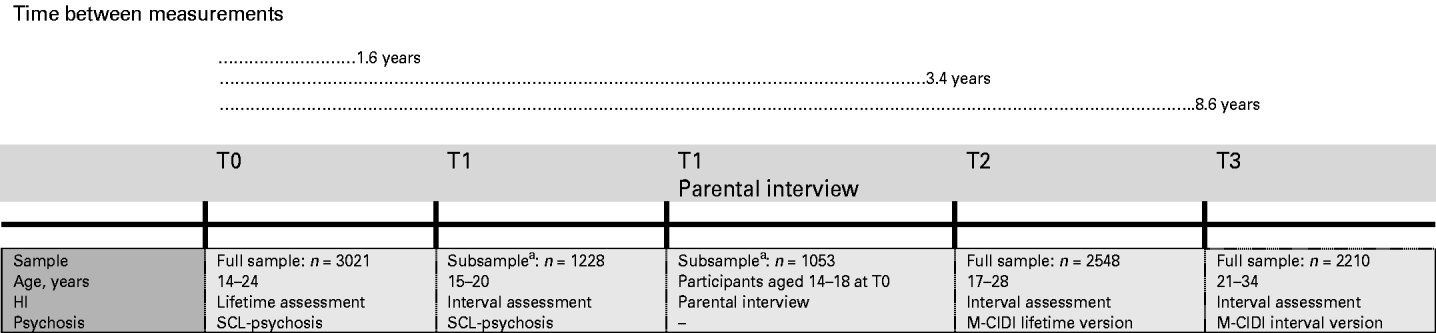
The Early Developmental Stages of Psychopathology (EDSP) Study is a prospective longitudinal cohort community study which collected data on the prevalence, incidence, risk factors and course of mental disorders. Following ethics committee approval, the sample was randomly drawn from the 1994 government population registers. The sample consisted of adolescent and young adults living in the Munich area (Germany), aged 14 to 24 years at baseline. Participants completed a baseline investigation (T0) and three follow-up investigations (T1, T2 and T3). At baseline, 3021 interviews were completed (response rate: 71%). Because the study primarily intended to examine the incidence and developmental risk factors for psychopathology, the younger group (14–15 years) was sampled at twice the rate of persons aged 16–21 years, and the oldest group (22–24 years) was sampled at half this rate. Furthermore, participants aged 14–17 years were assessed three times (T1, T2, T3) and participants aged 18–24 years were assessed only two times (T2, T3) after baseline. The follow-up periods had mean durations of approximately 1.6 years (T0–T1, s.d.=0.2), 3.4 years (T0–T2, s.d.=0.3) and 8.6 years (T0–T3, range 7.4–10.6 years, s.d.=0.7). The risk set consisted of the 3021 individuals at baseline and their T1 (n=1228, response rate=88%), T2 (n=2548, response rate=84%) and T3 (n=2210, response rate=73%) follow-up measurements. Fig. 1 shows an overview of the study design and lists the measurements conducted at the different time points. Written informed consent was obtained from all participants. More detailed information about the EDSP Study can be found elsewhere (Wittchen et al. Reference Wittchen, Perkonigg, Lachner and Nelson1998 b; Lieb et al. Reference Lieb, Isensee, von Sydow and Wittchen2000).
Design of the Early Developmental Stages of Psychopathology Study. The time-line shows the assessments at each time point. a The subsample of participants aged 14–17 years at baseline. For 1053 of these, parental interviews were completed. Parental reports of childhood hearing impairment (HI) were available for 723 participants. T0, Time 0 (baseline investigation); T1, time 1 (follow-up investigation 1); T2, time 2 (follow-up investigation 2); T3, time 3 (follow-up investigation 3); SCL, self-report Symptom Checklist; M-CIDI, Munich Composite International Diagnostic Interview.

Instruments
Assessment of psychotic experiences
Psychotic experiences were assessed using the computer-assisted version of the Munich Composite International Diagnostic Interview (DIA-X/M-CIDI) (Wittchen & Pfister, Reference Wittchen and Pfister1997), an updated version of the World Health Organization's CIDI version 1.2 (WHO, 1990). The DIA-X/M-CIDI is a comprehensive, fully standardized computer-assisted diagnostic interview for the assessment of symptoms, syndromes and diagnoses of various mental disorders in accordance with the Diagnostic and Statistical Manual of Mental Disorders, 4th edition (DSM-IV) criteria, along with information about psychosocial impairment as well as the onset, duration and severity of symptoms. The DIA-X/M-CIDI was developed specifically for use in adolescents and young adults. High validity (Reed et al. Reference Reed, Gander, Pfister, Steiger, Sontagg, Trenkwalder, Hundt and Wittchen1998) and high inter-rater and test–retest reliability of the CIDI have previously been shown (Wittchen, Reference Wittchen1994; Wittchen et al. Reference Wittchen, Lachner, Wunderlich and Pfister1998 a). Fully trained and experienced clinical psychologists, who were allowed to probe with clinical follow-up questions, conducted the interviews to ensure validity and reliability of assessments. The lifetime version of the DIA-X/M-CIDI was used at baseline and the interval version was applied at each of the follow-ups, covering the respective time periods between interviews.
The presence of psychotic experiences was assessed using the 20 core psychosis items of the DIA-X/M-CIDI-G section (G1, G2a, G3–G5, G7–G13, G13b, G14, G17, G18, G20, G20c, G21 and G22a) including symptoms of delusions, hallucinations and passivity phenomena. Participants first read a list of all the psychotic experiences and were then asked whether they ever experienced these symptoms (list and phrasing available upon request). All items could be rated as absent or present, without intermediate levels. Data on the DIA-X/M-CIDI-psychosis section were collected at T2 (lifetime version) and T3 (interval version) only. The mean interval between T2 and T3 measurements was 4.9 years. Two different outcome measures were created: (i) a dichotomous variable indicating the presence or absence of at least one positive rating on the 20 core psychotic items (hereafter: CIDI-psychosis) and (ii) in order to examine dose–response in the association between HI and psychotic experiences at increasing levels of psychosis severity, four progressively stricter psychosis subcategories were constructed (hereafter: CIDI-psychosis severity) with: no symptoms (0), one or two symptoms (1), three or four symptoms (2) and at least five symptoms (3).
In addition, participants completed the self-report Symptom Checklist-90-Revised at T0 (SCL-90-R; Derogatis, Reference Derogatis1983). The SCL-90-R is a multidimensional self-report symptom inventory that assesses psychopathology as a continuous dimension of human experiences and enables screening of nine dimensions of psychopathology (Derogatis, Reference Derogatis1983; Arrindell & Ettema, Reference Arrindell and Ettema2003). Reliability and validity have been established previously (Bonicatto et al. Reference Bonicatto, Dew, Soria and Seghezzo1997). Baseline psychosis proneness was assessed using the paranoid ideation (six items) and psychoticism (10 items) subscales. These subscales include self-reports on psychotic experiences that can be regarded, if not as clear-cut psychotic symptoms, as an expression of psychosis proneness. In accordance with previous analyses in this sample (Henquet et al. Reference Henquet, Krabbendam, Spauwen, Kaplan, Lieb, Wittchen and van Os2005), the total scores of both subscales were combined into a single dimension reflecting psychotic experiences. In line with previous work (Henquet et al. Reference Henquet, Krabbendam, Spauwen, Kaplan, Lieb, Wittchen and van Os2005), and as validated recently (Dominguez et al. Reference Dominguez, Wichers, Lieb, Wittchen and van Os2009), baseline psychosis proneness was defined dichotomously as the group of participants with the highest 10% of scores (hereafter: SCL-psychosis).
T0–T3 assessment of HI
The presence of HI was based on self-report and assessed at T0 (lifetime assessment) and over the T0–T1, T1–T2 and T2–T3 intervals (interval assessments). The assessment was included in a questionnaire enquiring about a range of somatic complaints, including sensory deficits. At T0, participants were asked the following question: ‘Did you ever experience a period in which you were unable to hear anything at all?’, yielding a binary exposure variable. At the T1, T2 and T3 follow-ups, HI was assessed using the same question, restricted to the interval since the last interview. Since complete deafness was an exclusion criterion for EDSP study participation at baseline, the impairment assessed referred to a period of transient or permanent severe HI. The most common causes of severe hearing loss that may temporarily or permanently affect young people include syndromal or non-syndromal genetic disorders, prenatal and perinatal infections and noise exposure (for reviews, see Olusanya & Newton, Reference Olusanya and Newton2007; Tharpe & Sladen, Reference Tharpe and Sladen2008).
Childhood HI
Although previous work suggests that self-reported HI has adequate sensitivity and specificity (Sindhusake et al. Reference Sindhusake, Mitchell, Smith, Golding, Newall, Hartley and Rubin2001), an additional parental indicator of childhood HI was used to validate the exposure of HI in the current study. A parental investigation was conducted at T1 in the subsample of participants aged 14–17 years at baseline (n=1053). Using a standardized checklist (Wittchen et al. Reference Wittchen, Lieb, Schuster, Oldehinkel and Rapoport1999), information was gathered about family and early childhood variables, including sensory deficits. Parental reports of childhood HI, rated dichotomously, were available for 723 participants.
Statistical analysis
All analyses were conducted in Stata, version 10 (StataCorp., USA). Prevalence estimates of HI and cumulative lifetime incidence of CIDI-psychosis were calculated. As data were acquired at multiple points in time, associations between exposure and outcome were analysed with data in the long format, i.e. each individual in the study contributed multiple observations (the variable ‘time’ expressing the number of measurements for each person, with a maximum of four measurements at T0, T1, T2 and T3). Clustering of observations within subjects was controlled for by adjusting for the variable ‘time’ in the model. Based on previous work, all analyses were adjusted for sex, age at baseline and education (low, medium, high). As young people may acquire hearing loss at a young age by attending pop concerts, during which exposure to illicit drugs may also occur, analyses were additionally adjusted for use of any illicit drugs at baseline (including cannabis, amphetamine, cocaine and other stimulants) at least five times lifetime (‘0’ no, ‘1’ yes).
Association between HI and psychotic experiences at T2 and T3
The association between HI and CIDI-psychosis at T2 and T3 was examined by logistic regression analysis, with associations expressed as odds ratios (ORs) and their corresponding 95% confidence intervals (CIs). In order to exclude the possibility that any association between HI and psychotic symptoms would be confounded by high levels of baseline psychosis proneness (given that this measure may possibly be associated with over-reporting of HI and, independent of that, with psychotic symptoms at follow-up), analyses of association between HI and T2–T3 CIDI-psychosis were repeated with additional adjustment for T0 SCL-psychosis. In addition, analyses were also repeated on a subsample from which participants with the 50% highest baseline SCL-psychosis scores were excluded. Finally, as previous research has shown that the effect of certain predictors of psychosis [e.g. cannabis (Henquet et al. Reference Henquet, Krabbendam, Spauwen, Kaplan, Lieb, Wittchen and van Os2005) and childhood trauma (Spauwen et al. Reference Spauwen, Krabbendam, Lieb, Wittchen and van Os2006)] is stronger in individuals already showing some degree of psychosis proneness at baseline, we examined whether the association between HI and T2–T3 CIDI-psychosis was stronger in those with higher levels of baseline psychosis proneness. To this end, a HI×baseline SCL-psychosis interaction term was included in the model.
Associations at different levels of psychosis severity
The magnitude of the association between HI and different levels of psychosis severity was examined using multinomial logistic regression with the Stata mlogit routine, with the lowest psychosis-severity subcategory serving as the reference group.
Age-dependent association
The hypothesized age-dependent association between HI and psychosis was tested by splitting the baseline sample around the median age, creating a young (14–17 years) and an old (18–24 years) age group. An age×HI interaction term was fitted followed by calculation of age-stratified effects from the model including the interaction by applying the appropriate linear combinations using the Stata LINCOM routine.
Childhood HI
In order to validate the self-report measure of HI used in the current study, the association between childhood HI (based on parental report; see Fig. 1), and T0 HI (which should include any childhood experience of HI) was assessed by logistic regression analysis. In addition, the association between childhood HI and baseline SCL-psychosis was examined using logistic regression analysis. Finally, the association between HI and CIDI-psychosis was examined after excluding all individuals with HI whose parents had not reported a similar impairment during childhood.
Results
Mean age at baseline was 18.3 years (s.d.=3.3) and 49.3% were male. The cumulative lifetime incidence of CIDI-psychosis at T3 was 17.9% (n=848). The prevalence of HI over time was: T0=92 (3.1%), T1=8 (0.7%), T2=18 (0.8%) and T3=33 (1.6%), yielding a total of 151 (1.8%) observations of HI. Of the subjects, seven reported HI at two time points and one at three time points. Neither CIDI-psychosis (OR 0.99, 95% CI 0.97–1.01) nor HI (OR 1.04, 95% CI 0.99–1.09) were associated with age.
Association between HI and psychotic experiences at T2–T3
There were 47 participants who reported HI at either T2 or T3, and two participants who reported HI at both T2 and T3, yielding a total of 51 observations of HI in the combined T2–T3 assessments. The association between HI and CIDI-psychosis was significant (OR 2.16, 95% CI 1.17–4.01). Adjustment for age, sex, education and drug abuse (OR 2.04, 95% CI 1.10–3.81) and baseline SCL-psychosis (OR 1.99, 95% CI 1.06–3.73) did not attenuate the association.
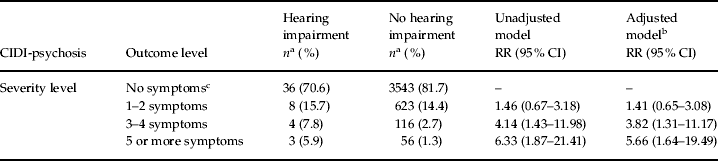
The magnitude of the association with HI increased with increasing levels of CIDI-psychosis severity (Table 1). A negative interaction between HI and age was apparent in the model of CIDI-psychosis (χ2=5.86, p=0.016). Stratified analyses indicated that the association was strong in young (age 14–17 years: OR 3.28, 95% CI 1.54–7.01), but not in older participants (age 18–24 years: OR 0.82, 95% CI 0.24–2.84). There was no evidence for moderation by baseline SCL-psychosis (χ2=0.00, p=0.99). Finally, the association remained large and significant after exclusion of participants with the 50% highest SCL-psychosis scores at baseline (OR 4.15, 95% CI 1.25–13.82).
Associations between cumulative lifetime incidence of hearing impairment (time points T0 to T3) and psychotic symptoms (CIDI-psychosis) at different levels of severity

T0, Time 0 (baseline investigation); T3, time 3 (follow-up investigation 3); CIDI, Composite International Diagnostic Interview; RR, relative risk; CI, confidence interval.
a n Refers to multiple observations clustered in individuals.
b Adjusted for sex, education, drug abuse and time.
c Reference category.
Childhood HI
In the subsample with parental reports of childhood HI (n=723), 36 participants were rated positive for childhood HI (5.0%). Childhood HI was strongly associated with the T0 self-report of HI (OR 13.08, 95% CI 4.79–35.67). In addition, childhood HI was strongly associated with the continuous baseline SCL-psychosis score (adjusted b=2.15, 95% CI 0.26–4.03). Finally, the adjusted OR for the association between HI and CIDI-psychosis, excluding individuals with a self-report of HI that was not matched by parental report of childhood HI, was 5.61 (95% CI 0.34–91.4).
Discussion
The finding of an association between HI and psychotic symptoms replicates earlier work (Stefanis et al. Reference Stefanis, Thewissen, Bakoula, van Os and Myin-Germeys2006; van der Werf et al. Reference van der Werf, van Boxtel, Verhey, Jolles, Thewissen and van Os2007). There was evidence for a dose–response relationship, as the association grew stronger with increasing levels of symptom severity. In a subsample with parental reports of childhood sensory deficits, childhood HI similarly predicted later psychotic experiences. Finally, the association was restricted to young adolescents, which is congruent with recent accounts of an age-dependent association between HI and psychosis (Stefanis et al. Reference Stefanis, Thewissen, Bakoula, van Os and Myin-Germeys2006; van der Werf et al. Reference van der Werf, van Boxtel, Verhey, Jolles, Thewissen and van Os2007). The age-dependent effect of HI suggests that disruption of development during a critical phase, in interaction with other social and personal vulnerabilities, may render an individual more susceptible to psychotic interpretations of internal and external stimuli (Kapur et al. Reference Kapur, Mizrahi and Li2005).
HI and psychosis: a shared cause?
Numerous conditions in young people may affect hearing acuity, resulting in transient or permanent impairment (for reviews, see Olusanya & Newton, Reference Olusanya and Newton2007; Tharpe & Sladen, Reference Tharpe and Sladen2008). Causes of HI in young people that may also have an impact on the risk for psychotic experiences include birth trauma (Herrgard et al. Reference Herrgard, Karjalainen, Martikainen and Heinonen1995) and prenatal and postnatal exposure to infections (Dalman et al. Reference Dalman, Allebeck, Gunnell, Harrison, Kristensson, Lewis, Lofving, Rasmussen, Wicks and Karlsson2008; Zammit et al. Reference Zammit, Odd, Horwood, Thompson, Thomas, Menezes, Gunnell, Hollis, Wolke, Lewis and Harrison2009). Rubella and meningitis may harm the developing central nervous system, and exposure has been associated with an increased risk for both hearing deficits (Fortnum & Davis, Reference Fortnum and Davis1993) and psychosis (Brown et al. Reference Brown, Cohen, Greenwald and Susser2000; Leask et al. Reference Leask, Done and Crow2002; Dalman et al. Reference Dalman, Allebeck, Gunnell, Harrison, Kristensson, Lewis, Lofving, Rasmussen, Wicks and Karlsson2008). Thus, HI and psychosis may be the result of a single underlying causative mechanism. This hypothesis is strengthened by a study reporting that rubella increased the risk for non-affective psychotic disorder independent of HI (Brown et al. Reference Brown, Cohen, Greenwald and Susser2000).
HI and psychosis: causality?
Not hearing what other people say may, directly or indirectly, trigger paranoid ideation and hallucinatory experiences. There is experimental evidence that sensory deprivation, mimicking profound hearing loss, induces feelings of paranoia and hallucinations (Leff, Reference Leff1968; Mason & Brady, Reference Mason and Brady2009). Sensory restriction may not only produce patterns of nerve impulses that give rise to hallucinatory experiences (Schultz & Melzack, Reference Schultz and Melzack1991), it may also result in reality-testing failures when the input from the outside world is significantly reduced. Failures of reality testing may cause a person to misattribute internal events to an external source. This mechanism may underlie the experience of hallucinations (Leff, Reference Leff1968; Bentall, Reference Bentall1990). Second, social adversity has been shown to mould the risk for psychosis (Boydell et al. Reference Boydell, van Os, McKenzie and Murray2004; Veling et al. Reference Veling, Selten, Susser, Laan, Mackenbach and Hoek2007). HI, whether originating early in life, or acquired later in life, is associated with social isolation, low self-esteem and increased feelings of loneliness and stress (Romans-Clarkson et al. Reference Romans-Clarkson, Walton, Herbison and Mullen1990; Bess et al. Reference Bess, Dodd-Murphy and Parker1998; Paykel et al. Reference Paykel, Abbott, Jenkins, Brugha and Meltzer2000; Kramer et al. Reference Kramer, Kapteyn, Kuik and Deeg2002). The adverse emotional and social consequences of HI may give rise to social defeat stress (Selten & Cantor-Graae, Reference Selten and Cantor-Graae2007). Prolonged exposure to social defeat stress may represent an intermediate mechanism linking multiple environmental exposures to an underlying biological mechanism of psychosis (Selten & Cantor-Graae, Reference Selten and Cantor-Graae2007; van Winkel et al. Reference van Winkel, Stefanis and Myin-Germeys2008). Thus, social defeat stress may mediate the link between HI and psychosis.
HI and psychosis: developmental impact?
Finally, HI with onset early in life may compromise the development of language, cognition and social skills (Bess et al. Reference Bess, Dodd-Murphy and Parker1998), giving rise to developmental alterations as observed in children destined to develop psychotic symptoms later in life (Cannon et al. Reference Cannon, Caspi, Moffitt, Harrington, Taylor, Murray and Poulton2002). Language and cognitive problems associated with HI may thus contribute to an increased risk in young people with a pre-existing vulnerability for psychosis. In addition, persecutory delusions and auditory hallucinations may develop as a result of delays in the acquisition of Theory of Mind (Frith, Reference Frith1992; Janssen et al. Reference Janssen, Krabbendam, Jolles and van Os2003) in children with HI. Theory of Mind abilities normally emerge during preschool years (Peterson et al. Reference Peterson, Wellman and Liu2005) and are highly dependent on day-to-day social interactions (Russell et al. Reference Russell, Hosie, Gray, Scott, Hunter, Banks and Macaulay1998). Selective deprivation of access to these early conversations by HI during critical developmental phases may interfere with Theory of Mind acquisition. Evidence to support this notion comes from studies showing significant delays in the mastery of Theory of Mind in hard-of-hearing children (Marschark, Reference Marschark1993; Peterson & Siegal, Reference Peterson and Siegal1995, Reference Peterson and Siegal1998). Thus, HI originating early in life may have an impact, during critical developmental phases, on language, cognition and social skills, increasing the risk for psychosis.
HI and psychosis: towards a multifactorial model
The association between HI and psychosis shows variation with age. Although the evidence to date suggests an increased risk in young people (David et al. Reference David, Malmberg, Lewis, Brandt and Allebeck1995; Stefanis et al. Reference Stefanis, Thewissen, Bakoula, van Os and Myin-Germeys2006), the association has also been found in older people (Cooper & Curry, Reference Cooper and Curry1976; Stein & Thienhaus, Reference Stein and Thienhaus1993). This latter implies the operation of multiple mechanisms contributing to the increase in psychosis risk, with differential impact across the age span. HI with onset during critical developmental phases may have an impact on risk by delaying the development of social reasoning skills, language and cognition, whilst other mechanisms may be operating in people who acquire HI later in life. Considering the negative impact of HI on perceived quality of life, as expressed by increased feelings of loneliness and a tendency for social isolation, social defeat stress may represent a more general mechanism mediating the link between HI and psychosis, regardless of age. Therefore, to the degree that HI moulds risk for psychosis, it is likely to do so in combination with a range of other factors.
Limitations
Several limitations should be considered when interpreting these results. First, the study used a measure of HI that was based on self-report and consisted of a single question. Although this may not seem a very reliable measure, self-reports of HI have been found to yield reasonable sensitivity and specificity (Sindhusake et al. Reference Sindhusake, Mitchell, Smith, Golding, Newall, Hartley and Rubin2001). Also, EDSP interviewers were allowed to follow-through with follow-up questions to clarify if participants had understood the question. Finally, parental reports of childhood HI were strongly associated with T0 HI, suggesting validity in the sense that adolescent HI was continuous with earlier permanent or recurrent HI. In addition, the validity of the findings was supported by the fact that if exposure status was restricted to those participants with HI who also had evidence of childhood HI according to parental report, the OR was also very high, albeit statistically inconclusive due to the small number of participants. Furthermore, to the degree that misclassification may have arisen, it is difficult to see how this could have been differential with regard to the psychosis outcome.
Second, the assessment of psychotic experiences confers the risk of false-positive answers, increasing random error. However, not only was the DIA-X/M-CIDI specifically developed for use in young and adolescent populations, there is also a substantial literature on the validity of self-reported psychotic experiences (van Os et al. Reference van Os, Linscott, Myin-Germeys, Delespaul and Krabbendam2009). In addition, the assessment of psychotic experiences in the current study was based on both self-report and diagnostic interview by trained and experienced clinical psychologists, lowering the risk for false-positive ratings.
Finally, although observational studies cannot provide evidence for causality in the association between HI and psychotic symptoms, no evidence to date exists to support reverse causality (psychosis provoking spurious reports of having impaired hearing). Furthermore, the association remained highly significant after exclusion of those people at baseline with high psychosis scores, rendering reverse causality as an explanation for the findings less likely.
Acknowledgements
This work is part of the Early Developmental Stages of Psychopathology (EDSP) Study. The EDSP Study is funded by the German Federal Ministry of Education and Research (BMBF; project no. 01EB9405/6, no. 01EB 9901/6, no. EB01016200, no. 01EB0140 and no. 01EB0440). Part of the field work and analyses were also additionally supported by grants of the Deutsche Forschungsgemeinschaft (DFG; project no. LA1148/1-1, no. WI2246/1-1, no. WI 709/7-1 and no. WI 709/8-1).
The principal investigators of the EDSP Study were H.W. and R.L. The core staff members of the EDSP group were: Dr Katja Beesdo, Dr Petra Zimmermann, Dr Axel Perkonigg, Dr Michael Höfler, Dr Tanja Brückl, Agnes Nocon, Hildegard Pfister, Barbara Spiegel and Dr Andrea Schreier. Scientific advisors are Dr Jules Angst (Zurich), Dr Kathleen Merikangas (National Institute of Mental Health, Bethesda), Dr Ron Kessler (Harvard, Boston) and J.v.O. (Maastricht). The EDSP project and its family genetic supplement have been approved by the Ethics Committee of the Faculty of the Technische Universität Dresden (no. EK-13811). All participants provided informed consent.
Declaration of Interest
R.L. has received speaker honoraria from Wyeth. H.W. has received research support from Novartis, Pfizer and Schering-Plough, has been a consultant for Novartis, Pfizer, Wyeth, Organon and Lundbek, and has received speaker honoraria from Novartis, Schering-Plough, Pfizer, Wyeth and Servier. J.v.O. is/has been an unrestricted research grant holder with, or has received financial compensation as an independent symposium speaker from, Eli Lilly, BMS, Lundbeck, Organon, Janssen-Cilag, GSK, AstraZeneca, Pfizer and Servier – companies that have an interest in the treatment of psychosis.