


Operation Pedro Pan (OPP) sent at least 14,048 unaccompanied minors to the United States and represents one of the largest exoduses of unaccompanied children in the history of the Western hemisphere. The program, largely coordinated by the Catholic Welfare Bureau and the United States Government, began in December 1960, almost a year after the success of the Revolution, and ended in October 1962 when the Cuban Missile Crisis halted all direct travel between the U.S. and Cuba. The Catholic Welfare Bureau placed around eight thousand of the children documented into the care of family, friends, and relatives already living in the U.S.; the rest were placed into group homes, foster families, and orphanages until they could be reunited with their parents. While most Pedro Pans reunited with their parents eventually, primarily through the Freedom Flights (1965–1973), some never saw them again.
Performative works commemorating OPP center nostalgic pre-Revolutionary musical genres and artists, as nostalgia remains an important (albeit often problematic) expression of exilic grief for Pedro Pans, their families, and the broader Cuban American community.Footnote 1 In this article, I examine the ways in which Pedro Pan artists first mobilized nostalgic musics, such as son, danzón, and rumba, to express individual grief within collective experience during the 1990s. Drawing on Svetlana Boym’s delineation of “restorative” and “reflective” nostalgias,Footnote 2 I note a distinction between “restorative” works that depict a unified, shared utopic past and “reflective” works that underscore loss through the conversion of the familiar to the strange. Crucially, both utilize nostalgic musics associated with their parents’ generation of Cubans while attempting to musically and sonically distinguish their experiences within that larger framework. I suggest that Pedro Pan artists use these musics to express their disenfranchised and suppressed grief within the constraints placed upon them by the Cuban American community and larger U.S. political and mediascape.Footnote 3
Nostalgia, Grief, and Music in the Pedro Pan Community
Pedro Pans experienced several traumatic events and losses directly before and after their migration event. Children commonly received little to no prior notice of their parents’ decision to send them abroad, were forced to leave most of their possessions and family behind, and spent their final moments before departure separated from their parents in a glass room called the pecera (fishbowl).Footnote 4 Additionally, because Pedro Pans often come from families who did not support the Revolution, many of them recall a loved one being imprisoned or killed in a military tribunal. One Pedro Pan I spoke with recalled that his mother secured a visa waiver for him after his father, who led an underground counterrevolutionary group, was executed.Footnote 5 Upon arriving in Miami, those children not placed with family or friends were taken to one of several temporary group homes, some of the most populous of which included Camp Matecumbe, Florida City, and Camp Kendall. As noted by several Pedro Pans, some persons in the camps utilized corporal punishment with the children. Additionally, several former Camp Matecumbe residents mentioned the overcrowded conditions, bullying, and even repeated instances of sexual assault during their time there.Footnote 6 Once placed in foster care or orphanages, experiences varied widely; some Pedro Pans found loving homes with their foster parents, while others lived a nightmare.Footnote 7 This in part accounts for the wide range of perspectives Pedro Pans have on their experience as part of the program.
Though their exodus occurred over sixty years ago, the grief many Pedro Pans feel for the simultaneous loss of homeland, family, culture, language, and childhood remains potent. When sharing their stories with me during my dissertation fieldwork,Footnote 8 individuals cried, got angry, or even asked to stop the interview. Lourdes Rodríguez-Nogués, a Pedro Pan and clinical psychologist, suggested in her 1983 study of Pedro Pan women that compounding factors delayed and complicated the grieving process, leaving many still impacted decades later. Some of these factors include their migration and separation from family at a premature age, the cultural, social, and linguistic barriers they faced upon arriving in the U.S., the initial belief that their stay in the U.S. would be brief, and the permanently altered relationship they had with their parents once reunited.Footnote 9 She suggests that the participants in her study struggled to face their experiences and memories until years after the fact. Their memories often returned unexpectedly to them in the face of a triggering event.Footnote 10 Consequent studies on Pedro Pan psychology,Footnote 11 María de los Angeles Torres’s reflections of her own Pedro Pan experience in her history of the exodus,Footnote 12 as well as my own observations in interviews with Pedro Pans and as the daughter of one myselfFootnote 13 corroborate these findings across different time periods.
For some Pedro Pans, one of the most significant challenges was processing their own experiences in the sociopolitical context of the Cold War and its aftermath.Footnote 14 U.S. political and media spheres, along with Cuban American communities, exerted a tremendous pressure on the Pedro Pans to be grateful for their exodus. As stated by Horacio Sierra in his article on Cuban American popular musicians and nostalgia,
[Celia] Cruz’s and [Gloria] Estefan’s musical troubles exist only in what was lost in Cuba. In fact, to complain about life in the US would be tantamount to a betrayal of the Cuban-American cause. Just as the US government worked tirelessly to facilitate a smooth immigration process for Cubans, which included propaganda campaigns underscoring their Whiteness to allay American nativist fears of exotic brown people, Cuban-American exiles worked with the government’s desire to taunt the Castro regime with an image of a successful exile community.Footnote 15
For many Cuban exiles of their parents’ generation, criticizing OPP meant dismissing broader Cuban Americans’ traumatic dislocation as unjustified. Anita Casavantes Bradford suggests that the tremendous pressure specifically on Pedro Pans was also a result of what she calls the “child-centered creation myth of exile,” the hegemonic narrative that the post-Revolutionary exile community was founded to save children from “communist and atheistic indoctrination.”Footnote 16 Many Pedro Pans consequently feared being shunned by their Cuban communities if they questioned the integrity of Catholic Charities’ housing facilities or the necessity of OPP. The many stories of abuse and neglect Pedro Pans faced while in Catholic Charities’ care, as documented in various histories of the exodus,Footnote 17 contradict the savior narrative and thus are less frequently highlighted by the broader exile community. The oppressive contexts left little room for public expressions of grief for the different types of losses associated with the exodus, and many Pedro Pan voices and experiences were consequently silenced.
The phenomena of Pedro Pans’ suppressed and delayed grief in the face of external pressures can be constructively understood through the model of hierarchical or “ranked” loss. In this model, social, political, and interpersonal factors can defer or complicate the grief of an individual whose right to mourn may be subjugated or minimized by others. Kenneth Doka first proposed the idea of “disenfranchised grief,” which describes “the grief that persons experience when they incur a loss that is not or cannot be openly acknowledged, publicly mourned, or socially supported.”Footnote 18 Examples of such grief may include the death of a partner in a secret relationship or the loss of a loved one during a catastrophic event in which hundreds of others also died. Judith Butler similarly discusses the “grievability” of individuals within broader political discourses, thus exposing how sociopolitical climates and biases impact hierarchies of grief.Footnote 19 She highlights public discourses surrounding death in the so-called War on Terror and how 9/11 victims were publicly mourned but suspected “terrorists,” their families, and other civilians in their home countries were dehumanized in Western media and their deaths thus trivialized. Butler suggests that sociopolitical factors not only determine who has the right to mourn a loss, but also whose deaths are worth mourning at all. While U.S. media portrayed the Pedro Pans as young, innocent victims of communist Cuba, the overwhelming emphasis was on the narrative of salvation and the children’s heartwarming interactions with U.S. families, food, and culture. The media lauded the Pedro Pans’ parents for sending them alone to the U.S., where they would ostensibly be protected from the political turmoil in Cuba and continue to be cared for. Additionally, U.S. propaganda championed the care and acceptance of the Pedro Pans as American families “doing their part” in the Cold War effort. While many are indeed grateful to have been part of the exodus,Footnote 20 the overwhelming public narrative of Pedro Pans growing up to be successful and well-adjusted thanks to the U.S. and their parents’ sacrifice drowns out those who never healed, those who remain bitter and depressed, and those whose emotional wounds ultimately led them to take their own life.
The hierarchies of loss affect Pedro Pans not only in broader politicized mediascapes but also within their own family unit. Kenneth Peskin highlights how mourners within a family and/or friend group are identified as more or less entitled to grieving a loss, thus pushing those of lower ranking to “defer” their grief for the sake of the “primary” mourner.Footnote 21 In the case of Pedro Pans, many felt the need to be strong for their parents in Cuba and for their siblings, often comforting younger siblingsFootnote 22 and lying in letters to their parents to help put their minds at ease.Footnote 23 Once reunited with their families, many Pedro Pans’ relationships with their parents changed irreparably, as their parents needed help navigating the English language or finding work, and yet often still expected to have the same child-parent dynamic they had in Cuba. In some cases, the reunion was only with one parent, as the other had either chosen to stay or had been imprisoned or killed. For many of these reasons, among others, Pedro Pan author Carlos Eire describes the day he left Cuba as the “death” of his childhood and his old self.Footnote 24 Another Pedro Pan in an interview with me similarly described her childhood as something lost in the exodus:
[My childhood in Cuba] was like a fantasy. When you reflect back, you’re just being a kid. You know what I mean? […] [crying] I’m happy about that. I’m happy about that. No, I’m good. I’m just, you know, emotional because it never was again. It never was. Childhood never [was] the same.Footnote 25
And yet, as Peskin suggests frequently happens, the parent’s grief for the loss of homeland, culture, community, language, family, and security often took precedence over the child’s in public discourse. Media coverage of the exodus often praises parents for sacrificing their well-being by sending their children to safety without them, suggesting that the parents’ pain far surpassed that of their “saved” children. In the first newspaper article written on OPP, for example, Gene Miller paraphrases a conversation with a young Pedro Pan to whom he assigns the pseudonym “Jose One” and which suggests the boy’s mother suffered more than the child did: “‘I cried a little’ Jose One confessed. ‘Mother cried mucho’.”Footnote 26 Many of my interlocutors additionally felt it was very important to mention that, while they suffered with the separation, their parents also suffered a great deal. These structures could explain why mourning losses associated with experiences in the U.S. can be met with accusations of being “ungrateful” for their parents’ sacrifice.
I suggest that restorative nostalgia serves as a socially acceptable, politically involved form of grieving in exile. It seeks to uncritically revive a utopic past real or imagined—it is often the substance of political campaigns or nationalist constructions that depict a glorified past in the interest of political and social mobilization.Footnote 27 In this case, nostalgia for the Cuba de ayer, or pre-Revolutionary Cuba, generates a sense of “diasporic intimacy”Footnote 28 that creates relational modes of belonging for the older Cuban American exile community, particularly in Miami, Florida. As Alan Aja notes, “[u]sed in song and dance from artists like the late Celia Cruz [and] as the name of Cuban-owned restaurants and grocery stores in South Florida, La Cuba de Ayer is essentially a ‘state of mind’ based on things that are imagined, but in reality were never ‘past’.”Footnote 29 Aja’s comments are in dialogue with Miguel de la Torre’s observation that the Cuban exile community often remembers pre-Revolutionary Cuba as nearly utopic, “forgetting” its many social, economic, and political ills. According to Torre, “Exilic Cubans avoid the pain of displacement by constructing a mythical Cuba where every guajiro (country bumpkin) has class and wealth, where no racism exists, and where Eden was preserved until the serpent (Fidel) […] brought an end to paradise.”Footnote 30 The function of nostalgia also explains why interrogations of this “collective myth” or sympathetic assessments of the same Revolution charged with destroying the Cuba de ayer are so harshly rejected by many in the exile community.
Music plays a large role in both constructing the memory of the Cuba de ayer and in grieving its loss. Scholars such as Horacio Sierra and Gema Guevara assert that exile musicking engages in an economy of nostalgia for pre-Revolutionary Cuba, often referencing and/or performing musics popular before the Revolution.Footnote 31 Robin Moore highlights how the memory of 1950s Cuba is often polarized between exiles and Cubans on the island in part because Cuba enjoyed a blossoming economy and entertainment industry, including a popular music boom, amid horrific and violent political turmoil.Footnote 32 Older exiles consequently tend to associate musical genres and recordings from that era with the comfortable lifestyles many of their families enjoyed before the Revolution while downplaying the severity of state violence and oppression. Guevara further suggests that popular music, in particular, forms a way of connecting exiles through familiar, euphemizing tropes that allow them to identify commonalities and construct a homeland outside of a specific geographic location. However, this process, as noted by Guevara, Moore, and Aja (among others), often “whitewashes” the history of pre-Revolutionary Cuba and ignores the classist, racist, and sexist structures it promoted. Appropriately, Boym cautions us that restorative nostalgia facilitates both forgetting and remembrance; to find a comforting time to return to, we must create one.
The interviews I conducted suggest that the consumption of pre-Revolutionary music for many Pedro Pans was also a way of feeling connected to the home they lost. One Pedro Pan told me that he began collecting records for his now massive collection because he “missed Cuban music so much” during his initial years in the U.S.Footnote 33 Another recalled that after returning to Miami from his temporary placement in New York, he felt it was important to reconnect with his culture, and so he “‘Cubanize[d]’ [him]self by listening to Cuban radio stations that played Cuban music from the 1940s and 1950s.”Footnote 34 One Pedro Pan I spoke with even recalled saving up to buy a transistor radio to hear any “Cuban sound” while separated from his parents in a Michigan orphanage and thus feel connected to the island again:
When I had enough money, I went out and bought my first transistor radio. But you know the real reason I went and bought that transistor radio was to see if I could get Cuban stations. In my mind, because I had this transistor radio, I could get Cuban, I could get any kind of Cuban sound, you know. I didn’t care what it was; music, news, sports…. But that never happened of course […].Footnote 35
A number of other Pedro Pans recall being primarily interested in American popular music as children in Cuba, but in exile came to crave Cuban music of their parents’ generation to feel connected to the homeland, culture, and community they lost. Which specific songs or even which sounds themselves generally didn’t seem to matter as much as their broader associations. When Pedro Pans felt they could not physically be in Cuba, hearing anything that represented home seemed to be part of staying connected and making sense of their new reality.Footnote 36
Early Pedro Pan Musical Performance of Exile and Loss
Starting in the 1970s, Pedro Pans and other Cubans part of their generation who migrated as youths utilized nostalgic musics from their binational childhoods to perform their own generational restorative nostalgia.Footnote 37 Exilic musicking of the 1960s focused on nostalgic longing for both Cuba and older Cuban musics, with compilation albums bearing titles such as Nostalgia de Cuba and La Cuba de ayer.Footnote 38 Firmat comments that during the first decade of post-Revolutionary exile “the chachachá and the mambo seemed to be less represented than the danzón.”Footnote 39 Beginning in the 1970s, however, Cubans who migrated as youths began recording their own music, blending the nostalgic musics from their parents’ generation and the Anglophone rock and roll they listened to both in Cuba (through Radio Kramer) and in the U.S. Firmat describes this sound, which blended dominantly Spanish language lyrics paired with musical and textual allusions to the Cuba de ayer and rock and roll, as “by turns assimilationist, nostalgic, and something in between.”Footnote 40 The musical esthetic, in part spearheaded by Pedro Pan artists Willy Chirino and Carlos Oliva, became recognized as the Miami Sound.
Pedro Pan alumni organizations began to promote the “Miami Sound” and its component music cultures as representative of their group’s bicultural and generational identity in the 1990s. For example, the first years of Operation Pedro Pan Group, Inc.’s (OPPG) annual fundraising dinners almost always featured live music by the “Pedro Pan stars,” which included Willy Chirino, Carlos Oliva y sus sobrinos del juez (and the Judge’s nephews), and occasionally singer Marisela Verena.Footnote 41 These artists performed a generationally and experientially specific form of restorative nostalgia for Pedro Pans, and thus, their music and the Miami sound remain an important part of sociality in alumni groups like OPPG. One leader of a different Pedro Pan organization makes explicit mention of the continued practice of musical curation: “in the events that our group does, we only play old Cuban music or American music from the sixties or seventies.”Footnote 42 Another Pedro Pan who served in leadership positions within an OPP alumni group stated that although she “didn’t listen to” Cuban music, it was necessary to have “bilingual” and “bicultural” music like Chirino’s at gatherings because “in his music he has that mix of American and [pre-Revolutionary] Cuban [music] that speaks to us.” She even recalled a moment in which a new band played post-Revolutionary music for the group and everyone stopped dancing because “we’re very particular about the music that we dance […] [w]e don’t listen to any of the new things that have happened in Cuba since [we left in] 1962.”Footnote 43 This comment exposes the politics inherent in the practice of musical curation, as such a strong reaction to newer Cuban music echoes broader politicized listening practices in the more conservative segments of the Cuban diaspora, who equate consumption of post-Revolutionary cultural products with implicit support for the Revolution.Footnote 44 Therefore, the restorative nostalgia performed as part of many Pedro Pan groups’ social events implicitly locates the former child migrants’ identities within the broader exile ideology of their parents while also incorporating the rock and roll from their own youths.
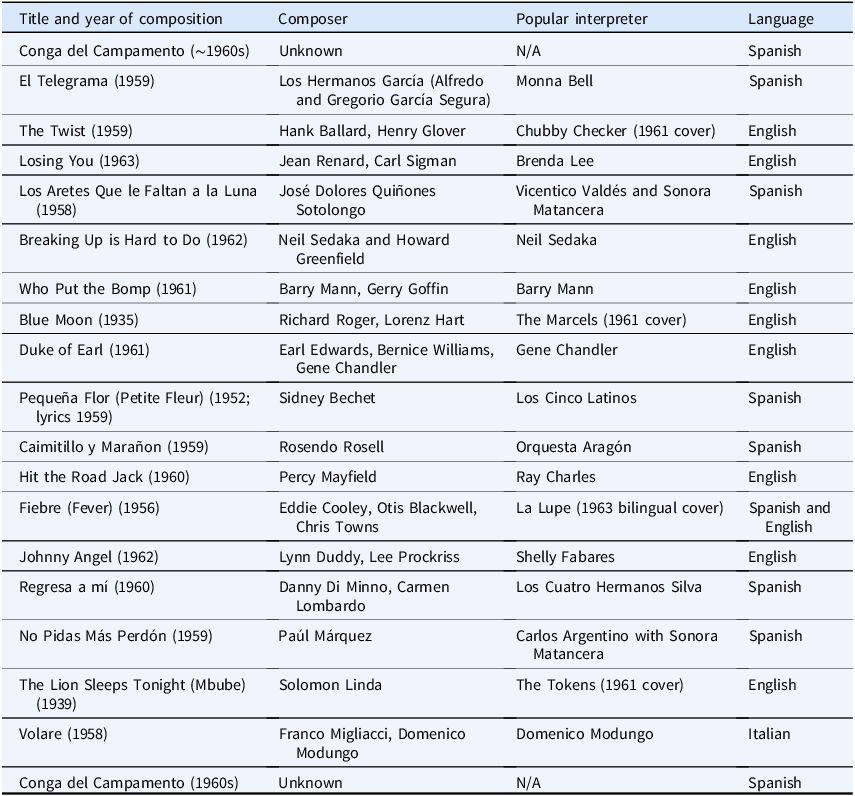
The Grupo Pedro Pan (GPP) album recorded by and sold to mostly Pedro Pans thirty years after they arrived in the U.S. exemplifies this type of restorative nostalgia.Footnote 45 The cassette, created during the debates surrounding the 1994 balsero (Cuban rafter) crisis and supported by the then-nascent alumni organization, OPPG, features four of the most famous popular music artists of the exodus in Miami and internationally: Willy Chirino, Marisela Verena, Lisette Álvarez, and Carlos Oliva. It represents, to my knowledge, the only attempt by Pedro Pan musicians to memorialize their exodus in a collective recording project. The two sides of the cassette generally focus on two different time periods: Cara A defines the musical memory of the Pedro Pans’ migration, while Cara B utilizes the artists’ recent musical releases to suggest a united anti-Castro front and OPPG’s alliance with the broader exile community. The focus of Cara A is the nearly ten-minute-long potpourri track featuring primarily pre-composed popular music from the time of the Pedro Pans’ youths. As shown in the “Pedro Pan Popurrí” track outline (see Table 1), the nostalgic popular songs represented in the broader potpourri utilize generationally specific musics to invoke idealized memories of the Pedro Pans’ time in relocation camps, thus affirming positive depictions of the Operation. Each of the Pedro Pan artists featured in this potpourri represents their bicultural and bilingual youths by singing in both English and Spanish, juxtaposing music popular on the radio in Cuba before the Revolution, including non-Cuban pop songs,Footnote 46 with music popular during their first years in the U.S.
Pedro Pan Popurrí track list, as heard in Grupo Pedro Pan (Internacional Sound Studios, 1994, cassette)

Table 1. Long description
A table with 18 rows and 4 columns. The columns are Title and year of composition, Composer, Popular interpreter, and Language. The table lists various songs along with their composers, popular interpreters, and the languages in which they are performed. The songs span different years and languages, primarily Spanish and English, with one song in Italian. Each row provides details for a specific song, including the title, year of composition, composer(s), popular interpreter(s), and the language of the song. The table captures a diverse range of musical works and their cultural contexts.
The accompanying liner notes for the “Pedro Pan Popurrí” suggest that the former child migrants invested in broader exilic politics and restorative nostalgia for the Cuba de ayer. The “Popurrí” takes on the form of a narrative, idealizing memories of the relocation camps and echoing broader exilic goals of ultimately returning to Cuba:
The songs of this Pedro Pan Potpourri were those that we brought with us and sang in the homes, in school[;] of course they were in Spanish, [but] later we incorporated hits in English. […] Oh, but despite the years that have passed, despite the ‘rock’ and the ‘twist’, the marañón Footnote 47 is still what we continue to like more! Because of this, “Regresa a mí,” and “Volare” predict the day we return, flying, to reconstruct a free Cuba.Footnote 48
The medley and its accompanying liner notes don’t acknowledge the violence, political turmoil, and social ills of the Cuba Pedro Pans grew up in, thus aligning with the nostalgic portrayals of the Cuba de ayer prominent in Miami. They similarly do not acknowledge the trauma many Pedro Pans endured in the camps or the xenophobia many of them have experienced in the U.S. They instead recall the camps as a time in which they were all “singing together,” performing light-hearted Cuban numbers, American pop, and Latin American baladas to suggest the children felt a sense of camaraderie.
The use of the politically charged “conga” at both the beginning and end of the medley additionally suggests Pedro Pan allegiance to the U.S. mission of eradicating Communism that in part fueled OPP in the first place. In addition to the overt political commentary in the lyrics (see Table 2), the conga as a musical form has associations with political protest in Cuba. While conga lyrics are not always political, some have been used for political purposes, from celebrating war heroes of Afro-Cuban descent to promoting politicians in carnival performances in the 1940s and 50s.Footnote 49 However, this “conga” bears no musical resemblance to those traditionally performed in Cuban comparsa groups or even to the version artists like Desi Arnaz and Eliseo Grenet popularized in the Western world during the early-to-mid twentieth century. Congas performed by comparsa groups during Cuban carnival festivities usually consist of myriad percussion and brass instruments that accompany group singing/chanting; interlocking patterns performed on bells and frying pans often give congas their distinctive sound. In contrast, the recording of the “Pedro Pan Popurrí” sounds like a children’s chant accompanied by a 3–2 son clave rhythm clapped by the group. Despite initially being rejected by Cuban elites for its association with working-class Afro-Cubans,Footnote 50 son came to symbolize the essence of the island’s cultural heritage in both Cuba and in exile and thus remains deeply nostalgic on both sides of the Florida Straits. By accompanying the “conga” with this rhythm, the artists authenticate the political messaging as “Cuban.” The singing of the melody in unison, clapped accompaniment, and simple and repetitive melodic structure also suggest the “childness” of the song, further locating the messaging as potentially coming from the artists’ former child-selves who lived in these camps. Listeners to this track, many of whom were Pedro Pans themselves,Footnote 51 may also have been aware that this “conga del campamento” was originally played in a United States Intelligence Agency propaganda film, in which the song was sung by a group of children in unison to suggest the young Pedro Pans’ investment in the film’s overt anti-communist messaging. Thus, the emphasis of the conga in the “Pedro Pan Popurrí” retroactively affirms the children’s ownership of the political messaging of the film.Footnote 52
“Conga del Campamento” lyrics transcription and translation, as heard in Grupo Pedro Pan (Internacional Sound Studios, 1994, cassette)

Table 2. Long description
A table comparing lyrics in Spanish and their English translations. The table has two columns and six rows. The first column is in Spanish, and the second column is the English translation. Row 1: ¿Quién viene ahí? Pregunta la gente, Who comes here, ask the people. Row 2: Y otros más prudentes, preguntan quién será, And more prudent ones ask who they’ll be. Row 3: Somos los Cubanos, oiganlo bien, We are the Cubans, listen well. Row 4: Que venimos refugiados por culpa de Fidel, That comes as refugees, because of Fidel. Row 5: Y a los comunistas queremos decir, And to the Communists we want to say. Row 6: Que de cubita bella se tienen que ir, That you must leave beautiful little Cuba.
While the “Conga” and the “Popurrí” may not seem representative of grief, in the context of the album they express feelings of loss within the hierarchies of grief placed upon Pedro Pans. As mentioned previously, investment in the child-centric creation myth of exile and the politicized nostalgia for the Cuba de ayer was, for many, part of being accepted into the Cuban community and maintaining relationships with families. Regardless of whether the artists felt such constraints, the restorative nostalgia in this work simultaneously avoids challenging hegemonic narratives that might alienate them from their community and attempts to express a sense of loss for homeland and culture. Firmat additionally notes that members of what is known as the 1.5 generation frequently feel “caught” in the hyphen between “Cuban” and “American,” never fully being part of either. While the “Popurrí” medley largely seems uplifting, the wild swings between musics and abrupt transitions between rock and roll, doo-wop, balada, bolero, and danzón point to a reality many Pedro Pan interlocutors have communicated to me and that Firmat articulates in his book: namely, “hyphens hurt.”Footnote 53 The medley’s abrupt transitions between languages and genres thus illustrate the disorienting and often isolating process of living between two cultural worlds.
Conversely, Mario Ernesto Sánchez’s Reference Sánchez1995 play Matecumbe: el vuelo de un Pedro Pan, which commemorated his personal unaccompanied migration experience just a year after OPPG’s recording project, exemplifies reflective nostalgia. The play roughly follows an unnamed Pedro Pan boy as he navigates through various scenes of life at the Matecumbe refugee camp. Several scenes represent the playwright’s literal memories while others symbolize emotional states he experienced. The action generally occurs chronologically, with occasional pauses in the narrative to introduce a brief monologue. Although Sánchez’s work is a play, there is very little dialogue—he predominantly relied on a soundscape by Cuban American composer Mike Porcel, overlapping yelling and non-linguistic sounds by actors (such as screaming, grunting, or laughing) to inform the actors’ motions onstage. The short monologues that do occur in the play almost never directly comment on the onstage action, instead articulating the present perspective of the playwright. When there is discernible dialogue in a scene, it usually quickly devolves into nonlinguistic sound or semi-intelligible shouting. Sánchez explained to me that he structured his work in this way because he “didn’t know any English at the time” he was in the camps, and so the work attempts to immerse audiences in the confusing and unnerving experiences of trying to navigate a new language. Sánchez’s work thus both immerses audiences in the painful and frightening experiences he remembers and reflects on the distance between his past and present selves.
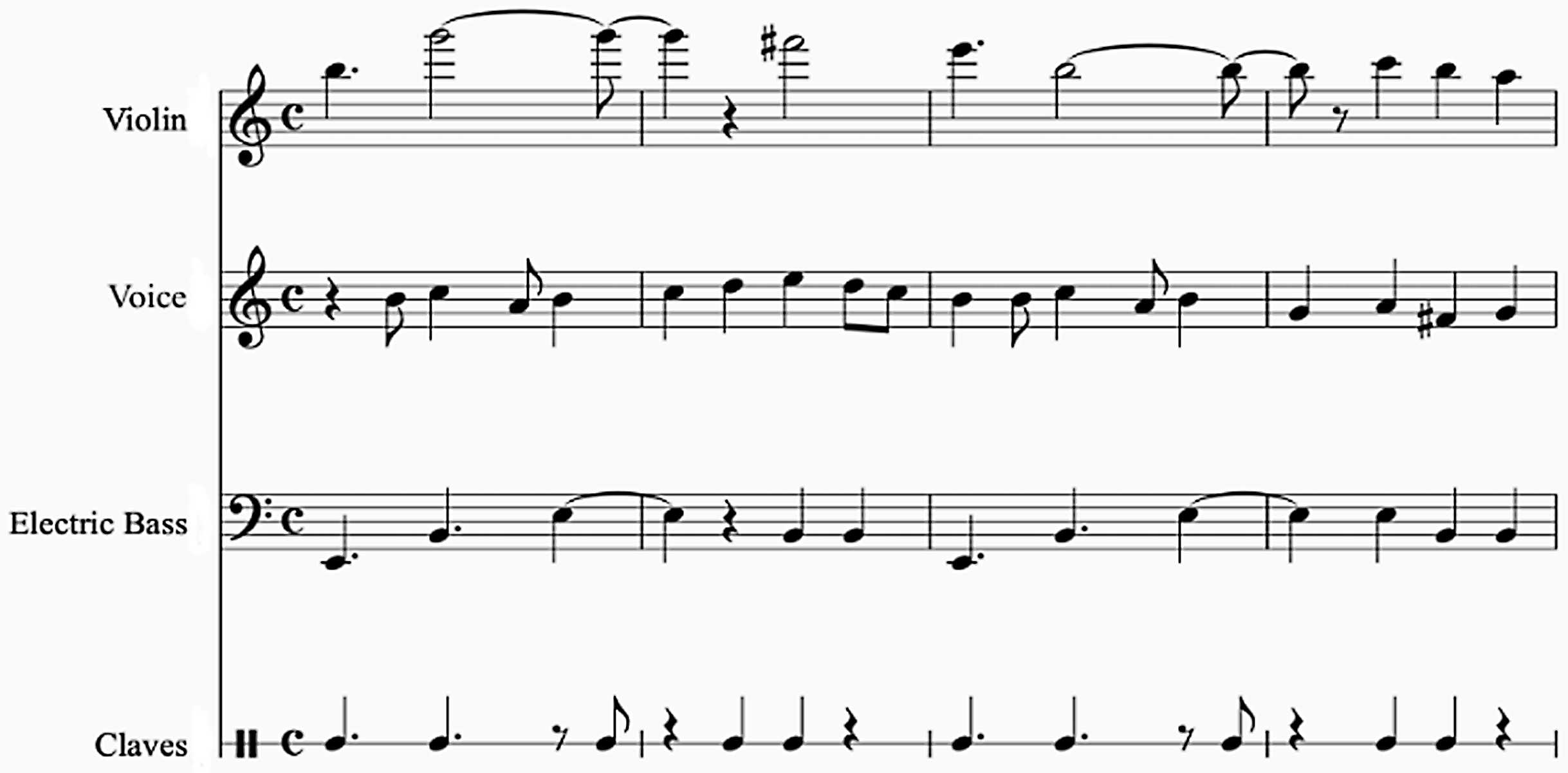
Nostalgic musics work to both assert Cuban belonging and reflect on the distortions of memory in time throughout the work. For example, the B section of Matecumbe’s main theme juxtaposes the danzón rhythm, voiced in a synthesized choral sample, with the rumba clave. The transcription in Example 1 highlights this juxtaposition. Rumba and danzón represent two deeply nationalistic, nostalgic, and internationally widely recognized dance musics that developed in Cuba prior to the Revolution. The imposition of the two musical signifiers already underscores a distance from the Cuba of Sánchez’s youth, as these rhythms would normally not be played together. But it is in the monologues where the memory of these musics becomes deconstructed more completely, showing both a rupture in dramatic time and underscoring the distance between past and present. A fragmented and slowed excerpt from the main theme accompanies all monologues; the rumba and danzón rhythms disappear with the shift in time. The only trace of them remains in the clave’s idiomatic timbre, occasionally punctuating the ends of phrases in the monologue theme.
Excerpt from Mike Porcel, B section of Matecumbe Main Theme. Reduced transcription by author from the 1995 premiere performance recording in Miami, FL. Matecumbe: el vuelo de un Pedro Pan, GC Video Productions.

The relationship between the main theme, representing a “musical summary” of the play’s narrative,Footnote 54 and its deconstruction in the monologues, representing the present perspective of the playwright, thus emulates the effect of griefwork Boym suggests is inherent in reflective nostalgia. She notes that, while the “loss is never completely recalled, it has some connection to the loss of collective frameworks of memory.”Footnote 55 She further suggests that these “collective frameworks of memory are rediscovered in mourning.”Footnote 56 Psychologist Robert A. Neimeyer additionally suggests that one of the most powerful tools for processing grief is finding the ability to engage with a painful loss directly while still being able to maintain enough of a healthy distance to constructively recontextualize it.Footnote 57 In my conversations with Sánchez, it certainly seemed that Matecumbe helped him process the painful memories he suppressed for years. Although Sánchez told me that he nearly fainted upon revisiting the campsite with curious actors from the play and that several Pedro Pans in the audience angrily confronted him about the less-than-flattering depiction of U.S. caregivers, the process of writing, rehearsing, and performing the work allowed him to “clean his closet of skeletons.”Footnote 58 The ultimate benefit of his reflective work, then, seems to be that the author could immerse audiences in his experience, use artistic expression as a form of cathartic release, and literally “stage” his memories to both face and gain perspective on his grief.
Fears of “Fading” and the Next Generation
In contemporary discussions with Pedro Pans, anxieties about the community “fading away” and their memories becoming lost are palpable. On April 10th, 2025, Mario Ernesto Sánchez passed away. Following Sánchez’s death, different ways of commemorating his life emerged in the news and on social media. Various news and Cuban exile media outlets remembered him for his role in the British sitcom Only Fools and Horses, his cameos on Miami Vice, and his role as director and founder of one of Miami’s first bilingual theater companies, Teatro Avante.Footnote 59 Others recalled Sánchez as an inspiration for Hispanic and Latine artists, a philanthropist,Footnote 60 and a champion for reaching across linguistic and cultural divides through art.Footnote 61 In Pedro Pan Facebook groups, he was mourned as a Pedro Pan brother, with some comments lamenting that the Pedro Pan community as a whole was “fading away.”Footnote 62 Indeed, following the news of Sánchez’s death, another second-generation Pedro Pan writer reached out to me and ended their note with a call to action: “it feels increasingly important for us, as descendants of Pedro Pan, to keep this legacy alive.”Footnote 63
Both remembrance and grieving are continuous, interrelated processes. Pedro Pan alumni organizations like OPPG and individual Pedro Pan artists respond to anxieties about “fading away” through numerous, regular events and artistic pieces educating the public about their exodus. Series of museum exhibits, documentaries, historic site registrations, plays, musicals, memoirs, and histories have been produced or endorsed by the Pedro Pan community to ensure no one forgets. As Jane Blocker notes in her monograph on the late Pedro Pan artist Ana Mendieta, titled Where is Ana Mendieta?,
Remembrance is a process, not a task to be completed; it is carried out through constant repetition and renewal. To be satisfied that Mendieta has been sufficiently memorialized is to admit, finally, that she is gone. ‘Where?’ serves as a living reminder rather than a stone marker for that loss.Footnote 64
French historian Pierre Nora’s influential concept of “sites of memory” points to similar concerns about memory loss towards the end of the twentieth century. He theorized these “sites,” which externalize and create spaces for individuals to reconnect with and re-signify collective memories, needed to be constructed and maintained so that societies could crystallize, preserve, and adapt memories important to their identity and keep them alive in the face of a quickly changing world.Footnote 65 To be satisfied with the number of commemorative works about OPP would be to suggest that “Cuba’s monumental children,” as historian Karen Dubinsky calls them, are no longer so monumental; their memory of what was lost and what they experienced is thus subject to being forgotten. With every new commemorative event, organizers erect their own “sites of memory” to articulate the need for remembrance fueled by an anxiety of impending loss.
Several Pedro Pans I spoke with seemed additionally concerned with preserving the music of pre-Revolutionary Cuba because they feared the next generation would lose touch with their heritage. Specifically, they are anxious about their children disidentifying with the construct of the Cuba de ayer, as they want consequent generations to keep its memory alive. One Pedro Pan DJ and engineer, “AC,” expressed an anxiety about “traditional Cuban music” being lost:
Do you think this movement of cubatón and reggaetón will have an impact on the future of the music that we used to know, you know, the traditional Cuban music? Because I see we are losing the generation of the new Cubans—I sense that they are gonna lose the value of what our music used to be forever unless somebody like yourself or EloyFootnote 66 or me keep it playing somewhere.Footnote 67
The broader exile community’s efforts to commemorate the Cuba de ayer reflect these anxieties as well. Albert Laguna’s Diversión: Play and Popular Culture in Cuban America discusses this phenomenon as part of Miami’s annual Cuba Nostalgia fair, which attempts to “provid[e] a roadmap of historical monuments, facts, and images that facilitate a major goal of the event: teaching the ‘younger people’, the US-born, to feel Cuban through nostalgia.”Footnote 68
Perhaps because of these efforts, second-generation Cuban Americans can feel a sense of what Neda Maghbouleh calls “inherited nostalgia,” a term that “describe[s] the relational expressions of longing and belonging [she] observed among […] second-generation youth” partially based in the consumption and sharing of nostalgic musics and memories from their parents’ generation.Footnote 69 In other words, the second generation of exiles often feel nostalgia for the Cuba de ayer that predates their birth, and their longing through imagination and investment in the memories of their parents becomes part of their sociality and identity expression. The phenomenon manifests in some of the second-generation Cuban American pieces depicting OPP, including the contemporary dance piece Cuban Project (2023–2024), choreographed and conceptualized by second-generation Pedro Pan artist Leymis Bolaños Wilmott, and the musical Pedro Pan! (2014–2024), written and conceptualized by second-generation Cuban American playwright Rebecca Aparicio. Both works similarly utilize nostalgic songs, genres, and artists in their performance of their parents’ experiences of childhood migration and their own cultural identities.
In the interest of transparency and acknowledging my positionality, I admit that I too utilize nostalgic music in my own grieving process as the child of a Pedro Pan: for my father’s and other Pedro Pans’ pain, for the loss of a homeland and culture I feel connected to but in reality do not belong in, and for the loss of a relationship with my Pedro Pan parent whose pain turned to abusive aggression. Although I recognize the destructive and oppressive nature of the politics surrounding restorative nostalgia in the exile community, I still compulsively indulge in musical nostalgia for the Cuba de ayer because it allows me to continue an imagined bond with my father. I recall the moments when I stood on my father’s toes and danced in his living room to Buena Vista Social Club’s 1997 cover of Isolina Carillo’s “Dos Gardenias.”Footnote 70 I remember how Benny Moré crooned in the background while we played dominoes in the kitchen. In those moments, it seemed as if we finally found peace with one another through our shared delusion of Cuba as a paradise lost, a place we could only briefly revive through music. Through this restorative musical nostalgia, we found a reprieve from my fear of him and his anger towards me. While I recognize others may not relate to my experience, it attuned me to the intergenerational relationships and bonds built upon nostalgia. Just as many Pedro Pans suggested that Cuban music from before the Revolution reminded them of their parents, so too can members of the second-generation experience a grief that can be expressed in part through their “inherited nostalgia.”
Moving Forward by Grieving the Past
To conclude, examining the relationship between Cuban American nostalgia and Pedro Pan grief exposes a plurality of ways in which music functions to help former child migrants and the next generation process their losses within broader socio-political contexts. The value of expressing grief within these frameworks in the diaspora is described by literature scholar and Pedro Pan Flora Mandri, who writes
In order for individual Pedro Pan children to heal the memory of the traumatized separation from their parents and country, they must rely on knowledge about the political and historical contexts of their personal experience. Only after they have contextualized past experiences in a collective memory, can they go forth with their present lives.Footnote 71
Pedro Pan artists and their children draw on these collective memory frameworks in their invocation of nostalgic musics associated with the Cuba de ayer while articulating their relationship to broader exilic expressions of grief through processes of curating and altering these familiar pieces. Additionally, as the Pedro Pans are confronted with the loss of their peers and their need to pass their own memories on to the next generation, musical nostalgia allows those who remain to make connections among themselves and to make sense of the past in relationship to their current reality. As Tia DeNora notes, “music offers a set of material and social practices, ethno-technologies, for performing, recalling, and stabilizing presence,”Footnote 72 allowing the deceased to live on in the memory of others. Boym’s dichotomy of reflective and restorative nostalgias, when applied to these performances of Pedro Pan memory, illuminates how music’s function as a “stabilizing presence” allows Pedro Pans and their children to connect with an imagined land, culture, and loved ones lost while also problematizing or embracing broader hegemonic narratives surrounding the exodus.
Acknowledgements
I am grateful to Dr. Robin Moore for his care and guidance during the dissertation research that informs this article. I appreciate the comments and suggestions that helped refine this essay, including those by Nicholas Schoonover, Mayna Tyrrell, Dr. Andrea Shaheen Espinosa, Dr. Heather Sparling, two anonymous peer reviewers, and the editorial staff of the Journal of the Society for American Music. I also thank my current colleagues at the University of Utah for their encouragement and support. The doctoral research informing this article was supported in part by the Society for Ethnomusicology’s 21st-Century Dissertation Fieldwork Fellowship and the Cuban Heritage Collection’s Goizueta Foundation Graduate Fellowship.
Elisa Glen Alfonso is an ethnomusicologist specializing in memory, trauma, performance, childhood, and U.S. Latine studies. Her work explores how intersections between childhood and politics in historical narratives become embodied and shaped by memory workers through manipulations of music and sound. Prior to assuming her current role as the Raymond C. Morales Postdoctoral Fellow in Ethnomusicology at the University of Utah, Alfonso served as East Carolina University’s 2022–2023 Interinstitutional Scholar in Musicology.


 Open access

