Introduction
Intertidal organisms often encounter extreme variation in temperature depending on their geographic location, season, timing of tides and their microsite position (aspect and degree of exposure). Despite polar terrestrial climates being generally more stable than those at mid-latitudes, polar intertidal environments can have substantial environmental variability, especially in the upper intertidal zone (Davenport & Macalister Reference Davenport and MacAlister1996, Peck et al. Reference Peck, Convey and Barnes2006). In the sub-Antarctic, intertidal invertebrates may encounter significant temperature variation due to frequent wave splash and extreme events that increase the periods or frequency of immersion. For example, by its location coinciding with the ‘Roaring Forties (latitudes)’, Marion Island is subject to frequent frontal systems and migratory anticyclones. The island's coastal shores are frequently exposed to large swells and severe wave action, but also to periods with low wave height (De Villiers Reference De Villiers1976, Rouault et al. Reference Rouault, Mélice, Reason and Lutjeharms2005). Therefore, organisms in the intertidal zone have probably maintained or evolved physiological tolerance to varying abiotic stresses including temperature.
One of the ways organisms can cope with large thermal variation is via reversible phenotypic plasticity (within life-time plasticity or thermal acclimation) which provides the organism with a compensatory physiological response when facing challenging conditions. In theory, individuals from constant thermal regimes should be less capable of modifying physiological function through acclimation than animals from environments that undergo more frequent and larger temperature variation within single generations (Gabriel & Lynch Reference Gabriel and Lynch1992). However, most studies that compare the plasticity of temperature tolerance across latitudes or regions that differ in temperature variability do not support this pattern (see Angilletta Reference Angilletta2009 for a review). In marine systems, eurythermal intertidal species often lack or have limited acclimatory ability despite the large temperature variation encountered in their habitats (Stillman & Somero Reference Stillman and Somero2000). This limitation is probably due to the unpredictability of the intertidal environment (i.e. a lack of consistent cues for detecting temperature extremes), or the duration of the exposure if too short relative to the time course of acclimation effects (e.g. Sinclair et al. Reference Sinclair, Thompson and Seebacher2006) and/or to the fact that these species already live close to their upper temperature limit. As a consequence, an additional plastic response would result in increased costs (Stillman & Somero Reference Stillman and Somero2000, Stillman Reference Stillman2003).
Heat shock proteins (Hsps) have been shown to play a significant role in the thermal tolerance of nearshore marine invertebrates by stabilizing and refolding denatured proteins under stressful conditions (Tomanek & Somero Reference Tomanek and Somero1999, Tomanek Reference Tomanek2010). Although a few studies indicate that stress proteins belonging to the family Hsp70 are up-regulated after heat exposures in marine invertebrates (e.g. Chapple et al. Reference Chapple, Smerdon, Berry and Hawkins1998, Tomanek & Somero Reference Tomanek and Somero1999, Buckley et al. Reference Buckley, Owen and Hofmann2001, Osovitz & Hofmann Reference Osovitz and Hofmann2005), data for sub-Antarctic species are limited. This is despite a recent effort to examine species in the Antarctic (e.g. La Terza et al. Reference La Terza, Papa, Miceli and Luporini2001, Clark et al. Reference Clark, Fraser and Peck2008a, Reference Clark, Fraser and Peck2008b) which generally have poor acclimation capacities (Peck et al. Reference Peck, Morley and Clark2010). Several studies have demonstrated that the plasticity of the temperature at which Hsps are induced can be influenced by laboratory acclimation (Barua & Heckathorn Reference Barua and Heckathorn2004), and thus, Hsp responses in intertidal organisms should be affected by the temperatures encountered in their natural habitat (Tomanek & Somero Reference Tomanek and Somero2002). Therefore, investigating the Hsp response of intertidal organisms as a result of different thermal histories, both acute and longer-term exposures, is essential for understanding how these organisms may cope with temperature variability. To our knowledge, no studies have investigated variation in heat shock protein 70 (Hsp70) response to acclimation or acute temperature change in sub-Antarctic marine invertebrates.
This study examines the magnitude of plasticity of upper thermal tolerance of two nearshore crustaceans from sub-Antarctic Marion Island, the isopod Exosphaeroma gigas Leach, and the amphipod Hyale hirtipalma Dana, and relates the results to the temperatures that the species experience under natural conditions. It also assesses the variation in the Hsp70 response, estimated using Western blotting of whole animal protein content, induced by acute temperature exposure and short-term acclimation. The results of this study provide information that is essential to assess which intertidal species have the ability to mount plastic physiological responses and whether Hsp70 is likely to play a mechanistic role in these responses, and may contribute to inform estimates of invertebrate population extinctions in the face of climate change in the region (Kelly et al. Reference Kelly, Sanford and Grosberg2011).
Methods
Species microsite use and temperatures
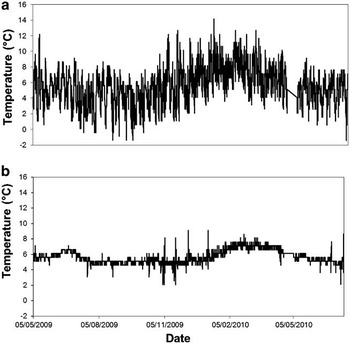
The amphipod H. hirtipalma and isopod E. gigas inhabit the mid- to lower-littoral zones on Marion Island, which at the study site at Trypot Beach (46°53′09′′S, 37°52′37′′E) are characterized by small boulders mostly covered by decomposing kelp Durvillaea antarctica (Chamisso) Hariot. Hyale hirtipalma (body mass: 60.0 ± 38.2 mg, n = 300) is typically found among the boulders and algal fronds (semi-exposed sites; Fig. 1a), while E. gigas (106.1 ± 70.3 mg, n = 276) favours the substrate under boulders (submerged sites, Fig. 1b; De Villiers Reference De Villiers1976, Branch et al. Reference Branch, Griffiths, Kensley and Sieg1991), and therefore encounters more stable temperatures. I-button data loggers (DS1922L, ± 0.5°C, Dallas Semiconductor Maxim, USA) protected in highly conductive capsules (DS1907, Dallas Semiconductor Maxim, USA) were deployed at semi-exposed and submerged positions of the shore at Trypot Beach to encompass microsites used by H. hirtipalma and E. gigas, respectively. Microsite temperature data were recorded at 90 min intervals from May 2009–September 2010 (Fig. 1).
Temperature profiles for a. semi-exposed, and b. submerged microsites of the intertidal rocky shore of Trypot Beach, Marion Island. Temperatures ranged from -1.4 to 14.2°C (mean ± SD of 5.6 ± 2.3°C) and 2.1 to 9.1°C (5.7 ± 0.8°C) for exposed and submerged sites, respectively.

Acclimation treatments and upper lethal limits
Several hundred individuals of each of the species were collected in April 2010 and maintained in temperature-regulated, oxygenated tanks at 6.7 ± 0.2°C for 1–3 days to allow habituation to new conditions. For each species, individuals were allocated haphazardly to three acclimation treatments: 3°C (2.8 ± 0.3, verified using I-button loggers, DS1922L), 7°C (6.7 ± 0.2) and 11°C (11.2 ± 0.6) for 5–12 days with a 12:12h light photoperiod. These temperature treatments reflect low, average and high seawater temperatures experienced at the collection site (Fig. 1). Filtered, fresh seawater and standardized amounts of food (D. antarctica kelp) were provided every three days. Water temperature was monitored using thermocouples (type T, gauge 24) and handheld thermometers (CHY 507, Taiwan) and recorded using I-button data loggers protected in silicone capsules (SL-ACC06, Signatrol, Tewkesbury, UK). Salinity and dissolved oxygen levels in the tanks were monitored throughout the acclimation periods using appropriate meters (YSI 30 Salinity Conductivity and Temperature Meter, Ohio, USA; Lutron Dissolved Oxygen Meter DO-5510, Taipei, Taiwan). No mortalities were recorded during acclimations. To assess acclimation effects on the upper lethal temperature limits, a static ULT50 protocol was followed for each acclimation group using standard methods (Davenport & Davenport Reference Davenport and Davenport2005).
Five to ten individuals from each acclimation group were placed in a small container filled with filtered sea water, preheated to the required experimental temperature. Individuals were exposed for two hours to pre-determined test-temperatures (TT) maintained by water-circulating baths (Grant Instruments GP 200-R4, Cambridge, UK). A wide range of TT was employed, with treatments added based on the organism's responses to preliminary trials. Temperature trials were rotated across acclimation groups so that individuals were acclimated for a similar period across treatments. Seawater was aerated using air pumps during the exposures and, salinity, conductivity and dissolved oxygen monitored before and after each experiment. Individuals were then placed at 7°C where individual responses were checked after 10 min and 1 hour. The number of dead and live individuals was determined to score percentage mortality, and each individual's sex and body mass were determined using a microscope (Stemi 2000-C, Zeiss, New Jersey, USA) and balance (AE163 Mettler, Sartorius Analytic, Germany; ± 0.01 g), respectively. Each test temperature was replicated at least three times.
For Hsp70 assessments, four individuals of each species were used in the following treatments: 1) field fresh (directly collected from the field), 2) acclimated at 3, 7 or 11°C, 3) acclimated at 3, 7 or 11°C and then exposed to 2 hours at 25°C treatment, and 4) acclimated at 3, 7 or 11°C and then exposed to 2 hours at 7°C treatment (representing controls for treatment (3)). After each treatment, individuals were snap frozen and kept at -80°C until later Hsp70 assays took place at Stellenbosch University (South Africa).
Protein extraction, quantification and sample preparation
Prior to protein extraction, individuals were thawed from -80°C and weighed (MS104S, Mettler Toledo, Switzerland). Samples were kept on ice between steps in the weighing process. Protein samples were obtained by homogenizing whole individual samples in 400 μl cold phosphate buffered saline (PBS) containing 2 mM Pefabloc® (Sigma-Aldrich Pty. Ltd, Johannesburg, South Africa) and a 1% volume antiprotease cocktail (100 ul/ml pepstatin A, 50 ul/ml leupeptin, 10 mM benzamidine, 10 mM sodium metabisulfite) (Karl et al. Reference Karl, Sørensen, Loeschcke and Fischer2009). The homogenate was centrifuged at 4°C at 11 000 g (13 000 rpm) for 30 min and the supernatant transferred to a new microfuge tube. Protein supernatants were quantified using a BCA assay kit (Pierce) on a ND1000 spectrophotometer (Nanodrop Technologies). Samples of 50 μg protein were prepared for sodium-dodecyl-sulphate polyacryamide gel electrophoresis (SDS-PAGE) by adding equal parts protein supernatant and SDS loading buffer (100 mM Tris, 4% SDS, 20% v/v glycerol, 0.2% bromophenol blue, 10% v/v β-mercaptoethanol). Prepared samples were denatured at 95°C for 5 min before being stored at -80°C until further analysis with Western blotting.
Western blot analysis
Each precast gel (7.5% resolving gel, 4% stacking gel, Ready Gel Tris-HCl, BioRad) was loaded with protein marker (SpectraTM Multicolor Broad Range Protein Ladder, Fermentas), positive control (HeLa cytoplasmic lysate, Abcam) and six samples. Gels were run in Tris-glycine running buffer (25 mM Tris, 192 mM glycine, 1% SDS, pH c. 8.3) at 100 V for 75 min in a BioRad Mini Protean(R) Tetra Cell (PowerPac Basic). Proteins were transferred onto a PVDF membrane using the Invitrogen iBlot transfer system (20 V for 7 min) and transfer stacks (Invitrogen). The membrane was incubated overnight using the Western Card system (Invitrogen) in an Invitrogen BenchPro™ 4100 card processing station. The membrane was blocked for 60 min in 5% non-fat instant milk powder solution made in Tris-buffered saline with Tween-20 (TBST; 20 mM Tris, pH 7.5, 150 mM NaCl, 0.1% Tween-20), and incubated with primary antibody (monoclonal anti-heat shock protein 70 antibody produced in mouse, clone BRM-22, 1: 2500, Sigma # H5147) in 5% milk-TBST for 900 min and secondary antibody (HRP-conjugated rabbit anti-mouse IgG, 1:10 000, Abcam # 6728) in 5% milk-TBST for 60 min. Heat shock protein 70 polyclonal antibody (D69, Cell Signalling) and mouse monoclonal to Hsp70 (C92F3A, Abcam) were also trialled as primary antibodies, but did not yield positive results in either species. Washing steps with 5% milk-TBST were performed between each of the incubation steps. The primary antibody detects both the constitutive (Hsp73) and inducible (Hsp72) forms of Hsp70 (referred to as Hsp70 for simplicity). To detect the presence of Hsp70, the membrane was incubated in Super Signal West Chemiluminescent substrate (Pierce, Thermo Scientific) and exposed to film (Amersham Hyperfilm MP) for between 30 sec and 10 min. The film was developed in an automatic autoradiography film processor (Hyperprocessor, Amersham Pharmacia Biotech). Membranes were stained with Ponceau S solution (Sigma) to serve as an internal control of equal loading (Romero-Calvo et al. Reference Romero-Calvo, Ocón, Martínez-Moya, Suárez, Zarzuelo, Martínez-Augustin and De Medina2010). Films and membranes were analysed using an HP Scanjet 8200 scanner and Image J (version 1.44p, US National Institutes of Health, Bethesda, MD, http://imagej.nih.gov/ij) following Ferreira & Rasband (Reference Ferreira and Rasband2011). The density of each sample band at 70 kDa was calculated relative to the density of the positive control (relative units, RU) for both the Ponceau-stained membrane and the film. The RUs for the film were adjusted to account for any differences in gel loading using the RUs from the membrane. The positive control served as the standard to allow for comparisons of relative densities between Western blots. At least three replicates of each sample were obtained for data analysis.
Statistical analyses
The upper lethal temperature tolerance of 50% of the sampled population (ULT50) for each acclimation temperature was calculated using a non-linear model (proc-probit) in SAS version 9.2 (SAS Institute Inc, Cary, USA). Statistically homogenous groups were identified using overlap of 95% confidence intervals. The effect of acclimation temperature, test temperature and their interaction on survival (number of individuals alive/total number of individuals tested as the dependent variable) was determined using a Generalized Linear Model (GLZ) in R version 2.14.2 (R Development Core Team 2012) assuming a binomial distribution and logit link function. Interactions that were not significant were removed during model simplification. A one-way ANOVA and a GLZ (binomial distribution and logit link) were used to determine whether log10mass or the proportion of males to females varied between acclimation treatments. Data on relative levels of Hsp70 were log10 transformed to achieve normality of data distribution (Shapiro-Wilks test) and equal variances (Levene's test). To identify the effects of acclimation treatments on the relative levels of Hsp70, a nested ANOVA was used with treatments and samples as covariates and replicates nested within samples. A post-hoc Tukey HSD indicated differences between treatment groups.
Results
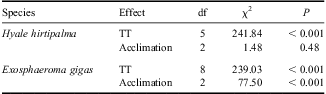
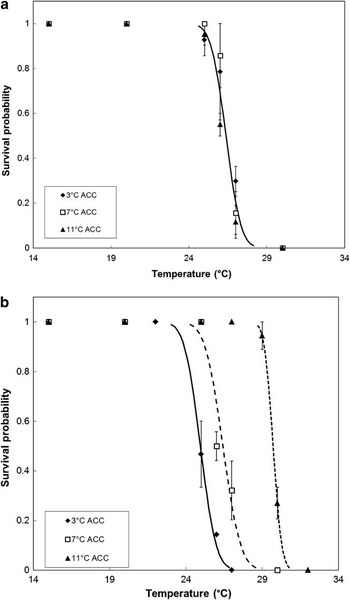
For both species, there were no significant differences in body mass (ANOVA, H. hirtipalma: df = 2, F = 0.72, P = 0.49; E. gigas: df = 2, F = 0.14, P = 0.87) or the proportion of males to females (GLZ, H. hirtipalma: df = 2, χ2 = 1.81, P = 0.40; E. gigas: df = 2, χ2 = 0.27, P = 0.87) between acclimation treatments. Results of the post-acclimation ULT trials provided contrasting results between the amphipod and isopod species. For both species, and for all acclimations, temperature had a significant effect on survival (typical sigmoid shape curve; Table I, Fig. 2). The ULT50 of individuals acclimated at average habitat temperature (7°C) did not differ between species (mean (95% confidence interval range) was 26.4°C (26.0–27.6°C) for H. hirtipalma and 26.4°C (26.1–26.9°C) for E. gigas). However, acclimation treatments had an effect on the ULT of E. gigas but not that of H. hirtipalma (Table I, Fig. 2). For E. gigas, the mean ULT50 (95% confidence interval range) at acclimations of 3, 7 and 11°C were 25.0°C (22.0–25.5°C), 26.4°C (26.0–27.6°C) and 29.5°C (29.1–29.8°C), respectively.
Results of Generalized Linear Models testing the effects of test temperature (TT) and acclimation temperature on the survival of two crustacean species from Marion Island.

Measured survivorship of a. the amphipod Hyale hirtipalma, and b. the isopod Exosphaeroma gigas as a function of temperature. Logit linear regressions are fitted for each 5–12 day acclimation: cold acclimation in solid line (3°C), average seawater temperature in stippled line (7°C) and warm acclimation in dotted line (11°C). Means ± s.e. are presented for each exposure.

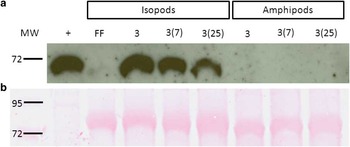
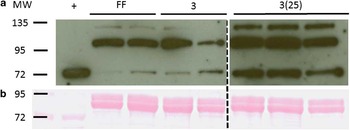
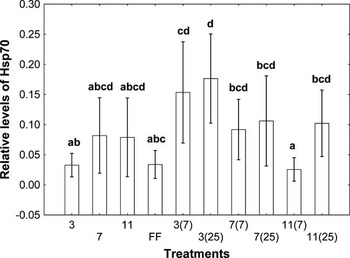
Hsp70 was not detected in H. hirtipalma with the three different primary antibodies used (Fig. 3). For all trials, a positive control was obtained and verified that the Western blotting process was not responsible for the lack of bands. For E. gigas, the amount of Hsp70 induced at 3°C acclimation and then acutely exposed to 7 and 25°C for 2 hours was significantly higher than the relative amount of Hsp70 at 3°C acclimation (treatment effect, F 1,9 = 5.18, P < 0.0001; Tukey HSD post hoc test, Figs 4 & 5). An acute high temperature exposure following a cold acclimation induced a higher Hsp70 response than a warm acclimation alone (i.e. 3(7) and 3(25) vs 11(7), Fig. 5). By contrast, a warm acclimation at 11°C followed by 2 hours exposure to a lower temperature (7°C) resulted in less Hsp70 than the same acclimation exposed to 25°C for 2 hours (Fig. 5). The relative amounts of Hsp70 induced during five days acclimation at 3, 7 and 11°C were, however, not significantly different (Tukey HSD post hoc test, P > 0.05; Fig. 5).
Representative Western blot of proteins from isopod Exosphaeroma gigas and amphipod Hyale hirtipalma samples run on a single gel. a. The western blot shows an Hsp70 band from isopods, but no binding to any amphipod proteins. Monoclonal anti-heat shock protein 70 antibody produced in mouse (clone BRM-22, 1: 2500, Sigma # H5147) was used as primary antibody. Molecular weight (MW, in kDa) is shown on the left of the figure. HeLa was used as a positive control (indicated by + sign), and b. the Ponceau stained membrane as a loading control. FF = field fresh, 3 = 3°C acclimation, 3(7) = 3°C acclimation, treated at 7°C, 3(25) = 3°C acclimation, treated at 25°C.

a. Representative Western blot proteins from isopod Exosphaeroma gigas samples run simultaneously on two gels, and blotted onto one membrane. Molecular weight (kDa) is given on the left of the figure. The figure shows two field fresh samples (FF), two acclimated at 3°C (3), and three acclimated at 3°C and then exposed to 25°C (3(25)). Nonspecific binding of heat shock protein 70 (Hsp70) antibodies were detected in all samples at c. 120 kDa and 100 kDa. Significantly more Hsp70 was detected in 3(25) as opposed to 3 (see Results). Monoclonal anti-heat shock protein 70 antibody produced in mouse (clone BRM-22, 1: 2500, Sigma # H5147) was used as primary antibody. HeLa was used as a positive (+) control, and b. the Ponceau stained membrane as a loading control.

Relative levels of heat shock protein 70 (Hsp70) (shown as mean ± 95% confidence interval; see Methods) from isopod Exosphaeroma gigas obtained for each treatment. Acclimation treatments include 3, 7 and 11°C and two hour exposures to 7 or 25°C prior to Hsp assessment are indicated in parentheses. Lower case letters indicate significant differences (P < 0.05; Tukey HSD post hoc test) between treatment groups for nested analysis of variance using log10 transformed Hsp70. Relative Hsp70 levels are shown on a normal scale to facilitate interpretation of the data.

Discussion
The amphipod and isopod species had the same basal thermal resistance, but distinct variation in plasticity of upper lethal temperatures. Thermal acclimation influenced the survival of the isopod E. gigas with individuals tolerating warmer temperatures when exposed to higher acclimation treatments. In contrast, previous exposure to acclimation temperatures for 5–12 days made no difference to the survival of the amphipod H. hirtipalma. Given the temperatures and time frame used in these experiments, the lack of acclimation probably reflects a genuine inability to shift the survival curve. A five to ten day long exposure is generally sufficient to induce the majority of the acclimation effects in marine crustaceans (Claussen Reference Claussen1980, Morrit & Ingólfsson 2000; but see Peck et al. Reference Peck, Morley and Clark2010 for lack of acclimation in subtidal ectotherms in the Antarctic). The isopod species, which inhabits mostly submerged sites under boulders and probably encounters a more stable and predictable environment than the amphipod species (Fig. 1), showed a plastic response. However, these distinct responses could also reflect differences in evolutionary history and/or phylogenetic association between the species. For the only other species of intertidal invertebrates examined on Marion Island, mites in the genus Halozetes, acclimation response also varied in a similar manner, but was dependent on the trait being considered (Deere & Chown Reference Deere and Chown2006, Deere et al. Reference Deere, Sinclair, Marshall and Chown2006). Such similarities suggest a role for environmental predictability which is higher in the marine relative to the intertidal environment at the island (Deere & Chown Reference Deere and Chown2006).
It is surprisingly difficult to compare the magnitude of change of ULT50 from E. gigas (an increase of 4.5°C for 8°C difference in acclimation temperatures) with other species reported in the literature as most studies that examine the plasticity of heat resistance in marine crustaceans have used different methods (e.g. dynamic methods, such as critical thermal limits, Gaston & Spicer Reference Gaston and Spicer1998, Morritt & Ingólfsson Reference Morritt and Ingólfsson2000) or protocols of lethal limits (survival time rather than proportion of individuals; e.g. Claussen Reference Claussen1980). Nonetheless, the few studies available (Claussen Reference Claussen1980, Stillman & Somero Reference Stillman and Somero2000) indicate significant plastic effects of lethal limits, generally in the direction that provides an advantage in the new environment given the prior thermal exposure. Moreover, little has been done for species in the sub-Antarctic while studies in the Arctic or Antarctic indicate that polar marine species have limited or no plasticity of critical thermal limits (Kivivuori & Lagerspetz Reference Kivivuori and Lagerspetz1990, Peck et al. Reference Peck, Morley and Clark2010). Therefore, this study shows that, in addition to having a temperature tolerance well above temperatures encountered in their habitats (26.4°C vs a maximum microsite temperature of 14.2°C and 9.1°C for the exposed and submerged site, respectively), some species in the sub-Antarctic also have the ability to acclimate to changes in temperature.
This study provides evidence that the production of Hsp70 probably plays a role in the thermal tolerance of E. gigas on Marion Island. Heat shock protein 70 levels were similar in all acclimations and in most combinations of high acclimation treatments and short-term acute temperature exposures. The maintenance of constitutive levels of Hsp70 may suggest a preparative response to potential heat exposures as found by Dong et al. (Reference Dong, Miller, Sanders and Somero2008) for high-intertidal limpets. Acute high temperature exposure after cold acclimation resulted in a significantly higher relative amount of Hsp70, probably resulting from an increase in inducible Hsp70. Acclimation effects on Hsp responses have been shown for several other marine organisms. For example, the temperature at which a heat shock response is induced can vary with thermal history (both acclimatization and acclimation) in intertidal invertebrates (Roberts et al. Reference Roberts, Hofmann and Somero1997, Tomanek & Somero Reference Tomanek and Somero1999, Buckley et al. Reference Buckley, Owen and Hofmann2001, Osovitz & Hofmann Reference Osovitz and Hofmann2005). However, Clark et al. (Reference Clark, Fraser and Peck2008b) found an absence of heat shock response in two Antarctic marine invertebrates, including a gamarid amphipod, during an acute heat-shock experiment, despite the presence of Hsp70 genes in both species. However, many studies of heat-shock response solely examine mRNA responses (e.g. Osovitz & Hofmann Reference Osovitz and Hofmann2005), and only a few include protein quantification and mRNA responses (see Bedulina et al. Reference Bedulina, Evgen'ev, Timofeyev, Protopopova, Garbuz, Pavlichenko, Luckenbach, Shatilina, Axenov-Gribanov, Gurkov, Sokolova and Zatsepina2013 for freshwater amphipods). It is thus difficult to ascertain if the mRNA responses would directly result in functional protein production, as the proteins probably have a different time-course of response (see e.g. Sørensen et al. Reference Sørensen, Loeschcke and Kristensen2013). A recent investigation of two freshwater amphipod species found that increased thermotolerance could be attributed to structural and functional rearrangement of hsp70 genes and correlated with Hsp70 proteins and their transcripts (Bedulina et al. Reference Bedulina, Evgen'ev, Timofeyev, Protopopova, Garbuz, Pavlichenko, Luckenbach, Shatilina, Axenov-Gribanov, Gurkov, Sokolova and Zatsepina2013). Furthermore, it is not possible to ascertain if the lack of Hsp70 in the amphipod species in our current study originated from: i) a lack of the correct antibody needed to bind to and detect Hsp70 in this species, ii) temperature treatments not inducing Hsp70 production although one might have expected at least some constitutive Hsp70 detected, or iii) alterations during gene expression of hsp70, transcription or translation that do not lead to increased Hsp70. Lastly, the amphipod H. hirtipalma may rely on other proteins to survive temperature challenges.
Marion Island's climate has changed rapidly in the last 50 years with notable increases in maximum air (Le Roux & McGeoch Reference Le Roux and McGeoch2008) and sea surface (Mélice et al. Reference Mélice, Lutjeharms, Rouault and Ansorge2003, Rouault et al. Reference Rouault, Mélice, Reason and Lutjeharms2005) temperature. Despite the relatively large warming tolerance (Deutsch et al. Reference Deutsch, Tewksbury, Huey, Sheldon, Ghalambor, Haak and Martin2008) of the two intertidal species (12.2°C and 17.3°C, respectively; calculated here as mean ULT50 minus maximum microsite temperature), the lack of plasticity and probable absence of Hsp70 response in the amphipod makes this species more vulnerable to climatic changes than the isopod. There is evidence that marine crustaceans in the sub-Antarctic can move across relatively large ocean distances by rafting on macroalgae that drift with winds and ocean currents, in particular with the Antarctic Circumpolar Current (Nikula et al. Reference Nikula, Fraser, Spencer and Walters2010, Fraser et al. Reference Fraser, Nikula and Waters2011). Therefore, studies that couple phylogeographic patterns of H. hirtipalma and E. gigas in the sub-Antarctic region with the investigation of heat shock responses (including both gene sequencing and protein quantification) would enhance understanding of these species’ capacities to buffer climate change. In particular, it may clarify if H. hirtipalma has lost the regulatory gene mechanisms for Hsp70 and/or the expression of these proteins compared to close relatives, or if these mechanisms are absent from this taxonomic group altogether.
Acknowledgements
The authors thank Sharon Kang for assistance with protein extractions and Jomien Mouton and Dr Craig Kinnear of the Magic Lab, Division of Molecular Biology and Human Genetics, Department Biomedical Sciences, University of Stellenbosch for advice and the kind use of their facilities for Western blotting. John S. Terblanche and two anonymous referees provided useful comments on the manuscript. This research was supported by an Antarctic Science bursary to SCT, British Antarctic Survey Grant 41326, the South African National Antarctic Programme and Harry Crossley bursary to LB.