Introduction
Neuropsychiatric symptoms (NPS) such as agitation, psychosis, depression and apathy are frequent in nursing home patients with dementia, with two-week prevalence rates of more than 80% (Selbaek et al., Reference Selbaek, Kirkevold and Engedal2007; Zuidema et al., Reference Zuidema, Verhey, Derksen and Koopmans2007b). These symptoms are often seriously disturbing to the patient and can be a burden to nursing home staff (Everitt et al., Reference Everitt, Fields, Soumerai and Avorn1991). Psychotropic drugs are often prescribed for NPS (Kim and Whall, Reference Kim and Whall2006; Selbaek et al., Reference Selbaek, Kirkevold and Engedal2007; Nijk et al., Reference Nijk, Zuidema and Koopmans2009). In fact, worldwide, it has been estimated that between 58% and 78% of nursing home patients with dementia are prescribed at least one psychotropic drug (Kim and Whall, Reference Kim and Whall2006; Selbaek et al., Reference Selbaek, Kirkevold and Engedal2007; Wetzels et al., Reference Wetzels, Zuidema, de Jonghe, Verhey and Koopmans2010). The frequency of antipsychotic drug use in long-term care varies between 20% and 50% (Kamble et al., Reference Kamble, Chen, Sherer and Aparasu2009; Chen et al., Reference Chen, Briesacher, Field, Tjia, Lau and Gurwitz2010; Testad et al., Reference Testad2010; Wetzels et al., Reference Wetzels, Zuidema, de Jonghe, Verhey and Koopmans2010; Shah et al., Reference Shah, Carey, Harris, Dewilde and Cook2011) in European countries (Testad et al., Reference Testad2010) and in the USA (Chen et al., Reference Chen, Briesacher, Field, Tjia, Lau and Gurwitz2010).
The efficacy of psychotropic drugs among this population is questionable, with potentially harmful side-effects. Thus, it is important to know why psychotropic drugs are prescribed at such high rates. While some patients may benefit from psychotropic drugs such as antipsychotics, others may be harmed because of the substantial side effects, such as extrapyramidal symptoms, somnolence, falls, stroke or even death (Ballard et al., Reference Ballard2009). Based on the US Food and Drug Administration warnings in 2003, and growing evidence for the limited efficacy of antipsychotics (Schneider et al., Reference Schneider2006) and other psychotropic drugs (Gauthier et al., Reference Gauthier2010), recent guidelines advocate limited prescription of psychotropic drugs (Jeste et al., Reference Jeste2008) and recommend psychosocial interventions as a primary intervention.
Psychotropic drugs are sometimes prescribed for inappropriate reasons (Kamble et al., Reference Kamble, Sherer, Chen and Aparasu2010; Stafford et al., Reference Stafford, Alswayan and Tenni2011), and factors other than NPS sometimes drive physicians to prescribe psychotropic drugs. There is some evidence that psychotropic drug prescription is related to the number of beds in the nursing home (Kamble et al., Reference Kamble, Chen, Sherer and Aparasu2009) and possibly to staff factors, such as distress. In a qualitative study among old age psychiatrists, the decision to prescribe psychotropic drugs was influenced by the amount of pressure exerted by nursing home staff, as well as a lack of other feasible non-pharmacological treatments, due to lack of resources, time restraints and barriers to implementation (Wood-Mitchell et al., Reference Wood-Mitchell, James, Waterworth, Swann and Ballard2008). However, none of these or any other studies describing the variation in psychotropic drug prescription (Chen et al., Reference Chen, Briesacher, Field, Tjia, Lau and Gurwitz2010) have examined the effects of the nursing home environment and simultaneously controlled for baseline patient factors.
Some factors associated with psychotropic drug use (PDU) are perhaps amenable to change. Work distress, staff/patient ratios and the number of patients per nursing home unit may be targeted with a combination of long-term care staff education and reallocation of government resources. Clearly, this warrants research to examine the factors that determine PDU, and in turn this may change prescription patterns.
We hypothesized that environmental correlates and staff factors would be independently associated with PDU in nursing home patients with dementia. To the best of our knowledge, this is the first time that environmental factors, patient factors and PDU have been examined in a large sample of Dutch nursing home patients.
Methods
Study design and subjects
This was an observational study and an extension of previously published material on the prevalence and predictors of NPS in patients with dementia in the Netherlands (Zuidema et al., Reference Zuidema, Verhey, Derksen and Koopmans2007b; Reference Zuidema, de Jonghe, Verhey and Koopmans2010).
Long-term multidisciplinary care for people with dementia in the Netherlands is generally provided in Dementia Special Care Units (SCUs) for 10–40 patients with 2–3 living rooms where they eat and engage in social activities during the day and several sleeping rooms where they sleep overnight (1–4 persons per sleeping room).
Patients were recruited from 59 dementia SCUs from 26 nursing homes in the Netherlands. Patients were included if (i) they met Diagnostic and Statistical Manual of Mental Disorders fourth edition criteria for dementia; (ii) their cognitive decline was judged by a psychologist or elderly care physician to be moderate to very severe, as defined by the Global Deterioration Scale (GDS) stages 4–7 (Reisberg et al., Reference Reisberg, Ferris, de Leon and Crook1982); and (iii) they had resided in the institution for more than four weeks. Terminally ill patients were excluded. The presence of agitation or other challenging behavior was not a prerequisite for patients to be included in the study. Detailed information on the study methods and the prevalence rates of individual symptoms have been published previously (Zuidema et al., Reference Zuidema, Verhey, Derksen and Koopmans2007b).
The local Research Ethics Committee approved of the study. Eligible patients were only included after informed consent of the patients or their legal guardians had been obtained.
Data collection and assessments
Data on the actual use of prescribed psychoactive medication on the day of assessment were recorded. Psychoactive medications were classified using the Anatomical Therapeutic Chemical classification (Nordic Council on Medicines, 1990) and grouped into antipsychotics, anxiolytics, hypnotics/sedatives, antidepressants and anticonvulsants. Cholinesterase inhibitors and memantine, prescribed to <1% of the patients, were excluded. Anticonvulsants (prescribed in 6% of the patients) were not included in the analysis since anticonvulsant use for agitation in dementia could not be separated from epilepsy.
The physical or psychosocial environmental factors included the presence or absence of a walking circuit, number of patients per living room, and staff/patient ratio. A walking circuit is a circular walking passage, designed to allow people with dementia to wander without finding closed doors. The number of patients per living room was defined as the number of patients per unit divided by the number of living rooms at the unit. The staff/patient ratio was defined as the number of staff (in full-time employment units) at each unit engaged in direct patient care (i.e. licensed vocational nurses, nurses’ aids, and recreational therapists; volunteers and non-professional caregivers were not included) divided by the number of patients in the SCU.
NPS and staff distress due to NPS were assessed using the Neuropsychiatric Inventory Nursing Home version (NPI–NH) by a structured interview of licensed vocational nurses (who had been specifically assigned to individual patients) by trained research nurse-assistants in each facility one month prior to the assessment. The NPI–NH was originally developed by Cummings et al. (Reference Cummings, Mega, Gray, Rosenberg-Thompson, Carusi and Gornbein1994). The nursing home version has been adapted for use by professional caregivers in nursing home facilities and has proven to be valid and reliable for use by trained nursing staff (Wood et al., Reference Wood2000; Lange et al., Reference Lange, Hopp and Kang2004). A Dutch translation is reliable and valid (Kat et al., Reference Kat, Jonghe, Aalten, Kalisvaart, Dröes and Verhey2002). The NPI–NH includes 12 neuropsychiatric symptoms: delusions, hallucinations, agitation, depression/dysphoria, anxiety, euphoria/elation, apathy/indifference, disinhibition, irritability/lability, aberrant motor behavior, sleep disturbances and appetite/eating change. NPI–NH staff distress scores were measured per symptom on a six-point Likert scale from no staff distress (0) to very severe staff distress (5), i.e. causing a major burden for carers and very time consuming to deal with. The frequency (F) and severity (S) of each symptom were rated on a five-point (0–4) and four-point (0–3) Likert scale, respectively. A separate score was calculated for each symptom by multiplying the frequency and severity scores, resulting in values ranging from 0 to 12 for each symptom. Some NPI–NH symptoms were clustered, e.g. psychosis (hallucinations and/or delusions), agitation (agitation, disinhibition and/or irritability), while others were not (e.g. depression, anxiety, and apathy), in order to fit potential reasons for psychotropic drug prescription. NPS within each cluster were considered relevant when individual symptoms had a F×S score ≥4 indicating patients with clinically significant behavioral symptoms. NPI staff distress was considered relevant when an individual symptom or at least one symptom (in a group of symptoms) resulted in a staff distress score of 3 or more (i.e. moderate, severe or very severe staff distress). Aberrant motor behavior, euphoria and eating disorders were not considered for analysis because these symptoms were not consistently part of a specific cluster (Zuidema et al., Reference Zuidema, de Jonghe, Verhey and Koopmans2007a), or (as an individual symptom) they were not thought to be the main reason for psychotropic drug prescription.
Analysis
Proportions or means were used to describe the demographic and clinical characteristics of the patient sample. The odds of antipsychotic, anxiolytic, hypnotic or antidepressant use associated with environmental factors, including staff distress, and patients’ NPS were estimated using a multilevel logistic regression analysis approach (MLwiN, ver. 1.02.0002) (Rasbash et al., Reference Rasbash, Healy, Browne and Cameron1998; Snijders and Bosker, Reference Snijders and Bosker1999). Multilevel analysis or hierarchical (linear) modeling is a more advanced form of multiple linear regression. It allows variance in outcome variables to be analyzed at multiple hierarchical levels and is appropriate for nested data (e.g. patients are nested within SCUs, which in turn are nested within nursing homes). Because we assume that PDU is not independent of the location of a patient's SCU residence, estimates at the patient level were corrected for the dependency at the SCU level (within SCUs) by adding an extra categorical variable (SCU) that provided an additional estimation of the variance at the SCU level (difference between SCUs).
Primary study outcomes were the presence or absence of prescribed antipsychotics, anxiolytics, hypnotics or antidepressants. Independent (fixed) variables were physical environmental factors; staff distress because of NPS; and patient factors (gender, age, dementia severity, and dichotomized patients’ NPI-NH F×S scores). As some SCUs were specially equipped for patients with challenging behaviors and others were not, an extra dummy variable was entered into the model to label these SCUs. Odds ratios with 95% confidence intervals not including 1 were considered significant (p < 0.05).
Two models were constructed: the first model (Model 1) simply used patient factors to explain the primary outcome variables. The second model (Model 2) was an extension of the first model, in which staff distress and environmental correlates were added as predictors of the primary outcome variables. In both models, the intra-class correlation (intra-SCU correlation) was calculated as a measure of the relative contribution of the SCU to the variance of PDU. The Wald statistic was used to test the significance of the variance at the SCU level (variance compared to the standard error of the variance) as well as the significance of independent variables at the patient level (estimates compared to the standard error of the estimates).
Results
Patient and SCU characteristics
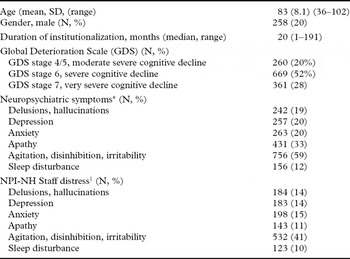
A total of 1322 eligible patients residing in 59 SCUs were considered for analysis. Three SCUs were excluded because of missing patient data in any one of the outcomes or covariates or missing patients in general (to rule out selection bias). The final study sample comprised 1289 patients (Table 1). In five cases, missing individual NPI–NH responses were imputed by 0.
Patient characteristics of 1289 nursing home patients with dementia

Figures in parentheses indicate percentages. All percentage values are percentages of the total group.
* Number of patients with F×S score ≥ 4.
† Number of patients with staff distress score ≥ 3.
Our patient sample was representative of the Dutch nursing home population, with a preponderance of very old persons, the vast majority being female and most patients having moderate to very severe dementia. The prevalence of NPS was high, with two-week prevalences of specific psychotic, mood and behavioral symptoms ranging from 12% to 59% (Table 1). Of the total sample, 19% lacked significant NPS.
Vocational nurses often experienced symptom-related distress if patients were agitated (532/756 patients = 70%) and less frequently if patients were apathetic (143/431 patients = 33%).
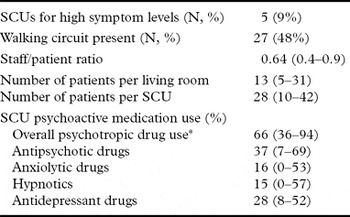
Almost half of the SCUs had a walking circuit, and approximately 1 in every 20 patients resided in a SCU specially equipped for patients with severe NPS (Table 2). Considerable heterogeneity existed between SCUs, as evidenced by differences in the numbers of patients per SCU, living room size and staff/patient ratio.
Characteristics of 56 dementia SCUs

Data are presented as the mean, SD, range (minimum–maximum) unless otherwise indicated.
* Antipsychotics, antidepressants, anxiolytics, hypnotics.
Psychotropic drug use
SCU rates of overall PDU were 66%, and for individual drug classes were 37% for antipsychotics, 28% for antidepressants, 16% for anxiolytics and 15% for hypnotics. PDU differed considerably between SCUs: 36–94% of all patients were on some psychoactive medication, 7–69% on antipsychotics, 0–53% on anxiolytics, 0–57% on hypnotics, and 8–52% on antidepressants (Table 2).
Associated variables
Staff distress
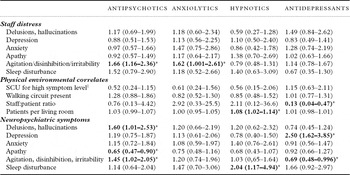
The odds of antipsychotic and anxiolytic drug prescription for agitated patients were 66% and 62% higher, respectively, if the staff experienced distress related to patient agitation (OR (95% CI) 1.66 (1.16–2.36) and 1.62 (1.00–2.61), respectively) (Table 3). Staff distress related to other NPS was not associated with antipsychotic, anxiolytic, hypnotic or antidepressant drug use.
Multilevel logistic regression analysis of neuropsychiatric symptoms, staff distress, and other environmental correlates on PDU in 1289 nursing home patients with dementia (Model 2)

Data are presented as odds ratios (95% confidence interval).
Psychotropic drug use is also corrected for age, GDS, and gender (Nijk et al., Reference Nijk, Zuidema and Koopmans2009).
* Significance (p-value Wald statistics df = 1) < 0.05.
† SCU designed for patients with high levels of neuropsychiatric symptoms compared to regular SCUs.
PDU = psychotropic drug use; GDS = Global Deterioration Scale; SCU = special care unit.
(Physical) environment
Hypnotic drug prescription was higher in SCUs with more patients per living room (OR 1.08 (1.02–1.14)). Antidepressant drug prescription was higher in SCUs with a lower staff/patient ratio (OR 0.13 (0.04–0.47)). Antipsychotic and anxiolytic drug prescriptions were not associated with environmental correlates. Psychotropic drug use in SCUs equipped for patients with severe NPS did not differ significantly from PDU in regular SCUs. Additionally, the presence of a walking circuit was not associated with PDU.
Neuropsychiatric symptoms
Antipsychotic use was positively associated with psychosis (OR 1.60 (1.01–2.53)) and agitation/aggression (OR 1.45 (1.02–2.05)) and negatively associated with apathy (OR 0.65 (0.47–0.90)). Anxiolytic use was not associated with NPS. The use of hypnotics was positively associated with sleep disturbance (OR 2.04 (1.17–4.94)), while the use of antidepressants were positively associated with depressive symptoms (OR 2.50 (1.62–3.85)) and negatively associated with agitation/aggression (OR 0.69 (0.48–0.996)).
Predictive validity of the multilevel model
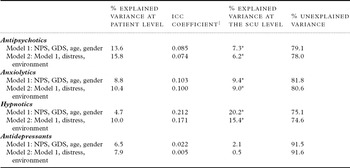
Patient factors (Model 1) were independently associated with PDU (Table 4). Patient factors did explain a higher proportion of the variance in antipsychotic and anxiolytic drug use compared to hypnotics and antidepressants.
Variance breakdown of the multilevel model for PDU predicted by patient factors, NPS, staff distress and other environmental correlates in nursing home patients with dementia (values are expressed % of the total variance)†

† the total variance consists of variance(fixed) + variance(SCU level) + π2/3, where the variance(fixed) denotes the variance of (fixed) patient factors, NPS (Model 1) and/or staff distress and environmental correlates (Model 2), variance(SCU level) denotes the variance at the SCU level (i.e. due to differences between SCUs, adjusted for fixed factors) and π2/3 ( = 3.29) denotes the unexplained variance (Snijders and Bosker, Reference Snijders and Bosker1999).
‡ ICC = variance between SCUs/(variance between SCUs + variance within SCUs).
* Significance variance (relative to SE variance) for PDU at the SCU level (Wald statistic df = 1; p < 0.05).
PDU = psychotropic drug use; ICC = intra-class correlation; SCU = special care units; NPS = neuropsychiatric symptoms; GDS = Global Deterioration Scale.
Staff distress and other environmental correlates (Model 2) were independently associated with PDU use and had incremental predictive validity compared to patient factors alone. In particular, staff distress contributed to antipsychotic and anxiolytic use, and environmental correlates contributed to hypnotic and antidepressant use.
In addition to patient factors and staff distress, the environment of the SCU in which patients resided also determined the amount of psychoactive medication use. Effects were present for antipsychotics (6.2% explained variance), anxiolytics (9.0%) and hypnotics (15.4%) but were not significant for antidepressants (0.5%).
Discussion
This study shows that the nursing home environment and symptom distress experienced by staff are independently associated with psychoactive medication use. Antipsychotic and anxiolytic drugs were more often prescribed to agitated patients if the staff were distressed than if they reported no significant distress. Antipsychotic drug prescription was explained by both patient factors and staff distress. Antidepressant drug prescription was related to patient factors and inversely related to the number of staff per patient. Hypnotic drug prescription was, to a lesser extent, explained by NPS but was more strongly associated with the number of patients per living room. A few studies have examined the effects of the nursing home environment on psychotropic drug prescription. In a study by Kamble et al. (Reference Kamble, Chen, Sherer and Aparasu2009), bed capacity was associated with PDU, while Selbaek et al. (Reference Selbaek, Kirkevold and Engedal2008) found that PDU was high in SCUs compared to regular units. However, none of these studies included staff distress.
The reasons why PDU is partly determined by the particular SCU in which the patient resides are yet to be determined. Our finding that PDU clusters within SCUs confirms previous findings. Chen et al. (Reference Chen, Briesacher, Field, Tjia, Lau and Gurwitz2010) reported that the rate of antipsychotic drug prescription to individual patients is higher in facilities with high antipsychotic drug rates compared to facilities with low antipsychotic drug rates. The independent effects of SCU on PDU in the present study suggest that other factors might contribute to the differences in PDU between SCUs. Differences in the organizational culture of SCUs (Hughes et al., Reference Hughes, Lapane, Watson and Davies2007) may be an important factor driving drug prescription decisions. This implies that in some organizations, physicians may be more inclined to prescribe psychotropic drugs to patients with behavioral problems that cause distress to the nursing home staff, whereas in other SCUs there may be a tendency to administer psychosocial interventions, more often as first-line therapies for dementia-associated NPS. Adherence to guidelines may explain some of the results in this study. Differences in PDU among SCUs (intra-class correlations) were large for hypnotics compared to antipsychotics/anxiolytics and, especially, antidepressant drugs. Although antidepressants may in general be underutilized, physicians treat patients’ depressive symptoms with antidepressants more consistently but treat patients with sleeping problems with hypnotics in only some SCUs. The same is true for anxiolytic/antipsychotic drug prescription, in which the physician might either prescribe drugs or psychosocial interventions.
A large proportion of the variance of PDU (80%) was not explained by staff distress, environmental factors or patient factors in the present study. Although some other patient factors might be relevant, such as dementia subtype, other environmental issues, such as the amount of applied psychosocial interventions, practice style of care, and staff and physician attitude towards PDU might be more important. Further research about the correlates of PDU is needed to identify factors potentially amenable to change.
The strengths of this study are the large representative sample of nursing home patients with dementia, the nearly complete data set and the sophisticated statistical modeling of predictors and outcomes. The heterogeneity of SCUs in the Netherlands provides an excellent environment to study possible correlates of PDU. In Dutch nursing homes, patients with dementia usually live together in groups/units of 10–30 residents in one or more larger living rooms. Dutch SCUs differ considerably in terms of number of patients, staff/patient ratio, physical design and the attitude of the staff towards dementia care. Additionally, the large number of SCUs may ensure the adequate heterogeneity that is needed for random effects models (multilevel models).
There are a number of limitations to this study. First, as this is an observational study, no conclusions on cause (NPS) and effect (PDU) can be drawn. Secondly, effects may be confounded by the fact that, as in all studies examining NPS and psychoactive medications, multiple medications may be used for the same condition, e.g. an antipsychotic combined with an anxiolytic (Nijk et al., Reference Nijk, Zuidema and Koopmans2009), and psychoactive medications may be prescribed for more than one reason, as symptoms often co-occur. Thirdly, data on staff distress and NPS were collected and rated by the same interviewer and were thus not independent. Finally, data on other (psychosocial) interventions were not collected, so we cannot completely rule out the possibility that only patients with enough NPS to distress the staff were prescribed antipsychotic and anxiolytic drugs after other interventions had failed. Future studies should focus on suboptimal drug prescription and possibly other relevant factors determining variations in PDU. Further insight into the correlates of PDU might also reveal environmental factors that can be influenced.
In summary, psychotropic drug prescription in nursing home patients with dementia seems to be independently associated with symptom-related staff distress and other environmental correlates. These findings raise concern, especially as psychotropic drug prescription rates are high in nursing homes. Our findings suggest potentially inappropriate psychotropic drug prescription. Psychotropics may be prescribed for the wrong reason, for too long, or too easily without application of psychosocial interventions, as recommended by guidelines. Clinicians who are aware of the potential hazards of PDU in frail elderly patients with dementia need to realize that staff distress may be a factor that drives the decision to prescribe antipsychotic and anxiolytic drugs in patients with NPS. Staff distress may be reduced by education and by easily modifiable environmental factors, which in turn could reduce NPS without resorting to psychotropic drug prescription.
Staff education aimed at increasing their knowledge of potentially harmful adverse effects of psychotropic drugs and the reallocation of government resources to improve the quality of both nursing home environments and nursing home care are means to ultimately reduce the inappropriateness of psychotropic drug prescription. The combined efforts of scientists, physicians, nurses, and bodies representing professionals and politicians, such as that described by Banerjee (Reference Banerjee2009) in the UK, should result in the further optimization of psychotropic drug prescription in frail patients.
Conflict of interest
None.
Description of authors' roles
Sytse Zuidema was responsible for the study concept and design, and the acquisition and analysis of the data. Jos de Jonghe was involved in the data analysis. All authors participated in the interpretation of the data and the preparation of the final paper.
Acknowledgments
This study was financially supported by the Joannes de Deo Foundation in Beek-Ubbergen, the Netherlands and the Dutch Brain Association (nr. 11F03.39), and conducted in cooperation with the Nijmegen University Nursing Home Network.