Emergence of multidrug-resistant organisms (MDRO) has led to increased patient morbidity and mortality, as well as increased healthcare costs.Reference Klevens, Edwards and Richards 1 – Reference Magill, Edwards and Bamberg 3 MDRO transmission is multifactorial, involving interaction between healthcare workers (HCWs), patients, and the hospital internal environment.Reference Arias and Murray 4 Healthcare facilities employ multiple methods to prevent MDRO transmission, including improving hand hygiene, surveillance for specific MDROs, rapid diagnostic testing, and in some cases, active surveillance testing to detect patients with asymptomatic MDRO carriage. Most facilities employ contact isolation, as recommended by the Centers for Disease Control and Prevention (CDC),Reference Siegel, Rhinehart, Jackson and Chiarello 5 for patients identified with MDROs from either surveillance or clinical cultures. Per this recommendation, HCWs put on gowns and gloves prior to patient care activities for those patients identified with MDROs, but they are not required to use gowns or gloves for other patients unless they are needed for specific activities as part of standard precautions.Reference Siegel, Rhinehart, Jackson and Chiarello 6
The benefit of glove use in reducing MDRO transmission has been repeatedly shown, especially when combined with proper hand hygiene.Reference Slota, Green, Farley, Janosky and Carcillo 7 – Reference Tenorio, Badri and Sahgal 10 The use of gowns adds considerable cost, in terms of materials, HCW time, and waste disposal, but evidence has been mixed regarding the incremental benefit of gown use in addition to hand hygiene and gloves. While several studies have found gowns to be associated with reduction in MDRO transmission,Reference Srinivasan, Song, Ross, Merz, Brower and Perl 11 – Reference Boyce, Opal and Chow 14 others have found no benefit over the use of gloves alone.Reference Slaughter, Hayden and Nathan 15 – Reference Grant, Ramman-Haddad, Dendukuri and Libman 20 However, multiple studies have demonstrated that HCW clothing often becomes contaminated with bacteria, including MDRO,Reference Beer, Vandermeer, Brosnikoff, Shokoples, Rennie and Forgie 21 – Reference Treakle, Thom, Furuno, Strauss, Harris and Perencevich 28 and gowns may directly reduce this contamination, potentially making HCWs less effective vectors for transmission.
The Benefits of Universal Glove and Gown (BUGG) studyReference Harris, Pineles and Belton 29 investigated whether the use of gowns and gloves for all patients, not only those known to harbor MDROs, reduced transmission of methicillin-resistant Staphylococcus aureus (MRSA) and vancomycin-resistant Enterococcus (VRE). Patients not placed in contact isolation for an MDRO may still represent an important nosocomial reservoir, either of important pathogens for which isolation is not typically instituted (eg, methicillin-susceptible S. aureus [MSSA]) or of undetected MDROs (particularly given that the majority of institutions do not perform active surveillance for all MDROs). This study was undertaken among a subset of intensive care units (ICUs) participating in the BUGG study to examine whether the use of gowns and gloves for all patient encounters reduced the rate of HCW clothing contamination.
METHODS
Study Design and Setting
A cross-sectional survey was conducted in 2 phases. Study sites were recruited from the intervention arm of the BUGG study. Of 10 sites randomized to the universal glove and gown intervention, 5 ICUs voluntarily participated (1 surgical ICU and 4 medical ICUs). Phase 1 occurred during the BUGG study, when gowning and gloving were practiced for all patient care (July–September 2012), and phase 2 occurred after the BUGG study concluded, when the unit returned to usual care, with contact isolation used only for patients known to harbor resistant organisms (October–December 2012). All HCWs performing direct patient care in the study ICUs on the dates of sample collection (including daytime and overnight shifts) were eligible to participate. The study was approved by the respective institutional review board at each of the participating sites.
Health Care Worker Survey and Sampling
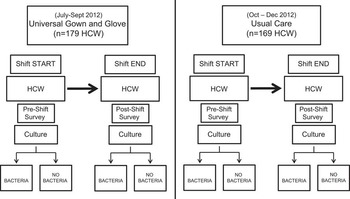
Sampling days were chosen by study personnel; ICU personnel were notified in advance of the study but not of the specific days sampling would occur. At the beginning of each shift, study personnel approached individual HCWs regarding participation in this study and obtained verbal informed consent. Using a premoistened ESwab (Becton Dickinson, San Jose, CA), study personnel sampled an approximate 10×10-cm area on the front of each HCW’s scrub top or shirt. If a white coat was worn, a second ESwab was used to sample the front and bilateral cuffs of the white coat as well. Identical methods were used at or near the end of the shift, except for white coats, which were not recultured (Figure 1). Short surveys were also administered at the beginning and end of a shift. The preshift survey assessed job type and HCW laundry practices, particularly regarding frequency, method, and location of cleaning of scrubs and white coats. The postshift survey included questions regarding the amount of time spent performing direct patient care, total number of patients cared for, self-reported percentage of patient interactions for which gowns and gloves were used, and specific activities or patient characteristics that may have increased the risk of HCW clothing contamination (eg, bathing patients, dressing changes, or caring for patients with diarrhea, open wounds, or uncontrolled secretions).
Overall study design for healthcare worker survey and microbiologic sampling during each phase of the study. Universal gown and glove: cover gowns and gloves used by all heathcare workers for all patient encounters; usual care: gowns and gloves used for encounters with patients with known multidrug-resistant organisms. HCW, healthcare worker.

For physicians and other staff who did not spend their entire shift in the study ICU, clothing samples and surveys were obtained using the same techniques before and after morning rounds. Each HCW was coded to facilitate matching of pre- and postshift cultures and surveys. After this study was completed, the codes linking the individual names to the culture and survey results were destroyed.
Microbiology Methods
All samples were processed by the Christiana Care Microbiology Laboratory; outside sites shipped swabs to Christiana Care using methodology shown not to impact yield.Reference Robinson, Harris, Morgan, Pineles, Belton and Johnson 30 Swabs were cultured for common human pathogens using broth enrichment to increase sensitivity. Swabs were vortexed in 5-mL brain–heart infusion broth for Gram-negative bacteria and placed in TSA with 6.5% NaCl for Gram-positive bacteria, then incubated at 35°C overnight. To detect Gram-positive pathogens, 50 µL broth was plated to ChromAgar to detect methicillin-susceptible and methicillin-resistant S. aureus, and 50 µL broth was plated to enterococcal agar to detect vancomycin-susceptible and vancomycin-resistant Enterococcus. To detect Gram-negative bacteria, 50 µL broth was plated to MacConkey agar with and without 6 µg/mL of imipenem (added to enhance detection of multidrug-resistant Acinetobacter baumannii and Pseudomonas aeruginosa). Plates were incubated 24–48 hours at 35°C. Gram-negative organisms were identified using standard laboratory protocols, and susceptibilities were performed following Clinical and Laboratory Standards Institute (CLSI) guidelines. 31
Statistical Analysis
Preshift clothing samples without corresponding postshift samples obtained from the same HCW were excluded from analysis. Bacteria identified were classified either as common pathogens causing healthcare-associated infections (ie, S. aureus, E. faecium, E. faecalis, A. baumannii, P. aeruginosa, Klebsiella pneumoniae, K. oxytoca, or Stenotrophomonas maltophilia) or opportunistic pathogens (uncommon bacteria that typically infect immunocompromised hosts). Acquisition was defined as the presence of a positive culture for at least 1 species of pathogen on the postshift clothing of an HCW whose preshift scrubs/shirt culture did not grow any pathogens. HCWs whose preshift cultures grew an opportunistic pathogen and whose post-shift culture grew a common pathogen were also considered to have acquired that common pathogen. Mantel-Haenszel χ2 and Fischer’s exact tests were used to compare characteristics of HCWs in each phase. Univariate and multivariable logistic regression analyses were performed to determine whether universal gowning/gloving was associated with acquisition of common or opportunistic pathogens (as separate outcomes), adjusting for job type, specific job duties, and other factors. All analyses were performed using SAS version 9.3 (SAS Institute, Cary, NC).
RESULTS
Complete sets of pre- and postshift cultures were obtained from 346 HCWs, including 179 (52%) from the universal gown/glove phase and 169 (48%) during the usual care phase of the study. Between 21 and 92 HCWs participated at each of the 5 sites. The majority (73%) of participating HCWs were nurses, and only 44 HCWs (13%) wore a white coat. Overall, 88 HCWs (25%) had common pathogens on their scrubs at the beginning of their shift, and 51 (15%) acquired a common pathogen during their shift.
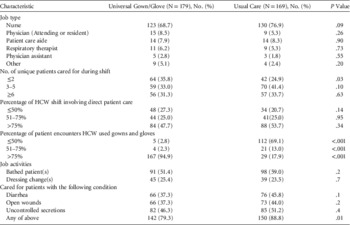
HCW surveys revealed no significant differences between the 2 study phases regarding job type or laundering of clothing (Table 1). The majority of HCWs (97%) reported laundering their scrubs at home, and 72% reported wearing freshly laundered scrubs. Intensity of patient care duties were similar when measured by estimated percentage of time spent in direct patient care, although HCWs described caring for fewer unique patients during the universal gown/glove phase. Performance of common tasks and/or caring for patients with characteristics that may increase risk of HCW clothing contamination were also similar, although a composite variable that included performance of any of the 5 surveyed tasks/characteristics was significantly more frequent among HCW during the usual care phase (89% vs 78%; P=.01).
Characteristics of Participating Health Care Workers, by Study Phase

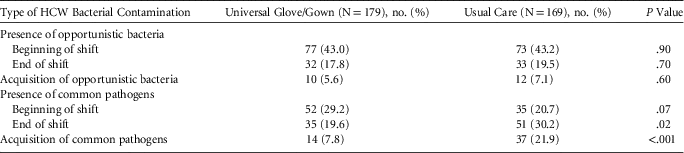
At the beginning of a shift, slightly more HCWs in the universal gown/glove phase had common pathogens on their clothing compared to the usual care phase (29% vs 21%), but this trend did not reach statistical significance (P=.07) (Table 2). However, at the end of a shift, fewer HCWs in the universal gown/glove phase had common pathogens on their clothing (20% vs 30%) and fewer had acquired a common pathogen (7% vs 23%; OR, 0.27; 95% CI, 0.13–0.53; P<.001). There were no significant differences between the 2 phases regarding the presence of opportunistic pathogens on clothing at the beginning or end of shift, nor for the acquisition of these organisms.
Results of Health Care Worker Clothing Cultures at Beginning and End of Shift, by Study Phase

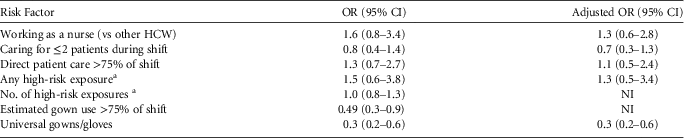
According to the univariate analysis, only study phase and percentage of time that gowns/gloves were worn were significantly associated with acquisition of common pathogens, whereas job type, number of patients cared for, HCW behaviors, and patient characteristics were not associated with acquisition (Table 3). Multivariate analysis also identified study phase (ie, universal gowning/gloving) as the only factor associated with acquisition of common pathogens. No factors were significantly associated with the acquisition of opportunistic pathogens (data not shown).
Association Between Universal Gown and Glove Use and Other Risk Factors with Acquisition of Common Pathogens on Health Care Worker Clothing, by Univariate And Multivariable Regression Analyses

NOTE. OR, odds ratio; CI, confidence interval; HCW, healthcare worker; NI, not included in the multivariate model.
a Includes bathing patients, changing wound dressings, caring for patients with diarrhea, open wounds or uncontrolled secretions.
Overall, 15% of white coats sampled grew common pathogens (3 MSSA, 3 vancomycin-susceptible Enterococcus sp., 1 Stenotrophomonas sp.). A total of 15 (39%) HCWs reported washing their white coats within the previous week, while 10 (26%) reported last laundering their coats >1 week prior but within the previous month, and 6 (16%) reported that it had been ≥1 month since their white coat had been laundered. One person claimed never to have washed his/her white coat, and 6 did not report when their white coats had last been washed. Fewer HCWs (n=19) reported specific laundering practices for their white coats. The majority (90%) reported laundering their white coat at home rather than dry cleaning, and most (63%) reported using hot water. No association between pathogen growth and frequency or method of washing white coats was found, and acquisition rates were unchanged when HCWs who wore white coats were removed from the analysis (data not shown).
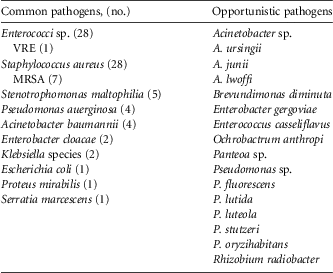
Several common pathogens were recovered from HCW clothing, but no multidrug-resistant Gram-negative bacteria were isolated (Table 4). Enterococcus species and S. aureus were most frequently identified. All MRSA acquisition (n=7) occurred during the usual care phase, when patients with known MRSA would have been cared for with contact isolation in place. Only 1 instance of VRE acquisition was identified, and this occurred during the universal gown/glove phase. A wide variety of opportunistic pathogens were recovered from HCW clothing as well.
Common and Opportunistic Pathogens Cultured from Health Care Worker Clothing during Both Phases of the Study

NOTE. MRSA, methicillin-resistant S. aureus; VRE, vancomycin-resistant Enterococcus sp.
DISCUSSION
In our study, the use of gowns and gloves for all patient encounters in an ICU setting was associated with a 70% decrease in the acquisition of commonly pathogenic bacteria on the clothing of HCWs, adjusting for job type, intensity of patient interaction, and other risk factors for HCW clothing contamination. This may be one mechanism by which gowns help decrease pathogen transmission, given that HCW clothing is frequently touched after performing hand hygiene and prior to contact with patients. The majority of pathogens identified (MSSA, Enterococcus, Gram-negative bacilli) were not MDRO and thus would not typically prompt contact isolation, yet patient-to-patient transmission remains a significant problem. Clothing contamination with environmental/opportunistic bacteria was also common but was not affected by universal gown/glove use.
Interestingly, many HCWs had common pathogens on their clothing at the beginning of their shift prior to any patient contact. This finding may reflect bacterial contamination that occurs at home (as most HCWs wear their scrubs to and from work) or during transit (ie, from coats, bags or other items carried daily to work). Preshift bacterial contamination may also reflect acquisition of bacteria from healthcare settings encountered prior to the onset of patient care, such as locker rooms and other common areas. Despite more frequent laundering, scrub/shirt tops were contaminated more commonly than were white coats when both were sampled at the beginning of a shift (25% vs 15%). Although our sample contained relatively few white coats, the contamination rate was not insignificant and reported laundering practices were often suboptimal, as has been previously reported.Reference Munoz-Price, Arheart, Lubarsky and Birnbach 32 This evidence further supports the recent Society for Healthcare Epidemiology of American (SHEA) guidance to avoid white coat use when examing patients and to launder white coats frequently.Reference Bearman, Bryant and Leekha 33
Further studies are needed to directly address the question of whether reducing HCW clothing contamination decreases patient aquisition of bacteria and, thus, clinically significant infections. Notably, the BUGG study demonstrated that universal glove and gown use did not reduce VRE acquisition but did reduce MRSA acquisition by 40%.Reference Harris, Pineles and Belton 29 The two pathogens most commonly identified in our study were S. aureus and Enterococcus, although VRE was uncommon. The transmission dynamics of VRE may differ from that of MRSA; thus, reducing clothing contamination may have a larger impact on S. aureus. However, this study did not compare HCW clothing contamination between ICUs randomized to the intervention and those continuing usual care during the BUGG study. New technologies, such as antimicrobial scrubs that have the potential to reduce all bacterial growth, have been studied with mixed results.Reference Bearman, Rosato and Elam 34 , Reference Burden, Keniston and Frank 35
Strengths of this study include its inclusion of multiple ICUs of different types and sizes in various regions of the United States. The study was designed to follow an individual HCW over a single shift to examine the overall burden of bacterial contamination between potential laundering events, rather than before and after a single room entry with a known MDRO-colonized patient, as in prior studies.Reference Morgan, Rogawski and Thom 25 , Reference Morgan, Liang and Smith 36 In this study, we cultured for multiple bacteria, including important pathogens that are not multidrug-resistant, rather than focusing on a single or limited number of MDROs.
The study is also subject to several limitations. The study was not a randomized controlled trial but, rather, took advantage of a natural experiment in that ICUs previously randomized to the BUGG study intervention were due to resume usual care when the study ended. The HCWs enrolled were a convenience sample, although efforts were made to increase generalizability by including multiple types of HCWs on both day and overnight shifts. This study was not designed to link HCW acquisition of bacteria to infections in specific patients, and we did not determine the prevalence of the studied bacteria among patients within each ICU at the time of the sampling, nor the background environmental bacterial contamination in each ICU. We utilized a postshift survey, which is subject to recall bias, regarding patient care activities and gown/glove compliance, rather than direct observation. Lastly, bacterial sampling is not 100% sensitive, but we chose methods to maximize sensitivity and thus detection of commonly pathogenic bacteria.
In conclusion, this study provides further evidence that the rate of acquisition of bacterial contamination on HCW clothing over the duration of a shift is not insignificant and can be reduced by using gowns and gloves for all patient care interactions. While this intervention has been shown to reduce MRSA acquisition by patients, the greater impact may be for the majority of bacteria identified, which are not multidrug-resistant and therefore would not require contact isolation (and thus gown and glove use) under current infection prevention recommendations. These pathogens, given their higher prevalance than most MDROs, may have a greater impact on patients; thus, continued efforts need to be made to reduce HCW clothing contamination.
Acknowledgments
The authors would like to thank the research staff at each site, as well as all of the participating healthcare workers.
Financial support: This work was supported by Christiana Care Health System, Department of Medicine, Division of Infectious Diseases.
Potential conflicts of interest: All authors report no conflicts of interest related to this work.