Introduction
Preterm born children with very low birth weight (VLBW: BW<1500 grams) have been assessed extensively at different ages because of their increased risk of various neuroimpairments (Lohaugen et al., Reference Lohaugen, Gramstad, Evensen, Martinussen, Lindqvist, Indredavik and Skranes2010; Nosarti et al., Reference Nosarti, Giouroukou, Micali, Rifkin, Morris and Murray2007; Taylor, Minich, Klein, & Hack, Reference Taylor, Minich, Klein and Hack2004). Several studies have documented lower IQ and problems with attention and executive functions in this group compared with term born peers (Aarnoudse-Moens, Weisglas-Kuperus, van Goudoever, & Oosterlaan, Reference Aarnoudse-Moens, Weisglas-Kuperus, van Goudoever and Oosterlaan2009; Anderson, Doyle, & Group, Reference Anderson, Doyle and Group2004; Burnett, Scratch, & Anderson, Reference Burnett, Scratch and Anderson2013; Martinussen et al., Reference Martinussen, Fischl, Larsson, Skranes, Kulseng, Vangberg and Dale2005; Skranes et al., Reference Skranes, Lohaugen, Martinussen, Indredavik, Dale, Haraldseth and Brubakk2009, Reference Skranes, Løhaugen, Evensen, Indredavik, Haraldseth, Dale and Martinussen2012).
Executive functions are generally defined as consisting of four different but related factors: inhibition and execution; working memory and updating; set-shifting and task switching; and interference control (Barkley, Edwards, Laneri, Fletcher, & Metevia, Reference Barkley, Edwards, Laneri, Fletcher and Metevia2001; Miyake et al., Reference Miyake, Friedman, Emerson, Witzki, Howerter and Wager2000; Robbins et al., Reference Robbins, James, Owen, Sahakian, Lawrence, McInnes and Rabbitt1998; Willcutt, Doyle, Nigg, Faraone, & Pennington, Reference Willcutt, Doyle, Nigg, Faraone and Pennington2005; Willcutt et al., Reference Willcutt, Pennington, Boada, Ogline, Tunick, Chhabildas and Olson2001). Furthermore, a distinction between verbal and spatial working memory and inclusion of processes such as planning, organization, attentiveness and visuospatial orienting has been identified (Castellanos & Tannock, Reference Castellanos and Tannock2002; Huang-Pollock & Nigg, Reference Huang-Pollock and Nigg2003; Willcutt, Pennington, Olson, Chhabildas, & Hulslander, Reference Willcutt, Pennington, Olson, Chhabildas and Hulslander2005). Currently, executive functions may be viewed as an umbrella term covering higher order cognitive functions that require these skills, which are interrelated both anatomically (Fuster, Reference Fuster2008) and functionally (Anderson, Jacobs, & Anderson, Reference Anderson, Jacobs and Anderson2008). These skills are important for efficient functioning in everyday life and are developed throughout childhood and adolescence. Consequently, a disruption in the adequate development of executive functions can influence the individuals’ quality of life.
A “preterm phenotype” has been proposed in which preterm birth can lead to increased inattention and anxiety, causing social and emotional problems in adolescents born preterm (Johnson & Marlow, Reference Johnson and Marlow2011). Several studies on preterm born adolescents and young adults report an increased prevalence of inattentiveness (Hack et al., Reference Hack, Youngstrom, Cartar, Schluchter, Taylor, Flannery and Borawski2004; Indredavik et al., Reference Indredavik, Vik, Heyerdahl, Kulseng, Fayers and Brubakk2004; Saigal, Pinelli, Hoult, Kim, & Boyle, Reference Saigal, Pinelli, Hoult, Kim and Boyle2003). However, there are only a limited number of studies of how VLBW preterm born adolescents and young adults perceive their own executive functioning. The few studies that do exist on this topic are mostly based on parents’ and teachers’ reports. One of the questionnaires used for this purpose is the Behavioral Rating Inventory of Executive Functions (BRIEF) (Gioia, Reference Gioia2000). BRIEF is based on the parents’ and teachers’ report of the children’s control of executive function in daily life, and is thought to measure the participants’ ability to regulate behavior and metacognition. Studies have shown that extremely preterm born children (<28 weeks of gestation) and those with extremely low birth weight (<1000 g) have poorer scores on various scales on the BRIEF, including Shift, Emotional control, Initiate, Working memory and Monitoring at 8 years of age (Anderson et al., Reference Anderson, De Luca, Hutchinson, Spencer-Smith, Roberts and Doyle2011, Reference Anderson, Doyle and Group2004). Luu, Ment Allan, Schneider and Vohr (Reference Luu, Ment, Allan, Schneider and Vohr2011) found that 19% of preterm born adolescents were reported by their parents to display Global Executive problems on BRIEF compared to 5% of the age-matched term born controls. The preterm born adolescents had more clinically significant behavior problems on the Initiate, Working Memory and the Metacognition BRIEF indices (Luu et al., Reference Luu, Ment, Allan, Schneider and Vohr2011).
BRIEF-Adult (Roth & Gioia, Reference Roth and Gioia2005) is the version of BRIEF used to assess executive functioning in daily life in adult populations and is primarily based on self-reports. The questionnaire aims to detect different aspects of deficits in everyday executive skills that may not be detected by neuropsychological test protocols (Gioia, Kenworthy, & Isquith, Reference Gioia, Kenworthy and Isquith2010). BRIEF-A has previously been used in different study populations, including adults with mild cognitive impairments (Rabin et al., Reference Rabin, Roth, Isquith, Wishart, Nutter-Upham, Pare and Saykin2006), deaf college students (Hauser, Lukomski, & Samar, Reference Hauser, Lukomski and Samar2013), and schizophrenic patients (Garlinghouse, Roth, Isquith, Flashman, & Saykin, Reference Garlinghouse, Roth, Isquith, Flashman and Saykin2010), but there is, to our knowledge, only one study that has included preterm born young adults (Heinonen et al., Reference Heinonen, Pesonen, Lahti, Pyhälä, Strang-Karlsson, Hovi and Kajantie2013). Heinonen et al. reported no significant differences between young adults born VLBW and term born controls at 21–30 years of age in self-reported BRIEF-A scores. However, the parent report of the BRIEF-A did indicate significant problems in the VLBW group regarding attention/executive functions.
The aim of the present study was to examine whether preterm born young adults reported more problems on BRIEF-A and obtained poorer results on neuropsychological tests than controls born at term. Furthermore, we explored the relationship between self-report and test results. Since our earlier reports on this study population have shown reduced attention and executive functions and a relationship between these deficits and signs of perinatal brain injury seen on MRI in adolescence (Kulseng et al., Reference Kulseng, Jennekens-Schinkel, Naess, Romundstad, Indredavik, Vik and Brubakk2006; Skranes et al., Reference Skranes, Lohaugen, Martinussen, Indredavik, Dale, Haraldseth and Brubakk2009, Reference Skranes, Lohaugen, Martinussen, Haberg, Dale and Brubakk2011, Reference Skranes, Vangberg, Kulseng, Indredavik, Evensen, Martinussen and Brubakk2007), we hypothesized that the preterm group as young adults would obtain lower scores on executive function tests and report more problems on BRIEF-A. Thus, we also hypothesized a relationship between self-report subscales/composite scores and the results from the Delis-Kaplan neuropsychological battery tapping attention/executive function.
Methods
This hospital-based longitudinal follow-up study focusing on the long-term cognitive consequences of being born preterm with VLBW is based on a cohort of children born from 1986 to 1988, who were evaluated at the age of 19–20 years. The study was conducted between October 2006 and December 2008.
Participants
All participants were enrolled in a multi-center long-term follow-up study at the University Hospital in Trondheim, Norway, during 1986–88. The mothers were of Caucasian origin, spoke a Scandinavian language, and were living in the Trondheim region.
VLBW group
A total of 121 children born preterm with VLBW were admitted to the neonatal intensive care unit (NICU). Thirty-three of these children died (27%) and 9 had moved away at follow-up. Two subjects with severe cerebral palsy (CP) and 1 with Down syndrome were excluded from follow-up because of inability to perform the neuropsychological tests. VLBW participants included both singletons and twins. Of the 76 young adults eligible for participation, 55 (72%) agreed to participate at 19 years of age, and 42 participants completed the BRIEF-A self-report form. One participant had spastic diplegic CP.
Comparison group
The participants in the comparison group were born to mothers recruited in a multi-center study including 1200 pregnant women who had a singleton pregnancy and expected their 2nd or 3rd child, and enrolled before week 20 of pregnancy. The main aim of the initial study was to investigate repeated small for gestational age (SGA) births in a group of high-risk mothers versus SGA births of mothers who had previously delivered non-SGA infants (Bakketeig et al., Reference Bakketeig, Jacobsen, Hoffman, Lindmark, Bergsjø, Molne and Rødsten1993). Children with birth weight greater than the 10th percentile adjusted for gestational age, born at term from a 10% random sample of the mothers were included for long term follow-up. At 19 years of age, 10 subjects in the comparison group had moved and 2 were excluded because of congenital malformations. Of the 110 young adults eligible for participation, 81 (74%) consented to participate in the cognitive assessments and 63 filled out the BRIEF-A self-report form.
Non-participants
Reasons for non-participation were not specifically asked for, but some reported shortness of time and lack of motivation. There were no significant differences in terms of gestational age and weight at birth, maternal age at child birth, and parental socio-economic status between participants, those who did not consent to participate at 19 years, and those who did not complete the BRIEF-A self-report form within each group (data not shown). Moreover, we did not find any difference in IQ between participants and non-participants measured at age 14 or age 19 follow-up assessments.
Clinical Variables
Neonatal risk factors for poorer neurological outcome such as gestational age at birth, birth weight, Apgar scores at 1 and 5 min, number of days on mechanical ventilator, and days in the NICU for the VLBW participants were included in the analysis.
Socio-economic Status
The Hollingshead´s Two Factor Index of Social Position was used to calculate the socio-economic status (SES) based on the education and occupation of one parent, or the mean index from both parents (Hollingshead, Reference Hollingshead1975). Information concerning the participants’ occupational and educational completion was gained through interview at the day of assessment.
Outcome Variables
BRIEF-A
The participants completed the Behavior Rating Inventory of Executive Function - Adult version (BRIEF-A) (Roth & Gioia, Reference Roth and Gioia2005). The BRIEF-A is a self-report assessment of executive functioning in everyday activities over the past 30 days. For the 75 items included in the BRIEF-A, the participants answered the following question: “During the past month, how often has each of the following behaviors been a problem?” The answers are rated by a three-point scale, scored as follows: never=1, sometimes=2, often=3. T scores from the BRIEF-A have a mean of 50 (SD=10), and scores ≥65 are considered clinically significant. Poorer executive functions are indicated by higher scores. The responses are summarized into an overall composite score; Global Executive Composite (GEC) and two index scores: Behavioral Regulation Index (BRI) and Metacognition Index (MI). The BRI is composed by the following sub-scales: Inhibit, Shift, Emotional Control and Self-Monitor, and MI is composed of the sub-scales Initiate, Working Memory, Plan/Organize, Task Monitor, and Organization of Materials.
Cognitive assessment
A neuropsychologist administered the Wechsler Adult Intelligence Scale-III (WAIS-III) (Wechsler, Reference Wechsler1997) throughout one session, with a fixed subtest order. The full scale IQ (FSIQ) is based on results from 11 subtests. The WAIS-III assesses specified domains of cognitive functions that are divided into four indices based on factor analysis: Perceptual organization, verbal comprehension, working memory, and processing speed. Based on IQ-scores the VLBW participants were sub-classified into those with low (IQ<89) and normal IQ (≥89) with a cut-off value −1 SD from mean score in the comparison group.
Attention / executive function tasks
The Delis-Kaplan (D-KEFS) battery was chosen to assess attention and executive functions since it is a standardized battery that has been translated into Norwegian. The norms have been found to be applicable to Norwegian subjects (Norwegian version of the manual Delis, Kaplan, Kramer, Reference Delis, Kaplan and Kramer2001). Subtests included in this study were chosen to provide a counterpart to functional outcome assessed by the BRIEF-A. The Color-Word Interference Test (Stroop) 1–4 was applied to assess the ability to inhibit automatic verbal responses (impulsivity), while the Trail Making Test (TMT) 1–5 measures flexibility during a visual-motor task. However, these tests also depend on other cognitive functions, including processing speed. Although the Stroop test is considered primarily to be a test of executive function, mental speed and semantic activation also seem to play a part in the performance of the Stroop. The TMT is a complex test assessing several functions, including processing speed, mental flexibility and eye-hand coordination/fine motor functioning. The first three TMT tests assess basic attention and processing speed, while the TMT4 requires switching and inhibition. The TMT5 puts more demands on eye-hand coordination and motor speed. The Design and Verbal Fluency tasks were used to evaluate fluency and initiation of problem-solving behavior, and The Tower Test was included to assess planning and organizing in problem solving.
Procedure
The cognitive testing was performed by a trained neuropsychologist who was blinded to the subjects’ group status. First, the WAIS-III was administered, and results from the general cognitive assessment (IQ) have been published previously (Lohaugen et al., Reference Lohaugen, Gramstad, Evensen, Martinussen, Lindqvist, Indredavik and Skranes2010). Then neuropsychological testing was performed during the same session. Participants were invited to a second session on another day for cerebral MRI and BRIEF-A. A total of 13 VLBW and 18 controls did not consent to the second session and thus missed the MRI and BRIEF-A assessments.
Statistical Analysis
The statistical analyses were conducted with the IBM SPSS Statistics version 20.0 for Macintosh. Comparison of the clinical variables and BRIEF-A scores between groups was analyzed with the non-parametric Mann-Whitney U test due to the data failing to be normally distributed and/or not having equal variances. Mean values of neuropsychological test scores were computed using a univariate general linear model with group as fixed factor and gender and SES as covariates. In addition, the analysis was repeated including the Processing Speed Index from WISC-IV as co-variate. Effect size was measured as Cohen’s d, which indicates the standardized difference between the means of the two study groups. Correlations between the neuropsychological test results and self-reported BRIEF-A sum and index scores within both groups were analyzed with the Pearson bivariate correlations. We conducted Fisher’s Z Transformation to test if the correlations between the two groups were different. To correct for multiple comparisons, we considered an alpha level of 0.01 as significant for all analyses.
Ethics
The Regional Committee for Medical and Health Research Ethics in Mid-Norway approved the study protocol (project number: 4.2005.2605). All participants gave a written informed consent when they met for cognitive assessment. If individual test results indicated learning disorders, or if there was a concern about the mental health, the participants were offered a referral to an appropriate public institution for further assessment and diagnostic evaluation.
RESULTS
Clinical Findings
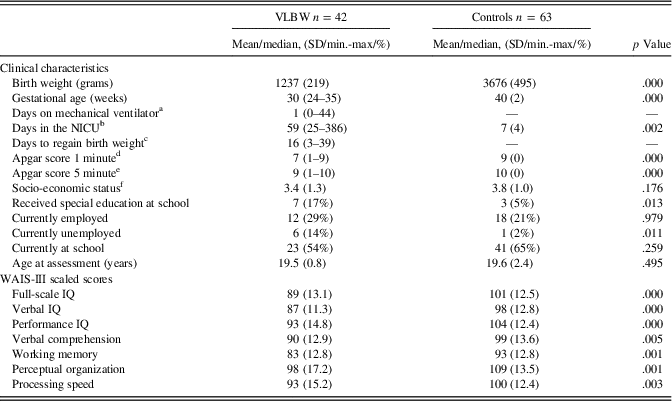
The VLBW group was significantly different from the comparison group on all clinical variables except SES and age at assessment (Table 1). The VLBW group scored lower on full IQ as well as on all IQ indices compared with controls.
Clinical characteristics and WAIS-III scaled-scores in the VLBW and the control group
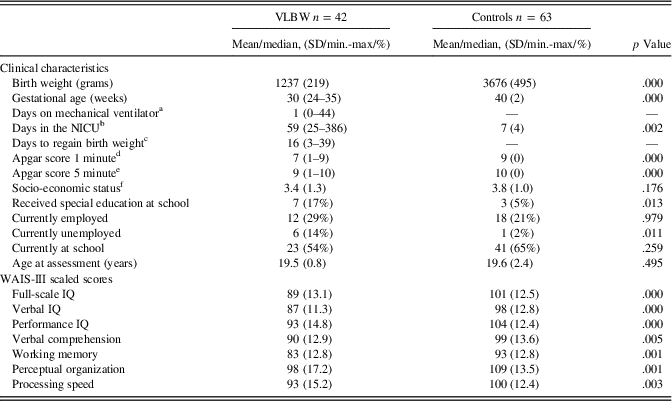
Note. Mann-Whitney U test. aVLBW, n=40; bControls, n=29; cVLBW, n=32; dControls, n=58; eControls, n=59; fControls, n=62.
WAIS-III=Wechsler Adult Intelligence Scale third edition; VLBW=very low birth weight; SD=standard deviation; NICU=neonatal intensive care unit.
BRIEF-A Results
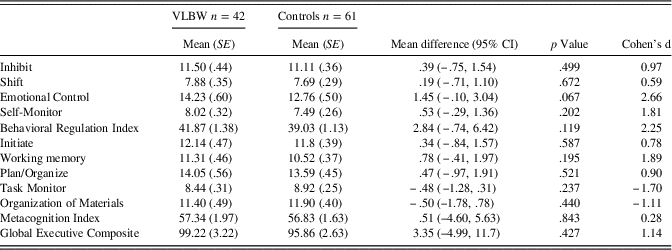
There were no significant differences between the VLBW and the comparison groups on any of the BRIEF-A measures (Table 2). On the BRI, 31% of the VLBW participants reported scores higher than +1 SD from mean value in the comparison group, while this was true for 16% of the controls (not significant). However, the BRI scores did not reach the level of clinical significance in either of the groups. There was no difference on BRIEF-A scores between those with normal IQ (n=22; mean IQ 100; SD=9) and those with low IQ (n=20; mean IQ 79; SD=9), or among the participants who were unemployed (n=6) and those who were employed (n=12) or at school (n=23) within the VLBW group.
BRIEF results in the VLBW group and controls

Note. Mann-Whitney U test. The subscale scores are scaled scores (M=10, SD=3), while the composites are standard scores (M=50, SD=10), with higher scores reflecting worse executive function.
VLBW=very low birth weight; SE=standard error; CI=confidence interval.
Attention / Executive Function Test Results
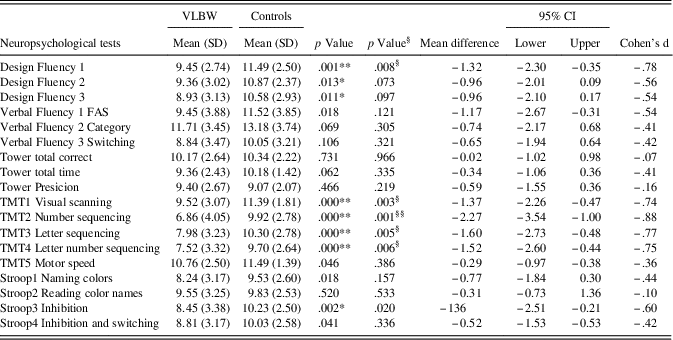
Attention and executive function test results for the different study groups are shown in Table 3. The VLBW group had lower scores than controls on 8 of the 18 neuropsychological subtests assessing different aspects of attention and executive functions. No group differences were seen for the Tower Test. Effect size for the tests with significant group differences varied between 0.54 and 0.88. When including PSI as covariate, the VLBW subjects still scored poorer on Design Fluency 1, TMT1, TMT2, TMT3, and TMT4 compared with controls.
Mean scaled scores from neuropsychological tests aiming to measure attention and executive functions in the two main groups: VLBW and controls.
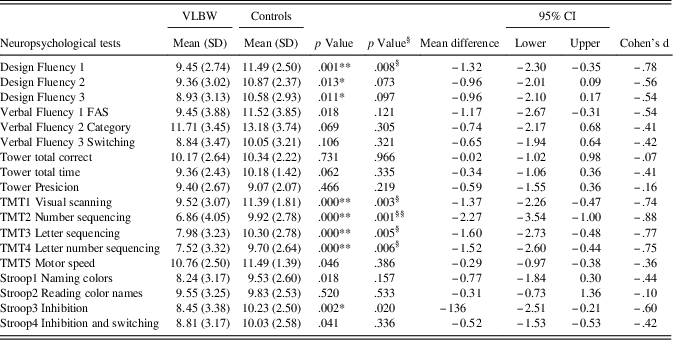
*p≤0.01 **p≤0.001, VLBW compared to controls (SES and gender as covariates).
§p≤0.01 §§p≤0.001, VLBW compared to controls (SES, gender, and Processing Speed Index as covariates).
General linear model, univariate analysis of variance, estimated marginal means with SES, gender, and WISC Processing Speed as covariates.
VLBW=very low birth weight; TMT=Trail Making Test; SES=socio-economic status.
Correlations between BRIEF-A and Attention / Executive Function Test Results
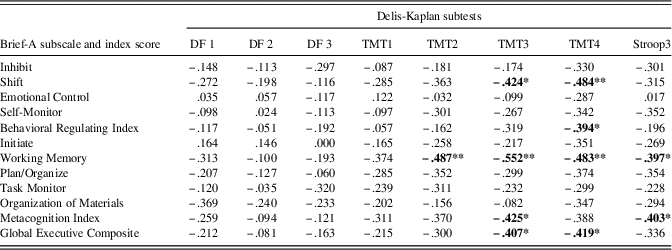
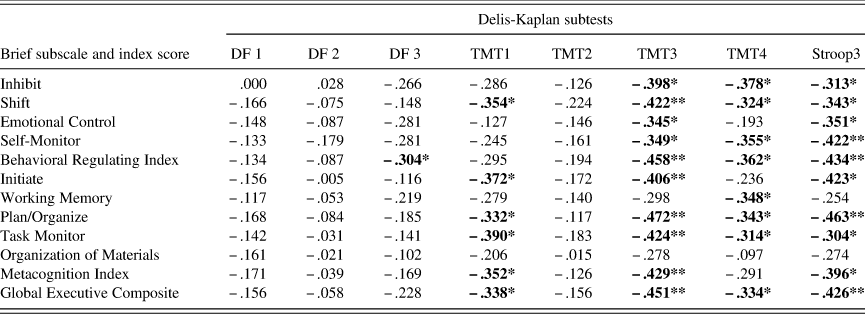
For the VLBW and control group, bivariate correlations of the BRIEF-A subscale and index scores and the neuropsychological tests with significant group differences are presented in Tables 4 and 5, respectively. Verbal fluency and the Tower Test were not included in the correlation analysis since we did not find any group differences on these tests. Table 4 shows that higher scores on BRIEF-A sum-indices correlated to poorer scores on the Trail Making Tests (based on scores on Shift and Working Memory) and Stroop tests (explained by scores from Working Memory and Plan/Organize), but with no correlation to Design Fluency in the VLBW group. In the control group all of the BRIEF-A sum indices correlated negatively to one or several of the D-KEFS test scores (Table 5). The correlations were not significantly different for the two groups when conducting Fisher’s Z transformation statistics.
Correlations between the BRIEF-A Sum and sub-Index scores and Executive and attention tests from the Delis-Kaplan test battery in the VLBW group
*p≤0.01 *p≤0.001 Bivariate correlation; Pearson, two tailed of the Sum-index scores and test-scores in the VLBW group.
DF1=Design Fluency 1; DF2=Design Fluency 2; DF3=Design Fluency 3; TMT1=visual scanning; TMT2=Number sequencing; TMT3=Letter sequencing; TMT4=Letter-number sequencing; Stroop3=Inhibition.
Correlations between the BRIEF-A Sum and sub-Index scores and Executive and attention tests from the D-KEFS in the control group
*p≤.01 **p≤.001 Bivariate correlation; Pearson, two tailed between Brief subscale/-index scores and D-KEFS subtest-scores in the VLBW group.
D-KEFS=Delis-Kaplan battery; DF1=Design Fluency 1; DF2=Design Fluency 2; DF3=Design Fluency 3; TMT1=visual scanning; TMT2=Number sequencing; TMT3=Letter sequencing; TMT4=Letter-number sequencing; Stroop3=Inhibition.
DISCUSSION
The VLBW participants obtained lower scores on several of the neuropsychological tests assessing executive functions compared to controls, but we found no significant group differences in self-reported BRIEF-A mean scores. Within the VLBW group, there was a correlation between the BRIEF-A indices and a limited number of test scores (TMT2, TMT3, and TMT4 and Stroop3 and Stroop4), while for controls all the BRIEF-A indices correlated to several of the D-KEFS tests scores in the control group.
In the present study, the VLBW group obtained lower scores than controls on several of the neuropsychological tests assessing attention and executive functions, which are in line with results from several other studies in VLBW adolescents and young adults at different ages (Nosarti et al., Reference Nosarti, Giouroukou, Micali, Rifkin, Morris and Murray2007; Taylor, Klein, & Hack, Reference Taylor, Klein and Hack2000; Taylor et al., Reference Taylor, Minich, Klein and Hack2004). We did not find any group differences on tasks assessing problem solving, in contrast to Luu et al. who reported that their 16-year-old preterm born participants had significantly poorer results on the Tower Test, when compared with controls (Luu et al., Reference Luu, Ment, Allan, Schneider and Vohr2011). Luu et al. studied adolescents with birth weight below 1250 grams, while our VLBW group had a mean birth weight of 1250 grams, which may account for the difference in findings, since birth weight has been positively related to outcome regarding executive functions (Aarnoudse-Moens et al., Reference Aarnoudse-Moens, Weisglas-Kuperus, van Goudoever and Oosterlaan2009). A possible explanation for the lower test results in the VLBW group is perinatal brain injury that affects brain areas and networks needed for higher order cognitive processing. Our group has reported diffusion tensor imaging findings in the same study population showing a relationship between deviations in white matter microstructure seen as reduced fractional anisotropy values and attention and executive function deficits in the VLBW adolescents (Skranes et al., Reference Skranes, Lohaugen, Martinussen, Indredavik, Dale, Haraldseth and Brubakk2009). We have also reported an association between entorhinal cortical thinning and poorer general cognitive abilities, visual-motor, and executive functions in the same group of VLBW subjects (Skranes et al., Reference Skranes, Lohaugen, Martinussen, Haberg, Dale and Brubakk2011). Slower processing speed and poorer working memory are known problem areas in VLBW populations (Lohaugen et al., Reference Lohaugen, Gramstad, Evensen, Martinussen, Lindqvist, Indredavik and Skranes2010) and our group has also found such deficits to be associated with cortical surface area deviations in this population of VLBW young adults (Skranes et al., Reference Skranes, Lohaugen, Martinussen, Haberg, Brubakk and Dale2013).
However, on the self-report similar results were found for the two groups. How can we explain the discrepancy between the normal self-reported BRIEF results and the reduced test scores in the VLBW group? One explanation could be that the reduced test scores reflect other cognitive core deficits than executive functions per se. All but one of the tests included had a strict time limit and the worse results in the VLBW group may, therefore, be partially related to reduced processing speed. This is in line with previous research reporting reduced processing speed and working memory as a common finding when evaluating cognition in VLBW subjects. Correcting for Processing Speed Index in the statistical model, group differences in Design Fluency 2 and 3 and Stroop 3 disappeared. The significance levels were also reduced from p≤.001 to p≤.01 in all other tests except for TMT2. Mulder et al. claimed that slow processing speed and reduced working memory explain inferior academic attainment in preterm born children (Mulder, Pitchford, & Marlow, Reference Mulder, Pitchford and Marlow2010), and in a later study, the same authors reported that very preterm born children aged 9–10 years had reduced scores on most executive function tests (i.e., inhibition, working memory, verbal fluency, and shifting), all of which were mediated by slow processing speed in the preterm group, except response inhibition. The authors concluded that processing speed seems to be an important determinant underpinning many neuropsychological deficits seen in very preterm born children in middle childhood (Mulder, Pitchford, & Marlow, Reference Mulder, Pitchford and Marlow2011). This is in line with our results where we found fewer group differences after co-varying for PSI. Some group differences in tests scores persisted after correcting for PSI, indicating that reduced processing speed does not fully explain the test results. We found correlations between the BRIEF-A indices and the Stroop and TMT test results within the VLBW group. This is in agreement with a recent Finnish study where attention/flexibility assessed by the TMT and verbal fluency was related to Metacognition Index, Behavioral Regulation Index and Global Executive Composite scores from the BRIEF-A parent report of VLBW and controls, as well as the self-report within the control group, but not in the VLBW group (Heinonen et al., Reference Heinonen, Pesonen, Lahti, Pyhälä, Strang-Karlsson, Hovi and Kajantie2013). Within the comparison group the BRIEF-A indices and sub-scores correlated to more D-KEFS test scores than among the VLBW groups. However, we did not find any significant group differences when looking at each correlation between BRIEF scores and test results. The correlation analysis, therefore, cannot serve as the basis for concluding that the VLBW participants had a less realistic awareness of their own executive functions.
The fact that we found a limited number of correlations between the test results and self-report in the VLBW group could suggest that BRIEF-A assesses other aspects of executive functions than the neuropsychological tests. In fact, it has been argued that measurements of executive functions obtained from behavioral observations/self-reports and neuropsychological test results are based on different sources of executive functions (Anderson, Anderson, Northam, Jacobs, & Mikiewicz, Reference Anderson, Anderson, Northam, Jacobs and Mikiewicz2002; Gioia & Isquith, Reference Gioia and Isquith2004). These studies have argued that standardized neuropsychological tests do not necessarily tap problems in everyday life activities where executive functions are needed and that such problems are better uncovered by self-report or parent report. Chaytor, Schmitter-Edgecombe, and Burr (Reference Chaytor, Schmitter-Edgecombe and Burr2006) found that scores on Stroop, TMT, WCST and the Controlled Oral Word Association Test only accounted for 18–20% of the variance in executive function abilities in daily life settings (measured by Dysexecutive (DEX) Questionnaire and Brock Adaptive Function Questionnaire) in adult patients with brain injuries associated executive functions deficits. In contrast, 51% of the variability in the everyday executive ability could be accounted by the participants’ ability to compensate (measured from the DEX questionnaire) and the amount of environmental cognitive demand.
Only a few studies have looked at the relationship between results from neuropsychological assessments and evaluation of attention/executive functions, and these studies all involve other groups. Studies comparing BRIEF and D-KEFS scores report inconsistent results. In a study exploring executive function in childhood epilepsy, the authors found that the parent-report and D-KEFS scores were correlated to BRIEF indices (Parrish et al., Reference Parrish, Geary, Jones, Seth, Hermann and Seidenberg2007). However, contrary findings were reported by Wingo, Kalkut, Tuminellos, Asconape, and Han (Reference Wingo, Kalkut, Tuminello, Asconape and Han2013), who found that none of the D-KEFS subtests were significantly correlated with BRIEF-A in young female college students.
In a study by Rabin et al. (Reference Rabin, Roth, Isquith, Wishart, Nutter-Upham, Pare and Saykin2006) that included persons with mild cognitive impairment, the BRIEF-A seemed to be sensitive to executive function changes in everyday aspects that are not assessed by neuropsychological tests. The authors argued that BRIEF-A can provide more ecologically valid information than performance-based tests administered in strictly controlled test environments. In a review article of the ecological validity of neuropsychological tests, it was argued that self-reported executive functions have been shown to have no or low correlation to executive tests (Chaytor & Schmitter-Edgecombe, Reference Chaytor and Schmitter-Edgecombe2003). This is in agreement with our findings, especially in the VLBW group.
The fact that the VLBW group does not report more executive function problems despite test-results suggesting such a disadvantage regarding tasks requiring attention/executive functions, could be explained by several factors. One possibility is that their executive function deficits do not influence daily life functioning. Based on their self-reports, they seem to manage their everyday life activities adequately and may, therefore, have adjusted their life so that the executive function challenges are reduced in everyday activities. Another possible interpretation is that they are underreporting their struggles, due to lack of insight regarding own functioning, which has been reported by others (Knight, Rutterford, Alderman, & Swan, Reference Knight, Rutterford, Alderman and Swan2002). Burgess, Alderman, Evans, Emslie, and Wilson (Reference Burgess, Alderman, Evans, Emslie and Wilson1998) found that an adult population of neurological patients reported fewer problems than controls and their significant other, although they had poorer performance on the executive tests. The authors argued that people with deficient executive functions are not good informants on their own abilities due to reduced self-awareness (Burgess et al., Reference Burgess, Alderman, Evans, Emslie and Wilson1998). Underreporting in our study is likely since parents’ and teachers’ BRIEF reports have shown problems in other studies of preterm born subjects. Other studies have reported similar results on self-report in VLBW groups as in controls, even though their parents reported increased symptoms in adolescence (Grunau, Whitfield, & Fay, Reference Grunau, Whitfield and Fay2004; Hack et al., Reference Hack, Youngstrom, Cartar, Schluchter, Taylor, Flannery and Borawski2004; Hallin & Stjernqvist, Reference Hallin and Stjernqvist2011; Indredavik, Vik, Heyerdahl, Kulseng, & Brubakk, Reference Indredavik, Vik, Heyerdahl, Kulseng and Brubakk2005; Saigal et al., Reference Saigal, Pinelli, Hoult, Kim and Boyle2003). Indredavik et al. (Reference Indredavik, Vik, Heyerdahl, Kulseng and Brubakk2005) assessed mental health in VLBW adolescents from the same study population as ours and reported no difference between the VLBW and control adolescents in self-reporting of behavioral problems, even though the parents of the VLBW subjects reported that their teens had more problems. In young adults, Hack et al. (Reference Hack, Forrest, Schluchter, Taylor, Drotar, Holmbeck and Andreias2011) found that the VLBW group did not distinguish themselves from the controls even though the results indicated an increase in psychopathology in this group. Indeed, there are concerns regarding the reliability of self-report, and the ability to rate one’s own cognitive control has been shown to be difficult not only for patients with different deficits, but also for healthy adults (Necka, Lech, Sobczyk, & Smieja, Reference Necka, Lech, Sobczyk and Smieja2012).
Strength and Limitations of Study
Strength of this study includes the use of a well-defined study sample with an acceptable return rate, and the longitudinal design where the participants have been followed throughout their childhood and adolescence. Furthermore, the combination of use of the BRIEF-A self-report instrument and standardized clinical neuropsychological tests thought to measure the same cognitive functions have not been performed before to this extent within a population of VLBW young adults. A possible limitation of the current study is the lack of BRIEF-A informant report form, which might have given additional valuable information about the participants’ executive functions. Furthermore, since our study population was born during the late 1980s and neonatal intensive care has improved substantially since then, we must be careful to generalize our results to preterm born populations born in the 1990s and later.
Clinical Implications and Future Directions
In general, studies including reports of executive function from significant others have shown stronger correlations to results on executive function tests than from self-reports. We recommend that a combination of behavioral ratings and neuropsychological tests be applied to obtain a more complete picture of executive functioning in a clinical group like preterm born individuals with VLBW. Based on our study and previous reports, we would argue that young adults born preterm with VLBW do have executive function deficits, but these deficits does not seem to represent a great challenge in their daily life functioning. Lohaugen et al. (Reference Lohaugen, Gramstad, Evensen, Martinussen, Lindqvist, Indredavik and Skranes2010) found that the need for special education was higher in the VLBW group included in the present study, and they were more often unemployed. So, questions arise for the future: Will they finish their education and manage to get work? Will they establish a family? To explore these questions further, inclusion of more ecologically valid tests of executive functions may be helpful. An example would be the Multiple Errands Test that tap the executive functions in a more realistic setting than the original pencil and paper tests of executive functions (Morrison et al., Reference Morrison, Giles, Ryan, Baum, Dromerick, Polatajko and Edwards2013). Future follow-up assessing cognition, mental health, and quality of life are, therefore, planned for this cohort of VLBW survivors. This study population has been followed longitudinally since early childhood, and their parents’ mental health was reported when their children were 14 years old, with no difference found between parents in the VLBW and control group (Indredavik et al., Reference Indredavik, Vik, Heyerdahl, Kulseng, Fayers and Brubakk2004). However, further studies incorporating other known variables that can impact the children’s long-term outcome such as parents’ mental health and family functioning in early childhood and adolescence could add valuable information regarding the young adults’ mental health.
CONCLUSIONS
In summary, the VLBW participants obtained lower scores on several of the neuropsychological tests than controls, but we found no significant group differences in self-reported BRIEF-A mean scores. We speculate that the lack of consistency may be partly explained by the assumption that measurements obtained from behavioral observations/self-reports and neuropsychological test results are based on different aspects of executive functions. However, we also suggest an underreporting of problems among the preterm born young adults, either caused by lack of insight or as a result of environmental compensating, which makes them able to handle the daily-life executive functioning requirements.
Acknowledgments
We thank the participants for their co-operation and interest in this study. The study was funded by The Research Council of Norway, Norwegian University of Science and Technology, and the Liaison Committee between the Central Norway Regional Health Authority and the Norwegian University of Science and Technology (NTNU). Conflict of interest statement: None of the authors have any financial and personal relationships to disclose that could inappropriately influence (bias) this work.