

I. Introduction
From its pioneering works (Labys and Cohen, Reference Labys and Cohen1978; Krasker, Reference Krasker1979; Jaeger, Reference Jaeger1981), the wine investment literature (see Storchmann (Reference Storchmann2012) and Le Fur and Outreville (Reference Le Fur and Outreville2019) for a survey of this literature) has postulated that a wine's financial value derives from its consumption value, based on an optimal but nonetheless uncertain consumption date (Sanning, Shaffer, and Sharratt, Reference Sanning, Shaffer and Sharratt2008). Consumption value depends on technological choices as well as natural endowments (Gergaud and Ginsburgh, Reference Gergaud and Ginsburgh2008), the latter including the climatic conditions prevailing during the harvest and pre-harvest periods (Ashenfelter, Ashmore, and Lalonde, Reference Ashenfelter, Ashmore and Lalonde1995; Byron and Ashenfelter, Reference Byron and Ashenfelter1995; Wood and Anderson, Reference Wood and Anderson2006; Ashenfelter, Reference Ashenfelter2008; Chevet, Lecocq, and Visser, Reference Chevet, Lecocq and Visser2011). Several authors document evidence that differences in climatic conditions explain the most significant part of the price variation across wines of different vintages (Ashenfelter, Ashmore, and Lalonde, Reference Ashenfelter, Ashmore and Lalonde1995; Ashenfelter, Reference Ashenfelter2008). Wine investors can thus anticipate the financial value of a bottle by relying on the weather data for its vintage.
The vintage is not such a concern for whisky, since unlike a wine bottle, the intrinsic characteristics of a whisky bottle are time-independent for two reasons (Moroz and Pecchioli, Reference Moroz and Pecchioli2019). First, the intrinsic characteristics of a whisky do not depend on the climatic conditions of its vintage, that is, its distillation year. Second, a bottle of whisky has no aging potential and, consequently, no optimal consumption date: its intrinsic characteristics change only during the maturation period in the barrel(s) and remain stable once bottled. For these reasons, a whisky investor cannot use weather factors to assess the consumption value of a given bottle but may instead rely on the evaluation of a whisky expert like Robert Parker in the wine industry. Expert ratings have already been used as a proxy for intrinsic quality in the wine economics literature (Landon and Smith, Reference Landon and Smith1997, Reference Landon and Smith1998; Schamel, Reference Schamel2009), and several authors show that these ratings can affect wine prices (Février, Roos, and Visser, Reference Février, Roos and Visser2005; Ali and Nauges, Reference Ali and Nauges2007; Ali, Lecocq, and Visser, Reference Ali, Lecocq and Visser2008; Cardebat, Figuet, and Paroissien, Reference Cardebat, Figuet and Paroissien2014). More specifically, Masset and Henderson (Reference Masset and Henderson2010), studying wine as an alternative investment vehicle, document that wines with higher ratings have higher returns.
However, the price effect of ratings may depend on the kind of wine considered. For instance, Jones and Storchmann (Reference Jones and Storchmann2001), studying Bordeaux crus classés, find that Parker's ratings have a more significant effect on the price of wines produced by smaller châteaux cultivating Cabernet Sauvignon. Similarly, Masset, Weisskopf, and Cossutta (Reference Masset, Weisskopf and Cossutta2015) note that the Parker and Quarin rankings have a higher impact for Bordeaux en primeur wines not covered by the official 1855 classification and for those belonging to the best vintages. Moreover, the effect of expert ratings can be enhanced by producers through advertising. This is what Cardebat, Figuet, and Paroissien (Reference Cardebat, Figuet and Paroissien2014) call a “marketing effect”: a more favorable score is likely to be more heavily publicized, which also pushes up the price. This marketing effect is also observed for lower quality wines: the mere fact of being ranked, even if the rank is relatively low, may enable a lower quality wine to benefit from a positive price effect (Storchmann, Mitterling, and Lee, Reference Storchmann, Mitterling and Lee2012).
Furthermore, independently of any issues of flawed or fraudulent opinions (see Storchmann (Reference Storchmann2012)), the relevance of wine experts’ ratings must be considered with caution for two other reasons: (1) the subjectivity and trustworthiness of quality assessments and (2) the information on quality available through other devices. Notwithstanding the issues of expert consensus (Hodgson, Reference Hodgson2009; Ashton, Reference Ashton2013; Cardebat and Paroissien, Reference Cardebat and Paroissien2015; Masset, Weisskopf, and Cossutta, Reference Masset, Weisskopf and Cossutta2015; Stuen, Miller, and Stone, Reference Stuen, Miller and Stone2015) and the potential inability of non-experts to understand expert evaluation comments (Quandt, Reference Quandt2007; Weil, Reference Weil2007), the reliability of a given expert is questionable (Ashton, Reference Ashton2012). Hodgson (Reference Hodgson2008) and Ashton (Reference Ashton2012) observe that, in most cases, experts’ opinions are not consistent when they make repeated judgments for a particular wine. Moreover, the information on quality provided by experts can be obtained through other devices (Storchmann, Reference Storchmann2012; Cardebat, Figuet, and Paroissien, Reference Cardebat, Figuet and Paroissien2014). Di Vittorio and Ginsburgh (Reference Di Vittorio and Ginsburgh1994), in particular, show that the quality of a wine can be inferred from its classification; while Ashenfelter and Jones (Reference Ashenfelter and Jones2013) note that the climatic conditions of its vintage are more effective in the estimating price, given that the rating is largely explained by weather factors.
Conversely, the time-independent dimension of whisky and the absence of official classifications similar to those observed for wine make the investigation of the expert rating effect on price a particularly relevant issue for whisky. Several whisky ratings exist, notably in specialized magazines (Whisky Magazine, Whisky Advocate, etc.) and in a prominent yearly guide first issued in 2003, Jim Murray's Whisky Bible, which is equivalent to the Parker's Wine Buyer's Guide. The Whisky Bible evaluates a wide variety of whiskies (more than 4,600 different bottles from over 30 countries for the 2018 edition), each one graded out of an overall score of 100, reflecting the sum of the whisky's ratings in four criteria (nose, taste, finish, and overall balance). This guide is subdivided into 11 chapters, representing a diverse range of producers worldwide and covering the different kinds of whisky (single malt, single grain, vatted malt, bourbon, pot still, etc.).
The aim of this paper is to investigate the effect of the Whisky Bible ratings on the investor ask price of vintage single malt whisky. Overall, our results show that the Murray score is not a powerful predictor of investor ask price, especially when controlling for the reputation of the distillery and, if any, the bottler. In addition, this rating, as an evaluation of the intrinsic characteristics of whiskies, appears to be mainly explained by the distiller and bottler names, suggesting that an accurate knowledge of distilleries’ and bottlers’ reputations is a more efficient predictor than the Murray score. As such, our findings are in line with those obtained for wine, in that the effect of expert ratings on price can be outperformed by other information (Ashenfelter and Jones, Reference Ashenfelter and Jones2013), supporting the idea that investors will benefit if they have an “epicurean” interest in the asset (Masset and Henderson, Reference Masset and Henderson2010). However, Murray's Bible may nonetheless embed information of use to unsophisticated investors with poor knowledge of the whisky industry, in the same way that Parker's Wine Buyer's Guide may help wine investors who are unfamiliar with the effect of the prevailing climatic conditions for a given vintage.
Finally, this research makes three major contributions to the literature. First, it extends the emerging empirical literature on distilled spirits prices. To the best of our knowledge, it offers the first analysis of the effect of expert ratings on the prices of a distilled spirit on the second-hand market. Second, it contributes to wine economics by examining the effect on the price of expert assessments for an alcoholic beverage whose quality cannot be inferred from weather data. Third, it contributes more generally to the literature on alternative investments by improving our knowledge of investors’ sensitivity to quality variables. From a managerial viewpoint, it provides useful insights for whisky investors into the relevance of the information provided by expert evaluations.
The remainder of the paper proceeds as follows. Section II describes our data and provides summary statistics. The empirical model and estimation results are then presented in Section III. Finally, Section IV concludes with a discussion of implications and suggestions for further research.
II. Data
In this research, we use an original dataset combining quality ratings from Jim Murray's Whisky Bible and data on bottle characteristics and prices from www.worldwhiskyindex.com, a web trading platform specializing in single malt Scotch whisky investment. This website references an extensive set of whiskies in its database, allowing us to gather a sufficient number of bottles that are also assessed in the Whisky Bible.
The data from the www.worldwhiskyindex.com (WWI) website were extracted between January 15–30, 2018. We collected a first sample comprising 352 observations of only one kind of whisky (single malt) produced by distillers located in Scotland. All of the bottles in our sample are referenced in the 2018 edition of the Whisky Bible. We focus solely on bottles produced by distillers located in Scotland to circumvent potential country-related effects. We retained ask prices as the dependent variable due to the insufficient frequency of transaction prices in the database. This approach has been validated in the wine economics literature (Schamel and Anderson, Reference Schamel and Anderson2003; Estrella Orrego, Defrancesco, and Gennari, Reference Estrella Orrego, Defrancesco and Gennari2012; Oczkowski and Doucouliagos, Reference Oczkowski and Doucouliagos2014; Oczkowski, Reference Oczkowski2015), and more recently for whisky investment (Moroz and Pecchioli, Reference Moroz and Pecchioli2020), assuming that sellers have accurate knowledge of the prices acceptable to potential purchasers.
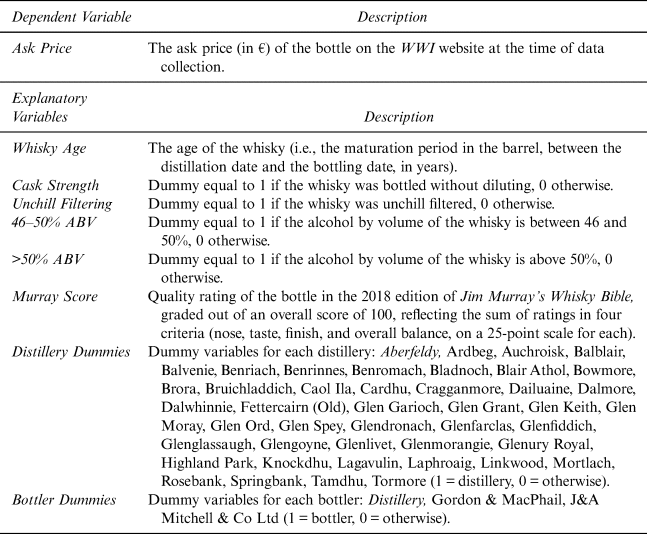
After accounting for missing data, we obtained a final sample of 274 bottles originating from 44 different Scottish distilleries. The relevant variables used in our analysis are described in Table 1 and are in line with the literature (Moroz and Pecchioli, Reference Moroz and Pecchioli2019, Reference Moroz and Pecchioli2020). It is worth noting that data from the WWI website were cross-checked with information mentioned in the Whisky Bible. Furthermore, when the whisky age (i.e., the maturation period in the barrel) was missing, but the distilling and bottling dates were provided, we attributed an age to the whisky by deducing it from the latter two variables. We also computed the alcohol by volume (ABV) variable as a set of dummies instead of as one continuous variable in order to consider differences relating to cask strength and unchill filtering. Forty-six percent ABV is considered to be the lowest strength at which malt whisky can be bottled without chill-filtering (Wisniewski, Reference Wisniewski2018), while cask strength whiskies tend to have a higher ABV than diluted whiskies (typically above 50% ABV).
Description of Variables

Notes: This table lists the variables and their respective descriptions. For “Distillery” and “Bottler” dummies, the respective references used in the regressions appear in italics.
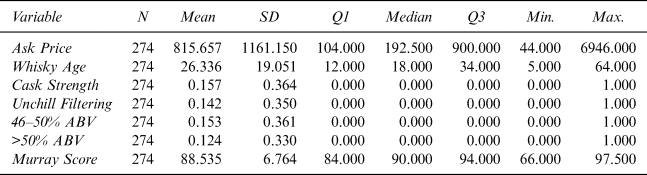
Table 2 provides descriptive statistics for our dataset. The asking price of bottles ranges from €44.00 to €6,946.00 with an average of €815.66. The average whisky age is 26.34 years, the youngest being 5-year aged and the oldest 64-year aged. Of the bottles in our analysis data, 15.69% are cask strength whiskies, 14.23% are unchill filtered, 27.7% were bottled at an ABV of between 46% and 50%, 12.4% are above 50% ABV, and 28.10% were bottled by an independent bottler, that is, not in-house by the distiller itself (the statistic not reported). More precisely, 65 bottles from 4 different distilleries (Balbair, Glen Grant, Linkwood, and Mortlach) were bottled by Gordon & MacPhail, and 12 bottles from Springbank were bottled by J&A Mitchell & Co Ltd. Our variable of interest, the Murray score, varies from 66 to 97.5 with an average of 88.53, which covers, to quote Murray (Reference Murray2018) himself, a sample of whiskies from the category “very unimpressive” to the category “superstar.”
Summary Statistics

Note: This table reports descriptive statistics for the whole sample (number of observations, standard deviation, 1st quartile, median, 3rd quartile, minimum, and maximum).
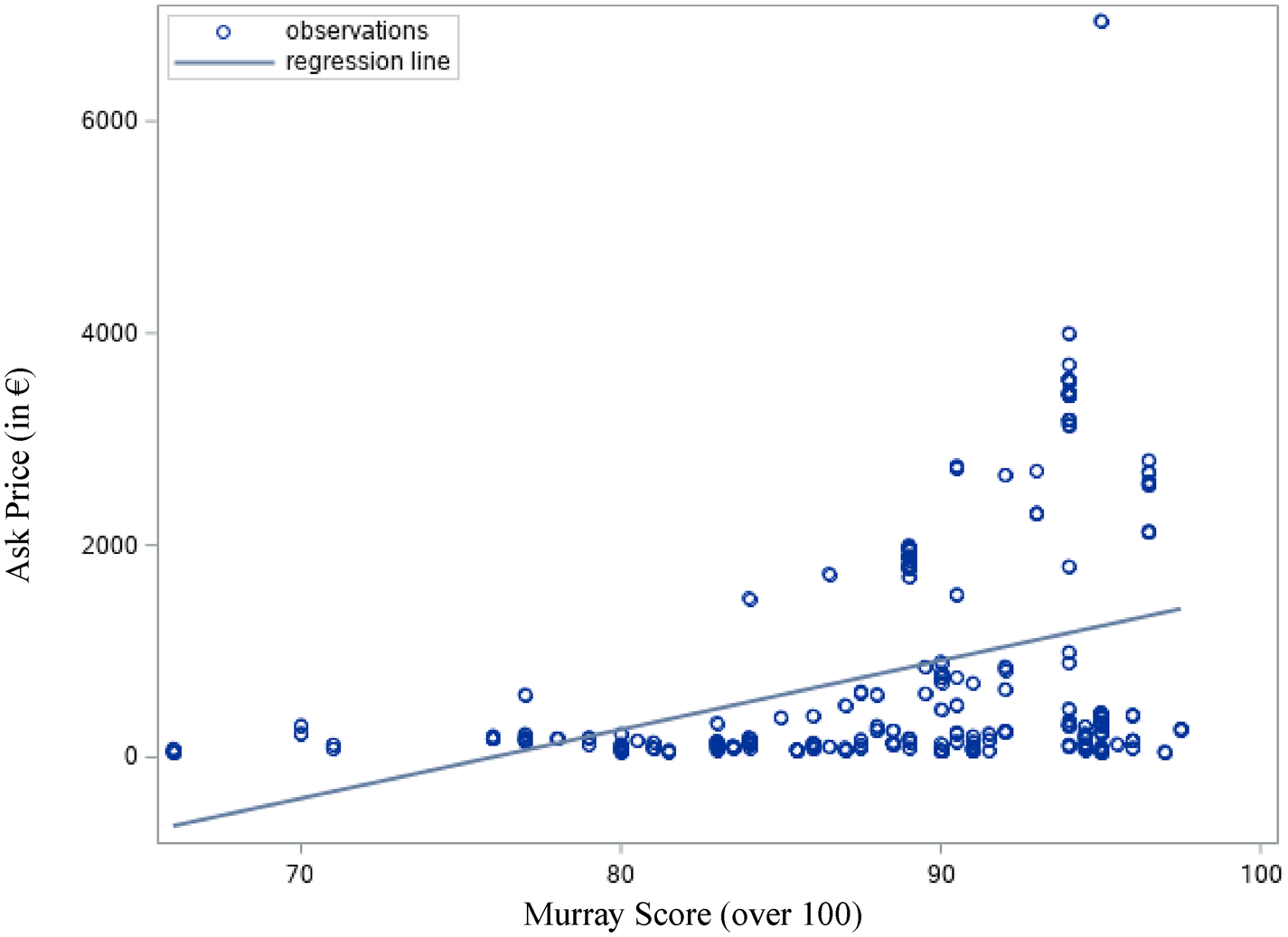
Figure 1 displays the distribution of ask prices by Murray score, showing a growing variance in prices as the score increases. In other words, it appears that while the bottles with the lowest scores exhibit the lowest ask prices, the best-rated bottles are not systematically the highest-priced ones. It is therefore difficult to draw any conclusion on the possible link between quality rating and investment price.
Distribution of Ask Prices by Murray Score

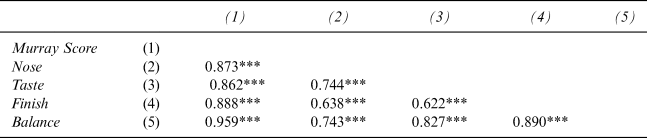
Table 3 reports Pearson correlations between the Murray score and its four components (nose, taste, balance, and finish). Unsurprisingly, the components are highly correlated with the overall score but also with each other. For this reason, only the overall score is used as the variable of interest in the subsequent regressions.
Pairwise Correlation Matrix of the Murray Score Variables

Notes: This table reports pairwise Pearson correlations between the Murray Score and its four components. The superscripts asterisks ***, **, and * denote statistical significance at the 1%, 5%, and 10% levels, respectively.
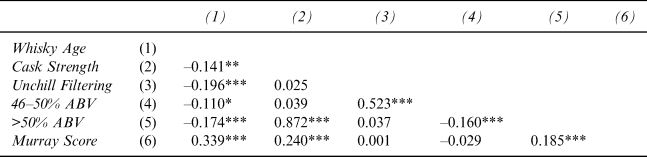
The Pearson correlations between all the variables used in the asking price OLS regressions are presented in Table 4. As expected, Cask Strength and Unchill Filtering are found to be strongly correlated with ABV variables. We, therefore, consider these variables in two separate sets of regressions in our analysis. It is worth noting that there is no other strong correlation between the independent variables that would be likely to bias our results.Footnote 1
Pairwise Correlation Matrix of Regression Variables

Notes: This table reports pairwise Pearson correlations between all of the regression variables. Variables are described in Table 1. The superscripts asterisks ***, **, and * denote statistical significance at the 1%, 5%, and 10% levels, respectively.
III. Empirical Model and Results
In the empirical part of this research, we first investigate whether expert ratings, using the Murray score, affect investor ask prices, controlling both for the extrinsic characteristics of whiskies and for distillery and bottler fixed effects. We then analyze the extent to which the Murray score can be explained by the same characteristics. To do so, we use a classic log-linear OLS regression model for the determinants of the price (Equation 1), as traditionally employed in most hedonic regression studies,Footnote 2 and a linear regression model for the determinants of the Murray score (Equation 2). Our empirical base models are as follows:


where Ask Pricei and Murray Scorei are the investor ask price and the overall Murray score of bottle i, respectively, and X i is the vector of explanatory variables. The residual ɛ i is assumed to be independently and identically distributed. Almost all the explanatory variables are presented as dummies, with the exception of Whisky Age and Murray Score, which are quantity variables.
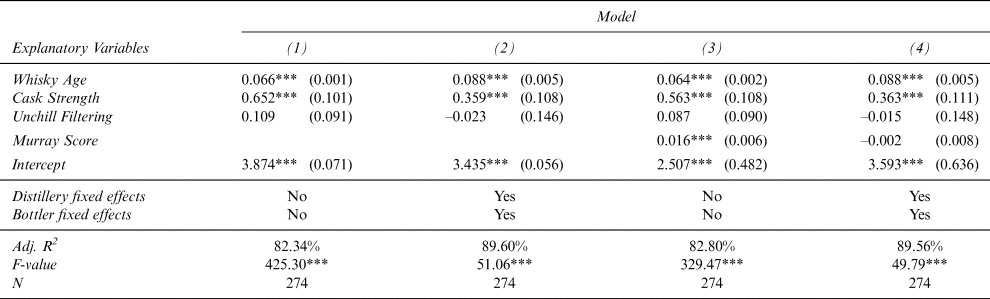
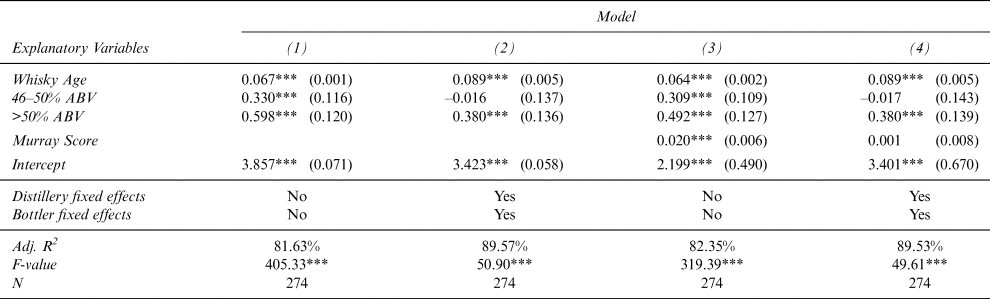
Table 5 shows the estimation results for the log of Ask Price OLS regressions. Model (1) only includes variables relating to the production process. The explained variance is about 82%, with Whisky Age and Cask Strength having a positive and significant impact (at the 1% level for each). The addition of distillery and bottler fixed effects in Model (2) increases the R2 by about 7%. Models (3) and (4) are similar to Models (1) and (2), respectively, except that we add the Murray Score variable. Although its parameter is statistically significant (at the 1% level) in Model (3), the R2 is improved by only about 0.5% compared to Model (1). Finally, when controlling for distillery and bottler fixed effects (Model 4), the parameter for the Murray Score variable becomes statistically insignificant. Overall, the results using ABV variables instead of Cask Strength and Unchill Filtering as predictors in regressions (cf. Table 6) are comparable and confirm our previous findings.
Estimation Results for Log of Ask Price

Notes: This table reports the estimation results for the log of Ask Price OLS regressions. Variables are described in Table 1. N is the number of observations. White robust standard errors adjusted for heteroscedasticity are in parentheses. The superscript asterisks ***, **, and * denote statistical significance at the 1%, 5%, and 10% levels, respectively.
Estimation Results for Log of Ask Price (with ABV variables)

Notes: This table reports the estimation results for the log of Ask Price OLS regressions. Variables are described in Table 1. N is the number of observations. White robust standard errors adjusted for heteroscedasticity are in parentheses. The superscript asterisks ***, **, and * denote statistical significance at the 1%, 5%, and 10% levels, respectively.
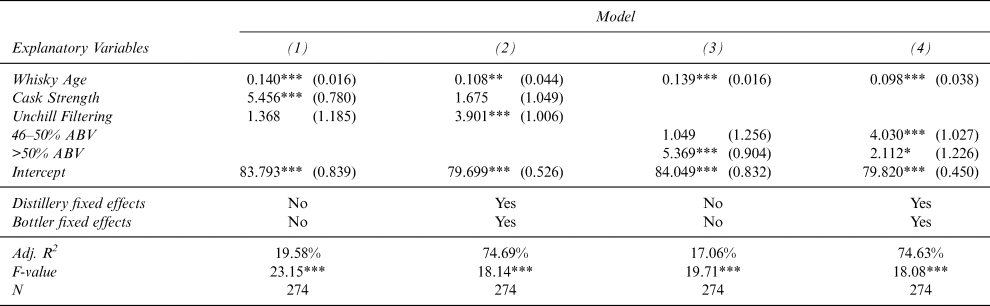
Table 7 reports the results of the Murray Score OLS regressions for four different model specifications. In Model (1), we merely include the variables relating to the production process. The adjusted R2 is 19.58%, with Whisky Age and Cask Strength displaying positive and significant effects (at the 1% level). When distillery and bottler fixed effects are added (Model 2), the adjusted R2 reaches almost 75%, with significant and positive parameters for Whisky Age and Unchill Filtering, whereas the effect of the Cask Strength variable becomes insignificant. In Models (3) and (4), we replace Cask Strength and Unchill Filtering with ABV variables. The results remain very similar, indicating that the Murray score, although it assesses the intrinsic quality of the whisky, is in most part explained by extrinsic characteristics, in particular, the name of the distillery and, if any, the bottler. It is worth noting that Murray does not resort to blind tasting (Murray, Reference Murray2018), which may represent a kind of expert failure (Storchmann, Reference Storchmann2012). One could argue that Murray may be influenced by the extrinsic characteristics of the bottle, as has been observed with consumer evaluations of other beverages (see Goldstein et al. (Reference Goldstein, Almenberg, Dreber, Emerson, Herschkowitsch and Katz2008) and Hart (Reference Hart2018)).
Estimation Results for the Murray Score

Notes: This table reports the estimation results for the Murray Score OLS regressions. Variables are described in Table 1. N is the number of observations. White robust standard errors adjusted for heteroscedasticity are in parentheses. The superscript asterisks ***, **, and * denote statistical significance at the 1%, 5%, and 10% levels, respectively.
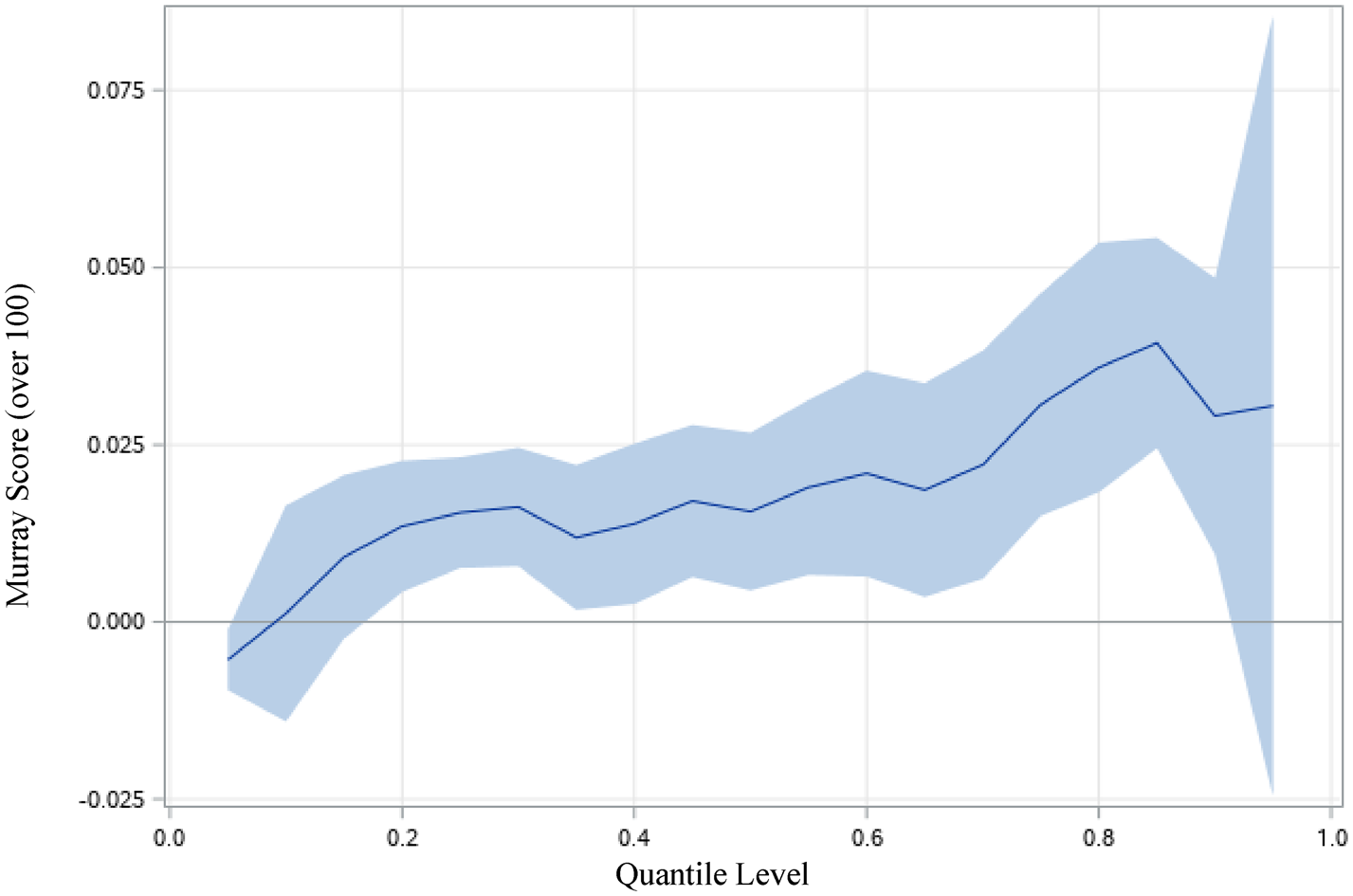
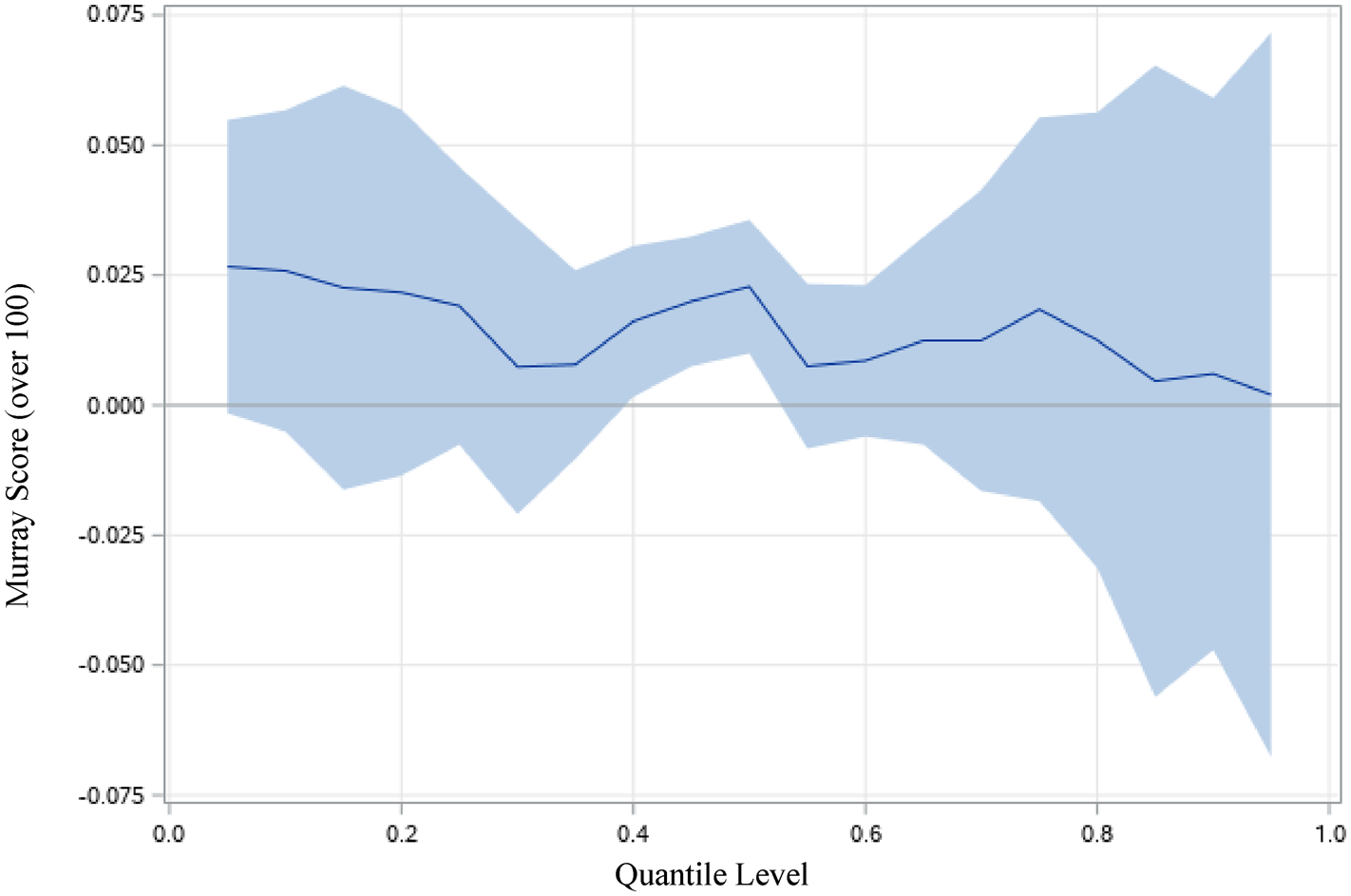
Finally, in order to test the robustness of our results and refine their analysis, we investigate whether the influence of the Murray Score changes with price level by running quantile regressions for model specifications (3) and (4) from Table 5. Figures 2 and 3 present graphical summaries of the results. For each specification, we plot the 19 distinct quantile regression estimates of the Murray Score ranging from 0.05 to 0.95 as a solid curve with filled dots. The shaded area depicts a 95% pointwise confidence band for these estimates. In Figure 2, the impact of the Murray Score is found to be increasing across quantiles, suggesting that the rating has a greater influence on the price for higher-priced bottles compared with lower-priced ones. Conversely, when controlling for distilleries and bottlers, the parameter remains relatively stable and insignificant across quantiles (cf. Figure 3).
Estimated Parameters by Quantile Level for the Murray Score (Model 3)
Notes: This graph plots the 19 distinct quantile regression estimates (ranging from 0.05 to 0.95) for the Murray Score as the solid curve with filled dots. The shaded area depicts a 95 percent pointwise confidence band for the quantile regression estimate.

Estimated Parameters by Quantile Level for the Murray Score (Model 4)
Notes: This graph plots the 19 distinct quantile regression estimates (ranging from 0.05 to 0.95) for the Murray Score as the solid curve with filled dots. The shaded area depicts a 95 percent pointwise confidence band for the quantile regression estimate.

Taken together, our results indicate, first, that the effects of the Murray score on investor ask price vanishes when controlling for distillery and bottler fixed effects. Second, the extrinsic characteristics of the whisky, including both technological choices made by the distiller and/or the bottler and, to an even greater extent, their respective reputations, explain the main part of the score differences. Assuming, in line with Tadelis (Reference Tadelis1999), that distillery names (and thus distillery dummies) capture reputation effects, these findings suggest that an accurate knowledge of distilleries’ and bottlers’ reputations is a more efficient predictor of whisky price than the Murray score. Conversely, in the absence of such knowledge, the information embedded in the Murray score can be a relatively reliable indicator for unsophisticated investors, especially for the most valuable bottles.
IV. Conclusion
Our results do not enable us to conclude that whisky investors are “great believers,” since the price they ask for a bottle does not appear to be influenced by its rating in the Whisky Bible. On the other hand, we cannot conclude that they are “radical atheists” either since this expert guide may provide relevant information for agents who want to invest in whisky bottles but who do not have a good knowledge of distillers’ and bottlers’ reputations. Two factors may mitigate our results. First, our sample is relatively small, and this may make it difficult to disentangle the various effects in the estimations. Second, the WWI website database displays no investor-specific information, and our analysis may therefore reflect the behavior of a relatively narrow group of investors. However, our results raise some interesting issues concerning the relationship between the quality determinants of a whisky and its value as an investment asset.
Our findings are in line with Ashenfelter and Jones (Reference Ashenfelter and Jones2013) in the sense that expert ratings are not efficient in explaining the price and can be improved. We show that distillery and bottler name, as a proxy for their respective reputations, are more accurate than ratings. Given the critical role of technological choices in the production of whisky, it would be interesting to collect information on distillery and bottler characteristics to refine the analysis by considering reputational components. Bottlers may differ on several technological dimensions, including the kind of barrels they use, the warehouse used for storage, etc., while distilleries may vary in terms of the kind of stills or yeast they include, the experience of the master distiller, etc. These considerations offer fruitful additional research opportunities in the field of distilled spirits as alternative investment assets.