Parenting styles and behavior toward children have long been recognized as an important influence on children's psychosocial development in general (Bradley & Vandell, Reference Bradley and Vandell2007), and on their risk for psychopathology, in particular (e.g., Collins, Macoby, Steinberger, Hetherington, & Bornstein, Reference Collins, Maccoby, Steinberger, Hetherington and Bornstein2000; McLeod, Weisz, & Wood, Reference McLeod, Wood and Weisz2007; McLeod, Wood, & Weisz, Reference McLeod, Weisz and Wood2007). As such, it is not surprising that researchers have also sought to understand the origins of specific parenting styles and behaviors (e.g., Belsky, Reference Belsky1984; Clark, Kochanska, & Ready, Reference Clark, Kochanska and Ready2000; Kopala-Sibley, Zuroff, & Koestner, 2011; Pardini, Reference Pardini2008; Seng & Prinz, Reference Seng and Prinz2008). Much of this literature has focused on the effects of parental history of depression on parents' own parenting behaviors (see Goodman et al., Reference Goodman, Rouse, Connell, Broth, Hall and Heyward2011; Kane & Garber, Reference Kane and Garber2004; Lovejoy, Graczyk, O'Hare, & Neuman, Reference Lovejoy, Graczyk, O'Hare and Neuman2000; Wilson & Durbin, Reference Wilson and Durbin2010), which in turn has been linked to child risk for psychopathology (e.g., McLeod, Weisz, et al., Reference McLeod, Wood and Weisz2007; McLeod, Wood, et al., Reference McLeod, Weisz and Wood2007). Although there are undoubtedly numerous biological, social, and psychological processes by which risk for psychopathology is passed across generations, much evidence supports negative parenting as one such mediator (e.g., Kane & Garber, Reference Kane and Garber2004; Lovejoy et al., Reference Lovejoy, Graczyk, O'Hare and Neuman2000; Wilson & Durbin, Reference Wilson and Durbin2010).
However, despite evidence supporting the effect of parental depressive history on parents' own parenting behaviors (for reviews, see Downey & Coyne, Reference Downey and Coyne1990; Lovejoy et al., Reference Lovejoy, Graczyk, O'Hare and Neuman2000), which in turn predict child risk for psychopathology (e.g., Collins et al., Reference Collins, Maccoby, Steinberger, Hetherington and Bornstein2000; McLeod, Weisz, et al., Reference McLeod, Wood and Weisz2007; McLeod, Wood, et al., Reference McLeod, Weisz and Wood2007), a number of gaps remain in this literature. For instance, we are aware of no research that has considered the possibility that one parent's depressive history may influence the other parent's behaviors toward their child, over and above each parent's own depressive history. This is despite a long history of theory and research that coparent characteristics and behaviors influence one's own behaviors toward one's child (Belsky, Reference Belsky1984; Kendler, Sham, & MacLean, Reference Kendler, Sham and MacLean1997). In addition, while much literature has focused on the effects of parenting on child psychopathology, less has examined the effects of child psychopathology on parenting. Finally, much research on this topic has been cross-sectional or, when longitudinal, limited to periods of 1 or 2 years, and has generally relied on only one informant in each study. Thus, using data collected from both mothers and fathers when their child was age 3, 6, and 9 years old, the first goal of this paper is to examine whether one parent's lifetime depressive history influences the parenting behaviors of the other parent, over and above the effects of their own depressive history. Our second goal is to examine transactional relationships between parental authoritarianism and permissiveness, two well-established maladaptive parenting styles, and children's internalizing and externalizing symptoms, as rated by both parents, over a 6-year period ranging from early to late childhood.
Parental Depression and Parenting Behaviors
Research has shown a well-replicated link between a parental history of depression and parenting toward offspring. For instance, early studies and reviews supported the link between maternal depression and negative parenting behaviors (Downey & Coyne, Reference Downey and Coyne1990; Weissman & Paykel, Reference Weissman and Paykel1974). A meta-analysis showed that maternal depression is related to more hostility and less engagement, even for mothers who are not currently depressed but have experienced a past depressive episode (Lovejoy et al., Reference Lovejoy, Graczyk, O'Hare and Neuman2000). Furthermore, associations between experimentally manipulated mood and parenting have also been demonstrated (Jouriles, Murphy, & O'Leary, Reference Jouriles, Murphy and O'Leary1989; Zekoski, O'Hara, & Wills, Reference Zekoski, O'Hara and Wills1987). Subsequent research has confirmed that maternal depressive history is robustly related to more negative parenting behaviors (e.g., Foster, Garber, & Durlak, Reference Foster, Garber and Durlak2008; Frye & Garber, Reference Frye and Garber2005; for a review, see Goodman, Reference Goodman2007).
These findings also extend to the influence of a paternal history of depression on paternal parenting behaviors. An initial meta-analysis (Kane & Garber, Reference Kane and Garber2004) found that fathers with a history of depression experience more conflict with their children. Subsequently, Wilson and Durbin (Reference Wilson and Durbin2010) meta-analyzed results from 28 studies and concluded there is a significant relationship between paternal depressive history and more negative parenting behaviors, such as hostility, control, restriction, and rejection.
However, despite these bodies of literature, almost no research to date has examined whether one parent's depressive history influences the parenting styles and behaviors of the other parent, over and above the effects of that parent's own depressive history. This is despite a long history of theory suggesting that coparent characteristics, including psychopathology, should deleteriously influence the other parent's parenting behaviors (e.g., Abidin, Reference Abidin1992; Belsky, Reference Belsky1984). We are aware of only one study that tested this question. In a cross-sectional study of mother–father pairs with a 9-month-old infant, Paulson, Dauber, and Leiferman (Reference Paulson, Dauber and Leiferman2006) found that when mothers experienced postpartum depression, fathers were less likely to sing songs to their children on a daily basis. Conversely, when fathers were depressed, mothers were less likely to tell stories to their child every day. Moreover, nondepressed mothers engaged in more enrichment activities with their infants when the father was also not depressed, compared to when fathers were depressed. The results from this study provide some tentative evidence of effects of mothers' depression on fathers' parenting, and vice versa.
There is evidence, albeit contradictory, that concurrent coparent depressive symptoms may influence the other parent's behaviors. For instance, some studies have found that nondepressed paternal parenting behaviors were worsened (e.g., Cummings, George, Koss, & Davies, 2013; Goodman, 2008; Jacob & Johnson, 1997), improved (e.g., Edhborg, Lundh, Seimyr, & Widstrom, 2003; Hops et al., 1987), or unrelated to mothers' depressive symptoms (e.g., Chabrol, Bron, & Le Camus, 1996).
Moreover, evidence suggests that a coparent's traits, behaviors, or subclinical symptoms, which may be influenced by his or her history of depression, likely influence the other parent's parenting (e.g., Belsky, Reference Belsky1979; Coyne, Thompson, & Palmer, Reference Coyne, Thompson and Palmer2002; Proulx, Helms, & Buehler, Reference Proulx, Helms and Buehler2007). It is also important to note that individuals with a history of depression are more likely to marry someone else with a history of depression relative to someone without such a history (Nordsletten et al., Reference Nordsletten, Larsson, Crowley, Almqvist, Lichtenstein and Mataix-Cols2016). Given the multiple associations between both parents' mental health and their parenting behaviors, it is important to demonstrate the unique effect of one parent's depressive history on the other parent's parenting, above and beyond the other parent's mental health history. Early in the history of this research, Belsky (Reference Belsky1979) found that mothers' coparent support strongly influenced their husbands' parenting behaviors, and concluded that spousal or coparent support, which would presumably be undermined by a history of depression in that coparent, is an important determinant of parenting behaviors. Similarly, intraparental conflict, which is increased in relationships where one partner is depressed (e.g., Coyne et al., Reference Coyne, Thompson and Palmer2002), is related to more negative parenting (Simons, Loenz, Conger, & Wu, Reference Simons, Lorenz, Conger and Wu1992; see Krishnakumar & Buehler, Reference Krishnakumar and Buehler2000, for a meta-analyses). Depression in one parent may also diminish the quality of the overall interparental relationship, thereby affecting each parent's parenting behaviors (Belsky, Reference Belsky1984; Coyne et al., Reference Coyne, Thompson and Palmer2002; Proulx et al., Reference Proulx, Helms and Buehler2007).
This evidence suggests that spousal depressive history may have an additive effect on the other parent's parenting styles. That is, while a history of depression, via a variety of potential mechanisms, may undermine a parent's parenting styles, it is likely that also having a coparent with a history of depression will additively impact these parenting styles. For instance, subclinical depressive symptoms, which would presumably be more common in an individual with a history of depression, have been found to influence their partner's parenting behaviors (Cummings et al., Reference Cummings, George, Koss and Davies2013; Goodman, 2008; Jacob & Johnson, 1997). As such, a coparent's depressive history may prove to be an additional burden on top of that parent's own depressive history in terms of its effects on their parenting styles. The current study will further explore these issues by examining whether maternal and paternal depressive history, respectively, predict paternal and maternal parenting styles as well as change in parenting styles over a 3-year period, over and above each parent's own depressive history.
Parenting and Child Psychopathology
Parenting styles and child symptoms of psychopathology are often conceptualized as bidirectional and mutually influential (Belsky, Reference Belsky1984; Collins et al., Reference Collins, Maccoby, Steinberger, Hetherington and Bornstein2000; Patterson, Reference Patterson1982), although the majority of research to date has focused on the influence of parents on children. Regarding the effects of parenting, research has examined both externalizing and internalizing outcomes in children. Externalizing behaviors are associated with, and sometimes longitudinally predicted by, harsh or otherwise negative parenting (e.g., Conger et al., Reference Conger, Conger, Elder, Lorenz, Simons and Whitbeck1992; Conger, Ge, Elder, Lorenz, & Simons, Reference Conger, Ge, Elder, Lorenz and Simons1994; O'Leary, Slep, & Reid, Reference O'Leary, Slep and Reid1999; Patterson, Reid, & Dishion, Reference Patterson, Reid and Dishion1992). A meta-analysis of 161 studies found that parental monitoring, psychological control, rejection, and hostility accounted for 11% of the variance in delinquency (Hoeve et al., Reference Hoeve, Dubas, Eichelsheim, Van der Laan, Smeenk and Gerris2009). In addition, the success of parent management training (as documented in Graziano & Diament, Reference Graziano and Diament1992; Kazdin, Reference Kazdin, Hibbs and Jensen2005; Ogden & Hagen, Reference Ogden and Hagen2008) in treating the symptoms of externalizing disorders in children further highlights that a variety of parenting practices may contribute to the maintenance or amelioration of symptoms.
There are also numerous studies evaluating the impact of parenting on child internalizing symptoms. Rapee's (Reference Rapee1997) review suggests that rejection and control by parents predicts future anxiety and depression in children, while McLeod, Weisz, et al. (Reference McLeod, Wood and Weisz2007) and McLeod, Wood, et al. (Reference McLeod, Weisz and Wood2007) found that parenting accounted for 8% of the variance in childhood depression and 4% of the variance in childhood anxiety in meta-analyses of 45 and 47 studies, respectively, although specific types of parenting behaviors, such as control, predicted a greater amount of variance in these outcomes. Further corroborating those findings, Yap, Pilkington, Ryyan, and Jorm (Reference Yap, Pilkington, Ryan and Jorm2014) meta-analyzed 181 articles and found less warmth, more interparental conflict, overinvolvement, and parental aversiveness to the child predicted higher levels of both childhood anxiety and depression. In sum, a substantial body of literature has confirmed the effects of parenting on both child internalizing and externalizing outcomes. In this paper, we aim to provide further evidence of the effects of parenting on change over time in internalizing and externalizing symptoms from age 3 to 9 years.
Child Psychopathology and Parenting
Just as parenting influences offspring psychopathology, it is also well established that children are active participants in shaping their environment, including the parenting they receive (Belsky, Reference Belsky1984; Lytton, Reference Lytton1990; Plomin, DeFries, & Loehlin, Reference Plomin, DeFries and Loehlin1977; Scarr & McCartney, Reference Scarr and McCartney1983). For example, Patterson's (Reference Patterson1982; Granic & Patterson, Reference Granic and Patterson2006; Patterson, DeBaryshe, & Ramsey, Reference Patterson, DeBaryshe and Ramsey1989) model of coercive interactions describes a pattern in which parents either provide a directive or refuse a child's request, thereby increasing the child's distress and aversive behaviors such as screaming or crying. Ultimately the parent accedes to the child's wishes in order to avoid the further escalation of undesirable child behaviors and possible public embarrassment. The child then learns that increased negative behaviors will eventually be rewarded, while the parent learns that acquiescing to the child's desires will immediately decrease the aversive behaviors. This is one example of a process that likely occurs not only in moment-to-moment interactions but also on a larger scale of child symptoms and parenting practices.
Several longitudinal studies have supported this transactional model and found that while negative parenting behaviors, such as permissiveness, inconsistent discipline, or punishment (corporal or otherwise), or a lack of parental involvement predict increases in externalizing symptoms, externalizing symptoms also predict increases in these parental behaviors (Burke, Pardini, & Loeber, Reference Burke, Pardini and Loeber2008; Combs-Ronto, Olson, Lunkenheimer, & Sameroff, Reference Combs-Ronto, Olson, Lunkenheimer and Sameroff2009; Hawes, Dadds, Frost, & Hasking, Reference Hawes, Dadds, Frost and Hasking2011; Pardini, Fite, & Burke, Reference Pardini, Fite and Burke2008).
However, much less research has studied transactional models of parenting and child internalizing symptoms, especially depression. Moreover, what evidence there is suggests that any effects seen of child internalizing symptoms on parenting behaviors may be due to the overlap of internalizing and externalizing symptoms. For instance, conduct problems, but not depression, predict increases in harsh parenting (Hipwell et al., Reference Hipwell, Keenan, Kasza, Loeber, Stouthamer-Loeber and Bean2008), while externalizing symptoms in youth were a better predictor of parenting behaviors than were depressive symptoms (Reitz, Deković, & Meijer, Reference Reitz, Deković and Meijer2006; Reitz, Deković, Meijer, & Engels, Reference Reitz, Deković, Meijer and Engels2006). Similarly, one study of 190 clinic-referred children age 7–13 found that the significant correlation between overprotective parenting and child anxiety symptoms became nonsignificant when child behavior problems were also in the model, suggesting that child anxiety may not be a unique predictor of parental overprotection over and above child behavior problems (Gere et al., Reference Gere, Villabø, Torgersen and Kendall2012). As such, the current study aims to provide further evidence regarding the effects of internalizing versus externalizing symptoms in children on their mothers' and fathers' permissiveness and authoritarianism, two parenting styles that are robustly linked to both internalizing and externalizing symptoms in offspring (e.g., McLeod, Weisz, et al., Reference McLeod, Wood and Weisz2007; McLeod, Wood, et al., Reference McLeod, Weisz and Wood2007; Milevsky, Schlechter, Netter, & Keehn, Reference Milevsky, Schlechter, Netter and Keehn2007; Rothbaum & Weisz, Reference Rothbaum and Weisz1994).
Overview and Hypotheses
The primary goal of this study is to examine the respective effect of maternal and paternal lifetime depressive history on paternal and maternal permissiveness and authoritarianism toward their 3-year-old children, over and above each parent's own depressive history, and to examine these effects on change in these behaviors as their children age from 3 to 6 years old. In this study, we follow Baumrind's (Reference Baumrind1971) conceptualizations, such that permissive parenting is characterized by high warmth, but low control, whereas authoritarian parenting is characterized by high control but low warmth. A number of studies have examined the factor structure of parenting behaviors. Permissiveness and authoritarianism, or similar constructs, consistently emerge, along with authoritativeness (e.g., Robinson, Mandleco, Olsen, & Hart, Reference Robinson, Mandleco, Olsen and Hart1995; Schaefer, Reference Schaefer1965; Schludermann, & Schludermann, Reference Schludermann and Schludermann1970), which is not examined here as we were primarily interested in maladaptive forms of parenting. Although these broad parenting styles can be broken down into more specific parenting behaviors, such as hostility, rejection, warmth, control, structure, and coercion (see Sessa et al., 2001; Skinner et al., 2005; Wilson & Durbin, 2012), and a number of studies have examined the influence of parental depressive history on these behaviors (e.g., Kane & Garber, Reference Kane and Garber2004; Wilson & Durbin, Reference Wilson and Durbin2010), we chose to focus on parental authoritarianism and permissiveness as we were primarily interested in the influence on, and of, broader, more general parenting factors, rather than specific behaviors. The specific behaviors examined in previous studies are included in the broader parenting styles examined in the current study (Robinson et al., Reference Robinson, Mandleco, Olsen and Hart1995). In addition, we aim to further examine the transactional relationships between parental permissiveness and authoritarianism and children's internalizing and externalizing symptoms at ages 3, 6, and 9 years old.
We expect that a maternal lifetime history of depression will predict more paternal permissiveness and authoritarianism, over and above the father's lifetime history of depression. Conversely, we expect that a paternal lifetime history of depression will predict more maternal permissiveness and authoritarianism, over and above the mother's lifetime history of depression. We then expect higher levels of permissiveness and authoritarianism, both from fathers and from mothers, to predict increases in internalizing and externalizing symptoms over childhood. Finally, we expect externalizing, but not internalizing, symptoms to predict increases in both maternal and paternal authoritarianism and permissiveness. We also examined whether effects varied by child gender, although we consider these analyses exploratory and had no a priori hypotheses.
Method
Participants
Our sample consisted of 392 3-year-olds (M age = 43.5 months, SD = 2.8) and their mothers and fathers from a larger longitudinal study of 559 children (see Olino, Klein, Dyson, Rose, & Durbin, Reference Olino, Klein, Dyson, Rose and Durbin2010, for details). Briefly, participants were recruited through commercial mailing lists and screened by phone to select children with no significant medical problems or developmental disabilities and who had at least one English-speaking biological parent who could participate. As part of this larger, ongoing study, mothers and children were assessed at 3-year intervals, that is, at ages 3 (2004–2006), 6 (2007–2009), and 9 (2010–2012). At the age 3 assessment, 392 pairs of parents had complete data on parental depressive history, parenting variables, and child symptomatology, which is therefore our effective sample size.
Our effective sample (N = 392; 154 females) was primarily middle class as measured by the Hollingshead Four Factor Index of Social Status, which is based on a combination of parental education and occupational prestige (M = 45.33, SD = 10.99; Hollingshead, Reference Hollingshead1975). Most children lived with both biological parents (88.8%). Of the mothers, 55.2% had completed a 4-year college degree, while 48.5% of fathers had completed a 4-year college degree. Of the children, 92.5% were Caucasian and non-Hispanic.
Number of parents in a household was not an inclusionary or exclusionary criterion. At age 3, parental history of depression was assessed only among biological parents, so stepparent depressive history is not included in the current study. We required complete baseline data for our effective sample. Hence, in our effective sample of 392, 383 (97.7%) of children lived with both biological parents, who were married or cohabiting. By the age 9 assessment, 304 (77.6%) of the 392 mothers' again reported being married or cohabiting.
Our effective sample of 392 did not differ from the remaining 167 families in the original sample who lacked complete data on socioeconomic status, child sex, the likelihood of coming from a two-parent home, race, ethnicity, and internalizing or externalizing symptoms at age 3 (all ps > .20). Of the 392 children for whom there was complete data at age 3, 107 participants had missing data on one or more variables at age 6 or 9. Sample sizes for each variable are in Table 1. These 107 with at least some missing data did not differ significantly from the 285 with complete data at all time points in terms of socioeconomic status, child sex, the likelihood of coming from a two-parent home, race, ethnicity, parental lifetime depressive history, parenting behaviors, and internalizing or externalizing symptoms at any time point (all ps > .15). Little's missing completely at random test also confirmed that missingness was unrelated to any variable in our study: c 2 (139) = 146.98, p = .31. Data can thus be viewed as missing at random for analyses. Full information maximum likelihood procedures in MPlus 7.31 were used to estimate the means and intercepts in the presence of missing data. This approach is generally acknowledged to be preferable to other methods for dealing with missing data, such as listwise deletion or mean imputation, as these latter approaches are more likely to yield biased estimates (Little & Rubin, Reference Little and Rubin1989; Muthén, Kaplan, & Hollis, Reference Muthén, Kaplan and Hollis1987; Schafer & Graham, Reference Schafer and Graham2002).
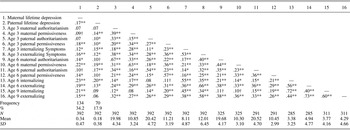
Descriptives and bivariate correlations for all study variables

Note: Depressive history assessed via the Structured Clinical Interview of DSM Disorders, maternal and paternal permissiveness and authoritarianism via the Parenting Styles and Dimensions Questionnaire, and child symptoms via the Child Behavior Checklist.
†p < .10. *p < .05. **p < .01.
Procedure
At the age 3 wave of assessments, both parents completed the Structured Clinical Interview for the DSM-IV (SCID; First, Spitzer, Gibbon, & Williams, Reference First, Spitzer, Gibbon and Williams1996; Williams et al., Reference Williams, Gibbon, First, Spitzer, Davies, Borus and Wittchen1992), from which a lifetime history of depressive disorders was ascertained. At the age 3 and 6 assessment waves, both parents completed the Parenting Styles and Dimensions Questionnaire (PSDQ; Robinson, Mandleco, Olsen, & Hart, Reference Robinson, Mandleco, Olsen, Hart, Touliatos, Perlmutter and Straus2001) as a measure of authoritarianism and permissiveness. At the age 3, 6, and 9 waves, both parents also completed the Child Behavior Checklist (Achenbach & Rescorla, Reference Achenbach and Rescorla2000, Reference Achenbach and Rescorla2001), from which their child's internalizing and externalizing symptoms were scored.
Materials
Lifetime history of depressive disorders
History of depressive disorders (major depressive disorder and dysthymic disorder) was determined from the nonpatient version of the SCID (First et al., Reference First, Spitzer, Gibbon and Williams1996) at the age 3 assessment. The SCID is among the most widely used diagnostic interviews, and its interrater reliability and procedural validity have been well documented (Williams et al., Reference Williams, Gibbon, First, Spitzer, Davies, Borus and Wittchen1992). The SCID interviews were conducted by master's-level clinicians and clinical psychology graduate students. Interrater reliability for a lifetime diagnosis of a depressive disorder was excellent (κ = 0.93). In the current sample, 134 (34.2%) mothers and 70 (17.9%) fathers met criteria for a lifetime depressive disorder. Both parents, where available, completed the SCID again when children were age 9. Forty-four mothers (11.2%) experienced an episode during the age 3 to 9 interval, 16 (4.1%) of which were first onsets, while 15 fathers (3.8%) experienced an episode, 5 (1.2%) of which were first episodes. Thus, of the parents in our sample who ever had a depressive episode, the majority of both mothers (66.7%) and fathers (78.6%) only had an episode prior to the beginning of the study. The effects of episodes after the onset of the study were not examined in the current study.
Parenting styles
Parenting styles at the age 3 and age 6 waves were assessed via the authoritarianism and permissiveness subscales of the PSDQ (Robinson et al., Reference Robinson, Mandleco, Olsen, Hart, Touliatos, Perlmutter and Straus2001), a widely used parent-report measure of parenting styles. Authoritarianism assesses parental behaviors of physical coercion, verbal hostility, and nonreasoning and punitive behaviors, and comprises 12 items (e.g., “I use physical punishment as a way of disciplining my child”). Permissiveness assesses the extent to which parents are overly indulgent toward their children, and comprises 5 items (e.g., “I give in to my child when the child causes a commotion about something”). Parents are asked “For each item, rate how often you exhibit this behavior with your child.” Response options range from 1 (never) to 3 (about half of the time) to 5 (always). The PSDQ has shown good internal consistency, agreement with informants, and convergent validity with child psychosocial functioning (Robinson et al., Reference Robinson, Mandleco, Olsen, Hart, Touliatos, Perlmutter and Straus2001; see Olivari, Tagliabue, & Confalonieri, 2013, for a review). In the current sample, at the age 3 and age 6 assessments, the Cronbach αs for mother/father permissiveness were 0.74/0.69 and 0.74/0.67, respectively. For mother/father authoritarianism, at the age 3 and age 6 waves, they were 0.75/0.77 and 0.74/0.76.
Child internalizing and externalizing symptoms
At the age 3 wave, internalizing and externalizing symptoms were assessed with the Child Behavior Checklist for Ages 1.5–5 (CBCL 1.5–5; Achenbach & Rescorla, Reference Achenbach and Rescorla2000). At the age 6 and 9 waves symptoms were assessed via mothers' and fathers' reports on the Child Behavior Checklist for Ages 6–18 (CBCL 6–18; Achenbach & Rescorla, Reference Achenbach and Rescorla2001). The CBCL 1.5–5 is a 100 item, and the CBCL 6–18 is a 119-item, parent-report checklist assessing emotional and behavioral problems in children. The internalizing and externalizing subscales show good internal consistency and convergence with interview-based symptom measures (Achenbach & Rescorla, Reference Achenbach and Rescorla2001). The CBCL 1.5–5 internalizing problems subscale consists of 36 items, while the externalizing subscale consists of 24 items. The CBCL 6–18 internalizing problems subscale consists of 32 items, while the externalizing subscale consists of 35 items. Each item is rated for the past 6 months on a scale from 0 (not true) to 2 (very or often true). For mothers, the age 3, 6, and 9 wave coefficient αs were 0.84, 0.87, and 0.86 for internalizing problems, and 0.90, 0.88, and 0.88 for externalizing symptoms, respectively. For fathers, the age 3, 6, and 9 wave coefficient αs were 0.83, 0.78, and 0.89 for internalizing problems, and 0.91, 0.89, and 0.94 for externalizing symptoms, respectively. Mothers' and father's reports showed moderate correlations across the age 3, 6, and 9 assessments for internalizing (r = .39, .51, and .43, respectively, ps < .001) and externalizing (r = .48, .60, and .51, respectively, ps < .001) problems. Mothers' and father's scores on each symptom variable were therefore averaged at each time point. At the age 3 wave, 392 mothers and 392 fathers completed the CBCL. At the age 6 assessment, 321 mothers and 295 fathers completed the CBCL. At the age 9 wave, 329 mothers and 313 fathers completed the CBCL. If scores for only one parent were available, that parent's scores were used, although this was only an issue for 26 cases at age 6 and 16 cases at age 9.
Regarding internalizing symptoms, based on the average of mothers' and fathers' reports of internalizing symptoms, 14 (3.6%), 20 (5.1%), and 26 (6.6%) participants, respectively, fell in the clinical or borderline range at ages 3, 6, and 9. Regarding externalizing symptoms, based on the average of mothers' and fathers' reports, 13 (3.3%), 29 (7.4%), and 23 (5.9%) participants fell in the clinical or borderline range at ages 3, 6, and 9, respectively.
Data analyses
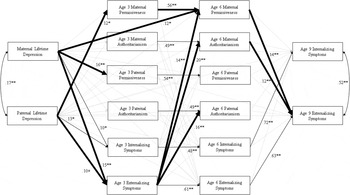
Analyses were conducted in MPlus 7.31. Analyses consisted of lagged path models. Analyses adjusted for the effects of other symptoms (e.g., age 3 externalizing predicting age 6 internalizing symptoms), thereby rendering our analyses quite conservative. Our model is depicted in Figure 1. All variables were covaried within each time point, with parental depressive histories being covaried with each other. All analyses initially adjusted for child sex and mother's and father's age; however, these were unrelated to any variables at the age 6 or 9 assessments, and were therefore dropped from our model. Differences in effects across child gender were examined via multigroup models in which the fit of a model where paths of theoretical interest are constrained to be equal across groups is compared to a model in which these paths are free to vary across groups.
Results relating paternal and maternal history of depression to parenting styles and child internalizing and externalizing symptoms at the age 3, 6, and 9 assessment waves. +p < .10, *p < .05, **p < .01. Covariances between endogenous terms refer to covariances on the error terms of those variables, although endogenous variable errors for age 3 and 6 variables are not depicted for visual clarity. Bold lines are those included in mediation analyses.

One concern is that parental lifetime depressive history was assessed concurrently with their parenting behaviors and their children's symptoms at the age 3 wave, and so the directionality of these relationships may not be clear, as both parenting and child symptoms may be confounded with parents' current depressive status. However, of our effective sample, at the age 3 wave, only 7 mothers (1.8%) and 3 (0.76%) fathers were depressed during the month prior to the assessment. The results were recomputed after excluding these currently depressed parents, but were identical to those reported here, and so they were retained in our sample. The results were also recomputed after excluding parents who had a first onset of depression during the study interval, but were identical to those reported here, and so these parents were retained in our sample. Thus, in almost all cases, parents' depression occurred before the assessments of parenting and child symptoms in the initial assessment wave.
As measures of goodness of fit, we present chi square (χ2), ratio of chi-square to degrees of freedom (χ2/df), comparative fit index (CFI), and root mean square error of approximation (RMSEA). Generally, a χ2/df of <2 (Carmines & McIver, Reference Carmines, McIver, Bohrnstedt and Borgatta1981), CFI values >0.90 (Hoyle & Panter, Reference Hoyle, Panter and Hoyle1995), and a RMSEA of <0.08 (Kline, Reference Kline1998) indicate acceptable fit. MPlus uses a bias-corrected bootstrapping procedure to estimate confidence intervals of indirect effects. Boostrapping is a nonparametric method based on resampling (5,000 in the current study) with replacement (Bollen & Stine, 1990; Shrout & Bolger, 2002). We present 95% confidence intervals as well as parameter estimates associated with the indirect effect. Estimates reported in Figures 1 are based on missing data being handled via full information maximum likelihood. For clarity, in Figure 1, the paths that were included in our mediation analyses are bolded. We retained nonsignificant paths so that results may be interpreted in the context of the effects of each variable.
Results
Descriptive statistics and bivariate correlations are presented for all variables in Table 1. Mothers' and father's depressive histories were positively correlated. Both maternal and paternal depressive history were associated with children's increased internalizing and externalizing symptoms at ages 3 and 6, although only maternal depressive history was associated with greater child internalizing and externalizing symptoms at age 9. Maternal depressive history was also associated with greater levels of paternal permissiveness, but only trended toward being associated with her own permissiveness. It was also associated with more maternal authoritarianism at age 6, and trended toward being associated with more paternal authoritarianism. Maternal depressive history was also positively associated with greater maternal and paternal permissiveness at age 6. Fathers' depressive history was positively associated with paternal authoritarianism at age 3, and with both their own and mothers' permissiveness. Finally, fathers' depressive history was associated with greater levels of their own authoritarianism at age 6, and trended toward a positive association with mothers' authoritarianism, while also correlating significantly and positively with mothers' permissiveness at age 6, but only trending toward an association with their own permissiveness. Overall, correlations support the possibility of effects of each parent's depressive history on the other's parenting behaviors.
We also examined the relative stabilities of symptoms from one time point to the next. Contrast comparisons showed that from age 3 to 6 compared to age 6 to 9, there were no significant differences in the stability of externalizing symptoms, t (780) = 1.39, p = .17, although internalizing symptoms were more stable from age 6 to 9 compared to from age 3 to 6, t (780) = 4.37, p < .001.
Child gender analyses
Constraining all regression paths to be equal across child genders yielded the following fit statistic: χ2 (62, N = 392) = 91.191, p = .01, χ2/df = 1.45, CFI = 0.98, RMSEA = 0.034. Allowing them to vary across child genders yielded the following fit statistics: χ2 (38, N = 392) = 58.536, p = .02, χ2/df = 1.654, CFI = 0.99, RMSEA = 0.037. A chi-square difference test revealed that a model in which paths are free to vary across child gender does not fit the data significantly better than a model in which paths are constrained to be equal, Δχ2 (24) = 32.66, p = .11, indicating that our paths of theoretical interest do not vary significantly as a function of the gender of the child.
Parental depression, parenting styles, and child psychopathology
Given the lack of differences for child gender, analyses were collapsed across male and female children. Our model (Figure 1) showed the following acceptable fit indices: χ2 (25, N = 392) = 40.82, p = .02, χ2/df = 1.63, CFI = 0.99, RMSEA = 0.04. Figure 1 presents the standardized parameters for the final models. Maternal and paternal depressive history were modestly, but positively, correlated. Maternal depressive history was unrelated to her parenting styles at the age 3 wave, but predicted higher levels of paternal permissiveness, as well as greater child internalizing and externalizing symptoms in the age 3 wave. Maternal depressive history also predicted increased maternal permissiveness in the age 6 wave. Paternal depressive history was unrelated to paternal permissiveness and authoritarianism at the age 3 wave. However, it was independently associated with elevated maternal permissiveness at the age 3 wave, as well as increased child internalizing symptoms at age 3, and trended toward predicting increased child externalizing symptoms at age 3. Neither parents' depressive history predicted changes in fathers' parenting from age 3 to 6. However, child externalizing symptoms at age 3 predicted increases in fathers' authoritarianism in the age 6 wave, as well as increases in maternal permissiveness and authoritarianism in the age 6 wave. Finally, the effects of maternal permissiveness and authoritarianism at age 6 on child externalizing symptoms at age 9 appeared to cancel each other out. That is, when both paths were included in the model, neither was significant. However, trimming either resulted in the other becoming significant. As such, indirect effects predicting age 9 child externalizing symptoms are reported both when only an effect of only maternal permissiveness was included, and when only an effect of maternal authoritarianism was included.
We also computed a series of contrast comparisons to test whether the effects of maternal versus paternal history of depression on their permissiveness at age 3 significantly differed from each other. No significant differences emerged (all ps > .20), suggesting that while there was a significant effect of each parent's depressive history on the other parents' permissive parenting, it was not significantly greater in magnitude than the nonsignificant effects of the other parent's own depressive history.
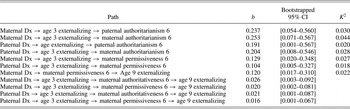
Table 2 reports the results from bootstrapped indirect effect. The results showed significant indirect effects from maternal depressive history to age 6 maternal permissiveness and authoritarianism as well as to age 6 paternal authoritarianism via child externalizing symptoms at age 3. Similarly, there were significant indirect effects of paternal depressive history to age 6 maternal authoritarianism and permissiveness as well as to paternal authoritarianism via child externalizing symptoms at age 3. There was also a significant indirect effect of maternal depressive history to age 9 child externalizing symptoms via maternal permissiveness at age 6.
Results of mediation analyses

Note: Estimates of indirect effects are unstandardized. Dx, Depressive history; K 2, effect size of the indirect effect.
The results also showed several serial mediation effects (Table 1). Specifically, there were indirect effects of both maternal and paternal depressive history on age 9 child externalizing symptoms via age 3 child externalizing symptoms to age 6 maternal permissiveness as well as maternal authoritarianism. Taken together, mediational analyses in both mothers and fathers' models suggest multiple transactional relationships over time between parental depressive history, parenting styles, and child externalizing symptoms.
Discussion
This study examined the effect of parental depressive history on parents' own and their coparents' authoritarianism and permissiveness toward their children at ages 3 and 6 years, and the transactional relationship between these parenting behaviors and child internalizing and externalizing symptoms at the ages of 3, 6, and 9. We were able to examine these relationships over a fairly long developmental period, thereby allowing us to examine predictors of change in our variables over time. We also included both mothers' and fathers' reports of child symptoms at each time point, which diminishes the likelihood that effects were inflated due to method variance. To our knowledge, this is the first study to simultaneously examine the role of each parent's depressive history on the other parent's parenting, while also integrating these factors with the development of child psychopathology from early to late childhood.
In fathers, and consistent with prior literature (Wilson & Durbin, Reference Wilson and Durbin2010), a history of a depressive disorder was associated with greater authoritarianism, but was not significantly associated with their permissiveness, which was predicted by their coparent having a history of depression. In parallel, while mother's depressive history was unrelated to her parenting behaviors in the age 3 wave, paternal depressive history was associated with greater maternal permissiveness. However, we should acknowledge that the magnitude of the effect of paternal versus maternal depressive history on the other's permissiveness did not significantly differ from each other. Moreover, maternal depressive history predicted increases in maternal permissiveness from the age 3 wave to the age 6 wave, while paternal depressive history showed a similar, but trend-level, effect.
In mothers, only her own history of depression was related to elevations in child externalizing symptoms at age 3, although there was a trend-level effect of fathers' depressive history as well. Fathers' permissiveness at the age 3 wave predicted increases in child externalizing symptoms from age 3 to 6, while child externalizing symptoms at age 3 predicted increases in paternal authoritarianism in the age 6 wave. However, we did not find any effects of paternal parenting in the age 6 wave on child psychopathology at age 9. Child externalizing symptoms at age 3 also predicted increases in mothers' permissiveness and authoritarianism in the age 6 wave. While mothers' parenting behaviors in the age 3 wave did not predict child symptoms at age 6, both parenting styles independently predicted increases in child externalizing symptoms at age 9. This may suggest that in older children, permissive and authoritarian parenting may additively influence their children's externalizing symptoms.
Parental depressive history and parenting styles
The results are partially consistent with a large body of literature demonstrating the effects of parental depressive history on parenting behaviors. In both parents, a history of depression was not significantly associated with their own permissive parenting at the age 3 wave, although mothers' history did predict increases in her own permissiveness from the age 3 to the age 6 wave. However, a history of depression in the mother predicted fathers' permissiveness in the age 3 assessment, whereas a history of depression in the father predicted mothers' permissiveness in the age 3 wave. Findings in both parents support the role of the coparent's depressive history in understanding each parent's parenting styles, in particular permissiveness, over and above their own depressive history.
The reasons for this, and especially the lack of effect of parents' depressive history on their own permissiveness in the age 3 assessment, are speculative and cannot be gleaned from the data. Bivariate results showed positive correlations between each parent's parenting, and that parental depression was associated with elevated negative parenting styles in the age 3 wave. It is therefore possible that a parent with a history of depression is showing more adverse parenting behaviors, which are in turn being modeled by, or explicitly taught to, the other parent. An alternative explanation, which is compatible with this first possibility, is that parents with a depressive history experienced more negative parenting themselves, which likely contributed to their depression risk. Furthermore, it is well established that parenting is transmitted cross-generationally (e.g., Beaver & Belsky, Reference Beaver and Belsky2012; Belsky, Conger, & Capaldi, Reference Belsky, Conger and Capaldi2009). Thus, depressed parents who experienced negative parenting themselves, may engage in those parenting behaviors with their own children, which are then modeled for, or taught to, the other parent.
Yet another explanation may be that coparenting a child with a partner who has a history of depression may be stressful and burdensome for that parent. That is, even though very few parents in our sample were currently depressed at the age 3 wave, those with a history of depression may show stable traits, such as high levels of neuroticism, self-criticism, or other elevated depressogenic personality or cognitive traits (see Klein, Kotov, & Bufferd, Reference Klein, Kotov and Bufferd2011; Kopala-Sibley et al., Reference Kopala-Sibley, Kotov, Bromet, Carlson, Danzig, Black and Klein2016; Kopala-Sibley & Zuroff, Reference Kopala-Sibley and Zuroff2014), or other factors that rendered them vulnerable to depression and that also impose a burden on the other parent. This may also explain the specificity of our effects to permissiveness; it is possible that when coping with the traits or behaviors associated with a coparent's depressive history, parents may have less energy to exert control over their children. Another possibility is that a depressive history in one parent may undermine the support they are able to provide the other, or that it leads to increased marital conflict (Krishnakumar & Buehler, Reference Krishnakumar and Buehler2000), thereby influencing that parent's parenting styles. This possibility would be consistent with spillover models of marital conflict that propose that adverse marital behaviors influence how each parent acts toward the child (see Gerard, Krishnakumar, & Buehler, 2006; Katz & Gottman, 1996). Assortative mating (Nordsletten et al., Reference Nordsletten, Larsson, Crowley, Almqvist, Lichtenstein and Mataix-Cols2016) may also offer an explanation. That is, men and women with depressive histories are more likely than those without to pick mates with certain characteristics. It is possible that this extends to parenting behaviors, in that men and women with a depressive history are more likely to marry more permissive or authoritarian spouses. Should our findings replicate in future research, there are multiple potential avenues through which coparent depression may affect the other parent's parenting that should be investigated in future research.
Parental depressive history, parenting, and child psychopathology
The results are also consistent with prior literature linking parental history of psychopathology to child psychopathology (see Downey & Coyne, Reference Downey and Coyne1990; Goodman & Gotlib, Reference Goodman and Gotlib1999), as well as evidence that parenting behaviors may mediate this effect (Downey & Coyne, Reference Downey and Coyne1990). Our findings also provide further support for models of coercive parenting (Granic & Patterson, Reference Granic and Patterson2006; Patterson, Reference Patterson1982) and transactional models of parenting and child psychopathology (Belsky, Reference Belsky1984; Lytton, Reference Lytton1990; Plomin et al., Reference Plomin, DeFries and Loehlin1977; Scarr & McCartney, Reference Scarr and McCartney1983). In fathers, results suggest a pathway from both parents' depressive history to paternal permissiveness, which in turn contributes to increases in child externalizing symptoms 3 years later. At the same time both parent's depressive histories were associated with greater child externalizing symptoms at age 3, which in turn predicted increases in paternal authoritarianism, and in both maternal permissiveness and authoritarianism, in the age 6 assessment, with these parenting styles subsequently predicting increases in child externalizing symptoms at age 9.
We should also note the lack of effects of parenting on child internalizing or vice versa, which is largely consistent with prior literature that has often failed to show an effect of child internalizing symptoms on parenting when adjusting for child externalizing symptoms (Hipwell et al., Reference Hipwell, Keenan, Kasza, Loeber, Stouthamer-Loeber and Bean2008; Reitz, Deković, et al., Reference Reitz, Deković and Meijer2006; Reitz, Deković, Meijer, et al., Reference Reitz, Deković, Meijer and Engels2006). The reasons for the lack of effects of parenting on child internalizing symptoms (McLeod, Weisz, et al., Reference McLeod, Wood and Weisz2007; McLeod, Wood, et al., Reference McLeod, Weisz and Wood2007) are unclear from the current study. Although zero-order correlations supported longitudinal bivariate associations of maternal and paternal permissiveness as well as maternal authoritarianism with child age 6 internalizing symptoms, this association was nonsignificant when adjusting for baseline child internalizing and externalizing symptoms. It is also possible that the lack of effects is due to the fact that risk for depression only begins to increase in adolescence. As such, we may have found more effects of parenting on internalizing symptoms in an older sample. We also did not find any differences in effects across gender. These, too, may only emerge in early adolescence, as it is during this period that the gender difference in rates of depression emerges (Hankin et al., 1998). It is therefore possible that parenting may have a more pronounced effect in females relative to males at this age. Another finding to note is that parental depressive history was associated with elevated levels of internalizing symptoms at the age 3 wave, which in turn predicted age 6 internalizing symptoms. This may indicate a direct effect of the intergenerational transmission of depression.
The results pertaining to child externalizing symptoms suggest that, first, a history of depression in either parent confers an increased likelihood of externalizing symptoms in children, although we cannot know from our data if this transmission is attributable to environmental, genetic, or other biological mechanisms, as there is evidence for the contribution of each (e.g., Harold et al., Reference Harold, Rice, Hay, Boivin, Van Den Bree and Thapar2011; Kim-Cohen, Moffitt, Taylor, Pawlby, & Caspi, Reference Kim-Cohen, Moffitt, Taylor, Pawlby and Caspi2005; Silberg, Maes, & Eaves, Reference Silberg, Maes and Eaves2010; Singh et al., Reference Singh, D'Onofrio, Slutske, Turkheimer, Emery, Harden and Martin2011). The difficult behaviors characterizing externalizing symptoms in children may then result in some mothers attempting to be more controlling (authoritarian), while other mothers may become more permissive, while still others may attempt to use both parenting styles, or perhaps vacillate between the two in an attempt to alter their child's externalizing behaviors. These attempts appear to be unsuccessful given that we found both of these parenting styles subsequently predicted increases in child externalizing symptoms 3 years later. Similarly, a history of depression in both parents is associated with risk for elevated child externalizing symptoms at age 3, albeit at a trend level for the effect of paternal depressive history, which in turn are related to increases in paternal authoritarianism. This suggests, consistent with Patterson's (Granic & Patterson, Reference Granic and Patterson2006) model, that fathers may respond to children's difficult behaviors by trying to control their child.
There was also evidence of differential relationships between parental depressive history, child psychopathology, and parenting at different ages, suggesting the importance of developmental timing in understanding our results. Child externalizing symptoms at age 3 predicted parenting styles at age 6, but not vice versa, whereas there were significant effects of parenting at age 6 on child externalizing symptoms at age 9. Some prior literature has examined the importance of the developmental timing of adverse parenting experiences for child psychopathology. While much theory suggests that early adverse experiences should have more potent effects on psychological development than later experiences (e.g., Manly, Kim, Rogosch, & Cicchetli, Reference Manly, Kim, Rogosch and Cicchetti2001), Keiley, Howe, Dodge, Bates, and Pettit (Reference Keiley, Howe, Dodge, Bates and Pettit2001) also note that in later childhood, children are better able to reflect consciously on the meaning of their experiences and therefore draw inferences about themselves based on these experiences, suggesting that experiences in later childhood may be at least as important as those in earlier childhood. Keiley et al. (Reference Keiley, Howe, Dodge, Bates and Pettit2001) found that later-harmed children showed greater externalizing symptoms compared to those experiencing harm earlier. In addition, Manly et al. (Reference Manly, Kim, Rogosch and Cicchetti2001) reported that maltreatment experienced in later childhood predicts externalizing psychopathology over and above the effect of early childhood maltreatment, again highlighting the importance of developmental experiences beyond early childhood. While further research is needed to clarify this issue, our results suggest that parenting appears to have a greater impact on child externalizing symptoms in middle to late childhood, whereas child externalizing symptoms impact parenting earlier on.
We also note that while the current study focuses on transactional simple main effects between parenting and psychopathology, there may be interactive effects between each parent's behaviors toward their child. For instance, some studies have found protective effects of positive father–child interactions on child outcomes when mothers are depressed (e.g., Goodman, Brogan, Lynch, & Fielding, 1993; Kahn, Brandt, & Whitaker, 2004; Tannenbaum & Forehand, 1994; but see also, e.g., Carro, Grant, Gotlib, & Compas, 1993; Mezulis, Hyde, & Clark, 2004). This issue should be further investigated in future research.
These results clinically further support the use of parenting interventions to ameliorate risk for psychopathology in children. However, they also suggest that parenting interventions may benefit from taking into consideration both parents' depressive history when understanding each parent's parenting. They also indicate that parent–child relationships appear to be more influenced by child externalizing than internalizing symptoms. As such, clinicians may wish to particularly attend to the parenting behaviors of parents of children who show behavioral problems, as both the parenting behaviors and the externalizing symptoms themselves may be ameliorated via directly treating the symptoms in the child, or the behaviors of the parent.
Limitations and future directions
Although this study had several strengths, including repeated measurements at three time points over the course of 6 years, using a fairly large sample, studying fathers in addition to mothers, and including both parents' reports of their child's symptoms, several limitations should be noted. Parenting behaviors and child symptoms were both assessed via parent report, which may have inflated associations due to shared method variance. However, this concern is mitigated, first, by the inclusion of both parents' reports of children's symptoms and, second, by the use of clinical interviews to assess parental lifetime depressive history. Despite this, future studies may benefit from using observational measures of parenting and interview-based measures of children's symptoms. We also cannot know if our results would extend later into childhood, or into adolescence, or generalize to interview-based assessments of child symptoms, or to diagnoses. In addition, we did not examine parent reports of their parenting behaviors at age 9, and so could not further examine the transactional relationship between parenting and child psychopathology from age 6 to 9.
We should note that item content on the CBCL is somewhat different at age 3 compared to ages 6 and 9. Tus, means are not directly comparable, and this may have influenced rank-order stability of participants, which may have in turn influenced the effects of our parenting measures on child symptoms. Finally, we cannot completely rule out the possibility that new parental depressive episodes between the age 3 and 9 assessments may have further impacted parenting styles, over and above lifetime depressive history.
Conclusion
We found that parental depressive history is associated with greater permissiveness in the other parent, over and above that parent's own depressive history. The results also highlight the reciprocal relationships between parenting and child psychopathology, in particular in relation to externalizing symptoms. Our findings also provide further evidence regarding the effects of parental as well as coparent depressive history on their own and their coparent's parenting. The present study helps to elucidate, and support the further investigation of, the complex interrelationships between parental depressive history, parenting, and child psychopathology. A better understanding of the etiology of parenting behaviors as well as their transactional relationships with child psychopathology is necessary for the further development of strategies to influence these important outcomes.