





Introduction
Landed estates had an important role in organising everyday life in the English countryside throughout the 19th century. Housing provision was one of the key areas where estates had a great deal of responsibility as members of various social groups resided in estate property or had a certain level of dependency on landowners. Most of those housed by agricultural estates such as land agents, blacksmiths, gamekeepers, farm bailiffs or agricultural labourers, worked for the estate. This paper focusses on those working in agriculture and residing in estate cottages. The issue of agricultural labourers’ housing conditions became part of the elite discourse in England by the late 18th century and remained important for decades.Footnote 1 During this era, large agricultural estates provided employment and accommodation for their labourers in many parts of the country. This meant that the quality of housing depended on the estates themselves, and the patterns of housing mobility and access to housing were also affected by estate policies. Some of the lands owned by large estates were cultivated by tenant farmers and their workers; tenant farmers also had a certain level of responsibility in providing housing for the agricultural population.Footnote 2
Contemporary works on estate housing often emphasized the poor sanitary conditions to be found in traditional cottage accommodation.Footnote 3 Several authors argued for redesigned or new dwellings, often from a practical point of view: healthier labourers were likely to be more productive. In order to convince landowners to improve their cottages, several plans and calculations were published.Footnote 4 By the end of the 19th century, improvements had been carried out by many large estates, often resulting in the construction of model cottages or entire model villages; these improvements were often driven by paternalism.Footnote 5 On the other hand, consequences of the so-called poor law regime hindered investments in housing for many farmers and estate owners in the mid-19th century, and later, the agricultural depression and the industrial development of urban centres discouraged several rural housing providers from improving their housing stock.Footnote 6
The role of large estates in organising village social and economic life has been explored in studies in Berkshire and Nottinghamshire by Michael Havinden and David Beckingham.Footnote 7 Recent research has brought to the fore the central importance of land agents in managing broad social and cultural aspects of landed estates. John Claudius Loudon noted in 1825 that the estate manager should have a knowledge of land surveying, woodland planting, mechanics, ‘a competent knowledge of rural architecture’ and a ‘thorough knowledge of accounts’. In addition, he emphasised that the agent should be a ‘man of good character, of upright principles, and conciliatory manners’. This allowed him to be ‘a common counsellor and peace-maker’ when dealing with the many ‘trifling disputes’, which arose between tenants and ‘occupiers of adjoining land’ and which could be sorted out before they resulted in ‘serious quarrels and lawsuits’.Footnote 8 Sarah Webster’s 2007 study demonstrates effectively the professionalisation of land agency in her analysis of the role of land agents on the Egremont estates in Sussex and Yorkshire 1770–1835 including the nationally important firm of Nathaniel Kent, John Claridge, and William Pearce, which was based in London.Footnote 9 James Bowen showed in 2010 how the land agent James Loch was able to rationalise field boundaries, build model farms, and improve drainage on the Marquis of Stafford’s estate at Lilleshall in Staffordshire.Footnote 10 Carol Beardmore’s more recent research has demonstrated the wide range of roles fulfilled by William Castleman who was land agent for Marquis of Anglesey’s Dorset and Somerset estate 1814–44. She provides convincing evidence of the crucial role of the land agent as a mediator between the landowner and his tenants, the negotiation of farm leases, the provision of education, and more broadly in terms of social relationships and social control.Footnote 11 Samantha Shave examined in 2020 the relationship between land agents and the old poor laws using the correspondence of William Spencer, a land agent at Sapcote in Leicestershire, to investigate his role in the introduction of a deterrent workhouse system in the early nineteenth century.Footnote 12
The question of housing mobility, especially the consequences of the poor law regimes which resulted in the so-called open and closed settlement model, has also received considerable attention.Footnote 13 Changes to the housing stock at estate villages in the 18th and 19th centuries were analysed by contemporariesFootnote 14 and by authors of the 20th century, from the perspective of housing quality and also from an architectural point of view.Footnote 15 Even though rural housing has become a key topic in British rural studies from the 1970s, the changing housing situation in estate villages and the role of large agricultural estates have received relatively little attention. Research related to housing on large estates has primarily focussed on architectural designsFootnote 16 and changes to the landscapeFootnote 17 brought about by 18th and 19th century improvements. However, framing the influence of large estates on local societies as a rural housing issue can still provide additional insights into the rural history of England.
This paper aims to contribute to earlier discussions concerning rural housing and the role of landed estates through a case study of the 19th and early 20th century Manvers estate in Nottinghamshire. Following an introduction to the estate, we first focus on how the poor laws and the open-closed settlement model affected housing mobility patterns in the county. Second, we assess the ways access to and provision of housing were organised, and finally, we consider the role of the estate in housing improvement and maintenance. Our study examines the role of some key actors, such as the land agent, estate owner, and tenant farmers. We also demonstrate how archival material of local relevance can be utilised for analysing housing issues in rural history. The Manvers collection held at the Manuscripts and Special Collections of the University Archives (University of Nottingham) consists of twelve catalogues, ranging from the 14th century until the 21st century. Some of the records in the collection are related to housing, cottages, and improvements specifically. Another group of relevant items providing insights into access to housing at the Manvers estate are tenancy and lease agreements for cottages and farms. Some of the surveys, account books, and reports contain quantitative information on the cottages and their inhabitants, such as the number and condition of dwellings and household composition.
The agent’s outgoing letter book and correspondence are useful to reconstruct the role of the estate in organising housing provision; one of the shortcomings of this material is the fact that only the letters written by the agent are included. While most correspondence was between the agent and the landowner, some other parties also appear in these letters, including representatives of certain institutions (for instance, accountants, vicars, poor law board members), and persons contracted to or working at the estate (for example, tenant farmers, farm bailiffs, and gamekeepers).Footnote 18 A perspective from below is provided by the recollections and drawings of the author Christopher Thomson who lived in a village on the estate and who published The Autobiography of an Artisan in 1847.Footnote 19
The Manvers estate at Thoresby
The Thoresby estate for most of the nineteenth century was owned by two men, the 2nd and 3rd Earl Manvers. Charles Herbert Pierrepont, 2nd Earl Manvers (1778–1860), who had served in the navy with Nelson in the Mediterranean during the Napoleonic Wars, retired on half pay in 1803 to look after the Pierrepont family estates. He was MP for Nottinghamshire 1801–1816, voting to oppose parliamentary reform in 1810, and to oppose Catholic relief in 1812 and 1816. He succeeded to the title and the Thoresby estate in 1816, focussed on the management of his estates, and was recognised as ‘a good landlord’, until his death in 1860.Footnote 20 He was succeeded by his second son Sydney William Herbert Pierrepont, 3rd Earl Manvers (1825–1900) who was MP for South Nottinghamshire 1852–1860 and a magistrate and Deputy Lieutenant for Nottinghamshire. Unfortunately, no private papers for the third earl appear to have survived, it is thought they were sold in the 1940s or 1950s or possibly destroyed. He was succeeded by his son the 4th Earl in 1900.Footnote 21 During the 19th and early 20th century, four land agents worked for the estate, which indicates a great continuity of estate management. Willam John Pickin held the office from the early nineteenth century until his death in 1860,Footnote 22 when John Horncastle took the post over and stayed in this position until 1874. He was followed by his son, Henry Horncastle,Footnote 23 who was replaced by Robert Walter Wordsworth (1883–1914).Footnote 24
The ecclesiastical parish of Edwinstowe was one of the largest in Nottinghamshire in 1853 extending to 18,644 acres with a population of 2,635. The parish consisted of five townships the largest being Edwinstowe (with 1006 inhabitants and 5,815 acres), and Earl Manvers was described as ‘lord of the manor, and principal owner’ although ‘Mr Walker and Mr Joseph Peatfield have estates here, with several other smaller owners’ so the township although partially controlled by Earl Manvers was an open rather than a closed village.Footnote 25 Two other townships, Budby and Perlethorpe, were wholly owned by Earl Manvers. Budby was described in 1832 as ‘a handsome rural village of Gothic cottages, at the south-west corner of Thoresby Park, under a thickly-wooded acclivity’.Footnote 26 In 1854, it had 147 inhabitants and 2,000 acres of land. Perlethorpe had fewer people (80) but was greater in extent (2604 acres) ‘nearly the whole of which is in the occupancy of its noble owner, and consequently the inhabitants are in his employ’.Footnote 27 Both Budby and Perlethorpe were closed villages dominated by a single landowner.
Through the nineteenth century, the main residence on the Thoresby estate was Thoresby Hall. This was rebuilt by John Carr of York and completed in 1772. In 1864, the Third Earl, four years after he inherited the estate, had this house demolished and built a massive new Hall between 1865–75 to the designs of Anthony Salvin. This has been described as ‘far more ambitious than any other of the Victorian age in the county… and a lasting monument to the self-confidence of at least one section of the C19 nobility’.Footnote 28 English Heritage describe it as ‘a huge 3 storey ashlar Elizabethan style house with a five storey central tower. All very irregular and elaborate’.Footnote 29 The estate also built and refurbished churches and some local schools, and the cottages which are the subject of this paper. The closed estate village at Budby is thought to have been built as a model village for the 1st Earl Manvers between c. 1807 and 1812 (Figure 1). This is the period when the 2nd Earl was looking after the estate. They are described by Pevsner as ‘Gothick cottages and houses, generally stuccoed and three bays, mostly of two storeys and painted pink, with curved porches (carried up through two storeys in some examples) and Gothic glazing detail’. Cottages and houses of a similar design are found on other parts of the estates owned by Earl Manvers, and they were probably designed by William Wilkins Senior. Clare Hartwell notes that there are ‘some affinities with designs in Joseph Gandy’s The Rural Architect’ of 1805.Footnote 30 There is very little information about the architects used to design other estate cottages although some almshouses at Perlethorpe were designed about 1890 by the Nottingham architect W. O. Hickson.Footnote 31
Sherwood house – a model cottage in Budby (2024).
Source: Photograph by the authors.

A remarkable account of life in the village of Edwinstowe is provided by Christopher Thomson (1799–1871) in his The Autobiography of an Artisan. He wrote this while living in Edwinstowe, and it was published in London and Nottingham in 1847.Footnote 32 Thomson dedicated his work ‘To the artisans and labourers of England, fellow-workmen in the holy cause of self-elevation, and to the friends of the industry of England, of whatever rank or station’. Thomson was born in Hull in 1799 and had a wide range of lowly paid jobs including working at sea and as a veneer sawyer in Hull. For many years, he was a ‘strolling player’ travelling from village to village acting in plays at public houses and in barns. By 1829, he was married with a young family and decided he could not make enough money as an actor. Friends from Edwinstowe, the shoemaker Mr Reuben Trueman and small landowner Mr Joseph Peatfield, suggested he became a house painter. Thomson noted that ‘with an increasing family, a settled home offered more domestic comfort than I had found upon the stage. For several months, we were content to live in lodgings; but we afterwards rented a house, and enjoyed the consequent advantages’.Footnote 33 He eventually settled in the village in 1832.Footnote 34
Thomson was an advocate of self-help and established a village library for workers. He was also a keen supporter of the Odd Fellows movement, a friendly society which for a small subscription provided help in times of adversity or illness. He emphasised that the local Birklands and Bilhagh ‘Lodge which has been established at Edwinstowe has been of essential service to the villagers, for it has raised the drooping spirits of the labourers, who saw no refuge for them in sickness or in adversity, save the Union Workhouse; by small savings they have purchased a certain dependence, and now they feel themselves rising into manliness’.Footnote 35
As Edwinstowe was an open village, and he had friends who could assist him with finding lodgings and a cottage, he soon found accommodation. He was also helped by a wealthy local resident who rented Edwinstowe Hall from Earl Manvers: ‘It was my good fortune, soon after settling here, to find a true friend and patroness, in the Countess of Scarbrough. Her desire to procure me employment, and to administer comfort to my family, has been, and still is, of essential service to me…’ She has been ‘the friend of all conditions, in the village and its neighbourhood’.Footnote 36 Although Thomson was pleased to find accommodation, he stresses in his preface that the conditions were cramped and not ideal for an artisan author who had to snatch moments when he could write. ‘With a family of seven children around him – some of them young ones – their merry laugh, and sometimes tearless cries, have been the constant companion of his pen’. He pointed out that ‘Although renting a comfortable cottage’ he could not ‘afford the luxury of a retired nursery’ and ‘the necessities of a small cottage’ forced his children ‘to indulge their studies of music and singing in the same room, – so that often four voices, and a German flute, have been employed around the same three-legged deal table at which the Author was writing’.Footnote 37
In addition to his enthusiasm for self-help and education Thomson was a keen landscape artist and published several lithographs in the 1860s, with accompanying text. One tellingly juxtaposes his depiction of a picturesque cottage in Edwinstowe in 1857 (Figure 2) with the reality of life in the cottage. He writes that such picturesque cottages ‘were more agreeable to look at than pleasant to live in’ describing ‘cold clay floors, want of room, want of height’ rain coming in through the roof, and complete lack of comfort. He contrasts these picturesque cottages, which had recently been demolished, with the ‘group of more modern cottages on the opposite side, erected by the good Earl Manvers for the use of his workmen, where comfort and cleanliness have each a local habitation, and where useful gardens and potato plots’ have been provided. He concluded that Edwinstowe ‘is a little modernized’, but ‘in every way it is more healthful’.Footnote 38
Depiction of mid-19th century Edwinstowe.
Source: Christopher Thomson (1868) Edwinstowe, Notts, [1857] private collection.

Poor laws and their consequences – the open–closed settlement model
There is a large body of literature on the evolution and organisation of the poor relief system. As most of these works have shown, various interdependencies arose on the local level: the poor laws, local social composition, migration patterns, and landownership had significant impacts on each other, which resulted in the appearance of open and closed villages. These processes have been analysed in detail leading to valuable reflections on the poor relief system’s impact on housing issues, especially on housing mobility, housing provision, and quality of dwellings. During the 1820s and early 1830s, discussions about a possible reform to the old poor law in order to reduce parish expenditures were underpinned by local-scale observations and experiments, some of them carried out in Nottinghamshire.Footnote 39 Before the 1830s, administration of the system was the responsibility of parishes; however, the Poor Law Amendment Act of 1834 aimed to organise parishes into poor law unions. Another goal of the Act was to reduce the number of outdoor recipients and to make workhouses the primary sites for poor relief.Footnote 40 As scholars have pointed out, effects of the reform only became apparent from the second half of the 19th century.Footnote 41 This was partly due to the initial opposition by some influential figures such as members of the local landed elite or members of the church.Footnote 42 By the early 1800s, contemporaries distinguished ‘open’ and ‘close’ villages:Footnote 43 open villages were characterised by a large number of landowners, while closed villages were in the hands of a very few estates (usually one or two). While in the case of open villages, the population and number of houses grew from the 1750s usually until the 1850s, the population of closed villages was rather stable throughout the same period, as landowners wanted to keep poor relief contributions low.Footnote 44
However, not long after passing the Poor Law Amendment Act of 1834, another reform was seen necessary by various interest groups. The main concern was that even though poor law unions became responsible for organising the poor relief, parishes remained the financial unit, meaning that the contribution paid was connected to the number of local recipients. This was very much in favour of the closed parishes and inflicted high financial burdens on open ones. Debates around this issue resulted in the Union Chargeability Act of 1865, which aimed to establish a more equal system, by making all parishes (open and closed) within a poor law union responsible to maintain the system financially. There has been debate among historians whether the new act had an impact on the housing stock; before the act pulling down cottages was relatively common, while in the second half of the 19th century, construction works became visible in certain parts of the country.Footnote 45
The distinction between open and closed villages became an important topic among historians and historical geographers following the research of Dennis R. Mills published from the late 1950s.Footnote 46 Several authors applied Mills’s terminology; however, critiques of the open-closed settlement model also appeared in the literature. The debate was mainly around the interrelatedness of landownership and the transformation of local societies – one of the main elements of the open-closed settlement model elaborated by Mills. While a number of academics argued that the structure and characteristics of local societies (including housing mobility and housing conditions) were affected by the number of landowners, others found that the distinction between open and closed settlements was not consistent in this sense and the model seemed to hide the variety of local circumstances.Footnote 47 A critical re-reading of Mills’s model from a theoretical point of view also appeared in the literature. This emphasized the need to analyse the interests and power relations of actors (such as landowners and their agents) through their positionality in order to understand the differences between open and closed villages and the effects of poor laws on housing mobility.Footnote 48
The poor law system undoubtedly had an impact on the provision of rural housing. The quality of dwellings may have declined in some open parishes by the mid-19th century. While in closed villages the local housing stock was controlled by a few owners (or their tenant farmers), in some of the open villages speculative investors appeared who let poor quality dwellings to families.Footnote 49 These were in many cases overcrowded and not properly maintained.Footnote 50 However, the quality of estate cottages in closed villages was not necessarily better until the second half of the 19th century. Short-term agreements often meant that tenant farmers avoided investments in permanent improvements of both dwellings and land.Footnote 51
Patterns of housing mobility and building works were under the strict control of landowners in the case of closed villages, and this is reflected in historical census data. MillsFootnote 52 provides a list of over a hundred Nottinghamshire settlements based on a report from 1848, about half of were classified as open and the other half as closed settlements.Footnote 53 Out of the 109 Nottinghamshire villages listed by Mills,Footnote 54 14 belonged to the Manvers family, half were classified as open and the other half as closed villages (Figure 3). While the population of open villages in the county grew from 41,000 inhabitants in 1801 to 194,000 by 1891, closed villages saw a less intense, yet significant population increase as the number of inhabitants grew from 11,000 inhabitants in 1801 to 19,000 by 1891.
Open and closed villages in Nottinghamshire.
Source: Drawn by Elaine Watts, based on Mills (1973) and archival sources.

Figure 3. Long description
A map of Nottinghamshire displaying the locations of open and closed villages. The map includes a legend indicating Manvers Estate locations, with numbers 1 to 15 corresponding to specific locations such as Gamston, Holme Pierrepont, and Sneinton. The map uses different symbols to represent closed, open, and not listed Manvers Estates. Key locations like Nottingham City and The Workhouse in Southwell are labeled. The River Trent is also marked on the map. The map shows the distribution of these villages across the region, with closed villages represented by black circles and open villages by grey circles. The dashed lines outline the boundaries of the areas under consideration.
Besides landownership and the poor law regime, two major processes affected settlement-level population changes in England and in Nottinghamshire in the second half of the 19th century. First, agricultural depression from the 1870s brought about a decline in the profitability of agriculture. In general, large estates decided to keep the rent paid by their tenant farmers as low as possible and to maintain the level of farm labourers’ wages. Second, the rapid expansion of industrial employment in urban centres attracted rural inhabitants, who decided to leave their villages.Footnote 55 In Nottinghamshire, the intense population growth of open villages was mainly a result of the industrial development in Nottingham and neighbouring villages. While the majority of the closed villages in the county show rather stable population numbers throughout the 1800s, a couple of them were sites to model village improvements in order to house coal miners from the 1860s. Annesley (288 inhabitants in 1861, 1202 inhabitants in 1871) and Newstead (108 inhabitants in 1861, 200 inhabitants a decade later and 967 inhabitants in 1881) are notable examples of these developments.Footnote 56
On the Manvers estates, the number of inhabitants in open villages grew 7.6 times, while the population slightly decreased in closed villages, from 996 inhabitants in 1801 to 631 inhabitants in 1891. The total population growth of open villages came from the rapid development of a small number of settlements, primarily affected by the industrial development of Nottingham. The village of Sneinton saw a population increase from 558 inhabitants in 1801 to 17,400 inhabitants in 1891. This village, located on the edge of Nottingham, had large-scale housing developments and was entirely sold off by the early 20th century. The number of houses changed in line with population numbers on the Manvers estate in Nottinghamshire during the 19th century, resulting in a stable average of 4–5 inhabitants per house throughout this period.
Early in the century, there is fragmentary evidence concerning the reduction or replacement of housing on the Manvers estate. According to a letter from 1811, one of the tenant farmers from Weston asked permission from Earl Manvers to convert one of his rented cottages into a stable, as one of his workmen had moved out from the building.Footnote 57 Another example is a set of three letters written by the land agent Pickin about pulling down paupers’ houses in Laxton village.Footnote 58 The condition of these was found to be unsatisfactory, and there was some debate about how the expenses of building new dwellings should be split between the parish and the estate. While many parishes in rural England were responsible for housing their poor before the Poor Law Amendment Act 1834,Footnote 59 the correspondence cited here indicates that in some localities the landed estate was also an important actor in forming the housing stock available for paupers.
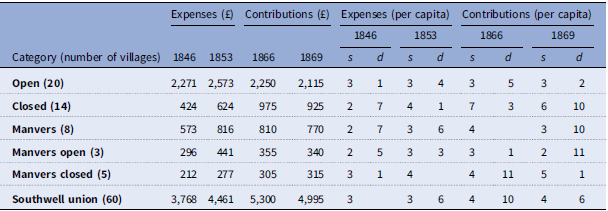
The settlements classified by the poor law commissioners can be divided into various groups based on their population’s main economic activity; we focus on the villages mainly inhabited by agricultural workers (Figure 4). The majority of the Manvers’ villages in the county belonged to the Southwell union (Figure 2), which consisted of 60 parishes in the mid-19th century. Four documents can be used to evaluate changes to the population in light of the poor relief system and Mills’s list (Table 1). Two letters to the Guardians of the Poor indicate the average annual expenses at the parish level from the 1850s,Footnote 60 and two financial statements show half-year financial balances of these parishes from the 1860s.Footnote 61 Combined with census data from 1841 and 1851, it can be seen that maximum annual expense per capita was 10 shillings 10 pence, while the average was 3 shillings in 1846, which changed to a maximum of 17 shillings 5 pence and an average of 3 shillings 6 pence by 1853. However, there was no clear link between the change in the expenses depending on the open-closed distinction and the change in number of inhabitants. As the parishes were charged separately depending on the number of local recipients before passing the Union Chargeability Act of 1865,Footnote 62 one could expect the expenses of closed parishes to be lower than those of open parishes. However, evidence published by Song suggests that in early 19th century Oxfordshire, poor relief paid for individual recipients in closed parishes was more generous compared to open ones,Footnote 63 which also seems to be the case in mid-19th century Nottinghamshire.
The Southwell workhouse (2025).
Source: Photograph by the authors.

Annual average expenses and contributions paid by parishes based on settlement categories

Table 1. Long description
A table comparing annual average expenses and contributions by parishes based on settlement categories. The table has 7 rows and 8 columns. Column headers are Category (number of villages), Expenses (£), Contributions (£), Expenses (per capita), and Contributions (per capita). Row labels are Open (20), Closed (14), Manvers (8), Manvers open (3), Manvers closed (5), and Southwell union (60). Row 1: Open (20), Expenses (£): 1846: 2,271, 1853: 2,573, Contributions (£): 1866: 2,250, 1869: 2,115, Expenses (per capita): 1846: 3, 1853: 4, Contributions (per capita): 1866: 3, 1869: 2. Row 2: Closed (14), Expenses (£): 1846: 424, 1853: 624, Contributions (£): 1866: 975, 1869: 925, Expenses (per capita): 1846: 2, 1853: 7, Contributions (per capita): 1866: 3, 1869: 10. Row 3: Manvers (8), Expenses (£): 1846: 573, 1853: 816, Contributions (£): 1866: 810, 1869: 770, Expenses (per capita): 1846: 2, 1853: 7, Contributions (per capita): 1866: 3, 1869: 10. Row 4: Manvers open (3), Expenses (£): 1846: 296, 1853: 441, Contributions (£): 1866: 355, 1869: 340, Expenses (per capita): 1846: 2, 1853: 5, Contributions (per capita): 1866: 3, 1869: 3. Row 5: Manvers closed (5), Expenses (£): 1846: 212, 1853: 277, Contributions (£): 1866: 305, 1869: 315, Expenses (per capita): 1846: 3, 1853: 4, Contributions (per capita): 1866: 4, 1869: 5. Row 6: Southwell union (60), Expenses (£): 1846: 3,768, 1853: 4,461, Contributions (£): 1866: 5,300, 1869: 4,995, Expenses (per capita): 1846: 3, 1853: 3, Contributions (per capita): 1866: 4, 1869: 6.
Source: Edited by the authors, based on MSCUN Ma 2 B 48/87; MSCUN Ma 2 B 49/36; MSCUN Ma 2 B 49/43; MSCUN Ma 2 B 49/49; open and closed (rows 1 and 2) include villages belonging to the Manvers estates (rows 4 and 5).
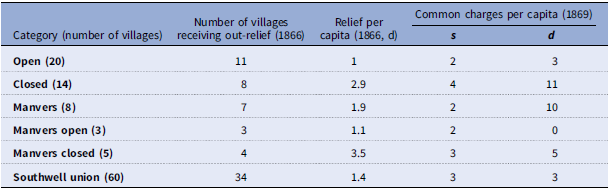
Figures from financial statements from 1866 and 1869 reflect the consequences of the Union Chargeability Act of 1865.Footnote 64 From this point on, contributions to the poor law union’s common fund were based upon the ‘annual rateable value of the lands, tenements, and hereditaments’.Footnote 65 In the Southwell Union, contributions were usually higher at closed villages (7 shillings 3 pence per inhabitant) than open ones (3 shillings 5 pence per inhabitant), compared to their population in 1871 (Table 1). This gap was also apparent in case of the open and closed villages belonging to the Manvers family, as closed villages usually had smaller population numbers. The financial statement from 1866 listed out-relief paid from the union common fund to the parishes (Table 2). Closed villages received significantly higher amounts (2.9 pence per capita) than open parishes (1 pence per capita), compared to their number of inhabitants. For 1869, the statement only listed the amount of ‘common charges’ for each parish, which was also higher for closed villages. These charges consisted of 16 different items, one of them being the out-relief; 62.6% of contributions paid for parishes of the Southwell Union from the common fund covered relief of the poor outside the workhouse.
Out-relief and common charges by parishes based on settlement categories (half-year, 1866–69)

Table 2. Long description
The table presents data on out-relief and common charges by parishes based on settlement categories for the years 1866 and 1869. It includes six rows and five columns. The columns are labeled as follows: Category (number of villages), Number of villages receiving out-relief (1866), Relief per capita (1866, d), Common charges per capita (1869, s), and Common charges per capita (1869, d). The rows are labeled as follows: Open (20), Closed (14), Manvers (8), Manvers open (3), Manvers closed (5), and Southwell union (60). The values in the table are as follows: Row 1: Open (20), 11, 1, 2, 3. Row 2: Closed (14), 8, 2.9, 4, 11. Row 3: Manvers (8), 7, 1.9, 2, 10. Row 4: Manvers open (3), 3, 1.1, 2, 0. Row 5: Manvers closed (5), 4, 3.5, 3, 5. Row 6: Southwell union (60), 34, 1.4, 3, 3.
Source: Edited by the Authors, based on MSCUN Ma 2 B 49/43; MSCUN Ma 2 B 49/49; Open and Closed (rows 1 and 2) include villages belonging to the Manvers estates (rows 4 and 5)
Two important conclusions can be drawn from these calculations. First, even if the primary motivation of landowners behind controlling the movements to their (closed) villages was to keep the number of poor residents low, many of the closed villages in Nottinghamshire were home to poor relief recipients in the 1850s and 1860s. Furthermore, the proportion of closed villages receiving contribution for out-relief was even higher compared to the proportion of open villages; almost all villages (both open and closed ones) belonging to the Manvers family received payment from the common fund in 1866 for this purpose. Second, based on Song’s observations,Footnote 66 it is likely that recipients residing in closed villages received higher amounts of relief than recipients living in open parishes in Nottinghamshire, even after passing the Union Chargeability Act. In other words, the figures presented here suggest that the residents of estate villages had better access to poor relief, and does not necessarily mean that the number of recipients was considerably higher at these localities compared to the rest of the Southwell Union.
Housing conditions and provision on the Manvers estate
The role of the landowner and tenant farmers in controlling access to accommodation and forming the housing conditions on the level of households can be evaluated through several different archival sources. These documents demonstrate that the land agent was responsible for managing the housing stock on the Manvers estate, which not only confirms that agents had a key role in organising different aspects of social lifeFootnote 67 but also highlights their influence on labourers’ housing. Tenancy agreements for cottages and farms were signed by the agent, and correspondence related to the dwellings shows that occupancy was also administered by him as well as maintenance works. Based on the outgoing letter book of the Thoresby agent, some of the estate employees were provided with a free house and garden in the late 19th century. Letters confirming the promotion of a new farm bailiff,Footnote 68 and a head keeperFootnote 69 indicate that these positions came with the provision of free accommodation, alongside further forms of non-financial remuneration such as firewood or certain amounts of dairy products on the expense of the estate. Although some of the documents give us some hints on the presence of rent-free cottage accommodation on the Manvers estates, little is known about the number and situation of households falling into this category. A letter from 1890 written by the land agent Wordsworth to one of the trustees mentions that ‘there are a good many cottages rent free which do not appear in our rental’ adding that ‘[t]here are some 50 to 60 cottages in all’.Footnote 70
Looking at the example of the closed village of Budby, there were 27 inhabited and one uninhabited houses in 1861, while an income tax assessment certificate from 1862Footnote 71 listed 20 people contracted for rented cottages, and 3 tenant farmers rented land with a house in the same village. In another closed village, Perlethorpe, the 1861 census found 19 inhabited houses, and there were seven families in rented cottages and two tenant farmers indicated on the income tax certificate of the following year.Footnote 72 These data suggest that the majority of the estate employees rented their cottages in Budby, while more than half of the cottagers in Perlethorpe were likely to be housed rent-free in the beginning of the 1860s. This situation changed by the beginning of the 20th century in two different ways. First, the population grew significantly, from 211 people in 1861 to 360 people in 1901 in the parish of Perlethorpe cum Budby. Second, the share of families in rented cottage accommodation slightly increased, from 59% in 1861 to 65% in 1901.Footnote 73 A memorandum from 1900 stated that ‘the expenditure in repairs is very heavy in the Parishes of Perlethorpe, Budby and Edwinstowe’ due to the large number of cottages, which is expected to ‘require as large an expenditure for many years still to come’.Footnote 74 As a consequence of the growing financial burdens, the estate started to decrease the share of the rent-free cottages in the second half of the 19th century, but still housed a significant number of people in Budby and Perlethorpe free of charge.
Although there are some uncertainties around the number of rent-free cottages and the terms and conditions of their occupancy, a more detailed picture can be drawn of the rented cottages and their residents. A couple of printed tenancy and lease agreements are available from the late 1860s and early 1870s. The first group of documents include one agreement from Edwinstowe and two from Budby, issued in 1869.Footnote 75 These one-year agreements, for ‘cottage and premises’, indicate that the yearly rent was between £3 10 shillings and £5 10 shillings, with a one-month notice to quit period. This is very similar to the estimated national average of £4 a year in the late 1830s.Footnote 76 Given that the national average of agricultural labourers’ wages was between 13 and 14 shillings weeklyFootnote 77 (around £34–36 a year) in the 1870s, and 21 pence a day (around £32 a year) in the Midlands in the 1850s,Footnote 78 cottagers probably had to spend around 10% of their salary on paying rents.Footnote 79
Two more important aspects are outlined in these documents: first, they include a section on the maintenance of the cottages, and second, a section defining the people not allowed to reside in the premises, which ultimately helped the landlord to control housing mobility patterns. It was listed among the tenant’s duties to ‘keep and leave the said Cottage or Messuage, Buildings, Land, Fences, Walls, and every part of the Premises, in good order and tenantable repair and condition’. The last section of these agreements prohibited the tenant to underlet any part of the premises and to take in any lodgers and any married couples (even their own children’s family) without the written permission of the landowner. Even if Edwinstowe was classified as an open village, while Budby as a closed village, Earl Manvers aimed to keep the housing mobility patterns under the same level of control at his cottages in both localities.
The second group of agreements include less detailed clauses and were mainly about the landowner’s right to remove tenants upon expiration of the notice period. Issued in the 1870s, these documents refer to the occupancy of ‘Cottage, Garden and Premises’ in the closed village of Perlethorpe.Footnote 80 The rental was usually two shillings per week, and the landlord had to give fourteen days’ notice to quit (although in the case of some cottagers the notice period was one month). These agreements (‘memoranda’) reflect the occupants’ dependency on the estate owner: besides defining the amount of rent and the notice period, the cottager agreed that ‘in case of my continuing therein after such notice, no proceedings shall be necessary to eject me from the said Premises, but I fully authorize Earl Manvers or his Agent, to take possession immediately after the expiration of the notice’. The fact that these agreements don’t mention any further rights and obligations of the landowner or the tenant, suggests that the housing conditions of the cottagers were underregulated in this era, especially compared to the situation a couple of decades later. Another important aspect implied by the concise nature of these agreements is that occupants of estate cottages were viewed primarily as employees and not as home occupiers; in other words, their position as labour force was more important than their housing situation from the viewpoint of estate management.
While the more detailed agreements did not allow the occupants to house people not contracted to the estate, an order from 1889 indicates that some of the cottagers took in ‘lodgers where the accommodation is insufficient’.Footnote 81 In order to prevent the occupants from doing this in the future, the owner ordered that permission has to be obtained and ‘an agreement which embodies this rule with the Tenancy of the Cottage must be signed by every Cottager in Perlethorpe, Budby and the Park’. Although these localities were listed as closed villages a couple of decades earlier, housing mobility was not fully controlled by the landowner at all times. While this document indicates the poor housing supply in this era, it also implies that instead of fully prohibiting lodgers from their cottages, the agent could in some circumstances allow ‘outsiders’ to stay with cottage tenants on the estate.
Tenancy agreements for cottages became more detailed by the 1910s, indicating a couple of new aspects related to housing conditions. According to an agreement from 1912, the tenancy would cease at the end of the Tenant’s employment or after one month of notice to quit period.Footnote 82 This document includes some sections regulating the usage of the property: besides clauses aiming to prevent the tenant from taking in lodgers, and from overcrowding the rooms with family members, it also mentions that no animals should be kept in the garden except for pigs, and no business should be carried out in the buildings without the written permission of the estate. There are some more detailed sections on the tenant’s responsibilities regarding the physical state of the building. It was mentioned among the occupant’s duties to keep the premises in good condition, including not just the cottage but also any garden, fences, gates and ditches attached to the dwelling. Another important clause that did not appear in the agreements from the 1870s aimed to forbid any alterations to the building and the erection of any new buildings without the written consent of the landowner.
A notebook from 1912 to 1913Footnote 83 contains some further information on rented cottages and their inhabitants in Edwinstowe, and another one from around 1920Footnote 84 provides similar details for Edwinstowe and Kneesall. Aiming to give a summary on the state of cottages, the first notebook includes sheets listing 68 tenant households in Edwinstowe, while the second one shows 70 in Edwinstowe and 30 of them in Kneesall. While these households had 1 to 9 members, most of them included families of 2 to 5 people. These sources are also useful to evaluate the household mobility patterns of the early 20th century: the usual length of tenancy was 2 to 4 years at these villages by the 1910s, and only a couple of them was longer than 20 years. This indicates a high level of fluctuation and suggests that it was very unusual for labourers at Edwinstowe and Kneesall to spend their whole life living in the same cottage in this period; from a broader perspective, these numbers might also indicate that the rapid change in the structure of employment (i.e. migration of the workforce from agriculture to industry and mining) was also present at the Manvers estate in this era.
While many of the estate cottages were let directly to estate labourers, some of the workmen were housed by tenant farmers, who also resided on the estate. Tenancy agreements for land and house from the early 1910s usually included 28 clauses, but only a couple them were related to housing. An agreement from 1913 regarding the yearly rental of 396 acres of land and other premises in Perlethorpe for £280 per annum allowed a twelve months’ notice to quit period.Footnote 85 This is much longer than the one month notice to quit period in tenancy agreements for labourers’ cottages,Footnote 86 and of course takes account of the tenant farmers agricultural responsibilities. The longer notice period was essential to ensure that agricultural production continued relatively seamlessly when there was a change of farming tenant. The place of residence of the tenant farmer was tied to the estate: clause XII of the agreement required the tenant to ‘reside on the farm and keep the premises in repair’. One of the schedules added to the agreement regulated the usage of workers’ cottages and aimed to stop such dwellings remaining unoccupied for a longer period of time, by stating that ‘Should any of the cottages let with the farm became vacant and no longer required for the tenant’s workmen the landlord shall have the first option of taking to them at a rent of £5 per annum’.
Changes to the housing stock – improvements and maintenance
Besides controlling access to the housing stock already existing at estate villages, landowners had a key role in influencing housing conditions through improvements. As labourers’ sanitary conditions became part of the elite discourse from the late 18th century, from this point on, landed estates placed a growing emphasis on housing maintenance and new developments, often in the form of model villages.Footnote 87 The main source providing the costs of building and maintaining buildings on the Manvers estate in the 19th century is an account book from the 1870s, including sheets for Nottinghamshire, Derbyshire, Lincolnshire, and Yorkshire villages, listing different kinds of improvements.Footnote 88 Columns on ‘Houses and Buildings’ indicate expenses related to improvements of existing buildings (mainly buildings related to farming and office buildings) and columns entitled ‘Cottages’ show costs of building new dwellings. On the Manvers Estate, expenditure on new cottages between 1861 and 1875 was highest in Nottinghamshire with £3573 spent on this purpose in this period. Among the villages listed, the highest outlay appears for Perlethorpe: over £2761 were spent on new housing improvements in this village. The rest of the outlay for ‘Cottages’ was divided between Fledborough (£356), Laxton (£192) and Walkeringham (£52).
Census data from 1861, 1871, and 1881 suggest that the building of new cottages came together with the demolition of older dwellings at Fledborough and Laxton, as the number of houses diminished or did not grow to the same extent as indicated in the account book for this period. In Fledborough, the 1861 census found 23 inhabited houses, which changed to 22 inhabited and 2 uninhabited houses by 1871 and remained the same a decade later. In the account book, the construction of two cottages appears in 1865 at this village. In Laxton, the number of houses diminished in the same period, from 126 (121 inhabited and 5 uninhabited) in 1861 to 122 (119 inhabited and 3 uninhabited) by 1871, and 116 (103 inhabited and 13 uninhabited) by 1881. Costs for a total of 4 cottages were indicated in the estate accounts between 1868 and 1870 for this village. In Perlethorpe, on the other hand, the number of houses increased from 19 to 25 and then to 30 between 1861 and 1881. According to the account book, investment in cottages were continuous between 1862 and 1866; however, the exact number of new buildings is not noted, except for 1862 (‘pair of new cottages’) and 1866 (one cottage). These figures indicate that the Union Chargeability Act of 1865 – even though from this point on closed parishes could not escape from paying contributions to the poor law union by restricting access to housing for paupersFootnote 89 – did not bring about a visible increase in the closed parishes on the Manvers estate. The archival sources and census data examined, however, suggest that modernisation of cottage accommodation became the primary motivation for improvement works, and that relatively strict estate policies remained in place for housing provision.
Besides construction works carried out by the estate, some information is also available on the role of tenant farmers in providing housing for their workmen. According to a bundle of letters from 1862, tenant farmers were entitled to financial reimbursement from the estate if they carried out any permanent improvements on buildings or the land.Footnote 90 A memorandum dated 24 March 1865 shows an example of a tenant receiving financial contribution for building cottages in Budby.Footnote 91 Another tenant farming in Budby and Walkeringham asked for some improvements to be carried out by the estate due to the ‘inconvenient and dilapidated state’ of his ‘house and farm buildings’.Footnote 92 Based on these sources, some of the tenant farmers invested in housing for themselves and their workers, but by the 1860s, it became common for the Manvers estate to contribute to these works.
By the early 20th century, administration of cottage maintenance became more detailed compared to the previous decades. As the example of the notebooksFootnote 93 mentioned before shows, inspection of the condition of estate housing facilities was organised by the estate. These records provide a summary on the interior condition of the cottages, and mention if any improvements were seen as necessary. While during the 19th century, attention turned towards housing conditions of estate workers in line with the elite discourses and sense of paternalism,Footnote 94 regulation of sanitary conditions became part of the picture only by the early 20th century. A remark on an inspection that took place in November 1913 mentions that ‘Privies & ashes pits require altering to meet sanitary authorities requirements’, as outlined in the Public Health Act of 1875.Footnote 95 In some cases, more thorough improvements were also seen to be necessary, for example, it was noted in the case of one dwelling that ‘[t]he advisability of remodelling this block in the form of 2 cottages is worth considering’.Footnote 96 A couple of cottages required further improvement as the ground floor rooms of these buildings were found to be damp, and in some cases, water entered these rooms at times when the level of River Maun was high. The issue of damp ground floor rooms in labourers’ cottages had been mentioned as one of the greatest flaws by some 18th century authors,Footnote 97 but the lack of a damp course remained a major deficiency of some of the cottages on the Manvers estate by the early 20th century. This remark also suggests that the cottages that were seen as modern, comfortable, and clean by Thomson in the 1850s and 1860s still had significant shortcomings in terms of quality in the 1910s.Footnote 98
Conclusion
This paper confirms Dennis Mills’ contention that the poor law regime had an impact on housing processes in Nottinghamshire. Historical census summary tables show that while most open villages saw a significant population increase in the course of the 19th century, the number of inhabitants remained stable in most closed villages during the same period. However, we demonstrate that in case of the villages belonging to the Manvers estate, the open-closed distinction was not that straightforward, as the landed estate aimed to control occupancy of their housing stock both in closed and open villages. Based on the archival sources analysed, it is evident that housing mobility was monitored and actively formed by the estate throughout the 19th and early 20th centuries. Our study also contributes to the discussions around the land agents’ role in organising rural communities: the archival sources cited reveal that the agent was in charge of administering access to housing, maintenance works, and improvements.
Even though many inhabitants of estate villages rented their cottages from the estate directly, rental and lease agreements were relatively brief up until the beginning of the 1900s. This indicates that the occupants were considered primarily as workforce, and their job contract was seen to be more important than their housing situation from the viewpoint of estate administration. Although sanitary conditions of agricultural labourers’ cottages had become an important topic during the 18th century, there is little written evidence in the estate archives of discussions on this question until the 1910s. Even if central government regulations related to cottagers’ housing conditions became part of the picture in the last quarter of the 19th century – due to the Public Health Act of 1875 – the first written evidence on this matter only appears in the early 20th century archival material. The comparison of account books on improvement works and historic census data provides some hints about the pace and extent of cottage modernisations during the second half of the 1800s. This indicates that quality of housing was not unproblematic in all the villages owned by the Manvers family by the early 20th century.
Acknowledgements
The authors are thankful for the funding received via the Professor R H Osborne Visiting Research Fellowships scheme at the School of Geography (University of Nottingham). The authors thank Elaine Watts (Cartographic Specialist and Facility Lead, School Geography, University of Nottingham) for her contribution to the article by drawing the map (Figure 1) presented in the paper.



 Open access

