Introduction
Many patients are referred to the otolaryngology department with a report of ‘mastoiditis’ on magnetic resonance imaging (MRI) of the head as an incidental finding following the observation of a bright signal on T2-weighted scans. The cause for this finding can be varied. Almost all cases of otitis, whether sterile or infectious, will result in fluid filling the mastoid air cells, which is self-limiting because of the inherent ability of the mastoid mucosa to absorb this fluid.Reference Anderson1, Reference Mafee, Singleton, Valvassori, Espinosa, Kumar and Aimi2 Whilst it is the high water composition of inflamed or oedematous mucosa in mastoiditis that results in a bright signal on T2-weighted MRI scans, a similar signal can also be found in simple Eustachian tube dysfunction.Reference Meredith and Boyev3
Acute mastoiditis is accepted as a clinical diagnosis, with imaging used as an adjunct to aid in management decisions and plan surgery where necessary.Reference Minks, Porte and Jenkins4 Magnetic resonance imaging has a role in detecting the presence of intracranial complications, but care must be taken to not over-diagnose ‘mastoiditis’ based on intramastoid fluid signal alone, as such patients can be subjected to further unnecessary clinical tests.Reference Mafee, Singleton, Valvassori, Espinosa, Kumar and Aimi2, Reference Polat, Aksoy, Serin, Yıldız and Tanyeri5, Reference Pauker and Kopelman6
This study aimed to assess the incidence of this finding in patients undergoing MRI to exclude acoustic neuroma. This group was chosen as they would have already had an audiology and/or ENT assessment to rule out significant middle-ear disease. A financial snapshot of what such a reporting practice can cost is also presented.
Materials and methods
The study was conducted in a 700-bed tertiary referral centre serving a catchment population of approximately 338 800.
A retrospective case note analysis of 500 patients who underwent MRI of the internal auditory meatuses (IAMs) between October 2015 and November 2016 was performed. A proportion of these patients were primarily sent for an MRI by our audiology department without first seeing an otolaryngologist, as per an interdepartmental protocol devised to identify acoustic neuromas in patients directly referred to the audiologists with unilateral tinnitus and/or asymmetrical sensorineural hearing loss. The clinical safety and efficacy of this protocol is the subject of a separate study. The remaining patients were sent for MRI after being primarily seen by an otolaryngologist.
The inclusion criterion for this study was all patients who underwent MRI of the IAMs to rule out cerebellopontine angle pathology such as an acoustic neuroma. Exclusion criteria included known middle-ear disease on clinical review. Data were collected from clinic letters, radiology images and audiograms, and were analysed using Microsoft® Excel 2008 spreadsheet software.
Results
The reports for the MRI scans of the IAM for 500 consecutive patients were analysed. These patients comprised 251 males and 249 females, with a median age of 58 years (range, 17–89 years). Magnetic resonance imaging requests from the ENT department comprised 59.6 per cent (n = 298), the rest being from the audiology department (40.4 per cent, n = 202).
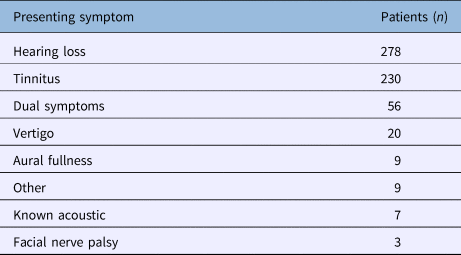
Of the patients, 50.2 per cent (n = 251) presented with left-sided symptoms; 11.2 per cent of patients (n = 56) had bilateral symptoms. Ninety-one per cent of all symptoms (n = 508) were a combination of tinnitus and asymmetrical hearing loss. The presenting symptoms of patients given an incidental diagnosis of mastoiditis based on findings seen on MRI performed for other reasons are shown in Table 1.
Presenting symptoms of patients given an incidental diagnosis of mastoiditis*

*Based on findings seen on magnetic resonance imaging performed for other reasons
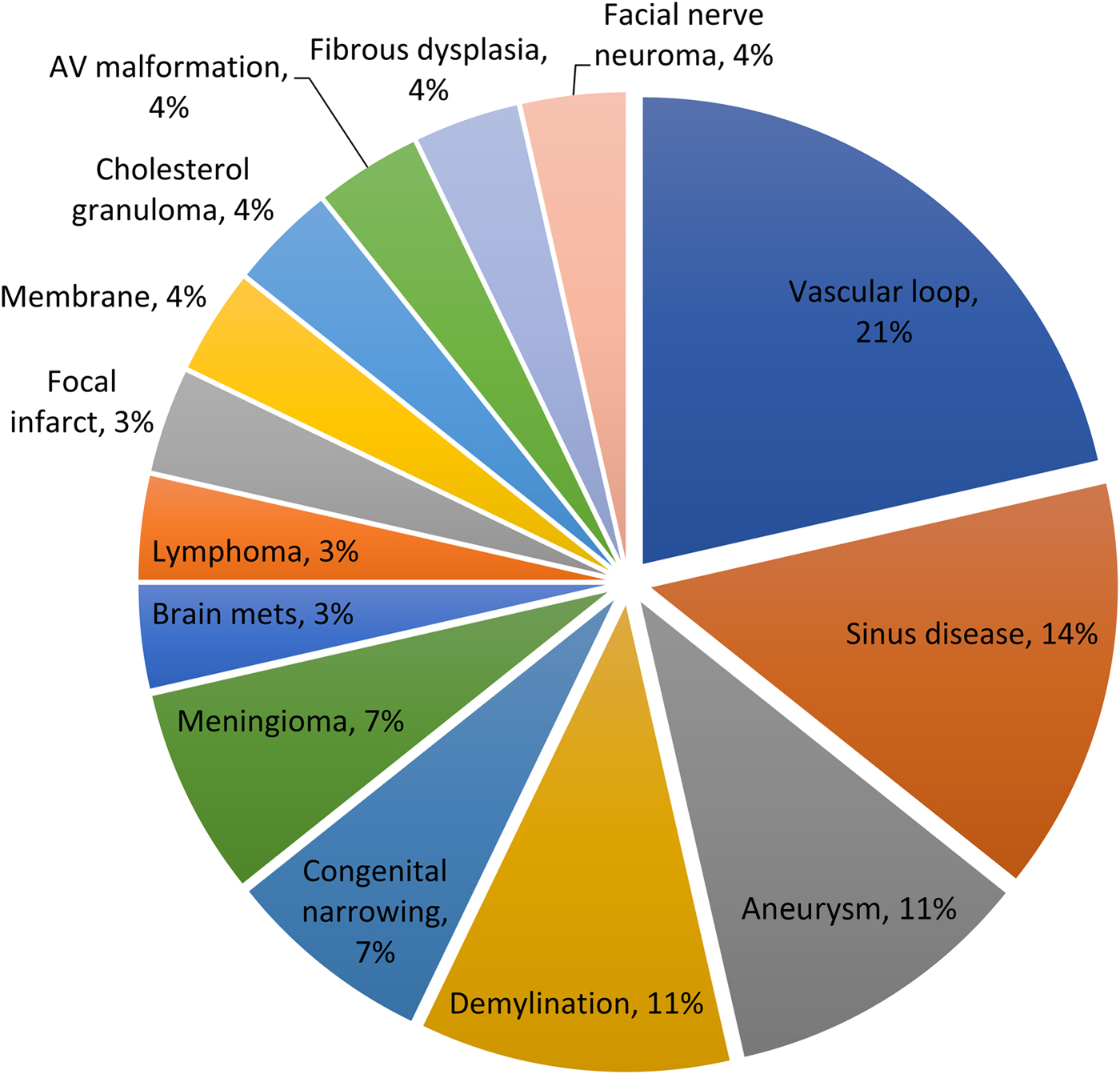
There was an abnormality reported in 14.6 per cent of scans (n = 73). The diagnosis of ‘mastoiditis’ was reported in 39.7 per cent (29 out of 73), of which 41.4 per cent of cases (12 out of 29) were right-sided and 20.7 per cent (6 out of 29) bilateral. The other 60.3 per cent (44 out of 73) included acoustic neuromas (16 out of 44) and other abnormalities including: vascular loops (6 out of 28, 21 per cent), sinus disease (4 out of 28, 14 per cent), and aneurysms (3 out of 28, 11 per cent). Incidental findings seen in addition to mastoiditis on MRI are shown in Figure 1. On review of the patient notes, none of the 500 patients had middle-ear disease.
Other incidental findings in addition to mastoiditis seen on magnetic resonance imaging scans. AV = arteriovenous; mets = metastasis

With respect to cost, had these 29 patients required review by an otolaryngologist, at a cost of £150 per consultation, this would have equated to a total of £4350.
Discussion
Synopsis of new findings
This study showed an incidence of 5.8 per cent (29 out of 500) for an incidental finding of ‘mastoiditis’ in MRI scans performed for other reasons. Of these, no patients had clinical evidence of middle-ear disease. Otolaryngological reviews of such patients may be associated with significant unnecessary cost.
Comparison with other studies
In a retrospective case series of 406 patients, Polat et al. found that fluid signal in the mastoid on MRI should not always be interpreted as mastoiditis by radiologists.Reference Polat, Aksoy, Serin, Yıldız and Tanyeri5 They showed that 82 per cent of patients with increased mastoid signalling did not show any evidence of otological disease. Similarly, in a smaller case series of 28 patients, Meredith and Boyev came to the conclusion that use of the term ‘mastoiditis’ was unwarranted in describing increased fluid signal within the mastoid, as this can lead to unnecessary medical treatment with antibiotics.Reference Meredith and Boyev3 Their findings reflect those of our study.
With respect to children, the literature further agrees that clinical correlation is needed. A retrospective case note review of 515 children seen over 3 months in an out-patient clinic was carried out by Singh et al.Reference Singh, Rettiganti, Qin, Kuruva and Hegde7 Patients had brain MRI scans for indications other than mastoiditis or otitis media, and 21.4 per cent were reported to have mastoid opacification. This correlates well with the work of von Kalle et al., who prospectively evaluated the mucosal thickening in the mastoid cells of 147 patients, and found that 25 per cent had asymptomatic mucosal thickening, with the prevalence rising to 42 per cent in children.Reference Von Kalle, Fabig-Moritz, Heumann and Winkler8
Saat et al. retrospectively analysed MRI images of: 35 adult and paediatric patients with clinically acute mastoiditis, and 34 consecutive age-matched controls without relevant middle-ear pathology and with incidental T2-hyperintensity that covered 50 per cent or more of the mastoid.Reference Saat, Mahmood, Laulajainen-Hongisto, Lempinen, Aarnisalo and Jero9 That paper reported that intramastoid T2-hyperintensity alone is not a reliable sign for acute mastoiditis. The authors found that in acute mastoiditis, intramastoid T2-weighted signal intensity is usually hypointense to cerebrospinal fluid, whereas there is an absence of diffusion restriction and intense intramastoid enhancement in incidental mastoid effusion.Reference Saat, Mahmood, Laulajainen-Hongisto, Lempinen, Aarnisalo and Jero9
Study strengths and weaknesses
This study of 500 consecutive scans in patients with normal middle-ear function adds a considerable body of evidence to the literature. The study's main weakness is that it is retrospective and so it is difficult to measure significant statistics on the given data set.
Recommendations for clinical practice
Clear radiological guidelines should be agreed upon with respect to the reporting of high signalling within the mastoid bone. This will prevent unnecessary referrals to the ENT department, and reduce the over-investigation and over-treating of patients. It will also provide a protective framework, within which radiologists can work without fear of ‘missing’ a case of mastoiditis.
• Incidental ‘mastoiditis’ on magnetic resonance imaging performed for other reasons is a common reason for referral to otolaryngology
• Almost all cases are because of high water content in the mastoid bone caused by relatively innocuous conditions including Eustachian tube dysfunction
• Such referrals may lead to unnecessary further interventions in patients with otherwise normal middle ears
• Unnecessarily referring patients with incidental mastoiditis for otolaryngological review has financial implications
Conclusion
Mastoiditis is a diagnosis that evokes urgent action by non-ENT clinicians to prescribe antibiotics and recommend urgent ENT review. The use of this term in radiological reports as an incidental finding can lead to erroneous prescriptions, and undue patient and general practitioner concerns until reviewed by an ENT specialist. It is also associated with financial implications. We recommend cessation of this term to describe the incidental finding of increased mastoid signalling in scans requested for other reasons.
Competing interests
None declared