Introduction
The ideational basis of the demand for Pakistan was the two nation theory, which held that Muslims and Hindus were two distinct nations that had separate and irreconcilable religious and socioeconomic systems, and each needed an independent state because peaceful coexistence under single political framework within a unified state was impossible. The religious difference was the dominant principle upon which the formerly united India was divided into a Hindu-dominated Indian state and a Muslim-dominated Pakistani state. This generalized principle ignored the existence of multiple nationalities within the Hindus and Muslims. Although religion was important for the multiple ethnic groups within each state, so was their distinct culture, language, and way of life. Ignoring the significant differences within each religious group created problems for both Pakistan and India. In time, the rise of ethnic movements exposed the fault lines in the religious principle that guided partition of the subcontinent.
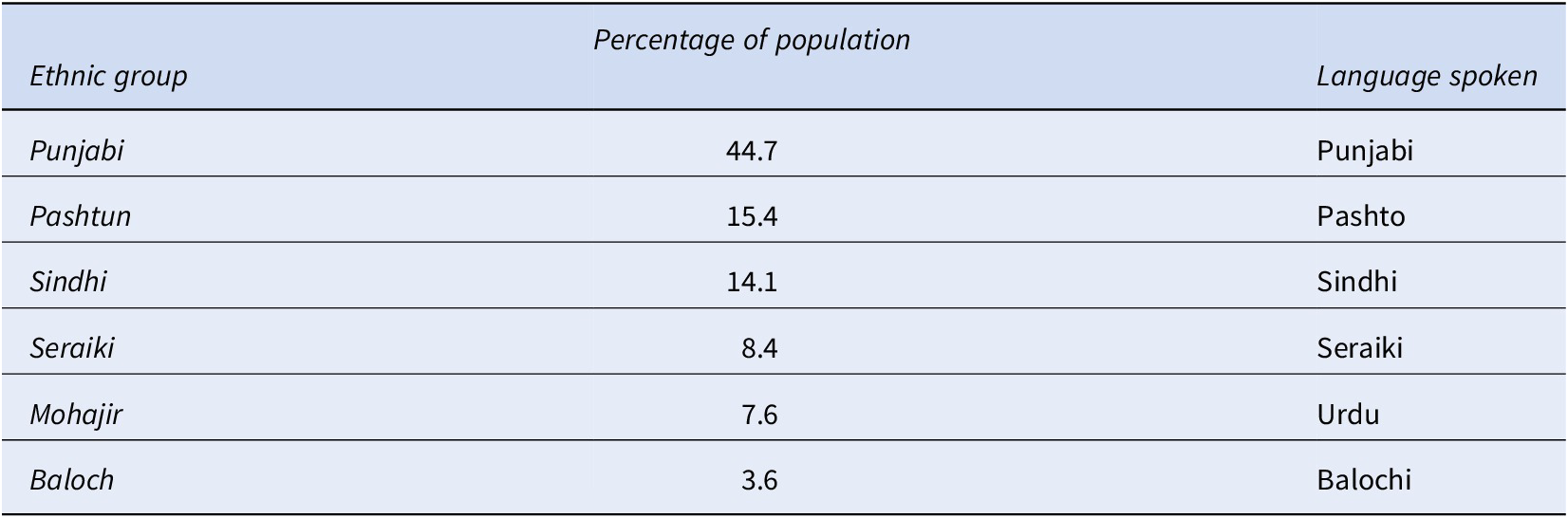
In multinational states where the hegemony of dominant nationality is established, the struggle of dominated nationalities for self-determination and autonomy is commonplace. Pakistan is one such multinational state, in which subordinated nationalities struggled for both independence and provincial autonomy. The demography of Pakistan is diverse and heterogeneous, comprising multiple ethnic groups. Before 1971, Bengali, Punjabi, Pashtun, Sindhi, Baloch, and Mohajir were the major ethnic groups residing in Pakistan. Of these, Bengalis were in the majority. Since the separation and independence of Bengal-dominated East Pakistan, now Bangladesh, the Punjabi ethnic group has been dominant in Pakistan (see table 1). Each ethnic group is concentrated in a geographical area—a region of identification and domination. Each is obsessed with the preservation of its own language, culture, and experience of shared history through cultural nationalism. This cultural nationalism has frequently been translated into political nationalism. Each group has given birth to nationalist movements demanding autonomy or independence through both nonviolent and violent action.

After the creation of Pakistan, the state has been periodically destabilized by the ethno-nationalist movements of various ethnic groups. These movements have taken the form of “self-determination, provincial rights, regional autonomy, allocation of resources, and the preservation of language and culture,” (Ahmed, Reference Ahmed1996a, 632). Their demands have fluctuated between autonomy and independence. In case of Bengali nationalism, its demand expanded from mere provincial autonomy into a desire for independence and a state of their own. According to Paul Brass, one of the reasons for the adoption of such a high cost strategy of secession is the support of external intervention (Brass Reference Brass1991, 81). India did intervene on the behalf of the Bengalis in 1971. Similarly, the demands of Pashtun nationalism shrunk from an independent state (Pashtunistan) to the province of Pakhtunkhwa. Balochistan, since its annexation with Pakistan in 1948, has launched four insurgencies but has failed to make the dream of Greater Balochistan come true. The Mohajirs constructed their ethnic identity in 1970s and demanded a province of their own with Karachi as its capital, leading to intra-ethnic conflict with the Sindhis.Footnote 1 Similarly, the Sarikis consider themselves separate from the Punjabis and demand their own separate province, Sarikistan.
The literature dealing with the phenomenon of ethnic politics and ethnic nationalism in Pakistan mostly covers the reasons behind the origin and emergence of ethnic nationalism in Pakistani society, particularly the factors that brought the state nationalism in conflict with ethnic nationalism. Scholars have provided different arguments for the rise of ethnic nationalism in Pakistan. For example, Mehtab Ali Shah (Reference Shah1997) contends that the main reason behind the emergence of ethnic nationalism and the consciousness of ethnic politics is the domination of one ethnic group, the Punjabi. He writes, “The entire foreign policy apparatus is almost wholly dominated by Punjabis and this means that a Punjabi view of the world is projected as Pakistan’s position on international affairs” (Shah Reference Shah1997, 141). Tahir Amin holds the view that the absence of power sharing by state elites with ethnic groups has led to mobilization on behalf of the excluded ethnic groups (Amin Reference Amin1993, 1). Adeel Khan considers the “interventionist attitude of the state” as the main factor responsible for “creating, hardening and radicalizing national sentiment” (Khan Reference Khan2005, 84). Similarly, Farhan Siddiqui emphasizes on the role of both state and government in the generation of ethnic conflicts in Pakistan (Siddiqui Reference Farhan2012, 112).
In this article I offer a unique approach, as no one has yet theoretically analyzed the phenomenon of the changes, rises, and falls in the demands of ethnic movements in Pakistan. What are the factors that contributed in the radicalization of Bengali and Baloch nationalism and the softening of Pashtun and Sindhi nationalism? How did Bengalis achieve independence and a state of their own while the Baloch failed? What were the circumstances that convinced the ethnic elites of the Bengali and Baloch ethnic groups to take the extreme option of secession and armed resistance against the state of Pakistan? Similarly, what conditions persuaded the ethnic elites of Pashtun and Sindh ethnic groups to settle for a moderate option of provincial autonomy? What explains changes in the demands of ethnic elites on behalf of their ethnic groups in different periods?
I used both primary and secondary sources in this research. Primary sources include my observation of the phenomenon of nationalist movements in Pakistani society and interviews with ethnic elites and followers of the ethnic nationalist parties. Secondary sources include statistics, books, research articles, press releases, and official statements by various leaders. I discuss only the provincial majority ethnic nationalisms—Baloch, Pashtun, Sindhi, and Bengali. Discussion of the provincial minority ethnic nationalism of Saraiki, Mohajir, and Hazaras is beyond the scope of the article. I hope that this article will be a source for understanding the provincial minority nationalities and their modus operandi.
Theoretical Frameworks
Ethnic nationalism in Pakistan has shifted between calls for independence and calls for autonomy depending upon the relationship between the state and ethnic group and the extent of shared political power and economic benefits. This changing landscape of ethnic nationalism is consistent with a common phenomenon of inter- and intra-ethnic elite competition for political and economic gain.
While the shifting range in nationalist demands can be explained through Brass’s instrumental theory of elite competition, two additional subtheoretical frameworks or approaches—relative deprivation and ownership of the states—are useful in understanding the particular radicalization of Bengali and Baloch nationalism and deradicalization of Pashtun and Sindhi nationalism. A complete picture of the ethnic nationalism can be developed through the combined application of these three models. Together these approaches help explain the concrete causes that compelled the ethnic elite to take the extreme option of liberation and secession by virtue of an armed resistance, as was the case with Baloch and Bengali ethnic nationalism.
Andreas Wimmer’s concept of ownership of the state—the shared sense of having ownership of the state—helps to explain the factors behind the pacification of the ethnic nationalism of Pashtun and Sindhi and the circumstances and conditions that persuaded the ethnic elite of the Pashtun and Sindhi and ethnic groups to downplay the ethnic card and cultural symbols and participate in state apparatuses.
Paul Brass’s Conception of Elite Competition
Brass’s main argument for the rise of nationalism is that “elite competition is the basic dynamic which precipitates ethnic conflict under specific conditions, which arise from broader political and economic environments rather than from the cultural values of [the] ethnic group in question” (Brass Reference Brass1991, 13). According to Brass, cultural values, norms, and differences are merely means to mobilize masses for the gain of political and economic dividends.
The oscillation of ethnic groups’ demands between independence and autonomy are greatly defined by the relationship of these ethnic groups with the state. For example, Bengali nationalists were at odds with the authority of the state and were deprived of their due share in political power and economic resources. This led to the deepening of their sense of deprivation and the change in their demands from autonomy to outright secession. Brass says, “Political and economic circumstances may cause elite[s] to downplay or discard the symbolic manipulation of cultural forms, values and practices and to instead seek cooperation with other ethnic groups or collaboration with the state authorities,” (Reference Brass1991, 16). Other ethnic groups in Pakistan have at times downplayed the cultural differences when they collaborated with state authorities. For instance, in 1975, when Pakistani president Zulfiqar Ali Bhutto dissolved the National Awami Party government in Balochistan, Baloch started an insurgency against the state that continued to 1977 and used the cultural card to attract more followers. However, during the presidency of Muhammad Zia-ul-Haq (1978–1988), when state authorities cooperated with the Baloch, they left the mountains and again integrated into mainstream society.
Ethnic nationalism in Pakistan is a prime example of the ways that cultural difference can be manipulated in the context of economic and political milieu. It intensifies when political and economic conditions do not favor the ethnic elite and loses intensity when a fair slice of the political and economic pie is presented to them. This circumstance depends upon the relationship between ethnic group and state—that is, whether it is cooperative or competitive.
Ted Gurr’s Notion of Relative Deprivation
Ted Gurr (Reference Gurr1993) analyzed the conflicts of 227 communal groups throughout the world and on the basis of the resulting data presented his idea about the origin of communal conflicts. He defines communal groups in terms of both culture and religious identity, having no recognized state of their own (Gurr Reference Gurr1993, 161). He identified two interrelated factors—relative deprivation and group mobilization—as key to understanding communal conflicts (Reference Gurr1993, 167). Grievances accompanied by a shared sense of cultural group identity are the raw material for group mobilization and demands of the leaders of the group: “If grievances and group identity are both weak, then there is little prospect of mobilization by any political entrepreneurs in response to any external threat or opportunity. On the other hand, deep grievances and a strong sense of group identity and common interest … provides highly combustible material that fuels spontaneous action whenever external control weakens” (Gurr Reference Gurr1993, 167).
Gurr’s Why Men Rebel (Reference Gurr1970), is his attempt to explain widespread political violence across the globe. In it, Gurr tried to provide a common conceptual framework though which the phenomenon of revolt, rebellion, and conflicts in the postcolonial states and societies can be explained and understood. Gurr argued that three factors are behind rebellion: (1) popular discontent (relative deprivation); (2) justifications or beliefs about the justifiability and utility of political action; and (3) balance between discontented people’s capacity to act and the government’s capacity to repress or channel their anger (Gurr Reference Gurr1970, 327–329). The sense of relative deprivation and injustice motivates and mobilizes people to take political action. Governments’ responses to political action are a major determinant of whether people’s anger leads to violence against authorities or is channeled into other kind of actions. The relative deprivation of the Bengali and Baloch intensified and mobilized ethnic nationalism. Grievances of these two ethnic communities were deep and their cultural identity strong, providing the raw material for the groups to mobilize for civil war in the case of the Bengalis and armed insurgency in the case of the Baloch.
Gurr (Reference Gurr1993) identifies six variables that shape the cost and benefit of political actions. Three variables are internal: (1) active grievances, (2) mobilization, and (3) communal political action; three are external: (4) “predisposing conditions, which determine the (unobserved) intervening variables of persisting grievances and potential for mobilization”; (5) international diffusion and contagion of communal conflict; and (6) state characteristics that shape the costs and benefits of political action (Gurr Reference Gurr1993, 168). These six variables help to explain the success of Bengali ethnic nationalism in securing independence for themselves and failure of the Baloch insurgency to establish an independent state. But other factors, such as geographical concentration, group cohesion and size, the nature of the polity (democracy, authoritarian, dictatorship), and the diffusion of the conflict across the border also played significant role in the success of one and failure of the other.
Andreas Wimmer’s Perspective of the Ownership of the State
Andreas Wimmer (Reference Wimmer1997) emphasizes the concept of the ownership of the state and access to its collective goods as a framework in understanding the politicization of ethnicities and resultant conflict among different ethnic groups. He describes ethnic conflicts as “struggles for the collective goods of the nation-state” (Wimmer Reference Wimmer1997, 631). Unlike multi-ethnic empires based on the universal principle of the citizenship, the conception of the modern nation-state is based on the particular principle of a specific nation. The “state embodies the idea and political practice of national sovereignty: the state should, so to speak, be dyed by a nation’s color and designate the ‘people’ in whose name it rules over its territory” (Wimmer Reference Wimmer1997, 634). Whose culture, language, and social symbols will be used by the state as its national culture and language? For these decide the claim of that group as the legitimate owner of the state.
When a specific ethnic group gets control of the ownership of the state, it leads to the ethnicization of the state and its apparatuses. In the words of Wimmer, “When a majority population with a tradition of political centralization, a so-called ‘state people’ (Stuutsvolk), takes over the apparatus, ethnicisation of the state and bureaucracy occurs automatically” (Reference Wimmer1997, 635). In postcolonial multi-ethnic, multilingual societies like Pakistan, different ethnic groups struggle for the transformation of their ethnic group into the state and recognition of owners of the state.
Wimmer’s concept of ownership of the state helps to explain the decline in the intensity of the Sindhi and Pashtun nationalism. The shared sense on the part of the ethnic elites within the ethnic group as legitimate participants in the state structure transformed their demands from separate statehood to maximum regional autonomy within the polity of Pakistan. Through their increasing presence in the state’s political, economic, and administrative institutions and sectors, a sense of ownership among the ethnic elite of Pashtun and Sindhi led to deradicalization in their nationalist sentiments and lessening of their resentment of the state and its apparatuses.
Understanding the Symmetry of Theoretical Frameworks
As I noted in the introduction, the main theoretical framework I have used for the understanding of the ethnic-nationalism in Pakistan is Brass’s theory of elite competition. This theory offers a broader picture of the ethno-nationalist movements in Pakistan. Gurr’s concept of relative deprivation and Wimmer’s idea of ownership of the state complement Brass’s theory, narrowly delineating the reasons for the extremism of the Bengali and Baloch ethnic nationalism and moderation of the Pashtun and Sindhi ethno-nationalist movements.
Brass’s theory of Elite Competition says that ethnic elites utilize group ethnic identity symbols such as language, religion, cultural values and norms to secure gains in the political and economic sources of the state. To gain a share of the pie of state resources, ethnic elites instrumentalize cultural symbols to mobilize the masses of the social group in order to build pressure on the state authorities in fulfilling their demands. This raises the question, at what point will an ethnic elite be in better position to exploit the cultural symbols of the ethnic identity for material gains through the ignition of ethnic nationalism? what are the conditions that can provide space for ethnic elites to react in extreme ethno-nationalist language? These conditions can be aptly described by Gurr’s theory of relative deprivation. When an ethnic group is collectively in a weaker position as compared to other groups in both the political and economic sphere, the ethnic elite can sense an opportunity to react, politicizing the relative deprivation around the discourse of ethnic identity of the group in order to garner their support for demands of a share in the political power and economic sources of the state.
Brass says that sometimes political and economic circumstances compel ethnic elites to downplay the cultural symbols of the ethnic group and cooperate with the state (Reference Brass1991, 16). But when does that happen? What are those political and economic circumstances that can result in the moderation of ethnic politics? These circumstances can be identified through Wimmer’s concept of ownership of the state—having a share in the benefits of the state in terms of political and economic resources. When ethnic elites realize that they have a stake in the ownership of the state or they are benefiting from the resources of the state, they downplay ethnic-nationalism. They moderate their demands, are less aggressive and more accommodating, and are more likely to compromise with state authorities.
These theoretical frameworks can also help us understand the broader phenomenon of ethnic nationalism and ethnic conflicts in other South Asian postcolonial diverse and heterogeneous societies like India, Sri Lanka, and Myanmar. These countries have ethnic contours similar to those of Pakistan: multi-ethnic and multilingual groups, domination of state apparatuses by one dominant ethnic group, relative deprivation of minority ethnic groups, and the politicization of the politico-economic deprivation by the respective elite of these ethnic groups (playing the card of ethno-cultural identity as described by Brass’s instrumental theory of the elite competition). These states have discontented ethnic groups who want either independence or autonomy. Relative deprivation and collective discontent play a significant role in providing the necessary spark to mobilize the masses in large number. The Khalistan movement in India, for example, is struggling for the creation of a Sikh state separate from the rule of Hindu India. In Sri Lanka, Tamils fought a civil war against the Sinhalese-dominated state in an effort to gain a separate identity and statehood. These ethnic groups want a stake in the ownership of the state in order to enjoy its political and economic perks and privileges. There are similar ethnic conflicts in other multi-ethnic and multilingual societies of Asia and Africa.
The Pakistani State Versus Its Ethnic Groups
Pakistan was carved out of Muslim majority regions that had nothing in common but Islam. Islam was instrumentalized to construct a nation, Pakistan, out of the diverse people populating these regions. Prior to the partition of British-ruled India, the Muslims in Hindu-majority regions were convinced of inevitability of Hindu domination after the departure of British from India by virtue of their numerical strength. Likewise, those Hindus living in Muslim-majority areas feared Muslim domination. After the independence of Pakistan was achieved, the communal identity of the state did not make sense in the absence of the majority Hindus. Still, the pioneer leadership emphasized shaping the identity of Pakistan along the lines of Muslim communalism, perceiving religion as the sole reliable tool to glue the diverse ethnic groups together and build a Pakistani nation. This conflict of identities between a state-perpetuated Muslim identity and the existing distinct and diverse ethnic-oriented identities of the people created much confusion, resulting in an identity crisis for the country as a whole.
That the Muslim communal identity clashed with the identities of the residing ethnic groups was not lost on the pioneer leadership of the state: they were aware of the artificiality of the Muslim communal identity. To promote the communal identity, the state utilized both oppressive and ideological state apparatuses. Mohammad Ali Jinnah, the founder of Pakistan, “warned of [the] poison of provincialism as a threat to the new nation’s unity” (Afzal, Reference Afzal2020). The pioneer leadership stringently opposed provincialism and emphasized the Muslim communal identity. Jinnah believed in one nation, one people, one religion, and one language to discourage the centrifugal forces of the provincialism and clip the wings of ethnic nationalism (Jaffrelot Reference Jaffrelot2015, 101). For the government of Pakistan, the use of the word nationality became anathema to the national integration and the “government passed a law in 1975, prescribing a seven-year imprisonment for individuals advocating the presence of more than one nationality in Pakistan” (Ahmed Reference Ahmed1996b, 1050). As Jinnah told the nation, “Pakistan is the embodiment of the Muslim nation and so it must remain. If we begin to think of ourselves as Bengali, Punjabi, Sindhi, etc., first, and Muslim only incidentally, then Pakistan is bound to disintegrate,” (Jinnah Reference Jinnah2000, 173–174).
For the propagation of the official nationalism of the state on the basis of the Muslim communal identity, the state leadership traced the roots of Pakistan to the Arab invasions of Sindh under the command of Muhammad bin Qasim in 712 CE. Textbooks describe the invasion of bin Qasim in terms of an “advent of Muslims to subcontinent” and the rule of the British as a “forcible seizure of power from the Muslims” (Aziz Reference Aziz1993, 14). This emphasis on the Muslim identity of the people residing in Pakistan came at the expense of their distinct ethnic identities. The social studies book of class 1 contains information like “Jinnah created Pakistan” (Aziz Reference Aziz1993, 2), deliberately ignoring the struggle and sacrifices of the popular masses generally and the role of leaders of different ethnic groups particularly. In the Pakistan studies textbooks for high school, it was said that Pakistan came into being the day the first Hindu accepted Islam and became a Muslim. Similarly, Arab and Turkish rulers of India were declared heroes of Pakistan. The heroes of ethnic groups who struggled against the colonial rule of the British for the liberation of India were discriminated against in official accounts of Pakistan as unpatriotic and even as traitors. Islam, Urdu, political centralization, and Indian threats were used to forge a nation out of the diverse ethnic groups (Devasher Reference Devasher2016, 53).
However, instead of the abstract idea of Muslim identity, ethnic groups preferred their lived ethnic identities entrenched in the history of thousands of years. The Pashtuns claim that their history is five thousand years old, whereas Pakistan has been in existence for less than eight decades. Similarly, the Sindhi trace their origin back five thousand years to the Indus Valley civilization. Ethnic groups resisted the imposition of a Muslim communal identity by asserting their historic identities and celebrating their heroes such as Bacha Khan (Pashtun) and G. M. Syed (Sindhi). They started to define themselves as Pashtuns, Baloch, Sindhi, and Mohajir rather than Pakistani.
The relationship between the state and the ethnic elites of the various ethnic groups acted as an independent variable in shaping the course (conflict and secession or cooperation and integration) that the different ethnic groups pursued. When the relationship between the state and an ethnic group was hardened, the ethnic elites opted for a confrontational course and even the extreme option of violence and independence. However, when the relationship was softened, the ethnic elites chose cooperative paths and settled for moderate options of provincial autonomy and rights within the existing political framework of Pakistan. Had the state accepted the six-point program of Sheikh Mujibur Rahman, a roadmap for complete provincial autonomy, Pakistan would have avoided its dismemberment and future challenges of ethno-nationalist movements.
Radicalization of Bengali Nationalism
“Of all the provinces which constituted Pakistan, it was Bengal which gave the most solid support to Muhammad Ali Jinnah in his struggle for the establishment of a separate Muslim state in the sub-continent,” (Choudhury Reference Choudhury1972, 242). Similarly, of all the provinces that constituted Pakistan, Bengal was the first to separate itself from the state of Pakistan. Bengal was a huge province, with both Hindu and Muslim majority areas. According to Mountbatten’s 3rd June Plan for the communal division of India, Bengal was also divided between Muslim-dominated East Bengal and Hindu-dominated West Bengal. West Bengal became part of Pakistan called East Pakistan. East Pakistan was separated from West Pakistan by one thousand miles of Indian territory. Bengalis demanded the implementation of the Lahore Resolution in spirit and letter, which provided for the maximum autonomy of the constituent parts of the country by mentioning the words independence and sovereignty. Bengalis were the dominant ethnic group in Pakistan, but they were dominated by the minority Punjabi-Mohajir nexus. Urdu, the minority language of 3.7 percent of the populace, was imposed upon them, which Bengalis resisted, demanding Bengali to be declared a national language. Bengali legislators were threatened with trial for treason if they used their own language (Khan Reference Khan2005, 66). In 1952, language riots resulted in the death of four Bengali students, giving Bengal its first martyrs. To commemorate their martyrdom, a memorial shaeed minar (martyr monument) was erected (Talbot Reference Talbot2005, 184)—an addition to the symbolic arsenal for politicizing Bengali. Instead of integrating the Bengalis by granting Bengali language national status, the state further alienated then by using it power apparatus to suppress them.
Bengali nationalism was intensified by the centralization of the state through the imposition of the one-unit system in 1955. Pakistan was divided into two provincial units—East Pakistan was one unit and West Pakistan along with its provinces was the other—ostensibly to establish a parity between the two wings of Pakistan. The one-unit scheme was meant to “counter the weight of Bengalis,” who were equivalent to 55 percent of the country’s population, in the National Assembly (Waseem Reference Waseem1996, 622). The provinces in West Pakistan protested the elimination of their separate provincial status to no avail. Economically, the eastern wing was handicapped by the exploitation of jute (the major cash crop of Bengal) by the western wing. The situation resembled an “inner colonialism” in which development of the western wing was dependent on the underdevelopment of the eastern wing. They were underrepresented in state institutions. Their representation in the government bureaucracy and military was equivalent to naught. In the words of Christophe Jafferlot, “access to socio-economic resources was not the only issue, exclusion from power-centers, and the non-accommodating attitude of these centers of power also rankled” (Reference Jaffrelot2002, 20). He further writes, “Ayub[’s] reply to Mujib’s six point program was only repression” (Jaffrelot Reference Jaffrelot2002, 20).
From 1947 to 1971, the Bengalis demanded provincial autonomy and preservation of their language and culture, but the interventionist behavior of the state radicalized them. Their cultural nationalism became political nationalism, and expanded their demand for provincial autonomy to a quest for independence. The relationship between the state and the Bengali ethnic elites became hardened and embittered. The uncompromising attitude of the state pushed the Bengalis to the extreme position of armed resistance, civil war, and ultimately independence.
Contributing Factors in the Success of Bengali Nationalism
Because of the uncompromising position of the state, Bengali cultural nationalism paved the way to statehood. According to Gurr, the kind of resistance (violent or nonviolent protest or rebellion) that takes place depends upon the strength of grievances and group identity. If both are strong then it provides “highly combustible material” for successful resistance (Gurr Reference Gurr1993, 167). In the case of Bengali resistance vis-à-vis the Pakistani state, it had strength in both factors: strong grievances about political, economic, and social discrimination and a strong group identity. Other factors that help in the successful mobilization of groups, as elaborated by Gurr, are the size of the group and their geographical concentration (Reference Gurr1993, 175). Bengalis had the advantage of these factors, too: they were a majority in the whole of Pakistan; Bengal was a geographic region in which Bengalis were concentrated; their territory was physically detached from the rest of Pakistan by one thousand miles of India (this physical detachment between the two wings made Pakistan’s army unable to prevent the secession of Bengal in 1971); and Bengal was psychologically absent from the minds of the West Pakistan. Further, Bengalis had their own language, culture, and physique. They also had a sense of shared deprivation from the West Pakistan leadership. The Bengalis had one leader, Sheikh Mujibur Rehman, and one party (the Awami League) to lead them. Sheikh Mujib and the Awami League instrumentalized this sense of deprivation and linked it with the cultural identity of the Bengalis. In other words, Mujib manipulated the cultural symbols of the Bengalis and translated them into political nationalism. Lack of intra-ethnic divisions among the Bengalis strengthened their unity in their cause of freedom. Finally, international support increased the chances of success of a group rebellion: Indian assistance in training the Mukthi Bahini, denying airspace to the Pakistani air force, and India’s direct intervention in the 1971 war helped the Bengalis achieve their independence. These factors greatly helped the Bengalis to stay united and achieve their freedom.
The Failure of the Baloch Insurgency to Make Greater Balochistan a Reality
“[T]he emergence of [a] Baloch nationalist movement should be viewed as a phenomenon in intimate linkage with the creation of Pakistan, and its crystallization was accelerated by the situational switching from a people having a ‘national homeland’ into a minority within the state of Pakistan,” (Boyajian Reference Boyajian2010, 172). The violent struggle of the Baloch nationalists against the state of Pakistan started after the partition. The political cause for armed Baloch nationalism was the coerced annexation of Kalat state into the newly created state of Pakistan. Conversion of the Baloch from a nation to a minority ethnic group under alien rule left no option for the Baloch but to take arms and defend their sovereignty. The cause of the first insurgency was the entrance of the armed forces in to the state of Kalat to force the khan to sign the instrument of accession to the state of Pakistan. The first encounter between the Baloch nationalists and the Pakistani state occured soon after the Khanate’s accession with Pakistan in March 1948 (Malik Reference Malik2013, 104). It was the Pakistani state project of centralization and a unitary form of government, accompanied by the preference for coercion over accommodation, that caused conflict between the state and the citizens.
The rise of Baloch nationalism is more deeply rooted in political causes than cultural and economic causes (in later stages, the economic disparity and the exploitation of indigenous resources by the center did play a significant role in the intensification of the nationalist movement). The most important phenomenon that instigated nationalist feelings in the common Baloch was the issue of “missing persons”: nationalist leaders declared it a human rights violation, and the Baloch diaspora internationalized the struggle of Baloch for Greater Balochistan by highlighting the state of Pakistan’s crime in cases of Baloch missing persons. The nationalist leaders also emphasized the deprivation of Balochistan from its own native resources, garnering support among the masses.
The issue of missing persons heightened the animosity and discontent of the Baloch against the state. Extrajudicial killing became a norm. “Across the province people have been abducted, killed, and their bodies abandoned, acts widely referred to as ‘kill and dump operations,’” (Grare Reference Grare2013, 13). The exact number of missing persons and forced disappearances is not yet known and statistics vary. In 2008, the federal interior minister said that at least 1,100 victims were missing in Balochistan (Pakistan Institute of Peace Studies 2012). Akhtar Mengal, a member of the Pakistan National Assembly, in a speech on the national budget, said that approximately 5,000 Baloch are missing (Mengal Reference Mengal2020).
One of the salient features of the Baloch nationalism is its violent form. The Baloch have initiated an insurgency against the state each time that they have been politically deprived by the state system. To date, the five insurgencies—1948, 1958–1959, 1962–1963, 1973–1977, and 2006 to the present—have been triggered by the maltreatment of Baloch nationalists by the state and government. During these insurgencies and the ongoing nationalist struggle, Baloch leaders have anticipated assistance from the Afghanistan region of Balochistan. A significant role in the creation of resentment and feelings of alienation among the Baloch against the state of Pakistan is played by the military’s operations and interventions to suppress the call for autonomy and sovereignty.
Factors Contributing to Failure
As noted, the Baloch started their struggle for independence the moment Pakistan emerged onto the political map of the world. Unlike the Bengalis, who succeeded in getting freedom in less than twenty-five years, the Baloch are far away from achieving their goal. There are several factors that account for the failure of Baloch insurgency to establish an independent state. Moreover, state has made inroads in dismantling the Baloch insurgents both through coercion and cooptation. Coercion includes the use of brute force in the shape of counterinsurgency military operations and the policy of forced disappearances. However, cooptation includes the granting of provincial status to Balochistan in 1971; the announcement of Aghaz e Haqooq e Balochistan (an initiative for the rights of Balochistan) in 2009; and the 18th Amendment in 2010, which granted provincial autonomy to provinces.
Further, the Baloch insurgent groups are more splintered than ever and are debilitated in both economic and human resources. When the Balochistan government announced a general amnesty scheme for insurgents in 2015, hundreds of insurgents laid down their weapons and accepted the olive branch extended by the government. Moreover, the Balochistan Liberation Force was declared a terrorist organization by both the government of Pakistan and the United States of America. The Balochistan Liberation Force is no longer an insurgent organization, but a terrorist outfit, against which the state has legitimacy to use brute force to completely eliminate it. All these factors have contributed to the failure of the Baloch insurgency in attaining freedom.
In all, the following six factors have led to the failure of Baloch insurgency in achieving Greater Balochistan,
-
1. Unlike Bengal and the Bengalis, the Baloch and Balochistan are spread across three countries: Pakistan, Iran, and Afghanistan. So it is neither is it a geographic nor an ethnic whole. The Balochistan province of Pakistan is a multi-ethnic province, home also to Pashtuns and Hazaras. So as an ethnic group, the Baloch lacks the advantage of both cohesive group identity and geographic concentration.
-
2. As compared to Bengalis, the Baloch are in minority in the whole of Pakistan. The population of Bengal was more than the whole of the West Pakistan according to the 1951 census. However, the Baloch are numerically the smallest of the major ethno-linguistic groups in Pakistan, just 4.6 percent of the population per the census of 2017.
-
3. Baloch nationalism is fragmented. Most of the time it has only been one tribe that is resisting the state while the rest cooperate. It has only been during the current insurgency that major tribes like the Mangal, Marri, and Bugtti have banded together for the cause of Baloch nationalism. For example, the first insurgency was launched by Prince Abdul Karim and ended with his arrest. Similarly, when Bhutto dismissed the government of Atta Ullah Mangal in 1973, over allegations of involvement in a conspiracy plotting rebellion, Akbar Bugatti accepted the post of chief minister of Balochistan. The government has used intra-Baloch division to its own advantage (Siddiqi Reference Siddiqi2012, 64).
-
4. Baloch nationalism was militant from the very start. But it was a rag-tag militia: few in numbers and ill-equipped, they lacked the capacity to defeat the numerically strengthened and materially well-equipped army. Like the political leadership, the insurgents were splintered into many groups with multiple leaders. Selig Harrison writes, “Seven separate guerrilla groups operated independently in the hills under seven separate sets of leaders,” (Reference Harrison1981, 71).
-
5. Unlike Bengal, which was separated from West Pakistan by one thousand miles of India, Balochistan is proximate to Pakistan, and the federal state has quick and direct access to every nook and cranny of it, making it easier to thwart Baloch insurgents.
-
6. The Baloch did not have the support of any foreign country at the height of the insurgency in the 1970s. On the contrary, foreign countries like Iran helped Pakistan suppress the insurgency by providing combat helicopters and pilots. Afghanistan provided political asylum only to the guerrillas who fled there. In other words, no powerful external state has provided assistance to the Baloch insurgents in their struggle.
Further, the Baloch struggle is divided between parliamentary politics and armed insurgency. The main schism is between those guerrilla fighters who believe in insurgency as a liberating force and those politicians who believe in parliamentary politics and the power of the vote. Within each group, there are further divisions that prevent the formation of a united front against the state. The insurgents are divided among multiple groups: the Baloch Liberation Army, the Balochistan Liberation United Front, and Lashkar-e-Balochistan. Similarly, the parliamentarian group is divided into many political parties: the Baloch Nationalist Party, National Party, and Sanaullah Zehri (Baloch Tribal Sardar), which is a member of the Pakistan Muslim League led by the Nawaz family.
These divisions provide multiple ethnic elites with different strategies for the achievement of a fair share in the politico-economic resources. The existence of a multiplicity of actors on behalf of the Baloch ethnic group has obstructed the progress of Baloch ethnic nationalism. Different ethnic elites—tribal chiefs—have instrumentalized ethnic identity symbols varyingly, some actively deploying group identity norms vis-à-vis the insurgencies against the state of Pakistan and others downplaying the ethnic identity and cooperating with the state. Those who get some material gain from the system downplay the ethnic card and cooperate with the government of the time. On the other hand, those who become disgruntled with the government actively deploy ethnic identity and even resort to violence against the state. A good example is the dismissal of the first chief minister of Balochistan by Zulfiqar Ali Bhutto in 1973. When the government of Attaullah Mangal was dismissed, he, with the help of his own tribe, launched an insurgency against the Bhutto government. However, the chief of Bugatti tribe, Nawab Akbar Bugatti, used the opportunity and accepted the post of chief minister of the province.
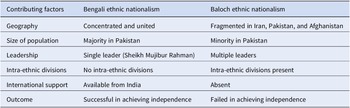
By way of summary, table 2 compares the factors behind the success of the Bengali and failure of the Baloch efforts.
Comparison of the contributing factors to the success and failure of Bengali and Baloch ethnic nationalism respectively.

Sindhi Nationalism: From G. M. Syed’s Sindhu Desh to Bhutto’s Integrative Reforms
Sindh is one of the four provinces of Pakistan. As noted above, it has been home to the native people of Sindh since the time of Indus Valley Civilization. One of the salient features of Sindhi society is its feudalistic structure. The society is divided into feudal lords, known as waderas, and serfs and peasants known as mazaray. Apart from feudal lords, the society is also dominated by religious personalities known as pirs. Popular Islam and the folk Islam of Sufism are quite prevalent. Sindh has always remained an appealing and attractive place for migrants, but migrants used to assimilate into Sindhi culture, posing no threat to the integrity of Sindhi identity. Later on, after the partition of United India and establishment of Pakistan, Sindh also attracted migrants from the Hindu-dominated provinces of India. These migrants, known as Mohajirs, settled in the urban centers of the province: Karachi, Hyderabad, and Sukkar. In Karachi city, the local Sindhis have now become a minority. The fear of becoming a minority has ignited the ethnic-nationalistic sentiments of the people of Sindh.
Sindh was the first province to opt for the creation of Pakistan. The father of Sindhi nationalism, G. M. Syed, was a staunch supporter of the Pakistan movement. After the creation of Pakistan, when reality differed from what they expected, the Sindhi turned toward the separatist ideology of Sindhudesh (the name of the proposed independent state for the Sindhi nation) under the leadership of Syed. Syed considered the Sindhi as a separate nation. He wrote, “The people of Sindh are a separate nation on the basis of all principles recognized the world over as the principles essential for nationhood. Those principles are (i) separate homeland, (ii) separate language, (iii) distinct culture, (iv) body of historical traditions and (v) existence of special political and economic interests,” (Syed Reference Syed1974, 23). What conditions compelled the former protagonist of the Pakistan movement into a diehard Sindhi nationalist?
The very first blow to the integrative culture of Sindh was the arrival of refugees from the united provinces of India, who settled in Karachi and Hyderabad. A large number of these migrants came from the Indian Punjab and settled in the Pakistani Punjab, where they quickly assimilated and were no longer recognized as migrants (Verkaaik Reference Verkaaik2004, 2). They did not create any problems for the local people of Punjab. However, those settled in Sindh areas created problems for the local people. Feroz Ahmed writes, “Sindhis then held a gratifying feeling that they were welcoming there Muslims as Ansars, as the people of Madinah welcomed the Muslims who migrated there from Makkah with the Prophet of Islam (pbuh)” (Ahmed Reference Ahmed1972, 11). This hospitality soon backfired. The Muhajir who migrated from India and settled in urban cities of Sindh did not assimilate into the culture of Sindh. Instead, they maintained their own identity, a rather superior one. They distanced themselves from the Sindhis, whom they considered culturally inferior, illiterate, and backwards (Siddiqi Reference Siddiqi2012, 82). Most of the incoming people were better educated, more industrious, and more politically conscious than were the Sindhis, and they established themselves quickly and took a lead in seizing opportunities in commerce, industry, and professions that the new country provided in abundance (Rahman Reference Rahman1993, 78). “Linguistically, culturally, politically, socially, economically, there was no comparison of these refugees with their Sindhi ‘hosts’” (Zaidi Reference Zaidi1991, 1295). Moreover, apart from across-the-border migration, within-border migration of Punjabi, Pashtun, and Baloch further aggravated the fear of being dominated by other ethnic groups. This demographic disruption provided ground for Sindhi nationalism. Syed availed himself of the opportunity and started the separatist Jiye Sind Mahaz (Long live the struggle for the Sindh).
With the arrival of Muhajirs came the Urdu language. The declaration of Urdu as a national language was another blow to the Sindhi’s identity. They resented and protested the imposition of a minority language. The imposition of Urdu was considered by Syed as an effort on the part of Muhajir-Punjabi imperialism to suppress the Sindhi language: “At present, the Muhajir-Punjabi imperialism is trying their worst to thrust Urdu language on the Sindhis, and are using the entire modern means and methods of publicity, education and sociological pressure for the purpose. But it is absolutely certain that, in spite of everything including the treacheries of the ruling Sindhi Agents of the Muhajir-Punjabi clique, the language of the Sindhi people will survive and grow from strength to strength as it has done in the past,” (Syed Reference Syed1974, 25).
Centralization of the state intensified the nationalist feelings of the Sindhis. The imposition of the one-unit system obliterated the distinct provincial identities of the provinces, let alone the autonomy expressed in the Lahore Resolution. According to Syed, who supported the Pakistan movement, “our sole reason for such a participation was the most unambiguously declared objective of the Pakistan movement, as defined in the 1940 Lahore Resolution of the Muslim League to found ‘Independent and Sovereign states’ in the Muslim majority provinces in the sub-continent,” (Reference Syed1974, 8). The leaders of the Pakistan Movement promised a federal form of government before the creation of Pakistan, but after the partition they resorted to over-centralization of the state. This hardened ethno-nationalist feelings among the people.
After these developments, various ethnic elites of the Sindhi ethnic group started different movements and created different parties with different political programs focusing on how to achieve rights for the Sindhis vis-à-vis the Mohajir-Punjabi nexus. Syed started his separatist nationalist campaign for the establishment of Sindhudesh, calling it a “nation in chains,” which needs to be liberated. The first sentence of his book, Nation in Chains, is “Sindhudesh was born with the birth of Mother Earth” (Syed Reference Syed1974, 3). Syed’s idea of a separate homeland for the Sindhis failed to materialize because of the countermovements of Rasool Bux Palijo’s Autonomist Awami Tahreek and, even more so, by the reform-oriented parliamentary politics of Zulfiqar Ali Bhutto’s Pakistan People’s Party. Charles Kennedy describes these different political programs as “gradualist, autonomist and separatist” (Reference Kennedy1991, 947). Bhutto’s Pakistan People’s Party was considered “gradualist,” believing in reforms through constitutional and parliamentarian means Palijo’s Awami Tahreek was called “autonomist” because its struggle was for autonomy. Syed’s Jiyae Sindh Mahaz was termed “separatist” for its agenda of secession and independence from the state of Pakistan.
It was the Pakistan People’s Party that surfaced as the dominant party in the province and weakened the nationalist parties through its gradual, reforms-based approach to remedy the miseries of Sindhis. Much harm was done to Syed’s project of Sindhudesh. With the demise of Syed and the emergence of the Pakistan People’s Party as a reformist and federalist party, the nationalistic struggle of the Sindh ethno-nationalists continued, but with lesser appeal to the general masses of Sindh. It was the Pakistan People’s Party that secured a majority of the votes of the Sindhi electorate, not the nationalist parties. Since 1971, nationalist political parties have not performed well in elections. The Pakistan People’s Party has ruled both Sindh and Pakistan multiple times.
During his tenure from 1971 to 1977, Bhutto took many steps that addressed grievances of the Sindhis. He nationalized the industries, reformed the bureaucracy, declared Sindhi as the medium of instruction in Sindh, and introduced the rural-urban quota system. All these reforms harmed the Mohajirs’ standing in society while improving the material conditions of Sindhis. The extent to which Sindhis were integrated in the state structure can be gauged from the fact that Bhutto launched military operations against the Baloch insurgents from 1973 to 1977, while enacting reforms that benefited the Sindhis.
The shift in demand from independence to autonomy is proof of the decline in the intensification of ethnic nationalism in Sindh. The reforms enacted by the Pakistan People’s Party benefited the Sindhis and let them believe in the idea of being a partner in the ownership of the state, with access to its resources. Sindh-based and Sindhi-led, the Pakistan People’s Party ruled the country multiple times, which enhanced their sense of being legitimate candidates to speak on behalf of the state. Furthermore, Bhutto increased the number of Sindhi in the state government leading to the ethnicisation of bureaucracy. Wimmer’s idea of state ownership and ethnicization of bureaucracy aptly describes the decline in the resentment of Sindhis toward the state: they considered it their own. The extremist strand of Sindhi nationalism that demanded separation of Sindh from Pakistan has been replaced by the moderate and reform-oriented Pakistan People’s Party.
Pashtun Nationalism: From Pashtunistan to Pakhtunkhwa
Pashtuns reside on either side of the Durand Line, which bifurcates the Pashtuns into Afghanistan and Pakistan. According to the 2017 census, Pashtuns make up 15 percent of the total population of Pakistan. This division of one ethnic group into two states gave rise to the irredentist claims of the nationalist leaders. Pashtun nationalists engendered the slogan of Lar Ao Bar Au Afghan (Afghans on either side of the Durand Line are one). This slogan is frequently chanted by the Pashtun nationalists, implying the oneness of the Pashtuns as a nation (Afghan) living on both sides of the Durand Line—that is, in both Afghanistan and Pakistan. The refusal of the Afghan government to recognize Pakistan in 1947 gave impetus to the nationalist sentiments of Pashtuns. The Afghan government protested the Pashtun territories becoming part of Pakistan and demanded their return.
After the creation of Pakistan, Pashtun nationalism was a continuity of the pre-partition anticolonial struggle against the British. Pashtun nationalism was expressed not only by the Khudai Khidmatgar movementFootnote 2 but also by the Wror Pashtun (Brother Pashtun). Ahmed writes, “The Khudai Khidmatgar (Red Shirt) movement in the settled districts of Sarhad, led by Ghaffar Khan, and the Wrore Pushtoon movement in the Pushto-speaking areas of Baluchistan, led by Abdul Samad Achakzai, emerged as the most articulate expressions of Pashtun national sentiments against the British,” (Ahmed Reference Ahmed1973, 9). Both movements continued their nationalist campaign after the creation of Pakistan.
Like Sindhi nationalism, Pashtun nationalism also saw ups and downs, highs and lows. It backed off its separatist demand of Pashtunistan to changing the nomenclature of the province from North West Frontier Province to Khyber Pakhtunkhwa. Pashtun nationalist leadership failed to even unify Pashtun areas of Pakistan in one administrative unit let alone establish a separate homeland. Pashtun nationalism has passed through four stages—(1) “pre-partition anti-colonial nationalism”; (2) “transnational nationalism” in the early years of the post-partition period; (3) “integrative nationalism” in the later years of Pakistan’s existence, marked by participation in parliamentary politics of the state; and (4), most recently, the Pashtun Tahafuz Movement, sparked by the extrajudicial killing of Naqeeb Masood in February 2018 (Ahmed and Khan Reference Ahmed and Khan2020, 8).
Pashtun nationalism was spearheaded by Khan Abdul Ghaffar Khan, known as Bacha Khan under the banner of the Khudai Khidmatgar Movement (Servants of God) also known as the Red Shirts. Prior the creation of the National Awami Party in 1957, Pashtun nationalism was non-parliamentary and based on resistance, but later it was based in parliamentary politics. The sole objective of the National Awami Party was the struggle for provincial autonomy. This was the first step toward integration in the state and away from the secessionist effort for the establishment of independent Pashtunistan. The movement started redefining the idea of Pashtunistan from an independent state for Pashtuns to a provincial unit within Pakistan in which Pashtuns would have the right to govern themselves and manage their affairs (Ghufran Reference Ghufran2009, 1098).
Though Pashtun nationalists started participating in the electoral politics of Pakistan and started the struggle for their due rights through constitutional means, there were groups who were engaged in armed resistance against the state of Pakistan for the establishment of Pashtunistan. They were financially and militarily supported by the Afghan government, which, as noted above, had reservations regarding the Pashtun territories of Pakistan. This support was at its peak during the reign of Dawood Khan as a president of Afghanistan in the 1970s. A special office to deal with the Afghan government’s interference in the internal affairs of Pakistan by instigating insurgency was installed in the foreign affairs department of Pakistan in 1973, during the government of Zulfiqar Bhutto (Haqqani Reference Haqqani2005). Hussain Haqqani further writes that it was before the invasion of Afghanistan by the USSR that Pakistan started to create troubles for the Afghan government by hiring warlords such as Gulbadeen Hikmatyar (Reference Haqqani2005). This implies that the struggle for Pashtunistan did not end after the creation of Pakistan, but continued actively up to the 1970s.
The recent manifestation of Pashtun Nationalism in the shape of the Pashtun Tahfuz Movement (Pashtun Protection Movement) has posed a new challenge to the state of Pakistan. The driving force behind the emergence of the Pashtun Tahfuz Movement is the suffering of the Pashtuns because of the ongoing war against terrorism. Pashtun areas remain the main theater of the war on terror across the Durand Line in both Pakistan and Afghanistan. The rise of the Taliban and the corollary military operations added to the Pashtuns’ sense of victimhood. The movement emerged from the former Federally Administered Tribal AreasFootnote 3 under the leadership of Manzoor Ahmed Pashteen. According to Khan Zaman Kakar, one of the leaders of the Pashtun Tahfuz Movement, “PTM has three classes of people: direct victims of [the] war on terror, Pashtun nationalist parties’ workers, and democratic people of Pakistan. Each faction has its own explanation of PTM. Direct victims explicate the movement in terms of checkposts, land mines, and missing persons. The nationalist faction views it through the lens of structural injustices of [the] past seven decades, and the democratic factions view it through the prism of human rights and fundamental rights,” (Kakar Reference Kakar2020).
The movement spread throughout the Pashtun regions of Pakistan. In the message of the Pashtun Tahfuz Movement, Pashtuns have found the dissonance of their own pain and suffering. They have welcomed the movement and became part of it. Manzoor Pashteen, in a reply to a question about the adoption of the PTM’s stance by the Pashtuns of KP and Balochistan, said, “It was the story of our pain that they feel too, because they also experienced the same pain. Those who haven’t experienced the same pain, they still don’t have feelings for the movement. The movement is formed by the Pashtun themselves because of the grievances, of the past fifteen years of war against terror, [that] they have,” (Pashteen Reference Pashteen2020).
The Pashtun Tahfuz Movement put its constitutional demands before the government of Pakistan. The movement’s narrative is an antiwar narrative: it demands an end to the war on terror in the Pashtun homeland, which has resulted in the suffering of Pashtuns. The demands include formation of a truth and reconciliation commission on extrajudicial killings, presentation of missing persons before the court, removal of land mines from the Federally Administered Tribal Areas, and the elimination of military checkpoints from the Pashtun region.
Integration of Pashtuns
The Pashtuns were gradually integrated in to the state of Pakistan. Integration weakened the nationalist tide of Pashtuns. This integration was made possible in part by the divisions within Pashtun society and in part by state capacity to absorb them into state institutions. This integration was so successful that Pashtuns even accepted the division of Pashtuns residing in Pakistan into two provinces, Khyber Pakhtunkhwa and Balochistan, by giving consent to the constitution of 1973. The 18th Amendment, which caters to the idea of a true form of federalism and grants provincial autonomy, is considered a victory by the nationalist parties. This evinces the statist orientations of the nationalist leaders and their parties. Even the Pashtun Tahfuz Movement, the recent manifestation of Pashtun nationalism, demands basic constitutional rights for Pashtuns and an end to extrajudicial killing and the war on terror. There is no mention of the unification of Pashtuns across the border or a revival of the dream of Pashtunistan. It is more an integrative movement than a separatist one.
The Pashtuns were economically integrated in the commercial and trade structure of the new state of Pakistan. They did not feel left out in the economic field as did other ethnic groups. During the Ayub era, a large number of Pashtuns migrated to and settled in Karachi for commercial purposes. Karachi became the most Pashtun-populated city in the world. After Punjabis, Pashtuns profited most from the rural exodus to Karachi and the emigration to the Gulf countries, making up 35 percent of the Pakistanis who went abroad from 1976 to 1981 (Jaffrelot & Rais Reference Jaffrelot1998, 170). Being a martial race like the Punjabi, the Pashtun were well represented in the army. Starting from Ayub Khan, the three successive commanders-in-chief were Pashtuns. Pashtun nationalism weakened with the passage of time because of the share in political power and space for the political parties to operate. The Khdai Khidmatgar Movement gradually began to lose its earlier support and dynamism as its followers became actively involved in conventional politics in Pakistan (Ghufran Reference Ghufran2009, 1099). By the late 1960s, Pashtuns were well integrated in the state system of Pakistan (Khan Reference Khan2005, 102). Pashtun nationalist parties, the Awami Nationalist Party and the Pashtunkhwa Milli Awami Party, started participating in the politics of Pakistan, vying for victory with other political parties. They have shared the political power of the state by making cross-ethnic coalitions with other parties, for example, a coalition of the Awami Nationalist Party with the Pakistan Muslim League in 1997.
Apart from the state capacity to successfully integrate Pashtuns in to the state structure and reduce the strength of Pashtun nationalists, it was the political divisions within Pashtun society that diluted the appealing spell of nationalists greatly. Unlike the Bengalis, Pashtuns have multiple leaders and political parties that claim to represent their interests. Pashtun nationalists are divided into two groups: followers of Asfandyar and the Awami Nationalist Party and followers of Mahmmod Khan Achakzai and the Pashtunkhwa Milli Awami Party. In the same vein, other national parties like the statist Pakistan Muslim League, Pakistan People’s Party, and Pakistan Tahreek-e-Insaaf (Movement of Justice) have made inroads in Pashtun society, despite having nothing to do with Pashtun nationalism. All of these parties have huge popular support within Pashtun society, as evidenced by the electoral results of 1993, 1997, 2002, 2013, and 2018. In each of these elections, the Awami Nationalist Party was badly defeated by centralist parties like the Pakistan Muslim League, Pakistan People’s Party, and Pakistan Tahrik-e-Insaaf. For a time, no party had ruled twice consecutively, but this trend was brought to an end by Pakistan Tahrik-e-Insaaf, led by cricketer-cum-politician Imran Khan, scoring majority seats in both 2013 and 2018 respectively.
As with Sindhi ethnic nationalism, Pashtun ethnic nationalism experienced a decline with the passage of time. Increased participation in the military and bureaucratic institutions of the state and having a share in the political power of the parliament has also increased the Pashtuns’ sense of ownership in the state of Pakistan. Now they, too, consider the state of Pakistan as their own and themselves as having the right to speak on behalf of the state. Pashtuns are now integrated in every sector of the state—political, economic, and administrative. They are benefiting from the collective resources of the state.
Conclusion
Since 1947, Pakistan has been at loggerheads with the regional identities of the ethnic groups that make up the state. State nationalism confronted ethnic nationalism, periodically leading to violence. If, on one side, the state failed to alleviate the grievances of Bengalis, on the other, it succeeded in integrating the Pashtuns and Sindhis into the state structure. The state has used both coercion and cooption to handle the problem of ethno-nationalism. The failure of the indiscriminate use of force in East Pakistan and the subsequent humiliation of the armed forces both at home and abroad convinced the authorities to avoid the indiscriminate use of force in the future. That is why the state strategically used force in the case of Balochistan, only targeting insurgent and rebel groups. Unlike coercion, cooption and cooperation provided relative success in the integration of the Sindhi and Pashtun ethnic groups. Owing to the failure of its nakedly coercive strategy in East Pakistan, the state used both coercion and cooption strategically in Balochistan, with the resulted that the efforts of insurgents failed.
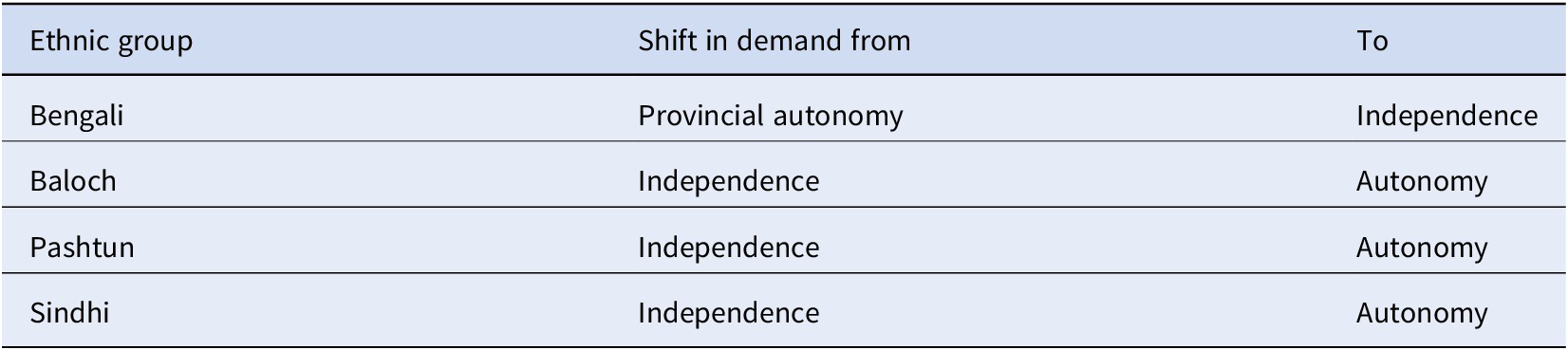
As summarized in table 3, the demands of ethno-nationalist movements experienced shifts from separatism towards autonomy depending on the relationship between the state and the ethnic group.
The general shift in the demands of ethnic groups from autonomy to independence

When the relationship between the state and ethnic groups was balanced, ethnic elites opted for integration; but when the relationship was imbalanced, ethnic elites went for the extreme option of armed resistance and secession. Granting provincial autonomy by the virtue of the 18th Amendment, increasing the financial share of each province in the national revenue pool by changing the criteria of the National Finance Commission, and the possibility of cross-ethnic coalitions in both the provincial and federal assemblies due to the proliferation of the political parties has eroded the militancy of ethno-nationalism and enhanced the integration of aggrieved ethnic groups into the state structure.
Ethnic identity is viewed negatively in Pakistan. It is true that Pakistan faces challenges in handling it. Federalism, negotiation, space for pluralism, and recognition of diverse languages and cultures are important to the solution of ethnic questions in Pakistan. Recognition of the multilingual, multicultural, and multi-ethnic identities of Pakistan and avoidance of their suppression is essential. The state should look for unity within the cultural diversity of society and see it as a strength rather than weakness. Seeing the ethnic groups as partners in ownership of the state, and granting them their fair share in its socioeconomic and political resources can lead to a stable and pluralized polity.
Disclosures
None.