In the early years of the nineteenth century, William Cunnington and Sir Richard Colt Hoare explored hundreds of barrows on the Wiltshire downs in their neighbourhood. Those on Normanton Down, within sight of Stonehenge, are amongst the most celebrated, not least because they yielded some spectacular grave goods of Early Bronze Age date. For Hoare they formed ‘a noble group of barrows … diversified in their forms, perfect in their symmetry, and rich in their contents’.Footnote 1 The bicentenary of the successful opening in September 1808 of Bush Barrow (Wilsford G5) – the most famous of the group – provides us with a convenient opportunity to celebrate the achievement of those pioneer excavators.Footnote 2 This paper is doubly opportune given recent fresh study of the varied grave goods as part of a wider research programme, allowing radical reassessment of their significance.Footnote 3
Although there have been many more excavations of barrows in the Stonehenge region since Cunnington and Hoare’s campaign,Footnote 4 there has been little further investigation of Normanton Down. Wilsford G11 was re-opened by John Thurnam, who was keen to recover the crania of the buried individuals that the former excavators had re-interred,Footnote 5 and the only more modern excavation was that of a Neolithic long mortuary enclosure on the southern flank of the Down by Faith de Mallet Vatcher.Footnote 6 The ploughed area around the barrows has also been fieldwalked (see below). Although this gives important background information, it has little direct relevance to the development of the Early Bronze Age cemetery. Later twentieth-century excavations of Early Bronze Age monuments in locations close to Normanton Down have taken place,Footnote 7 and these sites, which give invaluable detailed context for the composition and contents of local barrows, have been taken into the study area for a complementary paper.Footnote 8
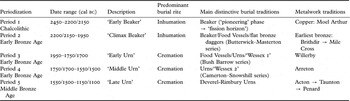
Despite the lack of modern barrow excavation on Normanton Down itself, a considerable amount can still be drawn from the records left by Cunnington and Hoare. The richer grave groups have always commanded much attention and have often been seen as exemplars of broader regional or national phenomena: they were central to Stuart Piggott’s ‘Wessex Culture’; Arthur ApSimon applied the name ‘Bush Barrow’ to a particular series of daggers and Colin Burgess referred to a ‘Bush Barrow group of graves’; meanwhile, Sabine Gerloff coined the term ‘Wilsford series’ because of the concentration of ornament graves in this and neighbouring barrow groups in the parish.Footnote 9 The Normanton group has continued to feature prominently in many standard texts and novel interpretations relating to Early Bronze Age barrows and grave assemblages. Ros Cleal et al emphasized that the barrows visible on the near skyline from Stonehenge, including part of the Normanton group, are dominated by those of the ‘Wessex Culture’.Footnote 10 But the relationship between stone circle and barrows seems to be even more particular for Normanton Down, since all recorded burials on the main east–west ridge may belong to a single archaeologically defined phase, Period 3 (table 1).Footnote 11 For this reason we focus here on the burials of that period, of which Bush Barrow is archetypal.
Summary chronology for the southern British Chalcolithic, Early Bronze Age and Middle Bronze Age

Dating is based on calibrated radiocarbon determinations. The less precise limits given allow for poor stretches of the calibration curve. There is some simplification; for example, ‘Urns’ (in-urned cremation burials) may start towards the end of Period 2, and there was a late facies of Beaker burial into Period 3.
Up until 1995 it had been assumed that the last great phases of construction of Stonehenge (Stonehenge 3) were contemporary with the encircling Early Bronze Age barrows and that the high-status interments in the Normanton cemetery in particular may have been of key figures involved in the construction. But the seminal publication of twentieth-century excavations at Stonehenge has produced a radically revised radiocarbon chronology, which has now pushed these unrivalled stone circles a few centuries earlier.Footnote 12 Their construction is thus shown to be broadly coeval with the earliest Beaker burials dotted across the landscape (Chalcolithic: c 2450–2200 bc, defined as Period 1 in table 1) rather than being contemporary with the cemeteries of fine barrows (such as Normanton) that only expanded over the course of the early half of the second millennium bc (mainly Periods 3 to 4). Nevertheless, there are good grounds for believing that the monument was still of critical religious importance to the communities of the mature Early Bronze Age, so there is still a valid question of relationship, to which we will return.
The anatomy of the Normanton Down barrow group
Normanton Down is a small block of chalk downland of modest elevation, with a maximum height of 110m OD where it appends Stonehenge Down in the north. Aside from this narrow ridge, it is clearly defined all round by dry valleys of varied steepness (fig 1). In topographical terms it is unexceptional, one small fragment of the undulating, dissected plateau of chalk that forms Salisbury Plain. At their closest, the barrows of the Normanton group lie just 1km south of Stonehenge and are situated along a low ridge which has a fine view of the stone monument. Thus they fall just within the ‘envelope’ of visibility from the circle, which captures only a small proportion of the many barrows concentrated in the Stonehenge environs.Footnote 13
The monuments of Normanton Down and its immediate environs (based on RCHME 1979, Reference GrinsellGrinsell nd and Exon et al Reference Exon, Gaffney, Woodward and Yorston2000). Symbols are approximately scaled to the diameter of the mound or outer ditch/bank. Modern excavations: 1 Lake group; 2 Lake East; 3 Normanton Down Neolithic mortuary enclosure; 4 Wilsford shaft; 5 Wilsford G1; 6 Wilsford G14; 7 Amesbury G39; 8 Luxenborough Plantation. Drawing: © Stuart Needham

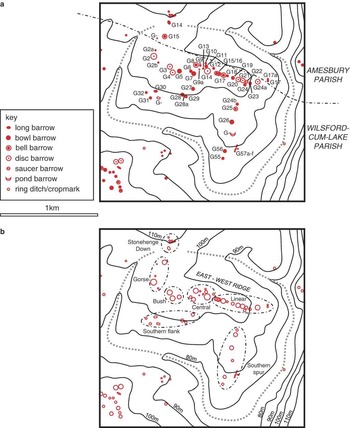
The barrow group that concerns us here was fully catalogued in the course of Leslie Grinsell’s comprehensive survey of the monument type in Wiltshire.Footnote 14 It is dominated by bowl barrows but also contains a number of the more specialized barrow forms he defined (fig 2a), a composition repeated elsewhere in the region. The Normanton Down group has most often been characterized as a classic example of a ‘linear’ cemetery.Footnote 15 Focus on one element of the group has subsequently dominated thinking on its evolution, for linearity invites speculation that there may have been a steady progression in construction from one end to the other.Footnote 16 This may well be a simplification, as few of the burials can be phased tightly, relative to one another. The interpretation of evolution of other well-excavated barrow cemeteries tends to involve less systematic patterns of infill and juxtaposition, even where there may have been elements of linear progression.Footnote 17 In this respect it is worth noting that the small long barrow (Wilsford G13), presumably of Neolithic date, is situated in the middle of the Normanton Down east–west ridge (fig 2a).
The Normanton barrow group: (a) barrow types and their unique parish-based numbers; (b) subgroups to aid discussion (based on RCHME 1979 and Reference GrinsellGrinsell nd). Drawing: © Stuart Needham

The linear element on Normanton Down is only a small part of a more complicated pattern of barrows on this downland block.Footnote 18 (fig 2b). Even along the main east–west ridge, only the eastern half of the spread of barrows is strictly linear (Wilsford G15–24a, Amesbury G17–17a). The monuments immediately to the west are more of a cluster, and further west still they become more widely spaced.Footnote 19 This last zone includes Bush Barrow (G5), so, despite the apparent supreme status of the individual buried therein and its assumed early construction, there was no great aggregation of satellite mounds immediately around it. We cannot, though, exclude the possibility of secondary burials within G5 itself, especially given the recovery of a large sherd of Biconical Urn from its surface in 1878.Footnote 20 This less dense distribution of monuments extends north west through the Normanton Gorse subgroup, before reaching a tight cluster of mainly small mounds on Stonehenge Down (Amesbury G1–3, 107–111), immediately north of long barrow Amesbury G14.
The valleys delimiting the western, southern and eastern sides of the Down enclose a gently shelving slope to the south west and a southward-pointing spur running off the eastern end of the east–west ridge. The southern flank is occupied by a loose cluster of several barrows (Wilsford G27–32), including a Neolithic long barrow and long mortuary enclosure, roughly grouped below the 100m contour line. Barrows on the southern spur were mainly strung out along the weakly defined ridge (Wilsford G24b, 25–26, 55–57) which runs at right angles to the east–west ridge. A cluster of mini-barrows to the east of the crest (Wilsford G57a–f) may be later Middle Bronze Age burial mounds. A site only recently recorded, between barrows G26 and G56, appears from the LIDAR survey of the Stonehenge environs to be a pond or pond barrow, possibly defined by a curving ditch.Footnote 21 If it proves to be a pond barrow, it will be the first to be recognized on Normanton Down.Footnote 22
The Cunnington/Hoare campaign on barrows around Stonehenge
William Cunnington began to excavate round barrows in the Stonehenge area, including those on Stonehenge Down, in 1802, at that time sponsored by the Revd William Coxe and Henry Wyndham, the MP for Salisbury; from 1803 he formed an alliance with Sir Richard Colt Hoare, who financed the whole programme thereafter.Footnote 23 Between them they managed to excavate more than 450 barrows, including twenty-four round barrows in the Normanton Down group.Footnote 24 They noted that at least twenty-five of this group had already been dug into; although it is known that the earl of Pembroke and William Stukeley had dug into five in 1722–3,Footnote 25 the other delvings seem to be totally unrecorded.
In contrast, Cunnington and Hoare’s records were exceptional for their time. The first of the two fine publication volumes compiled by Hoare was based very closely on a series of manuscript reports (‘letters’) written to him by Cunnington, who was effectively the on-site excavation supervisor. It is clear that Hoare wanted Cunnington to be the primary observer, for he trusted both his observations and his deductions when it came to drafting the published account.Footnote 26 Hoare re-cast the language of the reports to some degree and occasionally dropped out some detail or inference, but, to a very large extent, the content of the first volume of Ancient Wiltshire was generated by Cunnington;Footnote 27 and although Hoare arranged for a notable antiquary, Thomas Leman, to read and comment on Cunnington’s accounts for a while, he was rarely persuaded that Leman’s more educated view outweighed that of Cunnington, based on empirical observation and reasoned deduction.Footnote 28
This does not mean that, 200 years on, we would always regard Cunnington’s view as closer to modern interpretation than Leman’s – neither of them had any framework of archaeological methodology within which to reconstruct the prehistoric past. The key point is that Cunnington, being not unduly tainted by classical learning, was able to think free of ‘learned’ preconceptions.Footnote 29 In fact Cunnington saw, with remarkable percipience, a point that still much exercises archaeologists today – that we cannot readily situate ourselves in past worlds and past mind-sets:
In this group of barrows [the Lake group] our discoveries are in opposition to all systems because these systems are formed from ideas gathered from the limited knowledge we have of past events, and what we in this day consider is consistent with order and the nature of things. But the period in which the Britons raised these sepulchres is so very remote, and our manners and customs so dissimilar that at this day we have few documents to guide us. Therefore almost all our discoveries are at war against preconceived opinions gathered from books, etc.Footnote 30
The contribution of the workmen John Parker and his son, Stephen, notwithstanding,Footnote 31 another vital cog in Hoare’s campaign team was the surveyor and draughtsman, Phillip Crocker, an Ordnance Survey officer. Setting aside his magnificent watercolours of the excavated artefacts,Footnote 32 Crocker’s fundamental contribution was to survey groups of barrows, allowing each to be uniquely labelled with Cunnington and Hoare’s designated number against a plan. Thus, with rare exceptions, it is possible to be certain which mounds yielded which graves and goods.Footnote 33 As was typical of Cunnington and Hoare’s experience of Wiltshire barrows, the Normanton group yielded a range of monument forms and varied burial characteristics. At times they despaired of ever finding any correlation between barrow type and contained goods. Burials included inhumations and cremations – the latter in the majority, as they found to be the case more widely. A few of the burials – both inhumations and cremations – were exceptional in that they were accompanied by rich and diverse grave goods. That found in Bush Barrow was the most impressive of them all.
Bush Barrow (Wilsford G5)
Bush Barrow is a bowl barrow about 36.5m in diameter and stated to be about 3.3m high by Cunnington.Footnote 34 Cunnington first dug into the large mound on 10 or 11 July 1808 without success.Footnote 35 According to Hoare, ‘some farmers’ also attempted to discover the contents of the mound. Undaunted, Cunnington returned in September and found the now famous burial. The exact date seems not to be recorded, but it was undoubtedly between 5 and 10 September when William and his wife, Mary, were lodging at Amesbury.Footnote 36 Hoare was still returning from a trip to Wales and wrote, on 22 September, in reply to Cunnington’s news: ‘I congratulate you heartily on the continued success you have met with at Stonehenge.’Footnote 37
No drawing of the burial in situ is known (this was not yet the practice in such excavations) and Cunnington and Hoare were inexplicit about the posture of the skeleton. A number of scholars during the middle decades of the twentieth century reached the conclusion that the burial was extended, and they drew parallels with a few ‘princely burials’ in north central Europe. Based on this assumption, Paul Ashbee drew up a reconstruction of the grave using the original account to place the objects around a supine skeleton.Footnote 38 However, we have looked afresh at the extant evidence and found nothing to suggest that the skeleton was supine.Footnote 39 Cunnington’s original manuscript account on the burial rite is as follows: ‘Contrary to the more general practice we found on the floor of this Barrow the Skeleton of a stout and tall man, *lying from South to North.’Footnote 40
Taking ‘contrary to the more general practice’ together with ‘lying from south to north’, one might draw the conclusion that this burial was contrary to the normal crouched rite. However, ‘contrary’ could equally refer to its position on the floor of the barrow or, much more likely, the direction of the body – head to the south – Cunnington and Hoare’s experience being that heads were normally pointing roughly northwards.Footnote 41 Moreover, these intrepid barrow diggers, having encountered many inhumations by 1808, recognized that the inhumations primary to the burial mounds were always crouched,Footnote 42 and that the extended examples sometimes found high in the ancient mounds were secondary burials of later peoples – notably ‘Saxons’ or ‘Danes’. If the Bush Barrow skeleton had truly been extended, it would be surprising indeed for Cunnington to have omitted to mention such an extraordinary exception to the rule, given his detailed attention to the grave group. We can also add that more modern excavations have confirmed the near-universal absence of fully extended inhumations in Early Bronze Age Britain.Footnote 43
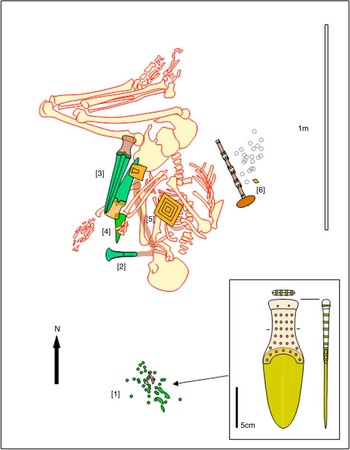
Being unsure of the exact position of the body, it may seem unwise to re-attempt a reconstruction of the grave layout, but Cunnington’s account is sufficiently graphic as to encourage it; in the process we might at least ascertain what ambiguities remain. Having argued that the body would have been crouched, we have to make a further assumption: that the body lay on its left side, the usual position for a senior, dagger-accompanied male of the period.Footnote 44 Special-case arguments, such as a female who acquired a position normally attributed to males, can always be invoked, but in the absence of skeletal evidence for re-examination we do best to accept the sex as judged by the excavator and assume the normal rite for a dagger burial. As a final preliminary, we need to deduce the position Cunnington was adopting in his account of the successive discovery of objects around the body. It is clear from his description of the orientation (above) together with the first object cluster (fig 3[1] and below) that he was viewing the body as if standing at the head end of the grave, which was to the south.
Hypothetical reconstruction of the Bush Barrow grave based on Cunnington’s account. Inset: reconstruction of the bronze and wood pieces found to the south of the head as a studded-hilt dagger. Drawing: © Stuart Needham

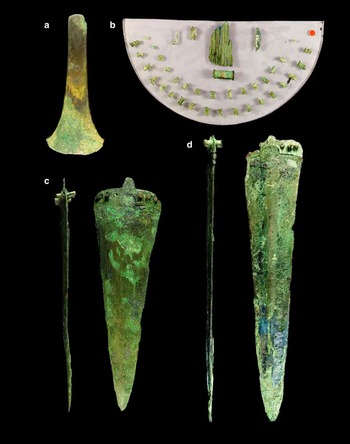
Having set out the body, we can now consider the disposition of the grave goods. Cunnington’s account seems to progress around the body in a logical flow and it may represent the sequence of discovery. It begins: ‘About Eighteen Inches South of the head we discovered a large quantity of Brass rivets intermixed with wood & some thin bits of Brass nearly decomposed’ (fig 3[1]; fig 4b). Past suggestions that these were the remains of a shield, helmet, box or alidade are all unconvincing.Footnote 45 The distance does not sound great, but the reconstruction makes it apparent that this set of objects was rather detached from the body and from the rest of the grave assemblage. This has important ramifications once it is appreciated that these pieces can now effectively be interpreted as the decayed remains of a studded-hilt bronze dagger or knife of a rare type (fig 3, inset). The ‘thin bits of Brass’ appear to be the remains of the blade.
Bush Barrow copper and bronze artefacts: (a) axe-head; (b) rivet group with fragments of blade, hooked wire and wood; (c) flat dagger; d) mid-rib dagger. Approximate scale: 33 per cent, except (b) 50 per cent. Photographs: © David Bukach and University of Birmingham

‘Near the shoulders lay the fine Brass Celt. This article had been deposited with its handle of wood’ (fig 3[2]; fig 4a). No wood-like structure survives in the corrosion layer, so it is possible that Cunnington and his team did actually notice a stain in the ground indicating the handle.
‘Near the right arm we found a large Dagger of Brass & and a large Spear Head of the same metal full thirteen inches long’ (fig 3[3]; figs 4c, 4d). Today we would identify both of these blades as daggers, but Cunnington may have thought the mid-rib on one was indicative of a spearhead. Alternatively, it is possible that they pointed in different directions in the grave (as shown in fig 3). The position ‘near the right arm’ has hitherto been taken to mean on the right side of the body,Footnote 46 but repositioning the body in a crouched posture actually makes it ambiguous. In most prehistoric crouched burials both hands are in front of the body, so the right forearm would be the same side of the body as the left. Perhaps Cunnington was actually making a slightly different point: if the body was laid on its left side the right arm would have been uppermost and perhaps this was the only one exposed before the daggers first came to light alongside.
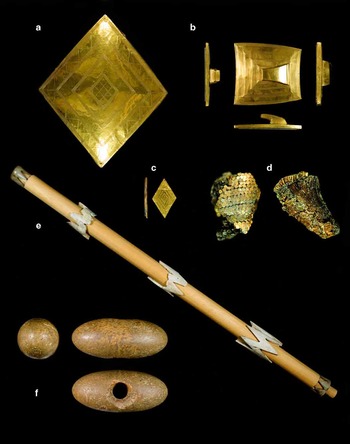
With these weapons was ‘a curious article of gold, which I conceive had once ornamented the case of the Dagger’. Although we interpret this to mean the large belt-hook (fig 5b), some ambiguity arises over the identification of the ‘curious article’: Cunnington only mentioned two of the three gold pieces found and he went on to describe the one he ‘supposed to belong to the sheath of the Dagger’ as being ‘a thin plate of gold neatly ornamented & in high preservation, it weighs … [unfortunately the weight was never entered]’. Annable and Simpson took this to be a description of the smaller of two lozenges (the larger is unequivocally placed elsewhere; see below) and therefore concluded that there was a contradiction with what Hoare subsequently published.Footnote 47 This seems unlikely; Cunnington rarely entered into detailed morphological description of the artefacts recovered and it would be surprising if he had mentioned the rather insignificant small lozenge and not the amazingly well-preserved and more highly decorated belt-hook. Hoare had evidently satisfied himself as to which was present alongside the daggers, not least because he goes on to place the small lozenge elsewhere (fig 3[6] and below), presumably having consulted Cunnington on this point.Footnote 48
Bush Barrow gold, stone and bone artefacts: (a) larger lozenge; (b) belt-hook cover; (c) smaller lozenge; (d) fragments of dagger pommel inlaid with gold-wire studs; (e) shaft mounts (on modern shaft); (f) mace-head. Approximate scales: (a, b, e, f) 33 per cent; (c) 50 per cent; (d) enlarged. Photographs: © David Bukach and University of Birmingham

‘The handle of wood belonging to the Dagger had been richly & most singularly ornamented by an immense quantity of minute gold rivets, no thicker than the smallest pin’ (fig 5d). Cunnington went on to express his fear that thousands of the ‘rivets’ had been thrown out by ‘the labourers’ before it was realized what they were.Footnote 49 Even so, it should not be assumed that the gold-pin studding covered the whole of the hilt; most definite is a deep zone at the butt end, perhaps creating a pseudo-pommel, and there appears also to have been a band along the base of the hilt.Footnote 50 Mike Corfield has also discovered that the rivets on the second dagger (Cunnington’s ‘spearhead’) were encircled by rings of similar tiny gold studs.Footnote 51 This begs the question as to whether this dagger, too, had a greater coverage of gold-wire inlay that went unnoticed by the excavators.
‘Beneath the fingers of the right hand lay a Lance Head of Brass but so much corroded that it broke to pieces in taking out’ (fig 3[4]). The term ‘lance head’ was generally used for the smaller blades we now call knife-daggers; if indeed it was a less substantial blade than the two daggers, this could account for its decayed state. It is noteworthy that the blade of the thin dagger interpreted from the fragments to the south of the head (fig 3[1], above) was evidently also in a poor state of preservation.
‘On approaching the breast of the Skeleton we found immediately on the breast bone a fine plate of gold’ (fig 3[5]; fig 5a). This was the large lozenge, which appears originally to have covered a core with a gently domed profile.Footnote 52 Although it was stated that the metal was ‘fixed to a thin piece of wood’, this is probably a deduction based on the lapped form of the edges of the plaque and two small perforations.Footnote 53
‘We next found on the right side of the Skeleton, a curious stone … also some curiously ornamented bones … and a great many small rings of Bones which were broken to pieces’ (fig 3[6]; figs 5e, 5f). ‘The stone is singular & had a wooden handle with a neat ornament of Brass on the top, the latter being fastened by a Brass pin.’ We cannot know whether a wooden handle was observed as traces, or was simply deduced. The ‘many small rings of Bones’ are particularly difficult to interpret because none were recovered, or none survive. Their evident poor condition relative to the zigzag mounts suggests fragile items – small and/or thin. This is a key passage for the revised grave reconstruction: the previous reconstructions had already placed the daggers and belt-hook on the right side of the body, so it always seemed strange that at this point in the narrative Cunnington specified the right side for the stone mace-head and its immediate accompaniments. However, if the daggers et al were in front of the body – on the ‘left’ from Cunnington’s vantage point at the head – then we can see why Cunnington needs to say that he has now crossed the body to the ‘right’ side, having taken in the lozenge on the breastbone en route.
Overlooked in Cunnington’s manuscript account, Hoare adds at this location ‘another article of gold’, which he illustrates as the small lozenge (fig 5c).Footnote 54 It is not hard to imagine this small gold object being overshadowed by the other two impressive gold items in the grave and this presumably explains Cunnington’s oversight.
Absent from Cunnington’s record is any observation of timber structures or furniture associated with the grave. Elsewhere, he recorded wooden coffins and voids where they were evident, as was the case for the nearby Amesbury G15.Footnote 55 Modern excavation has demonstrated that such remains are relatively common but often ephemeral,Footnote 56 and they could easily have been missed. Traces of mineralized fabric on the axe-head hint at the possibility that the burial was clothed or shrouded.Footnote 57 A distinctive weave or patterning in the cloth could potentially have identified the social ties or rank of the individual, or his deceased state. Elsewhere, burials beneath barrows of the period indicate the use of bracken, hides and soft furnishing around the body but we can only speculate that Bush Barrow may have contained such items.
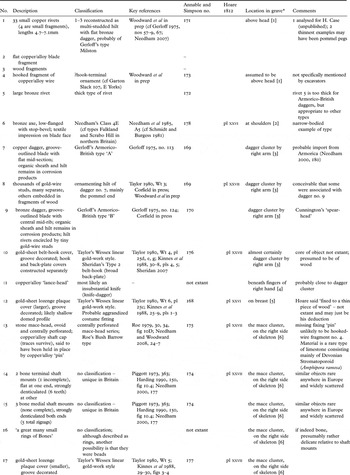
The excavation hole into Bush Barrow apparently remained open until at least June 1810, but sometime thereafter it was back-filled and has remained that way ever since. Following their normal practice, these excavators would have re-buried the skeleton in its original location. We have dwelt on the matter of reconstructing the Bush Barrow grave at some length, for it is crucial, firstly, to dispel the myth of the extended inhumation; secondly, although there can be no certainty about the disposition of the body and goods, it does have the value of raising new questions and possibilities. A summary of the current classifications of the objects is presented in table 2.
Summary of the grave assemblage from Bush Barrow (Wilsford G5)

* Numbers in square parentheses refer to the locations in the grave reconstruction in Figure 3. All objects are described and discussed more fully in Woodward et al in prep.
The previously enigmatic remains of an object or objects to the south of the head (fig 3[1]) can now be reconstructed as a studded-hilt dagger, a type proper to a period (Period 2) prior to the rest of the grave goods. One of the few known parallels was excavated by Cunnington himself in a barrow on Silk Hill, Milston, on the opposite side of the River Avon.Footnote 58 One cannot wholly rule out the possibility of an overlap in the currency of these daggers and the succeeding Armorico-British series (as represented by the other two daggers), nor the possibility of retention as an heirloom.Footnote 59 However, the fact that this studded-hilt implement was a little removed from the body could suggest that it had accompanied a different, earlier burial that may have been partly disturbed when Bush Barrow man was interred. Such a sequence would mean that the famous rich grave was not the primary interment under that barrow. There is a small hooked fragment of bronze currently mounted with the rivets of this early dagger which is not described by Cunnington or Hoare (table 2, no. 4).Footnote 60 Obviously its provenance remains uncertain, but one of the only bronze-wire objects from the British Early Bronze Age with such a tight crook is part of a composite neck-ring from Garton Slack 107, East Yorkshire, where it is associated, intriguingly, with a studded-hilt dagger.Footnote 61
We have also shown that, aside from the large gold lozenge and possibly the axe-head, the remaining artefacts may have constituted two clusters: one to the front of the body (daggers/knife/belt-hook) and one to the rear (mace-head, shaft mounts, rings, small lozenge). This assumes some importance, since there could be a major symbolic difference between the ‘dagger cluster’ at the front and the ‘mace cluster’ at the back. Mace-heads are extremely unusual grave accompaniments in the south of Britain, and were, perhaps, more appropriate to certain northern regions as regalia of high status.Footnote 62 The different connotations of the mace might have necessitated its placement away from the more regular accompaniments of high-status men in Wessex.
The axe-head is described as being ‘near the shoulders’ and, by implication, perhaps discrete from the dagger cluster at the right arm. Only eight axe-heads (ranging from full-sized to diminutive examples) are recorded in association with inhumations, and two or three of these are not fully recorded in terms of body and artefact positions.Footnote 63 Nevertheless, it would seem that a position close to the head was the most frequent for an axe. This is the case here at Bush Barrow and at West Overton G1, Manor Farm and Moot Low.Footnote 64 In three (or possibly all four) graves the axe-head was in front of the face. Of the remaining four graves, the axe-head from Borther Low was merely described as at the left side of the body (whose orientation, posture and sidedness was not noted). In two other graves – Butterwick and ParwichFootnote 65 – the axe-head was at the hips or thigh. These might indicate the position of an axe hung on a waist belt, rather than held in the hand. The final position, from Wilsford G58 in the Wilsford barrow group just to the south of Normanton Down, is exceptional, the axe-head lying at the feet of the body.Footnote 66
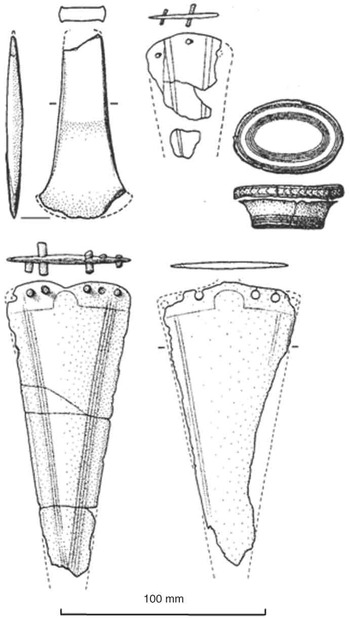
The dagger cluster at the front of the Bush Barrow body can be reconstructed as two magnificent daggers and a slighter blade, probably a knife-dagger, along with a gold covered belt-hook. The association of dagger with knife-dagger is a feature of a number of graves of Periods 3 and 4; the occurrence of two full-size daggers together is rather more unusual, but does occur nearby at Winterbourne Stoke G5 in a grave of similar date to Bush Barrow.Footnote 67 Only one grave parallels the full threesome of blades at Bush Barrow: that of Ridgeway 7, Dorset,Footnote 68 another ‘rich’ Period 3 grave, also matching in having a bronze axe-head and a gold-embellished pommel – this time with a cover of sheet gold (fig 6). This group accompanied a cremation, but it matches the front-of-body objects from Bush Barrow, with the exception of the belt-hook.
Grave assemblage from Ridgeway barrow 7 (Weymouth G8), Dorset, with comparable composition to Bush Barrow front-of-body objects. Scale: 50 per cent. Drawing: © Stuart Needham

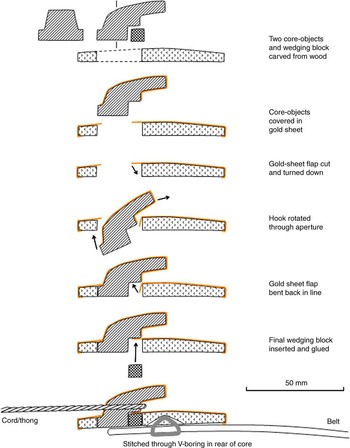
The associated ‘belt-hook’ at Bush Barrow – strictly speaking the gold-sheet cover for a belt-hook – is by far the most ornate yet known and also has a complex construction.Footnote 69 Although the hook’s cover is currently separable from that for the back-plate, it is deduced that this would not have been so when mounted on its core and probably the hook would have passed through a cord or leather loop (fig 7), for it was surely largely exposed while in use to make the most of its dazzling appearance. This makes it difficult to envisage its use for suspending one of the dagger sheaths, and a use literally for fastening a belt to itself is preferred. On this interpretation, its proximity to the daggers may simply reflect the fact that both were towards the front of the body. Belt-hooks, which number only twenty across the whole of Britain and Ireland (see below),Footnote 70 are almost always carved out of single pieces of bone and most have a back-plate which is little broader than the hook itself. Exceptions like Bush Barrow with broader back-plates are few and belong to Sheridan’s type 2.Footnote 71
Bush Barrow belt-hook cover: suggested mode of assembly and attachment for use. Scale: 75 per cent. Drawing: © Stuart Needham

The recorded position of the large lozenge, taken at face value, has always made it easy to interpret it as a splendid fastener for a cloak or other upper-body garment. Although the other two known lozenges – in gold from Clandon Barrow, Dorset, and in jet from Carlton Colville, Suffolk – were unfortunately not associated with human remains, the position of the seemingly equivalent rectangular gold plaque cover from Little Cressingham, Norfolk – another antiquarian find – seems certain: it was described as a ‘breastplate’ and was said to have lain on the breast of the skeleton. This inhumation was orientated head to the south, as at Bush Barrow, and its legs were drawn up.Footnote 72
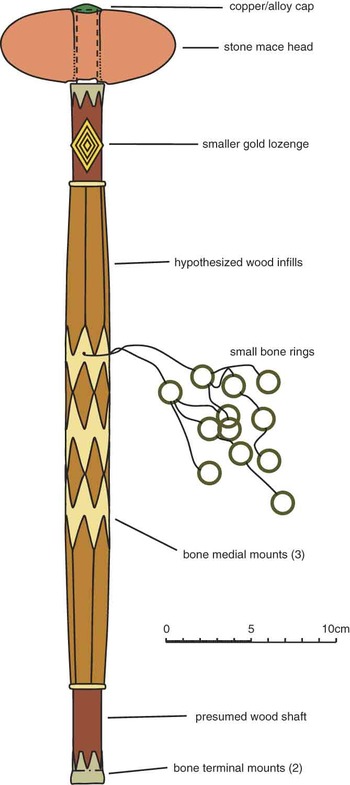
The mace cluster of objects to the right of the body is difficult to interpret, mainly because proximity cannot necessarily be taken to imply all were linked functionally. Opinion has swung to and fro on the question of whether the zigzag mounts ornamented the shaft of the mace-head or a separate one. A reconstruction that incorporates all the elements is feasible, but only if the shaft of the mace was swollen in the centre, for the three mid-shaft zigzag mounts have a larger diameter than the end-mounts (fig 6). It may make more sense to see this as a smooth, cigar-like swelling rather than a long, parallel cylinder with abrupt contractions close to the two ends, as drawn by Ashbee.Footnote 73 Moreover, by putting the apices of the medial mounts 90 degrees out of phase, so that the upper apices of one mount meet the lower apices of the next, it is possible to create lozenge-shaped gaps between (fig 8). Although these would have been too small for the small gold lozenge to be set within, the latter could have been set elsewhere on the shaft, for its width is comparable to the shaft diameter. Together these motifs would echo the magnificent breast ornament.
Hypothetical reconstruction of the Bush Barrow mace, incorporating all objects found in the ‘mace cluster’. Scale: 40 per cent. Drawing: © Stuart Needham

Given the unknown form of the bone ‘rings’, any attempt to include them in a reconstruction has to be highly speculative, and it must be kept in mind that vestigial remains may have been misinterpreted. However, two near-contemporary objects have interlocking bronze rings: three dangled from the cross-piece of a bronze double-pronged object from Wilsford G58,Footnote 74 while a double-ring-headed bronze pin from Collingbourne Ducis G4 has single rings dangling from each side of the head.Footnote 75 Although differing in execution from the arrangement speculated for Bush Barrow (fig 8), these finds do demonstrate that the design concept of strings of rings was current in central Wessex at this time.
Other grave groups from Normanton Down
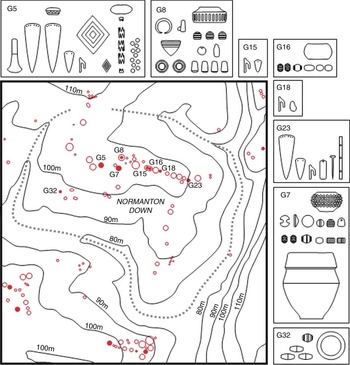
A fuller treatment of all known graves from the Normanton Down environs (fig 1: the circle) is to appear elsewhere.Footnote 76 Here we focus on Period 3 graves with a particularly strong association with the east–west ridge of Normanton Down (fig 9).
The location and character of Period 3 graves on Normanton Down. Those in the immediate environs are also marked. Objects are representations of the given type, not of the individual example; they are not shown at a consistent scale. Drawing: © Stuart Needham

Period 3 graves with daggers and/or belt-hooks
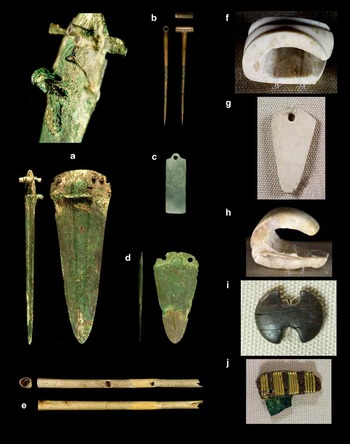
The dagger/knife association at Bush Barrow is repeated in Wilsford G23, a Period 3 grave at the east end of the Normanton linear group, where a perforated whetstone and a possible bone pipe were also associated (figs 10a–e). Not previously recognized, however, is that this grave also contained a belt-hook; it is unique in being made of bronze and is corroded onto one face of the dagger.Footnote 77 The seemingly unequivocal position of the hook in this instance suggests it attached the sheath to a belt, a function we have argued against for the Bush Barrow example above,Footnote 78 thus emphasizing that not all such objects functioned in the same way. Nevertheless, it may still be reasonable to suppose that such hooks were a part of the male ‘warrior’ costume set particularly during Period 3,Footnote 79 and, on this basis, two further Normanton graves that contained belt-hooks without daggers come into consideration: Wilsford G15 and G18 (figs 10f, 10h). Indeed, G15 contained a dagger- or knife-shaped bone pendant or toggle (fig 10g). Seventeen out of twenty belt-hooks have been found with cremations and for only six has the age and sex of the individual been determined; however, the two known inhumations were identified as males and four cremated remains have been identified as of probable or possible males.Footnote 80 There was also an unsexed adult (with a child) and an unsexed adolescent. Whatever the specifics of functional interpretation, it is noteworthy that the four Normanton belt-hooks were all in graves strung out along the main east–west ridge (fig 9).
Wilsford G23 grave group: (a) dagger with detail of attached belt-hook; (b) pin; (c) whetstone; (d) knife; (e) ‘pipe’. Wilsford G15 grave group: (f) belt-hook; (g) pendant. Wilsford G18: (h) belt-hook. Wilsford G7: (i) battle-axe bead. Wilsford G8: (j) halberd pendant. Approximate scales: (a–e) 33 per cent; (f–h, j) 100 per cent; (i) 150 per cent. Photographs: © David Bukach and University of Birmingham

Period 3 trinket graves
One of the features of the mature Early Bronze Age in Britain (Periods 3 and 4) is the frequency of graves dominated by variable quantities of small ‘trinketry’ – beads and pendants – although there are precedents in Periods 1 and 2. Amongst the various ornament graves on Normanton Down, Wilsford G7 and G8 are of especial interest in lying close to Bush Barrow and at the same time yielding rich accompaniments.Footnote 81 Although thought to date to within the same period, based on object types, the two grave groups actually contain objects that only overlap a little in specific types. Indeed, while the trinkets in G7 are a mixture of beads (having central perforations) and pendants (offset perforations), those in G8 are, unusually, all pendants. Much significance can be attached to the contrasts.
Intriguingly, one ornament in each of these graves is a diminutive weapon: in G7 it is a bead in the form of a developed battle-axe, most closely resembling examples within Fiona Roe’s Scotsburn and Crichie groups concentrated in Ireland and northern Britain (fig 10i).Footnote 82 In contrast, G8 contains a halberd-pendant, one of three from Wessex that have been much discussed in the literature, not least because they imitate the form of Aunjetitz metal-bound or metal-shafted halberds from Saxo-Thuringia (fig 10j).Footnote 83 These two weapon types not only contrast in form but also derive from opposite geographical poles. One possibility is that such signifiers indicate inter-regional marriage partners.Footnote 84 An alternative explanation is that the people themselves were not long-distance migrants but that the objects symbolized contrasting allegiances. However, Humphrey Case has pointed out that the westerly pointing head of the G7 skeleton is anomalous in the region and could suggest an origin in more northerly parts of Britain, where it is a standard orientation for females.Footnote 85 This individual could well be a migrant from the north, but the association of a Collared Urn with an inhumation burial is exceptional anywhere.
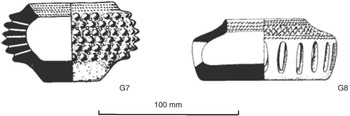
The distinction between these graves is potentially reinforced by the associated cup types, which are strikingly different in form (fig 11). The grape cup in G7 is a strictly local variety, whereas the slotted cup in G8 is characteristic of the southern coastlands bordering the English Channel and thereby linked to a maritime network bringing influences and material from continental Europe.Footnote 86 G8 is a bell barrow, while G7 is a bowl barrow,Footnote 87 and the two are also dichotomous in terms of burial rite: G7 by inhumation, G8 by cremation – though given that they fall around a critical shift in the balance of the respective rites, this need not indicate a specifically contrived opposition between these two burials.
The contrasting but contemporary pottery cups from Wilsford G7 and G8 (after Annable and Simpson Reference Annable and Simpson1964 and Longworth Reference Longworth1983, respectively). Scale: 50 per cent

One response to the presence of ‘weapon’ forms in these graves might be to set aside any assumption of gender, especially as there is no definitive identification from the respective skeletal remains. Although weapons are normally seen to be the possessions of high-status men, it is possible that these diminutive forms signify women of power or high influence who, in some respects, acted as male leaders normally did. Adopting male status emblems might be a way of expressing such power, especially when the objects in question also signified all-important long-distance connections.
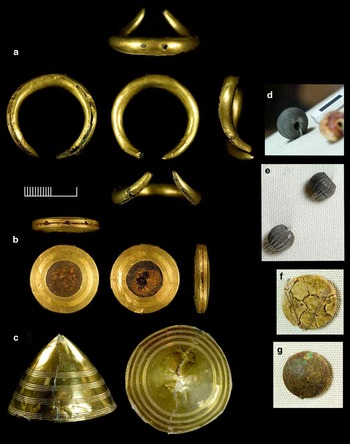
These two intriguing object-diverse grave groups raise other points worthy of discussion. The conical ornaments, one present in each, clearly show a background in the Beaker V-bored button;Footnote 88 yet in their different ways they depart from the prototype. The massive shale ‘button’ with gold cover in G8 (fig 12c) could not support itself stitched to a garment in the traditional way and must have hung, plumb-bob fashion, from its thread;Footnote 89 the rather slighter amber one in G7 (fig 12g) is V-bored for suspension from the side, instead of from the back as was normal on the Period 2 versions.Footnote 90
Wilsford G8: (a) horned pendant; (b) disc pendant; (c) conical pendant. Wilsford G16: (d) ‘melon’ bead. Wilsford G7: (e) ‘melon’ bead; (f) disc pendant; (g) conical pendant. Approximate scale: 100 per cent. Photographs: © David Bukach and University of Birmingham

Another Beaker-derived type present in both G7 and G8, as well as in occasional contexts elsewhere, is the disc pendant (figs 12b, 12f).Footnote 91 These are made of amber, either plain (as in G7) or with the addition of extremely neat gold-sheet edging all round the perimeter (G8). Grooving of the squared-off sides suggests a derivation from Beaker ‘pulley-rings’, which are sometimes grooved in the same direction; V-perforation into one side is a feature of both classes. If this is a legitimate ancestry, yet again a translation in style was accompanied by a switch in function, for the pulley-rings were probably components of functional belt fasteners,Footnote 92 whereas the disc pendants were probably literally suspended ornaments, though not necessarily from a necklace.
A unique pendant in the Wilsford G8 group is a penannular ring with tapered terminals, which also curve upwards in profile (fig 12a),Footnote 93 made of gold sheet wrapped over a copper/alloy core. Ashbee ventured that it may have been a diminutive imitation of central European ingot-torcs,Footnote 94 an attractive idea given the source of inspiration of the halberd pendants, but the comparison is let down by the detail, as was recognized by Humphrey Case.Footnote 95 The Normanton ornament shows no attempt to represent the coiled terminals that were present on the contemporary Ösenringe form of ingot-torc and it is too closed to represent the Spangenbarren form;Footnote 96 indeed, neither potential prototype, represented by thousands of examples, curves in profile. Instead, we prefer to follow Case in seeing this little ornament as a one-off local invention, perhaps intended to represent the horns of a cow, which makes sense of the curved tips.
A further rare type of ornament connects two Normanton graves – Wilsford G7 and Wilsford G16 (figs 12d, 12e) – with just three further afield: Manton (Wiltshire), Charmy Down (Somerset) and Capel Eithin (Anglesey).Footnote 97 It is a ribbed form of bead, sometimes dubbed a ‘melon’ bead, which is sufficiently distinctive, rare and geographically confined to suggest it was of restricted production with a currency centring on Period 3;Footnote 98 associated objects do not contradict such an early dating and the Long-Necked Beaker at Charmy Down might even suggest earlier beginnings.Footnote 99
Discussion
Legacy and principles
A number of new observations and ideas have emerged from the fresh study of the very old records of the burial deposits on Normanton Down; here we have focused on those belonging to one phase of the Early Bronze Age because they appear to tell a particular story. The fact that we can now, with current knowledge, engage in detailed phase-specific interpretation is testimony to the landmark achievement of William Cunnington and Richard Colt Hoare two centuries ago. They had the audacity to believe that more could be learned about the ancient past of Britain through the excavation of relevant monuments than by assuming that the literature of the ‘ancients’ was relevant and faithful. They had the perseverance to conduct many such excavations in the face of perennial personal ailments and despite the fact that the majority of sites did not yield results that were either exciting or interpretable within the prevailing climate of knowledge. Perhaps most crucially, they realized the importance of individual context (in so far as their fledgling mode of archaeology allowed) to the extent that they recorded each burial deposit in its own right and ensured the correlation of the relevant finds in perpetuity.
Still dependent for the most part on their nascent archaeological endeavours, we can nevertheless ask new questions in the light of phenomenal advances in the subject. Primary amongst them in relation to this study is: who was buried along the Normanton ridge during Period 3? This is a question that will always be at the forefront when so much material seems exotic, rare and rich. But we must remember that, even in this seemingly privileged zone, only a small minority of burials had lavish grave goods. Moreover, there has been much valid criticism of past assumptions that the relative ‘richness’ of grave goods correlates directly to a social hierarchy. Other aspects of a burial rite, such as the amount of labour involved in mound construction, or others not apparent to us archaeologically, may also have signified the relative importance attached to the deceased. On occasion, deceptions may also have been created by mourners intent on serving their own purposes; so care must be exercised in evaluating the different assemblages in Chalcolithic and Early Bronze Age graves. Despite their apparent ubiquity, it is still probable that formal burial was given only to a minority of the population over this time-span of almost a millennium. This conclusion itself, if valid, might indicate that all of those buried with formality were considered to be individuals of some distinction – whether accompanied by grave goods or not, whether covered by a mound, inserted into a pre-existing one or placed in a ‘flat’ grave.
These are crucial cautionary points for any current interpretation. Yet, while accepting that particular grave goods may not equate with a particular rank in life, we can still have faith in the idea that exceptional grave goods connote something exceptional about the person interred. In the context of the Normanton Down cemetery, it is surely beyond doubt that the individuals uncovered in Bush Barrow and the nearby barrows of G7, G8 and G23 were influential figures of their time and place. The other primary burials strung out along the Normanton ridge and, indeed, elsewhere, may have ranked just as highly in the eyes of contemporary society despite being accompanied by much less spectacular goods. The visible variations in accompaniments could reflect quickly changing attitudes as to what were the appropriate funerary rites for given situations, and/or unique historical factors; for example, if ‘founder’ burials were treated differently, or if some local power struggle gave cause for the greater display of wealth at a given funeral.
Masters of ceremonies: the Normanton ridge dynasty
Our new analysis suggests that the Normanton Down ridge top, with its fine views across to Stonehenge, was used for burial rather selectively. It appears to have been seen and/or accepted as the fitting place for burial of certain notable people over a restricted period. There is a distinct sense of ‘dynasty’ here,Footnote 100 using the term to denote both genealogical descent and the sway of a particular power structure. Despite the undoubted presence of Beaker burials nearby,Footnote 101 the ridge top may have been effectively embargoed for activity, both domestic and funerary, because of its importance as a reserved zone looking onto Stonehenge.Footnote 102 If so, we are presumably looking at a significant change in political climate to account for its use for burial during Period 3.
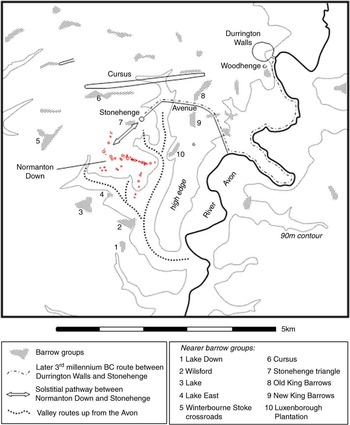
The connection with the great monument could have been physical as well as one of inter-visibility. The crucial winter solstitial axis, marking the rebirth of each year, passes across the ridge (fig 13) and might have formed a ‘pathway’ linking the generic and timeless ancestors and gods of the henge to the specific, named ancestors set along the ridge. Assuming Stonehenge still played an active part in the ritual cycle, these remembered ancestors must surely have occupied a key part in the ceremonies conducted there. It is not too fanciful to suggest that, for a limited period, they were the masters of ceremonies in the great ‘cathedral’, thus making ever more relevant the umbilical connection via the solstitial pathway.
Normanton Down – the southern portal to Stonehenge. The primary linkages of the later third and earlier second millennia bc are contrasted. Except for the Normanton group, barrows outside the main concentrations are not shown. Based on RCHME 1979 and Darvill Reference Darvill2006; third millennium route after Parker Pearson and Ramilisonina Reference Parker Pearson and Ramilisonina1998. Drawing: © Stuart Needham

This was a new direction of some consequence for Stonehenge. Previously, when the monument was being reconstructed on an unprecedented scale during the second half of the third millennium bc, it has been argued that it was linked by a different umbilical cord: via the Avenue to the River Avon and thence to Durrington Walls, with its very complementary character and function.Footnote 103 We may therefore be seeing, around the beginning of the second millennium, a strategic switch from a bipolar relationship between Stonehenge and Durrington Walls,Footnote 104 to one between Stonehenge and the great barrow cemeteries ranged closely around it. And among those cemeteries, Normanton Down does seem to have had a special place, for a while at least.Footnote 105 One possible reason for its pre-eminence could have been that the ridge combined visual surveillance of Stonehenge with an overview of the passage along the dry-valley routes from the River Avon to the south (fig 13). This would have been the main route of approach for visitors from the south coast and regions across the sea.
Although many later burials occur in the vicinity,Footnote 106 there is currently no firm evidence for burial along the Normanton ridge after Period 3, and this cessation is potentially as informative as the inception. It is as if for some political, historical or religious reason it was no longer acceptable for the elite to be buried there, so that the ridge-top barrows of the Normanton Down group became fossilized. If this part of the cemetery was treated in toto as a ‘monument’ to its particular political history, then it betrays a very different attitude from that given to those nucleated cemeteries nearby that continued to attract burials. A shift in the powerbase among local elites who were rivalling one another for supremacy could easily have caused a sudden change in the pattern of burial locations. Although Period 4 burials are to be found not far away, they have a more dispersed distribution across Normanton Down and the best evidence for any concentration is a little further away, in the Lake cemetery.Footnote 107
The question of foreigners
Another aspect of the question ‘who was buried there’ is whether any were migrants from outside the region or outside Britain. It is certainly possible – perhaps likely – that the magnificence of Stonehenge and other spectacular monuments attracted outside interest, and even incomers.Footnote 108 Only isotopic analysis of the skeletons – unfortunately returned to the mounds by Cunnington and Hoare – would have the potential to tell us definitively whether the individuals were alien or local to this burial-saturated region. For the time being, we are thrown back on to the evidence of artefacts and, where they are sufficiently detailed, of burial rites.
For Piggott, writing in 1938, Bush Barrow man was the exemplar of an invading aristocracy from Armorica, and the exotic and unusual nature of his equipment may still encourage some to see him as a foreigner.Footnote 109 However, even though one of his daggers (and conceivably both) was made outside Wessex,Footnote 110 this evidence is counterbalanced by the fact that different elements of his gear seem to draw inspiration, materials or objects from very different directions. Such multi-directional sourcing for a rich assemblage does not rule out the foreigner, but it certainly does not make a persuasive case for it either. Moreover, it is not possible to find close parallels anywhere else for the particular ensemble of objects in this grave.
The most influential people of the Early Bronze Age had complex identities, which drew added strength and authority from distant and multi-directional contacts, in keeping with the preoccupations of the age.Footnote 111 Against this background, we prefer to see Bush Barrow man as a local leader who rose to pre-eminence through the control of particular activities and ceremonies as well as through reciprocal high-level exchange with the elite of other regions.Footnote 112 It is possible that these two were tied together; if foreigners were attracted to the site to witness the magnificence of the monument and the spectacle of ceremonies held there, then it would be the local controlling elite who would sanction access and give appropriate hospitality. Permission and hospitality are what the elite of inland Wessex were most likely to be offering outsiders, rather than control of inter-regional trade.Footnote 113 Of course, it is always possible that the region offered for exchange valuable organic goods that have not survived to the present. Wool production, for example, historically has been a mainstay of the economy of Salisbury Plain and fine fabrics, hinted at in Bush Barrow, would have had good exchange value. Although a potential side-effect of this relationship would be to attract a disproportionate share of exotic gifts, these could only be re-distributed to others if they were not consumed in funerary rituals and not handed down to descendants.
Given these understandings, it is not surprising that we see a stronger than usual eclecticism in the objects interred with the dead on Normanton Down and Salisbury Plain more generally. Although there are certain regionally distinctive types, these are superimposed upon by a myriad of other types, some more general and some patently not native to the region. These would be expected outcomes of a higher frequency of contact between the indigenous groups of Salisbury Plain and visiting dignitaries, ‘pilgrims’ or those engaged in exchange from varied outside regions. If visits from foreigners were a regular occurrence, it must be assumed that the great majority returned to their homelands. But in some circumstances such visitors might stay on, thus coming to be buried in the celebrated cemeteries. The obvious situations, all made possible because of the high spiritual and social standing of the Stonehenge focus, are threefold: attracting in specialist craft-workers, the adoption of the young of other social groups (for example, for indoctrination in arcane matters) and inter-marriage. The first can be suggested for the craft-worker responsible for the gold-pin-studded hilt from Bush Barrow.Footnote 114 The accoutrements of the supposed women buried in Wilsford G7 and G8 respectively might point to one or both being foreigners married into the Normanton ridge dynasty. It is an attractive proposition to see both, with their contrasting identities, as having been closely related to the main individual in Bush Barrow. It is not inconceivable that both could have been wives, although there are obviously many other possibilities, even among close family.Footnote 115
Final perspective and the future
Although we have a number of informative grave contexts to interpret from Normanton Down, there are considerable lacunae in our knowledge of how these monuments came about, their chronological sequence and the history of land use against which they were constructed.Footnote 116 These deficiencies do make any interpretation more tenuous than might otherwise be the case. Even at the basic level of grave contents, it is worth reminding ourselves that we have only limited knowledge of a minority of the original tally of burials. One need look no further than the immediate vicinity of Normanton Down to see the benefits of modern re-excavation; Amesbury G39, Wilsford G1, the Lake East group and some of the Lake group show there can be many more burials in and around the mounds, and often much complexity of sequence, including possible examples of graves disturbing earlier ones. We wonder whether something similar occurred at Bush Barrow itself, thus explaining the studded-hilt weapon and the sherd of a Biconical Urn.
Again, with modern research offering much more sophisticated opportunities to learn of the physical state of the Early Bronze Age people – their diet, their ailments and their environmental histories – interpretation of the Normanton cemetery is of necessity restricted. Nevertheless, thorough review of the objects and contexts has shown just how much can still be gleaned from Cunnington and Hoare’s pioneering barrow-digging campaign. It has been possible to venture a particular historical scenario to explain the emergence of a key part of one of the celebrated cemeteries close to Stonehenge. It serves as an illustration of the need to interpret barrow groups in terms of local political histories and how these tied in with broader patterns of movement, exchange and relative success on the inter-regional stage. In the process we have also thrown up more acute questions to be posed for any future research, and such questions have been formulated into a ‘Research Framework for Normanton Down’;Footnote 117 it is hoped this will not only form the core of future interest in this special parcel of landscape within the Stonehenge World Heritage site, but will also stimulate new programmes of research.
Acknowledgements
Our primary thanks go to David Dawson, Paul Robinson and Lisa Webb at the Wiltshire Heritage Museum, Devizes, who did so much to make fresh study of the Normanton Down artefacts a rewarding and enjoyable experience. We are also grateful to Bill Perry, chairman of the Museum’s Trustees, for his support. David Bukach and John Hunter of the Leverhulme project team, University of Birmingham, have been extremely generous in allowing us to publish a selection of Dave’s photographs ahead of the project’s main publication. We also thank Tom Goskar, Colin Shell and the Environment Agency for assistance in relation to the LIDAR survey of Normanton Down.
ABBREVIATIONS AND BIBLIOGRAPHY
- Abbreviations
- VCH
Victoria County History
- RCHME
Royal Commission on the Historical Monuments of England
 inches’).