Introduction
Despite the attractive alternatives that sustainable agriculture represents for many farmers, widespread adoption of sustainable agriculture practices (SAP) has not occurredReference Caswell, Fuglie, Ingram, Jans and Kascak1–Reference Horrigan, Lawrence and Walker3. Conservation tillage is one of the most commonly used sustainable practices in the USA. However, its adoption has been slow, and remains lowReference Caswell, Fuglie, Ingram, Jans and Kascak1, Reference Derpsch2. Integrated pest management (IPM) practices were adopted by approximately 2% of the farmers in the year 1994, coordinators of the IPM program reportReference Derpsch2. Similarly, a 2001 national survey found that biological controls were in use on 3% of crop acresReference Caswell, Fuglie, Ingram, Jans and Kascak1.
Little is known about the general state of adoption of sustainable practices at the national and regional levels. The 2002 census of agriculture does not include information about sustainable agriculture practices. Thus, the National Agricultural Statistics Service (USDA-NASS) intends to include information about sustainable agriculture in the 2008 agriculture census4. In the meantime, institutions that advance sustainable agriculture, such as SARE, may encounter many barriers to making informed decisions about their plans and strategies.
Traditional adoption theories underplay the fact that there are often sound reasons why producers are unable to adopt SAPReference Vanclay and Lawrence5, Reference Hooks, Napier and Carter6. Several studies have found that nonadoption of SAP is a rational decision under certain circumstancesReference Vanclay and Lawrence5, Reference Vanclay and Lawrence7–Reference Roling and Jiggins9. Consequently, a focus on factors constraining adoption and how to overcome them can be fruitfulReference Horrigan, Lawrence and Walker3, Reference Vanclay and Lawrence5, Reference Nowak7, Reference Roling and Jiggins9, Reference Cary, Webb and Barr10.
Several analyses of constraints to adoption of SAP in the USA are availableReference Nowak7, Reference Nowak11–Reference Schneeberger, Darnhofer and Eder15. However, little is known specifically about the spread of SAP in the southern United States, a region with droughty summers, intense rainfall events, heavy insect and disease pressures, and problematic soils. Previous research identifies various barriers to adoption of SAP, but none has focused specifically on the South. The specific objectives of this research are: to identify change agent views about barriers to adoption of SAP; and to suggest strategies for overcoming barriers to wider use of SAP.
Sustainable Agriculture and SAP
Most proponents of the concept will agree that sustainable agriculture is not a defined set of agricultural practices, but rather a utopian and dynamic condition, a long-term goalReference Ikerd, Osburn and Owsley16, Reference Diver17. Although sustainable agriculture does not refer to a standard set of agricultural practices, there are certain methods or practices that enhance sustainabilityReference Derpsch2. Such methods are regarded in this research as SAP. Some methods commonly mentioned in the literature are: crop rotation, cover crops, no-till and low-till farming, soil conservation, diversity, nutrient management, integrated pest management, rotational grazing, water quality, wetlands, agroforestry and alternative marketingReference Derpsch2, 18. Caswell et al.Reference Caswell, Fuglie, Ingram, Jans and Kascak1 examine a broad measure of adoption of any soil conservation practice on highly erodible land in a large national farm survey dataset, finding that over half of the highly erodible cropland acres were under some kind of soil conservation practice. Soil testing is the most fundamental SAP. A 2008 US national survey of nearly 2000 ‘top farmers’ indicates that about half conducted soil tests according to state recommendations. Economic concerns and time were primary obstacles to soil testing. Twenty-four percent of corn growers, 23% of soybean growers and 23% of wheat growers cited test costs as a reason why they do not do soil tests.40 It seems that a large portion of the nation's land is not treated with the most basic SAP.
Barriers to Adoption of Sustainable Practices
Previous researchers identified factors that impede widespread adoption of SAPReference Caswell, Fuglie, Ingram, Jans and Kascak1, Reference Vanclay and Lawrence5, Reference Nowak7, Reference Norman, Janke, Freyenberger, Schurle and Kok11, Reference Young12. The generation and spread of information, economic limits, social factors, farmers' characteristics, attributes of sustainable practices, and infrastructure conditions are previously identified barriers to adoption.
Barriers related to the supply of information are: rapidly evolving knowledge and information needs, lack of available information for farmers, and change agents' lack of information and knowledgeReference Norman, Janke, Freyenberger, Schurle and Kok11, Reference Young12. The complexity of many SAPReference Nowak7, Reference de Souza Filho19 creates a need for learning and better understanding of cropping systems, machinery and chemical tools that in turn impede adoptionReference Vanclay and Lawrence5, Reference Norman, Janke, Freyenberger, Schurle and Kok11. Some authors report that the lack of available, reliable or locally relevant information is another obstacle to adoptionReference Nowak7, Reference Norman, Janke, Freyenberger, Schurle and Kok11, Reference Gamon, Harrold and Creswell20, Reference Pannell21. Inadequate information clarifying the economics of adopting, the technical details of implementation, and the likely production impacts of new sustainable practices are other barriers to adoptionReference Nowak7, Reference Norman, Janke, Freyenberger, Schurle and Kok11, Reference Bell, Carolan, Mayerfeld and Exner13, Reference Young22.
Lack of access to technical information in locally relevant, site-specific SAP is sometimes cited as an institutional failureReference Young22, 23. Some authors relate this problem to inadequate knowledge about SAP available to change agents from traditional information sourcesReference Nowak7, Reference Bell, Carolan, Mayerfeld and Exner13, Reference Agunga24. Some authors decry change agents' lack of receptiveness or attentiveness to research findings from sources other than university research stationsReference Agunga24. PaulsonReference Paulson14 concluded that change agent training often fails to stimulate them to reflect on their own beliefs, values and previous knowledge, which in turn reduces the effectiveness of such training. When information is available through applied publications, change agents often are unaware of its existenceReference Bell, Carolan, Mayerfeld and Exner13.
Economic factors
Economic factors are frequently mentioned in the literature as barriers to adoption of SAP by farmers and also by change agents. Some of these factors are the cost of materials and equipment, the uncertainty of profitability or increased risk, loss of productivity, labor supply, at-risk economic situations, and farm program policies.
Whether perceived or real, increased risk is often regarded as a barrier to adoptionReference Nowak7, Reference Norman, Janke, Freyenberger, Schurle and Kok11, Reference Bell, Carolan, Mayerfeld and Exner13, Reference Gamon, Harrold and Creswell20, 23, Reference Bearenklau35. Some authors identify increased risk to yields during transition and implementation of SAP, especially when new equipment is requiredReference Nowak7, Reference Wandel and Smithers8 or when the mix of inputs changesReference Rawson27. Wandel and SmithersReference Wandel and Smithers8 explain how the use of conservation tillage was incompatible with the farming systems of livestock that tended to use inverse plowing for manure incorporation.
Another barrier is the perception that SAP may reduce yields, though it is an empirical question whether a particular farm may have in fact greater profits from reduced costs associated with SAPReference Vanclay and Lawrence5, Reference Wandel and Smithers8, 23. Caswell et al.Reference Caswell, Fuglie, Ingram, Jans and Kascak1 analyze the claim that adoption of SAP will result in a decrease in pesticide or fertilizer use, finding little reduction in chemical loadings but no yield decreases (and some increases) in the five case adopter farms they examined.
Although it has been demonstrated that sustainable practices are as economically viable as conventional practices, profitability of sustainable practices is a concern among farmers and even change agentsReference Derpsch2, Reference Roling and Jiggins9. When sustainable practices are perceived as increasing the demand for labor, farmers might see this as disadvantageous because labor is often a scarce or expensive factor of production. They know the limits on their own time and energy and might be unable to provide the additional labor themselves. Additional labor costs may affect profitability. Farmers can also have serious concerns about whether the necessary labor will be available to hire when needed and at what costReference Nowak7, Reference Schneeberger, Darnhofer and Eder15, 23, Reference Antle and Diagana28. In addition, farmers' poor economic situation has been identified as a barrier to adoption of sustainable practicesReference Norman, Janke, Freyenberger, Schurle and Kok11, Reference Arellanes and Lee29. AgungaReference Agunga24 explains that technologies requiring considerable economic investment, such as conservation tillage, are considered to be not worth adopting in small operationsReference Wandel and Smithers8. In the USA, the transition period can be perceived as risky by farmers due to an economic environment that generally favors conventional agricultureReference Reed30.
Farmers are on a technological treadmill where they must adopt yield and efficiency measures to stay competitive in a context of falling commodity prices. The same price pressures inhibit adoption of sustainable approaches having largely societal benefitsReference Norman, Janke, Freyenberger, Schurle and Kok11.
Incompatibility with physical setting is another barrier to adoption explained in previous studiesReference Nowak7, Reference Marra, Pannell and Ghadim31. For instance, organic practices in Iceland are incompatible with the physical environment. The cool climate in Iceland makes the growing of nitrogen-fixing legumes difficult, which would otherwise help provide nitrogen-avoiding artificial fertilizersReference Marra, Pannell and Ghadim31.
There are characteristics of sustainable practices themselves that have been identified as barriers to adoption. For example, complexity of SAP may be greater because they place more reliance on information and timing of activity to substitute for material or mechanical interventionsReference Vanclay and Lawrence5, Reference Nowak7, Reference Wandel and Smithers8. In addition, difficulties in triability (reflecting the ability to experiment with practices on a partial basis), low observability of results, long time lag between treatment and effect, and the borderless nature of environmental problems have been cited as barriersReference Vanclay and Lawrence5, Reference Vanclay and Lawrence32.
Societal policies have been cited as an important factor that can constrain a farmer's decision to adopt SAPReference Derpsch2, Reference Horrigan, Lawrence and Walker3, Reference Young22, Reference Arellanes and Lee29, Reference Reed30. United States commodity price and income support programs have acted as barriers to widespread adoption of sustainable agriculture by encouraging producers to continue farming conventionallyReference Paulson14, 23, 25, Reference Reed30. Moreover, the disparity between the amount of agricultural subsidies going to large farms and small farms often encourages recipients to retain conventional approachesReference Derpsch2.
Farmer characteristics
In addition to information and economic factors, there are other factors identified by previous studies to constrain adoption. Personal characteristics such as age, attitudes and beliefs are mentioned as barriers to adoption of SAPReference Nowak7, Reference Wandel and Smithers8, Reference Dyrmundsson33. For example an attitude frequently identified as a barrier is the ‘resistance to change’Reference Wandel and Smithers8, Reference Dyrmundsson33. The belief that conventional systems give higher yields was identified as the biggest barrier to adoption of conservation tillage by Canadian farmersReference Wandel and Smithers8.
Land tenure
Ownership and use arrangements act as barriers to adoption in the USAReference Bell, Carolan, Mayerfeld and Exner13, 23. Bell et al.Reference Bell, Carolan, Mayerfeld and Exner13 describe the implications of property rights issues for adoption of sustainable practices among farmers in Iowa. They found that the majority of leasing agreements were 1 year term and cash rent, which were antagonistic to adoption of sustainable practices.
Social infrastructure
The supporting context of neighbors, kin and peer farmers shapes a farming subculture or farming style and its associated norms about acceptable agricultural practices. Environmental practices are often new in such subcultures and farmers may be likely to implement such new approaches. In other words, adoption decisions are often based on imprecise factors such as ‘what is considered to be socially and culturally acceptable by members of [potential adopters'] social group’Reference Agunga24, 34. As one change agent explained, ‘Two drivers determine whether a farmer will adopt a new technology: if he thinks it's profitable and if his peers accept it’Reference Vanclay and Lawrence5, Reference Bearenklau35.
In the USA, infrastructural issues have been identified as a constraint to adoption of sustainable practices. NowakReference Nowak7 suggested that farmers were unable to adopt residue management systems due to unavailability and inaccessibility of supporting resources. Few farmers adopted these systems without significant support from local equipment and agrochemical dealers, USDA technical assistance, credit sources and other components of the surrounding agricultural infrastructure.
A lack of marketing infrastructure is a constraint to sustainable agriculture in the Southern United StatesReference Khanna, Millock, Zilberman, Casey, Schmitz, Swinton and Zilberman (36. Khanna et al.Reference Khanna, Millock, Zilberman, Casey, Schmitz, Swinton and Zilberman (36 found that drip irrigation did not reach widespread adoption until a support infrastructure was established and extension specialists, dealers, support staff and farmers understood its implementation and functioning.
Methods
Sample selection
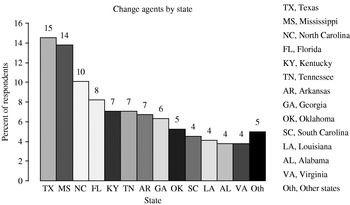
The target population for this study was agricultural change agents in 13 Southern US states (Fig. 1). A combination of two purposive, nonprobability sampling methods was used to identify respondents: expert or positional sampling and snowball sampling. Expert sampling was used to obtain the views of people who have specific expertise by contacting individuals holding positions with responsibilities related to the substantive issue, sustainable agricultural practicesReference Trochim37. Snowball sampling, asking respondents to refer other potential study participants, was used to augment the positional approach because there was no clear sampling frame and population was difficult to reachReference Ritchie and Lewis38.
Number of Internet survey participants by state—2004.

E-mail addresses for agricultural professionals were obtained from the websites of Land Grant Universities Systems, USDA, NRCS, American Society of Farm Managers and Rural Appraisers, Certified Crop Advisers of the American Society of Agronomy, and private consultants from commercial companies or other consultant networks (Georgia Association of Professional Agricultural Consultants, DuPont, Monsanto, Agrodist). Additionally, one list of 28 change agents that have been working with sustainable agriculture was obtained from Southern Sustainable Agriculture Working Group. Another list of 29 SSARE state and area coordinators who could forward the survey to change agents was also included. A final list of 1292 valid e-mail addresses of agricultural professionals was contacted.
Data collection
A semi-structured questionnaire instrument was designed and distributed through e-mail. A set of 12 open-ended questions were utilized to capture respondents' verbatim opinions. These were combined with a set of 14 closed-ended questions that were intended to get a general description of tendencies regarding adoption of sustainable practices, the respondent's demographic description and background.
Respondents were contacted initially with a message explaining the objectives of the project, encouraging them to participate. A subsequent e-mail provided a URL address and instructions for participating in the study. Within a month, three additional follow-up e-mails were sent. Respondents were encouraged to forward the URL to other knowledgeable individuals with interest and expertise in sustainable agriculture. A final sample of 269 respondents completed the change agent survey.
Data analysis
Responses to the open-ended questions were separated in individual files containing the verbatim responses to each item. Each file was stored with a distinctive name and imported to perform analysis with ATLAS.ti software for qualitative data analysis. [ATLAS.ti stands for ‘Archiv fuer Technik, Lebenswelt und Alltagssprache.’ Translated, ‘Archive for Technology, the Life World and Everyday Language.’ The extension ‘ti’ (pronounced TEE EYE) stands for text interpretation. Project ATLAS (1989–1992) of Technical University of Berlin was the origin of the software's first prototype.] Cross case analysis of patterns among data was performed utilizing a variable-oriented strategy. Information for each respondent's answer was coded or classified in individual pieces of data (themes). A name or code was assigned to each coded content itemReference Ritchie and Lewis38.
Patterns were identified utilizing frequencies of each code and category. ATLAS.ti was used to obtain frequencies for each code. Frequencies of codes included in a cluster or category were added to find a frequency for that category. Thematic categories or clusters of verbatim comments were organized from most frequent to least frequent. Codes in each category were organized in the same way. This helped us to establish a hierarchy of importance among categories or themes. In summarizing the findings, verbatim phrases or expressions from survey participants were retained as much as possible and are reported in italics. Interpretation was kept to a minimum so that at a more refined level of analysis original expressions can be re-examinedReference Campbell39. The analysis examines the general proposition that reluctance to change to SAP is an overused rationale of change agents that tends to mask real barriers that we endeavor to elicit in the survey.
Of the 269 responding change agents, 94% are male and 6% are female. Their ages ranged from 23 to 77 years, with an average of 48.5 years. Change agents were asked to classify themselves. The self-reports included professionals from agribusiness (37%), extension agents (24%), USDA-NRCS representatives (12%), nongovernmental organizations (9%), or other (17%). The participants were evenly distributed among the private and public sectors. Half the respondents were also farmers.
Results
Sustainable practice availability and adoption
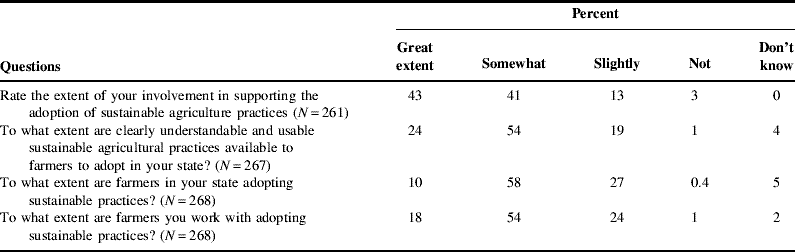
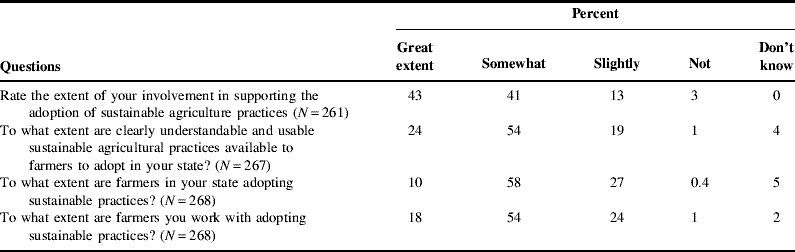
Four questions measured change agent involvement in sustainable agriculture and perceived availability of sustainable practice information. Table 1 suggests that 43% of respondents are very much involved in supporting adoption of SAP, and 41% report to be only somehow involved. About 10% think that adoption is occurring to a great extent in their state or among the farmers they work with (18%). Also, less than one-quarter of respondents think that usable and clearly understandable SAP are available to a great extent in their state. Most respondents think that adoption and availability of SAP are at most occurring only at low level.
Perceived rate of adoption of sustainable practices (regional change agents, 2004).
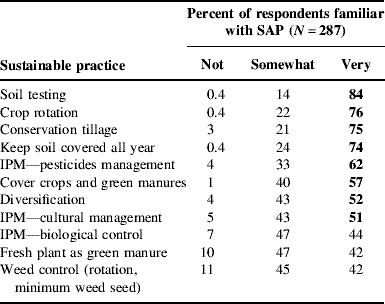
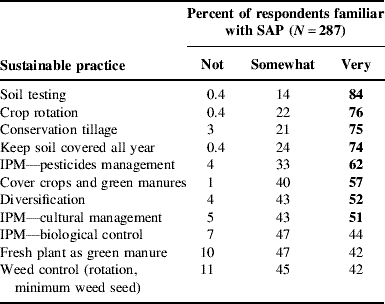
Change agents were asked to rate their familiarity with a set of 25 sustainable agricultural practices. Table 2 shows the SAP with the highest rating (50% or more) of respondents who reported being very familiar with eight of the 25 SAP listed in the survey.
Familiarity with selected sustainable agricultural practices (regional change agents, 2004).
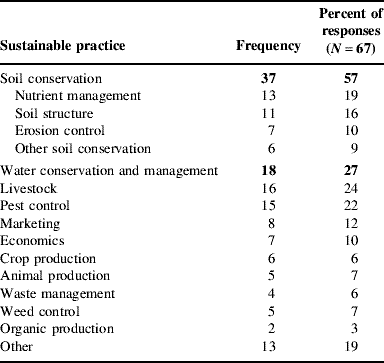
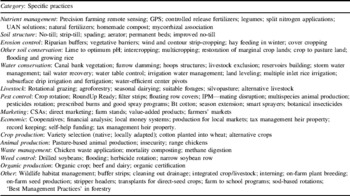
In addition to the list of 25 sustainable practices presented to change agents in the survey, respondents had the opportunity to identify other practices that are currently used by farmers in the South. Change agents identified 118 additional practices. For purposes of analysis, the practices were then subdivided into 15 grouping categories. Table 3 lists each category and the frequency of practices under these.
Sustainable soil and water practices used by farmers in the South (as reported by regional change agents, 2004).
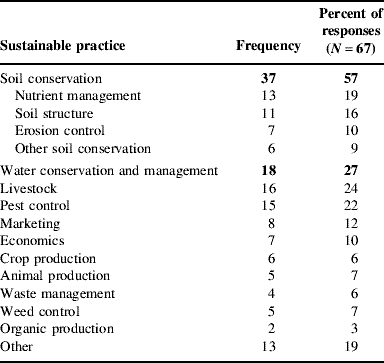
Table 4 shows the list of practices under each category. It is evident that change agents are aware of a variety of practices that are being used by farmers in the South. The majority of practices seem to be related to soil conservation. Water conservation, livestock and pest control are also issues that farmers are trying to include in their sustainable management. It is important to note that marketing and economic practices are also being included in sustainable management of farms in the South. The specific practices mentioned by respondents reveals the great variety of sustainable practices being used by farmers in the South of United States.
Categories of sustainable practices used by farmers in the Southern United States (as reported by regional change agents, 2004).

Barriers to adoption
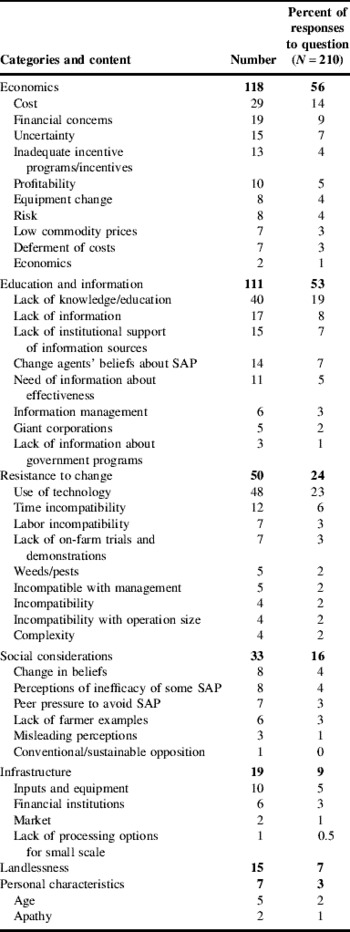
Change agents were asked: What were the major obstacles or barriers that producers must overcome to adopt sustainable agriculture practices? From the total responses to the survey, 78% of respondents answered this question. Their responses to this question are classified into eight categories listed in Table 5, which shows the frequencies and % for each variable from the total answers to this question.
Detailed summary of responses to the question, ‘What were the major obstacles or barriers that producers must overcome to adopt sustainable agricultural practices?' (regional change agents, 2004).

Economic factors
Many economic factors constrain the adoption of sustainable practices. The most frequently mentioned barrier to adoption of sustainable agriculture practices is cost. This includes the ‘initial cost’ of ‘converting’ or ‘changing practices’ including not only the ‘cost of new equipment’, but also the costs of ‘changing for one management style to another’, e.g. ‘old tillage equipment has to be converted or sold to make way for NT’. As another respondent stated, ‘With commodity prices at the levels they are (basically unchanged in the last 50 years) and equipment prices at increasing levels every year, growers can't afford to change to strip-till or no-till. They can do some form of conservation tillage, but not to the extent they need to’. Other respondents associated this problem with ‘equipment prices at increasing levels every year’, which makes ‘affordable technology’ unavailable.
The ‘availability of alternative materials’ or ‘organic materials’, ‘lack of proper equipment’ and ‘equipment’ were mentioned as problems for some farmers. For example, one respondent noted ‘harvests equipment for narrow rows’ as a barrier to an SAP that uses dense plant populations to reduce the need for herbicides.
Respondents included as part of the initial cost the ‘costs of the [new] system’, which are permanent or ‘extra costs’, such as new inputs ‘transportation costs (e.g. ‘organic materials’)’. One respondent called attention to the cost of sustainable compared to conventional practices, stating ‘Synthetic products are cheaper in general unless you are using a by-product of your farm operation’.
‘Most producers need to generate the maximum cash flow to keep the business running.' Another wrote, ‘So many growers are so squeezed financially that, even if their current financial situation under conventional farm [management] is terrible, they are afraid to make the jump into sustainable practices’. One change agent explained that ‘too many years of poor [management] places soil nutrient levels at a level that recovery does not fit into the cash flow’. Another respondent suggested that some federal programs offer incentives to help farmers, but these are problematic; ‘EQIP offers some incentives, [but] not enough’. [The Environmental Quality Incentives Program (EQIP) was reauthorized in the Farm Security and Rural Investment Act of 2002 (Farm Bill) to provide a voluntary conservation program for farmers and ranchers that promotes agricultural production and environmental quality as compatible national goals. EQIP offers financial and technical help to assist eligible participants install or implement structural and management practices on eligible agricultural land.]
Sustainable producers sometime have problems ‘getting more money for [their] products’. This may be caused by ‘bias of food retailers against small-scale producers and distributors’, or perhaps agricultural policies that are unfavorable to small producers. A respondent explained, ‘Low commodity prices … have placed some producers in that area of not being financially [sound] enough to adopt, or ‘tool up' to more sustainable practices. [Basically], they are out of business but don't realize it yet’.
Some respondents felt that adoption of SAP was moving slowly due to ‘lack of some funds to motivate participation’. More precisely, failure is a result of ‘lack of governmental incentives for sustainable farming’. A respondent affirms that there are government incentive programs, but ‘insufficient government support for adoption and expansion of sustainable practices on working lands (the new Conservation Security Program was originally designed to address this, but was largely gutted by low budgets and highly restrictive enrollment criteria)’. Another change agent mentioned that in ‘cotton country, the barriers consist of government payments’.
Some change agents think that government programs are ineffective or even detrimental because they are ‘tailored for large farms’ or show ‘bias towards large-scale producers in federal programs (EQIP)’. Others may be discouraged from adopting SAP by ‘Federal, State and WMD regulatory programs which require extensive permitting [licensing] and engineering studies to implement common practices’.
Farmers have an ‘increased risk of losses to insects, weeds, and pathogens’. Thus, ‘many farmers feel that the potential lost in income does not justify adopting more sustainable practice’. Some respondents think that farmers’ ‘[idea] that sustainable growing cost[s] more’ is the barrier. Others mentioned that it is ‘hard to see immediate benefits’ with sustainable agriculture because ‘some of these practices provide benefits but only over long-term usage’. Thus, it is important to ‘prove that sustainable agriculture is profitable TODAY’ in order to facilitate decisions to adopt SAP.
Education and information
Farmers' lack of knowledge or education ‘concerning sustainable agricultural practices’ was frequently expressed as a barrier. As was stated, ‘not being familiar with practices’ or ‘unfamiliarity with a lot of practices’ is constraining potential adopters due the uncertainty of changing to something unknown. Thus, the need for ‘learning’ about sustainable practices was often mentioned as an important barrier. One change agent notes, ‘Many lack an understanding of how the practice will benefit them in the long term’; they are ‘uninformed as to the benefits to sustainable agricultural practices to their land, communities and income’. They need ‘knowledge that the new system will pay’.
Change agents perceive a ‘lack of good sound information’ about SAP, a ‘lack of good economic information on use of practices’ and a lack of ‘knowledge and understanding of long-term benefits’ of sustainable practices. A respondent felt that ‘there is no local research showing dollars and cents savings from certain practices’. In addition, a general lack of sustainable alternatives was reported. Thus, it was suggested that ‘practices that are practical and effective must be developed and advocated’.
Many stated that there is an ‘educational problem’ among farmers and suggested that they need ‘more education’ in general and in specific ‘on the sustainable agricultural practices concept in stewardship of the resource and how they are beneficial to income of the farm’. One respondent even stated that ‘sustainable farming is a highly skilled profession! There is simply SO much to learn, and you can only learn some of it in textbooks’. Farmers' lack of education may lead to their ‘lack of ability to adopt and successfully use improved technology’.
Inadequate management of information
Other respondents think poor connections between producers and SAP information sources is a central problem. One wrote, ‘I could have said “lack of information’' or “need for more information” or even “insufficient awareness of, and support for sustainable agriculture in extension services”. However, there has been major improvement in each of these areas over the past few years—[such as] more and more sustainable ag research and outreach, vital information services such as ATTRA … big information-related barrier is how to access and assimilate the growing mass of information, sort the good info from the less-substantiated and the downright bogus, and most challenging, how to apply it to one's specific farm!’
Farmers often have trouble finding the information they need for their farm. ‘Most practices are good in paper, workable in research settings [but] difficult to apply on a large scale’. The implementation is not only difficult when it is done at large scale but when there is variability within farms. One said, ‘Some of my farmers farm different types of soil, requiring different systems … too much confusion’. In consequence, it was suggested that there is a ‘need to develop better and more user-friendly methods or approaches to sorting out what practices would be truly sustainable and economically viable for a specific farm’.
Lack of on-farm trials and demonstrations
Change agents report that farmers ‘lack good tests of what practices will work best on their farm’. Another change agent explains that there is a need for ‘application by local Universities to demonstrate feasibility’ and ‘intangible benefits such as improving soil, reducing weed growth and other aspects that are hard to economically quantify’. On-farm trials and demonstrations can be means to solve this barrier to the adoption of SAP.
Lack of institutional support
The agricultural knowledge and information system may be failing sustainable agriculture. As explained by a respondent, ‘Local governments [are] more interested in revenues to induce manufacturing’. Another felt that ‘lack of support in traditional ag structure—Farm Bureau, Dept. of Ag, extension’ is an important barrier to production and dissemination of information.
Moreover, some believe these organizations do not support SAP. There is a lack of ‘acceptance, support, and promotion by the extension service and USDA agencies line employees’. The ‘county extension agents (home and agriculture) and vocational agriculture teachers, plus university extension professors who are [farmers’] sources of information, who: 1) believe that sustainable means subsistence agriculture, 2) do not believe in it and openly do not support or detest it, and 3) are not willing to change’. Other reasons for the lack of institutional support are ‘lack of full-time person[nel] devoted to sustainable agriculture in the university system’ and the ‘lack of knowledge by extensionists and other Ag. Advisers’.
Another respondent explained that the roots of the problem may be economic constraints in the universities: ‘Land grant universities have sold out to chemical or pharmaceutical companies, so research and teaching do not focus on sustainable practices (unless of course the university can get some of the scarce grant money) … So unless a farmer is willing and able to go beyond what he or she is offered by the usual information sources (Extension, chemical companies, Farm Bureau, etc.), there is almost no access to alternatives. It's getting better, but in most cases farmers have to find their own resources’.
Change agent beliefs
Some change agents believe that reduced yields are associated with sustainable practices. This can be interpreted from a change agent's expression about barriers to adoption: ‘[farmers] can't give up yield’; or ‘sustainable agricultural practices … cuts maximum yields’. Some explained that this reduction is caused by a ‘loss of some crop land’.
Influence of the private sector
Corporate influence on national agricultural policy is another barrier related to information generation and dissemination. This was even cited as ‘possibly the most severe barrier of all in the long run’. As one change agent explained, ‘the concentration of food system economic power and control in the hands of a few giant corporations’ are barriers because ‘these economic interests pull all kinds of strings to dissuade or even prevent growers from adopting truly sustainable systems—mostly through lobbying at governmental levels to limit the growth of pro-sustainable policy; to remove limits on GMO crops and livestock, and on corporate power over growers (contracts, markets); and to maximize global “free” trade (giving corporations even more control internationally)’.
Resistance to change
Frequently mentioned barriers are: farmers' ‘reluctance’ or resistance to change ‘traditions’, ‘old habits’, ‘old ways of doing things’, referring to a ‘mindset’ that limits involvement in sustainable practices. One respondent expressed, ‘There is a mindset in many cotton farmers that leads them to monoculture even when they agree that it would pay to diversify’.
Some respondents gave explanations for these attitudes. Some connect this type of farmer attitude to tradition. That is, the fact that ‘often times a grower farms the way he farms because his daddy did it and his granddaddy before that’, so that their way of farming is a ‘custom or cultural habit’ and the change then represents ‘cultural shifts’.
Second, resistance to change was also attributed to their ‘thinking that their dads and granddads didn't necessarily farm in a sustainable fashion, so sustainable practices are not the best route to take, i.e. Dad and granddad raised excellent crops and did not practice sustainability very much at all’. So farmers may see no need to change ‘what works now’ and are reluctant to change to something new that they are unfamiliar with.
In a third instance, change agents consider the comfort associated with farmers' current management strategies as a cause of their resistance. Farmers ‘are accustomed to having their cropping system wrapped in a nice package (jugs and bags) and readily available to apply today. This is habit forming and the habit will be hard to break’.
Fourth, some management strategies have developed after many years of trial and error learning processes and therefore are difficult to change. As was explained by a respondent, ‘Most producers are caught up in the old paradigm of using petroleum based fertilizers and pesticides to increase or maintain crop yields. They believe in that system. They trust that system. They often have such little faith in the sustainable practices that they dismiss them before they try them. Many producers do not even want to learn about sustainable agriculture. They feel an aversion to the name’. Finally, farmers resist sustainable practices because they ‘have to try new methods and many are not willing to make that change’.
Age was also mentioned by some respondents as a barrier to adoption. The problem of ‘overcoming the “that's the way we've always done it” mentality’ is not only about the young or middle-age farmers who are doing things as their predecessors did. It is also about ‘the older traditional farmers’, that some change agents felt ‘are not going to change’. This was noted as an issue for younger and middle-age farmers because the ‘older generation’ are the ones ‘that still have control over the land’ in many cases.
Compatibility with existing practice
The fit with ongoing habit and pattern can be an obstacle to any new way of doing things. Time incompatibility refers to the time that practices require for implementation. Farmers may not have the labor or attention span to implement them successfully. As stated by a change agent, these practices are ‘too time consuming’, because of the need of ‘investing the time to learn different methods’ or ‘to implement some practices’. Farmers may also find labor incompatibilities as an issue to consider when thinking about changing to sustainable practices.
The incompatibility of practices with current systems was identified as a barrier. One change agent explained that for some farmers the ‘new method … doesn't fit well into their current practices’. Incompatible management styles were mentioned as a barrier.
Incompatibility with operation size is another barrier because ‘most producers are farming a greater number of acres than they used to be. Their time is strained trying to implement their normal operations’. Large producers may find it difficult or more costly, as ‘larger producers feel it costs more and will slow them down in the busy season’.
Complexity
One barrier related to the lack of information is the complexity of sustainable practices. This refers to ‘the highly complex and site-specific nature of sustainable and organic farming methodologies’. A respondent explained that ‘the variability of reaction to sustainable practices is a big problem. One soil or field may respond differently from another because of historical use, extent of previous topsoil loss, the existence of natural root restriction zones, etc. Tillage resolves some of this inherent variability, and makes more soils act alike, thereby simplifying management for farmers’. One respondent asserted that ‘the interactions between soils, crops, insects, weeds, micro-organisms and livestock are so complex that much is still unknown. As a result, a specific practice that works very well in one situation may not work in another’.
Perceived efficacy of SAP
‘Fear of the unknown’ makes farmers ask, ‘Will this different way of controlling weeds, insects, etc. really work?’, ‘Will the practice work in my climate, in my soils, and with my management style?’ Moreover, with adoption of sustainable practices, ‘Most often the producer fears that the new practice will not work and thus decrease their profit’. According to one respondent, a ‘widespread disbelief that these practices will work’ prevails among both change agents, and farmers. One change agent identified the ‘efficacy of some practices compared to conventional measures’ as a barrier.
Moreover, the view of change agents that conventional practices are effective in achieving sustainability is hindering the adoption of sustainable practices. Other change agents felt that ‘current production methods are keeping our producers financial sound (sustainable). Adopting some of the methods proposed by SSARE would reduce profits and make some operation un-sustainable’. Another respondent felt that ‘Profitability in my mind is the largest road block hindering sustainable agriculture practices’.
In addition, the socially-created belief that the appearance of the field is an indicator of competence affects negatively farmer decisions to adopt sustainable practices. Farmers feel the ‘need to have best looking fields’. ‘Farmers are prideful people who want other farmers to see weed free fields with row[s] that are completely weed free’.
Other social barriers to adoption of sustainable practices are lack of farmer examples and peer pressure. It was explained that there are ‘not enough examples for farmers to observe’ or even more precisely, the ‘lack of good successful examples’. Peer pressure is another constraint, which was even considered by a change agent to be a ‘much bigger deterrent than most folks realize’. Some ‘believe that sustainable means subsistence agriculture’ or ‘way out practices’. Others hold perceptions that “sustainable is organic and the idea that the organic folks are determined to take away the chemical options that traditional farmers have’. ‘Producers' dislike avid sustainable ag proponents who often badmouth what the evil greedy or stupid farmers are doing to our environment’.
Finance and infrastructure
Lenders do not seem prepared to support the transition to sustainable practices. This barrier refers to the fact that ‘banks and insurance programs [are] not set up to accommodate the different practices involved in sustainable ag’; ‘lenders … are not knowledgeable’ about sustainable practices.
Some mentioned a ‘lack of proven market history for sustainable products’ that may affect the development of ‘markets for new crops’ and a lack of ‘established distribution networks for sustainable products’. On the other hand, the ‘bias of food retailers against small-scale producers and distributor’ may also limit the development of market alternatives for sustainable products.
Another aspect of infrastructure that is affecting sustainable producers is the lack of processing options. One respondent stated that there is a ‘complete lack of facilities for small-scale poultry processing; limited facilities for temporary storage of horticulture crops (cooler space); lack of local canning, freezing, processing facilities that are available to the farmer or local processor’.
Land tenure
Another frequently mentioned constraint on SAP adoption is ‘absentee land ownership’. A respondent remarked that ‘landlord or tenant relationships control [most] of the acres’. Producers who are ‘farming leased land’ might be reluctant to adopt sustainable practices because usually ‘landlords dictate what can be done with their land’. The landlord ‘may or may not allow’ such changes. Farmers may also be refrained by the only reason that he will ‘worry about what the land owner will say’. Moreover, one producer remarked that there is an increase of farmers with ‘limited amount of land to farm’, a problem attributed to ‘land utilization issues’ such as ‘high land values and increases [in] land development’.
Personal characteristics
Because of the farming history of old generations, some change agents think that age is a definite barrier to adoption. Older farmers are less likely to consider sustainable practices. In contrast, ‘younger growers may be more interested’ in SAP because older farmers may be ‘ready to retire’ and ‘do not have the years to see some of the benefits’. As mentioned before, older generations may discourage younger ones from using sustainable approaches often because they ‘still have control over the land’.
Another identified barrier is farmers' apathy toward the negative effects of conventional farming. A lack of understanding of sustainable farming systems may inhibit adoption, as explained by a respondent, ‘They can't see that farming is a whole system, they can only see the bits and pieces’. Others felt that farmers are unable to perceive negative effects of conventional farming and ‘they require proof that bad practices (pesticides) are harming them and their land’. A change agent noted that farmers' ‘perceptions that changing practices may result in [yield] loss’ is a barrier to adoption of these practices.
Conclusions
Sustainable agriculture practices are not widely adopted in the Southern United States. The delivery of sustainable agriculture practices presents one central source of difficulty identified by respondents. The limited number of change agents highly involved in promoting sustainable practices, a limited number of change agents who are very familiar with some of the common sustainable agriculture practices, and the uneven availability of clearly understandable and usable approaches all inhibit the advance of sustainable practices in the region.
However, the demand for these practices is great, due to the great variety of them being used by farmers in the South. Soil and water conservation strategies are significant in a region of frequent intense rainfall events and thus receive more attention by farmers and agencies. Farmers are also using new practices to maintain financially sound operations, including marketing, financial management and credit strategies. In addition, farmers are using sustainable practices that are more specific to their operations (livestock, animal and crop productions). This indicates the need for more attention to specific production systems by research and extension agencies.
Economic and education/information issues are the most salient themes emerging from change agents' responses to the question about barriers to adoption in the South. Resistance to change and incompatibility of sustainable agriculture practices are impediments. Social and infrastructural issues are also influencing adoption of SAP. The most frequently mentioned economic factors preventing farms from adopting are cost and the financial situation of the farmers. Initial and transition costs are important barriers, as is uncertainty about these practices, against farmers' decision to adopt.
Among the barriers related to education and information, lack of knowledge and training is the most significant barrier identified by respondents. Lack of information and institutional support from traditional information sources are significant factors constraining adoption. The US Land Grant system, at least in the view of southern respondents, still has not fully embraced sustainable agriculture as a central path of development. Change agents' beliefs about sustainable agriculture practices were identified as an important barrier causing the lack of support for these practices.
The most frequently mentioned barrier to adoption is reluctance to change. However, this issue was not fully explained by many respondents. Some respondents viewed this resistance to change in terms of culture and traditions, the practicality of staying under a known, less complex and effective system (in the farmers' view), and in terms of the many costs associated with adoption.
Barriers related to the incompatibility and complexities of sustainable agriculture practices are considerable. The social context is a source of barriers to adoption; socially held beliefs and perceptions of change agents, peers and the other members of their community can negatively influence the decision to adopt. Some of these beliefs are tied to the lack of information and knowledge about sustainable agriculture and the traditional production paradigm. Barriers to adoption related to infrastructural conditions and land tenure in the South are also issues to consider.
Implications and Recommendations
Sustainable agriculture needs greater support from traditional information source agencies. This is limited by the lack of funding for sustainable agriculture that these institutions face. However, data from the present research support the idea that better administration of scarce resources could have an impact on the spread of adoption of sustainable practices. Adequate allocation of financial incentives and grant monies and constant evaluation of their impact can generate positive results.
Agencies need to be careful in choosing the allocation of economic resources. Targeting farmers and change agents who are truly interested in sustainability, who need the economic help and who can maximize the impact of such scarce resources can lead to a better impact of programs. Another approach, less costly than investing in research and dissemination of SAP, is promotion of farmer clubs and discussion groups focused on the issue. Grassroots associations defined by shared interests and common problems are key means for like-minded producers to support each other and share experience.
This type of approach served in other parts of the country as a very effective way to promote sustainable agriculture. In this way, extension agencies could serve as simple facilitators of communication and organization of such groups at the local level. At the regional, state and national levels, extension could help unite these local groups in their vision, objectives and shared interests or problems40.
Additionally, improved management of the existing information should lead to relevant and available information for change agents and farmers. In turn, this should help overcome the many beliefs and uncertainties about sustainable agriculture and lead to widespread acceptance of the idea. Practices need to be designed and delivered under a bottom-up approach that allows for initial assessment of local needs. This can reduce unnecessary efforts and expenses.
Agencies should relinquish ideas that have been left behind by the traditional extension paradigm. The idea that farmers are to be blamed if adoption does not occur after information was provided needs to be abandoned. If farmers fall under such criticism, this study shows that the farmers' decision of nonadoption might be rational under the limitations of current conditions. Those committed to promoting sustainable agriculture need to examine how they can help producers overcome the more immediate material and technical barriers to the use of SAP.
It is clear that agencies need to address their efforts not only to farmers but to change agents, communities, and the general public as well. This can help reduce some of the beliefs and perceptions that are hindering adoption, and at the same time increase public support of the concept. Public support in the long run will help sustainable agriculture assert its role as contributing to food security and national security.