Leafy spurge (Euphorbia esula L.) was considered a prime candidate for biological control in the 1980s because the weed was extremely persistent and had invaded thousands of hectares of land in a variety of habitats such as grasslands, woodlands, riparian areas, and waterways (Kirby et al. Reference Kirby, Carlson, Krabbenhoft, Mundal and Kirby2000). Chemical control required high application rates of persistent herbicides and was neither cost-effective nor could treatments be applied in all areas where leafy spurge occurred (Lym Reference Lym1998).
Aphthona nigriscutis Foudras and A. lacertosa Rosenhauer were introduced in the United States in the mid-1980s for biological control of leafy spurge (Julien and Griffiths Reference Julien and Griffiths1999) and successfully established in many locations in North Dakota (Lym Reference Lym1998; Lym and Carlson Reference Lym and Carlson2002). Aphthona spp. provide control at both the larval and adult stages; the larvae feed on the roots (most destructive phase), and the adults feed on the aboveground foliage (Joshi and Olson Reference Joshi and Olson2009). Significant reductions of leafy spurge root biomass often occurred within 2 to 3 yr of release (Kirby et al. Reference Kirby, Carlson, Krabbenhoft, Mundal and Kirby2000), but recovery of native species was slow (Butler and Wacker Reference Butler and Wacker2010; Setter and Lym Reference Setter and Lym2013).
The impact and effectiveness of a weed control program is generally gauged by changes in vegetative composition and production, but long-term weed control can also be monitored by changes in the seedbank. The seedbank of a plant community represents the “memory” of previous conditions (Templeton and Levin Reference Templeton and Levin1979) and is an important component of the potential of the community to recover from a major disturbance (Coffin and Lauenroth Reference Coffin and Lauenroth1989). On rangelands, seedbanks often occur as a thin, discontinuous layer and include seeds below, on, or near the soil surface (Young Reference Young1988).
Evaluation of seedbank ecology is critical for (1) developing theories about plant community assembly, structure, and function; (2) identifying factors regulating population dynamics; and (3) understanding successional patterns (especially following initial control of noxious weeds) (Perez et al. Reference Perez, Waller, Moser, Stubbendieck and Steuter1998). For example, Travnicek et al. (Reference Travnicek, Lym and Prosser2005) determined that once Canada thistle [Cirsium arvense (L.) Scop.] was controlled, future site recovery was influenced by the amount of Canada thistle seed in comparison to desirable native species seed. Seedbank composition is a major contributor to vegetative regeneration patterns observed in disturbed areas (Perez et al. Reference Perez, Waller, Moser, Stubbendieck and Steuter1998) and represents the potential future of the aboveground plant community (Cavers Reference Cavers1995; Swanton and Booth Reference Swanton and Booth2004; Templeton and Levin Reference Templeton and Levin1979).
Management Implications
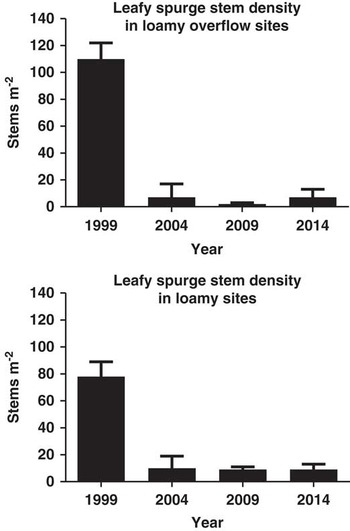
Aphthona spp. flea beetles were released for leafy spurge biological control in the Little Missouri National Grasslands (LMNG) in Badlands of southwestern North Dakota in 1999. The change in leafy spurge aboveground density and soil seedbank was monitored at two ecological sites, loamy overflow (valleys) and loamy (ridgelines) every 5 yr since release up to 2014. Leafy spurge stem density decreased an average of 92% at 5 yr after release of the biological control agents and remained at very low levels (<10 stems m−2) for 15 yr at both ecological sites. Similarly, leafy spurge seed in the soil seedbank decreased from nearly 67% in 1999 to 2% in 2014 in the valley sites, and from 70% in 1999 to 6% in 2014 in the ridgeline sites. Kentucky bluegrass began to infest both ecological sites and was well established within 10 yr of Aphthona spp. release as competition from leafy spurge decreased. The number of desirable plants increased to 21 species by 2014 (more than three times the number of species in 1999) in the valley sites and doubled to 14 species in the ridgeline sites, while less desirable forb species doubled in both ecological sites. The number of desirable grass species doubled in valley sites by 2014 but remained unchanged in ridgeline sites. In general, an increase in desirable species abundance in the seedbank indicated a trend toward a more natural and higher-quality plant community. The successful control of leafy spurge with Aphthona spp. flea beetles in the LMNG for the last 15 yr could not have been achieved by any other single control method. Aphthona spp. were an effective and economically feasible option for leafy spurge control across large areas and in a variety of terrains. Reseeding of native species following the release of flea beetles could help to restore the native community by allowing a more rapid reintroduction of desirable species into the seedbank and inhibiting invasion by nondesirable species such as Kentucky bluegrass.
A long-term leafy spurge biological control program was initiated in the Little Missouri National Grasslands (LMNG) in western North Dakota in 1999 when Aphthona spp. were initially released. The most abundant species in the region at the time were leafy spurge, Kentucky bluegrass (Poa pratensis L.), prairie Junegrass [Koeleria macrantha (Ledeb.) Schult.], little bluestem [Schizachyrium scoparium (Michx.) Nash-Gould], and green needlegrass [Nasella viridula (Trin.) Barkworth] (Cline Reference Cline2002). Leafy spurge was reduced from an average of 94 to 8 stems m−2 5 yr after release of Aphthona spp., a remarkable success, since the weed had dominated the vegetation for nearly 40 yr (Cline et al. Reference Cline, Juricek, Lym and Kirby2008). However, for the program to be a long-term success, the reduction in leafy spurge must be followed by an increase in desirable high seral species rather than less desirable, and often weedy, low seral species. High-seral species generally establish from seed either reintroduced or stored in the soil seedbank once an invasive species is controlled (Coffin and Lauenroth Reference Coffin and Lauenroth1989; Thompson and Grime Reference Thompson and Grime1979; Tracy and Sanderson Reference Tracy and Sanderson2000).
The purpose of this research was to evaluate change in the leafy spurge stand density and the soil seedbank composition 15 yr following the initiation of a leafy spurge biological control program using Aphthona spp. This study represents the longest reported follow-up of leafy spurge control using Aphthona spp. and provides insight into the long-term control potential and secondary succession in a once densely infested leafy spurge rangeland.
Materials and Methods
This study was initially established in 1999 in the LMNG when Aphthona spp. were released to control leafy spurge and monitoring of subsequent changes in the soil seedbank began. The landscape of the study site is rolling, with many gullies, ravines, and prominent rugged buttes, and is an unglaciated section of the Northern Great Plains within the Badlands region in southwestern North Dakota (Hanson and Whitman Reference Hanson and Whitman1938). The area has been seasonally grazed by cattle since the 1880s. The Badlands are characterized by striking differences in vegetation. Examples of the vegetation include: mixed prairie grasses on uplands, little bluestem on hillsides, saltgrass [Distichlis spicata (L.) Greene] and sagebrush (Artemisia spp.) on stream terraces, prairie sandreed [Calamovilfa longifolia (Hook) Scribn.] on hills, and woodland along stream courses and ravines. The elevation at the sites ranges from 760 m at lowland sites to 820 m at upland sites. The parent material consists of yellow and ash-gray shales, sandstones, clays, and scoria (which was produced by burning lignite beds) (Gauger et al. Reference Gauger, Leonard, Chandler, Simpson and Budge1930). Erosion from wind, water, and burning lignite veins created heterogeneous topography, including plateau tops, slopes, terraces, valleys, buttes, low hills, and knobs of various shapes (Hanson and Whitman Reference Hanson and Whitman1938). The soils of the area are predominantly well-drained loams, clay loams, sandy loams, and loamy loams. Average precipitation is 380 mm (15 in), with 70% occurring between April and September, and the mean annual temperature is 7.7 C (46 F).
The study was conducted on two sites within the LMNG, loamy (ridgelines) and loamy overflow (valleys) as defined by the U.S. Department of Agriculture’s Agricultural Research Service Ecological Site Description System (USDA-NRCS 2012). There were 12 plots established within each ecological site. The 24 plots were all located within Township 141 of the LMNG located approximately 15 km (9.3 mi) northwest of Medora, ND.
Criteria used to select the plots within each study site were density of leafy spurge (uninfested, light, moderate, or heavy) and lack of Aphthona within 2 km. The plots were 255 m2 (2,745 ft2) in size, and each was marked with a global positioning unit, a PVC post, and two plastic surveyor stakes in 1999. One stake was located at 90° to the right of center and perpendicular to the maximum water flow of the slope. Plots were separated into eight equal transects radiating from the center at 45° angles with transect three always pointing north from the center point.
Initial leafy spurge density was determined prior to the release of Aphthona spp. by counting the number of stems in 0.25-m2 quadrats at 1-m (3.28-ft) intervals along transects in each cardinal direction (3 per direction for 12 total per location). Leafy spurge stem densities were separated so infestation levels were zero (control) or approximated low (1X), medium (2X), and high (4X) density levels within a site. On the loamy site, light, medium, and heavy infestations averaged 87, 127, and 224 stems m−2, respectively, while on the overflow site, leafy spurge infestations averaged 46, 83, and 183 stems m−2, respectively. A total of 3,000 of the mixed species of Aphthona lacertosa Rosenhauer/A. czwalinae Weise and 3,000 A. nigriscutis Foudras biological control agents were released at each, site excluding the control, in July 1999. The experiment was a randomized complete block design with four treatments (initial leafy spurge densities and untreated control) and 12 replications for each site.
Leafy spurge stem density was recounted as previously described every 5 yr (2004, 2009, and 2014). Data for the 2004 and 2009 collection years were reported in Cline et al. (Reference Cline, Juricek, Lym and Kirby2008) and Setter and Lym (Reference Setter and Lym2013), respectively. The change in leafy spurge stem density over time was evaluated using analyses of variance (ANOVAs) for separate years and combined ANOVAs across years of the study. In the combined analyses, the effect of years was considered random, and the effect of treatments (initial stem counts) was considered fixed. Individual treatment means were separated using Fisher’s protected LSDs. Leafy spurge stem density was similarly reduced and did not differ by treatment 5 yr after the release of the biological control agents, and data were combined.
A seedbank analysis was conducted in August 2014 using seed germination methods outlined by Ter Heerdt et al. (Reference Ter Heerdt, Verweij, Bekker and Bakker1996). Five transects were randomly assigned at each of the original plots, and four soil cores were collected at 1-m intervals along each sampled transect. A total of 480 soil cores were excavated to a depth of 5 cm (1.97 in) with a 10-cm-diameter standard golf-cup cutter, as per the methods of Cline (Reference Cline2002). If the location to sample a soil core fell on a previously selected transect, the subsequent samples were taken on the same arc 1° to the right or left of the previous samples in 1999, 2004, or 2009, respectively. Soils samples were refrigerated at 3 C (37.4 F) before seedbank evaluation for at least 14 d to overcome dormancy, as suggested by Perez et al. (Reference Perez, Waller, Moser, Stubbendieck and Steuter1998).
Greenhouse trays, 28 by 56 cm, were prepared by adding a 1:1 mixture of steam-sterilized black sandy loam soil and commercial plant-growth media (Sunshine® Mix No. 1, patented formulation with wetting agents, Sun Gro Horticulture, 770 Silver Street, Agawam, MA 01001) to a depth of 2.5 cm. Next, the tray was topped with a 3- to 5-cm-thick layer of sterile silica sand (Ter Heerdt et al. Reference Ter Heerdt, Verweij, Bekker and Bakker1996). Four soil cores from each transect were combined and washed through a coarse (4 mm) and fine (0.2 mm) sieve and then added to the trays as the final layer. The trays were placed in the greenhouse, watered daily, and rotated weekly. There were 5 trays per location for a total of 120. Greenhouse temperature was maintained between 20 and 28 C, and natural light was supplemented with 450 µmol m−2s−1 to total 16 h d−1.
Each species was identified as soon as possible after emergence, recorded, and removed. The species were placed into six plant categories that included: major invasives (leafy spurge and Kentucky bluegrass), high seral forbs, low seral forbs, high seral grasses, low seral grasses, and hydric/mesic species. High seral species are found in undisturbed and stable plant communities and generally indicate a high-quality native plant community. Low seral species are found in areas with high disturbance levels and indicate an early successional, low-quality prairie (Juricek Reference Juricek2006). Coefficients of conservatism (C-values) were assigned to each plant species based on an assessment by the Northern Great Plains Floristic Quality Assessment Panel (2001). The C-values range from 0 to 10, with 0 for plant species that inhabit highly disturbed (low seral) areas and 10 for undisturbed, natural (high seral) areas. Low seral species had a C-value of 3 or less, and high seral species had a C-value of 4 or greater.
Introduced species were included in the low seral species categories, and any shrubs or woody species were included in the forb categories. The identified seedlings were used as a proxy to determine the abundance of seed in the samples collected from the soil seedbank. The study ended 6 wk after the last seedling was removed from an individual tray (Ter Heerdt et al. Reference Ter Heerdt, Verweij, Bekker and Bakker1996), or after 9 mo from the starting date of germination, whichever was earlier.
The seed trays were placed in the greenhouse in a completely random design with a six by four factorial arrangement, six vegetation categories and four densities of leafy spurge. The data from the two sites were analyzed separately. Each treatment combination in an experiment was replicated four times. Mean separation was done using t-tests between each pair of treatments at P = 0.05.
Results and Discussion
Aphthona spp. reduced leafy spurge stem density to less than 5% of the original stand within 5 yr of release and maintained greater than 90% control in both loamy overflow and loamy sites for 15 yr (Figure 1). Leafy spurge stem density had been reduced from as much as an average of 224 stems m−2 in high-density overflow sites (Cline et al. Reference Cline, Juricek, Lym and Kirby2008) to less than 10 m−2 regardless of original density or location. This reduction was maintained from 2004 to 2014 with no additional control inputs. Such high-level sustained reduction of leafy spurge would not be possible with herbicides due to both cost constraints and environmental impacts (Lym Reference Lym1998).
Change in leafy spurge stem density following release of Aphthona spp. biological control agents in 1999. Suppression was reevaluated thereafter every 5 yr until 2014 in loamy overflow and loamy sites in the Little Missouri National Grasslands in southwestern North Dakota.

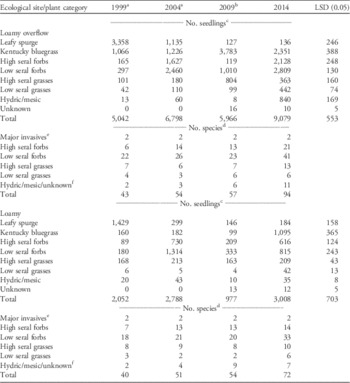
The decrease in leafy spurge stem density was followed by a decrease of leafy spurge seed in the seedbank, although the decline lagged the change in aboveground growth. Leafy spurge seed in the loamy overflow seedbank constituted 67% of the seedbank with 3,358 seedlings in 1999 but declined to 2% or less (127 and 136 seedlings in 2009 and 2014, respectively) by 10 and 15 yr after the release of Aphthona spp. (Tables 1 and 2). Another major invasive, Kentucky bluegrass, increased from 1,066 to 3,783 seedlings in 1999 and 2009, respectively, and then declined to 2,351 seedlings in 2014, constituting approximately 26% of the loamy overflow seedbank. Kentucky bluegrass seed production was likely reduced by the increased population of native grasses, which slowed the advance of this sod-forming species (Larson and Larson Reference Larson and Larson2010).
Seedbank results showing total number of seedlings that emerged from each plant category and total number of species in four plant categories across all soil cores in loamy overflow and loamy ecological sites every 5 yr from 1999 through 2014 in the Little Missouri National Grasslands in southwestern North Dakota.

a The 1999 and 2004 data were originally published by Cline et al. (Reference Cline, Juricek, Lym and Kirby2008) and are included for comparison.
b The 2009 data were originally published by Setter and Lym (Reference Setter and Lym2013) and are included for comparison.
c Total number of seedlings that emerged per 0.5 m−2 from soil samples collected to a depth of 5 cm.
d Total number of species that emerged each year in each ecological site.
e Major invasives includes only leafy spurge and Kentucky bluegrass plant categories.
f Hydric/mesic and unknown plant categories were combined due to small size.
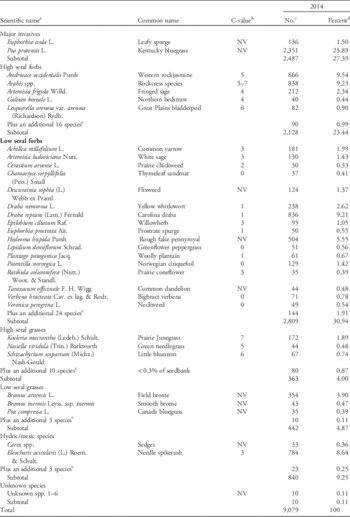
Scientific name, common name, coefficient of conservatism value, number of seedlings, and percent of total seedbank of plant species that emerged from soil cores excavated in August 2014 from 12 loamy overflow sites in southwestern North Dakota 15 yr after Aphthona spp. release for leafy spurge control in 1999.

a Scientific nomenclature follows the Flora of the Great Plains (Great Plains Flora Association 1986), except as amended according to the U.S. Department of Agriculture’s Natural Resources Conservation Service (USDA-NRCS) Plants Database (2014).
b Coefficient of conservatism (C-value) was assigned to plant species based on an assessment by the Northern Great Plains Floristic Quality Assessment Panel (2001). A coefficient value of “NV” (no value) indicates an introduced or unidentified species; values of 0–3 indicate species that flourish in highly disturbed habitats; and values of 4–10 indicate species from less disturbed, natural areas.
c Total number of seedlings that emerged per 0.5 m−2 from soil samples collected to a depth of 5 cm.
d Percentage of total seedlings that emerged across all soil cores.
e Species that comprised <0.3% of the total seedbank were not included in the table. A complete list can be found at Thilmony (2016).
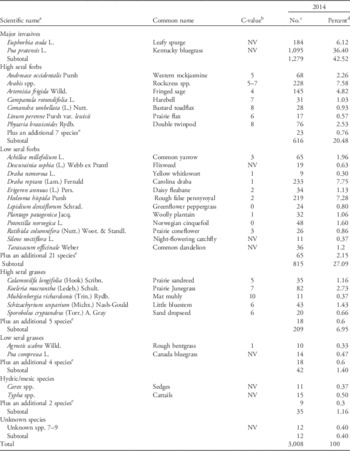
Leafy spurge seedling emergence decreased 89% in the loamy seedbank, from 1,429 seedlings in 1999 to 299 seedlings in 2009 (Table 1), constituting 11% of the seedbank. Unlike the lag in seedling reduction observed in the loamy overflow sight, decline in leafy spurge seed in the loamy seedbank only slightly lagged the reduction in the aboveground stems. Leafy spurge seedling numbers remained at this low level in 2014 (184 seedlings), which corresponded to a similar static number of stems observed at these sites (Figure 1). Kentucky bluegrass constituted 8% of the seedbank in 1999, with 160 seedlings, and increased to 1,095 seedlings in 2014, constituting 36.5% of the seedbank (Setter and Lym Reference Setter and Lym2013; Tables 1 and 3). In 15 yr, Kentucky bluegrass had replaced leafy spurge composition in the loamy seedbank.
Scientific name, common name, coefficient of conservatism value, number of seedlings, and percent of total seedbank of plant species that emerged from soil cores excavated in August 2014 from 12 loamy sites in southwestern North Dakota 15 yr after Aphthona spp. release for leafy spurge control in 1999.

a Scientific nomenclature follows the Flora of the Great Plains (Great Plains Flora Association 1986), except as amended according to the U.S. Department of Agriculture’s Natural Resources Conservation Service (USDA-NRCS) Plants Database (2006).
b Coefficient of conservatism (C-value) was assigned to plant species based on an assessment by the Northern Great Plains Floristic Quality Assessment Panel (2001). A coefficient value of “NV” (no value) indicates an introduced or unidentified species; 0–3 indicates species that flourish in highly disturbed habitats; and values of 4–10 indicate species from less disturbed, natural areas.
c Total number of seedlings that emerged per 0.5 m−2 from soil samples collected to a depth of 5 cm.
d Percentage of total seedlings that emerged across all soil cores.
e Species that comprised <0.3% of the total seedbank were not included in the table. A complete list can be found at Thilmony (2016).
The total number of seedlings that emerged increased 45% in the loamy overflow sites and 32% in the loamy sites throughout the past 15 yr (Table 1). In 1999, a total of 5,042 seedlings germinated in the loamy overflow sites, which increased to an average of 6,382 in 2004 and 2009, then increased again to 9,079 seedlings in 2014. Total seedling emergence in the loamy sites increased from 2,052 seedlings in 1999 to 3,008 seedlings in 2014. Compared with the loamy sites, the loamy overflow sites had a greater seedling emergence likely due to more optimal growing conditions that contributed to greater growth and seed production that more than doubled the number of emergent seedlings, a consistent trend throughout the 15-yr study (Cline et al. Reference Cline, Juricek, Lym and Kirby2008; Setter and Lym Reference Setter and Lym2013). The loamy overflow sites were at lower elevations, had more moisture available from surface runoff and subsurface water movement, had higher organic matter content, and were likely more fertile than the loamy soils (Hanna et al. Reference Hanna, Harlan and Lewis1982; Malo and Worcester Reference Malo and Worcester1975; Wolf Reference Wolf1987). Although not present in the seedbank, creeping juniper (Juniperus horizontalis Moench) occurred in dense layers in some loamy sites, which may have prevented seeds from entering the seed pool.
The rise in total number of seedlings at both sites can be partially attributed to the increase in species richness, which had doubled since 1999 (Table 1). In 2014 in the loamy overflow sites, 94 species emerged compared with 43, 54, and 57 species in 1999, 2004, and 2009, respectively. Species richness in the loamy sites also increased steadily from 40 species to 72 species by 2014. Increased species richness will increase biodiversity by introducing more genetic traits into the community (Tilman and Lehman Reference Tilman and Lehman2001). Moreover, greater species diversity could potentially lead to increased stability and productivity due to competitive mechanisms such as more efficient resource capture and use. More diverse communities tend to be more stable, even if individual species within the communities tend to be less stable (Tilman et al. Reference Tilman, Knops, Wedin and Reich2001).
High seral forb richness increased to 21 species by 2014 (more than three times the number of species in 1999) in the loamy overflow sites and doubled to 14 species in the loamy sites, whereas the number of low seral forb species nearly doubled in both sites (Table 1). Forbs are important components of rangeland communities and provide much of the ecological and botanical diversity (McArthur Reference McArthur1988). Forbs are valuable for providing palatable forage (with preferential palatability for some animals and species); increasing forage nutrient value (especially in the spring); increasing nitrogen fixation (from leguminous forbs); controlling erosion with ground cover; providing a low-maintenance, aesthetically pleasing landscape; and resisting the spread of wildfire.
The increase in overall percent composition of high seral forbs in 2014 at the loamy overflow sites was primarily caused by an increase in rockcress species (Arabis spp.), which constituted 9.23% of the seedbank collected in 2014 (Table 2), in addition to western rockjasmine (Androsace occidentalis Pursh) (9.54%) and fringed sage (Artemisia frigida Willd.) (2.34%). The rockcress species was likely either hairy rockcress [Arabis hirsuta (L.) Scop.] or Holboelli’s rockcress (Arabis holboelli Hornem.), which are both native species of the mustard (Brassicaceae) family. The same rockcress species primarily contributed to the increase in high seral forbs in the loamy seedbank in 2014, which constituted 7.58% of the seedbank (Table 3).
Western rockjasmine and fringed sage were observed every year in both sites (Setter and Lym Reference Setter and Lym2013; Tables 2 and 3). Western rockjasmine reached a maximum of 10.2% in 2004 in the loamy overflow sites (Cline et al. Reference Cline, Juricek, Lym and Kirby2008) and 2.3% in 2014 in the loamy sites. Fringed sage reached a maximum in 2004 of 7.5% of the loamy overflow seedbank and 10% of the loamy seedbank.
Low seral forb composition increased in the loamy overflow sites from only 297 seedlings in 1999 to 2,809 seedlings in 2014 (Table 1), which constituted approximately 6% and 31% of the seedbank composition, respectively (Setter and Lym Reference Setter and Lym2013; Table 2). Seven species were observed in the loamy overflow sites every collection date, common yarrow (Achillea millefolium L.), white sage (Artemisia ludoviciana Nutt.), greenflower peppergrass (Lepidium densiflorum Schrad.), prairie coneflower [Ratibida columnifera (Nutt.) Woot. & Standl.], common dandelion (Taraxacum officinale F. H. Wigg), and at less than 0.3% of the 2014 seedbank, Canada thistle and horseweed [Conyza canadensis (L.) Cronq.]. The rise in low seral forbs in 2014 can be partially attributed to white sage, flixweed [Descurainia sophia (L.) Webb ex Prantl], willowherb (Epilobium ciliatum Raf.), rough false pennyroyal (Hedeoma hispida Pursh), and Norwegian cinquefoil (Potentilla norvegica L.), which together constituted 10.82% of the loamy overflow seedbank in 2014 (Table 2), compared with <0.2% in 2009 (Setter and Lym Reference Setter and Lym2013).
Low seral forb emergence varied throughout the years at the loamy sites (Table 1). Low seral forb species constituted 9% of the seedbank in 1999, with 180 seedlings, increasing to 47% in 2004, with 1,314 seedlings (Table 1; Setter and Lym Reference Setter and Lym2013), and declined to 27.09% by 2014, with 815 seedlings (Tables 1 and 3). Common yarrow increased steadily from 0.10% in 1999 to almost 2% in 2014 (Setter and Lym Reference Setter and Lym2013; Table 3). Common dandelion constituted 2% of the seedbank in 1999, reached a maximum of just over 4% in 2004, and decreased to 1.2% of the seedbank in 2014. Rough false pennyroyal constituted 0.3% of the seedbank and was first observed in 2009 but increased to 7.28% by 2014. Common mullein (Verbascum thapsus L.) was the most abundant species in 1999, constituting 4% of the seedbank, but was absent thereafter. Likewise, wormseed wallflower (Erysimum cheiranthoides L.) and ball mustard [Neslia paniculata (L.) Desv.] constituted approximately 5% each in 2004 and were not observed again. Similar to the loamy overflow sites, yellow whitlowort (Draba nemorosa L.) constituted almost 30% of the loamy seedbank in 2004, 22% in 2009, and was the most abundant species both years, but decreased to 0.3% in 2014. Carolina draba [Draba reptans (Lam.) Fernald], which was not previously recorded, constituted 7.8% of the seedbank in 2014 as the most abundant low seral forb. Carolina draba is a very small plant that grows abundantly in areas with heavy grazing, indicating that overgrazing may have likely contributed to the presence and abundance of Carolina draba in the seedbank (Minnesota Wildflowers 2016). Also, common yarrow, dandelion, and mullein frequently grow in areas with disturbed soils (Stubbendieck et al. Reference Stubbendieck, Hatch and Bryan2011). So a decrease in these low seral species may indicate that the quality of the sites has improved throughout the years.
The number of high seral grass species nearly doubled to 13 by 2014 compared with 7 in 2009 in the loamy overflow sites, but remained unchanged in the loamy sites (Table 1). The rise of high seral grasses in the loamy overflow sites was due to presence of prairie Junegrass which constituted 13% of the overall seedbank composition, with 758 seedlings by 2009 (Setter and Lym Reference Setter and Lym2013). Prairie Junegrass was still the most abundant high seral grass in 2014 but constituted only 1.9% of the loamy overflow seedbank, with 172 seedlings (Table 2). High seral grass composition in the loamy sites constituted 8% and 7% of the seedbank in 1999 and 2014, respectively (Setter and Lym Reference Setter and Lym2013; Table 3). As in the loamy overflow sites, prairie Junegrass was the most abundant species in 1999, 2009, and 2014, and constituted approximately 4%, 14%, and 3% of the loamy seedbanks, respectively (Setter and Lym Reference Setter and Lym2013; Table 3). Prairie sandreed was found every year in the loamy sites, in addition to green needlegrass, little bluestem, and sand dropseed [Sporobolus cryptandrus (Torr.) A. Gray], which were found every year in both sites.
Low seral grasses in the loamy overflow sites increased 91% from 42 seedlings (<1% of the seedbank) in 1999 to 442 seedlings in 2014 (4.9% of the seedbank) (Tables 1 and 2; Setter and Lym Reference Setter and Lym2013), with most of the increase attributed to the introduction of field brome (Bromus arvensis L.), which constituted 3.9% of the seedbank in 2014 (Table 2). Field brome is an aggressive introduced species that outcompetes desirable vegetation and reduces forage production of perennial grasses as well as grazing performance (Sedivec and Barker Reference Sedivec and Barker1998) and was an unwelcome addition to these sites. Low seral grasses only constituted 1.4% of the loamy soil seedbank in 2014 with little change since 1999 (Table 1).
Hydric/mesic species were a very small component (<1%) of the loamy overflow seedbank from 1999 through 2009, with an average of 27 seedlings, but constituted more than 9% of the seedbank composition in 2014, with 840 seedlings (Tables 1 and 2). The increase in the number hydric/mesic species was largely due to the presence of needle spikerush [Eleocharis acicularis (L.) Roem. & Schult.], which constituted 8.6% of the seedbank in 2014. Similarly, fragrant flatsedge (Cyperus odoratus L.), another species that prefers wet and muddy areas, also emerged in 2014 for the first time (unpublished data). The presence of these species in 2014 indicate that the loamy overflow sites had adequate moisture for semiaquatic plants to establish. Hydric/mesic species emergence increase varied in the loamy sites with 43 seedlings in 2004 to only 10 seedlings in 2009 (Table 1). In 1999, sedge species were the most abundant hydric species, constituting 0.9% of the seedbank, but cattails (Typha spp.) were the most abundant from 2004 through 2014 (Setter and Lym Reference Setter and Lym2013; Table 3).
Biological control of leafy spurge with Aphthona spp. has successfully managed infestations in the LMNG in southwestern North Dakota for the past 15 yr (Figure 1). The flea beetles reduced leafy spurge in areas of high infestation levels with as much vigor and success as areas with low levels of infestation in addition to dispersing to and establishing at sites where flea beetles were never released. Once the Aphthona spp. established, leafy spurge infestations were successfully managed without additional costs or use of other control methods such as herbicides. No other single control method has efficacy that would last for more than 15 yr (Lym Reference Lym2005). Aphthona spp. flea beetles were an effective and economically feasible option for leafy spurge control across large areas and in a variety of terrain in this and similar studies (Butler et al. Reference Butler, Parker and Murphy2006; Kirby et al. Reference Kirby, Carlson, Krabbenhoft, Mundal and Kirby2000; Lesica and Hanna Reference Lesica and Hanna2004, Reference Lesica and Hanna2009; Mico and Shay Reference Mico and Shay2002).
Reduction of leafy spurge infestations made resources that had been used by the invasive weed available for enhanced growth of other individuals already within the community. Species richness doubled in both sites from 1999 to 2014. Often, plant communities that contain more species are more productive, yet the effects of the deletion of an individual species on total biomass is dependent on which species are present in the community and which species are lost. The results of this study are very similar to a 14-yr study in Montana in which native diversity increased after the release of Aphthona spp. flea beetles and subsequent reduction in leafy spurge (Lesica and Hanna Reference Lesica and Hanna2009). However, despite the decline in leafy spurge, the increase in native diversity was small, and Lesica and Hanna (2009) suggested that increases of native alpha diversity in semiarid grasslands may require decades.
The increase in native species following control of an invasive weed may be very dependent on the environment and topography of the area. In this study the number of high seral forbs and grasses increased by 3.5X and 1.9X, respectively, in the loamy overflow (valleys), while high seral forb species doubled but grasses remained nearly unchanged on the loamy (ridge) sites (Table 1). Larson and Larson (Reference Larson and Larson2010) found little evidence that desirable species replaced leafy spurge at three wildlife sites in North Dakota and suggested such areas would benefit from reseeding of native species. This suggestion is strengthened by Benson and Hartnett (Reference Benson and Hartnett2006), who found only 14 of 39 species in a tallgrass prairie site that established following a burn were from seed, the remainder were from vegetative reproduction. The increase in desirable species over the 15-yr span of this study is also in direct contrast to a review of 168 similar studies in which invasive weeds were controlled only to be replaced by secondary invasives, most of which (89%) were also considered noxious (Pearson et al. Reference Pearson, Ortega, Runyon and Butler2016). Based on these and other similar studies, the ability of native species to reestablish once an invasive species is reduced likely will depend on site history, conditions, abundance of desirable natives in the area, and propagules in the seedbank (Bazzaz Reference Bazzaz1996).