On Saturday, September 4, 1610, an urgent message arrived at the criminal court (Zentgericht) of Remlingen from the nearby rural market of Neubrunn: a dangerous criminal by the name of Georg Schmid, alias “Baker Georg,” had been apprehended the previous day, and the officials of the Zentgericht should come and get him.Footnote 1 The chief magistrate (Zentgraf) Johann Müller, together with the court clerk and one of the jurors, accordingly rode out to Neubrunn, where the prisoner was handed over, but with the condition, as Müller subsequently reported,
that if the prisoner should be released alive, and if he should cause any harm to any members of the community of Neubrunn in either the village [itself] or its fields, that they would in every case seek to recover these [damages] from the Remlingen Zentgericht, and moreover, that if they had reason to believe that the evildoer would [in fact] escape in this way, they would prefer that he die in prison.Footnote 2
Müller refused to guarantee the death of “Baker Georg” and explained to the angry peasants that it was not yet clear if the prisoner was in fact guilty of the accusations against him, or if his alleged crimes legally merited the death penalty. He added that the matter would have to be governed by Emperor Charles V's Imperial Criminal Code (Peinliche Halsgerichtsordnung) of 1532, and that even if the accused were found guilty, there remained the possibility that the Bishop of Würzburg, who exercised criminal jurisdiction over this part of Lower Franconia, would choose to pardon him.Footnote 3
The Neubrunners then presented a series of documents in support of the prosecution, including sworn witness testimony, and a list of eighteen interrogatories to be put to the accused. The questions presumed Schmid's guilt on a variety of charges (e.g., “why did he lie in wait at night for Michel Scheffer of Bettingen and without provocation strike him with a club?”) and brimmed with personal hostility (e.g., “why has he absented himself from here since Pentecost, and why does he sneak in and out [of the village] at night like a rat?” and “where has he been during this absence, and who gives him tavern money, since he is always completely drunk?”).Footnote 4 For his part, Schmid not only declined to answer these questions, but refused to speak at all, communicating by pointing and gesturing “as if he were mute.” Upon returning to Remlingen, Schmid dropped the act, protesting his innocence and explaining that the villagers bore him such enmity that he thought it unsafe to speak in their presence. The Remlingen court officials then launched their own investigation, which entailed almost three weeks of document collection and interrogation, and which would culminate with the order that Schmid be beheaded on October 11, 1610.Footnote 5 Nine days before his scheduled execution, Schmid cheated the headsman by dying in prison; the villagers of Neubrunn were the only ones who got what they wanted.Footnote 6
One could be forgiven for doubting the wider import of this sad story. The alleged crimes were decidedly mundane: the assault on Michel Scheffer, assault and robbery of a doctor from Fulda, submission of falsified documents, and assorted accusations against, threats to, and assaults on Schmid's neighbors in Neubrunn. The pronounced punishment seems equally unremarkable, as it has long been known that most death sentences in early modern Germany (as elsewhere in Europe) were imposed for aggravated property crime. Yet, if we shift our gaze from the type of crime and punishment to the intervening process of prosecution, the case of “Baker Georg” gains a stronger claim to our attention, for it suggests, together with other cases like it, that we may have seriously misconstrued the logic of early modern criminal law.
Ever since Michel Foucault's landmark 1975 treatment, research on the legal history of early modern Europe has manifested a fascination with capital punishment, with particular emphasis on the gory, ritualized, and public character of executions.Footnote 7 In a formulation popularized by Pieter Spierenburg, these “spectacles of suffering” are linked to the political insecurity of the early modern state, which not only failed to maintain a monopoly on violence, but also exercised a merely tenuous control over those whom it claimed to rule. On this understanding, political elites compensated for their weakness by staging self-consciously intimidating acts of retribution against those unfortunates whom they could punish, in particular the socially marginal. With the expansion of effective state power by the late eighteenth century came greater confidence, and criminal punishment grew increasingly bloodless, scientific, and private.Footnote 8
There is a great deal of merit to this approach, and I do not wish to suggest that it is, in any simple sense of the word, “wrong.”Footnote 9 It remains the case that this vision invests early modern penal institutions with characteristics that seem entirely at odds with the case of “Baker Georg.” Insofar as the courts are cast as the tools of political elites, the operation of the criminal law is reduced to a crude attempt at lordly coercion, with the failure of that attempt often attributed to popular resistance. The portrayal of magistrates as fearful men defensively clinging to power militates further still against any integrity in the procedures for determining and assessing guilt. And it is in this interpretive context, I would argue, that witchcraft persecution—which represented a tiny fraction of the cases handled by German tribunals—has garnered such enormous attention in the historical literature on early modern Europe.Footnote 10 What could be better evidence of the intellectual and moral bankruptcy of the criminal justice system than a prosecutorial campaign rooted in elite fantasy and paranoia, targeted at those disadvantaged by gender and poverty, and sustained by the power of inquisitorial methods to produce confessions of utterly imaginary crimes?
Yet, “Baker Georg” was apprehended and handed over by his own neighbors, against whose demands the Zentgraf felt obliged to insist on proper procedure before guilt could be pronounced. The Remlingen officials did their work carefully. They recorded the villagers' claim that Schmid's own wife feared he was in league with the devil, but did not pursue the matter any further. They collected documents that showed that the accused had previously been convicted of slandering the village mayor in 1597, and again in 1603 for shattering a neighbor's shoulder blade with a hatchet and for a subsequent prison break.Footnote 11 When Schmid attempted suicide by cutting his throat with a concealed knife, they bandaged the wound and suspended their interrogation until he had recovered.Footnote 12 They were particularly thorough regarding the most serious charge (i.e., the robbery and attempted murder of the doctor from Fulda, a capital offense according to §126 of the Imperial Criminal Code). Proceeding from a record of the victim's testimony and wounds, together with sworn statements from two witnesses, they bore down on Schmid's claims that he had taken nothing from the doctor and had in any case struck only in self-defense.Footnote 13 Why were coins in the denominations named by the doctor found in Schmid's pocket? If the doctor had in fact stabbed him with a rapier, why were there no marks on Schmid's body? And if Schmid had disinterestedly thrown aside the doctor's sword in the woods, why was it nowhere to be found when the area was searched?Footnote 14
Finally, the interrogators turned to torture.Footnote 15 Schmid had anticipated and dreaded this eventuality; he later explained that he had attempted suicide “to escape the scourge of torture and . . . out of fear that things would go ill for him.” But he did not escape. The two shallow cuts he made in his neck suggest a degree of hesitation; he also admitted to his interrogators that “since, however, he himself thought it not right that he should lose faith in God, he broke off [the attempt].” On the morning and again in the afternoon of September 24, 1610, “Baker Georg” was subjected to the legscrew, and his resistance began to crumble. He insisted to the end that the doctor had attacked him first, offering the unconvincing explanation that “because he stood somewhat taller than the doctor, [the rapier] went into the front of his vest but then came out over his shoulder [sic] without injuring his body.” Eventually, however, Schmid conceded that he had rifled his victim's pockets after knocking him down, and had concealed the doctor's rapier and glove in his cowshed (the Zentgraf promptly located the items in their hiding place). Schmid concluded his confession by pleading for mercy and by offering “to liquidate whichever of his landholdings could most quickly be sold and compensate the doctor [with the proceeds].”Footnote 16 As has been seen, mercy was not forthcoming.
It is difficult to assess the truthfulness of Schmid's final round of testimony, tainted as it was by torture. Yet, the principal effect of the legscrew was not so much the revelation of previously unsuspected offenses as the recasting of known incidents that Schmid had initially presented as altogether innocent. It also seems noteworthy that he was never completely broken and always maintained that he had acted out of provocation, self-defense, or, in the case of the slander charges, out of an honorable desire to expose the crimes of others to the authorities. Regarding the alleged assault on Michel Scheffer of Bettingen, for example, Schmid's initial testimony on September 6 had been:
He will not admit that he ever lay in wait for a person from Bettingen. Some ten to twelve years ago, a certain “Shoe Michael” approached him near Neubrunn at the lamplight hour, but he was a good companion, and [Schmid] never laid on him an angry word, much less a blow.
By the afternoon of September 24, this became:
He heard from a servant who had served . . . some twenty years ago in Neubrunn that Michael Scheffer had been accused of fornicating with his [i.e., Schmid's] current wife when the two of them had been servants [in the home] of the [current] mayor's father. For this reason he, the prisoner, struck Michael Scheffer, but since he [i.e., Scheffer] had otherwise been a good companion, he [then] let the matter drop, and yet was still struck by Scheffer [in return] with an axe.
In the same way, when asked why he had threatened to burn down the house of his next-door neighbor, Schmid at first declared that “he will not admit that he threatened [his neighbor] Endres Fiderling with fire, as they never had an angry word between them.”Footnote 17 Under torture, Schmid revised his declaration, explaining:
There were five [boundary] stones between his farm lot and Endres Fiderling's, but since Fiderling plowed so close to them that almost all of them were destroyed, he [i.e., Schmid] said that he wished that his and his neighbor's houses lay in a heap of ruins and would go up in flames, but he did not [actually] threaten to set fire to them.”Footnote 18
The trial of “Baker Georg” certainly fails to meet modern standards of procedural justice, but it strains credulity further still to reduce the prosecution to an act of arbitrary magisterial terror.
A single example will carry us only so far, of course, but it should be emphasized that while we have many fine studies of both the perpetration of injury and the statutory framework of punishment, we know little about the actual process of criminal investigation and prosecution in sixteenth- and seventeenth-century Germany.Footnote 19 Part of the problem is the provenance of the evidence: the fullest surviving “serial data” on criminal convictions come from urban archives, while most of the population lived on the land. The jurisdictional supersession of local rural courts by more professionalized central tribunals (which kept better records) was primarily an eighteenth-century phenomenon, by which point the frequency of death sentences had already ebbed significantly. Archival habits represent an additional challenge. Records of serious crimes have been much better kept than records of misdemeanors, and final sentences have been better preserved than the internal paperwork on which the sentences were based. Finally, intellectual compartmentalization within the scholarly community has also raised obstacles of its own. On the one hand, late nineteenth- and early twentieth-century work in early modern German legal history was more concerned with the jurisprudential doctrine than with actual practice, a habit which still marks the work of some scholars who trained first as lawyers and only secondarily as historians.Footnote 20 On the other hand, the rise of a social history of German law since the 1980s—now the predominant approach—has added an entirely new set of perspectives to the subject, but is often produced by scholars who are more interested in legal records as a window onto something else, rather than in the law as a set of practices in its own right.
This article is an effort to reconstruct and contextualize the process of criminal prosecution in the early modern German countryside during the high point of executions in the late sixteenth and early seventeenth centuries. It is based on the close reading of approximately forty substantially intact case files from three south German jurisdictions: the Criminal Court of Remlingen (supervised by the Bishop of Würzburg), the Lutheran lordship of Limpurg-Gaildorf, and the Catholic prince-abbacy (Fürststift) of Kempten, plus supporting materials from these and other south German lordships, in particular the Imperial monastery (Reichsstift) of Ottobeuren. My principal contention is that early modern German legal institutions operated with much greater flexibility and sophistication than is commonly acknowledged.
More specifically, I show that magistrates made genuine efforts to assess the gravity of offenses in terms of both the social context and consequences of infractions, as well as the inner disposition of offenders. In these regards, the seemingly recondite ruminations of learned jurists found both implicit and explicit application in actual court practice, and the problem of evidence and its corroboration was also taken seriously. Finally, while the posture of the common people toward the criminal law was certainly not the same as that of the magistrates themselves, there was substantial overlap in their attitudes, and the courts were, in practice, heavily dependent in their operation upon not just the acquiescence, but also the active support of the peasantry.Footnote 21
The most appropriate way to begin is by emphasizing the limited role of death sentences in early modern German penal practice. Analysis of urban sentencing patterns has already suggested that even during the surge of criminal prosecution during the later sixteenth century, only something like 10 to 30 percent of sentences were capital.Footnote 22 My own investigations in the countryside suggest that even this figure may be an overestimate. The Ottobeuren lordship has not preserved many criminal case files from this period, but a great many of the fiscal accounts of the senior sheriff (Obervogt) Hans Adam II von Stain zu Eberstall (ca. 1567-ca. 1610) have survived. These accounts record capital sentences in the form of a standardized payment of £7 to the headsman for an execution, as well as fines for less serious offenses, and may further be supplemented by some sentencing records and by von Stain's own “Tower Register” for the period 1582–1601.Footnote 23 Taken together, these records indicate that at the high tide of prosecution in the 1590s, there was an average of 0.75 executions per year in a lordship that comprised eighteen villages, fifty hamlets, and a central market town with a total population of close to 8,000.Footnote 24 At the same time, the Ottobeuren Obervogt imposed just over 600 fines every year, producing an overall ratio of noncapital to capital punishments of 800 to 1.
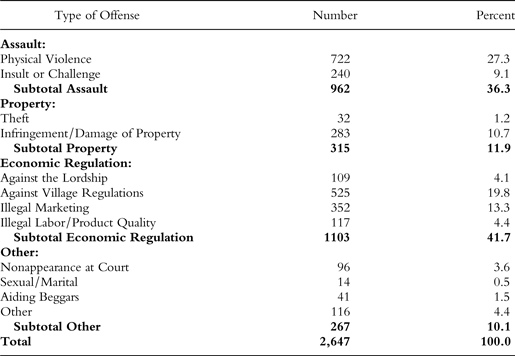
Several implications follow from the terms of this marked imbalance. In the first place, it is difficult to describe the Ottobeuren penal system as primarily reliant on terror. It seems equally difficult to characterize the system as venting its frustration on the marginal because of an inability to exercise authority over the rest of rural society. As is clear from Table I, the Ottobeuren Obervogt punished a very wide range of infractions. Assaults, both physical and verbal, made up just over one-third of offenses. Most of these did not rise above the level of insults and fisticuffs, but there were two cases of manslaughter in the four years covered by the table. Prosecutions for crimes against private property were much less common, with damage to crops by wandering livestock and boundary infringements the most frequent infractions, and direct thefts of property rare. Violations of the economic regulations of both the lordship (e.g., regarding tithe and rent obligations) and the village community (e.g., regarding the use of communal lands and forests), together with illegal marketing (i.e., private trading outside officially sanctioned marketplaces) and labor (i.e., on feast days), gave rise to the largest number of prosecutions.
Prosecutions for Noncapital Crimes at Ottobeuren (1593–1599)*

* Account years 1593–1594, 1594–1595, 1597–1598, and 1598–1599 only (2,493 individuals prosecuted).
SOURCE: Staatsarchiv Augsburg (StAA), RS Ottobeuren, Band 587-II, Hefte 17–20.
Almost all fines were levied in response to complaints filed by the peasants themselves, and the social reach of prosecution was surprisingly broad. In the village of Oberwesterheim, for example, a 1587 tax list, a parish register (intact from 1595–1633), and serf rolls from 1586, 1587, 1590 and 1595 allow us to identify all of the forty-nine householders resident in the village in 1595.Footnote 25 Comparison of the householder list with four of the Obervogt's accounts from 1593–1594, 1594–1595, 1597–1598, and 1598–1599 reveals that almost two-thirds (63.3 percent) of peasant householders were fined in these four years, with widows making up almost half of those who were not punished. Most (69 percent) of those subject to frequent prosecution, here defined as more than two fines during these four years, belonged to the minority of wealthy yeoman farmers (Bauern), rather than to the majority of poorer cottagers (Seldner). Similar patterns emerge from an analysis of the accounts of a later Ottobeuren Obervogt during the 1620s.Footnote 26
We cannot be sure that this pattern was typical of early modern Germany (very little research has been done on the social impact of prosecution), but there is little reason to suspect otherwise. There was nothing unusual about the scale or organization of the Ottobeuren administrative apparatus, and surviving records of the lower instances of other German judicial systems suggest a similar pattern of a high volume of prosecution and the sanctioning of a very broad range of offenses.Footnote 27 For the present purposes the point is that the deliberate assessment of guilt was clearly an important part of the system; a large number of people was punished lightly, and only a few with brutal severity.
There is nothing surprising in the suggestion that a “discrimination” of offenders was an essential element of criminal justice in early modern Europe. That term brings to mind a broad strand of research since the 1980s that has interpreted the criminal law above all as a form of social discipline. Historians who work in this tradition have (rightly) emphasized the disproportionate number of vagrants and other members of the social margins among the victims of the courts.Footnote 28 They have drawn attention to the stigmatization process whereby vagrancy had, by the later sixteenth century, become a “crime of status” in most of Europe, such that many authorities felt entitled to arrest vagrants even in the absence of a corpus delicti.Footnote 29
There is also no denying the existence of marked social disparities in the sentencing evidence. In sixteenth-century Ottobeuren, where ordinances against beggars and vagrants were promulgated in 1551, 1567, and 1597, outsiders to the monastery lands made up one in twenty of those conditionally pardoned for criminal offenses, but more than three-quarters of those sentenced to death. In the electorate of Mainz, whose enormous corpus of eighteenth-century criminal records has been intensively studied by Karl Härter, three-quarters of all death sentences were inflicted on vagrants and other itinerants on the social margin, in almost all cases as a punishment for property crime.Footnote 30 In the face of this evidence, which can be found all over early modern Europe, modern historians have increasingly come to speak of a “criminalization of poverty” and even of the “origin of heartlessness” in this period. This is misleading.Footnote 31
It is clear that not every prosecution was guided by the same (professions of) judicial objectivity as the investigation of “Baker Georg.” For example, when the peddler Albrecht Kreber was arrested for petty theft and assault near Gaildorf in July 1593, the local authorities were convinced that he was an associate of two highway robbers who had recently been executed in the nearby principality of Hohenlohe. Although Kreber protested that he knew nothing of these crimes, the sheriff (Vogt) Caspar Gärtner confidently advised his superiors that “although he claims to be as pure as the driven snow, you can see in his eyes that he is a thief.”Footnote 32 Similar suspicion fell on twenty-seven-year-old Caspar Kraus of Aschfeld, who was arrested in the town of Wenkheim for stealing a sack of apples in September 1618. The Wenkheim authorities delivered him to the Remlingen criminal court with a list of seven other unsolved thefts, requesting “that the said Kraus is diligently to be questioned on the attached interrogatory, for he has hung around Wenkheim for twenty years and has worked very little; it is therefore to be suspected that he may have been present [at] and helped with [these thefts].”Footnote 33 The initial report from the criminal court was not much more sympathetic, declaring that “to be sure, although he was willing to confess or admit very little voluntarily, we are nonetheless of the opinion that if he were questioned more intensely about these [charges], [confessions to] some of them might be squeezed out of him.”Footnote 34
In both of these cases, however, the court's ultimate decision was less harsh than might have been expected. Despite a shaky alibi (he claimed that he had only picked up from the street a sack of apples someone else had stolen and then dropped) and the admission of some minor pilfering, Caspar Kraus was ultimately released “with a strong reprimand” and excused, in all likelihood due to his poverty, from the obligation to pay court costs.Footnote 35 As for Albrecht Kreber, it was eventually realized that the peddler, who went by the nickname “Kreben Alberle,” was not the same person as “Alberlin the Peddler,” whose name had cropped up in the Hohenlohe prosecutions earlier that year. After inquiries with neighboring lordships failed to turn up any new information, the Duke of Limpurg-Gaildorf himself became concerned that “something should be done to advance the cause of justice,” and Kreber was released with a warning.Footnote 36
The essential point is that although early modern authorities were deeply suspicious of wandering or “masterless” individuals (and even more so of groups), this did not preclude sympathy for the poor.Footnote 37 For example, Anna Opferkuch of Abtsgemünd was plunged into poverty when her husband absconded in 1600 and left her struggling to collect outstanding payments for cattle he had sold in the Limpurg-Gaildorf lordship in 1597. Her local sheriff Georg Eldtelin was not only willing repeatedly (and ultimately successfully) to press the Limpurg-Gaildorf authorities to compel the buyers to pay up, but also went so far as to cover her losses out of his own pocket while awaiting resolution.Footnote 38 Anna Schmidt of Hettstadt found herself in even greater difficulty when her husband Klaus was convicted at the Remlingen criminal court of multiple offenses (defamation, threats, and theft) against their neighbors and clapped into prison in July 1609. The village officials were happy for Klaus to remain in prison indefinitely, and when the Bishop of Würzburg instead decided to pardon and banish Klaus conditionally, the Remlingen Zentgraf demanded that Anna pay accumulated court costs of thirty gulden before releasing her husband.Footnote 39 Too poor to come up with the entire sum herself and unable to find any sureties among their hostile neighbors, Anna turned in desperation to the episcopal chancery in Würzburg, which reprimanded the Zentgraf for running up unnecessary costs and ordered him to reduce his demands by a third and to release Schmidt promptly upon payment.Footnote 40
To be sure, as settled and “respectable” matrons, Anna Opferkuch and Anna Schmidt were ideal candidates for magisterial mercy, but it must be emphasized that German court officials often displayed a complex understanding of poverty that went well beyond any crude dichotomy of “deserving” and “undeserving” poor. It is not so surprising that learned jurists should have developed an extensive set of guidelines to excuse or mitigate the guilt of those who stole out of material want.Footnote 41 But it is worth emphasizing that this outlook also resonated in actual practice.
In April 1614, two peasants from Hummelsweiler named Hans Schwarz and Jacob Flexer were arrested by the Gaildorf authorities for stealing an ox in the hamlet of Steinenbühl. According to the charges against them, Schwarz and Flexer had taken the ox from its unlocked stall at two o'clock in the morning and then quickly sold it to a butcher in the village of Sulzbach (about a two-hour walk from Steinenbühl). The butcher was suspicious about the transaction (the ox had been sold for only a little more than half of its actual worth), and resolved to go after the pair, eventually catching up with them in the hamlet of Ebersberg, some nineteen kilometers west of where the theft had taken place. The butcher had Schwarz and Flexer arrested, took back the money, and turned the men over to the authorities.
The two prisoners readily admitted to the crime, but pleaded that they had been driven to steal the ox by the difficulty of their circumstances. Schwarz told his interrogators that
when a great mortality [i.e., plague] struck their homes last fall, so that no one could either earn [at home] or go elsewhere, everyone shunned them; on top of that they have been struck by the current harvest failure, so that they have fallen into debt and cannot raise any [money] to support themselves and their kin, each of them having two small children and a wife with child. In this state, Schwarz said to his neighbor Flexer, who was in the same distress, as the two men were lamenting together, that he knew where there was an ox. [Flexer] should go with him to get it and [then] sell it, to which [Flexer] at once agreed.Footnote 42
Flexer's story was virtually the same. He had been trained as a joiner, but had fallen into poverty “and for some time had been unable to earn anything from his trade, and but for one small piece of joinery had sold nothing, and then the mortality began.” Flexer sought to shift some of the blame onto his companion, who had “encouraged and induced” him to join in the crime, adding that he had only waited outside the stall while Schwarz had been the one who actually took the ox. Both prisoners concluded by insisting that they were respectable men (“we both have our own houses and two children each,” as Flexer put it) driven by poverty to this single infraction, and that they had never committed any other crimes.
The Gaildorf authorities were unconvinced, arguing that “no one could believe that such a bold seizure of the ox could be their very first [crime], and there are no further [crimes] hidden in their past.” How else could Schwarz have been so brazen, or Flexer so easily persuaded to join him? Nine days later, after inquiries had been made into their backgrounds, the interrogation resumed. This time the authorities pressed harder, threatening the men with torture, but Schwarz and Flexer stuck to their original stories. Flexer conceded that he had taken some grain from a neighboring farmer's house and traded it elsewhere for lard, but that was because he and some other neighbors had been helping to care for the ill farmer, and the sick man's house was out of cooking fat. Had he wanted to rob the farmer, there would have been better things to steal, as the farmer was rich, “but it would not be found that in this, or in any other case,” that he had, in fact, stolen anything. Schwarz was similarly adamant, insisting that the men had been driven to theft by poverty after doing their best to survive honestly: “It was an injustice to him that he should be accused of having been lazy, of not having worked and yet having eaten well.” They should talk to the mayor in the village of Honhardt, or to the innkeeper in the village of Steinbach, for whom he had cut wood for twelve weeks. As for his companion, Schwarz loyally insisted that Flexer was a good man who was unable to live by his trade, and had only agreed to the scheme when no one would hire or help him.Footnote 43
The Gaildorf authorities took these protestations seriously. They submitted a copy of the interrogation protocol to be evaluated by the jurist Ludwig Müller, chancellor of the County of Öttingen. They also wrote to the mayor of Honhardt and dispatched a messenger to Hummelsweiler, with a list of specific details—Schwarz's claims of woodcutting work, Flexer's account of the lard—to check, and the general instruction to determine the sort of reputation the men had and “whether they are [in fact] so poor and wanting in property that they may therefore have been driven to steal the ox.” From the marginal annotations subsequently made to the list, it is clear that the prisoners' stories were entirely corroborated.Footnote 44 The village mayor of Honhardt also confirmed Schwarz's reputation as an honest and trustworthy woodcutter, adding that Schwarz had come to him in tears, begging to borrow some grain, and declaring that “I and others who know him are most surprised to hear of this excess which he has committed, since I have always regarded and seen him to be a pious, hardworking old man.”Footnote 45 One week later, the two prisoners were released against the promise never to steal again or return to the Gaildorf lordship.Footnote 46
Chancellor Müller's legal opinion was drawn up without the knowledge that Schwarz and Flexer's claims had been documented, but in some ways that makes his advice all the more interesting as an indication of how juristic evaluation worked. Müller began by stating that the outbreak of plague and subsequent harvest failure themselves “significantly reduce any additional suspicion” of the two men. Throughout his assessment, however, Müller was at pains to draw distinctions between the “lifestyles” of the two thieves. Schwarz, the older thief, had (according to the information then available to Müller) an irregular work history, and had both originated the ox-stealing scheme and persuaded the younger man to join him. Flexer, by contrast, was a trained craftsman, and furthermore, “since there are no indications of a known habitus [to crime], we ought not to presume that he was so quickly corrupted by the old one, that he would easily have let himself be led astray.” Müller thought there were grounds to apply torture, but cautioned that it must be as restrained as possible so as not to endanger Flexer's future as a craftsman, and that in both cases, “I regard it as irresponsible to inquire too deeply into them, since 1) no other [incriminating] details are known of them, 2) the alleged excuses are not implausible, and 3) no striking or improper information has come in with respect to their lifestyle [Ihres wandels halb].”Footnote 47
Müller's invocation of “lifestyle,” and more specifically of the Aristotelian notion of “habitus,” reflects a wider early modern jurisprudential discourse on the identification and assessment of the consuetudo delinquendi, or habitual criminality. The medieval Germanic legal tradition, as reflected in the ordinances of individual cities and territories, often prescribed harsher sanctions for repeat offenders, but clung nonetheless to an older habit of decomposing criminal infractions (or careers) into individual injuries and imposing a discrete punishment for each one.Footnote 48 The fifteenth-century ordinance (Landgerichtsordnung) of the Free Districts of the Aargau, for example, decreed that a murderer also guilty of arson and theft should be broken on a wheel for the murder, his neck bound with a cord for the theft, and the entirety then rolled into the fire for the arson.Footnote 49
By the sixteenth century, however, the focus of both statutory law and legal scholarship in Germany had been widened beyond the criminal act to considerations of the criminal personality. This was a long-term, pan-European pattern with complex origins, but it seems clear that the decisive impulse came from ecclesiastical thinkers. During the twelfth and thirteenth centuries, scholastic theologians developed the notion that the essence of guilt lay in the intentions of the offender and that criminal liability was incurred primarily for a guilty mind and only secondarily for a substantive injury.Footnote 50 At the same time, and on the basis of older discussions of monastic discipline, canon lawyers formalized a concept of criminal incorrigibility, of a type of offender who could not be turned from crime through either admonition or punishment.Footnote 51 From the fifteenth century, European tribunals began to justify death sentences on the grounds of the incorrigibility of the convict.Footnote 52 In this same spirit, the 1532 German Imperial Criminal Code (§162) prescribed a death sentence for a third conviction for theft. Meanwhile, legal scholars (primarily Italians) had begun to articulate the notion that the imposition of a death sentence for a recidivist thief was justified by the kind of person he was. As Agostino da Rimini (ca. 1437–1477) put it, “the doctors take into consideration not the number [of thefts], but the disposition of the thief (animum delinquentis), that is, [the disposition] to repeat the crime.”Footnote 53 During the sixteenth and seventeenth centuries, the jurisprudential literature grew more complex, with elaborate analyses of the pattern necessary for a series of criminal acts to be considered proof of a consuetudo delinquendi. Thus the jurist Prospero Farinacci (1554–1618), whose work was particularly influential in Germany, insisted that habitual criminality was only indicated when the offenses were committed over a certain interval of time (i.e., not all on the same day) and were of the same, or at least similar, type.Footnote 54
We should not expect to see, and do not find, these refined jurisprudential categories in everyday use in early modern tribunals. Yet, magistrates often went to considerable lengths to reconstruct the criminal careers of those who stood accused before them, a pattern that is impossible to explain without acknowledging that the diagnosis of incorrigibility was normally a considered process, with genuine efforts made to assemble evidence and assess the potential for an offender's rehabilitation. Certainly the interrogation of the accused served as the centerpiece of any prosecution, but court officials did try to corroborate admissions and collect additional information.
Sometimes these efforts are only indirectly visible. In early 1591, for example, the Ottobeuren Obervogt's accounts record payments to three different individuals dispatched “on the matter of Heÿß Lieb” to three different locations, one an Ottobeuren village and the other two settlements some thirty-six kilometers distant. This same Heÿß Lieb was executed for murder and other crimes at Ottobeuren on March 13, 1591; it seems most likely that the missions that preceded his death were organized to collect evidence for the prosecution.Footnote 55
At other times the evidence is much more direct. We have already seen how the Limpurg-Gaildorf prosecutions of Albrecht Kreber (1593) and Hans Schwarz and Jacob Flexer (1614) culminated in the relatively mild punishment of banishment when correspondence with external authorities either confirmed the protestations of the accused or failed to establish any connection with other known criminals. The Remlingen criminal court operated in a similar way. In July 1618, two peasants from the village of Thüngersheim handed over Valentin Hofmann to the Zentgraf, with a report that Hofmann had stolen the enormous sum of 175 gulden from his employer, the teamster Hans Nicklas of Rottendorf. Hofmann was imprisoned on July 23, and was interrogated by, and made a confession to, the Zentgraf on August 6, but it appears that he subsequently retracted his admissions.Footnote 56 The officials in the Würzburg chancery, who received regular reports on the status of the investigation, were determined “to obtain certainty about him [i.e., Hofmann],” and on their instructions, the Zentgraf solicited a report from the village mayor in Thüngersheim and also arranged for separate secondary interviews of the posse that had made the original arrest.Footnote 57 It emerged that Hofmann had raised suspicions at the inn in Thüngersheim by repeatedly counting out a large sum of money on the table, and that shortly after his departure, two teamsters had come looking for him at the inn with the news that Hofmann was on the run after robbing his master. The teamsters engaged two Thüngersheimers to continue the pursuit, and they captured Hofmann when he tried to cross the Main River on a barge. No more than fifty gulden were found on Hofmann's person; the whereabouts of the remainder—and further proof of Hofmann's guilt—were uncovered when he attempted to bribe the Remlingen turnkey into releasing him by describing the hollow pear tree in which he had concealed the remainder of the loot in a cloth-wrapped bag, covered with leaves and “three rather large stones.”Footnote 58
The process of criminal biographical reconstruction is preserved in particular detail in the case of Georg Trinckhlin, a cowherd from the small hamlet of Karnsperg. In May 1607, Trinckhlin purchased a horse on credit from a baker in the hamlet of Vorderlintal and promised to pay the agreed-upon six florins eight days later. Trinckhlin instead rode the horse northwest to the town of Murrhardt, where he disposed of the horse at a reduced price, “since it was unwell and would no longer eat,” and then doubled back with the proceeds to the Gaildorf village of Mittelrot to clear some older debts to an innkeeper. At the inn in Mittelrot, Trinckhlin was seized by some local peasants “on suspicion of evildoing” and handed over to the authorities for interrogation.
Trinckhlin admitted to the fraud and to two other horse thefts, but emphasized that in both cases the owners had managed to reclaim their animals, carefully adding the legal technicality that in neither case had he actually broken into the stalls, as one was unlocked and the other had had a hole in the door, enabling him to reach in and open it. Perhaps in an effort to dispel suspicions of shiftlessness, Trinckhlin further elaborated that he had recently married, and that his new wife had been properly informed of, and had not been dissuaded by, “the matter in which he had been involved in [the town of] Schorndorf.”Footnote 59 It was on this disclosure the Gaildorf magistrates pounced.
A messenger was dispatched to Schorndorf, and although it took two and a half days of waiting and an additional twelve shillings in copying costs, he returned with transcripts of the records of Trinckhlin's prior arrest and interrogation in the summer of 1602.Footnote 60 These documents revealed that Trinckhlin had developed a routine throughout the neighboring countryside of acquiring horses and cattle with small down payments, promising to redeem the outstanding debt in a few weeks or months, but then quickly reselling the livestock and moving on. The Schorndorf authorities had contented themselves with flogging Trinckhlin out of town for his offenses.Footnote 61 Five years later their Gaildorf counterparts decided to take a harder—and harsher—look at his life.
They began by going through Trinckhlin's original testimony, verifying the incidents and annotating the transcript accordingly. They also brought in Master Peter Gentner (1577–1641), the executioner of Schwäbisch Hall, to begin what was termed the “painful interrogation” of the unfortunate prisoner.Footnote 62 Master Peter subjected Trinckhlin to the strappado no fewer than three times, producing confessions of forty-nine additional fraudulent purchases and outright thefts since his last arrest. The former typically involved livestock (sheep, cattle, and especially horses), whereas the latter tended to involve objects of daily life, including rope, a saddle, yoke-reins and harness chains, shoes and stockings, shirts and vests, hats, caps and gloves, a cup, a sword, and, on one occasion, even a book, which Trinckhlin ultimately gave to an innkeeper's children. The court officials quickly corroborated eight of the offenses and then resolved “for the greatest certainty and even if superfluous” to make further inquiries about three additional incidents, chosen “because the places lie closest at hand.” For his part, Trinckhlin continued to insist that he was at least not a violent criminal, for he had never committed or abetted an act of assault or murder, but added that “if he has forfeited his life, he will suffer and endure this patiently, and that there is no need to write to and collect information from other places, as the deeds were as they have been described.”Footnote 63
The ultimate outcome of the case was clear to all involved. Taken together, the various confessions wrung from Trinckhlin painted a portrait of an inveterate thief and con artist, of a man who had been trained as a butcher, but who had never settled down anywhere and had twice been engaged before finally marrying a woman who had been assured Trinckhlin was worth five times as much as he really owned. Early modern jurists maintained that habitual criminals of this sort deserved a different order of punishment. In the words of the Salzburg jurist Christoph Blumblacher, “a [habitual] thief is not hanged because of the stolen object itself, but because public security is threatened as a result of his [continual] stealing; this is why a death sentence is not imposed right away, but only after the third theft.”Footnote 64 The Gaildorf magistrates made their own views clear as they recorded their plans to verify Trinckhlin's confession: “if these [admissions] turn out to be true, this account entails nothing other than the executioner's absolution.” Twelve days later the prisoner was formally indicted by the Gaildorf Vogt Wilhelm Rösslin, who declared that Trinckhlin had committed so many crimes over the years “that we can no longer trust that there is any good in him,” and invoked the provisions against repeated theft in the Imperial Criminal Code to call for a death sentence.Footnote 65 By now Trinckhlin was resigned to his fate, begging only for a more dignified end by beheading, “since his home was nearby, and he should not hang as a scandal and disgrace to butchers and to others.” He was sentenced to the gallows the same day.Footnote 66 The last item in his dossier is a file copy of an extract made from his confession in April 1608 at the request of the neighboring magistrate, who was collecting information to prosecute one of Trinckhlin's former associates.Footnote 67
It is hard not to be disturbed by this chilling judicial determination, backed by torture and shaded by prejudice and presumption, to “know” the life of the accused. And although almost all arrests were made at the behest, or even by the hands, of the common people themselves, the archival record also contains evidence of at least some popular reservations about the rigors of the criminal law.Footnote 68 The teamster from whom Valentin Hofmann stole 175 florins in 1618 was not interested in cooperating with the prosecution, the Remlingen Zentgraf complained to the Würzburg chancery, and “still less in accusing the prisoner of the theft, and least of all in seeing him criminally prosecuted.”Footnote 69 Similarly, when it was reported in November 1619 that Margaretha Hueter and Hans Adelmann had separately absconded from their village Hettstadt, the Würzburg chancery assumed that the two had been engaged in adultery and ordered their arrests. It later transpired that Margaretha had been raped by Adelmann, and that two village women, anticipating just this sort of official reaction, had warned Margaretha that the Zentgraf would eventually come looking for her and had encouraged her to flee.Footnote 70 Noncooperation sometimes extended to the lowest levels of officialdom, such as when the sheriff of Kissingen warned some thieves that the pastor of Üttingen (whose residence they had robbed) was coming for them and would have them arrested.Footnote 71
The obstruction of justice was often a matter of self-interest, of course, such as when the mayor and community of Kembach blocked the investigation of a murder in their village for at least four years (1605–1609).Footnote 72 It is no less surprising that the relatives of an accused criminal might seek revenge against a witness. For example, the arrest of Balthasar Seubot of Hettstatt for sodomy with a goat in 1615 prompted his sons to issue threats against Ottilia Reis, who had stumbled across the sordid scene in the woods and then gossiped about the details to her sister-in-law. Be that as it may, it remains clear that the strictures of early modern criminal law gave pause to many contemporaries. Ottilia Reis was stricken with guilt after being interrogated by the Amtmann (junior magistrate) of the Remlingen Criminal Court, and when she later encountered Balthasar Seubot on the street, “without thinking, she burst out, ‘O Balthes, I was forced to betray you!’”Footnote 73 The Remlingen court jurors, drawn from the more prosperous ranks of the peasantry, were themselves in no hurry to pronounce sentence on Seubot. After badgering by the Würzburg chancery and objecting that they would have preferred to have had more time to assemble a full quorum, they eventually ruled that §116 of the Imperial Criminal Code prescribed burning at the stake for the offense in question—“but with the reservation, and without prescription, that the lordship may choose to employ grace.”Footnote 74
Most striking of all is the case of Georg Scheid of Birkenfeld, whose wife and stepson attempted to poison him with mercury-laden cheese in November 1624. Scheid noticed the mercury and took the cheese to the court for examination, but at the same time gave his stepson money to flee the area and even warned his wife Barbara that “should she be harshly interrogated by the executioner about all of this, she should say nothing.”Footnote 75
There were nevertheless definite limits to popular sympathy for property crime. Young Daniel Wolfrum's parents, for example, were respectable cloth sellers in the city of Fulda.Footnote 76 They likely knew he had been pocketing the change from the deliveries he ran for them, and they had previously agreed to pay twenty-five gulden to settle the claims of their maid, whom he had impregnated. When Daniel was arrested for breaking into a neighbor's house, they pleaded with the city officials for mercy, and when Daniel was pardoned and banished from Fulda, they brought a new bedroll out to the village where he was staying. Daniel fell in with a demobilized soldier, and the pair headed south into the County of Wertheim, where Daniel was arrested for brawling and theft in the town of Marktheidenfeld. After interrogating their prisoner without using torture, the Remlingen authorities contacted their counterparts in Fulda about the payment of fines and restitution. A telling reply was received: their patience now exhausted, Daniel's parents refused any further financial responsibility for him.
The sympathies of Carius Wolfrum and his wife had clearly been sustained by the fact that the thief was their son; in the absence of such a connection, the reaction of the peasantry to property crime could be much sharper. Andreas Uhl of Neubrunn was arrested for stealing sheep in August 1595, and he confessed to half a dozen thefts of grain, sheep, cheese, and coins, going back thirteen years. He was released and banished for three years in exchange for a promise to enlist in the Habsburg wars against the Turks in Hungary, an oath on which he promptly reneged. Elias Meder, the mayor of Uhl's village of Neubrunn, was incensed.Footnote 77 Meder was clearly an adversary of Uhl, and he was rumored in the village to have urged the Remlingen criminal court to banish Uhl “or at least prevent him from returning to Neubrunn.”Footnote 78 With Uhl now at large in the countryside, Mayor Meder began a letter-writing campaign, reporting to the court on Uhl's movements, collecting and submitting testimony about his suspicious behavior, and urging his preemptive arrest:
for should additional misdeeds arise or occur, by or because of him, you will have to consider at whose door the blame for negligence might be laid, for with that sort of saucy fellow, Satan is never content until the wicked intention is put into action, but by then it will be much too late . . . I also have no doubt, should he (and also his wife) again be taken into the custody of the criminal court, that his wicked plan and intention could be gotten out of him (and the wife), and if not, a right harshness (as appropriate) could be used against him.Footnote 79
The point is not that the common people had no sympathy for poverty; as is clear from the Ottobeuren records, peasants were often willing to give alms to beggars, even in defiance of the law.Footnote 80 Those who stole, however, put themselves beyond the pale, and the extremity of their circumstances was not regarded as much of a defense. This is clearly illustrated by the case of Hans Unfrid of Hafenthaler Hof, who was arrested for theft and poaching by the Gaildorf authorities at the beginning of November 1613. “Apple Hans,” as he was known, admitted to having taken honey and beeswax from his neighbors' hives, crabs from the lordship's streams, and grain from the mill in Hönig, but “says that he, too, has often suffered misfortune . . . and blames these times of high prices for his pilfering, for he was unable to manage.”Footnote 81 Unfrid's subsequent interrogations during the following week produced further confessions of additional property crimes, but the most interesting perspective emerged only on November 12, when the Vogt of nearby Gröningen interviewed “Apple Hans's” wife Anna Muntzin. Anna testified that they had lived in their house for eight years and that her husband had been a thief for the past six. He was often away from home drinking with his criminal friends, brought home animals he had stolen and killed, demanded that she cook them, and beat her when she refused. His own brother Jörg was so upset with the thievery that on at least one occasion he threatened to inform the authorities. “Apple Hans” himself once confided to Anna that he feared he would end up in chains, and “in summa, she says that her husband is often away two or three days at a time on his thieveries, and doesn't want to work any more.”Footnote 82 The Gaildorf authorities ultimately released “Apple Hans,” probably against a solemn promise of future good behavior. He returned to his old habits, and two years later was hanged in the nearby city of Schwäbisch Gmünd.Footnote 83
For all this, a place for mercy remained even in the minds of magistrates in the actual practice of punishment, especially in the case of youthful offenders. It was a well-established Roman legal principle (e.g., Dig. 43.4.1.6) that minors lacked will-power (affectu carent) and were therefore not doli capax (i.e., capable of genuine malice). According to the letter of German law, this should not have made much difference, since the 1532 Imperial Criminal Code (§164), leaning on both classical and medieval precedents, only ruled out the death penalty for theft when the offender was under the age of fourteen.Footnote 84 Yet sixteenth-century legal scholars, especially the Italians, were dissatisfied with these standards and hit upon the expedient of extending to criminal law the Roman civil law principle that “compassion for youth may sometimes cause the judge to impose a milder penalty.”Footnote 85 Giulio Claro thus argued that youth did not excuse the crimes of a minor between ages fourteen and twenty-five, but “he should, because of the weakness of [his] age, be more leniently punished, according to the evaluation of the judge.”Footnote 86A still more elaborate set of guidelines were set down by the jurist Andrea Fachinei, who taught at the south German university of Ingolstadt from 1587 to 1597.Footnote 87 Fachinei argued that young adults were extremely vulnerable to imprudence and unrestrained anger, and held that in most cases they should therefore be more lightly punished, a view he termed the “milder opinion.” He conceded that minors under the age twenty-five bore full responsibility for the crimes of adultery and murder:
But if it is a matter of other delicts, it is of the greatest importance to determine whether the minor offended once or many times, whether he was punished elsewhere for having committed other delicts, whether these delicts were serious, whether the malice of the offense justifies full criminal responsibility, and whether any hope glimmers of a better [future] harvest. To be sure, if it is a matter of a grave offense that an adult has repeatedly committed, I have not infrequently seen him suffer the death penalty, which I consider entirely appropriate. Absent these conditions, [however], I have followed the milder opinion.Footnote 88
Fachinei's stance—echoed by many subsequent commentators—is a fair description of actual practice, for the “glimmering hope of a better harvest” turns out to have been the most important exculpatory counterpart (and at times counterweight) to the damning finding of habitual criminality.Footnote 89 Daniel Wolfrum was ultimately released from prison with a warning; so was young Valentin Hoffman, who had made off with his master's money.Footnote 90 Clemency was similarly extended to the twenty-four-year-old shepherd Hans Bopp of Waldbrunn, who was convicted of robbery in 1625. Bopp had clearly had a hard life. His parents had died when he was very young, and he had left his natal village, where “there was no inheritance to expect and no way to feed himself,” and drifted from village to village working as a pig or sheep herder, at times being reduced to the life of a “beggar boy.”Footnote 91 Arrested after being recognized in an inn as the man who had robbed a Jew from Lindflur, Bopp was subdued after a violent struggle with the local sheriff and handed over to the Remlingen Zentgraf. In prison Bopp confessed to a series of thefts and robberies, and despite the fact—as court officials reported to Würzburg—that the number of offenses technically triggered the Imperial Criminal Code's provisions for a death sentence, “since the prisoner is very young, and the crimes [he] committed were not especially serious, we commend [the matter of the sentence] to your Grace for modification.”Footnote 92 Five days later Bopp was pardoned.Footnote 93
In addition to illustrating the hope early modern jurists held out for the redemption of youthful offenders, Andrea Fachinei's 1595 admonition underscores the complexity of the assessment they expected a magistrate to make of an accused criminal. The judge was obliged to evaluate what we might now call the “sociological” context of the crime: the habits and lifestyle of the offender, and his or her potential for rehabilitation. It was also important to assess what we might now call the “psychological” element of the crime, i.e., the criminal's state of mind at the time, whose turpitude had to be weighed against any potential mitigating factors.Footnote 94
Sometimes the details of this evaluation process have to be inferred. In the 1624 case of Barbara Scheid of Birkenfeld, who attempted to poison her husband with mercury, the Remlingen magistrates clearly attempted to make sense of the unhappiness and tensions within the Scheid household. They took careful note of Barbara's own judgment that she and her husband “had a bad marriage together” and of her complaint that “her husband had locked the bread away from her and [she] had to suffer great hunger at his hands.”Footnote 95 The Zentgraf also learned the arresting fact, as he reported to the Würzburg chancery, that since this was a childless marriage that had succeeded an earlier one in which Barbara had borne three children, “the husband cannot think otherwise than that his wife would try to kill him.”Footnote 96 In the end Barbara was sentenced to beating and expulsion. It appears that the Würzburg officials retained a degree of sympathy for Barbara even after her exile: when her children later complained that the Zentgraf had denied her access to property that she had formerly held with her husband, the chancery issued a stern letter of reprimand to the Zentgraf.Footnote 97
It may seem that Barbara's relatively light punishment should be attributed to the fact that her husband had suffered no obvious injury, but that interpretation is belied by the case of Anna Volk of Marktheidenfeld, who was arrested by the Remlingen officials the same month as Barbara for the very same crime—the attempted mercury poisoning of her husband.Footnote 98 Anna's chosen vehicle for the poison was boiled cabbage, and her husband Andreas received a direct indication of her scheme when the mercury began to appear in his urine. Andreas immediately brought the matter to the Zentgraf's attention, adding that he further suspected his wife of having deliberately terminated a nineteen-week pregnancy. Six days after Barbara Scheid's first interrogation, Anna Volk was brought before the Zentgraf. Whereas Barbara's story only came out fully after torture, Anna freely admitted that she had attempted to poison her husband:
but for the reasons that he, her husband, often ran away from home, drank himself drunk with wine, was a very poor householder, and during the past autumn only went to church once. Therefore, she thought, she would make an end of him once and for all, so that they might finally be parted from each other.
Anna vigorously rejected the abortion accusation (“she will admit nothing about the baby”), maintaining that she did not know for certain whether she had been pregnant and explaining that she had taken an infusion of mugwort (Roter Beifuss, Artemesia vulgaris) and dwarf elder (Attich, Sambucus ebulus) after not menstruating for two months “with the intention of getting her flow [again].” As for her husband, her final comment was that “she rather wishes she had given him a bit more [mercury] so that he might have died.”Footnote 99 The Remlingen officials were shocked. On December 19, 1624, they denounced Anna “for impudently violating not only the holy Ten Commandments of God, but also the Laws, Ordinances, and Proclamations of the Holy [Roman] Empire, and for ungodly deeds against Christian and inherent human nature,” and ordered that she be beheaded.Footnote 100
The disparity of punishment pronounced by the same tribunal on the same day in these two almost identical cases of attempted murder cannot be explained with reference to the substantive injury to the victim, which, by all accounts, was the same. Instead, the court seems to have decided that Barbara acted out of desperation whereas Anna acted out of malice. The inner psychological state was the decisive difference.Footnote 101 “Even in those matters,” the jurist Joachim Münsinger von Frundeck put it, “which in themselves imply a delict, we must pay heed to the intent, for if there is no intention to harm (animus iniuriandi), there can be no punishment.”Footnote 102
Sometimes, of course, a court's concern for inner psychological states was more clearly expressed. In October 1588, two peasants from the villages of Unterrot and Mittelrot presented themselves at the Gaildorf chancery to report their suspicion that Othilia, their sister and sister-in-law respectively, was being poisoned by her second husband, Caspar Schnabel of Honkling. Othilia had been suffering mysterious fainting and vomiting spells, and a curious chalk-like powder had been found in her kitchen. Her concerned relatives had taken the powder and a sample of Othilia's urine to Dr. Nicolaus Winkler, the town physician of nearby Schwäbisch Hall; though Dr. Winkler was unable to discern any indications of illness from the urine, the powder, he reported to the Vogt of Gaildorf, “was extremely suspicious.” Consultations with a local apothecary enabled Winkler to determine that a man fitting Caspar Schnabel's description had recently purchased “a poison, namely arsenicon, otherwise known as ‘hut-smoke,’” purportedly to rid himself of an animal that was damaging his crops. Schnabel was then arrested and initially denied any knowledge of either the apothecary or the arsenic, but when denounced to his face by the apothecary (who had been kept waiting in the wings) and threatened with torture, “he turned in on himself, and began to cry, saying, ‘Oh yes, dear friends, what have I done?’ and immediately confessed his guilt.”Footnote 103
The trial that followed was thus primarily concerned with the nature, rather than the fact, of Caspar Schnabel's guilt. Schnabel's attorney presented a dramatic portrait of a household brought to commensal collapse by a faithless Othilia, who not only refused to eat with Caspar, but also for five weeks maliciously responded to his requests for drink with washing water, water strained from milk, and even water from the fire barrel—in other words, with everything but fresh water. The unnamed attorney did not contest the fact that Schnabel had attempted to poison his wife, but emphasized that the attempt had been without effect, for she was still alive. He therefore asked that Schnabel's life be spared “and also that the attorney for the prosecution should withdraw his charges.”Footnote 104 The prosecution, for its part, had secured a legal opinion from Dr. Georg Hermann, the Syndicus (town attorney) of Schwäbisch Hall. Hermann argued that Schnabel had acted “with intent and malice . . . [and that] furthermore there had been absolutely no element missing from his intentions [an seinem willen gar nicht gemangelt] for his wife to have been murdered.” Hermann conceded that Giulio Claro and the consiliarist Bartolomeo Cipolla advised against the death penalty for an attempted murder, even if the attempt approached an act bordering on [etiamsi ad actum proximum deventum] a completed crime, but pointed out that Claro himself recognized that this restriction was not accepted by most jurists in crimes of extreme cruelty [atrocissimorum delictum]. In Hermann's view, Schnabel could perhaps be spared the most gruesome punishments of the Imperial Criminal Code for poisoners—breaking on the wheel after being torn with red-hot iron pincers—but he still deserved to die.Footnote 105 On October 26, 1588, Caspar was condemned to death. He received a final, ceremonial mug of beer and was then taken out before the Gaildorf town hall and beheaded.Footnote 106
For obvious reasons, it is difficult to determine the extent to which the magisterial concern for an offender's mens rea was shared among the peasantry. For example, after interviewing the participants in a fatal brawl in 1553, the Kempten junior sheriff (Untervogt) reported their account that the victim Veit Becheler had been drinking with some friends in the market town of Günzburg. “They were in good spirits, no one was expecting any trouble, but some anger nevertheless arose in their midst [and] blew up against them; they pulled out their knives and had at each other, so that the table where they had been drinking was knocked over [and] the candles were blown out, and in the midst of this the said Veit received—from whom is unclear—such a blow to the head that at once he fell and remained lying there until someone picked him up.”Footnote 107 Yet, there is also evidence from the peasant milieu in which an emphasis on the inner psychological state is clear. When the youth Sebaldt Hamm was found dead in Unterrot in 1616 after an evening of drinking and brawling, his acquaintance Lienhart Hofmann fled the village for fear of being blamed. Two years later, his widowed mother Anna appealed to the lord of Limpurg-Gaildorf asking that Lienhart formally be allowed to return. Not only was it uncertain whether her son had even struck the fatal blow, she argued, but Hamm was also in any case to blame for his own death, for he had initiated the altercation himself out of “willful malice, frivolous hatred and jealousy, [and] unprovoked, inane rage.” As for Lienhardt,
Your Grace well knows how often, as a result of human imperfection and inborn weakness, [and] especially with young people, the impulse [affect] we all have to retaliate so powerfully presents itself, and without our thinking or at all approving, forcefully captures and overpowers our will and reason, at times unintentionally.Footnote 108
Anna Hofmann did not write this letter herself, of course, but it was written at her request, and she certainly depended heavily on the argument it contained. There is other evidence, moreover, primarily in the realm of civil litigation, where the concern for the inner state clearly originated among the peasantry. In the Kraichgau village of Berwangen, for example, a dispute arose in 1582 when the debt ledger of the local innkeeper Hans Fink went missing, whereupon Fink flew into a rage, declaring that he would have the man responsible hanged and build the gallows himself. Fink did not explicitly accuse anyone by name, but several witnesses testified that he had broadly hinted that one his debtors, a certain Gilg Eisenhauer, had stolen it, and the village court sanctioned Fink for what it considered slander.Footnote 109 Fink's suspicions were not entirely dispelled when the ledger eventually turned up in the nearby village of Fürfeld, and he continued to mutter that if he had caught Eisenhauer with the ledger, he would have done something “that people would have talked and sung about.” Not unreasonably concerned for his reputation, Eisenhauer asked Fink for a public declaration that he bore him no ill will, but when the innkeeper refused (for which the Berwangen court fined him a second time), Eisenhauer declared that he would consider Fink to be a scoundrel and a thief, and would refuse to eat or drink with him, until Fink agreed to a settlement of Eisenhauer's grievance.Footnote 110
Fink's subsequent appeal to his overlord's Hofgericht (appellate court) in Bischofsheim casts a fascinating light on the dispute, in particular, on the fact that in the village court, Eisenhauer had asked Fink to declare on oath that he “had, in his heart and soul, held him [i.e., Eisenhauer] in suspicion” as the one who had originally taken the recently recovered ledger. Fink had objected that he was not obliged to reveal his inner thoughts and that Eisenhauer's own words were slanderous as well.Footnote 111 The ensuing submissions and counter-submissions over what constituted an animus iniurandi, and over whether—and how to determine if—words had been uttered with the intent to injure, defend, or rebut, were composed by university-trained lawyers, but the concern over inner intention and the energy to sustain the dispute for seven whole years, came from the village itself.Footnote 112
What kind of overall assessment should be made of early modern German criminal justice? Strongly negative opinions were already being voiced at the time. In 1635, the Leipzig appellate judge and legal scholar Benedikt Carpzov (1595–1666) published a landmark treatise on Saxon criminal law, the Practica nova imperialis Saxonica rerum criminalium. Of abiding influence for more than a century as one of the first self-consciously German legal treatises, the work also contained a vitriolic attack on the judges of his day, especially in rural areas:
First of all, it is well known that most of the time judges are not what by law they ought to be. For many criminal judges are the harshest, not to mention the cruelest, of men, who bear with the greatest severity on the backs of the innocent poor and against all legal safeguards, accepted morals, and customary uses, destroy some, slaughter others, and leave [still] others maimed. They violate the sanctity of the laws and subvert human society; they are hangmen, not judges. Who would instantly subject an imprisoned suspect to torture without previously investigating whether a crime has [actually] been committed? Whether the truth about the crime can otherwise be obtained? Whether sufficient indications [for torture] have been given? Without considering these [issues], they instantly resort to torture, fire, torment, and punishment, [commanding]: “Away to the dungeon and the flames!” . . . It is no secret that in smaller settlements, peasants and artisans nowadays commonly administer capital justice. In the rural districts, clerks, headmen and their ilk wish to be seen as solicitors and criminal law consults, but at the same time are ignorant of both the law and criminal matters, and often rely on the denunciations of some scoundrel or witch. Indeed, torturing both men and women, they thrust even the innocent into the most squalid prisons, where they detain, torment, and torture them for so long that they prefer to confess what they have not done, and even to kill themselves, than to endure the stench of the subterranean dungeons.Footnote 113
This indictment of German criminal justice would be cited by scholars throughout the nineteenth and twentieth centuries, especially in connection with witchcraft trials, and cannot be dismissed out of hand.Footnote 114 Carpzov was an experienced judge who had by this point already served fifteen years at the Leipzig appellate court (Schöffenstuhl), which issued some 2,300 decisions a year.Footnote 115 Yet it is often overlooked that his denunciation was part of a larger argument for the subjection of local tribunals to central supervision, in the course of which Carpzov also contended that many justices were too lenient, whereas others were overly eager to commute what should have been capital and corporal punishments into lucrative fines.Footnote 116 More to the point, Carpzov's scathing assessment simply does not correspond to the archival evidence of how criminal justice actually operated in the German countryside.
Early modern German magistrates were well aware of the limitations of their system of prosecution. They recognized that their procedures for collecting and storing information were imperfect, and understood that the application of torture compromised the reliability of confessions thereby extracted.Footnote 117 They wrestled with conflicting testimony and ambiguous evidence. In doubtful and difficult matters, they regularly consulted with the legal and medical experts of their day, and were, at the same time, often confronted by the limits of what expert opinion could tell them.Footnote 118 Magistrates also depended upon the cooperation of, and to some degree operated at the sufferance of, the rural population. Peasant jurors insisted on being paid for their services, and if angered, a village community could be an extremely dangerous place. In 1605, for example, the Remlingen Zentgraf pleaded with the Würzburg chancery to withdraw its order to carry out an arrest and impound property in the “disobedient” and “stubborn” village of Kempach, since “in undertaking the commanded impound and arrest, we would have to fear for the safety of our lives and limbs.”Footnote 119
None of this requires us to accept their prejudices or overlook their blind spots. If the scholarly literature on witchcraft persecution has shown us that witch trials differed profoundly from other criminal trials, that same literature has properly underscored the psychological sadism inherent to the process of criminal interrogation. The confidence that magistrates again and again expressed that they “knew” that an arrested suspect was guilty of more crimes than he was willing to confess also betrayed what Lyndal Roper has rightly termed the “addictive fascination of the interrogators that stoked the persecutory dynamic.”Footnote 120 But it was more than that. It was also the bitter fruit of experience.
It is certainly not the case that every seventeenth-century drifter was a thief, but the close association in early modern Germany between a rootless life and property crime was hardly a magisterial fantasy. In the first place, it is worth recalling the evidence of the Ottobeuren Strafregister (see Table I) that the settled peasant population rarely stole from each other. Physical and verbal assaults and the infringement and damage of property were common, but direct theft, which was widely regarded as an assault on the integrity of the household, was not. This is the context that makes sense of Gilg Eisenhauer's vehement efforts to refute even the insinuation that he stole from his fellow villagers. Furthermore, as a practical matter, in a society where the ownership and exploitation of real property was the foundation of virtually all wealth, life without a fixed residence was bound to be an uncertain existence, and even rich peasants cut loose from their social anchors—as a result of criminal exile, for example—might rapidly be reduced to hiring themselves out as servants from village to village.Footnote 121 For most peasants, the loss of fixed residence seems to have represented such a terrifying prospect that the Habsburg Imperial Aulic Court (Reichshofrat) in Vienna received appeals from all over Germany for the emperor's support against sentences of banishment.Footnote 122 There are even cases of fugitive criminals adopting the risky strategy of returning to their native territories and threatening local officials in an effort to secure favorable court rulings and emigration papers to enable the resumption of a settled existence in a neighboring territory.Footnote 123 It would not take long, in a life on the road, for the pressure and temptation to steal to be enormous.
Finally, unless all of the recorded testimony of interrogated criminals (much of which was made without torture) was a complete fabrication, it is difficult to avoid the conclusion that a vagrant's life was an often brutalizing experience. A young man such as Daniel Wolfrum of Fulda, barely nineteen years old when he was arrested in the town of Marktheidenfeld in 1608 and having only recently begun roving, had but a few minor offenses to his name, in particular the trick of snatching hens from peasant farms and reselling them in the next village, which he had learned from a demobilized soldier he met on the road.Footnote 124 Among those who had been longer adrift, the picture looked grimmer. Hans Beck of Oberfischach, arrested in Bartenstein in February 1593, at first “would not confess to any misdeeds at all, either great or small,” but when he was tortured, he acknowledged some twenty minor thefts of foodstuffs and articles of clothing. He then “asked for some time until the next day to reflect, which was granted to him,” and the following day, without being tortured, he ran off a list of more than forty additional offenses that stretched back eight years, including attempted gang rape, house and church breaks-ins, as well as a string of assaults and robberies that had claimed the lives of at least five victims, one of whom was strangled for no more than four gulden.
Beck and his associates were omnivorous, preying on men and women, laypeople and clergymen, and even one gang member's godmother, who was “evilly beaten” before being robbed of four and a half gulden.Footnote 125 Indeed, the evidence of thieves stealing from their own kin is not at all uncommon in the archival record—and while thieves occasionally told of formal pacts in which the parties had “allied themselves together and bound themselves into a company, such that they would all share what[ever] they might acquire, either individually or collectively, by theft [or] robbery,” there is more evidence of the proverbial lack of honor among thieves, with some members of these associations keeping the best of the loot for themselves and others feeling cheated.Footnote 126 Occasionally the testimony suggests the utterly cold-blooded nature of individuals such as Valentin Laur, who explained that he had begun his criminal career at the age of eleven when he set fire to a neighbor's barn and then repeated the arson some years later even though the neighbor “had at neither time done him any injury; he was his godfather and had lifted him from the baptismal font.” Laur followed this up with a series of horse thefts and at least four murders. Having said his piece, Laur then hanged himself in his prison cell.Footnote 127
Sixteenth- and seventeenth-century German magistrates struggled with the criminal cases that confronted them. Faced with the incompatible testimony of victims and offenders and with the limited means at their disposal, they seem to have inclined toward pragmatic solutions. When judging crimes of passion, even when a life had been taken, they were inclined to facilitate negotiated settlements between the families of the victim and perpetrator “so that all sides might again come to peace and quiet [after] the incident, which cannot now be undone.”Footnote 128 When they encountered people they felt were irredeemable (those who deliberately plotted murder and those members of the rootless poor who seemed to have degenerated into inveterate criminality), they killed them. They would not have considered themselves bloodthirsty men. They regarded torture as a necessary if unpleasant part of the interrogation process, and likely would have agreed with the contemporary Dutch jurist Justus Oldekop, who opined that it was easier to make a quick decision to execute (or release) a man than to use torture to get to the truth of an issue.Footnote 129 We do not have to agree with this assessment, but it is not clear that contemporary criminal justice systems that did not use torture were any more humane. In seventeenth-century England, the average length of a capital trial was approximately an hour from start to finish (the pace was a little more deliberate in the eighteenth century, when a few days might be allotted).Footnote 130 The odds were heavily stacked against the accused, and in the century 1530–1630, English common law courts executed some 75,000 people, mostly for property crime, vastly more than the contemporary Spanish Inquisition.Footnote 131
Perhaps the fairest comment one can make is that these magistrates seemed always to have tried to weigh and assess; they were judges in every sense of the word. They often got it wrong, of course, but not always in the way we might think. In September 1553, for example, Hanns Honoldt of Altusried, nicknamed Kletterlin, was arrested in the Prince-Abbacy of Kempten and imprisoned in the fortress of Liebenthann. Interrogated and tortured, Honoldt confessed to more than two dozen thefts. The list of stolen articles reflected the usual targets of rural thieves: horses, cloth and clothing, animal hides, wagon chains, kettles, and ears of grain. Honoldt was also asked, as was standard procedure, what he had done with his ill-gotten goods, and here something more unusual emerged: he had kept one or two items at home, Honoldt claimed, but more than two-thirds of the stolen articles had been resold to Simon the Jew of Haldenwang. The two men seemed to have had an informal partnership; their transactions stretched back five years, and on at least one occasion, Honoldt had brought in a stolen silver beaker, for which he was credited four gulden against a loan Simon had previously made to him.Footnote 132 As far as Matthias Rasch, the Kempten chancellor, was concerned, Honoldt's case was simple: he was clearly guilty and he was going to be executed. The trickier question, as Rasch explained in a letter written two days later to the absent Prince-Abbot, was what to do about Simon. Rasch and the other councillors “would dearly love to prosecute the Jew” [hab . . . guet lust zu dem Jud zugreiff], but recognized that imperial ordinances provided no clear mandate to do so. “We thought, however, that since this is a matter of public scandal [res mali exempli], and [since] if the Jew did not buy up the stolen goods, there would also not be so many thieves,” that it was worth arresting and interrogating Simon, “and proceeding according to what we find out from him.”Footnote 133 The Prince-Abbot assented, and in late November, Simon was taken in.
For Simon's first interrogation, conducted on November 24, 1553, the authorities extracted from Honoldt's confession a list of articles he claimed to have sold to Simon, and then grilled their new prisoner about each one. Simon acknowledged that he had purchased some of the items, and his wife others, but to many of the questions he simply responded that he might have bought the item in question, but that he really did not know, often adding that it had been a long time ago. On one point he was both clear and consistent: he had absolutely no idea that any one of the articles in question had been stolen.Footnote 134 Three days later, Simon was ushered into the torture chamber. He was not subjected to physical torment himself, but was forced to stand by as Honoldt was tortured, and as the interrogators again went through the list of articles, with the unfortunate Honoldt repeating his account of the theft and subsequent disposal of each item. Simon disclosed a few more details, but stuck to his claim of ignorance.Footnote 135
On December 4, 1553, Chancellor Rasch composed a final report to the Prince-Abbot. It was not felt necessary to discuss the fate of Honoldt, whose death sentence would be proclaimed eleven days later.Footnote 136 But what to do about Simon? As Rasch explained, during the interrogation session:
he, the Jew, [was] the whole time completely uncoerced, and freely admitted that he had bought up from Honold many goods and articles that he [Honold] had stolen. The Jew claims, however, that he did not know that they were stolen property, which we controverted by explaining the law to him, and [by] objecting that all presumptions and indications were against his ignorance, since in the first place he knew Honold well, and [knew] that he was never a man of such property as to be selling horses, beakers, clothing, and other things. Moreover he [Simon] bought [everything] from him very cheaply, under cover of darkness, and often and frequently, from which circumstances it may properly be concluded, that he [Simon] could easily have realized and known that Honold had not earned those goods by the sweat of his brow, but in another fashion, and thus he, the Jew, is guilty of culpable bad faith [malo dolo et culpa] and may justly be criminally prosecuted.Footnote 137
Rasch was a trained jurist who had done his work carefully.Footnote 138 He enclosed with his letter an abstract of the relevant Imperial ordinances on the status of Jews, and a short Latin essay, “Notes on the buying of stolen property,” in which he laid out the provisions of Roman and Canon Law, as well as the teachings of fifteenth-century commentators on the subject.Footnote 139 He made a very strong case in both fact and law against Simon's protestations of ignorance, and if Simon had knowingly and repeatedly purchased stolen property, he could in principle be punished as harshly as Honoldt. But these were not the only considerations in the chancellor's mind. He went on, in his letter to the Prince-Abbot, to point out that Simon was a poor, old man with nine children. Simon's Jewish relatives and his Christian friends had appealed for clemency, and his overlord Junker Hans Wilhelm of Laubenberg had also written on Simon's behalf. Simon himself had pleaded that he had always treated the Prince-Abbot's subjects honorably, that he really did not know that the property had been stolen, and that he, in any case, promised never to buy suspicious goods again. Finally, Rasch added, there was grumbling in the villages that Simon should not have been arrested when other more dangerous criminals were still at large. He recommended that Simon be released in exchange for an oath of future good behavior; it would also be preferable to act quickly “so that we might be rid of this guest before Christmas.”
The Prince-Abbot agreed, and a plea-bargain charter (Urfehdebrief) was drawn up.Footnote 140 Six months later, a certain Joss Neuss was arrested by the Kempten authorities. Neuss understood the grim reality of his situation. He confessed to more than two dozen thefts and declared that he was “ready to die.” His jailers wanted more information, of course, in particular about what he done with all the stolen property. Neuss was quite forthcoming. Most of what he had stolen between April and July 1554 had been sold to Simon the Jew of Haldenwang.Footnote 141 For all his diligence, Chancellor Rasch's judgment had perhaps been in error, but if so, his contemporaries would have criticized him for an excess of leniency rather than of severity.