1. INTRODUCTION
The generation of high magnetic fields has been an active area of research since many years in the field of laser plasma interactions (Wilks et al., Reference Wilks, Kruer, Tabak and Langdon1992; Sandhu et al., Reference Sandhu, Dharmadhikari, Rajeev, Kumar, Sengupta, Das and Kaw2002; Mondal et al., Reference Mondal, Narayanan, Ding, Lad, Hao, Ahmad, Wang, Sheng, Sengupta, Kaw, Das and Kumar2012). Huge magnetic field of the order of 108 G is generated on the interaction of an ultrashort laser pulse with a solid target (Tatarkis et al., Reference Tatarkis, Watts, Beg, Clark, Dangor, Gopal, Haines, Norreys, Wagner, Wei, Zepf and Krushelnick2002). The interaction of multiterawatt lasers with focused intensities of the order of 1019 W/cm2 and dense solid targets generates hot electrons, which penetrate deeply into the target and excites return shielding currents. These hot electrons play a major role in fast ignition scenarios (Tabak et al., Reference Tabak, Hammer, Glinsky, Kruer, Wilks, Woodworth, Campbell, Perry and Mason1994), where they transport the energy through the overdense plasma to the center of the compressed core and ignite the fuel there. The energetic electrons are extremely useful in the production of ultrafast X-ray pulses (Murnane et al., Reference Murnane, Kapteyn, Rosen and Falcone1991), generation of MeV–GeV protons and ions (Belyaev et al., Reference Belyaev, Krainov, Lisitsa and Matafonov2008). The hot electrons on propagating through the overdense plasma makes the system unstable and results in the generation of a relativistic electromagnetic two-stream instability or more commonly known as the Weibel instability (Weibel, Reference Weibel1959), which is mostly responsible for the generation of quasi-static magnetic fields. The other possible sources of magnetic field generation are the non-parallel temperature and density gradients (Stamper et al., Reference Stamper, Papadopoulos, Sudan, Dean, Mclean and Dawson1971; Haines, Reference Haines1997) [i.e.,
 $\partial B/\partial t = (1/n_{\rm e} e)(\nabla T_{\rm e} \times \nabla n_{\rm e} )$
] and the laser ponderomotive force (Sudan, Reference Sudan1993). Due to Weibel instability, the forward and return currents get separated, which causes the generation of quasi-static ordered magnetic field configurations. This is followed by the tearing and coalescence instabilities, which produce current channels and hence filamentary magnetic field structures (Mondal et al., Reference Mondal, Narayanan, Ding, Lad, Hao, Ahmad, Wang, Sheng, Sengupta, Kaw, Das and Kumar2012). Pukhov & Meyer-Ter-vehn (Reference Pukhov and Meyer-Ter-vehn1997) and Lasinski et al. (Reference Lasinski, Langdon, Hatchett, Key and Tabak1999) with the help of two-dimensional (2D) particle-in-cell (PIC) simulations have shown that Weibel instability causes the break up of fast electrons into current filaments. Okada et al. (Reference Okada, Ogawa and Sugie2006) has also observed this filamentation in the fast ignitor (FI) scheme with the help of 3D-PIC simulations. Sentoku et al. (Reference Sentoku, Mima, Sheng, Kaw, Nishihara and Nishikawa2002) has observed the generation of layered current sheets, which at later times partially merge with each other to form isolated magnetic channels in their 3D-PIC simulations. It was found that the fast electron energy flow was distributed inside as well as outside the magnetic channels.
It is well known that large quasi-static magnetic fields are generated via the mechanisms discussed above when the laser is incident normally on the target, but an obliquely incident laser has a considerable effect on the magnetic field generation. In sharply edged overdense plasmas, laser absorption can occur in an optical skin depth by both collisional and collision less processes, such as inverse bremsstrahlung (Catto & More, Reference Catto and More1997),
 $\vec J \times \vec B$
heating (Kruer & Estrabook, Reference Kruer and Estrabook1985), vacuum heating (Brunel, Reference Brunel1987), and anomalous skin-layer heating (Gamaliy & Draglia, Reference Gamaliy and Draglia1990). Tatarakis et al. (Reference Tatarakis, Gopal, Watts, Beg, Dangor, Krushelnick, Wagner, Norreys, Clark, Zepf and Evans2002) and Mondal et al. (Reference Mondal, Narayanan, Ding, Lad, Hao, Ahmad, Wang, Sheng, Sengupta, Kaw, Das and Kumar2012) have reported the generation of huge magnetic fields when a highly intense short pulse laser is incident obliquely on the plasma surface. Sentoku et al. (Reference Sentoku, Ruhl, Mima, Kodama, Tanaka and Kishimoto1999) in their 2D-PIC simulations have demonstrated the formation of high-energetic electron jets and the generation of megagauss magnetic fields in the coronal plasma for both s- and p-polarized lasers under oblique incidence. The magnetic fields generated due to Weibel instability are small and weak at the linear stage, and hence do not have a remarkable effect on the high-energy electron transport. However, when the magnetic fields get non-linearly saturated, they impact more on the high-energy electron flow. Thus, it is very important to study the saturation of the generated magnetic fields. Okada & Ogawa (Reference Okada and Ogawa2007) have investigated the non-linear saturation of self-generated magnetic fields of Weibel instabilites and have found that the saturation is determined by the laser intensity and the plasma density.
In the present work, we investigate the role of the angle of incidence of a short pulse laser on magnetic field generation in overdense plasmas with the help of 3D-PIC simulations using the code Picpsi-3D (Upadhyay et al., Reference Upadhyay, Patel, Rao, Naik and Gupta2012). The simulations have been done for three different angles of incidence. The formation of current filaments as well as filamentary magnetic field structures have been observed. The formation of current filaments is found to be much stronger when the laser is incident normally on the target. When the laser is incident obliquely, the formation of periodic density ripple-like structures are observed, which become more prominent for higher angles of incidence. These periodic structures carry forward and return currents, which produce periodic magnetic field patterns across the density ripples. The 2D-PIC simulations to investigate the laser–plasma interactions when the laser is incident obliquely on the plasma target dominate the existing literature. The 3D-PIC simulations provide a better insight of the processes occurring in these interactions specially on the target surface. To our knowledge, no 3D-PIC simulations have been done to study the phenomena that occur when the laser is incident obliquely on the target.
The paper is organized as follows. Section 2 represents the detailed description of the parameters of 3D-PIC simulation. The formation of current filaments for both normal and oblique incidences along with the non-linear saturation of the generated magnetic fields are discussed in detail in Section 3. The conclusions are presented in Section 4.
2. THE 3D-PIC SIMULATION PARAMETERS
The simulations have been done with a linearly polarized laser pulse (polarized in the Y direction) of wavelength 1 µm, normalized electric field amplitude a
0 (= eE
0/m
eωc) ≈ 6, which corresponds to an intensity of 5 × 10¹⁹ W/cm2, pulse duration 50 fs (full width at half maximum, FWHM) incident on an overdense plasma target of density 3.5 × 1021 cm−3 (3.14 n
c). Here n
c = m
eω2/4πe
2 is the critical density where e and m
e are the charge and mass of an electron, respectively, ω is the laser frequency and E
0 is the laser electric field amplitude. The electron plasma frequency is given as
 ${ {\rm \omega}} _{{\rm pe}} = \sqrt {4{ {\rm \pi}} n_{\rm e} e^2 /m_{\rm e}} $
where n
e is the electron plasma density. The spot size of the laser pulse is 3 µm (FWHM), and the laser period T
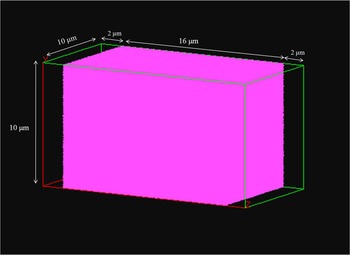
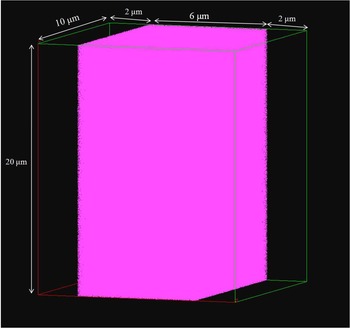
0 is 3.3 fs. The simulations have been done for three different cases. In the first case, the laser is incident normally (θ = 0°) on the target along Z direction. A simulation box of dimensions 10 µm × 10 µm × 20 µm consisting of 100 × 100 × 200 cells has been used. The overdense plasma slab is sharply edged and is located at a distance of 2 µm from the left boundary of the simulation box as shown in Figure 1. In the second case, the laser is incident obliquely at θ = 30° on the target. In the third case, the incident angle is changed to θ = 60°. In the last two cases, a simulation box of dimensions 10 µm × 20 µm × 10 µm consisting of 100 × 200 × 100 cells has been used as shown in Figure 2 and YZ is the plane of incidence. Absorbing boundary conditions have been incorporated along all the three dimensions. The simulations are done with 25 macroparticles per cell. The ions considered in this simulation are protons with mass m
i = 1836 m
e and Z = 1. The plasma is initially assumed to be cold with T
e = T
i = 0.
The 3D-PIC geometry of the simulation box when the laser is incident normally (θ = 0°) on the target.

The 3D-PIC geometry of the simulation box when the laser is incident obliquely (θ = 30°, 60°) on the target.

3. RESULTS AND DISCUSSION
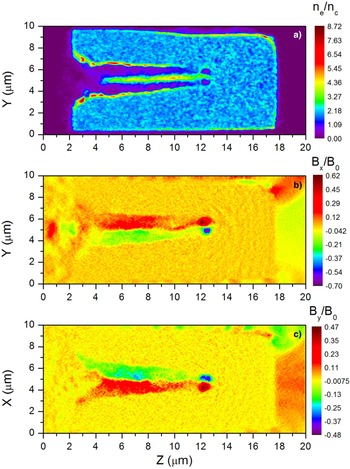
In the first case, when the laser is incident normally (θ = 0°) on the target, a strong current-carrying filament is formed, which can be observed clearly from Figure 3a, that represents the electron density distribution at time 107.72 T
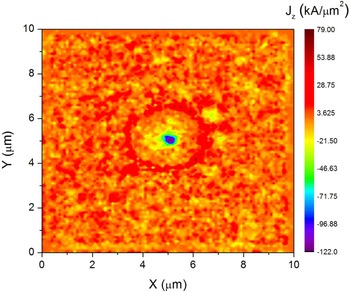
0. The formation of magnetic channels across this current-carrying filament is observed in Figure 3b and 3c, which displays the magnetic field generated along X and Y directions. A large magnetic field of the order of ≈400 MG is generated along X and that of the order of ≈200 MG is generated along Y. The current filament formed at the center of the XY plane carrying current in the forward direction and the return cold currents are shown in Figure 4. Tatarakis et al. (Reference Tatarakis, Gopal, Watts, Beg, Dangor, Krushelnick, Wagner, Norreys, Clark, Zepf and Evans2002) have reported the generation of magnetic fields of peak amplitudes >340 MG and below 460 MG during the interaction of a short pulse (0.7–1 ps) ultrahigh intensity (>1019 W cm−2) laser–solid target interaction. The laser intensity and the amplitudes of magnetic fields generated in our simulations are quite analogous with their experimental observations. The magnetic channels that are formed spread over a region of a few micrometers in the plasma, which is similar to the magnetic channel structural scale length as observed by Sentoku et al. (Reference Sentoku, Mima, Sheng, Kaw, Nishihara and Nishikawa2002) in their 3D-PIC simulations. Since we have n
e<γn
c where
 ${ {\rm \gamma}} = \sqrt {1 + a_0^2} $
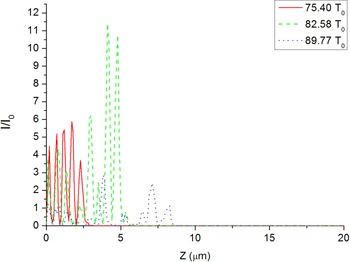
is the relativistic Lorentz factor, the laser pulse may penetrate into the overdense plasma slab due to relativistically induced transparency effects (Akhiezer & Polovin, Reference Akhiezer and Polovin1956; Kaw & Dawson, Reference Kaw and Dawson1970; Max & Perkins, Reference Max and Perkins1971). As the laser pulse penetrates the overdense plasma, it gets focused at a very short distance of ≈2 µm, and the axial intensity of the laser rises up to ≈11 times the fundamental laser intensity. Beyond this length, the central current filament causes the filamentation of the laser pulse and the intensity decreases on further penetration into the plasma as shown in Figure 5. Such kind of laser pulse focusing and formation of micron-sized magnetic channels were also observed in 3D-PIC simulations reported by Naumova et al. (Reference Naumova, Bulanov, Nishihara, Esirpekov and Pegoraro2002) in case of underdense but near-critical plasma. However, in our case, we have observed stronger filamentation of the laser pulse for a bit higher timescale as the plasma is overdense.
(a) Electron density distribution in the central YZ-plane (X = 5 µm). Magnetic field generated along (b) X-direction B x in the central YZ-plane (X = 5 µm), (c) Y-direction B y in the central XZ-plane (Y = 5 µm) at time 107.72 T 0 for θ = 0°. The electron density n e is normalized by the critical density n c = 1.12 × 1021 cm−3. The magnetic field B x is normalized by the laser magnetic field B 0.

Current density distribution along Z-direction J z (kA/μm2) in the XY-plane (Z = 6 µm) at time 107.72 T 0 for θ = 0°.

Axial intensity I versus Z (μm) for θ = 0° at times 75.40 T 0 (red solid), 82.58 T 0 (green dashed) and 89.77 T 0 (blue dotted). The intensity is normalized by the fundamental laser intensity I 0.

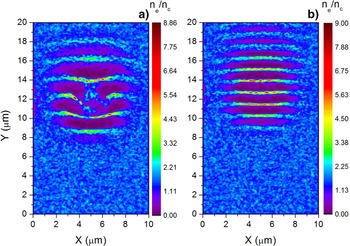
In the second and third cases, where the laser pulse is incident obliquely on the target, the formation of density channels can be clearly observed in Figure 6a and 6b, which depicts the electron density distribution at the plasma surface (Z = 2 µm) at time 75.40 T
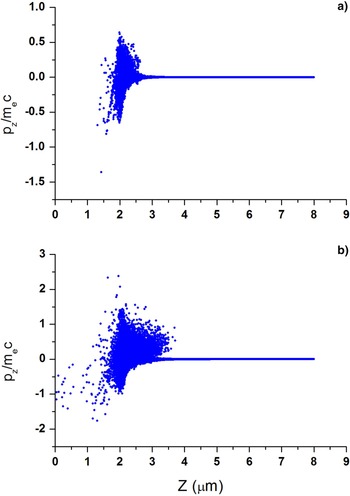
0 at θ = 30° and θ = 60°, respectively. These density ripple-like structures are formed due to vacuum heating. Since we have used a p-polarized laser, it is much favourable for vacuum heating. The laser electric field drags the electrons out of the plasma surface and as the electric field reverses its direction at later times, the electrons go back into the plasma again, which results in an efficient heating of electrons. Figure 7 shows the electron momentum phase space (p
z
/m
e
c vs. Z) for θ = 60° at different times. The laser electric field drags the electrons out of the plasma surface at time 64.63 T
0 as shown in Figure 7a. The electrons gain more momentum in the vacuum at a later time 68.22 T
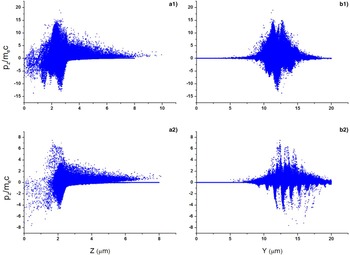
0 as shown in Figure 7b. Thus, the electrons at the plasma surface start gaining energy due to vacuum heating. Figure 8a1 and 8a2 represents the electron momentum phase space (p
z
/m
e
c vs. Z) at θ = 30° and 60°, respectively, at time 75.40 T
0. It can be observed that electrons are dragged out of the plasma surface at Z = 2 µm and sent back with almost equal momenta. Vacuum heating would be more effective for higher angle of incidences as the laser electric field component normal to the plasma surface becomes stronger with the increase in angle of incidence. Hence, the density ripples are observed to be much more prominent for θ = 60° as compared with that for θ = 30°. However, at θ = 30°, electrons gain more momentum as the laser is absorbed more efficiently due to
 $\vec J \times \vec B$
absorption. The inter spacing distance between these density ripples is almost equal to the laser wavelength (λ = 1 μm) in case of θ = 60°. At θ = 30°, the periodicity in the structures start getting deteriorated as
 $\vec J \times \vec B$
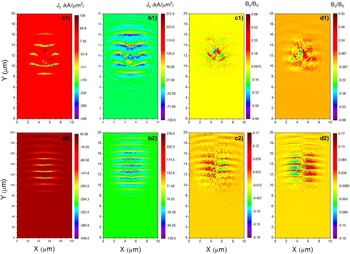
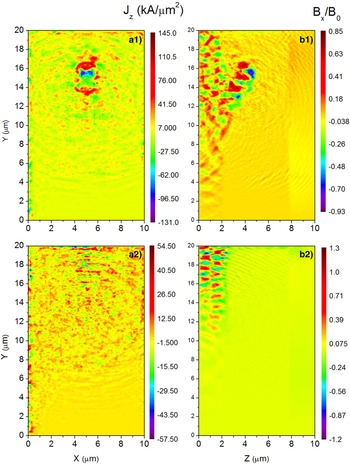
force starts dominating the electron heating process on reducing the angle of incidence. These periodic structures or density ripples carry forward and return currents that are responsible for the formation of magnetic channels across these ripples. The current density and magnetic fields generated across these ripples along Y and Z directions are plotted in Figure 9. Magnetic fields of the order of ≈400 and ≈100 MG are generated across these ripples at θ = 30° and 60°, respectively. Figure 8b1 and 8b2 represents the electron momentum phase space (p
z
/m
e
c vs. Y) at θ = 30° and 60°, respectively, at time 75.40 T
0. It can be observed that electron jets are emitted from the plasma surface more prominently in a periodic pattern at θ = 60°. This periodic emission of electron jets causes the formation of density ripples. Sentoku et al. (Reference Sentoku, Ruhl, Mima, Kodama, Tanaka and Kishimoto1999) have shown that high-energetic electron jets are emitted when the laser is obliquely incident on the target and multimegagauss magnetic fields are generated around these electron jets. These magnetic fields are generated in the coronal underdense plasma, which is put in front of the critical surface. However, in our case, we have a sharply edged boundary between vacuum and the overdense plasma. Here, though we have considered the overdense plasma target of low density (3.14 n
c), such kind of density ripples can also be observed for relatively high-density targets on using a laser pulse of higher intensity. When the laser is incident at an angle θ = 30°, the laser penetrates up to some distance inside the plasma due to strong
 $\vec J \times \vec B$
force and a part of it gets reflected as shown in Figure 10. However, at θ = 60°, as the
 $\vec J \times \vec B$
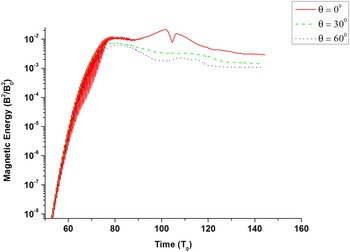
force is relatively weaker, the penetration in plasma is much less and the laser pulse as a whole almost gets reflected and propagates almost parallel to the surface through vacuum. Thus, the current density is found to be more at θ = 30°. Figure 11 depicts the saturation of magnetic energy with time. The magnetic energy increases very sharply up to ≈75.40 T
0 and then gets saturated. However, the magnetic energy decreases with an increase in angle of incidence. The formation of strong current carrying filaments decreases as the angle of incidence is increased. Since, a strong current-carrying filament is formed when the laser is incident normally (θ = 0°) on the plasma slab, the magnetic energy is highest in case of normal incidence.
Electron density distribution in the XY-plane at the plasma surface (Z = 2 µm) for (a) θ = 30° and (b) θ = 60° at time 75.40 T 0. The electron density n e is normalized by the critical density n c = 1.12 × 1021 cm−3.

Electron phase space p z /m e c versus Z (μm) for θ = 60° at time (a) 64.63 T 0 and (b) 68.22 T 0.

Electron phase space p z /m e c versus Z (μm) for (a1) θ = 30°, (a2) θ = 60°, and electron phase space p z /m e c versus Y (μm) for (b1) θ = 30°, (b2) θ = 60° at time 75.40 T 0.

Current density along (a1 and a2) Y-direction J y (kA/μm2), (b1 and b2) Z-direction J z (kA/μm2) for θ = 30° and 60°, respectively, and magnetic field along (c1 and c2) Y-direction B y , (d1 and d2) Z-direction B z for θ = 30° and 60°, respectively, at time 75.40 T 0 at the plasma surface (Z = 2 µm) in the XY-plane. The magnetic fields B y and B z are normalized by the laser magnetic field B 0.

Current density along (a1 and a2) Z-direction J z (kA/μm2) in the XY-plane at Z = 4 µm for θ = 30° and 60°, respectively, and magnetic field along (b1 and b2) X-direction B x in the central YZ-plane (X = 5 µm) for θ = 30° and 60°, respectively, at time 89.77 T 0. The magnetic field B x is normalized by the laser magnetic field B 0.

Normalized magnetic energy (
 $B^2 /B_0^2 $
) versus time (T
0) for θ = 0° (red solid), θ = 30° (green dashed), and θ = 60° (blue dotted).

4. Conclusion
The role played by the angle of incidence of a short pulse linearly polarized laser in the formation of periodic magnetic field structures in overdense plasmas has been investigated with the help of 3D-PIC simulations. The simulations have been done for different angles of incidence θ = 0°, 30°, and 60°. The conclusions drawn from the above discussions can be summarized as follows :
-
(i) Huge magnetic fields of the order of ≈400 MG are generated when the laser is incident normally on the target. The laser pulse gets focused up to a very short length of 2 µm inside the target and the axial intensity rises up to a maximum of ≈11 times the fundamental laser intensity.
-
(ii) At θ = 30°, the laser pulse penetrates up to some distance inside the plasma and a part of it gets reflected, whereas at θ = 60°, the penetration in plasma is much less and the laser pulse as a whole gets reflected and propagates almost parallel to the surface through vacuum.
-
(iii) Periodic density ripple-like structures are formed due to emission of energetic electron jets from the plasma surface, which may be due to vacuum heating. These ripples carry forward and return currents that are responsible for the formation of periodic magnetic field structures on the plasma surface.
-
(iv) The formation of density ripples are found to be more prominent at θ = 60° due to efficient vacuum heating, and the inter spacing distance coincides with the laser wavelength (λ = 1 μm).
ACKNOWLEDGMENTS
The authors are thankful to the Board of Research in Nuclear Sciences (BRNS), Department of Atomic Energy (DAE), Government of India for providing the financial support via Project No. 2012/34/61/BRNS.