Monogamy (i.e., romantic and sexual exclusivity) is a standard adopted early in committed relationships (Conley, Moors, Matsick, & Ziegler, Reference Conley, Moors, Matsick and Ziegler2013; Treas & Giesen, Reference Treas and Giesen2000; Watkins & Boon, Reference Watkins and Boon2015). Interviews with the newly married overwhelmingly indicate that they expect that they and their partner will remain monogamous (Campbell, Wright, & Flores, Reference Campbell, Wright and Flores2012). All industrialised countries report similar attitudes in this regard (Wellings et al., Reference Wellings, Collumbien, Slaymaker, Singh, Hodges, Patel and Bajos2006). Despite strong endorsement of monogamy and renouncement of infidelity (i.e., a violation of a couple's agreement to be exclusive; Glass, Reference Glass, Gurman and Jacobson2002), infidelity is common among those who are married (20%; Blow & Harnett, Reference Blow and Hartnett2005) or in dating or cohabiting relationships (up to 70%; Mark, Janssen, & Milhausen, Reference Mark, Janssen and Milhausen2011; Wiederman & Hurd, Reference Wiederman and Hurd1999). Infidelity is contingent upon availability of, attention to, attraction to, and response from an alternative partner. However, limited research attention has been given to targeted attraction to another (i.e., crushes) among adults or the role of crushes as a potential stepping stone to infidelity.
A crush has been defined as a unilateral romantic and/or sexual attraction toward another (Mullinax, Barnhart, Mark, & Herbenick, Reference Mullinax, Barnhart, Mark and Herbenick2016; Oettingen & Mayer, Reference Oettingen and Mayer2002). However, one's attraction might be reciprocated and still constitute a crush. Therefore, we modified the definition here to include attraction to someone with whom you are not currently involved, which is not explicitly required to be unilateral in nature. Furthermore, your attraction to this person is not necessarily communicated to them. Research has focused primarily on experiences of crushes during adolescence as reported by young adults and adolescents themselves. Very little is known about crushes at all, but especially for all other age groups. In a study of young adults (ages 18 to 21), most (75%) retrospectively reported having had a crush on a same-age, opposite-sex peer who was a casual acquaintance in their adolescent years, whereas fewer (17%) developed a crush on a close friend (Oettingen & Mayer, Reference Oettingen and Mayer2002). Bowker and colleagues (Reference Bowker, Spencer, Thomas and Gyoerkoe2012) examined crushes among adolescents (11–14 years) using peer nomination. Participants were asked to provide the name of someone who they had a crush on (no definition was provided). Most (56%) of their sample had at least one crush at the time of the study, and girls were more likely than boys to report having a crush. When asked to provide the names of people who were other-sex friends, crushes, or romantic partners, there were more crushes nominated than there were other-sex friendship or romantic relationship nominations. There was very little overlap in those who were named as a crush versus a romantic partner (Bowker, Spencer, Thomas, & Guoerkoe, Reference Bowker, Spencer, Thomas and Gyoerkoe2012). A study of adolescent girls (12–14 years) found that 94% reported having a crush (Hearn, O'Sullivan, & Dudley, Reference Hearn, O'Sullivan and Dudley2003), suggesting that crushes are common in adolescence. Adolescents and young adults start becoming preoccupied with romantic connection at this point in development (Dhariwal, Connolly, Paciello, & Caprara, Reference Dhariwal, Connolly, Paciello and Caprara2009), and establishing romantic relationships is viewed as a key part of development (Arnett, Reference Arnett2000, Reference Arnett2004). Although researchers have yet to study the function of crushes in adolescence, it can be assumed that crushes are some of the initial building blocks to the acquisition of skills and comfort in romantic relationships.
Given that attraction is a precursor to romantic involvement for many (Sprecher & Duck, Reference Sprecher and Duck1994), it can be assumed that crushes exist as a precursor to romantic involvement across the lifespan (Mullinax et al., Reference Mullinax, Barnhart, Mark and Herbenick2016). Yet, there has been limited study of crushes in adulthood for those who are single or already partnered. One exception is a recent study that examined experiences of crushes within the context of adults’ romantic relationships, that is, when an individual experiences a crush on someone other than their romantic partner (Mullinax et al., Reference Mullinax, Barnhart, Mark and Herbenick2016). Among the 160 women surveyed, 70% reported having had a crush on someone other than their partner at some point during their established relationship (52% had been in a relationship for 5–10 years). The women provided qualitative responses to questions about their crush, how they managed their crush, whether their crush affected their desire for their partner, and disclosure of their crush to their partner. These responses revealed that targets of crushes were more often cited as being physically attractive than emotionally and/or intellectually attractive. Women managed their feelings for their crush in a wide variety of ways, ranging from talking and thinking about their crushes to attempts to suppress thoughts about their crushes. Very few women responded in a way that indicated that having a crush affected their desire for their partner, although some reported increases in desire, whereas others reported decreases. The majority of women (80%) stated that they had not disclosed their crush to their partner and provided reasons such as not wanting to hurt or upset their partner, given there was no intention of acting upon these feelings.
Comparable research with men is not available. Moreover, no study to our knowledge has examined comprehensively how crushes affect the quality of romantic relationships when the individual with a crush is within an established romantic relationship. It may be that crushes are an extension of attention to attractive alternatives that pose similar risks to the quality of one's primary relationship, or it may be that crushes are relatively benign, a form of sexual or romantic fantasy that is not associated with poorer relationship quality.
Crushes as a Form of Attention to Attractive Others
Researchers have examined predictors of attraction to other partners in terms of sexual, romantic, and online infidelity (Allen et al., Reference Allen, Atkins, Baucom, Snyder, Gordon and Glass2005; Martins et al., Reference Martins, Pereira, Andrade, Dattilio, Narciso and Canavarro2016; Negash, Veldorale-Brogan, Kimber, & Fincham, Reference Negash, Veldorale-Brogan, Kimber and Fincham2016; Thompson & O'Sullivan, Reference Thompson and O'Sullivan2016), the heightened attractiveness toward those in relationships versus those who are single (‘the wedding ring effect’; O'Sullivan & Vannier, Reference O'Sullivan and Vannier2013; Uller & Johansson, Reference Uller and Johansson2003), traits and relationship quality associated with mate poaching alternative partners (Belu & O'Sullivan, Reference Belu and O'Sullivan2018; Foster et al., Reference Foster, Jonason, Shrira, Campbell, Shiverdecker and Varner2014; Schmitt & Buss, Reference Schmitt and Buss2001; Schmitt & International Sexuality Description Project, Reference Schmitt2004), as well as links between attention to others and relationship quality (Miller, Reference Miller1997, Reference Miller, Forgas and Fitness2008). There is also a small body of research on directing one's attention away from attractive alternatives (Maner, Gailliot, & Miller, Reference Maner, Gailliot and Miller2009; Maner, Rouby, & Gonzaga, Reference Maner, Rouby and Gonzaga2008; Miller, Reference Miller1997) and derogating the value of attractive others (Johnson & Rusbult, Reference Johnson and Rusbult1989; Lydon, Meana, Sepinwall, Richards, & Mayman, Reference Lydon, Meana, Sepinwall, Richards and Mayman1999; Simpson, Gangestad, & Lerma, Reference Simpson, Gangestad and Lerma1990).
Individuals who are highly committed to their relationships tend to derogate attractive alternatives, especially when the alternative represents a threat to the stability of one's relationship (Johnson & Rusbult, Reference Johnson and Rusbult1989), and they tend to rate potential alternatives as less attractive than their single counterparts (O'Sullivan & Vannier, Reference O'Sullivan and Vannier2013). Higher levels of attention to alternatives are linked to poorer relationship quality and notably to lower relationship satisfaction (Miller, Reference Miller1997, Reference Miller, Forgas and Fitness2008). Higher attention to alternatives is also linked to infidelity (Foster et al., Reference Foster, Jonason, Shrira, Campbell, Shiverdecker and Varner2014; McNulty, Meltzer, Makhanova, & Maner, Reference McNulty, Meltzer, Makhanova and Maner2018). McNulty and colleagues (Reference McNulty, Meltzer, Makhanova and Maner2018) demonstrated that those who were able to divert their attention more quickly from a photo of an attractive alternative and those who rated the alternative as less attractive (than did their counterparts) had decreased odds of engaging in infidelity.
Missing from the literature on research addressing attention to attractive others is whether having a crush makes an individual vulnerable to engaging in infidelity. Specifically, it is unclear whether having a crush on another individual while in an established relationship (i.e., attraction to others) is associated with higher rates of infidelity or is indicative of poorer quality of one's primary relationship (a risk factor for infidelity). Although there is a link between higher levels of attention to alternatives and poorer relationship quality and infidelity, it is unclear whether these associations are found with regard to having a crush.
Attraction that is not communicated to the target or is not believed to be reciprocated in some way might render a crush relatively harmless. However, those who report greater attraction to their crush, anticipate connecting romantically or sexually with the target of their crush at some point, or indicate that they would accept the opportunity to leave their partner for their crush should the opportunity arise, might be more inclined to engage in infidelity while participating in their primary relationship.
Predictors of Crush Experiences and Appeal of an Alternative
It is important to examine links between experiences of crushes while in an established relationship and relationship quality (i.e., how positively or negatively one feels about his or her relationship; Morry, Reich, & Keito, Reference Morry, Reich and Keito2010). It is also relevant to assess links to reports of infidelity because these outcomes can have a dramatic impact on current and future relationship functioning. Infidelity is linked to significant personal and interpersonal distress (for an overview, see Fincham & May, Reference Fincham and May2017). Although not a focus of past research, willingness to leave one's partner for a crush might be relevant for understanding links to relationship quality, especially stability, than simply whether one has a crush. High quality relationships are associated with higher levels of wellbeing concurrently and across time (Chapman & Guven, Reference Chapman and Guven2016; Proulx, Helms, & Buehler, Reference Proulx, Helms and Buehler2007). Identifying factors relating to negative outcomes (poor relationship quality or infidelity) can inform prevention and intervention efforts aimed at enhancing relationship functioning, particularly among those experiencing distress. In this study, we focused on identifying the extent to which individual characteristics (e.g., attention to alternatives, sociosexual orientation, avoidant attachment) and relationship factors (e.g., relationship and sexual satisfaction, commitment, and intimacy) are associated with crush experiences and appeal of an alternative (e.g., degree of attraction, frequency of sexual fantasy about the alternative, willingness to abandon one's relationship for the alternative).
None of these variables under investigation have been examined with regard to crush experiences or crush appeal. However, they have been linked to infidelity. Individuals with permissive sociosexual orientation (Barta & Kiene, Reference Barta and Kiene2005) and avoidant attachment styles (i.e., discomfort with closeness and intimacy; DeWall et al., Reference DeWall, Lambert, Slotter, Pond, Deckman, Finkel and Fincham2011; Mikulincer & Shaver, Reference Mikulincer, Shaver and Zanna2003) have higher rates of infidelity. Infidelity is also linked to lower relationship satisfaction and commitment (Drigotas, Safstrom, & Gentilia, Reference Drigotas, Safstrom and Gentilia1999; Previti & Amato, Reference Previti and Amato2004). Relationship satisfaction refers to how positively an individual feels about his or her relationship, as well as the degree to which the relationship meets an individual's expectations (Rusbult, Reference Rusbult1980, Reference Rusbult1983). It is associated with relationship commitment (Impett, Beals, & Peplau, Reference Impett, Beals and Peplau2001) and sexual satisfaction (Byers, Reference Byers2005; Santtila et al., Reference Santtila, Wager, Witting, Harlaar, Jern, Johansson and Sandnabba2007; Sprecher, Reference Sprecher2002), and contributes significantly to relationship longevity (Rusbult, Reference Rusbult1980, Reference Rusbult1983). Relationship dissatisfaction also is linked to infidelity (Previti & Amato, Reference Previti and Amato2004). High sexual satisfaction within one's relationship is positively associated with relationship quality and stability (Sprecher, Reference Sprecher2002; Sprecher & Cate, Reference Sprecher, Cate, Harvey, Wenzel and Sprecher2004).
Commitment (i.e., the long-term orientation to the relationship and intention to remain in the relationship; Rusbult, Reference Rusbult1980, Reference Rusbult1983) is associated with high quality marital relationships (Clements & Swensen, Reference Clements and Swensen2000) and stability (Impett et al., Reference Impett, Beals and Peplau2001; Le & Agnew, Reference Le and Agnew2003). Those with lower commitment have higher rates of infidelity (Drigotas et al., Reference Drigotas, Safstrom and Gentilia1999; Le, Dove, Agnew, Korn, & Mutso, Reference Le, Dove, Agnew, Korn and Mutso2010; Maddox Shaw, Rhoades, Allen, Stanley, & Markham, Reference Maddox Shaw, Rhoades, Allen, Stanley and Markman2013). Intimacy, which is the sense of closeness with one's partner (Miller & Lefcourt, Reference Miller and Lefcourt1982; Yoo, Bartle-Haring, Day, & Gangamma, Reference Yoo, Bartle-Haring, Day and Gangamma2014), is linked to marital satisfaction (Greeff, Hildegarde, & Malherbe, Reference Greeff, Hildegarde and Malherbe2001; Schaefer & Olson, Reference Schaefer and Olson1981; Tolstedt & Stokes, Reference Tolstedt and Stokes1983) and relationship satisfaction over time (Dandeneau & Johnson, Reference Dandeneau and Johnson1994).
In this study, we focused on identifying the extent to which these individual characteristics (i.e., attention to alternatives, more permissive sociosexual orientation, avoidant attachment) and relationship quality (i.e., commitment, relationship satisfaction, sexual satisfaction, intimacy) are associated with reports of crushes for adults in an established relationship, as well as reports of infidelity since the onset of the relationship.
Study Aims
The first goal of the current research (pilot) was to establish a preliminary estimate of how common crushes are among adult men and women who are currently in a romantic relationship (RQ1). The second goal was to identify features of crush experiences and the respondent traits and relationship characteristics associated with reports of a crush (RQ2). The third goal was to identify how crushes were associated with infidelity (RQ3). We hypothesised that:
H1:
Significantly more women than men would report experiencing a crush (pilot).
We predicted that:
H2:
Individual characteristics (attention to alternatives, permissive sociosexual orientation, avoidant attachment) would be positively associated with reports of a crush and with crush appeal.
H3:
Relationship quality (relationship and sexual satisfaction, commitment, and intimacy) would be negatively associated with reports of a crush and with crush appeal.
H4:
Those who reported a crush (vs. not) and greater crush appeal would be more likely to report infidelity in their current relationship.
Pilot Study
The primary purpose of the pilot study was to assess an estimate of the prevalence of crushes among adult men and women in romantic relationships (to ensure that they are sufficiently common) and to assess for any gender differences that may exist.
Method
Adult participants in romantic relationships were recruited to complete an anonymous online survey that assessed the prevalence of crushes at the time of the study.
Participants and Procedure
One hundred and seventy-six Canadian adults (18–54, M age = 23.1, SD = 6.86, 75% women) in romantic relationships completed measures assessing crush prevalence. Participants were recruited via introductory psychology classes at a Canadian university, as well as through online recruitment using social media sites (e.g., Facebook). All were compensated with participation credits (for their class) or by entry into a draw for a $10 gift card. Pilot study procedures were approved by our institution's ethics review board. In terms of identities, most participants reported being White (77.8%), followed by Chinese (6.3%), Indigenous (5.7%), Black (2.8%), or other (7.4%). Most identified as heterosexual (79.5%) and the remainder identified as bisexual (9.1%), lesbian (2.3%), gay (1.7%), or other (7.4%).
Measures
Participants were provided the following definition of a crush based on consultation with the literature (Hurlock & Klein, Reference Hurlock and Klein1934; Mullinax et al., Reference Mullinax, Barnhart, Mark and Herbenick2016): ‘A crush is an attraction to someone with whom you are not romantically or sexually involved. You may have a crush on someone well known to you or someone you have never even talked to. This person may know you find him or her attractive or he or she may have no idea that you do. When you have a crush on someone, you have feelings for, may have flirted with, but have not yet (and may never) attempt to connect with that person romantically or sexually.’ Participants then were asked whether they currently had a crush (no/yes) or ever had a crush (no/yes) while in their current romantic relationships. Relationship status was asked using the following question: ‘What is your current relationship status?’ (dating, one person exclusively; dating, more than one person; in a committed relationship [i.e., living together, engaged, married] with one person exclusively; in a committed relationship [i.e., living together, engaged, married], but also in a relationship with someone else; open relationship; other: please specify).
Results
To address RQ1, over one-quarter (28.1%) reported currently having a crush and almost half (47.3%) of participants reported ever having a crush on someone while in their current relationship, suggesting that crushes are a relatively common experience within a romantic relationship. A Chi-square analysis was used to compare participants who had a crush on someone while in a relationship (n = 48) to those who did not (n = 123). Contrary to H1, there were no significant differences in crush estimates by gender, χ2(1, N = 171) = 1.25, p = .54.
MAJOR STUDY
Method
Participants
Two hundred and forty-seven U.S. adults aged 25–45 (43.3% women, M age = 32.8, SD = 5.22) were recruited via Mechanical Turk® (Mturk®), a crowdsourcing website that allows workers to select small online tasks for pay. Participants were required to be in a romantic relationship at the time of the survey. The majority of participants identified as White (75.1%); the remainder identified as Black (8.6%), Hispanic/Latin (5.3%), biracial/multiracial (4.9%), and other (6.1%). Most participants identified as heterosexual (87%), and a minority of participants identified as bisexual (8.9%), gay (1.6%), lesbian (1.2%) or other (1.3%).
Procedure
Residents of the United States aged 25 to 45 who were in a romantic relationship at the time of the study were eligible to complete the study. Participants were recruited via Mturk® and were asked to complete an anonymous online survey regarding their current romantic relationship. Those who were interested in participating were required to complete a screening questionnaire to ensure that eligibility requirements were met. Participants were provided with a few items (e.g., relationship status, relationship duration) to respond to, some of which were fillers in order to disguise which criteria permitted entrance into the study. To ensure a sufficient sample of participants currently had a crush while in their romantic relationship, a question broadly screened for those with crushes in particular: ‘Are you currently attracted to someone other than your romantic partner, but you have not connected with them romantically or sexually?’ We first screened for these participants to ensure we had a sufficient number (based on power analyses) who had a crush (n = 102) and then removed the screening criteria once the minimum quota was met. Eligible participants were directed toward the consent form, and after reviewing information about the study, participants were required to select a link to indicate their consent and continue to the survey. Once completed, participants were debriefed then compensated monetarily ($1 USD) for their participation in the study. All study procedures were approved in full by our institution's ethics review board.
Measures
Background questionnaire
An experimenter-derived questionnaire was used to obtain demographic information, including gender (male, female, transgender male, transgender female), race/ethnicity, and sexual identity (i.e., heterosexual, lesbian, gay, bisexual, asexual, questioning, don't know, no labels preferred, other), age, and ethnic identity.
Characteristics of the romantic relationship
An experimenter-derived measure was used to assess relationship characteristics. Participants provided information pertaining to their current relationship, including relationship status (e.g., dating one person exclusively, dating more than one person, in a committed relationship with one person exclusively [i.e., living together, engaged, married], in a committed relationship but also in a relationship with someone else, open relationship), duration of relationship (in months), and partner gender (male, female, transgender male, transgender female). Participants were asked whether they had an agreement of romantic and/or sexual exclusivity with their partner (no/yes).
Infidelity
Participants were provided with the following definition: ‘Despite having some type of agreement or understanding with their partner, many people develop some kind of sexual or romantic involvement at some level (ranging from a brief one-time encounter to a long-term relationship) with another person. Romantic involvement means any kind of close affection or intimate connection, and sexual involvement means any kind of physically arousing contact (i.e., kissing, oral sex, intercourse).’ Participant infidelity was assessed by asking the following questions: ‘I have been sexually involved with at least one other person (other than my romantic partner) during my relationship with my current primary partner’ and ‘I have been romantically involved with at least one other person (other than my romantic partner) during my relationship with my current primary partner’ (no/yes/unsure). Only those who reported ‘yes’ to having an exclusivity agreement and ‘yes’ to romantic or sexual involvement were coded as having engaged in infidelity. These items were used successfully in past studies to assess infidelity (Belu & Sullivan, Reference Belu and O'Sullivan2018; Thompson & O'Sullivan, Reference Thompson and O'Sullivan2016).
Features of crush experiences
An experimenter-derived measure was used to assess whether (a) participants had a past or current crush on someone who was not their primary partner (i.e., crush status) and (b) characteristics of the crush experience regarding one's primary crush. Participants were provided with the same definition of a crush as used in the pilot and then were asked whether they ever had had a crush while in their current romantic relationship (no/yes), whether they currently had a crush (no/yes), and if so, the number of crushes they had experienced while in their current relationship. Those with a current crush provided information pertaining to their primary crush (defined as the crush they were most attracted to), including the duration of their crush (in months), how they met (i.e., work, school, friend of a friend, partner's sibling, partner's family member, ex-partner, online, other), and their defined relationship with their crush (i.e., strangers, acquaintances, casual friends, online friends, close friends, best friends, friends with benefits, past romantic partner, other). Participants were also asked whether they wished they could have sex with his or her crush (no/yes) and whether they would have sex with his or her crush if their partner would never find out (no/yes).
Crush appeal
The appeal of one's current primary crush was measured using the following items. First, participants were asked to rate crush appeal by reporting how physically and emotionally attractive his or her primary crush was on a Likert-type scale ranging from 1 (very unattractive) to 7 (very attractive). To assess the sexual desire associated with the crush, participants were then asked, ‘How often do you have sexual fantasies involving your crush?’ Possible responses ranged from 1 (never) to 9 (at least once a day) with a midpoint at 5 (once every two weeks). Appeal was also measured by the following question: ‘If provided with the opportunity, would you leave your current partner for your crush?’ (no/yes) and ‘How likely is this opportunity to arise?’ ranging from 1 (very unlikely) to 7 (very likely).
Attention to relationship alternatives
The Attention to Alternatives Scale (Miller, Reference Miller1997) measures the degree to which individuals notice, and pay attention to, attractive alternative relationship partners. Examples of items include ‘I am aware that there are plenty more “fish” in the sea’ and ‘I rarely notice other good-looking or attractive people’ (reverse scored). Responses range from 1 (never) to 9 (always), and are averaged, with higher scores indicating greater attention to alternative relationships. The authors provide strong support for the measure's psychometric properties (Miller, Reference Miller1997). In the current study, the internal consistency was acceptable (α = .71).
Sociosexual orientation:
The Sociosexual Orientation Index Revised (SOI-R; Penke & Asendorpf, Reference Penke and Asendorpf2008) is a nine-item scale that assesses one's orientation toward sex outside of committed relationships. The scale comprises three subscales (attitudes toward uncommitted sex, sociosexual desire, and past behaviour). Each subscale is measured by three items with responses that can range from either 1 (zero) to 9 (twenty or more), 1 (strongly disagree) to 9 (strongly agree) or 1 (never) to 9 (at least once a day). Sample items include ‘How often do you have fantasies about having sex with someone you are not in a committed romantic relationship with?’ and ‘Sex without love is OK.’ Possible responses range from 1 to 81. Higher scores indicate a more permissive sociosexual orientation (i.e., greater willingness to engage in uncommitted sex). This scale has been shown to have strong reliability and validity (Penke & Asendorpf, Reference Penke and Asendorpf2008). In the current study, internal consistency was good (α = .84).
Attachment avoidance
Attachment avoidance was measured using six items from the Experiences in Close Relationships Scale Short Form (ECR-S; Wei, Russell, Mallinkrodt, & Vogel, Reference Wei, Russell, Mallinckrodt and Vogel2007). Participants were asked to respond to each item on a 7-point Likert scale ranging from 1 (strongly disagree) to 7 (strongly agree). An example of an attachment avoidance item is ‘I try to avoid getting too close to my partner.’ Scores can range from 6–42, and higher scores reflect higher levels of attachment avoidance. The scale developers provided evidence of strong reliability and validity (Wei et al., Reference Wei, Russell, Mallinckrodt and Vogel2007). In the current study, internal consistency was good (α = .84).
Relationship satisfaction
Relationship satisfaction was assessed using the Global Measure of Relationship Satisfaction (GMREL; Lawrance & Byers, Reference Lawrance and Byers1992). The GMREL is a self-report measure that requires individuals to evaluate positive and negative aspects of their current romantic relationship. Respondents are asked ‘In general, how would you describe your overall relationship with your romantic partner?’ to which they respond using five 7-point dimensions: Good-Bad, Pleasant-Unpleasant, Positive-Negative, Valuable-Worthless and Satisfying-Unsatisfying. Scores are summed (range = 5–35), with higher scores indicating greater relationship satisfaction in one's current relationship. Research has demonstrated strong levels of internal consistency and strong validity (Byers, Reference Byers2005; Byers & Demmons, Reference Byers and Demmons1999). The Cronbach's alpha in the current study was 0.94.
Sexual satisfaction
The Global Measure of Sexual Satisfaction (GMSEX; Lawrance & Byers, Reference Lawrance and Byers1995) assesses self-reported evaluations of the positive and negative aspects of, or satisfaction with, an individual's sexual relationship. Respondents are asked ‘In general, how would you describe your overall sexual relationship with your romantic partner?’ Possible responses fall on five 7-point dimensions: Good-Bad, Pleasant-Unpleasant, Positive-Negative, Valuable-Worthless and Satisfying-Unsatisfying. Higher summed scores (range = 5–35) reflect greater sexual satisfaction. The developers report strong reliability and validity for the GMSEX (Byers, Reference Byers2005; Byers & MacNeil, Reference Byers and MacNeil2006; Lawrance & Byers, Reference Lawrance and Byers1995). A Cronbach's alpha of .96 was obtained in the current study.
Relationship commitment
The commitment subscale of the Investment Model Scale (Rusbult, Martz, & Agnew, Reference Rusbult, Martz and Agnew1998) measures how oriented an individual is to the long-term endurance of his or her relationship through the use of seven items. Item examples include ‘I want our relationship to last a very long time’ and ‘It is likely that I will date someone other than my partner within the next year.’ Responses fall on a 9-point Likert scale ranging from 0 (do not agree at all) to 8 (agree completely). Higher averaged scores indicate greater commitment to one's current relationship. This scale has strong psychometric properties and has been used extensively in the study of intimate relationships (Rusbult et al., Reference Rusbult, Martz and Agnew1998). A Cronbach's alpha of .90 was obtained here.
Intimacy
The Miller Social Intimacy Scale (Miller & Lefcourt, Reference Miller and Lefcourt1982) measures the degree of intimacy an individual currently experiences with his or her partner. This 17-item scale consists of items such as ‘How close do you feel to your partner most of the time?’ and ‘How important is it to you that your partner be encouraging and supportive to you when you are unhappy?’ Respondents indicate agreement on a Likert scale ranging from 1 (not at all) to 10 (a great deal/a lot). Higher scores reflect greater levels of intimacy within the current relationship. This measure has good internal consistency, test–retest reliability and validity, as demonstrated by the authors (Miller & Lefcourt, Reference Miller and Lefcourt1982). A Cronbach's alpha of .94 was obtained for the current study.
Data Analysis
Two hundred and ninety-one participants completed the survey online. Forty-one of these responses were deleted for being duplicates as identified by their IP address and/or the use of the same Mturk® ID. Missing data (less than 2%) were replaced using mean substitution (Tabachnick & Fidell, Reference Tabachnick and Fidell2013). Preliminary assumption testing was conducted to check for normality, linearity, univariate and multivariate outliers, homogeneity of variance-covariance matrices and multicollinearity. There were no violations of assumptions; however, three multivariate outliers were deleted. We conducted power analyses with G*Power based on effect sizes found in relevant literature (Erdfelder, Faul, & Buchner, Reference Erdfelder, Faul and Buchner1996). A power analysis for a hierarchical linear regression with five predictors was conducted in G*Power to determine a sufficient sample size using an alpha of .05, power of 0.95, and a small effect size (f = 0.10; Faul, Erdfelder, Buchner, & Lang, Reference Faul, Erdfelder, Buchner and Lang2013; McNulty et al., Reference McNulty, Meltzer, Makhanova and Maner2018). Based on these assumptions, the desired sample size was 204 participants.
The final sample consisted of 247 participants (139 male, 108 female). Because of our selective screening, over half (n = 149; 60.6%) of our sample had a crush on someone other than their romantic partner at the time of the study. Estimates of how common crushes are among adults in romantic relationships were derived from the pilot preceding this study. Descriptive analyses were conducted to first assess characteristics of the sample and subgroups. Descriptive analyses also were used to assess characteristics of the established romantic relationship and crush experiences. Those who reported a crush on someone other than their romantic partner were compared to those in a relationship without a crush. We compared these two groups based on individual characteristics (attention to alternatives, sociosexual orientation, attachment avoidance) and relationship quality characteristics (relationship satisfaction, sexual satisfaction, commitment, intimacy) using binary logistic regression analyses. We also examined crush appeal in association with relationship quality using Pearson correlations. Chi-square analyses were used to examine differences between groups regarding reports of infidelity. We explored the possibility of gender acting as a moderator. Research has found that adolescent girls were more likely to have a crush than were boys (Bowker et al., Reference Bowker, Spencer, Thomas and Gyoerkoe2012), men reported higher attentiveness to alternatives than did women (Miller, Reference Miller1997), inclusive of longer gaze times of potential alternatives, and gender differentially affected ratings of attractive others based on history of short-term sexual partners or partner age (McNulty et al., Reference McNulty, Meltzer, Makhanova and Maner2018; Miller, Reference Miller1997). Our analyses including gender did not reveal that gender was a significant moderator of crush occurrence. However, we conducted some exploratory gender analyses of crush appeal and crush status predictors to assess for differences.
Results
Sample Characteristics
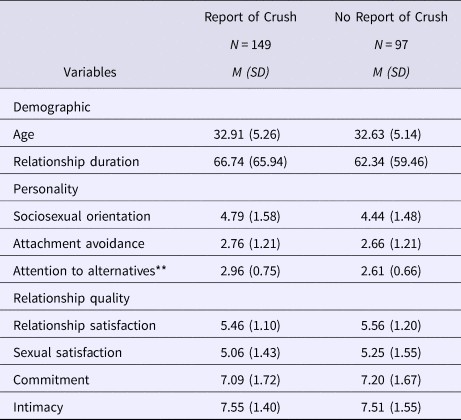
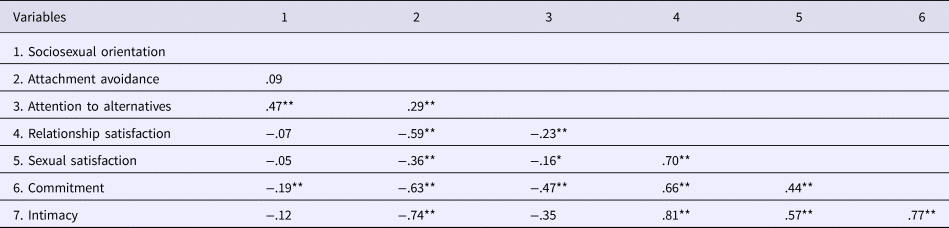
The means and standard deviations of the constructs used in this study are presented in Table 1 by group (crush vs. not). In terms of predictor variables, on average, participants reported that they experienced moderate levels of attention to relationship alternatives (M = 2.83, SD = 0.73), moderately permissive sociosexual orientation (M = 4.65, SD = 1.55), and moderately low levels of avoidant attachment (M = 2.72, SD = 1.21). They reported moderately high relationship (M = 5.50, SD = 1.13) and sexual satisfaction (M = 5.13, SD = 1.48), strong relationship commitment (M = 7.13, SD = 1.69) and high intimacy (M = 7.54, SD = 1.46). Inspection of zero-order correlations among the predictor variables revealed no problems with multicollinearity (see Table 2). As expected, the relationship quality variables were significantly correlated with each other as were most of the individual characteristics.
Demographic, Personality, and Relationship Quality for Those With and Without a Crush

Note: Analysis of variance were used to assess for differences in age and relationship duration. Personality differences were assessed via binary logistic regressions, and relationship quality by multivariate analysis of variance. **p < .01.
Correlations of Predictor Variables

Note: N = 247. **p < .01.
Relationship characteristics
Most participants were in a committed relationship with just one romantic partner (60.3%), and over a quarter (28.7%) stated that they were dating one person exclusively. A minority of participants reported being in a committed relationship with one person, but also seeing others (4.9%), dating more than one person (3.6%), or classified themselves as ‘other’ (2.5%). Participants were in relationships longer than five years on average (M = 64.8 months, SD = 63.3, range = 0.6–288 months). Analysis of variance between those with a crush and those without did not reveal any significant differences by age, F(1, 244) = 0.17, p = .68, or relationship duration, F(1, 242) = 0.28, p = .60, thus we did not control for these variables in the following analyses.
The majority (81.4%) of participants reported that they had a romantic and sexual exclusivity agreement with their current romantic partner. Few participants were unsure whether they had an exclusivity agreement (3.7%), and 13.9% of participants were certain that they did not have an exclusivity agreement. Of those with crushes, one-quarter (25%) of participants reported that they did have an understanding that neither they nor their partner was to have a crush on someone else during their relationship (yet did). More than half (57%) reported that they did not have this agreement, and 18% were unsure. The majority of participants (80%) reported that since the start of their current relationship, they had had at least one crush on someone other than their romantic partner (i.e., had ever had a crush). Most participants (77.7%) reported 1–3 crushes while in their current relationship, whereas a minority (15.7%) reported 4–6 crushes. The remainder (6.6%) had had a crush on more than six people.
Experience of Crushes Among Adults in Established Romantic Relationships
To address RQ2 regarding features of crushes, we found that more than half (60.6%; n = 139) of our sample reported that they had a crush on someone other than their partner at the time of the study. Of these, the majority (65.1%) had a crush on one person. One-quarter (23.5%) of participants reported having a crush on two people, and 5.4% reported having a crush on three people. The remaining 6% of participants had crushes on more than three people. Participants indicated that on average their crush had lasted for 18.11 months (SD = 32.0, range = 0.6–180 months).
Of the 139 participants who had a current crush, most identified the target of their primary crush as being an acquaintance (31.1%) or casual friend (30.4%). Fewer reported that they had a crush on a close friend (10.1%), stranger (7.4%), or online friend (6.8%). Four percent of the 139 participants reported a crush on a past romantic partner, and only one person (0.7%) reported a crush on a best friend. The remaining 9.5% labelled their relationship with their crush as ‘other’. Almost half (40.3%) of participants met their crush at work or their crush was a friend of a friend (28.2%). Others met their crushes online (12.8%), at school (5.4%), or their crush was a family member of their partner (2%). The remaining 11.4% stated that they met their crush in other ways, such as at a doctor's office, at a bus stop, in a yoga class, or shopping. Over half of the participants lived in the same city as their crush (56.5%).
One-third of those participants with a crush (34%) reported that they wished they could have sex with their current crush, and there was no gender difference in this regard, χ2(1, N = 149) = .843, p = .36. A minority of those with a crush currently (17.4%) indicated that they would have sex with their crush if they knew that their partner would never find out. The majority of those who would have sex with their crush were men (71%), χ2(1, N = 149) = 5.86, p = .015.
Crush Appeal
Crushes were reported to be highly physically attractive (M = 6.14, SD = 0.97) and emotionally attractive (M = 5.27, SD = 1.55). A multivariate analysis of variance (MANOVA) was conducted to assess for gender differences. Overall, the model was significant, F(1, 139) = 8.00, p = .001, Wilk's lambda = .90, ηp2 = .10, suggesting that men and women could be differentiated based on how attractive they reported their crushes to be. However, follow-up univariate analyses revealed that this gender difference was only significant for emotional attractiveness, F(1, 140) = 12.88, p < .001, ηp2 = .08. Women reported that their crush was significantly more emotionally attractive (M = 5.75, SD = 1.45) than did men (M = 4.85, SD = 1.53).
As a measure of sexual desire appeal for one's crush, participants were asked how often they sexually fantasised about their current crush. A small minority (2.8%) said never, 13.1% said seldom, 7.6% said once every 2–3 months, 9% reported once a month, 17.2% reported once every two weeks, 19.3% reported once a week, 16.6% reported several times a week, 6.9% reported nearly every day, and 7.6% stated at least once daily. An analysis of variance (ANOVA) revealed that men (M = 5.63, SD = 1.96) sexually fantasise about their crush significantly more often than women (M = 4.81, SD = 2.29), F(1, 142) = 5.27, p = .023, ηp2 = .04.
Few participants (17%) indicated that they would leave their partner for their crush if the opportunity arose; there were no gender differences in proportions reporting this, χ2(1, N = 145) = 1.02, p = .32. Participants were asked how likely it was that the opportunity to leave their partner for their crush would arise. On average, participants reported that this opportunity was unlikely (M = 3.48, SD = 2.00), and there were no reported differences between men and women.
Individual Characteristics of Participants Reporting a Crush
A binary logistic regression was performed to predict reports of current crush experiences from individual characteristics (avoidant attachment intensity, sociosexual orientation, attention to alternatives). The full model was significant, χ2(3, N = 247) = 14.84, p = .001, indicating that the model was able to distinguish between those who did and did not report a crush, consistent with H1. However, the model as a whole explained only between 5.9% (Cox and Snell R 2) and 7.9% (Nagelkerke R 2) of the variance of crush status, but correctly classified 60.2% of cases. Only attention to alternatives of the independent variables made a unique and statistically significant contribution to the model. The odds ratio of attention to alternatives was 2.08, indicating that for every one-unit increase in attention to alternatives, the odds of reporting a crush increased two-fold. This model did not differ based on gender.
Quality of Relationships and Crush Appeal
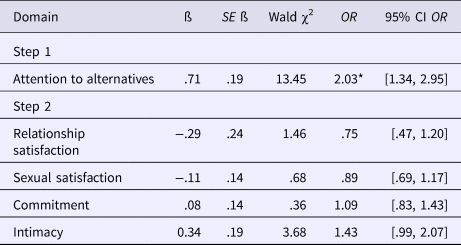
A hierarchical binary logistic regression was used to predict report of current crush experiences from relationship quality characteristics (relationship satisfaction, sexual satisfaction, commitment, intimacy), after controlling for the influence of relevant individual characteristics (attention to alternatives). Attention to alternatives was the only significant predictor from the previous logistic regression, and as such, it was entered at Step 1 and accounted for 5.7% (Cox and Snell R 2) and 7.9% (Nagelkerke R 2) of the variance, χ2(1, N = 247) = 14.54, p < .001. After entering relationship satisfaction, sexual satisfaction, commitment, and intimacy, the model was still significant, χ2(5, N = 247) = 22.03, p = .001, but only attention to alternatives remained significant (see Table 3). Thus, relationship quality characteristics were not able to predict reports of a crush experience above and beyond attention to alternatives, contrary to H2. See Table 3.
Predictors of Reports of Crush Experience

Note: N = 247. Nagelkerke R 2 = .12; χ2(5) = 22.03, *p < .001.
The relationship between crush appeal (as measured by physical attractiveness, emotional attractiveness, and frequency of sexual fantasy) and relationship quality (commitment, relationship satisfaction, sexual satisfaction, intimacy) was investigated using Pearson produce-moment correlation coefficients. Based on the crush-appeal gender differences reported earlier, these relationships were examined separately for men and women. There was no association between crush appeal and relationship quality variables for men. However, for women (n = 64), there were a number of significant correlations between crush and relationship quality. More specifically, frequency of sexual fantasy involving one's crush was negatively correlated with commitment (r = -.35, p < .001), relationship satisfaction (r = -.45, p < .001), sexual satisfaction (r = −.30, p < .001), and intimacy (r = -.40, p < .001).
A MANOVA was conducted to determine whether willingness to leave one's romantic partner for one's crush differentiated groups based on relationship quality. Those who were willing to leave their current romantic partner for their crush reported lower levels of relationship quality in their current romantic relationship, F(4, 141) = 12.44, p < .001, Wilk's lambda = .74, ηp2 = .26, consistent with H3. Specifically, those who would leave their partner reported being less committed to their current relationship, F(1, 144) = 49.42, p < .001, ηp2 = .26, less satisfied with their relationship, F(1, 144) = 24.15, p < .001, ηp2 = .14, less satisfied with their sexual relationship, F(1, 144) = 6.11, p < .05, ηp2 = .04, and reported lower levels of intimacy, F(1, 144) = 25.00, p < .001, ηp2 = .15.
Infidelity in Current Relationships
Those who indicated that they did not have an exclusivity agreement with their partner to be monogamous were excluded from our analyses assessing infidelity and crush status. We conducted a Chi-square analysis to assess where the proportions of individuals who had crushes (vs. not) differed in reports of past romantic involvement with someone other than their current partner. The analysis revealed no differences in proportions for romantic infidelity, χ2(1, N = 209) = 1.78, p = .18. However, the proportions of those with crushes significantly differed in reports of sexual involvement with an extradyadic partner (28%) than did their counterparts (15%), χ2(1, N = 209) = 4.78, p =.029, providing partial support for H4.
A series of binary logistic regressions analyses were conducted to examine whether those who reported greater crush appeal (physical attractiveness and emotional attractiveness, frequency of sexual fantasy about one's crush) were more likely to have been involved with an extradyadic partner. Bonferroni adjustments to the p-value were made (.05/4 = .0125) to account for inflated probability of type 1 error. The first model contained physical and emotional attractiveness as the independent variables and romantic infidelity as the outcome variable. There were no significant associations between attraction ratings and participant reports of romantic infidelity. The same is true for sexual infidelity. However, a model containing sexual fantasy frequency significantly predicted romantic infidelity, χ2(1, N = 125) = 16.02, p < .001. For every one-unit increase in reported frequency of sexual fantasy, participants were 1.5 times (OR = 1.52) more likely to have engaged in romantic infidelity. This relationship did not differ based on gender. There was no significant relationship between sexual fantasy frequency and sexual infidelity.
Chi-square analyses were performed to examine the association between willingness to leave one's partner for one's crush and infidelity. There were no significant associations between this facet of crush appeal and romantic or sexual infidelity. These results partially support H4.
Discussion
The current study examined among a sample of adults the nature of crushes, that is, a sexual or romantic attraction to someone with whom one is not involved. Our research suggests that crushes while in a romantic relationship are common among men and women, and do not appear to reflect poorer relationship functioning. Our study confirms recent findings that crushes occur across the lifespan and are not restricted to adolescence (Mullinax et al., Reference Mullinax, Barnhart, Mark and Herbenick2016). Almost half (40%) of participants had met their crushes in the workplace, whereas just over one-quarter (28%) met their crush through a friend of a friend. Most people (61%) reported that their crush was an acquaintance or casual friend, indicating that we develop attraction toward those fairly close to us, as others have found (Labrecque & Whisman, Reference Labrecque and Whisman2017). Crushes typically were of relatively long duration, although not as long as the length of their current romantic relationship, but still of a duration that suggests that one's crush endures in parallel to one's primary relationship.
Most research to date has examined crushes among children and adolescents (Bowker et al., Reference Bowker, Spencer, Thomas and Gyoerkoe2012; Hurlock & Klein, Reference Hurlock and Klein1934; Oettingen & Mayer, Reference Oettingen and Mayer2002). This is one of the first studies to examine crushes among adults, specifically when the respondent is currently in a romantic relationship. So far, research on adults in romantic relationships has examined attention to alternatives and their implications for commitment to one's relationship (Johnson & Rusbult, Reference Johnson and Rusbult1989; O'Sullivan & Vannier, Reference O'Sullivan and Vannier2013). High attention to alternatives has been linked to lower commitment (O'Sullivan & Vannier, Reference O'Sullivan and Vannier2013), lower satisfaction (Miller, Reference Miller, Forgas and Fitness2008), and infidelity (Foster et al., Reference Foster, Jonason, Shrira, Campbell, Shiverdecker and Varner2014; McNulty et al., Reference McNulty, Meltzer, Makhanova and Maner2018). Despite the conceptual similarity between attention to alternatives and crushes, our findings indicate that there are important distinctions to be made, especially with regard to how each is associated with relationship quality. Attention to alternatives is a more stable, global tendency of attending to attractive others, whereas having a crush involves more focused feelings of attraction toward a specific individual.
Contrary to our hypotheses, having a crush was only predicted by attention to alternatives and was not predicted by poor relationship quality with regard to commitment, intimacy, sexual satisfaction, and relationship satisfaction. This finding suggests that crushes may not have the same negative associations with particular individual characteristics and relationship quality as found in the attention to alternatives literature. Researchers have theorised that attention to alternatives is trait-like in nature due to its stability over time and its association with other stable characteristics (e.g., avoidant attachment, unrestrictive sociosexual orientation; McNulty et al., Reference McNulty, Meltzer, Makhanova and Maner2018; Miller, Reference Miller, Forgas and Fitness2008; Neal & Lemay, Reference Neal and Lemay2017). Although crushes are related, we argue that they are more state-like in nature and may occur as a result of a constellation of various factors, including opportunity, repeated interactions, and mood. Attention to alternatives is a precursor of both crushes and infidelity, and crushes may occasionally but do not always predict poor relationships as do associated outcomes such as infidelity.
Crushes may serve primarily neutral-to-positive functions for relationships, such as providing excitement or entertainment. They appear to be (statistically) normative in long-term relationships, as 80% of our sample reported that they had had a crush at some point in their current relationship. In their qualitative work on crushes, Mullinax and colleagues (Reference Mullinax, Barnhart, Mark and Herbenick2016) revealed that for some, crushes provided someone to fantasise about sexually and increased sexual desire in their long-term romantic relationship. Crushes may represent a form of relationship maintenance. Only 2.8% of the individuals with a crush reported never having sexual fantasies involving their crush. Over half reported having sexual fantasies relatively regularly (biweekly to several times per week). Mullinax and colleagues (Reference Mullinax, Barnhart, Mark and Herbenick2016) also found that women reported using their crush as fantasy material. This sexual fantasy component of having a crush may help people to stay committed to their long-term relationships (average 5.5 years in this study) by providing some variety to help cope with monotony, without the risks inherent to infidelity. Given that sexual desire naturally decreases over the course of a relationship (Birnbaum, Cohen, & Wertheimer, Reference Birnbaum, Cohen and Wertheimer2007), sexual fantasy may satisfy the need for novelty without necessarily compromising relationship quality (Mizrahi, Kanat-Maymon, & Birnbaum, Reference Mizrahi, Kanat-Maymon and Birnbaum2018). However, for women, sexual fantasy involving one's crush was associated with lower commitment, relationship and sexual satisfaction, and intimacy within their romantic relationship. Future research could further explore the function of sexual fantasy in relation to crushes within the context of someone's romantic relationship. Replication in a large representative sample is needed to know truly how common crushes are as well as the functions they serve.
It should be noted that those with a crush were more likely than were those without a crush to report sexual, but not romantic, infidelity at some point during their relationship. Research shows that greater attention to alternatives is linked to infidelity (Foster et al., Reference Foster, Jonason, Shrira, Campbell, Shiverdecker and Varner2014; McNulty et al., Reference McNulty, Meltzer, Makhanova and Maner2018). This greater tendency toward finding others attractive or noting attractive others in one's social network makes some individuals susceptible to infidelity as well as more susceptible to having a crush. Without longitudinal data, it is unclear whether those with a proclivity toward infidelity are more likely to have crushes, or whether having crushes increases one's odds of infidelity, or both.
Rather than explore only whether an individual had a current crush, we also examined intensity of a crush, given that these experiences likely vary from mild to acute. As expected, we found that some facets of crush appeal (i.e., attraction, sexual fantasy, desire to leave one's partner if the opportunity is available) were negatively associated with relationship quality. Greater frequency of sexual fantasy involving one's crush was associated with poor relationship quality among all factors tested, but only among women. There was a small subset (17%) of individuals who reported that they would leave their romantic partners for their crush if the opportunity arose. These individuals also reported significantly lower levels of relationship quality. However, when participants reported the likelihood of this opportunity arising, on average their responses indicated that it was unlikely, suggesting that they typically responded to what they perceived to be a truly hypothetical scenario. Even so, these individuals were not more likely to have engaged in infidelity than their counterparts who indicated that they would not leave their partner for their crush.
Limitations
Although this study helps fill a gap in the literature regarding crushes among adults, there are a number of limitations to note. Our sample was collected via crowdsourcing, which limits the generalisability of these results to those who are active online for pay. Even so, research has shown that crowdsourcing convenience samples are more representative than most convenience samples (Behrend, Sharek, Meade & Wiebe, Reference Behrend, Sharek, Meade and Wiebe2011; Goodman, Cryder, & Cheema, Reference Goodman, Cryder and Cheema2013) and are more attentive to directions than college students (Hauser & Schwarz, Reference Hauser and Schwarz2016). Our sample was relatively homogenous, consisting of primarily White, heterosexual individuals in long-term relationships, so we cannot assume crushes are linked to relationship quality in similar ways for other groups. For example, participants in our sample tended to be in relationships that were relatively long-term, and it may be that rates of crushes vary based on relationship type and perhaps the association of crush status with relationship quality differs based on relationship type are and their association with relationship quality. Perhaps for those in less established relationships with lower levels of commitment and investment, the presence of a crush may be more threatening to the existing relationship or its quality. Relationships in adolescence and emerging adulthood are characterised by lower commitment, lower relationship stability, and greater relationship turnover (Arnett, Reference Arnett2000; Cherlin, Reference Cherlin2009; Rauer, Pettit, Lansford, Bates, & Dodge, Reference Rauer, Pettit, Lansford, Bates and Dodge2013). Perhaps among this demographic and relationship type, crushes are more likely to be pursued or indicate poor relationship quality.
It is also important to note that our participants overall reported relatively high commitment, satisfaction, and intimacy within their current relationship. In addition, respondents reported lower than average levels of attachment avoidance, suggesting that relationship quality was high and that our variance in this regard reflected a ceiling effect. This pattern of responses may explain why we did not find a link between some of our individual characteristics and crush status. Future research could examine these associations more closely using more diverse samples, such as those in the earliest stages of their relationship.
Our relationship quality information comprises reports from one individual in a relationship, and relationships are inherently dyadic in nature. Although our study provides us with a better understanding of crushes within the context of a romantic relationship, findings regarding the impact of a crush on relationship quality would be more complete with information from both partners. In addition, we examined the perspective of those who reported having a crush and not of individuals who know their partner has a crush on someone else. Research is needed that examines crushes and relationship quality from the perspectives of both partners.
Our study examined a few individual characteristics and relationship quality factors, but there are other variables such as jealousy, trust and Dark Triad traits that may prove useful in distinguishing who is prone to having a crush versus not. Future research also should examine the relationship between crushes and relationship formation. Research has found that attention to potential alternative partners is a predictor of infidelity (Drigotas et al., Reference Drigotas, Safstrom and Gentilia1999). Yet, specific research on crushes within adulthood has not examined the link between crushes and infidelity. Longitudinal research within the context of romantic relationships could determine what role crushes play in the formation of relationships, including extradyadic relationships. Furthermore, if crushes lead to infidelity for a particular subset of individuals, what makes these individuals unique? Are there crushes that are especially problematic in some way for an established relationship's stability? If so, what is the nature of those crushes in particular and which factors might contribute to a shift in the potency of a crush to an establish relationship? Two factors that are likely strong contenders are reciprocity in attraction and whether the crush target is also in an established committed relationship. Future research should examine whether attraction that is acknowledged between both individuals in a crush and shared
For those who indicated that they would leave their partner for their crush if the opportunity arose, it may be that having a crush led to poorer relationship quality, poor relationship quality led to developing a crush, or both. However, our data were cross-sectional in nature, meaning that we cannot establish the timeline of these developments. Research that incorporates a longitudinal design would provide causal insights into the links crushes and poor relationship quality (where it exists).
Our study did not explore in detail the functions that crushes serve. It may well be that crushes typically are a form of fairly harmless and entertaining fantasy that for the most part simply add spark to one's day. Like flirting, crushes may serve to reinforce or enrich our own sense of attractiveness, provide needed distraction, or remind us that there are options outside of our current relationship or situation. Exploring the function of crushes in greater detail may help differentiate those that bolster one's relationship quality and those that undermine it.
Conclusions
Having a crush appears to be a common and relatively harmless experience among those in committed romantic relationships. In fact, relationship quality did not predict crush status. However, crush status was linked to an increased risk of sexual, but not romantic, infidelity in the current relationship. Only a small minority of participants (17%) indicated that they would leave their partner for their crush if the opportunity arose, suggesting that for many, the targets of their crushes are not considered true viable alternative partners. In fact, crushes may enhance relationships positively by increasing variety and novelty and possibly increasing sexual arousal and desire for their current primary partner in the process, all while maintaining fidelity. These insights will be valuable for those counselling individuals or couples who may be in distress about their own or their partner's crush experiences. However, given that some new relationships emerge from infidelity, presumably originating from a crush at its earliest stages, further research needs to assess and differentiate which crushes are positive and harmless, and which may place someone at risk for infidelity and/or relationship dissolution.
Acknowledgment
We gratefully acknowledge research support from a Canada Research Chair held by Lucia F. O'Sullivan.